Valve quietly discontinues Steam Link hardware production

Valve quietly discontinues Steam Link hardware production

(credit: Valve)

Valve is quietly discontinuing Steam Link, the in-home streaming box it first launched in late 2015. A low-key announcement on Valve’s Steam Link news page suggests that production of new units has ceased and that Valve is currently selling off the rest of its “almost sold out” inventory in the US, after selling out completely in Europe. Valve says it will continue to offer support for existing Steam Link hardware.

The $50 Steam Link was designed for streaming games from a local gaming PC to an HDTV in the same house, a job it did pretty well provided your networking hardware was up to it. In recent months, though, Valve has shifted its focus away from dedicated streaming hardware and toward mobile apps that can provide the same feature.

Apple is currently blocking the release of a Steam Link app designed for Apple TV and iOS devices, but similar apps are available for Samsung Galaxy devices and other Android phones (in beta). Steam users have been able to stream to laptops on the same network since 2014, as well.

Read 1 remaining paragraphs | Comments

https://arstechnica.com/?p=1415629


Hang on to your magical tridents, the final Aquaman trailer is here

Jason Momoa stars as Arthur Curry, aka Aquaman: half human, half Atlantean.

Enlarge / Jason Momoa stars as Arthur Curry, aka Aquaman: half human, half Atlantean. (credit: Warner Bros. Pictures)

We’re just one month away from the release of Director James Wan’s Aquaman, the first full-length feature film centered around Jason Momoa’s Justice League superhero. Now the final trailer has dropped, with all the magical tridents, warrior princesses, and epic CGI battles you’d expect from a superhero movie about averting a mythological war between two very different worlds.

Aquaman first entered the DC Comics universe in a 1941 anthology and later turned into a solo comic book series. He was a founding member of the Justice League during the “Silver Age” of the 1950s and 1960s. But he was never among the most compelling superheroes in the DC stable, often serving as the butt of jokes because of his supposedly inferior super powers. Hey, telepathically communicating with fish is cool, right?

So there was some initial skepticism about introducing the character into DC’s rebooted cinematic universe. Casting Momoa, who was so riveting as Khal Drogo in Game of Thrones‘ first season, was an inspired choice, and the initial artwork showing an Aquaman reimagined for the 21st century looked promising. For the reboot, DCU wisely played down the talking-to-fish thing (it’s more a form of telepathic compulsion) and focused instead on Aquaman’s superhuman strength, ability to breathe underwater, super fast swimming, and so forth.

Read 7 remaining paragraphs | Comments

https://arstechnica.com/?p=1415227


Insect-inspired microfluidics could help Ant Man and the Wasp breathe

Scott Lang, aka Ant-Man (Paul Rudd), and Hope van Dyne, aka the Wasp (Evangeline Lilly), would need 100 times more oxygen than usual at smaller scales.

Enlarge / Scott Lang, aka Ant-Man (Paul Rudd), and Hope van Dyne, aka the Wasp (Evangeline Lilly), would need 100 times more oxygen than usual at smaller scales. (credit: Marvel Studios)

The ability to rapidly shrink down to bug size (and beyond) gives Ant-Man and the Wasp tremendous advantages. But it also comes with some scale-related drawbacks, most notably, more difficult breathing. Trick out their suits with insect-inspired microscale air pumps, compressors, and molecule filters, combined with the fictional “Pym particle” technology, et voila! Problem solved.

Anne Staples, a bioengineer at Virginia Tech, and her graduate student Max Mikel-Stites first outlined the respiratory difficulties Ant-Man and the Wasp would likely face while insect-sized in a paper published this summer in the fledgling journal Superhero Science and Technology. (Can I just say how delighted I am that this journal exists?) The group researches respiration at the microscale, using insects as models. They described their work at a meeting of the American Physical Society’s Division of Fluid Dynamics in Atlanta, Georgia.

Mikel-Stites, a fan of the Marvel cinematic universe, was stoked for Ant-Man and the Wasp‘s release. So one day in the lab last spring, the conversation naturally turned to how difficult it would be for the superheroes to breathe when insect-sized. “Applying that perspective to Ant-Man and the Wasp seemed like a straightforward thing to do,” says Mikel-Stites, who admits to being a bit nitpicky when it comes to science in the movies. And he couldn’t stop thinking about the breathing problems that our superheroes would inevitably face.

Read 12 remaining paragraphs | Comments

https://arstechnica.com/?p=1413783


New TV spot for Glass will make you want to believe in super powers

Elijah Price, aka "Mr. Glass" (Samuel L. Jackson), Kevin Wendell Crumb, aka "The Horde" (James McAvoy), and David Dunn (Bruce Willis) find themselves thrown together in a mental institution.

Enlarge / Elijah Price, aka “Mr. Glass” (Samuel L. Jackson), Kevin Wendell Crumb, aka “The Horde” (James McAvoy), and David Dunn (Bruce Willis) find themselves thrown together in a mental institution. (credit: Universal Pictures)

An evil genius in a wheelchair and a psychotic serial killer with superhuman abilities join forces to escape from a mental institution in the new TV spot for Glass—the third and final installment in what’s become known as director M. Night Shyamalan’s “Unbreakable trilogy.” The trilogy brings together characters from his 2000 film Unbreakable and his 2016 box-office hit, Split.

(Spoilers for Unbreakable and Split below.)

Unbreakable tells the story of a security guard named David Dunn (Bruce Willis). Dunn is the sole survivor of a horrific train crash who draws the attention of a wheelchair-bound comic-book art dealer named Elijah Price (Samuel Jackson). Price, who has a genius-level IQ, suffers from a rare disease that gives him very fragile, easily fractured bones. He has become convinced that he must have an opposite “unbreakable” counterpart; he thinks Dunn might be that man.

Read 7 remaining paragraphs | Comments

https://arstechnica.com/?p=1413791


Artifact beta: Learn how to play Valve’s first card game… and how to pay

Artifact beta: home screen

Enlarge / It’s a beta! A beta that will take your money. (credit: Valve Software)

Valve’s next video game, a card-battling computer game called Artifact, will be a tricky one to review for a few reasons. For one, it inevitably comes with the baggage of being “Valve’s next video game.” Whatever Artifact is, it isn’t one of the company’s innovative first-person shooters.

But the bigger issue, for a review’s sake, applies to any modern card game: cards, cards, cards. The genre’s fun and strategy depends on hundreds of these things. Exactly how many are there? How do they interact with each other? And how do players get their hands on more of them?

We can start answering those questions with the Artifact beta, into which Valve sneaked us ahead of the closed-beta period (that period is supposed to start on Monday the 19th for anyone who claimed a beta key at various expos like PAX West). With only one day of play under our belts, we cannot come close to “reviewing” what’s on offer thus far.

Read 14 remaining paragraphs | Comments

https://arstechnica.com/?p=1414033


Sunset Overdrive review: Ride the rails to kaboom-town (finally on PCs, too)

Throw traps, shoot guns, grind rails: that's the <em>Sunset Overdrive</em> way.

Throw traps, shoot guns, grind rails: that’s the Sunset Overdrive way.

Update: There’s no shortage of new games this 2018 holiday season, but we wanted to bring a surprise gem to your attention: 2014’s Sunset Overdrive, a high-octane, parkour-driven visual stunner. With seemingly zero fanfare, a $20 PC version arrived yesterday for Windows PCs (Steam, Windows Store). Nearly everything about the original games still applies to this PC version, so enjoy our original review (which first ran on October 29, 2014) below. The piece appears largely unchanged, but we have added some PC-specific thoughts (finally, Sunset in 60fps!) and a gallery from the new edition near the end.

Keep moving, keep moving, keep moving. If I stay still, the monsters attack. If I stop sliding down rails, bouncing off of car hoods, or rappelling over zip lines, everything falls apart—the music in my head stops playing; the electricity stops surging through my dodge-rolls; the fire stops spewing from my duct-taped battle-axe.

Welcome to Sunset City, a sunny, dilapidated corpse of a not-so-futuristic riverside metropolis. The place used to be overrun by selfie-snapping hipsters until they chugged a brand-new energy drink that turned them into crazed mutants (we mean literally, as opposed to the figurative craze of a caffeine high). Somehow, “you” (by way of a relatively robust character creator, which happens to sport the dumbest hairstyles known to man) avoided taking a sip, and now you must survive and escape the madness alongside the few remaining human survivors.

Read 20 remaining paragraphs | Comments

http://arstechnica.com/?p=561205


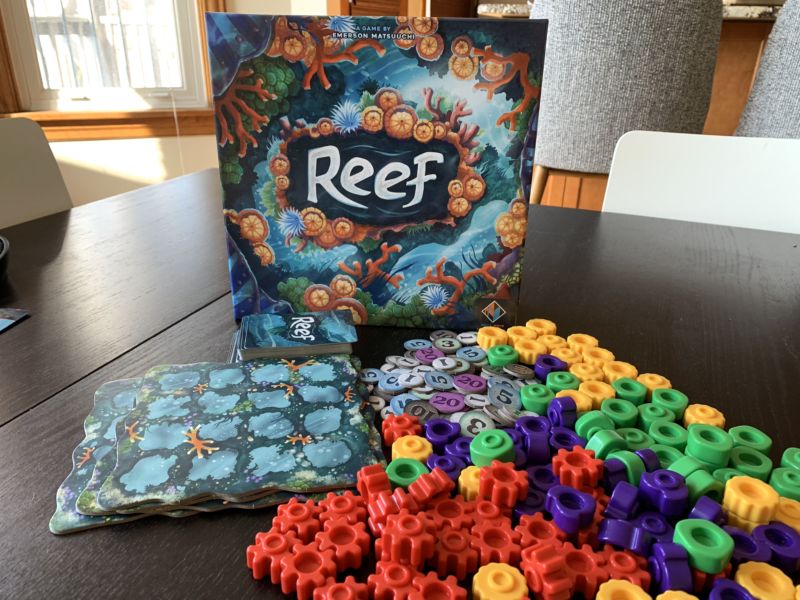
Abstract board games are all the rage—and Reef is the year’s best

Reef is a bright, inviting game with a lot of fun, colorful pieces.

Enlarge / Reef is a bright, inviting game with a lot of fun, colorful pieces. (credit: Aaron Zimmerman)

Welcome to Ars Cardboard, our weekend look at tabletop games! Check out our complete board gaming coverage at cardboard.arstechnica.com.

Abstract, family-style board games are all the rage these days, and for good reason. They tend to occupy that sweetest of sweet spots—accessible to non-gamers while remaining strategic enough to keep veteran players engaged. Their simple rulesets are packaged with quality components, bright colors, and light themes. In short, they’re games that just about anyone can enjoy.

The apotheosis of the form was arguably seen in 2014’s modern classic Splendor, an economic game about collecting satisfyingly hefty gem-styled poker chips. But last year, publisher Next Move Games introduced another contender to the throne: Azul, a puzzle-y abstract game about drafting and laying beautiful bakelite tiles. The game took the board gaming world by storm, eventually earning the prestigious Spiel Des Jahres (“Game of the Year”) award in Germany. So when Next Move announced another abstract spatial puzzle game, Reef (this time by Century: Spice Road designer Emerson Matsuuchi) we were hoping for a second lightning strike. It seems we’ve gotten one.

Read 16 remaining paragraphs | Comments

https://arstechnica.com/?p=1412465


Report: Cheaper, disc-free Xbox One option coming next year

Psht, who needs 'em?

Psht, who needs ‘em? (credit: Squirmelia)

Microsoft is planning to release a disc-free version of the Xbox One as early as next spring, according to an unsourced report from author Brad Sams of Thurrott.com (who has been reliable with early Xbox-related information in the past).

The report suggests the disc-free version of the system would not replace the existing Xbox One hardware, and it would instead represent “the lowest possible price for the Xbox One S console.” Sams says that price could come in at $199 “or lower,” a significant reduction from the system’s current $299 starting price (but not as compelling compared to $199 deals for the Xbox One and PS4 planned for Black Friday this year). Buyers will also be able to add a subscription to the Xbox Games Pass program for as little as $1, according to Sams.

For players who already have games on disc, Sams says Microsoft will offer a “disc to digital” program in association with participating publishers. Players will be able to take their discs into participating retailers (including Microsoft Stores) and trade them in for a “digital entitlement” that can be applied to their Xbox Live account.

Read 5 remaining paragraphs | Comments

https://arstechnica.com/?p=1413565


RIP William Goldman, creator of beloved film, The Princess Bride

Screenwriter William Goldman attends a special screening of <em>Butch Cassidy and the Sundance Kid</em> at Tribeca Film Festival in April 2009.

Enlarge / Screenwriter William Goldman attends a special screening of Butch Cassidy and the Sundance Kid at Tribeca Film Festival in April 2009. (credit: Joe Kohen/WireImages/Getty Images)

Legendary Hollywood screenwriter William Goldman has died at the age of 87 from colon cancer and pneumonia, The New York Times reports. Goldman won two screenwriting Oscars, for Butch Cassidy and the Sundance Kid (1969) and All the President’s Men (1976). But by far his most beloved (and most widely quoted) film across multiple generations is 1987’s postmodern fairytale, The Princess Bride.

The man once called “the world’s greatest and most famous living screenwriter” by the Guardian actually started out as a novelist, but his early novels got mixed reviews. Discouraged, Goldman agreed to adapt Daniel Keyes’ bestselling 1966 novel Flowers for Algernon into a screenplay. He was fired from the project, and even Goldman himself declared it was a “terrible” screenplay. But he learned from the experience and went on to sell his first original screenplay, Butch Cassidy and the Sundance Kid, for a record (at the time) $400,000.

The rest is Hollywood history. His other screenwriting credits include The Stepford Wives (the 1974 original, not the mediocre 2004 remake), A Bridge Too Far (1977), Chaplin (1992), and Misery (1990). Two of his screenplays are adaptations of his own novels: Marathon Man (1976) and The Princess Bride. Goldman was especially fond of the latter novel, first published in 1973. It was 15 years before Director Rob Reiner managed to bring the story to the silver screen after having long been a fan of the book.

Read 5 remaining paragraphs | Comments

https://arstechnica.com/?p=1413281


We’ve run wild on the Switch version of WarFrame—and it’s solid

Video shot and edited by John Cappello. Click here for transcript.

If you had asked us a year ago whether the Nintendo Switch would ever deliver a shooter on par with the online team-questing of Destiny, we would surely have laughed you off. A solid, connected, shooting-filled 3D game for Nintendo’s handheld? Go back to Mario Kart, dreamer.

But the past year has seen developers unlock serious power—and reasonable compromises—in impressive Switch ports. Now, one of the industry’s best Switch wranglers, Panic Button, has worked its magic on the free-to-play multiplayer shooter WarFrame, out this week on the platform.

Ahead of the launch, we had the opportunity to sit with the combined brain trust behind WarFrame on Switch—a producer at series creator Digital Extremes and the head of Panic Button’s porting team—and rap about what they made happen. We also went hands-on with the results and enjoyed the tweaked options laid out, including joystick sensitivity, button mapping, and—a rarity on the Nintendo Switch—a field-of-view slider, which first-person junkies will surely appreciate.

Read 5 remaining paragraphs | Comments

https://arstechnica.com/?p=1413073