LEGO DC Super-Villains is more of the same, and that’s just fine

Never fear, the... Justice Syndicate is here?

Enlarge / Never fear, the… Justice Syndicate is here? (credit: Traveller’s Tales)

Traveller’s Tales has been developing licensed Lego games for more than a decade now, and though the series has made some leaps and bounds, the core formula remains the same: jump into a familiar pop-culture universe, embody Lego-fied versions of your favorite characters, and play through a story that involves action-adventure gameplay and lots of scenery smashing.

Lego DC Super-Villains is comforting in its familiarity, like a favorite meal that always makes you feel better. The character creator adds a new mechanic while fitting neatly into the story, and there’s enough content to keep players occupied for dozens of hours. It’s not particularly challenging, and gameplay remains largely the same. But there’s enough heart and humor to make Lego DC Super-Villains an enjoyable adventure.

No more heroes

Unlike the previous Lego games in the DC universe, Lego DC Super-Villains puts you squarely on the side of chaos, working alongside baddies like the Joker, Scarecrow, and Harley Quinn. When a mysterious group from an alternate Earth pops up and banishes the Justice League, it’s open season for the villains of Metropolis and Gotham—at least until the so-called “Justice Syndicate” starts showing its true colors. Evil colors.

Read 10 remaining paragraphs | Comments

https://arstechnica.com/?p=1397941


Grand Theft Auto V hack exposed single-player games to malicious trolls

Grand Theft Auto V hack exposed single-player games to malicious trolls

Over the years, we’ve written a lot about the apparently easy-to-hack Grand Theft Auto Online and Rockstar’s many, many, many attempts to prevent cheaters from ruining the online experience for legitimate players. Last week, though, players reported that trolls were briefly able to mess with the single-player portion of Grand Theft Auto V through an exploit targeting players’ Rockstar Social Club accounts.

You can see an example of the single-player hacking in action in this Twitch clip, where a troll follows user SnowieLive after kicking him from an online session and continually kills his avatar in the single-player mode. “You’re not safe in single player,” the hacker says in a somewhat on-the-nose message in the clip. Similar clips from GTA speedrunner FriendlyBaron show hackers loading jets into his path and simply killing his character in mid-drive during a run.

Players that track the state of cheating tools in the Grand Theft Auto universe noted last week that one popular “mod menu” was advertising the newfound ability to discover an online player’s Rockstar ID, a hidden string of numbers associated with their Rockstar Social Club account. With that number, hackers using that tool could take control of an online user’s single-player games, with new abilities including “Rockstar admin kick, Network kick, Ragdoll, Fake money correction, Kill, Spawn vehicle, and send crew message.”

Read 2 remaining paragraphs | Comments

https://arstechnica.com/?p=1397827


Latest adaptation of Haunting of Hill House will haunt your dreams

Literature's most famous haunted house is back for the best adaptation yet.

Enlarge / Literature’s most famous haunted house is back for the best adaptation yet. (credit: Steve Dietl/Netflix)

The quintessential ghost story is back to haunt your dreams with the recent debut of The Haunting of Hill House, Netflix’s new miniseries adaptation of Shirley Jackson’s classic 1959 gothic horror novel. Frankly, it’s less an adaptation than a bold reimagining that still remains true to the rich metaphorical depths of the titular source material.

No less an authority than Stephen King cited the original Haunting of Hill House as one of the finest horror novels of the late 20th century in his nonfiction overview of the genre, Danse Macabre. His 2002 miniseries Rose Red was an homage of sorts. Jackson’s novel has already been adapted twice for the big screen: once in 1963 and again in 1999. The former film is considered a classic. The less said about the overwrought 1999 adaptation, the better, despite a stellar cast that included Liam Neeson, Catherine Zeta-Jones, Owen Wilson, and Lili Taylor.

This latest version is the best by far. Even though it veers sharply from the original storyline, there are sufficient nods to the novel throughout to keep the staunchest fan happy. The Haunting of Hill House offers up plenty of bone-chilling horror, but like all the best ghost stories, that horror is rooted in the complexities of the human psyche. At its heart, this is a story of family trauma and dysfunction, turning Jackson’s psychological subtext into text.

Read 15 remaining paragraphs | Comments

https://arstechnica.com/?p=1394305


The Guilty review: Even in 2018, a simple phone can be utterly thrilling

Ars chats up The Guilty writer/director Gustav Möller in a particularly Ars-y (and dark) karaoke room at Fantastic Fest 2018 (produced/edited by Nathan Mattise; transcript available). (video link)

AUSTIN, Texas—Browsing through written descriptions (whether in this year’s Fantastic Fest brochure or this weekend’s movie listings), The Guilty might sound remarkably unremarkable: a cop on desk duty takes a panicked 9-1-1 call and has to figure out what’s happening. It sounds like a classic high-stakes, detective-against-time story, but what makes its intriguing is that the entire film never leaves the detective’s office—the cinematic equivalent of a bottle episode.

Danish writer/director Gustav Möller has created something special with those constraints, and anyone lucky enough to find The Guilty playing nearby during its limited US theatrical release should take advantage of it. The film feels like a masterclass in minimalism in all aspects, from the way it doles out information to the performance of its lead to the so-good-you-can’t-help-but-notice-it sound design. The Guilty is a film you can’t look away from despite the visuals being its least interesting part.

Read 14 remaining paragraphs | Comments

https://arstechnica.com/?p=1397423


First thing we do, let’s kill all the experts

Timeworn headstones in Donegal Cemetery.

Enlarge / Here lies an expert (maybe). (credit: Nicolas Raymond / Flickr)

There is a Climate Science Legal Defense Fund. Take a moment to consider the implications of that fact. The inhabitants of what, under other circumstances, would be an obscure academic backwater need legal defense. Non-scientists have convinced themselves so thoroughly that these experts have to be wrong that they claim the whole field is swimming in fraud and have engaged in legal assaults to try to confirm their beliefs. The scientists need legal defense because their opponents are convinced they can provide evidence of the fraud—if only they could see every email the scientists have ever sent.

Climate scientists may suffer from an extreme example of this sort of vilification, but they’re hardly alone. The US has had a long history of mistrust in highly educated professionals, but we seem to have shifted to a situation in which expertise has become both a disqualification and a reason for attack.

That’s the central argument of Tom Nichols’ recent book, The Death of Expertise, which has recently come out in a paperback edition. Nichols is a professor at the Naval War College and an expert himself, having done graduate studies about the former Soviet Union. While he’s gained some prominence as a never-Trump conservative, the arguments in his book are evenhanded at distributing blame. And they make disturbing reading for anyone in science who’s interested in engaging the public—especially in the science arena.

Read 8 remaining paragraphs | Comments

https://arstechnica.com/?p=1394819


Review: Istanbul: The Dice Game rules the bazaar

Review: Istanbul: The Dice Game rules the bazaar

Enlarge (credit: Nate Anderson)

Welcome to Ars Cardboard, our weekend look at tabletop games! Check out our complete board gaming coverage at cardboard.arstechnica.com.

When it comes to gaming, I am a man of simple pleasures. I need no boxes of sculpted minis, no hour-long setup, no manuals the size of novels. Let me chuck huge handfuls of dice, collect colorful goods, earn chunky gems, and I am content. Wrap the whole package in elegant artwork with a clear ruleset and a low price, and I am ready to play, anytime, anywhere.

That’s why I love Istanbul: The Dice Game, the (inevitable) dice-driven implementation of 2014’s award-winning board game, Istanbul. In that earlier big-box game, players moved their “merchants” around the “bazaar” to collect and trade goods, or to gamble in the tea shop, or to spring a relative from jail and send him on an errand for you. (Don’t ask.) The goal was to collect enough shiny acrylic rubies to retire rich.

Read 14 remaining paragraphs | Comments

https://arstechnica.com/?p=1397063


Another Defender bites the dust as Netflix cancels Luke Cage

Shredded dude is baffled and angry.

Enlarge / Luke Cage (Mike Colter) will have to put another dollar in the swear jar when he hears the news. (credit: Netflix)

Just one week ago, Netflix surprised us all by canceling Iron Fist after a much-improved second season. Now we can add Luke Cage to the casualties.

Netflix unexpectedly pulled the plug on a third season today. This reduces the original Defenders to Jessica Jones, The Punisher, and Daredevil, whose third season just made its debut.

This is frankly a huge disappointment to fans of the Defenders series. Luke Cage had a strong first two seasons, with a terrific supporting cast—most notably Alfre Woodard as Mariah Dillard and Theo Rossi as her right hand, Hernan “Shades” Alvarez. While season 2 was a bit uneven, it ended with the dearly departed Mariah turning the tables on Luke, deeding him the Harlem’s Paradise nightclub. We were looking forward to seeing what kind of corrupting influence that kind of power might have had on Harlem’s hero.

Read 4 remaining paragraphs | Comments

https://arstechnica.com/?p=1397393


Call of Duty: Black Ops 4 review: War games, now with battle royale!

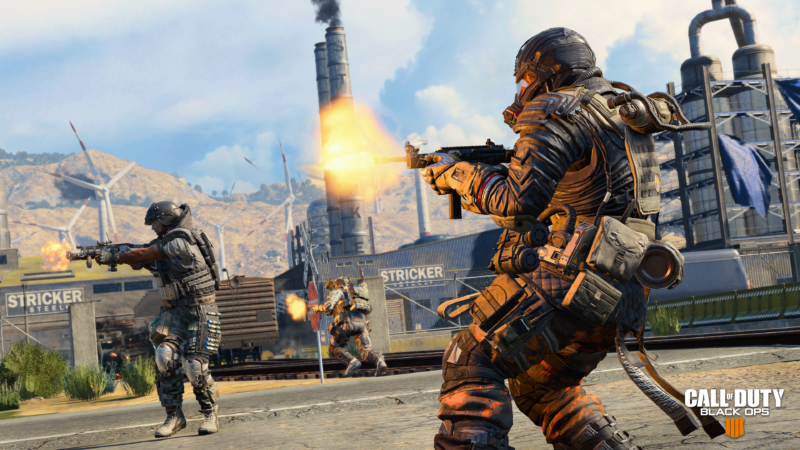
Players duking it out in the new Blackout mode.

Enlarge / Players duking it out in the new Blackout mode.

Call of Duty, like video game war simulations in general, is caught in a paradox. It never changes, and yet, every year, it definitely does change. Approaching a new Call of Duty, especially from the multiplayer side, is a bit of a challenge. How much do the various iterative changes matter, and do they manage to reshape the core of the game in any meaningful way? Call of Duty has long been a game about moving fast and shooting guns; what makes the latest version worth playing over the dozen-plus iterations prior?

To be fair, Call of Duty: Black Ops 4 changes more than most. The highly choreographed, extravagantly cinematic single-player campaign that has been de rigueur for the series’ entire lifespan has been excised. That leaves an awkward hole at the core of the experience, which developer Treyarch has filled with Blackout, an 88- to 100-player battle royale mode in the vein of Fortnite or PlayerUnknown’s Battlegrounds. The rest of the game modes—the standard-by-now multiplayer suite and the ridiculous but addictive Zombies mode—fall in line around Blackout, creating a three-tiered experience of hyper-violence and militaristic energy.

Black Ops 4 is the biggest single-game change for the Call of Duty franchise in ages. But it’s still, when it comes right down to it, just another Call of Duty.

“Where we droppin’, soldier?”

Black Ops 4 doesn’t present its content in any particular order. As a player, you can jump freely between its three modes, and nothing—except for player progression in each mode—is gated from the start. The natural place to start, though, is Blackout, the newest part of the Call of Duty package, both the most derivative and the most distinct mode on offer. Taking place on a sprawling map stitched together from locations and motifs in Call of Duty‘s multiplayer past, Blackout heavily resembles just about any other battle royale game, both in concept and execution.

Read 14 remaining paragraphs | Comments

https://arstechnica.com/?p=1396925


Players are exploiting Black Ops 4 emotes to peek around corners

In first-person view, you're staring at a wall. With the third-person emote camera, you can see what's coming around that corner.

Enlarge / In first-person view, you’re staring at a wall. With the third-person emote camera, you can see what’s coming around that corner. (credit: Twitter / GameSkinny)

The first-person perspective in shooters usually brings an inherent kind of balance to the constant battle for cover—if you peek your head out to see an opponent, they’ll be able to see you as well. Over the weekend, though, Black Ops 4 players found the game’s new gesture system had the unintended side effect of breaking this balance, letting players easily and safely see around cover from a third-person perspective.

When you perform a Fortnite-style gesture in Black Ops 4, the camera instantly zooms out to a third-person view with full, free-look control of the camera. The intent is for players to enjoy their own animations from any angle. But the new viewpoint also allows for illicit and completely protected peeking around walls and corners, as can be seen in multiple video and photo examples that have been posted online since the game’s launch.

Developer Treyarch is wasting no time in addressing player concerns over the apparently unintended unbalancing. In a statement posted to Reddit Saturday, the company wrote that it is working on an update that will remove the free-look third-person camera from the “competitive” portions of the game.

Read 1 remaining paragraphs | Comments

https://arstechnica.com/?p=1394387


Laika: Forget historic tragedy, this first space dog saves alien planets

Trailer for Laika

The story of Laika—the first pup launched into space—has been documented everywhere from Ars Technica to Arcade Fire songs. This decidedly tragic tale starts with Soviet leader Nikita Khrushchev wanting to press his country’s perceived space advantage over the United States after the USSR’s Sputnik had beaten US efforts into the heavens back in October 1957.

“We never thought that you would launch a Sputnik before the Americans,” Khrushchev told famed rocket guru Sergei Korolev, according to cosmonaut Georgy Grechko. “But you did it. Now please launch something new in space for the next anniversary of our revolution.”

That “something” would be a female dog named Laika. And Soviet space leaders had just one month to get this effort together. Picked off Moscow streets and sent into the lab then the skies, Laika’s contribution to space history would be largely symbolic. Her capsule contained a temperature-control system and some dog food, but the Soviets must’ve always viewed this as a one-way, suicide mission—no one had yet solved the problem of how to safely return a spacecraft through Earth’s atmosphere, after all. Within a couple of hours after launch, the thermal control system failed and the capsule overheated. Humanity’s first attempt to send a living creature into space ended, well, not great.

Read 24 remaining paragraphs | Comments

https://arstechnica.com/?p=1393427