The stage is set for a war between worlds in His Dark Materials S3 teaser

[embedded content]
The final rebellion begins in season 3 of His Dark Materials.

Those (like me) who have been eagerly awaiting the third and final installment of HBO’s His Dark Materials will appreciate the release of a season 3 teaser giving us our first glimpse of what’s in store. Based on the bestselling trilogy by Philip Pullman, S3 will see our heroine, Lyra (Dafne Keen), finally come to terms with her destiny, even as her father, Lord Asriel (James McAvoy), declares war on the Authority.

(Spoilers for the first two seasons below.)

As we’ve written previously, the three books in Pullman’s series are The Golden Compass (published as Northern Lights in the UK), The Subtle Knife, and The Amber Spyglass. They follow the adventures of a 12-year-old girl named Lyra, who lives in a fictional version of Oxford, England, circa the Victorian era. Everyone has a companion daemon in the form of an animal—part of their spirit that resides outside the body—and Lyra’s is named Pantalaimon. Lyra uncovers a sinister plot that sends her on a journey to find her father in hopes of foiling said plot. That journey takes her to different dimensions (the fictional world is a multiverse) and ultimately to her own coming of age.

The first season mostly covered the events of The Golden Compass, although it also included characters and events from The Subtle Knife. Most notably, S1 introduced the character of Will Parry (Amir Wilson), who doesn’t appear until the second book in the series. He befriends an on-the-run Lyra and has possession of the subtle knife, which can cut the curtain between universes.

Initial reviews were mixed, but the second season amply rewarded those who stuck with the series. “Freed from the creative burden of establishing an elaborate fictional world for viewers unfamiliar with the books, S2 was a briskly paced, yet still emotionally resonant experience,” I wrote in my S2 review. “Ruth Wilson’s fiercely feral portrayal of the complicated Mrs. Coulter remains a highlight, and the heartbreaking season finale perfectly set the stage for the final showdown.”

Will (Amir Wilson) and Lyra (Dafne Keen) face their greatest challenge yet.
Enlarge / Will (Amir Wilson) and Lyra (Dafne Keen) face their greatest challenge yet.

In the S1 finale, Lyra followed Lord Asriel across the multiverse bridge to another world, just as Will found his own way into that same world through another doorway. S2 picked up from there, covering the remaining events of The Subtle Knife, which establish Lyra’s central quest and set up the climactic showdown portrayed in The Amber Spyglass. Both strangers in a strange new world, Lyra and Will teamed up to reunite him with his own father, a quest they believed was linked to whatever destinies they are meant to fulfill. They also discovered the subtle knife (formally known as Æsahættr), which can cut through the fabric between worlds.

In the heartbreaking S2 finale, Lin-Manuel Miranda’s Lee Scoresby sacrificed himself so that Will’s father could briefly reunite with his son and instruct him to bring the subtle knife to Lord Asriel. Mrs. Coulter kidnapped Lyra, believing that her daughter is the prophesied Second Eve who will bring about the fall of man. We last saw Lyra drugged and lying in a trunk aboard a ship, heading to an unknown destination.

The late lamented Lee Scoresby (Lin-Manuel Miranda) spots a familiar face in the underworld.
Enlarge / The late lamented Lee Scoresby (Lin-Manuel Miranda) spots a familiar face in the underworld.
YouTube/HBO

McAvoy’s Lord Asriel was conspicuously absent ins S2 because of the pandemic, with a planned standalone episode scrapped. But one final scene depicted him essentially declaring war on the Authority by calling on some angels to join him in rebellion. That war—and probably some recriminating father/daughter fireworks after the events of the first two seasons—will feature prominently in S3. Per the official premise:

Based on The Amber Spyglass, the final novel in Philip Pullman’s award-winning trilogy, in the final chapter of this epic fantasy series, Lyra (Dafne Keen), the prophesied child, and Will (Amir Wilson), the bearer of The Subtle Knife, must journey to a dark place from which no one has ever returned. As her father’s great war against the Authority edges closer, they will learn that saving the worlds comes at a terrible price.

The trailer opens with a voiceover by Mrs. Coulter: “There are forces out there, Lyra, that you can’t begin to understand.” She swears she’s doing all of this for Lyra, but realizes there’s no good reason for Lyra to believe her, even though her protective actions cost her everything. “What could be more dangerous than you?” Will asks at one point. She replies, “The truth.”

Meanwhile, Asriel is “gathering the greatest from every world” for his war against the Authority—which looks like it includes a host of witches and angels. The fierce bear warrior Iorek Byrnison features prominently in the teaser. We also get a final glimpse of Lee Scoresby when Lyra visits the underworld, and some tender moments between Lyra and Will.

The eight-episode third season of His Dark Materials will premiere on HBO on December 5, 2022, with two episodes airing each week. The series finale will air on December 26, 2022.

Listing image by YouTube/HBO

https://arstechnica.com/?p=1888152
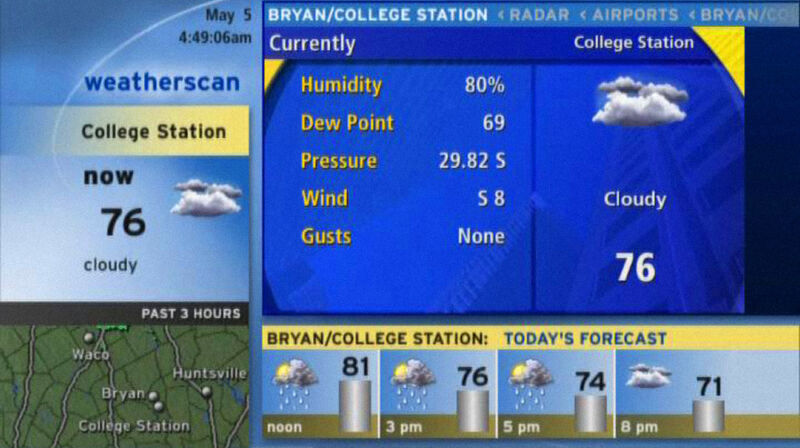


After 23 years, Weather Channel’s iconic computerized channel is shutting down

An on-air capture of Weatherscan in 2020.
Enlarge / An on-air capture of Weatherscan in 2020. Weatherscan shows 24/7 weather forecasts controlled by computer.

In the early 2000s, Americans who wanted to catch the local weather forecast at any time might turn on their TV and switch over to Weatherscan, a 24-hour computer-controlled weather forecast channel with a relaxing smooth jazz soundtrack. After 23 years, The Weather Channel announced that Weatherscan will be shutting down permanently on or before December 9. But a group of die-hard fans will not let it go quietly into the night.

Launched in 1999, Weatherscan currently appears in a dwindling number of local American cable TV and satellite markets. It shows automated local weather information on a loop, generated by an Intellistar computer system installed locally for each market. Declining viewership and the ubiquity of smartphone weather apps are the primary reasons it’s going offline.

As Weatherscan goes offline, more TV providers are displaying messages like this one.
Enlarge / As Weatherscan goes offline, more TV providers are displaying messages like this one.
Blue Ridge

There are also technical issues with maintaining the hardware behind the service. “Weatherscan has been dying a slow death over the course of the last 10 years because the hardware is aging,” says Mike Bates, a tech hobbyist who collects and restores Weather Channel computer hardware as part of a group of die-hard fans who follow insider news from the company. “It’s 20 years old now, and more and more cable companies have been pulling the service.”

Bates says that giants like Comcast and Verizon have already dropped Weatherscan, but smaller cable companies have kept it going. “Because of the small subscriber user base for the technology, I am assuming the Weather Channel just quit porting [the Weatherscan system] forward to newer hardware,” says Bates. “So they just kind of let it run until eventually we are nearing the death. There’s probably 60 or 70 Weatherscan [units] still in operation out there. I don’t know the exact number.”

Over the years, Weatherscan developed a cult following due to the way the service mixes computers with weather, along with a measure of nostalgia for the smooth jazz music that plays continuously over the forecasts. Hobbyists like Bates (who goes by “techknight” on Twitter) have collected the hardware necessary to run their own Weatherscan stations out of their homes. Some have also created software that simulates the service in a browser.

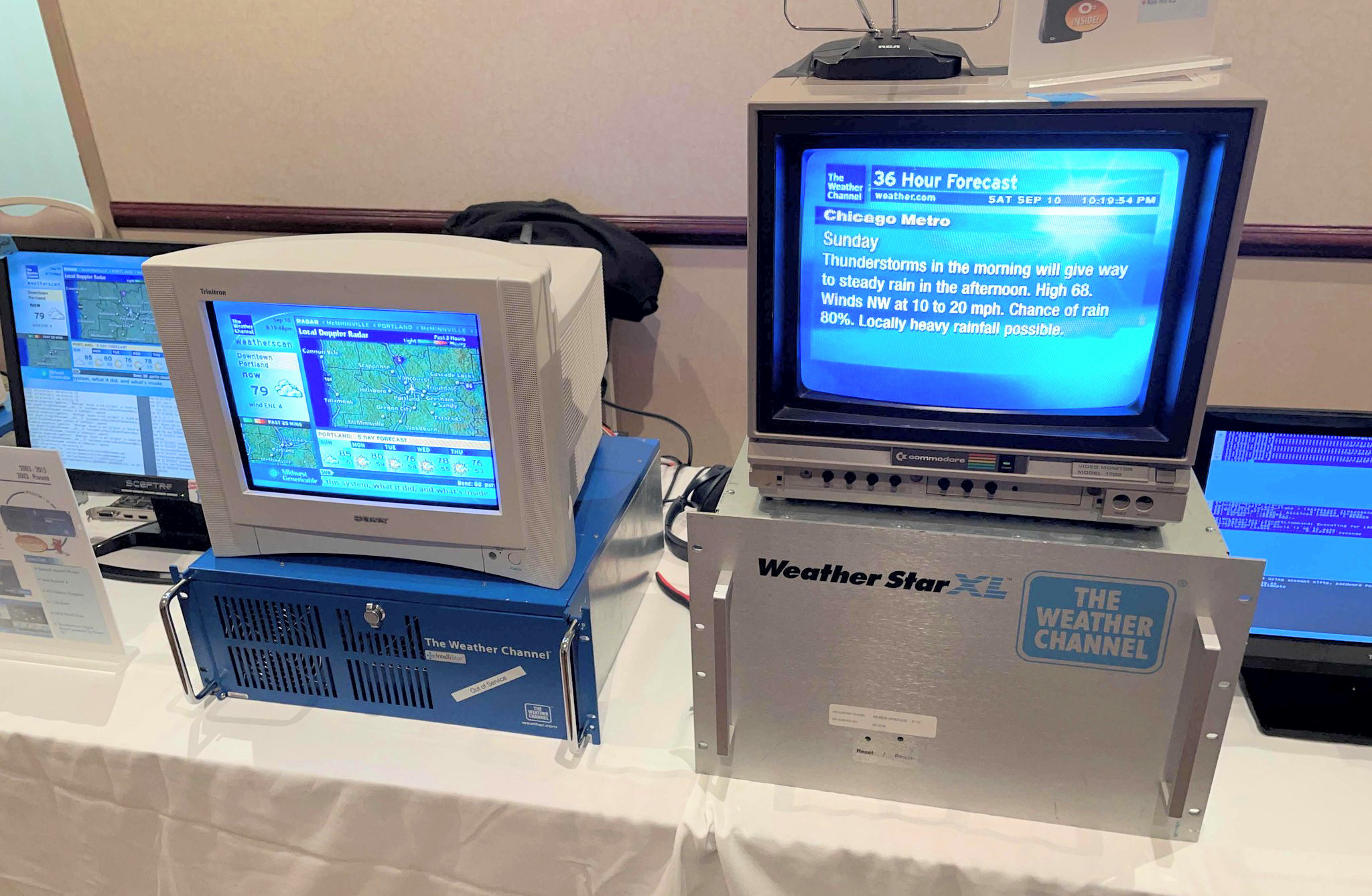
Mike Bates displayed an Intellistar computer running Weatherscan (blue unit, left) and a Weather Star XL (right) at VCF Midwest this year, along with other hardware and TV station simulations.
Enlarge / Mike Bates displayed an Intellistar computer running Weatherscan (blue unit, left) and a Weather Star XL (right) at VCF Midwest this year, along with other hardware and TV station simulations.

The Weather Channel amassed a large fan following over the decades, and that community maintains a wiki filled with intricate details about beloved on-air talent, discontinued programs, and the back-end tech that pulls it all together. It’s that deep lore that inspires hobbyists like Bates to try to preserve the equipment. “At the end of the day, we are not only preserving the hardware and software that we are nostalgic for, but also that which made The Weather Channel what it once was.”

Recently, during the pandemic, Bates reverse-engineered an earlier Weather Channel computer called the Weather Star 4000. During the 1990s, it provided on-screen computer forecasts until just before Weatherscan launched in 1999, although some units still hung on as late as 2014. The Weather Star software inspired its own wave of nostalgia, including simulators that mimic its distinct retro look.

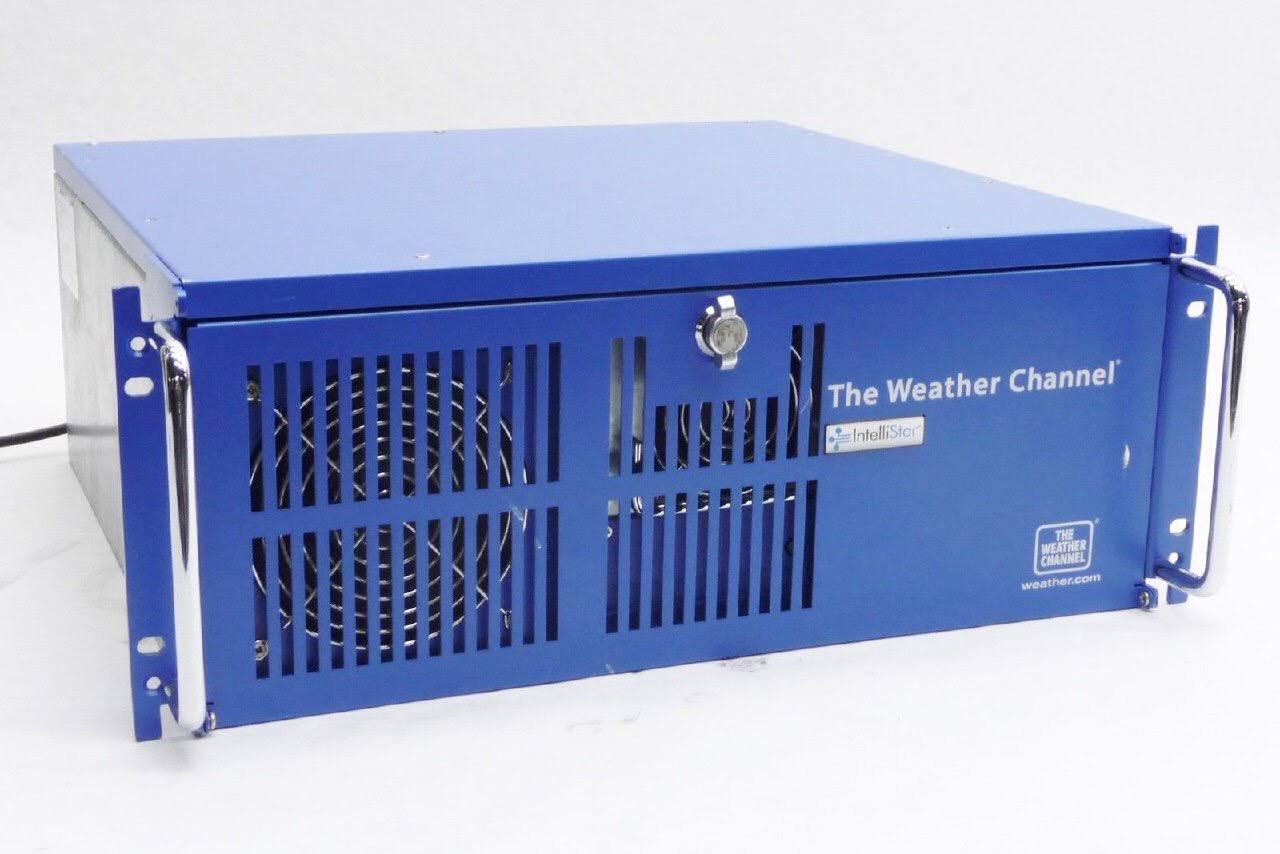
An Intellistar computer system that can run the Weatherscan TV service.
Enlarge / An Intellistar computer system that can run the Weatherscan TV service.
Mike Bates

However, getting Weatherscan to run locally was a team effort, primarily by friends named Ethan, Brian, and Jesse. One of the Intellistar computer models behind the service runs FreeBSD on a Pentium 4-based PC in a blue rack-mount enclosure. It includes an ATI card for generating the graphics and a proprietary PowerPC-based card that pulls it all together to make it broadcast-ready.

To get Weatherscan working at home, the group of friends found decommissioned Intellistar units on eBay and used forensic tools to reconstruct data from the hard drives, piecing together a working version of the Weatherscan software from multiple sources. Since then, they have exhibited their work at shows like the Vintage Computer Festival Midwest last month.

[embedded content]
A video by Mike Bates featuring restoration of an Intellistar computer system.

The announcement of Weatherscan’s impending demise came in a letter to the National Content & Technology Cooperative (NCTC) in mid-September. A few alternative TV weather services remain, such as AccuWeather National and WeatherNation, but none will have that smooth jazz charm. Even so, the soul of Weatherscan will still live on thanks to fans like Bates.

“It’s an iconic thing that was kind of long forgotten about except for enthusiasts,” says Bates. “But the way we consume content has changed drastically. It’s the end of an era.”

https://arstechnica.com/?p=1884131


Why Chris Pratt’s performance in the Mario movie trailer is so distracting

[embedded content]
The world’s introduction to Chris Pratt’s Mario.

When my 8-year-old daughter got home from school on Thursday, I was excited to show her the first trailer for the upcoming animated The Super Mario Bros. Movie. And while she would later express excitement at the sight of Bowser battling an army of penguins or Mario being confused about a field of giant mushrooms, her immediate reaction after watching the trailer was more negative:

“Mario’s voice sounds weird.”

This is not an uncommon reaction to the first public line-reading for the Chris Pratt-voiced Mario, judging by the overall tone of social media in the last 24 hours. It’s a reaction that seems to extend past the Internet snark zone, too; at least two parents I know in real life have told me that their kids expressed similar confusion about Mario’s movie voice.

But putting our collective finger on what exactly is “weird” about Pratt’s Mario performance requires a bit of examination into how the idea of what Mario is “supposed” to sound like developed in the first place, and whether Pratt’s performance can ruin what otherwise looks like a pretty solid movie.

Let the judging begin

To be fair, the only examples of Mario’s movie voice we have thus far are the two lines Pratt delivers in the trailer. Judging Pratt’s entire Mario performance on that basis is like judging an opera based on the first note.

That said, the sheer Pratt-iness of Mario’s first line in the trailer—”What is this place?”—is utterly distracting. As Ars’ Sam Machkovech put it yesterday, the line delivery “comes without any sort of exaggerated Italian accent, instead sounding like rote Chris Pratt.”

That delivery is more than a little ironic given that, back in June, Pratt told Variety that Mario’s voice in the movie would be “updated and unlike anything you’ve heard in the Mario World.” We suppose that’s technically true because we haven’t previously heard someone who sounds exactly like Chris Pratt in the “Mario World.” But still.

Jack Black's Bowser sounds just like you'd expect a monster that looks like this to sound.
Enlarge / Jack Black’s Bowser sounds just like you’d expect a monster that looks like this to sound.

Pratt’s second line in the trailer—”Mushroom Kingdom, here we come.”—adds the subtlest hint of an additional Brooklyn-style inflection (“Heeeeah we cahm…”). It’s a line reading that has inspired countless social media comparisons to Linda Belcher from Bob’s Burgers, which is both fair and impossible to unhear. Even here, though, the voice sounds like Chris Pratt doing a vaguely New York-area accent, rather than an actor truly inhabiting a unique character.

Wah, whoo, wa-hoooo!

The difference is apparent when you compare Pratt’s performance to that of Jack Black as Bowser in the same trailer. Every line Black delivers rumbles with undertones of a guttural roar that feels entirely appropriate for the character. Beyond the trailer, you can see and hear the joy Black puts into this performance in a New York Comic-Con appearance Thursday.

Black has a bit of an advantage here, though, because Bowser’s voice isn’t that well defined in the public consciousness. Aside from some now-ancient Saturday morning cartoons, Bowser is very rarely heard delivering vocalized dialogue either in Mario games or supporting media.

Mario’s voice, on the other hand, has been defined for decades by Charles Martinet and his bubbly, enthusiastic, exaggerated faux-Italian accent. Even young children can pick up on this characterization: After calling Chris Pratt’s take on Mario “weird,” my daughter proceeded to do her best imitation of what Mario is supposed to sound like in the form of a 30-second montage of Martinet-inflected “Woohoos” and “It’s-a-me’s.”

[embedded content]
Martinet’s performance in 1996’s Super Mario 64 helped cement the way Mario is “supposed” to sound for generations of gamers.

Despite this, I’m not sure that Martinet would be the best choice to voice Mario for an entire movie (or that Pratt should just do a direct Martinet impression). Martinet’s Mario voice is tuned for maximum impact during the kind of short, high-energy sound bites that get repeated hundreds of times during a game. That’s great for accentuating individual player actions or important moments, but that over-the-top style might grate over the course of a movie full of extended monologue and dialogue from the famous plumber.

To get some idea of how this might be a problem, start with this video of Martinet ad-libbing as Wario at E3 1996. Now watch that video on loop for two hours.

While Martinet might be able to moderate his delivery for a new medium, I’m not sure it’s necessarily the best idea for him to try. At the same time, though, Martinet’s take on Mario has established itself deeply enough in the public consciousness that any new take on the role is going to bump up against it.

https://arstechnica.com/?p=1888112


No Man’s Sky adds tons of quality-of-life improvements alongside Switch launch

Today was a red-letter day for space exploration and crafting game No Man’s Sky. The game released on Nintendo Switch, first of all, but that release was accompanied by a major overhaul to many of the game’s menus and systems. Developer Hello Games has dubbed it “No Man’s Sky 4.0,” or the “Waypoint” update.

Since its launch in 2016, No Man’s Sky has been through numerous changes and iterations, to the point that today’s Minecraft– or Valheim-esque experience barely resembles the ambient, aimless exploration of the original release. Today’s update isn’t as major as the one that turned an exploration game into a crafting one, but it’s probably the runner-up, in that it offers a sweeping array of quality-of-life improvements.

Many of these are related to either the game’s inventory system or its difficulty levels. Neither of these things is necessarily as flashy as new features like space whales, horror-like abandoned cruiser expeditions, trainable alien animals, or pilotable mechs, all of which (and more) were added in one update or another since launch. But anyone who has played No Man’s Sky at any point will know that the game can be a little rough around the edges in those two areas, so sweeping changes there may be welcome.

The game offers several difficulty modes, which you can now change on the fly during play. Further, you can granularly adjust individual elements of the difficulty to suit the game to your playstyle. Don’t like combat very much? Turn all the combat difficulty stuff down. Prefer a challenging interstellar economy to navigate? Leave that turned up. There’s also an entirely new game mode called Relaxed mode, which Hello Games says cuts significantly down on the grinding and information overload while keeping all the game’s systems intact.

Speaking of information overload, there’s a new menu that can greet returning players to remind them of key information relevant to where they are in the game, including progress on a variety of tasks. The goal here is to make the game a bit less overwhelming, especially if you’re returning after some time away. And inventory improvements abound, with more stackable items, more ways to sort the inventory, streamlined inventory UI, and much more.

There are a bunch of other changes, too, like improved visual effects for various space-y stuff in the game, crafting menu improvements, new survival challenges, accessibility options, a robust story logs view, and AMD FidelityFX 2.0 support.

All these changes rolled out alongside the game’s launch on the Nintendo Switch today, but they aren’t limited to the Switch by any means. Most of the features are available on all platforms.

Listing image by Hello Games

https://arstechnica.com/?p=1888155


In sudden reversal, Valve will let a cult classic visual novel onto Steam

Well? Is it the sensual world, the despotic society, or the destructive sanctions? Inquiring minds want to know!
Enlarge / Well? Is it the sensual world, the despotic society, or the destructive sanctions? Inquiring minds want to know!


Last week, publisher Spike Chunsoft regretfully informed customers that Valve-mandated game changes meant the first official English translation of Chaos;Head Noah would not be launching on Steam as planned. Now, the company says the visual novel will be coming to Steam later today, thanks to a change of heart from Valve’s content review team.

In a statement, the publisher said it was told that Steam’s content review team had “re-examined” the game and will now allow it to launch on Steam “as is.” That’s a major reversal from last week, when Spike Chunsoft cited “Steam’s guideline-required changes to the game’s content” that “would not allow the game to be released to [the publisher’s] standards.” It also brings Valve more in line with Nintendo, which was already allowing the ESRB M-rated game to launch on the Switch without any apparent issues.

“We believe this decision is the result of the unwavering support from fans of the Science Adventure Series as well as all of the players who are eagerly awaiting the release of this title,” Spike Chunsoft said in its statement. “Your voices have been heard. We sincerely appreciate your commitment. We look forward to your continued support of Spike Chunsoft and the Science Adventure Series.”

“I think [Valve] sensed the heat rising and doubled back before it became bad optics across more websites,” PQube Games Head of Localization Andrew Hodgson told Ars Technica of the rapid reversal.

A new, more permissive Valve?

Intriguingly, Spike Chunsoft also suggested that Valve’s more permissive policy on certain risqué games may extend beyond Chaos;Head Noah. “We’ve also examined the process that led to the previous decision about Chaos;Head Noah and made some changes to avoid situations like this in the future,” Valve said in a statement sent to Spike Chunsoft (as reported by the publisher).

<a href="https://rassegna.lbit-solution.it/wp-content/uploads/2022/10/in-sudden-reversal-valve-will-let-a-cult-classic-visual-novel-onto-steam-2.png" class="enlarge" data-height="619" data-width="1100" alt="Is that a schoolgirl outfit?! That’s it, shut it down!“><img alt="Is that a schoolgirl outfit?! That’s it, shut it down!” src=”https://rassegna.lbit-solution.it/wp-content/uploads/2022/10/in-sudden-reversal-valve-will-let-a-cult-classic-visual-novel-onto-steam-1.png” width=”640″ height=”360″ srcset=”https://rassegna.lbit-solution.it/wp-content/uploads/2022/10/in-sudden-reversal-valve-will-let-a-cult-classic-visual-novel-onto-steam-2.png 2x”>
Enlarge / Is that a schoolgirl outfit?! That’s it, shut it down!

It has been over four years since Valve established its “allow everything onto Steam” policy, with exceptions for “things that we decide are illegal or straight-up trolling.” Since then, though, many in the visual novel community have noticed an inconsistent pattern in which Valve bars many (but not all) anime-styled games featuring characters in school uniforms. That has held true even for “games that aren’t even remotely salacious,” according to Hodgson, a description he said includes Chaos;Head Noah.

Valve hasn’t publicly clarified its stance on what specific content is and is not allowed in these kinds of games and hasn’t responded to multiple requests for comment from Ars on the matter. But Hodgson told Ars he sees this kind of promised change as “effectively an admission of wrongdoing within the process itself.”

For the moment, though, Hodgson said he’s unsure “whether or not that’s just a blanket statement to get people off their backs rather than something that actually means anything.” The proof, he said, will be whether “another visual novel with similar criteria to those that have previously been banned” is submitted to Valve and approved for sale on Steam. “Alternatively, developers who had previously been rejected may choose to try their luck again,” Hodgson added.

Listing image by Nintendo

https://arstechnica.com/?p=1888007


What happened to the virtual reality gaming revolution?

What happened to the virtual reality gaming revolution?
Aurich Lawson / Getty Images

Six years ago, consumer virtual reality seemed set to be the next major tech breakthrough.

With the demonstration of his impressive prototype Oculus Rift head-mounted display (HMD) in 2012, Palmer Luckey managed to instantly erase the poor image VR had garnered from ‘90s movies like The Lawnmower Man and woefully premature commercial curios like Nintendo’s Virtual Boy. This led the Kickstarter campaign for the first Oculus developer kit to balloon past its $250,000 funding goal on the way to a final haul of $2.4 million. Two years later, Oculus accepted a $2 billion buyout offer from Facebook.

The lead-up to the 2016 launch of the first consumer version of the Oculus Rift (the CV1) only raised consumer VR’s profile further. Analyst predictions were bullish, going so far as to say that the VR market would be worth $150 billion in just five years. Oculus’ co-founders were breathlessly profiled in glossy magazines, with Luckey landing on the cover of Time in August 2015. Google even partnered with Disney to give away its low-tech paper Cardboard sleeves, enticing fans of Star Wars and other mega properties with themed mobile experiences. Decades removed from the hangover of failed VR arcades and gimmicky consumer trinkets, things would be different this time.

Double Fine’s Tim Schafer put it best at DICE 2016. “We all wanted Snow Crash to happen, and then we put on the things, and it was just Pterodactyl Terror, and we all threw up,” he told Ars, possibly (jokingly) misnaming Virtuality’s less-than-stellar VR arcade experiment Dactyl Nightmare. “I think there’s been a huge leap [this time].”

Six years later, VR has yet to reach the stratospheric heights its cyberpunk fantasy promised. But the latest wave hasn’t been another high-profile failure, either. Meta’s Quest 2 headset has helped significantly revitalize consumer interest in the sector with its user-friendly experience and relatively low price (though it’s not as low as it once was), with its Oculus Store supporting a handful of bona fide VR-native hit games.

This all goes a long way toward explaining how, given the ups and downs of iteration and experimentation that followed Rift’s consumer release, VR developers and watchers told Ars they’re still excited about virtual reality—and they’re thrilled to see where the technology is heading next. And while the initial enthusiasm about its global impact has been tempered a bit since 2016, most in the space now say it doesn’t need to have a profound impact to be a success.

Hype meets reality

The Rift CV1.
Enlarge / The Rift CV1.

When the Rift CV1 was released, evangelists proclaimed that VR wasn’t just going to revolutionize games—it would change the world. (Goldman Sachs said in 2016 that mass adoption of VR hardware alone would overpower the $99 billion TV market by 2025, and it was hardly the only company making such lofty claims.)

But an instant revolution was never in the cards, as Road to VR executive editor Ben Lang told Ars. “The expectation among the nascent industry was that it was going to be this crazy takeoff,” Lang said. “But as happens with very new technology, until you can go from pure hype—like, ‘this is going to change everything,’—to really finding specific useful cases, it never becomes this instant, overnight thing.”

Back in 2016, it seemed that every major tech company was eager to carve out its piece of the VR pie. Rift and HTC’s Vive were available for PC early that year, while Sony’s PSVR would be out in October for PS4. On the mobile side, Google improved on its Cardboard product with its mobile-powered Daydream to counter Samsung’s Gear VR.

https://arstechnica.com/?p=1885995


Overwatch 2 launch marred by multiple DDoS attacks

Artist's conception of Blizzard fighting off DDoS attackers.
Enlarge / Artist’s conception of Blizzard fighting off DDoS attackers.


When a highly anticipated online game launches, unforeseen server capacity issues and long entry queues are nothing out of the ordinary. In the case of this week’s Overwatch 2 early access launch, though, the usual crowding problems are apparently being exacerbated by coordinated distributed denial of service attacks.

On Tuesday evening, Blizzard President Mike Ybarra issued a generic tweet warning that “Teams are working hard on server issues with Overwatch 2.” Less than an hour later, though, he followed up with some more worrying specifics. “Unfortunately we are experiencing a mass DDoS attack on our servers,” he said. “Teams are working hard to mitigate/manage. This is causing a lot of drop/connection issues.”

Overnight, Overwatch 2 Game Director Aaron Keller posted an update saying that “we’re steadily making progress on server issues and stability, as well as working through a second DDoS attack. We’re all hands on deck and will continue to work throughout the night. Thank you for your patience—we’ll share more info as it becomes available.”

On top of any DDoS-related problems, Blizzard is also acknowledging that “some players are experiencing server disconnects” and “some players who merged their PC and console accounts are seeing an ‘Unexpected Server Error'” in the game’s early hours.

Potential players across the Internet are posting reports of hours-long wait times to get in a game and server queues with tens of thousands of people. The situation is unsurprisingly leading to plenty of jokes and memes as well. Former Gears of War and Jazz Jackrabbit developer Cliff Bleszinski got in on the act, tweeting that “Unexpected Server Error Occurred” can apparently serve as the game’s subtitle.

“Yes, this is petty, as that game steamrolled over mine,” Bleszinski added, referring to the failure of 2017’s Lawbreakers. “And I know how hard it is to launch an online game, but, still… I giggled.”

Overwatch 2 was first announced at Blizzcon back in 2019. Last year, Activision Blizzard CEO Bobby Kotick said the game would not hit a planned 2022 release amid “increased competition… and higher voluntary turnover” among employees. At the time, though, Blizzard suggested that it is “still planning to deliver a substantial amount of content… next year.”

Amid two successful Overwatch 2 beta tests earlier this year, the game was taken up by the esports Overwatch League for high-level competitive play. Blizzard announced the game’s October 4 early access launch in June.

https://arstechnica.com/?p=1887064


Intel A770, A750 review: We are this close to recommending these GPUs

We took our handsome pair of new Arc A700-series GPUs out for some glamour shots. While minding standard static-related protocols, of course.
Enlarge / We took our handsome pair of new Arc A700-series GPUs out for some glamour shots. While minding standard static-related protocols, of course.
Sam Machkovech

What’s it like owning a brand-new Intel Arc A700-series graphics card? Is it the show-stopping clapback against Nvidia that wallet-pinched PC gamers have been dreaming of? Is it an absolute mess of unoptimized hardware and software? Does it play video games?

That last question is easy to answer: yes, and pretty well. Intel now has a series of GPUs entering the PC gaming market just in time for a few major industry trends to play out: some easing in the supply chain, some crashes in cryptocurrency markets, and more GPUs being sold near their originally announced MSRPs. If those factors continue to move in consumer-friendly directions, it will mean that people might actually get to buy and enjoy the best parts of Intel’s new A700-series graphics cards. (Sadly, limited stock remains a concern in modern GPU reviews. Without firm answers from Intel on how many units it’s making, we’re left wondering what kind of Arc GPU sell-outs to expect until further notice.)

While this is a fantastic first-generation stab at an established market, it’s still a first-generation stab. In great news, Intel is taking the GPU market seriously with how its Arc A770 (starting at $329) and Arc A750 (starting at $289) cards are architected. The best results are trained on modern and future rendering APIs, and in those gaming scenarios, their power and performance exceed their price points.

Yet our time with both Arc-branded GPUs has been like picking through a box of unlabeled chocolates. While none of our testing results were necessarily revolting, a significant percentage tasted funny enough to make a general recommendation pretty tricky.

Table of Contents

Warning: Intel buyers will want (if not need) a ReBAR-compatible PC

There’s a lot to get into with Intel’s latest major entry into the GPU market, and it’s important to start by addressing a considerable barrier to entry for potential customers.

Intel strongly urges buyers of its new Arc graphics card line to triple-check their computer’s support for a pair of relatively recent features: Resizable BAR (“ReBAR”) and/or Smart Access Memory. We say “and/or” because they’re branded versions of the same technology. The shortest explanation is that a ReBAR-compatible motherboard can send much larger chunks of data to and from the graphics card on a regular basis, and Intel would really like you to turn the feature on if possible.

Will the Arc A750 and Arc A770 graphics cards work without Resizable BAR enabled? Yes, but we don’t recommend it. Intel’s Arc architecture leans heavily into ReBAR’s wide-open pipeline to your GPU’s frame buffer—so much so that it doesn’t have a fallback when a game’s workload includes constant streaming of assets like textures. The best example I found was in driving along Cyberpunk 2077‘s sprawling highways at high speeds. With ReBAR enabled on my AMD Ryzen 7 5800X system, I could expect smooth-enough driving at 1440p with “high” settings enabled and ray tracing disabled. (This test’s “1 percent low” frame rate count, indicating the worst persistent dips, measured above 30 fps, which is pretty good.)

I then rebooted, disabled ReBAR on the BIOS level, and played the same Cyberpunk segment again. The result was nigh unplayable, thanks to constant multi-second pauses and chugs. To give this scenario a fair shake, I immediately reloaded the save file in question and tried again in case this was a matter of one-time shader compilation causing the stutters. The bad numbers persisted between the tests.

Should your favorite games revolve around tight corridors or slower runs through last-gen 3D environments, the Arc GPU difference between ReBAR enabled and disabled can range from a margin-of-error sliver to a 10–15 percent dip. But even if you can stomach those issues, you might run into significant quirks outside of gaming. In my case, Google Chrome and Microsoft Edge would both routinely glitch with ReBAR disabled while videos played in any tab. The whole browser window would turn into jibberish while the rest of the OS environment remained intact. It looked like this:

When I left ReBAR disabled on my Intel Arc A700 series testing rig, my web browser would glitch out for 2–3 seconds at a time (in a way that I couldn't capture using a Windows shortcut key combination) while the rest of the OS environment looked normal. Once I enabled ReBAR, this glitch never appeared again.
Enlarge / When I left ReBAR disabled on my Intel Arc A700 series testing rig, my web browser would glitch out for 2–3 seconds at a time (in a way that I couldn’t capture using a Windows shortcut key combination) while the rest of the OS environment looked normal. Once I enabled ReBAR, this glitch never appeared again.
Sam Machkovech

The only fix for this error was to enable ReBAR. If you don’t have a relatively recent CPU-and-motherboard combo that supports either ReBAR or Smart Access Memory—basically, Intel’s 10-series and up or AMD’s Ryzen 3000-series and up—the rest of this review may be moot for you.

That’s an unfortunate brick wall for a PC gaming market dominated by budget-priced CPUs and GPUs.

https://arstechnica.com/?p=1886768


New PS5 exploit unlocks root privileges, read/write memory access

Hackers are getting closer to fully unlocking user control of the PS5 hardware.
Enlarge / Hackers are getting closer to fully unlocking user control of the PS5 hardware.

Long-time console hacker and exploit developer SpecterDev has released a PS5 exploit that can give users root privileges and read/write access to large chunks of system memory. While this exploit can’t be used to actually execute arbitrary code just yet, it represents an important step toward getting homebrew code running on the console.

The exploit, released this weekend, makes use of a FreeBSD vulnerability in the system OS that was reported to PlayStation’s HackerOne bounty program in January (a very similar vulnerability on the PS4 was reported to PlayStation in 2020). Making use of the exploit relies on setting up a fake DNS server on your local network such that accessing the PS5’s on-screen manual (which is loaded via the system’s hidden web browser) points instead to a page on your local PC.

From there, the exploit uses an error in how the PS5’s browser implementation handles memory locking while setting IPv6 socket headers. While the details get pretty technical, the exploit essentially sets up a race condition to access that exposed socket header memory before it’s fully locked. That small bit of access is then used as a hook to start reading and writing arbitrary data into large areas of the PS5’s memory via an RPC server on the host machine.

Limitations

Because this exploit relies on a race condition, SpecterDev warns that it only works about 30 percent of the time and might lead to multiple kernel panics (and subsequent lengthy system restarts) before read/write access is successfully obtained. The exploit also can’t currently write to low-level “kernel space” (which is still protected by an intact hypervisor) or even execute any code that a user might write to user space (which relies on areas of “Execute Only Memory” that are still protected).

Still, the exploit provides access to the PS5’s debug menu, as hacker Lance McDonald demonstrated in a tweet last night. It also provides PS5 hackers with an entry point to learn more about the PS5’s memory and security systems and could serve as a potential beachhead for developing a fully homebrew-compatible hack for the console. That said, SpecterDev warns that “homebrew will take a lot of effort” because of the aforementioned security protections that are still intact.

While this exploit currently works on version 4.3 of the PS5 firmware (released last October), SpecterDev speculates that some slight changes could get a similar exploit to work on firmware version 4.5 (released last December). Sony marked the issue as “resolved” on HackerOne in April, though, suggesting that the same vulnerability probably won’t work in firmware versions released since then.

That makes SpecterDev’s entry point different from a distinct, “essentially unpatchable” PS5 exploit revealed by hacker CTurt earlier this month. That method made use of a separate issue with the PS5’s “just-in-time” compilation of emulated PS2-on-PS4 games to gain a hook into the console’s “user space” memory to write and run homebrew code.

While the days of regular PS5 owners being able to install their own homebrew apps on the PS5 may still be a ways off, the hacking community won’t rest until that time arrives.

https://arstechnica.com/?p=1886381


Nintendoes what Valve don’t: Game barred from Steam will launch on Switch

Nothing weird going on here. No siree.
Enlarge / Nothing weird going on here. No siree.

Japanese publisher Spike Chunsoft announced that the first official English translation of visual novel Chaos;Head Noah won’t be coming to Steam as planned “due to Steam’s guideline-required changes to the game’s content.” But while the game is apparently too risqué for Steam, the family-friendly folks at Nintendo apparently have no problem with a Switch version that Spike Chunsoft says will still launch in the US on October 7 as scheduled.

“Spike Chunsoft, Inc. believes these [Steam guideline-required] changes would not allow the game to be released to its standards,” the publisher said in its announcement. “The company is looking into delivering the title through alternative storefronts, and when details are decided will make another formal announcement. Until then your patience and understanding is appreciated.”

Nintendo says this scene is appropriate for its store page, so we figure you readers can handle it.
Enlarge / Nintendo says this scene is appropriate for its store page, so we figure you readers can handle it.

Chaos;Head Noah was initially listed for Steam pre-sale in April, but that page was taken down in August, according to tracking site SteamDB. At the time, that led to some concerns about the eventual fate of the Steam version, which Spike Chunsoft finally confirmed today.

Valve’s apparent push for content restrictions comes even though the extremely similar thematic sequel Chaos;Child has been available in English on Steam since 2019 (following its initial 2014 release in Japan on the Xbox One). The English PS4 version of Chaos;Child received an M for Mature rating from the ESRB, which described game scenes of strangling, torture, and “exposed brains” alongside sexual content like “two female characters moaning off screen while discussing each other’s breasts.”

How bad is it?

Chaos;Head Noah is an enhanced port of Chaos;Head, the game that launched the cult-classic Science Adventure series of visual novels (which also includes Steins;Gate and its sequels). The game follows a series of murders and suicides in Tokyo’s Shibuya neighborhood and allows players to change the story progression by indulging in various positive or negative “delusions.” Some of those delusions can reportedly get extremely gory and/or suggest (but not directly show) imminent sexual violence.

“I don’t think it gets much worse than anything already in Steam’s library,” PQube Games Head of Localization Andrew Hodgson (who worked on the English translation of Steins;Gate) told Ars Technica of the “titillating and violent content” in the game. “It’s far from adult, even if it can be quite gruesome in certain scenes.”

Just your average, everyday game on a Nintendo console.
Enlarge / Just your average, everyday game on a Nintendo console.

The original Chaos;Head was originally released for Japanese PCs in 2008 before the enhanced Noah hit the Xbox 360 in 2009. That console port (and a later Vita re-release) received CERO Z content ratings in Japan, which “assumes that the game should not be sold or distributed to those younger than 18 years old” and is roughly equivalent to an ESRB “AO for Adults Only” rating in the US. CERO’s “content icon” system for that game only included a warning about “crime,” however, and not violence or sexual content.

Subsequent Japanese ports of Chaos;Head Noah for the PS3, PSP, Android, and iOS were heavily edited to remove some of the more extreme images and descriptions of violence. In turn, those ports received a lower CERO D rating (roughly equivalent to the ESRB’s “M for Mature” rating) in Japan. A source in the visual novel translation community (who asked to remain anonymous) confirmed that both the Switch and proposed Steam English-language versions of the game were based on this edited-down script.

A Japanese Chaos;Head port for the Nintendo Switch, released earlier this year, received the higher CERO Z rating (and “crime” content icon) despite using the edited version of the game that previously received a CERO D rating. The English translation will launch on Switch in the US next month, with an “M for Mature” rating and content descriptors that warn of “Blood and Gore, Sexual Themes, Language, [and] Intense Violence.”

https://arstechnica.com/?p=1886112