Searching: You’ve never seen Windows XP and load screens like this

Ars chats up the team behind Searching. Click here for transcript. (video link)

Searching may seem like a pass on paper: yet another thriller that plays out on computer screens. From Unfriended to Modern Family, viewers have seen this schtick before. To potentially complicate matters further, this one comes from a brand-new director.

But Aneesh Chaganty is not new to telling stories through screens—the Searching director and co-writer spent two years making ads at Google. He famously landed the role after making a viral short called “Seeds” that leveraged Google Glass, another creative constraint. “I quit my job at Google in NYC and moved to LA to make an indie movie,” he tells Ars about Searching. “But I was a filmmaker at Google; I was writing, developing, and directing commercials there. And a lot of my job was to take technology and give it a larger emotional narrative that people understand.”

Read 14 remaining paragraphs | Comments

https://arstechnica.com/?p=1361769


Examining why Switch games cost more than their PC counterparts

After initially struggling to attract wider support from third-party developers, the Switch library is now absolutely filled with ports of big-budget and indie games available on other platforms. However, some Switch players have started to notice that those ports often come at a pricing premium when purchased on Nintendo’s console.

The folks over at Switch blog Switcher decided to quantify how much that “Switch tax” costs while building their own database of Switch games. Their analysis found that, of 471 games being sold on both Steam and Switch, the downloadable Switch versions cost just over 10 percent more on average.

That average obscures a wide range of price discrepancies, of course, including some that end up in the Switch’s favor. In fact, a majority of titles listed on both platforms (55.8 percent) sell for the exact same price on both, and an additional 8.9 percent are cheaper on Nintendo’s eShop.

Read 6 remaining paragraphs | Comments

https://arstechnica.com/?p=1363927


GoldenEye 007 gets quite the 21st-birthday present: An oral history

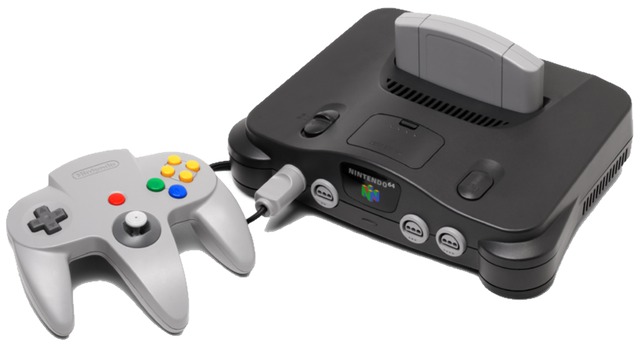
The Nintendo 64, known before launch as the “Ultra 64.” (credit: Wikimedia Commons)

Many monumental video games have reached their 20th, 30th, and even 40th anniversaries at this point, and fans can be forgiven for missing a milestone or two. But in the case of GoldenEye 007‘s 21st birthday, the N64 classic received quite the treat this week: an oral history starring a few of the game’s original developers.

This feature comes from an unexpected source: MEL Magazine, an online-only outlet operated by Dollar Shave Club with only one other gaming oral history under its belt. But MEL picked up where 2015’s Rare Replay dropped off. That Microsoft-published collection of classic Rare games, complete with detail-loaded mini-documentaries, had to skip GoldenEye for licensing reasons.

MEL’s feature sums up quite a few details that have appeared in various behind-the-scenes stories over the years, though it does so with the assistance of three of that game’s artists and programmers: Karl Hilton, Mark Edmonds, and David Doak. As a result, the game’s history is retold in appreciably chronological order, and fans get one of the deepest looks yet at details including: Rare’s visits to the original MGM sets while the source film was being made; Rare’s use of a “hacked-together” Sega Saturn controller to test pre-release code, since the N64 controller wasn’t yet finalized; the “cheaty” holes tucked into the popular Complex multiplayer map, which its designer added just so he could beat his colleagues in matches; and the exact reasons that the game didn’t include certain famous Bond actors or real-life gun names.

Read 2 remaining paragraphs | Comments

https://arstechnica.com/?p=1363161


Inside Two Bit Circus, LA’s new VR and arcade amusement park

LOS ANGELES—A new kind of entertainment is opening next month: a large, carnival-like arcade filled with VR headsets, brand-new arcade cabinets, holograms, escape rooms, a robot bartender named Guillermo del Pouro, hidden passages, and more.

It’s called Two Bit Circus, and it’s run by a company of the same name. Founded by Eric Gradman (a computer programmer who has also worked as a circus performer) and Brent Bushnell (an engineer who is also the son of Atari and Chuck E. Cheese’s co-founder Nolan Bushnell), Two Bit Circus is something of a staple in the LA scene now. Their previous individual installations have appeared at nightclubs, corporate events, and more.

Read 9 remaining paragraphs | Comments

https://arstechnica.com/?p=1362595


Logitech’s new mouse packs gaming prowess in a workplace-friendly design

Enlarge / The Logitech G Pro Wireless Gaming Mouse. (credit: Logitech)

Gaming hardware is not often known for the tastefulness of its design, but the $150 Logitech G Pro Wireless Gaming Mouse bucks that trend—you could use this in public without drawing any undue attention to yourself.

The new mouse has been designed with the feedback of more than 50 pro gamers—including a pro Overwatch team that used it when it won the first Overwatch League—to ensure a comfortable size and shape. The gaming cred shows in a few places: it has a new 16,000 dpi sensor that can track movement at over 400 inches per second to enable quick, precise motion, and it can report its motion up to 1,000 times per second to ensure low latencies. Its low weight (80 grams) and lack of cable mean that it can be thrown around effortlessly, enabling the fastest reactions.

Though the new sensor boasts a high resolution, Logitech claims it uses one-tenth the power of its previous optical sensor. The result is that the mouse can last 60 hours on a single charge. This is enough to go many games—even a whole tournament—without having to worry about power.

Read 2 remaining paragraphs | Comments

https://arstechnica.com/?p=1362903


In Octopath Traveler, jobs define more than just gameplay mechanics

Enlarge / Human villains and rivals ground Octopath Traveler in a set of societal rules to follow or break.

Octopath Traveler isn’t structured like most other Japanese RPGs. Part of this is apparent on the face of it: the game splits its narrative into eight stories following just as many protagonists. Each has its own tale to tell, and they don’t criss-cross very often.

But the differences from usual JRPG fare run deeper than that. Octopath Traveler rarely sports the classic good-versus-evil tropes of its genre peers. The laws and rules of its world aren’t cleanly established by some magic order, world-ending demons, or fantastical religions. instead, those details are built slowly and organically in the player’s mind through characters’ actions and motivations.

Each playable character has a role to play, tied to a “job” system like the ones found in certain Final Fantasy and Dragon Quest games. Therion, a thief, can steal items from enemies during combat, for example. Primrose, a dancer, uses her movements to inspire her allies with different improvements.

These jobs don’t just determine the game’s mechanics, though. They also play an equally important role in defining the story of each character and how they perceive, and are perceived by, the world around them. At its best, Octopath Traveler uses these professions to force its cast to learn important lessons about that world, which would otherwise be left up to the player to guess at.

Read 13 remaining paragraphs | Comments

https://arstechnica.com/?p=1362823


Indictment: Congressman spent campaign funds on $1,500 in Steam games [Updated]

Rep. Duncan Hunter (R-CA) says his son spent over $1,300 of campaign funds on Steam games. (credit: David Brooks / San Diego Union-Tribune)

Update: August 21, 2018 In a 47-page indictment today, federal prosecutors formally charged Rep. Duncan Hunter (R-Calif.) and his wife Margaret with wire fraud, falsifying records, campaign finance violations, and conspiracy involving $250,000 of campaign funds. That includes $1,528.68 spent “at Steam Games on video games” in 2015, according to the criminal complaint.

Margaret Hunter claimed at one point those purchases were “personal” and put on the campaign credit card in error, according to the documents. The campaign later promised in FEC reports that the Hunter family would pay back over $1,300 in Steam purchases from personal funds for this reason. But in 2016, according to the charging documents, Margaret Hunter falsely told her bank that the Steam charges were “fraudulent” and received a $1,302 credit for the purchases.

The indictment also alleges the Hunters used campaign funds for lavish personal spending on vacations, clothing, food and drink, salon trips, dental work, and more while concealing this spending from the FEC and investigators.

Read 7 remaining paragraphs | Comments

http://arstechnica.com/?p=860245


Valve’s “Steam Play” uses Vulkan to bring more Windows games to Linux

(credit: Aurich Lawson)

Valve announced today a beta of Steam Play, a new compatibility layer for Linux to provide compatibility with a wide range of Windows-only games.

We’ve been tracking Valve’s efforts to boost Linux gaming for a number of years. As of a few months ago, things seemed to have gone very quiet, with Valve removing SteamOS systems from its store. Last week, however, it became clear that something was afoot for Linux gaming.

The announcement today spells out in full what the company has developed. At its heart is a customized, modified version of the WINE Windows-on-Linux compatibility layer named Proton. Compatibility with Direct3D graphics is provided by vkd3d, an implementation of Direct3D 12 that uses Vulkan for high performance, and DXVK, a Vulkan implementation of Direct3D 11.

Read 2 remaining paragraphs | Comments

https://arstechnica.com/?p=1362591


Italy’s famous dome is cracking and cosmic rays could help save it

Enlarge / Florence’s famed Il Duomo has been plagued by cracks for centuries. Muon imaging could help preservationists figure out how to fix it. (credit: CAHKT/Getty Images)

The soaring dome atop the Cathedral of St. Mary of the Flower justly dominates the Florence skyline and has stood for centuries, ever since Filippo Brunelleschi designed it in the early 15th century. But scholars aren’t quite sure how this goldsmith with no formal architectural training managed to construct it. Brunelleschi built a wooden and brick model of his plan, but deliberately left out crucial details and left no comprehensive blueprints so his rivals could not steal his secrets.

Elena Guardincerri, a physicist at Los Alamos National Laboratory who grew up in a nearby town in Italy, thinks she can help resolve part of the mystery with the aid of a subatomic particle called a muon.

Inverted tension

Brunelleschi found inspiration for his design in the inverted catenary shape of the Pantheon, which is an ideal shape for domes because the innate physical forces can support the structure with no need for buttressing. Robert Hooke phrased it best in the 17th century: “As hangs the flexible chain, so but inverted stands the rigid arch.” A chain suspended between two points will naturally come to rest in a state of pure tension; inverting that catenary shape into an arch reverses it into a shape of pure compression. Standard building materials like masonry and concrete would break fairly easily under tension, but they can withstand large compressive forces.

Read 11 remaining paragraphs | Comments

https://arstechnica.com/?p=1362097


Minigame integrated into EVE Online helps scientists understand cells

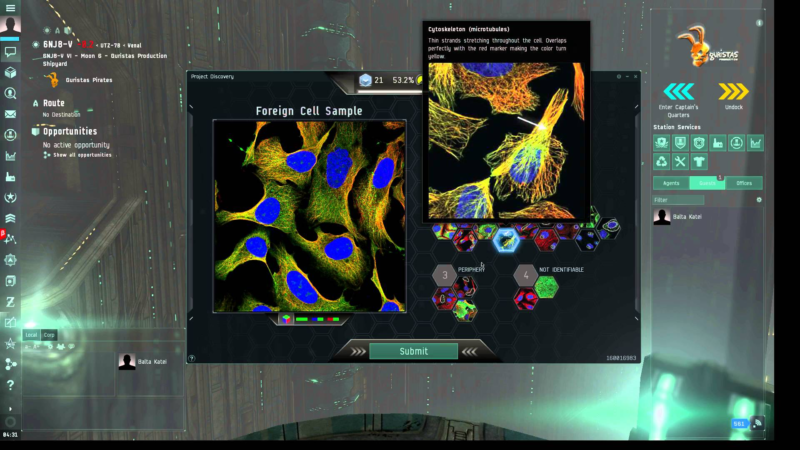
Enlarge / Yes, those are real human cells inside a fictional galaxy.

Citizen science, which asks the public to help out science projects, has produced some spectacular successes. But finding a way to grab and maintain hold of the public’s attention can be a challenge. That has led to a number of projects that turn the science challenge into a game, finding ways of making a “win” into scientific progress.

But scientists have also figured out ways of hijacking existing games, including using pre-existing fan bases that recruit players through in-game rewards. Now, there’s a progress report on an effort to turn EVE Online players into cell biology experts. Thanks to some in-game rewards, more than 300,000 players contributed roughly 33 million calls on where in a cell a protein was located. This not only greatly expanded a public database of information on proteins, but it enabled the researchers to better train a neural network to do the same thing.

Call it

While in many cases it has been possible to determine or infer what a protein does, that only gives us a partial idea of its actual function. That’s because many proteins are shipped to specific locations in cells. So while two proteins may look similar in terms of the order and identity of their amino acids, one may be shipped to the nucleus, where it interacts with DNA, while its relative gets sent to the cell’s surface, where it acts on proteins in the surroundings. So figuring out where a protein normally resides within cells can go a long way toward helping us figure out its normal functions.

Read 11 remaining paragraphs | Comments

https://arstechnica.com/?p=1361749