How Epic’s Fortnite rose from the ashes of Paragon’s failure
Paragon deserved better. Epic Games’ recently shuttered title looked like a third-person shooter, but it was all MOBA under the hood. That might not seem like an argument in its favor, as conventional wisdom says the MOBA genre is oversaturated and already behind the multiplayer curve. This gorgeous contender was a bit different, however. It learned from the mistakes of similar abandoned projects and constantly shot for something just a little bit different from mainstays like League of Legends and Dota 2. That drive to find its own niche should have been Paragon’s greatest strength, but it might have ended up as the game’s greatest weakness.
Now Epic has moved onto bigger, more profitable, and arguably better things with Fortnite: Battle Royale, the biggest thing in the gaming world since the last biggest thing in the gaming world. The 100-player slugfest is certainly more popular than Paragon’s relatively staid five-on-five battles—especially based on rumors that few people were still playing by the end.
The more I play Fortnite, though, the more I see a lot of Paragon’s DNA.
Blizzard Entertainment just released Rialto, a new map for its hero-based first-person shooter Overwatch. Set in Venice, Italy, Rialto does a few things differently from past Overwatch maps—it has more water than any before it and uses 90° angles in tightly packed streets to create choke points in addition to narrow archways, to name a couple changes.
In this video, Overwatch Assistant Game Director Aaron Keller talks about how Blizzard approached designing the map and about the process for making Overwatch maps in general. I visited Blizzard HQ in Irvine, California, and among many other things, I asked Keller: How do you balance a map for nearly 30 characters? Do you design maps to be strong for specific characters? How do you make sure framerates stay high and the action stays fast? And do the differences between consoles and PCs affect map designs in any way?
If you want answers to all those questions and more, check out the video. Keller also revealed a hint about a new easter egg, and he explained how a fleet of small boats run by robot gondoliers saved players from getting booped into the water too much and helped keep the map balanced.
Nintendo’s $20 charging stand fixes one of the Switch’s biggest problems
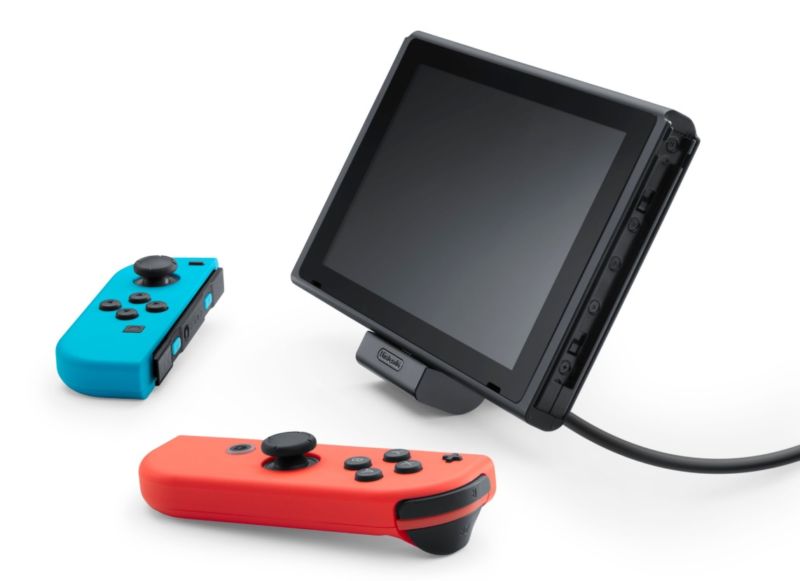
Enlarge/ Imagine if the default Switch dock looked something like this?
One of the few sour notes in our initial review of the Nintendo Switch last year was for the “surprisingly flimsy” kickstand. Not only does the thin, plastic, flip-down strip on the system’s rear feel poised to snap off at the slightest pressure, but using the kickstand prevents you from simultaneously charging the system from the bottom-mounted USB port.
Nintendo seems to be acknowledging this problem after the fact, announcing a $20 Adjustable Charging Stand that will “enable longer play sessions” in tabletop mode starting July 13. Users will be able to charge the system via a USB-C plug on the side while tilting the stand “to create the best viewing angle for different environments,” according to Nintendo’s online shop listing.
Nintendo’s solution for better tabletop play comes well after a number of similar third-party stands for the Switch have hit the market, many of which retail for less than $20. The “official” stand, though, benefits from an extremely compact design and the assurance that it will conform to the Switch’s USB-C charging requirements (the stand doesn’t seem to come packaged with an extra wall charger, though).
PS4 expands its sales lead, now 71% of “two-console” market with Xbox One
(credit: Ars Technica/Aurich Lawson)
New statements from Electronic Arts suggest that Sony’s PlayStation 4 has sold 2.5 times as many consoles as Microsoft’s Xbox One through the end of 2017, with Sony now controlling over 70 percent of the “two-console” market worldwide.
As Variety noticed this morning, the numbers can be derived from a recent EA investor conference call, where CEO Andrew Wilson mentions “sales of current-generation consoles from Microsoft and Sony” totaling 103 million at the end of 2017. Combine that with Sony’s own reports of 73.6 million consoles sold through the end of 2017, and you get a rough estimate of 29.4 million Xbox One consoles on the market. That amounts to just under 40 percent of the PS4’s reported sales.
Even with a bit of wiggle room to account for EA’s market-size estimation methods, that’s an extremely tepid result for Microsoft’s console. The last time public estimates of the Xbox One’s installed base leaked out at the beginning of 2017, they fell in the 25 million to 30 million unit range, suggesting Microsoft sold less than five million systems in the 2017 calendar year. The PlayStation 4, meanwhile sold roughly 20 million consoles in 2017, expanding its already sizable lead in overall installed base.
Nintendo says Switch won’t get Virtual Console classic game downloads
Enlarge/ Don’t expect to see a screen like this on the Switch.
With Nintendo offering a selection of 20 downloadable NES games as part of its newly announced Nintendo Switch Online service, starting in September, many have been wondering if the company is planning to revive its Virtual Console selection of emulated classic game downloads for the Switch as well. The answer to that question seems to be no, as Nintendo told Kotaku that “there are currently no plans to bring classic games together under the Virtual Console banner as has been done on other Nintendo systems.”
That doesn’t mean individual downloads for games from older consoles will be completely absent from the Switch, of course. Already, Nintendo offers up arcade games like Punch-Out!! and Vs. Super Mario Bros. as part of the Switch’s Arcade Archives series. Hamster has similarly released ports of a variety of Neo Geo classics on the system, and Sega has plans to do the same for many of its older titles.
But the announcement seems to cut off the possibility of the same kind of unified, system-level, one-stop clearinghouse for hundreds of emulated titles that became available on the Wii in 200 and later moved to the Wii U and 3DS under the Virtual Console name. It also seems to cut off the faint possibility that players might be able to carry forward Virtual Console purchases on previous Nintendo consoles to the Switch in the future.
Nintendo introduces Switch cloud saves as part of paid online subscription
Just a few more months…
First, the good news: Nintendo will finally begin offering a way for Nintendo Switch owners to back up their currently vulnerable game save data starting in September. Now, the bad news: that feature will only be offered to players who spend $20 a year for Nintendo’s first-ever paid online subscription service.
“Nintendo Switch Online,” which the company has been teasing for well over a year, will include an unexpected “Save Data Cloud Backup” feature, the company announced Monday evening. A Nintendo PR e-mail promises the feature will be “great for people who want to retrieve their data if they lose, break or purchase an additional Nintendo Switch system.” But it also warns that cloud saves will only be available “for most games,” with no details about the ones that will be left out. More details of how cloud saves will work will be available at a later date.
The subscription service will be required to play any Nintendo Switch games’ online modes from September onward. Games like Splatoon 2 and ARMS can currently be played online for free; that will change once Switch Online launches later this year.
Facebook changes an Oculus division’s name, invents term “Facebook Reality”
On Monday, Oculus chief scientist Michael Abrash posted this image of Facebook CEO Mark Zuckerberg testing something at what was formerly known as Oculus Research. Now, these tests take place at Facebook Reality Labs. (credit: Oculus)
Nearly four years ago, Facebook paid roughly $2 billion to acquire the virtual reality company Oculus, yet since then, Oculus has continued operating as a formal, separate entity. All of the shared companies’ VR hardware and software have been sold and marketed under the “Oculus” brand, though sometimes with a “from Facebook” disclaimer.
That’s still the case, but Monday marked the first notable divergence from this trend. That’s when Oculus chief scientist Michael Abrash announced a pretty significant pivot. “Oculus Research has a new name—starting today, we will be known as Facebook Reality Labs (FRL),” he wrote (using Facebook, no less).
His announcement immediately assured readers that “our focus on the future hasn’t changed.” Abrash used the post to point out that FRL had already been “helping Oculus and all of Facebook create trailblazing AR [augmented reality] and VR experiences, from what’s most affordable to leading edge.” He then described a future in which mixed-reality technologies will usher in “the second great wave of human-oriented computing.” Abrash did not lean into his division’s new name and describe any upcoming products as “FR” or “Facebook Reality” experiences.
As I write these words, I have deliberately quit out of the app on my laptop so that I don’t have the temptation to toggle over to it, indulging an eight-second distraction between typed lines of this book review. In fact, in recent months I’ve tried to become more conscious of how and where I use Twitter.
It’s just so fun and so damned useful. Twitter mainlines breaking news for addicted journalists. It’s also freakin’ hilarious at times. (I can’t get enough of @RikerGoogling, and I have a penchant for @BodegaBot, too.) But I also know that it’s an RT-laden, hashtag-driven, self-indulgent miasma that I will certainly get sucked into if I’m not careful.
So our ears perked up this week when, in an earnings call Thursday evening, Activision Blizzard President and CEO Coddy Johnson promised that the company has “invested significant dedicated resources and design time” to the PC version of Call of Duty: Black Ops 4. The company wants to “make sure we can deliver a great PC game to serve that community.”
Johnson didn’t go into any detail on what those “dedicated resources” might mean for PC players, beyond pablum like the game “continu[ing] to push the envelope in innovation” and including “a number of new exciting developments.” But he did specifically call out the game’s “appeal on growth platforms like PC” as a focal point ahead of a larger gameplay reveal set for May 17.
Elsewhere in the call, Activision executives addressed the rising popularity of “Battle Royale” shooters like PUBG and Fortnite, which have recently taken a lot of industry and player attention away from more traditional online shooters like Call of Duty. Activision Blizzard CFO Spencer Neumann acknowledged Activision was feeling a “near-term impact from Battle Royale,” even though Call of Duty still grew overall year-over-year.
But Activision CEO Bobby Kotick added coyly that “when we see things that appeal to our audiences, we are very good at being inspired by those,” which could easily be seen as a hint that Battle Royale is coming to Black Ops 4. That would gel with reports by Kotaku, Eurogamer, and others suggesting the company is working on such a mode for Black Ops 4. Those reports also suggest the game will ditch the standard single-player and co-op campaign in favor of a focus on multiplayer gameplay and the “Zombies” survival mode.
Put it all together, and you get the impression that Activision might be ready to really shake up the somewhat formulaic, console-focused design of Call of Duty this year. Now that we’re over a decade on from the original Modern Warfare, that’s not an unwelcome sign.
https://arstechnica.com/?p=1303373
Over a 5th of the world’s population is logging in to YouTube—despite scandals
NurPhoto/Getty Images
At YouTube’s annual Brandcast event, the king of online video touted its reach and new celebrity-fueled projects as reasons why advertisers should invest their dollars with the Web instead of television. According to CEO Susan Wojcicki, YouTube now has 1.8 billion monthly logged-in viewers. Considering that number doesn’t take into account viewers who simply go to YouTube to watch videos without logging in, it means YouTube’s reach continues to grow despite recent controversies surrounding its creators and how the site treats potentially offensive content.
Wojcicki didn’t go into detail about any of YouTube’s recent content issues, but she did highlight the importance of facing the challenges that come with such a vast, open platform. “It’s incredibly important to me and to everyone at YouTube that we grow responsibly,” Wojcicki said. “There isn’t a playbook for how open platforms operate at our scale. But the way I think about it, is it’s critical that we are on the right side of history.”
Wojcicki announced that YouTube aims to have more than 10,000 human moderators looking at “violative” content on the platform. In recent months, YouTube has added more humans to its moderation team, hoping to supplement the machine learning technology it uses to moderate the content on its site. These changes came as YouTube placed new restrictions on creators that are allowed to monetize content through YouTube’s Partner Program, and as the company added new details to its content policies in order to flesh out the definitions of what it considers offensive and inappropriate content.
Ever since the ad-pocalypse over a year ago, YouTube has been forced to continuously address its content problems to appease advertisers. When advertisers discovered their ads running over terroristic, salacious, and inappropriate videos, many pulled away from YouTube and took their dollars with them. While monitoring billions of hours of video is no small feat, the more that YouTube can say it is doing to cleanse its monetizable content, the better.
Upping the star-power
YouTube continued another part of its strategy by announcing new celebrity content partnerships. Arguably the most peculiar and dramatic collaboration is with Will Smith—YouTube will live stream the actor bungee-jumping from a helicopter over the Grand Canyon on Smith’s 50th birthday in a few months on September 25.
In addition, YouTube signed deals with the NBA and LeBron James to air a docu-series dubbed Best Shot about high school basketball players on the NBA’s YouTube channel. Youtube also snagged a deal with Quantico star Priyanka Chopra for a show called If I Could Tell You Just One Thing in which the actress asks people from around the world for their best advice. The company also renewed a few of its celebrity-driven, ad-supported shows announced last year, including Kevin Hart’s What the Fit? comedy-fitness reality show.
The company’s increased moderation and celebrity collaborations are undoubtably meant to show advertisers that the online video site is just as appealing, if not more so, than traditional television. Highly produced content like celebrity collaborations give advertisers mostly clean and buzzy content to support, while YouTube also benefits from its creators who carry their own audiences—many of which are millions strong. Only two YouTube homegrown creators gave speeches at Brandcast—Anna Akana and Tyler Oakley—both of whom emphasized how YouTube gives them a platform to reach a wide variety of viewers, as well as a space for them to be creative.
However, Brandcast is an event for advertisers, and it appeared YouTube leaned more heavily on its high-profile partnerships than it did last year. In addition to all the new celebrity-driven content coming to the platform soon, YouTube announced that it renewed its Coachella live stream rights for another three years. Also, for the first time, YouTube will make ad inventory on all official music videos on the site available through Google Preferred, its top-tier advertising platform. That means advertisers looking to buy into Google’s premium ad platform have much more content to choose from on YouTube, and it should all be content that gleans millions of views fairly quickly.