Sci-fi stunner Prospect values small stories in a galaxy far, far away

Enlarge / Sophie Thatcher (right) and Pedro Pascal in Prospect. Check out the trailer here.
Prospect film still

AUSTIN, Texas—Make no mistake, South by Southwest conference film darling Prospect takes place within a giant, intergalactic reality. Even lower- to middle-class adventurers like our heroes, Cee (Sophie Thatcher) and Damon (Jay Duplass), have a spacecraft and mostly functional equipment. And when this just-getting-by father and daughter duo takes an unexpected crash/detour that happens to land on a resource-rich planet littered with aurelacs (a valuable stone found inside some slimy pod that must be handled with care or “kaboom!”), Cee recognizes this as an opportunity.

“$10,000?” she retorts after dad ballparks the first gem recovered. “That’s enough to cover the loan… and the pod lease?”

Their ship has been built with Kubrick-like attention for analog detail, with cheap-ish CRT displays punctuated by handwritten notes. The planet they’re now on feels dream-like, a lush swampy Dagobah with a near-constant twinkle in the atmosphere. Nothing could happen from here and Prospect would still be worth watching for an hour-and-change of ambience and aesthetic alone. But as its initial 10 minutes show, this gorgeous-looking sci-fi flick has big subjects to match its style: intergalactic travel regulations, tiers of consumer goods, interplanetary trade standards.

Yet Star Wars this is not. Prospect instead succeeds by tossing much of its thought-out big picture away and relegating the rest to background. This is a small story set in a galaxy far, far away. And, even if it meanders a bit at times, this narrow focus keeps Prospect from ever losing its propulsive tension or engaging picture.

A different kind of one-horse town

As you might guess, Cee and Damon do not stop after stumbling upon a single patch of aurelacs. Dad sees much more potential, including millions in possible profit given the stash, he insists. “We will never ever have a chance like this again,” he says.

But some remote, resource-rich planet with the potential for a futuristic gold rush can’t stay remote for long. Cee and Damon quickly discover they aren’t the only team on the ground with prospecting ambitions. (Ah, I see what they did there.) And opting to embrace this detour rather than getting back to orbit leads the pair into a simple saga with two motivations—first, grab the aurelacs and get out; second, stay alive while doing it.

Prospect takes on a distinct Western vibe from here, becoming an adventure tale filled with colorful characters, otherworldly dialects, and ample close encounters. Our heroes gain a verbose companion named Ezra (Pedro Pascal, who, Variety correctly recognized, sounds straight out of Deadwood); they encounter packs of others who want to hold them captive and procreate or simply want to force them into aurelac-mining for others.

Don’t expect high-budget lightsaber battles or cutting-edge VFX aliens interspersed throughout that story, however. Prospect thrives more as a character-study due to the strength of its performances. In particular, Thatcher as Cee makes you feel each step of her transition from book-reading, punk-listening teen to cunning, hardened survivor who’s capable of holding a rifle or stitching up a wound. She often becomes the most compelling thing in the film, much like other recent genre offerings succeeding on the strength of a young heroine (Thelma, Meerkat Moonship).

“We maybe were a bit naive in the conception of this, putting the entire film on the shoulders of a teenage girl,” Chris Caldwell, Prospect co-writer/director, tells Ars. “But she killed it, and in many cases she saved our ass.”

“In another movie, you might get 12 takes, but we’re in helmets that are hard to breathe in—you get four takes,” adds Zeek Earl, co-writer/director and cinematographer. “She nailed it.”

Highlights from our chat with Prospect‘s filmmakers, Chris Caldwell and Zeek Earl.

Style via the Seattle-maker scene

When Prospect started off as a humble short film Kickstarter back in 2012, the team stated its motivations clearly: “Our goal is to capture a piece of what makes 2001, Blade Runner, and the original Star Wars so awesome: texture,” the pitch read. “Prospect will be real and tactile, building a robust world with custom props and costumes, rather than digital effects.” That ethos earned them a short film (which debuted at SXSW 2014), and that short film eventually earned them a full-length film (which debuted at this most recent SXSW).

“The theme was throwing stuff away,” Earl says of Prospect‘s world-building. “You can’t get fixated on what’s going to make it into the movie. We’ve got beautiful stuff—we did a cigarette ad for a grimey dude’s T-shirt, and I love it. But it didn’t make it into the movie… We started with a Wikipedia of sorts, however, so if there was a character even only seen briefly, we figured out their backstory, home planet, cultural connections. We totally have ideas for how the economics work or how the government works for places not even mentioned.”

“We both grew up on the Star Wars Visual Encyclopedia; it’s about creating a taxonomy of world-building,” Caldwell adds. “We were chasing that feeling of total immersion in a world. When you’re building something from scratch, something that’s totally imagined, you don’t get the benefit of all the detail built into real-world objects.”

The project’s newly found buzz—that same Variety review said “the standalone Star Wars movies should feel like [this];” Slashfilm called it the best indie sci-fi since Moon—validates this “good story shrinks in the wash” approach. And Caldwell and Earl did a remarkable job adding to that texture visually. Everything from Cee and Damon’s uniforms to the various encampments they encounter make for wallpaper-worthy compositions, yet the cinematography never gets flashy enough to overshadow the action.

This likely stems from the duo’s insistence on an extreme DIY approach. Everything appearing on-screen happens through practical effects, and all props came from the hands of their fellow Seattle-makers.

“It was a challenge, but it was the most fun thing to do,” Earl said. “We had seven months, and my dream was to have a warehouse. We just got a shitty box and filled it with passionate people who wanted to make a world—that was absolutely thrilling. And every object was original; we’re not on Earth so, we have to make everything.”

“On the production design end of things, we had to build up our own shop,” Caldwell explains. “We pulled from a majority of people who never worked on a movie before—they had worked on everything from cosplay to industrial design to carpentry. We’re pulling people from all kinds of backgrounds, and that diversity of perspective shows in how things materialized. We had a big focus on utility in design in the end, and having people used to building products instead of props really informed that.”

It’s easy to feel like all sci-fi these days centers on big, heady concepts: time-travel, resource-stricken dystopias, artificial intelligence, and so on. Some of it is done well, and others get lost straight to Netflix. But that critical mass has created certain expectations for any sci-fi movie released in 2018; Prospect succeeds by nodding to all that came before, blazing a different trail.

Prospect continues to play the festival circuit with no VOD or wide-release announcements available at this time. The most up-to-date screening information will likely be found on the film’s Facebook page.

https://arstechnica.com/?p=1289545


Nintendo’s new multi-screen patent isn’t just crazy—it might already hide in Switch

Anybody familiar with Nintendo’s hardware history knows better than to expect the company to rest on its laurels. Sure enough, as the company’s Switch continues racking up sales, a hint at its next portable system has already arisen in the form of a patent application that is too bonkers to ignore.

Patent applications, after all, can be filed without a company ever intending to make the product, and Nintendo has a history of these—including misleading patents that gave us an incorrect impression of how the Switch might eventually turn out. Take this week’s newly published patent, first found by Digital Trends, with a few grains of salt—but we’ll forgive you if you start believing that this tracked, multi-touch, multi-screen console might ever exist.

The above gallery reveals how this “game system” would stand out thanks to its “plurality of display units in combination with a high degree of freedom.” The April 2017 patent application describes a few situations in which touchscreen systems—which look a lot like a Switch with no attached Joy-Cons, or perhaps average smartphones or tablets—calibrate with each other to combine their displays as a single, unified game screen. We see a few multi-screen orientations, including screen pairs that touch, screen pairs that don’t touch, and larger groups of three or four screens with similarly unified displays.

Two of the patent application’s pieces of art show an even crazier concept: real-time recognition of any panels’ Z-axis orientation. One example shows a bowling ball rolling down one screen, towards another screen’s bowling pins, thanks to the angle at which the first panel is held. Another example shows an image unfolding correctly across three panels held at varying angles.

The patent’s language makes clear that Nintendo assigns no limit of screens and hardware to this multi-screen concept. That’s because each system, according to Nintendo, would include specific processing instructions and beacon hardware to daisy chain along with compatible siblings.

Nintendo hints at multiple options for pairing separate displays. One would have players line up any two panels and swipe their screens in a single, smooth line, which would then define the paired systems’ specific orientation. However, the patent doesn’t explain whether or how these systems might lock together either magnetically or with a Joy-Con-like slot—and swiping across two screens that way might disturb their physical orientation. Thus, the patent’s other description of a real-time system that wirelessly transmits coordinates and calculates vectors seems like a more likely solution, should this concept ever exist as real hardware. (Plus, the latter implementation seems necessary for the sake of systems whose panels aren’t touching, as shown in the gallery.)

The patent accounts for the times that systems aren’t touching in various ways. In some cases, invisible geometry will be drawn in the precisely measured space between two systems (like in the art above that shows an Arkanoid-style game adjusting based on how far two systems are spread from each other). In other cases, separate systems will stay frozen in default orientations in each player’s hand, and these must be combined in a certain pattern to solve a puzzle.

Nintendo’s art primarily shows fingers being used to control these games, but the patent’s language includes explicit mention of a possible camera-and-microphone addition for input, along with “an external operation apparatus.”

Hidden in the Switch?

The patent’s language otherwise explains exactly how games will be processed, which files will be stored and booted on each local device, and what kind of data, including save files, is transferred between systems during a game’s operation. That shouldn’t be considered a hint at this device ever reaching the market, but it also doesn’t dispel the possibility that the existing Nintendo Switch could replicate this patent’s features. The console’s Broadcom wireless comms chip includes Bluetooth 4.1 support, which might suffice in terms of data throughput and multi-device compatibility.

Still, we believe its mention of beacon-like sensing will require some sort of add-on device, if not an entirely new system. (It’s also hard to imagine Nintendo waiting this long to announce patented features hiding in released hardware).

[embedded content]
This Nintendo Labo “Toy-Con Garage” video includes a moment that looks a lot like what Nintendo has patented. Fast forward to 1:24 to see it.)

Considering that Nintendo Labo will ship next week with some interesting multi-Switch ideas—including a “Toy-Con Garage” concept (see above) that has two Switches and two Joy-Cons talk to each other for a multi-screen mini-game—it’s clear that Nintendo is still charmed by connected screens in the same room. But everything from GBA Link Cables to Nintendo DSes to Wii Us only toyed with the idea of separate screens being combined in basic ideas. This patent clearly goes one bigger with something we’ll affectionately dub the Nintendo MS (Many Screens) for however long this patent hovers as a compelling possibility, as opposed to a reality or ruled-out vaporware.

Listing image by USPTO

https://arstechnica.com/?p=1293715


Dinosaur Island review: Get Jurassic on your theme park!

Enlarge / The player boards.
Charlie Theel
Welcome to Ars Cardboard, our weekend look at tabletop games! Check out our complete board gaming coverage at cardboard.arstechnica.com.

Fallout, Star Wars, and The Godfather all became board games—why not Jurassic Park? That appears to have been the question asked by Pandasaurus Games, the publisher behind Dinosaur Island.

“Wait a second,” you say, “Dinosaur Island does not actually use the Jurassic Park brand.” That’s true; however, you don’t have to squint hard to imagine Richard Attenborough on the game’s cover or to soak in the overwhelming ‘90s vibes. This may not be a Jurassic Park board game in name, but it’s certainly one in spirit.

Who doesn’t want to run their own dinosaur theme park? This streamlined Euro-style design has players acquiring electrified paddocks, filling them with bright pink dinosaur meeples, and raking in wheelbarrows of cash. You’ll attain different strands of DNA to complete recipes and craft pre-historic beasts. Sometimes your security won’t be up to snuff and a guest or two may get eaten. No worries, though; your PR firm will smooth things out.

Dinosaur Island hasn’t been out long, but it has already achieved extraordinary success. In addition to massive funding in two Kickstarter campaigns, the game sold through its first print run in retail at the pace of a striking velociraptor. With expansions and a two-player spinoff on the horizon, this island is only getting started.

Bones of the past

Dinosaur Island is a gangly Brachiosaurus of a game as it spreads across your table and claims a healthy amount of real estate. Despite a wild sprawl of side boards, card decks, and player mats, it’s a surprisingly simple design that’s easily digested. In particular, the game borrows mechanisms from Euro-style predecessors featuring worker placement and public drafting.

Charlie Theel

The flow of Dinosaur Island is not altogether smooth as it jumps from phase to phase, with each phase comprised of unique rules and processes. On an individual basis, each phase is simple enough to foster quick learning. This light overall weight allows players of varying skill levels to dive in, gradually reconciling the different ways each phase of the game intersects with the others.

The first phase is the most straightforward as you spend scientists to claim strands of DNA or acquire new recipes to manufacture your carnivores and herbivores. There’s a continual philosophy here of introducing small twists to keep things just interesting enough; this phase is all about utilizing randomized DNA via rolled dice, as well as apportioning workers with different values to each player. (Your scientists are numbered 1-3 and serve as a multiplier when utilized to acquire DNA or as a necessary requirement to select the more costly dinos and paddocks.)

This is absolutely a resource-management game. You’re filling your cold storage with different genetic strands (resource one) in order to construct dinos (resource two) which require ample paddock space and security. You’re using these once-extinct predators to attract patrons (resource three) and score victory points based on filling up your park.

One of the key phases of Dinosaur Island is the public market, where you’ll purchase park attractions, buy modules for your lab, and hire specialists which grant asymmetrical powers. These critical decisions feed resource acquisition and conversion heading into phase three. Since much of the game lies in virtually identical inputs and outputs that result in mathematically narrow swings, the selection of these modules is a large differentiator in player builds and downstream effects. While the DNA and dinosaur birthing is a prime attention getter, choices about upgrades and supplementary attractions such as Ferris wheels and hat stands prove significant.

The third phase happens simultaneously as players utilize workers in their personal labs to spend that precious DNA and tinker with their park options. You can increase your security level, gain supplementary income, or increase the size of your existing paddocks. It all happens quickly and keeps downtime minimal as play rapidly shifts into the park phase.

This final stage has players actually filling their parks with small meeples drawn from a bag. If you’re lucky, you’ll pick up red-blooded patrons quick to file in and ogle your enormous beasts. If you’re not so lucky, you might pick a hooligan who jumps the fence and avoids the turnstiles. Hooligans leech your efficiency by filling up limited park space and denying you income. Like much of the game, it’s simple, quick, and trades off excitement or deeper engagement for streamlined play.

What kind of park is this?

If you’re looking for an experience that features runaway T-rexes and velociraptors as you sneak through laboratories and jungles, you’re out of luck. Dinosaur Island is not targeted at adventure; its focus is more on putting you in the seat of amusement park tycoon. You select attractions and fill out your acreage with fantastic beasts. You make money hand over fist, and if security is not quite up to the task, you merely lose a few points.

While not always an “exciting” game, this is a clever design of interwoven mechanisms that feed interesting decisions. It felt to me a bit like renowned designer Vlaada Chvátil’s work (though much simpler); there’s a similar feel to his 2011 release Dungeon Petzin that discreet mechanical concepts are tied together with surprising clarity.

There’s also no denying just how beautiful this product really is. It’s a huge box offered in two versions: one a deluxe Kickstarter package with lavish metal coins and several aesthetic upgrades, as well as a slightly more modest retail release that still spreads its many appendages of neon across your table. From double-layered player boards that firmly hold cubes on track to the many unique illustrations—Dinosaur Island is simply gorgeous to stare at.

Yet the largest accomplishment of Dinosaur Island’s design team lies in crafting this work from the ground up in service to their thematic vision. This is not a dry experience by any means, as everything from DNA procurement to customer acquisition is handled with precision and care. Despite the fact that we’ve seen plenty of games with similar genes in the past, this one stands apart with a solid vision and excellent execution.

https://arstechnica.com/?p=1293497


YouTube demonetized my tuba videos (also, I make tuba videos)

Early in 2018, YouTube made changes to how us commoners can earn money through its Partner Program (or “YPP”). You probably heard about it here and, oh yeah, here.

Now seems like a good time to describe my own (less tumultuous) history with YPP.

I play tuba

Before becoming one of the resident grammar-hammers at Ars Technica, I taught one-on-one tuba, euphonium, and trombone lessons in public schools in the Houston / Galveston area. Around 2001, I started arranging sheet music (mostly duets) to play with my students.

Arranging (or “transcribing”) is when you take a piece of music composed for one instrument (or set of instruments) and rewrite it for a different instrument (or set of instruments). The Night on Bald Mountain you hear in Fantasia, for instance, is actually an arrangement of an arrangement, first by Rimsky-Korsakov and then by Leopold Stokowski.

Arranging music is fulfilling for a couple of reasons. First, you get to perform music that might not otherwise exist for your instrument, and second, you get a different, deeper appreciation for a piece of music after you’ve had to take it apart and put it back together again in a new form. It’s similar to how a gearhead only really appreciates an automobile engine after he’s spent weeks underneath it covered in motor oil.

Sometime around 2008, I got it in my head that I wanted to try selling my transcriptions online. My first collection of arrangements contained music by stalwarts like Bach, Beethoven, Purcell, Vivaldi, and Chopin.

Why them and not, say, Nelly, who was one of the best-selling artists between 2000 and 2010? Because Nelly is still alive, remarkably, that’s why. If you want to sell arrangements of music by someone who’s still alive, copyright law requires you go through music publishers and entities like ASCAP to ensure that the original content creator gets a cut of any money you make. Some publishers even want you to estimate how many arrangements you’re going to sell and want you to pay royalties before you’ve sold copy one.

To that I said [armpit fart]—I already had a job (see: paragraph 3).

But—and this came to me while I was eating 45-cent wings at BW3—what if, as a promotional move, I uploaded YouTube videos of me playing copyrighted songs on tuba?

If I arranged this today, the pitches wouldn’t be so crowded together.
Enlarge / If I arranged this today, the pitches wouldn’t be so crowded together.

I could record both parts of a duet, and, with some century-old cinematic trickery involving image cropping, I could create the illusion that there were two of me playing both parts simultaneously.

Would that drive potential consumers to visit my website where, maybe-just-maybe, they would purchase my arrangements? Aw snap, son, I like money.

Why The Legend of Zelda?

What’s the audience for YouTube videos of people playing tuba? Band kids in junior high and high school, for one, and grown people nostalgic for when they were band kids in junior high and high school. And what do those folks like? They like video games, movies, TV shows, and what they hear on the radio. So the theme from The Legend of Zelda—which I guess was in subsequent Zelda games, I dunno, maybe—was an obvious choice.

As much as I’d like to say I figured out Zelda by ear, I had five cats at the time. I was too busy cleaning up vomit. Even in the primordial savagery of 2008, sheet music for everything was already lurking on the Web. I must’ve found a transcription of Zelda for guitar or flute trio or butt trumpet and re-arranged it for tuba / euphonium duet. I don’t remember. I’ve slept since then.

I tried out the sheet music with my students. They seemed to like it.

Recording

In an ideal world, this is when I’d tell you about cutting-edge HD camcorders, condenser mics, DATs, and my home studio.

But ain’t nobody got time for that jibber-jabber. Instead, I used the video setting on the still camera I got for a wedding present in 2001. It recorded in 15fps standard definition and had like, uhhh, one megapixel? (Note: 2001 was a different time.)

Instead of using a tripod for the camera, I used a music stand, because I was making the video in a bandhall during a break between after-school lessons (#Manhasset4Life). I played Part I in one chair and Part II in another chair right next to it. Instead of listening to one track while recording the other, I saved time by plugging the earbuds from my iPod shuffle into a pocket-sized metronome.

This is an arrangement I’m currently working on. See how much better the pitch spacing is?
Enlarge / This is an arrangement I’m currently working on. See how much better the pitch spacing is?

Editing

The still camera’s built-in microphone was a magnet for room noise, so I used every filter Adobe Premiere Pro 2 had. Lowpass and DeNoiser are reliable. A dedicated audio processor would have had more powerful tools, but I’m not made of time. By cropping the left half of Part I’s video and the right half of Part II’s video, I created the illusion of two players playing at the same time instead of just one lonely dude with a good haircut.

If you look really-really-really closely at my Zelda, you might see a few split seconds of blurriness throughout. That’s because, no matter how closely you hew to a metronome, you’re gonna stray. But removing a few frames in post-production will let you get back on the beat. (Note: the blurriness is from the camera’s auto-focus. There was no way to turn that crap off—again, 2001 was a different time.)

Uploading

I uploaded my first videos in March 2008, which is when YouTube switched from 320×240 pixels to 480×360. Soon 16:9 became an option with the addition of 720p HD in November of that year, and thus I uploaded my first 16:9 video (“The Blue Danube Waltz”) the following January.

I could have spent every waking hour in May 2008 researching codecs so that I could get the highest-possible video quality out of YouTube’s limitations. But I didn’t. That’s why the image at the top of this article makes you think you need your eyes checked.

Profit, or why you hate YouTube

By 2007, YouTube was sharing advertising revenue with video uploaders as long as they didn’t upload copyrighted content. So even if you got away with uploading the music video for “Hot in Herre,” you couldn’t get money by running YouTube ads in front of it. Unless, you were Nelly that is.

Those same rules applied to my videos. I couldn’t run ads in front of The Legend of Zelda because the tune was copyrighted material. The audio from my video of the theme from Raiders of the Lost Ark was even pulled for a few months.

But time has a way of changing rules. In the last two or three years, many copyright holders realized that, rather than pull scofflaws like me off the YouTubez, they could earn more dinero by allowing us to keep uploading our copyrighted materials. Those creators and YouTube even let us run ads alongside the copyrighted content. The catch? The advertising revenue would be divided among the uploader, the copyright holder, and YouTube.

Suddenly, all the videos I had uploaded in order to coax potential customers to buy my sheet music were just one box-click away from putting those sweet, sweet advertising dollars in my virtual pocket.

So, did I click that box? Well, DUH.

I don’t think I’ve ever made more than a couple hundred dollars per year in advertising. So… this was more than a hobby, but not quite a side business? Let’s say a “side-piece.” (That’s what that means, right? I’m pretty sure.)

Demonetized?!

Here’s the email that I got on from YouTube on February 21 but haven’t bothered to read until today:

As you probably heard, we recently announced updates to the YouTube Partner Program (YPP)…

As of today, your channel, TubaPeter.com, will no longer have access to monetization tools associated with YPP because it doesn’t meet the new threshold of 4,000 hours of watch time within the past 12 months and 1,000 subscribers. If you meet the new threshold at some point in the future, you’ll be automatically re-evaluated for YPP. The reviews typically take 1-2 weeks.

Let’s check how many viewing hours I have…

Son of a...
Son of a…

What’s YouTube’s justification for this? I’m glad you asked, imaginary interlocutor.

This program threshold allows us to significantly improve our ability to identify creators who contribute positively to the community and help drive more ad revenue to them (and away from bad actors). These standards also help us prevent potentially inappropriate videos from monetizing, which can hurt revenue for everyone.

So if you’re reading this, I need y’all to spend about 650 hours on my YouTube channel.

How things have changed

In the last decade, I’ve graduated to a 720p camcorder given to me by a friend. Sometimes I use an XLR mic that runs into a handheld TASCAM, but I think the Rock Band-branded USB mic (loaned indefinitely to me by the same friend who gave me the camcorder) might be better. Real mics try to be as faithful as possible to actual sounds while a Rock Band mic just wants to filter out garbage.

Collaboration.
Enlarge / Collaboration.

I’m sure YouTube’s current resolution is a million fps with the same dimensions as the ceiling of the Sistine Chapel. Premiere CS6 runs circles around Pro 2, and it probably has a built-in split-screen function that I haven’t explored yet. My arrangements are now for sale in a variety of formats on a variety of sites. And sites that move sheet music, like Sheet Music Plus, have streamlined the process of selling new arrangements of copyrighted music by living artists and composers.

The description of this process may seem like a litany of cut corners, and my website (www.TubaPeter.com) is probably the most rinky-dink thing you’ve ever seen (I am not what you’d call “tech-savvy;” in fact, by the standards of Ars Technica, I’m practically a jock.) But my goal was never to make the awesomest video of the badass-est tubist playing the hardest arrangement ever. My goal was to make music for kids who were goofing around after band class or marching rehearsal. Finding a beat-up print-out of one my arrangements in a bandhall filing cabinet or seeing a kind-of splatty video of teenagers playing my Godfather Theme is what I find satisfying.

So given my narrow potential audience and the new YPP, my setup isn’t likely to change or have any awesome cutting-edge additions anytime soon. Though even if it did, I’d still use music stands instead of tripods. Need to stay on brand, after all.

https://arstechnica.com/?p=1291091


Fortnite studio called out by Gears of War director over hiring practices

Enlarge / Former Epic Games design director Cliff Bleszinski speaks onstage at Spike TV’s 2011 Video Game Awards at Sony Studios in Los Angeles.

Former Epic Games developer and director Cliff “CliffyB” Bleszinski took public shots at his former employer on Friday in what appears to be a hiring dispute.

“Hey @epicgames, could you please stop trying to hire away my team?” Bleszinski, who currently runs a studio called Boss Key Productions, wrote on Twitter on Friday afternoon. “We just launched @Radical_Heights on #UE4 and are really happy with how it’s going.” The tweet included a GIF of the phrase “not cool.”

Bleszinski followed this up with an insinuation that this alleged employee poaching has to do with his studio’s new “X-Treme Early Access” game Radical Heights, which bears a striking resemblance to Epic’s hugely popular Fortnite Battle Royale. “There’s room at this genre for more than a few games SMH [shaking my head],” he wrote in one tweet. In another, he added, “We have plenty of ways to make [Radical Heights] our own, but they may never see the light of day if [Epic] keeps doing this.”

Missing from Bleszinski’s public HR allegation is the fact that the two studios have already been down this road before. Boss Key co-founder Arjan Brussee left the company in December to return to his old employers at Epic. Brussee and Bleszinski began working together at Epic in the ’90s as collaborators on the PC platforming game Jazz Jackrabbit. When Bleszinski confirmed the departure in December, he “wished him well” but phrased it as “we’ve parted ways” as opposed to Brussee leaving specifically for a new “secret project” (which the former Boss Key chief later confirmed as the reason).

Bleszinski’s Friday allegation didn’t include any allusion to Brussee being involved, and it did not clarify whether Epic’s hiring eyes might be targeting staffers who’d flexed their muscles on Boss Key’s last game, the troubled shooter Lawbreakers. That 2017 game had its share of issues, but its combination of polish, high-speed action, and Unreal Engine 4 optimizations have not been close to matched in the current, unoptimized version of Radical Heights. Before Boss Key launched its new game this week, the studio confirmed last week that it would cost too much to continue actively supporting Lawbreakers or convert it to a free-to-play model.

Bleszinski has long courted controversy by lambasting specific camps of game fans and creators. When Lawbreakers was announced as a PlayStation 4 console exclusive, Bleszinski described Xbox fans as “salty” in one interview. He once described Markus “Notch” Persson as “pouty” over that developer’s decision to not support Oculus Rift, and in 2008, he blamed slow development of major PC games on fans who are “savvy enough to know BitTorrent [and] to know all the elements so they can pirate software.”

Epic Games did not immediately respond to a request for comment.

https://arstechnica.com/?p=1293573


A different kind of regret: Trying White Castle’s new Impossible Slider

White Castle is known for a lot of things, but serving delicious and nutritious food is not one of them. But when word made it to the Orbiting HQ that the oldest fast food chain in the United States was now dishing up Impossible Burgers, we decided we needed to investigate.

The White Castle-Impossible Burger partnership is an unlikely one, to be sure. The former is perhaps best known for being the last step in finalizing a massive hangover as well as the intended destination of a hungry duo seeking late-night sustenance. The latter is a plant-based burger that “bleeds,” sears, and even purports to taste like a beef-based burger. Earlier this year, a few of my colleagues ventured out to a DC-area burger joint to taste-test the Impossible Burger. The reviews were mixed, with the highest praise coming from Tim Lee, who called it a “convincing imitation” of the real thing.

For the uninitiated, a slider from White Castle is a tiny slab of beef with five holes. It’s steamed on a griddle with a bunch of minced onions and served inside of what looks like a dinner roll. The burgers are tiny—you can get 18 sliders from a single pound of ground beef. (I once ate 19 in a single sitting to win a contest in college.) Under certain conditions—or a suitably altered state of mind—they can be delicious. But a visit to Whiteys can also result in gastrointestinal regret for some. I have a proverbial cast-iron stomach, and I get a White Castle craving about once a year, so I volunteered to see what the Impossible Slider is all about.

The suburban Chicago White Castle I dined at trumpeted the arrival of the Impossible Burger with a large poster in a window. As I walked inside, I was greeted by the familiar sights, sounds, and smells of White Castle. It was a bit jarring to be there before midnight, but I collected myself and walked up to the counter to place my order: three Impossible Sliders (one without cheese), two regular sliders (the control burgers), fries, and a medium Fanta Lime. I found an empty booth and sat down to await my fate.

White Castle cooks the Impossible Slider to order on a grill used solely for the plant-based burgers. Unlike the beef burgers, which are shipped to the stores frozen in hole-punched patty form, the Impossible Burger shows up fresh. Each Impossible Slider is individually made and flattened out with a spatula. It is then cooked on a 300-degree grill; the grill for meat sliders is set to 230 degrees. The familiar holes are missing from the Impossible Slider, and it’s made much thicker than its ex-cow counterparts in order to hold together during the cooking process, according to Niles, Illinois White Castle General Manager Tahita Hale.

My order arrived in the usual boxes on a paper plate. The packaging was familiar, but what was inside was not. The Impossible Slider is significantly thicker than a normal White Castle burger, and it actually looked more burger-like than a slider—White Castle habitués know what I’m talking about. Lifting the bun from the cheese-less Impossible Slider revealed a lumpy mass with a pickle on top and a bit of pink toward the center. I replaced the top of the bun and took a bite.

It tasted… fairly burger-like. Unlike the Impossible Burgers my colleagues had in DC a couple of months ago, my slider was moist and had a texture that offered a passable impression of a beef burger. With the smoked cheddar, the Impossible Slider was even better. I suspect that the more trimmings and condiments on your Impossible Slider, the more it will mask the differences between it and a normal burger.

What it didn’t taste like was a slider. A White Castle burger has its own character, a taste of beef and onions with slight hints of regret. The parts of the bun in contact with the burger soften a bit and take on a bit of the meat and onion flavor to create something greater than the sum of its parts. In contrast, the bun on the Impossible Burger remained dry, tasting of white bread and little else.

The Impossible Burger is priced at $1.99, compared to 95¢ for a cheeseburger and 77¢ for a slider. They are currently only available at White Castles in Chicagoland, New York, and New Jersey, so if you’re dying for an excuse to visit Whiteys and don’t live in one of those areas, you’ll need to go elsewhere for your plant-based burger alternative. Is it worth the trip? If you’re a vegetarian who has always wondered what it would be like to eat at White Castle, go for it. It’s prepared properly, and it tastes like an Impossible Burger should. It’s worth checking out if you’re just Impossible-curious. But if you’re craving the One True Slider, skip the Impossible Slider and get a sackful of the old standby. You won’t be disappointed… for a couple of hours, at least.

Listing image by Eric Bangeman

https://arstechnica.com/?p=1293099


Win Mazda’s new iRacing challenge to get a test in an MX-5 race car

I don’t think I’m exaggerating when I say it has never been easier to get into motorsport. A plethora of grassroots endurance racing series have sprung up in recent years, making wheel-to-wheel racing cheaper than it has been in decades. However, even this route isn’t exactly cheap; in addition to your safety gear you’ll still need to either build a car to the rules or rent a seat in one. For those without the mechanical skills, space, or budget to build their own race car, there are still other options: video games. After all, unlike most other games, a good racing game teaches you skills that do translate well to the real thing.

Arguably, it all started in 2008 with the first Nissan Playstation GT Academy, which used Gran Turismo to find new racing talent. GT Academy proved the concept, and, as racing games have improved, more and more motorsports programs have started taking the idea seriously. Perhaps the best example is McLaren’s World’s Fastest Gamer competition, the winner of which got a contract as the Formula 1 team’s latest simulator test driver.

Mazda is the latest company to give it a go; the winner of its new Hot Lap Challenge will get a test next spring in the Global Mazda MX-5 Cup car. There are two ways to win. Starting on Friday (April 13) at the Long Beach Grand Prix in California, Mazda is holding seven “at-track” qualifying rounds, bringing two simulators running iRacing to each race for that purpose. Whoever sets the fastest overall lap across those seven weekends wins a trip to the 2019 Rolex 24 at Daytona and becomes a finalist for the race car test.

For those who can’t make it to one of the seven races this year, there’s an online option, again using iRacing. On each of the same seven weekends there will be a Time Attack competition in the game. The five fastest racers from each of these events then go through to a final race later this year, and the winner of that also goes to Daytona for the Rolex 24 next January to face off against the other finalist for the overall win.

If you’ve been looking for a way to drive a race car on someone else’s dime and you think you have the iRacing skills, you can find the dates of the individual rounds here.

https://arstechnica.com/?p=1293055


Crazy racing mash-up: Gamer vs driver in real cars, but with video-game views

Enlarge / Luke Woodham (left) is a professional drift racer. Theo Thomas (right) is a gamer and vlogger. They both raced on an off-road track in real cars but without being able to see out the windshield.

I don’t know about you, but when I play racing games—which I do quite often—I’m quite particular about which camera angle I use. It’s almost exclusively the “front bumper cam” these days; after several years using the in-car view (where offered), I’ve found I’m just that bit faster without peering through a simulated windshield. It’s a POV I came to love in the first Gran Turismo game two decades ago, and, for me, it remains the best.

I’ve never been able to come to grips with the “over the shoulder” external view, where a camera is above and behind your car—it just feels so unnatural, especially if I’m using a steering wheel and pedals. So I’d probably have fared pretty badly in this challenge between a professional drift racer and a prolific gamer, organized by Castrol and Need For Speed Payback.

A brief disclaimer: yes, at the end of the day this stunt is an advert for Castrol’s products and the latest NFS game, but that doesn’t make it any less cool. It involved Luke Woodham, a pro drift racer who competes in Europe, and Theo Thomas, a gamer with a sizable following on YouTube. They competed to see who could set a faster time in a point-to-point race across a dirt road in the desert, using identical Ford Mustangs. But there was a catch—all the windows on the cars were blacked out.

To see where they were going, they had to rely on a camera mounted above and behind the Mustang, replicating that particular gaming POV. Bonkers, eh?

Video edited by Justin Wolfson.

I interviewed the pair late last week to find out how it all went. What follows is a lightly edited transcript of the video above. (And I’d like to apologize for my sound quality; it was a bit rushed on my end, and I didn’t have time to record my audio locally.)

First off, hats off to you both. I can’t imagine how much harder it was to drive a real car like that. So my first question for both of you is, when you play racing games, do you use a wheel or the controller?

Luke Woodham: For me, obviously coming from a racing background, I prefer to use the wheel. Which kind of makes it all realistic, yeah, that’s my point of view. I don’t know, Theo, what do you do?

Theo Thomas: So with me I mix between both, ‘cause I make a lot of videos on the games. It’s easier to just use a controller than to set up the whole wheel setup, but when I’m playing and I’m trying to beat lap times, it’s the hood view with the wheel. And then, if I’m playing around, it’s just the controller.

How much practice did you guys get in the car before going for your actual run?

Luke Woodham: To be honest, it was pretty much straight in. I was that confident in getting in the car and using the system I had in the car with the camera behind, the screen in front of us; it was that realistic. You know I could take it out onto the street, and everyday driving wouldn’t be an issue with it. It was that realistic, so for me it was straight into the driving.

Theo Thomas: Yeah, it was pretty straightforward. I drive a similar car myself—similar-size engine, similar-size car—so jumping into it, it felt as it should, but with that game view it was a little bit scarier.

Luke, as a professional drift racer I imagine you’re probably used to looking out the side window for about half of the time you’re competing, but how did you find the challenge of driving a car just using an external camera?

Luke Woodham: You hit the point very well there: we do look out the side windows the whole time pretty much when we’re driving. I was actually saying, when I started driving the car, that you could actually incorporate the video system on the car to maybe, when we are competing, having it so you can just have a quick glance at the camera, ‘cause it picks up so much. It’s kind of a wider view; you could actually use it, and it could work out really well.

So for me, it was fantastic. Everything worked out brilliantly. I’m very confident in driving a car with the camera setup on it, and it was so just realistic, it was unbelievable.

Theo, is it fair to say that your driving skills are more honed in the digital world? And if so, was this the most challenging thing you’ve had to do in a real car?

Theo Thomas: Most of my experience is just basically playing games, but I have been driving for a little while. I’ve not done anything kind of like track racing or anything like Luke does, so it was probably scarier for me. But it was so much fun to do it.

Did you find that the physical feedback you get through the seat of your pants as the car’s moving around actually helped you?

Theo Thomas: Oh yeah. It helped a lot, I mean, what I’ve been playing with recently, I’ve been toying with a lot of things with virtual reality, and I’ve had the experience of being in a motion rig that moves as you hit a bump in the track or something, and I’ve found that my driving’s actually better when I have things like that. So it was similar to that really, except if I did crash, I would crash.

Last question: are there any other thoughts you guys had about the experience that you might want to share with our audience?

Luke Woodham: Just if you could race a race series with actually using what Castrol Edge did with the video system in the car, that’d be a fantastic idea. I was thinking that on the day when I was driving it, that maybe we could have a full-on race series where all the cars are blacked out and you just do it off the screen. I would be the first person to sign up for it. It was brilliant, and it’s so much fun creating the project and working with Castrol Edge like we did.

[embedded content]

https://arstechnica.com/?p=1292647


Steam Spy announces it’s shutting down, blames Valve’s new privacy settings

Aurich Lawson

In light of Internet and social-media privacy landing at the top of major news outlets this week, another major online service announced its own privacy-policy updates on Tuesday. The latest change comes from Steam, the Western world’s largest online PC game seller. According to Steam’s creators at Valve, an updated settings panel will soon let gamers more clearly decide how their use of the service is communicated to approved friends and the public at large.

Within hours of this announcement, one company confirmed the policy change’s collateral damage. Steam Spy, the world’s most comprehensive game ownership and play estimator available to the public, announced that it “won’t be able to operate anymore” thanks to Valve’s official policy change.

“Valve just made a change to their privacy settings, making games owned by Steam users hidden by default,” the site’s operators announced on its official Twitter account. “Steam Spy relied on this information being visible by default.” In answering questions from fans, Steam Spy creator Sergey Galyonkin suggested that the site will only remain as an “archive” from here on out.

From Gauge to Spy to goodbye

Indeed, Steam’s new private-by-default setting is the kind of proactive, data-protective move that sites like Facebook have faced repeated scrutiny about over the past decade. However, as of press time, we could not confirm exactly how these updated settings will work, thanks to the service’s “edit privacy settings” page currently appearing blank. (This can be found in the Steam interface by selecting the word “profile” under the menu that appears when mousing over your username.)

If you’ve seen Steam Spy mentioned at Ars Technica in the past, that’s for good reason. The service launched in April 2015, nearly a year to the day that Ars senior gaming editor Kyle Orland published his extensive, data-sampling “Steam Gauge” feature to measure both game ownership and playtime estimates based on the huge sampling size afforded by Steam’s default privacy settings. As Orland wrote in 2014:

The core of our data comes from the individual profile pages on Valve’s SteamCommunity.com social portal, such as this one for yours truly. Prominent on each of these public pages, again just a click away, is a list of every game that Steam users have registered to their accounts. This page also lists how many hours they’ve played for each of those titles.

Orland’s work combined that public data with tried-and-true data-sampling techniques. Ars estimated that the resulting numbers would “generate a margin of error of only 0.33 percent from the actual numbers, statistically.” Steam Spy carried our data-scraping work forward, with attribution to Orland, while issuing similar caveats to our own: that the numbers could be skewed particularly by “free weekend” promotions and volatile information regarding more recent game launches.

Even with those caveats, as Orland wrote at the time, “the site represents an invaluable resource for anyone interested in demystifying the usually opaque world of game sales stats.” Without tools like Steam Spy, anybody hoping for clear sales data about video games sold in the West won’t have many places to turn. Monthly game sales charts from firms like NPD dried up years ago, so stat hunters will largely be stuck picking through official announcements from publicly traded companies.

Valve pointed out that Steam will also receive a long, long, long-awaited “invisible” function for Steam’s online-status toggle, which will allow players to actively communicate with Steam friends while hiding from the general public, and that it will also specifically let players hide both game ownership and gameplay time counts from friends. The company explained that Tuesday’s changes came “directly from user feedback,” which Steam Spy founder Sergey Galyonkin questioned via his site’s Twitter feed: “They said it was by users feedback which makes me as a person born in the Soviet Union very suspicious :)”

After Epic Games founder Tim Sweeney applauded Valve’s privacy-minded policy change, Galyonkin responded with his own opinion on why so much data was open on Steam in the first place: “This was always a compromise between being able to play with other people and privacy,” he wrote in response. “It seems they moved towards privacy now.”

We have sent Galyonkin questions about the policy change and will update this report with any response.

https://arstechnica.com/?p=1291589


Surprise! Red Dead Redemption is getting a 4K patch on Xbox One X today [Updated]

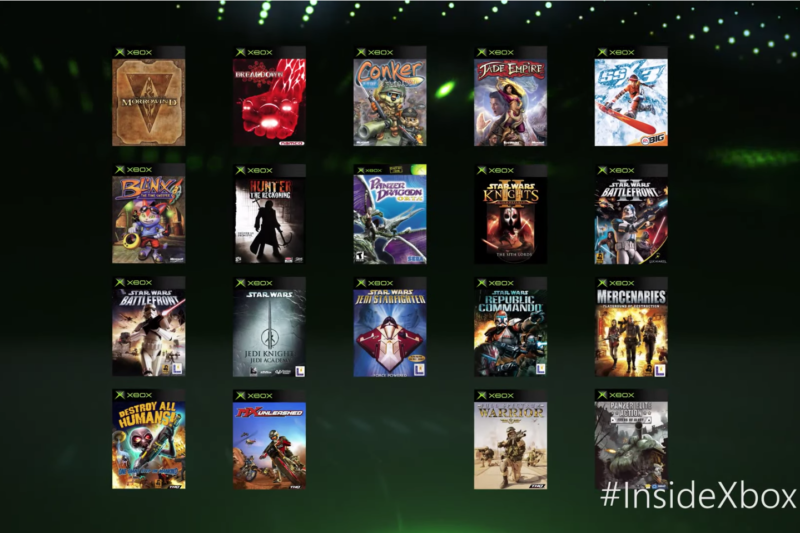
Enlarge / The 19 OG Xbox games coming to Xbox One by the end of April.

While Microsoft has arguably fallen behind in some current-gen gaming console metrics, the company has taken a clear lead among the big-three systems’ backwards-compatibility efforts. That’s been evidenced in a regular drip-feed series of older 360 and OG Xbox games being brought forward to work on Xbox One systems, of which the PlayStation 4 and Nintendo Switch have no peer. Honestly, these Xbox One announcements come frequently enough to not merit the spotlight treatment.

But Tuesday’s announcement, which was teased a full week earlier, brought the goods with a substantial list of games newly converted to work on Xbox One—and a few Xbox One X “upgrade” surprises, to boot.

The arguable biggest news of the day is that Red Dead Redemption‘s Xbox 360 version has now been patched to take advantage of Xbox One X hardware. That means, like other Xbox 360 games given the X treatment, RDR will now render at nine times its original 720p resolution. Should you have a 4K TV, an Xbox One X, and a copy of RDR, you’ll be able to play the game at 3840×2160 pixel resolution once its patch launches sometime today.

[Update: The 4K patch is now live, and we have a little, beautiful gallery here for proof. Click any image while in the gallery interface to bring up a full 3840×2160 resolution screenshot captured from our own Xbox One X console.]

This one’s a big deal specifically because RDR fans have waited for years for the game to receive a PC port, which might, among other things, let fans jack up the game’s settings and resolution. Seeing as how Rockstar Games has remained mum on that possibility going on nearly eight years, we imagine this XB1X update will remain the only 4K way to play the game for some time.

The other Xbox 360 games slated to receive this same upscaling treatment today include Star Wars: The Force Unleashed, Darksiders, Portal 2, Gears of War 2, and Sonic Generations. Out of all of those, only Gears 2 hasn’t received a PC port to let players manually crank the game’s resolutions or settings higher than originally intended.

Microsoft’s push to port more original Xbox games to Xbox One continued on Tuesday as well, with a whopping 19 pre-360 games coming to Xbox One by the end of April. These will land in two phases, and the first one, coming April 17, will include the never-ported-elsewhere Sega classic Panzer Dragoon Orta and the “complete” version of Elder Scrolls III: Morrowind.

On April 26, the back-compat collection will expand with six Star Wars-themed games: both original Battlefront games, Jedi Knight: Jedi Academy, Jedi Starfighter, Republic Commando, and Knights of the Old Republic II. (The first KOTOR RPG already landed on Xbox One back-compat last year.)

The rest of the announced original-Xbox back-compat games are as follows: Blinx: The Time Sweeper, Breakdown, Conker: Live & Reloaded, Hunter: The Reckoning, Jade Empire, and SSX 3 on April 19; and Destroy All Humans!, Full Spectrum Warrior, Mercenaries: Playground of Destruction, and MX Unleashed on April 26. (European Xbox One owners will also get an exclusive shot at Panzer Elite Action: Fields of Glory on April 26.)

https://arstechnica.com/?p=1291381