Kate Beaton on creating the best graphic novel of 2022

Kate Beaton
Enlarge / Kate Beaton
Corey Katz / Kate Beaton

For those who paid attention to the webcomics scene of the 2010s or simply enjoy good humor writing, the name Kate Beaton is likely a familiar one. The Canadian cartoonist’s Hark a Vagrant—a dizzying mix of the literary and historical references, lack of respect for institutions that didn’t deserve any, and gleeful silliness that ran through 2018—was a staple of Best Of lists for years, whether online or in its two print collections.

Outside of that work, Beaton has created kids’ books (The Princess and the Pony and King Baby, which both won awards) and earlier this year an animated series based on one of those books: Pinecone & Pony on Apple TV+.

This week her latest project hits shelves, and it’s arguably her greatest achievement to date. Ducks: Two Years in the Oil Sands is a memoir of her experiences working in the Athabasca oil sands in northern Alberta. It’s a serious, moving, and heartfelt piece of cartooning that is as kind as it is fearless and easily one of the most impressive graphic novels of this year, or works of any kind in the past decade.

WIRED caught up with the author via email to ask about her memoir, the end of Hark a Vagrant, and teaching readers about life in the oil sands of Canada.

WIRED: Ducks is utterly devastating. It feels, as a reader, as if it’s something that you’ve been working toward for some time. I know you published an early, and significantly different, version of this as a webcomic in 2014. One of the things that both versions share is a sense of, perhaps, emotional disconnection, a feeling of being so overwhelmed that it was nearly impossible to share what it had actually been like. How did you overcome that to make this book?

Kate Beaton: Hmm. I’m not sure if I agree with the question. I don’t think I have an emotional disconnection or ambivalence. If anything, too much of the opposite.

It’s my intense connection and deep concern that make it a hard and impossible story to tell—as soon as I describe one thing, I feel bad that I did not describe three other things to make sure that I am giving the full picture, because there is no one detail that will make you understand what I want to show you; the contradictions are endless, the complexity enormous.

If I started talking about the oil sands to someone, I couldn’t stop, because there was no point at which I could be satisfied I’d explained it. I needed editors to help make this book so that it wasn’t 2,000 pages—and it’s still 500 pages, and there’s all kinds of things missing. But that’s probably for the best. It has to be a readable book.

How long was this in the works? You mentioned when you closed down Hark a Vagrant way back in 2018 that you were working on a graphic novel. Was that Ducks?

The book was in the works since 2016, I pitched it to Drawn and Quarterly in the summer of 2016.

I took a year to write it. I took several years to draw it. In between, there were a few stops and starts. I had two children, and I lost my sister Becky to cancer. Becky is in the book. There were long periods then when I wasn’t working on it but it was always on my mind. I’m sure it was helpful, but also it’s just the way it was.

Does now feel like the right time to tell this story, compared with 2014? Or, perhaps, is it a case of you being better equipped to handle it now?

In 2014, I was just in my studio and I was compelled one day to start drawing out those comics. I later called them a “test,” but at the time it was just something I was driven to do for their own sake, and as I was doing it, you could see the bigger picture emerging of what it could be. I guess I always thought this was a book I’d make, but that really made it clear that I could.

But I couldn’t do it right then. I had a picture book I was working on; I couldn’t fathom leaving Hark a Vagrant right away. But I started winding down to it. I mean—I started the book in 2016, not that long afterward, so it’s not really a question of 2014 versus 2022, it’s just that it took this long to make the book.

One of the things that sticks with me about it is how kind it is. I feel you take great pains to emphasize that the experience of working in the oil sands dehumanizes everyone to some extent, no matter how they may believe they’re responding to it. Was that an attitude you’ve always had in this context, or was it something that came as you looked back on everything?

I’ve always had it. I didn’t come back to reflect only to find that everyone was human after all, haha. I lived with these people, they were my friends, my coworkers, my neighbors. And even when things are grim, I can see what I’m looking at. Even if it hurts.

Of course, I have had many years to think about it, too, and to get older myself, and I am sure that has made a difference at a gradient—hopefully the slow onset of wisdom. But, you care about the people you are surrounded by, don’t you?

Perhaps I’m betraying my own shortsightedness, but I had no idea of what the oil sands were, or what working there was like. The book feels very educational in that respect.

I know a lot of readers won’t know much about the oil sands. If you don’t have a connection to it, you might only have a sense of it being a place that is, you know, big and ponderous and full of dump trucks and environmental issues and money.

Luckily for those readers, I didn’t know much about it myself when I landed there, and everything in the book is from my point of view, and the reader is dropped in those shoes to learn as I learn what they are looking at. So in that sense, a gradual education works out by design and naturally, as it did for me.

Are you nervous about what audiences will make of the book? It uses all the tools you developed during Hark a Vagrant, but with a very different direction and ambition than that project, which was at heart a humor strip.

I’m not nervous about what audiences who are used to Hark a Vagrant will make of it. I think anyone who has followed me and my work for a while has a sense of who I am and where I’ve been going and what I have to say, even if this is a much different book.

I am more nervous about making a book about what people consider a very polarizing topic here in Canada. I’m not sure what will come with that. But all I could do was tell things with honesty.

How has making Ducks impacted what you’re doing moving forward? I feel like If I Cannot Have My Own on your Patreon demonstrates a similar tone, as well as a similar sense of pacing, for example.

Well, that is a story I have had in my head for probably a decade, so I don’t know about that. It’s loosely based on an anecdote my dad told me a long time ago that I thought about and spun around.

I think what is more likely is that I had these things in me but I kept making Hark a Vagrant for maybe longer than I should have—or not should have, but something like that. I have no regrets. We all have to grow and change. Losing my sister the way we did, how terrible it was, made me lose all will to write jokes for a living for a long time. Although now that I have finished Ducks, maybe that will come back.

That leads into my last question: How does it feel having finished the book? There’s such a feeling of it being an intense, personal experience that I wonder if it is a relief to be able to share it.

Well, I am answering this before the book is fully out in the world, so it is hard for me to say. It is still in that in-between time where not many have read it. I don’t know what’s going to happen. I hope it will be good. I hope I’ve done good.

This story originally appeared on wired.com.

Ars Technica may earn compensation for sales from links on this post through affiliate programs.

https://arstechnica.com/?p=1882099


GeForce GPUs are 80% of EVGA’s revenue—but it’s cutting ties with Nvidia anyway

GeForce GPUs are 80% of EVGA’s revenue—but it’s cutting ties with Nvidia anyway

Graphics card manufacturer eVGA has made a name for itself manufacturing and selling Nvidia’s GeForce GPUs for two decades, including some of the more attractively priced options on the market. But according to the YouTubers at Gamers Nexus, analyst Jon Peddie, and an EVGA forum post, EVGA is officially terminating its relationship with Nvidia and will not be manufacturing cards based on the company’s RTX 4000-series GPUs.

EVGA’s graphics cards have exclusively used Nvidia GPUs since its founding in 1999, and according to Gamers Nexus, GeForce sales represent 80 percent of EVGA’s revenue, making this a momentous and arguably company-endangering change. But EVGA CEO Andrew Han told Gamers Nexus that the decision was about “principle” rather than financials—Han complained about a lack of communication from Nvidia about new products, including information about pricing and availability.

Nvidia’s pricing strategy was apparently another sore point for EVGA. Nvidia’s first-party Founders Edition cards could often undercut the pricing of cards offered by EVGA and other vendors, forcing them to either lower prices or lose sales as a result.

Nvidia may not be entirely at fault here—the wider dynamics of the GPU market are also tough to navigate. As Peddie points out, even as GPU costs have gone up, profit margins for the board partners that manufacture Nvidia graphics cards have gone down. Modern high-end graphics cards have massively higher power, cooling, and PCI Express signaling requirements than cards from just a few years ago, making them more expensive to design and manufacture, and reporting about the RTX 4000 series indicates that that trend is only going to continue.

Profit margins for Nvidia's add-in board partners like eVGA have been sinking for a while.
Enlarge / Profit margins for Nvidia’s add-in board partners like eVGA have been sinking for a while.

And it probably doesn’t help that the GPU market has been plummeting back to earth this year, after over a year of limited stock and inflated pricing. Sliding cryptocurrency values and the Ethereum cryptocurrency’s move away from GPU mining have both flooded the market with secondhand GPUs, which has in turn affected demand for new GPUs. In Nvidia’s last earnings call, CEO Jensen Huang complained of “excess inventory” of RTX 3000-series GPUs that made it miss its quarterly revenue projections by $1.4 billion.

For Nvidia’s part, its public stance can be summed up as “so long and good luck.”

“We’ve had a great partnership with EVGA over the years and will continue to support them on our current generation of products,” Nvidia spokesperson Bryan Del Rizzo told Tom’s Hardware. “We wish Andrew [Han] and our friends at EVGA all the best.”

The end of the EVGA-Nvidia relationship could hurt Nvidia—Peddie says that EVGA represents about 40 percent of Nvidia’s GPU market share in North America—but in the medium term the company is unlikely to be fazed much. Nvidia has other partners, and despite differences in cooler design and clock speeds, GPUs in the same series tend to perform similarly regardless of which of Nvidia’s partners actually made them. In other words, an RTX 3070 is an RTX 3070, and people who want one are just going to buy one from another company if EVGA’s products aren’t available.

EVGA will continue to sell its other products, including power supplies, though Han told Gamers Nexus that the company doesn’t plan to return to the GPU market at all—not with AMD’s or Intel’s GPUs, and not with future GeForce product generations. Han also said that EVGA would continue to sell cards based on older GeForce GPUs, including the RTX 3000 series, until they run out of stock toward the end of 2022. The company will keep enough inventory of these cards on-hand to fulfill any warranty repairs or replacements for currently supported cards.

Kyle Orland contributed to this report

https://arstechnica.com/?p=1882286


Sony: PSVR2 is “truly next-generation,” so it can’t play PSVR1 games

It may look empty, but the original PlayStation Vr ecosystem contained many games that will never move forward.
Enlarge / It may look empty, but the original PlayStation Vr ecosystem contained many games that will never move forward.
Kyle Orland

A Sony executive confirmed Friday that the PlayStation VR 2 will not be backward-compatible with games developed for the original PlayStation VR.

Sid Shuman, senior director of content communications at Sony Interactive, asked Hideaki Nishino, senior vice president of platform experience at Sony, whether games for the original PSVR could be played on a PSVR2 kit on the Official PlayStation Podcast, episode 439 (his answer starts at 29:12).

“PSVR games are not compatible with PSVR2 because PSVR2 is designed to deliver a truly next-generation VR experience,” Nishino said. Nishino listed several “much more advanced features” in the VR2, including new controllers with haptic feedback, adaptive triggers, advanced eye tracking, and 3D audio. “That means developing games for PSVR2 requires a whole different approach than the original PSVR.”

While the answer was emphatic—”not compatible”—and closed off any hope fans might have harbored, Nishino’s checklist of new VR2 features didn’t clearly explain why the system would be incapable of running less-advanced VR1 games.

Consider the Oculus Rift S, which touted an entirely different eye tracking system than its predecessor, the original Oculus Rift. The Rift S maintained compatibility with games built for any Rift system (along with some games for other headsets). It was a seamless transition for those who upgraded their Rift or bought into VR at a later stage.

It’s also a disappointing outcome for some great games that were available only on PlayStation VR. Those include the original Mario-caliber Astro Bot, brain-twisting puzzle-game Statik, the VR mode for Resident Evil 7 that never saw release on any other system, first-party VR exclusive Blood & Truth, and a VR mode for WipEout that could only benefit from a VR2 headset.

The lack of compatibility could possibly involve the PSVR2’s far more focused control system, centered on the Sense VR controllers. PSVR players could swap between a DualShock 4 (and even use that gamepad’s motion-sensitive features), PlayStation Move wands, and even the PSVR Aim Gun. While the PSVR2’s gamepads follow the typical VR design, they have more refined rumbles and “impulse” triggers, cribbed from the PS5’s Dualsense.

The PSVR2, slated for early 2023, received a more formal introduction to the world earlier this week when Sony offered hands/eyes-on details of the PS5 add-on at the 2022 Tokyo Games Show. The VR2 offers several quality-of-life upgrades from its predecessor, including a single cable connection, a precise interpupillary distance (IPD) calibration tool, and an improved room-tracking system. This followed earlier reveals of the system’s base specs.

Sony does offer a camera adapter to play PSVR games on the PlayStation 5, which helps keep the system viable. But that’s not much consolation for the noteworthy games stranded on the isle of previous-generation VR experiences.

https://arstechnica.com/?p=1882262


The end of Ethereum mining could be a bonanza for GPU shoppers

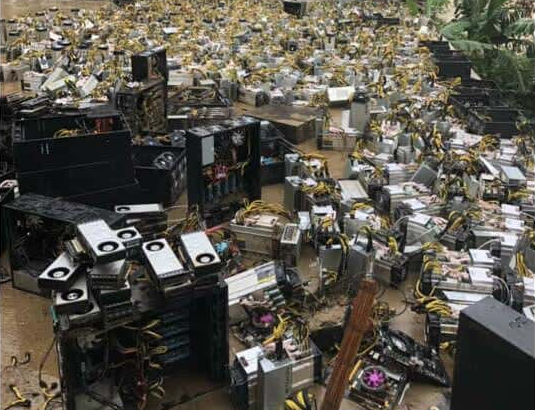
While these GPUs were liquidated following 2018 flooding in China, they provide a good visual for the flood of GPUs hitting secondhand markets these days.

For most of the world, yesterday’s long-awaited Ethereum “Merge”—which took the cryptocurrency from proof-of-work mining to a proof-of-stake model—is notable for cutting Ethereum’s energy consumption by 99.95 percent. But for gamers, the Merge has already contributed to a dramatic shift in the market for GPUs and could continue to drive down graphics card prices going forward.

In recent years, crypto miners had been scooping up as many GPUs as they could to power their mining rigs, leading to short supplies and heavily inflated prices for consumers who just wanted better graphics on their PC games. That trend seems to have reversed itself in late 2021, though, as dollar-denominated prices for most cryptocurrencies began a long slide that made GPU mining unprofitable in many areas.

Prices for GPUs have already plummeted throughout 2022, leading to GPUs routinely going for significantly less than their MSRP on auction sites like eBay. GPU manufacturers have been left with an unexpected surplus of excess inventory.

Last month, Nvidia announced preliminary results suggesting weaker-than-expected demand for its high-end cards. “Changes to cryptocurrency standards and processes including, but not limited to, the pending Ethereum 2.0 standard may also create increased aftermarket resales of our GPUs and may reduce demand for our new GPUs,” the company said.

Nowhere to run to, baby

You might think that Ethereum miners could simply transition to other cryptocurrencies that still rely on proof-of-work mining (including Bitcoin, which is still the biggest cryptocurrency by market cap). The forked Ethereum Classic, which is sticking with the token’s original proof-of-work model, has emerged as an alternative trying to fill just that role.

But a recent report found that pre-Merge Ethereum was responsible for a whopping 20 to 39 percent of crypto-asset electricity usage. That’s such a large share of the crypto mining space that all those miners moving to other tokens en masse would quickly lead to a glut of compute supply. That would in turn quickly drive down returns to the point where only miners with extremely cheap electricity could turn a profit.

We’re already seeing that cycle play out on Ethereum Classic. As miners started flocking to the fork post-Merge, the increased supply of compute power has already made it nearly impossible for miners to turn a profit.

The total hashrate for the Ethereum network has been falling for months, suggesting some miners may have been getting out well ahead of the Merge.
Enlarge / The total hashrate for the Ethereum network has been falling for months, suggesting some miners may have been getting out well ahead of the Merge.

Luxor COO Ethan Vera told The Block that only about 100 TH/s of Ethereum mining capacity would be able to “find a home” on other proof-of-work tokens after the Merge. That leaves about 90 percent of the previous Ethereum mining network that will “basically have no use for GPUs in crypto mining” post-Merge, Vera said.

“GPU mining is dead less than 24 hours after the merge,” Bitfarms Chief Mining Officer Ben Gagnon tweeted Thursday morning. “The only coins showing profit have no market cap or liquidity. The profit is not real.”

https://arstechnica.com/?p=1882144


HBO drops official trailer for Avenue 5’s second and final season

[embedded content]
HBO’s Avenue 5 returns next month for its second and final season.

We’d almost forgotten about HBO’s dark comedy Avenue 5, which debuted right before the world shut down in response to a global pandemic. But the series, which stars Hugh Laurie as the captain of a luxury cruise spaceship touring the solar system, was renewed for a second and final season. And now we have an official trailer to give us an idea what’s in store for the beleaguered passengers and crew.

(Spoilers for the first season below.)

As I’ve written previously, the series is the brainchild of Armando Iannucci, best known for creating the stellar HBO comedy series Veep, which won multiple Emmy awards over its seven-season run. Avenue 5 is set roughly 40 years in the future, when private spaceflight, aka space tourism, is totally a thing. The titular space cruise chip is modeled after today’s luxury ocean liners, complete with fine dining and regular exercise classes. But the ship experienced major technical difficulties, resulting in a course malfunction that meant it would take three years for the return trip, rather than the scheduled six months. The crew scrambled to solve the problem while keeping the passengers from panicking. 

In addition to Laurie as Captain Ryan Clark, the cast includes Silicon Valley‘s Zach Woods as Matt Spencer, head of customer relations, and Josh Gad as smarmy billionaire Herman Judd, who owns the Avenue 5 and pretends to be a man of the people, when he’s frankly quite the snob. Making Captain Ryan’s job even more difficult is Karen Kelly (Rebecca Front), a bossy passenger who apparently is on board under false pretenses, having used her sister’s (nontransferable) ticket.

Rounding out the cast are Suzy Nakamura as Iris Kimura, an associate owner of the ship; Lenora Crichlow as second engineer Billie McEvoy; Himesh Patel as stand-up comedian Jordan Hatwal, performing on the Avenue 5; and Ethan Phillips as former astronaut Spike Williams, whose boozy womanizing ways inevitably cause tensions.

The big reveal of the pilot episode: the main engineer was killed and Clark admitted he was actually an actor, hired to be a reassuring figurehead on the ship. In fact, all the visible “crew” on the bridge were actors and models, and their bridge “controls” were merely props, because Judd wanted to achieve a certain look for the Avenue 5. The real crew operates “backstage” and does the real work of operating the ship.

In the season finale, Rav Mulcair (Nikki Amuka-Bird), head of Mission Control on Earth, successfully brought a two-person shuttle to Avenue 5, but only one person could head back with the pilot—which meant if Judd went back, Rav would be stuck on the ship with everyone else. In the end, Iris was accidentally sent back. Meanwhile, an attempt to jettison ballast (unnecessary objects) to correct course and shorten the return journey to six months instead of three years backfired spectacularly. The ballast was jettisoned from the portside rather than the rear, and now the journey home will take eight years.

I enjoyed the first season, although I felt it never quite found its comic footing, and the tone was a bit uneven. It can be tricky to find humor in an inherently dark situation. I guess it depends on how amusing you find a debris field that includes ejected coffins orbiting the ship—or seven passengers self-ejecting from the airlocks to their deaths because they’re convinced they’re on a prank reality show—darkly hilarious or disquieting. Filming for the second season was delayed due to the COVID pandemic but eventually concluded last November. Per HBO’s official description:

Picking up five months after failing to reroute the vessel, season two follows the crew—including fiery engineer Billie, unpredictable head of customer relations Matt, and faithful right-hand Iris—as they struggle to lead, calm, control, and, if need be, hide from increasingly unruly passengers. On Earth, they’re lauded as heroes, and in space, everyone can hear them scream.

In the trailer, we see Matt insisting that the passengers should be told about the new, longer timetable for returning home. Clark balks, mostly because the food is running out. If he tells the truth, “I’m going to become the next all-you-can-eat buffet.” He even insists everything is fine to Iris, who is now back on Earth with Mission Control. But maybe they won’t have time to starve to death since the ship seems to be on a collision course tilt the Sun—as Rav calls it, “The big yellow cancer factory made out of lava. That one.” But hey, at least they have options.

The second and final season of Avenue 5 comes to HBO and HBO Max on October 10, 2022.

Listing image by YouTube/HBO Max

https://arstechnica.com/?p=1881746


Halo Infinite’s canceled split-screen campaign can be uncanceled by exploit

Halo Infinite’s canceled split-screen campaign can be uncanceled by exploit
Aurich Lawson | Bungie

Last week, the Halo Infinite development team announced that it was walking back a years-old pledge to support split-screen co-op for the game’s campaign mode. The feature had been delayed multiple times before being tossed into the bin, and the decision dashed the hopes of anyone who hoped to enjoy the game’s campaign with at least one friend on a single screen.

Within days, fans suggested that the feature had been working on Xbox consoles all along, albeit via a glitch—which, as of press time, has yet to be patched on Halo Infinite‘s retail version on Xbox consoles. Following reports and videos of the exploit, a team of gaming analysts confirmed via hours of campaign testing that Halo Infinite‘s split-screen mode is functional—enough so that we’re left scratching our heads as to what the heck is going on at Xbox.

How to do it yourself

Before I post any instructions, a warning: Using this exploit could affect or outright nuke your Xbox’s Halo Infinite save files. This is due to a longstanding bug, reported in December, where Halo Infinite gets confused if two gamepads are signed into the same “gamertag” profile on one console. Assigning a separate gamertag to each connected controller before booting the game appears to solve the problem, but you have been warned.

Currently, this exploit requires an online connection and at least one person in your Xbox friends list to run the game at the same time as you. They can merely leave the game on in the background on their Xbox for your purposes, but it’s still an inconvenience. Once you’ve booted Halo Infinite, make sure your friend is online by using the Xbox gamepad’s “back” button (the menu button immediately to the right of the D-pad, with two overlapping squares) to load the game’s built-in friend list interface. In fact, go ahead and practice loading this menu, highlighting your friend’s name, and tapping the A button to reveal a “join” menu option. Don’t join their online session yet.

On your own console, begin the usual steps of launching a Halo Infinite single-player campaign session. Pick your preferred save file (assumedly a new one to enjoy co-op fresh with a partner, but you do you), then start the session. The game will begin counting down from “five,” and here’s where you will need to be vigilant. At the instant the countdown hits “zero,” tap the gamepad’s “back” button, select your friend, and join their session. You don’t have much time to do this, especially if you’re on a faster-loading Xbox Series X/S. (Aren’t you glad you practiced this step beforehand?)

<a href="https://cdn.arstechnica.net/wp-content/uploads/2022/09/HaloInfinite-couch.png" class="enlarge" data-height="2160" data-width="3840" alt="Halo Infinite split-screen couch co-op being played on the author’s Xbox Series X, as enabled using the wacky steps outlined in this section.”><img alt="Halo Infinite split-screen couch co-op being played on the author’s Xbox Series X, as enabled using the wacky steps outlined in this section.” src=”https://rassegna.lbit-solution.it/wp-content/uploads/2022/09/halo-infinites-canceled-split-screen-campaign-can-be-uncanceled-by-exploit.png” width=”980″ height=”551″>
Enlarge / Halo Infinite split-screen couch co-op being played on the author’s Xbox Series X, as enabled using the wacky steps outlined in this section.
Sam Machkovech

If you do this correctly, you’re in. You can now leave your friend’s session (use the “leave fireteam” toggle in the menu you’re currently in) and let them know they can turn off their Xbox if they’d like. Once you’re out of the online session, use the “B” button to back out to Infinite‘s top-level menu (with four tabs at the top: Play, Customize, Community, Shop). While still in the Play tab, tap down to “Custom Game.” This will suggest you’re about to play a simple versus match, but your Xbox has the campaign loaded, so you’re still in good shape.

The only option you should touch in this menu is “Server,” which you’ll change from “Xbox Live” to “Local Online.” Do this, then press “start” on your second activated controller (again, we suggest you assign a unique gamertag to this gamepad, not a duplicate of yours or a “guest”) to add it to the fireteam. It will look like you’ve added a single opponent to a simple versus match. Instead, you’ve added a co-op partner. Once P2 is acknowledged in this menu, select “play,” and the campaign will begin.

https://arstechnica.com/?p=1881804


Here are the winners of the 2022 Ig Nobel Prizes

The Ig Nobel Prizes honor "achievements that first make people laugh and then make them think."
Enlarge / The Ig Nobel Prizes honor “achievements that first make people laugh and then make them think.”
Aurich Lawson / Getty Images

Would you give yourself an alcohol enema for science? Test the running speed of constipated scorpions in the lab? Build your very own moose crash test dummy? Or maybe you’d like to tackle the thorny question of why legal documents are so relentlessly incomprehensible. These and other unusual research endeavors were honored tonight in a virtual ceremony to announce the 2022 recipients of the annual Ig Nobel Prizes. Yes, it’s that time of year again, when the serious and the silly converge—for science. You can watch the livestream of the awards ceremony here.

Established in 1991, the Ig Nobels are a good-natured parody of the Nobel Prizes; they honor “achievements that first make people laugh and then make them think.” The unapologetically campy award ceremony usually features miniature operas, scientific demos, and the 24/7 lectures whereby experts must explain their work twice: once in 24 seconds and the second in just seven words. Acceptance speeches are limited to 60 seconds. And as the motto implies, the research being honored might seem ridiculous at first glance, but that doesn’t mean it’s devoid of scientific merit.

Viewers can tune in for the usual 24/7 lectures, as well as the premiere of a mini-opera, The Know-It-All Club, in which every member “makes clear their opinion that there is only one person in the Know-It-All Club who knows anything”—in keeping with the evening’s theme of knowledge. The winners will also give free public talks in the weeks following the ceremony, which will be posted on the Improbable Research website.

Here are the winners of the 2022 Ig Nobel Prizes.

Art History Prize

Citation: “Peter de Smet and Nicholas Hellmuth, for their study ‘A Multidisciplinary Approach to Ritual Enema Scenes on Ancient Maya Pottery.'”

Honestly, I could write an entire article about this fascinating 1986 paper, adapted from the doctoral dissertation of de Smet. The study focuses on the polychrome pottery of the late classic Mayan period (600–900 CE), which frequently depicts palace scenes, ball games, hunting parties, and dances associated with human sacrifice (via decapitation). But in 1977, scholars discovered one Maya jar depicting the administration of an enema—and subsequently several others as well.

Apparently, the Maya were known to administer medicinal enemas, but the pottery scenes suggested that they may also have taken intoxicating enemas in a ritualistic setting. De Smet and Hellmuth analyzed the iconography on several pottery pieces depicting enemas, as well as the linguistic glyphs appearing in those scenes. They also compiled a list of the possible “ethnopharmacological” substances the Maya might have ingested.

In the time-honored tradition of scientific self-experimentation, de Smet (a self-described “non-inhaling smoker” and “regular user of coffee and beer”) tested the efficacy of a couple of the suspected substances by administering enemas on himself. He drank an oral alcoholic concoction for comparison before separately administering a clyster. Both concoctions had about 5 percent alcoholic content “since a clyster with an alcoholic content of 20 percent is quite irritating to the rectal tissue,” so a lot of the concoction needed to be consumed. Intoxication levels were measured with a breathalyzer. “The results certainly support the theoretical suggestion that alcohol is absorbed well from an enema,” the authors concluded.

De Smet wisely declined to self-administer a tobacco enema, given the evidence for toxic side effects. Nor did he personally test psilocybin mushrooms, fly agaric, water lily (a possible hallucinogenic), Tsitse (Erythina alkaloids), or Toh-ku—all less likely candidates for use in the rituals depicted on the pottery. He also chose to skip toad poison (the Bufo alkaloid bufotenin). Instead, he administered an enema of dimethyltryptamine (DMT), which is closely related, finding “no discernible effect.” That’s an N of 1, however, with a rather low dose. The authors recommended “further research” to expand the sample size and dose range, but we did not delve deeper to discover whether any other intrepid researchers followed de Smet down the self-administered enema path.

https://arstechnica.com/?p=1880190


Console hacker reveals PS4/PS5 exploit that is “essentially unpatchable”

[embedded content]
A proof of concept shows mast1core being used to load an external PS2 ISO into the system’s emulator.

Longtime console hacker CTurt has blasted what he calls an “essentially unpatchable” hole in the security of the PS4 and PS5, detailing a proof-of-concept method that should allow for the installation of arbitrary homebrew applications on the consoles.

CTurt says he disclosed his exploit, dubbed Mast1c0re, to Sony via a bug bounty program a year ago without any sign of a public fix. The method exploits errors in the just-in-time (JIT) compilation used by the emulator that runs certain PS2 games on the PS4 (and PS5). That compilation gives the emulator special permissions to continually write PS4-ready code (based on the original PS2 code) just before the application layer itself executes that code.

By gaining control of both sides of that process, a hacker can write privileged code that the system treats as legitimate and secure. “Since we’re using the JIT system calls for their intended purpose, it’s not really an exploit, just a neat trick,” CTurt said of a since-patched JIT exploit on the PS4’s web browser.

Getting in

To get control of the emulator, a hacker can theoretically make use of any number of known exploits that exist in decades-old PS2 games. While some of these can be activated just with button presses, most require using a known exploitable game to access a specially formatted save file on the memory card, leading to a buffer overflow that gives access to otherwise protected memory (similar exploits have been used in PSP and Nintendo 3DS hacks over the years).

This method is a bit limited, though, by the fact that the PS4 and PS5 can’t natively recognize standard PS2 discs. That means any exploitable game has to be available either as a downloadable PS2-on-PS4 game via PSN or one of the few PS2 games released as physical, PS4-compatible discs via publishers like Limited Run Games.

Getting an exploit-ready PS2 save file onto the PS4 isn’t a simple process, either. CTurt had to use an already-hacked PS4 to digitally sign a modified Okage Shadow King save file, letting it work with his PSN ID. Then CTurt used the system’s USB save import feature to get that file onto the target system.

[embedded content]
A previous CTurt hack showing PS2 homebrew running from a DVD-R on unmodified hardware.

With the basics established, CTurt walks through a complicated series of buffer and stack overflows, memory leaks, and RAM exploits that he used to gain control of the PS2 emulator. With that control established, he was able to access built-in loader functions to transfer a separate PS2 ISO file over a local network, then tell the emulator to load that game via a virtual disc.

While loading other PS2 games into an emulator is nice, CTurt’s real goal was to use this entry point as a way to run arbitrary homebrew code on the system. That process will be detailed in a future write-up, CTurt tells Ars over Twitter DM, alongside the privilege escalation necessary to run any code “in the context of a PS4 game.”

Hackers would still need to make use of a separate (and potentially patchable) kernel exploit to gain “full control” of a PS4, CTurt told Ars. But the mast1c0re exploit on its own should be enough to run complex programs “including JIT-optimized emulators and potentially even some pirated commercial PS4 games.” Mast1c0re could also theoretically be used as an entry point to compromise the PS5 hypervisor that controls low-level system security on that console, CTurt said.

https://arstechnica.com/?p=1881857


Our biggest remaining PlayStation VR2 questions have been answered

Onward and upward with a brand-new VR system.
Enlarge / Onward and upward with a brand-new VR system.
Sony Interactive Entertainment

Ahead of Sony’s arrival at this weekend’s 2022 Tokyo Games Show, the company’s PlayStation division pushed a bunch of online news onto fans over the past 24 hours. The biggest news arguably came from hands-on and eyes-on impressions of its PlayStation VR2 add-on for the PS5 console.

The new virtual reality system, slated for an “early 2023” retail launch, is now being talked about outside Sony’s careful public relations hands, and its earliest testers have offered impressions of both the hardware and some of its apparent launch software.

PSVR2: What we already knew

Thanks to Sony’s announcements from earlier this year, we know that PSVR2’s OLED display packs a pixel resolution of 4000×2040, which can run VR software in either 90 Hz or 120 Hz modes. That performance is boosted by a new foveated rendering system, which is meant to emphasize full pixel resolution where your eyes are focused and blur the parts where your eyes are not—and this, unsurprisingly, is coupled with new internal eye-tracking sensors.

We also know that PSVR 2 will ship with two entirely new gamepads, one for each hand, that follow the Meta Quest archetype of VR controllers (complete with buttons, triggers, and joysticks) but with the additional tech upgrades found in Sony’s recent DualSense gamepads—namely, more refined rumbles and tension-filled “impulse” triggers.

A new “inside-out” tracking system resembles the kind found in Meta Quest and various Windows Mixed Reality headsets, and this uses built-in cameras to scan players’ real-world environs and track VR positioning, no external cameras or tracking boxes required. However, unlike the wireless-by-default Meta Quest 2, PSVR2 requires a cable connection for power and data transfer to a PlayStation 5 console.

PSVR2 hardware: What we’ve learned this week

Speaking of that cable connection: we’ve now seen it in action. The new single-cable connection, via PS5’s sole USB Type-C slot, is a revelation compared to the external, cables-everywhere “processor unit” required for Sony’s first VR system. This 4.5-meter cable has reportedly been designed to weigh as little as possible, but a cable that can wrap around your legs may remain a deal-breaker for some.

Sony also confirmed that PSVR would lack built-in audio. Just like the last model, PSVR2 owners will need to connect headphones using a 3.5 mm jack. The original PSVR shipped with low-budget earbuds, which may happen again for PSVR2—and to Sony’s credit, the new headset includes nifty, built-in “earbud plugs” that you can squish your existing earbuds into to tidily store them. But this is a bummer compared to the built-in audio found in Valve Index and all Meta Quest models. This week’s demonstration videos show that Sony’s larger, PS-branded headphones constrain users in VR, reduce airflow, and leave people sweaty, so interested users should look into high-quality, lightweight wired earbuds ahead of PSVR2’s 2023 launch. (My 3.5 mm recommendation is the affordable, high-performing Koss KSC32-i.)

In better news, Sony’s lens mechanism includes a precise interpupillary distance (IPD) slider, which can be accessed with a handy dial while the system is attached to the face. (This is a huge differentiator from Quest 2, which skipped such a slider as a cost-saving measure.) New users can access a handy calibration menu at any time to make sure the IPD setting is aligned to their unique face, and this additionally asks users to glance at an array of moving dots to calibrate PSVR2’s eye-tracking sensors. So far, PSVR2’s “hovering” fit, complete with a foam backstrap and nifty dial to tighten the fit, resembles the same one that we loved in the original PSVR. The fit around the eyes is reportedly spacious enough for glasses wearers, though we’re still waiting to hear about the new system’s weight and distribution compared to the original—at least, beyond suggestions that the current headset is quite light.

A July 2022 tease of how PSVR2's automatic room-tracking technology will work when the system launches in 2023.
Enlarge / A July 2022 tease of how PSVR2’s automatic room-tracking technology will work when the system launches in 2023.
Sony Interactive Entertainment

PSVR2’s new room-tracking system, which relies on four built-in cameras, appears to automatically account for objects in your gaming space. When users aim the system’s cameras at a new room, the black-and-white passthrough view coats objects (furniture, entertainment centers) in a trippy pattern of 3D triangles as the PSVR2 cameras scan over them, instead of making users aim their hands to scan and “paint” a play space. If PSVR2 gets it wrong, users can still use the system’s controllers to fine-tune their VR “boundary” before they begin playing. The headset includes a button on its bottom that can enable PSVR2’s passthrough camera mode at any time so that users can see what’s around them without removing the headset.

We previously learned that PSVR2 includes an array of built-in rumbling motors—a first in consumer-grade VR—and now we know how they work in action. The rumble’s severity can vary between a subtle sensation, like when flies buzz about your face during a sequence in Resident Evil: Village VR, or a more intense full-head blast, like when a monster flies above your head and sends a gust of wind toward you in Horizon VR: Call of the Mountain. So far, reports suggest that this sensation is more immersive than it is obnoxious.

Sony has not yet confirmed the maximum brightness of its OLED display, simply suggesting that it is rated for “HDR,” but Sony is clearly taking screen quality and light bleed seriously. OLED panels are generally better at managing an “infinite” contrast ratio, thus putting deepest blacks and brightest lights side-by-side, and PSVR2 apparently includes a superior light-blocking arrangement of foam and nose liners.

https://arstechnica.com/?p=1881340


Regulators put the brakes on Microsoft’s Activision acquisition

An Xbox controller on a table next to a Call of Duty game.
Getty Images | Bloomberg

Microsoft’s $75 billion acquisition of video game maker Activision Blizzard faces in-depth probes in Brussels and the UK following growing concerns the deal is anti-competitive and will exclude rivals from accessing the blockbuster game Call of Duty.

It comes as the UK’s Competition and Markets Authority is expected to launch an in-depth investigation this week after Microsoft decided not to offer any remedies at this stage, according to two individuals with knowledge of the situation.

Earlier this month, the CMA became the first global antitrust regulator to sound the alarm over the transaction, giving Microsoft five days to come up with undertakings that would resolve its worries or face an extended “phase 2” probe.

The companies have already been in talks with regulators in Brussels since the deal was announced eight months ago, in what is known as the pre-notification stage—an indication of how scrupulous officials will be during the probe.

Regulators and others involved in the deal expect a prolonged EU investigation once Microsoft officially files its case in Brussels in the coming weeks. People familiar with the EU’s thinking say regulators will take their time to examine this deal because of its size, the nature of the buyer and the rising concerns from rivals, including Sony.

“It is a big deal, a difficult deal,” said a person in Brussels familiar with the transaction. “It needs an extensive investigation.”

It comes after Sony last week accused Microsoft of misleading the games industry and regulators about its commitments to keep Call of Duty on PlayStation consoles. It said Microsoft had only offered to keep releasing Activision’s hit game on PlayStation for a limited number of years.

The move by the UK lays out the issues that Microsoft will have to overcome to pull off its biggest-ever deal. The US tech giant is hoping to close the deal by the end of June next year but must first clear regulatory hurdles in countries from New Zealand to America.

Microsoft opted not to offer any remedies to the CMA at this stage because there were no obvious commitments the UK regulator would be likely to accept, according to people with knowledge of the situation.

The watchdog does not generally accept behavioral remedies, such as commitments to maintain access to a product or service, at the end of a phase 1 probe apart from in rare circumstances.

One competition lawyer with knowledge of the case said it was “almost impossible” for Microsoft to offer a remedy that would prevent the investigation moving to an in-depth antitrust probe.

The Activision deal comes at a time when regulators around the world are concerned they have not been as interventionist as they should have been with regards to previous Big Tech deals.

Gaming rivals say they fear that Microsoft will offer commitments it could easily “wriggle out of” and that are not long lasting. Sony and others want the commission to force Microsoft to offer guarantees that they will be able to access all games “on equal terms and in perpetuity.”

Microsoft has said it will continue to make Call of Duty available on other companies’ gaming consoles, such as PlayStation, rather than turning it into an exclusive title on Microsoft’s Xbox. Brad Smith, Microsoft’s president and vice-chair, had previously said “we want people to have more access to games, not less.”

The company could choose to enter a formal commitment to the CMA to guarantee its rivals’ access to games during the second phase of the investigation, when an independent panel will analyze the deal in depth and consider potential solutions to antitrust issues.

© 2022 The Financial Times Ltd. All rights reserved Not to be redistributed, copied, or modified in any way.

https://arstechnica.com/?p=1881530