Jon Favreau, director of Iron Man and the live-action The Jungle Book film, has been selected by Disney to executive produce and write a live-action Star Wars TV series for Disney’s upcoming streaming video service, according to a blog post on the Star Wars website.
Disney hasn’t said exactly when the new streaming service will launch, but CEO Bob Iger said on an earnings call last year that the Star Wars series would likely premiere after 2020—though the announcement posted today specifically says the “series does not yet have a release date.” In the meantime, Disney has made plans to pull content like other Marvel and Star Wars movies from Netflix in 2019 to pave the way for this new service.
We don’t know much about this TV series beyond Favreau’s role and the time frame. Star Wars fans will likely try to closely examine the words of the announcement for clues, but they won’t find much to work from. Lucasfilm president Kathleen Kennedy offered this press-release-style statement with the announcement:
I couldn’t be more excited about Jon coming on board to produce and write for the new direct-to-consumer platform… Jon brings the perfect mix of producing and writing talent, combined with a fluency in the Star Wars universe. This series will allow Jon the chance to work with a diverse group of writers and directors and give Lucasfilm the opportunity to build a robust talent base.
Favreau’s statement simply said:
If you told me at 11 years old that I would be getting to tell stories in the Star Wars universe, I wouldn’t have believed you. I can’t wait to embark upon this exciting adventure.
Favreau is arguably best known as a movie director and producer, but he brings TV experience to the series as well. He was nominated for an Emmy for Outstanding Non-Fiction Series for Dinner for Five, and he’s directed episodes of The Orville and The Office. Favreau has also appeared in the Star Wars franchise as an actor: he voiced Pre Vizsla in the Star Wars: The Clone Wars animated series, and he will have a cameo in Solo: A Star Wars Story. Beyond Star Wars, Favreau wrote the critically acclaimed films Swingers and Chef.
To date, Favreau has been heavily involved in other Disney projects. He’s slated to direct The Jungle Book 2 and has been working on a live-action take on The Lion King. He was also an executive producer on Avengers: Age of Ultron and the upcoming Avengers: Infinity War.
https://arstechnica.com/?p=1271957
“Dating coach” game Super Seducer barred from PlayStation 4
Enlarge/ An example of some of the “hilarious” options for how to pick up women in Super Seducer.
Sony won’t allow a controversial game about seducing women on the PlayStation 4’s online marketplace, the company said this week.
Super Seducer, which launched on PC and Mac via Steam on Monday, was planned for a PS4 release according to press materials from last month. But Sony said in a statement to the BBC that the game “will not be made available” on the platform. While the outlet additionally reported that it was Sony’s decision to block the game, the reasoning behind the decision is unclear (a Sony representative was not immediately available to comment to Ars Technica)
As the title suggests, Super Seducer is built around “world-renowned dating coach Richard La Ruina,” who “teaches players the secret psychological tricks of attraction experts, accumulated from over 20 years of live workshops,” according to a press release. Players in the game select from multiple choice options on how to respond to live-action video depicting attempts to pick up women, with La Ruina explaining the “right” and “wrong” way to go about things.
Player accounts suggest the game’s worst options—such as “start touching yourself to get her turned on”—are presented as over-the-top humorous wrong answers. But even the “right” answers risk spilling over into creepy coercion or harassment, and they highlight harmful stereotypes about women, according to some players. The game doesn’t feature any full nudity, but it does feature frequent scenes with women in their underwear.
“I made it with the intention of helping men who are generally shy, introverted, and scared to approach women,” La Ruina told The Verge in an interview. “I’m not going to pretend it’s not a game that aims to teach men how to pursue beautiful women successfully, nor apologize for that subject matter,” he added in a press release from February.
Super Seducer first attracted controversy last September when the game was suspended from Kickstarter just before hitting a €23,000 funding goal. Press materials released since then have emphasized the game’s “controversial” nature, with La Ruina saying that he was “honestly surprised by the extent of the backlash.”
Where to draw the line on allowable content can be a touchy subject for gaming platform holders. Valve blocked similar seduction-based game House Party from Steam last year, then reinstated it on the service after black “censorship” bars were added over the in-game private parts.
World War II carrier “Lady Lex” found 2 miles under sea by Allen expedition
A photo provided by Paul Allen shows one of USS Lexington‘s 5-inch gun mounts. Nearly 76 years after it sank, the rifling is still visible in the barrel.
An anti-aircraft gun mount aboard the wreck of the USS Lexington.
Two Dauntless dive-bombers stacked on the bottom near the wreck of the USS Lexington.
AFP PHOTO / HO / COURTESY OF PAUL G. A
A Grumman F4F Wildcat fighter, bearing the “Felix the Cat” logo of the Navy fighter squadron VF-3. The same logo is used today by VF-3’s successor, VF-31, the “Tomcatters.”
AFP PHOTO / HO / COURTESY OF PAUL G. A
Paul Allen, the co-founder of Microsoft, has put his money into many passion pursuits. Underwater archaeology—specifically, finding ships sunk during World War II—is one of the most prominent. Last August, Allen’s research vessel Petrel discovered the wreckage of the USS Indianapolis, the cruiser that delivered components of the two nuclear bombs dropped on Japan to close the war. A 2015 Allen expedition on his personal yacht Octopus recovered a bell from the HMS Hood, the Royal Navy cruiser sunk by the German battleship Bismarck thatled to the loss of over 1,400 men. The expedition also surveyed the wrecks of “Ironbottom Sound” off Guadalcanal—the site of massive losses by the Allied navies during the long battle for that island.
Now, the Petrel has located the USS Lexington—the aircraft carrier that, along with the USS Yorktown, fought the first-ever carrier duel with the Imperial Japanese Navy in the Battle of the Coral Sea.
The Petrel located the Lexington‘s wreck with a Hydroid Remus 6000 drone submersible, an autonomous underwater vehicle equipped for searching large areas of seabed and rated for operations at 6,000 meters (3.7 miles). With its side-scan sonar, the Remus 6000 is capable of mapping over 100 square kilometers per deployment. The Petrel‘s Remus is the only privately owned AUV of its type in the world—others are operated by various navies and research institutions. An Argus 6000 remotely operated submersible was used to inspect the wreck visually.
[embedded content]
Video from the Petrel‘s Remus 6000 autonomous underwater vessel.
The damage dealt by the Lexington‘s and Yorktown‘s aircraft to the Japanese carrier Shōkaku, the decimation of the air wing of the carrier Zuikaku, and the sinking of the light carrier Shōhō would change the direction of the war, weakening Japan’s naval air power just before the Battle of Midway. The battle also preempted a Japanese invasion of Port Moresby, Papua New Guinea, which would have allowed Japan to attack eastern Australia.
Bombed and torpedoed multiple times, the Lexington was still afloat. But when fires caused by the bombing reached the Lexington‘s aircraft fuel stores and burned out of control, the ship had to be abandoned, and the destroyer USS Phelps was ordered to scuttle the ship with torpedoes. It took five to do the job because two torpedoes, including one located by the crew of the Petrel, were duds. The crew abandoned ship, but the Lexington went down with 35 aircraft aboard, settling to the bottom of the ocean two miles beneath the surface; 216 crewmembers died during the fight.
Images from the Argus 6000 ROV show the Lexington and some of its aircraft in amazingly good condition after 76 years (or at least good condition for a ship that was deliberately sunk with torpedoes). Grumman F4F Wildcat fighters bearing the “Felix the Cat” logo of the VF-3 Navy fighter squadron (now carried on by the Navy’s VF-31) were visible, as were Dauntless TBD Devastator dive bombers.
Facebook survey: Should we let men ask 14-year-old girls for sexual pictures?
Enlarge/ Thumbs down for this week’s weird Facebook survey.
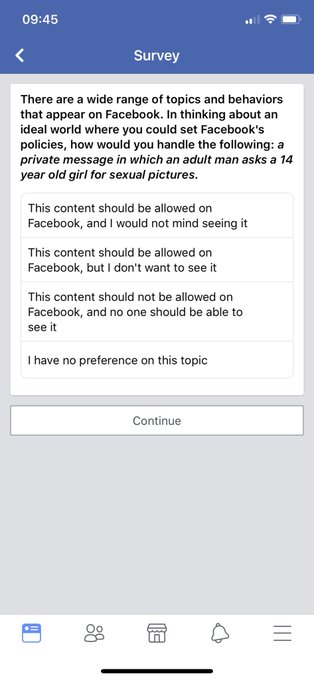
Facebook’s ongoing effort to solicit user feedback reached a bizarre low over the weekend. As reported by The Guardian, the social network included a question in a survey that allowed responders to indicate that FB should allow illegal, sexualized content from teenagers on the platform.
A screengrab clarified the exact phrasing of two questions, and these appear to combine stock question templates with a controversial phrase: “a private message in which an adult man asks a 14-year-old girl for sexual pictures.” The first asked how users thought Facebook should respond to such a scenario, and it included positive-sounding answers such as, “this content should be allowed on Facebook, and I would not mind seeing it.”
The second question asked “who should be deciding the rules” on that kind of content appearing on Facebook, and its answers included, “Facebook decides the rules on its own,” “external experts decide the rules and tell Facebook,” and “users decide the rules by voting and telling Facebook.”
One image of the survey in question, as tweeted by an editor for The Guardian on Sunday.
As Guardian reporter Alex Hern pointed out, no question in the survey included an option of contacting or referring a case to law enforcement. The survey was received by Guardian editor Jonathan Haynes, and UK law forbids the solicitation of nude or sexualized images from “a child,” which is anyone under the age of 18.
Facebook’s survey push on this angle of online communication is curious for two reasons. First, the UK law in question was notoriously held up both in being signed into the public record and enforced. Second, Facebook introduced a new Messenger Kids app for iOS users only in December, which is designed to let users ages 13 and younger communicate on the platform exclusively with friends and peers who parents expressly approve of.
Additional questions in the Sunday survey, according to The Guardian, asked users’ thoughts on “glorifying extremism” and on the service’s “transparency” and understanding of “cultural norms” in developing policies.
Facebook vice president of product Guy Rosen tweeted a response about the survey on Sunday, telling Haynes, “We run surveys to understand how the community thinks about how we set policies. But this kind of activity is and will always be completely unacceptable on FB. We regularly work with authorities if identified. It shouldn’t have been part of this survey. That was a mistake.”
The company offered an additional statement: “We understand this survey refers to offensive content that is already prohibited on Facebook and that we have no intention of allowing so have stopped the survey. We have prohibited child grooming on Facebook since our earliest days; we have no intention of changing this, and we regularly work with the police to ensure that anyone found acting in such a way is brought to justice.”
https://arstechnica.com/?p=1269819
Clicker Heroes maker compares new lawsuit from “patent troll” to extortion
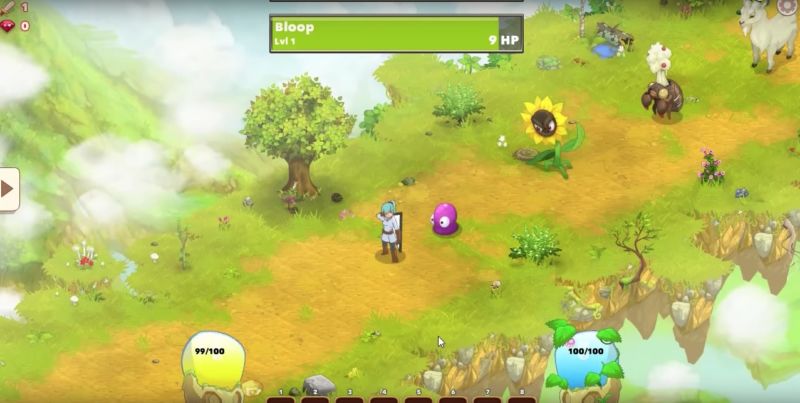
Enlarge/ This is a screen grab from the forthcoming Clicker Heroes 2.
Playsaurus, a small Los Angeles-based game studio that makes Clicker Heroes and the upcoming Clicker Heroes 2, has recently been threatened with a lawsuit if it doesn’t pay $35,000 for a patent licensing fee to cover a patent for “electronic tokens.”
In a Thursday blog post, the CEO of Playsaurus wrote that the company that sent him the letter, GTX Corporation, is a “patent troll.” CEO Thomas Wolfley called GTX’s demands to avoid “costly litigation” over Playsaurus’ use of electronic “Rubies” in its games “meritless.”
In a brief phone interview with Ars on Friday, Wolfley told Ars that receiving the demand letter was disconcerting.
“I kind of feel like it’s as if someone walked into my home with a knife and asked me for $35,000, except it’s legal,” he said. “I’ve been stressed out this whole week.”
Leslie Jacobs, the Maryland-based attorney who sent Playsaurus the demand letter, did not respond to Ars’ request for comment.
GTX claims that its patent (7,177,838, or simply ‘838) seemingly covers any kind of digital credit or currency. The patent was filed in 2000—it notes that “Electronic commerce using the World Wide Web (Web) is exploding in growth”—and was issued in 2007.
On its website, GTX describes itself as a company “dedicated to the development of technologically advanced proprietary raster-to-vector conversion and editing software to bridge paper to CAD.” The website makes no mention of “electronic tokens” or the ‘838 patent.
However, the ‘838 patent was fairly quickly used as a weapon in litigation. A company called Actus used ‘838 as early as 2009 in a lawsuit against Apple, Amazon, eBay, and others. That lawsuit was ultimately settled.
More recently, GTX has also filed suits over alleged infringement of the ‘838 patent against a Cypriot game company and another British company called Soccer Manager Limited. The precise relationship between GTX, Actus, and another company, PayByClick, is unclear. The ‘838’s patent history shows that the assignee has bounced between those three entities.
The inventor of the ‘838 patent is listed as one Marvin Ling, who is Andrew Ling’s father—Andrew now serves as the company’s CEO. Andrew, who also did not respond to Ars’ request for comment, is also the co-founder of PayByClick.
In the blog post, Wolfley continued that GTX’s legal efforts were “abusive and unethical,” noting that $35,000 was half the annual salary of an employee. He also wrote:
As I am a major owner of Playsaurus, I see this as a personal attack, and the cost in my own time and well-being has already been significant and draining. It is a shame that the United States legal system can’t provide a quick and easy way for us to punish them for these actions.
I believe it is unethical on our part to pay any negotiated amount, which serves to encourage the behavior of trolls with bogus claims. So, if pressed, we will take the matter to court and see it to the end. We have retained a law firm to assist and represent us if necessary. Playsaurus is a 100-percent privately owned organization, and we are not beholden to outside investors. We absolutely refuse to negotiate license fees with patent holders who make bogus claims.
Wolfley’s attorney, Miguel Bombach of Perkins Coie, a major commercial law firm, wrote back in a sternly-worded letter that Jacobs’ allegations were “baseless.”
Primarily, he argued, the ‘838 should be invalidated as it is an unpatentable abstract idea, which was resoundingly rejected in a unanimous 2014 Supreme Court decision known as Alice Corp v. CLS Bank.
Bombach continued:
This abstract idea is no different than using tickets to purchase drinks at a party or going to an arcade and using tokens to play games… Applying the idea with a “server” or reciting “memory” does not transform this concept into something that is patent eligible. After Alice, buying and using tokens for transactions (like a kid would do at Chuck E. Cheese’s), cannot be patented by simply reciting computers and the Internet. Furthermore, GTX’s attempted preemption of using tokens on the Internet clearly signals patent ineligible subject matter under Alice.
GTX has not yet responded to Bombach’s letter.
https://arstechnica.com/?p=1269017
Do we really need another Star Wars wargame? Yes, and this is it
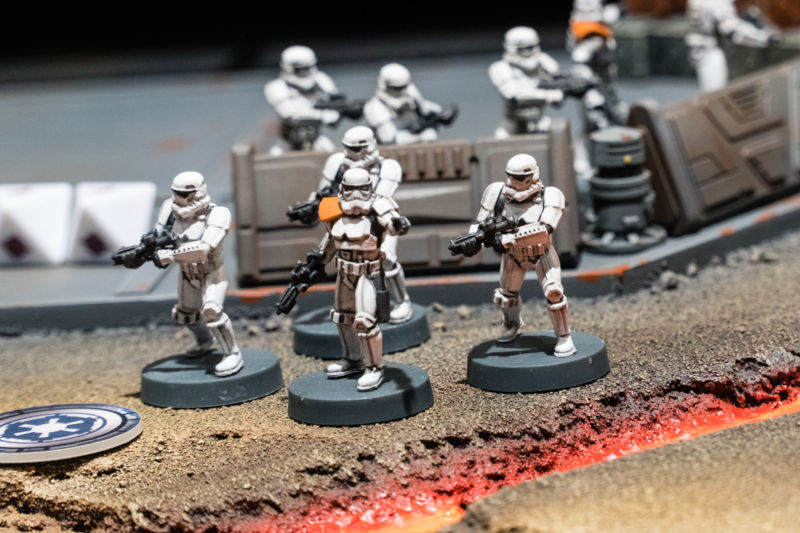
Enlarge/ A fully painted stormtrooper battalion at last year’s Essen game show.
Owen Duffy
If you’re a Star Wars fan, you may have felt a recent disturbance in the Force. Don’t be alarmed, though—it’s just the upcoming (March 22) release of a new tabletop game from Fantasy Flight Games, and it’s set against the backdrop of the titanic struggle between the heroic Jedi and the villainous Sith Lords.
It’s enough to make you wonder whether there’s any aspect of the Galactic Civil War that hasn’t already been exhaustively explored on the tabletop. But, as it happens, there is.
Star Wars: Legion is a miniatures battle game that pits armies of Rebel and Imperial troops against one another in deadly tactical combat. Where X-Wing and Armada let players fight it out in the cold void of space, this new release takes the action planetside, with ground-based clashes between forces of infantry, vehicles, and giant mechanical war-walkers.
At first glance, Legion is a similar proposition to the iconic dark-future wargame Warhammer 40,000. You’ll collect plastic troops, super-glue them together from multi-part kits, and paint them before deploying for battle. But while it has some superficial similarities to games that have come before, it soon becomes clear that Legion has plenty of innovations of its own.
You’ll face some tough decisions before you even get your troops to the table. For each battle, you’ll need to decide which units to field and which characters will lead your forces. Will you recruit a mass of basic infantry squads, overpowering the enemy by sheer weight of numbers, or will you upgrade your troops to elite status, with a smaller but deadlier army packing heavy weapons and specialist equipment? Will you deploy speeder bikes that race across the battlefield, attacking enemies and getting out of harm’s way before they have a chance to strike back? Or will you rely on slower, heavier battle walkers armed with devastating laser cannons that rain death on anyone unlucky enough to come within range?
Once you’ve chosen your units, it’s time for hostilities to commence. Legion does a fantastic job of combining tactical challenge with fast-flowing gameplay. At the start of each turn you and your opponent will choose from a selection of command cards, placing them face-down on the battlefield before simultaneously revealing them. These dictate who gets to act first, but they also control the order in which your units activate. You’ll constantly need to ask yourself which is more important to your battle plans: greater control over your troops or the chance to strike before your enemies can.
An unpainted walker.
An unpainted airspeeder.
Painted rebels.
Painted stormtroopers—along with Mr. Vader!
The game uses a split turn structure, with players moving and attacking with a single unit at a time. This means that the battle is in a state of constant flux. You’ll need to continually reassess your position and respond to your opponent’s moves. You’ll maneuver your way across the battlefield, ducking behind cover, unleashing volleys of laser fire and charging into hand-to-hand combat, with casualties steadily mounting on both sides.
Speaking of combat, it’s handled by a slick and elegant dice-rolling system that will feel familiar to X-Wing veterans. Units roll color-coded custom dice representing their skills in ranged or close-quarters fighting. With hit and block symbols on the dice themselves, there’s no complicated combat math to bog things down, and fights resolve quickly and intuitively.
It all adds up to a polished and elegant mechanical experience. But what’s really impressive about Legion is how faithfully it recreates the cinematic feel of the Star Wars films themselves. And that’s especially evident in its array of characters, units, and vehicles, which all behave exactly as you’d expect from the movies.
Stormtroopers are abysmally bad shots, rarely managing to take out more than a handful of rebel troops over the course of a game. But they’re useful for laying down suppressing fire, pinning down enemy units and stopping them from getting to the heart of the fray. Luke Skywalker is appropriately heroic, charging into battle and deflecting laser blasts with his lightsaber. Darth Vader is a slow-moving menace, stalking towards your troops before effortlessly tearing them apart. Then there are the vehicles, an assortment of speeding, shrieking, stomping death machines that strafe, blast, and claw their way through enemy lines.
It makes for some incredibly dramatic moments: generals colliding in fierce lightsaber duels, infantry squads wiping each other out in a hail of cannon fire, plucky troops sneaking behind a towering Imperial walker to target a weak spot in its armor. The story of the game soon becomes as much a part of its appeal as the unfolding contest of wits and cunning, and it can be positively exhilarating, even to someone like me who (please don’t tell anyone) isn’t all that interested in Star Wars.
It all comes at a price, though. The game’s starter set includes Luke Skywalker, Darth Vader, and enough Rebel and Imperial minis to fight small-scale skirmishes. But if you want to play bigger battles, you’ll need to do some shopping. New units will set you back anywhere from $12.95 to $49.95 for larger vehicles. You’ll also have to invest time and effort into building and painting your models, which means that Legion really isn’t a game for casual players. To get the most out of it, you’ll want to go all-in, and that’s likely to be expensive. Also annoying: the base set comes with only a tiny handful of dice, and you’ll need to buy more separately, which just seems stingy.
But if you’re a Star Wars fan looking to recreate the thrill of the series’ spectacular battle scenes, this is a slick, polished translation from screen to tabletop. It’s a fast-paced, tactically challenging rollercoaster, and it’s impressively faithful to its source material. The Force is strong with this one.
https://arstechnica.com/?p=1268909
New Lego pieces: Still hard on your feet, but easier on the planet
Enlarge/ All of these Lego pieces will now be made of sugarcane-derived polyethylene.
Starting this year, buyers of new Lego playsets will begin to see a new type of block in their boxes—ones made of plant-based plastic.
To usher in Thursday’s news, Lego rolled out its new plant-based hero, Plantis Maximus.
Plantis Maximus gets an origin tale at Lego’s announcement site, starting with this illustrated sugarcane plant…
…which turns into Lego bricks and pieces.
Plantis starts to spread the gospel of plant-based materials for Lego pieces.
He has a mission to plant-i-cize all Lego bricks…
…by the year 2030.
In the meantime, production of plant-based plant pieces has already begun.
The company’s announcement describes the plant-based pieces’ composition as “technically identical” to its standard blocks’ materials, and Lego notes the new pieces have been tested to meet the company’s standards. (It doesn’t confirm whether this means Arduino-testing rigs or having bedraggled parents accidentally walk over them on bare feet and remark on how similarly painful they feel.) And unsurprisingly, these new pieces will have the company’s standard circle-grid structure on their bottoms to ensure compatibility with decades of Lego pieces and sets.
In spite of this “technically identical” composition, the announcement doesn’t confirm what the hold-up is to roll this kind of material out beyond a 1 to 2 percent sector. Lego did not confirm whether the hold-up is due to larger piece designs, sugarcane polyethylene production sourcing, green tint from that specific kind of polyethylene, or other issues.
In 2012, Lego announced a corporate initiative to find more “sustainable” materials for its block pieces, which the company once estimated are produced to the tune of “more than 60 billion” a year. That was followed in 2015 by the announcement of a corporate Sustainable Materials Center and a hiring drive of over 100 R&D staffers. All these initiatives align with the company’s long-stated goal of using a complete “sustainable material” pipeline for its Lego bricks and pieces by the year 2030. Thursday’s announcement sees the company stick to that timeline, as opposed to fast forwarding it in any way.
Research about plant-based polyethylene has pointed to environmental impact such as cropland expansion and fertilizer use, but the literature ultimately points to a net gain compared to the use of fossil fuels for the materials.
https://arstechnica.com/?p=1268717
Twitter CEO wants to study platform’s “health,” but is he ignoring the cancer?
Enlarge/ Is it too late to measure the “health” of Twitter?
Aurich / Getty
Twitter CEO Jack Dorsey posted a series of tweets on Thursday to concur with growing resentment about his platform—and to admit that Twitter is somehow not in a position to fix the problems he listed.
Dorsey’s tweet thread began with an all-too-familiar promise of “public accountability” (which is a clever thesaurus-twist of his usual “more transparent” promises), before then delivering what might be his most frank admission of Twitter’s woes:
We love instant, public, global messaging and conversation. It’s what Twitter is, and it’s why we’re here. But we didn’t fully predict or understand the real-world negative consequences. We acknowledge that now and are determined to find holistic and fair solutions. We have witnessed abuse, harassment, troll armies, manipulation through bots and human-coordination, misinformation campaigns, and increasingly divisive echo chambers. We aren’t proud of how people have taken advantage of our service or our inability to address it fast enough.
That last part, about Twitter’s apparent inabilities, resonates through the rest of the Thursday posts. Dorsey claimed that Twitter has been “accused of… optimizing for our business and share price instead of the concerns of society” and that the company has fallen behind in part by focusing on the removal of TOS-violating posts instead of “building a systemic framework to help encourage more healthy debate, conversations, and critical thinking.”
A more holistic approach apparently began for Twitter by seeking outside counsel about “the health of public conversations.” Dorsey pointed to the private research firm Cortico, who created a series of conversation “health” metrics based on its studies of Twitter data: shared attention; shared reality; variety; and receptivity. The metrics that Dorsey linked to describe behaviors, however, as opposed to a platform’s design—with phrases you’d expect from an elementary school etiquette chart like, “Are we open, civil, and listening to different opinions?”
Thus, Dorsey admitted that Cortico’s metrics might not fit what he seeks in “a rigorous and independently vetted set of metrics” regarding how Twitter users interact. He announced a grant of “meaningful funding” and Twitter data access for any research team that proposes what Twitter deems a worthy conversation-measurement plan.
But is it a cancer?
Dorsey’s tweetstorm juggles two seemingly disparate ideas: the company’s “inability” to contend with disruptions, abuse, and hatred, and its desperate call for outside help to measure the current state of events, as opposed to shoring up resources or building entirely new systems.
As more data and research pile up to point fingers at Twitter’s biggest issues, there’s also the matter of anecdotal evidence of the service’s inherent issues. I offer the following stories as an answer to Dorsey’s questions about Twitter’s health: its cancer may be incurable.
Every image in this gallery is a screencap I’ve taken of suspicious accounts on Twitter. This one is the most suspicious because… it’s a “Machkovech” who I cannot find any information about through family members.
This six-month-old account was awoken to post one thing about an Ars Technica article I wrote. I reported it following this reply and received no response from Twitter.
This account reposts and summarizes content from tech blogs as if it has a legitimate audience, but it has zero apparent authentic followers and no apparent signs of a legitimate start-up enterprise (e.g. a video channel). I nearly responded to its seemingly legitimate question about a game before finding its apparent troll-farm activity.
This account laid dormant for years before posting its first and only tweet: a slag about one of my articles.
When a peer began receiving strange replies from an unknown account, I dug into the interruptor’s post history and found comparisons of homosexuality with bestiality (a common Eastern European trolling move) and a suspicious insistence on living a “real” life.
One inauthentic account took the opportunity to interrupt my attempt to get Twitter’s attention on the matter. Diving into its post history revealed more confusing content.
To review: because it’s a free service, Twitter’s money-making moves are currently limited to either selling ads or monetizing the data it accumulates. To harvest either of these possibilities, the service relies on aggregated, non-chronological content feeds (like most other free social-networking services). One byproduct of this approach is that, in addition to advertised content, a typical Twitter user will see everything from “you may have missed this” summaries to “your friend liked or re-tweeted” content emerge, as a sort of friend-of-a-friend content nudge.
Twitter has also spoken publicly about its investment in automated tools used to identify inauthentic and robotically created accounts. More avid and followed Twitter users who turn off the service’s “quality” filters can sometimes see this in action, where random gibberish replies might appear for roughly an hour before being auto-deleted.
Dorsey’s calls for conversation health metrics do not in any way appreciate the apparent next-level disruption tactic already being rolled out on Twitter this year: subtler, seemingly real accounts popping up with the express intent of passing those four metrics on their face. I have chronicled an apparent rise in this account type for the past few weeks at my own Twitter account, often finding accounts that have existed for as briefly as a few months or as long as nine years.
These accounts have a lot in common: a series of everyday-person thoughts from a unified perspective; a lack of a consistent social circle, in which they use Twitter to exchange pleasantries, jokes, or other group-of-friends interactions; a sporadic posting history that isn’t immediately evident when flipping through an account on a smartphone screen; and a reliance on RTs, likes, and replies to verified and well-followed Twitter accounts.
[Disingenuous actors’] accounts often debut with an apparent political and social identity, along with a stress on link shares with unique, viral-styled descriptions and exclamations. This is perhaps done with hopes of gathering followers, “likes,” and shares. Then, when it politically suits an operator, an account may start sharing politically divisive messages.
The difference with that description and the activity I’ve anecdotally chronicled in the past few months is a reduction in obvious virality. Instead, these accounts are at their most intense when interrupting other major users’ Twitter conversations or threads with rebuttals and “well, actually”s. So long as these interrupters abide by Twitter’s TOS, their disagreeable posts and arguments break no apparent site rules.
And when these accounts’ replies and RTs are in any way acknowledged by verified or bigger-ticket accounts, by being RTed, replied to, or quoted, there’s no current way for Twitter to measure the health or harm of that interaction. Instead, the current algorithm is designed solely to suggest and auto-forward content that is simply the busiest—the most liked, most seen stuff.
As of press time, Twitter continues to ignore calls for a new kind of report: one that alleges inauthentic or troll-farm activity. One that lets a user say, for example, “this account has waded into a local-politics conversation in spite of having few authentic interactions with people or issues in my city.” Worse, Twitter was designed to amplify these exact kinds of voices—the ones that appear out of thin air to condemn brutal and even fascist practices across the world and that are amplified when a groundswell of similar voices appear to call for action. That Egyptian revolution we all crowed about in 2011 might have looked very different on a more “secured” Twitter, and in the present day, an authentic, incredibly shy account that has a lot to say about regional transit budgets can look as suspicious as the apparent inauthentic actors I’ve seen on Twitter for months.
Again, to be totally clear, this anecdotal take is still subject to less dramatic results, like genuine accounts or harmful-yet-simple trolling efforts from bored teens. But if it turns out that accounts like these continue to be run and operated by paid troll-farm services—bounced around via VPNs to avoid IP address scrutiny, operated by minimum-wage workers in third-world countries, possibly fostered by ad purchases using American bank accounts—then the big question is, what’s their end game? American political disruption certainly seems possible, especially in the cases where they pop up specifically to offer thoughts on political issues as big as assault rifles and as small as city council meetings.
But it could be something even scarier: an effort to test and tease Twitter’s systems and to harvest innocent bystanders’ reactions, thereby dumping fuel into an artificial intelligence-powered botnet. 2018’s Twitter is already confusing, in terms of verifying whether a drive-by poster is in any way legitimate. What happens if 2020’s Twitter is inundated in tens of thousands of real-sounding, TOS-abiding robots—assuming Twitter still exists by then?
https://arstechnica.com/?p=1268209
Trump plans to meet with game industry over gun violence next week [Updated]
Enlarge/ Trump as he appears in a satirical, video-game-styled animation Donald Trump: Fired Up!
Presidential Press Secretary Sarah Huckabee Sanders announced at a briefing Thursday that President Trump plans to meet with members of the video game industry next week “to see what they can do” on the issue of gun violence.
Details on specific timing and attendance for the meeting weren’t immediately available, but Sanders cast the meeting as of a piece with multiple others that have already taken place between the president and “a number of stakeholders” in the gun violence debate. “This is going to be an ongoing process and something that we don’t expect to happen overnight, but something we’re going to continue to be engaged in and continue to look for the best ways possible to protect schools across the country,” Sanders said.
The announcement comes after multiplestatements in recent days in which the president called out the “incredible” level of violence in video games and other media while publicly mulling changes to the existing voluntary rating systems that help guide parental media purchases.
“It’s hard to believe that at least for a percentage—maybe it’s a small percentage of children—this [media violence] doesn’t have a negative impact on their thought process,” Trump said Wednesday at a meeting with lawmakers. The scientific consensus, though, suggests there is no link between violent outcomes and exposure to violent media.
The Entertainment Software Association, a lobbying group that represents many major video game publishers in Washington, was not immediately available to respond to a request for comment.
Update 7:12pm ET: In a statement provided to Ars Technica, the Entertainment Software Association said that “ESA and our member companies have not received an invitation to meet with President Trump.” That membership includes all of the biggest video game publishers in the United States, making it unclear who exactly is slated to attend Trump’s announced meeting.
The ESA statement continues:
The same video games played in the US are played worldwide; however, the level of gun violence is exponentially higher in the US than in other countries. Numerous authorities have examined the scientific record and found there is no link between media content and real-life violence. The US video game industry has a long history of partnering with parents and more than 20 years of rating video games through the Entertainment Software Rating Board. We take great steps to provide tools to help players and parents make informed entertainment decisions.
https://arstechnica.com/?p=1268277
Disney’s Wreck-It Ralph 2 plans to “break the Internet” this Thanksgiving
Ralph and Vanellope survey what the Internet looks like from within.
Our heroes argue over how to pronounce “Wi-Fi.”
Of course they get to the Internet via a series of tubes.
Ralph helps feed a bunny in a tablet game.
In getting the high score, Ralph makes this bunny suffer.
Which port is that Wi-FI dongle plugged into, exactly?
eBay in the Wreck-It Ralph world.
Pop-up ads, as people. No thanks.
Another look at the “Internet” in Wreck-It Ralph 2.
After sending up various eras of video games in 2012, Disney’s Wreck-It Ralph film series will return to theaters with a sequel this Thanksgiving—and Wednesday’s trailer sees the franchise changing its jokes and references to an Internet theme.
Disney isn’t being shy about the sequel’s title, opting for the ambitious-sounding Ralph Breaks The Internet: Wreck It Ralph 2. However, the trailer doesn’t show the titular hero, voiced again by John C. Reilly, facing off against Kim Kardashian’s butt. Instead, the two-minute trailer shows him and his cohort Vanellope (again voiced by Sarah Silverman) shooting through a series of tubes to land in an avatar-filled approximation of the Internet.
Real-life brands like YouTube Red and IMDb rub shoulders with made-up companies and portals, while we see brief flashes of a “conspiracy theories” tunnel, a frenzy of “pop-up ads” represented by annoying solicitors, and a massive, eBay-branded shopping mall. The whole brouhaha begins when an arcade manager from the first film brings something new to the arcade where Ralph and his friends live: a Wi-Fi router.
[embedded content]
Wreck-It Ralph 2 trailer
Rather than reveal exactly why Ralph jacks into this matrix or what problems he faces there, the trailer spends more time lingering on silly scenes, including an eBay auction for a painting of a sad kitten and Ralph interrupting a tablet video game in which players must feed food to a bunny. (Ralph, predictably, gets too excited about this game and overstuffs the poor bunny.) The first Wreck-It Ralph shined both because of its savvy gaming references and its heartfelt stories of friendship, and its original trailers were careful not to spoil either of these aspects. Therefore, it’s likely that we won’t see the sequel’s best gags and cameos spoiled until the film launches on November 21.