The script for Star Wars: Episode IX is finished, J.J. Abrams says
Star Wars: The Force Awakens director J.J. Abrams appeared on The Late Show with Stephen Colbert last night, where he gave an update on the status of Star Wars: Episode IX. “We have a script,” he said, “which is a big deal for me.” Abrams also confirmed for Colbert that shooting will begin this July.
Abrams co-wrote the script with screenwriter Chris Terrio, best known for writing 2012’s well-received Argo and 2016’s far-less-well-received Batman vs Superman: Dawn of Justice.
Abrams himself began his time in the film industry as a screenwriter; Colbert jokingly introduced him as “best known as the co-writer of the 1997 Joe Pesci and Danny Glover blockbuster comedy Gone Fishin’” rather than as the co-creator or executive producer of Lost, Westworld, and Alias or as the steward at various times of such mega-franchises as Star Wars, Star Trek, and Mission: Impossible.
[embedded content]
Abrams’ interview on Colbert
Despite that background, Abrams said having a script at this point was not a foregone conclusion. “Having a script in advance is something we haven’t always been lucky enough to have,” he said. Having one is certainly preferable: film productions like Episode IX must adhere to very tight schedules in order to stay on budget, and even small changes can throw the shooting order out of whack.
That said, a finished shooting script isn’t actually always final. Rogue One: A Star Wars Story was heavily rewritten and even partially reshot after an initial cut of the film was produced. Directors, studios, and producers prefer to avoid that eventuality, though, because it drives up the cost of production if scenes need to be reshot.
But Star Wars is so important to Disney that it has so far been willing to throw a wrench in the works—like reshooting Rogue One or firing Jurassic World director Colin Trevorrow from Episode IX before handing it to Abrams—if its executives felt that would be better for the franchise in the long run.
Episode IX is due for release in December of 2019. In the interim, Disney will release Solo: A Star Wars Story—a prequel centered on Han Solo that a lot of people wish was focused on Donald Glover’s Lando Calrissian instead—on Memorial Day this year. The trailer for that film debuted during Super Bowl LII last month.
https://arstechnica.com/?p=1264315
President Trump: “We have to do something” about violent video games, movies
Enlarge/ Donald Trump starred in this widely panned video game released in 2002. His White House comments on Thursday did not reference its potential influence on America’s youth.
In a White House meeting held with lawmakers on the theme of school safety, President Donald Trump offered both a direct and vague call to action against violence in media by calling out video games and movies.
“We have to do something about what [kids are] seeing and how they’re seeing it,” Trump said during the meeting. “And also video games. I’m hearing more and more people say the level of violence on video games is shaping more and more people’s thoughts.”
Trump followed this statement by referencing “movies [that] come out that are so violent with the killing and everything else.” He made a suggestion for keeping children from watching violent films: “Maybe they have to put a rating system for that.” The MPAA’s ratings board began adding specific disclaimers about sexual, drug, and violent content in all rated films in the year 2000, which can be found in small text in every MPAA rating box.
The White House meeting also placed blame for last week’s tragic school shooting in Parkland, Florida, on factors such as a lack of “mental institutions” in the United States and marked gun-free zones. “When they see ‘this is a gun-free zone,’ that means that nobody has a gun except them,” Trump said. “Nobody is going to be shooting in the other direction. And they see that as such a beautiful target. They live for gun-free zones.”
Trump did not acknowledge recommendations for bans on assault-style weapons during the meeting. He instead used Twitter to recommend raising a minimum gun-buying age to 21 years and ending the sale of assault-rifle bump stocks.
“That’s just a really pathetic excuse”
CNN reached out to an unnamed 17-year-old Parkland High School student following Trump’s remarks. When asked about the president’s statement, the student replied, “That’s just a really pathetic excuse on behalf of the president. I grew up playing video games, Call of Duty, all those first-person shooting games. I would never dream of taking the lives of any of my peers.”
The news follows similar statements offered by Kentucky governor Matt Bevin (R) last week in the wake of the Parkland High School shooting. “There are games that literally replicate and give people the ability to score points for doing the very same thing that these students are doing inside of schools, where you get extra points for finishing someone off who’s lying there begging for their life,” Bevin said in the interview.
Kyle Orland’s Ars report on the Bevin statement sums up a recent history of inconsistent and inconclusive studies about violent gaming’s impact on young minds. Orland also digs into the modern history of politicians blaming or questioning violent video games’ role and influence in shooting tragedies. Among those asking questions was President Barack Obama, who asked Congress in 2013 to “fund research into the effects that violent video games have on young minds.” His 2013 call was part of a wider request to end the federal government’s freeze on gun-violence research. Trump has yet to issue a statement about that ongoing bureaucratic freeze, which has essentially stymied gun-violence research since the passage of the Dickey amendment in 1996.
Trump previously used Twitter to place blame for a school shooting on violent media, saying days after the Sandy Hook school shooting in 2012, “Video game violence & glorification must be stopped—it is creating monsters!” Trump himself was the star of a financial sim game, Donald Trump’s Real Estate Tycoon, in 2002, but the only violent reactions it provoked came from critics.
https://arstechnica.com/?p=1264381
Learning from scantily clad dancer scandal, Xbox exec calls for inclusivity
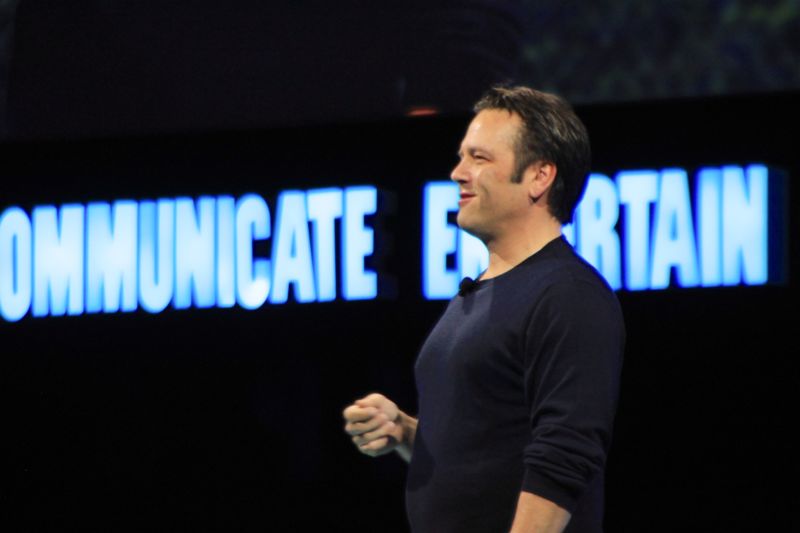
Enlarge/ Microsoft’s Phil Spencer speaks at the DICE conference in Las Vegas.
Kyle Orland
LAS VEGAS—In just over four years as head of Xbox and executive vice president of gaming at Microsoft, Phil Spencer has overseen some tough times for the gaming brand. But he says one of the most difficult lessons he has learned in that time came after a company-hosted Game Developers Conference party that featured scantily clad women dancing on podiums.
That “unequivocally wrong, unequivocally sexist, unequivocally intolerable choice” led to justifiable public backlash, Spencer recalled at a keynote speech at the DICE Summit in Las Vegas this morning, which Ars attended. But, he said, the “internal backlash at my own company was almost harsher.” Instead of sidestepping responsibility, Spencer said he “absorbed the hit” as a leader and used it as an opportunity to “bet on what we stood for… we don’t tolerate any employee or partner that enables or offends others… we stand for inclusivity.”
Doing better
This sort of internal cultural transformation has been a deliberate focus for Microsoft since Satya Nadella became the company’s third-ever CEO roughly four years ago, Spencer said. That company-wide “reboot” was especially necessary in the Xbox group, which Spencer admits was in a “world of pain” since “we hadn’t done our best work with the announce[ment] of the Xbox One. The product we built wasn’t meeting the expectations of our customers, market share was taking a nosedive, and it was painful to read all the headlines.”
Worse than that, though, Spencer said the Xbox employees thought the “management team had gone tone-deaf about what our customers were demanding from us.” Not too surprising considering the kinds of statements Xbox executives were making before Spencer’s promotion.
After fighting through these kinds of corporate culture problems, Spencer said he “personally committed to do better” in building and leading a diverse team where everyone felt trusted and welcome and in building a corporate culture that’s set up for everyone to succeed. That’s not just a nod to inclusivity for some sort of politically correct image’s sake, he said, but a reflection that “study after study after study shows teams with most representation are most creative, most innovative, and most undaunted by problems.”
Spencer gave an example of a diverse team’s benefits from Microsoft’s own Minecraft marketing. While the game’s male protagonist, Steve, was often described as an “architect, designer, or archaeologist,” the marketers usually said the female Alex “liked to build and explore.” It was a female member of the team that pointed out the “subtle but powerful gender distinction” in these kinds of descriptions and led to a more gender-equal marketing for the game.
Small adjustments—like asking quiet members of the team for their opinions and really listening rather than jumping in immediately with supposed answers—can help foster a corporate culture where all types of employees feel welcome to contribute, Spencer said. Microsoft has also focused on subtle bits of workplace culture that influence who applies for jobs and who sticks around long after they’re hired, he said.
Making “gaming for everyone”
Beyond transforming Microsoft’s corporate culture, though, Spencer said he has also focused on making the Xbox more welcoming to gamers in general. With an estimated 2 billion gamers in the world within the next three years and many newcomers coming from countries like Brazil and India, Spencer said the game industry is “going to see increasing opportunity and responsibility to make gaming for everyone.”
That can be a big problem for a lot of gaming communities these days, Spencer pointed out. He cited quotes from gamers who don’t want other players to know they’re black or female when playing online for fear of “vulgar and aggressive” reactions from other players. People harassed in this way start to avoid gaming, and, worse, “start telling others to avoid gaming,” Spencer said.
“The message of these episodes is this: ‘you’re not welcome here,'” he continued. “‘And if you stick around, be ready to deal with any disturbing behavior that comes your way.’ When toxicity is aimed at any of us, it needs to stop with all of us.”
Spencer pointed specifically to Blizzard’s renewed efforts to battle toxicity in the Overwatch community, which he said have already reduced player complaints by 20 percent. The whole industry will have to get behind similar efforts, he said, if gaming is to take its rightful place as “one of the great equalizers and unifiers for society.”
Gaming, he pointed out, is the only art form where we actually “walk in someone else’s shoes and see the world through their eyes” and where players “are on equal footing regardless of age, education, socio-economics, race, religion, politics, gender, orientation, ethnicity, nationality, or ability.” That makes games unique in being able to “bring people together” and create empathy between different cultures, he said, if game creators build worlds with that goal in mind.
“Our reach and impact can be so much greater, if we’re ready,” he said. “Together, we can make gaming a reflection of the world we don’t just want to see, but that we want it to be… The pen might be mightier than the sword, but today, I believe the pixel is mightier than the pen.”
https://arstechnica.com/?p=1263737
Flight-sim devs say hidden password-dump tool was used to fight pirates [Updated]
The usually staid world of professional-grade flight simulations was rocked by controversy over the weekend, with fans accusing mod developer FlightSimLabs (FSLabs) of distributing “malware” with an add-on package for Lockheed Martin’s popular Prepar3d simulation. The developer insists the hidden package was intended as an anti-piracy tool but has removed what it now acknowledges was a “heavy-handed” response to the threat of people stealing its add-on.
The reason for the warning, as crankyrecursion found, was that the installer seemed to be extracting a “test.exe” file that matched a “Chrome Password Dump” tool that can be found online. As the name implies, that tool appears to extract passwords saved in the Chrome Web browser—not something you’d expect to find in a flight-sim add-on. The fact that the installer necessarily needs to run with enhanced permissions increased the security threat from the “Password Dump.”
FSLabs head Lefteris Kalamaras responded to the uproar over the discovery on the company’s forums, arguing that the hidden file does not “reveal any sensitive information of any customer who has legitimately purchased our products” (emphasis in original). The file, he insists, is only activated if the installer sees a serial number that matches a database of pirated numbers found floating around on the Internet. “This method has already successfully provided information that we’re going to use in our ongoing legal battles against such criminals,” he wrote.
In a later update, Kalamaras acknowledges that some users were uncomfortable with “this particular method which might be considered to be a bit heavy-handed on our part.” The company promptly released a new installer without the test.exe code included.
“Heavy handed” sounds like quite an understatement, though, given what we know. Kalamaras’ statement heavily implies that the original installer did, in fact, attempt to obtain password information from users who installed a product they suspected of being pirated (note the specific language that only “legitimate” users didn’t have to worry about their sensitive information being revealed). Whatever your feelings on the ethical and practical implications of piracy, this level of extreme countermeasure is practically unheard of in the PC gaming scene.
The overzealous DRM brings to mind EA’s use of unremovable and intrusive SecuROM software to protect some of its titles in 2008 and Sony’s installation of a system destabilizing rootkit inside audio CDs played on PCs in 2007. Both of those efforts led to multiplelawsuits against the publishers, and those instances didn’t even reveal any of the users’ personal information.
We’ve reached out to FlightSimLabs for comment and will update if and when we hear back.
Update 8:48pm ET: In a follow-up message posted late Monday, Kalamaras confirmed that the suspicious tool included with the installer was intended to extract Chrome Web browser information from those using pirated copies of the game. However, he writes, that tool was only activated in the case of one specific pirate who had been identified as creating and distributing illicit registration keys via an offline key generation tool.
“We even went so far as to figure out exactly who the cracker was (we have his name available upon request of any authorities), but unfortunately we could not be able to enter the registration-only websites he was using to provide this information to other pirates,” Kalamaras writes. “We found through the IP addresses tracked that the particular cracker had used Chrome to contact our servers, so we decided to capture his information directly—and ONLY his information (obviously, we understand now that people got very upset about this—we’re very sorry once again!) as we had a very good idea of what serial number the cracker used in his efforts.”
Using this method, Kalamaras writes, the FSLabs team was able to “dump that cracker’s information needed for us to gain access to those illicit websites, so we could then forward the information to proper legal authorities.” What he and his team found, he writes, was “an entire web of operations” dedicated to pirating multiple flight simulators.
Kalamaras emphasized numerous times in his message that the browser-dumping tool in question “will never execute on your machine” unless you are that one specific, targeted cracker. Nonetheless, he also apologized multiple times for even temporarily placing the inactive tool on users’ hard drives during the installation process and said he understood why people felt their trust had been violated. Any legitimate customers can request a full refund from the company.
“We have already replaced the installer in question and can only promise you that we will do everything in our power to rectify the issue with those who feel offended, as well as never use any such heavy-handed approach in the future,” he writes. “Once again, we humbly apologize!”]
https://arstechnica.com/?p=1262181
Poop Talk docu-comedy flings open bathroom doors, dives into stinky humanity
Enlarge/Poop Talk, loaded with renowned comedians.
Copyright 2017 Comedy Dynamics and Party of Seven Entertainment
For some, a 75-minute film of famous and talented comedians letting rip a steady stream of explicit jokes and messy misadventures involving fecal matter is an easy sell. Sign me up. For others, some pushing and straining may be needed to get them to plop down and watch.
Those hesitant viewers are just the ones the film’s creators are hoping to bag.
With the funny and sometimes cringe-inducing docu-comedy Poop Talk, comedians try—and do—use humor and tales of their deeply personal bodily functions to squeeze out the humanity of it all. The ultimate goal, its creators told Ars, is to flush the stigma associated with the stinky act—not to mention a whole host of gastrointestinal disorders.
“There will be people who just won’t see this film because of the subject matter—and that’s sad,” comedian and executive producer Jason Sklar tells Ars. “In 2018, that is insanity.”
Jason was joined in making this film by his twin brother Randy, also a comedian and executive producer here, along with director and childhood friend Aaron Feldman. With a massive lineup of their comedic peers, they set out to start a conversation about something everybody does, but not everybody talks about.
“We saw in ourselves that we became more comfortable with the topic over time,” Sklar says. “I’m 100-percent more comfortable than I was before, and that’s just fascinating and wonderful.”
Executive Producers Randy and Jason Sklar.
Eric “I don’t poop in public” Stonestreet.
Aisha Tyler impersonates her dad.
Jordan Rubin’s poor dog.
Wait for Kumail Nanjiani to tell you about party cream.
Nicole Byer ventures into dangerous territory.
Rob Corddry talks bidets.
Nikki Glaser goes back to her roots.
Nick Swardson. Brace yourself for this part.
A list on toilet paper.
Adam Carolla has some interesting takes.
Despite now being vocal producers of an unabashedly scatological flick, the Sklars were initially hesitant. It was Feldman who brought up the idea to the comedic duo, known for hosting Cheap Seats on ESPN Classic. About two years ago, Feldman “pulled out, like, a whole packet, and he said, ‘it’s a movie about poop,’” Randy says. “He starts going through it, and we were like, ‘OK, Aaron, I love you man, but I don’t think we can do this. It’s not our brand of comedy’… We said no.”
Feldman didn’t give up. He suggested that they take the weekend to think it over and discuss, which they did. Despite some initial worry about being forever linked to a poop documentary, the brothers couldn’t wash out the idea.
“It’s the most universal thing in the world, but people have a tough time with it,” Randy says. “It’s a taboo subject that people, like, really grapple with talking about. Why is that? That to us was fascinating.” And with their belief that comedians serve as “amateur anthropologists,” they thought, who better to talk about this than their hilarious, comedian friends?
The Sklars went back to Feldman with the idea of creating a film in the style of the cult-classic docu-comedy The Aristocrats—a “very honest, real, funny” piece to open the discussion. Aaron immediately agreed. The result is a 75-minute film of interviews and anecdotes from a long line-up of comedians, including Kumail Nanjiani, Nicole Byer, Aisha Tyler, Adam Carolla, Rob Corddry, Nikki Glaser, Pete Holmes, Eric Stonestreet, and Nick Swardson. The film also includes a few scientific experts, who briefly touch on digestion and bowel movements.
[embedded content]
Poop Talk trailer
For the most part, the film trots through comedic bit after bit, which swirl around the social and cultural issues of poop and pooping. Topics include whether to poop in public bathrooms and how to talk turds on stage, with family members and romantic partners, and across cultures. Also, why don’t Americans use bidets? No really. The film brings up some really good points there.
Almost every imaginable perspective and comfort level is represented. Without giving any of the jokes away, Eric Stonestreet (Modern Family) discusses his aversion to public pooping while Nick Swardson (Reno 911!) recounts making brownies on a friend’s kitchen floor. Aisha Tyler (Whose Line Is It Anyway?) shines with fresh takes and punchy family stories, while Nicole Byer (Loosely Exactly Nicole and the Upright Citizens Brigade) breaches the taboo subject of eating while pinching off a loaf. And the mother Russia story. Gold.
Some serious poop
Whatever your current relationship is with poo, this film will make you laugh. It’ll almost certainly elicit at least one “eww,” as well. But it does so with purpose.
As a health reporter, I would have loved more scientific detail about turds and their formation, which Poop Talk contained in early versions. The Sklars said those segments were largely cut to keep the film snappier, as to not weigh the discussion down with too much detail.
Still, they hope that the film is not just funny but also helpful for people with gastrointestinal issues. As Nikki Glaser points out in the film, those with Crohn’s disease and other inflammatory bowel issues would likely benefit from more open discussion and less shame. The Sklars, who noted that their father died of colon cancer in 2009, echoed the idea. They suggested that more discussion and dialogue may get people to pay more attention to their own health and open up about what they’re experiencing.
“I’m not gonna say that, like, a million more colonoscopies are going to happen after this film,” Jason said. “But I do think that if we get more comfortable talking about it, then maybe… if it saves a few people, then it’s worth it.”
Poop Talk opened in select theaters February 16. The film will also be available on VOD worldwide. Click here for details.
Black Panther reinvents the superhero origin story in a profound way
Wearing the futuristic armor created by his sister Shuri, T’Challa brings some bad guys to justice.
Marvel Studios
He can fight, but can he be a good king?
Marvel Studios
The Dora Milaje, Wakanda’s elite fighting force, is entirely made up of women with vibranium spears.
Marvel Studios
Okoye, general of Wakanda’s warriors, stands with superspy Nakia.
Marvel Studios
T’Challa talks about how to manage Wakanda’s future with best friend W’Kabe. Note that the high-tech city of Wakanda is hidden behind an invisible wall right next to W’Kabe’s farms. Wakanda is a world of urban farming, it seems.
Marvel Studios
Killmonger and T’Challa face off.
Marvel Studios
Shuri is T’Challa’s little sister, who is a brilliant scientist. She’s the one who designed the Panther suit and runs Wakanda’s high tech labs.
Marvel Studios
Here’s another angle of Shuri’s lab, where you can see the hologram/wall screen covered in hexagonal tiles that move almost like feathers when they transform into an image.
Marvel Studios
M’Baku leads one of Wakanda’s tribes and challenges T’Challa’s leadership.
Marvel Studios
A view of the Afro-futurist ecotopia that is Wakanda.
Marvel Studios
This street scene from Wakanda’s city shows us a world where high tech co-exists with tradition.
Marvel Studios
Wakanda’s vibranium mine is packed with labs, maglev trains, amazing flying vehicles, and a lot of insane weapons.
Marvel Studios
Priest’s 1998-2003 run on the Black Panther comics is the inspiration for the movie. Here you can see a typical example of Priest’s humor, where long-suffering Everett Ross is just trying to do his job while techno-magical insanity breaks out.
We’ve all seen a lot of bloated, meandering superhero movies over the past year, stuffed with exhaustingly large super teams and unmemorable villains. So what makes Black Panther a welcome change isn’t just its hero, whose charisma and gravitas are undeniable, but that it is an elegantly structured adventure. The stakes are high, the reveals make sense, and the payoff is satisfying. This is the way superhero movies should be done.
Plus, the secret nation of Wakanda has tech that’s way more inventive than anything Tony Stark has produced lately.
Nation-building
Most audiences met T’Challa (the superlative Chadwick Boseman) during Captain America: Civil War, when a blast at the UN killed the then-prince’s father. Still, Black Panther is very much an origin story. T’Challa has long had the super strength of the Black Panther, which comes from eating the Heart-Shaped Herb that grows out of vibranium caches. Now he needs to take the throne of Wakanda and decide whether his nation will assume a place on the world stage or continue to hide its true nature. All his bad guy challengers, from vibranium thief Klaue (Andy Serkis) to military insurgent Killmonger (Michael B. Jordan, in an equally charismatic performance), are in some sense related to Wakanda’s foreign policy.
Usually a superhero origin story is one of progressive alienation and loneliness: Spider-man has to distance himself from people he loves; Wonder Woman leaves her kingdom on Themiscyra; Hulk has to keep everyone out of his blast radius, etc. But for T’Challa to become Black Panther, he must fully join with the community of Wakanda and guide it in the right direction. In this way, Black Panther offers an interesting counterpoint to Batman and Superman, who have secretive and deeply conflicted relationships to Gotham and Metropolis. T’Challa is the rightful and public leader of Wakanda, and thus his origin story is also fundamentally about how to build a new nation.
This turns out to be a lot harder than hand-to-hand combat. The older generation of Wakandans push for separatism. The nation has kept its culture and technology safe for thousands of years by closing itself off from the world. But Klaue and Killmonger threaten to expose its secrets, leaving Wakanda vulnerable to the predatory colonialism that’s ravaging other African nations. In a sense, the true Big Bad of this film isn’t any one person—and indeed, we wind up feeling some sympathy for Killmonger—it’s the threat of national instability.
This sounds like heady stuff, and it is. But director/co-writer Ryan Coogler and the cast handle it with humor as well as pathos. At one point T’Challa’s mad scientist sister Shuri (Letitia Wright) greets the bemused Everett with a sardonic, “Hello, colonizer!” And though Black Panther tends to be fairly earnest, Killmonger and M’Baku also get a lot of snarky zingers. We never feel like this is a “message” film, even though arguably it is. The light tone and snappy adventure plot pull us through, reminding audiences that this is a story about hope and heroism, not dystopia.
Priest’s Panther
At T’Challa’s side are a ton of outstanding characters: Danai Gurira is tough and regal as Okoye, general of the Dora Milaje, Wakanda’s elite, all-female fighting force; Letitia Wright is sweet and dorky as the geek with a million super-gadgets; Daniel Kaluuya, who won hearts as the lead in Get Out, is excellent as T’Challa’s ambivalent best friend W’Kabi; and Winston Duke steals the show as the grumpy but good-humored M’Baku, who leads Wakanda’s most distant tribal group. On top of all that star power, there’s also Everett K. Ross (Martin Freeman), dubbed “the whitest man in the world” in the comics, playing a good-hearted, befuddled intelligence agent. The more we get to know these characters, the more we realize that the people who question T’Challa the most are often his greatest allies. It’s a nice touch. Wakanda is not a nation of sycophants.
To reinvent Black Panther for the twenty-first century, Coogler relied heavily on the 1998-2003 comics written by Priest. During his run, Priest explored many of the key themes of the film, including T’Challa’s role as king of Wakanda. He introduced the Dora Milaje, who are central to the film’s action, as well as an earlier version of the character M’Baku. And the dorky-but-good intelligence agent Everett K. Ross was Priest’s attempt to create a version of the Friends character Chandler.
We can also thank Priest for bringing nuance to T’Challa’s character. Our hero-king is torn between wanting to protect Wakanda and his deep sense of social justice. Should he focus on protecting his country’s wealth or help the downtrodden people of the African diaspora, suffering throughout the world? To dramatize this, the film sets several pivotal scenes in Oakland, California—where the Black Panther Party was born—and contrasts it with the safe, affluent world of Wakanda.
Wakanda as Utopia
Wakanda is also one of the greatest visual achievements of this film, though not in a way that’s immediately obvious if you’re focused on all the fight scenes and vibranium weapons. As both Coogler and Boseman have noted in interviews, Black Panther is about imagining what amounts to an alternate timeline for Africa, one where its nations developed futuristic technology without any interference from European colonizers.
The result is technology that incorporates common African tribal designs and symbolism as well as traditional ways of life. Wakanda is an Afro-futurist ecotopia, a smart city unlike anything we’ve seen in big-budget movies before. Gleaming skyscrapers and maglev trains co-exist with pastoral herdsmen and packed-earth streets. Machine interfaces use vivid colors (none of Apple’s muted metals here), and holographic displays seem to rustle like feathers as they transform.
As I mentioned earlier, it’s interesting to compare this city with Gotham or even Metropolis, both of which have become tattered, dirty, crumbling messes in recent films. Black Panther shows us what true, uncompromising heroism looks like, but it also tries to suggest what a good society would look like, too. The place feels lived in and real, not like some sparkly place in Asgard. When you watch this movie, take a moment to savor what we see of Wakanda—it’s a rare attempt to represent Utopia at a time when most superhero movies have gone grimdark.
Ultimately, T’Challa has to do more than just keep Utopia clean. Thanks to their rich vibranium mine, Wakanda’s science and technology have developed at a much faster rate than other parts of the world. They have healing pods that look like cooler versions of a Star Trek medical bay and an AR system that lets you “drive” any vehicle (including fighter jets) from Shuri’s lab. Plus, they can build ultra-strong armor that pops out of a necklace.
If T’Challa decides to show Wakanda to the world, his nation will likely become the new “developed world,” and Europe will fall behind. Beneath every vibranium-tinged struggle and every boss fight lurks a question about the moral duty of a nation. Should its leader hide behind “Wakanda First” and keep its riches for himself? Or, should he give what he can to make the entire world a better place?
Thanks to this smart, deftly told yarn, we get satisfying and complex answers. And we’re left wanting more—all hail the new King of Wakanda!
Listing image by Marvel Studios
https://arstechnica.com/?p=1261319
Atari stock jumps 52% on plans for nostalgia-backed cryptocurrencies
The venerable Atari 2600.
Atari SA—the shambling corpse holding company that shares a name with the company that made Pong and the Atari 2600 decades ago—has seen its stock price soar after lending its brand to a couple of ill-defined cryptocurrency efforts.
The French holding company announced last week that it had traded use of its name for a 15 percent stake in Gibraltar-based Infinity Networks, which will create a cryptocurrency-based “Atari Token” platform that could be used to pay for various kinds of “digital entertainment.” Atari is also planning to extend its existing partnership with online casino maker Pariplay to create a separate “Pong Token” that will be accepted in “crypto-casinos.”
“Given our technological strengths with the development studios, and the global reputation of the Atari brand, we have the opportunity to position ourselves attractively in this sector,” Atari Chairman and Chief Executive Officer Frederic Chesnais said in a statement.
If the name “Atari Token” sounds familiar, it might be because the firm previously used that name for its own cross-platform reward points system which could be used to fuel in-game microtransactions. The reuse of the name seems coincidental at this point, though it’s possible that the old Atari Tokens could be folded into the new Atari Token brand somehow.
A jump onto the cryptocurrency bandwagon isn’t shocking for the company now known as Atari, which seems to form the bulk of its business by trading on the nostalgia value of its brand names. The company has loaned out its name for a Linux-based crowdfunded console, an Atari-branded speaker hat, and a line of Internet of Things devices in recent months.
In the wake of a shooting that left at least 17 dead on Wednesday in a high school outside Boca Raton, Florida, Kentucky Governor Matt Bevin (R) focused on violent video games as part of a “culture of death that is being celebrated” and leading to these kinds of incidents.
“There are video games that, yes, are listed for mature audiences, but kids play them and everybody knows it, and there’s nothing to prevent the child from playing them,” Bevin said in an interview on WHAS’ Leland Conway show Thursday morning. “They celebrate the slaughtering of people. There are games that literally replicate and give people the ability to score points for doing the very same thing that these students are doing inside of schools, where you get extra points for finishing someone off who’s lying there begging for their life.”
“These are quote-unquote video games, and they’re forced down our throats under the guise of protected speech,” Conway continued, seemingly referring to a 2011 Supreme Court decision that prevents content-based restrictions on games. “It’s garbage. It’s the same as pornography. They have desensitized people to the value of human life, to the dignity of women, to the dignity of human decency. We’re reaping what we’ve sown here.”
When Conway asked if Bevin was interested in a ban on these types of games or merely more parental oversight of children’s access, Bevin asked for media producers to take some responsibility for their works. “I think we need to start by having an honest question about what value any of these things add,” he said. “Why do we need a video game, for example, that encourages people to kill people. Whether it’s lyrics, whether it’s TV shows, whether it’s movies, I’m asking the producers of these products, these video games and these movies, ask yourselves what redemptive value, other than shock value, other than the hope you’ll make a couple of bucks off it. At what price? At what price?”
Video games and other cultural products were part of a long list of causes Bevin suggested for the increase in school shootings and the nation’s loss of its “moral compass.” Parents, churches, and schools have all abdicated their responsibility to “hold children to task,” he said, leading kids to “make their own rules without fear of consequences.” He also made brief reference to the prevalence of medications and their harmful side effects as a potential cause.
Bevin recalled that children used to regularly bring guns to school after Christmas when he was a child but said it’s changes to society that have led to those children using those guns in schools today. “We as adults have to stop acting like children ourselves. We need to step up and say that right is right and wrong is wrong.”
This isn’t the first time Bevin has cited video games as a partial cause of school violence. In a Facebook video posted days after a January school shooting in Benton, Kentucky, Bevin included video games as part of the entertainment industry “filth” that is “desensitizing young people to the actual tragic reality and permanency of death.”
Games have been a favored explanation for school shootings and other youth violence among many commentators at least since the shooters in the 1999 Columbine massacre were revealed to be fans of Doom. Some media reports focused on the 2007 Virginia Tech shooter’s love of Counter-Strike, and a Norwegian mass shooter claimed at his trial that he had trained for his rampage using Call of Duty: Modern Warfare 2.
Florida lawyer Jack Thompson was one of the loudest proponents of the link between video games and real-world violence for years before he was disbarred in disgrace in 2008. But violent video games as a potential cause of real shootings is an idea that has been floated in some form by everyone from the NRA to President Obama over the years.
Science aside, video games and other violent media will likely be a focus for many politicians and commentators looking for an explanation for this latest bout of violence in the coming days. International statistical comparisons, though, suggest that the prevalence of guns in the United States is more closely correlated with these kinds of mass shootings.
https://arstechnica.com/?p=1260967
Valve bans developer after employees leave fake user reviews
Enlarge/ Insel’s Wild Buster is one of the games that has been removed from Steam after evidence of user review faking was found.
Insel Games, a Maltese developer of online multiplayer titles, has been banned from Steam and had all its titles removed from Valve’s storefront after evidence surfaced that it was encouraging employees to manipulate user review scores on the service.
Yesterday, redditor nuttinbutruth posted a purported leaked email from Insel Games’ CEO encouraging employees to buy reimbursed copies of the game in order to leave a Steam review. “Of course I cannot force you to write a review (let alone tell you what to write)—but I should not have to,” the email reads. “Neglecting the importance of reviews will ultimately cost jobs. If [Wild Busters] fails, Insel fails… and then we will all have no jobs next year.”
In a message later in the day, Valve said it had investigated the claims in the Reddit post and “identified unacceptable behavior involving multiple Steam accounts controlled by the publisher of this game. The publisher appears to have used multiple Steam accounts to post positive reviews for their own games. This is a clear violation of our review policy and something we take very seriously.”
While Valve has ended its business relationship with Insel Games, users who previously purchased the company’s games on Steam will still be able to use them.
Refining the system
Insel Games is a relatively minor publisher in the grand scheme of the Steam market, with only three titles and top sales measured in the tens of thousands, according to Steam Spy estimates. Still, the company’s Steam ban reflects on Valve’s continuing efforts to clean up the highly manipulable world of user reviews.
“These are your most loyal fans and so you’re cutting them away from the sampling pool,” Larian Studios’ Swen Vincke told Rock Paper Shotgun in the wake of that change. “That doesn’t really feel fair. We have 42K backers whose opinion will be hidden behind a filter and not be accounted for in the score.”
User reviews can have a serious impact on Steam developers’ bottom line, as evidenced by one developer who sued customers for bad reviews and was banned for the practice in 2016. As long as that financial impact is there, Valve will be fighting off ever more clever attempts to game the system and manufacture fake buzz where none actually exists.https://arstechnica.com/?p=1260033
American Horror Story creator to call Netflix home in multimillion-dollar deal
Netflix’s latest content grab ushers the mind behind Nip/Tuck, Glee, and American Horror Story into the company. The streaming giant announced that it has penned an exclusive five-year film and series deal with writer-director-producer Ryan Murphy. According to some reports, the deal is worth as much as $300 million.
Murphy will officially start at Netflix on July 1, 2018. While most of the ideas Murphy will bring to Netflix users’ screens are as yet unannounced, the company has already scored the rights to two of his forthcoming series: Ratched, a drama series about the notorious nurse from One Flew Over the Cuckoo’s Nest, and The Politician, a comedy series that could star Barbra Streisand and Gwyneth Paltrow.
Despite the move to Netflix, Murphy will continue to oversee his shows currently in production on Fox and FX, as well as an upcoming FX drama series called Pose, which focuses on the transgender community in 1980s New York.
Murphy is no stranger to Netflix, as some of his shows—including Nip/Tuck and American Horror Story—already stream on the site. But now his new creations will live on Netflix exclusively for the next few years, which Netflix undoubtably hopes will encourage loyal fans of his work to subscribe to the content provider.
“Ryan Murphy’s series have influenced the global cultural zeitgeist, reinvented genres and changed the course of television history. His unfaltering dedication to excellence and to give voice to the underrepresented, to showcase a unique perspective or just to shock the hell out of us, permeates his genre-shattering work,” said Netflix Chief Content Officer Ted Sarandos.
Murphy’s move to Netflix comes months after the company also poached Shonda Rhimes away from her longtime home network ABC. Rhimes, creator of Grey’s Anatomy, Scandal, and How to Get Away with Murder, said Netflix allows her to provide a “vibrant new storytelling home for writers” with “unique creative freedom.” Like Murphy, Rhimes continues to oversee her currently running shows on ABC even after signing with Netflix.
Disney’s involvement on two fronts makes Murphy’s move to Netflix particularly telling. Disney CEO Bob Iger tried to court Murphy to stay with the company after the news broke of Disney acquiring many 21st Century Fox assets. All of Murphy’s existing series run on Fox and FX, networks that would be controlled by Disney if the deal goes through. Murphy was reportedly uncomfortable about the Disney deal after it was announced, as were others in the industry.
Disney also plans to remove its content from Netflix in 2019 and launch its own streaming service. At the time of the initial announcement, the company said Disney and Pixar content would leave Netflix and live exclusively on Disney’s new service. Shortly after, the company confirmed that Star Wars and Marvel content will also be pulled from Netflix come 2019. Netflix has been scooping up content and creators rapidly as of late, and now the company must do so for two big reasons: to bolster all the original content it wants to produce in the coming years and to stay competitive as companies like Disney, Apple, Amazon, and others do their best to further fragment the streaming market and lock their hot properties behind their own proprietary streaming services.