Another Star Wars movie series is coming—from Game of Thrones‘ showrunners
Enlarge/ David Benioff and D.B. Weiss, newly announced as writers and producers of another Star Wars film series.
How many Star Wars film series do you think you can stomach?
Ahead of the current trilogy’s conclusion—and before we even see a glimpse of Rian Johnson’s upcoming, separate-storyline trilogy project—the powers that be at Lucasfilm announced another Star Wars film series on Tuesday. The news is light on details, save an important detail: this trilogy will be helmed by current Game of Thrones showrunners David Benioff and D.B. Weiss.
The official announcement includes praise from Lucasfilm president Kathleen Kennedy, along with Benioff and Weiss admitting to feeling a mix of “honored” and “terrified” by their newest gig. The two confirmed that their work on Star Wars films as writers and producers will begin once the final season of HBO’s Game of Thrones wraps. HBO announced last month that fans will have to wait until 2019 to see that series’ conclusion, so the duo has a little ways to go before going full-steam into a world of Midi-chlorians.
Every official Star Wars channel took a Tuesday opportunity to make GoT references, including a Twitter call to “send a raven” and the announcement’s joke that “there have (thankfully) been no sightings of White Walkers around Lucasfilm.” How much the duo’s Star Wars project will resemble GoT‘s mix of violence, social hierarchy, and characters dying every which-way obviously remains to be seen, as no dates or other information have yet been revealed.
This news, of course, comes quickly after we laid eyes on a brand-new trailer for Solo: A Han Solo Story. A shorter teaser trailer debuted during Super Bowl LII and was followed by a longer, dialogue-filled version the following day.
https://arstechnica.com/?p=1255605
Charges filed, details emerge for arrest of Counter-Strike’s co-creator
Enlarge/ Jess Cliffe in 2017, talking about the development of the original version of the video game Counter-Strike.
Following an arrest in Seattle last week, the co-creator of the video game series Counter-Strike has now been formally charged with the crime of commercial sexual abuse of a minor.
The King County Prosecutor’s Office issued the charge to 36-year-old game developer and Valve Software employee Jess Cliffe on Monday, alongside the release of a statement of probable cause. This document repeats many details from Friday’s bail hearing at a King County courthouse, which initially disclosed accusations of multiple instances of sexual contact with a minor, along with one instance of videotaping an encounter.
The listed “juvenile victim” was 16 years old at the time of the alleged incidents, and she was initially referred to Seattle Police by Child Protective Services due to “reports of CSEC [Commercial Sexual Exploitation of Children] activities.” The woman (who has not been identified by Seattle Police) explained that she had used the website SeekingArrangement.com to “meet with men who offered to pay her money to have sex with her.” Subscriber information for the phone number of one man matched Cliffe’s name and home address.
As mentioned in the bail hearing, the alleged victim accused Cliffe of filming their final sexual encounter without her consent. Monday’s statement noted what she told investigators happened after that encounter: in a car ride back to her neighborhood, the alleged victim mentioned the potential illegality of their arrangement (to which Cliffe allegedly “countered that it was technically legal as he was paying her for her time”). Then she almost accused him in that car ride of filming child pornography. She “decided against it as to not upset him in addition to the fact that he could not be certain that he was aware of her true age of 16 years,” she told investigators.
Police eventually served warrants to AT&T, Verizon, and SeekingArrangement.com, which revealed messages sent between Cliffe and the alleged victim on June 5 and 6 of last year and photos that matched Cliffe’s appearance. Police went to Cliffe’s home on the night of January 31 to inform him he was “named in an assault investigation,” and he met investigators hours later.
After being informed of his Miranda rights, Cliffe confirmed to investigators his use of multiple websites to arrange dates with women, and that, in some cases, those included “arrangements” that included “payment for their time.” (He described one of those sites’ URLs as SugarDaddyArrangement.com, which investigators had not tracked at the time.) He denied recognizing photos of the alleged victim.
Moments later, Cliffe was presented with message logs sent by his accounts to the woman, and he said he “was unable to recall or connect the communications or any other recollections to photographs” of her. Still, he corroborated enough of the information that investigators had already established, including the alleged victim’s physical description, some of her personal background details, and the logistics of how the date began and ended. All this established “probable cause” in the eyes of King County investigators. (In his description of the alleged victim, Cliffe told investigators that the woman “appeared to be 23 years old.”)
Cliffe’s next hearing is scheduled for February 25. He has posted $150,000 bail. Cliffe continues to be suspended from his employment at Valve Software, and the company has not responded to requests for comment since confirming Cliffe’s suspension to Ars last week.
https://arstechnica.com/?p=1255033
Han Solo film finally has a trailer, complete with Millennium Falcon and a Wookiee
We’re confident that this is indeed proof of Chewie in Solo.
Enter Solo, seen here through shadows as played by Alden Ehrenreich.
Donald Glover, all cozy-lookin’ as Lando Calrissian.
Say hi to Tobias Beckett, the character played in this film by Woody Harrelson.
A snowy journey of some sort.
It’s hard to see, but we swear that this is the Millennium Falcon in motion.
As predicted by many a hopeful Star Wars fan, this year’s Super Bowl LII included the world’s first look at the upcoming 2018 film Solo: A Star Wars Story.
The 45-second “teaser” trailer comes packed with just about everything you need to confirm that this is indeed a film about a younger Han Solo: flashes of a Millennium Falcon; an Imperial base that Solo has somehow infiltrated while making promises of becoming “the best pilot in the galaxy”; and brief-but-clear shots of iconic characters such as Lando Calrissian (played by Donald Glover) and a big, might-be-Chewbacca Wookiee.
We also see glimpses of other actors, like Woody Harrelson’s Star Wars universe debut as Tobias Beckett and Emilia Clarke (Game of Thrones) as Qi’Ra. The trailer also showed some action-filled sequences, including one intriguing shot of a massive supertrain gliding along a snowy track. But this teaser lacks clearer stretches of dialogue or hints at a plot angle. We can only hope that a promised Monday trailer will answer more questions before this film reaches movie theaters on May 28, 2018 (Memorial Day in the United States).
[embedded content]
Solo: A Han Solo Story world premiere teaser trailer
https://arstechnica.com/?p=1254243
The funniest, most accessible book on rocket science is being reissued
Enlarge/ On Jan. 10, 2013, the Saturn V F-1 gas generator completed a 20-second hot-fire test. Engineers are completing a series of tests at Test Stand 116 located in the East Test Area at NASA’s Marshall Space Flight Center in Huntsville, Ala.
It’s rare that a book about as high-minded and serious a topic as rocket science manages to be both highly informative and laugh-out-loud funny. But if there’s a better way to describe John Clark’s Ignition!, I’ve yet to discover it. A cult classic among chemists, many of the rest of us discovered the book via one of Derek Lowe’s tales of hilariously scary chemicals.
It’s where I learned words like hypergolic, which describes how eager one chemical is to spontaneously ignite, and realized that some of these mid-century scientists must have had as much right stuff as any test pilot. But there was hitch—Ignition! was out of print, so reading it involved an interlibrary loan (or a dodgy PDF, which of course I can’t condone).
But now, Rutgers University Press has decided to dust it off and reissue it. From May it will finally be possible to put a physical copy on one’s bookshelf. And honestly, if you’ve got any interest in chemistry—particularly the branch of it involving violent, energetic, and occasionally explosive reactions—it’s a book you need to read.
Ignition! is a history of liquid rocket propellants, but it’s also a history of cold war and the space race, told from a particular point of view. Clark was the chief chemist at a rocket lab in New Jersey, operated first by the US Navy, then US Army. He was a central figure in what was a relatively small field, one with a definite purpose. This wasn’t science just for science’s sake, but a quest to find new oxidizers and fuels for rocket engines, to make better missiles or space probes.
The propellants being asked for would have to be liquids throughout a range of temperatures, and preferably completely innocuous and easily stored until reacting violently together upon combination. However, if you guessed that many of the chemicals suitable for energetic reactions in a rocket often tend to react energetically in many other situations—often with no provocation at all—Clark’s tales of “catastrophic self-disassembly” might not be entirely surprising.
The dry wit with which he recounts these history lessons will be the bigger shock, for this is a truly funny read. He snipes about the US’ failure to use the metric system, grumbles about then-new computers in a way that would still be familiar today, and numerous anecdotes have reduced me to tears. (The story about an Admiral who wanted Clark’s Naval Air Rocket Test Section to drop a rat—sex not specified—into a 10,000-gallon tank of 90 percent hydrogen peroxide is a good one, as is the one about the rocket scientist sitting next to Scott Crossfield on an airplane.) That humor helps the accessibility, and as long as you remember some high school chemistry you shouldn’t have a problem with the science either.
Some of his predictions for the field, made in 1971 after retiring from what by then was called then Liquid Rocket Propulsion Laboratory of Picatinny Arsenal, didn’t stand the test of time. The US didn’t field another liquid-fueled ICBM, nuclear rockets turned out to have an insurmountable environmental problem, and hydrogen did indeed have a first-stage role in the Space Shuttle. But I think it’s fair to cut him a little slack here; after all, this is rocket science we’re talking about.https://arstechnica.com/?p=1254205
Donkey Kong scoreboard strips Billy Mitchell’s high score claims
Enlarge/ Mitchell rides an oversized Donkey Kong machine in the recent Citrus Bowl parade.
Billy Mitchell has been a polarizing figure in the tight-knit world of classic video game high scores since well before he appeared as Steve Wiebe’s antagonist in the 2007 documentary The King of Kong: A Fistful of Quarters. But the Mitchell doubters got some strong new support on Friday as the Donkey Kong Forum—a popular clearinghouse for tracking performance in the game—removed Mitchell’s best claimed scores from its high-score list.
In a detailed post on the Donkey Kong Forum justifying the decision, moderator and scoreboard maintainer Jeremy “Xelnia” Young cites video evidence to suggest that three 1,000,000+ point scores presented by Mitchell were actually set using emulation rather than actual arcade hardware, as Mitchell claimed.
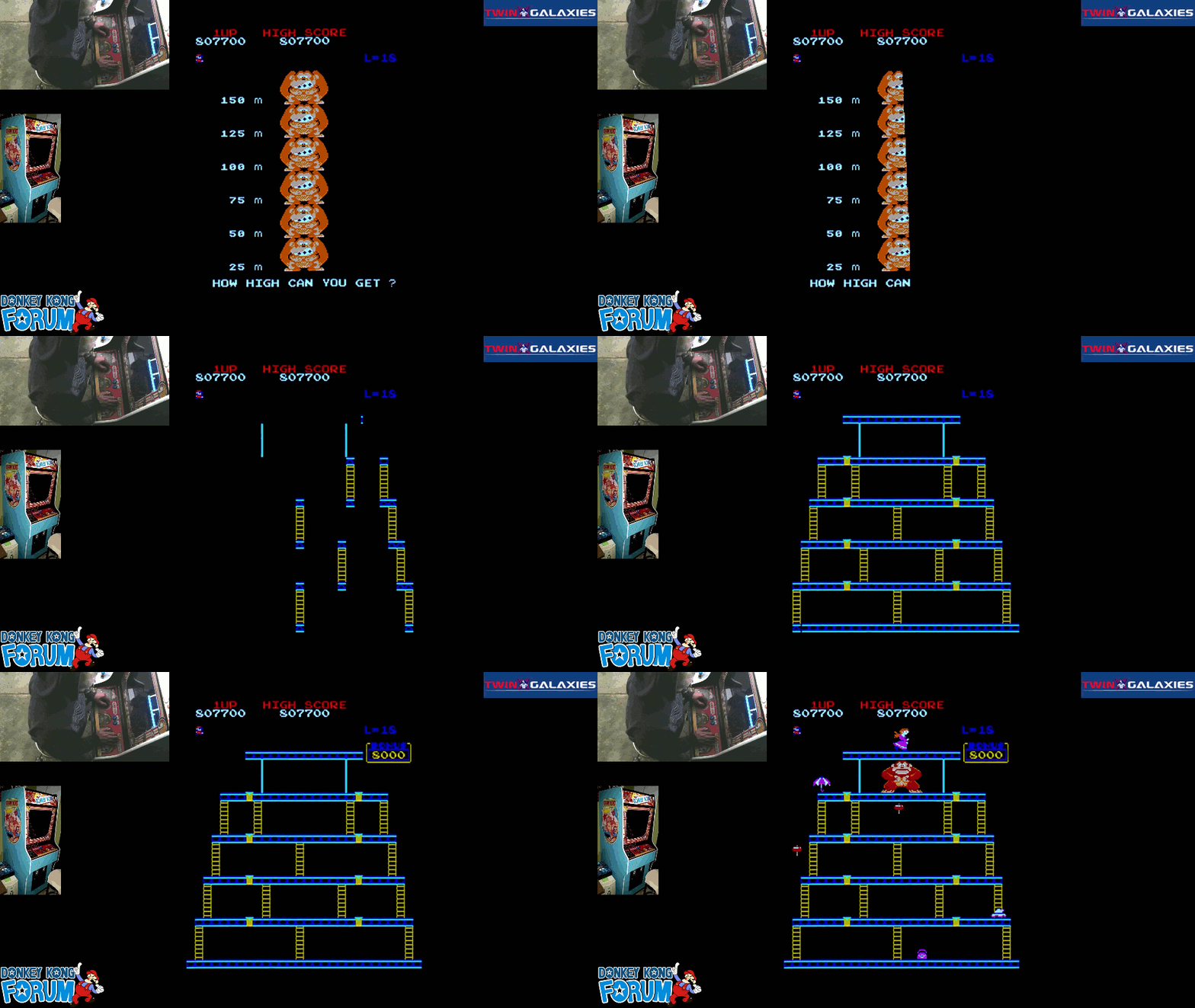
Footage captured from MAME version 0.115 shows the stage being built in whole chunks.
Enlarge/ Direct-feed footage captured by Chris Gleed shows how an actual Donkey Kong cabinet renders a new stage (click for animation).
Enlarge/ Footage from Billy Mitchell’s 1.05 million point claim seems to resemble the MAME footage (click for animation).
While a real Donkey Kong cabinet generates and displays game scenes in a “sliding door” effect, sliding from one side to the other, old versions of MAME instead build entire chunks of a level at once and then display them as a complete screen buffer (with slight differences as MAME has been updated over the years). The difference is noticeable in slow-motion, frame-by-frame analysis of the transitions between Donkey Kong levels. In the analysis, a new stage is first built in pieces after the “How High Can You Get?” interludes.
Comparing slow-motion footage of Mitchell’s videos with those from MAME and authentic cabinets, Young writes, “show that each of the Donkey Kong world record direct-feed recordings presented by Billy Mitchell and verified by TG were generated in MAME and not by original Donkey Kong hardware.”
“The preponderance of evidence”
The difference between a MAME-set record and one set on an authentic Donkey Kong printed circuit board isn’t academic. Besides important differences in timing and controls between the two, MAME allows players to easily record and replay inputs to piece together a record-breaking run from multiple attempts. While there’s no direct evidence that Mitchell did this kind of rerecording, presenting a MAME run as actual arcade gameplay would certainly introduce the possibility of such cheating.
Young cites other reasons to doubt Mitchell’s score submissions. While Mitchell claims all of his 1M+ point scores came from “direct feed” off an actual Donkey Kong cabinet, setting up such a direct output from the ancient arcade hardware requires an incredibly complex setup, as laid out by Donkey Kong streamer Chris Gleed. This is why most Donkey Kong scores are confirmed in front of a live audience or using a video camera pointed at the screen, which can also have the benefit of showing the player at the cabinet at the same time.
There is no such footage of Mitchell actually at the controls of a real machine during his three claimed 1M+ point games, including the infamous “surprise” footage presented in a climactic scene in The King of Kong. What’s more, there are some significant questions regarding the circumstances under which each score was supposedly created.
A screen recording of Mitchell’s highest claimed DK score of 1.062 million points was only shown publicly at a short press conference event put on by the International Video Game Hall of Fame. The authenticity of that record is mainly propped up by testimony of Todd Rogers, who was recently banned from gaming high-score board Twin Galaxies after evidence he had lied about a long-standing Dragster record on the Atari 2600.
“Scores already on the board are always subject to review, and if the preponderance of evidence is against [one score], than the score should be removed, even if no single bit of evidence is a ‘smoking gun,'” Young writes in the Donkey Kong Forum post. “In my view, we have reached that point with Billy Mitchell.”
Fall of a giant?
Mitchell’s various gaming achievements, braggadocious style, and signature American flag tie have made him one of the most recognizable (and parodied) professional gamers for years before esports were even a real thing. His biggest claim to fame in the gaming community remains playing the first perfect game of Pac-Man, an undisputed record which he achieved in 1999. But Donkey Kong has become a big part of his public persona in recent years, including a ride on a giant Donkey Kong machine at December’s Citrus Bowl parade.
While Mitchell’s Donkey Kong scores were impressive at the time he claimed them, they’ve since been surpassed in video-verified runs by numerous players. Mitchell’s highest claimed score only ranked at No. 20 on the Donkey Kong Forum rankings before being removed. As it stands, Mitchell’s highest confirmed score—an impressive 933,900-point performance achieved in front of multiple witnesses at Midwest Gaming Classic in 2004—is the 47th highest score listed on the site.
Mitchell has not responded to a request for comment from Ars Technica. Twin Galaxies—a long-standing video game high-score authority recognized by the Guinness Book of World Records—responded via a forum post by commissioner Dave Hawksett. He wrote that “Time will be needed for Twin Galaxies to fully review this evidence. We will do this thoroughly and impartially. In the meantime we will continue to observe this discussion by experts in our community.”
Incidentally, Wes Copeland’s 1.218 million-point Donkey Kong game—referred to by some as a perfect game of Donkey Kong when it was achieved as a new high score in 2016—was surpassed in December with a 1.247 million-point game from Robbie Lakeman. Both of those amazing scores have direct video evidence showing the players performing on actual arcade cabinets, yet another way they seem to be in a different class from those of the storied Billy Mitchell.https://arstechnica.com/?p=1254113
“A risk to the community”—Counter-Strike co-creator faces $150K bail post-arrest
SEATTLE—Counter-Strike video game co-creator Jess Cliffe appeared in a King County courtroom on Friday, where his bail was set for $150,000 following his booking in a King County jail on Thursday over allegations of sexual exploitation of a minor.
The bail figure was set following a request by the King County Prosecuting Attorney’s office to set bail at $250,000 “for the community’s safety and the victim’s safety.” The office, represented by Nyoko Maraire, described its findings of probable cause when requesting that bail figure: Cliffe allegedly contacted at least one minor via a website, who he paid for sex “multiple times.” In one encounter, Cliffe purportedly videotaped his sexual contact with this unnamed witness “against her will.” After that encounter, the unnamed witness “stopped contact between the parties,” the prosecutor alleged.
Maraire did not provide further details about the witness, how exactly the two parties met, or whether Cliffe was specifically made aware of her status as a minor.
“Even if the facts are true as claimed, this was a meeting on an adult website,” Cliffe’s defense attorney Zachary Wagnild said when requesting that no bail be set for his client. “He was not looking for underage women and had no idea this woman was underage.” Wagnild confirmed that his client and the witness indeed had sexual relations, adding that the witness had “said [Cliffe] was very nice.” This request for zero bail also claimed Cliffe was not a flight risk and pointed out that he was a longtime Seattle homeowner with his girlfriend, who was in attendance at the hearing.
Enlarge/ Jess Cliffe in 2017, talking about the development of the original version of the video game Counter-Strike.
Valve Software
The 36-year-old Cliffe was clad in an all-red jumpsuit and plastic slippers. He did not speak at the hearing. Wagnild requested that any media present not take photos or videos of his client’s face. Pro Tem Judge Rod Benjamin upheld this request, pointing out that Cliffe has “not been charged with a crime at this point.”
Judge Benjamin set the $150,000 figure and described Cliffe as a “risk to the community based on these findings.” A no-contact order was set between Cliffe and the witness, and the order is set to expire February 23. Judge Benjamin also upheld the prosecutor’s additional request that Cliffe be ordered to not possess firearms for the same amount of time.
Cliffe’s next King County court appearance has been set for Monday, February 5. He had not posted paid bail as of press time. Valve Software had announced following Cliffe’s Thursday arrest that he had been “suspended” until further notice. Valve representatives did not immediately respond to request for comment about Friday’s hearing.
https://arstechnica.com/?p=1253965
YouTube TV subscribers can now watch live TV on Apple TV, Roku devices
Nearly a year after its debut, YouTube TV is available on two huge streaming platforms: Apple TV and Roku. The streaming video company announced that dedicated YouTube TV channels for Apple’s set-top box and Roku devices are now available for subscribers to download. While you can’t sign up for a new YouTube TV subscription on either app, current subscribers can sign in to their accounts and watch live TV on those devices.
The new additions come after months of delay—YouTube initially planned to push out the YouTube TV app for Apple TV and Roku at the end of last year. In October, YouTube TV hit Xbox One and Android TV devices, but the company pushed back the rollout for Apple TV and Roku into the first quarter of 2018. The YouTube TV channel is ready to download on 4th-generation Apple TV devices, Apple TV 4K, all Roku TVs, and most Roku streaming devices. YouTube TV’s help page lists all supported device models.
YouTube TV is the company’s live TV streaming service that charges $35 per month for access to over 40 live TV channels including ABC, NBC, CBS, FOX, FX, ESPN, FS1, SyFy, USA, and others. It also includes a Cloud DVR service that lets you record an unlimited number of shows, as well as the option to create a total of six user accounts, each with personalized TV recommendations and DVR content.
Noticeably absent from YouTube TV’s supported devices list are any Amazon set-top boxes or streaming sticks. Google and Amazon have been feuding for some time now, with Google removing YouTube access from Amazon’s Echo Show smart speaker last year. Shortly after, Google announced it would remove YouTube from all of Amazon’s Fire TV devices in 2018, making it nearly impossible for Fire TV users to watch the most popular source of online video. Amazon hasn’t played nicely with Google devices either, as it never carried Google Home devices and stopped selling Chromecasts in 2015. With this ongoing feud, it’s unlikely that YouTube TV will roll out on Amazon devices anytime soon.
https://arstechnica.com/?p=1253659
Has the PS4 peaked? Annual console shipments are flat for 2017 [Updated]
Fig. 1: The flattening of PS4’s annual shipments is right on schedule for the PlayStation family.
Fig. 2: If the PS4’s annual shipments have peaked, it still likely has a few more good years before sales really start to fall off a cliff.
Fig. 3: The PS4 is slightly outpacing the PS1 and PS2 in launch-aligned lifetime shipments, but the future trajectory is uncertain.
Update: The original piece below conflated console shipments to stores with actual sales of consoles to consumers. All the numbers discussed in this piece are shipment figures as reported by Sony in quarterly earnings reports. Other reports focused on sellthrough show slight growth for the PS4 in 2017, owing to differences in when units are shipped and when they are sold to consumers. Ars regrets any confusion.
Original Story
After the relative disappointment of the PlayStation 3, the PS4 has been an unquestioned sales success for Sony. The system has raced to ship an impressive 76 million units worldwide through the end of 2017, and it maintains a dominant position over the Xbox One in the high-end console sales race (though Microsoft claims not to care very much about that relative positioning).
But Sony’s quarterly earnings report last night contained a bit of a gray cloud for the PS4’s longer-term prospects. For the first time since its launch, shipments for the PS4 in the all-important holiday quarter were down year over year, from 9.7 million in 2016 to 9 million in 2017. The decline means calendar year shipments for the PS4 were flat from 2016 to 2017, sitting steady at 19.4 million.
It seems likely that Sony’s annual shipments for the PS4 will never climb higher than that number based on historical analysis. Looking back over the trajectories for the last three PlayStation systems, annual shipments tend to peak after the system’s third or fourth full calendar year on the market (not counting the partial launch year; varied launch dates throughout the year make precise day-and-date-aligned comparisons a bit tricky). With the end of 2017, the PS4 has reached the end of its fourth full year on the market, and the console seems set to begin its long decline in annual sales (Fig. 1).
That’s not to say the PS4 is going away any time soon. The system will likely drop off from its peak slowly over the next few years before hitting a market near-saturation point where relative annual shipments fall more precipitously (Fig. 2). PS4 software sales will likely continue to increase as the base of players with systems in the home continues to grow, too.
Generationally speaking, though, we’ve probably hit the functional midpoint of the PS4’s shipping cycle if history is any guide.
What sales may come
Of course, things might be different this time around. The late 2016 launch of the PS4 Pro could fundamentally shift the market, giving the PS4 family longer legs and a higher peak than previous generations. A surprise killer app could push PS4 sales to unexpected new heights in the coming year, too, as games like Nintendogs and Pokemon have done for Nintendo portables.
More likely, however, the PS4’s shipment peak starts the long countdown to the PlayStation 5, which history suggests should restart the cycle of console boom and bust in the next three or four years (that’s assuming that Sony doesn’t keep the current generation limping along with some sort of PS4 SuperPro, of course). How soon Sony decides to pull the trigger on that hardware refresh depends a lot on how quickly the PS4’s sales pace drops from here on out.
If the PS4 has peaked, it does so at a slightly lower annual shipment level than either the PS1 or PS2 (though that’s after the PS4 sold much faster than either out of the gate). Direct comparisons of total units sold can be a bit tricky in retrospect—both the PS1 and PS2 faced less serious competition from other console makers, but the total size of the console gaming population was also smaller during their heyday.
Thus far, however, the PS4 has shipped slightly more both the PS1 and PS2 at roughly the same point in their lifetimes (Fig. 3). Whether Sony’s latest console goes on to become its best selling ever depends on just how quickly shipments drop from what is likely a current annual peak. In any case, the PS4 is already on the verge of outpacing the PS3’s lifetime shipments,with plenty of good years left on the clock.
(Note: Late-term PS3 shipments in the above charts are estimated from spotty quarterly shipment data released by Sony late in the system’s life.)
https://arstechnica.com/?p=1253661
YouTube will put disclaimers on state-funded broadcasts to fight propaganda
Valentina Palladino
YouTube’s latest strategy to fight the spread of misinformation involves putting a disclaimer on videos from certain news sources. The online video website announced it will start labeling videos posted by state-funded broadcasters to alert viewers that the content is, in some part, funded by a government source. YouTube will begin labeling videos today, and the policy extends to outlets including the US’s Public Broadcasting Service (PBS) and the Russian government broadcaster RT.
According to a report by The Wall Street Journal, PBS videos will now have the label “publicly funded American broadcaster,” while RT will have this disclaimer: “RT is funded in whole or in part by the Russian government.”
The new policy is YouTube’s way of informing viewers about where the content they’re watching is coming from, a piece of information often hidden or left unsought by the viewers themselves. “The principle here is to provide more information to our users, and let our users make the judgment themselves, as opposed to us being in the business of providing any sort of editorial judgment on any of these things ourselves,” YouTube Chief Product Officer Neal Mohan told the WSJ.
While providing more information about the source from which viewers get their news on YouTube is helpful, Mohan’s sentiment is at odds with another strategy currently in development: YouTube is reportedly considering surfacing “relevant videos from credible news sources” when conspiracy theory videos pop up about a specific topic. For now, YouTube will reserve editorial judgement—until it starts deciding which news sources are deemed credible on its website. However, we don’t know if this strategy will become a reality anytime soon, as it’s still in the early development stages.
YouTube’s decision to label all state-funded news videos comes after heavy criticism from the US government and others about big tech companies’ involvement in the spread of misinformation. Facebook, Google, and others have had to answer questions about how Russian actors were able to easily spread misinformation regarding the 2016 election to millions of Americans.
The new policy also comes after YouTube has dealt with a number of controversies surrounding inappropriate content on its website. In just the past year, YouTube went through an ad-pocalypse after advertisers found out their ads were running over extremist videos; it had to address public outcry to the distorted and inappropriate children’s content on the site (some of which misused popular children’s characters or involved the potential abuse of children themselves); and it had to set up new rules to police its biggest creators after Logan Paul uploaded a video featuring the dead body of a suicide victim.
Conspiracy theories abound
In short, it was only a matter of time before news organizations on YouTube would have to deal with new rules made specifically for them. The new labeling policy will be helpful for some YouTube viewers as it will shed a bit more light on their favored news sources. It will also show Congress that YouTube is, at the very least, trying to inform its audience of possible misinformation and propaganda coming from government-backed sources.
But general conspiracy-theory videos are just as big of an issue on YouTube as government propaganda videos. The company has been tweaking its algorithm ever since conspiracy-theory videos about last year’s Las Vegas shooting populated search results immediately after the incident. However, most of the reported algorithm changes surround promoting more reputable sources rather than downgrading or hiding misleading sources.
YouTube is reportedly still working on changing its algorithm to serve more mainstream news results in news-related searches. But it’s unlikely that algorithm tweaks will be able to totally squash conspiracy theory videos from gleaning millions of views when those misleading videos continue to pop up in a viewer’s “recommended” section.
Until now, YouTube’s algorithm for serving up content never focused on truthfulness—it has always been focused on delivering videos that viewers are most likely to click on next. It’s unclear (and likely will be for quite some time) if the new changes will successfully convert users away from sensationalized and inaccurate conspiracy videos.
https://arstechnica.com/?p=1253577
Counter-Strike co-creator arrested over alleged child sexual exploitation
Enlarge/Counter-Strike: Global Offensive, the series’ latest version, is still played by millions of fans to this day.
Valve Software
Jess Cliffe, the co-creator of Valve’s popular online shooter series Counter-Strike, was booked into a Seattle jail on Thursday morning over allegations of sexual exploitation of a child.
Seattle ABC affiliate KIRO-7 broke the story on Thursday after discovering Cliffe’s booking record into King County jail. Seattle police detective Patrick Michaud confirmed to Ars that Cliffe was arrested at the jail itself, which public records show happened at 1:17 am Pacific Time, and that no charges had yet been filed.
No bond has yet been set, and a bail hearing is expected to take place later on Friday. Police did not immediately confirm any other details about the arrest to Ars.
KIRO pointed out, according to its sources at the King County Prosecutor’s office, that a booking over such charges “typically indicates” the creation of child porn. The station attempted to interview Cliffe’s girlfriend at the couple’s home in West Seattle; she asked questions about the charges and otherwise offered no comment. Though Cliffe does not have a criminal history, public records confirm that Cliffe pled not guilty to assault charges in 2013, and that those charges were dismissed later that year by a King County court.
The 36-year-old game developer was hired by Valve shortly after he and series co-creator Minh Le began working on the game in 1999, originally a “mod” based on the Half-Life game and its Source rendering engine its fork of the original Quake engine. The game quickly became popular as an online, team-based shooter with a stress on military precision and team tactics.
Valve formally released Counter-Strike as a standalone game in the year 2000 and has continued supporting it ever since. Le eventually left Valve in 2006, while Cliffe remained with the company to continue working on Counter-Strike and other Valve game series. Cliffe’s voice can still be heard as a narrator in the game, saying iconic phrases such as “terrorists win” and “the bomb has been planted.”
However, Cliffe’s employment status with Valve is currently “suspended,” according to a statement released by the company.
“We are still learning details of what actually happened,” Valve said to Ars in a statement. “Reports suggest he has been arrested for a felony offense. As such, we have suspended his employment until we know more.”