Author Ursula K. Le Guin has left us, and we’re now all Dispossessed
Enlarge/ Ursula Le Guin at home in Portland, Oregon, December 15, 2005.
Dan Tuffs/Getty Images
Before Donald Trump ever uttered a word about building a wall, author Ursula K. Le Guin, who passed away on Tuesday, wrote of a world that had built one—a wall that divided two ideologies:
Like all walls it was ambiguous, two-faced. What was inside it and what was outside it depended upon which side of it you were on.
—from The Dispossessed
I read Le Guin’s The Dispossessed when I was 16. While the author’s six-part Earthsea book series had a lasting effect on me as well—it influenced, among other things, my Dungeons & Dragons campaigns—The Dispossessed came at a time when I was starting to become more aware of how science fiction could be political and social allegory as much as great space adventure. Newly displaced from the city I had spent most of my life in and settling into a new town, I spent the months before my senior year of high school at the library and used book stores. I largely spent my nights holed up reading books my parents assumed were light summer reading: Le Guin’s The Dispossessed, Samuel R. Delany’s Dhalgren, Asimov’s Foundation books, and various forms of Vonnegut. Le Guin’s The Left Hand of Darkness, a book I would read later, further demonstrates how completely Le Guin synthesized earth-bound philosophical questions with interplanetary travels.
The Dispossessed held a mirror up to American capitalism and culture in the form of the planet Urras and contrasted it with the anarchist-syndicalist “utopia” of the Odo on Urras’ moon, Anarres. Of all the books I read in my youth, that one stirred the greatest amount of internal debate. I was politically aware before, in the way teenagers who go to model Congresses and stage mock presidential debates are politically aware. But the “extremes” of The Dispossessed were a direct assault on what I had been taught about the way the world works, while at the same time foreshadowing language I would hear from all political sides later in life.
There was no “right” side between the two worlds bridged by Shevek, the Odonian physicist at the center of Dispossessed. Both were imperfect, driven by circumstances and by values that resulted in widely differing types of suffering. “Suffering is the condition on which we live,” Shevek says at one point. “Of course it’s right to cure diseases, to prevent hunger and injustice, as the social organism does. But no society can change the nature of existence.” The capitalist (and sexist and classist) world of Urras was a world of plenty, and plenty of oppression of the lower classes. The Odonians value conformity and oppress “egoizers”—individualists who express their own thoughts too forcefully, in a fashion some might compare to “political correctness.” The division between the two sides resembles the extremes of today’s political climate, which might as well come from different planets.
Le Guin’s work was full of that simultaneous ambivalence and certainty, drawn from her Taoist worldview of finding balance. The Earthsea stories also reflect that Taoist center, along with Le Guin’s incredible world-building skills demonstrated in all her works. While J.R.R. Tolkien may have influenced Earthsea, Earthsea certainly left a mark George R.R. Martin’s tales of fire and ice—as seen in Planet of Exile, Le Guin’s story of a world with 15-year-long seasons. And there was The Word for World Is Forest, an allegory for the Vietnam War, which presaged (and arguably provided the underlying world and plot for) James Cameron’s film Avatar.
Le Guin railed at the marginalization of the genres she was successful in—genres that in many ways she was forced into by the prejudicial natures of the literary world of the time—by the larger literature world. At her acceptance of the Medal for Distinguished Contribution to American Letters at the National Book Awards in 2014 (an event she had been shut out of much of her career, as she would later tell TheNew York Times) she said:
I rejoice in accepting [this award] for and sharing it with all the writers who were excluded from ‘literature’ for so long—my fellow writers of fantasy and science fiction, writers of the imagination who over the past 50 years watched the beautiful awards go to the so-called ‘realists.’ I think hard times are coming when we will be wanting the voices of writers who can see alternatives to how we live now, and see through our fear-stricken society and its obsessive technologies to other ways of being, and even imagine some real grounds for hope. We will need writers who can remember freedom, poets, visionaries—the realists of a larger reality. Right now I think we need writers who understand the difference between the production of a market commodity and the practice of art.
Those words ring especially true today after Le Guin’s passing. She was 88.
https://arstechnica.com/?p=1248829
Oculus creates a new, open source unit of time to measure frame rates
Enlarge/ You’re gonna need a more precise clock to measure those 90 fps frames…
Back to the Future
Of all the things we expected to come out of the rise of Oculus and the still-burgeoning era of consumer virtual reality, a new fundamental unit of time was not one of them. But that’s just what Oculus and Facebook have rolled out this week in the form of the flick, a new definition that subdivides a single second into precisely 705,600,000 parts.
If you use common time units like the millisecond or nanosecond to measure how long a single frame of video appears on screen, you’re often left with a fractional remainder rather than a clean, whole integer. This can be a problem in programming and visual effects, where rounding and/or floating point representations can lead to slight imprecision or desynchronization over time. Delivering video frames with perfect timing is also pretty important to delivering a comfortable VR experience.
Thus, the idea of a new time unit was hatched in an October 2016 Facebook post by Oculus Story Studio Architect Christopher Horvath, and it was fleshed out with partners in the following months. The flick (short for frame-tick) was constructed so that everything from 24 fps films to 90 fps VR games to 16,000 fps ultra-slow-motion video and more could measure a single frame in a whole number of flicks (a 90 fps frame takes up 7,840,000 flicks, for instance). The flick also lines up with the most common audio sampling rates in the same way, allowing for precise demarcations in timing.
With that definition set, Oculus has created an open source C++ library allowing for easy integration with standard library timing functions. The same basic idea can be implemented in other programming languages much the same way.
That’s all well and good, but we’re actually more looking forward to integrating this exciting new time unit into our everyday speech. Back in a flick!
https://arstechnica.com/?p=1248729
Unlocked PS4 consoles can now run copies of PS2 games
[embedded content]
Video of Dragon Ball Z Budokai Tenkaichi 3 for the PS2 running on an unlocked PlayStation 4.
After years of work, hackers have finally managed to unlock the PS4 hardware with an exploit that lets the system run homebrew and pirated PS4 software. In a somewhat more surprising discovery, those hackers have also unlocked the ability to run many PS2 games directly on the console, using the same system-level emulation that powers legitimate PlayStation Classics downloads.
That firmware was patched (and automatically updated on many systems) in late 2016, and there’s currently no known way to downgrade an updated system to the older firmware, which limits the range of consoles that can run the exploit. For compatible consoles, though, the kernel-level exploit allows for pretty much full control of the system, including the running of unsigned code.
Exploit in hand, the hacking community has quickly gotten to work on a “package creator”—which recompiles homebrew and decrypted PS4 software into a form that will be accepted by an unlocked PS4—and a “homebrew enabler”—which adds a PS4 settings menu option to download and install such code packages directly to a PS4. Copies of games released since early 2017, which require more recent firmware, can’t be run using this method, but all older PS4 titles appear to run without much issue after running through this hacking gauntlet.
While we’re still a long way off from just putting a PS2 disc into a PS4 and getting it to run, this hack shows that such backward compatibility would likely work on standard PS4 hardware if Sony decided to support it. And now that the floodgates have been opened, the hacking community will likely shift to trying to find additional exploits for more recent PS4 firmware—or a more-generalized method that can downgrade a system to an exploitable earlier firmware version. If that happens, Sony’s previously tight control over PS4 software distribution could be in serious jeopardy.
https://arstechnica.com/?p=1248229
Realizing you can’t have enough JK Simmons, new sci-fi spy series doubles him
Enlarge/Counterpart is ready to give you all the JK Simmons you can handle.
Warning: The following preview outlines general details for the premise of Counterpart, a new Starz sci-fi series debuting this weekend.
The “actor as multiple roles” genre has been done in a seemingly infinite amount of ways as of late: clones, siblings, whatever Cloud Atlas was. With Starz’ new series Counterpart debuting this Sunday (8pm ET), the premise gets a slight twist. Beloved institution JK Simmons (everything from those insurance ads to Justice League and Whiplash) portrays mild-mannered office man Howard and alternate-universe spy bad-ass Howard Prime.
Confused? Luckily, audiences get the gist of this situation early in the series premiere: 30 years ago during the Cold War, scientists were experimenting when something went wrong, opening a passage between two seemingly distinct worlds. “Go through this door,” bossman Peter tells Howard. “And you’re in a world identical to ours.”
Sort of. Counterpart subscribes to the divergent timeline theory of sci-fi time, meaning Howard’s world and the Prime world have a shared history but then split and evolve based on the different happenings since. As just one small example, we learn both Howard and Howard Prime share a distaste for their brother-in-law and taste for striped ties, but Prime has become a pseudo-bounty hunter while regular Howard works a mostly administrative job within the same organization (Prime also deals with high cholesterol).
Within this slightly-altered world, Counterpart has a more LeCarre-ish story to tell. Howard works at a secretive government agency in Berlin called the Office of Interchange, doing, well, he doesn’t really know what the OOI does initially. No one in the “normal” or “regular” world seems to know about what the OOI does or the secrets it keeps. Howard only begins to rise in the ranks and learn about the larger purpose of his day job when a defector—a person illegally (no visa, because they issue visas in the Prime world) hopping between the universes—comes into the regular world and starts assassinating folks seemingly at random. Howard Prime shows up to let the OOI know in confidence he believes there are moles among the worlds’ bureaucracy enabling these killings, and he needs to work with the regular world OOI higherups (plus Howard) to do something about this situation quietly.
Real-world Howard, a long-term pencil pusher essentially.
Howard Prime, ready to mix it up and inevitably has better aim.
The Office of Interchange, an ominous governmental agency based in Berlin where most employees seemingly have no idea what’s happening.
Counterpart has a pretty fetching cinematic language—lots of exterior European urban landscapes, darker and grayer lighting (despite not happening during the Cold War), small and subtle flourishes of improved technology (one of the OOI officer’s smartphones is seriously sleek).
Howard’s relationship with Emily (Olivia Williams), doesn’t necessarily translate perfectly between dimensions.
Ars has watched the first three episodes and will likely (and happily) blow through the next three very soon (Starz provided six in advance to press; the channel already ordered two 10-episode seasons). The violence can get intense, the scenery remains delightful, and the writing (led by relative newcomer Justin Marks, who is also linked to future Top Gun editions) stays clever. The show sprinkles in meditations on what makes us us (nature versus nurture) gracefully, and presumably that will only increase going forward.
Thus far, the spy story on its own merits a watch for any fans of the genre (in particular: when the first inevitable Parent Trap-switch takes place, the attention to detail of all parties involved plays out excellently), but the performances are what will keep Counterpart on critics’ watchlists. Olivia Williams (Rosemary from Rushmore) also does double duty, though with a lot more to do in one universe, and new-to-us actors like Harry Lloyd and Ulrich Thomsen (the first a reluctantly explain-y OOI official catching Howard up, the latter a steely counterintelligence agent) or Sara Serraiocco and Nicholas Pinnock (can’t say, #nospoilers) all prove likable quickly.
And Simmons’ performance may very well be the whole reason the show exists. The two Howards appear on screen together a fair amount, but you never for one second question which is which. Simmons somehow demonstrates both a shared DNA and a distinct persona in each of his characters. When some confused OOI individual asks who’s who, audiences are way ahead thanks to subtle cues like a slight slouch and pursed lip on Howard and the stiffening brow (followed by a quick f-you) from Howard Prime.
The distribution (Starz, aka where some devotees go for Outlander but should also checkout American Gods S1 at least) and familiar-ish premise may keep Counterpart from becoming some kind of cultural watercooler force, but Simmons’ performance makes following the series worth it early on. So in a logistical sense, maybe Counterpart’s best hope is to mimic the gameplan of another actor-centric showcase that debuted with little fanfare, earned its star some accolades, then had a decent long-term run thanks to the post-airing screening market. That show came along 10 years ago; I think it was called Breaking Bad.
https://arstechnica.com/?p=1246959
An MMO goes full circle, promises to bring subscriptions back this year
Enlarge/ Starting sometime this year, you’ll be able to pay up front to fake as any of Rift Prime‘s heroes.
The online game-subscription model has generally waned in recent years, overtaken by the popularity (and apparent profitability) of the “free-to-play” (F2P) paradigm. One of the earliest MMORPGs to switch to a F2P model, the Trion-published Rift, announced a curious change coming to its payment model: a branch-off of one Rift server, and its entire gameplay and payment structure, to return to the flat subscription model later this year.
As reported by Kotaku, the game’s developers announced plans for this new version, dubbed Rift Prime, in a Friday blog post. The plan actually began life months earlier when Trion asked fans about the idea of a “challenge server” product—meaning, a version of the game that was harder and segregated interested players into their own, higher-difficulty pool of players. Fan response to the pitch went a different direction.
The players’ “strongest cues,” the devs write, revolved around “how to make the business model more appealing.”
If you’re wondering exactly what those cues were, consider Trion’s Rift Prime description: a pay-per-month version of the game with “no lockboxes [aka loot boxes] and a significantly reduced store with more of the current store-based items obtained through gameplay (or removed entirely).” Additionally, all progress through the Prime version will be “sequential” and “progressively unlocked.” That means players will no longer pay for microtransactions (MTX) to, say, access certain content or increase XP-gain boosts.
[embedded content]
This Rift trailer is from the game’s last major patch from two months ago, well before Rift Prime was announced.
Right now, Trion describes the Rift Prime version as a limited-time affair. Players will progress through Rift’s systems “at a faster pace than the original launch” and will come to a finite conclusion “in spectacular fashion.” The company didn’t offer further clarification about that pacing or about a more specific release window or price.
Current Rift players replied with questions about the new product, such as whether any perks from their years of F2P Rift play would transfer, how an existing paid “Patron” system will change, or whether Rift’s shrinking playerbase will benefit from current players leaving the F2P version for the paid one. To the latter question, a Trion representative hopped on the thread to offer the company’s estimation: the new, paid-subscription version will attract more lapsed Rift players than anything else.
You are now free… to subscribe
This may be the highest-ever profile example of an existing, populated F2P game to receive a paid-subscription version instead of the other way around. The common online-game news of the past decade has included gamesgoingF2P while their creators crow about larger playerbases and easier “access.” As more games made the F2P switch, including Rift in 2013, critics—including one of Ars’s—hailed the transition. But in our case, that came with an expectation: that F2P games could work “without compromising their traditional gameplay.”
The microtransactions and random-item purchases that have since defined F2P games’ economies have come under greater scrutiny and criticism over the past year, largely because retail-priced games have begun adopting them in earnest. With so many F2P games adopting identical item-driven economies and shoving slot machine-like mechanics into players’ faces, there’s arguably an issue of burnout. Players have seen these hidden costs, with cosmetics and beyond, in so many games that they may once again yearn to pay up front—and thus avoid certain gameplay issues and manipulations.https://arstechnica.com/?p=1247131
First Martians board game makes a powerful case for staying on Earth
Enlarge/ The components are (generally) good quality.
Owen Duffy
Welcome to Ars Cardboard, our weekend look at tabletop games! Check out our complete board gaming coverage at cardboard.arstechnica.com.
For millennia, humans have been captivated by Mars. To the ancient Romans, the “red planet” represented the god of war, presiding over conquest and glory. To the 19th-century astronomer Giovanni Schiaparelli, it was a world connected by vast canals, evidence of an advanced civilization. Today, our cosmic neighbor is a place to be explored, analyzed, and understood; the prospect of setting foot on Martian soil seems tantalizingly close.
But if the board game First Martians is anything to go by, we shouldn’t bother. Mars doesn’t want us.
A cooperative game with an integrated smartphone app, First Martians casts players as a team of astronauts—an elite group of engineers, medics, and scientists. The team is brave, smart, and capable, and it took me about 40 minutes to doom them all. Critical systems failed. Morale plummeted. Team members suffered debilitating injuries. Fist-fights broke out in the habitation hub. Eventually the carnage ended when our exhausted mechanic got sloppy on the job and accidentally electrocuted himself.
And so, with the tutorial mission out of the way, it was time for things to get really tough.
A world of hurt
First Martians is a long-awaited game based on its designer’s earlier release, Robinson Crusoe. That’s appropriate; as anyone who read the 2011 novel The Martian knows, themes of isolation and hardship apply just as well to distant worlds as they do to tropical islands.
Aside from the shift in theme, there’s another big difference between the two titles. Where Robinson Crusoe was a traditional analog game, relying on cards and dice to craft its story of tropical survival, First Martians is one of a growing number of games that integrate smartphones and tablets. As you play, you’ll interact with an app which throws a stream of new challenges in your path: malfunctioning equipment, dangerous seismological events, disturbing news from back home on Earth. The app tracks your responses. Failing to take care of issues as they arise means they’ll come back to bite you on later turns, developing from minor irritations into full-blown catastrophes.
What makes things complicated is that while you’re dealing with the app’s relentless parade of calamity, you’ll also have to take care of day-to-day mission business. The game comes with a collection of scenarios that see you building new structures, exploring the Martian surface, and conducting scientific research; the balance between meeting your objectives and “not dying” is tricky to find.
Like most cooperative games, First Martians presents you with more problems than you can handle at any given time and challenges you to identify those that most need your attention. Each of your astronauts takes two actions per turn. Spend them both on a single activity, like repairing damaged machinery or conducting lab research, and you’ll automatically succeed. Spend just one and you’ll have to roll dice to see whether you pull it off.
You can try to spread yourself thin, dealing with a multitude of little crises, but that means doing a half-assed job, leaving your team reliant on oxygen scrubbers held together by duct tape and misplaced hope.
This all makes for a punishing game, which is great for the gaming masochists among us. Unfortunately, First Martians also suffers from some glaring (and totally avoidable) weaknesses.
The biggest is the rulebook. It’s confusing and disjointed, burying bits of vital information in sidebars and omitting other bits completely. To play the game, I had to read the instructions, watch a one-hour tutorial video, trawl through forum posts from confused players, and then consult the publisher’s 66-page PDF full of corrections and clarifications. It’s a huge amount of effort just to get the basic information needed to play.
Then there’s the app itself, which is full of text that looks like it’s never been proofread. Given the effort and attention that’s clearly gone into the game’s aesthetic presentation, it’s jarring and disappointing to run into half-formed sentences and clunky, unnatural dialog.
How did this slip past QA?
Owen Duffy
Owen Duffy
The translations need work.
Owen Duffy
Owen Duffy
So many cubes…
Owen Duffy
More fundamentally, though, First Martians doesn’t seem sure how best to use its digital component.
The game comes with lots of fiddly stats to keep track of, requiring players to shove plastic cubes around its board constantly as part of some not-very-interesting bookkeeping. Some stats that the app does display, like the number of days elapsed during a mission, also come with physical trackers that only serve to add needless clutter and administrative hassle. There’s even a deck of cards whose sole purpose is to generate random numbers—just one of the responsibilities that could have been more elegantly handled by a nifty bit of software.
What makes this doubly disappointing was my hope that First Martians could draw a new audience into board games. Its sci-fi theme and flashy app integration seem like perfect bait to lure my videogame-obsessed friends over to the cardboard dark side. “Look!” I could say, “this is cool! It’s not all about pushing plastic cubes and poring over incomprehensible rules!” But that’s exactly the trap that the game falls into.
It’s a pity, because the overwhelming impression I get from First Martians is that there’s a good game inside, desperately trying to break out. The game relentlessly hammers players with tough decisions with no obvious best course of action. It engineers a delicate system where one failing element can quickly affect others, and it feels like trying to stop a row of dominoes collapsing after the first few have already fallen.
But as promising as some aspects are, they can’t overcome the game’s fatal flaws in execution. After sinking hours into learning First Martians and working my way through scenarios, constantly Googling uncertain points as I found them, I’m done.
If a second edition ever fundamentally rethinks the roles of the app and the human players, I’ll definitely be interested. But until that happens, I’m staying on Earth.
https://arstechnica.com/?p=1247007
Years after predicted “death,” game consoles are doing better than ever
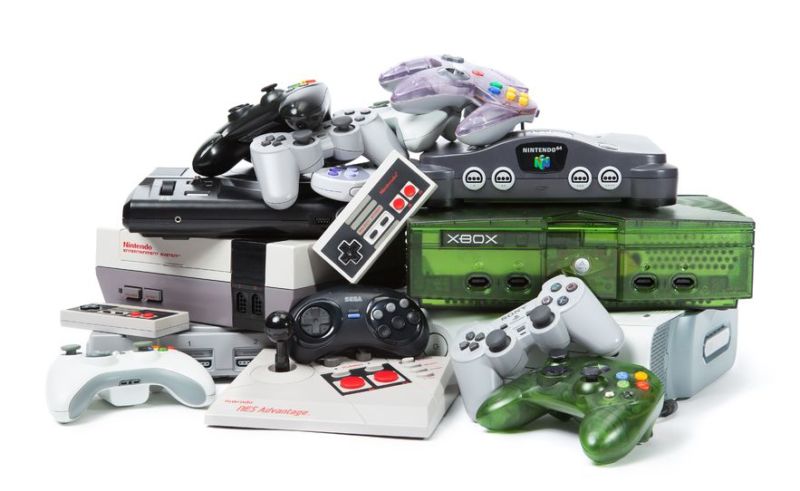
Enlarge/ We will admit, new sales for the consoles shown here did not do very well in 2017.
It’s hard to remember now, but we’re only four or five years out from widespread and confident predictions that the game console market was effectively dead or dying. In 2012, Wired cited mobile disruption and “the whole box-model mentality” in declaring the death of the console. Around the same time, CNN cited a “four-year tailspin” in sales for dedicated consoles (which, coincidentally, started right around the same time as the global financial crisis) to explain “why console gaming is dying.”
And IGN, in its own 2012 look at the fate of the console market, offered a bold prediction for the fate of the PS4 months before it was even officially announced: “A better-graphics box at $400? Not going to work.”
Today, those and manyother relatively recent predictions of doom for the console market look downright silly. The industry analysts at NPD announced last night that the US video game market grew 11 percent in 2017 to $3.3 billion. The reason? “Video game hardware [meaning consoles] was the primary driver of overall growth,” as hardware was up 27 percent for the year, to $1.27 billion.
The launch of the Nintendo Switch was a huge part of this increase, of course. We already knew that the system has been selling at a rapid clip that reportedly outpaced even Nintendo’s expectations worldwide. In the US, though, “on a time-aligned basis through the first ten months on the market, Nintendo Switch has sold more consoles than any other platform in history,” NPD says.
But the Switch isn’t the only console success story these days. As NPD notes, “combined sales of PlayStation 4 and Xbox One continue on a record-setting pace” in the US. Together, those “high-end” consoles are selling 18 percent better than the PS3 and Xbox 360 did at the same point in their lifecycles and four percent better than the PS2/Xbox generation.
That announcement puts a point on Sony’s own strong announcements of PS4 sales, which reached 73.6 million worldwide by the end of 2017 (including 5.9 million over the recent holiday season). But it’s not just Sony carrying that segment of the market; Microsoft’s Aaron Greenberg pointed out last week that the Xbox One outsold the PS4 in the US in December, proving it at least has some market power on this side of the Atlantic.
Even Nintendo’s neglected 3DS family, which looked like it was cratering as recently as 2016, is doing well in this new supercharged console market. December was the 3DS platform’s best month for hardware sales since December 2014, NPD said.
Put it all together, and it’s hard to believe that the collective wisdom just a few years ago expected consoles to slowly wither away in light of competition from casual mobile games and commoditized PC hardware. Now, it seems clear the concept of a dedicated gaming machine that hooks up to the living room TV is alive and well, thanks to a wide selection of strong hardware that players want to buy.
https://arstechnica.com/?p=1246813
Crazy kaiju-robot antics only hint at Nintendo Labo’s true potential
After writing up Nintendo’s Wednesday reveal of its new Labo playsets (coming April 20 to the US and Japan and April 27 to Europe), I realized I’d forgotten to add an important word to the article’s introduction: “what.”
More specifically, the drawn-out, question-marked version I should have shouted when the product’s reveal video played out. (“Whaaaaat?!”) I’m a big fan of Nintendo’s physical-toy era in the ’60s and ’70s, back when company legend and Game Boy creator Gunpei Yokoi came up with engineering wonders like the Ultra Hand and the Ten-Barrel Puzzle. As a result, I was immediately charmed by the physicality and toy-controller possibilities of the reveal video, which included everything from a motorcycle steering chassis to a 13-key piano to a string-loaded fishing rod—all built by players with a mix of pre-cut, pre-marked cardboard, sensing stickers, plastic, string, and more.
But then I began wondering: exactly how does everything work with Nintendo Labo? In particular, what the heck is going on with Labo’s most insane offering: a full-body robot suit?
Player, piano
Understanding how Labo-constructed Toy-Cons will work starts by analyzing this image, which we break down in the text below. The rest of this gallery shows how the Nintendo Labo piano is put together.
Nintendo Labo will combine the Switch console, its Joy-Con controllers, and buildable cardboard sets.
The debut video shows how to put the piano set together. Start with individual, foldable cardboard pieces.
Getting closer.
It’s missing something.
Oh, right. The Switch.
There’s also a slot for a Joy-Con to be inserted, visible here on the left.
Nintendo has not answered precisely how the Labo Robot Kit will work, either in its reveal videos, Labo’s official sites, or hands-on impressions posted by other outlets. With the limited info I’ve gathered, I’m taking it upon myself to offer educated guesses while commenting on why I have a serious case of Labo love.
We do know quite a bit about Labo based on hands-on reports that went live at the same time as Nintendo’s Wednesday video. The Labo Variety Kit was demonstrated at length to various outlets, and the “how” of the Variety Kit’s cardboard piano—which recognizes 13 distinct keys and a number of modulating knobs—was explained as follows by The Verge:
The Joy-Con that slots into the back [of the Labo piano] has a camera, which can see the back of the keys so that it knows which ones you’re pressing and then relays that information to the Switch. The sound-modifying knobs, meanwhile, each have distinctive stripes that are associated with their respective sounds, so that the camera can tell them apart.
To be clearer: the right-side Joy-Con, which ships with every Nintendo Switch, comes with an infrared camera and four additional infrared sensors. These are apparently enough to create Labo’s distinct combination of positional and visual data. When fed by patterns on the cardboard parts and “reflective” stickers, they can individually recognize no less than 14 simultaneous points of interactivity.
We have to wait for more direct access to all of the Labo creations (which Nintendo calls Toy-Cons) to break down exactly how every single one of them works. When we get our hands on Labo later this year, we will do just that. For now, let’s focus on the Labo Robot Kit, which was not shown off during any hands-on press previews—but appeared for long enough in Labo’s debut video to reveal juicy information.
We can start by looking at the Labo video’s footage of the cardboard piano’s assembly. Labo walks its players step-by-step through the process of building a Toy-Con, and it includes see-through 3D models of the construction every step of the way to teach users (assumedly, our world’s future engineers) exactly how this stuff works. By the end, builders have gotten the piano pretty much fully built, at which point they must insert the right-side Joy-Con into the back of the piano, so that its IR camera rig can see the piano’s full innards.
The reveal video shows Labo instructing players to test the piano’s buttons and dials, in order to test the IR sensor. This screen, which includes a touchscreen option for kids to move the camera around and see how the piano is working, actually shows 19 distinct sensing positions, including 13 purple “keys,” a pair of dials (one red, one green) directly above the keys, and four larger boxes. (We still don’t have full information about exactly which of these keys, knobs, and other elements must have sensor-boosting stickers attached.)
This wealth of data, above and beyond a mere 13-key rig, is important as we transition to the Labo Robot Kit.
Go-go Labo rangers
The Labo Robot Pack comes with everything seen here. (We break it down in the text below, along with more thoughts in this gallery.)
Another look at the pack in its construction phase.
As arms and legs move, so do the white strips.
We’re still wondering how exactly the strips’ position relates to real-life movement.
Be a robot.
“Moooom, the back fell off my robot suit again!”
Oh, and of course, this game’s robot TURNS INTO A CAR. The video shows the player bending his knees to transform.
Nintendo’s official Labo Robot Kit site includes images of the full kit’s basic, exterior design. In the first image of the above gallery, the left-side image shows two handheld wands made entirely of cardboard, while two foot clips made of plastic are shown as connected directly to the backpack, not fully extended to the floor. That’s made clearer on the model’s feet on the right-side image. Also in that right-side image, both the handheld and foot-clipped parts are connected to string that runs through the backpack itself.
If we go back to the reveal video, we see a brief shot of the backpack’s exposed innards, before a final piece of cardboard is slapped onto the back. Four apparent levers can be seen, each with a white strip at different levels. We can tell based on the official product image that each limb’s string runs through the top of the cardboard backpack, aligned with each of these levers. As you move an arm or a leg, each white strip moves up and down.
The backpack’s back-side flap of cardboard includes a holder for the right-side Joy-Con, and again, its IR sensor points at the innards, including these white strips. Should there be any doubt that these are the backpack’s primary trackable points of data, notice the video’s footage of the Robot Kit’s accompanying game. Its robot hero has four visible levers on its back, mirroring the same design that players wear.
Additionally, the non-camera Joy-Con is mounted to a small cardboard-and-plastic headset, which a player wears for some sort of control in the game itself. This could be meant for head-tracked camera movement in the game, or for directing a player’s motion or attacks. But it’s definitely not up there just to make a kid look silly.
One question remains: what other, finer points of data might Labo’s Robot Kit be equipped to handle, a la the cardboard piano’s wealth of sensing data? The fact that Nintendo didn’t demonstrate a working version to the press could mean that there’s more to the kit; the best evidence to support this guess is the backpack’s use of three large holes on both its left and right sides. These may accommodate additional connections, either by string or some other doo-dad. There’s also the possibility, of course, that this four-lever system is not yet optimized enough for public testing.
Coming soon: a “more-power” glove?
Some of Labo’s concepts were teased in Wednesday’s video without an accompanying product announcement, like this steering wheel and pedal combo.
What’s really exciting about the steering wheel is this sticker-sensor array, which has no less than ten points of data for the Switch’s Joy-Con IR sensor to translate into a control system.
The rest of this gallery includes other teased Labo Toy-Cons that don’t appear to have an announced release yet. First: a huge joystick with a wedged cardboard base, for the sake of 360-degree flexing.
A bird with flappable wings.
A camera with rotatable lens. (Pokemon Snap 2, maybe?)
And a big pistol that resembles a flare gun.
Either way, the beauty of the IR-tracked backpack is its sheer design flexibility. If you were asked to build a fully tracked four-limb robot suit from scratch, meant to interact with a video game system, you might imagine no less than four hardware-connected sensing rigs to track basic movement—or more if you want to account for, say, ball-and-socket joints. But Nintendo will only employ one IR sensor to record four distinct limbs’ movement. There’s work to be done to engineer the rest of the physical rig, of course, but this “single-sensor” system saves users the trouble of, say, ordering laser- and wire-connected parts from Alibaba.
That’s a lot of design modularity for Labo’s future. Labo essentially declares that the Nintendo Switch already includes enough sensors and electronics. From there, Nintendo, or its fans, can engineer entirely different build-it-yourself kits based on this base with nothing but cardboard and stickers. The possibilities are wild. I’ve already imagined one idea, based on my own VR experiences. With an angled, wrist-strapped glove, Labo 2.0 could aim an IR sensor at a single human hand and, at the very least, track the basic movement of individual digits, if not the fingers’ bending at knuckles. (A second Joy-Con could join the party to determine angle and rotation, which might deliver convincing spatial hand tracking.)
Our last image gallery, directly above, includes five Toy-Cons that do not appear to have announced releases yet. Since it’s advertising these preview concepts early, Nintendo clearly sees a future in the Labo line. Its control possibilities really could go in as many wacky directions as I’ve just guessed with my own Toy-Con Glove idea.
Already before launch, Nintendo’s Labo approach feels like a much better path forward in the gimmick-filled control world than what’s come before. The era of locked-down, $90-and-up control peripherals has long passed. Players generally do not want to be saddled with a pricey, space-filling control mechanism that only works for a few games—a fact that spelled doom for everything from Kinect to Guitar Hero. The Switch has succeeded, in part, by giving players a familiar suite of controls to play as they see fit, either at home or on the go. The system also just so happens to have just enough sensing tech built in to accommodate crazy control styles… for those who want to buy add-on kits and construct their own Toy-Cons. Everyone wins. It’s brilliant, even before it exists.
Listing image by Nintendo
https://arstechnica.com/?p=1246487
Here’s why you can’t buy a high-end graphics card at Best Buy
Enlarge/ Philadelphia miner Matthew Freilich shared this picture of his mining rig, which contains eight Nvidia GTX 1070 graphics cards.
Matthew Freilich
The market for high-end graphics cards used to work like the market for almost any other piece of computer gear. You’d go to your local electronics store, pick one up off the shelf, and pay an amount right around the manufacturer’s suggested retail price.
But the rise of cryptocurrency mining has created an unprecedented global shortage of graphics cards. If you go to your local retailer, you’re likely to find bare shelves where the beefier cards used to be. Instead of trading at a discount, used cards routinely sell for well above MSRP on sites like eBay and Craigslist.
And it’s driving PC gamers—who used to be the primary market for these cards—crazy.
“Cryptocurrency can’t crash soon enough,” one gamer wrote on the PCGaming subreddit a few days ago. Gamers thinking about building a new gaming machine are being forced to put those plans on hold until the market settles down. Others, who bought high-end graphics cards a few months ago, are wondering if they should sell at a big profit.
Jared Walton of PC Gamer sums up the situation: “It’s a terrible time to buy a graphics card.”
The graphics card shortage is happening because high-end graphics cards are the best way to mine Ethereum and other non-bitcoin cryptocurrencies. With the price of these cryptocurrencies rising to unprecedented heights in recent weeks, a powerful graphics card can generate several dollars per day in cryptocurrency. And so a growing community of hobbyist miners has been snapping every graphics card it can get, creating shortages and high prices for everyone else.
“It’s not available in any store”
Enlarge/ High-end graphics cards are all sold out at a Best Buy in Washington DC.
Timothy B. Lee
On Wednesday, I visited my local Best Buy to see the graphics card shortage for myself. A locked cabinet in the gaming section was supposed to hold a wide range of graphics card. But the more expensive ones—cards like the AMD Radeon RX 580 and Nvidia GeForce GTX 1080 that were best suited for cryptocurrency mining—were sold out. All that was available were a handful of low-end graphics cards not suitable for Ethereum mining.
I asked a sales representative to check to see if I could get an RX 580 at another Best Buy store. No luck.
“It’s not available in any store,” she told me. “It’s not online.”
Sullivan McIntyre
I had an experience that’s being played out all over the country and around the world. Sullivan McIntyre, a Redditor from San Francisco, sent us this photograph of the graphics card section at Central Computers. Not only are there hardly any graphics cards available for purchase, but the company has notified customers that it is suspending its return policy for graphics cards.
The reason: graphics card prices have been fluctuating wildly.
Enlarge/ Prices for AMD’s high-end Radeon graphics cards have soared in recent months. Data from PC Part Picker.
According to data from PC Part Picker, you could get an AMD Radeon RX 570 for around $200 last spring, while an average RX 580 cost closer to $250. But prices started to rise over the summer, with both cards costing more than $350 by early July. Prices settled down a bit in the fall, but in recent weeks we’ve seen an even more extreme price rise: RX 580 cards now cost more than $400 on average.
And this chart of average prices understates the degree of price rise because it includes retail stores that tend to sell closer to MSRP and sell out instantly. If you want to get a graphics card in a timely manner, you’ll probably be forced to pay even higher prices to online resellers. As we write this on Thursday, resellers on Amazon are asking almost $500 for an RX 570, while some RX 580s are going for more than $600.
The story is similar for the Nvidia GeForce cards that are popular with miners. Average prices for the GTX 1060 have risen from $275 to $400 since May, according to PC Part Picker, while the 1070 has risen from $425 to $600. And again, these averages probably understate the rise, because if you actually want to get a card promptly you might be forced to pay an online reseller significantly more.
Timothy B. Lee
This pattern correlates closely with changes in the price of Ethereum. Graphics card prices started inching upward around June 2017—the same time Ethereum prices started to soar. The current boom coincides with the even more dramatic Ethereum boom of recent weeks.
The cryptocurrency boom is creating big profit opportunities
Enlarge/ Philadelphia IT security professional Matthew Freilich sent us this picture of his first mining rig with six graphics cards in it.
Matthew Freilich
So who’s driving all this demand for graphics cards? Cryptocurrency miners. To understand the phenomenon, we talked to people active in cryptocurrency mining, and they all told us similar stories: mining Ethereum and other cryptocurrencies has become hugely profitable in recent months, which is why so many people are racing to expand their mining operations. And getting graphics cards is the main bottleneck.
Bitcoin mining is no longer profitable on consumer graphics cards because people have built sophisticated custom ASIC-based mining equipment that’s far more power-efficient. But Ethereum has a memory-hungry mining algorithm that’s resistant to ASIC optimization. That means mining Ethereum is still practical with a consumer graphics card if it has more than two gigabytes of memory. Entry-level graphics cards don’t have enough memory, but more advanced ones do.
Most of the people we talked to began mining in the summer of 2017—right around the time graphics card prices started to creep upward.
Matthew Freilich is an IT security professional in Philadelphia, and he told Ars that he started his mining activities last June.
“A lot of cryptocurrencies were starting to rise in value, and a really good friend of mine said he was building a cryptocurrency rig,” Freilich told Ars. “Once I started talking to him about that more, I started to get really interested in it. I decided I’m going to build one of these also.”
Freilich initially bought six Nvidia GTX 1070 graphics cards from Dell, which at the time still had cards available for the MSRP of around $400. He also ordered a special motherboard capable of accommodating a large number of graphics cards. Freilich used a mining-centric operating system called PIMP OS.
“It was kind of a turnkey solution,” Freilich told Ars. “It has the drivers built in and has compatibility with a lot of the motherboards.”
Once he was satisfied with that first rig, Freilich started working on a second one. To get better prices, he began trolling Craigslist for graphics cards. Freilich paid cash and got used—but perfectly functional—GTX 1070s for as little as $300.
When I reached Freilich on Tuesday, he had eight graphics cards in his second rig in addition to the six in his original rig. And he was starting work on a third rig. He had just returned from Best Buy, where he had bought yet another GTX 1070. Freilich had paid $429, which is above MSRP but a bargain in today’s market.
“I check online every day pretty much and a couple of times a day” to see if his local Best Buy has graphics cards in stock, he told Ars. “If they have them in stock I’ll snag it immediately.”
It won’t take long for Freilich to earn his money back. “I’m making about $50 per day” across his 14 cards, Freilich says. That works out to around $3.50 per card per day. At that rate, a card will need around four months to pay for itself.
Of course, nothing is that simple. The value of cryptocurrency changes rapidly. In the short run, higher cryptocurrency prices mean that miners earn more for the same effort. But Ethereum (and other blockchain networks) automatically raise the difficulty of the mining problem as more people join the network. So if the mining boom continues, difficulty will rise and Freilich’s cards will generate less cryptocurrency per day than they’re generating now, cancelling out some of the gains from recent price increases.
Other miners told Ars similar stories. We talked to Zach, a high school student in the Chicago area who also got involved in mining last summer. He was able to find a source that would sell him a couple dozen RX 580 graphics cards for the MSRP around $300. He immediately turned around and re-sold them for $400. Those profits helped to finance investments in still more graphics cards that he put to work mining Ethereum and a lesser-known cryptocurrency called Siacoin.
Edward, a software developer in the Memphis area, told us that he uses Nvidia GTX 1060, 1070, and 1080 cards. When we talked on Tuesday, he said his 1060s (which currently sell for around $400) were earning around $5 per day, per card, while a high-end 1080 (worth upwards of $700) could earn as much as $8 per day.
Chris, a software developer in Salt Lake City, had the largest operation of any of the miners we talked to. He had six mining rigs with six video cards in each—”a mixture of AMD RX 580s, Nvidia 1070 TIs, and a few 1060s.”
Mining is a global phenomenon
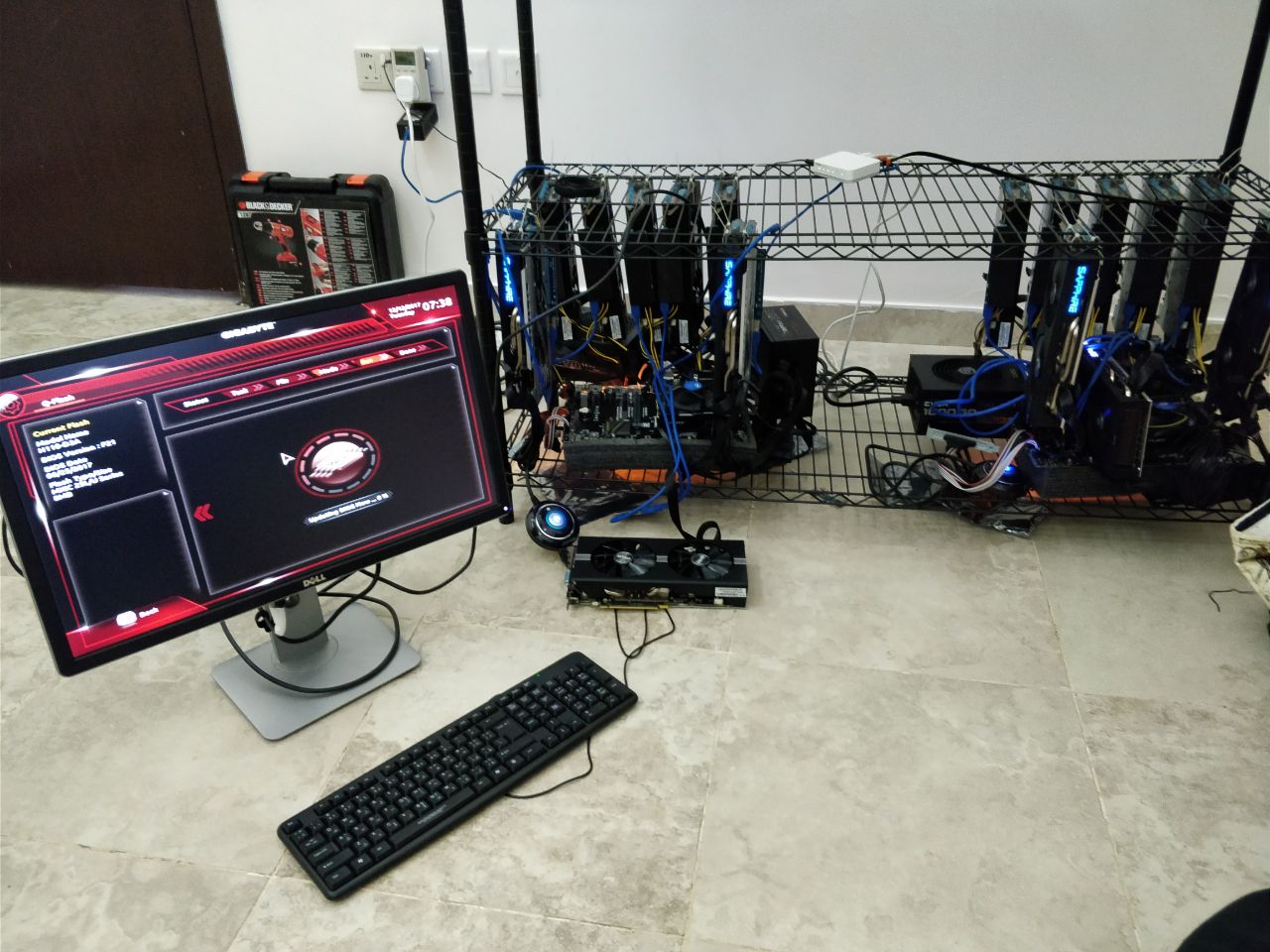
Enlarge/ Suleiman Alaquel sent us this picture of his mining rig in Saudi Arabia.
Suleiman Alaquel
Blockchain networks are global, so people are unsurprisingly having similar experiences around the world. Suleiman Alaquel, a software developer from Riyadh, emailed us about his experiences mining cryptocurrency in Saudi Arabia. The kingdom is an attractive place to mine cryptocurrencies because electricity there is cheap. But graphics cards are expensive.
“I went to a store that’s well known for PC gamers’ tech,” Alaquel told us by email. “As soon as I asked for a high-end GPU he said ‘you’re also one of them miners!’ He told me that everything is sold out because of miners!”
A few miners had pre-ordered all of the high-end graphics card shipments the store expected for the next six months, Alaquel said.
He added that you could get high-end graphics cards on the Saudi version of Cragislist, but they were expensive. An AMD Radeon RX 580 goes for around 2,000 Saudi riyal—$530.
A miner in South Korea told us that supplies are less constrained there, perhaps because so much hardware is manufactured in Asia. But graphics card prices were still high.
“Pretty much any computer store will build you a mining rig,” he wrote by email. “You choose the card, choose the number of cards, and select where you want them shipped to.”
One big difference from the US or Saudi Arabia, he said, is that electric utilities don’t allow mining in residential buildings—so miners generally have their rigs shipped directly to commercial hosting facilities.
“One store I was at a couple days ago was processing 17 rigs for one client,” the South Korean miner wrote. “When I tried to buy a mining case a few days ago, the store I went to had about 240 in stock, but they were all allocated and being shipped out… Not a single rack for me from that store.”
https://arstechnica.com/?p=1245799
Twitch challenges YouTube with new video producer tools, Disney partnership
The Amazon-owned video site Twitch announced it’s introducing new tools for its creators, essentially, to build hype around their upcoming videos. Twitch, which is best known for live-streamed gaming content, will debut “video producer” tools today that let creators make landing pages, countdown timers, and reruns for their content.
As explained in Twitch’s blog, a new part of the upload workflow will be “Premieres,” which is a different category of video than “Live” or “Rerun.” Creators must make landing pages for all Premiere videos, which seems to mean that any premade, uploaded video will need a landing page. Viewers can set reminders from a video’s landing page for an alert before the video is available. Creators can also use a countdown timer to build anticipation for the release of their newest video. Reruns, which are separate from Premiers, are exactly what they sound like: videos that already aired that creators have scheduled to play again.
Twitch’s new system contrasts with YouTube’s in that, when an uploaded YouTube video goes live, it simply appears on the site. Unless you’ve subscribed to the creator’s channel or opted to receive alerts when that creator uploads, you won’t always know when that creator posts a new video. While Twitch’s video producer tools don’t necessarily make it easier for new viewers to find a creator’s content, they make it easier for loyal fans to never miss a new video. For creators, Twitch claims the tools provide “more control over their path to success” by giving them new ways to ensure their audience keeps coming back.
“The challenge frequently faced is that when the time comes to share recorded content with the world, success is in the hands of algorithms,” Twitch’s press release stated. “Video Producer gives creators more options, more control, and more opportunities to find viewers, grow an audience, and make a living doing what they love.”
Twitch is clearly making a statement about how different its platform is compared to YouTube. It’s unclear if these new tools will result in better audience retention or even better profits for creators on Twitch, but nevertheless, Twitch is positioning itself as a platform that’s consistently thinking about how it can improve the creator-audience relationship.
A Disney deal arises
The company also announced a new multiyear partnership with Disney Digital Network to bring “exclusive” content to Twitch from some of the biggest Internet personalities. Disney-managed creators Jacksepticeye, LuzuGames, Markiplier, and Strawburry17—who have more than 44 million YouTube subscribers combined—will all create new content for Twitch under this deal. The company wouldn’t provide specifics about the type of content or the frequency with which these creators will upload to Twitch, but a Twitch representative made a point to say that the company doesn’t control the type of content its creators make.
All four partnered creators have Twitch accounts already, with varying degrees of activity, and all of them post regularly to YouTube as well. It’s highly unlikely that any of them will stop posting to YouTube because of this new Twitch partnership, although we may see some of them promote Twitch content in their YouTube videos (a common practice among gaming YouTubers). Snagging four of the most popular gamers is certainly a win for Twitch because not only does it mean these creators will produce more content for the site, but they’ll also bring their millions of fans along with them and possibly convert some of them to loyal Twitch viewers.
These Twitch changes come after a new slew of changes at YouTube. After the Logan Paul controversy, YouTube promised to manually vet all Google Preferred content, and it updated its subscriber and view threshold for creators to make money through YouTube’s Partnership Program.
While YouTube is trying to protect its advertisers and put a stop to “bad actors” and distasteful content on its site, it’s also alienating some small creators who feel stifled and disenfranchised by the new policies. While we likely won’t see a flood of small creators move from YouTube to Twitch, it’s possible that some will be inspired to give Twitch a try thanks to the new video producer tools and clout from popular gamers.