Nintendo has announced a new build-your-own-accessories line for the Switch console, dubbed Nintendo Labo. It will arrive on April 20 worldwide.
Labo’s two playsets, the $69.99 Variety Kit and the $79.99 Robot Kit, will come with marked cardboard sheets that must be punched and folded by players, along with connecting string, reflective stickers (for controller-sensing purposes), and other accessories. The foldable parts resemble everything from pianos to fishing rods, along with a full-body robot outfit. They accept both the Switch console and its Joy-Con controllers in various slots.
Nintendo Labo will combine the Switch console, its Joy-Con controllers, and buildable cardboard sets.
The debut video shows how to put the piano set together. Start with individual, foldable cardboard pieces.
Getting closer.
It’s missing something.
Oh, right. The Switch.
There’s also a slot for a Joy-Con to be inserted, visible here on the left.
Many other modes were shown, including this insane fishing-rod rig. Take that, Sega Bass Fishing!
Work a foot pedal with a Joy-Con inserted.
Make this cardboard person walk solely by controlling the Joy-Con’s rumbling.
More vibration-based controls.
Put it together.
The Robot Kit looks quite large.
That’s an intense backpack.
Nintendo has a name for the resulting toys that players create by combining cardboard and hardware: Toy-Cons. (Get it?) Other Toy-Con possibilities include a motorcycle steering mechanism, RC cars, an interactive Toy-Con house (with a pet inside that you’ll take care of), and a series of “make the Joy-Cons vibrate to move cardboard characters around” figures. Each Toy-Con will utilize various sensing mechanisms of the Switch and Joy-Cons. For example, the 13-key piano will utilize the right Joy-Con’s infrared camera to identify when you press its piano keys or manipulate any of the “knobs” you assemble and add to the piano.
The Robot Kit looks decidedly more complex, complete with a series of strings and levers, and it’s designed to be worn like a backpack along with a helmet and foot attachments. (Perhaps this full-body rig is what Nintendo had in mind when the company recently said it wasn’t all that interested in virtual-reality development.)
Each playset will come with compatible software, as well, though exactly how many modes will come with each kit is currently unclear. In the Robot Kit’s case, that software largely resembles a long-teased “Project Giant Robot” game that Nintendo legend Shigeru Miyamoto had previously talked up for an eventual launch on the Wii U. That game appears to now have new life as part of the Nintendo Labo series.
Robot Kit.
Variety Kit.
If you’re going to pay Nintendo $10 for a sticker pack, it may as well be as full of fan service as this box appears to look.
A better look at how the cardboard sets look before being disassembled.
Put it together with your parents…
…but also designed for kids to be able to assemble.
Piano time.
An additional “Customization Kit” will be offered by Nintendo, complete with stickers, stencils, and colored tape, for $9.99. You can also, of course, grab your own markers and paints to customize your cardboard parts as you see fit.
Nintendo offered fans roughly 12 hours of advance notice before this announcement. The company claimed that it was about to unveil “a new interactive experience for Nintendo Switch that’s specially crafted for kids and those who are kids-at-heart.” This was preceded a day earlier by a Ubisoft staffer’s claim that Nintendo’s Wednesday would “explode the Internet.”
https://arstechnica.com/?p=1245981
Epic admits that Fortnite’s success may seal another F2P game’s fate
Enlarge/Paragon sure can look cool, but in terms of gameplay, fans argue that updates have left something to be desired.
Epic Games’ Fortnite proved to be one of 2017’s weirdest gaming success stories. Following years of sluggish development and a half-baked “paid early access” launch in July, the game received a new, entirely free mode in an update for all PC and console versions. That mode, the incredibly PUBG-like Fortnite Battle Royale, has gone on to rack up millions of players (though exactly how many is unclear, since Epic still describes both the paid and free content as a combined number of over 40 million).
The mode’s success hasn’t left every Epic Games fan satisfied, however. On Tuesday, the company put an exclamation point on growing rumblings from fans of one of its other free-to-play products, the “action MOBA” game Paragon, by admitting that Fortnite BR‘s success may be Paragon‘s undoing.
[embedded content]
Paragon’s last major content update, summarized in this video, came in September. A smaller update followed in November.
In a post at Paragon‘s official Reddit community, an unnamed Epic staffer admits that the game’s various updates since its 2016 “early access” launch have not driven “large enough” player growth. For the uninitiated, Paragon launched both as an Unreal Engine 4 showcase and as a take on games like Dota 2 and League of Legends, with a more active, behind-the-character camera angle (a formula seen in other recent F2P games, including Smite and Gigantic).
“This [lack of player growth], combined with the humbling success of Fortnite, has caused us to question if we have a good path to grow Paragon and make it thrive,” the staffer adds. In the post, the staffer confirms that fans aren’t imagining things; Paragon‘s development updates have indeed slowed down in part because a number of its developers “jump[ed] onto Fortnite to help sustain the game.”
From there, the developer describes Paragon’s future in a chicken-and-egg manner. Epic hints to updates and improvements, but it also confirms that the game’s “release cadence”—meaning, how often it receives updates—will be slowed down. The post also twice indicates that substantial changes to the game are a matter of “if,” rather than “when.” Based on this post’s phrasing, Epic may be indicating that without more players, the game won’t receive substantial updates. Without more updates, the game won’t attract more players.
The rest of the announcement thread is full of regular members offering suggestions that some users complain have already been “taken under consideration” by Epic with no sign that they will ever manifest in the game. Those suggestions include ranked multiplayer modes, specific balance requests for Paragaon‘s five-on-five combat, and a complete overhaul of the game’s “card” system. (Currently, new players can be mathematically outdone by older players who’ve either earned better cards or purchased them with real-world money.) This follows months of concern among the community over developer silence and questions about the game’s long-term development roadmap. (One of the community’s highest-voted threads includes a lot of conjecture based on business decisions surrounding Epic and the company’s stakeholders at Tencent, who operate Riot Games and the popular MOBA game League of Legends.)
Fan concerns aren’t just being aimed at Paragon. Fans of Fortnite‘s standard “Save The World” mode, which still requires buying a “Founder’s Pack” to play ahead of an eventual free-to-play launch, are complaining about similar development drop-off compared to Fortnite BR. As the latter mode gears up for a major update to its default map in the next few days, the former mode continues lacking access to community-demanded features like a more easily accessed tower-defense mode.
“I bought [Fortnite] expecting PvE fort-building, but Epic decided to dump that and go chasing the PUBG money instead,” one ResetERA forum member writes.
https://arstechnica.com/?p=1245171
Hackers seem close to publicly unlocking the Nintendo Switch
Enlarge/ At the 34C3 conference, hacker Derrek shows the soldered FPGA setup that helped him find the decryption key necessary to unlock the system’s binaries.
When it comes to video game consoles, it’s only a matter of time before even the most locked-down system gets unlocked by hackers for homebrew coding (and, potentially, piracy). The goal for most console makers is to hold off that day for as long as possible, to maintain their total control over the console’s software ecosystem as long as they can.
For Nintendo and the nearly year-old Switch, that control seems in imminent danger of slipping away.
Hackers have been finding partial vulnerabilities in early versions of the Switch firmware throughout 2017. Their discoveries include a Webkit flaw that allowed for basic “user level” access to some portions of the underlying system and a service-level initialization flaw that gave hackers slightly more control over the Switch OS. But the potential for running arbitrary homebrew code on the Switch really started looking promising late last month, with a talk at the 34th Chaos Communication Congress (34C3) in Leipzig Germany. In that talk, hackers Plutoo, Derrek, and Naehrwert outlined an intricate method for gaining kernel-level access and nearly full control of the Switch hardware.
[embedded content]
This 34C3 talk on hacking the Nintendo Switch gives an in-depth look at how Nintendo’s various security methods have been circumvented.
The full 45-minute talk is worth a watch for the technically inclined, it describes using the basic exploits discussed above as a wedge to dig deep into how the Switch works at the most basic level. At one point, the hackers sniff data coming through the Switch’s memory bus to figure out the timing for an important security check. At another, they solder an FPGA onto the Switch’s ARM chip and bit-bang their way to decoding the secret key that unlocks all of the Switch’s encrypted system binaries.
The team of Switch hackers even got an unexpected assist in its hacking efforts from chipmaker Nvidia. The “custom chip” inside the Switch is apparently so similar to an off-the-shelf Nvidia Tegra X1 that a $700 Jetson TX1 development kit let the hackers get significant insight into the Switch’s innards. More than that, amid the thousand of pages of Nvidia’s public documentation for the X1 is a section on how to “bypass the SMMU” (the System Memory Management Unit), which gave the hackers a viable method to copy and write a modified kernel to the Switch’s system RAM. As Plutoo put it in the talk, “Nvidia backdoored themselves.”
The floodgates are open
While the 34C3 hackers didn’t release a version of their exploit to the public at the conference, they promised they were working in conjunction with documentation group ReSwitched to release a public homebrew method soon (a cryptic tweet from Plutoo shows a rudimentary homebrew launcher on a Switch with the date “Feb 1st.”) Other groups have not been content to wait, though, and seem to be jumping off of the 34C3 talk to develop and tease their own upcoming Switch hacks.
Hacking collective Fail0verflow jumped on the bandwagon earlier this month by posting video evidence on January 7 of a “coldboot exploit” that let the group scroll a message across the Switch’s screen. In a follow-up tweet, Fail0verflow clarified that its hack does not require a modchip and purportedly works on the Switch bootrom in a way that “can’t be patched (in currently released Switches).”
That’s a significant statement, since exploits like those discussed at 34C3 don’t work on Switch firmware past version 3.0.0, which was patched last July (other hackers claim to have privately held methods to run homebrew code on more recent firmware). Fail0verflow’s statement suggests its exploit could work on all Switches currently available in the wild and could be counteracted only if Nintendo made changes at the factory production level.
The hacks being discussed above can be used to run homebrew code on the Switch, which you can start writing right now using open source library libnx (which is currently missing important functions like GPU acceleration and audio playback). Thus far, the hacks don’t seem to be useful for pirating legitimate Switch games, which are protected by an extra layer of security.
But hacking collective Team-Xecuter has publicly hinted at its own “solution” for Switch hacking. The group posted a short video showing the Xecuter logo appearing before the Switch’s usual bootup sequence (and a purported bootloader decryption key to prove its veracity). Team-Xecuter is known for hardware modchips that allow pirated games to run on other consoles, suggesting that it could be releasing a similar modchip for the Switch as soon as spring.
Nintendo doesn’t seem to be “looking into” VR very much anymore
Enlarge/ It looks like this patent image that surfaced in 2016 is as close as we’re going to get to a Nintendo-approved VR headset anytime soon.
Readers with decent memories may remember early 2016, when Nintendo President Tatsumi Kimishima said the company was looking into the virtual reality space at an investor’s briefing. Coming months before we had concrete details on the company’s upcoming Switch, the statement set off industry alarm bells about Nintendo’s potential future plans. A vague Nintendo patent for a head-mounted tablet holster that surfaced in late 2016 got the chatter going even further.
Fast forward to today, and it’s increasingly clear that Nintendo has finished “looking” and has decided VR shouldn’t be part of its plans for the time being. The latest evidence comes from a recent interview with Nintendo France General Manager Philippe Lavoué in French publication Les Numeriques. “If you look at VR headsets, I doubt they can appeal to the mainstream,” Lavoué said in a translation of that interview. “Consumers are not patient with entertainment if you’re not able to deliver an all-inclusive package.”
Lavoué goes on to downplay any need for Nintendo to invest in hardware capable of full 4K images, saying that the TV display technology has “not been adopted by the majority” and would therefore be a premature investment for the company. “And what novelty would we bring compared to our competitors?” he said. “If we do the exact same thing as everyone else, we’re bound to die because we are smaller than them. With the Switch, we offer different uses, adapted to players’ pace of life. Its advantage is being able to fit into your daily life.”
The new comments echo those made by Nintendo of America President Reggie Fils-Aime, who told Fortune last June that when it comes to virtual and augmented reality, “Are they both fun and social? I don’t think that’s there yet.”
Fils-Aime has been uttering some variation of that line since at least 2014, when he told the AP “the technology [for VR] isn’t quite there yet, in our view… when it’s there and enables a fun experience, we’ll be there too.”
Nintendo Senior Director of Corporate Communications Charlie Scibetta left the VR door a little more open at the time, though, telling Ars in 2014 that “anything that would help increase the gameplay and make it more entertaining we’d certainly think about, and we’re always looking at new technologies.” And legendary Nintendo designer Shigeru Miyamoto told NPR in 2015 that the company “experiment[s] with virtual reality and different technologies,” even as he said, “we don’t feel that virtual reality is a good fit” for Nintendo’s family-centric play philosophy.
As for 4K, Fils-Aime said in a Verge interview last year that targeting the current top-end of traditional TV resolution audience was “a strategy that for us, candidly, is a bit too limited.” Keep in mind, too, that Nintendo’s first HD console wasn’t released until late 2012, when the display standard had penetrated over 75 percent of US households.
Given that pace, we could be waiting quite a while for the company to adopt what is now considered the “high-end” of VR and 4K technologies. For the time being, we’ll have to settle for makeshift stereoscopic holsters and third-party Japanese arcade installations to give us hints of what a Nintendo-approved VR experience could be like.https://arstechnica.com/?p=1244385
Hostile workplace accusations rock PlayStation developer Quantic Dream
A trio of French media reports over the weekend accuse high-profile PlayStation developer Quantic Dream (Heavy Rain, Beyond: Two Souls, the upcoming Detroit: Become Human) of fostering a “toxic corporate culture” where inappropriate behavior and homophobic, racist, and sexist jokes were tolerated, if not encouraged.
The reports spring from a complaint reportedly filed last spring by five former Quantic Dream employees, centering on what French newspaper Le Monde describes as “degrading photomontages.” French magazine CanardPC includes some examples of those (NSFW) montages on its Web version, showing Quantic Dream employees photoshopped onto sexually suggestive or explicit images. Le Monde’s report cites a collection of roughly 600 such images that circulated around the company via group email since 2013, including some with “homophobic or sexist slurs.” French online news site Mediapart has a similar report.
Quantic Dream founder David Cage is accused in the Le Monde piece of making racist remarks toward a Tunisian employee surrounding CCTV footage of a burglary. Cage is also accused of making repeated dirty jokes in work situations and sexist remarks about female cast members in his games.
Cage is quoted in Le Monde’s piece as saying the accusations are “ridiculous, absurd and grotesque.” Cage says he was not aware of the worst of the shared images until they were recently brought to his attention, though some employees say these images were often printed and displayed around the company offices.
“You want to talk about homophobia? I work with Ellen Page, who fights for LGBT rights,” Cage told Le Monde. “You want to talk about racism? I work with Jesse Williams, who fights for civil rights in the United States. Judge my work.”
Quantic Dream cofounder Guillaume de Fondaumière, who stands accused of various acts of sexual misconduct in the piece, called the accusations “absolutely false” and insisted, “none of any of this happened at any evening event.”
In a follow-up statement posted on Twitter Sunday, Quantic Dream says it “categorically den[ies] all of these allegations. Quantic Dream filed a complaint several months ago, and further complaints will follow.
“Inappropriate conduct or practices have no place at Quantic Dream. We have taken and always will take such grievances very seriously,” the statement continues. “We value every single person who works at Quantic Dream. It is of utmost importance to us that we maintain a safe environment that allows us all to channel our shared passion for making video games.”
Back in 2013, Quantic Dream found itself embroiled in a scandal when nude images of Ellen Page’s character from Beyond: Two Souls were found embedded in the game and leaked via the use of a “debug” PlayStation 3. It was later revealed that Page was considering legal action against Quantic Dream surrounding the leaked images.
Quantic Dream also faced a different kind of controversy concerning a Paris Games Week trailer for the upcoming Detroit: Beyond Human, which focused on scenes of domestic abuse. In December, UK parliament member Damian Collins said it was “completely wrong” to feature such domestic violence in a game, echoing other activists quoted at the time. Cage defended the scene, telling Eurogamer that he “[tries] to tell a story that matters to me, that I find moving, interesting and exciting and my role as a creator is to maybe deliver something that people don’t expect… The rule I give myself is to never glorify violence, to never do anything gratuitous. It has to have a purpose, have a meaning, and create something that is hopefully meaningful for people.”
https://arstechnica.com/?p=1244267
How to keep a charity gaming marathon going for 160 hours straight
[embedded content]
From your seat at home, an AGDQ run like this looks simple. Behind the scenes, though, is a constant swarm of action to get everything running smoothly.
Of all the millions of video game streams that run each year on Twitch—from individuals at home to professional eSports tournaments—there’s nothing quite like the Games Done Quick marathons. Each year since 2010 (and twice a year since 2011), hundreds of speedrunners gather to play games as quickly as possible for seven days straight in a non-stop tag-team that only takes short breaks for set up and on-stream interviews.
In the process, hundreds of thousands of viewers donate millions of dollars for charity (over $4 million in 2017 alone), with their donation messages shared on stream.
While the production looks relatively simple from the viewer’s side of the Twitch stream—a video of the gameplay screen, a smaller webcam view of the player, a donation counter, a timer, etc.—a lot of work goes on behind the scenes to keep the games running and the donations flowing smoothly for an entire week. To see what things were like from the other side, I headed down to Dulles, Virginia, earlier this week to see some of the work that goes into making the Awesome Games Done Quick (AGDQ) marathon into the well-oiled machine that it is.
Your entry to a week full of playing games really fast…
This hotel knows its audience.
Behind the scenes, volunteer work is marked by feverish setup followed by not much to do during the runs themselves.
Producers hard at work setting up the next run.
A stage crew member blasts some air in an uncooperative NES to try to get it working.
A miniature cheer goes up as the NES finally generates a video signal.
In an AGDQ first, the laptop in the foreground measures and shows the controller inputs for a Strider speedrun tutorial segment.
Selfie time before the big run.
In their off time, runners and attendees hang out in a makeshift arcade full of classic and modern titles.
Attendees lean over a BishiBashi cabinet, ready to slap the hell out of those buttons.
A broken NES sits waiting for care in the practice room.
Hey, maybe someone will need a Commodore 64 modem for their run?
The view from the back of the ballroom, where the runners themselves are dwarfed by the massive projected images.
The audience erupts in laughter over a particularly silly Strider glitch.
The audience holds its collective breath as a runner takes on Mother Brain.
Constant applause is an ever-present companion that can be heard even way down the hall from the main ballroom.
You never know when you’re going to need a few dozen Nintendo controllers…
Swimming in a sea of consoles.
Kyle Orland
When live on stream, the audience is at your back while a wall of monitors faces you down.
Getting organized
The work for a Games Done Quick marathon starts months before the Twitch stream, when organizers start accepting submissions from members of the speedrun community who want to be on the big stage. Well over 1,000 submissions (which would run for over 2,000 hours altogether) have to get narrowed down to about 200 runs that will make up the week of streams.
“It’s easier for shorter games to get in; we were pretty up front about that,” says Matt “CoolMattie” Merkle, AGDQ’s Director of Operations and Event Manager. “RPGs are obviously really long… a game like Final Fantasy X isn’t going to make it into the event without something crazy happening, like a ‘skip cutscene’ button being discovered.”
Merkle says the organizers struggle to create a mix of games that includes the classics speedrun fans expect while also introducing games that haven’t been seen at the marathon before. This year’s AGDQ schedule stood out for not including the now-traditionalSuper Metroid race or other popular titles like Super Mario 64.
“We don’t want anything to feel like it’s safe,” Merkle said. “It shouldn’t be that any game is considered a lock for every event… We want to make sure that the run is really entertaining, so in the end, it doesn’t matter how popular it is: if you think the run isn’t going to work or it’s too stale, you have to move on.”
With the schedule approved, over 1,800 runners and other attendees descend on the Dulles Airport Holiday Inn for AGDQ week, functionally taking over the location. In addition to the main ballroom, where the stream emanates, there are massive practice rooms (both public and private), a makeshift arcade, a tournament room for impromptu competitions, and a “casual” console room with loads of classic consoles for those just hanging out. A fleet of food trucks swings in front of the lobby around lunchtime to help feed the hordes.
Hundreds of those attendees will volunteer to help with setup and production. Besides the runners themselves (and often additional commentators sitting by on the couch behind the player), AGDQ needs to fill the following positions at all hours of the day:
A stream tech to run the broadcast software.
Stage techs to physically connect consoles and get runners set up.
An audio engineer to run the mixer.
A producer to call the shots and make sure everyone is in communication.
A host to read donations and introduce runners.
Donation trackers who monitor the incoming donations and pick ones to be read on stream.
An interview crew with its own production staff to fill time between runs.
For the most part, Merkle says, there are people awake at all hours to take the four-to-eight hour shifts at each post. “The hardest time to shift people for is Friday evening,” AGDQ Tech Coordinator Aharon Turpie said. “That’s the night everyone wants to go and party.”
But making sure people are at the right place at the right time can be a major undertaking. Oversleeping “has been a problem at previous events,” Merkle admits, especially when runners don’t show up for their call times. “[The panic level] slowly escalates as we get closer to the run. It starts off with a ‘Hey’ text to the guy or girl. Then you text the roommates, then text the friends we know about, then get on discord [an online chat room service]. Then we get to ‘OK, what room are they in?’ and start to knock on doors.”
Planning out sleep schedules is up to the volunteers themselves, and that can be an issue for those not used to the marathon environment. “You have the seniors, the people who have been at these events before, and the newbies,” Merkle said. “The newbies will try to stay up as long as they physically can. By the third day they crash and sleep for 48 hours. The seniors, they plan ahead of time what they want to see and what they want to go to sleep for… It’s a week long, so eventually they’re going to sleep whether they like it or not. We prefer they make it to their room when they do it.”
“There are definitely times where people are like ‘I have a run in three hours, I’m going to take a three-hour nap,’ and then run down here… then as soon as the run’s over they go to sleep,” Aaron added.
Many runners prefer to get a time slot earlier in the week so they can relax and hang out the rest of the event without having to worry about practicing and staying sharp. “At Summer Games done Quick, the Metroid runners asked us not to put them on Saturday because they wanted to have a little bit of free time afterwards and not be practicing the whole event,” Merkle said.
Listing image by Kyle Orland
https://arstechnica.com/?p=1244059
The Vegas Pinball Hall of Fame astounds us with a huge, rare collection
LAS VEGAS—When we weren’t pounding the pavement at last week’s overloaded CES trade show, we at Ars Technica took whatever opportunity we could to nerd out in uniquely Vegas style. That didn’t mean dumping our spare quarters into a Lord of the Rings-themed slot machine; it meant hitching a ride to the Vegas Pinball Hall of Fame.
This collection of roughly 260 working pinball, electromechanical, and video games has been open to the public for over a decade, with its 2006 opening followed by a size-boosting relocation in 2009 to a venue two miles down Tropicana Avenue. It arguably includes the most varied and valuable open-every-day collection of pinball and pinball-like games in the United States, if not the world—but you’d never know it by simply passing the building.
Inside this concrete slab hides the biggest collection of the rarest pinball and electromechanical games ever made.
Sam Machkovech
This was taken by standing on a chair in one corner of the venue. You can get a sense of the machine variety here: mostly pinball and electromechanical, with about one-fifth of the space dedicated to video games.
Sam Machkovech
This is probably the best representation of the dim lighting in the room.
Sam Machkovech
Follow the rules.
Sam Machkovech
The rarest machine in the house by far, Midway’s Pinball Circus. Only two were ever made.
Sam Machkovech
We chose not to reproduce most of the information cards so you would have more to read should you visit the venue. But we had to post a few. This one’s crucial.
The VPHoF’s oldest pinball machine is from the 1920s. “These things used to be outlawed!” our guide reminded us.
That old machine sits next to arguably the collection’s highest-tech virtual pinball machine.
An average dive into an older machine. Start with the full, beautifully restored machine.
Then look closer at the Atlantis pin’s general body and layout.
Then zoom in on its information card. You’ll possibly need to squint.
Nearly one third of the room is dedicated to this ’50s and ’60s era of pins.
A few Elton John-based machines were in the house.
We did the best we could with the room’s weird lighting, in terms of imbalances thanks to inlaid lights in the machines.
Abra-ca-dabra! It sure was a different era when Gottlieb made so many pins.
Imagine if this game’s designers pulled off a mechanical way to arrange dominoes like shown in the art. Even so, it’s a striking design as drawn.
I’m still floored by how the bouncy balls inside that Hi-Score Pool pin worked in action.
A closer look.
The collection’s more modern machines flank the wall near the entrance.
It’s impossible to get a photo that makes Black Hole look as good as it does in real life. Its black-on-black-on-black style has an incredible glow and effect.
More of Gottlieb’s best era.
A collection so bustling, Creature Of The Black Lagoon gets crowded out.
Not to be confused with Peppy the Clown, who appears in the second gallery.
KISS returned with a modern pin via Stern; this is not that version.
Street Fighter II: The Video Game: The Pinball Game.
This probably cost less to produce than the related film.
No shortage of sci-fi-themed pins at the VPHOF.
Not every day you run into the phrase Goldeneye 007 flanked by a big Sega logo. This came before Nintendo and Rare’s N64 classic.
I can think of two Elvira-themed pinball games from the 1980s, including this one.
One row had a space theme.
Another angle of those two pins, with ST:TNG flanking.
Continuing the space-license theme.
A zoom on that Spider-man machine.
This rare Q-bert machine is a treat.
Great ramps and action.
Not many of these exist.
And even fewer of its Goin’ Nuts spinoff exist. Like, only 10.
It’s hard to tell from the photo, but this Flintstones cab is gargantuan. About as big as a typical arcade-hall basketball game.
Giant flippers.
More Flintstones info.
Vegas, baby.
In case the full pinball table didn’t make it clear, this is a pinball game. Hold that pinball, Freddy.
Nightmare’s game board.
For a short spell, a few games capitalized on the popularity of Caddyshack by including old white dudes, golf, and pesky gophers. None of them officially mentioned Caddyshack.
The warehouse’s nondescript exterior only stands out thanks to a shopping-center marker and a single yellow sign above its front door. Walk in, and you may very well wonder if it’s technically open, considering the full room is unlit and there’s nobody acting as a greeter, taking a cover charge, or explaining how the venue works.
But what this room lacks in glitz or presentation, it makes up for in sheer pinball fandom. Every machine includes an index card covered in misspelled, chicken-scratch handwriting, with all kinds of details about a particular game’s general-interest trivia and minutia about the VPHoF’s edition in particular. (A few information cards appear in the above and below galleries.) The venue’s staff, meanwhile, keeps busy. Rather than work the door, they typically manage ongoing machine repairs and game swaps, as the venue frequently swaps its roughly 260 playable games out from a nearby warehouse with another 800-plus machines. Newer pinball games, along with the VPHoF’s rarest and most popular classics, are the inventory-swap exceptions, enjoying near-permanent status in the playable collection.
Let’s start this “electromechanical” gallery—meaning, games outside the pinball realm—with the delightful and weird Skid Row.
Sam Machkovech
An explainer. The HOF also had an Ice Cold Beer machine, which is similar in style but quite different in mechanics.
Need some two-player pinball in your life? The incredible and rare Challenger has you covered. Roughly 100 were produced. The table tilts depending on how well your side does.
Chicago Coin’s Slap Shot is also a fine two-player game, but it cannot be mistaken for pinball. This is straight-up versus hockey.
I appreciate this placement of the colorful, oddball clown machine next to the sex tester. Get a double dose of scary stuff, kids.
The collection includes quite a few gun games.
Plenty of bowling-launcher games, too.
Though, really, none of the bowling-styled games top this beast.
Another angle.
And you better believe the HOF has its share of baseball-like games.
Batter up!
The wind-up, and the pitch.
Baseball, arm wrestling, basketball.
In the center is Bally’s Target-Roll, a sort of roulette- and craps-like target-shooting game.
If this were working, you’d aim the rotation and angle of this ship as it spins around, trying to contact the other metal rods nearby.
This isn’t straight-up pinball; you’re actually managing the movement of cars around a track while playing, and you’re going for laps, not score.
Shoot-‘n-race. We had to wait for the video game era before someone combined these concepts.
“Shoot this rifle!” “No, shoot this rifle!”
Goalee is essentially a one-on-one hockey game. “One can play,” but it’s really like playing Pong against yourself.
We spent less time cataloging the video games on site, but we had to make room for this sit-down Star Trek cab.
Same can be said for this rarely-seen Nintendo duo of versus light-gun games.
We actually didn’t notice that the display was upside down until reviewing these photos. How odd.
“As machines go off to that big arcade in heaven, they lose their value,” a staffer told us while showing us around the collection. This is only made more complicated by the lack of new replacement parts existing for a lot of machines, the staffer added. “If the tech dies, the [game in question] either winds up in the Smithsonian or our backyard.”
VPHoF prices its games individually at 25 or 50 cents a play—hence, why it houses so many change-making machines, including a block of four side-by-side. That’s it for cost; visitors don’t have to pay a cover fee on top. These coin-catch mechanisms are specifically used, instead of being set to free-to-play, as part of the preservation process, in fact. “If the games aren’t played, they will say, ‘fuck you,’ because they dry out, and they get corroded,” the staffer told Ars. “They need to be played.”
Thus, while VPHoF, a registered 501(c)(3) non-profit, will gladly accept donations to maintain operation and repair costs, the owners and operators say they’re actually more interested in visitors coming to the place and going hands-on with the collection. If the above galleries (split into pinball, first, and electromechanical, second) aren’t hint enough, please accept our assurance that the venue is absolutely worth the detour during a Vegas trip, roughly eight minutes’ drive from McCarran Airport.
Listing image by Sam Machkovech
https://arstechnica.com/?p=1243417
Review: Fallout: The Board Game
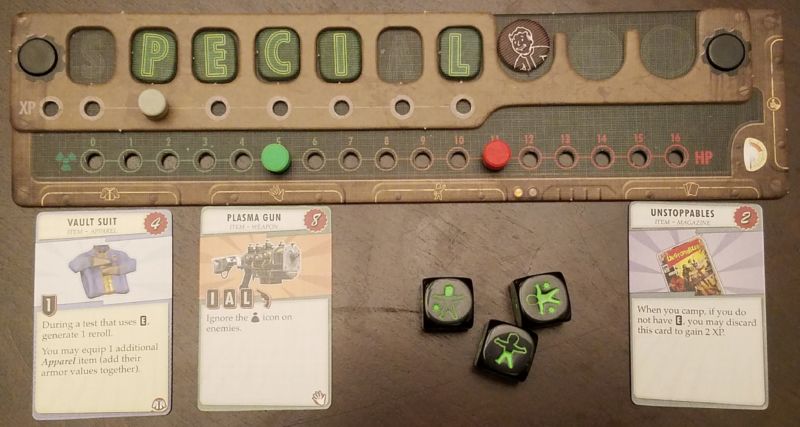
Enlarge/ Two letters short of being truly S.P.E.C.I.A.L.! Also, note the V.A.T.S. dice.
Charles Theel
Welcome to Ars Cardboard, our weekend look at tabletop games! Check out our complete board gaming coverage at cardboard.arstechnica.com.
Would you be surprised if I told you that the new Fallout board game from Fantasy Flight Games (FFG) was something special? You really shouldn’t be, since FFG has a fantastic track record of nailing intellectual properties like Battlestar Galactica, Star Wars, and Doom. Fallout is the latest success here, a tabletop design that feels like a passionate love letter to its source material, even as it stumbles in some areas.
This cardboard version of the digital classic is best described as a narrative adventure game for up to four players. Participants compete for thumbs (the energetic expression for victory points) by engaging in branching story paths, acquiring gear, and throwing their weight behind one of the factions vying for power.
Howdy, partner
The adventure game genre is an old dog. Finding lasting success requires a clever hook to gain separation from classics such as Talisman and Runebound. Mage Knight accomplished this through a focus on deep mechanisms threaded through hand management. Fallout goes a different direction, framing play around a wonderful emergent narrative. It offers you scripted stories to explore and wiggle room to forge your own chapters.
Four scenarios are included in the box, and each features two factions butting heads—say, a group of Synths battling the Institute in a tragedy questioning the nature of humanity. Other scenarios feature Children of the Atom, the Brotherhood of Steel, and of course the Enclave. It’s a veritable amusement park for fans to frolic through.
Play comes from the game’s enormous card library. Each card is numbered to ease cataloging, as you will be pulling cards from the stack often throughout play. Scenarios dictate which cards are placed face-up, offering initial nuggets of narrative for players to chase. Each card offers multiple objectives, which function as a race; get there first and you win a reward. Depending on which conditions are satisfied for each objective, rewards are handed out, and the environment will shift as that card is removed and a new one (or two) is pulled from the library.
Chasing these scripted objectives is addictive. You can choose to hunt a Synth or perhaps head to civilization to chase down a rumor. As the game plugs along, your investment grows and your pulse surges like a Deathclaw on the hunt.
In order to accomplish your goals, you will be exploring the game’s hex map and carefully using your limited action points on each turn. Wandering enemies such as raiders and hideous bloatflies will follow you around, converging on your position with a somewhat mindless AI. You will scavenge equipment such as a Pip-Boy, a shot of jet, or even a worn rifle (although firearms are oddly difficult to come by).
The attention to detail is remarkable. In addition to a bevy of beloved items and characters, the experience and combat systems are spectacular. The S.P.E.C.I.A.L. skill system as a whole is abstracted into gaining individual letter tokens that spell out that iconic acronym. Each letter gained offers a re-roll when partaking in a skill check using that skill. As you acquire experience, you will gain letters and possibly perks, which function as powerful single-use abilities.
Combat is similarly streamlined into a roll of the dice, looking for body part icons that match an enemy’s vulnerable areas. This distillation of the V.A.T.S. system is clever as a nod to the video game, but it’s also deceptively adroit at masking the math behind the roll. This allows you to remain cognitively immersed in the world as opposed to focusing on dry system elements. The dice-based tests are also resolved quickly, which keeps downtime minimized and play moving forward.
War never changes
All of this is really secondary to the core focus on story. By throwing its identity completely behind the narrative quest system, Fallout walks a fine line. The writing and branching decision trees are definitely engaging. You will immediately be hooked on the choose-your-own adventure plot—though I’m not sure it quite pays off in most scenarios.
The game constantly lures you with excellent stories, but they’re often incidental to victory. Those agenda cards direct your optimal path and need to be followed if you care about winning. Often times, they will persuade you to prop up and advance a particular faction, which means that a large swath of narrative options are a no-go.
Perhaps more frustrating is that the story arc never quite reaches a climax. Since pursuing many of the snippets will simply waste your time or progress a faction in opposition to your own cause, it can feel as though you’re being railroaded in a specific direction. The game often ends abruptly without a satisfying final moment, clever quip, or wise reveal.
The benefit here is the drive to replay each scenario and pursue those strands you never untangled. Replaying a game whose most satisfying aspect is a scripted story can be an unsatisfying proposition, but the design team behind Fallout handled this challenge fairly well. Side-quests offer interesting twists and alternative encounters, even when replaying a known scenario.
The game also revels in randomness that may turn some off. Beyond the dice, there’s a certain level of fortune determined by the story objectives. A new card can hit the table with a goal of investigating Vault 83… and if one of the players happens to be near that rusted shelter, then they simply luck out.
The agenda cards highlight this randomness as well. If two of the three players receive starting goals encouraging them to prop up the Brotherhood of Steel, the third player can easily fall behind, since they don’t benefit from a natural alliance that was randomly determined. Those are the breaks in the wasteland, but if you’re looking for a keenly balanced competition, you may walk away frustrated. Again, the story experience is the star here.
One fortunate result of this design is that play count can scale down seamlessly. Fallout even works splendidly as a solo experience, with a lone player fighting the natural timer of factions growing in strength. This is surprisingly fulfilling, with the only loss being the absence of emotional connection through reminiscing with others about the series. This game does such a great job at manifesting those past experiences in the Fallout universe that you can’t help indulging in some shared nostalgia.
Despite the imperfections, fans of both the Fallout series and adventure games in general will find several fantastic concepts to hang their hats on here.
https://arstechnica.com/?p=1243661
The detailed toys and rare collectibles that keep watch over our home offices
Thanks to Ars Technica’s unique staff-from-all-over arrangement, we don’t often see how our coworkers organize their home offices. There’s also the matter of us being a bunch of overgrown children who keep, and proudly display, all kinds of toys, action figures, dolls, and other nerdy decorations in our home offices.
Thus, this latest edition of our ongoing “how Ars works” series focuses specifically on the toys and characters that keep watch over our desks, chairs, coffee mugs, and other home-office accoutrements.
Tech Culture Editor Sam Machkovech presents his “forever alone” shelf. More details in next images, but for now: that 8-bit Starry Night print came from the Portland Retro Gaming Expo. And “Bedmaster” is perhaps the rarest board game Sam owns. It’s a ’70s swingers board game. (Sam has never opened it, he insists.)
That Box Boy box set (the one with Japanese text, from a Nintendo 3DS game) is a relatively rare Nintendo creation, and it includes the simplest, most boring Amiibo Nintendo has ever produced.
Two Nintendo-produced hanafuda card sets. The one on the left is a limited edition, Mario-themed set given away exclusively by Japan’s Club Nintendo series.
The card stock on Nintendo’s hanafuda cards is pretty stellar. Here’s a peek at one Mario-ized version of a classic Nintendo hanafuda card.
A better look at the Pac-Man jigsaw puzzle that came in the Milton Bradley Pac-Man board game from the ’80s. Weird to see anthropomorphized Pac eat a ghost whole like a snake.
And a tighter zoom on that relatively rare Spelunky Joe figurine. Sam bee-lined to Spelunky’s PAX booth many, many years ago to claim this from series creator Derek Yu before the game became a speedrunning sensation.
Sam has decided to start collecting Japanese N64 boxes for some reason. He says it’s because the box designs are cooler than the Western ones.
Sam’s toy-shelf protectors.
Amiibo, some figurines to recreate the original Mario Bros. arcade cabinet art, mint-condition Nintendo “Classic” consoles, and a litany of Nicktoon-affiliated figurines.
A Kerbal Space Program mini, flanked by some friends.
Not quite toys, but Sam keeps these perler bead coasters on his living room table. Handmade by a thoughtful ex.
A few Ars staffers have outed themselves as particularly pack-ratty toy collectors, so those people (Sam Machkovech, Aurich Lawson, and Jonathan Gitlin) have their collections broken out as separate galleries.
Creative Director Aurich Lawson has shared images of his incredible Star Wars toy collection in the past; these are his newest pickups, yet to receive Ars scrutiny.
Samurai variants. Don’t ask questions. Just gaze in awe.
Aurich Lawson
Not pictured here: a bunch of shattered and smashed toy-mainframes.
Salacious in tow, of course.
Hi, Cars Section Editor Jonathan Gitlin here. I’ll admit it, I’m a manchild, and my workspace reflects that. In the background are three 400% Bearbricks (L-R: Futura, Dave Flores, Unkle). In the foreground, the Gorillaz. The metal object between the creepy leather bear and Murdoc is a stub axle that failed in a race car, costing us the chance of a win.
Jonathan Gitlin
A classic, Bill McMullin’s Shuttlemax.
Jonathan Gitlin
This is all waiting to be reassembled following our house move earlier this year.
Jonathan Gitlin
And these ones. Technically the Saturn V belongs to my wife.
Jonathan Gitlin
Zapp Brannigan, Zombie Lisa, Homer the surf bum, Bender, and Fry. And an errant Mk 7 Space Marine. The metal cog in the foreground used to be the first gear for a Honda F1 car.
Jonathan Gitlin
Some Kubricks stage an impromptu dance-off for an audience.
Jonathan Gitlin
Fellow Arsian Dave Chen printed these out for me a few years ago.
Jonathan Gitlin
OK, he doesn’t usually live here, right in front of my monitor.
Jonathan Gitlin
The rest of our slightly more restrained staffers’ collections can be seen in this last gallery, below.
Senior Gaming Editor Kyle Orland: “This shelf has too much stuff to individually list, but the right half is all Mario. There’s also some Pac-man stuff from my first E3 in 2004 on the left, and you can spot a WarioWare Twisted store display that actually moves when the solar battery is working.”
Orland: “This photo includes my very first video game collectible, a boxed super Mario Bros. plastic trophy from a late ’80s Toys R us clearance, and my newest ones, mini arcade cabinets that are fully functional.”
Orland: “Random knickknacks atop my retro gaming CRT, including a Super Mario Bros. Famicom box purchased on my Tokyo Game Show trip.”
Managing Editor Eric Bangeman: “A mix of geek stuff and souvenirs. Middle shelf from left to right: pass from tour of Twickenham Stadium in London in 2016, a couple of frogs, Pillars of Kings bookstands from LOTR, a proof set from the London Mint, and a geode. On the bottom shelf are some mementos of my time with the Park Ridge Wilderness Scouts, a model of Gondor, an unopened can of Primo from a trip to Hawaii, and a ‘fart molecule’ from a chemistry class in the mid-’80s.”
Eric Bangeman
Bangeman: “I’m an architecture geek, too. This is a reproduction of the Mercury on the walls of what is now a ballroom at the last surviving hotel built by Frank Lloyd Wright, The Historic Park Inn in Mason City, Iowa. It’s worth visiting if you ever find yourself in north-central Iowa.”
Eric Bangeman
Bangeman: “The remainder of my collection of obsolete Apple hardware: a G4 Cube, graphite iBook SE, and an eMate. Plus Gumby and Pokey, with a Pac-Man plush from Level 257. There’s some rugby stuff at top left from the USA-Australia match at Soldier Field in 2015. And at right, you can see my non-obsolete Apple hardware: a 4K Apple TV sitting on top of a Directv Genie, which goes to the 43″ 4K TV I have mounted on the wall across from my desk.”
Eric Bangeman
Senior Reviews Editor Samuel Axon: “We’re big Blizzard fans in our home—such that we have two TVs set up for playing Overwatch together on two PS4s. That all started with World of Warcraft, so we’ve themed parts of our kitchen on WoW. Ragnaros, the fiery end-boss of early WoW, stands guard over our stove, basically saying, ‘By fire, be cooked!'”
Axon: “We also have this more obscure WoW toy on the entry table to the kitchen. It’s based off of the Cinder Kitten WoW in-game pet, and in this case, all that California sunshine powers it to constantly do that waving motion you see on the good luck cats at Chinese restaurants.”
Senior Technology Editor Lee Hutchinson isn’t much for figurines, he says, but he sent along this shot of his Sharknado 3 figure with no further description.
Health Reporter Beth Mole: “I don’t like knick-knacks generally, but we do put out our cozy Christmas Death Star by the window, which was a miraculous sign to mark the birth of a new Star Wars movie.”
Technology Editor Peter Bright has currently packed up all of his Dota 2 collectibles. Until they’ve been unpacked and more properly presented, here’s an older image of his massive collection.
Listing image by Aurich Lawson
https://arstechnica.com/?p=1243633
The Usenet Deep Space 9 recapper that helped inspire modern TV criticism
In 1993, TV—and TV writing—were much different entities than what we know today.
Every action has an equal and opposite reaction, Exhibit 5,768: the current golden age of TV has clearly inspired a golden age of TV writing. And if you follow today’s TV criticism at all, chances are a handful of names immediately come to mind (people like Emily Nussbaum at The New Yorker or James Poniewozik at TheNew York Times, for instance). But time and time again, stories on the rise of this format in recent years end up pointing to one writer—Uproxx’s Alan Sepinwall—as the dean of modern TV criticism.
While landmark TV writing sites like TV Without Pity (1998) wouldn’t come along until the Internet matured, Sepinwall was on the Web back when “Lynx and Mosaic were the only two browsers and you had to drive uphill through the snow both ways to get to the Yahoo! homepage,” as he once put it. Back in 1993, long before he started his own blog or went on to contribute to the Star Ledger and Hitfix, Sepinwall was just a college sophomore posting about NYPD Blue to Usenet.
“Tim was, I think, a CalTech prof by day. I tried tracking him down once to thank him for inspiration, to no avail,” Sepinwall tweeted when reflecting on his 20 years as a critic in 2016.
Luckily, Sepinwall ultimately got his chance. In fact, the underground TV writing/DS9 legend recognized the name. “I remembered Alan Sepinwall from my days on Usenet,” Lynch told Ars recently. “He didn’t tend to post to the Star Trek newsgroups all that much, but I remember seeing his stuff here and there. And when I later moved back to New Jersey, The Star-Ledger is where he was writing for years. I read that column and I said ‘I know him.’ He found me a few years ago when someone was doing a feature on him, and he ended up sending me a signed copy of his book.”
Ahead of the recent anniversary of his start with DS9, Lynch happily revealed he didn’t start modern TV criticism, either—he actually got into it because his college buddy Mike was already reviewing Trek on mailing lists and Usenet back in 1988. “After about half a season [of reading], I said, ‘You know, I can do that,” Lynch said. “So very early in The Next Generation S2, I started writing reviews.”
This was the late ‘80s, and Lynch would review TNG all the way through S6. His early work doesn’t resemble what you’d necessarily read in Entertainment Weekly or on The AV Club today: the pieces include recaps of the main plot and any notable subplots before getting into how he feels about the episode (see an early review from 1989 for TNG’s “The Icarus Factor” as an example). Each ends with a rating out of 10, sometimes rating individual storylines or performances even.
But in January 1993, things changed. That’s when, 25 years ago this month, Star Trek: Deep Space Nine premiered.
“I even said it in one of my reviews, I wasn’t planning on reviewing DS9. The time suck was too large,” Lynch said. He had just started his first year of teaching (which was “also not a time-light activity”). “I warned people not to expect reviews, but then the show premiered. I thought ‘I can’t not talk about this.’”
Here, Lynch’s writing evolved into the forebear for modern TV writing. To start, Lynch didn’t shy away from or hide his personal preferences. For instance, slapstick Ferengi episodes? No thanks, see his review of S6’s “Profit and Lace”—“I wrote something to the effect of: ‘There were some nice moments of pathos, some nice cliffhangers, and Armin Shimerman did a great job, but enough with this week’s Buffy the Vampire Slayer,’” Lynch recalled. “That got a lot of people’s attention.”
Lynch skipped his prior recaps in favor of individual episode discussions involving themes, writing, and performances. His pieces got longer, and separate season wrap-ups emerged. For another example, Lynch looks back at DS9 S2 as a high point, and a late-season review like his take on two-parter “The Maquis” demonstrates that reverence. While all the reps (Lynch imagines he penned well over 100,000 words in total between TNG, DS9, Voyager, Enterprise, and some film reviews) clearly helped him develop a certain style, Lynch acknowledges DS9 also provided a richer text to engage with.
“From early on, DS9 struck me as something with so much meat in the premise. There was an awful lot of stuff they could do with it, and I got very into its potential,” he said. “TNG was depicting a very utopian society, which was challenging for the writers at times. But DS9 and later Voyager dealt more with, ‘How do you maintain a utopia’ or, in Voyager’s case, ‘How do you build one?’ Voyager ran away from that premise as fast as it could, but DS9 mostly tried to keep that. In the end, I wasn’t 100 percent thrilled that they decided to go on a war footing instead, but there was a lot of stuff they did that spoke to more complexity of character and theme than TNG. I love TNG, but DS9 usually gave me more to think about.”
Sisko explains to Bashir that humans of the 21st century rebelled against the government that kept impoverished people in ghettos.
The actors who played Bashir and Garak on Deep Space Nine played up the romantic chemistry between the two men.
Deep Space Nine is on the wormhole front in the Dominion Wars, yet its main characters remain fundamentally humane and strive for peace.
Deep Space 9
A genuine Internet impact
Though he covered TNG, Voyager, Enterprise, and some films/books, Lynch’s writings on DS9 are what ultimately earned him a lasting place in TV criticism lore. If the Sepinwall namecheck isn’t enough proof, his work eventually inspired fans to create an entire wikia just for these reviews, and his writing decisions (like when he took on Enterprise or eventually retired) made TrekToday headlines just like the announcement of a new film would. (No, he insists his work didn’t inspire the First Contact character, though.)
Lynch kinda, sorta even had an idea at the time that he was gaining more readers than just his other Usenet pals. Early in his DS9 review, Lynch taught science at a school in California “and I was teaching Rick Berman [Gene Roddenberry’s successor]’s son, just luck of the draw,” he said. “I don’t know that his dad was reading my reviews all that much, but his son certainly was. And he asked me for copies of a couple of them from Voyager and DS9 to print out and show dad.”
Lynch would later hear from people like writer Brannon Braga (TNG, Voyager, Enterprise, and now The Orville) and artist Michael Okuda (supervisor on many films and Enterprise), plus fellow TV writers like Bad Astronomer Phil Plait. A UK magazine called TV Zone asked Lynch to review Trek books based on the strength of his DS9 work, studios approached him with sci-fi scripts to review, Tor nearly published a compilation, and the Marc Alaimo (DS9’s Gul Dukat) fan club even asked him to attend an official farewell dinner at the end of DS9 (both Alaimo and Casey Biggs,DS9’s Damar, chatted Lynch up that evening).
Yet the pièce de résistance of his impact seems clear in retrospect—the TNG writers room once invited Lynch to pitch an episode based on the strength of his work near the beginning of DS9. Lynch recalls he wrote an episode following up on Data dreaming as laid out in TNG’s “Birthright;” the writer dug into Trek dream symbolism and Data’s emotions or lack thereof.
“Obviously, I wasn’t taken, but that was very flattering,” Lynch said. “I’m flattered and still somewhat amazed that the decade or so of writing I did was seen as so valuable.”
Born at the wrong time?
If Lynch came up reviewing Trek during today’s TV writing culture, it’s quite likely he would’ve been scooped up by some major outlet (if not a sci-fi show writer’s room directly) to write full-time. But his experience came during a different era of recaps and reviews, so Lynch still teaches science to generations of young students. And if he were to shift careers back to writing, he’d rather pursue science writing than entertainment writing at this point anyway. Yet, today he has no regrets about how it all played out.
“Those reviews made me realize my writing was somehow valuable, and it encouraged me to keep doing it in some shape or form,” Lynch said. “It made me better as a teacher, and it leads to the occasional moment of hilarity when students stumble upon it and say, ‘Wait, is this you?’ A friend who was dean of students at one of my previous schools referred to me as her favorite science nerd, and she said it was because I didn’t write like one.”
A few years have passed since Lynch rewatched any DS9, but he keeps up with new Trek films and intends to follow Discovery once its distribution method becomes a bit more viewer-friendly. Given how much a certain series shaped his life, however—Lynch’s DS9 writings spanned the entire run of the show, which coincided with ages 22 to 29 for the teacher—it’s unlikely his answer to “what’s the best Trek?” will ever change.
“As much as I tended to ride DS9 for not living up to its potential at times, in a lot of ways it was a high-water mark for writing in the Star Trek Universe,” Lynch said. “The advantage of being in a stationary setting versus a starship setting is, you couldn’t run away from the consequences, which is something virtually every other series did quite a bit. In DS9, they really had to push themselves in different ways, so some of the cultural questions and political questions it brought up are still to this day very, very strong pieces of work and things I think about.
“I would love to have some other Trek series come up where I can say, ‘I think we’re finally equalling the strengths of DS9—and without the occasional lows.’ But that remains a pipedream.”
Lynch joked he likely won’t be so eager to chat when Voyager hits its 25th anniversary in 2020. So as far as legacies go, he notes, DS9’s is not a bad one to have after all these years.