What If? 2 is here with even more serious answers to your weird questions

From swing-set physics to riding a fire pole from the Earth to the Moon, Randall Munroe has got you covered.
Enlarge / From swing-set physics to riding a fire pole from the Earth to the Moon, Randall Munroe has got you covered.
Randall Munroe / Ars Technica

Forget debating the airspeed velocity of an unladen African versus a European swallow. How many pigeons would it take to lift a person seated in a launch chair to the top of the Q1 skyscraper in Australia? Answer: You could probably manage this with a few tens of thousands of pigeons, as long as they don’t get spooked by a passing falcon or distracted by someone with a bag of seeds. That’s just one of many fascinating (and amusing) tidbits to be gleaned from What If? 2, the latest book from cartoonist and author Randall Munroe and the sequel to 2014’s bestselling What If?

Regular Ars readers likely need no introduction to Munroe, or his hugely successful and influential webcomic xkcd. But we’ll give you a brief rundown anyway. Munroe has a degree in physics and worked for NASA’s Langley Research Center as a contract programmer and roboticist. As a student, he often drew charts and maps and “stick figure battles” in notebook margins and decided to scan them and post them to his personal website in 2005. The webcomic got its own website in 2006, when Munroe left NASA to write xkcd full time.

It didn’t take long for xkcd, with its distinctive stick figures, to become a daily staple for scientists, engineers, and online nerds in general. There’s nothing quite like them. Longtime fans know all about the tooltip with the hidden secondary punchline for each cartoon and Munroe’s obsession with possible velociraptor attacks. They spent hours with 2012’s “Click and Drag” and eagerly followed the four-month-long journey of time-lapsed frames that comprised the experimental “Time,” which won the 2014 Hugo Award for Best Graphic Story.

Munroe’s 2012 tribute to the Saturn V rocket inspired scientists to take the “Up-Goer Five Challenge”: explaining their research papers in the most basic language possible. In fact, Munroe ended up writing an entire book, 2015’s Thing Explainer, using only the 1,000 most commonly used words in the English language. (For instance, pencils were “writing sticks,” airplane engines were “sky boat pushers,” and microwave ovens were “food-heating radio boxes.”)

What If? 2 follows the same format as its 2014 predecessor. Munroe selects absurd-sounding reader-submitted questions and attempts to answer them, illustrated with his trademark drawings. Some have relatively short answers, like whether it’s possible to build a sword of solid air. (Answer: Technically, yes, but “it wouldn’t be very strong, it would be hard to sharpen, and it would quickly give your hand frost damage.”) Others get the multi-page treatment, such as whether you could fill an entire church with bananas.

Randall Munroe/xkcd

These are interspersed with “Weird and Worrying” questions, where Munroe doesn’t even answer them; he included them because he thought the question itself was funnier than any answer he could come up with. Case in point: if Harry Potter forgot the location of the invisible entrance to Platform 9-3/4, how long would he have to crash into walls before discovering it? “You could calculate out the answer by counting all the brick walls in the train station,” Munroe told Ars. “But really, I just like the mental image of Harry Potter being, like, ‘All right, it wasn’t the last five, I’m going to try this one now.'”

In short, the book is chock full of even more serious answers to seemingly silly questions. “Even if the answers aren’t useful, knowing them is fun,” Munroe writes in his introduction. What If? 2, for example (the physical book), “weighs as much as the electrons in two dolphins. That information probably isn’t useful for anything, but I hope you enjoy it anyway.”

Ars sat down with Munroe to learn more. Bonus: today’s xkcd is a fun flow chart guide for those who acquire a copy of What If? 2.

Ars Technica: Somehow people got into the habit of asking you these really weird, silly, sometimes impossible, implausible questions. And you started answering them. How exactly did that happen?

Randall Munroe: When I started drawing comics, I was surprised to learn there were so many people who were entertained by the same niche science ideas or funny applications of math to different problems—stuff I laughed at but I didn’t expect anyone else to. Then I put up these comics and found there are a whole bunch of people out there who think about stuff the way I do. That was really cool. But I definitely didn’t expect that people would start thinking of me as the person to settle arguments. I’d get these emails: “Hey, me and my friend have been arguing about this for a while now, and we don’t know how to answer the question. It feels like it’s not a good enough question to bother a real scientist with. But we both agreed you seemed like a great person to send it to.”

Perhaps I should have felt a little bit miffed. Are you implying that I have nothing better to do with my time, that a real scientist has important things to do? But they were also right. I would get these questions, and then six hours later, I’d wake up from a kind of trance, because I’d gone down every research rabbit hole you can imagine. For me, seeing a really interesting question, where you don’t know the answer but you think it might be solvable—it can be like getting a song stuck in your head. You just can’t quite drop it until you figure it out.

So people would have these arguments, and then I’d get sucked in. I’d be like, I think the answer is this, but I can’t prove it. I’m going to try to prove it. So it started off as me just trying to prove that I was right about something to a random person on the Internet. But then I found that I learned so much cool stuff while I was doing it that I thought, man, I should save these answers somewhere and share them with people. And that’s how my What If? blog and book got started.

An xkcd classic.
Enlarge / An xkcd classic.
Randall Munroe/xkcd

https://arstechnica.com/?p=1880389


Ubisoft is pretending it was never really that interested in NFTs

A computerized skeleton has a headache and an UbiSoft logo on its face.
Enlarge / Galaxy brain, meet Ubisoft brain…


If you’ve been following Ubisoft’s relationship with the NFT space in the last year, you probably remember that its nonsensical release of Quartz NFTs in Ghost Recon Breakpoint was halted in April after just a few months. At the time, though, Ubisoft said that players should “stay tuned for more updates with features to the platform and future drops coming with other games!”

In the months since, though, Ubisoft seems to have become less enthusiastic about its future NFT plans. In a recent group Q&A following a press event at Ubisoft’s Paris HQ (transcribed by GameIndustry.biz), CEO Yves Guillemot tried to clarify that the company is “still in research mode, I would say, when it comes to NFTs.”

“We really look at all the new technologies. We are very much on cloud, on the new generation of voxels, and we’re looking at all the Web3 capabilities. We tested a few things recently that are giving us more information on how it can be used and what we should do in the universe of video games. So we are testing ground with some games, and we’ll see if they really answer the players’ needs.

The bit about “answering the players’ needs” is especially interesting in the wake of Ubisoft’s use of NFTs in Breakpoint. In the months after Ubisoft gave away thousands of game-usable NFTs, an Ars analysis found only 96 successful secondhand sales for those in-game items on Objkt and Rarible (the only two marketplaces where such sales are allowed), with prices generally measured in the equivalent of tens of dollars. These third-party transfers were sold as one of the primary use cases for NFTs in the first place, so the lack of sales shows just how little player interest there was in Breakpoint‘s NFT implementation.

Looking back, Guillemot said that “we probably were not good at saying we are researching,” suggesting that this was always intended more of a toe-dipping experiment rather than a major investment in an exciting new technological playfield. That restraint wasn’t communicated when Ubisoft launched its Quartz NFTs last December, though.

Back then, the company described the effort in a press release as “the first building block in our ambitious vision for developing a true metaverse.” At the time, Ubisoft also discussed long-term plans for the blockchain to “genuinely make players stakeholders of our games… placing back into their hands the value they generate through the time they spend, the items they buy or the content they create online.”

Now, though, Guillemot talks about NFTs as just another in the long line of wacky tech fads that Ubisoft likes to play around with when they’re new:

“As a company, we went into VR early, into the Wii early—we always try new things,” he said. “Sometimes it works, sometimes it doesn’t work, but it’s always to make sure we can bring a new experience to players that will be innovative and interesting. The goal of the company is always to create the best experience, and new technologies are always good for that because there’s less competition and people are more interested to try new things on new technology.”

The weirdest part of Guillemot’s NFT remarks came when he spoke as though Ubisoft hadn’t launched its first NFT experiment yet. “We should have said we were working on it, and when we have something that gives you a real benefit, we’ll bring it to you,” he said. “Exploring doesn’t mean launching.”

While we agree that exploring doesn’t mean launching, we’d argue that Ubisoft actually launched NFTs in Breakpoint last December. The fact that Guillemot now says Ubisoft is waiting until it has “something that gives you a real benefit” before any further “launching” tells you everything you need to know about just how quickly the company’s feelings on NFTs have changed.

https://arstechnica.com/?p=1880695


The 103 classic games that did, and didn’t, make the Atari 50 anniversary cut

<img src="https://rassegna.lbit-solution.it/wp-content/uploads/2022/09/the-103-classic-games-that-did-and-didnt-make-the-atari-50-anniversary-cut.png" alt="The box art for Atari 50 includes teases of various console designs and game box art images.”>
Enlarge / The box art for Atari 50 includes teases of various console designs and game box art images.
Atari Corp. / Digital Eclipse

Earlier this year, news emerged about yet another Atari classic-gaming compilation meant to celebrate the company’s 50th anniversary. As we’ve seen quite a few Atari-branded collections over the years, we wondered exactly what shape Atari 50‘s selection of “over 100 games” would take ahead of its launch on Steam, Xbox One, PS4, and Nintendo Switch on November 8.

Thanks to a European retailer listing that emerged over the weekend, we now have an apparently final list of the Atari 50 selection of games: 103 in all, as spread across arcade cabinets, six console families, and a selection of “reimagined,” newly coded games and ports. The verdict: It’s pretty good, yet it’s still a glaring reminder that the compilation might better be named “Atari Corp. 50.”

Missing vowels and details about Vctr Sctr (for now)

We’ll break this article up into platform-specific lists, which each include our own notes and analysis, and we’ll start with the least-surprising list. This collection’s stewards at Digital Eclipse (TMNT: The Cowabunga Collection) had already announced plans to “reimagine” six games beyond the original code supplied by Atari’s archives, and these alone could be worth the price of admission for ’70s and ’80s gaming stalwarts.

Two of these, Haunted House and Yars’ Revenge Reimagined, were announced as straightforward modern-graphic versions of their Atari 2600 counterparts, and while we trust Digital Eclipse’s track record, we have yet to see exactly how these two games have been rebuilt, or whether they lean on classic pixel designs or new 3D assets. Two additional games sound like souped-up, modern remixes of their original counterparts: Quadratank (a four-player touch-up of the 2600’s Tank) and Neo Breakout (which combines Breakout and Pong as a two-player versus game).

The last two reimagined games in the collection are the most intriguing. Vctr Sctr will combine “gameplay from a variety of vector arcade classics” into a newly remixed experience. It’s unclear whether this new game will break classics up into mini-games or smush them together into a new game experience, but either way, the original Atari arcade library was rich with vector-driven games to choose from. Additionally, Swordquest: Airworld is a new sequel to the 2600’s three-part Swordquest series.

This week’s leak does not include any previously unknown games in the above “reimagined” category. For surprises, we should move on to the compilation’s selection of arcade cabinet games:

  • Akka Arrh (1982, unreleased)
  • Asteroids (1979)
  • Asteroids Deluxe (1980)
  • Black Widow (1982)
  • Breakout (1976)
  • Centipede (1980)
  • Cloak & Dagger (1983)
  • Crystal Castles (1983)
  • Fire Truck (1978)
  • Food Fight (1983)
  • Gravitar (1982)
  • I, Robot (1983)
  • Liberator (1982)
  • Lunar Lander (1979)
  • Major Havoc (1983)
  • Maze Invaders (1981)
  • Millipede (1982)
  • Missile Command (1980)
  • Pong (1972)
  • Quantum (1982)
  • Space Duel (1982)
  • Sprint 8 (1977)
  • Super Breakout (1978)
  • Tempest (1980)
  • Warlords (1980)

Since these lists are alphabetical, this selection’s biggest surprise is at the top. Akka Arrh is one of the rare few Atari arcade games to be canceled and somehow avoid a wider online release or leak in the years that followed. That changed in 2019 thanks to a controversial dumping of a rare cabinet’s ROM chips, so this game’s inclusion isn’t necessarily a world premiere for MAME enthusiasts. Still, Digital Eclipse and Atari Corp. deserve credit for shaking hands and giving fans a legitimate path toward purchasing and enjoying this unreleased game. (Atari Corp. had previously done this for the unreleased arcade game Maze Invaders, which launched on Atari Flashback Classics Vol. 3 in 2018.)

The collection’s biggest concession is made clear by the date range in the above list. Notice that no cabinets beyond the year 1983 appear. That’s no accident. Shortly after the early 1980s video game industry crash, the company’s corporate masters at Warner opted to break Atari into parts and sell them. The hardware-focused division, Atari Corp., is responsible for this year’s anniversary compilation, while Atari Games, Inc., went on to release many incredible Atari-branded arcade games before eventually being acquired by Midway—which, this many years later, is now controlled by Warner Bros. Discovery. (A chance corporate-gaming reunion, then!)

Thus, Atari Corp. and Digital Eclipse apparently have not licensed many notable “Atari” arcade classics from their current license holders at WBD. That list is quite long, but just counting the year 1984, that leaves out the megaton games Paperboy and Marble Madness, with the legendary likes of Gauntlet and 720 following a few years later. Similarly, anything with a significant Hollywood tie-in, like 1983’s Star Wars, also doesn’t make the cut.

https://arstechnica.com/?p=1880536


Mando and Grogu are a clan of two in The Mandalorian S3 teaser

[embedded content]
Disney debuted a teaser for The Mandalorian‘s third season during D23 Expo.

Disney is holding its annual D23 Expo this weekend, and that means lots of teasers, trailers, casting news, and fun cameo appearances. The streaming platform’s Star Wars offerings this year included our first look at the third season of The Mandalorian, as well as a final trailer for the limited series, Andor,  and a trailer for a new animated anthology series, Tales of the Jedi.

(Spoilers below.)

We’ve been pining for the new adventures of Grogu and his Mandalorian space daddy (Pedro Pascal) since their heartfelt reunion in the finale of The Book of Boba Fett—aka The Mandalorian season 2.5. (Din Djarin had sent Grogu off for Jedi training with Luke Skywalker (Mark Hamill), but the bond between the two proved far more powerful. Sniff.) The teaser revisits some of the highlights of the S1 and S2 adventures of this “clan of two,” before giving us a glimpse of what’s to come.

Recall that Din broke Mandalorian protocol by taking off his helmet twice: once to save Grogu, and once to bid the adorable green baby Jedi farewell. That did not go down well with his people, particularly Katie Sackhoff’s Bo Katan and the Armourer (Emily Swallow), who insists, “You are a Mandalorian no more.” Bo Katan covets the Darksaber that Din won by defeating Moff Gideon (Giancarlo Esposito) in battle, which technically makes him the ruler of Mandalore.

Din seems far more interested in bopping around the galaxy with Grogu than sitting on a throne, although he’s keen to get back into Mandalorian good graces. But I doubt he’s as keen to give up the Darksaber. The political intrigue and simmering tension suggested here should keep things interesting. We also get a glimpse of a thriving Greef Carga (Carl Weathers) and Peli Motto (Amy Sedaris), who provides Mando with a new R2 unit for his Naboo starfighter. And of course, there are lots of battles and fancy spacecraft maneuvers.

The third season of The Mandalorian will debut on Disney+ in February 2023.

Andor

[embedded content]
Final trailer for Andor.

Meanwhile, the premiere of Andor is just two weeks away. As we’ve reported previously, the story begins with the Empire’s destruction of Cassian Andor’s (Diego Luna) homeworld and will depict his transformation from a “revolution-averse” cynic to a major player in the nascent rebellion who is willing to sacrifice himself to save the galaxy.

The ensemble cast also includes Genevieve O’Reilly as Mon Mothma, a senator of the Republic who helped found the Rebel Alliance, as well as Forest Whitaker reprising his Rogue One role as Clone Wars veteran Saw Gerrera. Stellan Skarsgård (as Luthen) and Adria Arjona co-star as the resistance fighters who recruit Andor to the cause. Kyle Soller, Denise Gough, Fiona Shaw, Robert Emms, and David Hayman have all been cast in undisclosed roles.

We got our first look at the series with a behind-the-scenes teaser in December 2020 during Disney’s Investors Day. We got a short teaser earlier this year at Star Wars Celebration, and a full trailer just last month. Luna was on hand to introduce the final trailer, which features some cool new footage. We also learned the series will have a “spy thriller” vibe, filled with “danger, deception, and intrigue”; those elements do seem to dominate this final trailer. And apparently every three episodes, the timeline will jump forward.

The first three episodes of Andor premiere on Disney+ on September 21, 2022. The remaining nine episodes will air weekly, concluding on November 23, 2022. A second 12-episode season will purportedly lead directly into the events of Rogue One.

The Last Jedi

[embedded content]
Trailer for the new animated anthology series The Last Jedi.

First the bad news: if you’re a fan of the Star Wars animated series The Bad Batch, the second season’s release has been delayed from September 28, 2022, to January 4, 2023. But there’s also good news: Disney+ will debut a new animated anthology series, The Last Jedi, in its entirely on October 26, 2022. The streaming platform dropped the official trailer during the D23 Expo.

The Last Jedi is in the same vein as 2021’s Star Wars Visions, another anthology series comprised of seven animated shorts, each created by a different Japanese anime studio. Created by Dave Filoni and Charles Murray, each of the six 15-minute episodes will feature a fan-favorite Jedi. Some take place before the Clone Wars, while others are set decades before.  For instance, it looks like we’ll be getting Ahsoka Tano’s origin story in one episode, while another will focus on Count Dooku, both part of the master line connected to Qui-on Jinn. And yes, Liam Lesson will be voicing the latter.

Listing image by Disney+

https://arstechnica.com/?p=1880214


Forget all you know and lose yourself in the first trailer for Willow

[embedded content]
Warwick Davis is returning as the Nelwyn dwarf sorcerer in the new Disney+ series Willow.

The 1988 fantasy film Willow was under-appreciated in its day, but it’s now a fantasy cult classic. Disney+ is betting on the strength of its nostalgic appeal with the new fantasy series Willow, set decades after the events of the first film. And now we have an official trailer, which debuted at D23 Expo.

As we’ve reported previously, the original Willow was directed by Ron Howard, and it told the story of a child with a rune birthmark who was prophesied to bring about the downfall of the evil sorceress Queen Bavmorda. The child was set afloat on a grass raft and found by a village of little people (the Nelwyn). A Nelwyn dwarf sorcerer named Willow led a party to find a community of Daikini (tall people) to raise the baby. Many magical adventures ensued.

The Oscar-nominated film debuted to mixed critical reviews, but made a decent showing at the box office, earning $137.6 million globally—even though it never became the blockbuster hit producer George Lucas had hoped it would be. Lucas and Davis had discussed the possibility of a sequel series as early as 2005, but Disney+ didn’t give the project the green light until October 2020, with Howard on board as an executive producer.

On a rescue mission
Enlarge / On a rescue mission

The series looks and sounds like a promising return to that world. Among other positive signs, Warwick Davis is returning as the Nelwyn dwarf sorcerer Willow Ufgood. (Davis was on stage for the trailer’s introduction at D23 Expo.) The official synopsis describes the series as “an epic period fantasy series with a modern sensibility set in an enchanted land of breathtaking beauty”—so, very much in the same vein as the original film. It continues:

The story began with an aspiring magician from a Nelwyn village and an infant girl destined to unite the realms, who together helped destroy an evil queen and banish the forces of darkness. Now, in a magical world where brownies, sorcerers, trolls, and other mystical creatures flourish, the adventure continues, as an unlikely group of heroes set off on a dangerous quest to places far beyond their home, where they must face their inner demons and come together to save their world.

In addition to the return of Davis, Joanne Whalley is back as Sorsha, daughter of the defeated Queen Bavmorda from the original film, and an accomplished warrior in her own right. Kevin Pollak reprises his role as the brownie Rool, who brings a bit of levity to the proceedings. Alas, Val Kilmer has been recovering from throat cancer and thus couldn’t come back as mercenary swordsman Madmartigan. But we learned from the panelists that Christian Slater will join the cast as a friend of the swordsman, described merely as “a character aiding quest.” So Madmartigan will be there in spirit.

Hey, it's Kevin Pollak reprising his role as Rool the brownie.
Enlarge / Hey, it’s Kevin Pollak reprising his role as Rool the brownie.

The new characters include Erin Kellyman as a servant named Jade, who is training to become a warrior; Ruby Cruz as Jade’s best friend Kit, daughter of Sorsha, who assembles a party to rescue her twin brother; Ellie Bamber as a kitchen maid named Dove; and Amar Chadha-Patel as a thief named Boorman, who is promised his freedom in exchange for helping the party. Ralph Ineson plays Commander Ballantine, Adwoah Aboa plays Scorpia, Kenny Knight plays Keene, Alexis Rodney plays Lachlan, Charlie Rawes plays Toth, and Talisa Garcia plays a queen and mother of the as-yet-unnamed character played by Tony Revolori. Dempsey Bryk and Rosabell Laurenti Sellers have been cast in undisclosed roles.

The trailer opens with a mysterious voiceover: “You think you know what is real and what isn’t. What is light, what is dark. Now forget all you know. Come with me.” Cut to Sorsha saying “Willow.” She sends Kit to seek out the sorcerer and ask for his help in rescuing her kidnapped son, because the world once again needs his magic. Of course Willow agrees to help, leading them “beyond the edge of our world into the unknown.” There’s a nameless enemy out there, “rallying the forces of evil,” Willow says. “And the only thing standing in his path is us.”

Pollak’s brief appearance as Rool—and might that be Franjean with him?—was the clear highlight for me. He’s delighted to see his old pal Willow again, and basically mimes the narrative arc of the first movie: “Just like old times. Running! Horses! Mayhem! Mayhem! Happy kissy ending!” Yep, that about sums it up. And it looks like the series will serve up plenty more of the same.

Willow debuts on Disney+ on November 30, 2022.

Listing image by Disney+

https://arstechnica.com/?p=1880218


The rest of PAX West 2022’s standout indie games: Rhythm madness, bloody combat

The Nintendo corner of PAX West 2022; it's hard to get a full photo of the entire show floor, especially one that includes all eight games profiled in the article below.
Enlarge / The Nintendo corner of PAX West 2022; it’s hard to get a full photo of the entire show floor, especially one that includes all eight games profiled in the article below.

SEATTLE—In-person video game conventions are back! Kind of!

Nerdy conventions and other physical events began reappearing in public halls late last year, though what a difference a year makes. PAX West 2021 was my first in-person convention since the COVID-19 pandemic began, but the event was a ghost town, full of empty, blacked-out spaces and massive gaps in the cast of showcasing companies. Last week’s PAX West 2022, on the other hand, finally felt like the real deal, and it was fortunately met by a vigilant, mask-wearing crowd.

Some gaming companies have apparently moved on from local convention participation, with Microsoft and Sony not hosting PAX West booths (though each had a presence at last month’s boisterous Gamescom 2022 in Cologne, Germany). Hence, this post-PAX “coolest upcoming games” feature is far from comprehensive, owing as much to missing companies as to specific games not demoing well in packed convention halls. Even so, we played enough diverse fare to feel comfortable shouting out solid PAX West highlights.

[embedded content]
Rift of the Necrodancer announcement trailer

Rift of the Necrodancer
Release date TBA; platforms TBA | Official site

The studio behind 2015 indie smash Crypt of the Necrodancer clearly cares about new ideas in the well-worn genre of rhythm gaming. That’s proven by PAX West’s promising world gameplay premiere of the new spinoff Rift of the Necrodancer, which basically looks like a greatest-hits collection of other popular rhythm game concepts, only beefed up by the genre experts at Brace Yourself Games.

This week’s demo includes three modes, and each directly compares to a previous hit: Guitar Hero, Rhythm Heaven, and Punch-Out!!. The first looks deceptively familiar. Musical notes fall from the top of the screen to a line at the bottom, and when they cross this line, you must tap the corresponding button to the beat to clear the note.

But what if the notes were monsters—each with their own personalities and movement patterns, thus jumping or shifting as they approach the clear line? This tweak to the Guitar Hero formula feels appropriate for the Necrodancer series, which originally combined top-down monster battles with rhythm-based taps, and already in the new demo, the spinoff’s take on this concept feels incredibly fresh. Each monster has a unique pattern as it descends to the beat of catchy tunes, and the fun kicks into gear when multiple monster types fill the screen. One might need to be tapped twice or thrice to be cleared, shifting to the right or left after each tap. Another might constantly shift between lanes during its descent.

Rift‘s boxing mode combines familiar Punch-Out!! combat with rhythm-based responses, and I’m shocked nobody thought of this before. Punch-Out!!, after all, revolves around memorization and pattern recognition, which is similar to the toughest rhythm-gaming challenges, and I was immediately charmed by the sensation of dodging, blocking, and countering with catchy songs as reference points. If Nintendo isn’t going to make a Punch-Out!! sequel any time soon, then this already seems like a good alternative.

Meanwhile, the mode that mimics Rhythm Heaven feels a little less unique, but that’s not a complaint. The sample level I played looks and feels a lot like Nintendo’s niche hit, particularly in terms of upbeat tunes and detailed, adorable animations to tap buttons along to. It’s unclear if BYG has other modes or surprises in store for the final version of Rift; the game is apparently early in development, so we’re far off from such confirmations, let alone a release date or confirmed platforms beyond Windows. But already, we’re excited by this spinoff’s possibilities.

https://arstechnica.com/?p=1879881


Remembering the strange tale of Queen Elizabeth II and the golden Nintendo Wii

A console fit for a queen?
Enlarge / A console fit for a queen?

The 70-year reign of Queen Elizabeth II, which ended yesterday with her death, will be remembered for the many historical events and world figures with which it intersected. Among fans of video game marginalia, it will also be remembered for a marketing stunt from a now-defunct video game publisher that sent a gold-plated Wii to Her Majesty.

The story of the queen’s connection to the Nintendo console begins in early 2008, when the UK tabloid Sunday People published a lightly sourced story alleging that “the gadget-loving Queen has become hooked on Prince William’s new Nintendo Wii games console.”

An unnamed “palace source” supposedly told the paper that the queen “begged to join in” after seeing the then-25-year-old William play with his Christmas gift (from then-girlfriend Kate Middleton) at Sandringham House. The then-81-year-old monarch reportedly had “hand-eye coordination [that] was as good as somebody half her age” (we wonder what her Wii Fit age would have been) and “showed all the signs of becoming a Nintendo addict.”

Fast forward to 2009, when THQ launched Big Family Games (known in the US as Neighborhood Games) for the Wii. The badly reviewed Wii Sports knockoff focused on games like bocce, horseshoes, and “ladder golf” and would be little remembered today if not for a unique marketing campaign cooked up by THQ UK.

To stress the “family” part of the title, THQ said it sent a copy of the game to the royal family, “arguably the most important family in the country,” as THQ’s Danielle Robinson put it in the accompanying press release. To give the story a bit of extra pizzazz, THQ commissioned a unique gold-plated Wii to send along with the game because “we thought that Her Majesty the Queen wouldn’t want to play on any old console.”

The idea of Queen Elizabeth II playing a horrible game of virtual horseshoes on a gold-plated Wii is inherently hilarious.

While it’s fun to imagine an octogenarian monarch playing on a one-of-a-kind gold-plated console, it seems the queen never even received the special, shiny system. As the royal family’s official contact page states plainly, “For security reasons, the Correspondence Team are unable to accept any unsolicited gifts which are sent to The Queen.”

Thus, the gold-plated Wii was quietly sent back to THQ, which failed to send out a second press release clarifying the initial stop-and-gawk coverage of “the queen’s golden Wii.” As far as anyone knew, Queen Elizabeth II was the lucky owner of one of the rarest and most blinged-out game consoles in the world.

https://arstechnica.com/?p=1879984


Justin Roiland, Shovel Knight devs dish on their trippy new indie games

<img src="https://rassegna.lbit-solution.it/wp-content/uploads/2022/09/justin-roiland-shovel-knight-devs-dish-on-their-trippy-new-indie-games.png" alt="Our two favorite interviews and gameplay sessions at PAX West 2022 revolved around games from two completely different companies. To be clear: Mina the Hollower (left) is not being produced in any way by Justin Roiland (right) or his company Squanch Games.”>
Enlarge / Our two favorite interviews and gameplay sessions at PAX West 2022 revolved around games from two completely different companies. To be clear: Mina the Hollower (left) is not being produced in any way by Justin Roiland (right) or his company Squanch Games.
Yacht Club Games / Squanch Games

SEATTLE—Last week’s crowded, fun-filled PAX West 2022 expo was very different from the ghost town of its 2021 edition, which meant Ars Technica got to spend time with some of our favorite video game creators. You may have already seen our PAX West chat with the co-creators of the Monkey Island series, where we got a peek at Return to Monkey Island‘s new puzzles, jokes, and delectable animations. But that wasn’t the only interview we conducted.

Below are two additional interviews based on highlights from our time at the four-day expo. Each comes from indie studios whose previous games have impressed: Yacht Club Games (Shovel Knight) and Squanch Games (Trover Saves the Universe). The interviews were conducted after I played each studio’s new game, and I’ll be back tomorrow to report on other gameplay highlights from the expo.

Mina the Hollower
(Release date TBD, platforms TBD | Official site)

My favorite discovery at PAX West 2022 wasn’t entirely surprising, as it hit many of my personal gameplay biases: a Game Boy Color aesthetic; a top-down adventure that recalls the three Game Boy-exclusive Legend of Zelda games; and the development chops of a studio like Yacht Club Games, which is best known as the creator of the incredible platformer Shovel Knight.

Still, Mina the Hollower‘s world gameplay premiere at PAX West included an element I wasn’t suspecting: a healthy dose of NES-era Castlevania. As a result, Yacht Club’s design philosophies veer from Link’s Awakening to make this new game more of an action-first exploration game and less of a backtrack-heavy, “seek action” adventure.

The basic concept sounds pretty Zelda-like: Start from a central “hub” as a lowly, average adventurer (in this case, a timid mouse named Mina), then explore roughly eight zones in 2D, top-down fashion; each contains “overworld” and “dungeon” elements. Beat all of these levels to face a final challenge while getting stronger as you play.

But Mina the Hollower eschews the idea of an inventory that lets the hero solve puzzles and explore new zones along the way. Instead, progress is more like that in Zelda II: The Adventure of Link, where players pick which basic meters (damage, health, armor, etc.) to expand as they rack up experience points. (Also, as in Zelda II, each time you upgrade a meter, its next upgrade is more expensive, which may delay your progress if you want to go all-in on, say, attack power.)

<img alt="A handy GIF demonstration of Mina's basic moves. She swaps special weapons Castlevania-style, then uses a whip for her default attack, which has a mild wind-up before it unleashes.” src=”https://rassegna.lbit-solution.it/wp-content/uploads/2022/09/justin-roiland-shovel-knight-devs-dish-on-their-trippy-new-indie-games.gif” width=”768″ height=”432″>
A handy GIF demonstration of Mina’s basic moves. She swaps special weapons Castlevania-style, then uses a whip for her default attack, which has a mild wind-up before it unleashes.
Yacht Club Games

Equipping items, meanwhile, works as it does in classic Castlevania games: find the secondary weapon you want by smashing pots or lanterns, then keep it equipped until you stumble upon the next one you might want to use. (If you accidentally pick up a weapon you don’t want, you get a generous amount of time to grab the last one you’d equipped.)

These weapon options shamelessly lift from the Castlevania series and include exploding bottles, tossable axes (which rise and fall in an arc), and throwing daggers, along with the more Zelda-like ability to dash into and tackle baddies. As in Castlevania, their ammo count is based on a mana meter that must be restored through exploration and killing enemies. The game’s primary weapon is a whip as well, and Mina has a slight delay when she flicks her little mouse wrist back before lunging forward and striking.

Mina’s signature maneuver is a burrow, which lets her sneak beneath the earth, move a bit faster, and pop up for an extra-long jump. And this maneuver is certainly the game’s secret feel-good sauce. In combat, it lets Mina craftily dodge enemies and traps, while she can also burrow during overworld exploration to root out treasure, dig beneath and lift larger stones, or sneak into hidden rooms.

Mina also gets a jump move by default (no item needed), which means the level design generally forces Mina to hop around in both battle and puzzle solving. After only minutes of play, I figured out a higher-speed maneuver, which required burrowing to hop and jumping diagonally over gaps or up stairs. I didn’t need long to appreciate the new game’s combat timings, and I quickly discovered how to manipulate or deceive several tricky baddies to attack them before they could wear down my limited health.

“That’s been a secret for the past 5–6 years: our unannounced 3D game.”

Mina the Hollower‘s director, Alec Faulkner, confirmed in an interview with Ars Technica that he began working on a Mina-style prototype in early 2019 while Yacht Club was putting final touches on the Shovel Knight: King of Hearts expansion pack. He’d been inspired by a recent retro-tech project.

“I bought a new Game Boy Color, hacked it, added a backlit screen, and was playing games on a Flash cart all the time,” he said. “I was thinking, ‘These Zelda games sure are cool, but why are there no other 2D Zeldas?’ Nintendo ain’t making a new 2D Zelda nowadays, and no one else tried [during that era]. That’s so bizarre to me: there’s a billion platform games that try to be Mario.”

https://arstechnica.com/?p=1879800


The knives are out again in first teaser for Glass Onion

[embedded content]
Daniel Craig reprises his role as Benoit Blanc in Glass Onion: A Knives Out Mystery.

We loved director Rian Johnson’s delightful 2019 hit film Knives Out as much as anyone. So we’ve been eager to learn more about the upcoming sequels commissioned by Netflix. Fortunately, the streaming platform just dropped the first teaser for Glass Onion: A Knives Out Mystery—and per Johnson, it’s less of a sequel and more of a new standalone mystery featuring Daniel Craig’s philosophically minded Kentucky sleuth Benoit Blanc. Based on the teaser, it looks fabulous, and we can’t wait for the film’s release later this fall.

Knives Out premiered at the Toronto International Film Festival and was an instant hit, and word of mouth spread quickly. The film ended up grossing $311 million worldwide—the top-grossing film in 2019 not based on existing IP. In my review, I praised Johnson’s deft ability to mix dark subject matter with a lighter touch in his old-school classic whodunnit: “Think Clue meets Murder on the Orient Express—or any number of adaptations of novels by the grande dame of murder mysteries, Agatha Christie—both of which the director cited as influences via a 2019 Twitter thread of movie posters.”

So naturally there was going to be a sequel… or two. Lionsgate originally took on the project, but in 2021 Netflix won a bidding war for the rights to the film plus a second sequel, beating out both Amazon and Apple with a whopping $469 million bid. Johnson wrote the script for Glass Onion during the pandemic, inspired particularly by the Christie-based “tropical getaway” whodunnit Evil Under the Sun (1982), as well as a 1973 film called The Last of Sheila.

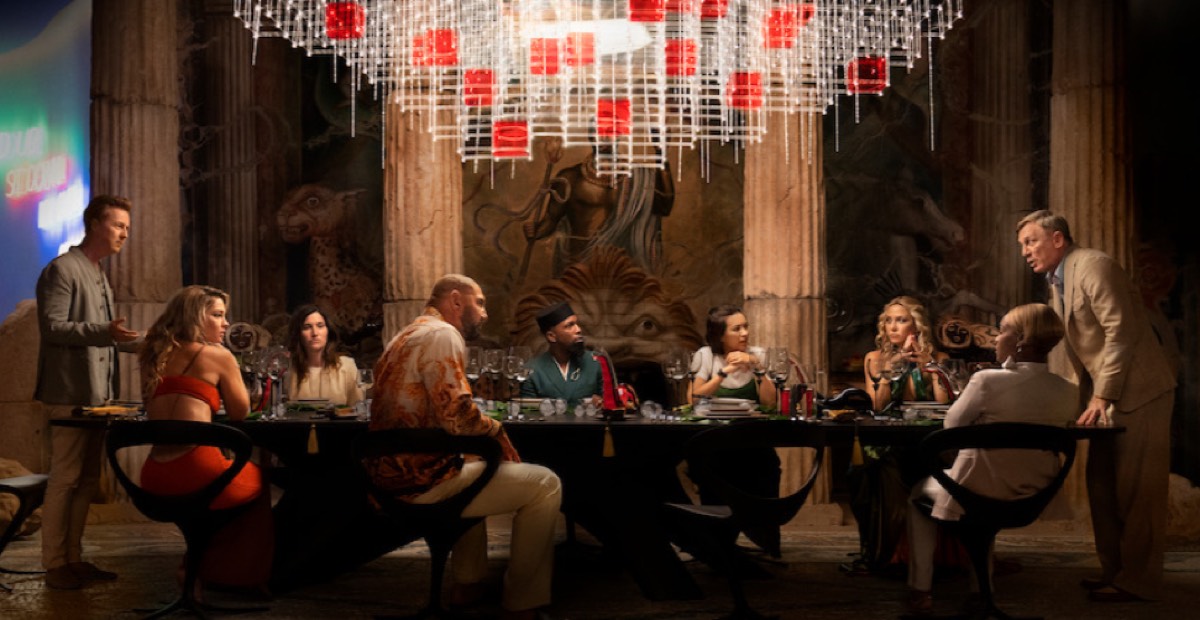
<a href="https://rassegna.lbit-solution.it/wp-content/uploads/2022/09/the-knives-are-out-again-in-first-teaser-for-glass-onion-1.jpg" class="enlarge" data-height="620" data-width="1200" alt="The all-star cast of Glass Onion.”><img alt="The all-star cast of Glass Onion.” src=”https://rassegna.lbit-solution.it/wp-content/uploads/2022/09/the-knives-are-out-again-in-first-teaser-for-glass-onion.jpg” width=”640″ height=”331″ srcset=”https://rassegna.lbit-solution.it/wp-content/uploads/2022/09/the-knives-are-out-again-in-first-teaser-for-glass-onion-1.jpg 2x”>
Enlarge / The all-star cast of Glass Onion.

Craig had forgotten his distinctive Southern drawl since shooting the first film, and rather than try to wing it, he worked with an accent coach for a few months to “make it as grounded and anchored in reality as possible.” Johnson has said that Glass Onion will showcase Blanc’s perspective a bit more than its predecessor; we will meet the new characters through his eyes. Per the official premise:

If Knives Out was about the murderous ties of flesh and blood, Glass Onion makes a good case for being just as wary of one’s closest friends. When tech billionaire Miles Bron (Edward Norton) invites some of his nearest and dearest for a getaway on his private Greek island, it soon becomes clear that all is not perfect in paradise. And when someone turns up dead, well, who better than [Benoit] Blanc to peel back the layers of intrigue?

In addition to Craig and Norton, the cast includes Janelle Monae as a tech entrepreneur named Cassandra “Andi” Brand; Kathryn Hahn as an ambitious governor of Connecticut keen to run for the US Senate; Leslie Odom Jr. as one of Bron’s scientists, Lionel Toussaint; Kate Hudson as a fashion designer named Birdie Jay; Jessica Henwick as Birdie’s assistant, Peg; Dave Bautista as a YouTube star named Duke Cody; and Madelyn Cline as Duke’s assistant (and girlfriend) Whiskey. Ethan Hawke will also appear in an as-yet-undisclosed role.

Glass Onion: A Knives Out Mystery will make its world debut at the Toronto International Film Festival on September 10. It will be released in select theaters in November before hitting Netflix on December 23.

Listing image by Netflix

https://arstechnica.com/?p=1879703


William Gibson’s novel comes to vivid life in first teaser for The Peripheral

[embedded content]
Prime Video’s new sci-fi series The Peripheral is based on William Gibson’s novel.

A young woman struggling to hold it together in small-town America finds herself witness to what may or may not be a murder in the first teaser for The Peripheral, a new Prime Video series based on William Gibson’s 2014 novel of the same name.

(Spoilers for the novel below.)

The novel is in many ways vintage Gibson: a bleak, dystopian future world chock-full of big thematic ideas, visionary technology, and its own slang terminology. The reader is plunged into this setting and must acclimate accordingly; Gibson isn’t interested in presenting everything to us on a silver platter. But that initial effort pays off as the novel evolves into an action-packed cyberpunk thriller.

There are two plot lines that eventually begin to converge. The first arc takes place in our near-term future and is centered on a young woman named Flynne. Flynne works at the local 3D printing shop in a small town; the store is the sole source of goods for the population, along with Walmart’s fictional future offspring, Hefty Mart. Flynne’s brother Burton is a veteran of the US Marine Corps’s elite Haptic Recon force and suffers from brain trauma resulting from his cybernetic implants.

Chloë Grace Moretz stars as Flynne Fisher.
Enlarge / Chloë Grace Moretz stars as Flynne Fisher.
Prime Video

Burton works security for a video game/virtual world maintained by a company called Milagros Coldiron. When Flynne agrees to substitute for Burton one day on the job, she witnesses a woman being gruesomely killed by a swarm of nanobots. But is it an actual murder, or is it merely part of the game? (This is a Gibson novel, so the boundaries can get a bit fuzzy.)

The second arc takes place in a futuristic and desolate London in the aftermath of an apocalyptic event dubbed “the Jackpot,” which wiped out 80 percent of the population. This world is essentially ruled by Russian oligarchs (“klepts”). Here, our main protagonist is a corporate PR guy named Wilf Netherton, who sets up a publicity stunt for Daedra West, this world’s version of an influencer. The stunt goes horribly wrong, and Wilf is fired.

The link between the two timelines is the titular black market technology, “peripherals,” which are favored by hobbyists known as “continua enthusiasts.” Running on “quantum servers,” the peripherals digitally link the users to the past, and the moment they make direct contact, the past splits off into an alternate timeline called a “stub.” Wilf is introduced to the tech and the existence of stubs by his rich buddy Lev. We eventually learn that Flynne’s world is one such stub. The increasingly convoluted and interconnected plot involves a hunt for Daedra’s missing sister Aelita, corporate espionage, political corruption, timeline shenanigans, and multiple attempts on Flynne’s life since she is the sole witness to Aelita’s murder.

Louis Herthum plays drug baron Corbell Pickett
Enlarge / Louis Herthum plays drug baron Corbell Pickett
Prime Video

Prime Video greenlit the TV adaptation in November 2019, and the show was developed by Westworld showrunners Jonathan Nolan and Lisa Joy as part of their overall deal with the streaming platform. They serve as executive producers, along with series creator and showrunner Scott B. Smith. Per Deadline Hollywood, The Peripheral is meant to be a “dazzling, hallucinatory glimpse into the fate of mankind—and what lies beyond.”

Chloë Grace Moretz stars as Flynne Fisher, with Jack Reynor (Midsommar) co-starring as her brother Burton and Eli Goree playing Burton’s triple amputee comrade-in-arms Conner. Gary Carr plays Wilf, and Charlotte Riley plays Aelita. (Curiously, there is no cast listing for Daedra, who plays a pivotal role in the novel.) The cast also includes J.J. Feild as Lev, Adeline Horan as Billy Ann Baker, T’Nia Miller as Cherise, Alex Hernandez as Tommy Constantine, Austin Rising as Leon, Louis Herthum as local drug baron Corbell Pickett, Chris Coy as Jasper, Melinda Page Hamilton as Ella, Katie Leung as Ash, Hannah Arterton as Dee Dee, and Alexandra Billings as Detective Ainsley Lowbeer.

Will the series be any good? It’s tough to tell from this extended teaser, which focuses on introducing the basic premise and is set to oddly retro electronic music reminiscent of Stranger Things or TRON. But the visuals are certainly striking, and we’ll clearly be getting plenty of action. We get glimpses of the novel’s movable tattoos, a possible nanobot swarm, and what looks like a cloaking technology for a car that might be akin to the invisibility “squidsuits” favored by assassins in the novel’s future world.

The Peripheral premieres on Prime Video on October 21, 2022. A second season is purportedly already in active development. The first season’s eight hour-long episodes should cover the entire 2014 novel, raising the question of where the series will go for its sophomore season. One possibility: Gibson published a “sequel and a prequel” novel in 2020 called Agency. That book features the same futuristic technology and is set in an alternative 2017 (in which Hillary Clinton was elected US president) and—what else?—a “post-apocalyptic” time period in the 22nd century with people engaging in more timeline shenanigans.

Listing image by Prime Video

https://arstechnica.com/?p=1879607