Apple now requires App Store games with loot boxes to list odds
Enlarge/ This is not the way loot boxes work in the Xbox/Windows exclusive Forza Motorsport 7. After Aurich’s Photoshop job, however, we almost wish it were.
Apple rolled out a number of iOS App Store rule changes on Wednesday, and the one that catches your eye will likely depend on your mobile-app interests. The biggest change, at least in terms of number of people likely reached, is a tweak to a major rule about video games on the platform: how loot boxes are advertised to players.
9to5Mac was among the first sites to dig into the rules update and pick out the big changes, and it found that Apple has opted to use the term “loot boxes,” which it defines as “mechanisms that provide randomized virtual items for purchase.” Now, any game or app that utilizes such a random-item system “must disclose the odds of receiving each type of item to customers prior to purchase.”
While loot-box mechanics have landed in news headlines thanks to major console games, the practice was popularized long ago in free-to-play mobile games on iOS and Android, typically in a Japanese genre known as “gacha.” The most prominent example of this type of mobile game in the West is arguably Nintendo’s Fire Emblem Heroes, which launched on all smartphone platforms earlier this year and encourages players to accumulate fighters, knights, and mages by getting them out of virtual slot machines—which dole out random rewards, not static or guaranteed ones. Currency for those slot machines can be earned by playing the game, but you can get that currency faster by paying real-world money.
Nintendo appears to rotate its available heroes in limited-time events, so if you want these heroes, you’ll want to log in sooner than later (and probably spend cash).
First one’ll cost ya.
Tap on the color you want once you’ve spent your first orbs; keep going if you like those colors to save a scant number of orbs.
Four stars is pretty good for a summon.
Cost breakdown.
I started with about 24 orbs in all once I factored in freebies from My Nintendo. That was enough to generate good heroes and keep me from needing to spend money.
Fire Emblem Heroes offers an example of how this odds-listing system could work in action. Now, when you mull over which of the game’s slot machines you want to pay currency to (there’s typically a couple to pick from), you should expect to see a list of every single hero in the game, along with a variety of “rarities” that determine strength and other combat attributes, with a percentage likelihood attached. This will probably look like a blind-box listing from a toy seller like Kidrobot, showing that some hero unlocks are much rarer than others.
China began enforcing similar rules for online game operators in May of this year. At that time, when popular game makers like Blizzard complied, they showed how vaguely written rules about loot-box odds can be taken advantage of to leave players in the dark. In Blizzard’s case, the company simply announced that each of its loot boxes is guaranteed to contain one “rare”-class item, while players have a 1-in-5.5 chance to earn “epic”-class items or a 1-in-13.5 chance to earn “legendary”-class items.
However, this disclosure didn’t confirm whether item types, ranging from valuable costumes to worthless “graffiti tags,” had their own percentage chances. Apple’s vaguely written rule would allow game companies to post similarly unclear descriptions.
Still, Apple has beaten Google to the punch in announcing this kind of loot-box odds rule, as Android’s Google Play contains no such rules or requirements.
Apple’s Wednesday update to the App Store rules includes a few other changes. Cryptocurrency apps must now be associated with major banking firms if they offer “Initial Coin Offerings (“ICOs”), cryptocurrency futures trading, and other crypto-securities or quasi-securities trading.” VPN-service apps must now clearly state what user data is gathered and how it’s used, and language has been added to reflect local laws about VPNs. And a rule about “template”-designed apps tries to strike the balance between kicking out crappy clone apps and still allowing small devs to rely on template services to deliver their legitimate apps. In short: the language appears to still allow these apps but will likely put them in a default higher-scrutiny queue before being approved.
https://arstechnica.com/?p=1236237
The full, real, actual Civilization VI just came out on iPad
Enlarge/Civilization VI is the first full Civ game to be released on mobile.
Civilization VI is now available on the App Store for iPad. It’s the full game, making it the first legit, main series Civ game to be released on mobile.
The game was ported by Aspyr Media, a company that has been doing Mac game ports for two decades and which had previously ported BioWare’s Jade Empire and Star Wars: Knights of the Old Republic to iOS. While those games were available on the iPhone in addition to the iPad, Civilization VI is not.
Unfortunately, Civ VI will not work on just any iPad. According to Aspyr’s blog post announcing the release, Civilization VI requires “iOS 11 on an iPad Air 2, iPad 2017, or any iPad Pro.” This is not surprising, but it cuts out the entire iPad mini line—which is still available for sale from Apple—and the original iPad Air, which is still popular and in use.
We tried the game out and found that it is indeed the full Civilization VI experience, as promised. The UI is blown up a little bit, but all the same elements are there. You tap and drag units to move them, and keyboard shortcuts are supported with the smart keyboard. The arrow keys moved around the map. The “additional content” section is present for DLC, and LAN multiplayer is supported—but not cross-platform.
The main menu in Civilization VI for the iPad.
Eric Bangeman
The city construction view, with an advisor tip on touch controls.
Eric Bangeman
The reports screen.
Eric Bangeman
The main world view.
Eric Bangeman
The tech tree.
Eric Bangeman
The civics tree.
Eric Bangeman
According to Twitter user Steve Troughton-Smith, mods are also supported via iTunes File Sharing. Unfortunately, Civ VI does not support the iPad Pro 12.9-inch resolution—the game works on that device, of course, but it looks a little blurry.
Search for Civilization VI in the App Store, and you might be surprised to see that it’s listed for free. There’s good news and bad news here. The good: fear not, for there are no microtransactions, timers, or any of that game design-influencing stuff that can break a game like this. Civ VI is free because the first 60 turns you play are free. After that, you have to buy it. That’s where the bad news comes in: it will cost $60, the same price as the PC and Mac versions.
However, Civ VI is currently discounted at $30 for the launch window—which is (maybe not) coincidentally the price at which you can currently buy the desktop version in Steam’s winter sale.
Civilization VI‘s first expansion pack, Rise and Fall, is scheduled to release on PC February 18, 2017. Aspyr hasn’t said yet when (or whether) that expansion will come to the iPad version. It will add long, gameplay-changing ages, governors, and non-violent ways to seize cities, among other things.
Here’s the short trailer for the iPad release of the game.
[embedded content]
Civilization VI iPad launch trailer.
https://arstechnica.com/?p=1236195
War Stories: Lord British created an ecology for Ultima Online, but no one saw it
Richard Garriott: game designer, astronaut, master haunted house maintainer. In the ’80s and especially the early ’90s, Garriott was part of the first “rock star” cadre of game developers (along with other huge names like John Carmack, John Romero, and, of course, Chris Roberts, who worked for Garriott at a little company classic PC gamers might be familiar with) that transformed PC gaming from beeps and line art to full interactive experiences. And, after that, he flew to the International Space Station just because he could.
So when we were looking for a good interview to start off a new video series on developers who faced down interesting technical challenges, it was hard to come up with a more suitable candidate than Lord British himself.
Fortunately, Garriott was reasonably familiar with Ars and was happy to invite us to his New York home—because for Lord British, telling war stories involves talking about Ultima, and talking about Ultima is a lot easier if you actually have all the Ultima games at hand. On their original platforms. In Richard Garriott’s freaking house.
No plan survives contact with the users
If we sound a little starstruck, it’s because…it’s Lord British, man. Our Apollo series represents one kind of huge video project: huge, multi-part, taking a year to pull together. By contrast, this video is the kickoff to a different kind—one we can do a lot more easily and regularly but which still benefits greatly from being done in video format (still pictures don’t do justice to how awesome it is to have the creator of Ultima tell stories about Ultima).
And the specific war story being discussed? It’s about the launch of Ultima Online, and it has a familiar refrain: the best laid plans of devs and men gang aft agley as soon as the users show up. The launch of Ultima Online in 1997 saw Garriott and crew scrambling to implement the basic systems of one of the founding MMORPG titles, and twenty years ago, the rules and conventions of the genre as we know it today were still very much up in the air. Garriott had to make a lot of guesses about what exactly players might want to do in the game and spent a considerable amount of time building what he thought was the perfect “virtual ecology.” Of course, the game’s players had different ideas—users rarely tend to go where you want them to go, especially in games.
We sincerely hope you all have at least a fraction as much fun watching this as we had making it, and we can’t wait to bring you more of these.
(As an aside, if anyone is looking to pick up the Ultima games for some nostalgia, they’re currently on sale at GOG.)
Magic Leap finally announces a headset… but it’s vague, touched-up in Photoshop (Updated)
Enlarge/ Say hello (or “yikes”) to Magic Leap One.
Magic Leap
Fans and hopefuls in the VR and AR spaces have long wondered when Magic Leap would finally reveal anything to cash in on years of hype and $1.9 billion in investments. Most people who saw the company’s first product announcement on Wednesday may still be waiting.
The company has finally announced a product, dubbed the Magic Leap One, which includes a headset, a single wand controller, and a “lightpack” processing unit—the latter to be worn on your waist like a high-tech fanny pack. The kit is currently advertised as a “developer” device and has a vague launch window of 2018—which will hopefully be enough time for the company to actually show us the final, physical product. No price has yet been announced.
Wednesday’s announcement, unfortunately, only shows a few static images of what the product will look like, and thanks to perfectly smooth details and a lack of realistically dangling cord connecting the headset to the lightpack, it’s fair to assume that Magic Leap has only delivered a Photoshop render of its long-in-development product. No video footage of the device being worn was released on Wednesday.
Magic Leap One’s various parts, spread on a table.
The various renders that Magic Leap put out today show cords dangling off the back of the headset, but it’s not quite clear whether or how the two visible cords intersect.
A single-hand wand that couldn’t possibly be less revealing. Are there buttons on the sides? How does the trackpad work? It’s all so unclear at this point.
It’s not a fanny pack. It’s a “lightpack.”
Look at me, ma! I’m augmented!
The product description repeats promises we’ve heard before—that the headset projects lights near your eyes to convince users that digital objects appear in the real world as if they’re actually there—and without the strain or brightness of a constant display. However, exactly how the system projects those images—and maps an entire room so that digital objects will remain in a proper position no matter when you put the headset on or take it off—is still entirely unclear. We get to see eight camera-like sensors on the front of the device, at least, but it’s unclear whether Magic Leap One will contain rear- and side-facing sensors to help map unseen portions of a room.
Additionally, it’s impossible to tell how comfortable Magic Leap One will feel to wear, as its opening render appears to be made entirely of a hard, plastic shell. The best part of a VR or AR headset is how it looks in action, but we received no previews of that functionality today. Instead, we just get to look at a bug-eyed headset render that might fit into an early ’00s Spider-Man film.
A report by Rolling Stone‘s Glixel confirms that Magic Leap will introduce two different-sized models of the One headset—which even the biggest VR companies have opted not to do, choosing instead to make head-mounted displays that can adapt to any face size. The Glixel report also explains Magic Leap’s engineering hook: it reduces overhead by only rendering a cut-down portion of a full light-field of view. According to Magic Leap founder Rony Abovitz, the human brain only processes a cut-down amount of that data, much like how MP3s only require a cut-down range of frequencies to nearly perfectly recreate full-fidelity audio.
The worst news from Glixel’s report, however, is that Magic Leap’s “field of view” (FOV)—meaning, how much augmented effect appears when wearing the glasses—is only slightly bigger than that of Microsoft’s similar Hololens. Glixel’s Brian Crecente compared the augmented region to “a VHS tape held in front of you with your arms half extended.” Crecente also never confirms whether the headset he tested looks anything like the renders revealed to the public today.
Update, 3:05 pm: A Magic Leap spokesperson sent a statement to Ars Technica to explain the hardware images posted today: “The photos are not renderings, and the only retouching that was done was to edit out some sensitive IP.”
https://arstechnica.com/?p=1235379
Facebook’s stance on rival VR hardware just softened in a big way
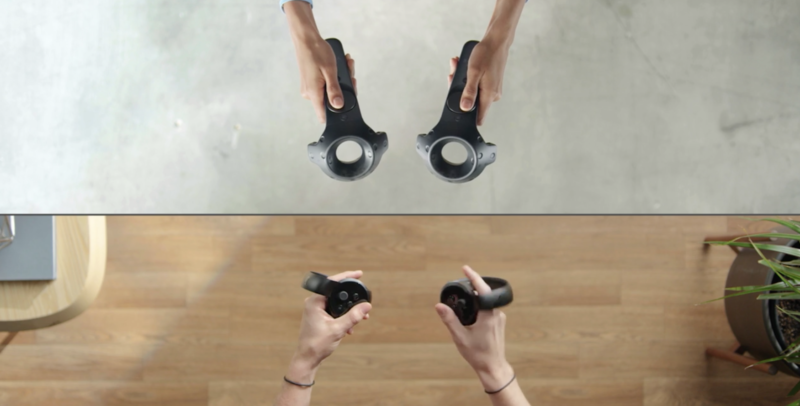
Enlarge/ Oculus Touch controllers (bottom) and HTC Vive wands (top) join in harmony… at least in Facebook Spaces. Is this an indication of VR harmony to come?
In a major about-face for the virtual reality teams at Facebook, the company announced a surprise Tuesday update to its VR “Spaces” app. The social media service’s first VR chat app, still in beta and free, now officially supports its biggest home-VR rivals in the HTC Vive and the SteamVR platform.
This may come as a shock to anyone who has tried using Facebook VR software on rival hardware. Facebook and its home-VR company Oculus have spent more than a year telling customers that many of its major VR games and apps must remain exclusive to Oculus hardware, as opposed to being opened up and used by owners of rival hardware like the HTC Vive. This, in part, inspired a homebrew community to break Oculus’ hardware-locking systems and prove that cross-platform issues were never technical. (The SteamVR platform, conversely, has supported outside hardware such as Oculus and Windows Mixed Reality from the moment those headsets reached the market.)
Ars’ Sam Machkovech tests Facebook Spaces in VR, with help from Kyle Orland. Edited by Jennifer Hahn.
For now, anyone who wants to use Oculus Store content on hardware like HTC Vive must continue to employ software workarounds like “ReVive.” But Facebook Spaces, as a separate, non-Oculus Store download, is arguably a much bigger piece of software to receive official rival support.
At October’s Oculus Connect conference, Facebook founder Mark Zuckerberg told a San Jose crowd that he wants “one billion people” (yes, B as in boy-that’s-a-big-number) eventually using VR. This app’s platform-opening change is a good indicator that Facebook may finally care less about which hardware someone uses and more about which software they use in any augmented, mixed, or virtual-reality interface. Getting more users into official Facebook VR apps may also be necessary for the company to test and harvest the data needed to achieve its lofty VR and AR goals, including geolocation tags of recommendations and friend moments that could appear in real-world locales.
Ars’ Justin Timb–er, I mean, Kyle Orland draws happy trees.
Sam Machkovech
He also draws a happy chef.
Insert pre-made clip-art in your VR chat room.
Kyle has found the “disguise” clip-art.
I called a friend while I was in VR, and he sent this screen of how it looked. This was before I filled our chat lobby with all manner of weirdness and inappropriate doodles.
Kyle still has his shocked face on while posing with the selfie stick.
Here, Sam, have this picture.
Oh, I can post this to Facebook and, I dunno, make my friends jealous of my VR rig?
Sure, why not.
Kyle slaps more dumb stuff on my face and takes more photos of it.
By throwing a 360-degree image into the center of the table, Kyle and I can now hang out in snowglobe-like locales around the world.
I can place mirrors in the VR chat room wherever I please.
I hand a mirror to Kyle so that he can see what his avatar’s T-shirt looks like. (The shirt is the only option in the beta, and it has the same logo as the conference this app was announced at, F8.)
The SteamVR version of Facebook Spaces, which must be downloaded from Facebook’s official site and is currently Windows-only, is mostly identical to the Oculus one. The primary difference is that a few controls have been remapped from the Oculus Touch controllers to the HTC Vive wands, so a few finger-specific gestures are a little clumsier. But it’s easy enough to figure out, and from there, you can create lobbies of up to four friends to have conversations, write notes, play with virtual toys, grab selfie-stick cameras, and pick through Facebook-feed content. As I found in my initial tests earlier this year, Facebook Spaces wins out by using a cute, expressive, Muppet-like avatar system and by keeping its chat system relatively simple and easy to figure out.
One welcome update has come to Spaces via an “experimental” toggle in its settings: Windows desktop support. This isn’t quite the full desktop experience that Facebook wants to deliver via its Oculus Rift app, but it does let VR users point a stylus at their Windows desktop to mouse around and type into text bars via a floating keyboard without having to leave the Spaces app. For anyone who wants to have a legitimate 30-minute VR meeting with colleagues in Spaces, this productivity-minded tweak might very well be the difference maker.https://arstechnica.com/?p=1234747
“I have a really weird idea”—the rise of Mr. Robot’s IRL show-hacking
Show tech advisor Ryan Kazanciyan has been posting regular explainers that include screenshots of the technical work he and Kor Adana did in Mr. Robot S3. And with this show, everything that appears on-screen is a potential clue…
Here’s Elliot’s Kibana host monitoring dashboard from episode four…
Here are the password libraries Elliot relies on for a brute-force approach late in S3.
Mr. Robot writer Kor Adana’s in-season schedule seems tough. In addition to some pivotal plot-making in the writers’ room, Adana does appearances on the The Verge’s Digital After Show, conducts regular post-episode Q&As with The Hollywood Reporter, and famously leads the charge on the show’s obsession with technical detail. Each bit of screen real-estate that appears in an episode—URLs, code, IP addresses, etc.—has to pass through Adana and the team. But throughout all of that, one constant Mr. Robot quest stays in the back of the mind.
“Whenever an opportunity presents itself to do some form of PR for the show, the first thing we go to is, ‘What can we incorporate from the ARG?’” Adana tells Ars. “Can we hide a puzzle? Can we do a cipher code? Our conversations always seem to start with, ‘I have a really weird idea I want to run by you,’ but somehow we’re able to pull it off. And it’s been kinda crazy in S3.”
As S3 wraps up, Mr. Robot’s ARG—alternate reality game, essentially a transmedia narrative that complements the main story and is told through clues and puzzles hidden within anything show-related—has become as obsessed over as the show itself. Adana finds himself often dropping hints in plain sight: within appearances on that aftershow, inside answers he gives THR, in show listserv emails, at Comic-Con pop-ups that mimic show restaurants, even on commercials the show produced and aired within USA’s normal ad blocks. It’s a pet project of sorts for the writer, something that started in very, very small doses in S1 but grew exponentially last year after Adana and his team noticed fans’ appetite for it (back in S1, staff saw community members analyzing radiator pops and hisses for Morse code the team hadn’t even thought to place).
“I’ve always wanted a really compelling hacker show with characters I care about and empathize with, and with tech that’s realistic, and that I can kind of interact with,” Adana told us in an extended podcast interview during S2. “I love the notion that if I had nothing to do with the show at all and I was watching something with real IP addresses and URLs, and went down that rabbit hole, I would find some new information that added to the story. I think that’s awesome; I love that idea.”
For an example of some of the ARG puzzles that have been solved by the folks in the show subreddits (/r/MrRobot and /r/ARGSociety) or on chat platform Discord, take the commercial above. Viewers had to watch the show live to notice Mr. Robot’s Red Wheelbarrow restaurant suddenly had a genuine commercial airing during USA’s ad breaks. Within the jingle, there’s a snippet where the vocals are sung backwards, and sleuths could find a clue by noticing it and then manipulating the audio, easy enough. However, the show’s ARG team laid a second, less-obvious clue in there. Scattered throughout those 30 seconds are five stray images all in different orientations. ARG players needed to spot the stills, place them together, properly orient them, and then run the image through a specific app in order to find an audio file embedded.
“That’s the one where I thought we went too far, it’s too arcane, and we asked too much,” says Jeffrey Kaufman, senior vice president of digital for USA Network (he leads the team that builds all these sites and videos hidden on the Web waiting for fans to discover). “I thought that’s the one they won’t figure out… and it took maybe a day for it to be cracked. So you never know what’s going to happen until it’s out in the world.”
[embedded content]
Mmmmm… barbecue.
Red herrings and Red Wheelbarrows of S3
If that sounds intense both to produce and to dissect, it is. The show has an army of dedicated fans at this point searching and working together to solve the ARG, so the show itself has assembled its own super team in response. In addition to Adana and Kaufman’s USA Digital group, they’ve partnered with a digital agency called Ralph (which partnered with Netflix on some Black Mirror campaigns) and the legendary Curious Codes team responsible for the annual badge challenge at Def Con. The group has even started trying to incorporate outside companies that appear on the show into the ARG. When Mr. Robot searched Shodan early in S3, for instance, observant fans could type the same query into the real Shodan search engine, find the precise screen the character analyzed, and eventually discover a hidden IP address. The ARG team had simply reached out to Shodan in advance knowing fans would try this, and the search company happily placed a results page for the show.
As Kaufman put it, these days any detail could mean something, but not every detail does. And as the Mr. Robot ARG team continues to push the boundaries on the where and what of their puzzles, the community has become conditioned to look everywhere—including places where there may be nothing. This year on the show, a fast-food restaurant called Red Wheelbarrow played a vital role on-screen as a front for one of the show’s hacker collectives. Naturally, since it appeared on-screen, fans knew they’d be able to find a working website: https://www.red-wheelbarrow.com/. The site includes a kids’ section with back-of-menu style puzzles and games, leading the community to focus on a “spot the differences” puzzle with potential meta puzzles within.
“Well somewhere in this puzzle are these puddles on the ground. There are a lot of things within this image that are puzzles—but the puddles are just part of the drawing,” Kaufman says. “Folks on Reddit were really, really analyzing these puddles: the number of them, the position, the circumference—really deep analysis into it. Eventually, one of the players pointed this out in Discord: ‘Somewhere Kor Adana is laughing at us about the discourse over these puddles.’ And that became a meme—now when fans go down a rabbit hole and think they’re getting into tinfoil hat territory, they post this picture with Kor.”
“Honestly, when we started I never thought I’d turn into a meme,” Adana adds. “Now I think of it as a badge of honor.”
(ARG-player CarnageIncarnate reached out to add one of the early season trailers helped inspire the puddles meme, as players on Discord analyzed puddles outside of Red Wheelbarrow during a shot of Irving.)
The S3 ARG continues to play out, though Kaufman and Adana revealed that everything from S2 had finally been found (they admittedly lurk sometimes in subreddits and chats to stay up to date). For players who discovered the final clues, the ARG team hid their online tags in various on-screen locations throughout S3, knowing these subtle hat-tips would be found (and they were). Given everything remains in progress for this season, Adana and Kaufman hesitated to give any hints about undiscovered clues. So, know for certain this article doesn’t have any—but the same can’t necessarily be said for all those Adana post-episode recaps.
Listing image by Michael Parmelee/USA Network
https://arstechnica.com/?p=1234521
The Last Jedi, broken down with spoilers, opinions, and more spoilers
Enlarge/ Much more has awakened in this week’s incredible Star Wars sequel. Let’s go to spoiler town to talk about it.
Haven’t seen Star Wars Episode VIII: The Last Jedi yet? If not, you can’t entirely be blamed, at least if you live in a city that had a ton of advance theater sell-outs. Still, between the $220 million opening weekend and the number of Star Wars fans who frequent Ars, chances are, you found a way to see Rian Johnson’s rapturous, mostly amazing series debut.
For those who haven’t seen the film and still clicked this article’s very descriptive headline, it’s not too late to remain unspoiled; our positive, light-touch review from last week can be found here. Otherwise, I have taken a full week since seeing last week’s early press screening to mull over the film, not to mention a few very excited weekend chats with friends and colleagues. Like other classic Star Wars entries, this one is built for rewatching and talking about with friends and Rebellion allies, so in that spirit, let’s dive into some incredibly spoilerriffic thoughts on The Last Jedi.
Seriously: It’s all spoilers from here on out. You’ve been very, very warned.
For some actors, the force awakens
Spoiler: Luke Skywalker is in this film. (Really, these galleries are spoiler-free, if you want to click through them before seeing the film.)
Everything looks more dismal on Irish islands.
Rey arrives at a strange island hoping to enlist Luke Skywalker’s help against the First Order.
Adam Driver truly delivers as a more terrifying—and believable—Kylo Ren.
“Not looking good out there, R2.”
The film begins with a dramatic bombing run against a Dreadnaught.
The ice-desert battle at the film’s climax will not soon be forgotten.
Finally, the average moviegoer gets to see what modern video gaming fans have known for years: how great of an actor Mark Hamill can be. We had all seen hints when he voiced the Joker in animated form, but the Batman: Arkham gaming series allowed Hamill to cement his Joker portrayal as something dark, deep, and substantial. This experience was all paid forward in Episode VIII, as Hamill had to convince moviegoers of something pretty bonkers: that Luke Skywalker would ever turn his back on the Force and allow a new evil empire to arise in his absence.
This logical leap may very well be what Hamill meant when he spoke to Vanity Fair earlier this year: “I pretty much fundamentally disagree with every choice you’ve made for this character,” he said to the director. Hamill clarified in later interviews that this blunt initial impression softened as he signed on to Johnson’s script and vision, and his Last Jedi performance serves as proof.
Nothing about Hamill’s wizened Skywalker appears phoned-in or throwaway, even though some of his performance’s best moments, from milking a CGI dragon-cow to screwing with Rey’s Force training by tickling her with a feather, shine with a one-take, spur-of-the-moment quality. But Hamill gets a lot of time to build his character’s emotional fortress. While a lot of quiet, brooding, and burdened moments are worth calling out for their subtlety and impact, Johnson and Hamill’s best collaboration comes from the trifecta of flashbacks to the great betrayal between Skywalker and Ben Solo.
There’s no understating how clever this he-said, he-said storytelling trick plays out, as it lets different characters react, wonder, and grow over the span of the film. Luke’s initial story is meant to warn Rey of the dark forces she may soon face, which sets up Ben’s compelling, context-changing stab—sold to incredible effect by a spiteful Hamill performance. Once viewers are clued in to the true series of events, they’ve seen all sides of Skywalker’s sadness and regret that have built over the years. In this third and final flashback, a glow of lightsaber in Hamill’s wide, terrified eyes—that moment in which he realizes that even he, legendary Luke Skywalker, isn’t the universe’s perfect pariah—answers the question of his changed motives in ways that an overwrought script never could.
As a result, seeing the apparent conclusion of Luke Skywalker’s Star Wars life proved more fulfilling and satisfying than I could have ever imagined. His self-sacrifice moved the Resistance’s existence forward, but its temporary levity also allowed Luke to say goodbye as the snarky, likable, love-conquers-hate character we as fans originally fell in love with. Seeing that hopeful light flicker one last time was an amazing show-don’t-tell reminder of how, in Star Wars, hope conquers all.
Perhaps more impressive is Adam Driver’s performance, since he has to follow two trajectories: one as the film’s obvious, highest-ranking villain, and another as a boy taking his final steps toward understanding and embracing his evil destiny. Kylo Ren must act like disciple and master simultaneously, an acting feat that the light-side duo of Luke and Rey split up, and Driver wins out as a result. Kylo is still the tempestuous boy we met in Force Awakens, but this time around, he accepts and leans into that wilder side—and tricks everyone else, from Snoke to Rey, into thinking he’s clueless about his true power and potential.
Daisy Ridley’s Rey, much like Hamill in the original trilogy, is stuck playing a straighter, more one-dimensional foil to these other actors’ delectably dramatic arcs. She’s remarkable in supporting her co-stars, certainly, but she is still given a lot of compelling material to work with—and smolders as she faces a potentially average and ordinary origin story.
Her endless-mirror scene lingers for just long enough to let us appreciate its dismal perspective, but it also offers a nice dramatic irony: the film’s viewers see and understand something about Rey before she necessarily figures it out. Driver nails a compelling excited-yet-confused perspective by the end of that scene, so even though we know she’ll soon have to contend with the difficult balance of light and dark, we as viewers wind up excited to follow her through that obvious plot point.
S.P.Y. and other special effects
Porg is my co-pilot.
Canto Bight is the casino city where everyone’s loyalty is to profit, and they could care less who wins the war.
Use the Force, Rey!
Eat my voltage, Phasma!
Driver and Ridley at least deserve equal credit for one of the film’s most visually striking elements: their no-CGI, cross-galaxy conversations. Actors already struggle when they have to stage scenes in green-screen rooms, with no visual perspective to frame what’s going on. Quadruple that challenge by having those actors exchange a film’s most surprising and revealing conversations all by themselves. But those scenes saw each of these forever-linked Star Wars characters wield equal parts confidence, surprise, doubt, and fear. Masterful stuff.
That’s not to say The Last Jedi slacked off in terms of bombastic visuals; far from it. The opening bomber-run sequence gave Rian Johnson and crew an opportunity to stage a cool, WWI/WWII-styled aerial run, and the Rebellion’s bulky, slow, and intimidating craft ramped the visual and dramatic tension up on all sides. (Should you laugh at the idea of these bombers requiring an “only from above” trajectory in outer space, let’s just remember that Star Wars has been breaking the laws of physics for decades.) There are probably a few articles’ worth of visual analysis to be written about the film’s final, gorgeous ice-desert battle, as well, with its glacial sand burning red on one side—and thus slapping bright-red exclamation points on so many of the battle’s events.
The film’s most obvious visual punch came from Rey and Kylo’s whoa-it’s-really-happening battle. A Force-heavy face-off, a slowly turning lightsaber on a table, a bokeh-smothered slice-and-collapse of Snoke, and black-and-red warriors all succumbing to Rey and Kylo’s weaponry in a red-all-over room: the full scene plays out like staring into the sun. Meaning, when I close my eyes, I can still see the entire fight glowing in my vision, bright with incredible red-on-black contrast.
As a major series fan, however, nothing in this film delighted me more visually than what I call Crappy Puppet Yoda (which I shorten to “S.P.Y.” for what I actually call him). ILM clearly put a lot of effort into making painfully adorable Porgs, hulking dog-storks, and glittering snow-wolves, but the film’s creatures on the practical-effects spectrum just rang truer. The hooded monks who patrolled Luke’s island were a lot more fun to watch get visibly frustrated, compared to the Porgs’ cloyingly precious antics, while the dumpy, can-barely-move Yoda just felt more appropriate for a final Jedi goodbye. Luke never had to contend with CGI Yoda in the original trilogy, and Johnson and co. deserve credit for upholding that streak.
Not sold on other performances
“Let’s go, BB-8! We have to propel another action sequence along by way of questionable logic!” “[concerned beeping noises]” “I know, I know.”
The other leading men from Force Awakens, Poe and Finn, enjoy their share of memorable and enjoyable scenes, particularly Poe’s opening “can you hear me now?” silliness. But in this sequel, those characters’ trajectories hinge on far more predictable and simple “growth” missions. Poe learns, through endless bangs of his head against the figurative door, how to put the full Rebellion ahead of his own grand-standing ambitions, while Finn finally embraces the idea that he can be a hero—and then learns what being a hero actually constitutes. (Rose’s might-be-dead speech about “not fighting what we hate, but saving what we love” is her best moment, and one that her character arc sells quite well.)
You could have summarized both of those characters’ growth concepts in a text crawl, and their Last Jedi plots feel like they’ve been puffed out to move the film’s action sequences forward. This, by the way, is what drags the character of Rose down the most: that she exists mostly to latch onto, and descriptively shout about, whatever “objective” is next. She’s intentionally ordinary, which is refreshing for a Star Wars hero, but the script never gives her room to cash in on this uniqueness. We never truly learn about her origin story, beyond a brief “life sucked” summary about her casino-slave origins, or how she and her sister survived and thrived through such a hard youth. Instead, she reads like a video game character, one who loudly describes an important mission objective whenever you tap the “select” button.
That’s three characters all battling for time, attention, context, and logic. They all feel crowded as a result, and it didn’t have to be that way. What if Poe and Finn had been boiled down to a single, more fleshed-out struggling-with-heroism archetype? Wouldn’t it have been easier for Rian Johnson if JJ Abrams actually killed Poe off like originally planned?
Instead, we are steered through a pair of could’ve-been-shorter subplots: one with Laura Dern as Vice Admiral Holdo, a confusing “I seem bad but I’ve been good all along” stand-in leader and one plot that takes a striking detour into wildly new Star Wars territory. The casino planet of Canto Bight works to break up Last Jedi’s scenery and pace, and it’s presented in gorgeous, fleshed-out form, but its existence as an arms-dealer, profit-off-war station feels way more like a tantalizing tease of three new Star Wars films to come than as a compelling addition to the stories that Last Jedi needs to tell. (To clarify: Disney has not yet confirmed what Rian Johnson’s Star Wars film trilogy will focus on.)
I am absolutely drooling at the storytelling and world-building potential that this offshoot Star Wars universe offers—especially with easy-to-draw parallels with modern society. Hell yes to those eventual films. (And I hope Benicio Del Toro’s shady character receives screen time in them, as well.) But we’re not watching them yet. In Last Jedi‘s case, we’re already bursting at the seams at the 2:30 mark. If Disney didn’t have a new offshoot trilogy to tease, this casino world might have made more sense on the cutting room floor.
Holdo’s emergence as a new, stern-faced, female Rebellion leader suffers from an unfortunate but undeniable comparison to real-life events. It’s hard not to see her appear over a comatose Leia for the first time and ask aloud whether this is how Carrie Fisher was written out of the film—and then cringe at Dern’s ho-hum “I’m in charge” speech as a lousy Leia substitute. As we eventually see, that’s not how Leia fades away. But—what did Holdo really contribute to the Rebellion’s effort? Her iciness and lack of communication inspires a somewhat costly mutiny, and its primary payoff is to teach Poe an important lesson of teamwork and temperament as he picks up the Rebellion’s scraps. I can hold my tongue and swallow some serious gaps in physics and logic in a Star Wars film, but a cockamamie internal-struggle plot is a little tougher to fathom as a serious good-guy military strategy.
Leia and other questions for Episode IX
Star Wars fans had to say goodbye to Carrie Fisher in The Last Jedi. But are they saying goodbye to Leia, as well?
So what’s to come for Princess Leia? Series fans finally see the character’s Force powers emerge—in a tremendous, slow, jaw-keeps-dropping sequence of her finally cashing in her Force chips—and watch her very clearly lead the Rebellion’s thin ranks away as her brother performs the ultimate Jedi sacrifice. Yet her screen time in Last Jedi is a bit too meager—enough to see Fisher flash her knowing smile and enjoy far heartier dialogue than she got in Force Awakens but not enough to count as Leia’s full goodbye to the series’ cinematic universe.
The powers that be at Disney will likely make an announcement at the outset of production on Episode IX about what we should expect for Leia—because no decision will leave all series fans happy, and Disney is probably eager to get the blog-comment rage out of the way before late 2019 rolls around. From the way Last Jedi ends, however, Leia’s story is clearly unfinished, and the only way to complete the new trilogy’s arc of stories—at least in terms of what bricks have already been placed by the first two entries—is to recast Leia.
The idea I’ve been floating with friends, to an admittedly mixed response, is handing the daunting role to an actor like Sigourney Weaver. In terms of age, performance, sci-fi cred, and balance of humor and toughness, Weaver stands out as a very favorable comparison to what Fisher brought to the role of Leia. Barring that, I can’t help but wonder what top-of-Hollywood actor would turn down an opportunity to wrap the original Star Wars trilogy’s characters and finish Leia’s story in a strong-female-role, no-metal-bikini way. Think someone crazy and out-of-nowhere like Meryl Streep. It could happen.
Meanwhile, with Snoke out of the way, Episode IX‘s structure already seems more tantalizing. In the original trilogy, we always knew some version of Darth Vader, with or without the Emperor, would show up and wield a certain, compelling brand of evil. The prequels, meanwhile, did the same with Palpatine. But Kylo Ren’s “me first, at any cost” take on leading the First Order can go in so many directions, which was already proven out by his fruitless, film-closing battle against Skywalker. The stage is thus set for an obvious Kylo versus Hux showdown, but when that will drop in Episode IX, and how it might splinter off to either help or hurt the Rebellion, leaves a lot of sequel possibilities up in the air.
For now, Snoke has thankfully been cast aside. He came with all of the baggage of other Star Wars villains and potential comparisons. Explaining away his origins and purpose would have been a waste of time, if not a copy of prior Star Wars films. Slice him in half—and use his final urging, for Kylo to stab his biggest enemy, to further prop up Kylo’s true rise to power. You couldn’t have asked for a better goodbye to a more boring villain.
Really, Last Jedi stands out by booting so many original-trilogy conventions (other than Benicio del Toro’s DJ pulling a could’a-seen-that-coming Lando Calrissian double-cross). Three narrative choices stand out: the lack of a surprise parent revelation, the drastic reduction of Rebellion ranks, and the little boy revealing his Force powers at the very end. These three things all add up to an Episode IX that will have to ask what it really takes for series heroes to move forward with the Force, midi-chlorians be damned. We may yet receive a true Rey origin story, where we learn her parents really aren’t as ordinary as Kylo Ren warns, but that’s no longer the point.
The stage has been set for a brand-new type of Star Wars heroism, and for all of the series’ new, younger characters, that could put an exclamation point on the book-burning, end-of-the-Jedi farewell between Luke and Yoda.
https://arstechnica.com/?p=1233943
More haunting declassified scans of nuclear weapons test videos released
Enlarge/ A high-altitude nuclear detonation captured on decades-old film at the Lawrence Livermore National Laboratory.
The videos depict atmospheric nuclear tests carried out by the US between 1945 and 1962. Often, the detonations were filmed by as many as 50 different cameras at different angles, locations, and frame speeds. Over time, the US military racked up some 10,000 films from 210 tests.
The films sat in storage for decades until nuclear physicist Gregg Spriggs was asked to model the effects of nuclear explosions, according to an LLNL press release. Spriggs’ model didn’t correspond to information that was published contemporary with the actual tests in the 50s and 60s, so he started digging out old nuclear test films to reanalyze the explosions and fact-check his data against the manually-recorded historical data. In some cases, Spriggs found that the decades-old, manually-recorded data was off by as much as 30 percent.
That spurred an initiative to reanalyze all of the nuclear test video footage available, in order to confirm that the nuclear yield of each test was accurately recorded. Accurate yield data (that is, data on how much energy a weapon releases) helps scientists certify the nuclear stockpile. “These are devastating weapons, and I hope they’re never used in war,” Spriggs said in the LLNL press release. “But the stockpile has been an effective deterrent for more than 70 years. My hope is that this project can help to make sure it stays viable into the future.”
The video-scanning project has required the expertise of rare film expert Jim Moye, who cleans the films and scans them twice in a professional film scanner in order to capture the most exact gradations of color and black and white possible. Many of the films are already decaying after careless storage, so digitization will help preserve the database for future generations.
The videos released this week include footage of the “Harlem Event,” a 1.2 megaton atmospheric detonation above Christmas Island in 1962. The video below shows how nuclear explosions can result in two distinct flashes of light. The first flash happens when the shockwave is formed, but quickly the superheated air around the blast epicenter “shields the light from inside the fireball,” according to LLNL. “As the shockwave cools to below 3,300 Kelvin, the air becomes transparent and the hot gasses begin to show through, creating the second pulse.” Measuring the time between these two flashes, as well as the darkest frame between the two flashes, can help calculate the blast’s yield.
[embedded content]
Similarly, the “Bighorn Event” (also a 1962 test over Christmas Island) shows a more distinctive fireball and mushroom cloud. “The speed at which the mushroom cloud rises and the height of the cloud can be used to calculate yield,” LLNL writes.
[embedded content]
Other metrics by which researchers can measure test yield is the glow time and speed of growth of the initial fireball created by the explosion. A video of the 1955 “Turk Event” released this week occurred just above the desert floor at the Nevada Test Site.
[embedded content]
https://arstechnica.com/?p=1233925
Meet the legislator trying to do something about video game loot boxes
It’s been a rough holiday season for video game loot boxes. The increasingly common in-game microtransactions (usually just a few dollars each) offer a small chance at ultra-rare upgrades, cosmetic tweaks, and a much larger chance at being packed with common junk. Games like Forza Motorsport 7, Need for Speed Payback, and, of course, Star Wars Battlefront 2 are receiving a slew of critical and user ire for the way they push randomized sets of in-game items on players.
While plenty of gamers are fed up with the practice, one gamer who happens to be a Hawaiian state legislator is trying to do something about it.
Last month, state representative Chris Lee publicly launched his effort to pass legislation regulating the sales of video games with loot boxes in Hawaii. In a press conference flanked by religious and business leaders, parents, and affected gamers, he called out “predatory practices in online gaming and the significant financial consequences they can have on families.” Battlefront 2 got specific condemnation as a “Star Wars-themed online casino” in Lee’s telling.
Rep. Lee doesn’t use the word “predatory” lightly in describing loot boxes. He says it’s an appropriate adjective for game makers who are knowingly exploiting addictive gambling mechanisms to manipulate players and increase their bottom line. “We know inside the development process for many of these games that there are clear and deliberate decisions being made to employ these kinds of mechanisms with the full knowledge of the effects they can have,” he told Ars in a recent interview. “That’s made obvious by kinds of people who have been employed, including psychologists and other sorts of experts.”
“This issue is not about regulating content or speech or anything like that,” he continued. “It’s about protecting public health when there is unquestionably a significant impact, particularly on children and youth. As elected leaders, we clearly have an obligation to prevent an industry from exploiting people.”
A gamer at heart
The first time video games came under the serious scrutiny of potential government regulators, in 1993, the elderly congresspeople worrying over the likes of Mortal Kombat and Night Trap admitted they had little direct experience playing games themselves. But Lee is part of a rising generation of lawmakers who grew up with video games as an everyday part of their life. They come at potential regulation from a different perspective.
The 36-year-old Lee says he grew up playing games like Wolfenstein 3D and SimCity, that he’s “had just about every [console] out there” in the years since, and is currently playing around with VR gaming in his limited spare time. He says there are at least “four or five” other avid gamers in the Hawaii legislature and that many lawmakers he’s worked with in other states are gamers, even if they don’t make it “publicly known.”
“It’s ironic that the gaming industry had all these customers and all these players that it created 20+ years ago that are now in positions to affect where that industry is headed today,” Lee said. “These issues I think, unlike the 1990s—when I don’t think that first-hand experience existed in politics— it’s very prominent today. When I talk to legislators in other states, there are a good number of them that get it right off the bat, and I don’t have to say a word about what I’m calling about.”
Enlarge/ Lee said absent-mindedly spending hundreds of dollars on Clash of Clans helped him realize the potential problems with in-game item sales.
Lee, who’s represented a small corner of the island of Oahu since 2009, has so far focused on issues like gay marriage, renewable energy, and universal basic income in his legislative career, so video game regulation is a bit of a left turn. But while Lee says he’s been aware of the rising tide of loot boxes and microtransactions in the gaming business for a while now, it was a direct experience spending hundreds of dollars on Clash of Clans over a few months that helped make him aware of the impact of the problem.
“It didn’t really even really occur to me it was turning into a thing,” Lee said of his spending on the popular mobile game. “At that point, I finally realized I had to delete this, because I’ve got nothing to show for spending that money once the game is gone. It was just a bad investment. If that can happen to somebody like me, who I think is cognizant of what I’m typically doing, imagine the folks who have addictive tendencies out there or who have other issues that are far more vulnerable to the kind of loot box and gambling mechanisms out there… it’s the kind of situation that people can get caught in without ever intending to.”
Think of the children
Games like Clash of Clans, which let you buy in-game items and upgrades directly, probably wouldn’t be targeted by the legislation Lee and his colleagues are currently working on. The real target, he says, are the randomized in-game loot boxes that let players simply buy a chance to get items of varying rarities.
Lee cites medical experts and psychologists who focus on gambling to show the negative effects this kind of variable reward mechanism in games can have on people. But he’s also relying on the “hundreds” of stories he says have flooded his office since his bill was introduced. Those messages are variants of “I know I have a problem; I spent thousands of dollars on games; I know it’s bad, but I can’t help myself now.”
“If people want to spend a thousand hours grinding away to earn a new character skin, by all means have at it,” Lee said. “If they want to spend money to buy that character skin in the game, that’s great, too. It just shouldn’t be through an exploitive, targeted gambling mechanism in which the player is being encouraged to spend money to win a chance at getting something, rather than getting that thing itself.”
But there’s still some question as to whether buying loot boxes is psychologically harmful to children in the same way as other forms of gambling. “Whether this random reward structure leads to harmful purchasing/playing behavior is still up in the air, as it is so new and has yet to be investigated empirically,” Chanel Larche, a doctoral candidate at the University of Waterloo’s Gambling Research Lab, told Ars. “It is way too early speculate how players may experience these rewards, or the cognitive and behavioral consequences, be they positive or negative, that some players may undergo from purchasing loot crates.”
Because different players can value a loot boxes rewards differently, some players may not see themselves as “losing” even if they get relatively common items in exchange for their purchase, Larche suggested. “If they gain what they were hoping for, it could be a rewarding experience… If the loot-box feature was a central goal of the game that is mandatory to use for the purpose of the game, we might see a clearer need for regulation. Alas it is not that simple.”
Enlarge/ Is this essentially the same as a kid buying a box of character skins in Overwatch?
Regardless, just as with casino gambling, Lee wants games with these kinds of randomized in-game purchases restricted to purchasers and players 21 or older. Under that age, players are “psychologically vulnerable to it; they’re said not to have the cognitive maturity at that point to make the appropriate decisions in that context,” Lee said.
For adult players, Lee said games should be required to display the odds of getting certain items from each loot box purchased, as is already required in countries like Japan, China, and Australia. “They believe there’s a chance of winning whatever is advertised, but nobody knows whether it’s one in 100, one in a million, or even just zero. You never really know… That’s a concern, because how do we know people aren’t being ripped off?”
https://arstechnica.com/?p=1231835
ISS astronauts will get their own Star Wars premiere—in space
Enlarge/ In space, no one can hear you stream. Because the latency would kill you.
When you’re orbiting 400 kilometers above the Earth, getting to the movie-plex to watch the latest science fiction blockbuster is a bit of a drag. But the current crew of the International Space Station will still be able to watch Star Wars: The Last Jedi, according to a report from Inverse—and they’ll do so while in orbit.
NASA Public Affairs Officer Dan Huot told Inverse that the ISS crew “will be able to watch it in orbit. Don’t have a definitive timeline yet.”
This is at least partially thanks to the improvements made in the ISS’s communications systems in 2013. Those updates were intended to improve the “scientific output” of the space station, which once had to essentially rely on dial-up speed connections. The High Rate Communications System (HRCS) gave the ISS a massive upgrade in its downlink and uplink speeds—increasing the bandwidth of uplink from the ground to 25 megabits per second, making it qualify as broadband under FCC guidelines. The downlink speeds—the rate at which ISS can send data to ground stations—is a blazing 300 megabits per second. The high-speed networking gear and accompanying Ethernet upgrades were executed by the ISS’s commander at the time, Canadian astronaut and interstellar rock star Chris Hadfield, and Flight Engineer Tom Marshburn.
HRCS is based on Ku-band radio links through NASA’s Space Network, a network of nine Tracking and Data Relay Satellites (TDRS) in geosynchronous orbit that link all of NASA’s Earth-orbiting spacecraft to corresponding ground stations. The last link in the Space Network, TDRS-13, was launched in August. That means that while there’s a big data pipe for the ISS to pull data through, there’s plenty of latency—the data has to travel out deeper into space before being relayed back to whatever ground station is connected to the TDRS satellite of the moment and then back through the terrestrial network to Goddard Space Flight Center.
So, despite the upgrades (and probably because of the latency), the ISS astronauts will not be streaming The Last Jedi. “They typically get movies as digital files and can play them back on a laptop or a standard projector that is currently aboard,” Huot said.