Splatoon 3 review: Nintendo’s well of squid ink has run dry

<img src="https://rassegna.lbit-solution.it/wp-content/uploads/2022/09/splatoon-3-review-nintendos-well-of-squid-ink-has-run-dry.jpg" alt="Familiar Splatoon faces show up to usher players through a confusing, unsatisfying campaign.”>
Enlarge / Familiar Splatoon faces show up to usher players through a confusing, unsatisfying campaign.

In the crustacean-filled universe of Nintendo shooter series Splatoon, (sorry for the pun): Something fishy is going on.

I’m not sure what Nintendo was thinking with its push of Splatoon 3, this week’s brand-new sequel, as a replacement for 2017’s Splatoon 2. Where the last game added meaningful new weapons and modes to the series’ quirky online modes, this year’s new model adds a sprinkling of online-only content, which at best leaves the formula unperturbed and at worst is in dire need of rebalancing. And while Splatoon 2 and its 2018 expansion pack delivered some of the best solo campaign content of the Switch’s generation, Splatoon 3‘s equivalent is a slapdash mess.

Thanks to limited pre-release online testing, I can’t definitively review that half of the game, and I’m wondering how much of it can be redeemed with post-launch support. But I’m comfortable enough to say that Nintendo has dropped the ball for series fans and created an unwelcoming mess for newcomers.

A bad case of the crab (tank)s
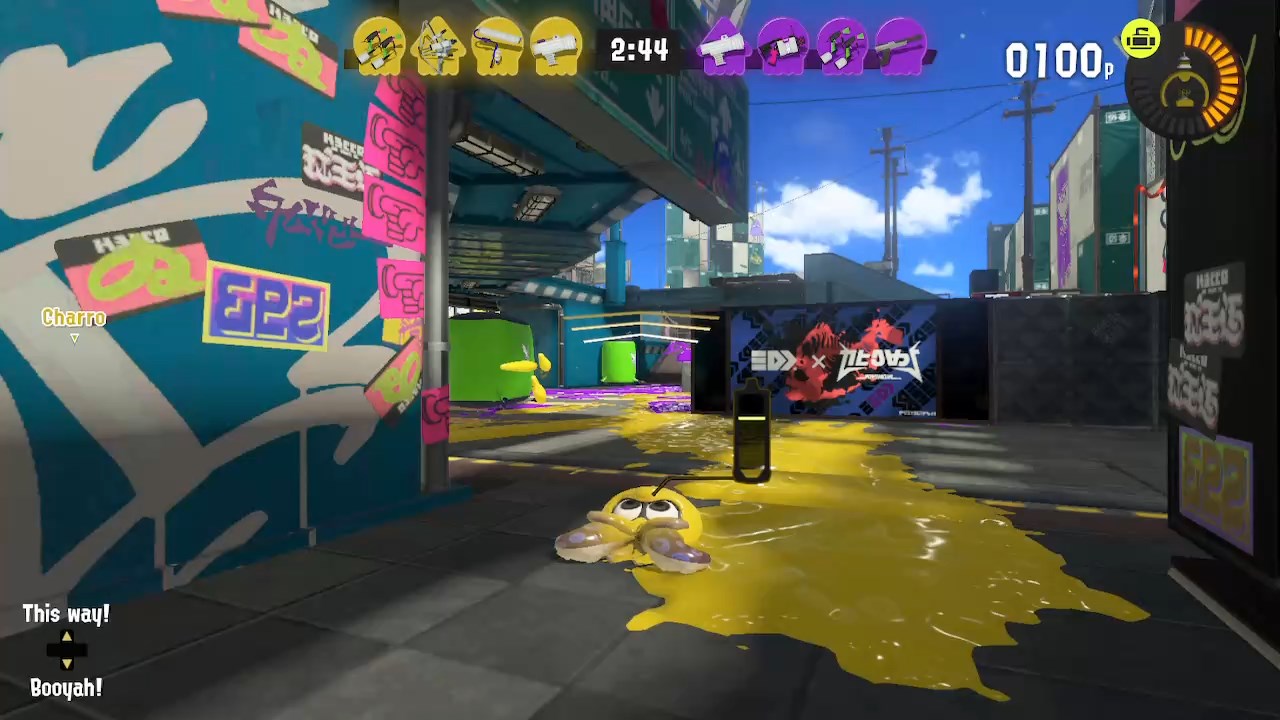
In online matches, lay down ink of your team's color to claim "turf." This color is doubly useful because you can transform into a squid at any time, then swim through your color of ink to both refill ammo and move faster.
Enlarge / In online matches, lay down ink of your team’s color to claim “turf.” This color is doubly useful because you can transform into a squid at any time, then swim through your color of ink to both refill ammo and move faster.

To explain how the series works, allow me to adapt the phrasing I used in 2017:

Splatoon has a few disparate parts: an eight-hour single-player campaign; a range of ranked and unranked multiplayer combat modes; and a “Horde”-styled multiplayer challenge mode, in which you and up to three others team up to take out waves of enemies. The game continues to operate in a universe dominated by Japanese-hipster “squid kids” who dress in “fresh” outfits and shoot paintball guns all of the danged time.

The series’ default multiplayer mode, the “Turf War” team battle, returns as the touchstone Splatoon experience. Your team has three minutes to cover an arena’s floor with more of your paint color than the opponent’s, and any ground smothered in your color becomes “swimmable.” Every player can tap a button to switch between a gun-toting teenager or a fast-swimming squid. Squids can hide or swim through their corresponding color of ink.

Splatoon 3 is so similar to its forebear that I didn’t have to modify any of that text; all I did was remove a redundant reference to the series’ first game on Wii U in 2015. My Splatoon 2 review went on to document smart changes to its online systems, which included a hearty expansion of available weapons, significantly improved level designs that emphasized verticality and sneaky tactics, and that quirky waves-of-enemies mode (known as “Salmon Run”), which turned out to be a pretty fun, kid-friendly version of a mode made famous by the likes of Gears of War and Halo.

What does Splatoon 3 add to online play? Not a ton. The biggest change is a new selection of “special attacks,” which can be activated in an online game after laying down enough ink or doing enough damage to foes in a single life. In my limited online testing, these abilities immediately felt unbalanced—though their tide-turning powers don’t figure as frequently in combat, thanks to how long they take to charge, so that impression is hard to quantify. One example is easy to point to, however.

The “crab tank” lets players temporarily turn into a slow, super-armored crab with temporary, unlimited ammo that shoots at a high rate. I’ve already found that this tank is all but unstoppable when it faces off against one foe at a time; it’s impossible to use the series’ strongest up-close attacks and take the crab down before it can blot out any up-close combatant with its stream of paint. The best a team can hope for is that their opponent triggers its crab tank mode while surrounded by opponents.

https://arstechnica.com/?p=1878698


We’ve finally seen Return To Monkey Island in action: looks great, full of laughs

Dave Grossman (L) and Ron Gilbert (R) joined Ars Technica for a rare interview in Seattle at PAX West 2022.
Enlarge / Dave Grossman (L) and Ron Gilbert (R) joined Ars Technica for a rare interview in Seattle at PAX West 2022.
Sam Machkovech

SEATTLE—Longtime game designer Ron Gilbert has repeatedly suggested that a sequel to his beloved Monkey Island series would arrive how fans want it: unspoiled. It’s a major reason why the point-and-click adventure’s pre-release period has been devoid of gameplay footage or other major giveaways of what to expect, lest any of its puzzles or jokes be ruined.

As the long-awaited Return to Monkey Island approaches its September 19 release date, then, interested fans will have to tide themselves over with the bones Gilbert and his collaborator Dave Grossman threw my way at this weekend’s PAX West. After I entered their meeting room and sheathed my camera, the pair turned on an external display, picked up a computer mouse, and began goading hero Guybrush Threepwood around the new game’s environs.

You might be jealous, but I would argue that your comparable ignorance about how the game looks and sounds is a happier place to be until September 19. My patience for this game’s release has now dwindled.

“Rediscovering that about your past self is really interesting”

<a href="https://cdn.arstechnica.net/wp-content/uploads/2022/09/Return-to-Monkey-Island-Screen-Alt1.png" class="enlarge" data-height="1080" data-width="1920" alt="A screen from the near-final version of Return to Monkey Island, provided by the game’s publishers at Devolver Digital.”><img alt="A screen from the near-final version of Return to Monkey Island, provided by the game’s publishers at Devolver Digital.” src=”https://rassegna.lbit-solution.it/wp-content/uploads/2022/09/weve-finally-seen-return-to-monkey-island-in-action-looks-great-full-of-laughs.png” width=”980″ height=”551″>
Enlarge / A screen from the near-final version of Return to Monkey Island, provided by the game’s publishers at Devolver Digital.
Terrible Toybox

Editor’s note: This article is careful not to spoil a single puzzle, joke, or unannounced character reveal. One plot-specific reveal, which Gilbert and Grossman were happy to announce, lands near the end of the article.

“Wanna do ‘Monocle’? Wanna do ‘Jail’?” Gilbert, sitting next to Grossman, rattles off a few vague terms while picking through a debug menu on a near-final macOS build of the game. After deciding on where to take me in gameplay, Grossman seems caught off guard: “Oh!” he blurts. “Cut scene happening.” I ask if everything is fine, to which Gilbert replies, “It’s a little spoiler-ish.” The scene in question is unsurprising as far as Monkey Island lore goes, but I’ll leave its details mum for now, except to say: it got me laughing, and it confirmed my confidence in the game’s art direction.

The scene, like the rest of the game, includes accurately mapped lip sync for its fully voiced dialogue, and its hand-drawn characters are appropriately rigged to look like detailed paper cutouts being tugged every which way. Eyes bulge, faces distort, and arms and hands emote in a manner that preserves the sequel’s “ripped from a picture book” aesthetic without resembling a dated Adobe Flash animation project. Instead, the conversation sequences I saw fondly recalled some of my favorite ’90s children’s books, especially the works of Lane Smith (The Stinky Cheese Man, The True Story of the Three Little Pigs) as if they’d been animated by devoted fans of the source material.

It didn’t hurt that the scene in question embraces the series’ classic sense of humor. This scene toys with the classic archetype of a bad guy steering into folly, complete with henchmen who suggest “safer” business decisions that happen to be illegal and brutal—then campily telegraphs to players the exact path they will take to ruin someone’s day. This 90-second exchange instantly put me at ease as a classic Monkey Island fan: as if I’d put on a comfortable, well-worn peg leg after all these years.

In checking with Gilbert and Grossman about the sequel’s sense of humor, the duo confirmed that they replayed the series’ classic games before beginning work on the newest sequel—and Gilbert says a mass game-playing revisit of his old titles is standard practice before he starts any new game project. As they’ve previously suggested, the new game pulls characters and ideas from 1997’s Curse of Monkey Island (which neither worked on), while Grossman admits that the Starz historical-fiction series Black Sails also influenced the duo: “It’s not written by humorists at all, but there are a lot of interesting ideas.”

In describing his habit of replaying old games before making new ones, Gilbert describes “rediscovering that feeling of, oh, I once thought this, or, this is the way I wrote about this stuff. Rediscovering that about your past self is really interesting, yet also, you know, we aren’t the same people anymore. So we’re not going to just pretend like we made this game in 1993. We’re going to use everything we’ve learned as designers, writers, and people, and put all that into the new game.” To this point, the duo emphasized “empathy” with how players encounter and figure out puzzles, compared to the sometimes brutal difficulty walls of the original games.

https://arstechnica.com/?p=1878461


New 8K video footage showcases Titanic shipwreck in stunning detail

[embedded content]
OceanGate Expeditions captured the very first 8K video footage of the world’s most iconic shipwreck.

Titanic is by far the most famous historical shipwreck, still holding an enduring fascination for the public 100 years after the “unsinkable” ship struck an iceberg and sank in April 1912. We’ve seen images and video footage of the wreck since it was discovered in the mid 1980s. That includes the footage shot by director James Cameron in 1995 for sequences featured in his blockbuster 1997 film—although much of the latter was actually miniature models and special effects filmed on a set, since Cameron couldn’t get the high-quality footage he needed for a feature film.

Now a private company called OceanGate Expeditions has released a one-minute video showcasing the first 8k video footage of the wreck of the Titanic, showing some of its features in new, vivid detail. One can make out the name of the anchor manufacturer (Noah Hingley & Sons Ltd.) for instance, and the footage also gives us a better look at the bow, hull number one, the number-one cargo hold, solid bronze capstans, and one of the single-ended boilers. The video has already racked up nearly 3 million views on YouTube, even though the average TV or computer screen has much lower resolution than the 8K footage.

The footage was shot during the company’s 2022 descent, with guests forking over $250,000 apiece for a seat on the submersible. “No public entity is going to fund going back to the Titanic,” OceanGate President Stockton Rush told The New York Times in defense of the steep price tag for what is essentially deep-sea tourism. “There are other sites that are newer and probably of greater scientific value.”

Titanic met its doom just four days into the Atlantic crossing, roughly 375 miles (600 kilometers) south of Newfoundland. At 11:40 pm ship’s time on April 14, 1912, Titanic hit that infamous iceberg and began taking on water, flooding five of its 16 watertight compartments, thereby sealing its fate. As the lower compartments of the ship filled with water and the crew rushed to evacuate as many passengers as possible into the limited number of lifeboats before the ship sank, the wireless telegraph operator sent out a series of increasingly frantic Morse Code messages, including what has become the world’s best-known distress signal: dot dot dot dash dash dash dot dot dot (SOS). More than 1,500 passengers and crew perished; only around 710 of those on board survived.

Titanic remained undiscovered at the bottom of the Atlantic Ocean until an expedition led by Jean-Louis Michel and Robert Ballard reached the wreck on September 1, 1985. The ship split apart as it sank, with the bow and stern sections lying roughly one-third of a mile apart. The bow proved to be surprisingly intact, while the stern showed severe structural damage, likely flattened from the impact as it hit the ocean floor. There is a debris field spanning a 5-by-3-mile area, filled with furniture fragments, dinnerware, shoes and boots, and other personal items. 

Since its discovery, the wreck has been deteriorating badly, and not just from accidental damage by salvage operations. (A company called RMS Titanic Inc. apparently destroyed the ship’s crow’s nest when it retrieved Titanic‘s bell, and a two-person submersible crashed into the wreck in 2019.) Deterioration is also due to iron-munching bacteria feasting on the ship’s hull.

While it’s always awe-inspiring to see the famous wreck, especially with such clarity, there aren’t any real discoveries or surprises in the new 8K footage. “I don’t object to this kind of commercial exploitation because they’re not touching or damaging the wreck,” Paul F. Johnston, curator of maritime history at the Smithsonian’s National Museum of American History, told The New York Times. “And it brings attention to the underwater world and to shipwrecks in general, but in my opinion, there’s not that much to be learned from Titanic that we don’t already know.” (He dismissed the guests as “people paying a lot to be ballast.”)

That doesn’t mean the footage isn’t useful, however. This was the second OceanGate expedition to the Titanic wreckage, with another planned for next year. Being able to compare the video footage taken during each eight-hour excursion could help determine the rate of decay, and the company is collaborating with scientists keen to identify the various species on and around the wreckage.

Rush also thinks the high-quality footage could be used to create immersive media installations, projecting the footage on walls and floors, as was recently done for the works of Vincent van Gogh. “Capturing the 8K footage will allow us to zoom in and still have 4K quality, which is key for large-screen and immersive video projects,” he said.

In 2020, we reported on a controversial decision by a federal judge who approved RMS Titanic Inc’s proposed salvage operation to retrieve a Marconi telegraph from the deteriorating wreckage. The National Oceanic and Atmospheric Administration (NOAA) fiercely opposed the salvage mission. The company’s 60-page plan called for an uncrewed submersible to pass through a skylight. If that doesn’t work, the expedition would cut through the roof, which is already heavily corroded. Then a “suction dredge” would remove any loose silt, and the submersible’s arms would cut through any electrical cords. The project was put on hold due to the pandemic, and the new 8K footage may also help the company determine if this plan is still feasible two years later.

Listing image by OceanGate Expeditions

https://arstechnica.com/?p=1878462


Examining the game industry’s hidden impacts on climate change

Water water everywhere, and all the [circuit] boards did shrink...
Enlarge / Water water everywhere, and all the [circuit] boards did shrink…
Getty Images | Aurich Lawson

Amid the stress of living on a warming planet, playing video games is an escape for billions. Whether you’re inhaling mystical doodads in Kirby and the Forgotten Land or cruising through Guanajuato in Forza Horizon 5, games offer a digital retreat that feeds our fundamental need to play.

Unfortunately, the scope of climate change is such that we will need to rethink almost every element of global society—including the game industry.

Ben Abraham has been thinking about the need for that kind of change for a long time. Speaking with Ars, Abraham recalled how, as a teenager, the top floor of his parents’ split-level Australian home would become a grueling sauna thanks to a combination of the summer sun outside and a gaming PC (with cathode ray tube monitor) hemorrhaging heat inside.

Today, Abraham links the memory of that heat-filled room to the future of games. His recent book, Digital Games After Climate Change, summarizes years of research focused on the environmental impact of digital games and includes detailed estimates of the industry’s carbon footprint and suggestions for what the industry can do to reduce it.

The scale of the problem

In his book, Abraham analyzes the climate impacts of the game industry from development to consumption.
Enlarge / In his book, Abraham analyzes the climate impacts of the game industry from development to consumption.

The true magnitude of climate change defies comprehension. To have a hope of staying under 2º C of warming over pre-industrial levels, we need to reduce our output of CO2 by almost 10 percent every year for decades—and likely even faster. It’s the very scope of climate change that, some believe, causes us to lose sight of solutions and often misunderstand what the real issue even is.

While comparisons between climate commitments and World War II are generally overused, the scale of both undertakings is similar. As with World War II, meeting climate commitments could require quick and nearly universal changes in land use and rationing of basic goods.

Video games (and the hardware on which they are played) are closer to frivolous luxuries than basic goods. And if we want to avoid any talk of rationing those games for the “greater good” of climate change, individual action isn’t enough. It will require a holistic, industry-wide mobilization that acknowledges the externalities of the creation and consumption of games.

https://arstechnica.com/?p=1870754


Valve bars Steam developer who posted anti-trans rant in patch notes

Artist's conception of Valve eliminating Dolphin Barn Interactive from Steam.
Enlarge / Artist’s conception of Valve eliminating Dolphin Barn Interactive from Steam.

Valve has removed Roman gladiator sim Domina from Steam after the developer used a recent patch notes post as an opportunity to rant against transgender people and the idea of changing your public gender identity.

Dolphin Barn Interactive’s v 1.3.25 patch notes for the game, published on Wednesday, asks for “respect” as the game changes from its “deadname” of “Domina” to the rebranded “Dominus,” which has supposedly undergone a “sex change.” The thinly veiled post gets more direct as it goes on to demean a well-known trans streamer and asks players to “stop destroying the innocence of children by lying to them about basic biology.”

The Steam store page for Domina says the game is no longer available “at the request of the publisher.” But in a post on a newly created Gab account, Dolphin Barn Interactive’s Nicholas Gorissen said that is “incorrect” and that “Steam cancelled us” over the developer’s views on trans people.

Gorissen also shared a forum screenshot (mirrored on ResetEra) that includes a ban message from “a member of Steam support” citing “a recent announcement posted to the Domina community hub [that] includes insults targeting another person… With that in mind, we are ending our business relationship with Dolphin Barn Incorporated and removing all associated products from sale.”

Steam’s Rules and Guidelines for discussion and user-generated content bars posts that “flame or insult other members.” Steam’s online conduct policy further bars posts that “defame, abuse, harass, stalk, threaten, or otherwise violate the legal rights (such as rights of privacy and publicity) of others.”

A post shared by Nicholas Gorissen detailing Valve's reasoning for the ban.
Enlarge / A post shared by Nicholas Gorissen detailing Valve’s reasoning for the ban.

Valve’s message, as posted by Gorissen, also references previous communications asking Gorissen to stop clearing reviews that had been flagged by Steam moderators for other rule violations. The developer pushed back against this idea in an early August post, which complained that “we can’t even flag the lying reviews as fraudulent because nameless, cowardly steam moderators whom we cannot interact with, have final editorial control!”

Back in March, Domina drew controversy for a patch notes post that included an entreaty to “TAKE OFF THE FCKN MASKS – Next time you’re at the grocery store, try showing a woman your face. Be confident, unafraid of the LIES…”

Gorissen claims on Gab to have “brought millions of revenue to the table” for Steam, and data from Steam Charts and Game Data Crunch suggests the game has been a modest sales success since its 2017 release. The game has received over 10,000 Steam reviews since its launch, though a few thousand of those have come in the last month amid a flood that Steam has flagged as “off-topic review activity.”

Last year, Steam banned developer “Very Positive” from the service for using a name that manipulated user perceptions of its game’s reviews. And in 2018, Insel Games was barred from the service for encouraging employees to write fake reviews. https://arstechnica.com/?p=1877975


I’m still worried about Diablo IV’s cosmetic-only microtransactions

Get your premium currency ready.
Enlarge / Get your premium currency ready.

A couple of weeks ago, Blizzard published a long-awaited update about its upcoming action role-playing game Diablo IV. The post shared some new information about how seasons will work and explained how the company plans to shake up the metagame by continuously releasing new content.

But after the contentious release of Diablo Immortal, a game packed to the gills with power-bestowing microtransactions, there was only one question on fans’ minds: How, exactly, would Diablo IV be monetized? These days, that’s not a strange question to ask about a full-priced title like Diablo IV.

There’s good news, but I’m still worried about some of the game’s proposed systems.

It’s alive

The game is going all-in on the “live service” model, with Director of Product Keegan Clark writing in the update that “Diablo IV will be supported by an army of developers for years to come.”

That’s not necessarily a bad thing; the Diablo series has always attracted an obsessive fanbase that’s happy to grind away at the same game for decades. In fact, considering the support Diablo games have historically enjoyed through ladder resets (Diablo II) and seasons (Diablo III), it has always felt a little strange that Blizzard has never charged for much beyond the base games and expansions.

If you want a continuously supported game, it’s reasonable to expect to pay at least something for its upkeep, even if it’s optional (though there are plenty of examples of games that have done just fine by releasing a ludicrous amount of free content over the years). And since there has been no new Diablo III content for quite some time beyond minor seasonal rebalancing, having a team dedicated to producing new seasonal content for the game—including, the blog post tells us, new gameplay features, quest lines, challenges, and live events—is very exciting indeed.

Thankfully, Blizzard reiterated its earlier promise that Diablo IV will offer only cosmetics—not power—for cash. These cosmetics will come from two sources: an in-game shop that sells cosmetic armor pieces for premium currency and a paid battle pass. Seasons—the optional periodic character resets we saw in Diablo III—will remain free. In its post, Blizzard is almost falling over itself to reassure fans that Diablo IV is not Diablo Immortal.

<a href="https://cdn.arstechnica.net/wp-content/uploads/2022/09/Diablo4microtransactions7.png" class="enlarge" data-height="1080" data-width="1920" alt="Diablo III‘s seasons are back, and they now feed into the "season pass."”><img alt="Diablo III‘s seasons are back, and they now feed into the "season pass."” src=”https://rassegna.lbit-solution.it/wp-content/uploads/2022/09/im-still-worried-about-diablo-ivs-cosmetic-only-microtransactions-1.png” width=”640″ height=”360″ srcset=”https://rassegna.lbit-solution.it/wp-content/uploads/2022/09/im-still-worried-about-diablo-ivs-cosmetic-only-microtransactions-2.png 2x”>
Enlarge / Diablo III‘s seasons are back, and they now feed into the “season pass.”

“The way we approached designing the Shop and the cosmetics within it was by thinking about the experience we want players to have,” the post says. “We want buying things to feel good—before, during, and after purchase. So, if players choose to buy something, it should be because they want to, not because they feel like they have to. It should also be clear to players exactly what they are getting before they choose to buy, with no unpleasant surprises.”

But as Ars Culture Editor Sam Machkovech pointed out to me, that cheery statement has some interesting undertones. First, the last sentence is a not-so-oblique reference to lootboxes, a monetization scheme that got Diablo Immortal banned from two European countries. With regulatory and governmental eyes continuing to zero in on the practice, the decision to eschew lootboxes becomes more prudent than beneficent, at least for a certain type of game.

Further, of course Blizzard wants “buying things to feel good”! Why would a company not want to make buying things feel good? The whole “we’re doing this for you” attitude ignores the fact that these “options” were not something anyone was asking for.

https://arstechnica.com/?p=1877698


19th century art form revived to make tactile science graphics for blind people

3D-printed lithophanes can help optically impaired scientists “see” data, such as from protein separation gels, with their fingertips.
Enlarge / 3D-printed lithophanes can help optically impaired scientists “see” data, such as from protein separation gels, with their fingertips.
ordan Koone/Bryan Shaw

In the 19th century, an art form known as lithophanes was all the rage in Western Europe. These thin engravings were usually made from translucent materials like porcelain or wax. When backlit, a glowing 3D image would appear that would change its features in response to variations in the light source. Now researchers have revived this art form to create tactile graphics to illustrate scientific data that glow with high resolution. According to a recent paper published in the journal Science Advances, these lithophanes are accessible to sighted and visually impaired people, making them a universal visualization tool for scientific data.

“This research is an example of art making science more accessible and inclusive. Art is rescuing science from itself,” said co-author Bryan Shaw, a biochemist at Baylor. “The data and imagery of science—for example, the stunning images coming out from the new Webb telescope—are inaccessible to people who are blind. We show, however, that thin translucent tactile graphics, called lithophanes, can make all of this imagery accessible to everyone regardless of eyesight. As we like to say, ‘data for all.'”

The word “lithophane” derives from the Greek litho (stone or rock) and phainein (to cause to appear), popularly translated as “light in stone.” The art form’s roots may date back to ancient China, as many as 1,000 years before the Tang Dynasty. (Historical sources describe paper-thin bowls with hidden decorations.) But to date, no actual lithophanes are known to have been in China before 1800.

Exactly who perfected the process of making lithophanes is still debated among historians. The common 19th century process involved etching a 3D design into a thin sheet of translucent wax or porcelain using traditional relief and intaglio printmaking techniques. More light would shine through the parts of the carving where the wax was thinnest.

These lithophanes were between one-sixteenth of an inch to a quarter-inch thick. They were displayed as plaques, hung in windows or in front of shields with lit candles behind them as a light source. Lithophanes could also serve as night lights, fireplace screens, tea warmers, or ornaments engraved with erotic images. American industrialist Samuel Colt filled his Hartford, Connecticut, home with more than 100 lithophanes and commissioned 111 lithophane versions of a photograph of himself to give to friends and associates.

The technique fell out of favor after the invention of photography, but the advent of 3D printing has revived interest. Today, lithophanes are typically made with plastic, 3D printed from any 2D image that’s been converted to a 3D topograph, according to Shaw and his co-authors, which they did with free online software. Four of those co-authors have been blind since birth or childhood, yet still successfully completed their Ph.Ds. But they are rare examples. Finding a way to create universal tactile science graphics that both blind and sighted individuals can use would remove a longstanding barrier that has kept many visually impaired people out of the sciences.

https://arstechnica.com/?p=1874119


Indie dev mounts successful sting operation against scammy Steam curators

Artist's conception of indie developer Fabrice Breton knocking out some scammy curators.
Enlarge / Artist’s conception of indie developer Fabrice Breton knocking out some scammy curators.

Valve has removed a handful of Steam curator pages after a virtual sting operation exposed them as part of an apparent scam to acquire and resell free game keys.

In a Twitter thread posted earlier this week, Brok the Investigator developer Fabrice Breton discussed the flood of free game key requests he got from Steam curators after his game’s recent launch. While some of those curator pages were no doubt legitimate, Breton suspected many more were scammers using artificially inflated curator pages to get free game keys. Those free keys could then be converted into cold hard cash through gray-market code resellers like G2A, thus eating into legitimate sales that profit the developer.

To separate the scam curators from the real ones, Breton said he responded to those key requests with keys for the free, limited Prologue version of the game rather than the full release. While those keys would be indistinguishable from full ones before redemption, any curators actually interested in playing the game would quickly realize the difference and reach out about the problem.

Only a few curators complained, “confirming that most of those emails are from scammers who did not even activate those keys on their account before posting a review” as Breton put it. The game’s quick availability on key resale sites also suggests that many of the free keys Breton sent out were not being played by the recipients.

Did you even play the game?

Following this little experiment, Breton says he noticed “a good chunk of ‘suspicious’ negative reviews” for his game popping up from some of the curators that got the Prologue keys. That included many curators for which Brok was the only game with a negative review and a few curators who flipped their recommendation from positive to negative (likely after “getting angry clients coming back at them” from resale sites, according to Breton).

“Those reviews are 100 percent fake because, considering I sent them Prologue keys, they couldn’t play the full game,” Breton noted. And while Steam’s more direct user review system requires reviewers to actually own and play the game being reviewed, a curator page can recommend or pan any game in the Steam catalog.

Reddit user darklinkpower did a deep dive on the curators that panned Brok and noted a number of suspicious similarities between many of them, including identical creation dates and admins. All of those curator pages are no longer available as of Wednesday morning, though, after an apparent purge by Valve for “violating the Steam Community Rules and Guidelines” (some of the curator pages are currently still available in Google cached versions from recent weeks).

“Somehow, I feel just slight guilt over it now,” Breton writes of his apparent role in getting these curators removed. “I’m aware those scammers often live in less fortunate countries where making a living is harder. But they should do positive work, building something instead of filling our mailbox with spams and leeching off the work of others.”

Breton recommended that Valve modify Steam’s Curator Connect program to limit the flood of fake requests developers face and to let developers identify and verify trusted curators. Breton also wants Steam to “not allow curators to review games they don’t own [or] at least allow players to see which curator reviews were done by playing the game and how much play time.”

https://arstechnica.com/?p=1877286


The Last Of Us Pt 1 remake review: Enough upgrades to leave us stunned

<img src="https://rassegna.lbit-solution.it/wp-content/uploads/2022/09/the-last-of-us-pt-1-remake-review-enough-upgrades-to-leave-us-stunned.jpg" alt="This moment from The Last Of Us Pt 1 was captured as a real-time cinematic on PlayStation 5. All images of the PS5 version were directly captured by Ars Technica, except where noted (though Sony’s own supplied screens are in line with how the game looks on current-gen hardware).”>
Enlarge / This moment from The Last Of Us Pt 1 was captured as a real-time cinematic on PlayStation 5. All images of the PS5 version were directly captured by Ars Technica, except where noted (though Sony’s own supplied screens are in line with how the game looks on current-gen hardware).
Naughty Dog / Sony Interactive Entertainment


A little over a decade ago, developer Naughty Dog diverged from its base of amusing, swashbuckling video games by revealing its most intense project yet: The Last of Us. The game’s first-look trailer, which premiered at E3 2012, appeared almost too good to be true.

In some ways, this new series looked like the stunning Uncharted games we’d already seen on the PlayStation 3. It was full of realistic characters, detailed environments, and convincing movie-like dialogue. But this wasn’t a shooting gallery interrupted by wild train sequences and epic climbs up mountains. Instead, TLOU appeared to host the tensest and most brutal combat ever seen on a gaming console. A camera dramatically swung around two survivors of an apocalypse, and these resource-starved protagonists tiptoed around dangerous foes (humans and zombies alike), always one low-on-ammo gun jam or wrong step away from certain doom.

One year later, the game launched to accolades and high sales figures, but it didn’t quite resemble that dramatically staged “real gameplay” trailer. The final game’s enemy AI, battle choreography, and presentation of player choices felt more video gamey than we saw in the trailer.

I remembered that old sense of disappointment while I played The Last Of Us Pt. 1, this week’s PS5 remake of the 2013 original. Honestly, there were moments while I tested this note-for-note remake where I felt adrift, enough so that I saw cracks in its handsome, “current-gen” facade. This is not a perfect remake, and it may leave both new players and Naughty Dog diehards disappointed in some respects.

But when I finally got far enough in the dark, compelling campaign to relive its jump-scare corridors and epic battles and saw the progress that had been made since 2013, I got it. TLOU Pt. 1 is a rare example of a gaming publisher pointing to a classic “bullshot” trailer, then telling a team of developers, “You get to finish the job. You get to make this look and feel like that amazing trailer.” And in enough respects, Naughty Dog has done just that.

Grotesque yet beautiful

As far as remakes go, TLOU Pt 1 splits the difference between “wholesale rework” and “massive touch-up.” In terms of narrative and world design, most of the original game has been preserved. Environments, conversations, puzzles, hidden collectibles, and even codes to locked safes are the same.

That sales pitch may remind you of another remake project that jumped from PS3 to PS5: Demon’s Souls. The 2009 original on PS3 remains so beloved on a mechanical level that its 2020 remake team was careful to leave combat encounters and mechanics mostly alone. But where Demon’s Souls 2020 made jaws drop with its massive visual leap, TLOU Pt 1 has a slight problem: Its source material was already ahead of its time.

Naughty Dog spent years cutting its teeth on three Uncharted games on the PS3, and the original TLOU was the console’s grotesque-yet-beautiful swan song, a game that was able to squeeze incredible environments and dramatic stories out of Sony’s famously cantankerous console. The game eventually received a native PS4 version, which merely bumped the resolution and frame rates, yet even this simple port turned out to be one of the PS4 generation’s prettier games for a few years.

So we’re not looking at something like Demon’s Souls or even Link’s Awakening as remade on the Switch—where the graphical foundation is so massively shifted that you can’t help but gawk at it. TLOU Pt 1‘s graphical leaps are impressive, but they may pass you by if you’re not constantly flipping back and forth between the original material. To make my own point, I tested the new version for hours before going back to compare, at which point I realized I was remembering the PS3 original through rose-tinted glasses. The new version’s upgrades are so organic that they appear without much fanfare, as if this is how the game originally looked.

https://arstechnica.com/?p=1877139


Leaked Switch-esque portable from Logitech could be great for streaming, emulation

Logitech is allegedly working on a handheld, Android-powered gaming console.
Enlarge / Logitech is allegedly working on a handheld, Android-powered gaming console.
Evan Blass

There are many Nintendo-Switch-style, Android-powered gaming handhelds out there, usually available as imports on eBay or AliExpress. Some, like the AYN Odin, are fairly well-regarded. Others, like the Retroid Pocket 2+, are less good, but they’re so cheap that they’re still worth buying for people who want a portable console for old-school game console emulators. But it’s rare for any of them to have backing from a major company, reliable hardware and warranty support, or clear software update policies (beyond occasional Android version updates or support from alternate Android distributions).

That’s why the rumors of a Switch-like, Android-based portable from Logitech caught our eye. Originally teased by prolific leaker Evan Blass (and preserved by The Verge following a DMCA takedown), the handheld is definitely reminiscent of a Switch Lite. It has four face buttons (arranged Xbox-style with the “A” on the bottom and “B” on the right, rather than Nintendo-style with these buttons reversed), left and right shoulder buttons and triggers, asymmetrical dual joysticks, a D-pad, and four other face buttons for various system functions. But the device appears to run a customized version of Android with full Google Play access, and it seems to have built-in access to Microsoft’s, Nvidia’s, and Valve’s game streaming services for portable PC gaming.

Blass points out that the handheld is likely the fruit of a recently announced collaboration between Logitech and Chinese tech company Tencent. In early August, the companies said they would “combine Logitech G’s expertise in hardware with Tencent Games’ expertise in software services” to create a streaming-focused handheld gaming console at some undisclosed future date.

The console appears to have space for a microSD card slot on top. It looks more than a little like a Nintendo Switch Lite.
Enlarge / The console appears to have space for a microSD card slot on top. It looks more than a little like a Nintendo Switch Lite.

While we know what it looks like, we don’t know the device’s specs, including its SoC, its screen size or resolution, its RAM or storage allotment (it does appear to include a microSD slot on top, however), or its battery life. A faster chip would make the console cost more, but it would also allow it to capably emulate newer consoles like the Dreamcast, GameCube, PS2, and Wii, whereas many cheap portables top out at the original PlayStation or the Nintendo 64.

And pricing will be key. The console could probably afford to be more expensive than some of the $100-ish no-name Android consoles out there, but it would ideally be quite a bit cheaper than x86-based handhelds like the Steam Deck. These consoles are larger and heavier than most Android consoles, but they’re also much more versatile because they’re powerful enough to run PC games directly instead of via streaming. They can also emulate newer consoles at higher quality settings.

https://arstechnica.com/?p=1877033