In a recent interview with Nikkei Asia, Nintendo President Shuntaro Furukawa said the company has no plans “at this point” to increase the price of the Switch. Despite “rising production and shipping costs” for the system, Furukawa said Nintendo wants to “avoid pricing people out” of its console ecosystem (a worry apparently not shared by Meta, which recently raised the asking price of its Quest 2 VR headset).
While some are overreading the “at this point” phrasing as suggestive of a future Switch price increase, all this talk has us focused on some different questions. Namely, why haven’t we seen a price drop for the Nintendo Switch in the last five-plus years? And can we ever expect Nintendo to offer the system for less than its launch price?
A historical anomaly
When it comes to consistent console pricing, the Switch is truly in a class by itself. As of this writing, the Switch has been available in North America for over five years—nearly 2,000 days—yet it’s still being sold in the US for the same $299.99 you would have paid when the system launched in March, 2017.
Enlarge/ Accounting for inflation, the $300 Switch is still one of the cheaper consoles.
Enlarge/ While most consoles see a distinct downward pricing trend shortly after launch, the Switch has sat still for five years.
To say this is unprecedented in the game industry is an understatement.
Looking back through the history of game console pricing, we found that the vast majority of consoles see their first price drop within a year or two of launch. It’s a pattern that encompasses successful systems like the PS2 (which dropped from $300 to $200 about 17 months after its US launch) to stinkers like the Wii U (which saw a $50 price drop just 10 months after launch), and almost everything in between.
The few consoles that do make it out of their second full year without a price drop almost invariably see some sort of reduction in year three. The Switch, on the other hand, has now shot through years three, four, and five at its original price.
Enlarge/ We know there’s a lot going on in this graph, but it’s still pretty easy to identify the Switch as a major outlier.
Enlarge/ If the Switch were an “average” console, it would be selling for around $150 to $180 today.
After five years on the market, the average game console (that hasn’t stopped production entirely by that point) sells for an average price that’s about 50 to 60 percent of its nominal launch price (depending on whether you look at the mean or the median). The Switch, which is still at 100 percent of its nominal launch price over five years after launch, is a huge outlier.
The only previous console that’s really in the same price-stability ballpark as the Switch is the Nintendo Wii. That system finally dropped from $250 to $200 in November of 2009, just over 1,100 days after its late-2006 launch. The Switch, for its part, is now threatening to double that record.
https://arstechnica.com/?p=1874055
First look at del Toro’s Cabinet of Curiosities is magically macabre
[embedded content]
A master of horror gives a first-look at some of the twisted nightmares and violent delights from his new anthology series, Guillermo del Toro’s Cabinet of Curiosities.
Halloween might be the last thing on people’s minds in the dog days of August, but a new first-look teaser for Netflix’s new anthology series, Guillermo del Toro’s Cabinet of Curiosities—plus the release of several simultaneously gorgeous and horrific images—are putting us in a much more frisson-seeking frame of mind. Nobody does horror quite like del Toro, and this anthology very much looks worthy of his reputation.
The series was first announced in 2018 and features eight episodes written and directed by filmmakers handpicked by del Toro. “In this anthology we gave ownership of each episode to the directors,” he says in the first-look teaser. “Each of the episodes has a whole world. They present you with different delights. Some are savory, some are sweet. You get a surprise from each of the bites.”
The list of directors includes Jennifer Kent, who directed 2014’s phenomenal The Babadook; her episode, “The Murmuring,” is based on an original story by del Toro and features Babadook star Essie Davis (aka Miss Fisher). “Dreams in the Witch House,” based on an H.P. Lovecraft short story, is directed by Catherine Hardwicke (Lords of Dogtown, Twilight).
“Graveyard Rats” is directed by Vincenzo Natali (In the Tall Grass, Splice), while Guillermo Navarro (Narcos) directed “Lot 36,” also based on an original story by del Toro. Keith Thomas (Firestarter) directed “Pickman’s Model,” another episode based on a Lovecraft short story; David Prior (The Empty Man) directed “The Autopsy”; Panos Cosmatos (Mandy) directed “The Viewing”; and Ana Lily Amirpour—who directed the exquisite A Girl Walks Home Alone at Night—directed “The Outside.”
That’s quite a range of voices and artistic styles, augmented by a star-studded cast that includes Rupert Grint, Ben Barnes, Crispin Glover, Peter Weller, Kate Micucci, Nia Vardalos, David Hewlett, Demetrius Grosse, Sebastian Roche, F. Murray Abraham, Hannah Galway, Steve Agee, and Michael Therriault, among others.
The fact that the series also incorporates the kind of stunningly atmospheric visual effects del Toro is known for is the cherry on top. “We wanted to create beautiful, practical creatures with all the artistry that goes into creating a great monster,” del Toro says in the teaser. “We achieved some of the most remarkable images in the series. With Cabinet of Curiosities, what I’m trying to say is ‘Look, the world is beautiful and horrible at exactly the same time.'”
Guillermo del Toro’s Cabinet of Curiosities will be released on Netflix across a four-day event. Two episodes will drop on October 25, 2022, with two more episodes released each day through October 28, 2022.
Listing image by Netflix
https://arstechnica.com/?p=1873832
Google adds instant cloud-streaming button to web searches for games
Enlarge/ A good Stadia idea finally comes to Google.
Google / Sam Machkovech
The earliest sales pitch for Stadia, the Google streaming service that beams high-end video games to web browsers via the cloud, included the idea that it might work as simply as Googling your favorite game. You might search for a popular game to learn more about it, only to immediately see an option to start playing it inside your web browser, no additional hardware required—and perhaps no payment, either.
Nearly three years after Stadia’s official launch—and 18 months after the service’s massive internal downgrade—that scenario has finally begun to play out. What’s more, the feature appears to be streamer-agnostic, as multiple Stadia-like streaming services have started appearing in search results.
Oh, look, Stadia trials get a slightly spiffier font
That’s a handy way to learn that Destiny 2 is immediately playable in my web browser… entirely for free… on more than one compatible service!
These results appear only if you search for the full name “Control Ultimate Edition.”
If you remove “Ultimate Edition” from the query, only Amazon Luna’s entry for the game appears. Hmm.
No Stadia? No problem. Google will direct you to search results even when a game’s instant-streaming version is exclusively available on a single rival’s platform.
Fortnite: not on Stadia, but Google will help you play it on your web browser, anyway.
Scroll down a bit to get to the first Hellblade game.
What a handy free-to-play shortcut.
This week, Google rolled out a limited launch of a “Play Now” tab that appears on searches for select video games on desktop browsers. (As of press time, out of three Google accounts tested, the search results shown in this article only appear on one of them.) This tab can be found in the right-hand “knowledge panel” that is otherwise automatically populated with user reviews, game details, and digital download purchase links.
When a Google game search returns a Play Now tab, it will include as many compatible streaming services as possible, including Google Stadia, Microsoft Xbox Cloud Gaming, Amazon Luna, and Nvidia GeForce Now. (My searches for many PlayStation-exclusive games on that console’s Plus Premium cloud-streaming selection have thus far come up short.) Each entry shows what kind of fee may be required to play the game. Conveniently enough, many Google Stadia games can now be played for free for the first 30 minutes or as long as 120 minutes, and supported free-trial Stadia games get a bright-green flash of italicized text: “trial available.” Other games and services that have appeared thus far have included tags like “premium subscription” or “free-to-play.”
Some search results elevate this tab to a valuable “above the fold” placement, visible without a single scroll of a mouse wheel, while others require scrolling through roughly one full desktop-sized page to find the streaming links. Once you click a service’s “play” button, Google will whisk you to the streaming service’s web portal to immediately begin playing. The action requires signing into the respective service, which means this isn’t quite the “search and immediately play” scenario you might imagine—though thanks to Stadia’s use of Google accounts, it’s arguably the fastest option of the four integrated services thus far.
And in great news, Google has been careful to double-check any Play Now game that is labeled “free-to-play.” No payment method is required to start playing games with the label, which thus far include Fortnite, PUBG Battlegrounds, and Destiny 2.
https://arstechnica.com/?p=1873372
Amazon studio plans lighthearted show of Ring surveillance footage
Enlarge/ Amazon’s combining its endless reach with its constant surveillance—but for laughs.
Getty Images
For some people, the term “Ring Nation” might evoke a warrantless surveillance dystopia overseen by an omnipotent megacorp. To Amazon-owned MGM, Ring Nation is a clip show hosted by comedian Wanda Sykes, featuring dancing delivery people and adorable pets.
Deadline reports that the show, due to debut on September 26, is “the latest example of corporate synergy at Amazon.” Amazon owns household video security brand Ring, Hollywood studio MGM, and Big Fish, the producer of Ring Nation
Viral videos captured by doorbell cameras have been hot for a while now. You can catch them on late-night talk shows, the r/CaughtOnRing subreddit, and on millions of TikTok users’ For You page. Amazon’s media properties, perhaps sensing an opportunity to capitalize and soften Ring’s image, are sallying forth with an officially branded offering.
Ring Nation will feature “neighbors saving neighbors, marriage proposals, military reunions and silly animals,” Deadline writes. But Ring Nation might be aiming even higher, according to Ring founder Jamie Siminoff—to something approaching a salve for our deeply divided nation.
“Bringing the new community together is core to our mission at Ring, and Ring Nation gives friends and family a fun new way to enjoy time with one another,” Siminoff told Deadline. “We’re so excited to have Wanda Sykes join Ring Nation to share people’s memorable moments with viewers.”
Ring owners already had a lower-key way to share clips, mostly of crime or purported crime, through the Neighbors app. Doing so essentially reveals your location at a granular level. Responding to Congressional inquiries in the past, Ring cited users as being responsible for violating their neighbors’ privacy, noting that it includes stickers and signs that comply with some states’ public recording policies.
Ring Nation producer Big Fish is also, incidentally, the producer of Live PD, the police ride-along series canceled after the George Floyd killing and resulting protests, but the show was recently revived.
Since its launch in 2019, Disney+ has only slightly jumped in subscription costs for both monthly and annual fees. If active subscribers don’t check their account settings when a major Disney+ change goes live later this year, they won’t notice a difference in their bills, as the streaming service’s “base” price will remain $7.99 per month.
Starting in December, however, anyone who sticks to that Disney+ tier will see a new “feature” on the service: advertisements. Disney+ will follow the likes of Netflix and HBO Max, which announced post-launch pricing shake-ups to add advertisements to their programming as a way to offer lower-priced tiers while raising rates for other ad-free subscriptions.
That means Disney+ will also see its existing ad-free tier increase in price, starting on December 8, to $10.99 per month or $109.99 per year, a 37.5 percent increase. Technically, long-term Disney+ subscribers will see a price hike at the lowest tier, as well, as the existing $79.99 per year option ($6.66/mo) will be discontinued. If you want to pre-pay to save, you’ll have to do so at the no-advertisements tier.
Get ready for a Disney-sized range of tiers and bundles
Disney has yet to reveal exactly how its advertisement model will work, and for a family-centric platform like Disney+, that clarification will matter. The company’s long-running Disney Channel famously skipped all paid outside sponsorships since its launch in April 1983, instead regularly featuring Disney products (shows, theme parks, merchandise) between-episode breaks and interstitials. Disney has not indicated that the Disney+ ad-supported tier will include a similar limitation, which could lead to just about any PG-rated advertisement interrupting its children’s programming.
Additionally, Disney did not clarify whether the platform’s programming will be interrupted by ads at random intervals or whether Disney+ will resemble Hulu’s ad-supported tier and manually slot ad breaks at logical moments (i.e., major breaks in the action or old TV series’ existing ad break fades to black).
Speaking of Hulu: Disney confirmed price hikes to that streaming service coming in December for all of its tiers. The company previously announced that Hulu’s ad-supported tier would increase on August 18 to $7.99 per mo (a jump of $1), while its ad-free version will become $14.99 monthly in October (a $2 increase). Disney continues to only offer an annual plan purchase for Hulu’s ad-supported tier ($79.99 per year).
The company previously bundled Disney+ (no ads), Hulu (with ads), and ESPN+ (with ads) for $13.99 per month, and that bundle will increase to $14.99 per month. Now, making pricing matters more confusing, Disney will offer an all-ads bundle of those services for $12.99 per month or a minimal-ads bundle (only on ESPN+, which has always had ads) for $19.99 per month. None of these offers include discounts for pre-paying annually.
If you’d like to add Hulu’s live television tier to the mix, this will only be available as part of a larger bundle that also includes Disney+ and ESPN+. Such a bundle will cost between $69.99 and $82.99 monthly, depending on how many ads you want to stomach on the attached services.
Netflix’s announcement about ads followed almost every other streaming service unveiling an ad-supported tier, with HBO Max unveiling its own $5 monthly discount in June 2021. The 2020 launch of NBC’s Peacock included three monthly subscription tiers differentiated by content and number of advertisements, though the service’s “Premium Plus” version still shows ads for some content.
https://arstechnica.com/?p=1873237
Intel tests show its Arc A750 GPU beating an RTX 3060, if only you could buy one
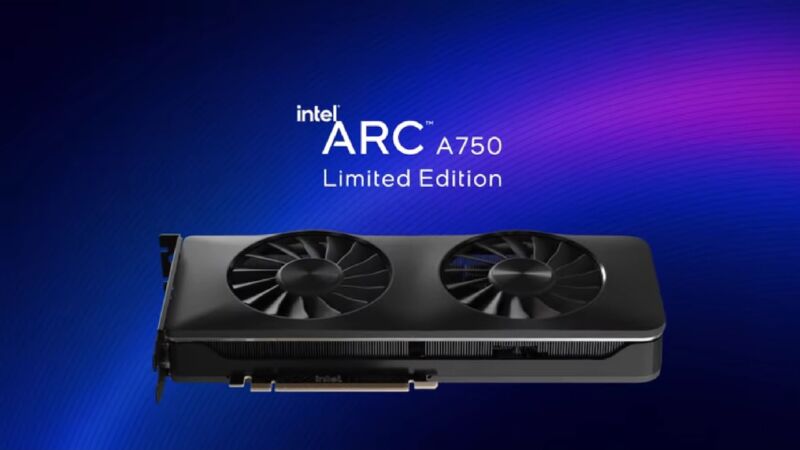
Enlarge/ Intel’s as-yet-unreleased Arc A750 Limited Edition card. The “Limited Edition” GPUs appear to be reference models along the lines of Nvidia’s Founder’s Edition cards and AMD’s first-party graphics cards.
Intel still hasn’t announced a release date for its Arc dedicated graphics cards, but the company has conducted a PR offensive over the last few weeks to set expectations and preview how the cards are stacking up. In a video and accompanying post today, company representatives Ryan Shrout and Tom Peterson compared the upcoming Arc A750 card to Nvidia’s RTX 3060 in a few dozen DirectX12 and Vulkan games They demonstrated that the card is usually able to keep up with the most popular member of the RTX 3000 GPU family.
In a series of tests at 1080p and 1440p, Intel’s tests show that the A750 usually comes within a few percent of the RTX 3060’s performance, sometimes overperforming (Cyberpunk 2077, Fortnite, Microsoft Flight Simulator), sometimes underperforming (Assassin’s Creed Valhalla, Deathloop), and sometimes roughly matching Nvidia’s average frame rates (DOTA 2, Hitman 3, Death Stranding). Average FPS is just one way to measure game performance—crucially, Intel didn’t provide any minimum or 1 percent low frame rates, which can have more of an impact on how smooth your game feels when you’re playing it. But if you take these tests at face value, the Arc A750 does at least appear to be a viable midrange GPU competitor.
Intel ran tests in a series of DirectX12 games and compared their average FPS performance to the Nvidia RTX 3060.
It also provided alternate slides with performance normalized to the 3060 to make it easier to tell where Arc over- and underperformed.
More tests, this time at 1440p.
If anything, the Arc A750 stacks up a bit better to the RTX 3060 at 1440p.
A few tests run in games that use Vulkan, a non-proprietary low-level graphics API.
The story is the same: some overperformance, some underperformance, lots of similar performance.
Delays and driver troubles have made Arc’s launch bumpy. And by failing to get products to market while the Great GPU Shortage of late 2020/all of 2021/early 2022 was still ongoing, the company missed an opportunity to establish an install base by selling to gamers desperate to buy any kind of GPU.
Intel’s strongest argument for its new GPUs might be its three-tier pricing strategy. The company categorizes games using one of three performance tiers: Tier 1 is newer games using modern APIs that have been specifically optimized for Arc GPUs, Tier 2 is games that use modern DirectX12 and Vulkan APIs but don’t have any Arc-specific optimizations, and Tier 3 is older DirectX and OpenGL titles. All of the games in today’s comparison are Tier 1 or Tier 2 titles, but Intel says Arc’s pricing will be determined by its competitiveness in Tier 3 games.
Because Arc struggles so much with games in this third tier, it could mean that the A750 will come in substantially below the RTX 3060’s official MSRP of $329 (its current street price based on a cursory non-scientific check of Amazon and Newegg is closer to $400). Early benchmarks have shown the DirectX11 version of Shadow of the Tomb Raider running at half the speed of the DirectX12 version. A card that performs like an RTX 3060 in newer games while being priced more like an RTX 3050 or 1650 could be attractive for some bargain hunters, regardless of the other teething issues Arc is having.
The Arc A750 is the second-fastest Arc GPU we know about; a somewhat faster A770 will presumably compete with the RTX 3060 Ti or RTX 3070.
https://arstechnica.com/?p=1873098
PlayStation Plus’ highest tier slams to an apparent halt on classic games
The dust has since settled enough for us to see PlayStation Plus’ revision in action for more than two months, and as far as its bang-for-the-buck rating, Sony scores highly. Should you pre-pay for the “premium” tier, you can access hundreds of games from every PlayStation generation for $10 per month, including a good mix of hits and acclaimed indies (along with hundreds of games that neither set sales charts nor critics’ lists on fire).
However, Sony’s not ready to meet Microsoft in one key sales pitch: a subscription to first-party games available on launch day. Should you want to play new games in Sony-exclusive series like God of War or The Last of Us, those will continue to require payment of a full MSRP at launch; Xbox Game Pass is more generous with day-one access to all of its games, from Halo Infinite to Forza Motorsport. PlayStation Plus’ apparent counter to this came in a new “classics” library, exclusively on the service’s priciest tier, which would contain the PlayStation 1, PlayStation 2, and PlayStation Portable game libraries.
Doing the math on “up to 340” classics
But so far, PlayStation Plus doesn’t feel representative of that original classics-library target, and a Wednesday blog post suggests Sony is dragging its feet.
PlayStation Plus’s latest blog post confirmed that 11 games would land on the service’s premium and “extra” tiers in August. While this list includes three solid games from Sega’s Yakuza series, and the quirky likes of modern indie Bugsnax and classic RPG remake Trials of Mana, it doesn’t include games from any Sony console library outside PS4 and PS5. That follows a July addition of only three “classic” games, all from the PSP, to PS Plus.
As a reminder, PS Plus’ classics selection launched in June with 27 games from the trio of aforementioned systems: 11 for PS1, 24 for PS2, and two for PSP. Two months later, we’re up to 30 conversions of those consoles’ original versions. And now that we’ve done the math, we’re concerned that those libraries won’t get much bigger unless Sony revises its advertising.
Sony tells PlayStation Plus Premium subscribers that its classics will grow to “up to 340” games, but this number includes titles that had already been on the PlayStation Now streaming service, which revolves almost exclusively around PlayStation 3 games. North American PS Plus Premium subscribers can access 294 PS3 games (though about five of these are iterative updates or DLC packages). Add 30 to that number, and you’re left with 16 possible additions.
Sony has yet to emulate PS3 games on native PS5 or PS4 hardware, so these have to be streamed from the cloud. That differs largely from the service’s PS1, PS2, and PSP games, which can be downloaded and natively rendered without any cloud-induced issues with latency or pixel fidelity. Thus, some modern console owners eager to play classic games may see Sony’s current total of “324” classics as misleading, so long as their home Internet connection or data cap proves prohibitive.
So many exclusives missing from PS1, PS2, PSP, and PS3
Third-party contracts and arrangements limit the console maker’s ability to publish additional classic games. For example, republishing any ’90s EA Sports classics on PlayStation Plus would require that Sony not only shake hands with EA but also work out deals with athletes and other potential license holders represented in older games. But Sony’s wholly owned content across its first three consoles is plentiful enough that it could dump 16 more games onto PlayStation Plus tomorrow and still have dozens of games left to pick from, should it ever upgrade the program in the future. (And to clarify: PlayStation Plus Premium already includes third-party fare from the PS1, PS2, and PSP eras made by studios like Capcom, Bandai Namco, Team 17, and THQ Nordic.)
Sony may be satisfied keeping its classic game publication plans to a minimum while emphasizing modern PS Plus additions like Final Fantasy VII Remake Intergrade and Stray. The company can inflate its classics selection with hundreds of games that had been sitting on the existing PlayStation Now service for years, all before being folded into the better-known PlayStation Plus fold. (We’ve previously talked about Sony’s PlayStation Now branding problem.) But while PlayStation Now’s selection of PS3 games includes some gems, it’s missing some of the PS3’s best exclusives, including the local-multiplayer madness of Calling All Cars, the quirky puzzle-platformer Puppeteer, sequels in the Sony-owned series Killzone and Resistance, and the PS3 classic Metal Gear Solid 4.
Perhaps Sony will change its classic-publishing tune as PlayStation Plus’ new-tier shine wears off to help generate headlines and attract new customers. But for those PlayStation fans who pre-purchased a full year of PS Plus Premium with expectations of Sony celebrating its ’90s and early ’00s reign, the wait will apparently continue to be tough—especially as Microsoft pushes a hardware-agnostic approach to attract more gamers. Sony representatives did not immediately reply to Ars Technica’s questions about what to expect from PlayStation Plus’ classic game selection in the coming months.
https://arstechnica.com/?p=1872971
Were bones of Waterloo soldiers sold as fertilizer? It’s not yet case closed
<img src="https://rassegna.lbit-solution.it/wp-content/uploads/2022/08/were-bones-of-waterloo-soldiers-sold-as-fertilizer-its-not-yet-case-closed.jpg" alt="The Morning after the Battle of Waterloo, by John Heaviside Clark, 1816.”>
Enlarge/The Morning after the Battle of Waterloo, by John Heaviside Clark, 1816.
When Napoleon was infamously defeated at Waterloo in 1815, the conflict left a battlefield littered with thousands of corpses and the inevitable detritus of war. But what happened to all those dead bodies? Only one full skeleton has been found at the site, much to the bewilderment of archaeologists. Contemporary accounts tell of French bodies being burned by local peasants, with other bodies being dumped into mass graves. And some accounts describe how scattered bones were collected and ground up into meal to use as fertilizer.
It’s that last claim that particularly interests Tony Pollard, director of the Center for Battlefield Archaeology at the University of Glasgow. He has examined historical source materials like memoirs and journals of early visitors, as well as artworks, to map the missing grave sites on the Waterloo battlefield in hopes of finding a definitive answer. He recently provided an update on his efforts thus far in a recent paper published in the Journal of Conflict Archaeology.
Napoleon had initially been defeated and deposed as emperor of France in 1814, ending up in exile on the island of Elba in the Mediterranean. He briefly returned to power in March 1815 for what is now known as the Hundred Days. Several states opposed to his rule formed the Seventh Coalition, including a British-led multinational army led by the Duke of Wellington and a larger Prussian army under the command of Field Marshal von Blücher. Those were the armies that clashed with Napoleon’s Armée du Nord at Waterloo.
Enlarge/ Map of the Battle of Waterloo, 18 June 1815, showing major movements and attacks. Napoleon’s units are in blue, Wellington’s in red, Blücher’s in grey.
Historians still argue about exactly when the battle began, but Wellington’s dispatches indicate that Napoleon “commenced a furious attack upon our post at Hougoumont” at about 10 am on June 18. This was a large country house partially obscured by trees, one of several key locations on the Waterloo battlefield. The fighting raged for eight hours across multiple sites.
In the end, Wellington’s casualties amounted to some 15,000 dead or wounded, while Blücher’s forces suffered 7,000 dead or wounded. Napoleon’s forces fared worse: between 24,000 and 26,000 men were killed or wounded, including several thousand who were captured. An additional 15,000 French soldiers deserted over the ensuing days.
This made for a monumental clean-up task. One contemporary account, by Major W.E. Frye, described the battlefield on June 22 as “a sight too horrible to behold.” Frye recounted “the multitude of carcasses, the heaps of wounded men with mangled limbs unable to move and perishing from not having their wounds dressed or from hunger.”
Enlarge/ Artwork by James Rouse depicting the burial of the dead at Chateau Hougoumont after Waterloo.
https://arstechnica.com/?p=1861820
28 years later, Super Punch-Out!!’s 2-player mode has been discovered
<img src="https://rassegna.lbit-solution.it/wp-content/uploads/2022/08/28-years-later-super-punch-outs-2-player-mode-has-been-discovered.jpg" alt="Up until today, Nintendo had never announced a two-player mode in a Punch-Out!! video game. As it turns out, one has hidden in plain sight for nearly 30 years.”>
Enlarge/ Up until today, Nintendo had never announced a two-player mode in a Punch-Out!! video game. As it turns out, one has hidden in plain sight for nearly 30 years.
Aurich Lawson | Nintendo
While Punch-Out!! has been one of Nintendo’s most beloved “fighting” series since its 1984 debut in arcades, it has rarely featured something common in the genre: a two-player mode.
On Monday, however, that changed. The resulting discovery has been hiding in plain sight on the series’ Super Nintendo edition for nearly 30 years.
Credit goes to the coder responsible for the @new_cheats_news account on Twitter, which has routinely posted discoveries of leftover modes, menus, and gameplay features in classic games since 2014. Many of the account’s findings require Game Genie codes or hex edits to original ROM files to access them since the modes are often left behind in the games’ original code, never meant to be seen by average fans.
Yet today’s Super Punch-Out!! discovery revolves around a simple series of button combinations, which require nothing more than a second controller. The two-player mode is hidden behind an additional, previously undiscovered menu, which lets solo players skip directly to any of the game’s boxing combatants. It’s essentially a “level select” menu, which many classic games featured for internal testing, and speedrunners could arguably use it to practice against specific opponents more quickly.
This menu can be accessed by holding the R and Y buttons on player two’s controller at the “press start” screen, then pressing Start or A with player one’s controller. Do this, and a new menu appears, displaying all 16 boxers’ profile icons. Pick any of these icons to engage in a one-off fight; once it’s over, you’re dumped back to the same boxer-select menu.
In this menu, friends can access a two-player fight if player two holds their B and Y buttons down until the match starts. You won’t hear a sound effect or any other indication that it worked. Instead, the match will begin with the second player controlling the “boss” boxer at the top of the screen. Combine the “ABXY” array of buttons with “up” and “down” on the D-pad to pull off every single basic and advanced attack.
[embedded content]
Ars Technica’s Sam Machkovech captured the two-player mode hidden inside of Super Punch-Out!! while testing on a retail Nintendo Switch.
I have thus far confirmed that this works on an original SNES cartridge, along with both the SNES Classic Edition and the game’s version on Nintendo Switch—which I used to record the above video demonstration of the game’s wimpiest character, Gabby Jay, swaying from side to side. In traditional one-player modes, Gabby Jay stands still before throwing a few slow punches.
Thus far in my testing, I would not necessarily describe the game’s long-hidden two-player mode as “balanced” for competitive play, owing to both the boss characters’ high levels of power and their obvious pre-punch “tells.” The latter typically come with long pauses that solo players have studied for years; dodge them, and the boss is left open to be stunned and pummeled. Thus, I don’t imagine Super Punch-Out!! will land on competitive stages like Evo anytime soon. Still, the button-tap latency for the boss characters is fluid enough to make the mode an amusing option for longtime SNES fans to try out with their friends.
A more balanced version of the concept is featured in the series’ 2009 Wii version, which only allowed players to fight as palette swaps of longtime series character Little Mac. This week’s discovery of a two-player mode on SNES adds a much wider range of battling options for the second player.
The game industry’s history of hidden menus and Easter eggs is certainly bountiful, but today’s news arguably most resembles the 2016 discovery of a cheat menu hidden in the first three Mortal Kombat arcade games. This required inputting specific buttons on an arcade cabinet in the correct order, even without inserting quarters, and could unlock anything from “fatality” animations to free-play modes.
The Punch-Out!! series’ NES version was previously the subject of fan scrutiny in 2016 when frame-by-frame analysis confirmed a visual tell of when to punch some of that game’s toughest bosses. Years before that, an interview with one of Punch-Out!!‘s original developers suggested more secrets were inside the NES classic that fans had yet to discover. Might there be a two-player mode hidden inside the older game as well?
https://arstechnica.com/?p=1872210
Crypto-driven GPU crash makes Nvidia miss Q2 projections by $1.4 billion
Getty Images
Nvidia doesn’t officially announce its second-quarter financial results until the end of the month, but the company is trying to soften the blow by announcing preliminary results today. And as with so many other tech companies in the last month, the results are mixed at best. With $6.7 billion in revenue, Nvidia managed to eke out year-over-year growth, but the results are still bad news because that number is down from a previously forecasted $8.1 billion, a miss of $1.4 billion.
Nvidia blamed this shortfall on weaker-than-expected demand for its gaming products, including its GeForce graphics processors. Nvidia pointed to “a reduction in channel partner sales,” meaning that partners like Evga, MSI, Asus, Zotac, Gigabyte, and others were selling fewer new GPUs than anticipated. This drop can be attributed partly to a crash in the value of mining-based cryptocurrencies like Bitcoin and Ethereum—fewer miners are buying these cards, and miners looking to unload their GPUs on the secondhand market are also giving gamers a cheaper source for graphics cards.
“As we expect the macroeconomic conditions affecting sell-through to continue, we took actions with our Gaming partners to adjust channel prices and inventory,” said Nvidia CEO Jensen Huang. That means we may see further price drops for existing GeForce GPUs, which have already been dropping in price throughout the year. Some cards still haven’t reverted to their originally advertised prices, but they’re getting closer all the time.
By contrast, AMD grew its quarterly gaming revenue from $1.3 billion last year to $1.7 billion this year, thanks partly to its semi-custom hardware powering consoles like the Xbox Series S and X and the PlayStation 5. Nvidia’s GPU tech powers the Nintendo Switch, but otherwise, Nvidia is more dependent on PC gaming for its revenue.
In better news for Nvidia, the small overall increase in revenue is driven almost exclusively by the company’s data center business, including GPU-accelerated AI and machine learning applications and GPU acceleration for cloud-hosted virtual machines. Nvidia’s data center revenue is projected to be up 61 percent from last year, from $2.37 billion to $3.81 billion.
Nvidia will supposedly launch its next-generation RTX 4000 series GPUs later this year. Based on the new Lovelace architecture, these GPUs may appeal to some gamers who originally sat out the RTX 3000 series due to shortages and inflated prices and are now avoiding the GPUs because they know a replacement is around the corner.