Enlarge/ Note: This image, of a chintzy player mat stamped with clip-art-quality design work, is not from the game we are looking at today.
Nate Anderson
If a game this ugly can capture the hearts, minds, and continued attention of the devotees of the overcrowded board game market to become a modern classic, you know it’s something special.
And if a board game becomes popular, you can be sure of one thing: A card game version will eventually arrive. If that’s a hit, get ready for the dice version. And then, market willing, comes the roll-and-write version. That may sound like cynical resignation to cash-grabby companies endlessly returning to the same well, but these reimagined versions aren’t necessarily a bad thing. In fact, some of my favorite games are card or dice versions of “bigger” board games.
That’s where last year’s Terraforming Mars: Ares Expedition comes in. A card-game spin on the original, Ares Expedition aims to capture the feel of the board game in a smaller, tighter package.
We are pleased to report that it succeeds.
Any complaints we had about the production values of the original board game have been fixed.
Aaron Zimmerman
The central board tracks how far along you and your opponents are in terraforming Mars.
Aaron Zimmerman
The new game’s theme is identical to the original board game’s. You and up to three opponents take on the role of CEOs of megacorporations working to turn the inhospitable terrain of the red planet into something humanity can call home. While your actions contribute to the main goal of raising three key global parameters—the planet’s temperature must hit 8° Celsius, atmospheric oxygen must rise to 14 percent, and oceanic coverage must become sufficient to kickstart the planet’s own hydrologic cycle—this is not a cooperative game.
Both games end when the parameters have been met—thematically, this takes place over centuries. But because you’re a CEO of a corporation, your real goal is to be the best terraformer on the planet so you can secure funding, lucrative contracts, and accolades from the World Government on Earth. Among other tasks, you’ll populate Mars with plants, animals, and bacteria; you’ll build cities and life-sustaining infrastructure; and you’ll mine the moons of Jupiter for resources. For a fuller look at the original board game, check out our full review. https://arstechnica.com/?p=1867641
Ubisoft’s big day of delays, cancellations: Avatar open-world game moves to FY24
<img src="https://rassegna.lbit-solution.it/wp-content/uploads/2022/07/ubisofts-big-day-of-delays-cancellations-avatar-open-world-game-moves-to-fy24.png" alt="Ubisoft insists that its first video game based on the film series Avatar is still on the way—but will now miss its original "2022" launch window.”>
Enlarge/ Ubisoft insists that its first video game based on the film series Avatar is still on the way—but will now miss its original “2022” launch window.
Fans of gaming mega-publisher Ubisoft may have held out hope that an upcoming presentation, slated to stream online in September, might contain a few surprises or confirmations for more big games coming in 2022. The company’s latest financial disclosure presentation popped that balloon, however, in a massive way.
A Thursday disclosure to investors was paired with an audio presentation hosted by Ubisoft CEO Yves Guillemot, and its first nine minutes contained mostly doom and gloom. After confirming previously announced plans to launch a Mario + Rabbids sequel and the long-delayed Skull & Bones pirate-battling game, Guillemot confirmed two lengthy game delays and four game cancellations—while remaining mum about at least two games in apparent development limbo.
More like “The Way of the Wait”
The arguably biggest news concerns a delay to Avatar: Frontiers of Pandora, an open-world adventure game based on James Cameron’s Avatar film series. The game is now slated to launch in Ubisoft’s “fiscal year 24,” which could mean any time between April 2023 and March 2024. That’s a substantial bump from its original “2022” launch window—which could have put it near the December 16 launch of that film series’ first sequel in 13 years, Avatar: The Way of the Water.
We could see a firmer launch date for that game during the aforementioned September video presentation, or at the very least, anything that resembles actual gameplay; thus far, the only hint of the Avatar game’s existence is an “in-engine” reveal that may not actually resemble how the game will look in real time. Still, the game appears to target current-gen consoles like PlayStation 5 and Xbox Series X/S, which could mean the game will take substantial technological leaps not available on past-gen console families.
Guillemot took the opportunity to confirm that A:FoP presents a “major, multi-year opportunity for Ubisoft,” suggesting that it could come with online game-as-a-service hooks or “expansion pack” add-ons to keep players engaged over time, much like how Ubisoft has done with pretty much every open-world game it has launched over the past eight years.
A VR game that will now only be virtual, never real
In addition, Guillemot confirmed that a “smaller, unannounced, premium game” has been bumped from Ubisoft’s FY23 to its FY24. Without further clarification on what this project might be, we must look to reporters like Bloomberg’s Jason Schreier, who has previously suggested that the game in question is a standalone Assassin’s Creed expansion pack. This game, referred to as “Project Rift,” reportedly began life as an add-on for 2020’s Assassin’s Creed Valhalla before being converted to a larger stopgap release. According to the same reports, this was done to tide fans over while another unannounced Assassin’s Creed project, meant to function as an ever-evolving, online-connected hub of Assassin’s Creed environments and timelines, was still under development.
Following the news of two game delays, Guillemot confirmed four game cancellations in all, including two previously announced titles: Ghost Recon Frontline, a battle royale concept that had already gone into early playtesting; and Splinter Cell VR, a new, Meta Quest-exclusive entry in the longtime stealth-action series. The latter had been announced during an Oculus event in 2020, at which time something called Assassin’s Creed VR was also announced (and not to be confused with the series’ “escape room” VR installations). A Reddit post from earlier this year included a video mock-up of a potential new VR game called Assassin’s Creed Nexus, and its author suggested that the resulting game will offer a more linear translation of the AC series formula to VR—though its authenticity is far from confirmed.
The bloodletting continued during the call with news of “two other unannounced titles” being summarily canceled. Since ACVR has previously been announced, it arguably remains on Ubisoft’s development docket, though the company had no further details about that game today. Either way, ACVR was not directly referenced during today’s presentation, and the same goes for two of Ubisoft’s most elusive in-development games: Beyond Good & Evil 2, which was announced to massive fanfare at E3 2017, and Prince of Persia Remake, which was announced in 2020, only to be delayed multiple times.
https://arstechnica.com/?p=1868543
It’s getting too hot to play the Steam Deck or Switch outside, makers warn
Enlarge/ Even the shade may not be enough to save your Nintendo Switch in extreme temperatures.
One of the main perks of portable consoles is the ability to play them outside the house, a use we’ve seen emphasized in multiple marketing campaigns over the years. But as countries around the world have sufferedthroughrecord-breakingheat waves in recent weeks, two major portable console makers are warning players that their products don’t function well in ambient temperatures in excess of 35° C (95° F).
Nintendo of Japan led off the warnings last week, tweeting that “if you use the Nintendo Switch in a hot place, the temperature of the main unit may become high,” according to a machine translation. “If the temperature of the main unit becomes too high, it may sleep automatically to protect the main unit.” The company also urged players to make sure the vents on the console and docking unit are not blocked by dust or debris, and to install that dock “in a location that does not retain heat.”
Valve joined in with a public heat warning yesterday, tweeting a reminder that the Steam Deck “may start to throttle performance to protect itself” in high ambient temperatures. The Steam Deck’s internal APU starts scaling back performance when the chip itself hits a temperature of 100° C (212° F), and will shut down if it tops 105° C (221° F), Valve said. After that, the system can limit battery charging rates, download speeds, and even SSD speeds to keep the GPU running as steadily as possible.
It’s getting hot in here…
These heat warnings aren’t completely new for either company. Nintendo and Valve have long published support documentation citing 35° C as an upper limit for the “safe operational range” of their consoles (fun fact: Valve also doesn’t recommend you use the Steam Deck at altitudes more than 3,500 meters above sea level). Still, it’s notable that both companies felt the need to publicly reinforce these recommendations now, as temperatures exceed 40° C in the UK for the first time and heat-driven wildfires force evacuations across France, Spain, and Portugal.
For the Switch, we noted in early coverage of our initial review that the tablet can get noticeably warm during extended play sessions on high-end games. That said, most Switch games are designed with a consistent hardware profile in mind, meaning they shouldn’t overtax the processor under normal thermal conditions.
[embedded content]
Some hackers are already experimenting with extreme cooling solutions for the Steam Deck.
For the Steam Deck, on the other hand, thermal performance can depend heavily on how far the specific graphics and performance settings for a particular game push the processor. While Valve includes a built-in frame rate limiter to reduce overall power draw (and processor heat), playing with the system settings and/or game settings can help reduce that power draw in extreme conditions.
The news arrived on Wednesday on Xbox Blog, and it clarified that for the time being, Discord access would be exclusive to the optional “Xbox Insider” tier of early, beta, and preview console OS updates. That update is already going live in waves to Xbox Insiders today, and it adds a new tooltip to the system’s “chat” sidebar: “Try Discord Voice on Xbox today!”
Simplifying your Discord life adds a few complications
Since its debut in 2015, Discord has exploded in popularity as a gaming-friendly chat platform on computers and smartphones. One major differentiator over a service like Slack, which looks and operates similarly, is Discord’s clever ties into existing gaming networks. The idea being, wherever you’re playing a game, Discord can broadcast that status to friends via ties to other platforms’ APIs (“playing Stray on PlayStation,” “LFP in World of WarCraft,” “streaming a session of Peggle 2 on Twitch”). Users can switch between direct messages, game-specific text chat rooms, real-time voice channels, and even video-sharing services to coordinate their next online gaming sessions.
But what if you want to talk among your Discord voice chat friends while also using dedicated headphones on an Xbox, PlayStation, or Switch? Up until this week, you couldn’t do so directly on any console. Your best bet was to find a headset that supports simultaneous Bluetooth inputs, then connect it to both your console and your Discord-loaded smartphone. (Alternatively, you can do what I do: put a smartphone’s earbud into one ear for Discord, then drape a console’s headphones over that. I don’t recommend this.)
First, you’ll need to sync your Discord account with your Xbox account.
Prompt to enter Xbox credentials.
Redirect to Xbox.com to do so.
And a reminder of all the stuff Xbox will hand over to Discord in this process.
Sadly, this week’s rollout of Discord on Xbox is a bit limited. The biggest issue is that there is no formal Discord app or interface on Xbox. You will need to keep a smartphone handy to initiate a “handoff” of your Discord session. Get ready for an annoying first-time setup process.
Should you have an updated Xbox on the Insider OS track, its new “Try Discord Voice” prompt will initiate an account-sync process, which requires using a mobile Discord app to take a photo of a QR code displayed by your Xbox. (You’ll need to re-do this if you’ve done so before, due to it adding a new level of credential for voice chat.) With this in place, when you are about to join a voice channel on Discord, a new “try voice chat on console” prompt will appear.
Now, let’s forward some voice chat from Discord to Xbox.
Yes, this is an open voice channel, let’s join it.
If you have all your Xbox account sync ducks in a row, “Join on Xbox” will appear in this sub-menu.
At this point, your smartphone will forward the request to an installed Xbox app.
This simple interface appears on your phone once it’s all connected, and all audio is now being handled by Xbox hardware.
Tapping through this will then, ugh, create another handover to Microsoft’s dedicated Xbox app on either iOS or Android. Yes, if you want this to work, you need to install the Xbox app on your mobile device (and Discord will suggest you do so, if you haven’t yet). This facilitates the key technical aspect of forwarding all Discord audio to your Xbox hardware.
https://arstechnica.com/?p=1868233
As Microsoft-Activision merger nears, a classic FPS license reappears—for free
<img src="https://rassegna.lbit-solution.it/wp-content/uploads/2022/07/as-microsoft-activision-merger-nears-a-classic-fps-license-reappears-for-free.png" alt="This week, the classic RPG-FPS series Heretic and Hexen series are back in a curious way.”>
Enlarge/ This week, the classic RPG-FPS series Heretic and Hexen series are back in a curious way.
While we at Ars Technica don’t necessarily cheer the moments when giant gaming conglomerates swallow up other giant gaming conglomerates, we also have a faction that champions efforts to preserve and re-release classic video games. These two philosophies collided this week, leaving us feeling a bit dizzy.
The bottom-line good news: Four underappreciated classics from the id Software universe are closer to a broader re-release and are currently free to download. This appears to be related to Microsoft’s planned $68.7 billion acquisition of Activision Blizzard’s vast catalog of game publishing and development properties.
A Thursday announcement from Microsoft’s Xbox division confirmed that five “Bethesda” video games were now available on modern Windows PCs via the Microsoft Store, albeit through an unusual path. These games, including the two earliest Elder Scrolls adventures and three fantasy-tinged shooters from the combined Heretic and Hexen series, would need to be accessed through the Xbox Insider Hub on Windows 10 and Windows 11 PCs, as they were “previews” meant to solicit “feedback.” Joining the Xbox Insider Hub on Windows PCs is free and does not require a Game Pass subscription, which means these games are now free to download for participating members (at least until MS revokes their availability on the Insider Hub).
A welcome return to the Dome of D’Sparil
Original, low-res screens of Hexen, as a reminder of its class-based first-person questing.
Original, low-res screens of Hexen, as a reminder of its class-based first-person questing.
Original, low-res screens of Hexen, as a reminder of its class-based first-person questing.
Original, low-res screens of Hexen, as a reminder of its class-based first-person questing.
Original, low-res screens of Hexen, as a reminder of its class-based first-person questing.
It only takes a moment to see why these games would receive such a soft, Insider Hub-tied launch, as they currently operate via DOSBox emulation—a clunky system that re-creates the old-school feeling of booting your favorite old games on a text-only command prompt. For anyone who expects Windows Store game launches to “just work,” the results are inelegant, especially in letting players adjust visual options or remap controls. Still, they get the job done—and they’re highly recommended as freebies.
But that’s not why we’re here; after all, the same antiquated builds had been for sale at storefronts like GOG and Steam for years. And they remain highly recommended FPS classics wherever you purchase and play them, as they injected the kinds of fantasy and RPG-related perks that the genre desperately needed during their ’90s heyday. (The original Quake was poised to deliver similar systems before its developers discarded such aspirations in the face of developmental pressure and crunch.)
Rather, the Heretic and Hexen games are notable due to residing in publishing-related limbo for years. When Microsoft acquired Bethesda and its subsidiary publishers and developers in late 2020, the resulting addition of Bethesda-tied games on Xbox Game Pass, a seeming flex of newly owned licenses, wasn’t complete. This was arguably due to the service’s focus on consoles, which would preclude ancient PC-only games, but over the following months, the PC-specific Game Pass tier never got a taste of specific games. Which made us wonder: Was it a matter of crossed licensing wires?
This is where things get confusing. If you look up this week’s Heretic and Hexen games at digital storefronts, they list id Software as a publisher—and once Microsoft owned id as part of the Bethesda acquisition, you’d think that’s where this topic starts and ends. However, Activision acquired those games’ developers at Raven Software in 1997, and as part of the deal, Activision took over all ownership rights for the combined Heretic and Hexen series. Adding to the confusion, id Software is listed on digital storefronts as the publisher of 1998’s Hexen II, but that’s technically incorrect—even though, at one point, that game wason sale on the now-defunct Bethesda Launcher. Thus, we can’t say that Steam’s credit of id as a publisher of older Heretic and Hexen games is accurate, either. (At any rate, we’ve yet to see hints of Hexen II land on the Xbox Insider Hub.)
A way to taste beef Strogg-anoff once more
It’s unclear whether Microsoft, Activision, and Bethesda have cleared up a few small licensing quibbles ahead of the corporate triad’s acquisition closure before opening the bigger floodgates to series like Call of Duty. That is only an educated guess at this time, as reps for Bethesda did not answer Ars’ questions ahead of publication.
This week’s emergence of Activision-tied software on Microsoft’s platforms follows a late June launch of Quake IV‘s PC version on the same Xbox Insider Hub interface. (This version, too, is entirely free to access, no Game Pass subscription required.) This 2005 shooter was also made without id Software’s involvement, helmed at the time by Raven Software and Activision. But it does have a clearer, Activision-free path to joining Xbox Game Pass, as Bethesda jumped through proper hoops to publish the game’s formal re-release in 2012. Yet this game’s absence from the aforementioned 2020 Game Pass dump has us wondering whether there were still some lingering Activision license issues to resolve.
Even the cheapest, slowest modern game consoles are capable of pushing high-definition 3D graphics that would have been unthinkable a few decades ago. But if you’re old enough to remember when video game graphics were just a series of colorful, abstract blobs, Lego has something for you.
A new 2,532-piece set re-creates the 1980-era, four-switch version of the venerable Atari Video Computer System (VCS), later known as the Atari 2600. The kit includes a moving joystick, three game cartridges that can be inserted into the system or into an ’80s-brown storage rack, and other nostalgic touches—even the chintzy wood-grain texture on the front of the console has been lovingly re-created with Lego bricks.
The Lego Atari 2600 launches for $239.99 on August 1.
The Lego Atari 2600 comes with a moving joystick and three replica cartridges that fit into the system.
The Lego Group
A replica 1980s living room pops out of the console, complete with CRT TV and period-appropriate posters.
The Lego Group
Three small scenes re-create memorable imagery from the games (and will give younger kids something to do while adults put the main console together).
The Lego Group
Atari nerd minifig and mini-joystick included!
The Lego Group
The Atari 2600 set is a follow-up of sorts to the 2,646-piece Nintendo Entertainment System from a couple of years ago. But where that console included a replica TV set with a 2D rendition of Super Mario Bros that could actually scroll, the Atari 2600 kit includes an ’80s living room set that pops out of the console and miniature scenes that depict the centipede from the game Centipede, the asteroids from the game Asteroids, and the adventure from the game Adventure.
Ars Technica may earn compensation for sales from links on this post through affiliate programs.
Listing image by The Lego Group
https://arstechnica.com/?p=1867900
AI art is challenging the boundaries of curation
<img src="https://rassegna.lbit-solution.it/wp-content/uploads/2022/07/ai-art-is-challenging-the-boundaries-of-curation.jpg" alt="A woman looks at a work of art created by an algorithm by French collective named OBVIOUS, which produces art using artificial intelligence, titled Portrait of Edmond de Belamy at Christie’s in New York on October 22, 2018. The piece sold for $432,500.”>
Enlarge/ A woman looks at a work of art created by an algorithm by French collective named OBVIOUS, which produces art using artificial intelligence, titled Portrait of Edmond de Belamy at Christie’s in New York on October 22, 2018. The piece sold for $432,500.
In just a few years, the number of artworks produced by self-described AI artists has dramatically increased. Some of these works have been sold by large auction houses for dizzying prices and have found their way into prestigious curated collections. Initially spearheaded by a few technologically knowledgeable artists who adopted computer programming as part of their creative process, AI art has recently been embraced by the masses, as image generation technology has become both more effective and easier to use without coding skills.
The AI art movement rides on the coattails of technical progress in computer vision, a research area dedicated to designing algorithms that can process meaningful visual information. A subclass of computer vision algorithms, called generative models, occupies center stage in this story. Generative models are artificial neural networks that can be “trained” on large datasets containing millions of images and learn to encode their statistically salient features. After training, they can produce completely new images that are not contained in the original dataset, often guided by text prompts that explicitly describe the desired results. Until recently, images produced through this approach remained somewhat lacking in coherence or detail, although they possessed an undeniable surrealist charm that captured the attention of many serious artists. However, earlier this year the tech company Open AI unveiled a new model—nicknamed DALL·E 2—that can generate remarkably consistent and relevant images from virtually any text prompt. DALL·E 2 can even produce images in specific styles and imitate famous artists rather convincingly, as long as the desired effect is adequately specified in the prompt. A similar tool has been released for free to the public under the name Craiyon (formerly “DALL·E mini”).
The coming-of-age of AI art raises a number of interesting questions, some of which—such as whether AI art is really art, and if so, to what extent it is really made by AI—are not particularly original. These questions echo similar worries once raised by the invention of photography. By merely pressing a button on a camera, someone without painting skills could suddenly capture a realistic depiction of a scene. Today, a person can press a virtual button to run a generative model and produce images of virtually any scene in any style. But cameras and algorithms do not make art. People do. AI art is art, made by human artists who use algorithms as yet another tool in their creative arsenal. While both technologies have lowered the barrier to entry for artistic creation—which calls for celebration rather than concern—one should not underestimate the amount of skill, talent, and intentionality involved in making interesting artworks.
Like any novel tool, generative models introduce significant changes in the process of art-making. In particular, AI art expands the multifaceted notion of curation and continues to blur the line between curation and creation.
There are at least three ways in which making art with AI can involve curatorial acts. The first, and least original, has to do with the curation of outputs. Any generative algorithm can produce an indefinite number of images, but not all of these will typically be conferred artistic status. The process of curating outputs is very familiar to photographers, some of whom routinely capture hundreds or thousands of shots from which a few, if any, might be carefully selected for display. Unlike painters and sculptors, photographers and AI artists have to deal with an abundance of (digital) objects, whose curation is part and parcel of the artistic process. In AI research at large, the act of “cherry-picking” particularly good outputs is seen as bad scientific practice, a way to misleadingly inflate the perceived performance of a model. When it comes to AI art, however, cherry-picking can be the name of the game. The artist’s intentions and artistic sensibility may be expressed in the very act of promoting specific outputs to the status of artworks.
Second, curation may also happen before any images are generated. In fact, while “curation” applied to art generally refers to the process of selecting existing work for display, curation in AI research colloquially refers to the work that goes into crafting a dataset on which to train an artificial neural network. This work is crucial, because if a dataset is poorly designed, the network will often fail to learn how to represent desired features and perform adequately. Furthermore, if a dataset is biased, the network will tend to reproduce, or even amplify, such bias—including, for example, harmful stereotypes. As the saying goes, “garbage in, garbage out.” The adage holds true for AI art, too, except “garbage” takes on an aesthetic (and subjective) dimension.
For his work Memories of Passersby I (2018), German artist Mario Kinglemann, one of the pioneers of AI art, carefully curated a dataset of thousands of portraits from the 17th to 19th centuries. He then used this dataset to train generative algorithms that could produce an infinite stream of novel portraits sharing similar aesthetic characteristics, displayed in real time on two screens (one for female portraits, one for male portraits). This is an example of an AI artwork that does not involve output curation. Still, the meticulous curation of the training data played a fundamental role in its conception. Here, “bias” is a blessing: The dataset was heavily biased according to the artist’s personal aesthetic preferences and taste, and this aesthetic bias is reflected in the final artwork, albeit through the distorting lens of the computer-driven generative process.
Another novelty spurred by the recent progress of generative algorithms is the ability to produce images by describing the desired result in natural language. This has come to be known as “prompting,” or guiding the algorithm with text prompts as opposed to sampling random outputs. Consider the illustration accompanying this article: The collage features several images generated by prompting DALL·E 2 with the phrases “an AI image generation algorithm, conceptual art,” “collage with images made by a generative AI model, illustration from Wired magazine,” and “an artist curating artworks produced with an AI algorithm, conceptual art.”
https://arstechnica.com/?p=1867634
Analysis: GameStop NFT trading slows in marketplace’s first week
Enlarge/ If GameStop’s NFT business is gonna go “to the moon,” total trade volume on the platform has been bending in the wrong direction so far…
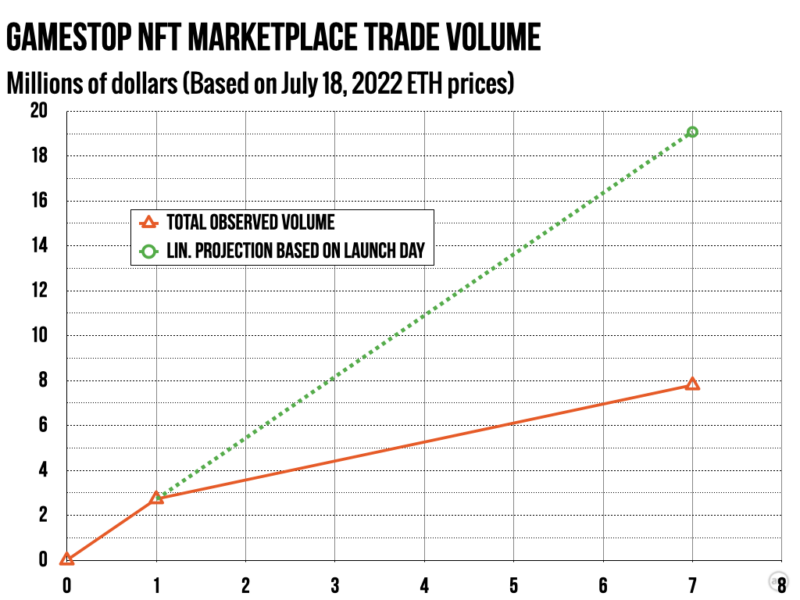
Last week, when Ars analyzed the first day of NFT sales on GameStop’s heavily hyped crypto marketplace, some boosters were quick to suggest that this was just a starting point and that interest and trading volume might increase as time goes on and more people discover the trading platform. Over the marketplace’s first week, though, interest in trading GameStop NFTs seems to be declining when compared to that launch day performance.
An Ars-exclusive analysis of the GameStop NFT marketplace now shows that it has been responsible for about 5,254 ETH in total trading volume in its first week (worth about $7.8 million at current exchange rates). That’s a daily average of about 750 ETH ($1.117 million) in total trade volume. GameStop takes a 2.25 percent fee for all those trades, representing a daily average of 16.9 ETH ($25,113) in direct revenue to the company. All told, six of the over 300 collections on the platform are responsible for a majority of that trading volume.
(Note: Ever-volatile ETH prices have increased about 38 percent since last Tuesday, when Ars did its launch day analysis of the marketplace. Unless otherwise noted, we’re using the current ETH spot price—$1,488.06 as of this writing—for conversions here, even though transactions earlier in the week likely took place at lower dollar/ETH rates.)
The average daily trade volume over the first week is a significant slowdown from the marketplace’s launch day, when it processed 1,831.81 ETH in total trade volume (worth about $1.976 million then or $2.725 million at today’s rates), according to Ars’ analysis. On that first day, GameStop made approximately 41.2 ETH in transaction fees (worth about $44,500 then or $61,331 today).
Enlarge/ The “GameStop Astronaut MetaBoy” NFT has been one of the hottest to hit the marketplace recently, bringing in over 163 ETH in total trade volume in less than a week.
Of the hundreds of NFT collections that saw some trading activity on the marketplace’s first day, the median collection saw average daily volume shrink by about 50 percent during the first week of trading (when compared to launch-day volume). That doesn’t include 34 collections that have yet to see a single trade on the marketplace, of which 25 have been available since day one.
And the dozens of new NFT collections on the marketplace (i.e., those that saw their first transactions after the marketplace’s launch day) aren’t making up that gap. Those 85 or so collections are responsible for just 556 ETH of total trade volume in the last six days (about $828,575).
The wrong direction
Any way you slice it, total activity on the GameStop NFT marketplace has been slowing down in the days since the service launched. That’s perhaps not too surprising, considering the months of pent-up demand among crypto bulls and GameStop stock enthusiasts that was unleashed on the platform’s launch day last Monday. It’s also not that surprising in the context of the wider NFT market, where a leading marketplace like OpenSea has seen daily trade volume plummet by roughly 90 percent since its peak in January.
Still, the slowdown is a setback for GameStop and crypto boosters who hope the introduction of NFT trading can revolutionize GameStop’s brick-and-mortar-focused business model. For now, if trading on the GameStop NFT Marketplace continues at the same weekly rate, it will see a total trade volume of about 273,000 ETH in its first year. That’s worth about $406 million today, or about just 6.75 percent of GameStop’s $6.011 billion in fiscal 2021 net sales.
Of that volume, GameStop will take about 6,147 ETH in transaction fees (about $9.15 million), which is only about 0.15 percent of GameStop’s fiscal 2021 net sales or 2.4 percent of its $381 million fiscal-year 2021 loss. Even if GameStop HODLs all its ETH and the cryptocurrency spikes back to its all-time high price of about $4,800, then those annualized transaction fees will be worth just $29.5 million (about 0.49 percent of fiscal 2021 net sales; 7.7 percent of fiscal 2021 loss).
Earning tens of millions of dollars annually from a completely new line of business isn’t nothing, of course, especially when GameStop doesn’t have to worry about much in the way of inventory or brick-and-mortar overhead to sell NFTs. Still, this isn’t the kind of bottom-line performance that will severely impact a multi-billion-dollar company in the long run.
It is still the early days for GameStop’s NFT business, though, and the wider market for NFTs could still bounce back from its current doldrums. Or maybe the eventual integration of “web3 gaming” assets on the GameStop marketplace (which the retailer says will be added “over time”) will help it “cement itself as the ultimate destination in the new paradigm of gaming,” as Immutable’s Robbie Ferguson suggested when announcing a deal with GameStop in February.
For now, though, GameStop and its boosters will be watching and waiting for such a turnaround to occur. Until and unless it does, the GameStop NFT marketplace seems fated to be a relatively minor part of the international retailer’s business going forward.
Catching up with Stranger Things S4 (yes, we have some feels)
Stranger Things came back from a pandemic-driven three-year hiatus stronger than ever with an ambitious supersized fourth season—so much so that Netflix released it in two parts. Part 1 had a few minor flaws, particular in the earlier episodes, but quickly gained dramatic momentum. The cliffhanger ending deftly set the stage for the epic final two episodes, which featured a visually stunning, nail-biting battle against the denizens of the Upside Down—and some of the most emotionally resonant moments in the series to date. It’s been two weeks since Part 2 dropped—the perfect time to talk about the many highs and occasional lows of this latest season.
(WARNING! Some very major spoilers below the galleries in the interest of in-depth analysis.)
Ratings-wise, this was the series’ best season yet, drawing so many viewers when Part 2 dropped over Fourth of July weekend that Netflix actually crashed at one point. S4 Part 1 dominated the Nielsen streaming charts for four straight weeks, and that dominance is expected to continue once Nielsen releases its numbers for the two super-sized finale episodes. (There’s usually about a month’s delay for streaming platform viewership.) Part 1 also received 13 Emmy nominations. Seven years after it debuted, Stranger Things is more popular than ever, even launching two old ’80s tunes back onto the charts after they were featured prominently this season.
The season opens eight months after the S3 finale. The entire Byers clan, including Eleven (Millie Bobbie Brown), has relocated to Southern California, where Will (Noah Schnapp) and Eleven naturally find themselves high school outcasts. Mike (Finn Wolfhard), Dustin (Gaten Matarazzo), Lucas (Caleb McLaughlin), Max (Sadie Sink), Nancy (Natalia Dyer), Steve (Joe Keery), and Robin (Maya Hawke) remained in Hawkins, where Lucas’ newfound basketball abilities wins him admission to the popular crowd. Meanwhile, Hopper (David Harbour) is being kept prisoner by the Russians, but he’s plotting a breakout with a Russian guard nicknamed Dmitri (Tom Wlaschiha). This involves sending a coded message to Joyce (Winona Ryder), who promptly hops on a plane to Alaska with Murray Bauman (Brett Gelman).
The decision to split everyone up geographically made for a weaker overall narrative arc, because not all the storylines were equally compelling, The Russia subplot was by far the weakest, despite great performances by the cast, and the oddball pairings of Hopper and Dmitri, Joyce and Murray, worked very well. There just wasn’t enough plot to sustain it for the entire season. Also, each subplot is meant to evoke different film genres, which is a clever conceit, but the genres (prison breakout movie, stoner action comedy, 80s slasher horror, eg) don’t always mesh particularly well. Frankly, the show works best when it stays focused on Hawkins, which has always been the heart and soul of Stranger Things. This season was no exception.
Out of place
Eleven, aka Jane (Mille Bobby Brown), and Will (Noah Schnapp) are navigating a new high school in California.
El is being bullied by a walking cliche of a Mean Girl (Elodie Grace Orkin).
Jonathan (Charlie Heaton) spends most of his time getting baked with his buddy Argyle (Eduardo Franco).
Back in Hawkins, Mike (Finn Wolfhard) and Dustin (Gaten Matarazzo) are in a D&D club while Lucas (Caleb McLaughlin) is a rising basketball star.
Mike and Dustin are being bullied by walking cliches of jocks.
A traumatized Max (Sadie Sink) has withdrawn from everyone, including Lucas.
Steve (Joe Keery) works with Robin at the local video store.
Robin (Maya Hawke) crushes on one of her band mates.
Nancy (Natalia Dyer) is an intrepid teen reporter
Hopper (David Harbour) is stuck in the weakest storyline. He’s in a Russian prison camp. A guard named Dmitri (Tom Wlaschiha) is his dubious ally.
Joyce (Winona Ryder) and Murray Bauman (Bertt Gelman) fly to Russia to rescue Hopper.
Star cheerleader Chrissy (Grace Van Dien) is having ominous waking visions.
A mysterious force kills Chrissy in a very nasty way.
It’s the curse of Vecna, a monstrous entity in the Upside Down.
There are a couple other minor nitpicks, most notably the simplistic depictions of high school bullies in Hawkins (basketball captain Jason, played by Mason Dye) and California (Mean Girl Angela, played by Elodie Grace Orkin) who torment our protagonists. They and their minions are little more than walking cliches, made all the more noticeable by how well other characters have been developed—including several newcomers this season.
And then there’s Eleven’s disproportionate response after being humiliated in front of a visiting Mike at the local roller skating rink: she breaks Angela’s nose with a roller skate in a fit of rage. This is very out of character and seems to have been shoe-horned in for purposes of the plot. Eleven has only ever killed in self defense, and in the past would humiliate but not harm high school bullies. Plus, there are no real consequences or lessons learned. She is briefly arrested, but is soon whisked off to another secret government lab. There’s a world that needs saving, and she needs to recover her powers. Who cares if a high school bully got her nose broken?
Part 1 ended on three cliffhangers. Joyce reunited with Hopper as he escaped from his Russian prison, but they still had to find a way back to the US. Steve, Nancy, and D&D dungeon master Eddie Munson (Joseph Quinn)—easily this season’s breakout character—got trapped in the Upside Down. Dustin, Lucas, and Erica (Priah Ferguson) found another gate to rescue them, but Vecna snatched Nancy’s mind at the last minute, with Steve torn between trying to save Nancy right then or looking out for the younger kids in the “real” world. As for Eleven, she learned the truth about what really happened in the laboratory that tragic day—and the true nature of the threat her friends now face back in Hawkins. Naturally, they’re connected.
The latter episodes were among the strongest because they served to really flesh out the mythology, and it’s notably rich and satisfying. Dustin suggests that perhaps the Upside Down has always existed, a hellish dimension inhabited by monsters like the Demogorgon, perhaps created out of human mental anguish. We learned those creatures constituted a hive mind in S2, and met a seemingly conscious entity called the Mind Flayer in S3, who seemed to know Eleven. In S4, we found out just who that is.
This season’s big bad hails straight from classic D&D lore: Vecna, a once-powerful wizard who first became undead and then became a lich. The series gives Vecna a different backstory that connects the character to everything that has happened in Hawkins since the first season. He rather resembles Freddy Krueger from the Nightmare on Elm Street franchise, except he preys on people’s (especially teens’) negative thoughts and feelings rather than their dreams.
https://arstechnica.com/?p=1865588
Wordle: The Party Game isn’t really the first Wordle board game
How do I do this without a touchscreen?
NYT / Hasbro
Why let a web site mark your letters when someone else at your party can do it?
NYT / Hasbro
NYT / Hasbro
Comes with everything you see here. Batteries not included (or necessary)
NYT / Hasbro
A preview of what you’ll be seeing in the Barnes & Noble “gifts for people you know only kind of well” section this December.
NYT / Hasbro
On Thursday, The New York Times and Hasbro announced Wordle: The Party Game, a $20 physical version of the viral web game hit that will be available starting in October. But this new game is far from the first to allow players to essentially “play Wordle in real life,” as the marketing copy promises.
Aside from the obvious change in medium, Wordle: The Party Game differentiates itself from its digital inspiration mainly through multiplayer gameplay designed for two to four players (recommended for ages 14 and up, according to the manufacturer). The most basic play mode has players alternating as the “host” who gets to choose a secret five-letter word—don’t worry, CNN reports the game will come packaged with “an official word list to use, compiled by the Times” if you can’t think of your own.
The non-host player then uses an included dry-erase game board to guess at the host’s secret word. After that, the host marks letters using translucent green and yellow tiles—patterned after the digital game—to indicate letters that are in the correct spot and letters that are present somewhere else in the secret word, respectively. Players receive points based on how many guesses it takes to home in on the secret word.
What word am I thinking of?
While this will be the first officially branded Wordle product available in the physical world, a long line of similar and near-identical board games have led up to the release of Wordle: The Party Game.
Basic code-guessing games can be traced back, at least, to Bulls and Cows, a public-domain pen-and-paper game that at least one source suggests has been around for “a century or more.” In this game, players guess at a secret four-digit number and receive clues telling them how many digits are in the right position (bulls) or present but in the wrong position (cows).
<a href="https://cdn.arstechnica.net/wp-content/uploads/2022/07/jotto.jpg" class="enlarge" data-height="1298" data-width="1838" alt="A sample game of Jotto shows how the basic word-guessing gameplay works.”><img alt="A sample game of Jotto shows how the basic word-guessing gameplay works.” src=”https://rassegna.lbit-solution.it/wp-content/uploads/2022/07/wordle-the-party-game-isnt-really-the-first-wordle-board-game.jpg” width=”640″ height=”452″ srcset=”https://rassegna.lbit-solution.it/wp-content/uploads/2022/07/wordle-the-party-game-isnt-really-the-first-wordle-board-game-2.jpg 2x”>
Enlarge/ A sample game of Jotto shows how the basic word-guessing gameplay works.
In 1955, the release of pen-and-paper game Jotto changed the guessing target from a secret number to “any five-letter word in the dictionary except those capitalized and those designated as foreign words,” as the official rules put it. In Jotto, two players would take turns guessing at each others’ secret words, scoring “jots” (and crucial information) based on how many letters in their guess appeared somewhere in the opponent’s secret word. Even more points were available for guessing the full word as quickly as possible.
Much like the original color-based Mastermind (or Cows and Bulls before it), in Word Mastermind players receive two pieces of information after each guess: how many letters are in the proper location and how many letters are present in the wrong location.
Word Mastermind appeared in many versions over the years, comprising many different languages, word lengths, and other names, like Call My Bluff and What’s My Word? But the original Word Mastermind is probably my favorite of these just because of the bright yellow letter tiles that stick up from the board, practically screaming “I am from the 1970s” as they do.