MSI Afterburner GPU overclocking tool returns after Ukraine war paused development
Enlarge/ Nvidia’s RTX 4080 (rear) and 4070 (front).
Andrew Cunningham
Anyone who has ever attempted to squeeze a little more performance out of a graphics card is probably familiar with MSI Afterburner, software used for GPU overclocking and undervolting and performance monitoring. Despite the MSI branding, it’s actually widely compatible with Nvidia and AMD GPUs from all vendors, and for years it has been a simple-but-effective tool for people trying to get the most out of their hardware.
The app’s stable version was updated earlier this week for the first time since late 2021, adding official support for Nvidia’s RTX 4000 series cards and AMD’s RX 7000 series cards, partial Intel Arc support, and a few other additions and fixes.
The long gap between the release of version 4.6.4 and 4.6.5 results from Russia’s invasion of Ukraine in February 2022. The software is maintained primarily by Alexey Nicolaychuk, a Russian national who has been developing it continually since it was introduced in 1997 as RivaTuner.
Nicolaychuk declared the Afterburner project “probably dead” in a forum post earlier this year, claiming that MSI had “semi-abandoned” the software and that the company had stopped paying him. MSI confirmed to PC Gamer that it had not been able to pay Nicolaychuk due to “economic regulations” caused by other countries’ sanctioning of Russia following its invasion of Ukraine, not because it had plans to abandon the software entirely.
“We fully intend to continue with MSI Afterburner,” an MSI representative told PC Gamer. “MSI have been working on a solution and expect it to be resolved soon.”
Although none of the parties involved have issued a follow-up statement, a new version suggests that the solution worked and that the problem has been resolved. (For his part, Nicolaychuk has “decided to stop commenting [on] the future of the project publicly.”)
If you’re downloading a new version of Afterburner, make sure you’re doing it from either MSI’s website or Guru3D (the Guru3D site currently appears to be more up to date). MSI’s network was breached in a cyberattack earlier this month, and the company has warned users to only download drivers, BIOS updates, and other software from official sources to avoid malware.
https://arstechnica.com/?p=1933407
Secrets of the Elephants series reveals a unique, dynamic animal culture
<img src="https://rassegna.lbit-solution.it/wp-content/uploads/2023/04/secrets-of-the-elephants-series-reveals-a-unique-dynamic-animal-culture.jpg" alt="An African Savannah elephant roams through Kimana Sanctuary in Kenya in the new documentary series Secrets of the Elephants.“>
Enlarge/ An African Savannah elephant roams through Kimana Sanctuary in Kenya in the new documentary series Secrets of the Elephants.
NatGeo for Disney/Nichole Sobecki
It’s almost Earth Day, and to mark the occasion, National Geographic and Disney+ have released a new documentary series called Secrets of the Elephants. The four-part series is a sequel of sorts to the remarkable 2021 documentary Secrets of the Whales, which was narrated by Sigourney Weaver and produced by James Cameron.
NatGeo and Disney+ hope to recapture some of that same magic with Secrets of the Elephants. Cameron once again produced, with Natalie Portman stepping in for narration duty. Per the official premise, “The series travels the world—from the Savannahs of Africa to the urban landscapes of Asia—to discover the strategic thinking, complex emotions, and sophisticated language of elephants, shaping a unique and dynamic culture.”
Each episode focuses on an elephant population in a different environment—the desert, the rainforest, Asia, and the African Savannah—and highlights the unique changes taking place in each environment and the ways the elephants have adapted to survive there. For instance, a female desert elephant gives birth in a harsh environment ravaged by drought, taking a refreshing shower in the afterbirth—the first time this behavior has been caught on camera. (Mud baths are more common, providing a natural form of sunscreen for desert elephants.)
Elephants in the African rainforest are much more elusive; they’re terrified of humans due to years of poaching for their tusks, which are denser than those of other elephants. (The ivory is easier to carve and hence more desirable.) Savannah elephants must navigate the treacherously steep Chilojo Cliffs in Zimbabwe to get to life-saving water. The cameras captured them testing the solidity of the soil with each step—another documentary first. In Kenya, we meet a Savannah elephant named Long’uro, who lost his trunk in a hyena attack.
One of the featured scientists is Paula Kahumbu, a conservationist and CEO of WildlifeDirect; she is known for her efforts to stop the illegal trade in elephant ivory, among other contributions. Kahumbu grew up in Kenya and developed an interest in research and conservation early on. In graduate school, famed paleoanthropologist and conservationist Richard Leakey sent her to Amboseli in Kenya, the site of the world’s longest-running research project on elephants. She spent two weeks interning with two Masai women who were research assistants to conservationist Cynthia Moss, director of the Amboseli Trust for Elephants, driving around in a Land Rover to take a “roll call” of the local elephant population.
Enlarge/ Wildlife expert Paula Kahumbu is a Kenyan conservationist working to protect Africa’s endangered species.
NatGeo for Disney/Wim Vorster
“My initial thought was, ‘Oh, it’s going to be one of those really boring research projects where you just add data sheets and data sheets,'” Kahumbu told Ars. “But it was these amazing women from the local community who knew every individual elephant by name. They could tell from their personalities who was who. The elephants would hear their voices and walk to the car. It was like friends meeting old friends, and that is what won me over. I just fell in love with elephants.”
Ars spoke with Kahumbu to learn more.
Ars Technica: One of the themes of Secrets of the Elephants is how environment shapes behavior. Therefore, drastic changes to the environment trigger necessary adaptations and behavior. Each featured species of elephant in the documentary series seems to have adapted different behaviors. Were you surprised by this?
Paula Kahumbu: Yes, it’s a funny thing because we know elephants are super intelligent, and we know that they’ve thrived on this planet for as long as they have because of their incredible adaptability. But it’s something else to see it happening before your eyes and to know that they have not just solved problems, they’ve passed on that knowledge—they’ve created a whole culture.
For example, when elephants were working their way down a steep escarpment in Zimbabwe, you could watch their progress and be amazed. But then you look closely, and you see them using their trunk to punch the ground in front of them as they walk to tell if it’s firm enough to put their foot down. It’s quite awe-inspiring. It was also quite shocking to observe them completely silent in the rainforest. You don’t hear a thing, and you might just see the glint of a tusk to know it’s there. In Borneo, they’re noisy because they’re just so excited. They’ve learned that the sound of a certain threshing machine means there’s lots of food, and they rally each other. It was almost like they were on a sugar high.
I’m so used to East African elephants and their environment. I studied elephants in forests in Kenya, and I’ve seen how they changed their behavior, their family structure. But this was an extreme level of adaptation.
https://arstechnica.com/?p=1933362
First teaser for Star Trek: Strange New Worlds S2 is giving us all the feels
[embedded content]
The second season of Star Trek: Strange New Worlds is coming to Paramount+ in June.
Along with the animated Lower Decks, Star Trek: Strange New Worlds represents the best of the new crop of Trek series, receiving much praise upon its debut for its return to classic Star Trek episodic storytelling. Even the opening credits are a tribute to the iconic opening credits sequence for The Original Series (TOS), showing the USS Enterprise soaring through space, past asteroid belts and clouds of interstellar dust as it searches for the titular new worlds. We’re about to get even more of that classic Trek goodness, judging by the first extended teaser.
(Spoilers for the first season below.)
The series features classic TOS characters Capt. Christopher Pike (Anson Mount), Number One (Rebecca Romijn), and Spock (Ethan Peck). Babs Olusanmokun plays Dr. M’Benga; Celia Rose Gooding has the unenviable task of filling Nichelle Nichols’ shoes as Cadet Nyota Uhura; Jess Bush plays Nurse Christine Chapel; Melissa Navia plays Lt. Erica Ortegas; and Christina Chong plays La’An Noonien-Singh (a relation of the classic revenge-obsessed Star Trek villain Khan).
Enlarge/ Paul Wesley reprises his role as a young James T. Kirk.
YouTube/Paramount+
Alas, we bid farewell in the penultimate S1 episode to chief engineer Hemmer (Bruce Orak), an Aenar, aka an albino subspecies of Andorians that are generally depicted as blind. When an infection of Gorn eggs hit the ship, Hemmer helped fight the spread, only to become infected. When he sacrificed himself by drifting off into space and perishing along with the Gorn eggs he carried inside, there wasn’t a dry eye in millions of homes around the world. And the S1 finale gave us a bona fide cliffhanger when Number One was arrested for being a genetically modified Illyrian.
That means the Enterprise is getting a new chief engineer for S2: Pelia, played by the legendary Carol Kane. (The showrunners decided it was too soon to introduce classic TOS character Montgomery Scott, originally played by James Doohan, even though the character briefly appeared in a potential future in the S1 finale.) Paul Wesley will reprise his role as a young James T. Kirk, and Dan Jeannotte will guest star as Sam Kirk. Showrunner Alonso Myers has said that the resolution to Number One’s arrest will be a “straight-down-the-middle classic Trek episode,” and that the second season would also pick up the serialized thread of Singh’s leave of absence.
Best of all, we’re getting a crossover episode with Lower Decks, with Tawny Newsome and Jack Quaid playing their Lower Decks characters Becket Mariner and Brad Boimler. Yes, part of the crossover episode will be animated in a similar style. Apparently Lower Decks showrunner Mike McMahan (who worked on the S1 Strange New Worlds episode “Spock Amok”) worked on this episode, particularly tweaking the dialogue. And none other than Jonathan Frakes (aka Riker) will direct.
The teaser doesn’t give much away in terms of plot details, emphasizing instead the diversity and camaraderie of the crew as they embark on adventures and face challenges, both personal and professional. Singh might have some feelings for Kirk. (“You have an energy,” Number One observes. “It’s making me sweat.”) She might be less impressed after watching Kirk struggle with a revolving door on what appears to be Earth. (“I’m from space,” he offers in his defense.)
Spock has a drink with Klingons and even gets his moment in the captain’s chair, although he struggles to come up with a catchphrase equal to Picard’s “Engage!” or Pike’s “Hit it.” His take is quintessential Spock: “I would like the ship to go. Now.” But it’s Pike who succinctly sums up what the Enterprise and her crew are all about: “Through great wonders and great danger, the next great Age of Exploration starts with us.”
The second season of Star Trek: Strange New Worlds premieres on June 15, 2023, on Paramount+.
Listing image by YouTube/Paramount+
https://arstechnica.com/?p=1933065
Archaeologists are unlocking the secrets of Maya lime plasters and mortars
Enlarge/ Archaeologists analyzed samples of Maya plasters collected from the Copan archaeological site in Honduras.
Rodriguez-Navarro et al., 2023
There is a rich body of scientific research investigating the secrets behind the remarkable durability of ancient Roman concrete. But ancient Maya masons had their own secrets when it came to making the lime plasters, mortars, and stuccos used to build their magnificent structures, many of which still stand today. A team of Spanish scientists has analyzed samples of Maya plasters from Honduras and confirmed that the Maya added plant extracts to improve the plasters’ performance, according to a new paper published in the journal Science Advances.
As we’ve reported previously, like today’s Portland cement (a basic ingredient of modern concrete), ancient Roman concrete was basically a mix of a semi-liquid mortar and aggregate. Portland cement is typically made by heating limestone and clay (as well as sandstone, ash, chalk, and iron) in a kiln. The resulting clinker is then ground into a fine powder, with just a touch of added gypsum—the better to achieve a smooth, flat surface. But the aggregate used to make Roman concrete was made up of fist-sized pieces of stone or bricks.
Mayan lime plaster draws on similar ancient knowledge, according to Carlos Rodriguez-Navarro and his colleagues at the University of Granada. The use of lime plaster dates back to around 10,000 to 12,000 BCE, and the manufacturing process typically involved the calcination of carbonate rocks like limestone to produce quicklime, which was then slaked to create portlandite. It seems the Maya independently developed their own lime pyrotechnology around 1100 BCE, and the plasters, mortars, and stuccos they produced exhibit impressive resistance to granular disintegration, fracturing, or scaling, despite more than 1,200 years of exposure in a hot and humid tropical environment.
With regard to Roman concrete, in 2017, scientists analyzed the concrete from the ruins of sea walls along Italy’s Mediterranean coast, which have stood for two millennia despite the harsh marine environment. That analysis revealed that the recipe involved a combination of rare crystals and a porous mineral. So exposure to seawater generated chemical reactions inside the concrete, causing aluminum tobermorite crystals to form out of phillipsite, a common mineral found in volcanic ash. The crystals bound to the rocks, preventing the formation and propagation of cracks that would have otherwise weakened the structures.
In 2021, archaeologists analyzed samples of the ancient concrete used to build a 2,000-year-old mausoleum along the Appian Way in Rome, widely considered one of the best-preserved monuments on the famous road. They discovered that the tomb’s mortar was similar to the walls of the Markets of Trajan: volcanic tephra from the Pozzolane Rosse pyroclastic flow, binding together large chunks of brick and lava aggregate. However, the tephra used in the tomb’s mortar contained much more potassium-rich leucite. The potassium in the mortar dissolved in turn and effectively reconfigured the binding phase.
And earlier this year, archaeologists analyzed samples taken from the concrete walls of the Privernum archaeological site near Rome and found that the Romans employed “hot mixing” with quicklime, among other strategies, to give the material self-healing functionality. When cracks begin to form in the concrete, they are more likely to move through the lime clasts. The clasts can then react with water, producing a solution saturated with calcium. That solution can either recrystallize as calcium carbonate to fill the cracks or react with the pozzolanic components to strengthen the composite material.
https://arstechnica.com/?p=1932932
Star Trek fans will finally get a Section 31 movie—with an Oscar-winning lead
Enlarge/ Michelle Yeoh as Emperor Philippa Georgiou in Star Trek: Discovery.
Paramount+
Paramount+ has announced a new movie called Star Trek: Section 31 that will star Oscar-winning actress Michelle Yeoh, reprising her role as Emperor Philippa Georgiou from Star Trek: Discovery.
It was announced in 2019 that the streaming network was exploring the idea of a series starring her—in fact, it was one of the first post-Discovery announcements—but it’s been radio silence since then, and Yeoh’s already illustrious career has reached new heights with the enormous critical and popular success of Everything Everywhere All At Once. Star Trek viewers could be forgiven for assuming that Yeoh—now, more than ever, beloved an artist and star as you could possibly name—might have moved on.
This announcement makes it clear that’s not the case, though her expanded popularity could be the reason for reducing a series concept to just a single movie. (That bit is complete speculation on our part, though.) Yeoh released the following statement alongside the announcement:
I’m beyond thrilled to return to my Star Trek family and to the role I’ve loved for so long. Section 31 has been near and dear to my heart since I began the journey of playing Philippa all the way back when this new golden age of Star Trek launched. To see her finally get her moment is a dream come true in a year that’s shown me the incredible power of never giving up on your dreams. We can’t wait to share what’s in store for you, and until then: live long and prosper (unless Emperor Georgiou decrees otherwise)!
The concept of Section 31 was introduced quite a long time ago—specifically, in 1998, for the sixth-season Star Trek: Deep Space Nine episode “Inquisition.” While some have described it as a CIA equivalent, that’s not quite right because, in theory, the CIA is still beholden to US laws and leadership. In a series of Deep Space Nine episodes featuring the organization, it was revealed that Section 31 was specifically a fully independent entity with no oversight, as those who set it up believed that the Federation needed to be able to play dirty toe-to-toe with other civilizations’ unchained spy organizations like the Romulans’ Tal Shiar or the Cardassians’ Obsidian Order to survive, but the Federation’s values and laws wouldn’t otherwise allow that.
Since then, Section 31 has been referenced in many other places, including a few episodes of Star Trek: Enterprise, the alternate timeline film Star Trek Into Darkness, a couple of episodes of Star Trek: Lower Decks, and numerous Discovery episodes.
Those appearances served to flesh out the organization far beyond what Deep Space Nine did when it was first introduced.
It’s always been a bit of a side note in Star Trek lore, though, so the fact that it’s the subject of the first Star Trek movie since the mostly unrelated J.J. Abrams trilogy is remarkable—though perhaps you could argue that it has a lot more to do with the appeal of both Georgiou as a character and Yeoh as a performer.
Georgiou was introduced in the storied captain role when Discovery first premiered, but the series quickly turned expectations on their head by killing her off. However, an alternate reality version of the same character was soon introduced to the show with different motives and a different background. This Georgiou entered the same universe as most of the rest of Star Trek TV canon, and ultimately became involved in Section 31.
The description for the new movie says it will track some part of Georgiou’s career within Section 31 as she “faces the sins of her past.” It doesn’t get any more detailed than that, though.
Produced by CBS Studios, the movie will be written by Craig Sweeny (The 4400, Medium, Elementary, Star Trek: Discovery) and directed by Olatunde Osunsanmi (DC’s Legends of Tomorrow, Gotham, Colony, Star Trek: Discovery)—both veterans of the CBS television world.
https://arstechnica.com/?p=1932896
That Galaxy Quest TV series might finally be happening and we have mixed feelings
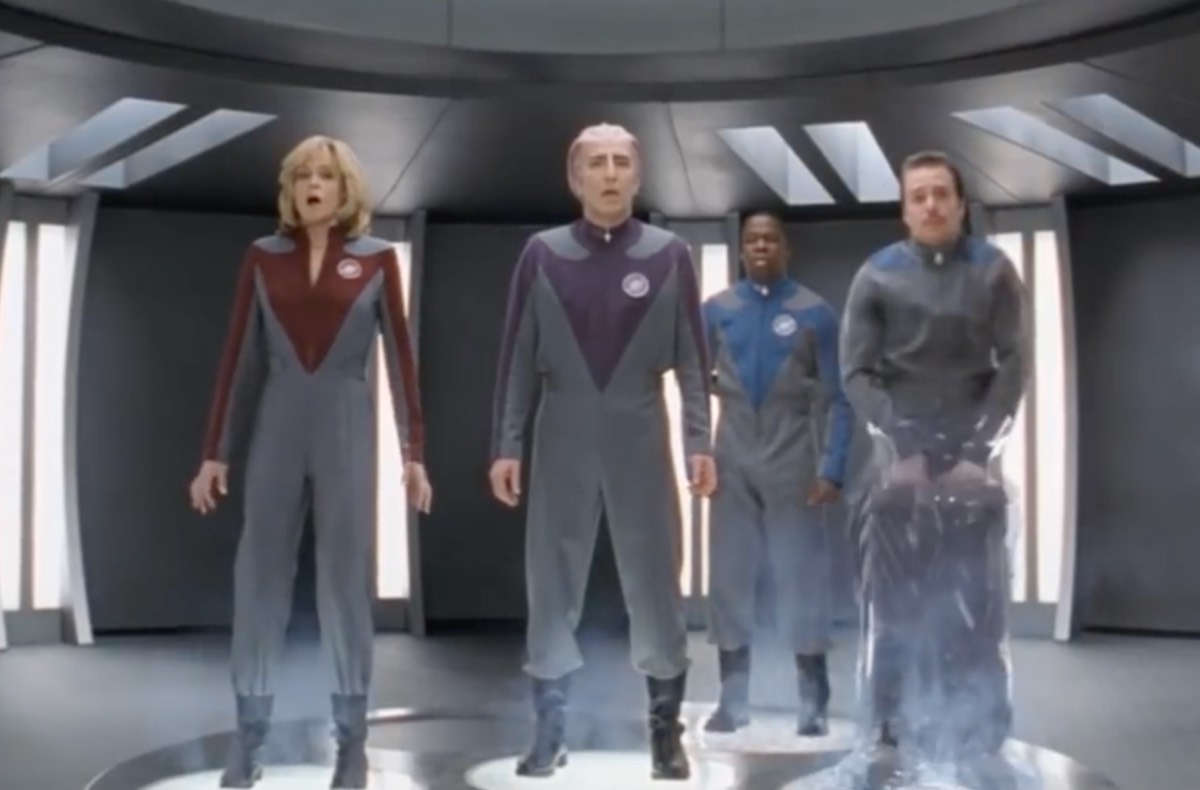
Never give up, never surrender! That was the mantra of the intrepid crew of the fictional NSEA Protector starship in the 1999 science-fiction action comedy Galaxy Quest. It’s also apparently the mantra of Paramount TV, which has been trying to bring a spinoff series to the small screen since 2015. That persistence might finally pay off, as Deadline Hollywood reports that a Galaxy Quest TV series is back in early development for Paramount+. It’s early days yet, so there are no details about what this TV series might be about or whether any surviving members of the original cast will be returning, even in cameos. Paramount has thus far declined requests for comment.
As I’ve written previously, the film is a clear homage to Star Trek, as well as its intensely committed fan base. The premise is deceptively simple: What if aliens watched transmissions of a popular science-fiction TV show from Earth and thought it was real? An alien race called the Thermians models their entire society on the principles of a fictional Galaxy Quest TV show, building real, functional versions of the spaceship and much of the technology from the series. When their existence is threatened by a reptilian humanoid general from another species, named Roth’h’ar Sarris, they travel to Earth to ask their heroes for help—arriving in the middle of a Galaxy Quest fan convention.
Of course, the heroic crew of the NSEA Protector are washed-up actors, eking out a living making personal appearances and selling autographed photos. Suddenly they find themselves aboard an actual spaceship, facing real peril, and must rise to the occasion to save the day—becoming more like the characters they once played.
Galaxy Quest didn’t exactly bomb at the box office, grossing about $90 million globally and earning mostly positive reviews. But it wasn’t the blockbuster success that it should have been. Galaxy Quest is a rare perfect film: a masterful satire with clever twists, wickedly funny, and so very meta. And it has stood the test of time, holding up even after multiple re-watchings. What makes it truly great and so beloved by fans more than 20 years later is its obvious deep affection for its targets. Sure, the film pokes fun at the Star Trek franchise: the cheesy tropes, the characters, the actors who play them, and the fandom it has inspired over the years. But it is never mean-spirited, cynical, or condescending. The teasing is done with genuine affection.
There has long been talk of making a sequel. But it wasn’t until April 2015 that Paramount announced a collaboration with Amazon Studios and the original movie’s co-writer (Robert Gordon), director (Dean Parisot), and executive producer Mark Johnson to create a spinoff series, similar to the studio’s resurrection of Minority Report and School of Rock as TV series. But the unexpected death of co-star Alan Rickman—who played Alexander Dane/Dr. Lazarus in the original film—from pancreatic cancer in 2016 threw a spanner into those plans. Could you even make such a series without him? Co-star Sam Rockwell, who played Guy, told io9 he thought the series would now never happen.
But Paramount wasn’t ready to let the project die, and by August 2017, Paul Scheer had signed on to help develop the spinoff series. Scheer’s vision back in 2017 involved a serialized adventure picking up where the film ended, hopefully capturing “the difference between the original cast of Star Trek” and the cast of the J.J. Abrams reboot. There were also a couple of comic book series in 2008 and 2015, and the first issue’s storyline included events from the fictional two-hour pilot of Galaxy Quest: The Journey Continues. (The original film closed with the opening credits of that sequel.) At one point, Simon Pegg and screenwriter Georgia Pritchett (Succession) were involved.
And now a fresh TV series effort is underway with Johnson again leading the development.
Honestly, I have mixed feelings about a spinoff series from one of my all-time favorite movies. On the one hand, I love and cherish every character and every line of dialogue in Galaxy Quest. On the other, how do you improve on perfection? As Enrico Colantoni, who played Thermion leader Mathesar, told io9 in 2014, “To make something up, just because we love those characters, and turn it into a sequel—then it becomes the awful sequel.”
Paramount’s Minority Report series was… not good, but School of Rock ran for three seasons, so who knows? I guess we’ll just have to wait and see whether (a) the series ever sees the light of day, and (b) whether the finished series lives up to its timeless predecessor.
https://arstechnica.com/?p=1932765
Listen up! Bea Wolf is a brilliant retelling of a classic Old English saga—for kids
<img src="https://rassegna.lbit-solution.it/wp-content/uploads/2023/04/listen-up-bea-wolf-is-a-brilliant-retelling-of-a-classic-old-english-saga-for-kids.jpg" alt="Kids and grown-ups alike will enjoy answering "candy's clarion call" in Bea Wolf.”>
Enlarge/ Kids and grown-ups alike will enjoy answering “candy’s clarion call” in Bea Wolf.
Boulet/Macmillan
A rowdy group of young “mallow-munchers,” “bully-crushers,” and “bedtime breakers” must battle a fun-hating foe intent on putting an end to their untamed revels in Bea Wolf, a new graphic novel by cartoonist and writer Zach Weinersmith, with illustrations by the French cartoonist Boulet. It’s a 21st-century re-imagining of the Old English epic poem Beowulf, but unlike most prior translations aimed at adults, this one targets kids (although adults should love it, too).
Ars readers are likely already familiar with Weinersmith’s work, most notably the webcomic Saturday Morning Breakfast Cereal, still going strong after 20 years, as well as The New York Times bestseller Soonish, a popular science book co-authored with his wife, Kelly Weinersmith. While he’s known for his science-nerd credentials, Weinersmith (like me) earned his undergraduate degree in English literature. That’s where he started drawing what’s now known as “Classic SMBC.” The comic soon morphed into the single-panel version we know and love today, while Weinersmith went back to college to study physics.
It was while he was studying literature that Weinersmith fell in love with Beowulf, as well as the medieval chivalric romance Sir Gawain and the Green Knight. When he became a father, he told some of those timeless tales to his daughter, Ada. In 2015, he crowdfunded a children’s retelling of Sir Gawain called Augie and the Green Knight, and said it was because he wanted to give his daughter a book “about little girls who are smart, and scientific, and risk-taking.” Boulet created the illustrations for that book, so it was only natural for Weinersmith to ask him to also illustrate Bea Wolf.
The original epic poem Beowulf is set in Scandinavia and recounts the adventures of its titular hero. The Danish King Hrothgar’s mead hall is under attack from a monster called Grendel. Beowulf obligingly slays the beast, incurring the wrath of Grendel’s equally monstrous mother. He slays her, too, and eventually becomes king of his people, the Geats. Some 50 years after those adventures, Beowulf slays a dragon, although he is killed in the process. Scholars believe many of the characters are based on historical figures in sixth-century Scandinavia.
Bea Wolf is set in an unnamed suburb, where a group of kids build their own sanctuary from the world of adults, dubbed Treeheart. They consume mountains of candy and soda and engage in all kinds of raucous play—much to the annoyance of their grown-up neighbor, Grindle. Grindle leads a joyless existence and longs for peace and quiet. He also has a secret weapon: He can instantly turn kids into pimply adolescents and boring, responsible grown-ups. As their ranks diminish, the remaining children call on a warrior champion to help defeat Grindle: the titular Bea Wolf.
Weinersmith has successfully captured the spirit of this timeless story, weaving in generous amounts of alliteration and his version of Old English kennings, a compound figure of speech that replaces a common noun with two or more words that make for a more figurative than literal description. For example, in the original Beowulf, “sea” is described as “sail-road” (seġl-rād), while in Bea Wolf, King Carl, founder of Treeheart, is described as “oak-strong and owl-wise.” There’s even an appendix where Weinersmith provides a kid-friendly primer on the history of Beowulf, its unique language, and the various attempts to translate it for modern readers.
Ars spoke with Weinersmith to learn more.
https://arstechnica.com/?p=1925154
If 80% of Nvidia 40-series owners turn on DLSS, what’s going on with the others?
Enlarge/ Buying one of these Nvidia cards is a big commitment, both in dollars and case space. Most people who buy them do turn on DLSS and ray tracing, according to Nvidia. So … what’s going on with the folks who don’t?
Andrew Cunningham
As part of its push for the RTX 4070, Nvidia’s new $600 entry point into its Ada Lovelace GPU series, Nvidia has some statistics that, depending on how you look at them, are either completely baffling or entirely believable.
In a blog post and in press materials sent out before the 4070’s debut, Nvidia offers stats pulled from “millions of RTX gamers who played RTX capable games” in February 2023. They show that:
83 percent of 40 series gamers “turn RT on” (ray tracing)
56 percent of 30 series
43 percent of 20 series
As for DLSS, Nvidia’s AI-accelerated upscaling and frame-generation tool for games that support it, Nvidia writes that 79 percent of 40 series, 71 percent of 30 series, and 68 percent of 20 series owners turned the feature on.
Enlarge/ Nvidia’s chart showing DLSS and RT adoption among 40-series Nvidia card owners, among other interesting statistics.
Nvidia (or the person writing its copy, at least) believes the “core of this story,” the thing to take away from these numbers, is that “technologies don’t just define the way people create content, they redefine how it’s consumed, ultimately becoming integral parts of its transformation.” Or, put another, less graduate-student-dinner-party way, ray tracing and DLSS are “how today’s gamers achieve the best graphics and performance.” Please consider upgrading your video card, in other words.
Not everybody sees these numbers and comes to the same conclusions. In an r/hardware Reddit thread (first spotted by PC Gamer), many ask what the exact criterion is for “turn on.” From experience, ray tracing, or RT, is something you can definitely turn on, play a game for a minute, notice that it looks like a RealVideo stream from 2003, then turn it off. If you did that in February 2023, did you “turn RT on,” as such?
Another question would be what the sample sizes look like. Steam’s March 2023 hardware and software survey, which incorporated data from October 2021 to March 2023, showed that 15 percent of Steam users were using 20 series RTX cards, 34 percent 30 series, and just 0.68 percent 40 series (thanks to u/nukleabomb for the math). Are these early adopters more or less likely to try out the same features as the rest of the gaming world once they eventually move up to more capable cards? We’ll have to find out.
More confounding to think about in Nvidia’s numbers are the remainders. Among that very small set of people who were able to source a 40-series card, and also afford to pay for one, the number who would try out DLSS seems like it should be closer to 100 percent. Given that Nvidia’s numbers presumably come from those who install its card and use the GeForce Experience app to install and maintain drivers, and the February 2023 dating, there’s little chance that the holdouts are crypto opportunists or card flippers.
And those 17 percent of 40-series owners who have used them but haven’t turned on ray tracing in any game yet—can we arrange an interview? Is it just video transcoding and rendering? Are they just entirely unimpressed by lighting upgrades, fanatics for frame rate, or both?
There is something for Nvidia to celebrate here, of course. More than 80 percent of the GPUs profiled in Steam’s survey are made by Nvidia, and seeing that a firm majority of 20-, 30-, and 40-series owners turn on DLSS gives them remarkable leverage. Other companies can provide ray tracing, and there are DLSS alternatives like XeSS and FSR, which can even work with Nvidia’s cards. But DLSS is Nvidia’s own thing, it’s being used, and it’s becoming a selling point. Catching up seems like a tall order for AMD, Intel, and whoever else wants to take on this heavy favorite.
https://arstechnica.com/?p=1931860
Bethesda adds Denuvo to Ghostwire: Tokyo one year after the game was cracked
Enlarge/ Artist’s conception of Bethesda slamming Denuvo protections on a game that has been widely pirated for over a year.
So it’s a bit odd that Bethesda Softworks has just quietly added Denuvo protections to Ghostwire Tokyo, a game that was quickly cracked after its Denuvo-free release just over a year ago.
The late addition was confirmed by DSOGaming, which says it triggered the new Denuvo protections in the game’s latest Steam update by simulating frequent changes in the CPU. While fresh Denuvo protection seems unlikely to impact piracy for the long-cracked title, it could serve as a shield for new DLC and expansion content.
Reversing the timeline
Bethesda’s apparent “close the barn door after the horse has bolted” strategy here is the reverse of the usual pattern across the industry, where publishers eventually remove Denuvo protection after the launch-window piracy protection it provides has been mooted by a crack (an event that can happen rather quickly, even with Denuvo in place). Capcom recently removed Denuvo protection from 2021’s Resident Evil Village, mirroring a Denuvo timing pattern it has used for previous Resident Evil and Monster Hunter releases.
The Ghostwire addition comes alongside the recent addition of a “Denuvo anti-tamper” notice on the Steam page for the upcoming Bethesda shooter Redfall, which launches in just a few weeks. Such a notice has yet to appear on the page for Bethesda’s Starfield, which doesn’t launch until September.
Entangled superpowers cause portal-jumping havoc in The Marvels teaser
[embedded content]
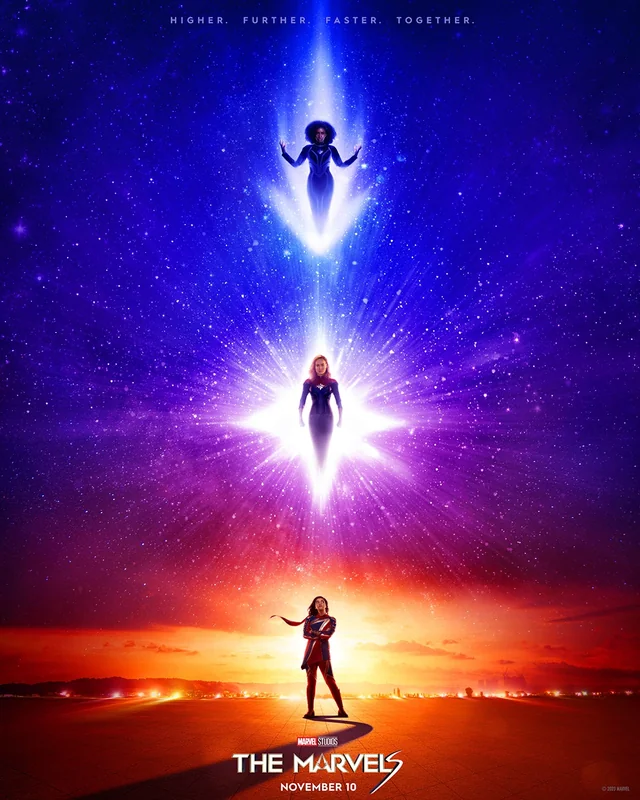
Captain Marvel (Brie Larsen), Ms. Marvel (Iman Vellani), and Monica Rambeau (Teyonah Parris) return in The Marvels.
Remember Ms. Marvel‘s end credits scene, where Brie Larson’s Captain Marvel suddenly appears in Kamala Khan’s (Iman Vellani) bedroom, while Kamala finds herself on a spaceship with Goose (the cat that’s really a Flerken)? Judging by a newly released teaser, that scene will lead directly into The Marvels, the sequel to 2019’s Captain Marvel. It’s part of Phase Five of the MCU, and the film is directed by Nia DaCosta (Candyman).
Both Larson and Vellani reprise their respective roles for the film, along with Teyonah Parris as Monica Rambeau, daughter of Carol/Captain Marvel’s BFF Maria. Monica grew up to become a SWORD agent, but thanks to the events of WandaVision, she can also absorb and manipulate energy as Spectrum. As for Khan, aka Ms. Marvel, she’s a teenage Pakistani American who lives in Jersey City. She’s a major comic books fan, worships Carol Danvers/Captain Marvel, and fantasized about becoming a superhero someday. Her powers stem from the Terrigen Mists, released globally in a crossover storyline, the “Inhumanity.” The mists activated dormant Inhuman cells in several people, Kamala included.
Per the official premise:
Carol Danvers, aka Captain Marvel, has reclaimed her identity from the tyrannical Kree and taken revenge on the Supreme Intelligence. But unintended consequences see Carol shouldering the burden of a destabilized universe. When her duties send her to an anomalous wormhole linked to a Kree revolutionary, her powers become entangled with that of Jersey City super-fan Kamala Khan, aka Ms. Marvel, and Carol’s estranged niece, now S.A.B.E.R. astronaut Captain Monica Rambeau. Together, this unlikely trio must team up and learn to work in concert to save the universe as The Marvels.
Naturally, Nick Fury (Samuel L. Jackson) will be on hand to lend some assistance, along with fan-favorite Goose the cat. Saagar Shaikh, Zenobia Shroff, and Mohan Kapur will reprise their Ms. Marvel roles as Kamala’s older brother Aamir, mom Muneeba, and dad Yusuf, respectively. There’s also a new villain, played by Zawe Ashton, most likely the aforementioned Kree revolutionary. (One rumor is that Ashton will play a gender-swapped version of Kree General Ael-Dan from the comics.) Park Seo-joon (Parasite) has also been cast in an as-yet-undisclosed role.
The TV series Secret Invasion—which had a full trailer released last week—also builds off the events of Captain Marvel, but with a very distinct spy thriller vibe and themes of political paranoia, drawing inspiration from the TV series Homeland and The Americans. Judging by this new teaser, The Marvels feels like more classic MCEU fare: lots of action sprinkled with bits of humor, interpersonal tensions, and some timely self-reflection. In other words, it will be much like 2012’s The Avengers.
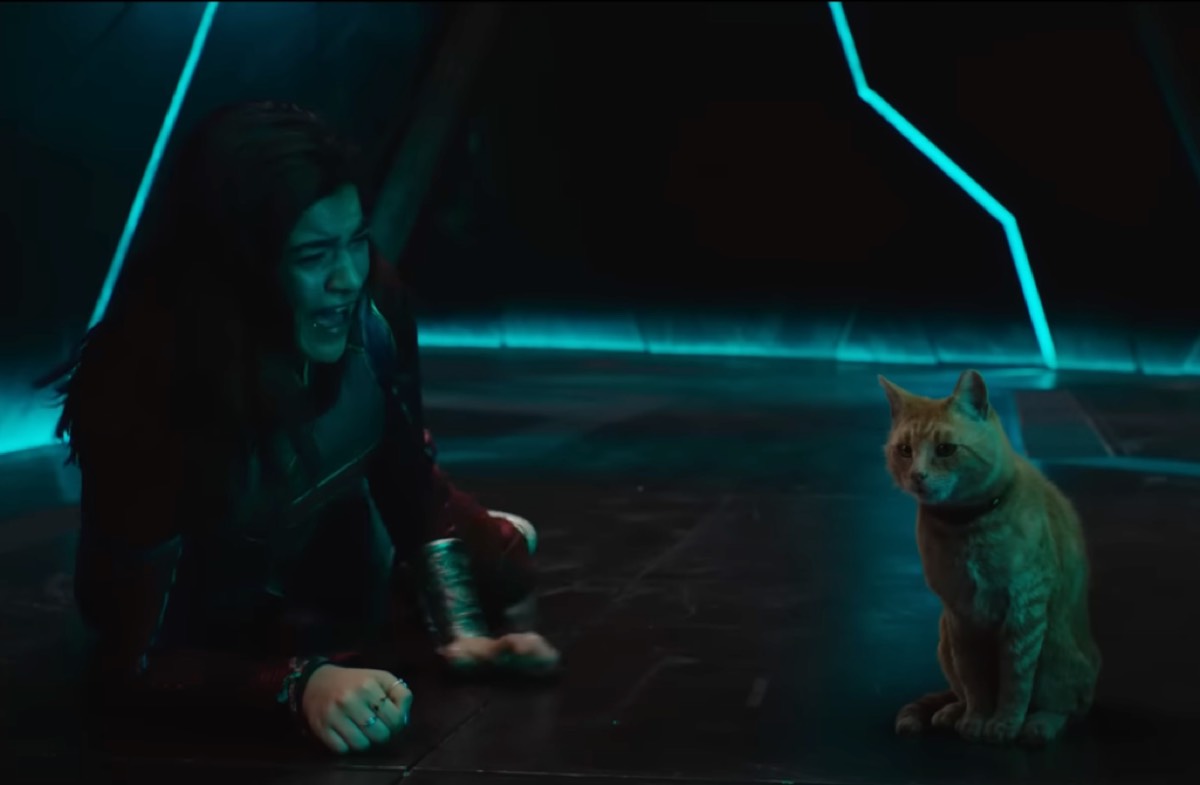
Enlarge/ Kamala Khan/Ms. Marvel meets Goose the Flerken.
YouTube/Marvel Studios
The teaser opens with Fury and Rambeau exploring an anomaly in space—looks like a wormhole or “jump point,” as Rambeau calls it. She’s trying to get some scientific data on the anomaly, only to switch places with an understandably panicked Kamala Khan. Khan’s panic is short-lived once she recognizes Fury; she’s an uber-fan, remember. (“Is this an Avengers test?”) Meanwhile, Rambeau finds herself mid-battle on another planet, while Danvers finds herself in Khan’s bedroom, bewildered by all the posters of herself plastered on the walls.
Eventually, Fury and Rambeau figure out the issue and meet up at Khan’s house, where Rambeau explains that their powers have become entangled. Eager to show Rambeau what she can do, Khan ends up switching places with Danvers—whose powers are clearly also entangled—where she meets Goose, who does what a Flerken does to those attacking her. Also, are those Flerken kittens? How deadly cute is that? And however strenuously Rambeau and Danvers deny that the three of them are a team, they totally are—to Khan’s delight.
The Marvels is slated for theatrical release on November 10, 2023.