Activision’s internal investigation finds no “systemic issue” with harassment

A magnifying glass inspects a surface covered in various corporate logos.
Enlarge / Taking a close look…


Last November, The Wall Street Journal published a damning report alleging that Activision CEO Bobby Kotick withheld information about harassment allegations from his board of directors. The report also suggested that Activision executives failed to act decisively to address the kind of widespread complaints contained in a California Department of Fair Employment and Housing (DFEH) lawsuit filed last July.

In a Securities and Exchange Commission filing on Thursday, Activision’s board of directors said the company has concluded its own thorough investigation of those claims, which it says shows that “we are not a company that looks the other way.”

After consulting with external advisers, talking with employees, and reviewing contemporaneous notes, Activision writes “that there is no evidence to suggest that Activision Blizzard senior executives ever intentionally ignored or attempted to downplay the instances of gender harassment that occurred and were reported.” The company’s board of directors also didn’t withhold any information from the company, Activision writes.

Activision’s new statement acknowledges “some substantiated instances of gender harassment” that “occurred and were reported.” But Activision adds that those individual experiences of harassment can be “hard to reconcile” with a more collective, data-driven look at how the company is handling harassment as a whole. And valid individual complaints “do not support the conclusion that Activision senior leadership or the Board were aware of and tolerated gender harassment or that there was ever a systemic issue with harassment, discrimination or retaliation,” the company writes.

On the contrary, Activision says that an investigation from outside adviser (and former Equal Employment Opportunity Commission chairman) Gilbert Casellas found that, “based on the volume of reports, the amount of misconduct reflected is comparatively low for a company the size of Activision Blizzard.”

“Like any organization that has employed over 25,000 employees over the last decade, Activision Blizzard can always improve,” the company writes. Activision goes on to list internal changes it has made in recent months, including zero-tolerance policies for harassment and alcohol consumption in the workplace and at work events; waiving arbitration for harassment and discrimination claims; and increased investment in anti-harassment and anti-discrimination training and compliance teams.

Activision also takes the opportunity in its new filing to call out what it calls “an unrelenting barrage of media criticism that attempts to paint the entire Company (and many innocent employees) with the stain of a very small portion of our employee population who engaged in bad behavior and were disciplined for it.” The DFEH complaint that started Activision’s year of bad press contained allegations that were “highly inflammatory” and “made for the press,” the company writes.

In addition to the DFEH lawsuit, Activision still faces a number of suits from shareholders and a reported SEC investigation concerning the company’s alleged failure to share material information surrounding employee misconduct. A separate lawsuit against the company by the federal Equal Employment Opportunity Commission was controversially settled for $18 million last September, while a wrongful death lawsuit from the family of an employee who died by suicide was dropped last month. https://arstechnica.com/?p=1861257
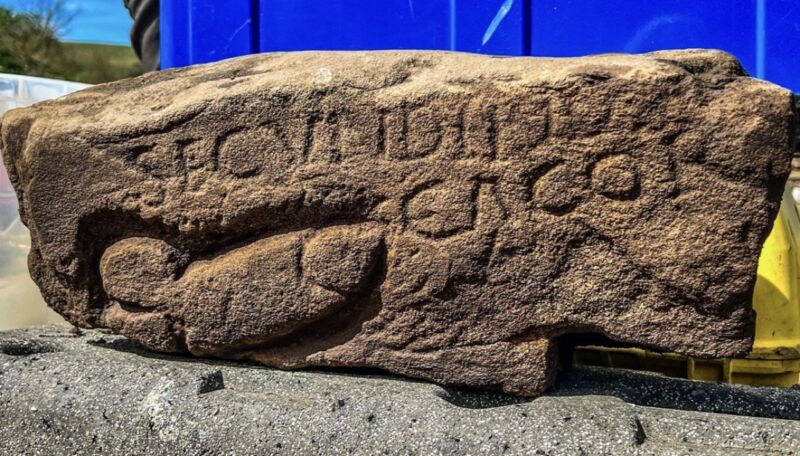


Ancient Roman soldier carved a phallus with a personal insult in this stone

Archaeologists found a crude graffiti drawing of a penis accompanied by a personal insult at the ancient Roman fort Vindolanda.
Enlarge / Archaeologists found a crude graffiti drawing of a penis accompanied by a personal insult at the ancient Roman fort Vindolanda.
Vindolana Charitable Trust

Archaeologists excavating the remains of a Roman auxiliary fort in the UK recently made a surprising and rather hilarious find: a small stone carved with the unmistakable image of a penis—basically an ancient Roman d**k pic, accompanied by a crude insulting message directed at someone the carver clearly disliked.

The Vindolanda site is located south of the defense fortification known as Hadrian’s Wall. An antiquarian named William Camden recorded the existence of the ruins in a 1586 treatise. Over the next 200 years, many people visited the site, discovering a military bathhouse in 1702 and an altar in 1715. The Rev. Anthony Hedley began excavating the site in 1814, but he died before he had the chance to record what he found for posterity. Another altar found in 1914 confirmed that the fort had been called Vindolanda.

Serious archaeological excavation at the site began in the 1930s under the leadership of Eric Birley, whose sons and grandson continued the work after his death, right up to the present day. The oxygen-deprived conditions of the deposits (some of which extend six meters, or 19 feet, into the earth) mean that the recovered artifacts are remarkably well-preserved. These include wooden writing tablets and over 100 boxwood combs, which would have disintegrated long ago in more oxygen-rich conditions.

Vindolanda tablet 291, circa 100 CE: An invitation from Claudia Severa to Sulpicia Lepidina, inviting her to a birthday party.
Enlarge / Vindolanda tablet 291, circa 100 CE: An invitation from Claudia Severa to Sulpicia Lepidina, inviting her to a birthday party.

The site is most famous for the so-called Vindolanda tablets, among the oldest surviving handwritten documents in the UK. Discovered in 1973, these are thin wooden leaves, about the size of a postcard, with text written in carbon-based ink. Most of the documents are official military communications and personal messages from garrisoned soldiers to their families, revealing many details about life at the fort.

For example, one tablet is a letter from a Roman cavalry officer named Masculus to a prefect asking for more beer to be sent to the garrison. (An army marches on its stomach.) By far the most famous is Tablet 291, written around 100 CE by the wife of a commander of a nearby fort named Claudia Severa. It was addressed to Sulpicia Lepidina inviting her to a birthday party and represents one of the earliest known examples of a woman writing in Latin.

Among the many other interesting finds: a bronze and silver fibula (a brooch or pin for fastening garments) in 2006; the remains of a female child between 8 and 10, found in a shallow pit in a barrack room in 2010; a wooden toilet seat unearthed in 2014; and two (unmatched) Roman boxing gloves unearthed in 2017, similar to modern full-hand boxing gloves—except these date back to 120 CE.

Also in 2017, archaeologists found cavalry barracks littered with swords, ink tablets, textiles, and arrowheads, among other artifacts. Archaeologists also found a 5th-century chalice in 2020 and unearthed a carved sandstone last year depicting a naked warrior figure astride a horse—possibly the Roman deity Mars.

Retired biochemist Dylan Herbert was volunteering at the excavation site when he came across the carved stone.
Enlarge / Retired biochemist Dylan Herbert was volunteering at the excavation site when he came across the carved stone.
Vindolanda Charitable Trust

As for this latest find, one of the volunteers working on the excavation was a retired biochemist from South Wales named Dylan Herbert, who initially viewed the stone as just another piece of rubble. But when he turned it over, he noticed clear lettering and realized it was far from ordinary. “Only after we removed the mud did I realize the full extent of what I’d uncovered, and I was absolutely delighted,” said Herbert.

The stone is fairly small, measuring 40 cm wide by 15 cm tall (15 inches by 6 inches). Experts in Roman epigraphy recognized the lettering as a mangled version of Secundinus cacator, which translates into (ahem) “Secundinus, the shitter.” The penis image merely added insult to injury—a clever subversion of the traditional interpretation of a phallus as a positive symbol of fertility. The Vindolanda site now has 13 phallic carvings, more than have been discovered at any other dig site along Hadrian’s Wall.

“The recovery of an inscription, a direct message from the past, is always a great event on a Roman excavation, but this one really raised our eyebrows when we deciphered the message on the stone,” said Andrew Birley, director of excavations and CEO of the Vindolanda Trust. “Its author clearly had a big problem with Secundinus and was confident enough to announce their thoughts publicly on a stone. I have no doubt that Secundinus would have been less than amused to see this when he was wandering around the site over 1,700 years ago.”

https://arstechnica.com/?p=1861071


Sony is making a Gran Turismo movie, due next August

Sony is making a Gran Turismo movie, due next August

South African director Neill Blomkamp is set to direct a Gran Turismo movie for Columbia Pictures. Deadline first broke the news of a potential GT film in May, but on Tuesday, Sony announced a release date for the film: August 11, 2023.

Video games don’t often make great movies, though I still have a soft spot for Super Mario Bros, even if the elevator scene with the Koopas ruined slow dances at weddings for me forever. Although Blomkamp is no stranger to horror, the GT movie is unlikely to feature an army of subterranean dinosaurs.

Instead, the plot involves a teenager GT gamer whose skills see him through a series of competitions to become a professional racing driver.

If that sounds vaguely familiar, it should, because from 2008 until 2016, the Nissan Playstation GT Academy program did just that, identifying promising talent using the PlayStation driving game.

GT Academy was the brainchild of Darren Cox, who was working in Nissan’s marketing department in the UK. In 2016, Cox explained that the idea came about during a co-promotion with Sony in 2006, where the prize was a new Nissan 350Z. Contestants had to compete in GT and on a real track to determine the winner.

“After the event, one of the instructors mentioned to me that some of the guys were actually pretty good [at track driving]. Comparing their lap-times in real life versus the game showed a pretty good correlation between the two, and we started working on the idea of trying to take a good gamer and make them a racer,” Cox told me.

Two years later, the first GT Academy competition was held, with Spain’s Lucas Ordóñez emerging triumphant. A decent race in the 2009 Dubai 24 Hours prompted Nissan to sign Ordóñez to its works racing team, and from 2010 to 2016, the program minted another 21 winners, some of whom have gone on to win prestigious races like the 2015 Bathurst 12 Hours in Australia.

It’s not the only racing movie in the works—Apple is apparently paying for a Formula 1 film starring Brad Pitt as a retired driver who comes back into the sport to race against a rookie. Despite the big names attached—Lewis Hamilton as a producer, Top Gun: Maverick director Joseph Kosinski directing—the plot sounds too close to 2001’s Driven, which featured Sylvester Stallone as an aging driver persuaded to come out of retirement to race in the CART series (now IndyCar).

Time will tell if we’ll get to see Pitt drive his F1 car off the track and into a car chase through Chicago.

https://arstechnica.com/?p=1860962


Review: TMNT: Shredder’s Revenge is a must-play arcade throwback

Everyone's favorite heroes in a half shell are back—and they're here to reclaim their '90s arcade-brawling glory.
Enlarge / Everyone’s favorite heroes in a half shell are back—and they’re here to reclaim their ’90s arcade-brawling glory.
Dotemu / Tribute Games


Teenage Mutant Ninja Turtles: Shredder’s Revenge might be the best 2D beat-‘em-up video game ever made. Depending on your preferences, it could drop down to #2 or #3 on your personal all-time list, but that still makes it an incredible, must-play game, and its production values and group-gaming fun factor are unmatched in the genre.

Since getting my copy, I’ve completed the game’s campaign four times and hosted gameplay sessions with a number of friends, and I’m still not tired of the fun. Shredder’s Revenge is everything I have wanted in a Ninja Turtles arcade sequel: immediately accessible, gorgeously animated, hilarious, and packed with enough mechanical systems to make it satisfying to return to.

Beyond Guardian Heroes, beyond 2007’s TMNT

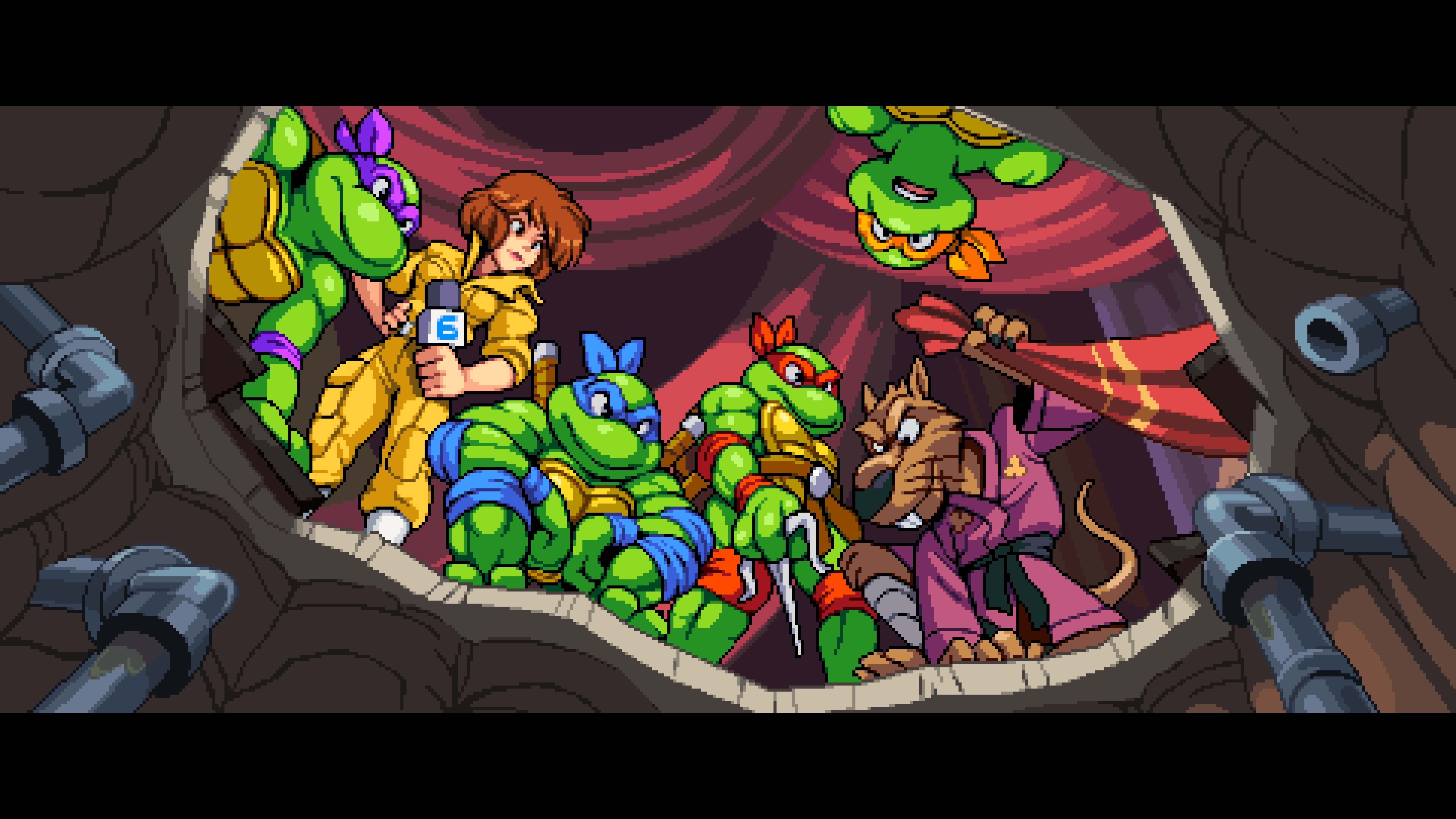
The game opens with a classically styled animated intro set to the TV series' original theme song (re-recorded, sadly, but it has Mike Patton from Faith No More on vocals, which is cool.)
Enlarge / The game opens with a classically styled animated intro set to the TV series’ original theme song (re-recorded, sadly, but it has Mike Patton from Faith No More on vocals, which is cool.)
Dotemu / Tribute Games

Shredder’s Revenge rewinds to a 32-bit era of high-res, meticulously animated pixel art—perhaps one generation past the beloved likes of Guardian Heroes—and imagines a world in which Konami kept making TMNT arcade games. This week’s new game, out on Windows, Xbox, PlayStation, and Switch imagines what directions the series might have gone in an alternate universe dominated by arcade games.

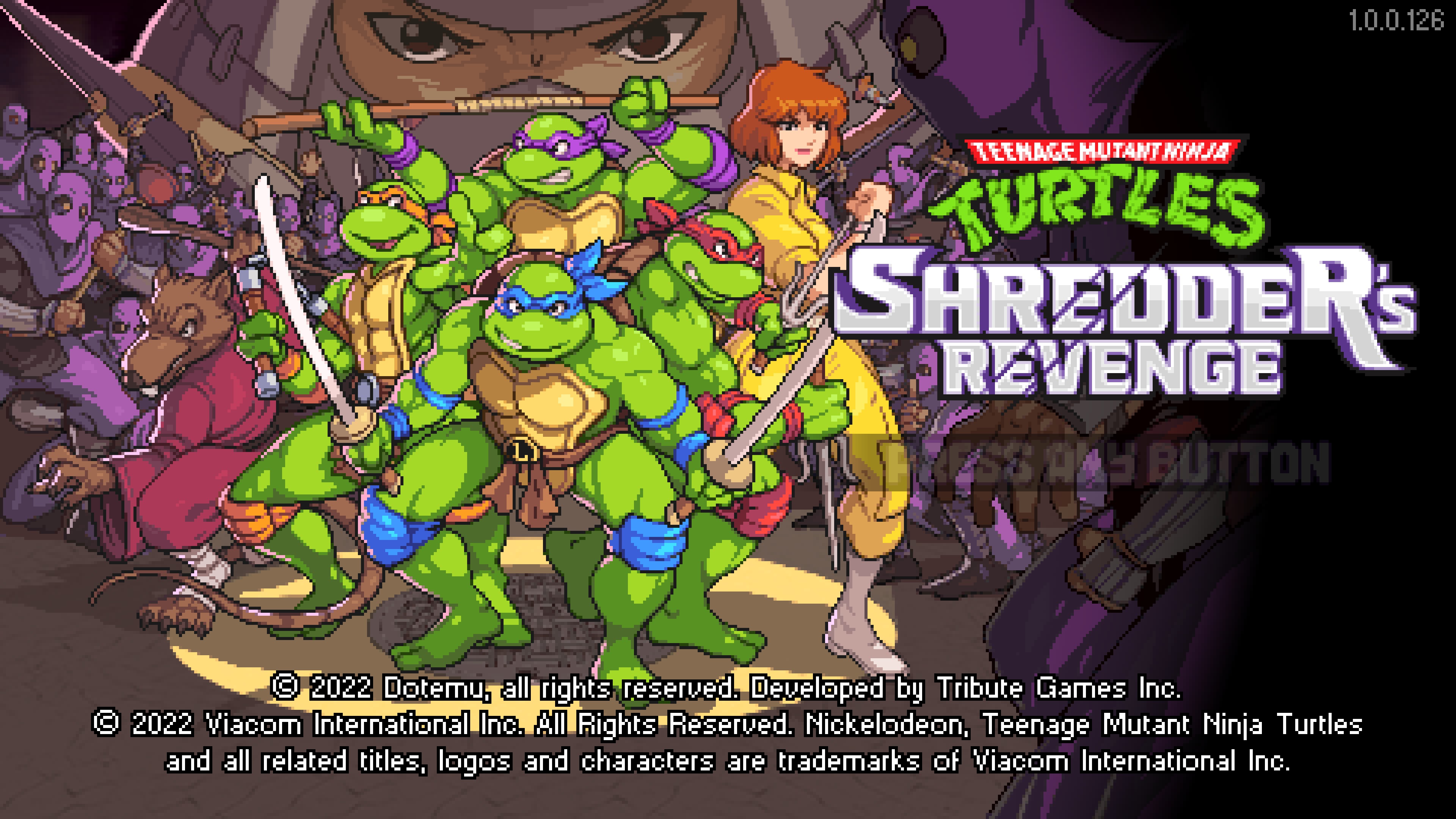
I'd love a version of the game's title screen that doesn't have text on it. This design looks rad, and I prefer the pixelated version over the hand-drawn one on the game's physical box.
Enlarge / I’d love a version of the game’s title screen that doesn’t have text on it. This design looks rad, and I prefer the pixelated version over the hand-drawn one on the game’s physical box.
Dotemu / Tribute Games

As it turns out, the main developers of this new game tried such a concept 15 years ago. The simply named TMNT for the Game Boy Advance looked and felt a lot like games from the series’ arcade heyday, boosted by a satisfying combo-counter system and some experience-point chasing. Sadly, that solid 2007 game was lost in a portable-gaming world that had moved on to the Nintendo DS.

Somehow, the game’s devs stuck together and formed a new studio, Tribute Games (Scott Pilgrim vs. The World). Now, they’ve partnered with Dotemu (Streets of Rage 4) to take arcade-style turtling to the next level—and a big reason for the new game’s success is that it rewinds to the series’ past.

Enough humor and style to reward repeat playthroughs

This screenshot is so '90s, you can practically smell the plastic toy version of the Turtles' Party Wagon.
Enlarge / This screenshot is so ’90s, you can practically smell the plastic toy version of the Turtles’ Party Wagon.
Dotemu / Tribute Games

This is the first Ninja Turtles game to return to the series’ breakout era of the late ’80s and early ’90s, and it does so with the bright aesthetics, era-appropriate music, and goofy comedy missing from other Turtles games that have come since. Each hero and enemy is loaded with comical and exaggerated animations, along with visual gags that don’t get old over repeated playthroughs.

Newscaster April O’Neil joins the fight by beating up foes with microphones and cameras. Michelangelo madly dashes in a way that pays amusing homage to Wile E. Coyote. And your march toward the end of each level constantly interrupts members of the Foot Clan while they’re doing ridiculous things, from working fast-food counters at a mall to rifling through parked cars to steal their engines.

Tribute Games relishes the opportunity to animate other familiar characters from the ’90s animated series, and boss encounters in particular come with detailed, exaggerated takes on classic character designs that have aged incredibly well. From obvious mainstays Bebop and Rocksteady to deep cuts like Tempestra, each boss encounter benefits from charismatic dialogue and diverse battling patterns. The boss fights are so fun that I hope the game is eventually updated with a “boss rush” that lets players fast forward to them.

https://arstechnica.com/?p=1860753


X-ray imaging reveals why this 17th century painted yellow rose lost its luster

<img src="https://rassegna.lbit-solution.it/wp-content/uploads/2022/06/x-ray-imaging-reveals-why-this-17th-century-painted-yellow-rose-lost-its-luster.jpg" alt="The pigments used to create the yellow rose in Abraham Mignon's Still Life with Flowers and a Watch have degraded, giving the rose a flatter appearance—the opposite of the 3D illusory effect intended by the artist.”>
Enlarge / The pigments used to create the yellow rose in Abraham Mignon’s Still Life with Flowers and a Watch have degraded, giving the rose a flatter appearance—the opposite of the 3D illusory effect intended by the artist.

The 17th century still-life painter Abraham Mignon was known for his depictions of flowers, fruit, forests, and grottoes, among other objects. But over time, certain pigments have degraded to such an extent as to alter the artist’s intent. Most notably, a yellow rose prominently featured in Mignon’s Still Life with Flowers and a Watch has become flattened and monochrome, particularly compared to the other blooms featured in the painting.

A team of Dutch and Belgian scientists used chemical and optical imaging techniques to examine the elemental distribution of the various pigments, according to a recent paper published in the journal Science Advances. In this way, they could infer Mignon’s original painting technique—specifically how the artist built up layers to create what would have been a 3D appearance for the original rose.

According to the authors, over time, artist pigments and binders in oil paintings inevitably deteriorate when exposed to external factors such as light, relative humidity, temperature, and/or exposure to solvents, as well as incompatible pigment mixtures. The result was discoloration and color changes that can affect the paint’s structural integrity, causing such defects as loss of transparency, brittleness, or micro-cracks.

Examples of this kind of degradation include the discoloration of a blue glass pigment Rembrandt used in several paintings; the fading of light-sensitive pigments—Prussian blues, organic yellow, and red lake pigments—and the darkening of chrome and cadmium yellow in the works of Edvard Munch, Vincent van Gogh, and Pablo Picasso, among other great artists.

<a href="https://rassegna.lbit-solution.it/wp-content/uploads/2022/06/x-ray-imaging-reveals-why-this-17th-century-painted-yellow-rose-lost-its-luster-2.jpg" class="enlarge" data-height="860" data-width="1200" alt="Pigment degradation in the yellow rose of Abraham Mignon's Still Life with Flowers and a Watch. (a) The full painting; (b) detail of the yellow rose; and (c) elemental distribution image of arsenic.”><img alt="Pigment degradation in the yellow rose of Abraham Mignon's Still Life with Flowers and a Watch. (a) The full painting; (b) detail of the yellow rose; and (c) elemental distribution image of arsenic.” src=”https://rassegna.lbit-solution.it/wp-content/uploads/2022/06/x-ray-imaging-reveals-why-this-17th-century-painted-yellow-rose-lost-its-luster-1.jpg” width=”640″ height=”459″ srcset=”https://rassegna.lbit-solution.it/wp-content/uploads/2022/06/x-ray-imaging-reveals-why-this-17th-century-painted-yellow-rose-lost-its-luster-2.jpg 2x”>
Enlarge / Pigment degradation in the yellow rose of Abraham Mignon’s Still Life with Flowers and a Watch. (a) The full painting; (b) detail of the yellow rose; and (c) elemental distribution image of arsenic.
N. de Keyser et al., 2022

“At an advanced stage, these phenomena can decrease the readability of the artwork and hence significantly alter the artists’ intention,” they wrote. That includes altering intended optical effects, such as the folds of draperies, which can disappear, making the object appear flat. This is what happened, for example,  with the ultramarine degradation in Jan van Eyck’s Three Marys at the Tomb. Also, the fading of red pigments in Van Gogh’s The Bedroom turned purple walls blue and a pink floor brown—a reverse optical effect.

Mignon’s yellow rose—a signature flower among 17th century still-life painters, per the authors—has suffered a similar fate. The rose provides “an exemplary topic for this study, looking flat and poor in color contrast while featuring a crumbling powdery appearance or a significantly broken up paint surface,” the authors wrote, adding that the rose lost most of its 3D character, particularly when compared to the other, better-preserved flowers in the painting.  

https://arstechnica.com/?p=1859787


Meet Harold Gillies, the WWI surgeon who rebuilt the faces of injured soldiers

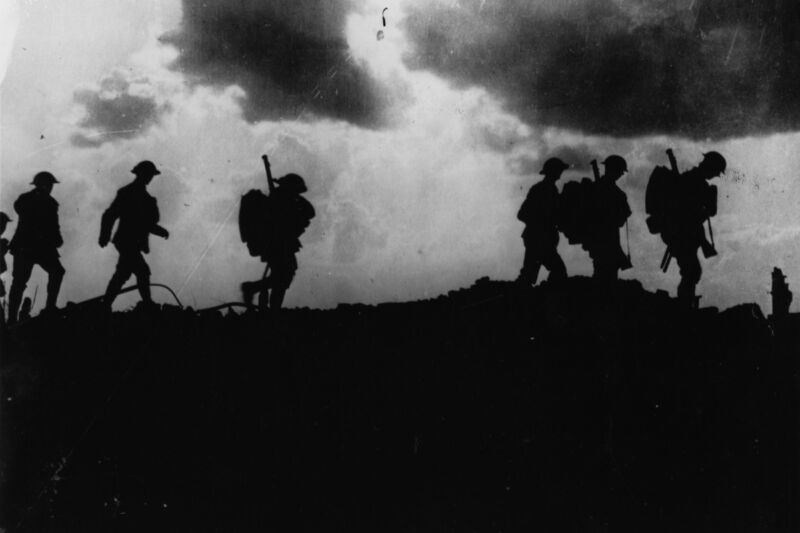
British troops moving to the trenches east of Ypres in October 1917. A new book by historian Lindsey Fitzharris explores the stories of those soldiers who suffered severe facial injuries, and the pioneering surgeon who rebuilt their faces: Harold Gillies.
Enlarge / British troops moving to the trenches east of Ypres in October 1917. A new book by historian Lindsey Fitzharris explores the stories of those soldiers who suffered severe facial injuries, and the pioneering surgeon who rebuilt their faces: Harold Gillies.
Hulton Archive/Getty Images

In August 1917, a World War I British soldier named John Glubb was hit in the face by a shell. He recalled blood pouring out in “torrents” and feeling something akin to a chicken bone moving around his left cheek. It turned out to be half of his jaw, broken off by the impact.

Glubb wasn’t the only unfortunate WWI soldier to suffer a disfiguring facial injury. Shells filled with shrapnel were designed to inflict as much damage as possible, and the need to peer over the parapets of trenches to assess the battlefield or fire a shot meant a greater risk of getting hit in the face by bits of flying metal. Unlike losing a limb, these soldiers faced great social and professional stigmas when they returned home from the front because of their disfigurement. They were usually reduced to taking night shifts and relegated to special blue benches when out in public—a warning to others to avert their eyes.

Fortunately for these men, a New Zealand-born surgeon named Harold Gillies devoted his life to developing innovative techniques for reconstructing faces after witnessing the carnage firsthand during his service at the front. Once home, he set up a special ward for soldiers with facial wounds at the Cambridge Military Hospital in Aldershot, eventually convincing his superiors that a dedicated hospital was warranted. He’s often referred to as the “father of plastic surgery” because of his pioneering work at The Queen’s Hospital (later renamed Queen Mary’s Hospital) at Frognal House in Sidcup.

Gillies is a key figure in a new book by author and medical historian Lindsey Fitzharris, entitled The Facemaker: A Visionary Surgeon’s Battle to Mend the Disfigured Soldiers of World War I. A noted science communicator with a large Twitter following and a fondness for the medically macabre, Fitzharris published a biography of surgical pioneer Joseph Lister, The Butchering Art, in 2017—a great, if occasionally grisly, read.

Her work soon caught the attention of the Smithsonian Channel, who tapped Fitzharris to host their 2020 documentary series revisiting infamous historical cold cases, The Curious Life and Death Of….  Fitzharris usually has several book ideas simmering on the back burner at any given time. For instance, she has a children’s book coming out next year illustrated by her husband, cartoonist/caricaturist Adrian Teal, and is already working on a third book about a 19th-century surgeon named Joseph Bell, who inspired Sir Arthur Conan Doyle’s Sherlock Holmes.

The Facemaker was not her first choice for a follow-up to The Butchering Art, since she wasn’t that knowledgeable about World War I. But her publisher loved the story of Gillies, so Fitzharris gave herself a crash course in the history of that period. “The Butchering Art is hyper-focused on one man, Joseph Lister, who applied germ theory to medical practice,” Fitzharris told Ars. “This is a book not about one man, but many men. It’s about Harold Gillies, the pioneering surgeon who rebuilt soldier’s faces during the First World War, but it’s also about these disfigured men. I hope that their voices really shine through in the narrative.”

Ars spoke with Fitzharris to learn more.

(Warning: Some graphic facial reconstruction photos and descriptions follow.)

US Army trainees in trenches on the Western Front during World War I, France, 1918. The need to peer over the parapets resulted in a dramatic rise in facial injuries from shrapnel, often quite disfiguring.
Enlarge / US Army trainees in trenches on the Western Front during World War I, France, 1918. The need to peer over the parapets resulted in a dramatic rise in facial injuries from shrapnel, often quite disfiguring.
Archive Photos/Getty Images

Ars Technica: This is such a massive topic. How did you narrow the focus so that the scope was manageable?

Lindsey Fitzharris: It’s true, it was a much more complicated story. I think that’s why it took me five years to write, just coming to grips with the scale of World War I, with military medicine at that time, with all of these complicated advances. One of the challenges with World War I is there is so much material: so many diaries and letters by the soldiers writing about their experiences. Someone asked me what the difference is between academic history and the commercial history that I write. A lot of what I do now is discard information. I’m absorbing a lot in my research, but I’m pushing that away because I don’t want to overwhelm the reader. I want to find the pulse of the story.

I knew I wanted to drop the reader into the trenches right from the beginning. There’s a man named Percy Clair who wrote this beautiful diary that allowed me to tell the story of what it was like to be injured, hit in the face, and lay on the battlefield for quite a long time before you were recovered. I wanted the readers to understand how difficult it was in the first instance just to get off the battlefield, and then to get to Gillies, because Clair was initially sent to the wrong hospital.

There were also complications around accessing patient files in the UK, and what you can and can’t say with regard to a patient’s name. When I’m using a patient’s name in The Facemaker, it’s because that knowledge is public, or Gillies himself had published it at some point. If Gillies published about a certain patient, if I went into the case files and found further information that he hadn’t included, I couldn’t use that information in relation with that person’s name. The Butchering Art didn’t have that complication because it was set in the 19th century. Everything was old enough that we didn’t have to worry about all of that. But a lot of the material for The Facemaker is in copyright. I had to contact Percy Clair’s family members to get permission to quote from his diary to the extent that I did.

https://arstechnica.com/?p=1858351


Sony’s new PlayStation Plus launches in US with over 800 games

When Sony announced its new tiered PlayStation Plus program in March, it promised that the most expensive Premium tier would include “up to” 740 games from across all five PlayStation consoles (and the PlayStation Portable). As recently as last month, the company had only revealed a bit over 100 of the games that would be included in its top-tier subscription plan.

With today’s launch of the new PlayStation Plus in the US, though, we can now see the full catalog of titles Sony is making available to subscribers for download and/or streaming. And that launch list actually surpasses Sony’s promises, including nearly 400 PS4/PS5 games (available on the “Extra” tier or above) and over 460 games from earlier console generations (available on the “Premium” tier).

In terms of recent-generation games, PlayStation Plus includes 34 that also offer an “enhanced” PS5 version, alongside a handful of PS5 exclusives like Returnal and Demon’s Souls. That list also includes 27 games from “Ubisoft Plus Classics” provided by the major third-party publisher.

Meanwhile, in the Premium tier’s “Classics Catalog,” there are hundreds of PS3 games that are only available via streaming (and which ran at 720p resolution in a quick test by Ars’ Sam Machkovech). Many games originally available for other consoles will also be available for streaming via a PS4, PS5, or PC on this tier, plus direct download on consoles.

It looks like the PS1 games available on PlayStation Plus are running at their original 60 Hz NTSC rate; they are not the slower 50 Hz PAL versions that were made available in some other regions.

Premium tier subscribers also get access to two-hour game trials for select PS4 and PS5 games. That trial availability is extremely limited for now, though, spanning just 12 games, including Cyberpunk 2077 and Tiny Tina’s Wonderlands.

Players who aren’t interested in downloadable/streamable game access can still sign up for the more limited Essential tier, which is roughly analogous to the previous PlayStation Plus offering. That $59.99 annual membership offers access to cloud saves, online multiplayer games, and two specially chosen game downloads from the PS4/PS5 library.

All of the new PlayStation Plus tiers also include access to the PlayStation Plus collection, with access to 19 PS4 classics that are playable only on PS5 consoles.

https://arstechnica.com/?p=1860542


Starfield gameplay premiere resembles “No Man’s Skyrim,” leads Xbox showcase

<img src="https://rassegna.lbit-solution.it/wp-content/uploads/2022/06/starfield-gameplay-premiere-resembles-no-mans-skyrim-leads-xbox-showcase.png" alt="Starfield will emerge from outer space and land on Xbox consoles and Windows PCs by June 2023.”>
Enlarge / Starfield will emerge from outer space and land on Xbox consoles and Windows PCs by June 2023.
Xbox / Bethesda

Microsoft’s bow in the annual flurry of early June game announcements, streamed on YouTube on Sunday, came with a surprising asterisk: a focus on “games you can play over the next 12 months.” But while the company had a lot to announce for Xbox Game Pass subscribers in 2022, the biggest Xbox console exclusives shown on Sunday appear to skip 2022 altogether.

Bethesda Game Studios tempered fans’ expectations last month by confirming that both of its biggest previously announced “Xbox console exclusive” games, Starfield and Redfall, had been delayed to 2023, and now we know that both should arrive by June of next year. After reviewing Starfield‘s Sunday gameplay reveal, we honestly wonder whether that time window will be sufficient for Bethesda to finish the game, because Starfield looks massive.

At the end of his presentation, Bethesda veteran Todd Howard gestured to a map of one of Starfield‘s major star systems, Alpha Centauri, which appears to include four “major” planets around its sun and an additional eight or nine moon-like celestial bodies. Then the “galaxy map” zoomed out to reveal six named solar systems, along with dots for an additional dozen, and Howard said the full game map includes “over 1,000 planets for you to explore.”

<a href="https://cdn.arstechnica.net/wp-content/uploads/2022/06/Starfield_04_Mountains.png" class="enlarge" data-height="2160" data-width="3840" alt="The "barren" planets in Starfield look vast and evocative.”><img alt="The "barren" planets in Starfield look vast and evocative.” src=”https://rassegna.lbit-solution.it/wp-content/uploads/2022/06/starfield-gameplay-premiere-resembles-no-mans-skyrim-leads-xbox-showcase-1.png” width=”980″ height=”551″>
Enlarge / The “barren” planets in Starfield look vast and evocative.

That’s shy of the 18 quintillion planets you’ll find in the 2016 space exploration game No Man’s Sky, and Howard clarifies that many of Starfield‘s planets will be “barren” sources of crucial resources. Thus, we’re left wondering exactly how many of these planets will be designed with the verbose cities, fortresses, settlements, and quests hinted at in this trailer, especially since Bethesda didn’t offer a size estimate compared to its other major RPG launches (ie “50 percent more dialogue than Skyrim“).

Starfield's spaceship-building interface.
Enlarge / Starfield’s spaceship-building interface.

Still, thanks to Sunday’s 15-minute presentation, we’re finally able to imagine how Starfield will play. The trailer’s most promising content revolves around players’ ability to both build and operate their own spaceships. A detailed ship-building interface allows players to bolt ship components together, and each portion impacts variables like cargo storage space, hull and shield integrity, number of supported crew members, combat proficiency, and “gravity jump range,” as measured in light years. This interface includes requirements to balance engine power and “reactor” energy demands, while Howard hints to crew enlistment being a key factor to managing your long-distance voyages.

<a href="https://cdn.arstechnica.net/wp-content/uploads/2022/06/Starfield_05_Destruction.png" class="enlarge" data-height="2160" data-width="3840" alt="In Starfield, not only can you fly from planet to planet, but you can also expect interstellar combat, driven in part by how you customize your spaceship.”><img alt="In Starfield, not only can you fly from planet to planet, but you can also expect interstellar combat, driven in part by how you customize your spaceship.” src=”https://rassegna.lbit-solution.it/wp-content/uploads/2022/06/starfield-gameplay-premiere-resembles-no-mans-skyrim-leads-xbox-showcase-3.png” width=”980″ height=”551″>
Enlarge / In Starfield, not only can you fly from planet to planet, but you can also expect interstellar combat, driven in part by how you customize your spaceship.

With a spaceship built, players can not only blast off into space but also contend with interstellar combat. Bethesda Game Studios has never shipped a game with dogfight support, so we’ll be curious to play this mode and see how flexible it is on a maneuverability and weapon-targeting basis, but at first blush, Starfield‘s spaceship combat sure looks cool.

We’re less excited about ground combat in Starfield thus far, however, as it appears to revolve around basic military weaponry (pistols, assault rifles, grenades), as opposed to the wild battling technology we would expect in a 24th-century universe that has mastered things like “gravity warp drives.” Yet other interface teases, including a combat-focused skill tree and a weapon-crafting interface, suggest that later-game Starfield weapons could be boosted with upgrades like massive magazines and “ballistic laser” elements. We do appreciate that the skill tree system offers additional rewards when players repeatedly use an ability they’ve unlocked, thus “ranking” those abilities higher to get increased damage and other perks.

Sady, Bethesda’s demo didn’t include a VATS-like system that might emphasize loadout-specific tactics or give non-combat character archetypes a fighting chance. A peek at the game’s character-creation system confirms character types like “diplomat” and “chef,” who will arguably battle quite differently than “bounty hunter” and “ronin.” These “backgrounds” will be combined with selectable “traits” that might give players town-specific perks or special traversal abilities. Hilariously, Bethesda revealed one trait that makes players stronger… so long as they continuously hop when they walk across planetary surfaces. It describes your character’s need to jump as “an addiction.”

<a href="https://cdn.arstechnica.net/wp-content/uploads/2022/06/Starfield_02_NewAtlantis.png" class="enlarge" data-height="2160" data-width="3840" alt="A populated city in Starfield.”><img alt="A populated city in Starfield.” src=”https://rassegna.lbit-solution.it/wp-content/uploads/2022/06/starfield-gameplay-premiere-resembles-no-mans-skyrim-leads-xbox-showcase-4.png” width=”980″ height=”551″>
Enlarge / A populated city in Starfield.

On a story basis, it sounds like your Starfield character figures into the plot by being the first human to discover an “artifact,” which “appears to be one of many,” a quest giver suggests. This quest begins on the apparently major hub world of Constellation, and from there, you’ll build up both your personal abilities and an increasingly powerful spaceship to traverse the galaxy in search of additional artifacts—while contending with warring cross-galaxy factions who have different ideas on what to do with these artifacts. That says nothing of the “visions” artifacts apparently produce for people who find them, which will likely figure into the plot one way or another.

[embedded content]
Starfield gameplay reveal

While some of the worlds are dotted with fantastical beasts and massive, detailed cities, Bethesda Game Studios seems content to keep its chatty characters in a more dated realm of plasticky, dead-eyed animations. But, hey—if the story and dialogue are up to Bethesda’s usual standards, we can forgive faces that look like they’re at least two console generations behind.

https://arstechnica.com/?p=1860390


Frost Giant Studios’ debut mixes Starcraft with Diablo

Frost Giant Studios’ debut mixes Starcraft with Diablo
Frost Giant

Frost Giant Studios, co-founded by former Blizzard real-time strategy masterminds Tim Morten and Tim Campbell, has finally unveiled the trailer for its first game, Stormgate, which enters beta on Steam next year. The trailer provides a peek at the feel of this upcoming real-time strategy throwback.

This first look was only a teaser, however, so I sat down with two key Frost Giant employees, writer Micky Neilson and assistant art director Jonathan Ryder, to dig into the game’s backstory and learn how Frost Giant plans to follow in Blizzard’s footsteps without repeating its mistakes.

Low-fi sci-fi

The first moments of the Stormgate trailer evoke the feel of StarCraft. It’s in the ghostly blue hue of a holographic projector, the subtle mumble of an AI assistant, and the thunderous arrival of a chunky sci-fi mech suit. Instead of going for a purely retro aesthetic, however, the trailer mashes modern, high-resolution art with the gritty, lived-in feel that defines the StarCraft franchise. This carries over to the game itself, which is built on Unreal Engine 5.

“When it comes down to design and art, when we see something futuristic, whether it’s a vehicle or a doodad on the map, you should be able to tell what the function of that thing is by looking at it,” says Neilson.

The human technology in Stormgate is defined by bulky suits of armor, pouches, and useful-yet-imperfect holograms. Weapons shoot bullets, not lasers, and armored suits achieve flight the old-fashioned way: with a rocket pack. This captures not only the feel of early Blizzard titles but also, by extension, that studio’s inspirations, such as the tabletop war game Warhammer 40K, the Alien franchise, and 1997’s cult sci-fi movie Starship Troopers.

That’s not to say Frost Giant’s approach is stuck in the ’90s, however. Jonathan Ryder, Frost Giant’s assistant art director, says the team updates the low-fi aesthetic by guessing at the impact of more recent scientific breakthroughs.

“MIT was creating this bacteria that can create electrical charge into a battery,” says Ryder. “So, we thought about, what would 50, 60, 70 years of innovation on that look like, if we were using it for clean technology?” This speculation helps the team bend the rules of physics without losing touch with reality.

The trailer also reveals the Infernals, Stormgate’s distinctly different second faction. These creatures take inspiration from another Blizzard franchise, Diablo, and bring an unexpected dose of high fantasy. This would seem to run counter to the speculative realism of the human faction, but Stormgate hopes to keep the Infernals rooted in the same logic by walking a line between sci-fi and fantasy.

“They use magic, so there’s always those questions,” says Neilson. “How much of it are artifacts, or how much of it is innate? Sometimes, magic and science can come together a little bit. If you’re casting a cold spell, is it drawing from the moisture in the air to create that spell?”

https://arstechnica.com/?p=1860160


Diving brothers found the wreck of the Gloucester 300+ years after sinking

[embedded content]
In 1682 a royal ship carrying the heir to the English throne ran aground and sank off the Norfolk Coast. The wreck was discovered by two brothers in 2007 and has remained a closely kept secret until now.

At 5:30 am on May 6, 1682, a ship called the Gloucester ran aground on a sandbank off the coast of Norfolk and sank within the hour. Among the passengers was James Stuart, Duke of York and future King James II of England, who escaped in a small boat just before the ship sank. Had he perished, British history might have played out quite differently. Yesterday we learned that the wreck of the Gloucester was discovered by a pair of brothers in 2007, although it took several more years to verify that the wreck was indeed the Gloucester. Its discovery has been a closely guarded secret until now.

“Because of the circumstances of its sinking, this can be claimed as the single most significant historic maritime discovery since the raising of the Mary Rose [Henry VIII’s favorite warship] in 1982,” said maritime history expert Claire Jowitt of the University of East Anglia (UEA). “The discovery promises to fundamentally change understanding of 17th-century social, maritime, and political history.” Jowitt is the author of a new paper published in the journal English Historical Review, outlining the significance of the find.

This was a particularly fraught historical period, rife with political intrigue and religious tensions. In January 1649, King Charles I was executed and Oliver Cromwell came into power as Lord Protector of the Commonwealth of England, Ireland, and Scotland. The executed king’s sons, Charles (the heir) and James, fled to France where they lived in exile.

Charles II regained the English throne when the Commonwealth collapsed in 1660, naming James (a devout Catholic) Duke of York and his presumptive heir. This did not go down well with English Protestants, who formed the Country Party (later the Whigs) and attempted to exclude James from the line of succession, creating a constitutional crisis. The vilified James ended up living in Scotland for several years. Nonetheless, the “exclusion crisis” eventually ended, and James was crowned king when Charles II died of apoplexy in 1685.

<a href="https://rassegna.lbit-solution.it/wp-content/uploads/2022/06/diving-brothers-found-the-wreck-of-the-gloucester-300-years-after-sinking-3.jpg" class="enlarge" data-height="791" data-width="1200" alt="Sinking of the Gloucester in 1682.”><img alt="Sinking of the Gloucester in 1682.” src=”https://rassegna.lbit-solution.it/wp-content/uploads/2022/06/diving-brothers-found-the-wreck-of-the-gloucester-300-years-after-sinking.jpg” width=”640″ height=”422″ srcset=”https://rassegna.lbit-solution.it/wp-content/uploads/2022/06/diving-brothers-found-the-wreck-of-the-gloucester-300-years-after-sinking-3.jpg 2x”>
Enlarge / Sinking of the Gloucester in 1682.
Public domain

Three years before his coronation, the future King James II set sail on the Gloucester with his heavily pregnant second wife to meet with the Scottish Parliament. Other passengers included the Earl of Roxburgh, John Churchill (future Duke of Marlborough), and Colonel George Legge, an ancestor of George Washington.

The English diarist Samuel Pepys was a passenger on the royal yacht sailing alongside the Gloucester in the royal fleet and recorded the harrowing experience of the sinking for posterity in a letter to a friend. He thought the event would “become the talk of the town,” and described victims being pulled from the water half-dead.

There are no records on how many people died, per Jowitt, but she estimates it was between 130 and 250 of the approximately 330 passengers. And Pepys believed it could have been much worse. “Had this fallen out but two hours sooner in the morning, or the yachts at the usual distance they had all the time before been, the Duke himself and every soul had perished,” he wrote.

<a href="https://rassegna.lbit-solution.it/wp-content/uploads/2022/06/diving-brothers-found-the-wreck-of-the-gloucester-300-years-after-sinking-4.jpg" class="enlarge" data-height="1098" data-width="1200" alt="Lincoln and Julian Barnwell with the ship's bell, which helped confirm the wreck was the Gloucester.“><img alt="Lincoln and Julian Barnwell with the ship's bell, which helped confirm the wreck was the Gloucester.” src=”https://rassegna.lbit-solution.it/wp-content/uploads/2022/06/diving-brothers-found-the-wreck-of-the-gloucester-300-years-after-sinking-1.jpg” width=”640″ height=”586″ srcset=”https://rassegna.lbit-solution.it/wp-content/uploads/2022/06/diving-brothers-found-the-wreck-of-the-gloucester-300-years-after-sinking-4.jpg 2x”>
Enlarge / Lincoln and Julian Barnwell with the ship’s bell, which helped confirm the wreck was the Gloucester.
Norfolk Historic Shipwrecks

According to Jowitt, the night before the sinking, James had quarreled with the Gloucester’s pilot about the best course to take to avoid running aground the Norfolk sandbanks. He thought they had already cleared that region. “It was James’ course they were following when disaster happened, but he accepted no responsibility, scapegoating others, and ensuring that the pilot was imprisoned through a court-martial,” she said during a press conference.

The man who presided over that court-martial suspected there had been a cover-up, and other crucial witnesses to the sinking—including Churchill, James’ closest adviser—”apparently started to think less of James after the Gloucester foundered,” Jowitt said. Furthermore, per survivors’ accounts, James stubbornly stayed on board until the last possible moment, effectively dooming many others to death, since protocol dictated they could not abandon ship before royalty. Later accounts alleged that James placed the survival of his dogs and priests above the survival of others.

(L-R) Lincoln Barnwell, Claire Jowitt (UEA), Benjamin Redding (UEA), and Julian Barnwell look at some of the items found in the shipwreck.
Enlarge / (L-R) Lincoln Barnwell, Claire Jowitt (UEA), Benjamin Redding (UEA), and Julian Barnwell look at some of the items found in the shipwreck.
University of East Anglia

That reputational damage tarnished James II’s reign from the start. Several eyewitnesses to the sinking came to view him as unfit to rule and later played a role in the successful plot to remove him from the throne in 1688, known as the “Glorious Revolution.” His daughter Mary, and her husband, William of Orange (both Protestants), assumed the throne, and the rest is history.

The Gloucester remained half-buried in the seabed for more than 300 years until Julian and Lincoln Barnwell came along. The brothers are printers based in Norfolk and avid licensed divers. Lincoln Barnwell said he had watched the lifting of the Mary Rose from its watery resting place as a child, and that experience inspired the search for the Gloucester. They started searching in 2003 and persisted for the next four years, covering some 4,000 miles of terrain.

https://arstechnica.com/?p=1859743