Multiversus hands-on: Finally, a compelling Smash Bros. clone
Enlarge/ Yes, we’re as surprised by this game being good (at least in its closed alpha state) as you are.
Warner Bros. Games
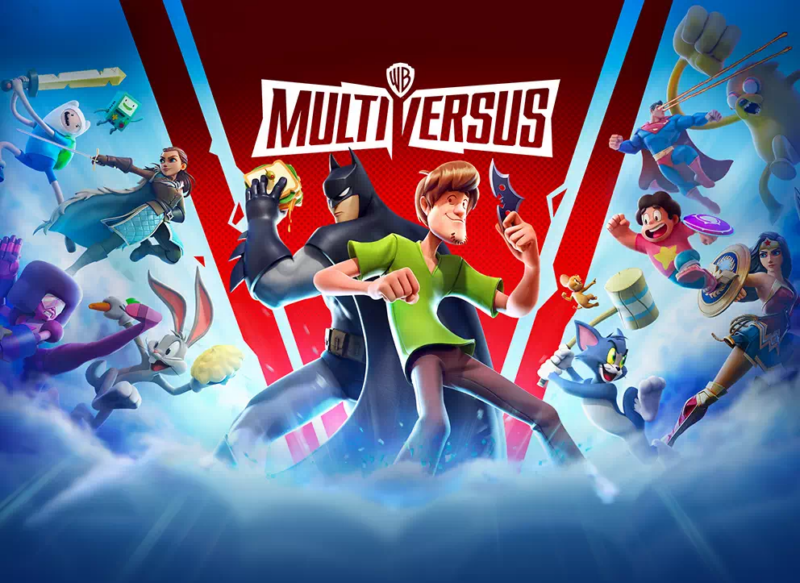
Starting today, Warner Bros. Games is taking the formal veil off its worst-kept video game secret in years: Multiversus. When we saw the leaks about this upcoming free-to-play PC and console game, which stars various WB and Time Warner intellectual property in a cartoony, Smash Bros.-style arena fighter, we had our reservations. Was WB seriously trying to compete with Nintendo’s biggest fighting game by pitting Arya Stark against… Shaggy from Scooby-Doo? Whose dream cartoon face-off is that?
A few days ago, WB invited us to go hands-on to see for ourselves what the game is like ahead of today’s launch of a closed alpha test to address those kinds of questions and more. So far, we’ve come away impressed and surprised. In a world that didn’t necessarily need another Smash Bros. clone, the devs at Player First Games have seemingly cracked the code—and made something that could neatly coexist with Nintendo’s massive hit, if not surpass it. (Even better, at first blush, the F2P stuff seems tolerable!)
Less blocking, more cooperating
Enlarge/ Just a normal, everyday mash-up of WB intellectual property.
Most of the “arena fighter” genre basics, as established by Smash Bros., are accounted for in WB’s latest fighting game. Instead of wearing down an energy bar à la Street Fighter, Multiversus players try to “ring out” their foes by racking up damage and setting up knockout blows. Movement is pretty Super Mario-like in terms of dashing and jumping between floating platforms, and players have a range of basic and special attacks that don’t require complex joystick and button combos.
<a href="https://cdn.arstechnica.net/wp-content/uploads/2022/05/20220519095654_1.jpg" class="enlarge" data-height="1152" data-width="2048" alt="Reindog, the "brand-new" character who joins a bunch of familiar WB faces in Multiversus, can use its tether to not only boost allies but also yank them back to safety. If you can imagine jumping off-screen to punish a foe in crazy fashion, then having your ally yank you back, you can begin imagining where Multiversus‘ co-op appeal begins to shine.”><img alt="Reindog, the "brand-new" character who joins a bunch of familiar WB faces in Multiversus, can use its tether to not only boost allies but also yank them back to safety. If you can imagine jumping off-screen to punish a foe in crazy fashion, then having your ally yank you back, you can begin imagining where Multiversus‘ co-op appeal begins to shine.” src=”https://rassegna.lbit-solution.it/wp-content/uploads/2022/05/multiversus-hands-on-finally-a-compelling-smash-bros-clone-1.jpg” width=”980″ height=”551″>
Enlarge/ Reindog, the “brand-new” character who joins a bunch of familiar WB faces in Multiversus, can use its tether to not only boost allies but also yank them back to safety. If you can imagine jumping off-screen to punish a foe in crazy fashion, then having your ally yank you back, you can begin imagining where Multiversus‘ co-op appeal begins to shine.
The biggest differences in Multiversus come from the game’s focus on two-on-two fighting, as opposed to the one-on-one and free-for-all combat traditionally seen in Smash clones. Most of Multiversus‘ current cast members have at least one maneuver in their arsenal that will benefit a teammate, though these moves also function as fine solo-combat options if you don’t team up with someone. Wonder Woman can generate a shield for allies; Garnet from Steven Universe can throw a bolt that both harms foes and boosts allies; while a new game-specific creature dubbed Reindog can fake like the Medic from Team Fortress 2 and connect a power-boosting line to a teammate.
The rest of the game’s mechanics have been shifted from the Smash Bros. archetype to nudge players into using their special co-op powers. For one, shields don’t exist; you can’t stand back and hold a shield button down to block incoming projectiles, and you can’t tap a “perfect block” at the right time to counter a melee attack. Any team that has a defensive or shielding ability available will want to lean on that to some extent. A default “grab” button doesn’t exist in this game, either; certain characters have grabs as special abilities instead.
https://arstechnica.com/?p=1855218
WarCraft Arclight Rumble impressions: High production values, questionable costs
<img src="https://rassegna.lbit-solution.it/wp-content/uploads/2022/05/warcraft-arclight-rumble-impressions-high-production-values-questionable-costs.png" alt="Welcome to the mini-styled smartphone-RTS universe of WarCraft Arclight Rumble.”>
Enlarge/ Welcome to the mini-styled smartphone-RTS universe of WarCraft Arclight Rumble.
Blizzard Entertainment’s first real-time strategy game for smartphones, WarCraft Arclight Rumble, is slated to launch on iOS and Android later this year, with a tech beta going live sooner in various regions. Ahead of that launch, we were invited to test the game’s current version for a couple of days, and we can confirm that Blizzard is still pretty good at designing games for phones. (Even if they’ve brought at least one related gaffe upon themselves.)
In Arclight Rumble‘s case, however, a certain chicken-and-egg question comes up: When comparing this game to the wildly popular Clash Royale, exactly who is ripping off whom?
CGI intro emphasizes that you’re tossing plastic figurines onto a table, which then come to life and do battle on your behalf. Gotta… WarCraft ‘em all?
Just another day of plastic mini battling at the pub.
Both games overlap, as Blizzard’s new smartphone game adopts more than a few of Supercell’s well-trodden, touchscreen-friendly conventions. Yet Supercell’s game arguably borrows a lot from the original WarCraft series on PC—not just in its adherence to RTS traditions but also its medieval, primary-color aesthetic.
However you parse it, Arclight Rumble appears to add just enough depth to the smartphone RTS genre to stand out, though anyone new to this gaming space should brace themselves for a whole new universe of microtransactions. While not as aggressive as some of the smartphone world’s worst offenders, Arclight Rumble‘s approach will still be a tough sell to anyone who remembers buying WarCraft RTS games outright.
Familiar fare gets bigger, more strategic
The bottom of this screen shows the minis available during combat. You’ll have four of your deck’s maximum of seven units available at any time (six of your choice, plus a dirt-cheap miner), and you can drop them at any control points that you own.
The game’s new squeaky-voiced host introduces basic RTS mechanics in slightly cringe-inducing fashion, but she’s out of players’ hair after only a few minutes.
Some units can be dropped outside of your control points wherever you please on the battlefield, and these hugely impact Arclight Rumble‘s strategic depth compared to smartphone games like Clash Royale.
If you’ve played Clash Royale, you know the drill. The game defaults to one-on-one faceoffs without any fog of war, and the object is to send troops from your side of the battlefield to your opponent’s to destroy an enemy base while protecting your own. Troops appear as cards, randomly shuffled into players’ hands from a deck, and players spend a battle-specific currency to turn those cards into active troops (or spells that can be cast by tapping on the screen). More powerful units cost more currency, and each unit type has strengths and weaknesses over others, so savvy players will generate and direct troops with that in mind in order to succeed. (Melee beats ranged, ranged beats aerial, and aerial beats melee.)
That entire paragraph could apply to either game mentioned in this article, so what’s different in Arclight Rumble?
One campaign battlefield seen from the bottom-left. Click through to see how paths in an average Arclight Royale arena look and function. In this map, the bottom blue turret is our base, and the red ballista is an enemy’s control point.
The same battlefield seen from the bottom-right. The little rock formation on the right will generate gold every 20 seconds or so, which either faction can mine with a melee unit.
The same battlefield again, now seen from the top-middle. Instead of a base, campaign enemies have a higher-leveled unique warrior to fight. Kill it, and you win the campaign level.
Blizzard’s game better splits the difference between a smartphone card-battler and a PC RTS. Battlefields in Arclight Rumble are bigger, and they typically don’t fit on a single smartphone screen, thus requiring finger swipes to move your viewpoint between your base (bottom of the screen) and your foe’s (top of the screen). These arenas are vertically oriented, so it’s more of an up-to-down swipe to glance around, not left-to-right, which feels good in practice.
Unlike a classic RTS, players don’t rapidly click a mouse to issue commands, but troop management is also not as wholly simplified here as in Clash Royale. Arclight Rumble players can tap an arrow on the ground to tell troops which way to advance when a path branches, and they otherwise automatically march forward and target foes along the way.
Blizzard adds the RTS-like convention of putting control points and gold mines onto its larger battlefields. If your troops can successfully wear down a control point, it becomes yours, and some of them come with auto-firing catapults. Once you take over one of these, you can opt to spawn troops that much closer to your foe’s base. And gold mines can be smacked by any of your melee troops, including a low-cost miner character who comes as a default in your deck, no matter what other cards you put into it. You need gold to spawn new troops, but the miner, who costs only one gold, can quickly grab two gold pieces from mines that regularly regenerate near your base. (There’s also the strategic option to spend your allotment of gold to move troops toward enemies’ gold mines—especially for special troops that can be freely spawned outside of your control points.)
Leaders don’t go into battle; instead, they offer perks based on your army. You’ll want to unlock a couple and change them out based on the demands of the campaign.
Use your finger to zoom into and spin each of the characters, or scroll through the info box to learn more about unique abilities.
Increasing the game’s average map size and dotting each with control points is an interesting tweak to the fits-on-one-screen combat of Clash Royale, and mid-arena control strategy makes this game feel deeper than some of its peers. But such an expansion in scope exposes how simple these smartphone strategy games can feel once play hits a higher level. In particular, there’s no way to contend with Blizzard’s auto-targeting failures. As of press time, I’ve seen my melee troops turn around and react to enemies that have passed them by when two battling lanes criss-cross. This happens even when I’ve devoted my limited gold economy to a massive rush meant to bombard my foe’s base, my own defenses be damned. There’s no troop tag for “kiting” in this game, which might have indicated that enemies could lure my melee forces away from my objective.
https://arstechnica.com/?p=1854856
We made a PlayStation Plus explainer that’s better than Sony’s
Layers upon layers.
Since Sony announced its upcoming transition to a new, multi-tiered PlayStation Plus subscription service in March, the company has tried to explain that service’s many benefits with thousands of (sometimes confusing) words across two blog posts and an FAQ. We have tried to break down those benefits with ourownposts comprising thousands more (hopefully less confusing) words.
As we’ve struggled to make sense of the new offerings, though, we’ve found ourselves wanting a more concise, readable summary that breaks down each tier of the new PlayStation Plus at a glance. And we figured if we wanted that kind of quick reference, some of our readers might, too.
So please enjoy this breakdown of the new PlayStation Plus, as clear and concise as we could make it without leaving anything important out. We’ll try to keep this post updated as Sony adds or clarifies new features.
Pricing/benefits summary
Essential
Extra
Premium
Monthly price
$9.99
$14.99
$17.99
Quarterly price
$24.99
$39.99
$49.99
Annual price
$59.99
$99.99
$119.99
Two monthly downloadable games
X
X
X
Cloud saves
X
X
X
Online multiplayer access
X
X
X
PlayStation Plus Collection (on PS5)
X
X
X
Downloadable PS4/PS5 games
X
X
Ubisoft+ Classics game lineup
X
X
Downloadable PS1/PS2/PSP games
X
Streamable PS3 games
X
Streaming access to PS1/PS2/PS4/PSP games
X
Time-limited game trials
X
Essential tier benefits
Two monthly downloadable games
These are usually PS4 games these days, sometimes with PS5 enhancements
Since the beginning of 2020, PS Plus has offered 11 PS5 exclusives and 5 PSVR exclusives
You can access these games for as long as you maintain your subscription
Cloud saves
100GB of cloud storage per console for PS4 and PS5
Limit of 1,000 save files for PS4
Online multiplayer access
No subscription is needed for free-to-play games like Fortnite.
PlayStation Plus Collection (on PS5)
A collection of 19 “classic” PS4 games that are playable on the PS5
Not available on the PS4
Full game list, which hasn’t changed since 2020, is available here
Extra tier benefits
Downloadable PS4/PS5 games
62 titles announced so far, “up to 400” promised in March
Trophies/save data from the trial carry over if you buy the game
Other notes
Remaining PlayStation Plus subscriptions will be converted to Essential subscriptions
Remaining PlayStation Now subscriptions will be converted to Premium subscriptions
If you have both PS Plus and PS Now subscriptions remaining, you’ll be converted to a Premium subscription for the length of the longer remaining subscription.
Some PS1/PSP games purchased as downloads will be downloadable for free on a PS4/PS5, even without a PlayStation Plus subscription
Planned transition timing
Asia (except Japan): May 24
Japan: June 2
Americas: June 13
Europe, Australia, New Zealand: June 23
https://arstechnica.com/?p=1854909
Orphan Black’s Tatiana Maslany goes green in She-Hulk: Attorney at Law trailer
[embedded content]
She-Hulk: Attorney at Law, starring Tatiana Maslany, starts streaming on August 17 on Disney+.
Marvel has released the first trailer for its latest spinoff series, She-Hulk: Attorney at Law, and it looks like it will be a lot of fun. Bonus: Mark Ruffalo reprises his role as Bruce Banner/Hulk and teams up with She-Hulk, played by Orphan Black star Tatiana Maslany. Marvel also announced that it has begun production in Atlanta on Echo, a nine-episode spinoff series centered on the deaf gang leader Maya Lopez (Alaqua Cox), who was introduced in last year’s Hawkeye.
Marvel Studios President Kevin Feige has described the series as a “half-hour legal comedy” (with superheroes) and said it would hew closely to John Byrne’s take on the character in the comics. That would be The Sensational She-Hulk series, known for its metafictional approach, in which She-Hulk occasionally broke the fourth wall, walking through ads and even arguing with Byrne as the writer. The character has been a member of The Avengers, the Fantastic Force, and S.H.I.E.L.D., and it’s expected that She-Hulk will eventually appear in the MCU films.
Per the official premise: “She-Hulk: Attorney at Law follows Jennifer Walters as she navigates the complicated life of a single, 30-something attorney who also happens to be a green 6-foot-7-inch superpowered hulk.” In addition to Ruffalo’s “Smart Hulk,” Tim Roth will reprise his role as Emil Blonsky/the Abomination from 2008’s The Incredible Hulk, and Benedict Wong will be back as Wong, most recently seen in Doctor Strange in the Multiverse of Madness. Jameela Jamil plays Titania, a super-strong rival of SheHulk; Ginger Gonzaga plays Walters’ best friend; and Renee Elise Goldsberry plays Amelia.
Lawyer Jennifer Walters (Tatiana Maslany) experiences an unusual transformation.
YouTube/Marvel Studios
It’s not easy being green….
YouTube/Marvel Studios
Mark Ruffalo is back as Bruce Banner/Hulk.
YouTube/Marvel Studios
Tim Roth reprises his role as Emil Blonsky/Abomination from 2008’s The Incredible Hulk.
YouTube/Marvel Studios
Jameela Jamil plays Titania, a super-strong rival of She-Hulk.
YouTube/Marvel Studios
Two Hulks are better than one.
YouTube/Marvel Studios
She-Hulk has needs, people.
YouTube/Marvel Studios
We saw the first footage from She-Hulk last November during Disney+ Day. The brief teaser featured Maslany and Ruffalo in an homage to the 1970s live-action Hulk series, with Walters uttering Bill Bixby’s trademark line, “Don’t make angry. You wouldn’t like me when I’m angry.” This new trailer introduces us to Jennifer Walters (Maslany), a successful single lawyer who has just been asked to lead the superhuman law division of her firm. But then her cousin, Bruce Banner, gives her a blood transfusion, and she gains some of his Hulk abilities. Fortunately, he makes a great mentor, training her to channel her powers by focusing on her anger and fear (aka “the baseline of any woman just existing”).
We get a brief glimpse of Roth’s Blonsky in prison and in his Abomination form, as well as Jamil’s Titania. And it looks like She-Hulk will be trying to find Mr. Right (or perhaps Mr. Right Now), as we see her swiping through a dating app and carrying one of her dates to the bedroom, bridegroom style.
As for Echo, we’ve already met Maya Lopez, aka Echo, in Hawkeye. She was the deaf commander of the Tracksuit Mafia, capable of perfectly copying another person’s movements. And she was on a quest to discover the true identity of Ronin, the assassin who had killed her father. That put her on a collision course with Clint Barton/Hawkeye, who had hung up his Ronin gear for good.
When the two adversaries finally battled it out, Barton revealed that someone working for Maya’s boss wanted her father dead. That boss turned out to be Wilson Fisk/Kingpin (Vincent D’Onofrio). In the Hawkeye finale, Kingpin escaped, only to be confronted by an angry Maya, who had learned the truth about her father’s murder. We heard a gunshot, but who was shot? And was it a fatal wound?
<a href="https://rassegna.lbit-solution.it/wp-content/uploads/2022/05/orphan-blacks-tatiana-maslany-goes-green-in-she-hulk-attorney-at-law-trailer-1.jpg" class="enlarge" data-height="800" data-width="1200" alt="Alaqua Cox stars as Maya Lopez, aka Echo, first introduced in last year's Hawkeye.”><img alt="Alaqua Cox stars as Maya Lopez, aka Echo, first introduced in last year's Hawkeye.” src=”https://rassegna.lbit-solution.it/wp-content/uploads/2022/05/orphan-blacks-tatiana-maslany-goes-green-in-she-hulk-attorney-at-law-trailer.jpg” width=”640″ height=”427″ srcset=”https://rassegna.lbit-solution.it/wp-content/uploads/2022/05/orphan-blacks-tatiana-maslany-goes-green-in-she-hulk-attorney-at-law-trailer-1.jpg 2x”>
Enlarge/ Alaqua Cox stars as Maya Lopez, aka Echo, first introduced in last year’s Hawkeye.
YouTube/Marvel Studios
The Echo series seems to be an origin story. Per the official premise, the character’s “ruthless behavior in New York City catches up with her in her hometown. She must face her past, reconnect with her Native American roots, and embrace the meaning of family and community if she ever hopes to move forward.” D’Onofrio will reprise his role as Kingpin, and we’ll even get to see Charlie Cox as Matt Murdock/Daredevil, briefly seen (to fans’ delight) most recently in Spider-Man: No Way Home. Zahn McClarnon will play Maya’s deceased father, William Lopez.
She-Hulk: Attorney at Law debuts on Disney+ on August 17, 2022. Echo is slated for a 2023 premiere.
Listing image by YouTube/Marvel Studios
https://arstechnica.com/?p=1854812
Acer’s new portable monitors can make 2D look like 3D
Good portable monitors improve your computing experience by providing more screen real estate. But two 4K portable monitors announced today, Acer’s SpatialLabs View and SpatialLabs View Pro, have a trick up their sleeves: making content look like it’s coming out of the screen. Using Acer’s proprietary hardware-software solution, SpatialLabs, the monitors can convert 2D content, like supported games, photos, and CAD designs, into stereoscopic 3D.
Certified by Adobe and Autodesk, SpatialLabs uses a specialized optical lens, two eye-tracking cameras, and AI to make 2D work look 3D without pesky glasses or other clunky headgear. SpatialLabs works by creating a set of images for each eye and projecting them through the optical lens to where you’re looking.
Acer’s idea is that creators, like CAD designers, 3D animators, and developers, quickly see how their work looks in 3D. The stereoscopic 3D environment doesn’t require time-consuming rendering, so it can provide a helpful and more immersive way to preview work.
Acer introduced SpatialLabs through its ConceptD 7 SpatialLabs Edition laptop in October and is now bringing it to entertainment and work-focused 15.6-inch portable monitors. It also announced a gaming laptop with the tech today.
Enlarge/ Acer showed the monitors with an HDMI 2.0 and USB-C port for video, plus USB-A and a headphone jack.
Meant for personal use, the SpatialLabs View monitor claims to present supported games in stereoscopic 3D through the new SpatialLabs TrueGame platform.
Gaming in stereo 3D
Enlarge/ Acer’s SpatialLabs View will be pricier and slower than your typical portable gaming monitor.
“This is possible because games are mostly created with three dimensions in mind: Developers include information about depth into each scene and object they build. SpatialLabs leverages this already existing information in order to present the games in stereoscopic 3D,” Acer said in its announcement. An Acer rep also pointed to using “shading and driver technologies” to get 3D and depth information from supported games.
Acer said that TrueGame would support more than 50 games upon release, including BioShock Infinite, Borderlands 2, Forza Horizon 4 and 5, God of War, No Man’s Sky, The Witcher 3: Wild Hunt, and Tiny Tina’s Wonderland. You can see the full list of games here. TrueGame will provide preconfigured 3D profiles for each title that will automatically launch when you play a supported game. An Acer rep claimed it will add more games “every month.”
So what’s the benefit of making gaming graphics look like they’re popping out of a 15.6-inch screen? According to Acer, you can expect more spacious-looking rooms and objects that “appear genuinely layered.” Before passing judgment, we have to see it in person but are curious how the effect might impact fast-paced action. The SpatialLabs View is also a smaller, high pixel density (282.4 pixels per inch) display with a 60 Hz refresh rate and response time of up to 30 ms, making it much slower than the 360 Hz desktop-sized gaming monitors and laptops available.
SpatialLabs also has a feature for generating a simulated stereo 3D image from 2D photos and videos, including online videos via YouTube.
A secondary 3D screen for creators
The SpatialLabs View Pro is more similar to the ConceptD 7 SpatialLabs Edition laptop in that it targets creative professionals. Acer said the portable monitor supports “all major file formats,” including OBJ, FBX, STEP, STL, COLLADA, IGES, glTF, 3DS, BLEND, PLY, DAE, IGS, and Datasmith, enabling the use of 3D design software like Cinema 4D, Revit, and Solidworks.
The monitor also works with the SpatialLabs Model Viewer, which lets you bring over images, models, and animations from 3D software and view them in stereoscopic 3D. And if you use Autodesk Maya or Blender, you could edit on a normal screen in 2D and view those changes in real time in stereoscopic 3D on the portable monitor. Integration with 3D modeling platform Sketchfab, for downloading additional 3D assets, could also help Acer encourage more use cases.
Acer also sees the SpatialLabs View Pro attracting customers to kiosks and point-of-sale displays, equipping it with a VESA mount, hand gesture recognition, and up to a 5-hour battery life to help.
Enlarge/ Acer hopes images seemingly popping out of a screen will catch shoppers’ eyes.
When you’re not using the upcoming displays’ 3D features, they’re just regular 4K IPS panels. They claim a max brightness of 323 nits, which would be strong for a portable monitor, 100 percent coverage of the Adobe RGB color space, and 1,200:1 contrast ratios.
Moving the needle?
SpatialLabs was a niche use when Acer announced it in the fall, and that remains the case. But these monitors may move the needle a bit—at least more than the laptop did.
For one, they should be notably cheaper than the SpatialLabs laptop. Acer didn’t share a price for the upcoming monitors, but the PC sells outside the US for 3,500 pounds/4,000 euros (about $4,366/$4,216).
Portable monitors are also a more approachable path to stereoscopic 3D than investing in a computer. Of course, the portable monitors assume you already have the computing capabilities to drive your 3D apps and SpatialLabs. Acer told Ars Technica that it recommends the following CPUs and GPUs for SpaitalLabs:
Desktops: Intel Core i7 or higher / RTX 2080 or higher
Laptops: Intel Core i7 or higher / RTX 3070 TI or higher
It remains to be seen if SpatialLabs can work with games in a way that looks good and doesn’t hinder gameplay or induce nausea. Competitive gamers will opt for something with a higher refresh rate, but it’s also hard to imagine more casual gamers flocking to the SpatialLabs View for stereoscopic 3D gaming. That’s especially true considering that the SpatialLabs View will cost way more than most desktop-sized gaming monitors at $1,099 “this summer.”
Having a second screen dedicated to the 3D experience seems more natural for creators and developers already working in this space, especially if it’s executed well. But dealing with a smaller screen and finding the proper use is a pertinent obstacle for professionals. Creatives may also be hesitant to become dependent on somewhat new technology for critical work.
Acer didn’t share a price or release date for the SpatialLabs View Pro.
Editor’s note: This article was updated with specs recommendations from Acer.
Ars Technica may earn compensation for sales from links on this post through affiliate programs.
https://arstechnica.com/?p=1854585
For All Mankind sets its alternate timeline sights on Mars in S3 trailer
[embedded content]
The space race shifts to Mars in For All Mankind S3.
The fictional battle for the domination of space between the US and Russia shifts its focus from the Moon to Mars for the third season of For All Mankind. Ars staffers have dubbed this relatively underappreciated gem “Moon Show,” and Apple TV+ has now released the official trailer for the show’s third outing on the streaming platform.
(Some spoilers for the prior two seasons.)
Ars Senior Technology Reporter Andrew Cunningham picked the series for our 2021 TV Technica list, praising its “complex, likable, memorable characters.” Series creator Ronald D. Moore (Battlestar Galactica) has made a point of trying to keep the show reasonably close to reality, despite the science-fiction concept, often consulting the original NASA plans for guidance and incorporating archival footage throughout the season. And as Cunningham wrote last year, “its repurposing and deepfaking of historical footage is fascinating both as a storytelling device and as a technical achievement.”
In S1, an astronaut named Ed Baldwin (Joel Kinnaman) became the Apollo 10 commander. His foil was fellow astronaut Gordo Stevens (Michael Dorman), a stereotypical hard-drinking, womanizing fighter pilot. Apollo 10 was the “dress rehearsal” for the historic Apollo 11 Moon landing when American astronaut Neil Armstrong became the first man to walk on the Moon. But in this alternate timeline, the decision not to land on the Moon with Apollo 10 meant the USSR beat America to the punch. Soviet cosmonaut Alexei Leonov made history instead.
Enlarge/ An alternate timeline where mankind walks on Mars? Yes, please!
YouTube/Apple TV+
Throughout the first season, both countries found water on the Moon, and America set up the first Moon base in 1974, followed shortly thereafter by a Soviet lunar base eight miles away. The first season ended with a complicated two-part episode involving a desperate launch of Apollo 25 to conduct an Apollo 24 relief and rescue mission. A post-credits scene set in 1983 featured a sea launch of a Sea Dragon rocket with a plutonium payload, bound for the US Jamestown colony on the Moon.
The second season was set during the same 1980s time period during the presidency of Ronald Reagan. In the show’s alternate timeline, the US and the Soviet Union were now fighting over which country would control the rich resources on the Moon. NASA was becoming more militarized as a result, and Baldwin became commander of a new nuclear-powered space shuttle called Pathfinder.
During the season, the lunar Jonestown colony grappled with massive solar flares, sabotage by Russian cosmonauts, and a damaged nuclear reactor, requiring a daring repair mission in duct-taped space suits. (RIP the two astronauts who performed the repairs and kept the reactor from melting down but perished from vacuum exposure.) Ultimately, the threat of all-out nuclear war was neutralized, and the final scene showed a human in a spacesuit walking on the surface of Mars.
Enlarge/ Clearly we’re getting more pulse-pounding space walks.
YouTube/Apple TV+
And that’s where the third season picks up. In the 1990s, the battle for space turned to Mars, and it’s not just a race between the US and Russia. Private industry has entered the fray in the form of a company called Helios. “Some say private citizens have no business in space exploration,” we hear Dev Ayesa (Edi Gathegi) declare. “I emphatically disagree.” (He appears to be Helios’ CEO.) But NASA is determined not to come in second place again—”to anyone.”
Scientists hope to find possible signs of life and sufficient resources (like water) to support large-scale human colonization. But such an ambitious mission rarely runs smoothly. Most notably, a massive dust storm on Mars obscures both landing sites, forcing the astronauts to make a blind landing. Judging by the wild cheers of mission control in the trailer, NASA succeeds. But if past seasons are any indication, that successful landing is just the beginning.
The third season of For All Mankind premieres on Apple TV+ on June 10, 2022.
Listing image by YouTube/Apple TV+
https://arstechnica.com/?p=1854518
Next-gen Nvidia RTX 4000-series GPUs are reportedly coming in the next few months
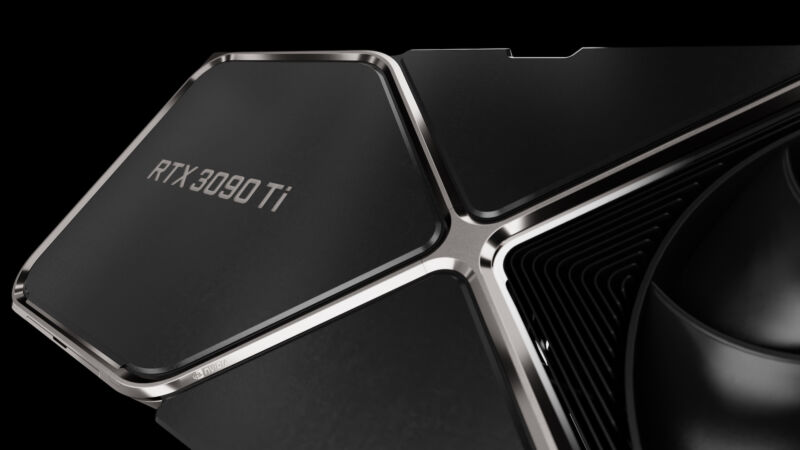
Enlarge/ Nvidia’s “Lovelace” RTX 4000 GPUs will be faster than the top-end RTX 3090 Ti.
It has been nearly two years since Nvidia introduced its Ampere GPU architecture in the GeForce RTX 3080, and the company is reportedly gearing up to announce its replacement. Tom’s Hardware reports, based on tweets from a normally reliable leaker, that the RTX 4000-series and its Lovelace GPU architecture will begin rolling out early in Q3 of this year.
It has been so difficult to buy Nvidia’s RTX 3000-series GPUs for so long that it feels almost too soon to be talking about their replacements, though there was a similar two-year-ish gap between the first RTX 2000 GPUs and the RTX 3000 series. The difference is in how long it took Ampere to trickle all the way down to the bottom of the lineup. The Turing architecture debuted in September 2018 and had made its way down to the low-end GeForce GTX 1650 by April 2019; the first Ampere cards appeared in September 2020 but didn’t come to the GeForce RTX 3050 until January 2022.
Other reports from the same source suggest that the RTX 4000 GPU could be a big boost over the top-end RTX 3090 Ti, stepping up from 84 of Nvidia’s streaming multiprocessors (SMs) to somewhere between 126 and 140 SMs. The supposed RTX 4090 will come with 24GB of GDDR6 RAM (the same amount as the RTX 3090 and 3090 Ti) and is said to roughly double the RTX 3090’s performance within the same 450 W power envelope. Whether any of these performance claims are true remains to be seen—Nvidia’s GPUs do typically offer impressive performance bumps between generations, but double the performance in the same power envelope would be an anomalously large jump, historically speaking.
We also don’t know how these GPUs will be priced, how easy they will be to get, and whether Nvidia will continue manufacturing and selling RTX 3000-series cards to meet GPU demand. The graphics card market is slowly returning to some semblance of “normal” after years of chip shortages, a cryptocurrency boom, and scalper-fueled chaos, all of which drove up both the MSRPs and the actual street prices of virtually every new and used GPU you can buy.
Nvidia has also ramped up the production of older GPUs like the GTX 1050 Ti and 1650 and the RTX 2060 to meet demand during the shortage, a practice the company could choose to continue if 4000-series GPUs are in short supply.
https://arstechnica.com/?p=1854409
Sony lifts curtain on PlayStation Plus revamp: New features, curious game list
Enlarge/ Sony’s previous teases suggested that we’d see more games in this week’s list of the revamped PlayStation Plus game selection.
Sony Interactive Entertainment
Starting next week, the PlayStation Plus subscription service will relaunch exclusively in Asia across PlayStation and PC platforms, with other regions’ relaunches to follow throughout June. With such little time to go, Sony has decided to finally begin revealing its launch game selection across a new series of subscription tiers.
But Sony’s Monday announcement falls well short of advertising we’ve previously seen. We now know that 119 games are coming to three PlayStation Plus “collections,” and they will be available in the service’s $15/month “Premium” tier (with fewer games in the $10/month “Extra” tier). That number comes nowhere close to the “up to 740 games” count across six generations of PlayStation systems that Sony previously suggested would be coming.
Sony representatives did not immediately answer questions about whether this availability gap will narrow once the service rolls out. For now, we’re left with the announcement’s tease that more games may appear between now and next week, as Sony is calling this initial 119-strong list “some of the games” coming to the refreshed PlayStation Plus library.
Tier confusion
Sony has opted to combine its existing PlayStation Plus and PlayStation Now services into one catch-all subscription family, arguably to face off more directly with its competition at Xbox Game Pass. Historically, PlayStation Plus enabled online multiplayer on PlayStation consoles and added monthly game giveaways, while PlayStation Now opened up a mix of downloadable and cloud-streamed game access.
Now, you’ll get all of that stuff from the “PlayStation Plus” subscription family—but it’s a bit more confusing and less à la carte. For the $10/month “PS+ Essential” tier, subscribers get what was previously known as PlayStation Plus: online multiplayer access and a few free video game giveaways every month. The next tier up, at $15/month (“PS+ Extra”), includes the base tier’s features and adds a selection of “modern” downloadable games from PS4 and PS5 (dubbed “Game Collection”). Jump higher still to $18/month (“PS+ Premium”) for all the previous stuff, plus games from every other PlayStation generation, which are either downloadable (Classic Collection) or streamed from Sony’s servers (Game Streaming).
Today’s news includes a pair of previously unannounced perks. Time-limited game trials will allow Internet-connected users in the Premium tier to download and freely play newer games that are not part of PS Plus—until an on-screen timer counts down to zero. Only six games will support this at launch, though reports in the wild suggest that more new games may get a similar trial option in the months to come. Sony’s announcement estimates “two hours” per game before players are nudged to buy the full game, though this number can vary; we’ve already seen Cyberpunk 2077 get its own time-limited game trial earlier this year, which gave players five hours of in-game time to experiment before deciding whether they wanted to buy.
Additionally, the Extra tier and above will come with a selection called “Ubisoft+ Classics.” This is basically a formal way of indicating that Ubisoft is committing a large-but-incomplete number of its back-catalog games to PlayStation Plus for the foreseeable future. Yet it also serves as a curious reminder that a thing called “Ubisoft+” exists on competing services, including Amazon Luna and Ubisoft’s own PC client, and that it offers more Ubisoft games, and more of those games’ DLC perks, outside of PlayStation Plus.
https://arstechnica.com/?p=1854365
Social media sites work to limit spread of Buffalo shooting footage
Twitch, the Amazon-owned livestreaming site that caters primarily to gamers, said it removed streamed footage of a shooting in Buffalo, New York, this weekend “less than two minutes after the violence started.”
An 18-year-old white man used an assault rifle to fire on crowds of shoppers in a Buffalo supermarket Saturday, authorities said. The attack—which killed 10 and injured three, including 11 Black victims—is being investigated as a hate crime after the shooter allegedly posted a lengthy manifesto citing 4chan posts regarding the racist “great replacement theory” as his motivation.
Buffalo Police Commissioner Joseph Gramaglia said Saturday that the shooter “had a camera and was livestreaming what he was doing” during the attack. The Twitch channel that had hosted that video has now been taken down, with its content marked as “currently unavailable due to a violation of Twitch’s community guidelines or terms of service.”
“We are devastated to hear about the shooting in Buffalo, New York,” Twitch said in a statement provided to the press. “Our hearts go out to the community impacted by this tragedy. Twitch has a zero-tolerance policy against violence of any kind and works swiftly to respond to all incidents. The user has been indefinitely suspended from our service, and we are taking all appropriate action, including monitoring for any accounts rebroadcasting this content.”
The New York Times reported that a Discord account with a name matching that of the now-suspended Twitch account made posts on a private server that included apparent planning for the attack. “We extend our deepest sympathies to the victims and their families, and we will do everything we can to assist law enforcement in the investigation,” Discord told the Times.
Discord tracks thousands of reports of extremist or violent content in its regular transparency reports and noted last June that such reports “continued to make up comparably small fractions of our overall volume” of moderation issues.
Footage whack-a-mole
Despite the quick Twitch takedown, copies of the livestreamed footage continue to proliferate on other social media sites. A Meta spokesperson told Engadget that the footage has been added to a database that will be used to identify copies and remove them automatically before they are visible on Facebook.
In April, Twitter updated its content moderation rules regarding “perpetrators of terrorist, violent extremist, or mass violent attacks,” making it clear that manifestos and footage related to such attacks were not welcome on the platform. But that policy includes a possible exception for tweets where “there is a clear and explicit intent to provide additional context and counterspeech” to the violent content.
“We believe the hateful and discriminatory views promoted in content produced by perpetrators are harmful for society and that their dissemination should be limited in order to prevent perpetrators from publicizing their message,” Twitter said in a statement Sunday.
If you’ve ever looked at a 360 Hz monitor and thought, “This isn’t fast enough,” here’s something to look forward to. While we’ve seen monitor prototypes surpass 360 Hz, the highest native refresh rate you’ll find on a PC display these days, it seems that AU Optronics (AUO) is working on panels that’ll be available with an even snappier 480 Hz refresh rate.
Of course, not many would look at a screen updating with new information 360 times every second as lagging. But for very fast-paced action—like in a competitive game where words and items whizz by in an instant or where a few milliseconds of a delay could be the difference between a win or a loss—more speed may be imperative.
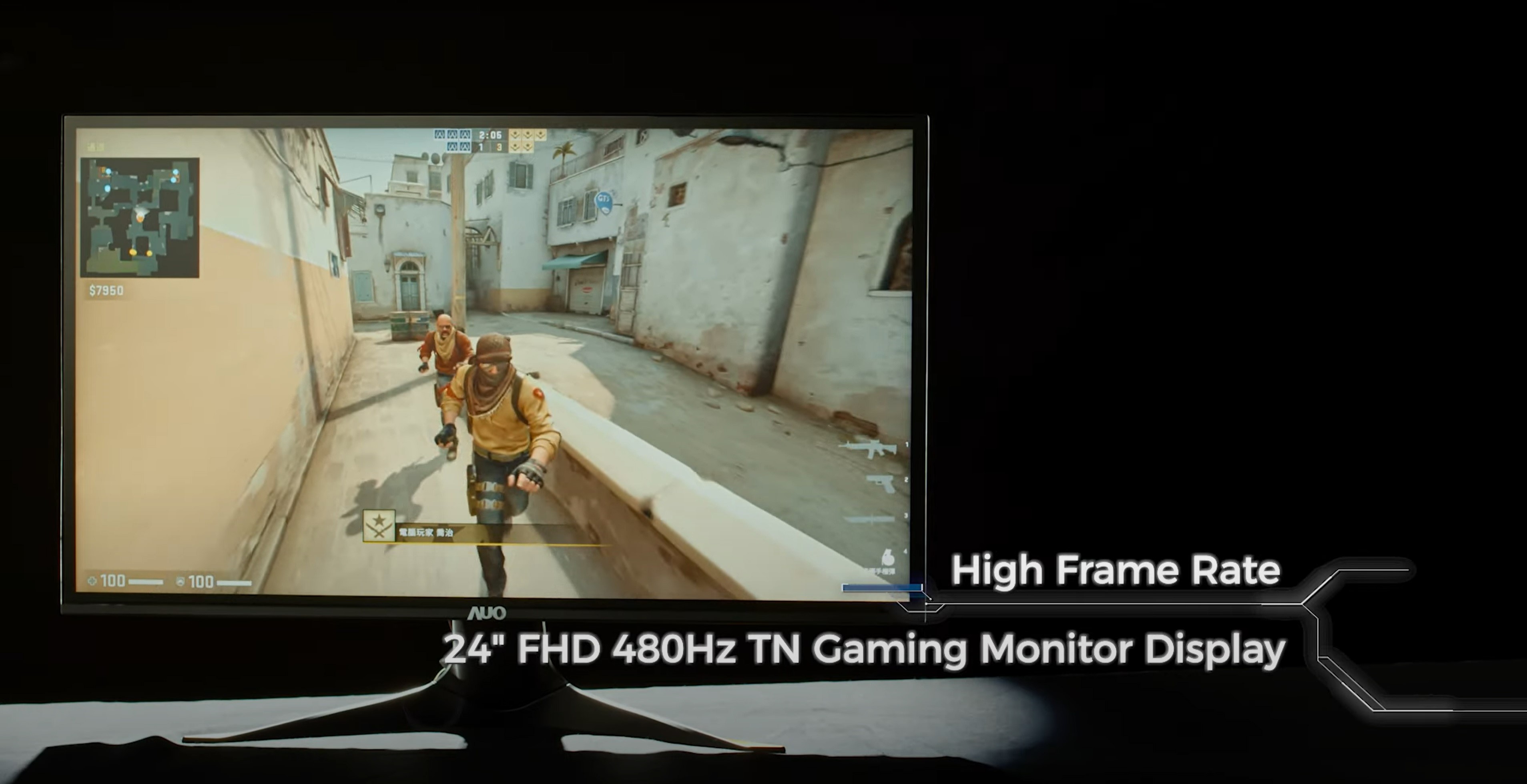
Enlarge/ AUO highlighted a 480 Hz panel when promoting its presence at SID Display Week.
As spotted by TFT Central this week, AUO announced via a YouTube video that it’s working on a 24-inch PC monitor panel with a 480 Hz refresh rate and response time that’s under 1 ms (the brand didn’t get any more specific there). And it’s aimed at gamers.
AUO, which sells panels to monitor vendors, including Acer, Asus, and MSI, also highlighted a 16-inch 480 Hz screen made for laptops. The response time here seems to be slightly higher, at “1.xms,” according to the video.
Enlarge/ AUO is also working on more portable 480 Hz displays.
Unsurprisingly, both displays work with 1920×1080 pixels, sacrificing sharper image quality for speed. For comparison, a 24-inch monitor with 4K resolution has a pixel density of 183.58 pixels per inch (ppi) versus the 91.79 ppi a 1080p alternative offers.
But 1080p is a marked improvement from when we saw the 480 Hz refresh rate in 2017. As recalled by ComputerBase, ZisWorks shared a 480 Hz prototype then, but the resolution was a measly 960×540. For what it’s worth, BlurBusters pointed to visible image quality improvements at the time, including reduced motion blur, even when compared to 240 Hz. Since it’s a shorter leap from 360 Hz to 480 Hz, it’d be interesting to see if we could tell the difference.
AUO’s 480 Hz panels are being developed with a more common resolution but also a waning LCD LED panel type, TN (twisted nematic). TN monitors are known for speed and are typically cheaper than alternatives, but often have inferior contrast to VA (vertical alignment) panels and worse color and viewing angles than IPS (in-plane switching).
480 Hz on the horizon
AUO released the aforementioned video to promote its presence at the Society for Information Display’s Display Week conference in San Jose, California, this week. In an announcement, AUO said it would “showcase the application scenarios of the next-generation” of gaming displays at the show.
Since AUO is a panel supplier, it didn’t point to any monitor release dates. AUO also seemed to more heavily focus on promoting some of its panel technology at SID Week, based on its announcement detailing other innovations it said it would show at the conference.
Last summer, TFT Central also pointed to plans for AUO and LG to release 480 Hz monitors. And considering we’ve recently seen a 500 Hz PC monitor prototype, 480 Hz doesn’t sound too farfetched.
Of course, should a 480 Hz monitor come out any time soon, it’d be a niche use requiring a heck of a system, including a top-end graphics card, the right content, and some pretty keen eyes to reap all the benefits.