Museum rigs up multi-screen N64 GoldenEye to prevent “screencheating”

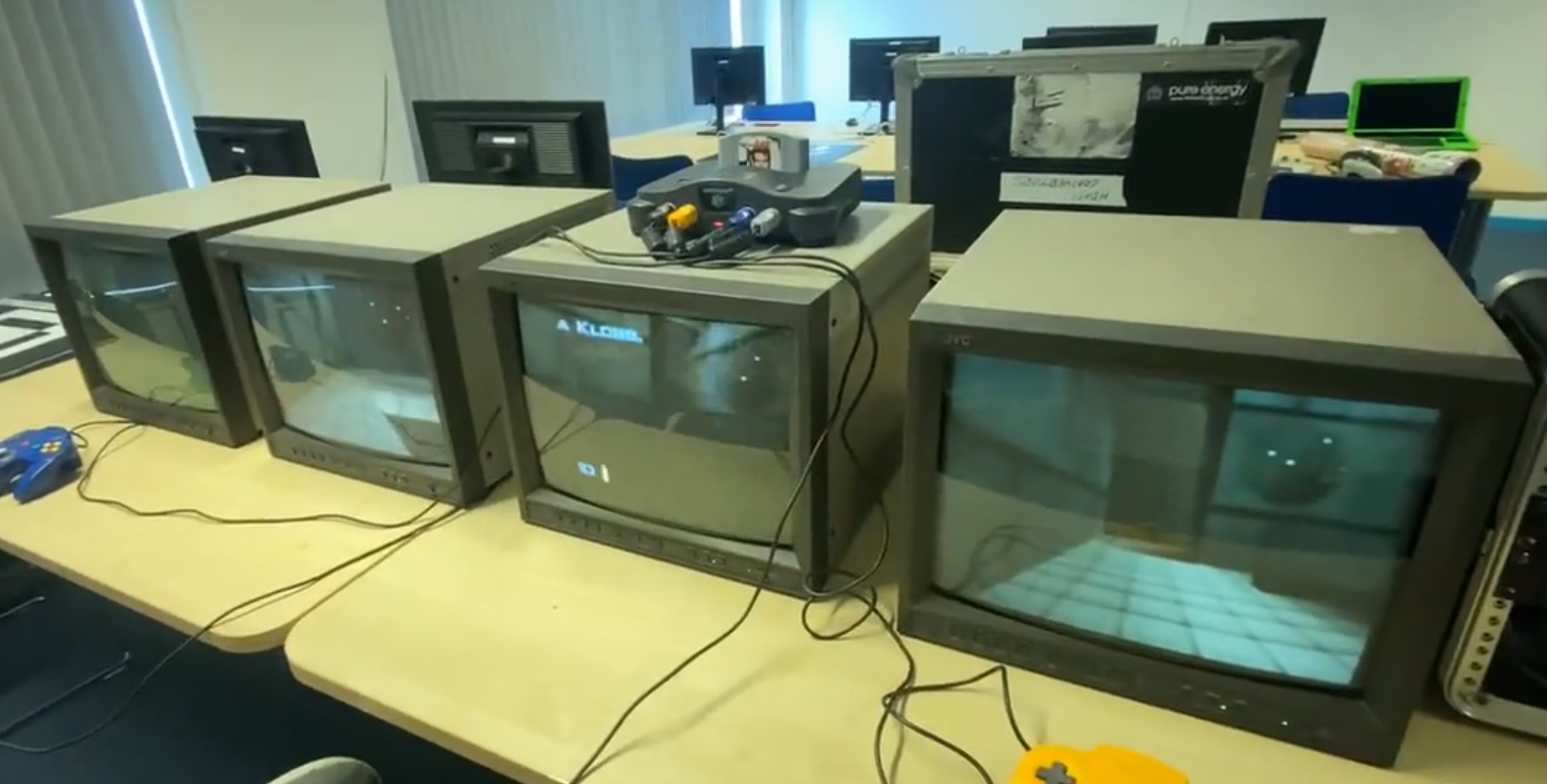
One console, four displays, zero "split-screen" antics
Enlarge / One console, four displays, zero “split-screen” antics

Anyone who remembers playing GoldenEye 007 on the N64 likely remembers having to account for the “screencheaters” that would glance at another quadrant of the split-screen shooter to gauge an opponent’s locations. There’s even a modern game that forces players to rely on the tactic to track invisible opponents.

Now, 25 years after GoldenEye‘s launch, a museum has managed to do something about those screencheaters, rigging up a way to split a game of GoldenEye across four TV screens without modifying the original cartridge or N64 hardware.

The multi-screen GoldenEye gameplay will be featured as part of the “25 Years of GoldenEye” event at Cambridge, England’s Centre for Computing History this weekend. A proof of concept for the unique playstyle (with all the monitors awkwardly facing the same direction) attracted some attention via a tweet Wednesday, leading Ars to reach out for more details on how the museum pulled it off.

“It’s not elegant”

<a href="https://rassegna.lbit-solution.it/wp-content/uploads/2022/05/museum-rigs-up-multi-screen-n64-goldeneye-to-prevent-screencheating-1.jpg" class="enlarge" data-height="500" data-width="500" alt="The C2-7210 video scaler is the key bit of tech for splitting GoldenEye‘s split-screen across multiple displays.”><img alt="The C2-7210 video scaler is the key bit of tech for splitting GoldenEye‘s split-screen across multiple displays.” src=”https://rassegna.lbit-solution.it/wp-content/uploads/2022/05/museum-rigs-up-multi-screen-n64-goldeneye-to-prevent-screencheating.jpg” width=”300″ height=”300″ srcset=”https://rassegna.lbit-solution.it/wp-content/uploads/2022/05/museum-rigs-up-multi-screen-n64-goldeneye-to-prevent-screencheating-1.jpg 2x”>
Enlarge / The C2-7210 video scaler is the key bit of tech for splitting GoldenEye‘s split-screen across multiple displays.

Centre for Computing History CEO and trustee Jason Fitzpatrick tells Ars the idea for multi-screen GoldenEye started when some employees at the museum were discussing their particular frustrations with split-screen first-person shooters on consoles. “We were talking about it and they said, ‘The trouble is being all on the same screen; you just look to the top right and see what they’re doing, and you can counter it,'” Fitzpatrick said. “And we went, ‘Oh, actually, we might have a way around that.’ So we just messed around and tried it and thought it was just a bit of fun.”

Fitzpatrick was in a good position to split up GoldenEye‘s split-screen signal because of his day job at Pure Energy TV and Film Props, where he says he’s often called on to set up old cathode ray tube TVs on set. That means he “happens to have a number of bits of equipment for messing around with video,” he said.

In this case, the key “bit of equipment” is a C2-7210 video scaler, a defunct piece of video production tech that lets professionals process a live video signal in a wide variety of ways. That includes the ability to zoom in on a specific portion of up to two input signals and then upscale the result to a full-screen output on another monitor or TV.

For multi-screen GoldenEye, Fitzpatrick said he simply split the standard PAL N64 signal into four identical copies, then fed two inputs each into two scaler units. After that, you point each scaler at a different quadrant of the input signal and send the resulting output to different TVs. A second input on one of those TVs also receives the unmodified full-screen signal directly from the N64 to make it easier to navigate menus.

“It’s not elegant in that basically you’re taking a 704×576 [pixel] image, and you’re just zooming into a quarter of it and then taking that quarter and stretching it across a full screen,” Fitzpatrick told Ars. “Even though we’re dealing with something around 352×288 [pixels], give or take, as a resolution for each one of those quadrants, by the time it’s pulled up to full screen it looks all right.”

That’s partly because “the original game didn’t look great anyway” and because the continuous horizontal line-scanning tech of the CRT “covers up a multitude of sins,” Fitzpatrick said. “Old video CDs were 352×288 anyway, so we used to watch films at that resolution,” he added.

This kind of signal splitting may bring to mind the massive CRT video walls that you sometimes see in art installations or old music videos. But Fitzpatrick says using a video wall controller for this kind of processing “would take hours to set up because you’d have to do each one individually… you wouldn’t have had the fine control over going exactly into that [split-screen] area. That would have just took the screen and cut it into four. It might have missed some bits and pieces.”

https://arstechnica.com/?p=1852894


Why Severance is one of the best shows on TV

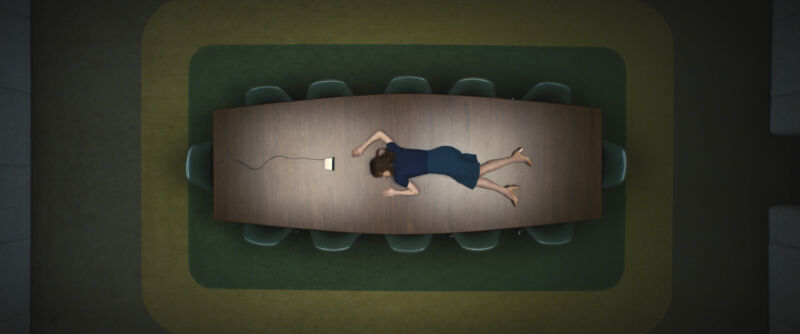
Helly R. awakes as an "innie."
Enlarge / Helly R. awakes as an “innie.”

Severance, which recently completed its first-season run on Apple TV+, explores a world in which people can really separate their work and personal lives. Thanks to a new procedure developed by Lumon Industries, people can bifurcate themselves into “innies” (work selves) and “outies” (personal selves)—with no sharing of memories. This appeals to people like Mark, who lost his wife in a car crash and has struggled to work through the grief. Why not forget all that pain for eight hours a day?

Mark works on the “severed floor” at Lumon, a place that makes your own office—no matter how bad it is—look like Disney World. But Mark likes it. Or thinks he likes it. Meanwhile, we as viewers have a few concerns. What, for instance, is he actually doing all day for Lumon? What’s with the creepy cult-like vibe everywhere? What happened to his buddy Petey? And why are people so excited about waffle parties?

If you think this sounds like the setup for a corporate sci-fi dystopia, you’re not wrong. Severance makes terrific TV out of its premise. Directed by Ben Stiller, the show is funny, absurd, depressing, mysterious, visually distinct, and ultimately propulsive. Each episode gathers speed, from the slow start to the rip-roarin’ finale, making this one of the best things we’ve seen so far in 2022. Here’s why.

(Some minor spoilers below)

Beauty amid the banality

Severance pulls off a nifty trick: turning windowless offices, fluorescent lighting, corporate furniture, break rooms, staircases, elevators, and antiseptic white corridors into something that goes from banal to menacing to—dare I say it?—wondrous.

The banality is clear enough. Lumon workers are encouraged with ridiculous corporate “perks” like finger traps and waffle parties, even as they work in absurdly empty spaces. The workers answer to middle managers who never seem fully human, even when asking people to show “kind eyes” to others. And the food coming out of the vending machine—shriveled raisins, anyone?—is unappetizing at best. The team’s collective work might be “mysterious and important,” as one character puts it, but this is an article of faith. To the viewer, the work looks like tedium.

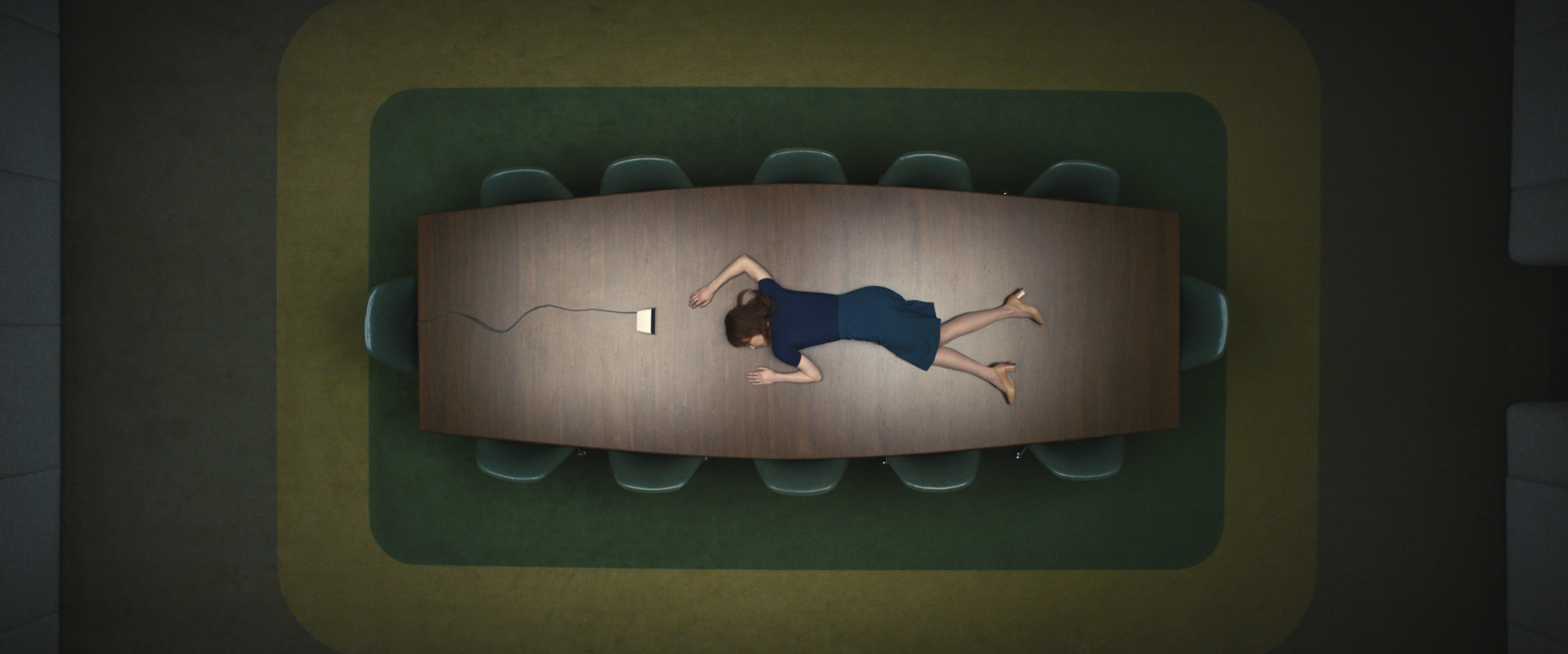
Then comes the menace layered atop the banality. We meet Helly R. in a normal conference room—but one where she is locked in, sprawled out on the table, and talked to by a disembodied voice. We hear hints of violence between the departments and are treated to odd, cult-like sayings from “the Handbook.” A character suffers disturbing hallucinations. A paper cutter is repurposed as a threatening weapon. The company has a mysterious scheme to do… something. The break room is a really bad place to be. So Severance takes its place in a long line of corporate dystopias.

But among the menace, we also feel an increasing sense of wonder. The labyrinthine basement is a maze that Lumon has forbidden its employees to map. Why? We don’t know. But we do follow our team of lovable Lumon losers as they, like growing toddlers, stray further than their guardians allow. Our team discovers new things. They find other departments, with the hint of many more waiting to be revealed. They explore a bizarre Perpetuity Wing. They find some, err, small bottle-fed quadrupeds (not to be too spoiler-y). Lumon might be creepy, but its people still respond to beauty when they find it, as Burt and Irving do in the Plant Room.

Among all the maze-like mystery, our team begins to make connections—between departments, between inner and outer selves, between each other. People grow, thanks in part to a ridiculous self-help book that makes it onto the severed floor. Families, lovers, and children become increasingly important.

Severance is an office parody. It is a tale of corporate dystopia and evil schemes. But it is also a show about healing, empathy, new life, and emotional growth under unpromising conditions. Holding all of these elements together gives the show its peculiar impact.

—Nate Anderson, Deputy Editor

https://arstechnica.com/?p=1852550


Rifftrax: The Game serves the fun, will make you crow in laughter

Rifftrax: The Game serves the fun, will make you crow in laughter
Wide Right Games

At Ars Technica, we’re fans of the Jackbox Party Pack series, which gathers friends around a TV to play social, joke-filled minigames that revolve around cracking jokes and voting on the group’s favorite gags. Really, any game that turns the trading of jokes into a group contest is up our alley.

For my money, at least, I am fine with cutting out the filler in these games and getting to the heart of what they often remind me of: creating my own Mystery Science Theater 3000 experience, where my friends and I mine humor out of the mundane. Turns out, there are already a few games that drill down to this exact premise, though the most recent one includes a substantial branding edge.

This week’s Rifftrax: The Game is pretty much what it sounds like, and it’s as close as you’ll get to playing along with that series’ founders (who themselves have deep ties to MST3K‘s legacy). While this $10 game on PC and all major console families isn’t the first of its kind, it clearly understands what’s fun about the concept—and errs on the side of simplicity, which mostly pays off.

*squeak* *a-hooooga* *baby crying*

If this game looks a lot like What The Dub?!, which launched on the same platforms last year, that’s because Rifftrax: The Game is made by the same developers at Wide Right Interactive. Just like most Jackbox games, load RTG on a bigger screen with a PC or console, at which point a URL and “room code” appear on the screen. Up to six players can load an instance on their phones’ web browsers, which is where they’ll type and vote throughout a single game. Hence, you don’t really have to be in the same room; join on Zoom or Discord, use the same URL and room code, and you’re in. (If you have more than six people watching, either in person or via streaming platforms like Twitch, overflow viewers can join the “audience” and participate via votes.)

So long as you have a smartphone and know your specific game's room code, you can participate. This makes it easy for friends who can't visit in person to join the fun.
Enlarge / So long as you have a smartphone and know your specific game’s room code, you can participate. This makes it easy for friends who can’t visit in person to join the fun.

With everyone assembled, a brief video clip plays, and this content errs on the side of low production values and awful acting. These clips are long enough for music and dialogue to emerge, and they end with a “RIFF HERE” blank, usually implying that you’ll be typing on behalf of the on-screen character who is about to speak (though comedic narration moments are easy to decipher). Players are urged to type their own riffs at this point, which can also include sound-effect triggers, discoverable via a handy drop-down menu. (Fart sounds, springy boi-oi-oings, and terrified screams: Yep, the classics are here.) Once all players have turned in their ideas, a text-to-speech robo-voice will read the group’s inventions, one at a time. Then vote on your favorites and repeat for as many clips as you want.

The built-in clip selection is RTG‘s biggest selling point. In addition to the usual suspects like public service announcements, public domain films, and low-budget sci-fi (yes, Plan 9 From Outer Space is here), the game mines a few other wacky sources for its “riffable” content, because it can splice 5- to 15-second clips out of shorter videos that might not otherwise make sense for a longer format like MST3K or traditional Rifftrax episodes. Thus, an average game’s clips can alternate between a Goldilocks-themed film starring actual bears and a cringe-worthy late-’90s explainer about how the World Wide Web works.

https://arstechnica.com/?p=1852720


Review: Moon Knight is a darkly complex superhero origin story with a soul

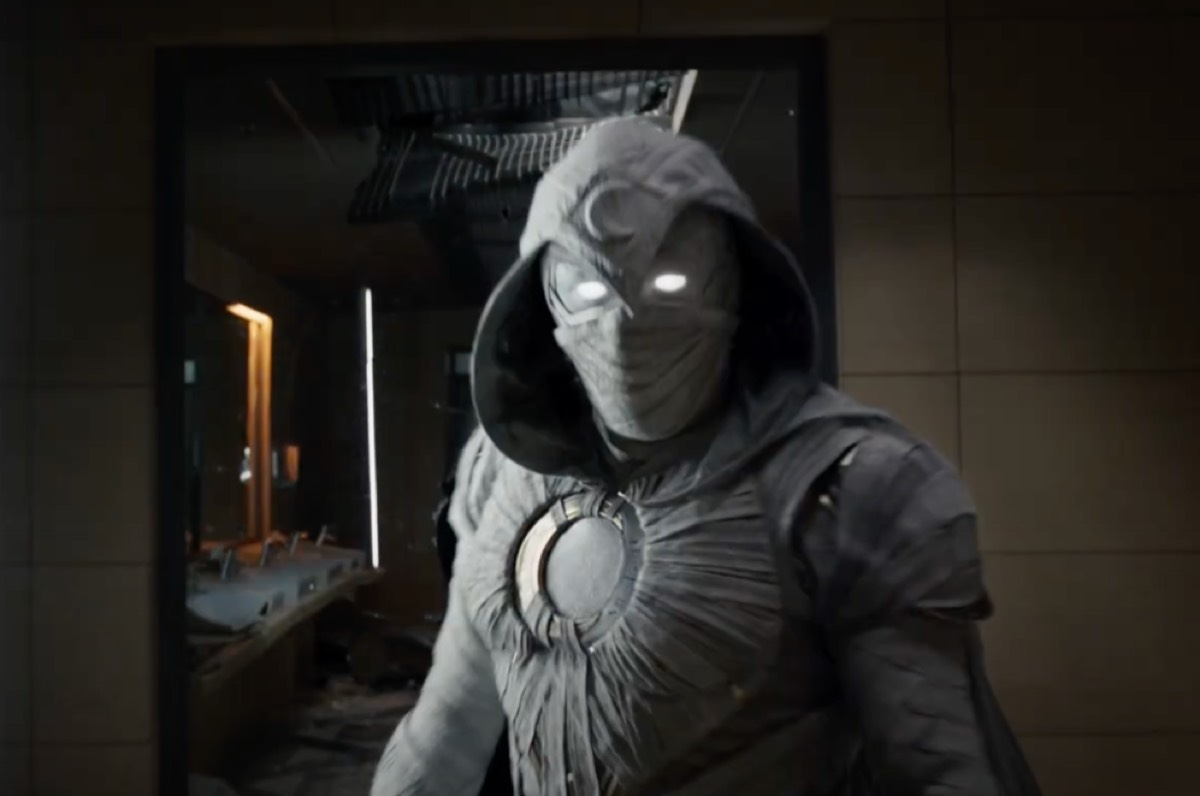
Moon Knight in full costume
Enlarge / Oscar Isaac is a tormented man with multiple personalities who becomes the avatar of the Egyptian moon god Khonshu in Moon Knight.
YouTube/Marvel Studios

Can anything good ever come of gods interfering in the affairs of men? That’s the underlying conundrum posed in Moon Knight, the latest spinoff series in the MCU’s Phase Four, and in the case of the series, the answer is a resounding yes. Starring Oscar Isaac as a tormented man with dissociative identity disorder (DID), the series has more in common with the Netflix Defenders series than with recent Marvel fare like WandaVision, The Falcon and the Winter Soldier, and Loki. But instead of taking place in New York City’s Hell’s Kitchen, it’s telling a unique superhero origin story rich in symbolism and Egyptian mythology.

(Some spoilers below for the comics and the TV series. Any major reveals are at the very end, and we’ll give you a heads-up when we get there.)

As I’ve written previously, in the comics, Marc Spector (aka Moon Knight) is the son of a rabbi, marked at a young age by the Egyptian moon-god Khonshu to be the god’s avatar on Earth. But Khonshu is a supernatural entity with many aspects to his nature—and also exists out of phase with normal time and space—so forging a psychic connection with the human Marc harms the man’s mental health.

Marc develops DID, eventually becoming a mercenary. He is hired by the ruthlessly amoral Raoul Bushman for a job, in which the latter kills an archaeologist who has uncovered an Egyptian tomb. Marc saves the archaeologist’s daughter, Marlene, leading to a major fight with Bushman. Marc loses the fight and is left for dead, but the locals carry him into the tomb and leave him in front of a statue of Khonshu. Khonshu revives and heals the dying Marc.

Steven Grant (Oscar Isaac) discovers the existence of another personality.
Enlarge / Steven Grant (Oscar Isaac) discovers the existence of another personality.
Marvel Studios/Disney+

When Marc returns to the US, he channels all the money he made from being a mercenary into fighting crime as Moon Knight, recognizable by his silver cape. He has four other distinct identities in the comics: a billionaire businessman named Steven Grant, a taxi driver named Jake Lockley, a suited consultant named Mr. Knight, and a little red-haired girl called Inner Child. Showrunner Jeremy Slater has kept the broad outlines of the origin story in place for the series, with a few key differences.

The first personality we meet is Steven Grant—not a billionaire, but an awkward, mild-mannered British dude who works in a London museum gift shop and yearns to share his knowledge of Egyptian history and culture as a tour guide. His professional and romantic prospects are dim because he is plagued by blackouts. He even goes so far as to chain himself to the bed at night but still frequently regains conscious awareness in unfamiliar surroundings.

Marc Spector (also Isaac) is the primary personality, a former mercenary who now serves as the avatar of Khonshu. May Calamawy plays Marc's estranged wife Layla El-Faouly.
Enlarge / Marc Spector (also Isaac) is the primary personality, a former mercenary who now serves as the avatar of Khonshu. May Calamawy plays Marc’s estranged wife Layla El-Faouly.
Marvel Studios/Disney+

One of those blackouts sets the show’s events in motion. Steven wakes up in the Austrian Alps and finds himself in mid-confrontation with Arthur Harrow (Ethan Hawke), a charismatic cult leader who demands that Steven give him an Egyptian scarab he happens to be holding. A mysterious force prevents Steven from doing so, while a voice inside his head laments that “the idiot” is in charge again. Steven blacks out again and finds himself covered in blood, with the bodies of Harrow’s men all around him. Yet more blackouts and a car chase ensue. Let’s just say that blacking in and out while driving at high speeds on a narrow mountain road—with heavily armed evil henchmen in hot pursuit—is not a safe means of travel.

It’s a highly effective opening to this series because we share Steven’s disorientation and confusion as he tries to understand what’s happening to him. Eventually Marc Spector, the mercenary persona, reveals himself and explains that he is the avatar of Khonshu, an outcast among the Egyptian gods for his crusade against humanity’s injustices. (F. Murray Abraham voices Khonshu, while Karim El Hakim physically portrays him.) Marc is estranged from his wife, Layla El-Faouly (May Calamawy), the daughter of an Egyptologist who was murdered by mercenaries.

As for Harrow, he was once Khonshu’s avatar but switched his allegiance to the Egyptian goddess Ammit, who is imprisoned by the other gods. She’s even more radical than Khonshu, judging the hearts of human beings for the good or evil they will do, not just the sins already committed. The scarab will reveal the location of Ammit’s tomb, so Harrow can release her and let Ammit exact her judgment on the world. Marc and Steven must figure out how to share the body and work together to foil Harrow’s plan with Layla’s help. Oh, and there just might be a third personality lurking in their shared body who only emerges when things get really bad.

Cult leader Arthur Harrow (Ethan Hawke) worships the Egyptian goddess Ammit, who will judge humanity based on future sins.
Enlarge / Cult leader Arthur Harrow (Ethan Hawke) worships the Egyptian goddess Ammit, who will judge humanity based on future sins.
YouTube/Marvel Studios

Slater proves himself to be a gifted storyteller, weaving all the threads of this complicated narrative into a seamless whole while exploring themes of identity and recovery from trauma. Bonus: The entire series is beautifully shot, with terrific set and costume design. It’s the classic mythological voyage of the hero in many respects, right down to the journey to the afterworld, but much of that voyage takes place inside the mind(s) of Marc and Steven. That kind of internal psychological journey can be difficult to portray in a consistently engaging way, but Slater successfully pulls it off. I particularly appreciated the skillful symbolic use of mirrors throughout to convey a fractured self.

Much of the credit for the show’s success is also due to Isaac’s riveting performance. He seems to effortlessly flit between two distinctive personalities, complete with unique accents and body language, and handles the action sequences with aplomb. Native Brits will undoubtedly cringe at Isaac’s supposedly London accent, but the actor has said he deliberately made it “bizarre and unconvincing.” It’s what a traumatized young boy in the process of splitting in two would consider to be a British accent, so for my money, the choice makes narrative sense.

https://arstechnica.com/?p=1852276


Nvidia hid how many GPUs it was selling to cryptocurrency miners, says SEC

Nvidia hid how many GPUs it was selling to cryptocurrency miners, says SEC
Getty Images

Nvidia has agreed to pay $5.5 million in fines to the United States Securities and Exchange Commission to settle charges that it failed to disclose how many of its GPUs were being sold for cryptocurrency mining, the agency announced today.

These charges are unrelated to the current (slowly ebbing) crypto-driven GPU shortage. Rather, they deal with a similar but smaller crypto-driven bump in GPU sales back in 2017.

The agency’s full order (PDF) goes into more detail. During its 2018 fiscal year, Nvidia reported increases in its GPU sales but did not disclose that those sales were being driven by cryptocurrency miners. The SEC alleges that Nvidia knew these sales were being driven by the relatively volatile cryptocurrency market and that Nvidia didn’t disclose that information to investors, misleading them about the company’s prospects for future growth.

Nvidia did disclose how cryptocurrency mining was affecting other segments of its business—the company made and sold some GPUs marketed exclusively to cryptocurrency miners. This created an impression that Nvidia was being transparent about the impact of cryptocurrency mining on its overall business, even though those CMP products didn’t stop people from buying regular GeForce gaming GPUs to use for cryptocurrency mining.

Nvidia has not admitted fault but has “agreed to a cease-and-desist order and to pay a $5.5 million penalty,” the order says.

If you want to know why this failure to disclose might upset investors, recall the aftermath of the 2017-era crypto bubble, when Nvidia missed earnings expectations and lost billions in stock market value because of a collapse in demand for GPUs. The popping of that cryptomining bubble also led to a glut of inventory that retailers had trouble moving, even after price cuts.

https://arstechnica.com/?p=1852714


Eve Online fans literally cheer Microsoft Excel features at annual Fanfest

<img src="https://rassegna.lbit-solution.it/wp-content/uploads/2022/05/eve-online-fans-literally-cheer-microsoft-excel-features-at-annual-fanfest.jpg" alt="Yeah, yeah, this looks exciting and all, but the spreadsheets are where the real action happens.”>
Yeah, yeah, this looks exciting and all, but the spreadsheets are where the real action happens.

There aren’t many games for which built-in integration with Microsoft Excel would be a major feature whose announcement would draw literal cheers from fans. But Eve Online showed itself to be the exception when developer CCP announced coming Excel integration during its Eve Fanfest keynote this morning.

Through an official partnership with Microsoft, CCP said it is creating a JavaScript API that will allow players to “seamlessly export data from Eve Online” into the popular spreadsheet program. That “will help players access and calculate everything from profit margins to battle strategy, making day-to-day Eve operations easier to execute,” the company said in a press release.

“It’s not April fools; this is real,” Eve Online Creative Director Bergur Finnbogason said on the Fanfest stage, receiving bemused laughter in response. “I’m not lying—we actually reached out to [Microsoft] and they were like, ‘Oh my god, we love Eve!'”

Spreadsheets in space!

Joking references to Eve Online‘s reputation as a “spreadsheets in space” simulator date back well over a decade at this point. And CCP leaned into that reputation at Fanfest, with Finnbogason joking that a data-filled presentation on the game’s economy by data scientist CCP Larrikin “really, really, really, really make[s] Eve sound like ‘spreadsheets in space.’ It’s hard to be a creative director sometimes when you have all the spreadsheet loving.”

Despite that, Finnbogason went on to acknowledge that “data is massively important to many advanced playstyles in Eve.” And it’s true; many individual players and in-game corporations use external tools and spreadsheets to track their resource production and destruction metrics in extreme detail. That data tracking can be key to efforts to maximize in-game currency, which can in turn be traded for additional game subscription time on the open market.

At Fanfest, though, Finnbogason noted that “the initial cost of setting up these [data-tracking] systems can be pretty daunting for small groups.” Built-in Excel integration for Eve Online data should “simplify the access to data for all” and “level the playground when it comes to the tools of the sandbox,” he said.

“Whether satisfying your curiosity or maximizing your industrial enterprise or managing your frontline warfare, it’s in your hands to create the tools for your advancement,” he said.

One of the many monthly graphs the EVE Economic Council uses to monitor the balance of in-game assets.
Enlarge / One of the many monthly graphs the EVE Economic Council uses to monitor the balance of in-game assets.

CCP already helps data-obsessed players with graph-filled monthly reports on everything from resource-mining production to regional NPC bounties. It’s all part of the company’s ongoing and surprisingly successful two-decade effort to actively manage its complex in-game economy. The goal, as CCP Larrikin put it on stage at Fanfest, is to create an “equitable distribution of resources” that will lead to more player satisfaction and a better game.
While a short demo of Eve Online‘s Excel integration drew legitimate cheers from the Fanfest audience, Finnbogason said the API tools were still in the “early phase” and that the company will be “sharing more later in the year.” That said, Finnbogason added that “this is pretty wild stuff,” and we have to agree.

Now if only Nintendo would create a similar spreadsheet tool so we could track our burgeoning Animal Crossing bell businesses.

https://arstechnica.com/?p=1852708


Rogue Legacy 2 review: Dopamine in video game form

Rogue Legacy 2 review: Dopamine in video game form
Cellar Door Games


There was something insidious about Rogue Legacy, the 2013 platformer “roguelite” developed by Cellar Door Games.

I remember sitting down to play the game for the first time on a Friday, and the next thing I knew, it was Sunday night. I emerged from that gaming bender bleary-eyed and disoriented, entirely unable to account for where my weekend went.

Rogue Legacy 2, which began life as an Early Access title in 2020, was fully released late last week, and it seems that Cellar Door has done it again. I’ll sit down to play “just one run” before I get my day started, and all of a sudden, it’s dark outside and I realize I’ve skipped two meals. For a certain kind of player, this game is a black hole.

Like its predecessor, Rogue Legacy 2 puts you in the role of an adventurer who strikes out on a quest to kill monsters and take their stuff. You hop around 2D levels and assault baddies with swords, bows, magic wands, and various other implements of death. Starting out as a puny weakling, you gradually upgrade your character to become strong enough to take on the game’s six bosses, who rule over the game’s six biomes.

Actually, that’s not quite right. Instead of upgrading one character, you upgrade your “legacy.” The game is a “genealogical roguelite,” according to the developer, meaning that every new character is the son or daughter of your previous character. At the beginning of each “run,” you are given the choice of three new characters to play; these are the “heirs” to your kingdom.

Each character comes with its own classes and special abilities.
Enlarge / Each character comes with its own classes and special abilities.

Rogue Legacy 2 is a roguelike (or “roguelite,” if you prefer—we’ll get to that in a moment), which means it traffics in procedurally generated dungeons, randomized items, and permadeath. Permadeath is perhaps the defining characteristic of the genre; when you die during a run, that’s it—your character is done and you have to start over. And you will die. In general, roguelikes are known for their crushing difficulty, arcane mechanics, and propensity to scoff at hand-holding niceties like “instructions” (Rogue Legacy 2 is much more friendly when it comes to tutorials).

The reason roguelikes are so compelling to theory-crafting, numbers-obsessed role-playing game fans is that they distill the long, slow character progression arc of a traditional RPG down into a bite-sized snack. In The Binding of Isaac—a modern exemplar of the genre and one of the best games of all time—you start each run as a wimpy milksop who’s barely fit to take on the game’s weakest foes. Forty-five minutes later, you’re a veritable god, filling the screen with colorful waves of destruction. Roguelikes provide that familiar dopamine drip of constant character progression, just accelerated and condensed. But when a run is over and you want to restart, you’re back at square one.

Rogue Legacy was different. The game pioneered a now-popular offshoot of roguelikes—today often called “roguelites”—that emphasized “meta-progression.” In these games, you’re not necessarily getting more powerful during a run; you are instead progressing between runs.

https://arstechnica.com/?p=1852530


Major mobile publisher buys Wordle! (but not the one you’re thinking of)

All aboard.
Enlarge / All aboard.
Aurich Lawson


Regular readers may remember how the viral success of Wordle led to an unexpected flood of downloads for an unrelated, six-year-old iOS game that also happened to be called Wordle! (note the exclamation point.) Those readers may also remember how mobile developer Steven Cravotta pledged to donate some proceeds from his unexpected Wordle! windfall to charity.

Since that report, though, Cravotta’s Wordle! has ended up in the hands of mobile gaming powerhouse AppLovin after selling for an undisclosed sum (as first noticed by TechCrunch). In doing so, the multi-billion-dollar company seems to have found a legal way to exploit the popularity of the Wordle name and brand to make millions of dollars in revenue.

A tale of two Wordles

<a href="https://rassegna.lbit-solution.it/wp-content/uploads/2022/05/major-mobile-publisher-buys-wordle-but-not-the-one-youre-thinking-of-3.jpg" class="enlarge" data-height="590" data-width="453" alt="Wordle! creator Steven Cravotta, not to be confused with Wordle creator Josh Wardle.”><img alt="Wordle! creator Steven Cravotta, not to be confused with Wordle creator Josh Wardle.” src=”https://rassegna.lbit-solution.it/wp-content/uploads/2022/05/major-mobile-publisher-buys-wordle-but-not-the-one-youre-thinking-of-1.jpg” width=”300″ height=”391″ srcset=”https://rassegna.lbit-solution.it/wp-content/uploads/2022/05/major-mobile-publisher-buys-wordle-but-not-the-one-youre-thinking-of-3.jpg 2x”>
Enlarge / Wordle! creator Steven Cravotta, not to be confused with Wordle creator Josh Wardle.
Kelly K Public Relations

Cravotta originally launched his mobile Wordle! in April 2016, at age 18, years before Josh Wardle would happen upon the same name for his unexpected web hit in 2021. Cravotta’s simple anagram game—whose gameplay closely resembled PikPok’s popular, pre-existing Four Letters—received a few updates in the months after its release, but then sat untouched and largely unnoticed for years.

“I never thought it would turn into anything so I kind of let the project go after a little bit,” Cravotta said in a recent YouTube video. “It was getting like one to two downloads a day for the past six years.”

Fast forward to late December 2021, when thousands of people hooked on Wardle’s web-based Wordle started to search the iOS App Store for a mobile version. With no official iOS offering from Wardle—and with Apple cracking down on some clone makers—players started downloading Cravotta’s similarly named Wordle! in vast numbers, eventually peaking at 200,000 downloads a day, Cravotta said. These numbers were despite the games having almost nothing in common gameplay-wise, except their shared use of letters to form words.

Following the unexpected popularity surge, Cravotta reached out to Wardle, and the pair decided to donate a portion of the app’s swelling proceeds (which came primarily from ads) to Boost! West Oakland, a child-tutoring charity. Cravotta announced that $50,000 donation on February 24, by which point his app had received 8 million downloads, according to The Washington Post.

Cravotta poses with members of Boost! West Oakland after donating $50,000.
Enlarge / Cravotta poses with members of Boost! West Oakland after donating $50,000.
Kelly K Public Relations

Selling out?

After the donation, things start to get a little weird for Cravotta’s Wordle! Internet Archive captures of the iOS App Store show the mobile app’s publisher account being transferred from Cravotta to the new Goldfinch Studios shortly before February 21, just before the donation was announced. The listed publisher then changed to AppLovin subsidiary Lion Studios Plus by March 31. That studio, founded in 2018, has cranked out dozens of derivative casual mobile games like Project Makeover, Bingo Story, and Solitaire Cruise, to name a few.

Those publisher changes coincide closely with app updates that have morphed AppLovin’s Wordle! from Cravotta’s unrelated anagram game to one closely resembling the web-based hit that shares its name.

<a href="https://rassegna.lbit-solution.it/wp-content/uploads/2022/05/major-mobile-publisher-buys-wordle-but-not-the-one-youre-thinking-of-1.png" class="enlarge" data-height="746" data-width="992" alt="The iOS App Store listing for Cravotta's Wordle!, as it looked in late December.”><img alt="The iOS App Store listing for Cravotta's Wordle!, as it looked in late December.” src=”https://rassegna.lbit-solution.it/wp-content/uploads/2022/05/major-mobile-publisher-buys-wordle-but-not-the-one-youre-thinking-of.png” width=”640″ height=”481″ srcset=”https://rassegna.lbit-solution.it/wp-content/uploads/2022/05/major-mobile-publisher-buys-wordle-but-not-the-one-youre-thinking-of-1.png 2x”>
Enlarge / The iOS App Store listing for Cravotta’s Wordle!, as it looked in late December.

In late January, the Wordle! app started receiving “bug fix” updates for the first time since 2016. But it was a new “6 Guesses” mode, added in a February 6 update, that caused the app version to closely mimic the web-based Wordle‘s gameplay and presentation, right down to the green and yellow letters offered as clues for the five-letter word hunt. Later updates would also add results sharing and daily puzzle features, further linking it to the popular web game.

The “6 Guesses” mode is now the first thing you see when you launch the Wordle! app for the first time. Cravotta’s original game is buried in a menu as “Word Fever” mode.

AppLovin has not responded to a request for comment from Ars Technica. The company told TechCrunch that it is bringing Wordle! to millions of mobile players worldwide and that the game is “exclusive to mobile devices.”

A representative for Cravotta said that “there is no comment at this time regarding the topic involving any acquisition,” but noted Cravotta’s current work on Puff Count, a free app that “keeps track of your puffs and nicotine intake to make quitting easier.”

https://arstechnica.com/?p=1852454


HBO drops official trailer for House of the Dragon prequel series

[embedded content]
HBO’s new series, House of the Dragon, is a prequel based on George R.R. Martin’s Fire & Blood.

Many Game of Thrones fans no doubt view the looming debut of House of the Dragon, GoT‘s first spinoff series, with considerable trepidation. On the one hand, the 10-episode prequel series is based on George R.R. Martin’s book Fire & Blood, and it’s complete, so there’s no chance of the series getting too far ahead of the source material. On the other hand, the GoT series finale was a crushing disappointment to many (if not most) fans, and HBO has a bit of an uphill battle ahead to win back their trust.

HBO just dropped the official trailer for House of the Dragon, which is visually sumptuous and confirms the likely plot and overall tone. But it will take more than a decent trailer to set those lingering doubts to rest. HBO also unveiled new, appropriately brooding posters for each major character.

As I’ve written previously, House of the Dragon is set 200 years before the events of its predecessor, chronicling the beginning of the end for the reign of House Targaryen. Those events culminated in civil war and the extinction of the dragons—at least until Daenerys Targaryen came along two centuries later. In addition to co-creators Martin and Ryan J. Condal, Miguel Sapochnik—who filmed some of the most eye-popping, complicated battles on Game of Thrones—serves as co-showrunner and directed the pilot and several other episodes.

Paddy Considine plays King Viserys I, who makes a controversial choice for his named heir.
Enlarge / Paddy Considine plays King Viserys I, who makes a controversial choice for his named heir.
YouTube/HBO Max

Fire and Blood, a fictional history of the Targaryen kings, begins with Aegon I’s conquest of the Seven Kingdoms of Westeros, thanks to the family’s advanced weaponry in the form of dragons. This is followed by a period of relative peace before the inevitable succession crisis. The final two sections of Fire and Blood deal with the fallout of that crisis and serve as the primary source material for House of the Dragon.

In the book, a council of lords selects King Viserys I Targaryen to succeed Jaehaerys I, passing over Princess Rhaenys Velaryon, a dragonrider known as “the Queen Who Never Was.” Viserys I has no sons from his first wife and decides his daughter, Princess Rhaenyra Targaryen, will succeed him. But this is Westeros, so there are others scheming for the Iron Throne, most notably Ser Otto Hightower, Hand of the King—whose daughter Alicent becomes the king’s second wife and wants her son Aegon to be the heir—and Prince Daemon Targaryen, the king’s younger brother.

The cast features Paddy Considine as King Viserys I; Emma D’Arcy as the older version of Rhaenyra (Milly Alcock plays the younger version); Olivia Cooke as Lady Alicent Hightower; the 11th Doctor, Matt Smith, as Prince Daemon; Rhys Ifans as Ser Otto Hightower; Steve Toussaint as Lord Corlys Velaryon, aka the “Sea Snake”; and Eve Best as Rhaenys Velaryon.

That would be Princess Rhaenyra (Emma D'Arcy).
Enlarge / That would be Princess Rhaenyra (Emma D’Arcy).
YouTube/HBO Max

Sonoya Mizuno plays the foreign-born dancing girl Mysaria; Fabien Frankel plays the Dornish-born Ser Criston Cole, a skilled swordsman; Graham McTavish plays Ser Harrold Westerling, a member of the King’s Guard charged with protecting Rhaenyra; Ryan Corr plays Ser Harwin Strong, the strongest man in the Seven Kingdoms; Jefferson Hall plays identical twins Lord Jason and Ser Tyland Lannister (clearly twins run in the Lannister bloodline); David Horovitch plays Grand Maester Mellos; Bill Paterson plays Lord Lyman Beesbury, Master of Coin; and Gavin Spokes plays Lord Lyonel Strong of Harrenhal.

HBO dropped a teaser for House of the Dragon last October, which didn’t do much more than give us an idea of the general look and feel of the series. This full trailer confirms that the storyline largely hews to the events of the final two sections of Fire & Blood.

A dragon sighting.
Enlarge / A dragon sighting.
YouTube/HBO Max

The trailer opens with a shot of a melancholy Rhaenys Velaryon gazing out over the sea as a voiceover (identified as Corlys Velaryon) intones, “What is this brief mortal life, if not the pursuit of a legacy?” That pretty much sets the tone as we briefly meet a few of the key players whose last names will be very familiar to GoT fans: the aforementioned Corlys, Rickard Stark, and Boremund Baratheon. All are seen declaring fealty to King Viserys Targaryen and his named heir, Princess Rhaenyra.

But she’s clearly a controversial choice, as Rhaenys Velaryon knows all too well: “Men would sooner put the realm to the torch than see a woman ascend the Iron Throne.” We see dragons, a dragon egg, a possible wedding, and a possible funeral, with intrigue lurking in every corner of Daemon’s conniving smirks. And of course there will be battles. All in all, it seems very Game of Thrones. It’s an “ugly game,” as Otto Hightower says, and we know all too well how the losers of such games typically fare. Who has the determination to win it—and what will that victory cost?

House of the Dragon debuts on HBO Max on August 21, 2022.

Listing image by YouTube/HBO Max

https://arstechnica.com/?p=1852423


Star Trek: Strange New Worlds is either good or it’s just so comforting that I don’t care

Star Trek: Strange New Worlds is either good or it’s just so comforting that I don’t care
Paramount+

If the modern Star Trek shows have all felt a little off to you, Strange New Worlds may be what you’ve been waiting for.

The modern era of TV Star Trek has been more than willing to experiment with what a Star Trek show is. Discovery and Picard both focus on heavily serialized season-long plotlines. Lower Decks is an animated sendup of (and love letter to) Trek‘s cultural peak in the ’90s. And the computer-animated Prodigy aims for a younger audience, with simpler storylines, a lighter tone, and tween-y interpersonal melodrama aplenty.

What none of these shows has explicitly tried to do is replicate the format of older shows like the Original Series or The Next Generation—monster/alien/glowing-godlike-being-of-the-week stories where no matter how bad things might look for our heroes, everything will be more or less wrapped up at the end of the hour.

Strange New Worlds faithfully follows the episodic template developed and perfected over many seasons of television and many hundreds of episodes of Trek shows of years past, and the result is a comfortable, old T-shirt of a show. Familiar plotlines, storytelling beats, and crew dynamics quickly emerge over the course of the show’s first five episodes, and Strange New Worlds is executing on all of it remarkably well. It’s also by far the safest, most retread-y of all of the new Trek shows, for better or worse.

Familiar old crew

Anson Mount returns as Captain Christopher Pike, the hottest dad in space.
Enlarge / Anson Mount returns as Captain Christopher Pike, the hottest dad in space.
Paramount+

Strange New Worlds benefits from the work done to establish Christopher Pike (Anson Mount), the latest iteration of Spock (Ethan Peck), and Una “Number One” Chin-Riley (Rebecca Romijn) in the second season of Discovery. Mount in particular has successfully cultivated a Cool Hot Space Dad vibe for Pike that is nowhere to be found in Trek’s original failed pilot-turned-cost-cutting-flashback sequence.

Even most of the “new” characters—Cadet Nyota Uhura (Celia Rose Gooding), Nurse Christine Chapel (Jess Bush), Dr. M’Benga (Babs Olusanmokun), and Chief Security Officer La’an Noonien-Singh (Christina Chong)—are either lifted from the Original Series or directly inspired by established characters. Because it’s not starting from scratch, Strange New Worlds hit the ground running, avoiding the awkward first-season break-in period that most Trek shows suffer from as they attempt to fill in backstories and depict mind-bending sci-fi scenarios at the same time.

Strange New Worlds picks up where that season of Discovery left off, with a few scenes to remind everyone exactly what happened on Discovery in the first place—Discovery‘s plotting is convoluted at the best of times, and any pre-pandemic television season feels as distant to me as the burning of Rome. Pike has glimpsed a grim vision of his own future, and he decides to carry on captaining the pre-Kirk Enterprise in spite of it.

There are a couple of characters, like Lt. Erica Ortegas (Melissa Navia), who don't have anything to do with characters we've met before, but they're few and far between.
Enlarge / There are a couple of characters, like Lt. Erica Ortegas (Melissa Navia), who don’t have anything to do with characters we’ve met before, but they’re few and far between.
Paramount+

After establishing that, though, the show makes only occasional nods in the direction of serialized storytelling, and most episodes follow a pattern that even casual Star Trek fans will recognize: A threat or unknown anomaly is introduced, the crew puzzles over the situation together in ways that help to establish their characters, and then the situation is resolved by some combination of diplomacy, phasers, and good-old-fashioned know-how.

https://arstechnica.com/?p=1823482