<img src="https://rassegna.lbit-solution.it/wp-content/uploads/2022/04/try-your-hand-at-quantum-go-fish.jpg" alt="Quantum Go Fish is just one of the many math-y games in Ben Orlin’s latest book, Math Games with Bad Drawings.”>
Enlarge/Quantum Go Fish is just one of the many math-y games in Ben Orlin’s latest book, Math Games with Bad Drawings.
Adapted from Math Games with Bad Drawings (2022) by Ben Orlin. You can read our latest interview with Orlin here.
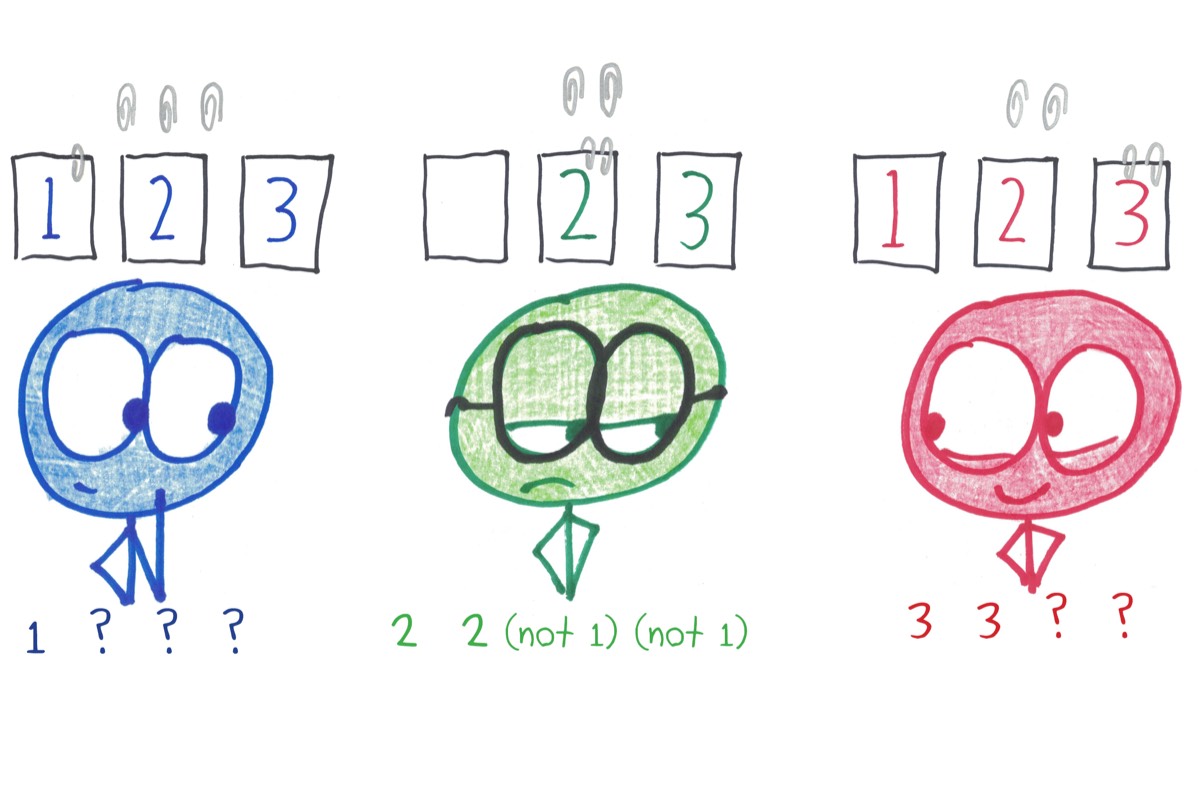
Of the thousand games I encountered in researching my book Math Games with Bad Drawings, only one of them truly frightened me. It’s a finger game. But trust me: It is the most cognitively taxing finger game that the human race has yet devised—a cross between a logic puzzle, an improv comedy session, and a collective hallucination, played with the strangest deck of cards you’ve ever seen (or not seen). Keep your aspirin at the ready.
How to play
What do you need? Anywhere from three to eight players. Each begins the game by holding up four fingers. These are the “cards” in the deck.
What’s the goal? There are two ways to win:
Prove that you have four cards in the same suit.
State exactly what suits every player has in their hand.
What are the rules?
To begin, no one knows the suits of their own (or anyone else’s) cards. All is a mystery. We only know that there are four cards per suit and as many suits as there are players.
On your turn, pick another player, and ask them if they have any cards from a particular suit. The first person to reference a new suit makes up a silly name for it. Note that you may only ask for a suit you already possess; thus, by asking for Unicorns, you are committing one of your as-yet-unknown cards to being a Unicorn.
The asked player can respond in one of two ways:
“No, I don’t have any.” Thus, all their cards must belong to other suits.
“Yes, here is one.” In this case, they give precisely one card to the asking player. Their other cards remain a mystery (and may or may not belong to the same suit).
Sometimes this decision will be forced. For example, if you’ve already committed to having Radishes, and I ask you for Radishes, then you must give me one. If not forced, the asked player may respond whichever way they wish.
You can win in two ways:
At the end of your turn, state exactly what cards each player must have.
At the end of your turn, prove that you have four cards in the same suit.
However, if a paradox occurs—meaning that the players collectively possess five or more cards all in the same suit and no one caught the error at the time—then something has gone wrong, and everybody loses.
Sample round
The three players begin with a total of 12 cards: four each of three different suits. No one knows what cards they (or anyone else) have.
Xia goes first and asks: “Yael, do you have any Narwhals?” Yael chooses to reply, “No.”
Yael goes next and asks: “Zoe, do you have any Scruples?”
Zoe chooses to reply, “Yes.”
The result leaves Zoe with three cards and Yael with five. Of these, two must be Scruples: one implied by asking, and one gained from Zoe.
Zoe goes next and asks: “Yael, do you have any Qualms?”
Yael may feel tempted to say, “No.” But this would lead to a game-destroying paradox. Yael has three cards which are not Narwhals; if they’re not Qualms either, then they must be Scruples. That would give Yael five Scruples, which is an impossibility.
Therefore, Yael must say “Yes” and give a Qualm to Zoe.
Xia goes next and asks Zoe, “Do you have any Narwhals?”
Clever move. If Zoe says no, then neither Yael nor Zoe would have any Narwhals. Thus, Xia would have them all and could claim victory. (Some players forbid starting with four cards all of the same suit; under that rule, Zoe would be required to say “yes” here.) Instead, Zoe says “Yes” and gives a Narwhal to Xia, who now possesses at least two Narwhals.
Yael, with the next turn, asks, “Xia, do you have any Qualms?” This means that one of Yael’s remaining cards must be the third Qualm.
Xia chooses to reply “Yes” and gives the final Qualm to Yael. All the Qualms are now spoken for. Moreover, since Yael’s final card can’t be a Narwhal and can no longer be a Qualm, it must be a Scruple.
The next turn falls to Zoe who asks, “Xia, do you have any Scruples?”
This means Zoe’s final card is a Scruple. Indeed, it’s the last Scruple, which means that Xia can’t possibly have one. Why did Zoe even bother to ask?
Because, with all the Scruples and Qualms accounted for, Zoe knows that Xia’s remaining cards are Narwhals. By declaring and explaining this knowledge, Zoe wins the game. (Xia, despite ending the game with all four Narwhals, began with only three, later gaining one from Zoe.) Easy like Sunday morning, right?
https://arstechnica.com/?p=1845514
Hate math? You’ll still love this cornucopia of simple-yet-seductive math games
Enlarge/ Ultimate Tic-Tac-Toe is at heart a game of fractal structure, per math teacher Ben Orlin, author of Math Games with Bad Drawings. Players must balance two levels, an element that requires them to “Think globally, act locally.”
In 1974, a geneticist named Marsha Jean Falco devised an ingenious research tool to help determine whether epilepsy in dogs was an inherited trait. She drew a series of symbols on index cards, where each card represented a dog and each symbol represented a DNA sequence, to create her own coding system. But as she shuffled and reshuffled the index cards over time, she began seeing the deck in terms of pure abstract patterns and combinations.
Eventually her personal coding system became the game of Set—just one of the many math-y games included in math teacher and bestselling author Ben Orlin’s new book, Math Games with Bad Drawings. (You can read an excerpt and try your hand at a game of Quantum Go Fishhere.)
Orlin’s first book, Math with Bad Drawings, after his blog of the same name, was published in 2018. It included such highlights as placing a discussion of the correlation coefficient and “Anscombe’s Quartet” into the world of Harry Potter and arguing that building the Death Star in the shape of a sphere may not have been the Galatic Empire’s wisest move. We declared it “a great, entertaining read for neophytes and math fans alike, because Orlin excels at finding novel ways to connect the math to real-world problems—or in the case of the Death Star, to problems in fictional worlds.”
In 2019, Orlin took on the challenge of conveying the usefulness and beauty of calculus with tall tales, witty asides, and even more bad drawings in Change Is the Only Constant: The Wisdom of Calculus in a Madcap World. That book is a colorful collection of 28 mathematical tales connecting concepts in calculus to art, literature, and all manner of things human beings grapple with on a daily basis. So a third book collecting a wide variety of math-y games was a natural progression—illustrated, as always, with Orlin’s own distinctively bad drawings.
Math Games with Bad Drawings isn’t really designed to be read cover to cover; rather, readers can browse randomly at their leisure to find the games best suited to their particular tastes and skills. (Wordle fans should enjoy Jotto, a similar logic-oriented word game invented in 1955.) There are 75.25 games in total, at least by Orlin’s idiosyncratic count. “I wanted a non-integer number of games,” he told Ars. Technically, there are around 51 full games, plus several he counted as 11/12s, because, even though they are full games, they didn’t merit more than a brief mention in the book. Variations of existing games counted as one-quarter games, while very tiny rule variations counted as 1/57th of a game. Add it all up and you get 75.25.
<a href="https://rassegna.lbit-solution.it/wp-content/uploads/2022/04/hate-math-youll-still-love-this-cornucopia-of-simple-yet-seductive-math-games-3.jpg" class="enlarge" data-height="379" data-width="1200" alt="Bullseyes and Close Calls is a classic code-breaking game, where players must guess their opponent’s secret number before their opponent does. It was hugely popular in the 1970s under the trade name Mastermind.”><img alt="Bullseyes and Close Calls is a classic code-breaking game, where players must guess their opponent’s secret number before their opponent does. It was hugely popular in the 1970s under the trade name Mastermind.” src=”https://rassegna.lbit-solution.it/wp-content/uploads/2022/04/hate-math-youll-still-love-this-cornucopia-of-simple-yet-seductive-math-games-1.jpg” width=”640″ height=”202″ srcset=”https://rassegna.lbit-solution.it/wp-content/uploads/2022/04/hate-math-youll-still-love-this-cornucopia-of-simple-yet-seductive-math-games-3.jpg 2x”>
Enlarge/Bullseyes and Close Calls is a classic code-breaking game, where players must guess their opponent’s secret number before their opponent does. It was hugely popular in the 1970s under the trade name Mastermind.
The games can all be played with just a few common household items: pencil and paper, coins, colored pens, standard dice, Goldfish crackers, paper clips, your hands, and occasionally an Internet connection. There are five sections focused on five different categories of games: spatial games, number games, combination games, games of risk and reward, and information games. For each, Orlin outlines the basic rules of play, a few “tasting notes” about the subtleties of the gameplay, where the game came from, and why it matters. He also lists any variations and related games.
For instance, Ultimate Tic-Tac-Toe involves two players navigating nine smaller (“local”) tic-tac-toe boards in a 3×3 grid, and the choices made determine the positions on a larger (“global”) board. Quantum Tic-Tac-Toe is even trickier, whereby players must place their “entangled particles” (Xs or Os) in such a way that when the “wave function” collapses, the winning player will be left with three in a row. (The wave function collapses when various pairs of boxes form an “entangled loop”: Box 1 is entangled with Box 2, which is entangled with Box 3, which is entangled with Box 1.)
“I tend to like the party games, the ones that actually work well for a group, more than the very intricate two-player, abstract strategy,” said Orlin, although he admits to having a soft spot for Ultimate Tic-Tac-Toe, the game that inspired this book. Among his favorites is Sequencium, a game of pure strategy, which, like chess, tends to favor the player who moves first.
“You’ve got this little grid, and you start with some numbers coming out of the corner, and then you just keep adding one to the number and putting it into the next box,” said Orlin. “You’re trying to grow this little vine of numbers as you move around the board. It’s a very simple ruleset but makes for a really surprisingly rich game.” Bonus: Per Orlin, there’s one surefire way for the second player to ensure a draw. Simply rotate the board 180 degrees and copy the first player’s moves symmetrically.
Orlin is already hard at work on his next book: How to Speak Math: A Guide to the Universal Language for Native and Non-Native Speakers. Unlike his prior books, where he carefully avoided most mathematical notation, this one will teach readers how to read and interpret mathematical symbols, proofs, and mathematical diagrams. “Mathematical notation is off-putting for a lot of people, and you can discuss what is exciting and intellectually rich about mathematics without getting into the notation,” he said. “But there are also certain things about math that you can only access through that notation.”
Ars spoke with Orlin to learn more.
<a href="https://rassegna.lbit-solution.it/wp-content/uploads/2022/04/hate-math-youll-still-love-this-cornucopia-of-simple-yet-seductive-math-games-4.jpg" class="enlarge" data-height="801" data-width="1200" alt="Math teacher Ben Orlin is the author of a new book (his third), Math Games with Bad Drawings.”><img alt="Math teacher Ben Orlin is the author of a new book (his third), Math Games with Bad Drawings.” src=”https://rassegna.lbit-solution.it/wp-content/uploads/2022/04/hate-math-youll-still-love-this-cornucopia-of-simple-yet-seductive-math-games-2.jpg” width=”640″ height=”427″ srcset=”https://rassegna.lbit-solution.it/wp-content/uploads/2022/04/hate-math-youll-still-love-this-cornucopia-of-simple-yet-seductive-math-games-4.jpg 2x”>
Enlarge/ Math teacher Ben Orlin is the author of a new book (his third), Math Games with Bad Drawings.
Rayleen Tritt
Ars Technica: Why math games?
Ben Orlin: There’s this thing that math does for people who enjoy math. You hear a setup to a problem and you just get pulled in. “Ooh, what is that going to create? Those choices of axioms or assumptions, what is going to emerge from that?” But other people don’t respond to math that way. You give them the setup of a problem, and they shrug their shoulders. It’s not an exciting prompt.
But most people want to try games. They want to see what happens when you start playing around in the space created by these rules. So I wanted to give people the experience of that kind of thinking, when you get into a ruleset and start messing around and seeing what possibilities it allows. Where do you have freedom, where are you constrained? It’s all very logical thinking and to me, that’s a very mathematical kind of thinking. Games are a great backdoor into that thinking because people just intrinsically enjoy it. With a more austere or abstract mathematical setting, they might not dive in as readily.
https://arstechnica.com/?p=1845789
Ubisoft’s first NFT experiment was a dumpster fire
Enlarge/ This is your brain on NFTs. We have a lot of questions.
Aurich Lawson / Getty Images
Ubisoft’s first experiment with non-fungible tokens (called “Quartz Digits”) in Ghost Recon Breakpoint is already winding down just four months after it started. The short saga serves as a prime example of the problems that can arise when a company just throws “the blockchain” into its plans without thinking about why it’s doing so.
Ubisoft announced on Twitter on Tuesday that the company has released “our final piece of content” for Ghost Recon Breakpoint after rolling out 11 updates since the game’s 2019 launch. While Ubisoft says it will “continue to maintain our servers” for Breakpoint and 2017’s Ghost Recon Wildlands for the time being, Breakpoint‘s relatively limited player base means that online multiplayer support probably won’t last that much longer. (Ubisoft will shut down the gameplay servers for battle royale shooter Hyper Scapelater this month).
On the Ubisoft Quartz website, the company confirmed that “the last Digit for Ghost Recon Breakpoint was released on 3/17/2022.”
“Thank you to all Ghost Recon Breakpoint players who claimed their first Digits! You own a piece of the game and have left your mark [on] its history.” Never mind that the Quartz website claimed that being listed on the “owner history” for a Digits NFT would “bring you fame for years to come!”
At the same time, Ubisoft said this is not the end of its NFT plans. “Stay tuned for more updates with features to the platform and future drops coming with other games!”
“At Ubisoft, we continuously learn by trying new things and encourage this attitude in our teams,” the company said in a statement provided to Ars. “Being first to take advantage of emerging trends and technology is more than core to Ubisoft’s strategy; it is part of our DNA. Ubisoft Quartz reflects this ambition and represents an incredible opportunity to learn with our community about what decentralization can bring to gaming. As the last Ghost Recon Breakpoint Digit was released on March 17, we will now look to continue our exploration by improving the value proposition of the platform with new projects and features.”
A sluggish market
After a big, splashy rollout of Quartz Digits in December, Ubisoft issued four further NFT “drops” for Breakpoint over the past three months. Each was offered in limited quantities and was initially available for free to players who met specific in-game level requirements.
Players who managed to snag a free Digits NFT could then sell the “unique” in-game item on two specific partner NFT marketplaces: Objkt and Rarible. But the secondhand market for the in-game items wasn’t exactly robust; in the nearly 120 days since Ubisoft first rolled out Digits, an Ars analysis shows just 96 successful sales from among the thousands of Digits minted by Ubisoft.
Enlarge/ Ubisoft’s first free Digits NFT drop as it appeared pre-launch in December.
Interestingly, Objkt seems to have quietly halted trading on all Ubisoft Digits months ago without much notice from the outside world. The last of the 26 total Digit sales on Objkt—a pair of Wolf Enhanced Pants that sold for 10TZ (then the equivalent of roughly $39)—was recorded on February 5.
There are no current sales listings for Ubisoft Digits on Objkt. And when you look at a listing for a Digit on the Objkt website, you’ll see a message reading, “You can’t trade this Digit at the moment, please visit quartz.ubisoft.com for more information.” (No relevant additional information can be found on that website.) Ubisoft and Objkt representatives have not responded to a request for comment on the matter.
On Rarible, though, the slow drip of Ghost Recon Breakpoint Digit sales continues to this day. As recently as Wednesday morning, someone bought a P320 in-game weapon for 19 XTZ (about $64). We hope the new owner enjoys the purchase while the Breakpoint servers are still up.
https://arstechnica.com/?p=1846253
Mysterious benefactor returns Charles Darwin’s missing notebooks after 20 years
[embedded content]
Two notebooks belonging to Charles Darwin, one of which contains his iconic 1837 “Tree of Life” sketch, have been safely returned to Cambridge University Library, more than two decades after first being reported missing.
Twenty years ago, two small notebooks written by 19th-century naturalist Charles Darwin mysteriously disappeared from the archives of Cambridge University Library. One of the notebooks even contains Darwin’s iconic 1837 sketch of the so-called “Tree of Life.” After multiple searches and a public appeal, the notebooks have finally been returned by an anonymous person.
“My sense of relief at the notebooks’ safe return is profound and almost impossible to adequately express,” said Cambridge University Librarian Jessica Gardner in a statement. “Along with so many others all across the world, I was heartbroken to learn of their loss, and my joy at their return is immense. They may be tiny, just the size of postcards, but the notebooks’ impact on the history of science and their importance to our world-class collections here cannot be overstated.”
Enlarge/ A page from Darwin’s 1837 notebook showing the “Tree of Life” sketch.
Stuart Roberts/Cambridge University Library
Darwin famously set sail on the HMS Beagle on December 27, 1831, as the ship’s naturalist. The expedition’s purpose was to chart the coastline of South America, and Darwin’s job was to collect and record specimens as well as investigate local geography at the various landing sites. He dutifully recorded all his observations in his notebooks and shipped many of his finds back to England so other scientists could study them. Originally slated to last for two years, the voyage took nearly five years to complete.
The Beagle finally anchored at Falmouth, Cornwall, on October 2, 1836. After a brief stop to visit family, Darwin returned to Cambridge, eager to take part in the study and cataloging of all the specimens he had collected. By the following March, Darwin learned enough to openly speculate in his Red Notebook about the possibility of one species changing into another.
Enlarge/ Darwin’s notebooks “B” and “C” after being unwrapped at Cambridge University Library.
Stuart Roberts/Cambridge University Library
In mid-July 1837, Darwin wrote down his ideas about life span and variation across generations of animals. He believed his ideas could explain all the diversity he had observed, particularly among the tortoises, mockingbirds, and rheas he recorded in the Galapagos Islands. That’s when he sketched the famous “Tree of Life” in his “B” notebook, showing a genealogical branching of a single evolutionary tree and concluding that “it is absurd to talk of one animal being higher than another.” He would publish the fully developed version of that tree over 20 years later in The Origin of Species.
The “B” notebook with its “Tree of Life” sketch was stored along with Darwin’s “C” notebook in a blue box about the size of a paperback in the archives of the Cambridge University Library. Together, they are known as the “Transmutation Notebooks,” and while they are priceless artifacts, their value is estimated at several million British pounds. The university boasts the largest and most significant collection of Darwin material in the world, including the naturalist’s personal library.
Enlarge/ This plain brown envelope contained the blue archive box with both notebooks inside, wrapped in plastic film and still intact.
Stuart Roberts/Cambridge University Library
In September 2000, the notebooks were removed from the Special Collections Strong Rooms to be photographed. However, in January 2001, the librarians found that the small blue box and the priceless notebooks within were missing. Initially, the assumption was that the notebooks had been misplaced. Librarians conducted searches over the next two decades, but the Special Collections room alone holds millions of documents.
Gardner came on board in 2017 and launched a new exhaustive search in 2020. Numerous experts combed through the entire Darwin Archive and even made fingertip examinations. Still, the notebooks could not be found. Gardner and several other experts concluded that the notebooks had likely been stolen.
Enlarge/ Jim Bloxham, head of Conservation and Collection Care at the Cambridge University Library, examines the still-wrapped notebooks at the start of the unwrapping and verification process.
Stuart Roberts/Cambridge University Library
So the Cambridge University Library launched a public appeal for the return of the notebooks on November 24, 2020, coinciding with the celebration of Evolution Day—the publication anniversary of On the Origin of Species in 1859. The Cambridgeshire Police were notified, and the notebooks were listed in the national Art Loss Register, as well as on PSYCHE, an Interpol database of stolen artworks. This also ensured that the international book trade could keep an eye out for the missing notebooks, given that such unique and valuable items could never be sold on the open market.
That appeal paid off 15 months later when a bright pink gift bag appeared in a public area just outside Gardner’s office. Inside was a plain brown envelope simply addressed “Librarian: Happy Easter.” The envelope contained the blue archive box with both notebooks inside, wrapped in plastic film and still intact. To celebrate their return, the two notebooks will be featured in an upcoming free exhibition, Darwin in Conversation, opening at the library on July 9. The exhibit will be transferred to the New York Public Library in 2023.
https://arstechnica.com/?p=1845873
Picard confirmed to end with third season, will feature more TNG guest stars
The dizzying alternate Picard timeline on Paramount+ will not be an infinite one.
After cast members suggested that the latest Patrick Stewart-led Star Trek series would soon conclude, Paramount made the news official on Tuesday: Picard will end after its third season. As part of its conclusion, the series will ramp up appearances of familiar faces from Star Trek: The Next Generation.
Tuesday’s announcement confirmed that actors LeVar Burton, Michael Dorn, and Gates McFadden would appear in the series during its third season. Previous Picard guest stars and TNG castmates included Jonathan Frakes, Marina Sirtis, and Brent Spiner. This massive TNG reunion has so far only been teased with names and audio. Each revealed third-season actor mutters bits of dialogue in a brief teaser trailer that ends with Picard and Riker facing off in an apparent duel.
[embedded content]
Picard third-season teaser.
This news arrives before the conclusion of Picard season two, which is six episodes into its once-a-week 10-episode run, slated to conclude on Paramount+ in the United States on May 5. Picard‘s second and third seasons were filmed consecutively, and production on the third season concluded roughly one month ago—at which time major series players like Jeri Ryan claimed that the show was “always intended to be 3 [seasons] and done.” Tuesday’s official announcement leaves zero room for doubt on that front.
Return to Monkey Island confirmed by Ron Gilbert as real, slated for 2022 launch
Enlarge/ That’s the second-biggest surprise I’ve ever seen.
Terrible Toybox / Lucasfilm Games
Return to Monkey Island, teased by Ron Gilbert on his official blog last week on April Fools’ Day, has been confirmed as an actual video game that will release in 2022.
Elsewhere, Gilbert said that the game has been in development for roughly two years by the team at Terrible Toybox, which also worked on the 2017 adventure game Thimbleweed Park. But Terrible Toybox has picked up a notable new partner this time around: Dave Grossman, who co-wrote and co-designed many legendary point-and-click games at LucasArts, including the first two Monkey Island titles.
Other familiar names include Dominic Armato, who will reprise the role of Guybrush Threepwood, and the original LucasArts musicians, who will provide the game’s score.
“Too much of my life creating and making things other people own”
For those unfamiliar, the Monkey Island series began life in 1990 with Gilbert, Grossman, and Tim Schafer at the helm, during the height of LucasArts’ point-and-click adventure game legacy. Gilbert remained on board for the series’ first sequel in 1991, only to leave LucasArts shortly after its release; he eventually teamed up with Schafer to make a new game for Double Fine Productions before once again striking off on his own. While other teams made Monkey Island games in subsequent years without the original creators’ involvement, the original games remain beloved thanks to their mix of brilliant puzzles and hilarious deadpan writing.
[embedded content]
Return to Monkey Island reveal trailer.
A minute-long trailer released on Monday is brief on gameplay details beyond debuting the apparent engine that will be used to display its high-res 2D characters and art assets—currently a mix of hand-tracked animation and Flash-like, flat-sprite manipulation. A single bouncing skull (Murray?) bounds in the direction of a ghost pirate fiddler, then mutters, “Ron Gilbert told me he’d never make another Monkey Island unless…” before getting punched off the deck.
That quote is a reference to a manifesto Gilbert wrote in 2013 about his dreams of creating another Monkey Island game. The post made clear that Monkey Island would never officially return unless Gilbert owned the series’ IP. “I’ve spent too much of my life creating and making things other people own,” Gilbert wrote. “Not only would I allow you to make Monkey Island fan games, but I would encourage it.”
In the years since that post went live, the Disney-helmed Lucasfilm Games has been more generous about helping its most venerable alumni re-release original games with minimal interference, and the company also increased its efforts to put its biggest properties in the hands of new developers. The upcoming Indiana Jones video game, for instance, is being made by MachineGames. Gilbert hasn’t said what deal he struck with LucasArts’ rightsholders, but it’s arguably good enough to make him eat some very famous “not making another Monkey Island” words.
Take the rest of Gilbert’s 2013 post with a grain of salt—particularly the directive about “rebuilding SCUMM,” the programming system he developed for classic LucasArts games. (It’s possible that he remade the engine, but due to game development timelines and budgets and the availability of robust third-party engines in the years since, it doesn’t seem like a hill worth dying on.)
The post offers hints about the compromises Gilbert is willing to make to deliver a modern game. As the trailer shows, the game indeed follows his “high-res 2D” dream instead of adopting 3D assets, and its use of spoken voice work suggests a fully voiced adventure (as we’ve seen in remastered Monkey Island games). Concerning the gameplay, Gilbert previously suggested dropping all “verbs” but still leaving in the “dialogue puzzles” that made the original games special. And as far as adventure-gaming difficulty is concerned, I’ll let Gilbert wax poetically:
It would be a hardcore adventure game driven by what made that era so great. No tutorials or hint systems or pansy-assed puzzles or catering to the mass-market or modernizing. It would be an adventure game for the hardcore. You’re going to get stuck. You’re going to be frustrated. Some puzzles will be hard, but all the puzzles will be fair. It’s one aspect of Monkey Island I am very proud of.
Gilbert is not likely to tease much more about the game ahead of its launch, at least if he sticks with his 2013 plans, which included a vow that no advance review copies would be distributed ahead of the game’s launch. Members of the press “should play it at the same time you do,” he told fans at the time. “I hope they won’t be mad at me. My Metacritic score hopes they won’t be mad at me.”
Fine by us. We’ll play the game whenever Gilbert gives it to us—which, according to today’s news, will be by the end of this year. (Take that, Breath of the Wild 2.)
https://arstechnica.com/?p=1845624
World of Tanks maker closes studios in Russia, Belarus
<img src="https://rassegna.lbit-solution.it/wp-content/uploads/2022/04/world-of-tanks-maker-closes-studios-in-russia-belarus.jpg" alt="World of Tanks will remain playable in Russia and Belarus even though developer Wargaming is leaving those countries.”>
Enlarge/World of Tanks will remain playable in Russia and Belarus even though developer Wargaming is leaving those countries.
Wargaming, the developer behind the massively popular military MMO World of Tanks and its spinoffs, has decided to close its offices in Russia and Belarus amid the ongoing invasion of Ukraine.
But that doesn’t mean the closings will be of immediate financial benefit to Wargaming. “The company will not profit from this process either today or going forward,” Wargaming wrote. “Much to the contrary, we expect to suffer substantial losses as a direct result of this decision.”
Wargaming did not cite Russia’s invasion of Ukraine directly in announcing its departure from the countries. In late February, though, Wargaming fired Creative Director Sergey Burkatovskiy after he posted a pro-war message on Facebook. “Sergey Burkatovskiy expressed his personal opinion on social media which categorically does not reflect the position of the company,” a Wargaming spokesperson told PC Gamer at the time. “He has been let go and is no longer at the company.”
Wargaming said its games will continue to be available to players in Russia and Belarus through the local management of Lesta Studio. That sets Wargaming apart from many other gaming companies that have cut off new game sales in Russia and Belarus in the wake of the invasion (though previous purchases and online services for games often remain accessible). Russia, Ukraine, and Belarus dominate the competitive scene for World of Tanks, and the game reported 37.2 million players on Russian servers—more than for all of Europe at the time—as recently as 2018.
Wargaming was founded in Minsk, Belarus, in 1998 and maintained a large studio there despite its decision to relocate its headquarters to Cyprus in 2011. The company said it employs more than 550 employees in its Kyiv, Ukraine, studios and previously said that it was putting “all available company resources” into “providing [Kyiv employees] with alternate housing, early salary payments, [and] additional funds to aid travel and relocation.”
Wargaming previously halted all worldwide advertising for World of Tanks in apparent deference to how the military imagery would be perceived amid an international conflict. The company later resumed advertising with redesigned content that removed imagery of advancing tanks and military vehicles. The advertising pause remains in effect in Ukraine, though, “as we believe it is inappropriate and insensitive to advertise our games while it is the center of this conflict,” the company said.
In late February, Wargaming announced a donation of $1 million to the Ukrainian Red Cross “to support Ukrainian hospitals and doctors, those citizens who have been displaced and other vital activities of the humanitarian organization as is needed.”
https://arstechnica.com/?p=1845603
13th Doctor teams up with a pirate queen in Legend of the Sea Devils trailer
[embedded content]
Jodie Whittaker’s time as the Thirteenth Doctor winds down with Legend of the Sea Devils, second of three Doctor Who specials in 2022.
We’re counting down to another regeneration on Doctor Who, although exactly who will replace Jodie Whittaker to become the Fourteenth Doctor remains a tightly guarded secret. (No, it’s not Tom Holland.) But the BBC this weekend dropped a teaser for Legend of the Sea Devils, one of three special episodes airing this year to mark Whittaker’s final days as the Thirteenth Doctor.
As previously reported, the recently concluded 13th season was particularly impacted by the COVID-19 pandemic. (That’s the 13th season since the franchise restarted in 2005, not the 13th season since the show debuted the day after the Kennedy assassination). Instead of the usual 13 episodes, S13 only planned for eight because of the pandemic. Ultimately, showrunner Chris Chibnall decided to cut the season down to just six episodes, with a complete narrative arc rather than the episodic structure that has been more typical of the series. (The decision is not unprecedented, however. The Trial of a Time Lord in 1986 was also one complete narrative.)
Collectively, the six-episode arc was given the subtitle Flux. In it, the Doctor and her companions encountered a universe-ending anomaly intent on killing the Doctor. The crew also faced a smorgasbord of classic Whovian alien races: the Ood, the Cybermen, the Sontarans, and the Weeping Angels. While some critics found the narrative arc confusing—almost inevitable when the Weeping Angels are involved—and the finale disappointing, it was generally a solid season.
Conspicuously absent from Flux were the Daleks, but that’s because Chibnall was saving them for the first holiday special, Eve of the Daleks, which aired on New Year’s Day. The special introduced a new kind of Dalek, the Dalek Executioners, who sought revenge on the Doctor for her actions in the S13 finale. The Doctor and her companions Yaz and Dan were caught in a time loop, thanks to a TARDIS reset (necessary to repair the TARDIS from damage incurred from the Flux). Every time the loop reset, it would shorten by one minute and was destined to collapse entirely at midnight.
Legend of the Sea Devils, in comparison, is a classic Doctor Who period story. In it, our heroic Time Lord encounters a famous personage from the past—in this case, a notorious pirate queen in 19th-century China named Zheng Yi Sao, aka Madame Ching. Born in 1775, historians speculate that Madame Ching may have started out as a prostitute or madame on a floating brothel.
Enlarge/ Crystal Yu (center) plays 19th-century Chinese pirate queen Madame Ching.
YouTube/BBC Studios
Her life changed forever in 1801 when she married the notorious pirate Zheng Yi, who hailed from a long family of pirates. Madame Ching proved to be a valuable asset, using her diplomatic skills to help her husband consolidate the various pirate fleets into a loose confederation. Each fleet had its own distinctive flag color (red, black, blue, white, yellow, and purple), and Zheng Yi took command of the largest Red Flag Fleet.
When Zheng Yi died in November 1807 at age 42—he fell overboard during a gale, which seems an ignominious end for a pirate—Madame Ching took over the entire confederation. She had the support of Zheng Yi’s nephew as well as his adopted son, Zhang Bao. (“Adopted” isn’t quite accurate; the boy was abducted from his family at 15 and forced into piracy. It seems to have been a common practice.) While Bao took over his father’s command of the Red Flag Fleet, he clearly wasn’t the boss. Historical records indicate that Bao obeyed his stepmother’s orders and “consulted her on all things before acting.” The two were also romantically involved.
Many battles and much pillaging followed, but the mounting opposition from the Qing Chinese government, the East India Company, and the Portuguese Empire—all of whom suffered significant losses to the pirate confederation—eventually became too powerful. This occurred as the pirate confederation was showing cracks in solidarity: the leader of the Black Flag Fleet, Guo Podai, openly fought Bao in late 1808 and surrendered to Chinese authorities shortly thereafter.
https://arstechnica.com/?p=1845449
Phasers locked: Paramount+ releases official trailer for Star Trek: Strange New Worlds
[embedded content]
Capt. Christopher Pike (Anson Mount, center), Number One (Rebecca Romijn, left), and Spock (Ethan Peck, right) are getting their own prequel spinoff series: Star Trek: Strange New Worlds, debuting May 5, 2022, on Paramount+.
Interplanetary adventures, political intrigue, and a spot of romance are in store for the crew of the USS Enterprise in the official trailer for Star Trek: Strange New Worlds. The spinoff prequel series debuts on Paramount+ next month.
As we’ve reported previously, one of the highlights of Star Trek: Discovery‘s second season was the appearance of classic original series (TOS) characters Capt. Christopher Pike (Anson Mount), Number One (Rebecca Romijn), and Spock (Ethan Peck). All three reprise their roles for Strange New Worlds.
Babs Olusanmokun plays Dr. M’Benga; Celia Rose Gooding has the unenviable task of filling Nichelle Nichols’ shoes as Cadet Nyota Uhura; Jess Bush plays Nurse Christine Chapel; Melissa Navai plays Lt. Erica Ortegas; Bruce Orak plays an Aenar named Hemmer who is blind in one eye (Aenar are an albino subspecies of Andorians that are generally depicted as blind); and Christina Chong plays La’An Noonien-Singh (a relation of the classic revenge-obsessed Star Trek villain Khan).
The brief teaser that dropped last month opened with a bearded and presumably retired Pike surveying his ranch from horseback. (A retired Pike is consistent with the TOS episode “The Cage:” we first meet Pike as he is debating leaving from Starfleet.) Then a small spacecraft zoomed past, and we caught tantalizing glimpses of the titular strange new worlds as a voice called Pike back to action.
The new official trailer opens with Pike beaming into what appears to be a bitter dispute between two alien factions. The aliens don’t seem to be expecting him, given his awkward reception (“Hi… sorry to interrupt”). We see crew members beaming down to the surface of a comet and encountering a large glowing golden egg-shaped structure.
“If you want to seek out new life, go where the aliens are,” Pike tells us. But that alien life might not be receptive to first contact, as Pike and the Enterprise find themselves under fire by aliens who consider their presence to be “blasphemy.” And romance blooms for both Pike and Spock (separately, not with each other).
Star Trek: Strange New Worldsdebuts on Paramount+ on May 5, 2022. The streaming platform has ready greenlighted a second season, with Paul Wesley (Vampire Diaries) joining the cast as future Enterprise Capt. James T. Kirk.
Ars Technica may earn compensation for sales from links on this post through affiliate programs.
<img src="https://rassegna.lbit-solution.it/wp-content/uploads/2022/04/the-punch-that-changed-mortal-kombat-history.jpg" alt="The raw power of a new Mortal Kombat cabinet was hard to contain…”>
Enlarge/ The raw power of a new Mortal Kombat cabinet was hard to contain…
David L. Craddock’s Long Live Mortal Kombat goes behind the scenes to reveal untold stories from the making of the first four Mortal Kombat games and explores how the franchise impacted popular culture. In this excerpt from the book, two of MK‘s arcade legends meet for the first time and learn a new technique that propels them to the top of the food chain in their local arcades.
<a href="https://cdn.arstechnica.net/wp-content/uploads/2022/04/LLMK-R1-ebook.jpg" class="enlarge" data-height="2560" data-width="1600" alt="David L Craddock's Long Live Mortal Kombat is available for pre-purchase on Kickstarter.”><img alt="David L Craddock's Long Live Mortal Kombat is available for pre-purchase on Kickstarter.” src=”https://rassegna.lbit-solution.it/wp-content/uploads/2022/04/the-punch-that-changed-mortal-kombat-history-1.jpg” width=”300″ height=”480″ srcset=”https://rassegna.lbit-solution.it/wp-content/uploads/2022/04/the-punch-that-changed-mortal-kombat-history-2.jpg 2x”>
Enlarge/ David L Craddock’s Long Live Mortal Kombat is available for pre-purchase on Kickstarter.
Nitin Bhutani was bored. It was the fall of 1992, and he was hanging out with friends between classes where he attended college in Long Island, New York. The group had two hours to kill. Bhutani proposed they go to the student rec center and play some of the pinball and arcade games there. Brown-skinned with dark, slicked-back hair, he looked for any excuse to get away from classrooms and play games. Truth be told, though, he was lukewarm toward his own suggestion. He and his boys had played the rec center’s handful of coin-operated amusements to death. But it was either hit buttons or hit the books, so they moseyed over to the rec center.
To Bhutani’s surprise, a new cabinet stood among the ranks of games he had conquered. He watched the attract mode. When the game’s title flashed across the screen, something about it—the intentional misspelling, the golden lettering set against a red backdrop—caught his eye. A few other guys stepped up to play. One of them finished the match by firing a bolt of lightning at the other character that blasted his head apart in a spray of blood. Holy shit, he thought. “It just showed up one day. I see this game where people are chopping heads off and am like, ‘Oh my god. I gotta play this,'” he recalls.
Bhutani no longer needed to hunt for distractions between classes. In fact, classes had become the distraction. He was spending five to six hours a day playing Mortal Kombat, bouncing between the cabinet at the rec center and his local arcade. Facing off against computer-controlled opponents grew tiresome. He needed challengers who’d force him to get even better. “I try to tell people, when you were young and went to an arcade, it was always one on one,” he says.
His friends liked the game and played against him. Soon enough, however, Bhutani outranked them. They were wasting their money, and he was wasting his time fighting guys who weren’t pushing him to grow as a player.
That was when the rumors started. “When you play at certain arcades, you hear, ‘Hey, there’s a couple guys in such-and-such arcade who are good.’ You drive over there and see what’s going on,” explains Bhutani.
Factoring driving time and gasoline into his Mortal Kombat schedule, Bhutani made a habit of piling into his car with friends and seeking competitors. He’d usually beat them, and one of three outcomes would occur: They would swear up a storm and stomp out of the arcade, try to fight him, or show him deference and ask to run with his crew. No matter how things went down, Bhutani planted his flag in the soil of every game room he conquered. As he expanded his territory, he kept an ear open for rumors of better players. Then he’d travel to their area and beat them, too. “That’s how it was back then,” he says of how word-of-mouth made him aware of fresh meat. “There’s no computers, nothing like that. There’s beepers. What the hell are you gonna do? Beep somebody?”
While playing one day, Bhutani learned from a fellow MK addict that one of the best players in the scene took on all comers at an arcade in Westbury. Bhutani smirked. He’d heard that before. The other player was adamant: This wasn’t some mark. This guy was one of the developers who made the game, and he was unstoppable. Godlike.
“The guy who made the game?” Bhutani remembers saying. “Okay. Let’s go get a piece of him.”