A fresh take on why Octavian won the war against Antony and Cleopatra

Anachronistic baroque painting of the pivotal Battle of Actium by Laureys a Castro, 1672.
Enlarge / Anachronistic baroque painting of the pivotal Battle of Actium by Laureys a Castro, 1672.
Public domain

Historians widely consider the Battle of Actium in 31 BCE to be the decisive event that led to Octavian defeating Mark Antony and Cleopatra. The couple committed suicide—Antony by stabbing himself in the stomach, and Cleopatra by the bite of an asp (or, alternatively, by some other poison). Octavian subsequently became the Roman Emperor Augustus, thereby ushering in the Pax Romana, a 200-year period of peace and prosperity that lasted until 180 CE.

Barry Strauss, a historian at Cornell University, argues that the true pivotal moment in the conflict occurred some six months before as part of a strategic campaign to cut off the supply lines for Antony and Cleopatra’s forces. Strauss makes his case in his new book, The War that Made the Roman Empire: Antony, Cleopatra, and Octavian at Actium, re-creating the battle in detail, as well as what he maintains was the turning point of the war six months before.

This is a particularly dramatic historical period that inspired two separate historical plays by William Shakespeare. Roman general and statesman Julius Caesar was famously stabbed to death at the Curia of Pompey on the ides of March in 44 BCE. The senators who killed him thought assassination was the only way to preserve the republic, but the murder ultimately led to the republic’s collapse. The following year, Caesar’s adopted son, Octavian, formed the Second Triumvirate with Mark Antony and Marcus Aemilius Lepidus.

Alas, the Second Triumvirate proved to be highly unstable, due in large part to the bitter rivalry between Octavian and Antony. Octavian successfully pushed Lepidus into exile in 36 BCE, claiming the latter’s provinces for himself. Meanwhile, Antony married Caesar’s former lover, Cleopatra, queen of Egypt, and sought to dominate Rome from there. Civil war inevitably broke out (the third and last of the Roman Republic), with the young and relatively inexperienced Octavian on one side and Antony and Cleopatra (supported by 40 percent of the Roman Senate) on the other.

The death of Julius Caesar in the Roman Senate—painting by Vincenzo Camuccini (1771-1844) Napoli, Museo Nazionale di Capodimonte.
Enlarge / The death of Julius Caesar in the Roman Senate—painting by Vincenzo Camuccini (1771-1844) Napoli, Museo Nazionale di Capodimonte.
Leemage/Corbis/Getty Images

On paper, Antony and Cleopatra seemed assured to win the war, given their combined resources and experience with military strategies and campaigns. Yet Octavian ultimately prevailed. According to Strauss, it was Octavian’s reliance on Roman General Marcus Vipsanius Agrippa, who successfully waged a naval campaign to cut off supply lines to Antony’s army, giving Octavian the upper hand. That campaign included the seizure of the city of Methone, a strategically significant port in an obscure corner of southern Greece.

“Actium was a great battle, but it did not stand alone,” Strauss writes in his introduction. “It was the climax of a six-month campaign of engagements on land and sea. Nor were all of the operations military. The war between Antony and Octavian involved diplomacy, information warfare—from propaganda to what we now call fake news—economic and financial competition, as well as all of the human emotions: love, hate, and jealousy, not least among them.”

Ars spoke with Strauss to learn more.

Ars Technica: You specialize in ancient military history, but you seem to have a particular fascination for this moment in Roman history—and especially this particular battle. Why is that?

Barry Strauss:  I was incredibly lucky when I was a graduate student. I got to spend a year in Greece with the American School of Classical Studies in Athens. In the fall of 1978, I was taken to Nicopolis by the school. Among the students, there were two people who devoted their lives to studying the site there, Konstantinos Zachos, a Greek archeologist who excavated the site of Augustus’ victory monument, and Bill Murray, a naval archaeologist and naval historian, who measured the size of the rams on the site. They both got me really interested in the subject early on. As for Julius Caesar and Octavian, I’d done a military history of Caesar. So this battle was kind of the missing link between Caesar and Octavian. And of course, there’s Cleopatra, who’s just utterly irresistible.

Historian Barry Strauss recreates the Battle of Actium in his new book.
Enlarge / Historian Barry Strauss recreates the Battle of Actium in his new book.
Simon & Schuster/Barry Strauss

Ars Technica: Literature, particularly Shakespeare’s plays, has colored our perception of many of these figures. One reason is that the source material is notoriously scant. How do you find good reliable sources, especially in cases where you have to reconstruct what happened based on a few lines of text here and there?

Barry Strauss: That’s one of the main things that we as ancient historians do. We have to read against the grain, and we have an adversarial relationship with the sources. So first of all, we have to ask, “Where is each author coming from?” to get a sense of what his biases might be. Then we gather a huge amount of material so that we can fill in the blanks.

A lot of that material is archaeological. A fair amount of it is based on what I might call reconstruction or some knowledge of how the sea works, of how boats work, of how war works. That allows us to narrow things down. Sometimes, honestly, we have to go for competitive plausibility. We can’t always say, “Well, we’re sure this has happened,” but we can say, “We consider this the likeliest reconstruction.” But it’s tough. It’s really difficult stuff.

https://arstechnica.com/?p=1843800


“Can it run Doom” will never be the same, thanks to new ray-tracing mod

<img src="https://rassegna.lbit-solution.it/wp-content/uploads/2022/04/can-it-run-doom-will-never-be-the-same-thanks-to-new-ray-tracing-mod.png" alt="E2M1 has never looked so cool. Welcome to the ray-traced Doom experience.”>
Enlarge / E2M1 has never looked so cool. Welcome to the ray-traced Doom experience.
id Software

Since the launch of Quake II RTX in 2019, fans have kept their eyes peeled for similar ray- and path-tracing updates for other classic ’90s shooters. It’s fertile upgrade territory, since modern machines push vanilla versions of Doom and Quake to over 1,000 fps by default—that’s wiggle room for computationally expensive lighting techniques—but those games’s official handlers haven’t really moved the ray-tracing needle.

Instead, Friday’s good news comes from the Doom community: The first three episodes of Doom 1 (1993) can now be played with top-to-bottom ray tracing enabled. Yes, I know, I see the date at the top of this article, but I swear: I installed and tested Doom within the new PRBoom+RT engine, and the results have not only looked quite good but felt surprisingly performative.

That is helped in large part by native support within the new engine for both Nvidia DLSS and AMD FSR. While you wouldn’t need either to run vanilla Doom, both of these upscaling systems help in a ray tracing update because they also shrink the base resolution of so many realistically rendered light bounces. The upscaling toggle makes a big performance difference: On my default testing rig (RTX 3080 Ti, AMD Ryzen 7 5800X overclocked), the “DLSS quality” toggle at 2160p resolution increases ray-tracing performance nearly 100 percent compared to a raw 2160p signal, from 33 fps to 61 fps in E1M1. You can scrape even more frames by playing around with lower-resolution DLSS and FSR settings.

Interestingly, DLSS by default hinges on games having temporal anti-aliasing built in, which means this new, patched version of PRBoom+ may have received a TAA pass just to make Doom‘s RT mode work on systems with less than the highest-end specs. (This is the kind of overkill, fan-built touch we love at Ars Technica.)

At its best, PRBoom+RT makes the original game look and feel like Doom 3, as previously dim hallways are reborn with the dramatic sense that darkness can loom around any corner. Like Doom 3, this mod includes a “press F for flashlight” keyboard option at any time, and I found that I needed that help in a few moments so far in my testing. Otherwise, in great news, mod creator Sultim Tsyrendashiev has mostly balanced the revamped moody lighting with playability in mind so that pitch-black hallways are the exception, not the rule.

https://arstechnica.com/?p=1845111


Game dev group says addressing NFT gaming’s “ethical issues” is a “priority”

<img src="https://rassegna.lbit-solution.it/wp-content/uploads/2022/04/game-dev-group-says-addressing-nft-gamings-ethical-issues-is-a-priority.png" alt="While some see NFT games like Axie Infinity as the future of gaming, the IGDA is increasingly worried about the ethical issues inherent to the space.”>
Enlarge / While some see NFT games like Axie Infinity as the future of gaming, the IGDA is increasingly worried about the ethical issues inherent to the space.

The International Game Developers Association (IGDA), a professional group of thousands of game makers from around the world, is increasingly concerned that the “ethical issues” surrounding the use of non-fungible tokens in gaming represents a “socio-political explosion waiting to happen.” That’s according to Dr. Jakin Vela, the founder of social justice-focused gaming nonprofit Games for Me. Vela was recently named interim director of the IGDA.

In an interview with Ars, Vela expanded on the IGDA’s “call to action” statement on NFTs in gaming from last July. That statement was critical of the technology and focused on the “energy inefficient methods” inherent to the proof-of-work blockchains that dominate the cryptocurrency and NFT space. “NFTs should never be used [by game developers] when a simple and far less costly database table can be managed to provide the same information and benefits,” the group said.

The IGDA’s Climate Special Interest Group also compiled a growing list of arguments against NFTs in gaming. That document notes that gaming communities and game developers are largely uninterested in the technology, with 70 percent of game makers saying in a recent survey that they have no interest in using NFTs in their upcoming projects.

Taking a “stronger stance”

Now, though, Vela tells Ars that addressing the increasing levels of hype and investment around NFT gaming is still “one of our priorities” at the IGDA. The organization is “in the process of revising our stance to be a little stronger because there are actually a lot of ethical issues that come with NFTs,” he said.

Among those issues, Vela said, is the prevalence of NFT-based “pyramid schemes,” where new money from later players is required to increase the value of highly speculative NFT purchases from early players. See this report from consulting firm Naavik for more detail on how games like Axie Infinity require a constantly growing player base to power their “play-to-earn” economy.

IGDA interim director Dr. Jakin Vela
Enlarge / IGDA interim director Dr. Jakin Vela

Beyond that kind of economic structure, though, Vela said “there’s also the ethical issues of a have/have-not creation” in NFT gaming economies, where “power differentials can play a key component.” There’s a major risk, Vela said, that NFT-based games could divided players into those “who maybe use it as a means for employment” and “others [who] can just as easily take advantage. It’s a very socio-political explosion waiting to happen, I think.”

While some view the crypto marketplace as a libertarian paradise free from restrictive government regulations, Vela sees that factor as a major potential vulnerability for gamers. Players who try to earn money through NFT gaming face a situation where “their resources—their entire investment in their employment activities—are reliant on this unregulated, really uncertain future ecosystem,” he said, “and it can put people in some murky waters, I think.”

The IGDA previously said that developers that absolutely can’t use a centralized database for their project should at least “use proof of stake for cross-ecosystem NFTs.” Those systems, which let users stake their cryptocurrency to help validate new transactions, “are far more energy-efficient than proof of work (PoW) algorithms and should be preferred whenever possible,” the IGDA wrote in July.

But Vela suggested to Ars that the organization’s thinking is changing even on this compromise position. “Even now, more research is coming out, and proof of stake is still reliant on ecosystems that are driving carbon emission up further,” he said.

Vela said the IGDA is working on a more focused statement addressing issues that touch on “more than just the environment.” The group is “having recurring meetings to ensure that we’re understanding all aspects of it.” Those meetings might be necessary because, as Vela puts it, there’s “a lot of technical jargon that leaves even a lot of intelligent people thinking, ‘Wait, but what? But why? I’m buying a receipt for what?’… If things were demystified for people, it would be a bit easier to understand and it would help inform individual decisions.”

https://arstechnica.com/?p=1845144


Report: US Senators urge FTC to scrutinize Microsoft/Activision merger [Updated]

A magnifying glass inspects a surface covered in various corporate logos.

Update 2, April 1: An Activision spokesperson provided Ars Technica with the following statement:

On Tuesday, the federal court approved a settlement agreement between Activision Blizzard and the EEOC that includes an $18M fund to compensate eligible claimants and to bolster enhancements to policies, practices, and training to prevent harassment and discrimination in the workplace, among other commitments. The company is committed to a safe and equitable working environment for all employees and has invested significant resources to ensure we’re creating a model for the industry. The transaction between Microsoft and Activision Blizzard will not interrupt any of the actions the Activision Blizzard’s leadership team has implemented throughout 2021 and is continuing to implement in 2022 with regards to improving our workplace. Activision Blizzard’s leadership team has discussed the company’s goals at length with Microsoft, and Microsoft has reviewed the renewed culture commitment and actions Activision Blizzard have done so far, and the efforts they´ve undertaken. Microsoft is supportive of the goals and the work being done. This is a compelling transaction for all stakeholders, including employees.

No additional special compensation arrangements for Mr. Kotick were entered into in connection with the transaction. Mr. Kotick’s base salary has been reduced to California’s minimum annual salary (which is approximately $62,500 for 2022), and he will not be awarded any bonuses or equity grants until the Workplace Responsibility Committee of the Activision Blizzard Board of Directors has determined that Activision Blizzard has made appropriate progress toward achievement of the transformational gender-related goals and other commitments described in such announcement.

Update, April 1: A spokesperson for Sen. Whitehouse has shared the full text of the letter sent to the FTC. In addition to the issues discussed below, the letter addresses whether Microsoft and Activision’s actions could “amount to anticompetitive harms in our labor market, and if so, if the merger will exacerbate these problems.”

“The proposed acquisition appears to be a cynical and ‘opportunistic’ attempt to capitalize off the systemic issues coming to light at Activision Blizzard,” the letter reads.

“Massive mergers have a way of leaving workers’ concerns on the cutting room floor,” Sen. Whitehouse said in a statement provided to Ars. “We need to guarantee accountability for tech employees—and employees everywhere—who’ve sustained serious abuse at the hands of their employers. I hope the FTC takes a careful look at this deal with an eye toward that accountability.”

Original story, March 31:

Four US senators have sent a letter to Federal Trade Commission Chairwoman Lina Khan expressing concern about Microsoft’s proposed $68.7 billion acquisition of Activision Blizzard, according to a Wall Street Journal report.

In the letter, Sens. Elizabeth Warren (D-Mass.), Bernie Sanders (I-Vt.), Cory Booker (D-N.J.), and Sheldon Whitehouse (D-R.I.) express worry that the merger could hurt efforts to hold Activision management accountable for widespread allegations of abuse, sexual harassment, and discrimination at Activision Blizzard. The letter also takes specific issue with reports that Activision CEO Bobby Kotick will be allowed to stay until the merger is finalized and that the embattled executive might have negotiated a “graceful exit” as part of the merger talks.

“This lack of accountability, despite shareholders, employees, and the public calling for Kotick to be held responsible for the culture he created, would be an unacceptable result of the proposed Microsoft acquisition,” the letter reads in part, according to the report. The senators also expressed general concern about “consolidation in the tech industry and its impact on workers.”

“Workplace culture is a critical priority for Microsoft,” Microsoft Corporate VP and General Counsel Lisa Tanzi told Ars Technica in response to a request for comment. “We believe Activision Blizzard will continue making progress, and we’re committed to further progress after the deal closes. We will constructively engage on unionization issues and will further discuss all of this with the FTC.”

The senators’ offices haven’t responded to a request for comment.

Looking into it

Bloomberg reported in late January that the FTC would be handling the customary antitrust review of the Microsoft/Activision deal. The agency has since sent both companies numerous requests for documents, according to regulatory filings.

Speaking to the Financial Times in February, Microsoft CEO Satya Nadella said he thought the FTC wouldn’t block the proposed merger on antitrust grounds, because the combined company still wouldn’t have a market-controlling position in the fragmented game market. “Even post-this acquisition, we will be number three with a low teens [market] share, where even the highest player is also in the teens [for market] share,” Nadella said at the time.

A group of 15 public policy organizations, including Public Citizen and the Communication Workers of America, sent an open letter to the FTC earlier in March urging the agency to investigate a merger the group said, “fits an alarming pattern of concentration in the gaming industry over the past several years.”

“By absorbing another major gaming studio and publisher, Microsoft will grow its ability to control content and self-preference its own at the expense of market competitors,” that letter said.

https://arstechnica.com/?p=1844932


Obi-Wan Kenobi shifts premiere date, will air first two episodes at once

[embedded content]
Incoming transmission from Obi-Wan Kenobi… Actor Ewan McGregor has some important news.

Disney+ originally picked an auspicious date for the premiere of its new Star Wars series, Obi-Wan Kenobi: Wednesday, May 25, the same date that Star Wars Episode IV: A New Hope was released in 1977 (back when it was known simply as Star Wars). That film celebrates its 45th anniversary this year. But the streaming platform announced today—via a video featuring star Ewan McGregor—that it is shifting that premiere date to Friday, May 27, right before Memorial Day weekend.

We might have to wait a couple of extra days, but at least Disney+ will simultaneously release the first two episodes. As Deadline Hollywood pointed out, May 27 is also the premiere date for the fourth season of Stranger Things (Part 1), so our holiday weekend viewing is pretty much sorted.

Obi-Wan Kenobi (Ewan McGregor) is on Tatooine looking after a young Luke Skywalker—from a distance.
Enlarge / Obi-Wan Kenobi (Ewan McGregor) is on Tatooine looking after a young Luke Skywalker—from a distance.
YouTube/Disney+

We first learned in August 2019 that the rumors were true about a Star Wars spinoff series featuring Obi-Wan Kenobi. That’s also when we learned that Ewan McGregor, who played Obi-Wan in the Star Wars prequels, would reprise the role. The actor made a surprise appearance at the tail end of a showcase presentation at D23 Expo 2019, Disney’s annual fan extravaganza. Then came the big news that his co-star Hayden Christensen would return as Anakin Skywalker/Darth Vader. Lucasfilm President Kathleen Kennedy called it “the rematch of the century” at the December 2020 Disney Investors Day.

The series is set 10 years after Star Wars: Revenge of the Sith, in which Obi-Wan faced off against Anakin Skywalker, who turned to the dark side and eventually became Sith Lord Darth Vader. That period will be “a dark time” for Obi-Wan, who must deal with the loss of all his friends. He and the other Jedi who survived Order 66 are also being hunted down by the Empire’s Jedi Hunters in the company of stormtroopers. Obi-Wan is on Tatooine on a mission to protect young Luke Skywalker as the series opens.

Young Luke clearly dreams of being a fighter pilot already.
Enlarge / Young Luke clearly dreams of being a fighter pilot already.

The streaming platform dropped the first significant look at the series earlier this month with a 90-second trailer. In that footage were shots of Obi-Wan spying on the childhood version of Luke, who was flanked by Uncle Owen and Aunt Beru (played by Joel Edgerton and Bonnie Piesse, the same actors from the series’ prequel film trilogy).

We also got a good glimpse of the Order of the Inquisitors’ Fifth Brother (Sung Kang), a character who debuted in the CGI-animation series Star Wars Rebels. (This live-action version sports a wicked spinning red lightsaber.) The trailer also focused on Reva (Moses Ingram), the Third Sister in the Order, who was shown taking orders from the Sith and interrogating residents of Tatooine (including Uncle Owen). However, there were hints (in the form of several hero shots) that her loyalties may eventually shift.

Listing image by YouTube/Disney+

https://arstechnica.com/?p=1844780


Russian game dev tells players to “raise the pirate flag” to get around sanctions

<img src="https://rassegna.lbit-solution.it/wp-content/uploads/2022/03/russian-game-dev-tells-players-to-raise-the-pirate-flag-to-get-around-sanctions.jpg" alt="If you can't buy Loop Hero, the developers encourage you to pirate it.”>
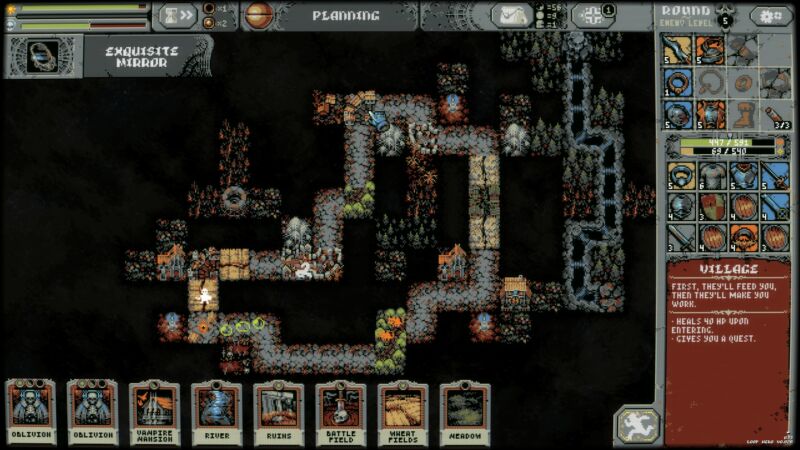
Enlarge / If you can’t buy Loop Hero, the developers encourage you to pirate it.


With Russian gamers effectively cut off from purchases on most major gaming platforms due to corporate sanctions against the country, the Russian game developer behind indie darling Loop Hero is encouraging Russian customers to pirate the game.

In a Sunday post on Russian social network VK (Google translated version), Loop Hero developer Four Quarters said, “In such difficult times, we can only help everyone to raise the pirate flag (together with vpn)” to get the game. The developer then included a link to a copy of Loop Hero on a popular Russian torrent tracker to aid in that process directly.

In a follow-up post the next day (Google translated version), Four Quarters insisted that “we didn’t do anything special, there’s nothing wrong with torrents.” The company also notes that players wanting to offer the developer donations in lieu of buying the game should refrain. “The truth is that everything is fine with us, send this support to your family and friends at this difficult time,” they wrote.

The Russian government has reportedly mulled legalizing software piracy to get around wide-ranging international corporate sanctions. The Office of the US Trade Representative has called out Russia as the international leader in video game piracy, and local surveys show that pirating cracked versions of games is very common in the country.

Near the beginning of Russia’s invasion of Ukraine, Four Quarters posted an anti-war message on its Twitter account, a public stance that comes with some risk, given government statements classifying anti-war protesters as “traitors.”

While players outside of Russia should still be able to purchase Loop Hero on Steam, Valve said earlier this month that banking issues prevented it from sending payments to developers in Russia, Belarus, and Ukraine (ironically enough). Valve recently told PC Gamer that developers in these countries will have to provide “intermediary banking information” in a foreign country to receive the payments they’re due.

“It’s a very frustrating situation, and we hope to find the resolution soon,” Valve wrote in a note to affected developers.

https://arstechnica.com/?p=1844494


How did a hacker steal over $600 million from a crypto gaming blockchain?

Artist's conception of Sky Mavis tracking down the hackers behind the $600+ million breach.
Enlarge / Artist’s conception of Sky Mavis tracking down the hackers behind the $600+ million breach.


Axie Infinity developer Sky Mavis announced Tuesday a massive breach of its Ronin cryptocurrency sidechain. An attacker used “hacked private keys” to break through Ronin’s validator network, Sky Mavis says, transferring 173,600 ethereum (worth approximately $594 million at current rates) and $25.5 million in USDC stablecoin as part of one of the largest breaches in the history of cryptocurrency.

To understand the nature of that breach, let us take you on a crash course in the short history of Axie Infinity and the complex web of crypto standards and technologies that helped allow the exploit to happen.

So you can, like, make money by playing a game?

Axie Infinity has been cited as one of the early success stories in so-called blockchain gaming. Such games use decentralized protocols to track ownership of certain in-game items and generally let players have some control over the resale of those items.

To play Axie Infinity, players need to purchase at least three NFTs of playable in-game Axies on the open market (or borrow them from owners). Playing with those Axies then earns players some Smooth Love Potions (SLP), which can power up Axies or be sold to other players as a commodity, creating a “play to earn” loop.

Last year, there was enough hype and money sloshing through this system that some players in the Philippines were able to make a decent local wage simply by playing the game as their full-time job. But that early success helped attract more players who hoped to hop on to the play-to-earn train, which flooded the market with SLPs.

Could this be your new job?
Enlarge / Could this be your new job?

With few new buyers coming in to purchase all those SLPs, the value of the potions (in dollars) has cratered roughly 80 percent since early November and a whopping 95 percent from its peak last May, according to CoinGecko. As the SLP’s value has cratered, so, too, has the number of daily active Axie Infinity players and the number of new players buying fresh Axies.

(For much more on how the Axie economy functions, and how it falls apart without new players who want to buy SLPs, read through this lengthy report from consultancy Naavik.)

The weak link in the (side)chain

While Axie Infinity originally ran directly on the ethereum blockchain, the high transaction costs and slow transaction speeds on that network quickly became untenable as the game grew. To get around those fees, Sky Mavis in 2020 started to use a sidechain—a parallel private blockchain running on top of ethereum that could bypass the need to pay ethereum “gas” for each and every transaction.

Sky Mavis initially partnered with Loom Networks for this sidechain functionality. In March 2020, though, the company broke that partnership and introduced its own sidechain called Ronin.

An image from Sky Mavis announcing the launch of the Ronin sidechain.
Enlarge / An image from Sky Mavis announcing the launch of the Ronin sidechain.

Unlike the distributed proof-of-work ethereum blockchain, the Ronin sidechain operates on a much more centralized proof-of-authority system. Rather than consulting the entire distributed blockchain network to confirm transactions, this proof-of-authority system runs its transactions through a small set of trusted, handpicked “validator” nodes. Each node stakes some of its reputation on validating each transaction, theoretically punishing lone actors that try to game the system.

Centralized exchanges like Binance and decentralized exchanges like Katana allow users a “bridge” to transfer their in-game assets back and forth between Ronin and the main ethereum blockchain. But because those transfers can happen more occasionally and at scale, the transaction costs end up much lower.

Ronin’s proof-of-authority system, centralized in just nine validator nodes, is the key to its ability to provide a higher volume of transactions at a much lower cost than the sprawling ethereum network. It also ended up being Ronin’s weak point, in this case.

As Sky Mavis explains, the unknown attacker was able to breach Sky Mavis’ systems and gain full access to four validator nodes that the company controls. The attacker was then able to use a leftover backdoor in those nodes to gain control of another validator controlled by the decentralized Axie DAO.

With that fifth validator node, the attacker could then provide a majority of validation signatures on any transaction it wanted, leading to the fraudulent transfers.

https://arstechnica.com/?p=1844301


Breaking down Sony’s confusing PlayStation Plus subscription relaunch

Layers upon layers.
Enlarge / Layers upon layers.

Tuesday morning, Sony announced plans to combine its PlayStation Plus and PlayStation Now subscription services. The newly revamped, multi-tier PlayStation Plus hydra will offer multiple pricing and access options for downloadable and streaming games from across the PlayStation’s more than 25-year catalog.

Starting in June, the revamped PlayStation Plus will be broken into three overlapping tiers, with benefits and pricing as follows:

PlayStation Plus Essential
$9.99/month or $59.99/year

This is a renamed version of the current PlayStation Plus offering, providing two monthly downloadable games, cloud saves, and basic access to online multiplayer games.

PlayStation Plus Extra
$14.99/month or $99.99/year

This tier adds access to downloadable versions of “up to 400” PS4 and PS5 games. This will include some titles from Sony’s first-party PlayStation Studios but not brand-new titles on the day of release (more on that below).

PlayStation Plus Premium
$17.99/month or $119.99/year

This tier offers additional downloadable access to “up to 340” games from the PS1, PS2, and PSP. Premium-tier customers can also stream available games from the PS1, PS2, PS3, PS4, and PSP to a PS4, PS5, or PC.

Streaming access for PlayStation Plus subscribers will initially be limited to countries where PlayStation Now is currently available: the US, Canada, Japan, Australia, and 15 European countries. Other countries will have access to a lower-priced PlayStation Plus Deluxe tier that gives all of the benefits of Premium sans streaming.

Game Pass’ long shadow

Sony currently offers streaming and/or downloadable access to nearly 800 titles from the PS2 through the PS4 via PlayStation Now. And while Sony hasn’t published full game lists for any of the coming PlayStation Plus tiers, the company did announce a handful of PS4 and PS5 titles that will be available in the Extra and Premium tiers: Death Stranding, God of War (2018), Spider-Man, Spider-Man: Miles Morales, Mortal Kombat 11, and Returnal.

When it comes to new first-party releases, though, Sony is still unwilling to match Microsoft’s Xbox Game Pass, which promises downloadable access to every first-party Microsoft Studios game on the day it’s released.

“[In terms of] putting our own games into this service, or any of our services, upon their release… as you well know, this is not a road that we’ve gone down in the past. And it’s not a road that we’re going to go down with this new service,” PlayStation CEO Jim Ryan told GamesIndustry.biz in an interview alongside today’s announcement.

Access to first-party games on launch day remains a major selling point for Xbox Game Pass.
Enlarge / Access to first-party games on launch day remains a major selling point for Xbox Game Pass.

Ryan went on to say that bundling those games as part of a subscription would break a “virtuous cycle” in which early purchases (at a full price of up to $70) help fund the next round of game development. “The level of investment that we need to make in our studios would not be possible, and we think the knock-on effect on the quality of the games that we make would not be something that gamers want.”

Sony has been famously stingy with subscription access to its own first-party games; titles like God of War (2018), Uncharted 4, and Infamous: Second Son weren’t made available to PSNow subscribers until late 2019, for instance. That said, Ryan noted that Sony reserves the right to change its mind on subscription access to its new releases beyond the “short term.”

Development funding aside, the lack of new releases is going to be an immediate comparison point between the revamped PlayStation Plus and Xbox Game Pass—one where Sony won’t come out looking great. And Game Pass Ultimate’s $14.99 monthly fee is actually cheaper than the $17.99 Sony is asking for its comparable premium tier (though the cost comparison flips if you buy PlayStation Plus a year at a time for $119.99).

https://arstechnica.com/?p=1844105


Warzone dev says game is losing players over “insane” download sizes

Maps this detailed can take up a lot of hard drive space.
Enlarge / Maps this detailed can take up a lot of hard drive space.


For years, players have complained that ballooning game download sizes are clogging up hard drives and Internet bandwidth. In a recent interview with streamer TeeP, Call of Duty: Warzone Live Operations Lead Josh Bridge admitted that the game’s massive file size is also impacting the team’s ability to release new maps.

Asked about the possibility of adding the original Verdansk map to cycle alongside the game’s current Caldera map, Bridge said, “We want that. We all want that,” before addressing the “technical problem” that makes it difficult: “The install and re-install sizes are fucking insane, right? If we pulled out Caldera and say we’re gonna drop in Verdansk, this could be essentially re-downloading, like, the size of Warzone,” he said.

“And every time we’ve done that, we lose players,” Bridge continued. “Because you’re kind of like, ‘I don’t want to re-download that,’ [so you] uninstall. I think you can’t fit anything else but Warzone on a base PS4.”

Bridge is exaggerating, but only a little. Activision says you need a whopping 175GB of hard drive space on PC for a Warzone install. On Xbox, the base download is listed at nearly 92GB, similar to the size on PlayStation systems. Adding Modern Warfare onto the Warzone package increases the total size to about 250GB on PC and 150GB on consoles.

About a year ago, Activision announced that the “larger than usual” Warzone “Season 2 Reloaded” patch would reduce the game’s “overall footprint” on hard drives by 10–15GB (and 30–35GB when combined with Modern Warfare, depending on the platform). The “data optimization and streamlining” in that update would also ensure that “future patch sizes for Modern Warfare and Warzone [would] be smaller” than the 57GB update being offered at that point.

The results over the ensuing year have been mixed. A February Season 2 patch required only about 11GB of file downloads, for instance, while a December 7 update that introduced new maps required a 41–45 GB download on consoles.

A ballooning problem

While big-budget games have definitely required larger download sizes in recent years, that doesn’t mean those games have taken longer to download, on average. An Ars Technica analysis from 2020 found that increases in broadband speeds in the US generally matched or outpaced the increase in game file sizes over the 2010s (though the same can’t be said for the rest of the world).

But massive game files like these can cause more significant trouble when it comes to a user’s total storage capacity. That’s especially true on the latest generation of consoles, which offer less than 1TB of default high-speed storage (667GB on the PS5, 802GB on the Xbox Series X, and just 364GB on the Xbox Series S). Expanding that storage can be relatively expensive, too, forcing many players to delete titles and juggle downloads as they switch between digital games (or juggle titles from old-fashioned USB storage to the system’s main high-speed drive).

In any case, Bridge was remarkably frank about Warzone‘s file size issues and said that “looking to the future, we’re putting a lot more effort into how we sort that out on a technical level so that we can have that [map] rotation. We’ve been really looking at it, so we’ll have more to talk about that, but that is ultimately a goal to ensure that there’s a freshness and a variety of experiences.”

https://arstechnica.com/?p=1843978


Bungie slams YouTube’s DMCA system in lawsuit against Destiny takedown fraudsters

Image from game maker Bungie advertising Destiny 2's Season of the Risen.

Bungie slammed YouTube’s Digital Millennium Copyright Act (DMCA) process in a lawsuit against 10 John Doe defendants accused of sending fraudulent takedown notices against Destiny 2 videos.

“Doe Defendants were able to do this because of a hole in YouTube’s DMCA-process security, which allows any person to claim to be representing any rights holder in the world for purposes of issuing a DMCA takedown,” Bungie wrote in a complaint filed Friday in US District Court for the Western District of Washington. Bungie continued:

In other words, as far as YouTube is concerned, any person, anywhere in the world, can issue takedown notices on behalf of any rights holder, anywhere. A disgruntled infringer or a competitive content producer, for example, can issue takedown notices purportedly on behalf of Disney, or Fox, or Universal—or even Google itself. All they need to do is: (1) fill out the video removal form… (2) have a Google account—including, upon information and belief, one created that same day and with fake information; and (3) fill out information and click verification buttons fraudulently certifying that they have the right to submit the takedown request, with no verification done by YouTube.

While YouTube and its owner Google were not named as defendants, they feature heavily throughout Bungie’s complaint. The 10 Doe defendants haven’t been identified yet because of “the Byzantine procedural labyrinth Google required before it would address the fraud its users were committing, let alone identify who its fraudsters were,” Bungie wrote.

The fraudulent notices were apparently sent in retaliation by Destiny 2 players who had received Bungie’s legitimate takedown requests, the lawsuit said. The fraudsters apparently targeted other YouTubers who had received official Bungie takedown requests and then sent emails to the victims that claimed the official Bungie notices were also fraudulent.

“YouTube’s easily gamed reporting system”

The fraudulent notices began on or around March 17 and targeted Destiny YouTubers including My name is Byf and Aztecross, who have 967,000 and 595,000 subscribers, respectively. Even Bungie’s official Destiny YouTube channel got served a fraudulent takedown notice, the lawsuit said. The notices were sent from “a fake Gmail address that was, upon information and belief, newly created, which did not match the addresses used by Bungie’s brand protection vendor for legitimate DMCA notices.”

“Thanks to YouTube’s easily gamed reporting system, the attack was a success, and videos were removed (and YouTubers given ‘copyright strikes’ that, under YouTube rules, threaten the future viability of their YouTube channels) on the basis of the Fraudulent Takedown Notices,” Bungie wrote.

Afterward, “the Destiny community was bewildered and upset, believing that Bungie had reneged on a promise to allow players to build their own streaming communities and YouTube channels on Destiny 2 content. Destiny community members were also misled to believe that Bungie’s brand protection agent was also fraudulent, causing confusion among users as to the authenticity of legitimate DMCA notices,” Bungie said.

Bungie said its attempt to solve the problem was “complicated by the fact that while YouTube has a form that allows anyone to claim to represent a copyright holder and issue copyright strikes, it has no dedicated mechanism for copyright holders who are being impersonated to let YouTube know about the DMCA fraud.”

When contacted by Ars, a YouTube spokesperson said, “We take abuse of our copyright takedown process seriously and terminate tens of thousands of accounts every year for violating our policies, which prohibit submitting false information in a takedown request. We’ll continue our work to prevent abuse of our systems, and we’re committed to taking appropriate action against those who knowingly misuse our tools.”

YouTube also said that copyright law compels the website to take DMCA complaints at face value and quickly remove content when someone alleges their copyrights are being violated. YouTube further said it has employees and systems that work to detect suspicious behavior but acknowledged that trolls and bad actors can sometimes circumvent the measures.

Bungie seeks defendants’ real names

Bungie uses the vendor CSC Global to send its actual takedown notices, which are sent only after specific approval from Bungie’s legal department, the lawsuit said. After learning of the fraudulent Aztecross takedown, “CSC issued a retraction notice requesting reinstatement of the video, but on Monday, March 21 it reported that YouTube had denied the retraction request because the retraction notice was not sent from the same email that had issued the initial Fraudulent Takedown Notice,” Bungie’s lawsuit said.

At 3:18 pm local time on March 22, after more urgent requests from Bungie, “Google provided an update: it had terminated the accounts that submitted the fraudulent requests and all fraudulent submissions would be reversed, but Google would not share any information identifying who the fraudulent users were, including channel identifiers, email addresses, or other identifying information, without a law enforcement request or civil process. Fortunately for the people whose videos were targeted by the Fraudulent Takedown Notices, Bungie has the financial resources to begin that civil process in order to meet Google’s requirements.”

Bungie’s lawsuit said it is “entitled to damages and injunctive relief, including enhanced statutory damages of $150,000 for each Fraudulent Takedown Notice that willfully infringed Bungie’s copyrights.” Bungie also accused the defendants of business defamation, violation of the Washington Consumer Protection Act, and breach of contract (the Destiny 2 software license agreement). Bungie said it suffered “significant reputational and economic damage.”

https://arstechnica.com/?p=1843948