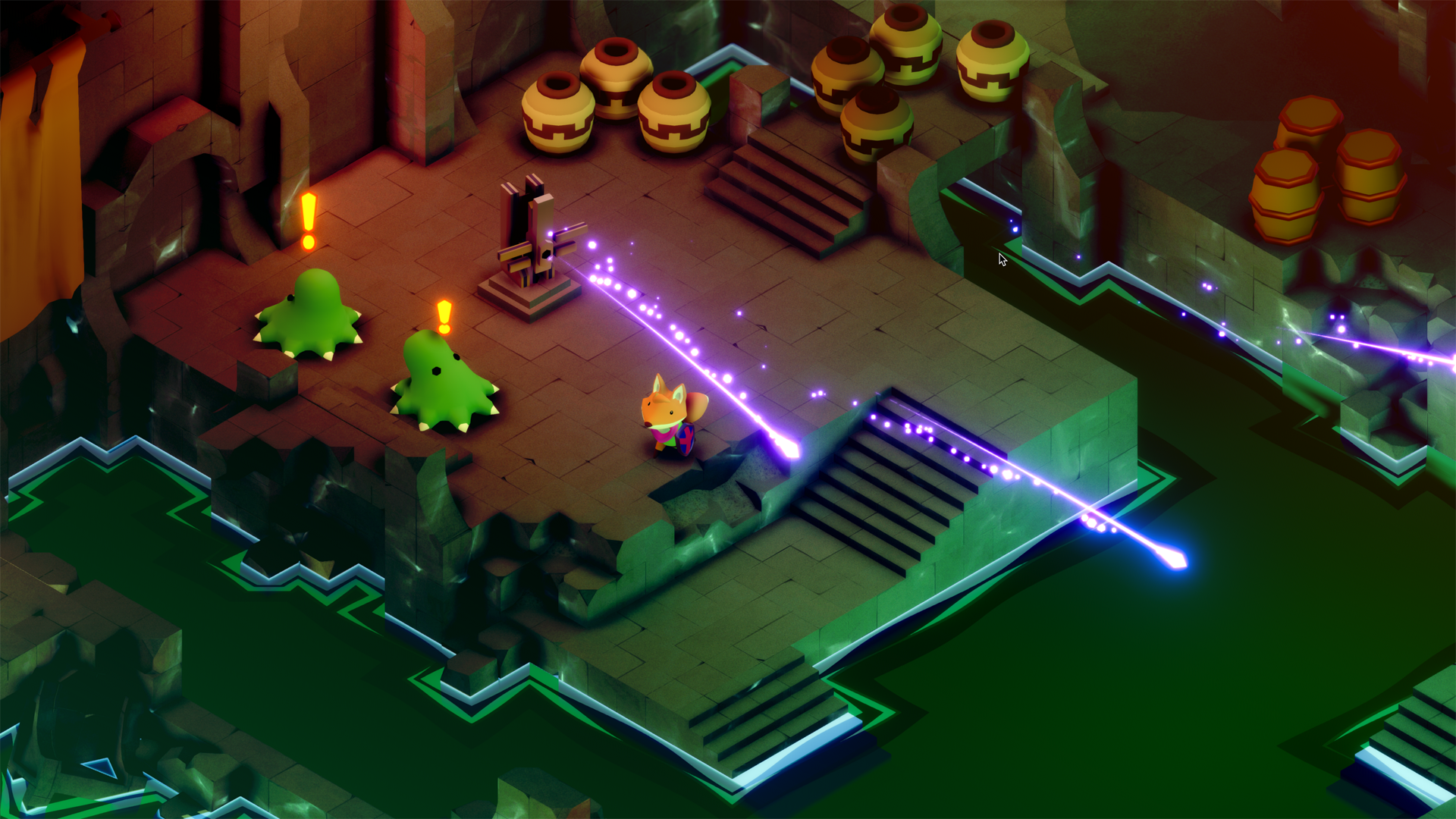
While the Deck comes with both Firefox and Chrome preinstalled, this update does not work with either of those browsers. Rather, Steam Deck owners will need to install and configure the latest Linux beta of Microsoft Edge. Yes, Linux users, Microsoft has come to your rescue.
The process, as detailed on the official Microsoft Edge Reddit community, requires jumping through a few hoops in the Deck’s Arch Linux environment, but it’s a mostly painless way to get a web browser to recognize and translate the Steam Deck’s buttons, triggers, and joysticks as video game input—something the other browsers haven’t gotten around to yet.
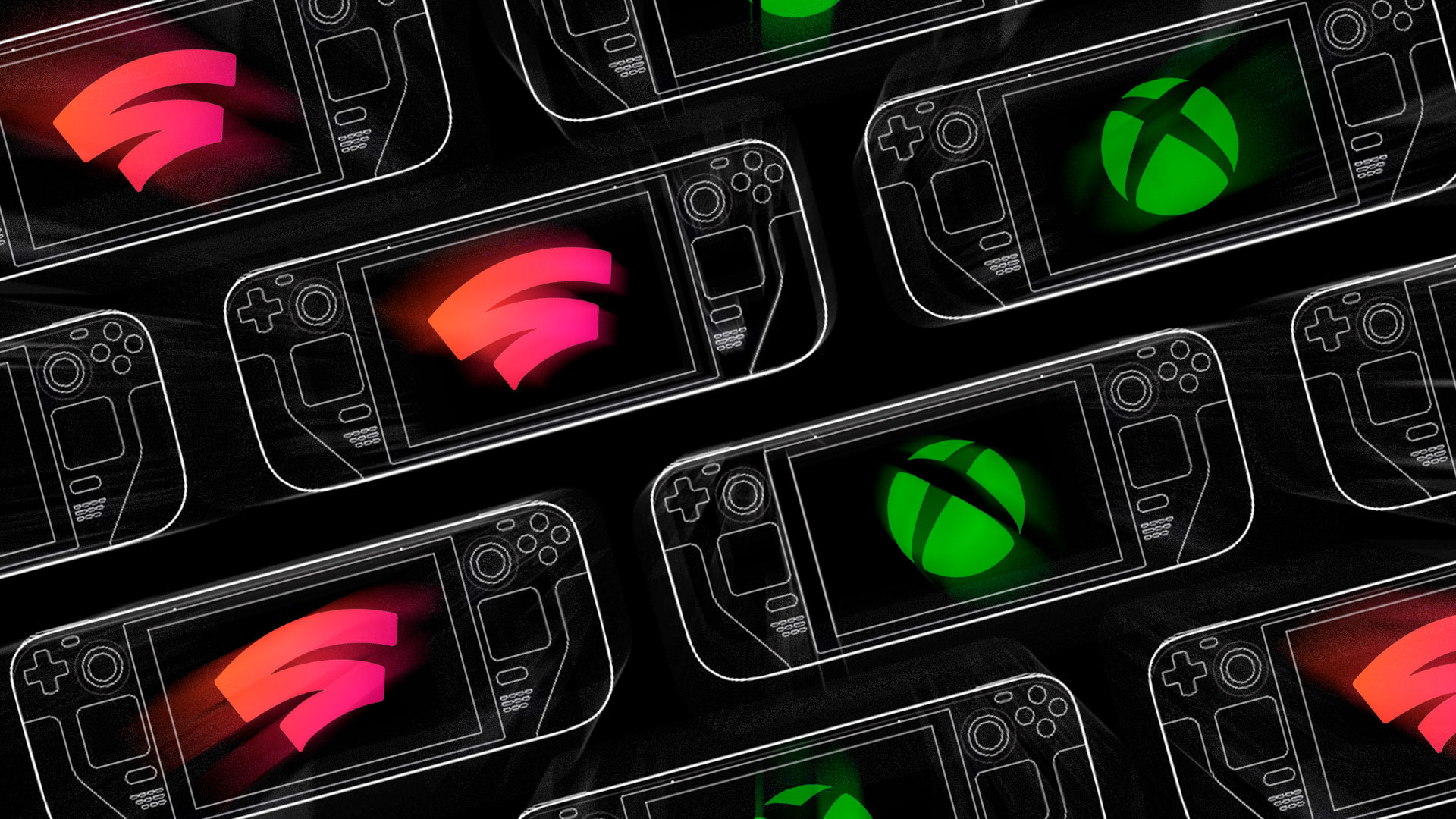
As a result, Deck owners can expect one-click access to the Xbox Cloud Gaming library, which beams over 200 games from Xbox Series X server blades to any compatible web browser on a computer with a gamepad connected. Even better, this method unlocks the same functionality for any rival service that streams games from the cloud to a web browser. That includes Google Stadia, which performs marvelously.
A flatpak, a Konsole, and a command line parameter walk into a bar
Interested cloud-streaming fans should start by loading the Steam Deck’s default desktop interface and then visiting the KDE Plasma “Discover” tab. As I explained in my Steam Deck Linux article last month, adding more apps to the Deck’s gated version of Arch Linux requires the installation of “flatpak” files since these can operate in their own sandbox outside of the Deck’s primary sector, which is read-only for anything but built-in apps. This Discover tab is a much more user-friendly way to find and discover formally signed flatpak files than using the built-in Linux Konsole, though that’s an option as well.
From there, pick Discover’s “Internet” category, then “web browsers,” and Microsoft Edge Beta will appear. (Or type “Microsoft Edge,” without “beta,” in its search box.) Once this is installed, Microsoft suggests entering this command into the Linux Konsole, which will require a connected physical keyboard or an installed keyboard app.
Microsoft’s Reddit guide details the rest of the steps, which are similar to getting third-party apps like Discord or VLC working in the default “SteamOS” interface. In particular, Microsoft suggests changing parameters for Edge in the Deck’s default gaming interface to max out its browsing window and put all the focus on the cloud-gaming site you’ll be visiting so the Deck’s gamepad buttons don’t inadvertently trigger something like the address bar. Unsurprisingly, Microsoft’s guide suggests putting “xbox.com/play” as the default URL.
Go through this process and Edge will do something that the Steam Deck has lacked thus far: translate button taps to a web browser so that they’re recognized as coming from a gamepad. Up until today, Steam Deck owners could boot a web browser in the Deck’s gaming mode, only to find that button reassignments in the Deck’s control menus didn’t act like they were in a video game. “No controller found,” the browser-based streaming service would say, despite users tapping joysticks and buttons that feel very controller-like.
https://arstechnica.com/?p=1842230
Server issues lock Gran Turismo 7 owners out of single-player races
<img src="https://rassegna.lbit-solution.it/wp-content/uploads/2022/03/server-issues-lock-gran-turismo-7-owners-out-of-single-player-races.png" alt="The virtual sun rises on another day that GT7‘s servers remain offline.”>
Enlarge/ The virtual sun rises on another day that GT7‘s servers remain offline.
A longer-than-expected server outage has meant that Gran Turismo 7 owners haven’t been able to access large portions of the single-player game for more than a day.
The scheduled server maintenance, timed around the release of the version 1.07 patch for the game, was initially planned to last just two hours starting at 6 am GMT (2 am Eastern) on Thursday morning. Six hours later, though, the official Gran Turismo Twitter account announced that “due to an issue found in Update 1.07, we will be extending the Server Maintenance period. We will notify everyone as soon as possible when this is likely to be completed. We apologize for this inconvenience and ask for your patience while we work to resolve the issue.”
As of this writing Friday morning, the server outage has extended to over 32 hours. While a version 1.08 patch is now available for download, the gameplay servers remain offline.
For many games, players would still be able to access single-player content while the developers worked on issues with multiplayer servers. For Gran Turismo 7, though, the vast majority of the single-player game is also inaccessible during the server outage. Only the Music Rally and World Circuit modes, plus unlocked solo races against the AI, are available offline. All portions of the game related to single-player progression—from license events and hot laps to missions and even car customization—are completely inaccessible.
Polyphony Digital’s Kazunori Yamauchi told Ars during a preview event that this persistent online connection was intended to serve as an anti-cheating tool. That was probably especially important to the developers because, as Ars’ Jonathan Gitlin put it in his review, “GT7 will try to tempt you to open your real wallet to buy in-game credits a little more frequently than you might like.”
Ars’ Sam Machkovech also worried about this eventuality in a comment on that review, warning that “there’s a good amount of the campaign that has no significant attachment to online connectivity, and the fact that this content doesn’t work when servers go down is maddening and insulting.”
What happened, Sony? You used to be cool
Requiring an online connection for single-player content is especially galling for a major PlayStation exclusive. Back in 2013, Sony scored a huge PR win by stressing how disc-based PS4 games wouldn’t perform any online checks before letting you play single-player content (contrasting with reports coming out of Microsoft). A tweet from Sony at the time captures the moment; it crows about the “thunderous, deafening applause” it received simply for saying that “PS4 disc-based games don’t need to be connected online to play.”
Nearly nine years later, though, Sony is no longer drawing that applause. Instead, hundreds of Gran Turismo 7 owners have been expressing their frustration by flooding Metacritic with 0/10 user reviews.
But GT7‘s extended server outage shines a bright spotlight on the practice. It also raises long-term preservation questions regarding how future players will be able to access Gran Turismo 7 when Sony eventually decides to shut down the game’s servers for good.
For now, Gran Turismo 7 owners tired of waiting to play the game they bought are forced to look elsewhere for their racing fix. As EA and Codemasters have cheekily tweeted, Grid Legends “is a videogame with cars in it that you can play right now.” Imagine that!
https://arstechnica.com/?p=1842076
Shining an infrared light on how “metal soaps” threaten priceless oil paintings
Enlarge/ NIST researchers collaborated with the National Gallery of Art and other organizations to study “metal soaps” found in oil paintings. The soaps can cause the painting to degrade over time.
National Gallery of Art/A. Centrone/NIST
Scientists at the National Institute of Standards and Technology collaborated with the National Gallery of Art and other institutions to study the deterioration of an oil painting, entitled Gypsy Woman with Mandolin (circa 1870), by the 19th-century French landscape and portrait painter Jean-Baptiste-Camille Corot. The researchers used three complementary techniques to analyze paint samples under infrared light to determine the composition of the damaging metal carboxylate soaps that had formed on the top layer of paint, according to a recent paper published in the journal Analytical Chemistry.
“The painting had some problems that art conservators pointed out,” said co-author and NIST researcher Andrea Centrone. “It has 13 layers, many due to restorations that occurred long after the painting was made, and at the very least, the top layer was degrading. They wanted to restore the painting to its original state of appearance and find out what was happening on a microscopic level on the top layer of the painting, and that’s where we started to help.”
Back in 2019, we reported on how many of the oil paintings at the Georgia O’Keeffe Museum in Santa Fe, New Mexico, had been developing tiny, pin-sized blisters, almost like acne, for decades. Conservationists and scholars initially assumed the blemishes were grains of sand trapped in the paint. But then the protrusions grew, spread, and started flaking off, leading to mounting concern. Some paintings have more pronounced protrusions than others, but even when the conservators restored the most damaged canvases, the pimpling (or “art acne”) returned.
Chemists concluded that the blisters are actually metal carboxylate soaps, the result of a chemical reaction between metal ions in the lead and zinc pigments and fatty acids in the binding medium used in the paint. The soaps start to clump together to form the blisters and migrate through the paint film. “They can form exudates on the surface, which obscure the painting itself, creating an insoluble film or an effect of transparency, so you can look through those layers, which was not the intention of the artist,” Marc Walton of Northwestern University told Ars in 2019.
This “paint disease” isn’t limited to O’Keeffe’s oeuvre. Conservators have found similar deterioration in oil-based masterpieces across all time periods, including in works by Rembrandt. For instance, the Metropolitan Museum of Art in New York City has an ongoing project to determine the causes and mechanisms of metal soap formations on traditional oil paintings; it is collaborating with scientists at Brookhaven National Laboratory to analyze samples using nuclear magnetic resonance spectroscopy and synchrotron-based X-ray methods. (The latter in particular have become almost ubiquitous in the scientific analysis of art and archaeological artifacts.)
<a href="https://rassegna.lbit-solution.it/wp-content/uploads/2022/03/shining-an-infrared-light-on-how-metal-soaps-threaten-priceless-oil-paintings-2.jpg" class="enlarge" data-height="1374" data-width="1200" alt="Gypsy Woman with Mandolin, by 19th-century painter Jean-Baptiste-Camille Corot. “><img alt="Gypsy Woman with Mandolin, by 19th-century painter Jean-Baptiste-Camille Corot. ” src=”https://rassegna.lbit-solution.it/wp-content/uploads/2022/03/shining-an-infrared-light-on-how-metal-soaps-threaten-priceless-oil-paintings-1.jpg” width=”640″ height=”733″ srcset=”https://rassegna.lbit-solution.it/wp-content/uploads/2022/03/shining-an-infrared-light-on-how-metal-soaps-threaten-priceless-oil-paintings-2.jpg 2x”>
Enlarge/Gypsy Woman with Mandolin, by 19th-century painter Jean-Baptiste-Camille Corot.
Heritage Art/Heritage Images via Getty Images
“Oil paint can last for centuries, but it is not inert,” Centrone and her co-authors wrote in their paper. “Artworks made with oil paints consist of several layers, each with specific functions, such as adhesion to the substrate (ground layer), pictorial layers, color saturation, and protection from the environment (varnish layer). Understanding the detailed composition of works of art is a tough analytical challenge since paint films consist of slowly evolving heterogeneities at micro- and nanoscales.”
The NIST team used a surgical scalpel to scrape off a small sample from a part of the painting that had already degraded and found the paint contained dried oil, cobalt green, and lead white pigments, in addition to metal soaps. They took a closer look at the soaps using infrared microscopy—ideal for monitoring changes in paint composition over large areas—to get a chemical fingerprint, but they weren’t able to identify specific types of soaps with that method.
https://arstechnica.com/?p=1841003
Mario Kart 8 Deluxe’s new expansion is good so far—but is it worth $25?
<img src="https://rassegna.lbit-solution.it/wp-content/uploads/2022/03/mario-kart-8-deluxes-new-expansion-is-good-so-far-but-is-it-worth-25.png" alt="Coconut Mall, it's good to have you back in modern Mario Kart. But how about the rest of this week’s new racetracks? Do they bode well for the total, $25, 48-track DLC pack?”>
Enlarge/ Coconut Mall, it’s good to have you back in modern Mario Kart. But how about the rest of this week’s new racetracks? Do they bode well for the total, $25, 48-track DLC pack?
The expansion pack will eventually add 48 more racetracks to MK8D, thus doubling the game’s total selection. Nintendo is breaking this down into six dumps of eight tracks each, and the first wave lands on Nintendo Switch consoles today. Based on what we’re seeing so far, the DLC initiative meets our medium-high expectations. These perfectly fine tracks come with karting ideas both old and new, and they’re a great perk as part of the $50/year Switch Online Expansion Pack tier, but they don’t make us confident about the whole package as a $25 standalone purchase.
Ninja Hideaway might be reason enough to buy
As previously announced, the Booster Course Pass (timely word choice, Nintendo) will revolve around the existing Mario Kart pantheon, as opposed to brand-new tracks. That could mean anything from the Super Nintendo original to the 2018 rollout of Mario Kart Tour on smartphones. (Also, we don’t know if any of these will turn out to be exclusive to, say, the series’ battle mode; so far, that’s not the case.) Outside of this week’s content update, Nintendo is keeping the rest of the racetrack selection hidden for the time being, and Nintendo says the remaining packs will finish launching by the end of 2023.
Will your favorite missing track eventually appear as part of the MK8DBCP? Maybe! One good way to gauge a track’s possible inclusion is to peek at Mario Kart Tour‘s available tracks, which also crib loudly from the series’ past. All but one of today’s classics had previously been remade for the smartphone game.
<a href="https://cdn.arstechnica.net/wp-content/uploads/2022/03/Switch_MK8D_Ninja.png" class="enlarge" data-height="3240" data-width="5760" alt="A preview of what to expect from the rich blues and purples of Ninja Hideaway on MK8D.”><img alt="A preview of what to expect from the rich blues and purples of Ninja Hideaway on MK8D.” src=”https://rassegna.lbit-solution.it/wp-content/uploads/2022/03/mario-kart-8-deluxes-new-expansion-is-good-so-far-but-is-it-worth-25-1.png” width=”980″ height=”551″>
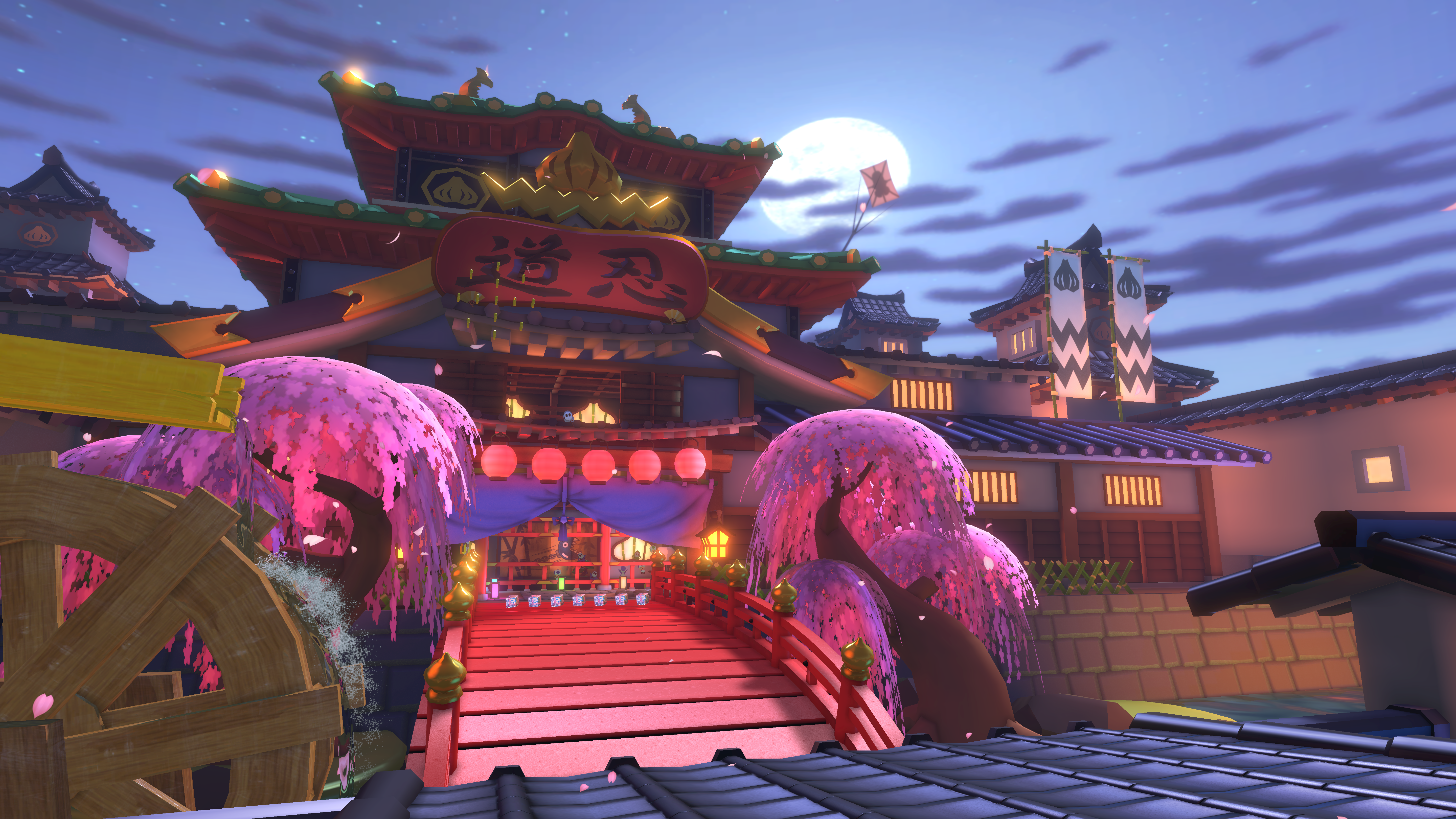
Enlarge/ A preview of what to expect from the rich blues and purples of Ninja Hideaway on MK8D.
The same goes for the three new tracks that had previously been MKT exclusives. The best of these, Ninja Hideaway, is arguably reason enough for Mario Kart addicts to buy the entire BCP outright—it’s honestly that inventive. Despite launching as part of a smartphone-exclusive game, Ninja Hideaway is rich with shortcuts, alternate paths, windy drift corridors, angled end-of-track rooftops, and clever gusts of wind to activate the series’ hang glider mechanic. I’m a big fan of how the track’s design nudges you to fly toward its mildly hidden rafters, then careen over their narrow beams to expose a handy new racing line.
Another Ninja Hideaway angle, showcasing its tricky, angled rooftop section.
Agh, so close to reaching those tricky rafters! You’ll need to ride this course’s gusts of air perfectly to reach them for a very cool shortcut.
It’s also arguably the best indicator for any expansion pack doubters that Nintendo has gone to noticeable lengths to upgrade these tracks’ visuals for Switch’s specs. Textures are far more detailed, particularly in the form of broken-apart stones on some of the main racing lines, while lighting coverage and effects inside the larger, window-lined buildings give each of these scenes more weight. Ninja Hideaway’s colorful-temple constructions are unlike any other Mario Kart track ever made, and they’re met with a memorable, slappa-da-bass funk-music foundation.
New tracks with routing gimmicks, and the glory that is Coconut Mall
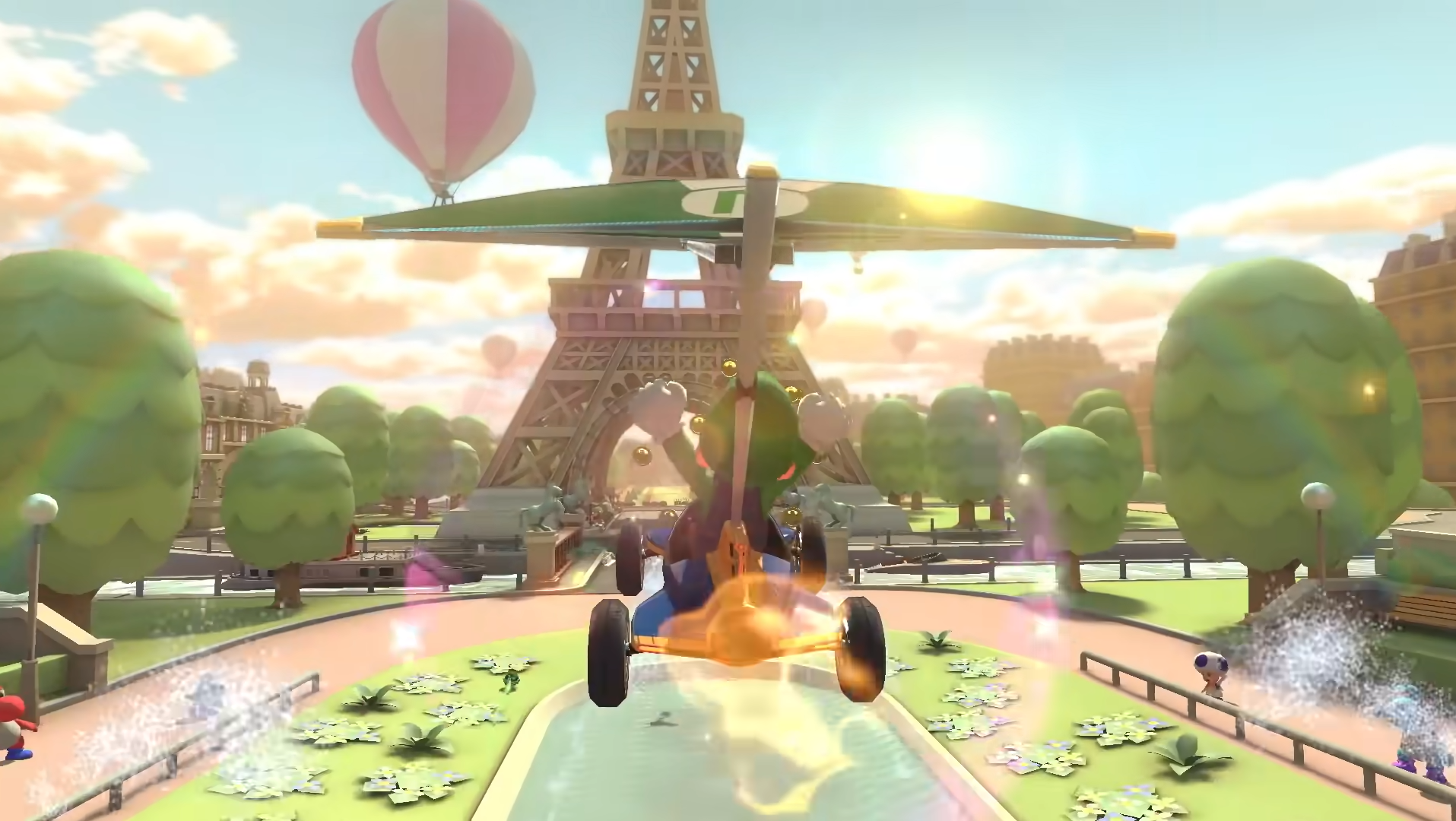
Enlarge/ Paris Promenade, as driven through by Luigi.
The other two MKT tracks in this set, Tokyo Blur and Paris Promenade, feel unremarkable in comparison, since they run on boilerplate racetrack roads. Yet, they share a gimmick: remixed road paths on a lap-by-lap basis. The former opens and closes various gates after each lap, thus changing the layout on the fly, while the latter does something wholly unique in the series: its final lap makes racers U-turn, reverse course, and drive through incoming traffic. As in, you have to drive past other MK8D competitors (either player- or computer-controlled) to win.
This tweak pumps more drama into an average race, and it lets back-of-the-pack racers more directly attack anyone in first place. Ultimately, since both gimmicks aren’t otherwise found in existing MK8D courses, I am glad to see Nintendo drop them into the BCP in its first wave as exciting versus-race options for friends and online lobbies alike.
Touched-up Coconut Mall.
The food court remains!
The beachside view now stretches farther and includes more stuff in the water.
The remaining remixed tracks, meanwhile, range from nostalgia-worthy to ho-hum. The best of these, Coconut Mall, is a beautiful recreation of the Mario Kart Wii original, and its visual touch-ups are absolutely rich. These include a tile-laid mural dedicated to Super Mario Bros. 1, a handsomely reflective window exterior on the track’s opening building, and a sweeping beachside view exposed after taking the course’s biggest hang-glider jump. (Sadly, the old “HAVE A NICE DAY!” sign has been removed for some reason, but the food court remains, and the updated textures and touch-ups on Switch make the Wii original look ancient in comparison.) The track itself is in ain’t-broke-don’t-fix territory, and its mix of escalators, multi-story paths, and indoor-to-outdoor battling zones have me wondering why it took Nintendo nine years to get this game into the MK8 ecosystem.
While Choco Mountain from Mario Kart 64 tugs at the nostalgia heartstrings, its course redesign is identical to the one found on MKT, albeit with a few visual touch-ups here and there compared to the phone version. (Geometry-wise, meanwhile, Choco Mountain remains nearly identical to its Mario Kart DS revision.)
<a href="https://cdn.arstechnica.net/wp-content/uploads/2022/03/mk8bcp-01.png" class="enlarge" data-height="1080" data-width="1911" alt="Sky Garden is a lot less flat in Mario Kart 8 Deluxe.”><img alt="Sky Garden is a lot less flat in Mario Kart 8 Deluxe.” src=”https://rassegna.lbit-solution.it/wp-content/uploads/2022/03/mario-kart-8-deluxes-new-expansion-is-good-so-far-but-is-it-worth-25-3.png” width=”980″ height=”554″>
Enlarge/ Sky Garden is a lot less flat in Mario Kart 8 Deluxe.
Sky Garden was massively revised on MKT compared to its original, flat Game Boy Advance version, and its MKT version appears here, as well. But so far, Switch’s new expansion pack only includes one default version of Sky Garden, even though MKT has a few pumped-up alternate track versions with even wackier fly-through-the-sky gusts and sharper drift-friendly turns. Perhaps Nintendo will eventually add similar “R” and “T” variants to this expansion pack’s full roster as a cheaper way to get up to a whopping 48 tracks.
https://arstechnica.com/?p=1841965
How to become a world-dominating supervillain for a measly $55 billion
<img src="https://rassegna.lbit-solution.it/wp-content/uploads/2022/03/how-to-become-a-world-dominating-supervillain-for-a-measly-55-billion.jpg" alt="Ryan North, creator of Dinosaur Comics, offers a step-by-step guide to becoming the next Lex Luthor in his new book, How To Take Over the World: Practical Schemes and Scientific Solutions for the Aspiring Supervillain.”>
Enlarge/ Ryan North, creator of Dinosaur Comics, offers a step-by-step guide to becoming the next Lex Luthor in his new book, How To Take Over the World: Practical Schemes and Scientific Solutions for the Aspiring Supervillain.
Ryan North, tweaked by Aurich Lawson
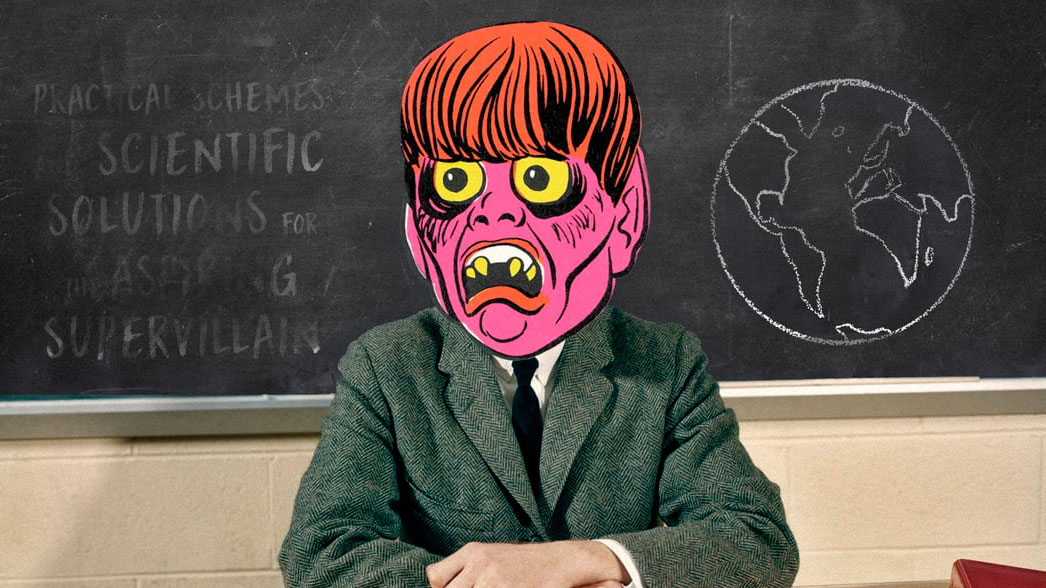
Are you a fan of superhero comics who identifies more with the Big Bad? Do you dream of riding around on your own cloned dinosaur and kicking back after a long day’s evil-doing in your floating, secret supervillain base? Good news: Ryan North has you covered. He’s the author of a new book called How to Take Over the World: Practical Schemes and Scientific Solutions for the Aspiring Supervillain, and there’s frankly nobody better qualified to guide the reader through a step-by-step process toward world domination.
North is something of a webcomic pioneer, having started Dinosaur Comics (aka Qwantz) way back in 2003. The strip’s signature six panels are the same every time, consisting of simple dinosaur clip art that North found on a CD; only the text changes. T-Rex is the main character, with Utahraptor appearing as a comic foil in the fourth and fifth panels. A third dinosaur, Dromiceiomimus, is featured in the third panel. North has said he did it this way because he can’t draw. It’s been a staple of nerdy webcomics ever since.
That early success led to North becoming the writer for several Marvel Comics series, most notably the Eisner Award-winning The Unbeatable Squirrel Girl (a personal favorite) and Jughead. It was only a matter of time before he wrote his first popular science book: the delightfully irreverent (and best-selling) How to Invent Everything: A Survival Guide for the Stranded Time Traveler. In each chapter, North demonstrated how the reader could invent any number of modern conveniences from first principles, as well as answering the burning question of whether it’s possible to tame a giant wombat.
How to Take Over the World takes a similar approach, providing a practical blueprint to help readers become the criminal mastermind of their dreams. The supervillains in comic books invariably get their comeuppance when the superheroes foil their evil plans, but North asked himself: What if the supervillain didn’t have to lose?
In How to Take Over the World, North outlines practical ways to set up a cool secret base; start your own country; hold the weather hostage; destroy the Internet; and become immortal, dutifully summing up the pros and cons of each scheme. And yes, one chapter covers cloning a dinosaur.
“Every supervillain wants to make a good entrance,” North writes. “The best entrance it’s possible to make is on the back of a dinosaur.” The catch: funding. North estimates that aspiring supervillains will need $55,434,551,900 USD to actually bring every scheme in the book to fruition, an amount only 20 people currently living on Earth could afford.
Ars sat down with North to learn more.
<a href="https://rassegna.lbit-solution.it/wp-content/uploads/2022/03/how-to-become-a-world-dominating-supervillain-for-a-measly-55-billion-3.jpg" class="enlarge" data-height="1168" data-width="1200" alt="Dinosaur Comics creator Ryan North with his trusty canine companion, Noam Chompsky. Ryan’s latest book is How to Take Over the World: Practical Schemes and Scientific Solutions for the Aspiring Supervillain.“><img alt="Dinosaur Comics creator Ryan North with his trusty canine companion, Noam Chompsky. Ryan’s latest book is How to Take Over the World: Practical Schemes and Scientific Solutions for the Aspiring Supervillain.” src=”https://rassegna.lbit-solution.it/wp-content/uploads/2022/03/how-to-become-a-world-dominating-supervillain-for-a-measly-55-billion-1.jpg” width=”640″ height=”623″ srcset=”https://rassegna.lbit-solution.it/wp-content/uploads/2022/03/how-to-become-a-world-dominating-supervillain-for-a-measly-55-billion-3.jpg 2x”>
Enlarge/Dinosaur Comics creator Ryan North with his trusty canine companion, Noam Chompsky. Ryan’s latest book is How to Take Over the World: Practical Schemes and Scientific Solutions for the Aspiring Supervillain.
Ars Technica: What was your inspiration for writing about supervillainy?
Ryan North: The first book, How to Invent Everything, used a fictional premise of going back in time and finding your time machine is broken to justify learning about the nonfiction. I really liked that. The fictional coding for this new book was, “OK, so I’m a comic book writer. I’ve come up with all these supervillainous schemes, I’ve written them all down and priced them out, and now we can find out what we actually need to dig to the Earth’s core, have a secret base, ride around on a dinosaur, and all that stuff.” Once you have that fictional premise, it gives you a reason to care about all the cool science and technology.
I like the empowerment one feels at the end. If you read a book about being trapped in the past, you know that if you did get sent back in time, you’d be a really competent time traveler. If you read a book about taking over the world, now you know that if you had $64 billion, then you could work on sending information into deep time or trying to figure out if we could solve the problem of human mortality. The fun of it is what attracted me to the idea.
Ars Technica: Every good superhero needs a good supervillain. Why it that so important, and what makes the best kind of supervillain? In the book you talk about “enlightened supervillainy.”
Ryan North: It’s important because the hero needs someone to fight, to challenge them. The best villains are the ones where you think, “Well, he’s kind of got a point there. He’s going about it the wrong way, but I see where he’s coming from.” That’s the type of villainy I tried to capture in the book. I didn’t want garden-variety villainy where you’re just robbing banks or taking people hostage. That felt too close to the actual, horrible things in the world. I wanted the kind of fantastical supervillainy where you’re taking over a floating base and things like that.
These villains are a lot like the heroes. Both want to change the world and want to do it outside of existing power structures. They see an issue, a problem, that they think they can fix, and they try to do it. A hero does it in a way that is ultimately beneficial to everyone, and a supervillain tends to do it in a bit more of a self-centered way. But the goal is usually similar.
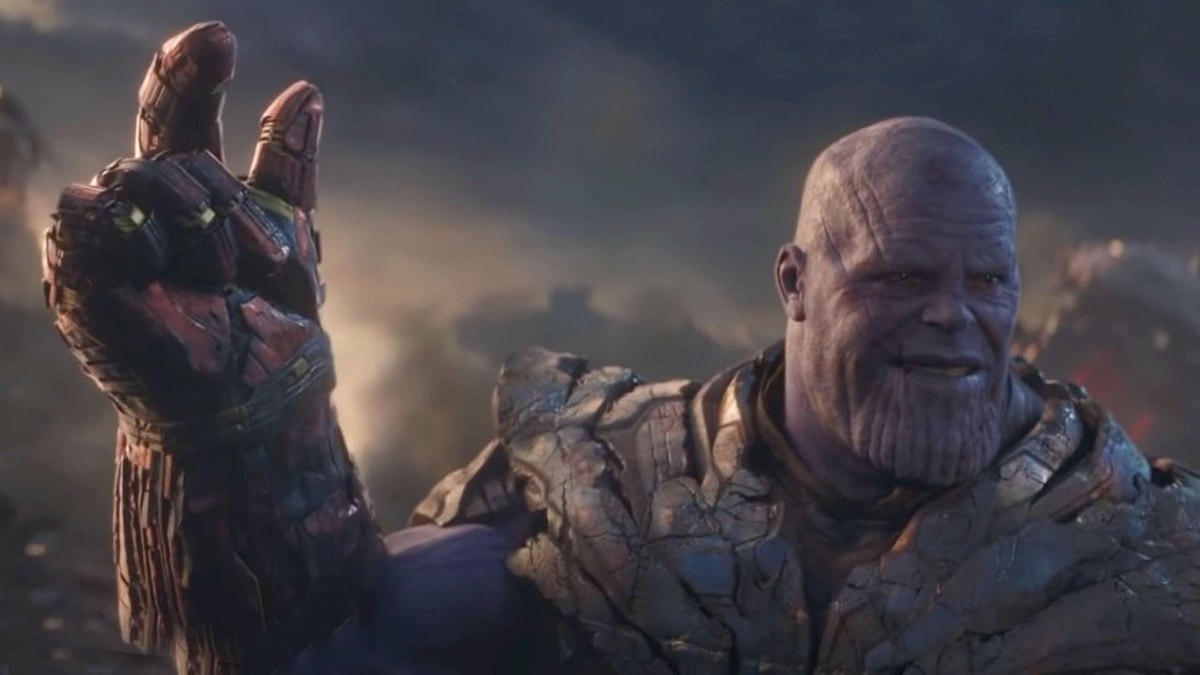
Enlarge/ Ryan sez: The best supervillains are those who make you think they might have a point. #ThanosIsRight.
Marvel Studios
If Spider-Man was trying to stop people from ever having to die, that would be a positive. If Doctor Doom was trying to become a immortal person for his own selfish reasons, that would be a negative for society. Although in the book, I argue that if people were immortal there would be a ton of downsides, and it actually is the most ethical thing to only become immortal yourself and then keep it a secret from everyone else. All the benefits, none of the downsides.
When the PC industry’s two biggest graphics card manufacturers aren’t battling over benchmarks or chip-shortage woes, they’ve been fighting over a different sales pitch: boosting performance for older GPUs. And while Nvidia has nearly won that war, that success has come with an asterisk: its proprietary performance-boosting system, DLSS, requires relatively recent Nvidia hardware.
AMD’s first major retaliation was 2020’s FidelityFX Super Resolution, but this open source, hardware-agnostic option has thus far proven inadequate. And AMD finally seems ready to admit as much in its rollout of FSR 2.0, which debuted in limited fashion on Wednesday ahead of a wider Game Developers Conference reveal next week. FSR 2.0 gets a formal rollout in video games starting “Q2 2022.”
It’s time for temporal solutions
Both FSR and DLSS function in modern games as pixel upscalers. In both cases, games run at a lower base resolution of pixels, and whichever system is active processes and reconstructs the resulting imagery at higher pixel counts. This can include intelligent anti-aliasing (to reduce “stair-stepping” of diagonal lines), blurring, or even wholly redrawn pixels. Ultimately, the dream is that these systems can wisely convert games running at 1440p or even 1080p to something nearly identical to a full 4K signal.
On the most basic level, DLSS’s reconstruction system leans on a dedicated core in Nvidia’s “RTX” line of GPUs, which has been trained on a machine-learning model that has studied thousands of hours of existing video games. DLSS uses additional data to reconstruct its imagery, as well, but its dedicated upscaling core has been the difference maker for games that might otherwise be tricky to upscale. Remedy’s 2019 hit Control remains a standout example of DLSS often looking superior to native, higher-res pixel counts, especially in how it reconstructs complex textures and in-game text.
AMD can’t always compete with DLSS if it relies on a hardware-agnostic upscaler that’s at the mercy of whatever base pixels a game provides. As AMD now admits on its GPU Open news site, “with a low-resolution source, there is just not enough information with a spatial upscaler for thin detail.”
That’s where AMD FSR 2.0 comes in—or, at least, AMD wants us to think so. The update’s biggest addition is a juggle of temporal data (motion vectors, movement within a game, etc.) as a double-edged tool: to anticipate and draw pixels and to replace traditional temporal anti-aliasing (TAA). If that system upgrade sounds familiar, it should: DLSS includes its own temporal pixel interpretation system. Additionally, AMD hints that its system can treat a game’s color data as its own vector to process and upscale. Neither Nvidia nor AMD has publicly described how color-mapping upscale systems work, even though AMD hinted at it so loudly this week.
[embedded content]
AMD FidelityFX Super Resolution 2.0 sample in Deathloop.
So far, the only promising example of the new system in action is a YouTube video. The post shows the FSR 2.0 system more nimbly translating temporal data as the first-person perspective shifts in the 2021 Bethesda game Deathloop. In good news, from what we can tell, FSR 2.0 appears to reduce the blur and pixel dithering that we saw in FSR 1.0’s ugliest in-motion examples from the past year.
https://arstechnica.com/?p=1841896
Putting Elden Ring’s 12 million sales in context
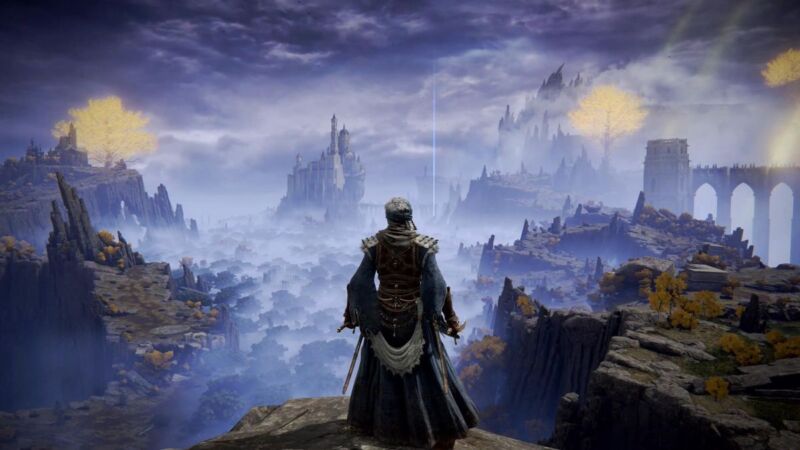
Enlarge/ The lord of all he surveys… in terms of sales, that is.
If you’ve even talked to someone who plays a lot of video games lately, you shouldn’t be surprised that Elden Ring—with its combination of open-world exploration and punishing Souls-like difficulty—is a huge hit. Still, we were taken aback when developer FromSoftware announced last night just how big of a hit the new IP has been already: 12 million worldwide sales as of March 14, just 17 days after the game launched.
That’s obviously a huge number, and FromSoftware is already promising to expand the new franchise “beyond the realm of games.” But just how big is 12 million sales for a game like Elden Ring? And what does it mean for a company that’s been slowly building up a dedicated audience for its Souls-like games for over a decade now?
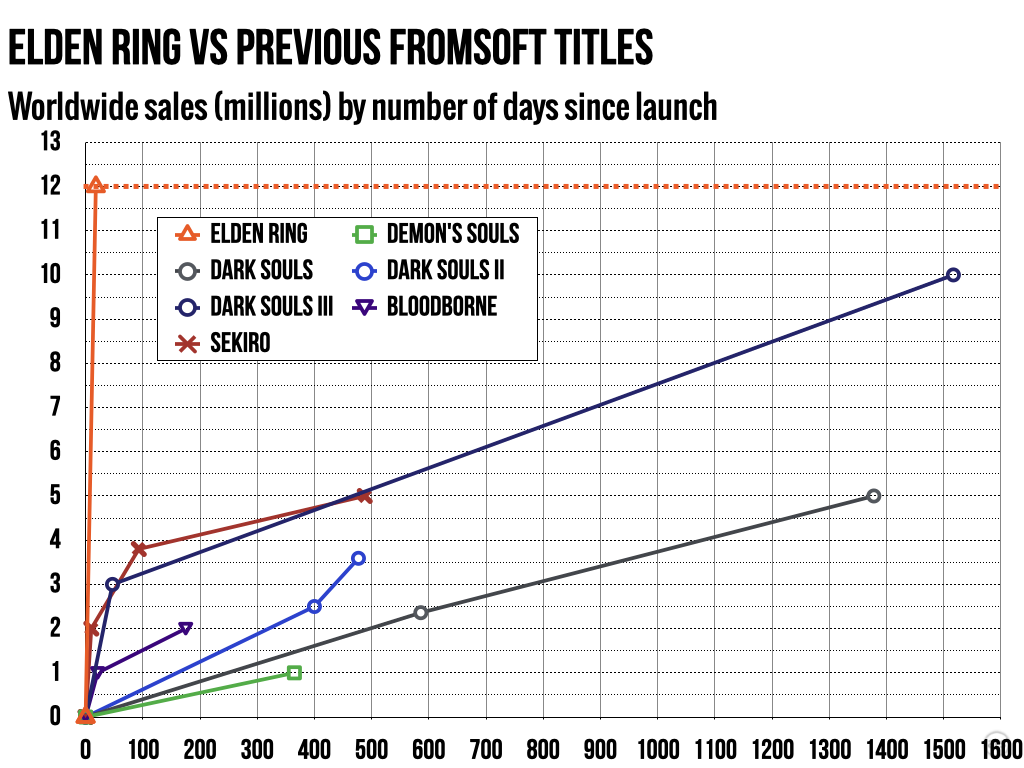
We crunched the numbers to put those 12 million sales into context, as you can see in the graphs below. The comparisons make clear that Elden Ring is more than just a massive hit for FromSoftware. Elden Ring is already one of the most popular open-world games in recent memory.
(Note: All numbers in the graphs below come from official shipment data released or announced publicly by the publishers themselves. This means that info for some titles dries up suddenly when the publisher decides to stop sharing updates on further sales. Some dates are estimates based on when the numbers were first publicized and “more than X” phrasing).
<a href="https://rassegna.lbit-solution.it/wp-content/uploads/2022/03/putting-elden-rings-12-million-sales-in-context-3.png" class="enlarge" data-height="768" data-width="1024" alt="Compared to the rest of the FromSoftware catalog, Elden Ring is in a class by itself.”><img alt="Compared to the rest of the FromSoftware catalog, Elden Ring is in a class by itself.” src=”https://rassegna.lbit-solution.it/wp-content/uploads/2022/03/putting-elden-rings-12-million-sales-in-context.png” width=”640″ height=”480″ srcset=”https://rassegna.lbit-solution.it/wp-content/uploads/2022/03/putting-elden-rings-12-million-sales-in-context-3.png 2x”>
Enlarge/ Compared to the rest of the FromSoftware catalog, Elden Ring is in a class by itself.
As far as FromSoftware’s recent catalog is concerned, Elden Ring is already in a class by itself. In just a few weeks, the new title has outsold each individual game in the Demon’s/Dark Souls series, as well as FromSoftware’s spiritual successors Bloodborne and Sekiro: Shadows Die Twice. (Bloodborne was only released on the PlayStation 4, limiting its potential reach).
Since the original Demon’s Souls in 2011—which sold a respectable but relatively paltry 1 million copies in its first year—FromSoftware has been steadily building a fanbase for its unique brand of action RPGs. Dark Souls III reached 3 million sales just a couple of months after its 2016 release before creeping to 10 million sales by 2020. Sekiro: Shadows Die Twice sold at a similar pace, hitting 5 million sales just over a year after its 2019 launch.
Still, Elden Ring has obviously taken the company to a new tier of sales. At this rate, the single game will quickly outpace the 27 million cumulative sales that the Dark Souls franchise took nearly a decade to amass (as of May 2020).
<a href="https://rassegna.lbit-solution.it/wp-content/uploads/2022/03/putting-elden-rings-12-million-sales-in-context-4.png" class="enlarge" data-height="768" data-width="1024" alt="As far as initial sales go, Elden Ring is already in very exclusive company.”><img alt="As far as initial sales go, Elden Ring is already in very exclusive company.” src=”https://rassegna.lbit-solution.it/wp-content/uploads/2022/03/putting-elden-rings-12-million-sales-in-context-1.png” width=”640″ height=”480″ srcset=”https://rassegna.lbit-solution.it/wp-content/uploads/2022/03/putting-elden-rings-12-million-sales-in-context-4.png 2x”>
Enlarge/ As far as initial sales go, Elden Ring is already in very exclusive company.
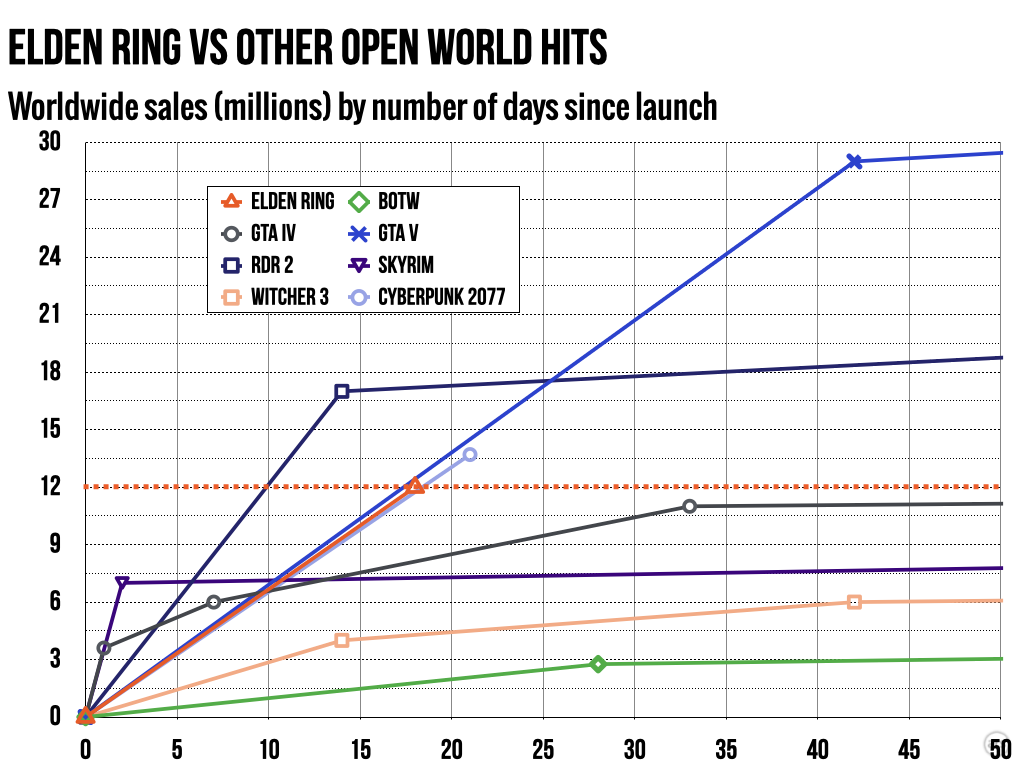
In fact, Elden Ring‘s initial sales pace puts it in the running with some of the best-selling open-world games of the last decade or so. The game is already selling faster out of the gate than Grand Theft Auto IV, Skyrim, The Witcher 3, or The Legend of Zelda: Breath of the Wild did at similar points in their sales cycles (though the last of these was limited by being sold only on the brand-new Switch and the dying Wii U at launch).
<a href="https://rassegna.lbit-solution.it/wp-content/uploads/2022/03/putting-elden-rings-12-million-sales-in-context-5.png" class="enlarge" data-height="768" data-width="1024" alt="Elden Ring could easily be a Red Dead Redemption 2 level mega-hit over the next few years.”><img alt="Elden Ring could easily be a Red Dead Redemption 2 level mega-hit over the next few years.” src=”https://rassegna.lbit-solution.it/wp-content/uploads/2022/03/putting-elden-rings-12-million-sales-in-context-2.png” width=”640″ height=”480″ srcset=”https://rassegna.lbit-solution.it/wp-content/uploads/2022/03/putting-elden-rings-12-million-sales-in-context-5.png 2x”>
Enlarge/Elden Ring could easily be a Red Dead Redemption 2 level mega-hit over the next few years.
The path of Red Dead Redemption 2 might be more instructive for charting Elden Ring‘s future. That Western epic shot out of the gate with 17 million sales in two weeks, besting even Elden Ring‘s pace. Since then, however, sales for RDR2 have slowed to a steady and respectable rate of about 9 million sales per year, leading to 43 million total sales by the end of 2021.
If Elden Ring‘s initial sales are any indication, the game could easily meet or surpass that mark over the next few years. Even if it doesn’t, though, the new franchise is already a massive part of the gaming landscape, and FromSoftware has established itself as one of the most successful developers of the generation.
https://arstechnica.com/?p=1841445
Tunic review: Don’t let Elden Ring overshadow this memorable Zelda-Souls hybrid
<img src="https://rassegna.lbit-solution.it/wp-content/uploads/2022/03/tunic-review-dont-let-elden-ring-overshadow-this-memorable-zelda-souls-hybrid.png" alt="Tunic looks and feels a lot like 8-bit Legend of Zelda. But I assure you, more is going on here.”>
Enlarge/Tunic looks and feels a lot like 8-bit Legend of Zelda. But I assure you, more is going on here.
When I reviewed The Legend of Zelda: Link’s Awakening on Switch in 2019, I lamented its stubborn adherence to the past. I don’t necessarily blame Nintendo for reproducing the Game Boy classic’s elements wholesale, but the remaster’s gorgeous, modern aesthetic, complete with 3D models replacing the original 2D sprites, started turning gears in my head.
Could a modern game have classic-yet-fresh gameplay that feels as good as this remaster looks? I asked myself. What if a beautiful, top-down adventure could both evoke 8-bit Zelda nostalgia and implement more modern mechanics and ideas? In the modern gaming era, we’ve seen all manner of games borrow liberally from Nintendo’s classic adventuring series, but they’ve mostly been on the 3D side.
Enlarge/ A great adventure begins. (Any image in this review with a “60” in its top-left corner was captured by Sam Machkovech on a Steam Deck.)
For more, please flip to a page that you haven’t found yet
<a href="https://cdn.arstechnica.net/wp-content/uploads/2022/03/tunic-manual.jpg" class="enlarge" data-height="800" data-width="1280" alt="This is one of the earliest instruction manual pages you uncover in Tunic. Each page you find includes a flip side, and the other side of this page arguably spoils the game’s earliest progression path, so I didn’t include it.”><img alt="This is one of the earliest instruction manual pages you uncover in Tunic. Each page you find includes a flip side, and the other side of this page arguably spoils the game’s earliest progression path, so I didn’t include it.” src=”https://rassegna.lbit-solution.it/wp-content/uploads/2022/03/tunic-review-dont-let-elden-ring-overshadow-this-memorable-zelda-souls-hybrid-1.jpg” width=”980″ height=”613″>
Enlarge/ This is one of the earliest instruction manual pages you uncover in Tunic. Each page you find includes a flip side, and the other side of this page arguably spoils the game’s earliest progression path, so I didn’t include it.
Andrew Shouldice / Finji
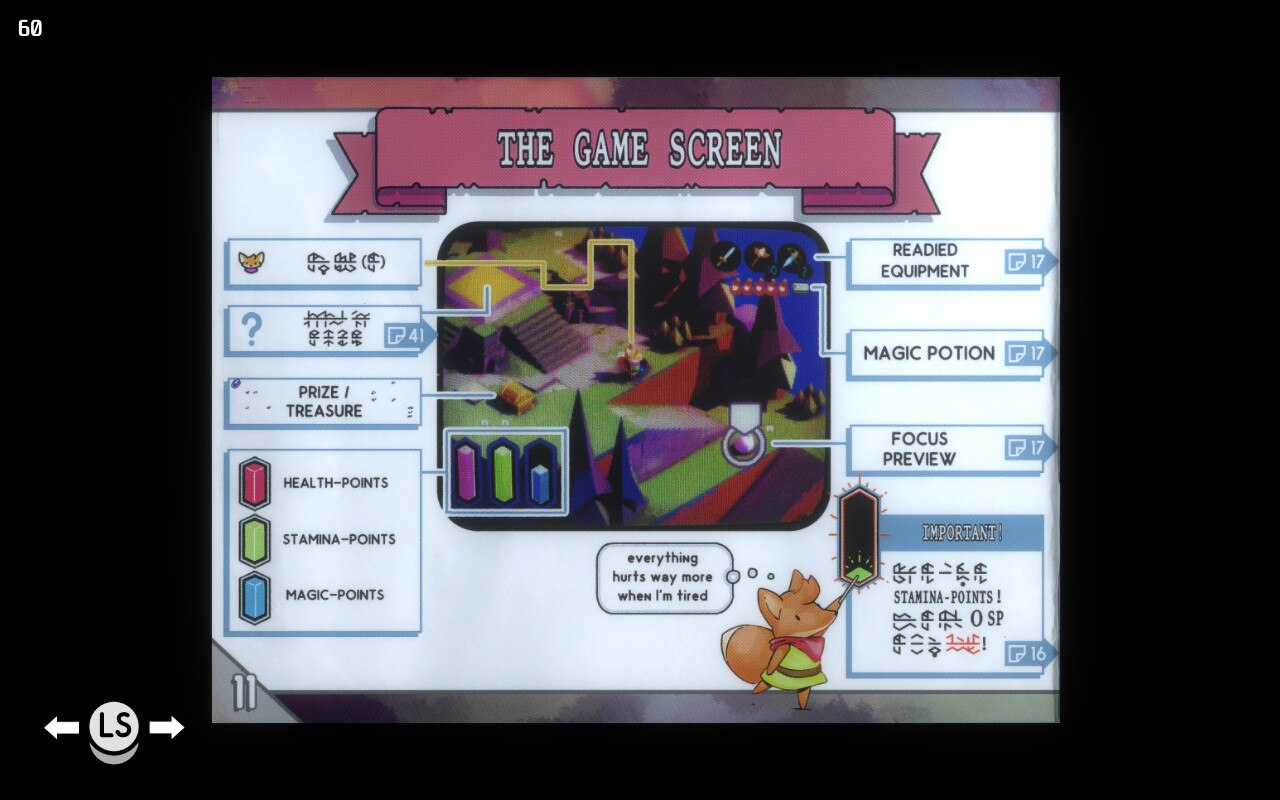
This review, I’m afraid, will be vague out of necessity, as Tunic makes clear in its opening moments that it’s meant to be peeled back one instruction manual page at a time.
That’s not a metaphor. Within minutes of beginning your top-down journey in Tunic as a cartoony, low-poly fox dressed in titular garb, you stumble across a glowing square. Pick it up, and a tiny piece of paper flies toward the screen and fills your view. In terms of size, orientation, and hand-drawn art, the page looks like it’s been ripped from a 1980s NES instruction manual. It’s not page one. And it’s covered in a mix of English words and gibberish characters.
That gibberish appears on signs, as well, but Tunic doles out enough English words to clarify basic directions and instructions. And it evokes enough Zelda-like systems to goad players into running, attacking, and using items, while later instruction manual pages clarify Tunic‘s mechanics at length. In particular, its Souls-like convention of a dodge-roll, as managed by a stamina meter, gets a frame-by-frame breakdown of exactly how a dodge-roll’s timing and temporary invulnerability works. And that explanation, like many others in Tunic, comes with an adorable hand-drawn fox somersaulting across the virtual instruction page.
I played Tunic‘s most recent free demo, which launched last year on Xbox consoles, so I can confirm that its devs responded to player feedback and tweaked combat in the final game to make its early stages feel gentler. Still, these milder sections hint at Souls. Your fox’s health is precious, and while you can storm through baddies haphazardly, that will get your canine killed before long. Stop, study enemy attack patterns, dodge, strike, and survive.
<a href="https://cdn.arstechnica.net/wp-content/uploads/2022/03/TUNIC_Xboxscreenshot_2_1920x1080.png" class="enlarge" data-height="1080" data-width="1920" alt="Within a few hours, Tunic‘s combat begins to seriously ramp up—but thankfully, so does your fox’s arsenal.”><img alt="Within a few hours, Tunic‘s combat begins to seriously ramp up—but thankfully, so does your fox’s arsenal.” src=”https://rassegna.lbit-solution.it/wp-content/uploads/2022/03/tunic-review-dont-let-elden-ring-overshadow-this-memorable-zelda-souls-hybrid-2.png” width=”980″ height=”551″>
Enlarge/ Within a few hours, Tunic‘s combat begins to seriously ramp up—but thankfully, so does your fox’s arsenal.
Andrew Shouldice / Finji
Tunic‘s penalty for death may sound familiar to Dark Souls players: You’ll revive at the last bonfire you touched (which always refills your health and revives non-boss enemies), and a portion of your in-game coins must be recovered from your point of death. This is a bit gentler than Souls, as Tunic doesn’t punish you for not blowing through in-game cash. Which is good, because Tunic takes a while before telling players what its coins do.
Enlarge/ The heck is this thing? An instruction manual page may tip you off before long.
Andrew Shouldice / Finji
The same goes for a lot of what you collect in Tunic. What’s up with this inventory of special coins? What about these square patches with drawings on them? Did I just pick up a potion or a bomb? Tunic‘s doling of items is similar to the blind item variety in Binding of Isaac, though Tunic‘s scattered instructions eventually offer in-game tips, along with a bit of counter-logical advice for how some items work. I found myself delighted every time a newly discovered instruction page essentially told me, “Go ahead, do things that you might assume are wasteful in these games. We’ll take care of you.”
https://arstechnica.com/?p=1841525
A misfit teen’s dream of being a superhero comes true in Ms. Marvel trailer
[embedded content]
Iman Vellani stars as Kamala Khan in the upcoming new MCU miniseries, Ms. Marvel.
Marvel Studios has released the official trailer for its latest MCU spinoff series: Ms. Marvel, starring Iman Vellani as Kamala Khan/Ms. Marvel. Created by Bisha K. Ali and consisting of six episodes, the miniseries will air on Disney+ and help set up the upcoming film, The Marvels, next year.
Ms. Marvel is a relatively recent addition to the world of Marvel Comics, with the distinction of being the first Muslim character to have her own comic book storyline. She appeared briefly in the background of Captain Marvel #14 (2013), and the solo series Ms. Marvel debuted in February 2014. That first volume won a Hugo Award for best graphic story in 2015, and the rapid success and high popularity of the character is what inspired Marvel Studios President Kevin Feige to introduce Ms. Marvel into the MCU Phase Four.
Kamala Khan, aka Ms. Marvel, is a teenage Pakistani American who lives in Jersey City. She’s a major comic books fan, worships Carol Danvers/Captain Marvel, and fantasizes about becoming a superhero herself one day. And then that day arrives. Her powers stem from the Terrigen Mists, released globally in a crossover storyline, the “Inhumanity.” The mists activated dormant Inhuman cells in several people, Kamala included.
Enlarge/ Matt Lintz plays Kamala’s BFF, Bruno Carrelli.
YouTube/Marvel
Marvel announced the planned miniseries during the 2019 D23 conference and offered a first look with early footage during the 2020 Disney Investor’s day. (That footage included clips of Vellani’s audition, as well as the moment she learned she’d won the role.) Per the official premise:
An avid gamer and a voracious fan-fiction scribe, Kamala is a Super Hero mega fan with an oversized imagination—particularly when it comes to Captain Marvel. Yet Kamala feels like she doesn’t fit in at school and sometimes even at home—that is, until she gets super powers like the heroes she’s always looked up to. Life gets better with super powers, right?
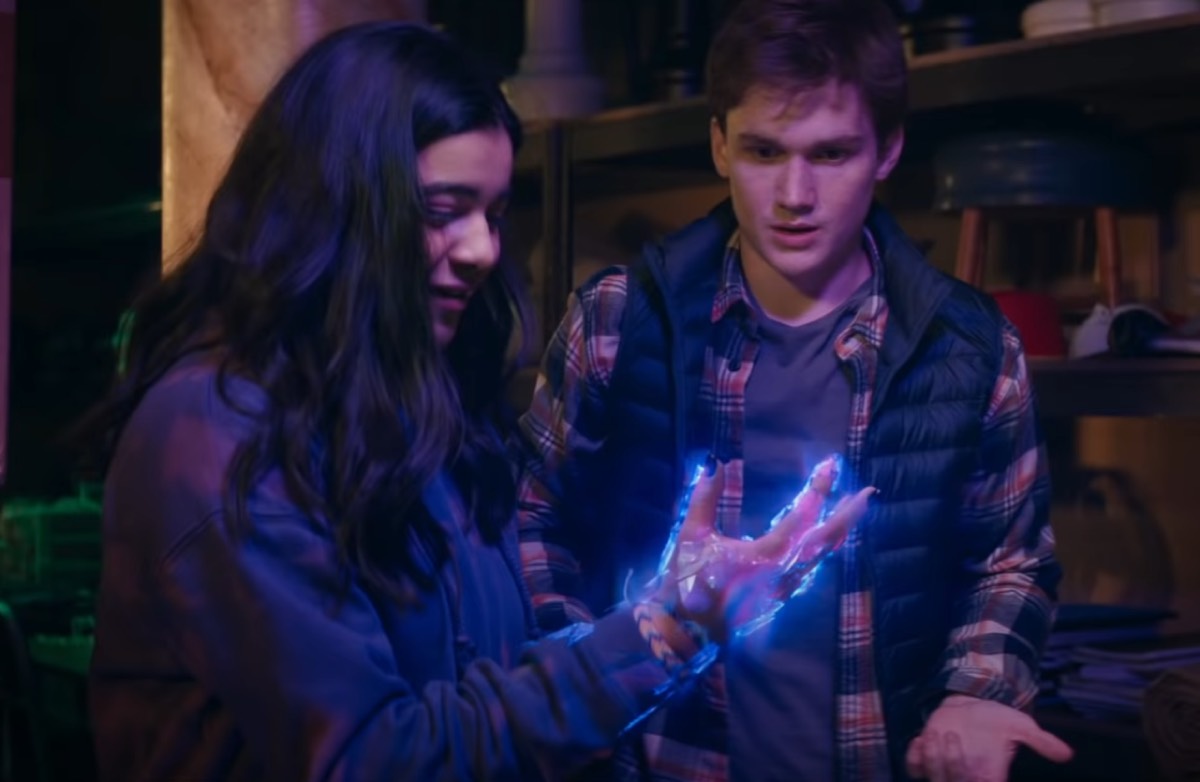
Matt Lintz plays Kamala’s best friend, Bruno; Aramis Knight plays the vigilante Red Dagger (aka Kareem); Rish Shah plays Kamran, the hot guy Kamala crushes on; Saagar Shaikh plays Amir, Kamala’s older brother; and Mohan Kapur and Zenobia Shroff play Yusuf and Muneeba Khan, Kamala’s father and mother, respectively.
Enlarge/ Rish Shah plays Kamala’s hunky high school crush, Kamran, who features prominently in her daydreams.
YouTube/Marvel
Set to the cheery upbeat tempo of The Weeknd’s “Blinding Light,” the trailer opens with a daydreaming Kamala, before morphing into a scene with the high school guidance counselor, who thinks she spends too much time in fantasy land—a sentiment shared by her parents. Of course, Kamala is a nerd who sports superhero T-shirts that earn the ridicule of the resident Mean Girls. When her powers emerge, she tells Bruno that it makes her feel “cosmic” but soon learns that great power often comes with great cost. “I always thought I wanted this kind of life,” we hear her say. “But I never imagined any of this.”
In the comics, Kamala’s main superpower is the ability to elongate herself, stretching parts (or all) of her body to extraordinary lengths. She can shapeshift into other people or objects, shrink down or enlarge her body, and has a healing factor to help her recover from injury. None of those abilities is visible in the trailer. Instead, Kamala seems to be channeling the same kind of energy that animates Carol Danvers/Captain Marvel, suggesting the writers decided to change Kamala’s powers when they brought the character to the screen. Then again, those abilities might show up in some form over the course of the series.
Ms. Marvel debuts on Disney+ on June 8, 2022. Vellani will reprise her role in the upcoming MCU Phase Four film, The Marvels, currently slated for release on February 17, 2023.
Marvel Studios
Listing image by YouTube/Marvel
https://arstechnica.com/?p=1841166
Microsoft promises faster PC game load times with DirectStorage release
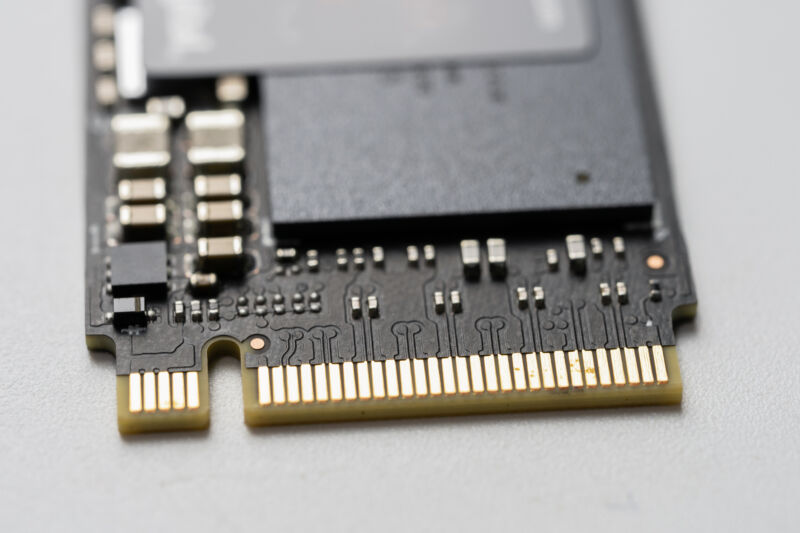
Enlarge/ You’ll need an NVMe SSD to use DirectStorage on Windows.
Getty Images
PC games can now use DirectStorage, a DirectX 12 Ultimate API that Microsoft announced in 2020. The feature is supposed to bring faster loading times and improved textures and draw distances.
The Xbox Series X/S already uses DirectStorage, and in June, Microsoft said it would bring the feature to Windows 11. The storage acceleration API should improve gameplay by bringing instant asset introduction and enabling more vivid virtual landscapes. It works by sending data directly from an NVMe SSD to the graphics card, skipping the CPU and leveraging PCIe 3.0 or PCIe 4.0 speeds, depending on the system.
In a developer blog post today, Microsoft said it is moving DirectStorage out of developer preview and making it available via a public SDK.
Microsoft initially said that Windows 10 wouldn’t support DirectStorage but later backtracked. In today’s post, Microsoft tried to steer PC gamers toward Windows 11, saying that the operating system “has the latest storage optimizations built in” and is the company’s “recommended path for gaming.”
No games support DirectStorage on PC yet, but AMD and game developer Luminous Productions recently demoedForspoken using the feature. The game is expected to release on October 11. Microsoft’s blog said the company would have more to say about PC games supporting DirectStorage “in the future.”
We can expect to see more games implement the feature. Sony has already promoted what a speedy NVMe SSD can do for gaming through the fast-loading universe-hopping in the PlayStation 5’s Ratchet and Clank: Rift Apart. However, not all PC gamers have moved from SATA to NVMe PCIe 3.0 or later SSDs. Microsoft previously said NVMe was necessary because such SSDs “can have multiple queues, and each queue can contain many requests at a time, making [them] a good fit for today’s gaming workloads that tend to be parallel and batched.”