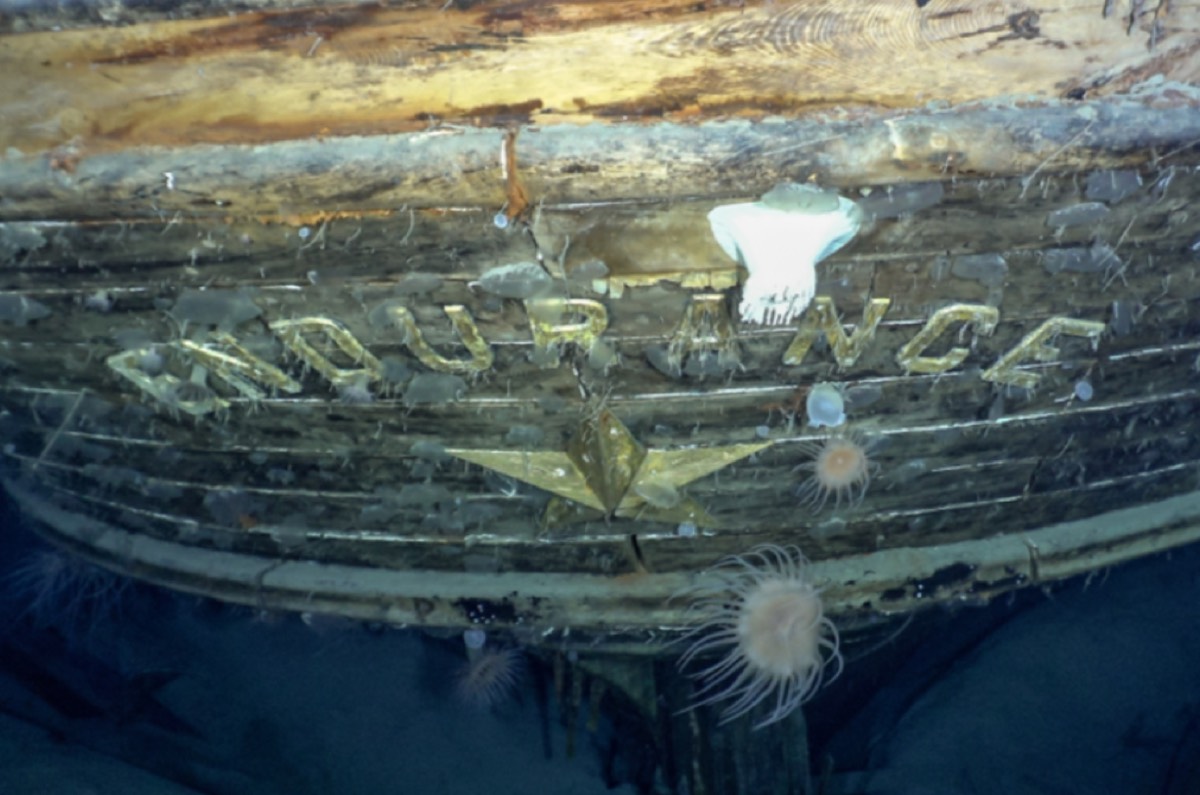
Endurance shipwreck has finally been found in pristine condition

<img src="https://rassegna.lbit-solution.it/wp-content/uploads/2022/03/endurance-shipwreck-has-finally-been-found-in-pristine-condition.jpg" alt="This is the stern of the good ship Endurance, which sank off the coast of Antarctica in 1915 after being crushed by pack ice. The Endurance22 expedition has located the shipwreck in pristine condition after nearly 107 years. “>
Enlarge / This is the stern of the good ship Endurance, which sank off the coast of Antarctica in 1915 after being crushed by pack ice. The Endurance22 expedition has located the shipwreck in pristine condition after nearly 107 years.
Falklands Maritime Heritage Trust/NatGeo

In 1915, intrepid British explorer Sir Ernest Shackleton and his crew were stranded for months on the Antarctic ice after their ship, Endurance, was crushed by pack ice and sank into the freezing depths of the Weddell Sea. Today, the Falklands Maritime Heritage Trust and National Geographic announced the discovery of this famous shipwreck, nearly 107 years later, 3,008 meters down, roughly four miles (6.4 km) south of the ship’s last recorded position.

The shipwreck is in pristine condition partly because of the lack of wood-eating microbes in those waters. In fact, the Endurance22 expedition’s exploration director, Mensun Bound, told The New York Times that the shipwreck is the finest example he’s ever seen; Endurance is “in a brilliant state of preservation.” The expedition has released the first images of the wreck—the first time anyone has laid eyes on Endurance since its sinking a century ago. Bound et al. included shots of the stern (with “ENDURANCE” clearly visible), the rear deck and ship’s wheel, and parts of the deck and hull.

A survival story

Endurance set sail from Plymouth on August 6, 1914, with Shackleton joining his crew in Buenos Aires. By the time they reached the Weddell Sea in January 1915, accumulating pack ice and strong gales slowed progress to a crawl. Endurance became completely icebound on January 24, and by mid-February, Shackleton ordered the boilers to be shut off so that the ship would drift with the ice until the weather warmed sufficiently for the pack to break up. It would be a long wait. For 10 months, the crew endured the freezing conditions. In August, ice floes pressed into the ship with such force that the ship’s decks buckled.

The rear deck and ship's wheel.
Enlarge / The rear deck and ship’s wheel.
Falklands Maritime Heritage Trust/NatGeo

The ship’s structure nonetheless remained intact, but by October 25, Shackleton realized Endurance was doomed. He and his men opted to camp out on the ice some two miles (3.2 km) away, taking as many supplies as they could with them. Compacted ice and snow continued to fill the ship until a pressure wave hit on November 13, crushing the bow and splitting the main mast—all of which was captured on camera by crew photographer Frank Hurley. Another pressure wave hit in late afternoon November 21, lifting the ship’s stern. The ice floes parted just long enough for Endurance to finally sink into the ocean, before closing again to erase any trace of the wreckage.

When the sea ice finally disintegrated in April 1916, the crew launched lifeboats and managed to reach Elephant Island five days later. Shackleton and five of his men set off for South Georgia the next month to get help—a treacherous 720-mile journey by open boat. A storm blew them off course, and they ended up landing on the unoccupied southern shore. So Shackleton left three men behind while he and a companion navigated dangerous mountain terrain to reach the whaling station at Stromness on May 2. A relief ship collected the other three men and finally arrived back on Elephant Island in August. Miraculously, Shackleton’s crew was still alive.

<a href="https://rassegna.lbit-solution.it/wp-content/uploads/2022/03/endurance-shipwreck-has-finally-been-found-in-pristine-condition-4.jpg" class="enlarge" data-height="737" data-width="1200" alt="Parts of the deck and hull of Endurance.”><img alt="Parts of the deck and hull of Endurance.” src=”https://rassegna.lbit-solution.it/wp-content/uploads/2022/03/endurance-shipwreck-has-finally-been-found-in-pristine-condition-2.jpg” width=”640″ height=”393″ srcset=”https://rassegna.lbit-solution.it/wp-content/uploads/2022/03/endurance-shipwreck-has-finally-been-found-in-pristine-condition-4.jpg 2x”>
Enlarge / Parts of the deck and hull of Endurance.
Falklands Maritime Heritage Trust/NatGeo

Shackleton died several years later during the Quest expedition to Antarctica, which set sail in 1921. He never reached the expedition’s planned destination, falling ill in late December just as the ship was about to leave Rio. He had begun drinking heavily to “deaden the pain,” despite not usually allowing alcohol while at sea. The Quest reached South Georgia on January 4, 1922, and Shackleton made his final diary entry before retiring to bed.

By 2 am, he was complaining of back pains and requesting painkillers. Ship physician Alexander Macklin suggested Shackleton might try leading a more normal life. Shackleton asked what Macklin thought he should give up. “Chiefly alcohol, boss, I don’t think it agrees with you,” the physician replied. Then Shackleton “had a very severe paroxysm” and died. The official recorded cause of death was coronary thrombosis.

https://arstechnica.com/?p=1839766


Is Elden Ring really that hard? Well, it depends what you mean by “hard”

Piece of cake.
Enlarge / Piece of cake.

Every time FromSoftware releases a new title, the entire gaming community seems to get wrapped up in the same tired debates about game difficulty. One side complains that games like Dark Souls and Bloodborne are just too hard for their own good and that only masochists enjoy games that punish players for every little mistake. On the other side, die-hard FromSoftware fans will argue vehemently that the games aren’t really that difficult if you just play them correctly.

The release and massive success of Elden Ring has predictably revived those debates, leading to familiar and circular arguments. To help end the bickering, we’ve tried to break down the vast and loaded concept of “difficulty” in video games into an Ars Difficulty Matrix (™) consisting of five noncomprehensive subcategories.

We’ve laid out the elements of that matrix below, and for each element, we’ve tried to explain how Elden Ring fits into the history of game design. In doing so, we hope to show that Elden Ring can be both brutally difficult and incredibly easy. It all depends on what, exactly, you mean by “difficulty.”

Mechanical difficulty

Mechanical difficulty simply refers to the way games require players to hit a certain set of buttons in a certain timing window to complete the next objective. This form of difficulty is also sometimes referred to as a “reflex test.”

Mechanical difficulty has a very long history in gaming. Classic arcade games overwhelmingly relied on increasingly difficult reflex tests to weed out players and force them to put in another quarter. Early console games often did something similar, using demanding mechanical challenges to increase the play time on cartridges with limited storage space. When people talk about games being “Nintendo Hard,” they’re usually talking about mechanical difficulty.

While pure mechanical difficulty isn’t as popular in games as it once was, it still features prominently in platformers like Super Meat Boy, Celeste, or the so-called “Kaizo Mario” ROM hacks, to name just a few.

Looks relaxing, doesn't it?
Enlarge / Looks relaxing, doesn’t it?

Compared to games like that, Elden Ring just isn’t very mechanically difficult. Most enemies telegraph their attacks with massive, seconds-long animations that give players plenty of time to react with a well-timed dodge, block, or parry. Some of the game’s platforming sections require precision double-jumps on a horse, but most of them are optional. While you can’t just button-mash your way to victory in Elden Ring, you don’t need preternatural hand-eye coordination to make progress either.

But while each individual block and attack may not be mechanically difficult, Elden Ring can require a lot of focus and endurance to chain those moves together into a successful battle (or series of battles). That’s especially true when multiple enemies gang up to attack you from all sides. So moves in Elden Ring are kind of like pushups; performing one is child’s play, but performing 100 in a single chain can be torture.

Which brings us to…

Punishing difficulty

This side of the Ars Difficulty Matrix measures how much penalty you pay for failure to complete an objective. How many mistakes do you get before facing the words “game over”? And when you do get a “game over,” how much progress do you lose?

In a title like Spelunky, a single mistake can mean restarting your entire run from the absolute beginning. On the other end, Quantic Dream games like Heavy Rain or Detroit: Become Human don’t have a “failure” state in the first place. They simply adapt the ongoing story to whatever you decide to do.

When people say Elden Ring and other FromSoftware games are difficult, the word those gamers are actually looking for is “unforgiving.” FromSoftware makes games where one false move against even minor enemies can cost you a significant chunk of your health bar or even lead to instant death.

While Elden Ring is a bit more generous than its predecessors with the flasks that can refill your health bar away from a checkpoint, using those flasks requires pausing for a lengthy animation that can open you up to a merciless counterattack if you’re not careful. And that doesn’t even get into the situations where you simply roll off a ledge and tumble hilariously to your death.

https://arstechnica.com/?p=1839505


Valve does what FromSoftware don’t, thanks to Steam Deck’s precaching update

A handheld video game console displays a high-resolution video game.


While Elden Ring‘s recent launch has been a massive critical and commercial success, it continues developer FromSoftware’s streak of leaving players in a technical lurch. Even on the newest Xbox and PlayStation consoles or the highest-end PCs, Elden Ring still manages to turn in somewhat unsteady performance for various reasons.

In the case of one unoptimized aspect of the game’s PC version, someone outside FromSoftware has swooped in to save the day. Usually, this kind of PC gaming story comes thanks to enterprising modders from the gaming community at large. In Elden Ring‘s case, however, the fix comes courtesy of an unlikely source: Valve, the massive company who runs the Steam storefront.

And Valve’s fix, so far, only works on Steam Deck.

Compiling more stutter than shaders

Shortly after Elden Ring‘s launch last month, Digital Foundry correspondent Alex Battaglia delivered a comprehensive look at Elden Ring‘s PC version and found that, no matter what PC he tested with, Elden Ring exhibited frequent, erratic frame-rate stuttering. Even his highest-end PC (Intel Core i9 10900K, RTX 3090), running the game at a paltry 720p resolution with all settings at their lowest, suffered from the same stuttering.

How is that happening on a thousands-of-dollars PC? As Battaglia says, Elden Ring exclusively runs on Windows 10’s DirectX 12 API, which “takes away the responsibility of the game’s memory management threading away from the driver.” As his team at Digital Foundry has comprehensively shown in the past, a game that has not been “fully baked” before it starts running can send players into a universe of constant shader-compilation stutter.

Elden Ring suffers terribly from this in its default state on PC. The game halts to generate the crucial parts of any new event: a new animation, a new enemy, a new explosion type, and so on.

<a href="https://cdn.arstechnica.net/wp-content/uploads/2022/03/elden-ring-crab.jpg" class="enlarge" data-height="1440" data-width="2560" alt="You probably don't want Elden Ring to stutter the first time it generates this massive murder-crab’s animations.”><img alt="You probably don't want Elden Ring to stutter the first time it generates this massive murder-crab’s animations.” src=”https://rassegna.lbit-solution.it/wp-content/uploads/2022/03/valve-does-what-fromsoftware-dont-thanks-to-steam-decks-precaching-update.jpg” width=”980″ height=”551″>
Enlarge / You probably don’t want Elden Ring to stutter the first time it generates this massive murder-crab’s animations.
FromSoftware

The same thing can happen in games that lean on the Vulkan API, as well. Avid PC gamers have likely run into games that pause either upon their first boot or after any major changes (patch downloads, manual graphics toggles) to compile shaders. Forza Horizon 4 and 5 are both popular examples of this in action on PC. Their shader compilation process is so long, you may as well go brew a cup of tea while you wait. But the wait pays off: your game isn’t interrupted whenever a new thing emerges in its massive, virtual world.

Since Elden Ring is FromSoftware’s largest open-world game yet, stuttering isn’t an issue that can be shrugged off. Nobody wants to be killed because a game-freezing stutter allowed a massive, detached, eight-finger hand to go from far away to in your face. So far, FromSoftware has not announced any plans to directly address Elden Ring‘s frame-rate stutter on PC, though the developer did mention a “frame rate phenomenon” in a blog post shortly after the game’s launch.

https://arstechnica.com/?p=1839496


Stonehenge may be ancient solar calendar

A new theory holds that Stonehenge served as an ancient solar calendar.
Enlarge / A new theory holds that Stonehenge served as an ancient solar calendar.
Timothy Darvill/Bournemouth University

Scholars have long speculated that the famed prehistoric monument Stonehenge might have served as some kind of calendar that helped local people predict eclipses, summer and winter solstices, the equinox, and other relevant celestial events. Now, a British archaeologist has concluded that the site was designed as a solar calendar, and he describes his system in a recent paper published in the journal Antiquity.

“Finding a solar calendar represented in the architecture of Stonehenge opens up a whole new way of seeing the monument as a place for the living—a place where the timing of ceremonies and festivals was connected to the very fabric of the universe and celestial movements in the heavens,” Bournemouth University archaeologist Timothy Darvill said.

Stonehenge is located on Salisbury Plain in Wiltshire, England. It consists of an outer circle of vertical sandstone slabs (sarsen stones), connected on top by horizontal lintel stones. There is also an inner ring of smaller bluestones and, within that ring, several free-standing trilithons (larger sarsens joined by one lintel). Radiocarbon dating indicates that the inner ring of bluestones was set in place between 2400 and 2200 BCE. But the standing arrangement of sarsen stones wasn’t erected until around 500 years after the bluestones.

No contemporary written records exist concerning the monument’s construction, and scholars have pondered its likely use and cultural significance for centuries. Stonehenge’s form (and maybe its purpose) changed several times over the centuries, and archaeologists are still trying to piece together the details of its story and the stories of the people who built it and gathered in its circles.

Stonehenge as viewed from the northeast, showing the post-and-lintel construction of the Sarsen Circle.
Enlarge / Stonehenge as viewed from the northeast, showing the post-and-lintel construction of the Sarsen Circle.
Timothy Darvill

Darvill, for instance, has championed the hypothesis that Stonehenge was a place of healing. Alternatively, University College London archaeologist Michael Parker Pearson speculates that the site was part of a broader ritual landscape, serving as a funerary monument (a possibility first proposed in the 12th century by Geoffrey of Monmouth). People apparently buried their dead (after cremation) at the site for several centuries. Those burial sites are located in the circle of pits now called the Aubrey holes.

In 2019, Parker Pearson and several colleagues reported the results of their investigation into the quarry source for the bluestones. They found that the 42 bluestones came all the way from western Wales. Chemical analysis has even matched some of them to two particular quarries on the northern slopes of the Preseli Hills.

One quarry, an outcrop called Carn Goedog, seems to have supplied most of the bluish-gray, white-speckled dolerite at Stonehenge. And another outcrop in the valley below, Craig Rhos-y-felin, supplied most of the rhyolite. When another group of archaeologists studied the chemical isotope ratios in the cremated remains of people once buried beneath the bluestones, those researchers found that many of those people may have come from the same part of Wales between 3100 and 2400 BCE.

One of the smaller sarsen stones in the circle.
Enlarge / One of the smaller sarsen stones in the circle.
Timothy Darvill

But the sarsen stones hail from much closer to home. Since the 1500s, most Stonehenge scholars have assumed the sarsen stones came from nearby Marlborough Downs, an area of round, grassy hills 25 to 30km (17 miles) north of Stonehenge which has the largest concentration of sarsen in the UK. A 2020 study by University of Brighton archaeologist David Nash and colleagues confirmed that.

As Kiona Smith reported for Ars at the time:

About 99 percent of the average sarsen boulder is silica, but the other 1 percent contains trace amounts of other elements, like aluminum, calcium, iron, potassium, magnesium, and others. That extra material is different in different sarsen sources, as it depends on the minerals in the ground where the rock formed. Nash and his colleagues used those trace elements as a geochemical fingerprint to match the Stonehenge sarsens to their most likely source.

Nash and his colleagues used portable X-ray fluorescence to analyze the chemical makeup of all 52 sarsens at Stonehenge (the only survivors of the 80 sarsens that once stood at the site). Each element emits a slightly different wavelength of light when hit by X-rays, and by measuring those emissions, researchers can map the composition of an object without damaging it.

https://arstechnica.com/?p=1837358


Rosario Dawson hunts for her son as Second Civil War rages in DMZ trailer

[embedded content]
Rosario Dawson stars in HBO Max’s new miniseries, DMZ, based on the comic book series of the same name.

Rosario Dawson stars as a woman hunting for her missing son in the dystopian ruins of Manhattan in DMZ. The new miniseries is based on the comic book series created by Brian Wood and illustrated by Riccardo Burchielli. Part of the show will premiere during SXSW this month before landing on HBO Max. The official trailer just dropped, and it seems to be equal parts Escape from New York and FX/Hulu’s Y: The Last Man.

(Some mild spoilers for the comic books below.)

Published from November 2005 through February 2012, Wood and Burchielli’s comic book series is set in a near future in which the US has been devastated by the Second American Civil War, and Manhattan has turned into the demilitarized zone of the title. Only about 400,000 people remain on the island, mostly people too poor to evacuate, snipers associated with various factions, and stubborn holdouts who just refuse to leave. (The comics are very New York-centric, inspired by Wood’s experiences living in NYC in early 2003—i.e., the aftermath of 9/11 and US invasion of Iraq.)

The US government’s forces are at war with the Free States of America, which is more of an “idea” than a geographically specific entity. The movement started as a series of grassroots revolts against the federal government’s focus on foreign wars while the infrastructure of America’s cities and states crumbles. The two forces are at a standoff, complicated by several rogue factions. These include a private military contractor; DMZ militias formed by the remaining residents; Wilson’s Triads, a criminal organization operating out of Chinatown; former soldiers who make up the Central Park Ghosts; the Fur Hat Militia; and a combined political party/militia group called Delgado Nation, loyal to the elected populist “governor” of the DMZ, Parco Delgado.

The main protagonist in the comics is photojournalist Matty Roth, who goes into the DMZ with a film crew for the fictional Liberty News Network as a war correspondent. They are attacked by militia, and a wounded Matty ends up stranded in the DMZ. Fortunately, a former medical student named Zee Hernandez treats his wounds and ends up being his guide in the DMZ. Matty is soon sucked into Delgado Nation, eventually leading his own military unit and mistakenly massacring a group of civilians. His actions turn him into a pariah and haunt him for the rest of the series.

Benjamin Bratt plays populist leader Parco Delgado, "governor" of the DMZ.
Enlarge / Benjamin Bratt plays populist leader Parco Delgado, “governor” of the DMZ.
YouTube/HBO Max

Syfy was interested in adapting the comic book series back in 2014, but nothing concrete seems to have come of it, and in October 2019, HBO Max announced its own miniseries. HBO hired Roberto Patino, best known for his work on Westworld and Sons of Anarchy, to create it. Ava DuVernay (Selma, When They See Us) signed on as executive producer and also directed the pilot episode.

Based on this trailer, the miniseries is deviating substantially from the comic series by focusing on Dawson’s character, Alma Ortega, who seems to be loosely based on Zee. Benjamin Bratt plays Parco Delgado, and Hoon Lee (Warrior) plays what looks like a version of Wilson, head of the Chinatown triads. The cast also includes Freddy Miyares, Venus Ariel, Jade Wu, Rey Gallegos, Agam Darshi, Juani Feliz, Rutina Wesley, Mamie Gummer, Nora Dunn, and Henry G. Sanders. None of them is playing Matty Roth, so who knows if the character will even appear?

All four episodes of DMZ will debut on HBO Max on March 17, 2022. We’ll have to see if there’s an appetite for a dystopian near-future where the US has been ripped apart by another civil war, given recent real-world events.

Listing image by YouTube/HBO Max

https://arstechnica.com/?p=1838833


A 3,600-hour Nintendo Switch OLED test gets to the bottom of burn-in

<img src="https://rassegna.lbit-solution.it/wp-content/uploads/2022/03/a-3600-hour-nintendo-switch-oled-test-gets-to-the-bottom-of-burn-in.jpg" alt="Go on, leave your Switch OLED on nonstop for 3,000 hours and more. It may not be the best idea, but at least one tester in the wild has found it takes that many hours before the screen is negatively impacted.”>
Enlarge / Go on, leave your Switch OLED on nonstop for 3,000 hours and more. It may not be the best idea, but at least one tester in the wild has found it takes that many hours before the screen is negatively impacted.
Aurich Lawson

For many Nintendo fans, the launch of the Switch OLED in late 2021 was a welcome upgrade that provided a bigger screen and richer colors. But some people were concerned with the company putting an OLED panel on a portable system due to fears of image retention or outright image burn-in.

Thankfully, my prerelease testing of Switch OLED, which included hours-long tests of static Zelda images, didn’t permanently burn any Zelda heart icons onto the screen, and anecdotal testing in the months since has looked positive. But what if that isn’t comforting enough? What if you need an extreme test to know exactly how well the Samsung-manufactured panels in the Switch OLED consoles resist all forms of burn-in and image retention?

Seen by the eyes of a Wulff

On the system’s launch day, YouTube tech critic and Twitch host Bob “WulffDen” Wulff began an experiment to conclusively answer this question, and five months later, he has published the latest video in his series on the topic. The console he tested, as put through an extreme test case that average gamers would never approach, needed 3,600 hours of nearly nonstop projection of a single image to show any signs of OLED burn-in.

Wulff’s conclusion came after months of leaving a portable Switch OLED screen frozen on a Zelda: Breath of the Wild image while set to maximum brightness, with occasional interruptions to check for signs of burn-in. His last formal check-in, posted on YouTube in December, concluded that his extreme test left the Switch OLED’s screen seemingly pristine after a whopping 1,800 hours of uninterrupted runtime.

Another 1,800 hours later, Wulff finally noticed small “ghosting” images on the panel. As his latest video reveals, these ghosting outlines are sometimes discernible during gameplay, but they’re easier to see when the tested Switch OLED displays a full-screen image of a single color. These retained outlines are visible even from a zoomed-out perspective, though curiously, Wulff doesn’t focus on the static UI elements in Breath of the Wild, like heart icons or a d-pad selector for items, that tend to inspire the most fears of burn-in.

<a href="https://cdn.arstechnica.net/wp-content/uploads/2022/03/Screenshot-10816.png" class="enlarge" data-height="1440" data-width="2560" alt="Breath of the Wild‘s silhouette appears as a ghost on this all-purple image.”><img alt="Breath of the Wild‘s silhouette appears as a ghost on this all-purple image.” src=”https://rassegna.lbit-solution.it/wp-content/uploads/2022/03/a-3600-hour-nintendo-switch-oled-test-gets-to-the-bottom-of-burn-in.png” width=”980″ height=”551″>
Enlarge / Breath of the Wild‘s silhouette appears as a ghost on this all-purple image.

Switch systems in portable mode don’t include mitigations for burn-in like pixel shifting or screen dimming; instead, the Switch enforces an automatic screen turn-off when it doesn’t detect button input for five minutes. Anyone doing battery or screen testing, then, must figure out how to engage button taps while stepping away, which Wulff did by using a third-party Joy-Con with rapid-fire functionality.

Good news for more than just Switch

As far as his tested Switch is concerned, Wulff doesn’t seem very bothered by the slightly noticeable ghosting image: “It’s still a little subtle, not anything that I’d probably do an RMA request for,” he says in his latest video. But Wulff thinks he can push this console further by leaving the test active, which he says he will continue to do to see if he can bring the system to “an unplayable state.”

This test has welcome implications for a lot of tech products besides the Nintendo Switch, particularly popular smartphones from companies like Apple and Samsung. UI elements on smartphones are much more likely to leave a thousands-of-hours impression than the same on a gaming platform. Switch players are likely to swap between the likes of Zelda, Mario Kart, and Pokemon, while smartphone owners are typically going to see the same fingerprint reader icon, on-screen keyboard, and top-of-screen UI on a daily basis.

If the Switch OLED can withstand over 3,000 hours without the aid of burn-in-prevention measures, the odds are good that TVs, phones, and electronics products will do just as well with current-generation OLED panels. Wulff’s test shouldn’t be taken as proof that all OLED panels are made equal in 2022 and beyond, and you may want to keep an eye on product teardowns to determine who is making your favorite device’s OLED screen and whether its model number is brand new. But it’s at least one further point on the side of OLED being an easier-to-trust technology as far as image retention goes.

At Ars Technica, we have at least one example of an OLED TV released before 2020 that succumbed to mild burn-in—a competitive online shooter’s UI continued to hover as a ghost image over other games and TV content. We also vividly recall LG’s bad reputation for smartphone OLED panels as far back as 2017. But many staffers haven’t reproduced such an annoying burn-in example on an OLED set, and newer TV and smartphone OLED screens have added nifty features to mitigate the possibility of such issues.

[embedded content]
Bob Wulff’s Switch OLED test, after 3,600 hours.

https://arstechnica.com/?p=1838687


Report: Apple mulling bid for NFL Sunday Ticket package

Derek Wolfe #95 and Von Miller #58 of the Denver Broncos celebrate after Wolfe sacked Tom Brady #12 of the New England Patriots in the AFC Championship game at Sports Authority Field at Mile High on January 24, 2016 in Denver, Colorado.
Enlarge / Derek Wolfe #95 and Von Miller #58 of the Denver Broncos celebrate after Wolfe sacked Tom Brady #12 of the New England Patriots in the AFC Championship game at Sports Authority Field at Mile High on January 24, 2016 in Denver, Colorado.
Dustin Bradford | Getty Images

The past two decades have seen Apple transform itself from a maker of expensive computers to a hardware, software, and entertainment Goliath. Live sports may be next on the agenda—according to a report in Front Office Sports, Apple is eying a multibillion-dollar bid for the National Football League’s Sunday Ticket package.

Sunday Ticket, which broadcasts out-of-market NFL games, has been carried by Directv since its launch in 1994. The rights to Sunday Ticket expire after the 2022 season, and with Directv hemorrhaging both subscribers and money, Sunday Ticket is going to have a new home for the 2023 season.

In addition to selling the rights to Sunday Ticket, the NFL is also seeking an investment partner for NFL Media, which includes the league’s website, NFL Network, and NFL RedZone. Apple would also become a minority shareholder in NFL Media, in addition to getting the streaming rights to out-of-market NFL games.

Last year, the NFL locked up its current broadcast partners into new contracts totaling $9 billion annually. Amazon also secured rights to the Thursday night slate of games for another $1 billion per year.

Apple will need to pay dearly to get in on some NFL action. Not only does the expiring Sunday Ticket agreement cost Directv $1.5 billion annually, but some of the league’s broadcast rightsholders saw their costs almost double under the new contracts, which run through the 2033 season. Add a 49 percent stake in NFL Media to the equation, and Apple would surely be paying north of $3 billion per year for a business partnership with the most popular professional sports league in the United States.

That’s chump change for a company with over $200 billion of cash and securities on hand.

While Apple has also been in negotiations with Major League Baseball to stream weekday regular-season games, a deal with either the NFL or MLB would mark its first foray into live sports. With the likes of Netflix, Hulu, HBO Max, and Amazon Prime constantly churning out new scripted programming, streaming live sports would give Apple another way to differentiate itself from the competition, resulting more subscribers… and more money.

https://arstechnica.com/?p=1838582


Activision employee suicide was spurred by workplace harassment, lawsuit says

Activision's publishing HQ in Santa Monica, California.
Enlarge / Activision’s publishing HQ in Santa Monica, California.

The parents of former Activision employee Kerri Moynihan have filed a wrongful death lawsuit against Activision Blizzard, alleging that the harassment she suffered working at the company contributed to her 2017 suicide at a corporate retreat.

The Los Angeles Superior Court lawsuit, which was filed Thursday and was initially reported by The Washington Post, alleges that the hostile work environment Moynihan was subjected to during her time at the Activision finance department contributed to her untimely death in 2017 at age 32. That death, which the lawsuit says was ruled a suicide by the Orange County coroner, came during an Activision company retreat at Disney’s Grand Californian Hotel & Spa.

The new lawsuit quotes heavily from the California Department of Fair Employment and Housing lawsuit filed against Activision last July. That earlier suit is used to establish that the company “fostered and permitted a sexually hostile work environment to exist in which female employees were routinely sexually harassed, belittled, disparaged, and discriminated against, and Activision failed and refused to take corrective action or reasonable steps to prevent that harassment.”

While Moynihan is not mentioned by name in the DFEH suit, the new lawsuit brought by her parents suggests that one anonymous story shared by the DFEH describes their daughter’s experience (warning, graphic content):

In a tragic example of the harassment that Defendants allowed to fester in their offices, a female employee committed suicide while on a company trip due to a sexual relationship that she had been having with her male supervisor… Another employee confirmed that the deceased female employee may have been suffering from other sexual harassment at work prior to her death. Specifically, at a holiday party before her death, male co-workers passed around a picture of the deceased’s vagina.

Moynihan’s parents say in the suit that they were not aware of the alleged harassment their daughter faced until the DFEH suit was made public last year.

“We are sickened by the reprehensible conduct of the DFEH to drag into the complaint the tragic suicide of an employee whose passing has no bearing whatsoever on this case and with no regard for her grieving family,” Activision Blizzard said in a statement issued shortly after the DFEH lawsuit became public last summer.

A relationship “against company policy”

The “male supervisor” cited in that DFEH story, according to the new lawsuit, is Greg Restituito, who worked as a senior finance director for Activision at the time of Moynihan’s death, according to his LinkedIn profile. Restituito, who was “married and had a newborn son,” according to the lawsuit, allegedly started a sexual relationship with Moynihan in the fall of 2016—a relationship with a subordinate that the lawsuit suggests was “contrary to Activision policy.”

Restituito’s one-year tenure at the company ended in May 2017, according to his LinkedIn profile, just weeks after Moynihan’s death. During the investigation into her death, Restituito allegedly initially lied about his relationship with Moynihan until admitting to it during a second interview with police. Restituito did not immediately respond to a message seeking comment.

Over the course of that police investigation, which the lawsuit calls “perfunctory and incomplete,” Activision allegedly “refused to turn over Kerri’s work-issued laptop to the LAPD, refused to give them access to Restituito’s work-issued laptop, refused to give them access to Restituito’s work-issued cell phone, and told the police that Restituito’s cell phone had been ‘wiped.'”

Further, the suit alleges that Activision’s “failure to take immediate, suitable, and effective corrective action and/or all reasonable steps to prevent that workplace sexual harassment” was “a substantial factor in causing harm to Kerri, including, without limitation, humiliation, embarrassment, belittlement, sadness, discomfort, emotional distress, mental anguish, and pain and suffering, all to her detriment and damage, tragically culminating in Kerri’s death at the age of 32.”

In a statement provided to The Washington Post, an Activision Blizzard spokesperson said the company is “deeply saddened by the tragic death of Ms. Moynihan, who was a valued member of the company. We will address the complaint through the legal process as appropriate, and out of respect for the family, we have no further comment at this time.”

The lawsuit adds to the legal and reputational pressure on Activision growing out of the DFEH lawsuit, which has sparked a class-action complaint from shareholders, an SEC probe, and a request for change from multiple state treasurers. It also comes as Activision prepares for a $68.7 billion acquisition by Microsoft, which could provide a “graceful exit” for beleaguered Activision CEO Bobby Kotick. https://arstechnica.com/?p=1838470


John Romero releases new Doom II map to “support the Ukrainian people”

All screens in this article were captured from a GZDoom instance running "One Humanity," currently on sale for €5 with all proceeds going to charity. (Yes, I opted for IDDQD. You'll have to wait for another day to see my Nightmare difficulty speedrun without cheats.)
All screens in this article were captured from a GZDoom instance running “One Humanity,” currently on sale for €5 with all proceeds going to charity. (Yes, I opted for IDDQD. You’ll have to wait for another day to see my Nightmare difficulty speedrun without cheats.)
John Romero

In a surprise treat for ’90s first-person shooter fans, Doom series co-creator John Romero emerged this week with a brand-new map for the 1994 classic Doom II. While it’s priced somewhat high for this kind of content—€5 for a single old-school map—there’s a good reason.

Romero makes clear in the release’s template file that this WAD’s sale is intended to “raise funds to support the Ukrainian people.” It can be purchased at his personal shop site, where he says all proceeds will go toward two humanitarian organizations: the Ukrainian Red Cross and the UN Central Emergency Response Fund. (On the non-charity front, Romero’s store also sells a bunch of Doom-era goodies.)

<img alt="Romero makes clear pretty early on that we're in Doom II territory, not Doom 1.” src=”https://rassegna.lbit-solution.it/wp-content/uploads/2022/03/john-romero-releases-new-doom-ii-map-to-support-the-ukrainian-people-1.png” width=”640″ height=”400″>
Romero makes clear pretty early on that we’re in Doom II territory, not Doom 1.
John Romero

One day after its Wednesday launch, the download was updated to add much of the same ReadMe information found in his 2019 Doom 1 map pack, Sigil, that explains to newcomers how to easily get the new map working in either Windows or MacOS. (As I found in my own casual testing, the same instructions do not work on Steam Deck, whose semi-closed Arch Linux implementation currently requires a dive into its command line.) To play Romero’s new map, “One Humanity,” you’ll need an original retail Doom II installation (which comes as part of the newest Doom II version on Steam and GOG), on top of which you can apply a source port like GZDoom.

A different type of humanitarian aid

<img alt="Pro tip: Don't use a modern engine's mouselook toggles to peek below and aim directly at enemies in this map's pit of despair. That breaks the tension of classic Doom II maps.” src=”https://rassegna.lbit-solution.it/wp-content/uploads/2022/03/john-romero-releases-new-doom-ii-map-to-support-the-ukrainian-people-2.png” width=”640″ height=”400″>
Pro tip: Don’t use a modern engine’s mouselook toggles to peek below and aim directly at enemies in this map’s pit of despair. That breaks the tension of classic Doom II maps.
John Romero

Though Romero’s map design in the original Doom II isn’t necessarily as beloved as his Doom 1 mastery, “One Humanity” sees the Doom series co-creator return to form with a clever ring-based level design. Most of the level’s content looms above a pit of despair, which Doomguy can battle through and warp out of in the case of an errant fall (though he will need to plummet to find the level’s sole rocket launcher). But the top-floor series of rooms is imperative to finding keys and triggers that will open doors and raise bridges to the level’s exit door.

Box maze time.
Box maze time.
John Romero

Along the way, players will stumble upon Doom-level classics like a handsomely lit box maze and one of those freaking hallways that ends with you flipping a switch and hearing too many enemy-warp sound effects on the other side. Its arrangement of enemy spawns and tight walkways emphasizes the brutality of Doom II‘s super shotgun, which is always nice to get re-acquainted with. And, yes, if you grunt-grunt-grunt along enough doorways, you will indeed find a useful BFG.

All of which is to say: this level looks and plays like an exploration of solid, classic Doom II mechanics, as opposed to including graphics or structures that allude to events of any particular real-life era (though on a graphical level, “One Humanity” does push the Doom II engine with cool tricks like crumpled doors and fractured floors).

This seems like a trap.
John Romero

The release joins an increasingly loud chorus of voices in games and tech to support the Ukrainian people amidst a Russian invasion—and while we’ve documented other tech companies’ recent efforts and fundraisers, we at Ars Technica welcome more links to such humanitarian efforts in the comment section below. I’ll close this out by quoting the “One Humanity” template file for those of you who may not choose to buy an old Doom II map file for one reason or another:

If you obtained this file for free, please consider making a donation to the Ukranian Red Cross or the UN Central Emergency Response Fund.

https://arstechnica.com/?p=1838307


Esports leagues bar Russian-owned teams, cancel regional events

Members of Virtus.pro will be able to participate in ESL events individually but not as representatives of the Russian-owned team.
Enlarge / Members of Virtus.pro will be able to participate in ESL events individually but not as representatives of the Russian-owned team.


Some major esports leagues are following the lead of their traditional sports counterparts in banning Russian-based teams and canceling events planned to be held in the region amid Russia’s continuing invasion of Ukraine. But at least one affected team is lashing out at the decision, blaming it on “prejudice” and “the cancel culture.”

On Wednesday, the popular ESL Pro League became the latest to announce it was barring “organizations with apparent ties to the Russian government, including individuals or organizations under alleged or confirmed EU sanctions related to the conflict” from participating in its events. The league stopped short of sanctioning individual players on those teams, though, saying they were “not complicit with this situation” and were welcome to still compete “under a neutral name, without representing their country, organization, or their teams’ sponsors on their clothing or otherwise.”

ESL identified two teams that would be initially affected by these sanctions, Virtus.pro and Gambit. The former is owned by ESFORCE, which is in turn owned by a partnership between Russian oil company Gazprom, insurance company Sogaz, and defense company Rostec, all of which have faced sanctions from the international community.

Despite that linkage, though, Virtus.pro said in a defiant statement that “we are not connected to the government” of Russia and that the team was being punished only because “we make an impression” of such a government link. “There are no rational reasons to suspend us from playing in tournaments, apart from prejudice and pressure from the outside,” the team wrote. “We are facing a prime example of ‘the cancel culture.'”

That said, Virtus.pro added that it will not forbid its players from participating in tournaments individually under ESL’s proposed neutrality rules. “They spend lots of time to become pro players, and unlike some tournament operators, we are not ready to invalidate someone else’s efforts.”

Gambit is owned by Russian telecom company Mobile TeleSystems, which is effectively controlled by Russian billionaire Vladimir Yevtushenkov, who was included on a 2018 list of Russian oligarchs. In a statement posted last week, before ESL’s decision, the team noted that many players “have family and friends living in Ukraine” and urged followers to “stay human in any situation, let’s support each other during this difficult moment. Let’s not engage politics in esports, but engage [in] mutual respect and support.”

A growing wave across sports organizations

ESL’s decision mirrors a previous move by the International Olympic Committee, which in 2017 barred Russia from participating in the games as punishment for a state-sponsored doping program. But individual athletes from the country had still been allowed to compete under the “neutral” flag of the Russian Olympic Committee.

More recently, though, both the IOC and FIFA have proposed a full ban of Russian and Belarussian athletes following the invasion of Ukraine. That includes expelling those athletes from the ongoing Paralympic Games in Beijing, China, after an outcry from other national committees participating in those games.

Members of Gambit Esports, one of the teams affected by multiple league sanctions against Russian-owned teams.
Enlarge / Members of Gambit Esports, one of the teams affected by multiple league sanctions against Russian-owned teams.

ESL’s decision follows Tuesday ban by Danish esports league BLAST Premier on participation by Russian-based teams in tournaments for the “foreseeable future.” On Wednesday, they were also joined by Elisa Esports, a Finnish CS: GO tournament organizer that said it was suspending Russian-owned organizations “until further notice.”

All three of those esports leagues have also canceled planned events that were to be hosted in or around Russia in the future. Riot Games and Valve have also decided to postpone Valorant, League of Legends, and Dota 2 esports events in Eastern Europe for the time being. “Our community’s welfare is integral to us and at this time, our number one priority is to support the players, casters, staff, and fans affected by the escalating crisis in Ukraine,” the Valorant Champions Tour wrote of its decision.

All of these responses follow an open letter from Ukrainian Vice Prime Minister and Minister of Digital Transformation Mykhailo Fedorov posted early Tuesday morning. That letter called on esports platforms to cancel events in Russia and Belarus and bar their players in an attempt to “motivate the citizens of Russia to proactively stop the disgraceful military aggression.” Companies including CD Projekt Red and Microsoft have responded to Fedorov’s call to halt sales of new games and products in Russia and Belarus. https://arstechnica.com/?p=1838293