How Pink Floyd inspired research into medieval monks and volcanology

Illumination from the late 14th or early 15th century, which portrays two individuals observing a lunar eclipse
Enlarge / Illumination from the late 14th or early 15th century, which portrays two individuals observing a lunar eclipse. It features the words “La lune avant est eclipsee” (“the moon is eclipsed”).

Sébastien Guillet, an environmental scientist at the University of Geneva in Switzerland, was rocking out to Pink Floyd’s classic Dark Side of the Moon album one day when he made a prescient connection. The darkest lunar eclipses all occurred within a year or so of major volcanic eruptions. And astronomers know the exact days of those eclipses. So medieval historical accounts of lunar eclipse sightings should be able to help scientists narrow down the time frame in which major eruptions occurred during the High Medieval period spanning 1100 to 1300 CE. Guillet collaborated with several other scientists to conduct such a study, combining textual analysis with tree ring and ice core data. They described their findings in a new paper published in the journal Nature.

“Climate scientists usually identify past volcanic eruptions by measuring the acidity and amount of volcanic ash in cores drilled from polar ice, or by inferring abrupt temperature changes in tree ring records,” Andrea Seim (University of Freiburg) and Eduardo Zorita (Helmholtz-Zentrum Hereon) wrote in an accompanying commentary. “However, these sources sometimes disagree, because the location, intensity, and timing of eruptions can produce varying results, as can circulation of the atmosphere. Guillet and colleagues’ approach offers an independent—and perhaps even more direct—source of information about the timing of volcanic eruptions, which could resolve some of these disagreements.”

Major eruptions can belch huge amounts of sulfur dioxide into the atmosphere, which gets converted into aerosols in the stratosphere. This produces volcanic dust. That dust then blocks incoming solar radiation, changing the Earth’s surface temperatures, precipitation, and atmospheric circulation. Climate models suggest that this kind of volcano-induced cooling of about 1° Celsius over several years can lead to unusual precipitation patterns: major flooding in one area and droughts in another. It could also lower ocean temperatures and expand sea ice, so the effects could last decades or more. In fact, there has been speculation that major volcanic eruptions during the High Medieval period may have contributed to the onset of the Little Ice Age (circa 1300-1850).

Guillet’s critical insight stems from the impact volcanic eruptions can have on the appearance of a lunar eclipse. If there are a lot of aerosols, the moon will appear dark during the eclipse; if aerosols are scarce, the moon will have a bright reddish appearance. So one should be able to estimate how much volcanic aerosols were in the atmosphere from medieval descriptions of the color and luminosity of the moon during lunar eclipses, and use that information to more accurately date medieval volcanic eruptions.

(a) A dark moon during a lunar eclipse suggests a large amount of volcanic aerosols in Earth's atmosphere. (b) A bright reddish moon suggests volcanic aerosols are scarce.
Enlarge / (a) A dark moon during a lunar eclipse suggests a large amount of volcanic aerosols in Earth’s atmosphere. (b) A bright reddish moon suggests volcanic aerosols are scarce.

“We only knew about these eruptions because they left traces in the ice of Antarctica and Greenland,” said co-author Clive Oppenheimer of the University of Cambridge. “By putting together the information from ice cores and the descriptions from medieval texts we can now make better estimates of when and where some of the biggest eruptions of this period occurred.” That timing matters because the season when an eruption occurs can influence the spread of volcanic dust and the resulting cooling and other climate anomalies associated with that eruption.

Given that the Book of Revelations in the Bible warns of a blood-red moon appearing in the end times, medieval monks tended to take special note of the moon’s coloration in their observations of the night sky. But they weren’t the only ones, per the authors. Chinese and Korean astronomers carefully recorded lunar eclipses in astronomical treatises and official dynastic histories. In the Arab world, lunar eclipses were recorded in universal chronicles, while Japanese observations of these events were recorded in the diaries of courtiers, chronicles, or temple records. One of the best accounts was that of the Japanese scribe Fujiwara no Teika, who described a dark lunar eclipse he observed on December 2, 1229:

Regarding the recent total lunar eclipse, although on previous occasions there has been totality, the old folk had never seen it like this time, with the location of the disk of the Moon not visible, just as if it had disappeared during the eclipse. Moreover, the duration was very long, and the change was extreme. It was truly something to fear. Indeed, in my 70 years I have never heard of or seen [such a thing]; the official astronomer spoke of it fearfully.

Of the 64 total lunar eclipses known to have occurred between 1100 and 1300, medieval chroniclers documented 51, and in five of those cases, the moon was described as being exceptionally dark. Guillet et al. also closely examined 15 specific volcanic eruptions, one of which occurred in the mid-13th century and was on par with the 1815 Tambora eruption that brought on 1816’s “year without a summer.”

<a href="https://rassegna.lbit-solution.it/wp-content/uploads/2023/04/how-pink-floyd-inspired-research-into-medieval-monks-and-volcanology-4.jpg" class="enlarge" data-height="538" data-width="1200" alt="Representations of lunar eclipse in medieval manuscripts. (a) Commentary on the Apocalypse by Beatus of Liebana; (b) 13th century depiction by Johannes de Sacrobosco; (c) Meigetsuki diary by Fujiwara no Teika.”><img alt="Representations of lunar eclipse in medieval manuscripts. (a) Commentary on the Apocalypse by Beatus of Liebana; (b) 13th century depiction by Johannes de Sacrobosco; (c) Meigetsuki diary by Fujiwara no Teika.” src=”https://rassegna.lbit-solution.it/wp-content/uploads/2023/04/how-pink-floyd-inspired-research-into-medieval-monks-and-volcanology-2.jpg” width=”640″ height=”287″ srcset=”https://rassegna.lbit-solution.it/wp-content/uploads/2023/04/how-pink-floyd-inspired-research-into-medieval-monks-and-volcanology-4.jpg 2x”>
Enlarge / Representations of lunar eclipse in medieval manuscripts. (a) Commentary on the Apocalypse by Beatus of Liebana; (b) 13th century depiction by Johannes de Sacrobosco; (c) Meigetsuki diary by Fujiwara no Teika.
Brit. Lib. Bd./NY Pub. Lib./Asahi Shinbunsa

The authors linked several dark lunar eclipses—in May 1110, January 1172, December 1229, May 1258, November 1258, and November 1276— to stratospheric dust veils stemming from major volcanic eruptions, based on polar ice chronologies. Tree ring records enabled them to refine the timing even further. They found that five other eruptions were likely associated with aerosol dust veils only in the troposphere, and these did not seem to have much of an effect on climate.

Guillet et al. admit that the study’s methodology does have its limitations, given that the visibility of lunar eclipses varies both geographically and meteorologically. However, “Our dataset offers a new, reliable and independent suite of chronological tie points that can complement established age markers,” they concluded. And as Seim and Zorita pointed out in their commentary, a better understanding of how these kinds of perturbations can affect climate will help scientists refine their climate models in the future.

DOI: Nature, 2023. 10.1038/s41586-023-05751-z  (About DOIs).

https://arstechnica.com/?p=1929373


Blue Beetle trailer promises a classic superhero origin story

[embedded content]
Xolo Maridueña stars as Jaime Reeves, who encounters alien biotechnology in Blue Beetle.

Is there anything better than a good superhero origin story? There’s something about watching an ordinary person, struggling with self-doubt, discover their unique hidden strengths and own their power that never fails to capture our imaginations. It’s the bread-and-butter of the superhero genre, and we’re getting yet another origin story this August, when Warner Bros. releases Blue Beetle, focused on the latest incarnation of the classic comic book character. The first trailer just dropped, and it looks like a fun, family-centric summer film.

The Blue Beetle character first appeared in DC Comics in 1939. Back then, he was a police officer who gained his superpowers by ingesting something called Vitamin 2X, giving him a distinct advantage when fighting crime. The character was rebooted in 1964 by Charlton Comics, in which an archaeologist named Dan Garrett acquired mystical abilities from an ancient Egyptian scarab. The mantle passed to Garrett’s student, Ted Kord (and to DC Comics), in 1966. The scarab element also featured in the 2006 retconned Blue Beetle, revealed to be an alien artifact. The scarab bonded with a teenager named Jamie Reyes, and the protective extraterrestrial armor Reyes acquired as a result led to him joining forces with the Teen Titans and Justice League, among others.

Reyes is the Blue Beetle in this new film from the DC Extended Universe, played by Xolo Maridueña (Cobra Kai). It was originally intended for release on HBO Max, but Warner Bros. and DC Films decided to add the film to their slate of upcoming theatrical releases instead. New DC Studios co-CEO James Gunn has said Blue Beetle won’t be connected to prior films in the DCEU, so if it’s a box office success, it could be incorporated into the new franchise. Director Angel Manuel Soto decided not to follow one of the classic storylines, opting instead to cherrypick his favorite moments from the character’s entire run.

Per the official premise:

Recent college grad Jaime Reyes returns home full of aspirations for his future, only to find that home is not quite as he left it. As he searches to find his purpose in the world, fate intervenes when Jaime unexpectedly finds himself in possession of an ancient relic of alien biotechnology: the Scarab. When the Scarab suddenly chooses Jaime to be its symbiotic host, he is bestowed with an incredible suit of armor capable of extraordinary and unpredictable powers, forever changing his destiny as he becomes the superhero Blue Beetle.

The cast also includes Bruna Marquezine as Penny, Jaime’s romantic interest; Belissa Escobedo as Jaime’s younger sister Milagros; George Lopez as his Uncle Rudy; Adriana Barraza as Nana; Elpidia Carrillo as Rocio; and Damián Alcázar as Alberto. Raoul Trujillo plays Carapax the Indestructible Man, a character drawn from the Ted Kord Blue Beetle series, while Susan Sarandon plays Victoria Kord, Ted’s widow, a new villainous character. Bonus: Harvey Guillén (What We Do in the Shadows, Werewolves Within) will appear in the film, although we don’t yet know in what role.

We meet Jaime Reyes working with his sister, apparently cleaning the homes of the fabulously wealthy. We next see him outside a swanky office building, hoping to get a better job for them both. That’s when a clearly anxious Penny gives him a cardboard burger container to guard with his life, warning him not to open it. But of course, at the urging of his family, he opens it and finds a pretty blue Egyptian scarab. The scarab activates and attaches itself to his face, to everyone’s horror—yep, just like the face huggers in Alien. And then his entire body sprouts that extraterrestrial armor. “Host acquired,” a disembodied AI voice declares.

Jaime might be the scarab’s chosen one, but that doesn’t mean he’s in control. Penny explains that it’s “some kind of world-destroying weapon.” While it’s “designed to protect its host, sometimes it does what you want and sometimes it doesn’t.” Then there’s the fact that Victoria Kord wants the artifact back: “The scarab chose you, but it belongs to me.” (Clearly the scarab begs to differ.) And he has to face off against Carapax, it seems, who warns, “The love you feel for your family makes you weak.” This being a feel-good superhero origin story, I think we’ll find out it actually makes him stronger, and he’ll figure out how to use this unexpected gift for good.

Blue Beetle hits theaters on August 18, 2023.

Listing image by YouTube/Warner Bros.

https://arstechnica.com/?p=1928647


Canadian statistics professor games Tim Hortons contest for 80-98% win rates

Tim Hortons sign with Canadian-flag-style maple leaf insignia
Enlarge / Tim Hortons is a coffee and donut chain popular with Canadians, Canadian-adjacent regions of the US, and statistics professors.
Roberto Machado Noa/LightRocket via Getty Images

All you had to do, if you really wanted some free coffee and doughnuts, was wake up around 3 am each day and click on some virtual Tim Hortons coffee cups.

It was 3:16 am, actually, that gave a University of Waterloo professor a roughly 80 percent win rate on Tim Hortons’ Roll Up To Win game. That wasn’t as good as the 98 percent Michael Wallace clocked in early 2020, when he discovered a quirk in the coffee chain’s prize distribution scheme, but it still made for great lessons for his students.

“I really like the fact that you can take data from the real world, run it through some math, and find patterns that describe what you see,” Wallace told his university’s news service. “It’s a kind of magic.”

For those unfamiliar, Tim Hortons is a coffee and donut shop chain with more than 4,000 locations in Canada and over 500 in the US, most of them in areas near Canada. The chain was founded by and named for a famous hockey player, and its brand can inspire devotion, to the point where Snopes offers a page debunking the myth that Tim Hortons put nicotine in its coffee.

Among the loyalty-inspiring aspects of Tim Hortons is its annual Roll Up To Win contest. Previously known as “Roll up the Rim to Win,” the contest previously involved unfurling the rolled-paper rim of a coffee cup to see if a prize claim was printed on the underside, to be collected at a shop location. When the COVID-19 pandemic hit North America, the chain wisely determined that its employees might not want to handle cups that customers had put their mouth on and then pressed with their fingertips. So the Roll Up went online, and that’s when the statistics professor started paying attention.

When it was a game based on physical cups, roughly one in six cups had a prize under the rim, a set number that would be offered until supplies ran out. As Wallace wrote soon after the game’s early-COVID shift, the new game was something like a slot machine, with each prize available to virtual rollers during a certain timeframe, sometimes as small as 0.1 seconds. Given that some prizes might go unclaimed, Tim Hortons specified in its rules that unclaimed prizes would roll over to another day, up until the last day, for claiming.

Tim Hortons donuts and coffee, from a pre-COVID era when rim-based give-aways could be controlled at the printing plant.
Enlarge / Tim Hortons donuts and coffee, from a pre-COVID era when rim-based give-aways could be controlled at the printing plant.
Brent Lewin/Bloomberg/Getty Images

With coffee sales likely down during the early pandemic and with 96 entries racked up, Wallace figured that at 5 am on the last day for prize redemption, nearly two weeks after the in-store promotion ended, he’d have his best shot. He played 96 times and won 67 coffees and 27 doughnuts, losing only twice. As he noted in Maclean’s, the maximum value of his prizes was about $500 (and he hoped to donate them), but turning a game with an 11 percent posted win rate into a 98 percent windfall was also free course content for a statistics professor.

Tim Hortons contacted Wallace to figure out how he won (“They were very kind,” he told Waterloo, “despite the fact that I probably caused some pretty stressful meetings”). His win rate fell off after the coffee chain changed the game mechanics, but he was still able to use timing, and Canada’s multiple time zones, to get his rate up to 40 percent in 2022, he told Waterloo’s The Record.

Then this year, Tim Hortons—seemingly unable to help itself or hold institutional knowledge—added real-time data on its website, showing how many prizes were being won at any given moment. Wallace signed some friends up to help him record the prize data across hours and days; the contest forbid computer scripting.

This is how Wallace determined that 3:16 am ET was the best time to play, yielding him an 80 percent win rate. The worst time was 11:46 am ET, when, as he told Waterloo, customers in Eastern Canada are in early lunch, and Western Canadians are still in their morning commute. If you still have Rolls to redeem, you can do so up until April 9, and that lag period between prize availability and final redemption has typically been slow, Wallace found. Sundays, too, are luckier.

Asked about Wallace’s continued success, Tim Hortons issued a typically Canadian statement of deference to The Record. “We know there are many Roll Up superfans like Professor Wallace who enjoy strategizing on how to best play the game, and we appreciate their passion for playing Canada’s favourite game!”

Wallace may be enthusiastic about the game, but the coffee is just a token. As he told The Record, he was born in England and primarily drinks tea.

Listing image by Tara Walton/Toronto Star via Getty Images

https://arstechnica.com/?p=1928660


Nvidia’s GameStream is dead. Sunshine and Moonlight are great replacements.

ipad displaying a number of games available for streaming via Moonlight
Enlarge / I wish I had more games installed for iPad-on-the-couch photo purposes, but I just don’t keep that many games on my drive at once!
Kevin Purdy

Nvidia’s GameStream had one job, the one in its name: stream games from the Nvidia graphics card inside your PC to the Nvidia Shield hooked up to your TV (or, back in the day, a Shield tablet). It did this job fairly well, making setup simple and optimizing games with some custom stream-smoothing. Now Nvidia is removing GameStream from Shield devices—but an even better DIY game-streaming solution is already available. Let’s take a look at it and talk to the developers about why and how they made it.

Nvidia's GameStream was a key part of the hardware company's pitch for its Shield products.
Enlarge / Nvidia’s GameStream was a key part of the hardware company’s pitch for its Shield products.

Nvidia is done with local streaming

Nvidia says a Shield update arriving this month will make it so “the GameStream feature will no longer be available in app.” If you try to skip the Shield update, GameStream will still stop working at some point (and possibly be removed from the GeForce Experience app in Windows). In the meantime, trying to dodge that update means not using GeForce Now, one of Nvidia’s recommended replacements, on your Shield and missing out on all the other update fixes and features that arrive with system updates.

If you’re a Shield owner, like I am, this stinks. Shield devices have merits of their own, receiving the longest and most consistent stream of updates of any Android/Google TV device ever released. They’re still perfectly functional as stream boxes (and even more appealing if Google lands an NFL package). But a big benefit of having both a Shield and a GeForce graphics card will soon be shunted.

The company’s suggested replacement for local streaming, Steam Link, is a reasonably simple option—if all the games you want to play are on Steam, if it performs well enough, and if there’s a client for your system. I’ve found setting resolutions and controller options to be a bit fiddly on Steam Link, and its network reliability to be (relatively, subjectively) less robust than the newer alternatives. Nvidia itself admits that with optimal settings, Steam Link is still 10 ms in latency behind its own streaming codecs.

The other Nvidia suggestion is GeForce Now. While it’s pretty impressive at its higher tiers, it also provides only a limited slice of your games library. It requires a great broadband connection and a monthly subscription, and it serves far fewer clients than Moonlight (including, notably, Apple TV).

Proof of Linux life for Moonlight.
Enlarge / Proof of Linux life for Moonlight.
Kevin Purdy

The better streaming client: Moonlight

While GameStream was meant to push Nvidia gear, it also sparked the creation of the wonderful Moonlight software. This free, open-source app has given people access to the output of their GeForce cards from all kinds of screens since 2018. It’s how I played Marvel’s Midnight Suns on an iPad on my couch and Elden Ring on a Windows laptop at my in-laws’ place, streaming from my own home.

With Moonlight, you can beam a game from an Nvidia card inside a Windows PC to a Windows/Mac/Linux computer, Chrome OS, iOS and Android and Amazon FireOS devices, a Raspberry Pi 4, and, if you’re willing to tinker, homebrew apps on the PlayStation Vita, Wii U, LG’s WebOS, and other single-board computers. As noted, this device doesn’t even have to be on your home network if you’ve set up your game-streaming PC and network as such.

All that effort could have been sunk when Nvidia nixes GameStream as a service. Luckily, Moonlight also works seamlessly with a different, more flexible server: Sunshine.

https://arstechnica.com/?p=1906410


Review: D&D: Honor Among Thieves is a worthy homage to the classic RPG

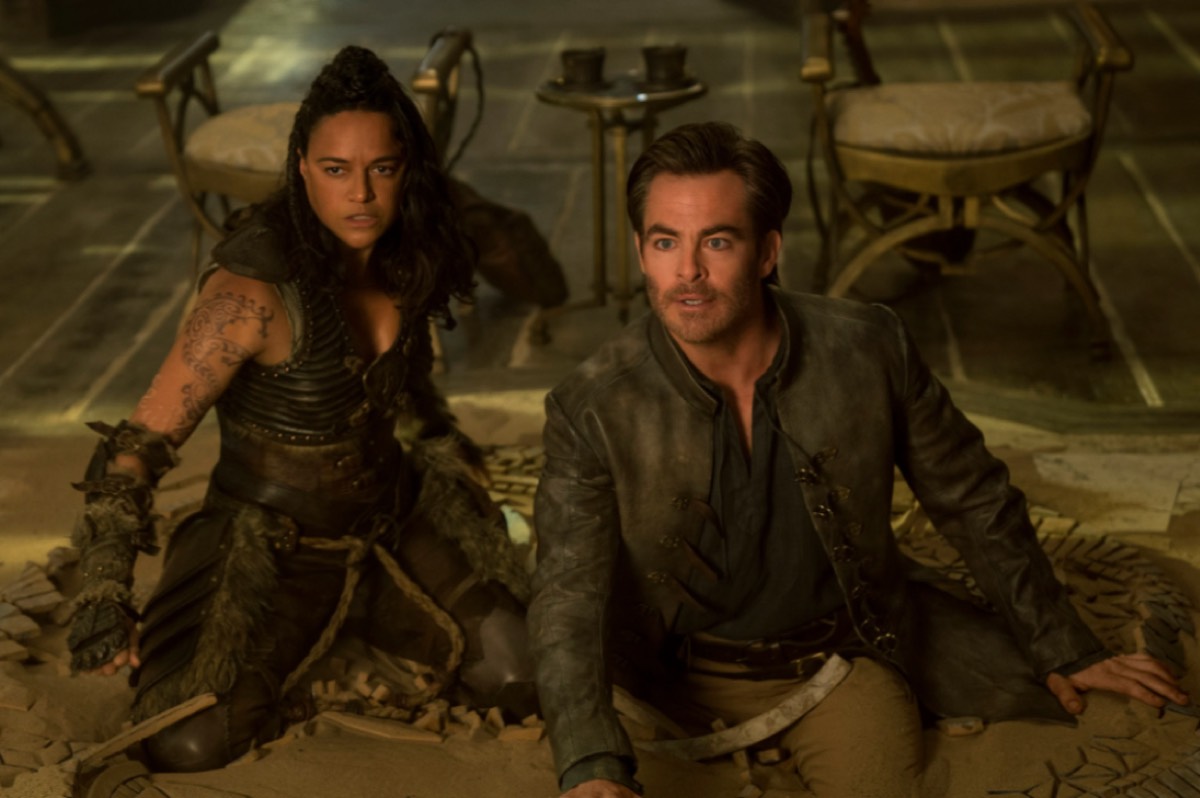
Chris Pine and Michelle Rodriguez star as Elgin (a bard) and Holga (a barbarian) in D&D: Honor Among Thieves
Enlarge / Chris Pine and Michelle Rodriguez star as Elgin (a bard) and Holga (a barbarian) in D&D: Honor Among Thieves.
Paramount Pictures

Of all the films due for release this spring, Dungeons and Dragons: Honor Among Thieves was one of my most anticipated premieres, solely on the strength of those killer trailers. The film does not disappoint. It’s a fresh, good-humored, energetic, and vastly entertaining fantasy/action/comedy, boasting a stellar cast and solid emotional core that serves as a worthy homage to the famous RPG that inspired it.

(Some spoilers below, but no major reveals.)

Honor Among Thieves is set in the hugely popular Forgotten Realms campaign setting. The film’s official premise is short and sweet: “A charming thief and a band of unlikely adventurers undertake an epic heist to retrieve a lost relic, but things go dangerously awry when they run afoul of the wrong people.”

Said charming thief is Elgin, a bard who is played by Chris Pine. To defeat the evil that has been unleashed in the world, he’ll need the strength of Holga, a barbarian (Michelle Rodriguez); courage from Xenk (Regé-Jean Page), a paladin; and magic thanks to Simon the Sorcerer (Justice Smith). Then there’s Doric (Sophia Lillis), a tiefling druid who can transform into various animals (including a ferocious owlbear). The cast also stars Hugh Grant as Forge Fitzwilliam the Rogue, a former member of Elgin’s band of thieves who is now Lord of Neverwinter, and Daisy Head as his top adviser, Sofina, a Red Wizard of Thay.

Daisy Head plays Sofina, a Red Wizard of Thay who covets a certain mysterious artifact.
Enlarge / Daisy Head plays Sofina, a Red Wizard of Thay who covets a certain mysterious artifact.
YouTube/Paramount

D&D the game has been around for decades and has built up a rich and complex mythology over that time, but directors Jonathan Goldstein and John Francis Daley—both longtime fans—wanted their film to be accessible even for those with no familiarity at all with the classic RPG. That requires a certain amount of potentially awkward opening exposition. So we first meet Elgin and Holga as prisoners in an icy fortress, up for parole. This gives Elgin a chance to tell his tragic backstory in hopes of winning the parole board’s sympathy—and, not coincidentally, giving the audience an amusing narrative introduction to this fantasy world. It’s tricky to pull off long stretches of expository monologue without testing an audience’s patience. But Pine sells it with his cheekily irreverent delivery.

That backstory involves Elgin’s grief over his dead wife and his choice to leave his daughter Kira (Chloe Coleman) for one last heist, drawn by the promise of acquiring a resurrection tablet that could bring his wife back to life. The heist went bad, and Elgin and Holga were captured, while Simon and Forge escaped with Sofina—along with the resurrection tablet and a mysterious artifact that was clearly Sofina’s target all along. Elgin longs to return to his daughter, so he and Holga break out of prison and find Kira living in Neverwinter with the now-wealthy and respectable (but still roguish) Forge. Naturally, their former comrade in arms betrays them, and the rest of the film is their quest to rescue Kira and stop Sofina from performing an ancient ritual that would turn the good citizens of Neverwinter into her zombie slaves.

https://arstechnica.com/?p=1926927


E3, now dead, was a show for a bygone game industry

E3, now dead, was a show for a bygone game industry
Aurich Lawson

This year’s edition of the Electronic Entertainment Expo (E3) has been canceled. The Entertainment Software Association (ESA) and show promoter ReedPop announced late Thursday that the planned June event—which was set to be the first in-person E3 since 2019—”did not garner the sustained interest necessary” from major publishers and potential attendees to justify a massive convention.

At this point, the cancellation of the 2023 show wasn’t a huge surprise. All three major console makers had already confirmed that they wouldn’t be attending, and major publishers Ubisoft and Sega publicly abandoned the show more recently. In an interview with GamesIndustry.biz, ESA president and CEO Stanley Pierre-Louis cited economic headwinds, digital marketing opportunities, and COVID-related game development timeline changes as reasons the companies backed out.

But the decades-long decline of E3 was also apparent well before this year’s problems—and even well before COVID forced the cancellation of the 2020 show (and every show in subsequent years). Part of me will miss the glitz and spectacle of the 15 E3s I’ve attended since 2004. But a larger part recognizes that E3 is a show that was built for a very different game industry and which has utterly failed to change with the times.

The console war’s premier battleground

Back before E3’s debut in 1995, a much smaller game industry than today’s dominated a significant chunk of Las Vegas’ sprawling Consumer Electronics Show. As the game industry grew, though, its major players decided that they needed a separate event to distinguish their business from the TV sets and music players cluttering the Las Vegas Convention Center every January.

The new game-focused show started with a bang when Sony executive Steve Race famously threw out his planned press conference speech about the then-upcoming PlayStation to deliver a single phrase: “Two hundred and ninety-nine dollars.” The price, which was $100 less than the stealth-launched Sega Saturn, practically settled that generation of the console wars before it had even started.

Console makers would spend big bucks to wow the E3 crowds in an attempt to score console war points.
Enlarge / Console makers would spend big bucks to wow the E3 crowds in an attempt to score console war points.
Sam Machkovech

This kind of jockeying for console supremacy—in front of throngs of eager media—was a central focus of E3 for decades afterward. At E3 2006, the early meme-ification of Sony’s PlayStation 3—complete with its “giant enemy crab” and “five hundred and ninety-nine US dollars” price—helped cement the system’s early reputation as overpriced and overcomplicated for developers.

By 2013’s show, though, Sony was the one with a PlayStation 4 that came in at $100 cheaper than the Kinect-powered Xbox One. Sony also used its E3 presentation that year to get in some savage digs at Microsoft, which was facing widespread controversy over its plans to restrict some used game sales on the Xbox One.

This kind of competitive bombast helped cement E3’s position as the place where the future of the console gaming market was hashed out. In the last decade, though, the major console makers seem to have realized that they didn’t need an expensive E3 booth or associated press conference to get their customers’ attention anymore.

This vintage photo, from my first E3 in 2004, shows you the crowds that attendees could expect to fight through for three days straight.

When it came time to debut the Switch in 2017, Nintendo hosted its own January hands-on event in New York City rather than rushing out demos for E3 months earlier. Sony followed suit in 2019, dropping out of that year’s E3 and then the planned 2020 event (before COVID hit), despite the impending launch of the PlayStation 5. And while Microsoft still hosted a press conference and game demos adjacent to E3 in 2019, the company decided it didn’t actually need an expensive booth on the convention center floor. https://arstechnica.com/?p=1928248


The long-rumored Starfleet Academy TV series will finally get made

<img src="https://rassegna.lbit-solution.it/wp-content/uploads/2023/03/the-long-rumored-starfleet-academy-tv-series-will-finally-get-made.jpg" alt="The crew of the Enterprise in Star Trek II: The Wrath of Khan, a film with many references to Starfleet Academy.”>
Enlarge / The crew of the Enterprise in Star Trek II: The Wrath of Khan, a film with many references to Starfleet Academy.

There’s officially another Star Trek series on the way, and this time it’s one we’ve been hearing rumors about since 2018: Starfleet Academy.

Announced today in a press release and reported by Deadline, the CBS Studios-produced series will follow a group of teenage Starfleet Academy students as they come of age while enduring rigorous training for future interstellar missions.

The central characters will reportedly have to navigate friendships, rivalries, and romances as they face a new enemy that threatens the Federation.

Co-showrunners Alex Kurtzman and Noga Landau issue this in-universe statement in the show’s announcement:

Admission is now open to Starfleet Academy! Explore the galaxy! Captain your destiny! For the first time in over a century, our campus will be re-opened to admit individuals a minimum of 16 Earth years (or species equivalent) who dream of exceeding their physical, mental and spiritual limits, who value friendship, camaraderie, honor and devotion to a cause greater than themselves. The coursework will be rigorous, the instructors among the brightest lights in their respective fields, and those accepted will live and study side-by-side with the most diverse population of students ever admitted. Today we encourage all who share our dreams, goals and values to join a new generation of visionary cadets as they take their first steps toward creating a bright future for us all. Apply today! Ex Astris, Scientia!

The announcement didn’t specify when the Star Trek timeline the series will take place, nor did it name any characters or specific plot points.

Kurtzman is the current head honcho of Star Trek; he has overseen most of the work on all the franchise shows that have premiered in recent years. Before that, he worked on the J.J. Abrams Star Trek films and worked as a writer on the TV series Xena: Warrior Princess and Hercules: The Legendary Journeys, and on the films The Island, The Legend of Zorro, and Transformers.

Landau is a television writer who first became known as a story editor on the TV series The Magicians—another action-adventure show set in a fantastical school with coming-of-age plotlines—and who later became showrunner for The CW’s Nancy Drew series.

This won’t be the first time Starfleet Academy has been explored in works of Star Trek fiction, of course. Beyond the obvious example of the Kobayashi Maru references throughout the franchise, there were substantial plotlines about the academy in The Next Generation and Deep Space Nine, among others.

Further, there were Starfleet Academy video games in the 1990s for various platforms. While the PC game with full-motion video with original cast members had enough features to recommend it, I always felt the SNES/Sega 32X Starfleet Academy game never got the love it quite deserved.

The Starfleet Academy TV series will begin production in 2024, and it will premiere on Paramount+ at some point after that.

https://arstechnica.com/?p=1928027


Elemental music: Interactive periodic table turns He, Fe, Ca into Do, Re, Mi

A recent college graduate has converted the visible light given off by the elements into audio, creating unique, complex sounds for each one.
Enlarge / Graduate student W. Walker Smith converted the visible light given off by the elements into audio, creating unique, complex sounds for each one. His personal favorites are helium and zinc.
W. Walker Smith and Alain Barker

We’re all familiar with the elements of the periodic table, but have you ever wondered what hydrogen or zinc, for example, might sound like? W. Walker Smith, now a graduate student at Indiana University, combined his twin passions of chemistry and music to create what he calls a new audio-visual instrument to communicate the concepts of chemical spectroscopy.

Smith presented his data sonification project—which essentially transforms the visible spectra of the elements of the periodic table into sound—at a meeting of the American Chemical Society being held this week in Indianapolis, Indiana. Smith even featured audio clips of some of the elements, along with “compositions” featuring larger molecules, during a performance of his “The Sound of Molecules” show.

As an undergraduate, “I [earned] a dual degree in music composition and chemistry, so I was always looking for a way to turn my chemistry research into music,” Smith said during a media briefing. “Eventually, I stumbled across the visible spectra of the elements and I was overwhelmed by how beautiful and different they all look. I thought it would be really cool to turn those visible spectra, those beautiful images, into sound.”

[embedded content]
What do the elements sound like?

Data sonification is not a new concept. For instance, in 2018, scientists transformed NASA’s image of Mars rover Opportunity on its 5,000th sunrise on Mars into music. The particle physics data used to discover the Higgs boson, the echoes of a black hole as it devoured a star, and magnetometer readings from the Voyager mission have also been transposed into music. And several years ago, a project called LHCSound built a library of the “sounds” of a top quark jet and the Higgs boson, among others. The project hoped to develop sonification as a technique for analyzing the data from particle collisions so that physicists could “detect” subatomic particles by ear.

Markus Buehler’s MIT lab famously mapped the molecular structure of proteins in spider silk threads onto musical theory to produce the “sound” of silk in hopes of establishing a radical new way to create designer proteins. The hierarchical elements of music composition (pitch, range, dynamics, tempo) are analogous to the hierarchical elements of protein structure. The lab even devised a way for humans to “enter” a 3D spider web and explore its structure both visually and aurally via a virtual reality setup. The ultimate aim is to learn to create similar synthetic spiderwebs and other structures that mimic the spider’s process.

Several years later, Buehler’s lab came up with an even more advanced system of making music out of a protein structure by computing the unique fingerprints of all the different secondary structures of proteins to make them audible via transposition—and then converting it back to create novel proteins never before seen in nature. The team also developed a free Android app called the Amino Acid Synthesizer so users could create their own protein “compositions” from the sounds of amino acids.

So Smith is in good company with his interactive periodic table project. All the elements release distinct wavelengths of light, depending on their electron energy levels, when stimulated by electricity or heat, and those chemical “fingerprints” make up the visible spectra at the heart of chemical spectroscopy. Smith translated those different frequencies of light into different pitches or musical notes using an instrument called the Light Soundinator 3000, scaling down those frequencies to be within the range of human hearing. He professed amazement at the sheer variety of sounds.

“Red light has the lowest frequency in the visible range, so it sounds like a lower musical pitch than violet,” said Smith, demonstrating on a toy color-coded xylophone. “If we move from red all the way up to violet, the frequency of the light keeps getting higher, and so does the frequency of the sound. Violet is almost double the frequency of red light, so it actually sounds close to a musical octave.” And while simpler spectra like hydrogen and helium, which only have a few lines in their spectra, sound like “vaguely musical” chords, elements with more complex spectra consisting of thousands of lines are dense and noisy, often sounding like “a cheesy horror movie effect,” according to Smith.

His favorites: helium and zinc. “If you listen to the frequencies [of helium] one by one instead of all at once, you get an interesting scale pattern that I have used to make a couple of compositions, including a ‘helium dance party,'” said Smith. As for zinc, “The first row of transition metals have very complex, dense grating sounds. But zinc, for whatever reason, despite having a large number of frequencies, sounds like an angelic vocalist singing with vibrato.”

Smith is currently collaborating with the Wonder Lab Museum in Bloomington, Indiana, to develop a museum exhibit that would enable visitors to interact with the periodic table, listen to the laments, and make their own musical compositions from the various sounds. “The main thing I want to [convey] is that science and the arts aren’t so different after all,” he said. “Combining them can lead to new research questions, but also new ways to communicate and reach larger audiences.”

https://arstechnica.com/?p=1927228


Why Transformers now look like a big bunch of gears and car parts

The front of a silver porsche 911
Enlarge / How did one of the rarest 911s end up becoming a Transformer?
Stef Schrader

“I didn’t know what car Mirage was going to be at first,” said Steven Caple Jr., director of Transformers: Rise of the Beasts. “Where I’m from, in Cleveland, Ohio, I’d never even been in a Porsche before,” he continued. “My actual first introduction to Porsche was Bad Boys I, so shout out to Michael Bay—that’s all I really had.”

Caple admitted in a panel during Austin’s South by Southwest festival that the star car of the beloved action film Bad Boys inspired him to make Mirage a classic Porsche in the upcoming film. Mirage is a bit of a rebel himself, and the callback to the classic buddy-cop movie just felt right.

Fortunately, extraterrestrial Autobots won’t be tempted to pull over in any sketchy places to debate the merits of in-car snacking, but this does mean they have bigger nemeses that necessitate transforming into giant robots to handle. It can be more complicated than you’d expect to make a cool Porsche into an Autobot film star, though—in fact, Porsche has a whole team that helps Hollywood studios get just the right car on the silver screen. Here’s how it all comes together.

Character development

It starts with a character. Filmmakers have a certain look and vibe in mind when a new Transformer is “cast,” so to speak. Mirage is a bad boy with an attitude, and the film, set in 1994, is meant to be a sequel to Bumblebee. That made Caple think of the 1994 911 Turbo from Bad Boys.

“I was born in the ’80s, and I was a kid in the ’90s… this is the era when I grew up,” Caple explained. “This movie is like a time capsule to me.”

“You get to ’94, and everything started to change—from the wardrobe to the culture to the music to the cars,” he continued. “You start to step away from square-bodied cars and say, ‘hello curves.'”

You probably have to be pretty into your Porsches to spot that this is a 3.8 RS and not a 911 Turbo.
Enlarge / You probably have to be pretty into your Porsches to spot that this is a 3.8 RS and not a 911 Turbo.
Stef Schrader

The “casting” choice of the 964-era 911—a car that was dramatically smoother and more streamlined than any 911 before it—is a callback for the current Transformers series, given that Bad Boys was Michael Bay’s feature-length directorial debut. Yet Mirage has always been portrayed as an upper-crust member of Autobot society, so it makes sense that the Transformers team picked an even rarer 964-generation Porsche to portray him: a 1993 911 Carrera RS 3.8.

“When I was designing the character, it started there,” Caple said. “I talked to Owen [Shively] and the team at Porsche and said… he’s going to be an outlaw. He’s going to be a rebel. Going to be flashy. Very confident, but smooth.”

That’s when Porsche suggested looking into the 911 Carrera RS 3.8.

The Carrera RS 3.8 uses the same wider body shape as Bad Boys‘ 911 Turbo, but it was a homologation specially produced to legalize the Carrera RSR race car with a host of lightweight parts and a hardcore aerodynamic package designed for track domination. Porsche only ever made 55 RS 3.8s, according to Total 911, making it an exceptionally rare ride. In other media and toys in the past, Mirage has been a Ferrari and a Formula 1 car, so an ultra-rare Porsche feels like a solid fit.

While many of us associate the Transformers series with the heavy use of CGI, the filmmakers still need to source real cars to use for many of the shots—and Porsche has a whole team dedicated to helping filmmakers place just the right car into film and television projects.

Owen Shively, from that early ideation conversation Caple mentioned, is the CEO of RTTM Agency, Porsche Cars North America’s exclusive representative when it comes to entertainment partnership requests like this. When Porsche needs someone to arrange a specific car for a new film or TV project, Shively’s agency is where they turn.

https://arstechnica.com/?p=1927246


Wii U and 3DS eShops close down later today, risking hundreds of unique games

Nintendo Wii U and 3DS eShop graphic
Enlarge / Your last chance to buy individual games for the Wii U and 3DS—assuming you have credits in your wallet account—arrives tonight.

Only a few hours remain for anyone who wants to buy games from the eShops for Nintendo’s Wii U and 3DS.

As it promised more than a year ago, Nintendo is shutting down those digital storefronts tonight at 8 pm Eastern, after previously halting the ability to add eShop funds in May 2022. After today, you can still download or re-download any titles you’ve previously bought from those shops, though that can obviously change in the future. Closing the eShops means that roughly 1,000 digital-only games will no longer be accessible, according to research by VGC, including 335 Virtual Console games that aren’t available through the Nintendo Switch Online service.

These kinds of sweeping moves, while perhaps understandable from a business perspective, pose a serious danger to the preservation of many games in the systems’ libraries. As Ars detailed earlier this month, video game preservationists are hamstrung by laws and regulations around remote access to DRM-protected work, even if it’s kept by research-driven organizations. Nintendo is one of many organizations that, through the Entertainment Software Association, lobbies to prevent libraries from offering legal access to archived games.

Today’s shutdown also marks the end of Nintendo’s Virtual Console, which allowed for the purchase of individual games from Nintendo’s catalog without a subscription. The Console was killed on the original Wii in 2019, and Nintendo does not intend to offer it on the Switch, noting in an FAQ about the eShop shutdown that it currently has “no plans to offer classic content in other ways” (since removed, but archived here). It has, however, offered a website on which you can “Bring back your gaming memories” of 3DS and Wii U titles you’ve purchased and played.

[embedded content]
The Completionist’s explanation of how he spent nearly a year buying every available 3DS and Wii U game before today’s shutdown.

If you’re wondering what it would take to buy every game on the eShop, somebody already did that. The Completionist, aka Jirard Khalil, downloaded 1.2TB of Wii U and 267GB of 3DS games, taking 328 days and costing $22,791. “Since the industry started, we run a daily risk of losing games forever,” Khalil tells viewers in the video. “That’s why this matters.” Khalil is donating the consoles and storage containing all the games to the Video Game History Foundation and will host a Preserved Play fundraiser for the foundation April 15-16 on his Twitch channel.

https://arstechnica.com/?p=1927063