Review: We had our doubts, but Peacemaker is a cheeky, irreverent delight

<img src="https://rassegna.lbit-solution.it/wp-content/uploads/2022/02/review-we-had-our-doubts-but-peacemaker-is-a-cheeky-irreverent-delight.jpg" alt="John Cena shows he has some dramatic chops as well as comedic timing in Peacemaker.”>
Enlarge / John Cena shows he has some dramatic chops as well as comedic timing in Peacemaker.

We had our doubts about Peacemaker, the HBO Max spinoff series based on John Cena’s character from 2021’s The Suicide Squad. But I’m happy to report that those doubts were entirely unfounded. Series creator James Gunn has successfully taken a seemingly irredeemable character and sent him on an emotional journey that made us love him—all framed in a blood-soaked, action-packed, cheekily irreverent main story that makes for top-notch entertainment.

(One big spoiler for The Suicide Squad below. Some spoilers for Peacemaker, but no major reveals.)

Gunn wrote the series for fun during his downtime in 2020 and ended up pitching it when DC Films approached him about a spinoff series for one of the characters in The Suicide Squad. HBO Max ordered Peacemaker straight to series. When the first teaser dropped last year, I admitted to being a bit skeptical. Cena’s performance in The Suicide Squad was terrific, but he wasn’t exactly a sympathetic character—or a particularly complex one. On the other hand, Gunn clearly felt there was more of the character’s story to tell, and that instinct proved correct.

The eight-episode series is set five months after the events of The Suicide Squad, specifically after the post-credits scene, in which we learned that Peacemaker—aka Christopher Smith—had survived what appeared to be a fatal shooting. That scene hinted that the US government still had some use for him, and in the show, he ends up being recruited for a new mission: the mysterious Project Butterfly, led by a mercenary named Clemson Murn (Chukwudi Iwuji). He gets assistance from A.R.G.U.S. agent John Economos (Steve Agee) of the Belle Reve Penitentiary, National Security Agency agent and former Waller aide Emilia Harcourt (Jennifer Holland), and new team member Leota Adebayo (Danielle Brooks).

Peacemaker and the Project Butterfly team, ready for action.
Enlarge / Peacemaker and the Project Butterfly team, ready for action.
YouTube/HBO Max

The cast also includes Robert Patrick (Terminator 2) as Chris’ crusty father, Auggie Smith, who thinks his son is a “nancy-boy”; Freddie Stroma as Adrian Chase (aka Vigilante), a sociopathic district attorney who fights crime and thinks he’s Peacemaker’s BFF; Annie Chang as police detective Sophie Song; and Nhut Le as Judomaster, a bodyguard and martial arts specialist. And of course, there’s Eagly, Chris’ beloved American bald eagle companion, voiced by Dee Bradley Baker.

Cena turns in a truly standout performance; he brings a surprising sweetness and vulnerability to his portrayal of a character Gunn once described as “douchebag Captain America.” Chris is wrestling with his guilt over killing Rick Flag in The Suicide Squad, and he’s haunted by Flag’s last words: “Peacemaker. What a joke.”

He is also forced to deal with his own tragic backstory over the course of the season, including the loss of his brother, and that backstory is surprisingly poignant. If you were raised by a white supremacist thug like Auggie Smith—who trained his son to be a killer and misses no opportunity to remind Chris that he’s a worthless waste of space—you might have grown up into a jingoistic mass murderer for hire, too.

Chris introduces Leota (Danielle Brooks) to his signature Peace Train cocktail: gin, vermouth, vinegar, peppercorn, a touch of maple syrup, and yak butter. She calls it a "feces drink."
Enlarge / Chris introduces Leota (Danielle Brooks) to his signature Peace Train cocktail: gin, vermouth, vinegar, peppercorn, a touch of maple syrup, and yak butter. She calls it a “feces drink.”
YouTube/HBO Max

Chris’ growing uneasiness with the Peacemaker persona he created manifests early on when he balks at killing a senator and his family on Murn’s orders. (Vigilante has no such qualms about killing women and children.) The family turns out to be “butterflies”: an alien species from a dying planet who use human bodies as hosts and seek to dominate Earth. Chris does take out his fair share of butterflies as the mission heats up, but he also befriends one of them and keeps it in a jar in his trailer.

It’s that inner mushy side that repeatedly earns his father’s ridicule, but it also makes Chris someone worth rehabilitating. Eagly loves him, after all, and if you can’t trust the instincts of an American bald eagle, what can you trust? Deep down, Chris just wants to belong, and one of the best arcs of the season sees him eventually finding a family of sorts in his Project Butterfly teammates.

https://arstechnica.com/?p=1834621


These are the hardest Wordle puzzles (so far)

The future is now.
Enlarge / The future is now.
Aurich Lawson | Getty Images


Anyone who has been on Twitter in recent weeks is probably intimately familiar with the grids of Wordle solutions clogging up everyone’s timelines. But those tweets give more information than it would seem. Collecting and analyzing data from millions of these Wordle result tweets can give us some interesting insights into aggregate play patterns and the relative difficulty of daily Wordle puzzles.

The Wordle Stats Twitter account has done a lot of the heavy lifting here. Since January 7, the bot account has used the Twitter API to sort through the public timeline for every tweet formatted as a Wordle result, tracking the total number of players and how many guesses each player needed to complete the puzzle. That account shared its underlying data with Ars to power a deeper analysis of daily play patterns.

This isn’t a perfectly random sample of Wordle players, of course—it’s limited to the group of players who use Twitter and choose to share their results publicly. The vast majority of what The New York Times said were millions of daily players at the end of January are not reflected here.

These results might be skewed if players are more likely to share interesting results than boring ones or if certain demographics of players are less likely to share in the first place. Players can also edit their tweeted results relatively easily, or they could cheat by simply playing the daily puzzle more than once.

All that said, the hundreds of thousands of daily Wordle results shared on Twitter are the best window we have into how the game is played in aggregate. When compared day to day, the results ought to give a decent picture of the relative popularity of the game and the difficulty of puzzles over time.

(For even more analysis going back to December’s games, check out this Medium post by a University College Dublin professor.)

<a href="https://rassegna.lbit-solution.it/wp-content/uploads/2022/02/these-are-the-hardest-wordle-puzzles-so-far-1.png" class="enlarge" data-height="768" data-width="1024" alt="The number of daily Wordle results tweets seems to have peaked in late January.”><img alt="The number of daily Wordle results tweets seems to have peaked in late January.” src=”https://rassegna.lbit-solution.it/wp-content/uploads/2022/02/these-are-the-hardest-wordle-puzzles-so-far.png” width=”640″ height=”480″ srcset=”https://rassegna.lbit-solution.it/wp-content/uploads/2022/02/these-are-the-hardest-wordle-puzzles-so-far-1.png 2x”>
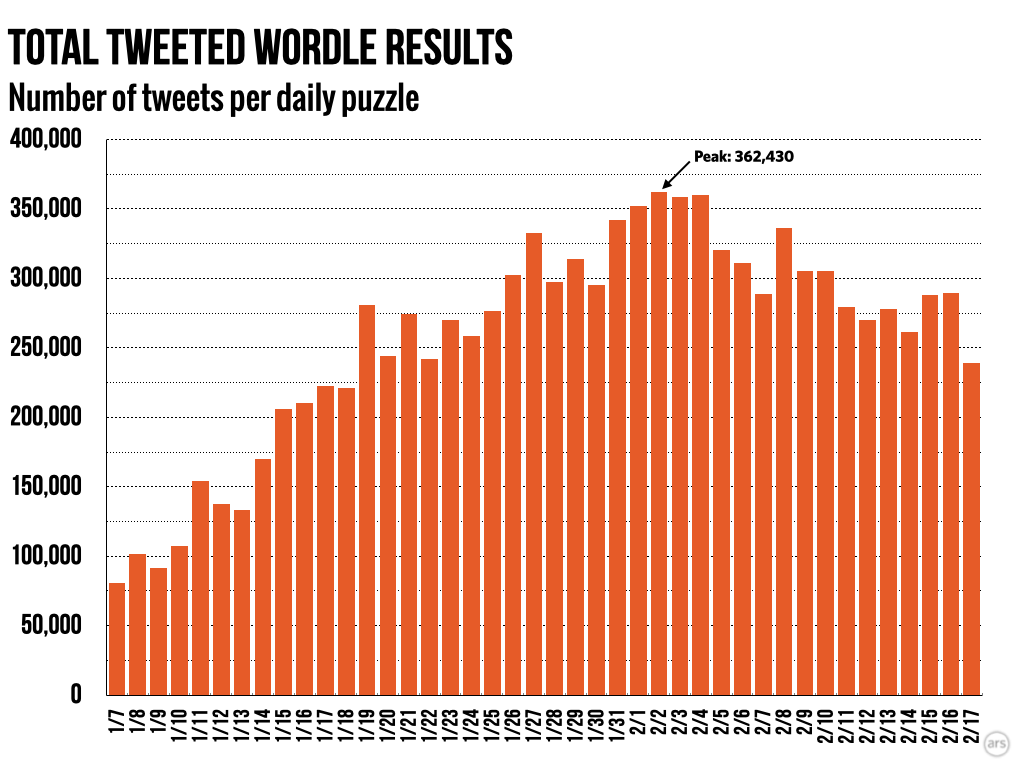
Enlarge / The number of daily Wordle results tweets seems to have peaked in late January.
Ars Technica / @WordleStats

Looking purely at the total shares, it seems like Wordle‘s dominance of the Twitter timeline may already be abating. Shares started at less than 100,000 a day in early January, and total shares on Twitter peaked at 362,430 with puzzle 228 on February 2, shortly after The New York Times purchased the game. Since then, sharing has slowly declined, dipping below 240,000 shares for puzzle 243 on February 17.

That doesn’t necessarily mean Wordle is getting less popular overall—new players might be less likely to be on Twitter, or long-time players may be tiring of sharing their results. But the slow decline in tweets has been interesting to see.

Warning: The remainder of this story has spoilers for Wordle puzzles through February 17. If you’re still working through the archives, finish them up before clicking through to the next page.

https://arstechnica.com/?p=1835236


Intel Arc desktop GPUs are coming in Q2, but don’t expect them to end the GPU shortage

Intel Arc GPUs.
Enlarge / Intel Arc GPUs.

Intel’s Arc GPUs continue to creep closer to release. At an investor meeting yesterday, Intel reiterated that it would be shipping mobile Arc GPUs based on its Alchemist architecture in the first quarter of 2022 and that desktop GPUs would follow at some point in Q2. Workstation GPUs would follow afterward in the third quarter.

Intel has released few official details about any of the Arc GPU configurations or performance targets, though leaked specs and benchmarks have given us a very broad idea of what we can expect. Intel graphics VP Raja Koduri tweeted a picture of an Arc GPU in a “Beast Canyon” NUC enclosure running 2018’s Shadows of the Tomb Raider, which means at least one of the GPUs will be physically small enough to fit inside that case. But pricing, availability, and even what the cards will look like are unknown.

The company plans to ship at least 4 million GPUs across its desktop, laptop, and workstation product lines in 2022, but that would represent only a sliver of the dedicated GPU market. Data from Jon Peddie Research (as compiled by Tom’s Hardware) suggests that Nvidia and AMD sold some 47 million desktop GPUs in the calendar year between Q4 of 2020 and Q3 of 2021, and that’s before you count laptop GPUs. Having another viable option in the GPU market will be good, but this small number won’t put much of a dent in the current GPU shortage.

Intel's GPU architecture roadmap.
Enlarge / Intel’s GPU architecture roadmap.

As for the future of its graphics division, Intel shared rough release timelines for its next-generation Battlemage and Celestial GPU architectures, which will be released in “2023-2024” and “2024+” respectively. Each architecture has a slightly higher performance target than the one before it, though how competitive these products are will also be determined by the GPUs that Nvidia and AMD are shipping in the next few years. Battlemage GPUs will also be integrated into Intel’s “Meteor Lake” processors, the architecture that will be used in Intel’s 14th-generation Core processors (assuming no delays and that Intel’s current naming conventions continue).

Intel also teased a mysterious GPU-related initiative called “Project Endgame,” a service that will offer Arc GPUs “through a service for an always-accessible, low-latency computing experience.” Whether Endgame is a cloud gaming service like Nvidia’s GeForce Now or a more workstation-y service that offers GPU computing capacity remains to be seen.

https://arstechnica.com/?p=1835191


Uncharted film review: This is how you don’t adapt a video game

<img src="https://rassegna.lbit-solution.it/wp-content/uploads/2022/02/uncharted-film-review-this-is-how-you-dont-adapt-a-video-game.jpg" alt="Tom Holland stars as Indi—er, as Nathan Drake in Columbia Pictures' Uncharted.”>
Enlarge / Tom Holland stars as Indi—er, as Nathan Drake in Columbia Pictures’ Uncharted.
Columbia Pictures

Imagine a video game sequel that does away with pretty much everything fans liked about the original. There’s less action, uninteresting puzzles, boring environments, plot holes big enough to drive a “Hog Wild” seaplane through, and, perhaps worst of all, dull dialogue. This imaginary game opens with an interminable 80-minute cut scene, only to be followed by an energetic action sequence that recalls the original game’s best moments.

That’s what the first-ever Uncharted film feels like. It’s based on the popular PlayStation-exclusive game series of the same name, and it stars the same main characters. But while it’s reminiscent of the Indiana Jones films that inspired the video games, the movie doesn’t have the same breezy, comical, action-packed magic of that franchise—or of the Uncharted games. How wild that a video game delivers better movie-like thrills than its live-action version.

A brief glimpse of gold

"Professor, what's another word for pirate treasure?" "Drake, stop asking me that question."
Enlarge / “Professor, what’s another word for pirate treasure?” “Drake, stop asking me that question.”
Columbia Pictures

The final scene is the only decent part of this movie, so I’ll start there. Like its namesake game series, this week’s theatrical exclusive is all about adventurers surviving fistfights and solving mysteries while searching for an ancient-treasure jackpot. Uncharted‘s booty is a doozy: two stranded, treasure-filled pirate ships, somehow hidden from all satellite and radar imaging or explorers for over 500 years. A villain captures the ships and decides to airlift them via helicopters.

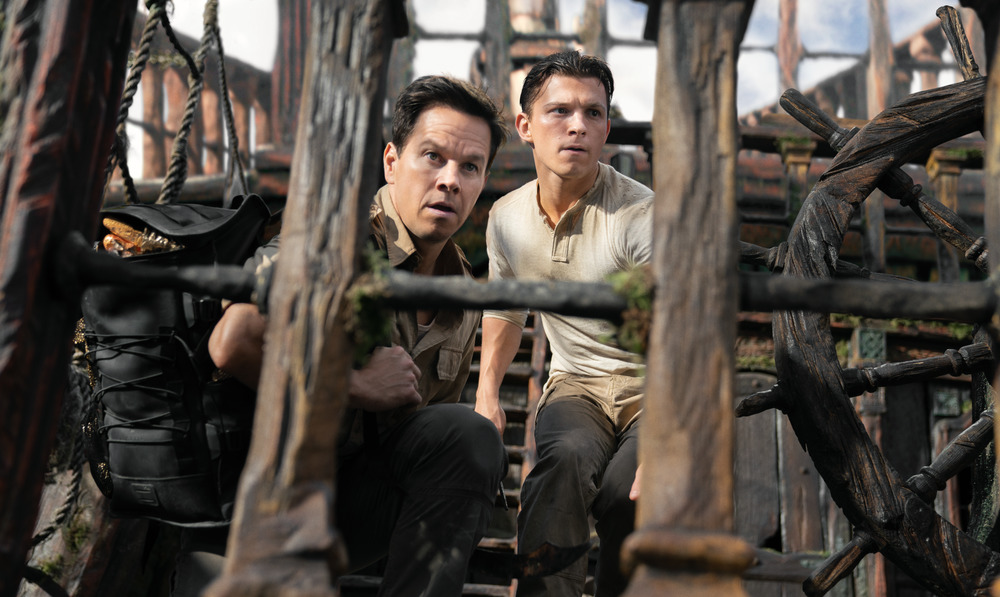
But series hero Nathan Drake (Tom Holland, Spider-Man: Homecoming) and his accomplice Sully (Mark Wahlberg, The Fighter) got to the ships first and stowed away on one of them. Whoosh—into the air they go, at which point they attempt a sky-pirate heist.

Most of the film's scenes with both Drake and Sully play out like this: boring and in the dark.
Enlarge / Most of the film’s scenes with both Drake and Sully play out like this: boring and in the dark.
Columbia Pictures

The camera follows the subsequent nonsense, which involves our heroes climbing through ancient ships and bouncing clumsily into combat. There are rope-assisted mid-air leaps between flying ships, and the men somehow get into full-blown sword fights in the year 2022. At this point, the film sees no reason to hide its intention: to deliver the most satisfying, CGI-fueled Indiana Jones-like fight a film has seen in years.

Holland and Wahlberg wait until this end-of-film scene to settle into a groove. The fighting is limber and comedic, and the banter between the two leads is genuinely funny for the first time in the entire film.

https://arstechnica.com/?p=1835176


Confirmed: Curia of Pompey, where Julius Caesar was killed, was built in three phases

Relatively modern city surrounds ancient ruins.
Enlarge / The Largo di Torre Argentina in Rome contains the Curia of Pompey. This place is falling apart. New study concludes it was built in 3 phases.

The Curia of Pompey is famous for being the site where Julius Caesar was stabbed to death on the ides of March in 44 BCE. It is of great interest to tourists, historians, and archaeologists alike. After analyzing mortar samples collected from the curia, researchers from Italy and Spain have confirmed an earlier hypothesis that the structure was constructed in three distinct phases, according to a recent paper published in the journal Archaeometry.

In ancient Rome, a curia was a structure where members of the senate would meet. The great Roman general Gnaeus Pompeius Magnus (Pompey) built this particular curia as a memorial to his own military achievements. A large theater section contained a temple, a stage, and seating on one end; a large porticus (housing the general’s art and books) surrounded a garden in the middle; and the Curia of Pompey was at the opposite end.

During Julius Caesar’s reign, the Roman senators temporarily met in the Curia of Pompey after their usual Curia on the Comitium burned down in 52 BCE. (Followers of an assassinated tribune named Publius Clodius Pulcher set it on fire while cremating his body.) Caesar’s planned replacement (Curia Julia) was under construction as a replacement meeting site when the ruler met his own brutal demise at the base of the Curia of Pompey. The senators who killed him thought assassination was the only way to preserve the republic, but the murder ultimately lead to the republic’s collapse.

<a href="https://rassegna.lbit-solution.it/wp-content/uploads/2022/02/confirmed-curia-of-pompey-where-julius-caesar-was-killed-was-built-in-three-phases-3.jpg" class="enlarge" data-height="702" data-width="1200" alt="The Death of Julius Caesar by Vincenzo Camuccini (1771-1844), Museo Nazionale di Capodimonte, Napoli.”><img alt="The Death of Julius Caesar by Vincenzo Camuccini (1771-1844), Museo Nazionale di Capodimonte, Napoli.” src=”https://rassegna.lbit-solution.it/wp-content/uploads/2022/02/confirmed-curia-of-pompey-where-julius-caesar-was-killed-was-built-in-three-phases-1.jpg” width=”640″ height=”374″ srcset=”https://rassegna.lbit-solution.it/wp-content/uploads/2022/02/confirmed-curia-of-pompey-where-julius-caesar-was-killed-was-built-in-three-phases-3.jpg 2x”>
Enlarge / The Death of Julius Caesar by Vincenzo Camuccini (1771-1844), Museo Nazionale di Capodimonte, Napoli.
Leemage/Corbis/Getty Images

While the theater complex would survive for centuries, the Curia of Pompey did not remain open. After the assassination, the curia was walled up (and possibly set on fire) just 11 years after its opening. A latrine was later built on the site. The curia was buried under more recent construction as Rome expanded and wasn’t excavated until the 1930s as part of Italian dictator Benito Mussolini’s razing of parts of modern Rome to unearth ancient historical sites. In addition to the Curia of Pompey, those efforts revealed four temples. The remains of the structure are still visible in an area of Rome called Largo di Torre Argentina.

The suggestion that the curia had been built in phases is not new. An earlier archaeological study analyzed the rock layers (strata) at the site and found that the curia’s construction began around 55 BCE using pozzolane rosse (pink pozzolana) extracted from volcanic deposits near the city’s center. Around 19 BCE, during the reign of Augustus Caesar, there was a second construction phase using pozzolane rosse extracted from a site further away. The third and final construction phase took place during the medieval period.

Fabrizio Marra of the National Institute of Geophysics and Volcanology in Rome and his fellow co-authors sought additional confirmation of this hypothesis from the perspective of archaeometry. Specifically, they wanted to conduct chemical analysis of the mortar (concrete) used to build the curia to determine which quarries supplied the building materials for each phase of construction. The team also analyzed samples from three basins at the site: two located on the western side of Largo di Torre Argentina, and the third on the northern side of Pompey’s curia.

Scaled plan of the sacred area of Largo Argentina showing the archaeological survey of the Curia of Pompey and of three basins.
Enlarge / Scaled plan of the sacred area of Largo Argentina showing the archaeological survey of the Curia of Pompey and of three basins.
A. Monterroso, J.I. Murillo, R. Martín and M.A Utrero

As we’ve reported previously, ancient Roman concrete was basically a mix of a semi-liquid mortar and aggregate. Portland cement (a basic ingredient of modern concrete) is typically made by heating limestone and clay (as well as sandstone, ash, chalk, and iron) in a kiln. The resulting clinker is then ground into a fine powder, with just a touch of added gypsum—the better to achieve a smooth, flat surface. But the aggregate used to make Roman concrete was made up of fist-sized pieces of stone or bricks.

In his treatise De architectura (circa 30 CE), the Roman architect and engineer Vitruvius wrote about how to build concrete walls for funerary structures that could endure for a long time without falling into ruins. He recommended the walls be at least two feet thick (0.6 m) and made of either “squared red stone or of brick or lava laid in courses.” The brick or volcanic rock aggregate should be bound with mortar composed of hydrated lime and porous fragments of glass and crystals from volcanic eruptions (known as volcanic tephra).

“A large number of papers in the last 15 years have shown the exceptional care with which Roman constructors produced mortar and concrete,” Marra et al. wrote. Scientists have analyzed the mortar used in the concrete that makes up the Markets of Trajan, built between 100 and 110 CE (likely the world’s oldest shopping mall). In 2017, the same team analyzed the concrete from the ruins of sea walls along Italy’s Mediterranean coast, which have stood for two millennia despite the harsh marine environment. The researchers found that the secret to that longevity was a special recipe involving a combination of rare crystals and a porous mineral.

And just last year, scientists analyzed samples of the ancient concrete used to build a 2,000-year-old mausoleum along the Via Appia known as the Tomb of Caecilia Metella, a noblewoman who lived in the first century CE. The scientists discovered that the tomb’s mortar was similar to that used in the walls of the Markets of Trajan: volcanic tephra from the pozzolane rosse pyroclastic flow, binding together large chunks of brick and lava aggregate. However, the tephra used in the tomb’s mortar contained much more potassium-rich leucite.

https://arstechnica.com/?p=1830221


Physical console games are quickly becoming a relatively niche market

The number of physical console game releases continues to decline even as the number of digital console games explodes.
Enlarge / The number of physical console game releases continues to decline even as the number of digital console games explodes.

Anyone watching the game industry knows that the console market is quickly shifting away from games sold on physical media and toward the digital download dominance that PC gamers have known for years. But a new exclusive analysis of NPD Game Pulse data conducted by Ars Technica shows the extent of the decline in physical console game production, even as the number of digital console titles continues to explode.

In terms of distinct game titles released in the United States, the raw number of new games available on physical media (i.e., discs or cartridges) dropped from 321 in 2018 to just 226 in 2021, a nearly 30 percent decline (games released on multiple consoles are counted as a single title in this measure).

The number of digital games released each year, on the other hand, remained relatively flat from 2018 through 2020. Then, in 2021, that number exploded to nearly 2,200 digital titles, a 64 percent increase from 2020.

The proportion of distinct console games released in physical form has consistently declined in recent years.
Enlarge / The proportion of distinct console games released in physical form has consistently declined in recent years.

All told, the proportion of all new console games available exclusively as digital downloads increased from 75 percent in 2018 to nearly 90 percent in 2021.

An uneven trend

The decline in distinct physical releases is not being felt equally across major consoles. Across PlayStation consoles, the total number of new physical releases declined over 38 percent from 2018 to 2021, echoing a nearly 31 percent decline on Xbox consoles. On the Switch, meanwhile, the total number of new physical releases decreased by less than 7 percent over the same period.

Total physical releases have been down year over year across PlayStation and Xbox consoles.
Enlarge / Total physical releases have been down year over year across PlayStation and Xbox consoles.

The number of distinct downloadable titles, on the other hand, increased significantly on all three console families in 2021. That was especially true on the Switch, which saw a 63 percent increase in the number of new digital releases from 2020 to 2021.

The number of physical Switch releases has been relatively flat, while the number of digital releases has exploded.
Enlarge / The number of physical Switch releases has been relatively flat, while the number of digital releases has exploded.

These divergent trends suggest that the decline in new physical releases is not simply an artifact of consoles like the Xbox One and PS4 nearing the end of their lifecycles. Instead, as a whole, publishers seem to see a physical release as a less relevant market for an increasing proportion of titles.

But the transition away from physical console games is not distributed evenly across all publishers. The largest publishers are much more likely to go through the hassle and expense of a physical release for their marquee titles.

A slight majority of console games from major publishers still merit a physical release.
Enlarge / A slight majority of console games from major publishers still merit a physical release.

Among major publishers, a slight majority (56.4 percent) of distinct titles released in 2021 were available as physical releases. That’s still a major decline from 2018, though, when nearly 80 percent of titles from those publishers merited a physical launch.

(For this analysis, we defined major publishers as those with the most total annual revenue, including: Activision Blizzard, Bandai Namco, Capcom, EA, Konami, Microsoft/Bethesda, Nintendo, Sega, Sony, Square Enix, Take-Two, Ubisoft, and Warner Bros. Interactive.)

With major publishers removed, physical console game releases become relatively rare.
Enlarge / With major publishers removed, physical console game releases become relatively rare.

When those large publishers are filtered out, though, physical game releases quickly become a very minor part of the market. Just 8.1 percent of new games from those smaller companies were available on physical media in 2021, down in terms of both proportion and raw numbers from 2018.

The niche-ening

Looking solely at the number of unique titles released gives an incomplete picture of the console gaming market, of course. Games that merit a physical release tend to be some of the most popular titles of the year and probably attract more total sales than the vast majority of bottom-of-the-barrel digital releases. These release numbers also don’t give any visibility into what proportion of sales go to the physical versions of games that are available as both discs and downloads.

But data from elsewhere also supports the idea that games on physical media are quickly becoming a smaller and smaller part of the console market. Capcom said last year that a full 80 percent of its new game sales were digital downloads, while Sony’s 2020 fiscal year results showed a majority of PlayStation full game sales were coming as digital downloads.

There is plenty of other data going back years pointing in the same direction. The wide availability of cheaper, disc drive-free console options from Sony and Microsoft in recent years also suggests physical releases are becoming relatively less important.

The decline in physical options is increasingly relevant to players given the limited life span of digital console game stores. The coming shutdown of the Wii U and 3DS eShops will mean hundreds of digital-only games on those platforms will no longer be available for purchase. If those games were also available on physical media, on the other hand, they would continue to live on in the secondary market.

Physical games aren’t going to go completely extinct any time soon. As long as there’s a market of game collectors who value a tangible product, there will be physical discs and cartridges to satisfy that market, akin to vinyl records in the music business (sales of which have actually been growing of late).

But the physical release data makes clear that console gaming’s digital transition is quickly approaching its end game. In the coming years, games released on physical media seem poised to become an increasingly niche concern.

https://arstechnica.com/?p=1835058


Sims 4’s same-sex wedding stories expansion will come to Russia after all

<img src="https://rassegna.lbit-solution.it/wp-content/uploads/2022/02/sims-4s-same-sex-wedding-stories-expansion-will-come-to-russia-after-all.jpg" alt="Wedding bells are ringing for Russian Sims fans.”>
Enlarge / Wedding bells are ringing for Russian Sims fans.


Last week, the team behind The Sims 4 “My Wedding Stories” expansion pack—which includes a heavy focus on same-sex marriages—said that the expansion wouldn’t be released in Russia where “our storytelling would be subject to changes because of federal laws.” Now, video game company EA has reversed that decision, saying the expansion will in fact be released in Russia “unaltered and unchanged” alongside the rest of the world.

In an update posted Wednesday afternoon on the Electronic Arts website, The Sims team writes that it previously believed that “our team could not freely share the storytelling of same-sex couple Cam and Dom in Russia.” That’s an apparent oblique reference to Russia’s Article 6.13.1 law, which prohibits “propaganda or homosexualism among minors.” Given that law, the team had decided that “the best way to uphold our commitment to sharing their story was to not release this pack [in Russia].”

Now, the team behind the game says it has “reassessed our options and realized we can do more than we initially believed…” The “My Wedding Stories” pack will now launch in Russia and the rest of the world on February 23, a delay of a few days from its original planned launch date of February 17.

#WeddingsForRussia

In its latest message, The Sims team makes reference to “the outpouring of feelings from our community including both support for our decision and concern for their fellow community members.” That’s in part an apparent reference to the #WeddingsForRussia campaign, which in recent days has flooded social media with messages urging Electronic Arts to reverse its decision and release the pack in Russia after all.

The main thrust of that campaign is summed up in this lengthy Twitter thread by SimplyHao. SimplyHao argued that Russia’s laws wouldn’t actually affect the game as long as it was labeled with an “18+” age rating and marketed to adults, which is how The Sims 4 has been marketed in Russia in the past. “All the recent cases of censorship and cuts were about self-censorship in fear of backlash,” SimplyHao writes, “not about some demand of the Russian government. And this is what EA does—just self-censors itself.”

[embedded content]

A number of petitions made similar points, arguing that “cancellation of the game can only worsen the situation with the rights of same-sex couples in Russia. By canceling The Wedding Stories Pack you accepted their homophobic rules of the game.”

“Love is love, and The Sims community will continue to be a safe space for those who want to see a world where that is true for everyone,” the EA team writes in today’s update. “We are thankful for the support of our team and our values even when it is hard. Thank you for being a part of The Sims.”

https://arstechnica.com/?p=1834854


Taika Waititi is diabolically funny as Blackbeard in Our Flag Means Death trailer

[embedded content]
Rhys Darby and Taika Waititi star as Stede Bonnet and Blackbeard, respectively, in HBO Max’s new comedy series, Our Flag Means Death.

HBO Max has released the full official trailer for Our Flag Means Death, the streaming platform’s new period comedy, featuring Taika Waititi’s hilariously deadpan portrayal of the infamous 18th-century pirate Blackbeard.

As I’ve written previously, the series is about an aristocrat who abandons his comfy life to become a “gentleman pirate.” Even better: the main character, Stede Bonnet (played to effete perfection by Rhys Darby), is based on a real person who really did sail with Blackbeard for a period. (You can read a bit about the actual pirate here, and/or listen to this episode of the wonderful Footnoting History podcast.)

The first teaser for Our Flag Means Death dropped last month and won us over immediately with its fish-out-of-water premise. Clearly, the series is unlikely to attempt much in the way of historical accuracy, which is entirely the right decision. Tonally, it evokes something along the lines of Hulu’s extraordinary period comedy series The Great, which takes historical characters and facts and embellishes them, complete with the odd deliberate anachronism. Per the official premise:

The unique new comedy is loosely based on the true adventures of 18th century would-be pirate, Stede Bonnet. After trading in his comfortable life for one of a buccaneer, Stede becomes captain of a pirate ship, but struggles to earn the respect of his potentially mutinous crew. Stede’s fortunes change after a fateful run-in with the infamous Captain Blackbeard.

There are also some impressive guest stars, including Leslie Jones, Fred Armisen, Nick Kroll, and Kristen Schall. Nathan Foad, Samson Kayo, Vico Ortiz, Ewen Bremner, Joel Fry, Matt Maher, Kristian Nairn, Con O’Neill, Guz Khan, David Fane, Rory Kinnear, Samba Schutte, and Nat Faxon all play additional crew members.

Gentleman pirate Stede Bonnet (Rhys Darby) gets an unwelcome surprise.
Enlarge / Gentleman pirate Stede Bonnet (Rhys Darby) gets an unwelcome surprise.
YouTube/HBO Max

As the trailer opens, we see Bonnet considering the exploits of famous pirates like Blackbeard and Captain Kidd, whom an acquaintance describes as being very talented. Bonnet has a new vision for a gentleman pirate: “Instead of killing with weapons, he kills with kindness!” He considers dressing well a power move, even among pirates: “Make people feel underdressed and suddenly you’re the one in charge.”

Pretty much all of Bonnet’s respectable friends are skeptical of his aspirations, and the footage of him hanging off a rope ladder while trying to push a beached ship back in the water doesn’t instill confidence either. “Pirating is not for everyone,” a crew member explains to Bonnet. “It’s a very dangerous lifestyle.” For his part, Bonnet thinks his crew members are really sweethearts deep down, “they’re just dealing with a fair amount of trauma.” Extra points for showing Leslie Jones as a tough female pirate holding Bonnet at knifepoint and calling him a “genital pirate.”

Blackbeard (Taika Waititi) and Bonnet bond.
Enlarge / Blackbeard (Taika Waititi) and Bonnet bond.
YouTube/HBO Max

We only had the briefest glimpse of Waititi’s Blackbeard in the teaser, but his character is front and center in the full trailer. He swings onto Bonnet’s ship with a confident swagger that makes every crew member giddy with fanboy delight. Blackbeard wants to cause some havoc, and havoc does indeed ensue. Bonnet does loot a library, which he defines as replacing all the books he steals with books he’s already read.

It seems like Blackbeard will develop a grudging affection for his unusual partner in piracy—”You’re a lunatic, and I like it”—perhaps because Bonnet makes a good cup of tea and serves tapas aboard a rowboat headed to shore. But are good manners enough to save Bonnet and his crew from annihilation by British forces?

Our Flag Means Death debuts on HBO Max on March 3, 2022.

Tapas means small plates!
Enlarge / Tapas means small plates!
YouTube/HBO Max

Listing image by YouTube/HBO Max

https://arstechnica.com/?p=1834768


14 months later, Cyberpunk 2077 gets next-gen console patch, free 5-hour trial

<img src="https://rassegna.lbit-solution.it/wp-content/uploads/2022/02/14-months-later-cyberpunk-2077-gets-next-gen-console-patch-free-5-hour-trial.jpg" alt="Virtual Keanu Reeves rests on his laurels after the latest Cyberpunk 2077 patch. But should he get up and do more before relaxing? We look into it.”>
Enlarge / Virtual Keanu Reeves rests on his laurels after the latest Cyberpunk 2077 patch. But should he get up and do more before relaxing? We look into it.

A surprise Tuesday presentation from game studio CD Projekt Red confirmed that its historically buggy 2020 game Cyberpunk 2077 is finally getting a “current-gen” patch for PlayStation 5 and Xbox Series X/S consoles. Then the studio immediately launched the patch.

In a move full of either confidence or desperation, CD Projekt Red celebrated the milestone by offering a free, five-hour trial of CP77 on current-gen consoles. Interested players can now download the game in its entirety for free, though upon boot, a timer will appear at the screen’s bottom-left to indicate how much time remains before the game is locked by a full purchase price. Since this trial doesn’t lock down any of CP77‘s regions or content beyond a timer, players could conceivably speedrun the game; slower players, meanwhile, should know that this timer runs even while the game is paused or in menus. So lean on “sleep mode” or other ways to stop the timer, slowpokes!

Based on my tests of the patch on both PS5 and Xbox Series X, I would say CDPR is being more confident than desperate, though CP77 is by no means ironclad this many months after its December 2020 premiere.

When “ray tracing” doesn’t necessarily mean “ray tracing”

<a href="https://cdn.arstechnica.net/wp-content/uploads/2022/02/cp2077-infographics2-en-ccadbad2.jpg" class="enlarge" data-height="1080" data-width="1920" alt="Infographic provided by CD Projekt Red about current-gen console options for Cyberpunk 2077.”><img alt="Infographic provided by CD Projekt Red about current-gen console options for Cyberpunk 2077.” src=”https://rassegna.lbit-solution.it/wp-content/uploads/2022/02/14-months-later-cyberpunk-2077-gets-next-gen-console-patch-free-5-hour-trial-1.jpg” width=”980″ height=”551″>
Enlarge / Infographic provided by CD Projekt Red about current-gen console options for Cyberpunk 2077.
CD Projekt Red

On the highest-end consoles (PS5, Xbox Series X), CP77 previously worked in a “back-compat” mode that leveraged some, but not all, of the newer consoles’ power. This week’s patch appears to tap into these systems’ full capabilities with more of a performance payoff.

For these two consoles, CP77 now offers two graphics modes: “ray tracing” and “performance.” However, the former mode’s name is misleading. In some games, enabling ray tracing can include anything from a performance-pounding “global illumination” model to a medium-intensity system of more realistic reflections on surfaces like water and glass. Sure enough, CP77‘s PC version offers a wider ray-tracing-effects pipeline. CP77‘s console version does not aspire so much; instead, its ray-tracing mode applies exclusively to shadows and ambient occlusion.

Toggling this 30 fps mode delivers more realistic and dynamic shadows throughout the game that account for multiple light sources, light glowing off of surfaces, and other means of rendering softer, more diffuse shadows. This is particularly noticeable in open-world sections where CDPR isn’t able to cheaply “bake” attractive shadow elements. Depending on the game scene in question, this can have a dramatic impact, as the 60 fps “performance” mode continues to suffer from flat, “glowing” lighting scenes where shadowless objects seemingly hover in 3D space. But the toggle doesn’t otherwise have an impact on, say, traffic density or other graphical aspects. While both modes aspire to a maximum 4K resolution, the actual pixel count of both is reduced by a dynamic resolution scaling system in order to keep frame rates steady.

Hence, current-gen console owners will likely want to opt for higher frame rates—and while both aforementioned consoles apparently hold close to 60 fps in performance mode, each can still dip into the mid-50s during intense sequences full of alpha particle effects. In these cases, Xbox Series X may be preferable due to its support of variable refresh rate monitors, which more nimbly handle sub-60 dips. But perfunctory testing on PS5 didn’t feel annoying or suffer from constant frame-pacing issues. To be clear: both of these systems previously offered 60 fps modes in the past. This week’s patch raises the apparent pixel count for both consoles’ performance modes while also upgrading visual aspects, like draw distance and number of visible vehicles on average roads.

Xbox Series S, meanwhile, has no such mode toggle. The weaker current-gen console locks to 30 fps at a maximum 1440p resolution without any ray-traced shadow support.

Whatever mode or current-gen platform you pick, your CP77 gameplay will benefit from current-gen PCI-e 4.0 storage speeds. That’s because loading times now land closer to the 3-5 second count, as opposed to 12-15 seconds on the previous current-gen versions or 45-60 seconds on last-gen consoles. Curiously, CDPR has elected to add “secrets” around the game’s open world that can only be found on PC and current-gen consoles. Sorry, PS4 and XB1 fans.

https://arstechnica.com/?p=1834494


Here’s how The New York Times changed Wordle

Here’s how The New York Times changed Wordle
Aurich Lawson


When The New York Times purchased viral daily word game hit Wordle for a “low seven figures” price late last month, the new owner promised that “no changes will be made to its gameplay.” But while Wordle‘s basic guessing system remains unaltered, the Times has made some minor changes to the five-letter word lists that help define the game.

Since its public launch last October, Wordle has relied on two basic lists of five-letter words. The first, which defines which words players are allowed to guess, encompasses nearly 13,000 words—pretty much every such word in the English language. The second, a list of daily answers, contains a more limited set of about 2,300 of those words, originally chosen based on whether they were familiar to Wordle creator Josh Wardle’s partner, Palak Shah (that second list should last the game into October 2027).

Both lists have long been semi-public knowledge for anyone who takes the time to look through the game’s unobfuscated JavaScript code, which was not exactly created with security in mind. In the past, some players have even exploited that lax security to try to spoil the daily Wordle solution for others.

Bad Word-les

Because the Javascript code on the New York Times version of Wordle is essentially unchanged, you can still look at both of these word lists by simply inspecting the HTML source code on the game’s new URL. Comparing those lists to the original version of the game (which was hosted at Powerlanguage.co.uk) reveals the changes the new ownership has made.

Those changes so far have not been major, encompassing just 25 guessable words and seven daily answers. All of the alterations are scheduled for the next 365 days, suggesting more changes may be coming next year. The vast majority of those disallowed words are gendered or racial slurs (“WENCH” is one of the only ones we’re comfortable reprinting) or relate to potentially offensive topics (“SLAVE,” “LYNCH”). Others are just foreign spellings (like “FIBRE”) or outdated words (like “AGORA”). Plenty of sexual terms and words relating to other “adult” topics are still allowed.

“We are updating the word list over time to remove obscure words to keep the puzzle accessible to more people, as well as insensitive or offensive words,” the Times said in a statement provided to ABC News’ Michael Slezak. “Solvers on the old word list can likely update to the new list by refreshing their browsers.”

That last line is a reference to many players, Slezak included, who are complaining on Twitter that their latest Wordle solution didn’t line up with those of other players. That’s because some players are still playing on the old PowerLanguage-hosted edition of the game, either through a cached version in their browser or one they deliberately saved locally before the recent changeover (the old URL now redirects to the NYT site). That includes some players who are sticking with the original version because of a glitch in the NYT site that made it so their existing streaks didn’t carry over to the new version. Those daily syncing issues will likely diminish as more players transition to playing on the NYT site.

We don’t think many regular Wordle players will be mourning the loss of some of the most offensive words in the English language from their daily word game. But for purists who are wary of any changes by a new, large corporate owner, the original version is not hard to find.

https://arstechnica.com/?p=1834470