100 million and counting: Nintendo affirms that Switch is still mid-cycle

Video game characters Mario and Luigi make bank.
Aurich Lawson | Nintendo

Nintendo’s latest financial report to investors, issued as an overview of its fiscal year’s third quarter, came with a momentous announcement for the veteran video game and console producer: Switch has joined the 100 million-worldwide-sales club.

What’s more, Switch’s current tally of 103.5 million means the device has leapfrogged over both the PlayStation 1 and Nintendo Wii in terms of sales. The count makes the Switch Nintendo’s highest-selling home console of all time. While Sony’s PS4 and PS2 console families continue to hold higher sales counts, neither got to the 100 million mark as quickly as Switch, which only needed 57 months to do so (March 2017 to December 2021).

Nintendo Switch's 57 months to reach 100 million units sold, as compared to other members of the 100 million club.
Enlarge / Nintendo Switch’s 57 months to reach 100 million units sold, as compared to other members of the 100 million club.
Kyle Orland

The only console family to get to the 100 million-global-sales mark faster is Nintendo’s own portable DS platform, which needed only 51 months. The DS, which came out in 2004, launched at a lower $149 price point and went lower from there, while Switch has never sold for less than $199.

Way to dampen our hopes about “Switch Pro”

In a statement to investors, Nintendo President Shuntaro Furukawa affirmed that the Switch console, as it nears its fifth anniversary, is “in the middle of its lifecycle.” Furukawa said nearly the exact same thing a few months earlier when Switch crossed the 90 million-sales mark.

Thus far, the company has officially remained mum about any future consoles. Instead, Nintendo has focused on how the Switch has avoided the sales downturn that typically besets game consoles after roughly four years. What’s more, while Nintendo hardware and software sales dropped relative to comparable periods in 2020, sales still exceeded the same spans of time in 2019. Nintendo accomplished this despite supply chain issues during 2021.

Additionally, wholly digital game-sales figures were flat for Nintendo in 2021 compared to 2020—with a key exception. When looking specifically at the holiday-adjacent October-December period of sales, Nintendo Switch’s digital game sales revenue grew a whopping 31 percent to 110 billion yen (roughly $950 million). That suggests a wider global embrace of digital game purchases during a traditional gift-giving season. That also means that Nintendo doesn’t need to put as many boxed copies of games under Christmas trees to drive revenue, and it doesn’t need to make as many payouts to brick-and-mortar retailers.

All-time biggest-selling console game in Japan

March 2020’s Animal Crossing: New Horizons reached a staggering global sales count of 37.6 million copies in less than two years. Only Mario Kart 8 Deluxe has sold more on Switch, but it needed over 4.5 years to reach its sales figure of 43.4 million copies. (We’ve previously talked about why AC:NH‘s sales figures are so remarkable.)

Of particular interest to Nintendo: AC:NH has now exceeded 10 million copies sold in its home nation of Japan, which Nintendo says makes it the highest-selling console game in Japan of all time. This lines up with publicly facing data as compiled by the Game Data Library, which shows Nintendo historically leading in home and portable console game sales in Japan. According to Game Data Library, AC:NH‘s current sales tally is very close to surpassing the Japanese portable-console champ, Pokemon Red/Green for the original Game Boy, which also exceeded 10 million.

Speaking of Pokemon: The latest series remake, November’s Brilliant Diamond/Shining Pearl, needed less than two months to join Switch’s illustrious 10 million-seller club. It reached a global sales tally of nearly 14 million copies by the end of December. BD/SP will likely surpass Pokemon Let’s Go‘s 14.3 million sales tally before long. (We’ll have to wait for Nintendo’s next investor report to see how much this month’s impressive Pokemon Legends: Arceus contributes to the Pokemon-on-Switch pile.)

As far as other major Nintendo launches in 2021: the company’s newest hardware model, Switch OLED, reached approximately 4 million in sales between its October launch and the end of 2021. Meanwhile, Metroid Dread became that series’ fastest-selling game by reaching 2.7 million in sales in under three months. (Should the sequel continue selling through 2022, it will almost certainly eclipse the original Metroid Prime to become the best-selling Metroid game of all time.)

All of this data combines to give Nintendo a good excuse to delay any “next-gen” gaming hardware without significantly biting into its general bottom line. And all of the above sales figures don’t even go into the company’s growing IP-licensing universe, which currently includes an upcoming Super Mario CGI-animation film and the operation of Super Nintendo World at Universal Studios theme parks.

https://arstechnica.com/?p=1831566


Gran Turismo 7 preview: A return to expansive, grindy, car-collecting roots

A Gran Turismo 7 screenshot showing an in-car view

If Sony and Polyphony Digital stick to their current deadline, the newest installment of the 25-year-old Gran Turismo franchise should launch on March 4. Gran Turismo 7 will be the first GT game for the PS5 console (there’s a PS4 port for those of us who can’t get a hold of the latest-gen hardware). The game will have a bunch of new features and see the return of plenty of older ones.

Earlier today, Sony published a half-hour “state of play” video showing off GT7, and earlier this week, the company briefed Ars on the new game. Read on to find out what we know—and crucially, what we’re still waiting to find out ahead of the game’s launch,

<a href="https://cdn.arstechnica.net/wp-content/uploads/2022/02/WorldMap.jpg" class="enlarge" data-height="1687" data-width="3000" alt="This is the world map for Gran Turismo 7.”><img alt="This is the world map for Gran Turismo 7.” src=”https://rassegna.lbit-solution.it/wp-content/uploads/2022/02/gran-turismo-7-preview-a-return-to-expansive-grindy-car-collecting-roots-1.jpg” width=”980″ height=”551″>
Enlarge / This is the world map for Gran Turismo 7.

When Gran Turismo: Sport debuted in 2017, it left many die-hard GT fans wanting. It solved some long-running issues with the franchise, notably in how it simulated tires. But Sport was almost entirely focused on e-sports and online multiplayer gameplay. To some fans raised on previous games that were giant sandboxes full of cars, this felt like a betrayal.

If I’m describing you, take heart, because GT7 looks like a return to the expansive (if at times grindy) GT universe you probably fell in love with in the late ’90s.

But GT7 is not just for graybeards. The game’s lead designer and Polyphony Digital head honcho Kazunori Yamauchi says that society has changed a lot since 1997. Young people don’t have the same interest in cars as they once had, and GT7 understands that societal shift. Instead, its goal is “exciting people to the allure of cars.”

Did you miss the license tests?Because they're back.
Enlarge / Did you miss the license tests?Because they’re back.

Think of GT7 as the car life simulator, Yamauchi says—a sandbox of life with cars, with no clear ending and plenty of mileage for gamers. As ever, you start the game with a small amount of credits and compete in races to earn more, winning prize cars along the way.

To begin with, GT7 will ship with 400 cars, which you’ll find split between Brand Central (for new cars from 2001 through today), Used Cars (which is self-explanatory), and the Legendary Car dealer (where you’ll find notable vehicles that won’t be cheap). And yes, the car wash and oil change are both back where they belong.

The return of customization and tuning will no doubt be welcomed by many. There are hundreds of custom parts you can add to a car; some add performance, while others are more cosmetic, like new wing endplanes or different-colored brake calipers. Each car has an expansive tuning menu, and a “measure” function simulates the effect of your tweaks in real time—something Yamauchi likens to a mini-game.

What won’t be easy is sharing your setups with other players. Despite an always-online requirement—necessary to prevent people from cheating with their saved games, Yamauchi says—the only way to share a setup is to take a screenshot and share that image. (We were told the reason is that players could have different parts installed on the car, and facilitating sharing was too complicated.)

There will also be 34 different race track locations with a total of 90 different raceable layouts—you’ll find all of these in World Circuits. Despite the name, this is a mix of real and fictional tracks, including the return of the much-loved Trial Mountain, among others. Each track also has its own tutorial program, much like in GT: Sport.

https://arstechnica.com/?p=1831206


Producer: Star Trek: Strange New Worlds will connect to a famous wrathful villain

Promotional image for upcoming Star Trek series.

The Star Trek franchise continues to expand on Paramount+ with the upcoming prequel series Star Trek: Strange New Worlds, which debuts in May. The show’s executive producers and key cast members were on hand this week for a virtual panel discussion as part of the 2022 Winter Television Critics Association (TCA) meeting. In addition to unveiling the poster art, the panel revealed that one of the characters will have an (as yet unspecified) connection to one of the franchise’s most famous wrathful villains.

As we’ve written previously, one of the highlights of Star Trek: Discovery‘s second season was the appearance of classic Original Series (TOS) characters Capt. Christopher Pike (Anson Mount), Number One (Rebecca Romijn), and Spock (Ethan Peck). The actors reprise their roles in the new spinoff series Star Trek: Strange New Worlds, created by Alex Kurtzman, Akiva Goldsman, and Jenny Lumet. It’s a prequel to TOS, as Pike and his crew navigate the USS Enterprise through the galaxy, exploring new worlds along the way.

Paramount+ hasn’t let many details leak about the new series. We didn’t even get an official teaser during Star Trek Day last year, although there was a video introducing all the main cast members. In addition to Mount, Romijn, and Peck, Babs Olusanmokun plays Dr. M’Benga; Celia Rose Gooding has the unenviable task of filling Nichelle Nichols’ shoes as Cadet Nyota Uhura; Jess Bush plays Nurse Christine Chapel; Melissa Navai plays Lieutenant Erica Ortegas; Bruce Orak plays an Aenar named Hemmer; and Christina Chong plays La’An Noonien-Singh. The latter character is apparently related to the classic revenge-obsessed Star Trek villain Khan, according to Goldsman, although he didn’t offer any specifics about what that connection might be.

<a href="https://rassegna.lbit-solution.it/wp-content/uploads/2022/02/producer-star-trek-strange-new-worlds-will-connect-to-a-famous-wrathful-villain-3.jpg" class="enlarge" data-height="792" data-width="1200" alt="Executive producers Akiva Goldsman, Alex Kurtzman, and Henry Alonso Myers joined several cast members to discuss Star Trek: Strange New Worlds, a new prequel series coming to Paramount+ in May.”><img alt="Executive producers Akiva Goldsman, Alex Kurtzman, and Henry Alonso Myers joined several cast members to discuss Star Trek: Strange New Worlds, a new prequel series coming to Paramount+ in May.” src=”https://rassegna.lbit-solution.it/wp-content/uploads/2022/02/producer-star-trek-strange-new-worlds-will-connect-to-a-famous-wrathful-villain-1.jpg” width=”640″ height=”422″ srcset=”https://rassegna.lbit-solution.it/wp-content/uploads/2022/02/producer-star-trek-strange-new-worlds-will-connect-to-a-famous-wrathful-villain-3.jpg 2x”>
Enlarge / Executive producers Akiva Goldsman, Alex Kurtzman, and Henry Alonso Myers joined several cast members to discuss Star Trek: Strange New Worlds, a new prequel series coming to Paramount+ in May.
Screenshot/Paramount+

Goldsman, Kurtzman, Mount, Peck, Romijn, and Gooding participated in the press panel, along with executive producer Henry Alonso Myers. There’s still no teaser, but Kurtzman did unveil the key art for the series: a panoramic view of a Western-style desert landscape with a cowboy figure on horseback gazing toward the USS Enterprise as it dominates the horizon.

“Our show speaks to the final frontier when it was really at its infancy, when it was just the beginning and the maiden voyages of the Enterprise were just starting,” said Kurtzman. “Anybody who knows Capt. Pike knows that he used to ride his horse around Mojave. We liked the idea that we were taking something very terrestrial and bringing that feeling and flavor to something that’s typically associated with science fiction. I think it speaks to the sense of nostalgia that very much, for me, is the show—the sense of hope, the sense of optimism, the sense of exploration and the spirit of adventure.”

Anson Mount (center) as Capt. Pike, flanked by Ethan Peck (left) as Spock and Rebecca Romijn (right) as Number One.
Enlarge / Anson Mount (center) as Capt. Pike, flanked by Ethan Peck (left) as Spock and Rebecca Romijn (right) as Number One.
Paramount+

According to Goldsman, Strange New Worlds will return to the episodic structure of classic Star Trek, making it a rare beast in this era of serialized storytelling and streaming platforms. “I am a big fan of serialized storytelling,” he said. “The original Star Trek was episodic at a time where one could tell closed-ended stories. [Reviving that structure] allowed us to do a few things that we haven’t been able to do in serialized storytelling. One is to move gently through genre as the original series did, to have episodes that are more tonally specific. Also, episodic or closed-ended stories allow you to have reversals, like the best Twilight Zone episodes, where we reframe the story we’ve just seen and learn to see from a different perspective.”

Both Goldsman and Myers emphasized that Strange New Worlds would respect existing canon. “We take canon very seriously on the show because we love it and we don’t want to break it,” said Myers. “But we also want to have fun with it and explore the little hidden areas that haven’t been touched.”

“I think that we are, by nature, people who like coloring books,” Goldsman added. “We like staying within the lines as much as we can. We’re Star Trek fans, so canon is almost always delightfully challenging, except when it’s really a pain in the ass. But within reason, we still try to hew as closely to it as possible.”

https://arstechnica.com/?p=1831036


Publisher pauses printing of Anne Frank book after allegations of “shoddy” research

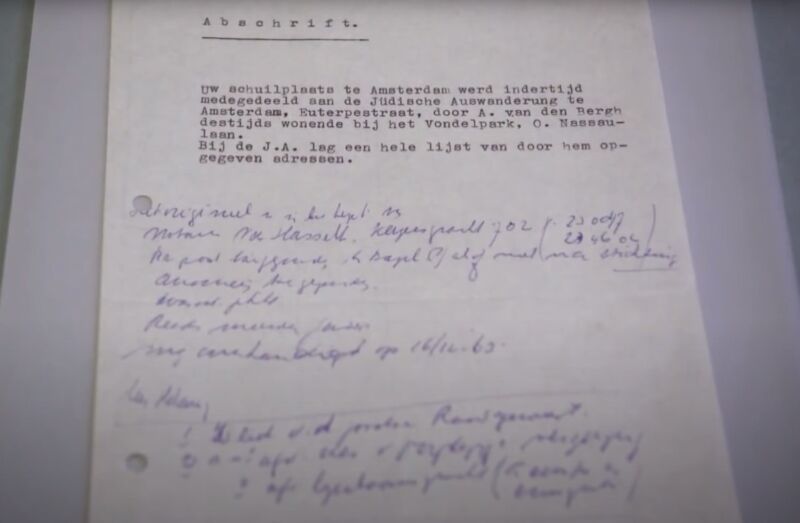
Otto Frank's copy of an anonymous note
Enlarge / Otto Frank’s copy of an anonymous note he received, allegedly identifying the person who betrayed the Frank family. The note is offered as evidence that a Jewish leader named Arnold van den Bergh was the most likely culprit in The Betrayal of Anne Frank by Rosemary Sullivan.

Last month, we reported on a new hypothesis about who might have betrayed the hiding place of Anne Frank and her family to the Nazis in 1944, which ultimately led to the death of Anne and most of her family. The new suspect: a local Jewish leader named Arnold van den Bergh, who may have handed over lists of addresses where fellow Jews were hiding in order to protect his own family. The theory was featured in a segment on 60 Minutes and is described in detail in a new book by Rosemary Sullivan: The Betrayal of Anne Frank: A Cold Case Investigation.

The news caused a stir, given that the named suspect was also Jewish. It also raised the hackles of historians who expressed skepticism about the hypothesis. Now, Reuters is reporting that the book’s Dutch publisher, Ambo Anthos, has suspended printing for a second run of the book after questions were raised about the shoddiness of the research, per an internal email that the news service acquired.

Anne Frank in 1940.
Enlarge / Anne Frank in 1940.
Public domain

The email was addressed to all of Ambo Anthos’ authors. The publisher wrote it should have taken a more “critical stance” on the new book. “We await the answers from the researchers to the questions that have emerged and are delaying the decision to print another run,” the email read. “We offer our sincere apologies to anyone who might feel offended by the book.”

On July 6, Anne Frank and her family began their lives in the Secret Annex attached to the office building at Prinsengracht 263, where Otto Frank had worked. The annex was only accessible via a door on the landing that was kept hidden by a bookcase. Anne chronicled their lives in the annex in her diary for the next two years and made her final entry on August 1, 1944. Just three days later, German police led by the SS stormed the annex, arresting the Franks and the Van Pels family. Anne Frank died (likely of typhoid fever) at age 15 a day after her older sister, Margot, at the Bergen-Belsen death camp between February and April 1945. Their mother, Edith, had died of starvation the year before. Only Otto Frank, Anne’s father, survived.

Suspects who have been proposed as possible betrayers over the ensuing decades include Lena Hartog, wife of the company’s assistant warehouse manager; Anton “Tonny” Ahlers, a member of the National Socialist Movement in the Netherlands; stockroom manager Willem van Maaren; and Nelly Voskuijl, sister of Bep Voskuijl.

The Anne Frank House undertook its own investigation and arrived at a surprising new theory in 2017, thanks to the efforts of a historian named Gertjan Brock. It’s possible, Brock suggested, that there was no betrayal, and the SS raid was really part of ongoing attempts to track down purveyors of illegal goods. This theory holds that the officers just happened to stumble upon the Jewish families hiding in the attic.

A new candidate for who betrayed the Frank family: Arnold van den Bergh was likely trying to protect his own family from capture and deportation.
Enlarge / A new candidate for who betrayed the Frank family: Arnold van den Bergh was likely trying to protect his own family from capture and deportation.
YouTube/60 Minutes/CBS

When he decided to revisit the cold case, retired FBI Special Agent Vincent Pankoke assembled a team that included some 20 historians, criminologists, and data specialists. While admitting that the case is circumstantial and some reasonable doubt remains, Pankoke et al. concluded that van den Bergh was the most likely culprit. A crucial piece of new evidence was an anonymous note to Otto Frank that specifically named van den Bergh as the one who passed on the information about where Jews were hiding in Amsterdam. The original note was lost, but Otto Frank made a copy and preserved it, although he never spoke publicly about the allegation.

But University of Leiden historian Bart van der Boom dismissed the theory as “defamatory nonsense” to the BBC, while Amsterdam University’s Johannes Houwink insisted that, if lists of Jews in hiding had existed, they would have surfaced long before now. The Anne Frank House was more circumspect in its reaction, stating that the Pankoke team’s investigation was impressive and had “generated important new information and a fascinating hypothesis that merits further research.”

Others who have questioned the research include the foundation set up by Otto Frank, the Anne Frank Fund, which insisted Sullivan’s book was “full of errors.” Historian Erik Somers of the Dutch NIOD Institute for War, Holocaust and Genocide studies praised the extensiveness of the investigation. But he thought the anonymous note was not quite the slam dunk Pankoke et al. thought it was and said the team had made certain assumptions about Jewish institutions in Amsterdam during World War II that were contradicted by other historical research.

One of the investigators on Pankoke’s team, Pieter van Twisk, told Reuters that he and the team were “completely surprised” by the email. “We had a meeting last week with the editors and talked about the criticism and why we felt it could be deflected and agreed we would come with a detailed reaction later,” he said. Per the BBC, van Twisk told Dutch public broadcaster NOS that the team had never claimed to have uncovered the complete truth. He estimated that their theory had a “probability percentage of at least 85 percent” and the hope was that their research would help fill some gaps in the existing research.

https://arstechnica.com/?p=1830881


New York Times spends “low seven figures” to buy Wordle

<img src="https://rassegna.lbit-solution.it/wp-content/uploads/2022/02/new-york-times-spends-low-seven-figures-to-buy-wordle.png" alt="The New York Times is buying Wordle.”>
Enlarge / The New York Times is buying Wordle.

The New York Times announced today that its Games division would be purchasing Wordle—everyone’s favorite five-letter-word guessing game and emoji-square generator—for a number in the “low-seven figures.”

The sale caps a meteoric rise for the simple game. It rode word-of-mouth recommendations and glowing media coverage to prominence, was subject to multiple copycat apps that Apple removed from its App Store, and inevitably generated backlash from people who don’t like it when other people have fun in public.

“At the time it moves to The New York Times, Wordle will be free to play for new and existing players, and no changes will be made to its gameplay,” the Times notes in its press release. Presumably after Wordle has moved, the Times will tweak its gameplay and impose a registration requirement or paywall as it sees fit. Many of the Times’ games, including Sudoku, Spelling Bee, and the mini-version of its crossword, can also be played for free without signing in or registering. But a subscription is required to play the full version of the crossword puzzle and access the NYT’s crossword puzzle archive.

Wordle creator Josh Wardle released his own statement saying that he was letting the Times “take over running Wordle going forward” and that he is working with the paper to make sure that current players’ win records and streaks will carry over. Wardle detailed to the Times in early January how the game had begun as a word guessing game for his partner.

“I think people kind of appreciate that there’s this thing online that’s just fun,” Wardle told the Times in that piece. “It’s not trying to do anything shady with your data or your eyeballs. It’s just a game that’s fun.”

Listing image by Aurich Lawson / Ars Technica

https://arstechnica.com/?p=1830746


A wacky, $3.6 billion end to gaming-acquisition January: Sony buys Bungie

Well, we didn't necessarily see this one coming.
Enlarge / Well, we didn’t necessarily see this one coming.
Aurich Lawson | Sony | Bungie

After Microsoft’s acquisition of Activision Blizzard King, talk turned to how Sony and its PlayStation division would deal with the fallout of the purchase. If the Xbox becomes the exclusive home of Call of Duty games, would Sony be left out of the megaton first-person shooter space? Would Sony fire back with a major acquisition of its own?

On Monday, Sony announced plans to acquire Bungie and its Destiny series of shooters in a deal reportedly valued at $3.6 billion (in an email to Ars Technica, a Sony rep declined to confirm that figure). Somehow, this pricey purchase includes a firm pledge from Bungie, despite its new corporate overlords: Bungie’s “future games” will not be PlayStation exclusives.

Bungie had clearly prepared to announce this news to its active Destiny 2 user base, which plays on a variety of non-PlayStation platforms like Steam, Google Stadia, and (of course) Xbox. Its Destiny 2-specific FAQ confirms that the game’s current content map is set until at least 2024, when a project dubbed “The Final Shape” launches. All planned content will continue to work cross-platform without any PlayStation “console exclusive” forks or DLC, the company said.

What if Activision had held on for two more years?

What does Sony get from this deal, then? In addition to the potential revenue that might be derived from Bungie’s current and future projects, even on rival platforms, PlayStation chief Hermen Hulst hinted that Bungie would bring value to the entire PlayStation portfolio. In his announcement of today’s news, Hulst says his team “will be excited about what we can share and learn” from Bungie. This doesn’t necessarily mean that portions of the Bungie staff will become secondary development teams on PlayStation-exclusive games or that the PC-focused teams will take the lead on PC ports of existing console-exclusive titles. But becoming part of the PlayStation first-party family would allow Sony to redirect Bungie’s efforts in a way that doesn’t strip “Bungie” games of their cross-platform promises.

This week’s news follows Bungie’s efforts to extricate itself from a publishing deal with Activision, which concluded in 2019 with Bungie buying itself out of the deal. Shortly after that deal was concluded, Destiny 2 found its way to more platforms, particularly Steam, as a free-to-play, cross-save franchise. Activision later revealed in investor reports that the buyout cost the Destiny 2 studio less than $200 million to complete.

The Monday announcement curiously lacks any mention of NetEase, the Chinese gaming publisher that became a minority stakeholder in Bungie in 2018. That deal exceeded $100 million, and today’s news likely means the publisher is being bought out of its stake in Bungie’s current and future efforts. At the time of the NetEase deal, Bungie indicated that the partnership would enable “new directions” for the studio, though it’s unclear if this was in reference to the 2019 breakup with Activision or any other non-Destiny games that have yet to surface.

Today’s news was apparently so shrouded in secrecy that Bloomberg reporter Jason Schreier broke the news to current Bungie employees. “Several Bungie staff learned it from me this morning as I tried to break the news,” Schreier wrote on Twitter. He wrote that Bungie’s staff members got the official news from their bosses this morning at the same time that Bungie’s and Sony’s official announcements went live on the Internet.

From Marathon to whatever Sony has cooking

This week’s news marks a surprising turn of events for a developer currently celebrating its 30th anniversary. Bungie began life as a predominantly Apple-focused game developer who gave Mac gamers their own celebrated, exclusive first-person shooter series in Marathon. Then-Apple CEO Steve Jobs unveiled Halo‘s first-ever gameplay footage to the world at a MacWorld keynote address, and shortly afterward, Microsoft snuck up and outright acquired Bungie in order to secure a valuable gaming exclusive for its original Xbox console. The following decade saw Microsoft and Bungie collaborate and squabble on all things Halo until they struck a deal for the game maker’s independence.

Now, in the wake of Microsoft spending a ton of money on (among other things) a platform-defining first-person shooter, Sony has apparently done the same. But as we’ve learned in the days since the Microsoft-Activision deal was inked, Microsoft may still have at least a couple of years of agreements to abide by to guarantee that brand-new Call of Duty games arrive on PlayStation consoles through 2023. Again, Sony’s deal echoes Microsoft’s here, as Bungie has committed to honoring plans to keep Destiny 2 and other “Bungie” games cross-platform and independent.

https://arstechnica.com/?p=1830618


Ubisoft execs: “Gamers are always right”—yet they somehow “misunderstand” NFTs

This galaxy brain image is still working out Ubisoft's apparent "piece-by-piece" puzzle explanation of its NFT plans.
Enlarge / This galaxy brain image is still working out Ubisoft’s apparent “piece-by-piece” puzzle explanation of its NFT plans.
Aurich Lawson | Getty Images

In the weeks since Ubisoft rolled out non-fungible tokens in one of its video games, critics—particularly those here at Ars Technica—have shot back with questions about their purpose. While Ars is still waiting for a formal response to our December questions, the closest we’re likely to get comes from a Thursday interview with Ubisoft executives that included a bold assertion that players’ “resistance” to NFTs is “based on misunderstanding.” (We hope Ubisoft isn’t saying that to anyone who has read Ars’ lengthy guide to NFTs.)

In the interview, conducted by Australian tech site Finder, two Ubisoft executives (Didier Genevois, head of Ubi’s blockchain team, and Nicolas Pouard, lead on Ubi’s “Quartz” and “Digits” NFT systems) fail to clarify how an online game’s NFT implementation differs on a gameplay basis from existing digital rights management (DRM) solutions, particularly those baked into storefronts like Steam and Ubisoft Connect.

When pressed directly on what benefit a player might expect from engaging with Ubisoft Digits, Pouard first said that “gamers don’t get what a digital secondary market can bring to them.” Eventually, Pouard answered with one potential benefit: “the opportunity to resell their items once they’re finished with them or they’re finished playing the game itself.”

Finder’s reporter then asked whether Ubisoft game license purchases might one day be treated like NFTs so that consumers can freely sell and trade the games they’ve purchased instead of having them locked in their Ubisoft Connect accounts. Pouard implied that such a thing could happen one day. “That’s part of the use case we can explore, but it’s not the focus today,”  he said.

A domain of wild contrasts

Pouard also indicated that the greater goal of NFT sales is connecting them to other marketplaces. He responded to a query about whether “play-to-earn” schemes could appear in Ubisoft games, with NFT acquisition as an endpoint, by saying, “Adding a real-world value reward might be the next addition on top of all the value a game already offers.” (Pouard in no way explained how such NFTs or rewards would be doled out, nor what kind of regulatory hot water his team could land in for promoting such a scheme.)

In one head-spinning quote, Pouard all but screamed Ubisoft’s intent for making money from a connected metaverse of some sort:

The interest in decentralization for a centralized company like Ubisoft is to open the gates of our games and to make them bigger by sharing [a stake] with our players. To build new experiences that are on top of what is in each game to date. It’s a new way to see what a game could be. I don’t want to go into numbers, but owning a percentage of a huge ecosystem might be even more interesting than just owning a game today. I’m sorry, as I know it’s difficult to understand right now, as this kind of idea doesn’t really exist yet [in gaming]. But we see that the ecosystem for a game can be much, much bigger than what a game is today in terms of value creation for everyone.

The interview is a domain of wild contrasts. On the one hand, Pouard said Ubisoft customers would have seen through any attempt to hide the NFT-based nature of its Digits system. “We need to be transparent on what we are doing,” he said.

Yet when asked about customers’ negative reaction to Ubisoft Digits, Pouard pivoted to condescension and obfuscation. After saying NFTs are “not an easy concept to grasp,” he boldly asserted that “piece by piece, the puzzle will be revealed and understood by our players.”

Worse, when describing the item-resale potential of Ubisoft Digits, Pouard got pretty blunt. “So, it’s really for [paying Ubisoft customers]. It’s really beneficial. But they don’t get it for now,” he said.

A few questions later, Pouard went back to heaping praise on players, telling Finder, “Players are always right. Because they are our players, and we love them. And so they’re always right.”

https://arstechnica.com/?p=1830183


Exploring mind-bending questions about reality and virtual worlds via The Matrix

<img src="https://rassegna.lbit-solution.it/wp-content/uploads/2022/01/exploring-mind-bending-questions-about-reality-and-virtual-worlds-via-the-matrix.jpg" alt="Virtual worlds might be digital, but they can be as real and meaningful as our physical world, philosopher David Chalmers argues in his new book, Reality+: Virtual Worlds and the Problems of Philosophy.“>
Enlarge / Virtual worlds might be digital, but they can be as real and meaningful as our physical world, philosopher David Chalmers argues in his new book, Reality+: Virtual Worlds and the Problems of Philosophy.
Aurich Lawson | Getty Images | David Chalmers

There’s a famous scene in The Matrix where Neo goes to see The Oracle. He meets another potential in the waiting room: a young child who seemingly bends a spoon with his mind. Noticing Neo’s fascination, he tells him, “Do not try and bend the spoon. That’s impossible. Instead, only try to realize the truth.” And what is that truth? “There is no spoon,” the child says.

The implication is that the Matrix is an illusion, a false world constructed by the machines to keep human beings sedated and docile while their bodies serve as batteries to power the Matrix. But what if this assumption is wrong, and the Matrix were instead just as real as the physical world? In that case, the child would more accurately have said, “Try to realize the truth. There is a spoon—a digital spoon.”

That’s the central argument of a new book, Reality+: Virtual Worlds and the Problems of Philosophy, by New York University philosopher David Chalmers. The Australian-born Chalmers is perhaps best known for his development in the 1990s of what’s known as the hard problem of consciousness. Things like the ability to discriminate, categorize, and react to environmental stimuli; the brain’s ability to integrate information; and the difference between wakefulness and sleep can all be explained by identifying an underlying mechanism.

"There is a spoon—a digital spoon."
Enlarge / “There is a spoon—a digital spoon.”
Warner Bros

But the subjectivity of experience is qualitatively different. Emotions, the taste of strawberries, or the smell of lavender all fall under the “hard problem” rubric because they are much more difficult to account for in physical or biological terms. Chalmers has also championed the concept of “philosophical zombies“: exact physical duplicates of human beings who lack any kind of consciousness or qualitative experience.

Chalmers has been pondering The Matrix as it relates to the so-called simulation hypothesis since the first film came out in 1999. The Wachowskis’ production company, Red Pill, had employed a Clemson University philosopher named Christopher Grau while they were developing the film, and they asked Grau to invite some of his academic colleagues to write essays about The Matrix for the film’s website. Chalmers was among those who received an invitation. He had already been working on an academic paper, and he was able to adapt those early thoughts into an essay, “The Matrix as Metaphysics.”

In that essay, Chalmers challenged the film’s oft-repeated theme that if someone is in the Matrix, they are experiencing an illusion, an elaborate deception, a hoax, or a fiction—in other words, the constant insistence that the Matrix is not the “real” world. “I argued that, yes, we could be in the Matrix, but if we are, it’s still perfectly real,” Chalmers told Ars. “It turns out that The Matrix is a wonderful way to illustrate a whole set of philosophical ideas.”

Reality+ develops that central techno-philosophical argument in greater detail, delivered in deceptively breezy, almost conversational prose. Chalmers uses The Matrix and other aspects of pop culture to explore a broad range of mind-bendingly deep philosophical ideas.

“For me, it’s a great way of making many of these questions very concrete, by anchoring them to actual science fiction scenarios,” said Chalmers, citing as an example James E. Gunn‘s 1954 sci-fi novella “The Unhappy Man” (later incorporated into The Joy Makers). The plot concerns a company called Hedonics Inc., which offers people the opportunity to move into a virtual world where everything is perfect. The story’s protagonist rejects that offer, deeming that perfect virtual world to be inferior to imperfect reality. Its themes prefigured those of The Matrix in many ways.

<a href="https://rassegna.lbit-solution.it/wp-content/uploads/2022/01/exploring-mind-bending-questions-about-reality-and-virtual-worlds-via-the-matrix-4.jpg" class="enlarge" data-height="797" data-width="1200" alt="A recurring theme in The Matrix franchise is that the Matrix is an elaborate deception or hoax. Only by taking the "red pill" can those trapped within it free their minds and re-enter the "real" world.”><img alt="A recurring theme in The Matrix franchise is that the Matrix is an elaborate deception or hoax. Only by taking the "red pill" can those trapped within it free their minds and re-enter the "real" world.” src=”https://rassegna.lbit-solution.it/wp-content/uploads/2022/01/exploring-mind-bending-questions-about-reality-and-virtual-worlds-via-the-matrix-2.jpg” width=”640″ height=”425″ srcset=”https://rassegna.lbit-solution.it/wp-content/uploads/2022/01/exploring-mind-bending-questions-about-reality-and-virtual-worlds-via-the-matrix-4.jpg 2x”>
Enlarge / A recurring theme in The Matrix franchise is that the Matrix is an elaborate deception or hoax. Only by taking the “red pill” can those trapped within it free their minds and re-enter the “real” world.
YouTube/Warner Bros.

In this accessible yet thought-provoking book, readers will encounter everything from Plato’s allegory of the cave and John Wheeler’s it-from-bit hypothesis to how mind and body might interact in virtual worlds, whether reality is a mathematical structure, and whether we might just be Boltzmann brains floating in a dream world. Chalmers also tackles techno-centric questions like whether smartphones extend our minds, whether the Internet is making us smart or stupid, the threat of deepfakes and alternative facts, and whether there can be an objective reality in a multiverse of virtual worlds.

“Our minds are part of reality, but there’s a great deal of reality outside our minds,” Chalmers writes in the introduction to Reality+. “Reality contains our world and it may contain others. We can build new worlds and new parts of reality…. There may be parts of it that we can never know. Reality exists, independently of us. The truth matters. There are truths about reality, and we can try to find them. Even in an age of multiple realities, I still believe in objective reality.”

Ars sat down with Chalmers to learn more.

https://arstechnica.com/?p=1827805


New Star Wars 1313 footage reveals the (canceled) Boba Fett game we always wanted

<img src="https://rassegna.lbit-solution.it/wp-content/uploads/2022/01/new-star-wars-1313-footage-reveals-the-canceled-boba-fett-game-we-always-wanted.png" alt="Nice splash of colors and reflection effects in this newly unearthed footage of Boba Fett as the star of canceled game Star Wars 1313.”>
Enlarge / Nice splash of colors and reflection effects in this newly unearthed footage of Boba Fett as the star of canceled game Star Wars 1313.

A new YouTube video making the rounds reveals that a long-canceled Star Wars game would have been the first time that bounty hunter and fan favorite Boba Fett starred in his own game.

Long before Fett became a fixture on Disney+, the game development teams at LucasArts began work on an action video game about bounty hunters and the planet Coruscant. As Bloomberg’s Jason Schreier reported in his games-industry book Blood, Sweat, and Pixels, that project, dubbed Star Wars 1313, morphed wildly over a four-year span. 1313 started development in 2009 but was canceled after LucasArts shut down in 2013—a casualty of Disney’s acquisition of all things Lucasfilm and Star Wars.

While we’ve seen teases of Star Wars 1313 before—especially during its splashy debut at E3 2012—public footage thus far has been limited to the game’s brand-new bounty hunter heroes. This week’s video is the first to show what Boba Fett looked like as 1313‘s playable hero, a development shift mandated by George Lucas months before the E3 2012 reveal. Coincidentally, Lucas also demanded that Fett not appear in that public 2012 reveal.

Fett is finally seen taking Uncharted steps

The new video comes from The Vault, a YouTube channel that focuses almost exclusively on details and leaks surrounding the canceled Star Wars Battlefront III project. The channel’s first-ever video about Star Wars 1313 pulls primarily from the portfolio of James Zachary, who directed 1313‘s animation team and led its motion-capture department.

Since Zachary’s Boba Fett videos are marked “private” and don’t have timestamps, we can’t be certain how long they’ve been hiding in plain sight on Zachary’s portfolio site. This footage shows 1313 at the point in which its development had shifted squarely into “Star Wars does Uncharted” territory, as opposed to an earlier state that reportedly borrowed from the Gears of War franchise.

Yes, every NPC looks identical—that's what pre-pre-alpha tends to look like. But as far as offering an atmospheric slice of an unfinished game, Boba Fett's stroll through a bar looks and sounds full of life. It cuts off before we see whether he faceplants into a Sarlaac pit, however.
Enlarge / Yes, every NPC looks identical—that’s what pre-pre-alpha tends to look like. But as far as offering an atmospheric slice of an unfinished game, Boba Fett’s stroll through a bar looks and sounds full of life. It cuts off before we see whether he faceplants into a Sarlaac pit, however.

Fett is framed in a three-quarters, third-person camera perspective, and The Vault video includes two discrete sequences: an atmospheric walk through a seedy bar, where he must contend with disagreeable patrons bumping into him, and an action-filled chase chase complete with dramatic jumps, cliffside hangs, and downhill slides. While the video’s first half has a few clearly unfinished assets, the second half is all “gray boxes” and other rudimentary content.

<a href="https://cdn.arstechnica.net/wp-content/uploads/2022/01/Screenshot-81.png" class="enlarge" data-height="2160" data-width="3840" alt="Boba Fett, seen here scaling and climbing in an unfinished segment of canceled game Star Wars 1313.”><img alt="Boba Fett, seen here scaling and climbing in an unfinished segment of canceled game Star Wars 1313.” src=”https://rassegna.lbit-solution.it/wp-content/uploads/2022/01/new-star-wars-1313-footage-reveals-the-canceled-boba-fett-game-we-always-wanted-2.png” width=”980″ height=”551″>
Enlarge / Boba Fett, seen here scaling and climbing in an unfinished segment of canceled game Star Wars 1313.

Zachary describes the chase sequence as something “used to sell the ‘environmental interaction’ animation pillar” of Star Wars 1313. The Boba Fett we see may very well be a reskin of the game’s original brand-new bounty hunter protagonist, as the chase doesn’t include any of Fett’s signature jetpack moves—which, as Schreier reported, had evolved and become functional during development before the project was canceled. Instead, the chase looks like a Nathan Drake sequence with a Coruscant background, with floating vehicles zipping across the horizon.

<a href="https://cdn.arstechnica.net/wp-content/uploads/2022/01/bobafett01.png" class="enlarge" data-height="2160" data-width="3840" alt="Boba Fett, seen casually sliding past a WALL or two (in clear pre-pre-alpha footage of Star Wars 1313).”><img alt="Boba Fett, seen casually sliding past a WALL or two (in clear pre-pre-alpha footage of Star Wars 1313).” src=”https://rassegna.lbit-solution.it/wp-content/uploads/2022/01/new-star-wars-1313-footage-reveals-the-canceled-boba-fett-game-we-always-wanted-3.png” width=”980″ height=”551″>
Enlarge / Boba Fett, seen casually sliding past a WALL or two (in clear pre-pre-alpha footage of Star Wars 1313).

Coincidentally, Star Wars 1313 began life as a “connected universe” project. That means it would join the same gritty universe that George Lucas had been putting together for a planned, adult-focused Star Wars TV series dubbed Underworld. The game project continued moving forward even as its associated TV series descended into development hell before vanishing entirely.

With The Mandalorian, the Star Wars powers-that-be have carried on what Underworld began, at least on the TV front. And the success of The Mandalorian and the Book of Boba Fett TV series means we shouldn’t be surprised if one of the mysterious, recently announced Star Wars game projects from EA and Respawn follows a Fett-like bounty hunter.

[embedded content]
Star Wars 1313 Boba Fett footage.

https://arstechnica.com/?p=1828944


Valve confirms Steam Deck shipment, review dates: By the end of February

Starting on February 28, Steam Deck will finally leave Valve's hands and (possibly) land in yours.
Enlarge / Starting on February 28, Steam Deck will finally leave Valve’s hands and (possibly) land in yours.
Aurich Lawson | DC

After delaying the Steam Deck’s launch to a vague “February 2022” window, Valve has returned to keep its promise. Today, the company confirmed the date its portable, gaming-centric PC will begin shipping to some preorder customers.

Valve listed two key dates in its Wednesday announcement. Firstly, the Steam Deck will begin shipping on February 28 to customers who got their $5 preorder payments in at the earliest possible moment, i.e., the first few minutes after the clock struck 1 pm EST on July 16.

Customers have a chance of being part of this shipment window if their order has an official Steam shipping estimate of “Q1 2022”; you can check your estimate by loading the Deck store page while logged into Steam.

“Launching” on February 25 (but not really)

But there’s another crucial date for Steam Deck preorder customers to keep in mind: February 25. That’s when Valve will send emails to an unconfirmed number of preorder customers requesting that they pay the rest of the console’s asking price. That figure ranges from $399 for the 64GB model to $649 for the 512GB model.

Valve’s announcement says that these email alerts—which essentially ask preorder customers to pay the rest of their tab—will land at 1 pm EST on that Friday afternoon. The notifications, Valve says, will be sent out in the order that successful preorders were made. Customers who receive the alerts have exactly 72 hours to pay, and if they miss the window, their reserved console will move down the list to the next batch of customers.

The announcement also mentions that Valve will operate its Deck preorder payment requests on a “weekly cadence.” This suggests that the full gamut of “Q1 2022” preorders will be broken up between February 25 and the end of March. In other words, if you didn’t place your Deck preorder within the first 45 seconds of the floodgates opening on July 16, you might have to wait a week or four.

Valve’s post doesn’t clarify whether quicker preorder payments will change the order in which these systems are shipped. But based on the language used in the announcement, it sounds like users won’t need to hover over their inboxes on that Friday to be part of the first shipping wave on February 28. Just, you know, maybe don’t pick that weekend to unplug from the Internet.

One way to check the Deck

Preorder customers will have a reason to wait a few hours before pulling the payment trigger. Valve has confirmed that Deck systems are being mailed to members of the press “shortly,” and the systems have a review embargo of February 25.

This review date will follow Valve’s tease of “preview coverage and impressions before that” date. If Ars’ experience reviewing the Valve Index virtual reality system is any indication, fans might expect to see a specific system feature broken out into a preview article, much like how we posted about “living with Valve Index as a work monitor for a week” before the product’s formal June 2019 launch.

Relatedly, the comments section of this article would be a great place to request specific tests and benchmarks or remarks on touchpads, the cloud-sync system, emulation front-ends, OS installations, game compatibility, and other things that Ars Technica might apply to a Steam Deck review, should Ars indeed be among the members of the press invited to the Deck’s upcoming review period. (As the first reporter to confirm Steam Deck’s existence, I’ve already been dreaming up coverage plans in the case of such a review opportunity.) https://arstechnica.com/?p=1828680