The retailer’s monthly subscription service, Humble Choice, previously offered a number of price tiers; the more you paid, the more new games you could claim in a given month. Starting February 1, Humble Choice will include less choice, as it will only offer a single $12/month tier, complete with a few new game giveaways per month and ongoing access to two collections of games: Humble’s existing “Trove” collection of classic games, and a brand-new “Humble Games Collection” of more modern titles.
Launcher cut-off: February 1, 2022
But this shift in subscription strategy comes with a new, unfortunate requirement: an entirely new launcher app, which must be used to access and download Humble Trove and Humble Games Collection games going forward. Worse, this app will be Windows-only. Current subscribers have been given an abrupt countdown warning (as spotted by NeoWin). Those subscribers have until January 31 to use the existing website interface to download DRM-free copies of any games’ Mac or Linux versions. Starting February 1, subscription-specific downloads will be taken off the site, and Mac and Linux versions in particular will disappear altogether.
Interestingly, the current Trove library consists of 79 games, but Humble says that the Trove collection will include “50+ games” starting February 1. This week’s warning to Humble’s Mac and Linux subscribers notes that “many” of the current Trove games will appear on the Humble Launcher, which is likely a nice way of saying that some of the existing games will not—perhaps around 20 or so, based on the aforementioned numbers.
Despite these changes, Trove’s selection of games will remain DRM-free. FAQs about the Humble Launcher suggest that subscribers can download Trove files and continue accessing them in DRM-free fashion, no Humble Launcher or ongoing subscription required. The same promise has not been made for the more modern game collection found in the new Humble Games Collection.
Humble has not announced further changes to its existing business model, which largely revolves around Steam keys that Humble either includes in Humble Choice, sells a la carte, or bundles in pay-what-you-want collections. In the latter case, the more you pay for a given bundle, the more games are included, so long as your payment amount exceeds a certain threshold. A spot check of existing Humble accounts held by Ars Technica staffers still includes web download options for older bundles’ DRM-free downloads, including Mac and Linux versions. These options, however, have become scarcer in recent years’ bundles, with the significant exception of nongame sales like PDF downloads of books and comics.
But the shift toward a dedicated launcher, and its loud positioning as the sole way to access certain subscription options, suggests that Humble is at least positioning itself to take more PC games out of the existing Steam-linked ecosystem, if not planning to do so outright. [Update, 2:55 p.m. ET: A recent FAQ indicates that Humble Choice’s biggest existing perk will persist to some extent: “a selection of hand-picked games redeemable via a key for select platforms, when available (Steam, Epic, Origin, GOG, etc.).” That language gives Humble wiggle room to make future Humble Choice games exclusive to the Humble Launcher, instead of arriving as redemption codes to be used at other popular storefronts. As of press time, the company has not clarified how likely Humble Choice codes for stores like Steam will be skipped in favor of Humble Launcher exclusives.]
“I’m not in a position to say f— it to a large community of people who want to support us.”
If you’re not supporting Linux and Mac OS X from a philosophical standpoint or for the fans, at least do it for the money. If you don’t support non-Windows platforms, you’re leaving a lot of cash on the table. I don’t know about you, but I’m not in a position to just say f— it to a large community of people who want to support us.
Ars Technica may earn compensation for sales from links on this post through affiliate programs.
https://arstechnica.com/?p=1825792
Raised by Wolves S2 trailer promises another wild, crazy (possibly maddening) ride
[embedded content]
Amanda Collin returns as Mother in the second season of HBO’s original series Raised by Wolves.
We finally have the full trailer for the second season of Raised by Wolves, the visually striking, occasionally frustrating sci-fi series created by Aaron Guzikowski, with Ridley Scott serving as executive producer. The series returns to HBO Max on February 3.
(Spoilers for S1 below.)
As I’ve written previously, the series involves two androids serving as Mother (Amanda Collin) and Father (Abubakar Salim) figures on a strange virgin planet, Kepler-22b (an actual observed extrasolar planet), after Earth has been destroyed by the outbreak of a religious war. They are programmed to incubate, birth, and raise human children to rebuild the population and set up an atheist civilization to keep the human race from going extinct.
The first teaser dropped last month and left us with decidedly mixed feelings. As I observed at the time:
On the one hand, once again, the visuals are amazing, and we’re thrilled that the strikingly androgynous Danish actress Amanda Collin is returning to star as Mother. Her extraordinary performance anchored the first season’s narrative arc and spooky, otherworldly vibe, and that same moody, disquieting vibe is present in the teaser. On the other hand, we were seriously disappointed in the S1 finale, which has shaken our confidence that S2 will rebound from that fiasco to become the genuinely original and visionary series it initially promised to be.
Enlarge/ Mother (Amanda Collin) and Father (Abubakar Salim) fear they might be becoming too human.
YouTube/HBO Max
S1 wasn’t to everyone’s taste, but I found it atmospheric and weird in interesting ways—until that finale. Mother became pregnant after having virtual sex with her VR creator, “downloading” the required information. Except instead of giving birth to a baby as she’d hoped, Mother literally vomited up a creepy, flying alien sucker-snake (FASS). In my review, I called it “a jarring, over-the-top ploy that simply wasn’t sufficient payoff for the viewer, and clashed mightily with the original set-up.” And just as we feared, the FASS looks to play a significant role in S2.
Per the official synopsis:
Android partners Mother (Amanda Collin) and Father (Abubakar Salim), along with their brood of six human children, join a newly formed atheistic colony in Kepler 22 b’s mysterious tropical zone. But navigating this strange new society is only the start of their troubles as Mother’s “natural child” threatens to drive what little remains of the human race to extinction.
As the trailer opens, Mother and Father have relocated with their children to the atheist colony on the other side of the planet, which seems far more hospitable to their well-being than their original settlement. We get hints of the planet’s still-hidden mysteries in the form of a desiccated alien body, as well as a strange skeleton, and we get scenes of what appears to be a gladiator-style combat stadium. Meanwhile, Marcus (Travis Fimmel) has become a zealous devotee of Sol and is intent on converting the children to his way of thinking. “To be worthy of Sol’s love, children, you need only need faith,” he tells them at one point. “And that is one thing that this robot can never take away from us.”
Mother and Father are far more than mere robots, of course, even fearing that they might be becoming a little too human the more time they spend on the planet with their brood. Mother’s more violent nature will still get a chance to emerge, including her signature sonic scream that reduces human bodies to so much bloody gore. On the whole, we remain hopeful that S2 will be a solid experience. But perhaps that’s because the FASS remains largely AWOL from the trailer, apart from one brief glimpse as it curls ominously around a tree, evoking some strong Garden of Eden vibes.
The second season of Raised by Wolves debuts on HBO Max on February 3, 2022.
Ancient Peruvians partied hard, spiked their beer with hallucinogens to win friends
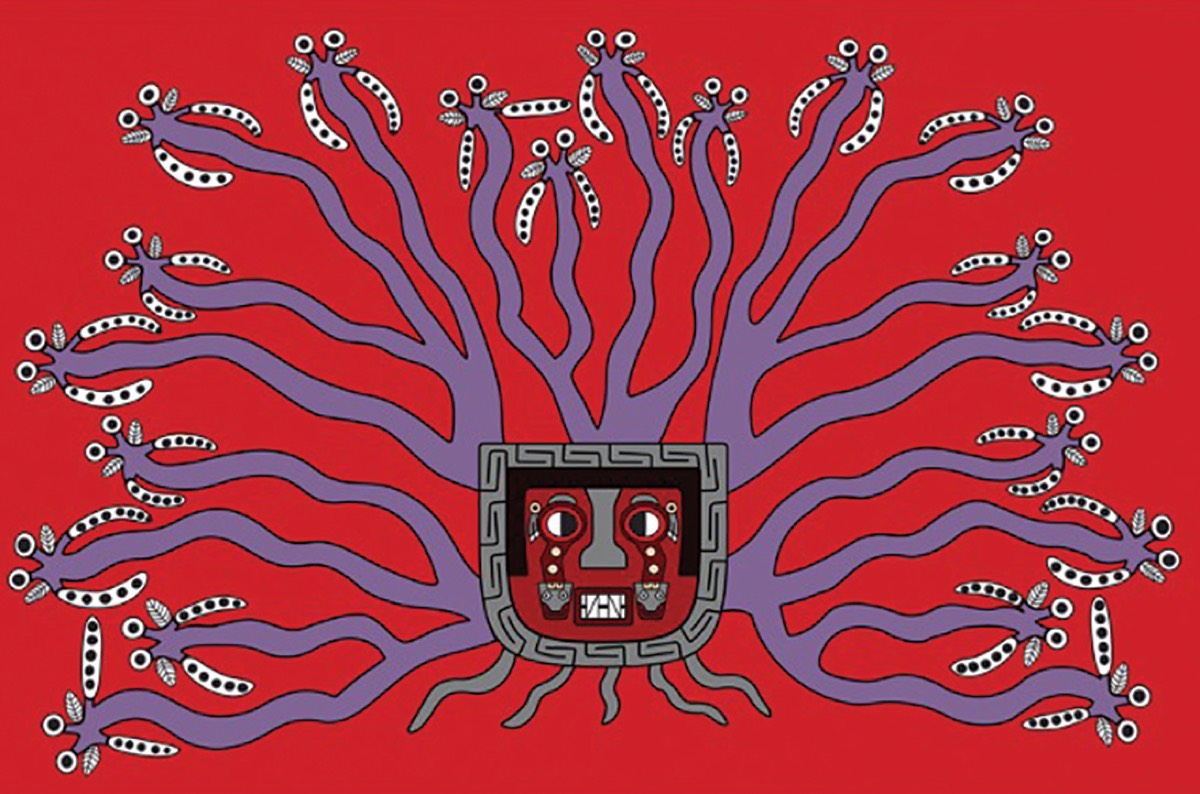
Enlarge/ A vessel from the Wari site of Conchopata features the tree and its tell-tale seed pods sprouting from the head of the Staff God.
J. Ochatoma Paravicino/M.E. Biwer et al., 2022
Lacing the beer served at their feasts with hallucinogens may have helped an ancient Peruvian people known as the Wari forge political alliances and expand their empire, according to a new paper published in the journal Antiquity. Recent excavations at a remote Wari outpost called Quilcapampa unearthed seeds from the vilca tree that can be used to produce a potent hallucinogenic drug. The authors think the Wari held one big final blowout before the site was abandoned.
“This is, to my knowledge, the first finding of vilca at a Wari site where we can get a glimpse of its use,” co-author Matthew Biwer, an archaeobotanist at Dickinson College, told Gizmodo. “Vilca seeds or residue has been found in burial tombs before, but we could only assume how it was used. These findings point to a more nuanced understanding of Wari feasting and politics and how vilca was implicated in these practices.”
The Wari empire lasted from around 500 CE to 1100 CE in the central highlands of Peru. There is some debate among scholars as to whether the network of roadways linking various provincial cities constituted a bona fide empire as opposed to a loose economic network. But the Wari’s construction of complex, distinctive architecture and the 2013 discovery of an imperial royal tomb lend credence to the Wari’s empire status. The culture began to decline around 800 CE, largely due to drought. Many central buildings were blocked up, suggesting people thought they might return if the rains did, and there is archaeological evidence of possible warfare and raiding in the empire’s final days as the local infrastructure collapsed and supply chains failed.
Before that, however, the Wari enjoyed a period of relative peace and prosperity, with a capital city (just northeast of today’s city of Ayacucho in Peru) that served as the center of the Wari civilization. The use of hallucinogens, particularly a substance derived from the seeds of the vilca tree, was common in the region during the so-called Middle Horizon period, when the Wari empire thrived.
Enlarge/ Vilca seed recovered from Component II at Quilcapampa (scale in cm).
Vilca typically grows in the dry tropical forests in the region. The trees produce long legumes filled with thin seeds. The seeds, bark, and other parts of the tree all contain DMT, a well-known psychedelic substance that is also found in the ayahuasca brews of Amazonian tribes. However, the primary active ingredient is bufotenine, the effects of which quickly wear off if the drug is taken orally. So it’s usually smoked, ingested in the form of snuff, or used as an enema by those seeking the full hallucinogenic effect. A 4,000-year-old pipe laced with bufotenine residue and related paraphernalia was found in an Incan cave in Argentina in 1999—the oldest archaeological evidence to date for using vilca in South America.
There is also evidence from historical accounts that a juice or tea derived from vilca seeds was sometimes added to chicha, a fermented beverage made from maize or the fruits of the molle tree native to Peru. This is one way to take vilca orally while still getting a weaker, sustained psychedelic effect, since the beta-carbolines produced during the fermentation of chicha suppress the stomach enzymes that counter the high by deactivating the active compounds. “Collective consumption of vilca-infused beverages is also documented ethnographically, with the more sustained experiences recounted contrasting with the overwhelming hallucinogenic rush produced when consumed in other manners,” the authors wrote.
For instance, people of the neighboring state of Tiwanaku were known to mix such hallucinogens with alcohol, specifically maize beer. There are monoliths depicting figures holding a drinking cup in one hand and a snuff tray in another, and smoking or inhaling vilca was part of a long-standing ritual tradition to foster personal spiritual journeys.
https://arstechnica.com/?p=1825350
One of Nintendo Switch’s best puzzle games is now (mostly) free for 7 days
Enlarge/ Usually, NSO trials like this feel like teasers for full-price purchases. This one is different.
Nintendo mixes cool, weird, and ho-hum perks into its $20/year Switch Online subscription service, including one we don’t generally talk about: limited-time game trials. Other modern gaming services include this sort of thing, particularly “Days With Gold” on Xbox Live, and the idea is that subscribers can temporarily test unlocked retail versions of games for no additional cost.
Generally, these deals range from intriguing to annoying, though they’re at their worst when they feel like glorified advertisements for online games: Try a game for as little as 72 hours, get hooked, then buy it when the promotional timer runs out and locks the game. This week, however, a new deal exclusively for Nintendo Switch Online subscribers gets my wholehearted recommendation.
Starting right now—as of 1 pm EST today, January 13—the 2019 Switch puzzle game Captain Toad: Treasure Tracker is fully unlocked for anyone already paying for the $20/year NSO service. Its free trial lasts for a little over seven days, expiring at 2:59 am EST on Friday, January 21.
One week is all you need
As far as I’m concerned, that’s basically Nintendo giving the game away outright. If you haven’t played Treasure Tracker on Switch or its original 2014 version on Wii U, I can assure you that its base gameplay is a cinch to knock out in a week of casual play.
Your average Captain Toad level is a puzzling diorama floating in space.
This dragon looks a lot more imposing than he actually is.
Choo choo! All aboard the cuteness train!
To you, this looks darling. To the Shy Guys, it looks like mass murder.
This isn’t jumping, this is falling… with style.
This gem is even easier to get than it looks, actually.
Treasure Tracker is an expansion of a bonus-level concept found in 2013’s Super Mario 3D World, dubbed “Captain Toad’s Adventures.” These puzzle boxes must be traversed by a version of Toad or Toadette, who is incapable of jumping. That means players must creatively scale up and down each level’s tricky geometry, all while carefully rotating the camera to correct any perspective shifts.
As a bonus beyond the Wii U version, Treasure Tracker on Switch adds a handy co-op mode, where a second player can hold a standard Joy-Con, then aim and wave it around like a Wii remote to assist the primary Toad or Toadette player. This set-up ranks with Nintendo’s best “aimless player can join in” toggles in past Wii and Switch games. So if you’re looking for a fun Nintendo Switch co-op experiment with a littler gamer, bump my recommendation up a few more points.
Should this NSO-related trial convince you that Treasure Tracker is worth buying outright, you have until January 16 to buy it from Nintendo’s eShop and other retailers at a 30 percent discount, reduced to $27.99. Is the game worth that much, seven years after its original Wii U launch? I’m not so sure. But as a cute, clever puzzle option during the doldrums of January weather, it’s much easier to recommend for a (nearly) free seven-day marathon session. And it’s certainly higher on my list than the still-limping N64 emulation situation on the $50/year NSO tier.
Ars Technica may earn compensation for sales from links on this post through affiliate programs.
https://arstechnica.com/?p=1825580
Prime Video releases red-band trailer for Legend of Vox Machina animated series
[embedded content]
The Legend of Vox Machina is based on the hugely popular livestreamed Dungeon & Dragons-based web series Critical Role.
Rowdy misfits-turned-mercenaries become unlikely heroes in the red-band trailer for The Legend of Vox Machina, a new adult animated fantasy series coming to Prime Video.
The series has an inspiring origin story. A group of professional voice actors used to get together to play Dungeons & Dragons, and when actress Felicia Day (Eureka, The Guild) heard about the game, she invited the actors to play in a livestreamed format for her YouTube channel, Geek & Sundry. (Day herself played a guest role as a human wizard named Lyra.) Voice actor Matthew Mercer served as Dungeon Master, and the campaigns took place in a fictional world he created called Exandria. The web series Critical Role was born.
Eventually, the folks at Critical Role formed their own production company and split from Geek & Sundry in February 2019, streaming new shows on their Twitch and YouTube channels and launching a spin-off comic book. Episodes typically run for three to five hours, and between 30,000 to 40,000 people watch live each week. Add in VOD and YouTube, and most episodes garner around 1 million views each week, making Critical Role a bona fide media mini-empire.
After failing to pique Hollywood’s interest in creating an animated series based on their campaigns, the Critical Role actors decided to launch a Kickstarter campaign to make their own 22-minute animation—essentially a prequel covering the events of the streaming portion of the campaign. They hoped to raise $750,000 and surpassed that goal within an hour of launch, raising more than $4.3 million and breezing past all their stretch goals by the end of the first day.
Enlarge/ The members of Vox Machina are misfits-turned-mercenaries who become unlikely heroes.
YouTube/Prime Video
By the time the Kickstarter closed on April 19, 2019, the project had raised more than $11.3 million, and Critical Role‘s members decided to expand the project into a 10-episode animated series. It’s one of the most quickly funded projects in Kickstarter history, raising more money than the high-profile Kickstarter campaigns for Mystery Science Theatre 3000 and the Veronica Mars feature film.
That’s the kind of money that catches Hollywood’s attention, and Prime Video soon acquired the streaming rights to The Legend of Vox Machina. The studio commissioned two additional season 1 episodes and renewed the series for a second season of another 12 episodes. The pandemic delayed the series premiere, which was originally slated for June 2020, but the show is now ready to make its debut later this month.
All of the original cast members will reprise their characters for the series, except for Orion Acaba’s character Tiberius. (Apparently, Acaba had a falling out with the rest of the Critical Role crew early in the first streaming campaign and left the game.) Mercer plays Sylas Briarwood; Ashley Johnson plays a gnomic cleric named Pike Trickfoot; Travis Willingham plays goliath barbarian Grog Strongjaw; Laura Bailey plays half-elf ranger Vex; Liam O’Brien plays half-elf rogue Vax; Taliesin Jaffe plays human gunslinger Percival Fredrickstein Von Musel Klossowski de Rolo III (“Percy” for short); Marisha Ray plays half-elf druid Keyleth of the Air Ashari; and Sam Riegel plays the gnome bard Scanlan Shorthalt.
Per the official premise:
Based on the beloved characters and adventures of Critical Role’s first livestreamed tabletop role-playing game (RPG) campaign, The Legend of Vox Machina is an animated fantasy-adventure series for adults that follows Vox Machina, a band of misfits with a fondness for boozing and brawling. In a desperate attempt to pay off their mounting bar tab, these unlikely heroes end up on a quest to save the realm of Exandria from dark magical forces. From a sinister necromancer to a powerful curse, the group confronts a variety of obstacles that not only test their skills, but also the strength of their bond.
The first two episodes will tell a new story featuring the seven Vox Machina team members, set before the events of the first streaming campaign. The rest of S1 will adapt the Briarwood story arc from the first campaign, incorporating a few other classic story arcs as well. The team travels to Percy’s ancestral home, Whitestone, which his family once ruled until Lord and Lady Blackwood killed most of his family and took control. The Briarwoods are also really into necromancy and a secret cult, and Vox Machina must prevent them from completing a dangerous ritual that would endanger everyone in the kingdom.
The Legend of Vox Machina premieres on Prime Video on January 28, 2022. You can also tune in to Critical Role‘s ongoing third campaign, which premiered last October on Twitch and YouTube.
Today, all of those copycat apps are gone, the apparent result of a belated purge by App Store reviewers following some social media attention. But this likely doesn’t mean the end of Wordle clones. Those quick removals paper over the complicated legal and social landscape surrounding copycat apps and the protections developers can claim on their game ideas.
Who owns “Wordle”?
<a href="https://rassegna.lbit-solution.it/wp-content/uploads/2022/01/wordle-and-ip-law-what-happens-when-a-hot-game-gets-cloned-2.jpg" class="enlarge" data-height="274" data-width="500" alt="A play sheet from Jotto, a pen-and-paper game that predates Wordle by decades.”><img alt="A play sheet from Jotto, a pen-and-paper game that predates Wordle by decades.” src=”https://rassegna.lbit-solution.it/wp-content/uploads/2022/01/wordle-and-ip-law-what-happens-when-a-hot-game-gets-cloned-1.jpg” width=”300″ height=”164″ srcset=”https://rassegna.lbit-solution.it/wp-content/uploads/2022/01/wordle-and-ip-law-what-happens-when-a-hot-game-gets-cloned-2.jpg 2x”>
Enlarge/ A play sheet from Jotto, a pen-and-paper game that predates Wordle by decades.
To start, it’s important to note that the basic five-letter guessing game underlying Wordle is not itself a completely original idea. The same basic gameplay was popularized by Lingo, a game show that dates back to the ’80s in the US and other countries. The two-player pen-and-paper game Jotto, which goes back to 1955, would also be very familiar to Wordle players. Before that, a more traditional version of the game called Bulls and Cows has been played since the 19th century, according to at least one source.
Conveniently, none of this history provides a legal problem for Wordle itself. “Whenever you have a copyright, you’re protecting the expression, not the idea,” Dallas attorney Mark Methenitis told Ars. “It’s a line a lot of people have a very hard time with, especially when you get into games.”
In other words, it’s exceedingly hard to copyright an abstract game mechanic like “guessing five-letter words and giving hints based on correct letters.” A game developer can file for a patent on an original gaming idea, a legal process that has been used to strangle video game clones in the past. But getting a patent is a long and arduous process that can fall apart if there’s “prior art” predating the idea (or if the mechanic could be considered legally “obvious”).
A trademark free-for-all
Separate from copyright or patent, a trademark could at least legally protect the name Wordle from being exploited by copycats. But unlike copyright, which applies automatically when a work is published, trademarks offer very limited protection until and unless they are registered with the US Patent and Trademark Office.
<a href="https://rassegna.lbit-solution.it/wp-content/uploads/2022/01/wordle-and-ip-law-what-happens-when-a-hot-game-gets-cloned-1.png" class="enlarge" data-height="696" data-width="392" alt="An unrelated game called Wordle! is one of a handful with similar names that have been on iOS for years.”><img alt="An unrelated game called Wordle! is one of a handful with similar names that have been on iOS for years.” src=”https://rassegna.lbit-solution.it/wp-content/uploads/2022/01/wordle-and-ip-law-what-happens-when-a-hot-game-gets-cloned.png” width=”300″ height=”533″ srcset=”https://rassegna.lbit-solution.it/wp-content/uploads/2022/01/wordle-and-ip-law-what-happens-when-a-hot-game-gets-cloned-1.png 2x”>
Enlarge/ An unrelated game called Wordle! is one of a handful with similar names that have been on iOS for years.
A quick search on the USPTO website shows two prior marks for software called “Wordle,” one from 2010 and one from 2013. Both of these were abandoned shortly after their original filing, but Wardle apparently hasn’t filed for his own trademark on his suddenly popular name.
That has left the “Wordle” trademark legally up for grabs, a situation that a company called Monkey Labs Inc. has taken advantage of. On January 7, that outfit filed its own trademark application for “Wordle,” claiming ownership of the name for “downloadable computer application software for social networking, namely, for posting, showing, or displaying information in the field of electronic gaming via the Internet, namely, software for playing word puzzle games.”
There could be grounds to get that trademark canceled for commercial misrepresentation under the 1947 Lanham Act, but any such legal argument could be an uphill battle. That’s especially true because other games and apps used the name prior to Wardle’s creation. There are currently three games on the iOS App Store—Wordle!, Wordle – Word Puzzle, and Wordles—that predate the Wardle version by years. While none of these have any mechanical similarities to the current viral hit, they have as much of a claim to the historical use of the “Wordle” name as anyone.
https://arstechnica.com/?p=1825385
Why is Zynga worth a whopping $12.7 billion? (Hint: It’s not FarmVille)
<img src="https://rassegna.lbit-solution.it/wp-content/uploads/2022/01/why-is-zynga-worth-a-whopping-12-7-billion-hint-its-not-farmville.png" alt="The company that publishes Grand Theft Auto now owns all of these goofballs, too…”>
Enlarge/ The company that publishes Grand Theft Auto now owns all of these goofballs, too…
Major console game publisher Take-Two has acquired social and mobile gaming giant Zynga for a whopping $12.7 billion in cash and stock, making the deal the largest acquisition of a single gaming company in history.
That might seem like a ludicrous price if your familiarity with Zynga is limited to FarmVille, CityVille, and other Zynga games that came to dominate the “social gaming” fad of the early 2010s (and led to the creation of some excellent books, if I do say so myself). But while the original FarmVillemerely limped along until 2010, Zynga has successfully transitioned into a casual mobile gaming powerhouse by spending billions of dollars on acquisitions like Gram Games (1010) and Small Giant Games (Empire & Puzzles) in 2018, as well as Peak Games (Toon Blast) and Rollic (Go Knots 3D) in 2020. Last year, the company even dipped into PC games with the acquisition of Torchlight studio Echtra Games.
With those companies gathered under the Zynga umbrella, the company now attracts over 168 million monthly users and made $706 million in revenue in the latest reporting quarter.
Still, Zynga’s mostly casual fare might seem like an odd match for a big-budget console game maker like Take-Two. But the acquisition gives Take-Two a simple way to get its massive and well-known console franchises—including Grand Theft Auto, Red Dead Redemption, Civilization, Borderlands, BioShock, Kerbal Space Program, and the 2K Sports games—in front of a huge audience of mobile players.
“Take-Two has an extensive catalog of commercially and critically successful console and PC titles with engaged and loyal communities of players, and there is a meaningful opportunity to create mobile games and new cross-platform experiences for many of these properties,” the company wrote in a statement announcing the acquisition. “Zynga’s nearly 3,000 employees include highly talented mobile developers, paving the way for Take-Two to accelerate this strategic initiative and introduce its iconic intellectual properties across the fastest-growing platform in the industry.”
<a href="https://rassegna.lbit-solution.it/wp-content/uploads/2022/01/why-is-zynga-worth-a-whopping-12-7-billion-hint-its-not-farmville-1.jpg" class="enlarge" data-height="675" data-width="1200" alt="A mobile version of the wildly popular Grand Theft Auto Online could quickly pay for the Zynga acquisition on its own…”><img alt="A mobile version of the wildly popular Grand Theft Auto Online could quickly pay for the Zynga acquisition on its own…” src=”https://rassegna.lbit-solution.it/wp-content/uploads/2022/01/why-is-zynga-worth-a-whopping-12-7-billion-hint-its-not-farmville.jpg” width=”640″ height=”360″ srcset=”https://rassegna.lbit-solution.it/wp-content/uploads/2022/01/why-is-zynga-worth-a-whopping-12-7-billion-hint-its-not-farmville-1.jpg 2x”>
Enlarge/ A mobile version of the wildly popular Grand Theft Auto Online could quickly pay for the Zynga acquisition on its own…
Take-Two CEO Strauss Zelnick expanded on this synergy on a Monday morning conference call discussing the acquisition. “Perhaps most importantly, we have the ability together, from both a development and a publishing point of view, to optimize the creation of new titles based on Take-Two’s core intellectual property,” he said. “We believe we have the best collection of console and PC intellectual property in the interactive entertainment business, and it’s basically nearly entirely un-exploited from mobile and free-to-play around the world. Zynga’s best-in-class studios can help us develop that property.”
Get mobile or die trying
That helps explain why Take-Two thinks Zynga is a good fit. But it doesn’t necessarily mean the company is worth today’s record valuation.
Is Zynga’s collection of popular mobile titles really worth more than Doom, Fallout, The Elder Scrolls, and all of Bethesda’s other games combined? It could be—if it helps Take-Two seize even a small portion of the mobile game market, which was estimated to be worth $100 billion in 2020.
<a href="https://rassegna.lbit-solution.it/wp-content/uploads/2022/01/why-is-zynga-worth-a-whopping-12-7-billion-hint-its-not-farmville-2.png" class="enlarge" data-height="675" data-width="1200" alt="Call of Duty: Mobile brought in an estimated $1 billion in revenue in 2021, showing how valuable the market can be for big-name console franchises.”><img alt="Call of Duty: Mobile brought in an estimated $1 billion in revenue in 2021, showing how valuable the market can be for big-name console franchises.” src=”https://rassegna.lbit-solution.it/wp-content/uploads/2022/01/why-is-zynga-worth-a-whopping-12-7-billion-hint-its-not-farmville-1.png” width=”640″ height=”360″ srcset=”https://rassegna.lbit-solution.it/wp-content/uploads/2022/01/why-is-zynga-worth-a-whopping-12-7-billion-hint-its-not-farmville-2.png 2x”>
Enlarge/Call of Duty: Mobile brought in an estimated $1 billion in revenue in 2021, showing how valuable the market can be for big-name console franchises.
Activision tried to leverage that acquisition with a King-made mobile version of Call of Duty, which began development in 2017. But the project fell apart, and Activision went to Tencent-owned TiMi Studios to develop Call of Duty: Mobile. That port is set to bring in over $1 billion in 2021, highlighting the potential value of bringing top-shelf console franchises to the massive worldwide mobile market.
In other words, today’s acquisition is only hard to understand if you still think of mobile games as the limited little cousin of PC and console gaming. In recent years, that relationship has flipped. Even giants of gaming’s old world are desperate for an easy way to leverage their franchises in the mobile market.
https://arstechnica.com/?p=1824871
Gruesome Viking “blood eagle” ritual is anatomically possible, study finds
<img src="https://rassegna.lbit-solution.it/wp-content/uploads/2022/01/gruesome-viking-blood-eagle-ritual-is-anatomically-possible-study-finds.jpg" alt="Thorbjørn Harr played Jarl Borg of Götaland in the first two seasons of the History Channel series Vikings. Spoiler alert: He met with a gruesome death via the legendary "blood eagle" ritual. The ritual may have been a myth, but a new study shows it is anatomically possible.”>
Enlarge/ Thorbjørn Harr played Jarl Borg of Götaland in the first two seasons of the History Channel series Vikings. Spoiler alert: He met with a gruesome death via the legendary “blood eagle” ritual. The ritual may have been a myth, but a new study shows it is anatomically possible.
History Channel
The History Channel series Vikings is a fictional account of legendary Norse hero Ragnar Lothbrok (Travis Fimmel), who was born a farmer and became a Scandinavian king. Early in the series, a rival leader named Jarl Borg (Thorbjørn Harr) of nearby Götaland leads an attack on Ragnar’s men and even convinces Ragnar’s brother to betray him. Borg doesn’t get an easy death when his schemes ultimately fail and he is captured. Ragnar performs the blóðǫrn (“blood eagle”) on Borg, a gruesome process of ritualized torture and execution allegedly carried out during the Viking Age (c. 750–1050).
The series prides itself on being as historically accurate as possible, which is a challenge, given that much of what we know about the Viking Age comes from epic poems telling of their achievements in spoken form, finally written down centuries later. That’s especially the case with the blood eagle ritual, which has long been dismissed as mere legend—whether because of repeated misunderstandings during translations of the poems or perhaps a desire by Christian scholars to portray the pagan Vikings as barbaric.
(Warning: some graphic anatomical descriptions follow.)
The blood eagle purportedly involved carving open the victim’s back, cutting the ribs away from the spine, and then pulling out the lungs through the opening to display them on the outspread ribs. The victim was allegedly alive the entire time, and his last breaths would cause a final fluttering of the lungs, akin to the fluttering of a bird’s wings. Some accounts also mention the pouring of salt on the victim’s wounds.
Regardless of whether it is fact or legend, performing such a ritual, while challenging, would have been anatomically possible with the tools available at the time, according to the authors of a recent paper published in the journal Speculum, and would be in keeping with the Vikings’ cultural mores. However, the victim inevitably would have died from shock and blood loss very early on in the process, so the final fluttering of the lungs is likely poetic license.
<a href="https://rassegna.lbit-solution.it/wp-content/uploads/2022/01/gruesome-viking-blood-eagle-ritual-is-anatomically-possible-study-finds-3.jpg" class="enlarge" data-height="796" data-width="1200" alt="Jarl Borg's body after suffering the "blood eagle" ritual execution for his treachery in S2 of Vikings. “><img alt="Jarl Borg's body after suffering the "blood eagle" ritual execution for his treachery in S2 of Vikings. ” src=”https://rassegna.lbit-solution.it/wp-content/uploads/2022/01/gruesome-viking-blood-eagle-ritual-is-anatomically-possible-study-finds-1.jpg” width=”640″ height=”425″ srcset=”https://rassegna.lbit-solution.it/wp-content/uploads/2022/01/gruesome-viking-blood-eagle-ritual-is-anatomically-possible-study-finds-3.jpg 2x”>
Enlarge/ Jarl Borg’s body after suffering the “blood eagle” ritual execution for his treachery in S2 of Vikings.
History Channel
Historical evidence for the blood eagle is scant. For instance, there is an account in the “Tale of Ragnar’s Sons” of Ivar the Boneless performing the blood eagle on King Ælla of Northumbria because the latter killed his father, Ragnar. (“They caused the bloody eagle to be carved on the back of Ælla, and they cut away all of the ribs from the spine, and then they ripped out his lungs.”)
There are also two accounts of Torf-Einarr’s execution of Halfdan Haaleg. In one version, an eagle is carved on Halfdan’s back with a sword, all the ribs cut from the backbone, and the lungs drawn out. It’s described as a sacrifice to Odin in thanks for Einarr’s victory. The second account comes from Norse poet and historian Snorri Sturluson: “Afterwards, Earl Einarr went up to Halfdan and cut the ‘blood eagle’ on his back, in this fashion that he thrust his sword into his chest by the backbone and severed all the ribs down to the loins, and then pulled out the lungs; and that was Halfdan’s death.”
Viking historian Luke John Murphy of the University of Iceland decided to enlist the aid of actual anatomical specialists to assess whether performing the blood eagle would even be feasible. “They’ve provided a totally fresh perspective on some very old questions, and let us tackle the blood eagle in a new way,” he said. His co-authors conducted several simulations using modern anatomy software, while Murphy re-assessed the stories, archaeological evidence, and historical accounts in light of their findings.
Human anatomy is complex, and the authors noted three distinct anatomical challenges to performing the ritual—particularly if the goal was to keep the victim alive for the entire process. One would first need to rapidly remove all the skin and muscles of the back; it would otherwise not be possible to cut and manipulate the underlying ribs so the lungs could be removed. Second, the mere act of opening the thoracic cavity from behind would likely weaken or sever several major arteries of the body, and probably deflate the lungs. Finally, it would be extremely challenging to reposition the ribs in the shape of an eagle’s wings, and then pull the lungs through the opening.
A posterior view of the thorax (back), without the skin, illustrating the anatomical structures encountered during the initial phase of cutting the blood eagle.
L.J. Murphy et al., 2021
A posterior view of the thorax, illustrating some deeper structures encountered while exposing the ribs.
L.J. Murphy et al., 2021
A posterior view of the thorax illustrating the results of detaching or cutting the ribs.
L.J. Murphy et al., 2021
Per the authors, “holding a sharpened blade parallel to the underlying muscle layer, while making long cutting incisions just superficial to the muscles” would have made it possible to remove the outer skin and muscle. This would be sufficient if the ritual was merely the carving of an eagle into the victim’s back, then folding back large flaps of skin and muscle to either side of the body to make “wings.” A typical Iron Age fighting knife would have been ideal for this purpose.
In order to perform the full legendary ritual, the executioner would be faced with obstruction from the shoulder blades and deeper back muscles and would hence need to sever the trapezius muscle and the underlying levator scapulae muscle in order to expose the ribs. One account describes the cut as extending “down to the loins,” and in that case, the lower back’s latissimus dorsi muscle would also have been cut.
It would have been very difficult to separate the ribs from the vertebrae, since the joints are stabilized by very strong ligaments. It wouldn’t be possible to cut each of them and detach the ribs quickly with a serrated blade while the victim was still alive. Hacking at the ribs with a sword or small axe would have seriously damaged the lungs.
Instead, “We suspect that a particular type of Viking spearhead could have been used as a makeshift tool to ‘unzip’ the rib cage quickly from the back,” the authors wrote in an accompanying essay for The Conversation. “Such a weapon might even be depicted on a stone monument found on the Swedish island of Gotland, where a scene carved into the stone depicts something that could have been a blood eagle or other execution.”
Enlarge/ A section from the Stora Hammars I stone from Gotland, Sweden, shows a man lying on his belly with another man using a weapon on his back.
Finally, for the final stage of removing the lungs through the cuts along the spine, one would need to fold the ribs outward to create wings. This is technically possible, although it would require tremendous strength and coordination, and the ribs would likely need to be fractured again somewhere on the victim’s side. One would also need to sever the muscles attaching the ribs to the lower back. The vertebral column would still present an obstacle to removing the lungs, and the primary bronchi and pulmonary veins and arteries aren’t long enough to allow the lungs to be removed while they are still attached. The lungs would also likely have collapsed by this point into compact tissue about the size of a fist.
In Vikings, Jarl Borg endures the entire process in silence before expiring, thereby earning his place in Valhalla. In fact, he might have survived the first stage, although probably not in silence, since the removal of the soft tissue from the back would have been excruciating. But he likely would have died of shock, suffocation, and/or exsanguination within seconds of the blade being thrust into his back to cut the ribs. Ergo, “even if the ritual was carefully performed the victim would have died very quickly,” the authors wrote. “Therefore any attempts to reshape the ribs into ‘wings’ or remove the lungs would have been performed on a corpse. That last ‘fluttering’ would not have happened.”
The authors also re-assessed archaeological and historical data and concluded that the blood ritual was in keeping with the behavior of the Viking Age warrior elite. Spectacular executions, displaying of dead bodies, and “deviant burials” did occur—such as the skeleton of a beheaded noblewoman buried with her head tucked under arm and her jawbone replaced by a pig’s mandible. Viking warriors were known to go to extreme lengths to protect their reputations, and the blood eagle appears to have been reserved for exacting revenge for the dishonorable killing of a father (or other male relative).
“Contrary to established wisdom, we therefore argue that the blood eagle could very well have taken place in the Viking Age,” the authors concluded in their essay. “It was physically possible, in line with broader social habits regarding execution and the treatment of corpses, and reflected a cultural obsession with demonstrating your honor and prestige. What’s more, its spectacular brutality would have ensured that everybody who heard about it would be keen to tell the story in all its gory details—just as we’re still telling them today.”
Wordle is the word: Why Ars is hooked on a free, easy-to-share web game
Aurich Lawson
My favorite gaming discovery from the end of 2021 is probably Wordle—even though I had to decipher a cryptic social media puzzle to figure out what this popular new game actually was.
As 2021 came to a close and I bundled up beneath blankets due to an apparent omicron infection, I sought out simple entertainment that I could share with friends. Because of my fatigue and unease, breaking down plot threads in TV series like The Book of Boba Fett or Succession felt like too much.
An outburst of green, yellow, and gray squares on friends’ daily feeds got what little attention I could spare. What were these patterns? Why were fewer rows of boxes apparently better? And how come my favorite smart people were obsessed with it?
I can name that Wordle in three guesses
The game in question, Wordle, is a relatively basic word-guessing affair. Every day, its site refreshes with a single five-letter word, and players get six chances to guess it.
A sample of a puzzle that is live as of this article’s publication (Wordle #203, if you’re keeping score). With each guess, more letters change color not just in the guessing grid but also the on-screen keyboard below, which cannot be hidden.
Sam Machkovech
Another sample puzzle (Wordle #202). The yellow tone is a bit off here, owing to how I captured the sample in the first place. Apologies for that.
Type five letters into the blank guessing box to start, then hit “enter,” and the grid will respond with a Wheel of Fortune-like flip of each letter’s background. A green box means you guessed the correct letter and the correct spot in the final five-letter word. Yellow means the letter is correct, but the placement is wrong. And gray means that letter isn’t in the word at all. Now, try again.
This is where the game’s first subtle genius emerges. Wordle shows you an on-screen keyboard, whether you’re playing on a desktop or mobile browser. With your first five letters entered, Wordle‘s keyboard lights up in kind, graying out wrong letters while adding green and yellow boxes to the ones you’ll want to keep. After two guesses, you’ll likely disqualify a few key letters, particularly vowels, and the keyboard’s visual alignment really helps with follow-up guesses.
There’s nothing else on Wordle‘s site. No ads, no memberships—not even a way to sign in or access older puzzles. Instead, its cookies keep track of your daily progress, particularly how many guesses it took you to solve each day’s puzzle. If you’ve been good at naming that Wordle in three guesses, the site will tell you so with a handy chart of your lifetime progress in a format that’s easy to share with other Wordle junkies.
Hip to be (green) square
This is how I saw the game before I ever played it: as a grid of green, yellow, and gray square emojis. As it turns out, hand-coding a letter-less Wordle grid is a nifty, spoiler-free way to showcase your path to a puzzle’s conclusion. Did you get a freakishly good first try? Did you get stuck on the second letter until a tenuous sixth guess?
Wordle’s simple defaults help even the most fatigued brains feel a bit smarter.
Wordle‘s clean design and simple color palette translate well to this emoji-fied interpretation in a way that’s easy to pass to players of any age. (The site didn’t launch with this unique solution-sharing feature but was later updated with an easy way to copy and paste a perfect Wordle-moji grid of your results.) And the game is arguably a lot less intimidating to parse and jump into than The New York Times’ popular Spelling Bee game—which originally required downloading an iOS-exclusive app, thus limiting its shareable potential compared to Wordle‘s open, uncluttered, free-as-in-beer website. The NYT has since launched a free, limited web version of Spelling Bee.
https://arstechnica.com/?p=1824475
Alan Tudyk’s awkward alien is humanity’s only hope in Resident Alien S2 trailer
[embedded content]
Alan Tudyk is back as an alien who crash-lands on Earth in the second season of SYFY’s Resident Alien.
An alien (Alan Tudyk) disguised as a small-town doctor must figure out how to rescue his new human friends from an invading army of his fellow aliens in the trailer for the second season of Resident Alien, SYFY’s critically acclaimed dramedy based on the Dark Horse comics created by Peter Hogan and Steve Parkhouse. This gem of series easily made our list of the best TV shows of 2021.
(Some spoilers for S1 below.)
As I’ve written previously, Tudyk’s alien (with an unpronounceable name) takes on the identity (and form) of small-town doctor Harry Vanderspiegle, and promptly gets roped into investigating a local murder. Harry’s mission is to wipe out the human race for the good of the planet, but he finds himself wavering in his resolve the more time he spends in the small town of Patience, Colorado.
Harry is assisted by Asta Twelvetrees (Sara Tomko), who tutors him in basic social cues. He is tormented by a young boy name Max (Judah Prehn), the only person in town who can see Harry’s true form. (Harry’s attempts to kill Max to protect his alien identity are hilariously inept, and their mutual taunting eventually gives way to a grudging détente.)
There’s also the highly insecure town sheriff, Mike (Corey Reynolds), who insists on being called Big Black, and his long-suffering deputy, Liv (Elizabeth Bowen), who is far more competent than Mike thinks. Local bar owner D’Arcy (Alice Wetterlund) is a former Olympic skier who returned home after a career-ending injury. She and the promiscuous Julia (Jenna Lamia), who owns the bowling alley, vie (in vain) for Harry’s romantic attentions. And of courses there are government agents who know an alien spacecraft has landed somewhere and are searching for Harry as well.
In the last few episodes of S1, Asta discovered Harry’s secret when he was too wounded to maintain his human disguise. (He was injured trying to retrieve his human-killing doomsday device.) She saved his life, and in the season finale, he returned the favor, rescuing Asta and Max from government agents. Asta convinced him not to kill humanity, and he flew off in his repaired spaceship to get rid of the device in space—only to find that Max had stowed aboard.
The S2 trailer opens with Harry waking up in the hospital, having suffered serious head trauma—no doubt the result of whatever happened with the device on board his space ship. When the doctor asks him who he is, he responds, “I’m an alien. I am here to kill everyone.” That’s technically a true statement, but not one likely to go over well with the doctor. Soon he returns to Patience and is welcomed with a surprise party by the townspeople, to which he responds with his usual lack of social finesse.
Enlarge/ “You saved my life! Like, you’re my guy!”
YouTube/SYFY
Harry’s grappling with the fact that he’s becoming more human—possibly a bit too human. Case in point: he saved Max’s life and now Max insists they’re BFFs. Harry tries telepathically conferring with his friend the octopus in a restaurant fish tank (voiced by Nathan Fillion); they seem to be related species. Since Harry has failed to kill the humans, the octopus says, his fellow aliens will send others to do the job for him. That would include killing Asta, whom Harry now considers a friend. (“You’re the only one keeping that alien from taking us out,” Asta’s father tells her.) When she finds out the reinforcements are coming, Asta urges Harry to do something to avert the massacre. “You’re an alien. Phone home!”
Mike and Liv are still on duty, and he’s just as dismissive as before about her theory that their memories have been wiped somehow—and that they just might have seen a UFO. Also, it looks like Harry and pals will be leaving Patience and going to New York City at some point, and we’ll get yet another delightful cameo from Linda Hamilton as General McCallister, who once saw a UFO as a child and has been hunting for proof that aliens exist ever since.
Resident Alien S2 debuts on SYFY on January 26, 2022.