Fallout 4 mod uses voice AI to add sensible reactions, more RPG-like choices
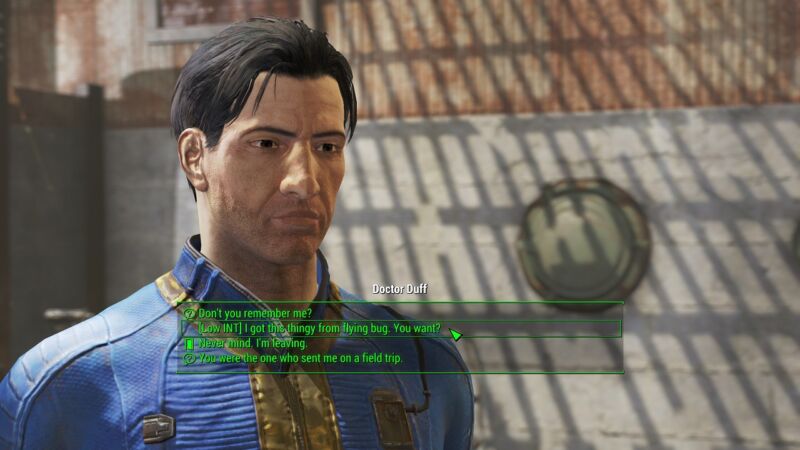
Enlarge/ Just because you’re still alive in a retro-futuristic-post-apocalyptic Commonwealth doesn’t mean you’re necessarily witty.
Bethesda / ProfMajowski
Modders can change many things inside their favorite games, but dialogue from professionally voiced characters hasn’t been one of those things—at least until recently. AI voice generation could open up new modding avenues for some games, as it has already done with one Fallout 4 mod package.
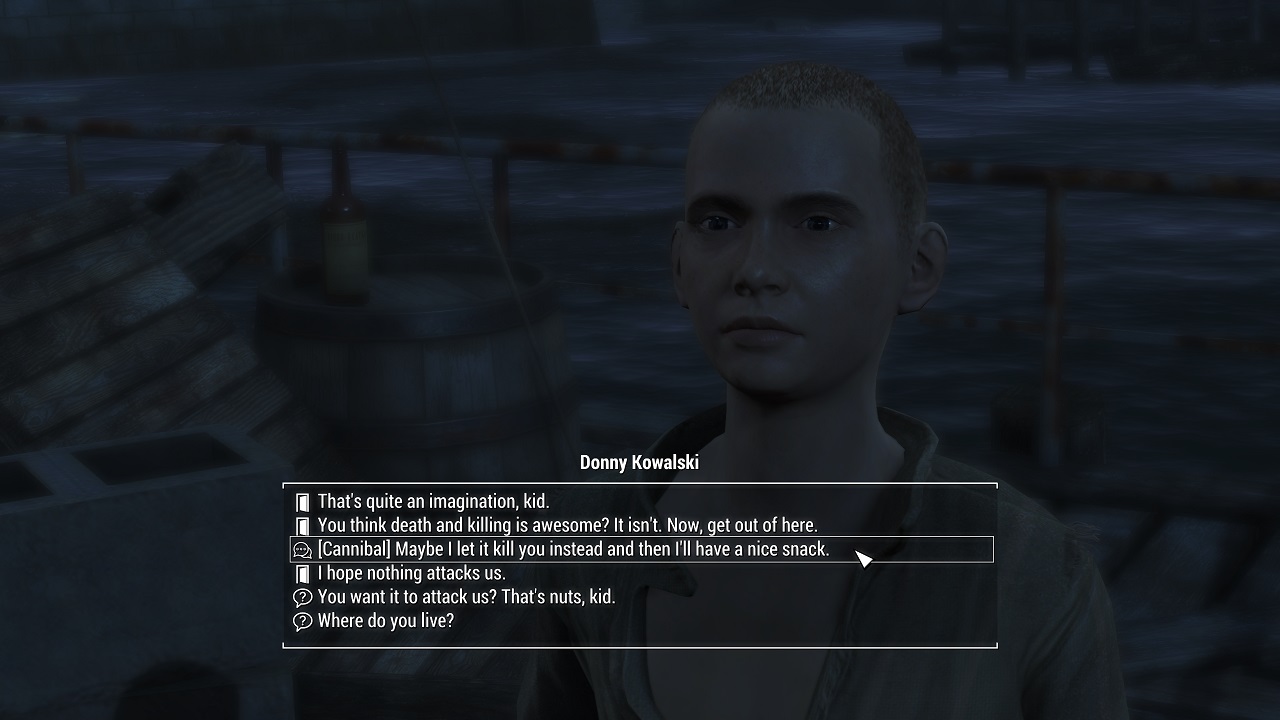
Roleplayer’s Expanded Dialogue (RED) is listed in the NexusMods catalog as a “Massive expansion of vanilla dialogue,” adding more than 300 entirely new lines of dialogue to the game. Those lines aim to solve an issue near to the hearts of fans of Fallout 1, 2, and New Vegas: role-playing. If you’re playing as a ruthless jerk, a brilliant nuclear scientist, or a strong but dimwitted dolt, you’ll see more dialogue options that reflect this. Mechanically, the roll-the-dice speech “checks,” which are based solely on your charisma level in the default game, can now be unlocked using related traits or skills.
Enlarge/ If you’re going to let a player be a cannibal, let them talk about it, too.
Bethesda / ProjMajowski
They’re not just new labels on existing dialogue, either. RED, created by NexusMods user ProfMajowski (and first seen by us at PCGamesN), says it used ElevenLabs voice AI to generate its more in-character lines. The results can sometimes “sound a little ‘emotionless,'” the creator writes, but “otherwise they basically sound like the real thing.” Nothing your character can newly say now will change the game’s mechanics or reactions, but it should sound a bit more in character.
It remains to be seen whether tweaking existing voice files with AI to create new sound-like lines will hold up to legal and copyright scrutiny or whether the new material can claim its own copyright.
Modders who wanted to remake Fallout 3 inside the engine of Fallout 4 were forced to shut down in 2018 after Bethesda advised them that the voice files the mod would have transferred and transformed were not even fully owned by Bethesda itself, opening the unpaid team to legal liabilities. Modders from that point onward tended to seek out their own voice talent, usually working for free, including Fallout: London, Fallout: New Vegas: The Frontier, and others. At the moment, you’re certain to get better and more lived-in results from voice actors, but AI results may soon be good enough for modders looking to move more quickly on large projects—if they can legally do so, of course.
I haven’t had the chance to kick the tires too much on the RED mod, owing both to the dependency traps of trying to line up a new mod in the Vortex manager, and the fact that you have to play a lot of Fallout 4 in a new, mods-enabled game before you meet characters with truly interesting things to say. Still, the opportunity to hear a strong, agile, but incredibly dumb wastelander make his way across burnt-down Boston makes a replay mighty appealing.
https://arstechnica.com/?p=1926831
Microsoft wins battle with Sony as UK reverses finding on Activision merger
UK regulators reviewing Microsoft’s proposed acquisition of Activision Blizzard reversed their stance on a key question today, saying they no longer believe Microsoft would remove the Call of Duty franchise from Sony’s PlayStation consoles.
Last month, the UK Competition and Markets Authority (CMA) tentatively concluded that a combined Microsoft/Activision Blizzard would harm competition in console gaming. At the time, the CMA said evidence showed that “Microsoft would find it commercially beneficial to make Activision’s games exclusive to its own consoles (or only available on PlayStation under materially worse conditions).” The agency also raised concerns about the merger affecting rivals in cloud gaming.
The preliminary finding was a victory for Sony, which has consistently expressed doubts about Microsoft’s promise to keep putting Call of Duty games on PlayStation. But Microsoft argued that the CMA’s financial model was flawed and was able to convince the agency to reverse its conclusion. In an announcement today, the CMA said it “received a significant amount of new evidence.”
“Having considered the additional evidence provided, we have now provisionally concluded that the merger will not result in a substantial lessening of competition in console gaming services because the cost to Microsoft of withholding Call of Duty from PlayStation would outweigh any gains from taking such action,” CMA Panel Chair Martin Coleman said.
As a result, the CMA panel investigating the deal “updated its provisional findings and reached the provisional conclusion that, overall, the transaction will not result in a substantial lessening of competition in relation to console gaming in the UK,” the agency announcement said.
Pulling CoD would cause “significant” financial loss
The updated findings said pulling Call of Duty off PlayStation would cause “a significant net financial loss for the Parties under all scenarios that we considered plausible,” but numbers were redacted from the public version of the document.
The CMA said the “most significant new evidence” submitted to the agency relates to Microsoft’s financial incentives to make Activision games exclusive to Xbox consoles, adding:
While the CMA’s original analysis indicated that this strategy would be profitable under most scenarios, new data (which provides better insight into the actual purchasing behaviour of CoD gamers) indicates that this strategy would be significantly loss-making under any plausible scenario. On this basis, the updated analysis now shows that it would not be commercially beneficial to Microsoft to make CoD exclusive to Xbox following the deal, but that Microsoft will instead still have the incentive to continue to make the game available on PlayStation.
UK hasn’t dropped cloud gaming concerns
This should make it easier for Microsoft to get UK approval for the merger, but the company still needs to convince regulators that the deal won’t harm competition in cloud gaming.
“Our provisional view that this deal raises concerns in the cloud gaming market is not affected by today’s announcement. Our investigation remains on course for completion by the end of April,” Coleman said.
The CMA’s provisional findings last month said evidence “indicates that Microsoft would find it commercially beneficial to make Activision’s games exclusive to its own cloud gaming service (or only available on other services under materially worse conditions). Microsoft already accounts for an estimated 60-70 percent of global cloud gaming services and also has other important strengths in cloud gaming from owning Xbox, the leading PC operating system (Windows) and a global cloud computing infrastructure (Azure and Xbox Cloud Gaming).”
Buying Activision Blizzard, the CMA said, “would reinforce this strong position and substantially reduce the competition that Microsoft would otherwise face in the cloud gaming market in the UK. This could alter the future of gaming, potentially harming UK gamers, particularly those who cannot afford or do not want to buy an expensive gaming console or gaming PC.”
Microsoft, in response, told the CMA that “Activision games would not have been available to cloud gaming services absent the Merger,” and that there’s “no evidence that Activision content would have been an important input for cloud gaming providers.” Microsoft also said its proposed licensing remedies would “ensure wide availability of CoD and other Activision titles on cloud gaming services.”
https://arstechnica.com/?p=1926787
How The New York Times managed to avoid ruining Wordle
Enlarge/ Sometimes, building better Wordles means building the same Wordles…
Aurich Lawson | Getty Images
SAN FRANCISCO—When The New York Times acquired daily puzzle mega-hit Wordle at the beginning of 2022, there were plenty of skeptics who were sure it signaled the end of the game’s incredible viral rise. Apparently, those skeptics included some of the people at the Times itself.
At a presentation at the Game Developers Conference Thursday, Times game producer and industry veteran Zoe Bell said the new owners expected Wordle‘s daily users “would just immediately decline” after the acquisition. Partly that was out of fear that some players would recoil from the “huge corporate behemoth” that now owned the indie hit. But it was also a simple recognition of the usual cycle for viral “zeitgeist” games: “How long can exponential growth go on?”
Just over a year after the acquisition, though, Bell said the company’s efforts at “preserving Wordle as an Internet treasure” have paid off. That’s largely thanks to a patient, “first do no harm” strategy that didn’t seek to directly monetize the game or introduce a lot of half-baked changes to the game’s successful formula, she said.
If it ain’t broke…
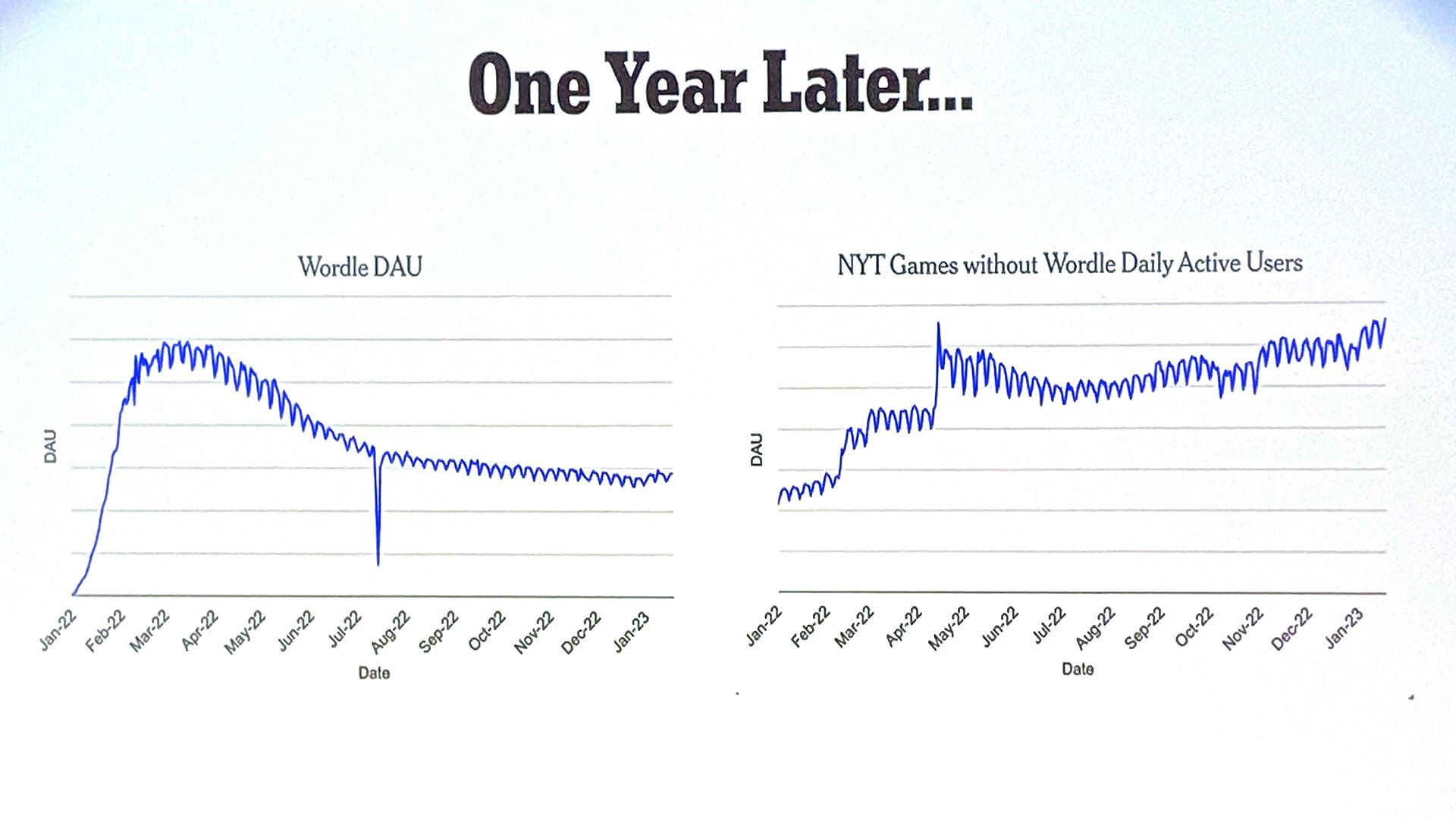
Bell said Wordle daily player numbers that are still “unfathomably high” are evidence of that strategy’s success. Before the Times acquisition, Bell said Wordle had gone from 90 players on November 1, 2021, to 300,000 by the end of the year. And while that exponential growth would inevitably slow, Bell said Wordle‘s daily user numbers peaked at tens of millions of players in March 2022 (that’s about a month after the peak in Wordle results shared on Twitter).
<a href="https://cdn.arstechnica.net/wp-content/uploads/2023/03/wordlegraph.jpg" class="enlarge" data-height="1080" data-width="1920" alt="While Wordle‘s player numbers have peaked, they’ve also stayed remarkably resilient over time.”><img alt="While Wordle‘s player numbers have peaked, they’ve also stayed remarkably resilient over time.” src=”https://rassegna.lbit-solution.it/wp-content/uploads/2023/03/how-the-new-york-times-managed-to-avoid-ruining-wordle-1.jpg” width=”640″ height=”360″ srcset=”https://rassegna.lbit-solution.it/wp-content/uploads/2023/03/how-the-new-york-times-managed-to-avoid-ruining-wordle-2.jpg 2x”>
Enlarge/ While Wordle‘s player numbers have peaked, they’ve also stayed remarkably resilient over time.
Even after that peak, Wordle‘s daily player numbers have declined much more slowly than those for similar viral hits like Pokémon Go and Among Us, according to Data.ai estimates presented by Bell. In fact, in early 2023, Wordle was still getting about half as many daily players as it did at its March peak, according to graphs shown by Bell, a level of interest that has remained at a relatively stable plateau since August.
While the Times didn’t rush to make changes to Wordle after the purchase, Bell did acknowledge a few unintended snafus with the transition.
The game’s move to The New York Times’ servers (from three different URLs where original creator Josh Wardle hosted the game) led to a tech problem that caused some players to lose their hard-earned streaks. And when the Times pared down the solution list to match its editorial standards, some players who didn’t refresh their browsers would be out of sync with their friends.
The Times also initially decided to remove some “less family friendly words” not just from the game’s solution set, but from the list of words that were valid to guess. As it turns out, “people like to guess racial slurs and dirty words as their initial guess,” Bell said.
After receiving some irate feedback questioning why the Times was trying to “police our guesses,” Bell said the team reverted that change. It’s not like players could really use their personal Wordle boards to harass other players, she pointed out. “If you want to [guess] that, go ahead.”
“…don’t break it”
After these initial headaches, the Times team refocused on coding just two major changes: a ground-up rewrite of the game’s code in React (which would allow the game to be integrated into the NYT’s mobile games app, alongside its famous crosswords) and the ability for players to sign in with a New York Times account (for reliable stat tracking across browsers and devices).
The Times took its time implementing those changes, which would eventually roll out in the summer of 2022. Even as daily users peaked in March, and even as competing apps dominated searches for Wordle in mobile app stores, Bell said Times management was “very patient” letting them take their time with these efforts, to make sure “there was a seamless experience” rolling them out.
<a href="https://rassegna.lbit-solution.it/wp-content/uploads/2023/03/how-the-new-york-times-managed-to-avoid-ruining-wordle-1.png" class="enlarge" data-height="427" data-width="800" alt="Wordle‘s value to The New York Times isn’t much of a puzzle.”><img alt="Wordle‘s value to The New York Times isn’t much of a puzzle.” src=”https://rassegna.lbit-solution.it/wp-content/uploads/2023/03/how-the-new-york-times-managed-to-avoid-ruining-wordle.png” width=”640″ height=”342″ srcset=”https://rassegna.lbit-solution.it/wp-content/uploads/2023/03/how-the-new-york-times-managed-to-avoid-ruining-wordle-1.png 2x”>
Enlarge/Wordle‘s value to The New York Times isn’t much of a puzzle.
The patience seems to have paid off; although Wordle remains free to play without a subscription, 35 percent of users who bought a new Times gaming subscription in 2022 cited the game as the reason they subscribed, Bell said. “Just like people used to buy the paper for the comics section, people now come to the Times for Wordle,” she said.
The biggest change since the summer has been the naming of Wordle editor Tracy Bennett in October. That meant there was someone to “curate the word list” and set a daily rhythm between hard and easy words, Bell said. It also gives players someone on the other side to think about when they play every day; “now when your streak breaks you can blame Tracy,” Bell joked.
But even that small curatorial change hasn’t been without its issues. When Bennett started matching the daily Wordle solutions to major events on the calendar (e.g. “FEAST” as the solution for Thanksgiving Day) some players insisted the new editor was ruining Wordle. Bell said the team has learned its lesson, and there are no plans for more daily themed solutions going forward.
And that just highlights how and why Bell said the Times team wants to be “very thoughtful” about making even small changes to Wordle going forward. It’s a caution driven by the stats: a stunning 95 percent of players say they are either somewhat or very satisfied with the game as it is.
Even incredibly small changes and problems can be “a huge deal when you’re running a huge viral hit… when tens of millions of people are playing your game, they notice everything,” Bell said. “After a while not breaking things, it’s OK to move on… [It’s OK to] buy a game you love and treat it like you built it.”
https://arstechnica.com/?p=1926522
The Ars Technica GOG collection: Our picks from GOG’s big Spring Sale
<img src="https://rassegna.lbit-solution.it/wp-content/uploads/2023/03/the-ars-technica-gog-collection-our-picks-from-gogs-big-spring-sale.jpg" alt="Frostpunk, an alternate history survival city building simulation game.”>
Enlarge/Frostpunk, an alternate history survival city building simulation game.
Several staff members are big fans of the GOG games marketplace, primarily for two reasons: the games are DRM-free, and there are many classic DOS games from the ’80s and ’90s.
GOG has been running its annual Spring Sale for a few days now. This time around, we worked with GOG to curate a list of Ars Technica picks. These are discounted games chosen by Ars staffers Samuel Axon and Lee Hutchinson that we think Ars readers might enjoy—assuming you haven’t played them already.
If you haven’t, discounts during this sale range from 20 percent to as much as 75 or 80 percent. Since most of them are classics, they generally weren’t too pricy to begin with.
And they are all, of course, DRM-free. As you know, we’re big fans of that approach. It helps make your games portable across machines; there are no online requirements, there aren’t any limitations on how many instances you can run at once, and of course, it aids with long-term software preservation efforts.
If you want to help support Ars, you can buy these games directly through each game’s link below—Ars gets a cut on each purchase of these games made here.
Worms Armageddon really needs no introduction. Remember GORILLAS.BAS? How about Scorched Earth? The Worms franchise took that nascent gameplay and turned it into something polished, professional, and full of character. Between its trademark Team 17 British humor, its zany arsenal of weapons, and its abundance of customization options, Armageddon was arguably the peak of the Worms franchise.
This Windows title enjoys an 80 percent discount, bringing the price down to just $2.99 from $14.99.
Might and Magic 6-pack Limited Edition
<a href="https://rassegna.lbit-solution.it/wp-content/uploads/2023/03/the-ars-technica-gog-collection-our-picks-from-gogs-big-spring-sale-8.jpg" class="enlarge" data-height="533" data-width="710" alt="Might and Magic 4+5: World of Xeen.”><img alt="Might and Magic 4+5: World of Xeen.” src=”https://rassegna.lbit-solution.it/wp-content/uploads/2023/03/the-ars-technica-gog-collection-our-picks-from-gogs-big-spring-sale-2.jpg” width=”640″ height=”480″ srcset=”https://rassegna.lbit-solution.it/wp-content/uploads/2023/03/the-ars-technica-gog-collection-our-picks-from-gogs-big-spring-sale-8.jpg 2x”>
For over a decade, tile-based first-person dungeon crawlers were synonymous with RPGs on the PC. There are many classics in that vein—you can’t talk about the genre without mentioning Wizardry—but at this point, you could probably claim that the most iconic series of them all was Might and Magic. This package includes the first six games from the Might and Magic series, including Book 1, Gates to Another World, Isles of Terra, World of Xeen, Swords of Xeen (and the infamously huge combination of the two Xeen games), and The Mandate of Heaven. For the earlier games in this sextet, you’ll have to get out the graphing paper—but for many of us, that’s like crawling under a cozy, nostalgic blanket.
Originally priced at $9.99 for the pack of six, the PC game is now $2.49, a savings of 75 percent.
Frostpunk: Game of the Year Edition
[embedded content]
Frostpunk: Game of the Year Edition.
In this city-survival strategy game that launched in 2019, gamers attempt to keep the lights and the heaters on by carefully using their resources in an alternate version of the 19th century. They maintain a city amid an apocalyptic global cooling by enacting morally questionable laws and making tough decisions that are sure not to be universally popular with the starving, freezing citizens. It might be a recent title—and an indie, no less—but it draws on the city simulation classics of the late ’90s and combines them with a compelling steampunk, alternative history aesthetic. Plus, it’s hard—another core tenet of good old games.
Originally priced at $48.99, the game is now 72 percent off and currently on sale for $14 at GOG.com for Mac and PC gamers.
Horizon Zero Dawn Complete Edition
[embedded content]
Horizon Zero Dawn trailer.
Launched in 2020 on the PC after a 2017 PlayStation 4 release, Horizon Zero Dawn is a graphical showcase that still manages to run on many older systems. While its core gameplay is your standard open-world fare—go here, watch a cut scene, go there, kill some bad guys, do some miscellaneous tasks in variations around a sprawling map, and so on—the franchise’s popularity among Ars editors (most of the gamers on the team speak highly of it on Slack regularly) has to do with its compelling science-fiction setting and concepts. If you like open-world games at all, it’s a must-play.
This Windows title is available right now for $16.49 on GOG.com, a 67 percent discount from its normal price of $49.99.
RimWorld
[embedded content]
RimWorld trailer.
Three survivors from a crashed space plane start building a colony at the rim of space in this sandbox simulation game that’s inspired by Firefly and Dune. The science fiction angle aside, this game is known for its astonishingly deep systems, interactions, and simulations. Like the game that inspired it (Dwarf Fortress), it’s intimidating to get into, but give it a couple of hours to get settled into your brain, and it’ll gladly take a couple hundred more from you before you know it.
Originally priced at $34.99, you’ll enjoy a modest 20 percent saving, taking the price down to $27.99 for the spring GOG.com sale for Mac, PC, and Linux gamers.
Riven: The Sequel to Myst
<a href="https://rassegna.lbit-solution.it/wp-content/uploads/2023/03/the-ars-technica-gog-collection-our-picks-from-gogs-big-spring-sale-9.jpg" class="enlarge" data-height="533" data-width="710" alt="Riven: The Sequel to Myst.”><img alt="Riven: The Sequel to Myst.” src=”https://rassegna.lbit-solution.it/wp-content/uploads/2023/03/the-ars-technica-gog-collection-our-picks-from-gogs-big-spring-sale-3.jpg” width=”640″ height=”480″ srcset=”https://rassegna.lbit-solution.it/wp-content/uploads/2023/03/the-ars-technica-gog-collection-our-picks-from-gogs-big-spring-sale-9.jpg 2x”>
OK, we’ve almost all played Myst. The pre-rendered graphical adventure game made one of the most compelling arguments for the CD-ROM and spawned an entire genre that continues to this day. It might have been the earliest PC game to crossover into mainstream popularity.
But not as many people played Riven, and here’s a controversial statement for you: it’s better than Myst. The music is magnificent, the rendered environments feel like an alien world that is simultaneously surreal and totally real, and the puzzles are beautifully designed and compelling—and we’re not talking about the “use the chicken on the pulley” nonsense solutions of some other adventure games. These make sense in the world they’re set in, with little abstraction.
Riven is now $2.39, down from its list price of $5.99, for Mac and PC.
Starship simulation games are as old as PC gaming itself—some of us remember the mainframe Star Trek game of yore, after all. While there have been quite a few commercial stabs at that genre in the Star Trek universe (StarfleetAcademy and Klingon Academy, for example), Bridge Commander is one of the best and most immersive. And it’s one of the latest games based on The Next Generation time period, so believe it or not, this is as cutting edge as licensed Star Trek full-fledged space sims get.
Star Trek: Bridge Commander is now $7.49, a 25 percent discount from its original $9.99 price, for PC.
Tyranny – Standard Edition
[embedded content]
Tyranny trailer.
Baldur’s Gate. Icewind Dale. Planescape Torment. Tyranny stands tall among the greats in the isometric CRPG tradition. Made by Pillars of Eternity and Fallout: New Vegas developers Obsidian Entertainment, this one offers a twist: You are the villain—well, sort of. It’s a complex moral tale with interesting characters and even more interesting choices. Does it have the best turn-based combat system ever? No, but that’s hardly the point. Get ready to read a lot of well-written dialogue, though.
Tyranny is now discounted by 75 percent, taking the price from $29.99 to $7.49.
Vampire: The Masquerade – Bloodlines
<img alt="Vampire: The Masquerade – Bloodlines.” src=”https://rassegna.lbit-solution.it/wp-content/uploads/2023/03/the-ars-technica-gog-collection-our-picks-from-gogs-big-spring-sale-5.jpg” width=”639″ height=”361″>
Vampire: The Masquerade – Bloodlines.
Part of the same lineage and pedigree as Tyranny, this much earlier title adapted a popular pen-and-paper role-playing franchise about—you guessed it—vampires into a classic, sort of janky 3D RPG full of great dialogue and immersive systems that draw inspiration from the likes of System Shock and Ultima Underworld. If you were PC gaming in the late ’90s and the early 2000s, you probably know this game and its influences. But this is a good time to revisit, because the franchise is soon to be revived in the world of PC gaming for the first time in ages.
Vampire for Windows is now 50 percent off its $19.99 list price, making it just $9.99 for the spring sale.
Look, this one is not actually part of the sale. But it’s Wing Commander—and it doesn’t need to be on sale because it’s already dirt cheap. Many Ars staffers are huge fans of space sims—more than one team Elite Dangerous multiplayer night has transpired, and Lee Hutchinson’s VR cockpit setup is the stuff of legends spoken in hushed, reverent tones. No, Wing Commander didn’t start the genre, and we love older classics too. But with their emphasis on storytelling, presentation, and tight dogfighting gameplay, the early Wing Commander games are true classics. The combo pack also includes expansions, like Wing Commander: The Secret Missions, Wing Commander: The Secret Missions 2: Crusade, Wing Commander II: Special Operations 1, and Wing Commander II: Special Operations 2.
In case you want to refer back to this list later on after the sale has ended, GOG has set up a landing page for this Ars Technica collection on its website that you can visit any time.
Ars Technica may earn compensation for sales from links on this post through affiliate programs.
Listing image by GOG
https://arstechnica.com/?p=1925871
Framework’s first gaming laptop features upgradeable GPUs, swappable keyboards
We were skeptical at first, but Framework has delivered on the promise of its original 13-inch laptop. Three product generations in, the company has made a respectable competitor for the Dell XPS 13 or MacBook Air that can be repaired, modified, and upgraded, and owners of the original laptop can easily give themselves a significant performance boost by upgrading to the new 13th-generation Intel or AMD Ryzen-based boards the company announced today.
Framework is now looking to build on that track record with an all-new Framework Laptop 16. It’s a larger-screened model that can fit more powerful processors, dedicated GPUs, and a range of different keyboard modules, all with the same commitment to repairability and upgradeability seen in the original Framework Laptop (now retroactively dubbed the Framework Laptop 13).
Framework isn’t discussing many details yet; preorders won’t open until “this spring,” and shipments won’t begin until “late 2023.”
Today, the company provided a preview of the laptop’s features, along with developer documentation to encourage the creation of new Input Modules—components that allow for keyboard customization much like the current Expansion Card system allows for port customization.
It’s not just about the GPU
Input Modules were born of the desire to solve the number pad problem for large laptops: do you use the extra space to build in a number pad while making the rest of the keyboard feel potentially cramped or off-center, or do you make a keyboard with no number pad and risk wasting a bunch of space?
“After performing some market research, we found out there is almost exactly a 50/50 split between people who love and need numpads and people who hate them,” Framework’s blog post says. “We used this as an opportunity to not only let you pick your preference there, but also completely customize the input experience.”
Input Modules come in three sizes: small, medium, and large. Large modules are for the keyboards themselves, and Framework says it will offer both white backlights and RGB backlights for its first-party modules. Medium modules can fit number pads, but they’re also big enough to accommodate other kinds of input devices, including “jog wheels, sliders, touchscreen displays, e-ink notepads, smartcard readers, and more.” And small modules are mostly meant for cosmetic customization, though Framework says that “it’s also possible to build functional modules like an LED Matrix or haptic slider.”
All modules can be up to 3.7 mm tall and still fit into the Laptop’s case. “Many” of Framework’s first-party modules will use open source firmware and a Raspberry Pi RP2040 microcontroller, opening them up to further customization by developers and end users.
The Framework Laptop 16 with no Expansion Bay installed. (You can also see a hint of a keyboard with a numpad if you look.)
The laptop with an Expansion Bay installed. It sticks out from behind the lid, not unlike the design of many 17-inch gaming laptops.
https://arstechnica.com/?p=1926225
Beethoven’s genome, sequenced for first time, yields clues on cause of death
Enlarge/ Portrait of Beethoven by Joseph Karl Stieler, 1820
Beethoven-Haus Bonn
Ludwig van Beethoven is one of the greatest composers of all time, but he was plagued throughout his life by myriad health problems, most notably going mostly deaf by 1818. These issues certainly affected his career and emotional state, so much so that Beethoven requested—via a letter addressed to his brothers—that his favorite physician examine his body after his death to determine the cause of all his suffering.
Nearly two centuries after the composer’s demise, scientists say they have sequenced his genome based on preserved locks of hair. While the analysis of that genome failed to pinpoint a definitive cause of Beethoven’s hearing loss or chronic digestive problems, he did have numerous risk factors for liver disease and was infected with hepatitis B, according to a new paper published in the journal Current Biology. The researchers also found genetic evidence that somewhere in the Beethoven paternal line, an ancestor had an extramarital affair.
“We cannot say definitely what killed Beethoven, but we can now at least confirm the presence of significant heritable risk and an infection with hepatitis B virus,” said co-author Johannes Krause, an expert in ancient DNA at the Max Planck Institute of Evolutionary Anthropology. “We can also eliminate several other less plausible genetic causes.” The fully sequenced genome will be made publicly available so other researchers can have access to conduct future studies.
Beethoven began losing his hearing in his mid- to late 20s, experiencing tinnitus and the loss of high-tone frequencies in particular. He claimed the onset began with a fit in 1798 induced by a quarrel with a singer. By his mid-40s, he was functionally deaf and unable to perform public concerts, although he could still compose music. He also had lifelong chronic gastric ailments, including persistent abdominal pains and prolonged stretches of diarrhea. By 1821, the composer showed signs of liver disease, marked by the first of two severe attacks of jaundice.
By December 1826, Beethoven was quite ill, suffering from a second bout of jaundice and swollen limbs, fever, dropsy, and labored breathing. His doctor performed several operations to remove excess fluid from the composer’s abdomen. Beethoven was mostly bedridden for the next few months, receiving visitors and being showered with gifts and tributes as news of his illness spread. On March 24, 1827, he purportedly said to visitors, “Plaudite, amici, comoedia finita est” (“Applaud, friends, the comedy is over”). Two days later, he died. According to his good friend Anselm Hüttenbrenner, who was present, lightning and a loud clap of thunder briefly woke Beethoven, who “opened his eyes, lifted his right hand and looked up for several seconds with his fist clenched … not another breath, not a heartbeat more.”
Enlarge/ Beethoven on his deathbed: lithograph by Josef Danhauser after his own drawing.
Beethoven-Haus Bonn
An autopsy identified severe liver damage (evidence of cirrhosis) as the likely cause of death and significant dilation of the auditory nerve. But what caused that liver damage or his hearing loss—or his chronic stomach complaints, for that matter? Medical detectives have been debating possible causes for nearly two centuries, drawing on the composer’s letters, diaries, and physicians’ notes for evidence, as well as reports on skeletal remains from when his body was exhumed in 1863 and 1888. But no general consensus has yet emerged.
That’s where Tristan Begg and his co-authors come in. Begg studies genomic analysis as a graduate student at the University of Cambridge, and he became intrigued by Beethoven’s letter requesting that his physician determine the cause of his illness. In what is now known as the Heiligenstadt Testament, Beethoven wrote to his brothers of his distress at being “hopelessly afflicted” by his hearing loss. He wrote that the only reason he hadn’t committed suicide was that he didn’t want to die “before I had produced all the works that I felt the urge to compose.” Beethoven ended with the request that his favorite physician, Dr. Johann Adam Schmidt, determine the cause of his ailments and make that information public. The testament was written in 1802, and Schmidt died 18 years before Beethoven.
Toxicological analysis of hair samples claimed to be those of Beethoven had been done in the past, along with an examination of skull fragments. For Begg et al., the first order of business was to authenticate 34 locks of hair traditionally attributed to Beethoven by tracking the provenance and conducting DNA analysis. They focused on eight locks from public and private collections, which ultimately took eight years.
https://arstechnica.com/?p=1925141
Microsoft says its new developer tools can reduce Xbox’s climate impact
Enlarge/ These tools won’t literally make vines grow out of your Xbox, but that’s definitely the image Microsoft wants to get across…
When it comes to reducing gaming’s aggregate impact on climate change, previous research has shown that the energy needed to power the game-playing hardware is responsible for the bulk of the industry’s greenhouse gas emissions. That’s especially true for console and PC games, which can draw hundreds of watts of power between the game hardware, display, and speakers.
To help limit the environmental impact of all this gameplay, Microsoft announced Wednesday the release of new tools for Xbox developers to measure and limit the amount of power drawn by their games.
Designing games to be more energy-efficient is not a new concept in the industry, of course. Mobile developers often must be conscious of how quickly a game will drain a limited smartphone battery. On the other end of the spectrum, pushing a PC or console GPU too far could literally melt it.
But Microsoft says its first-of-its-kind platform-level tools are designed to “help understand and reduce the carbon footprint and energy consumption posed by the games that they develop.” And the company says that case studies show increasing efficiency doesn’t have to be expensive in time or money, and “can be entirely imperceptible to the gamer.”
“The toolkit helps developers to leverage precision engineering feedback to help identify and reduce energy consumption in scenarios when a player doesn’t need it, thus ensuring the player experience is not negatively impacted,” the company says.
An energy consumption toolbox
Microsoft Xbox Developer Sustainability Toolkit includes power monitor tools that provide “real-time energy consumption feedback down to the nearest millisecond.” That kind of granular data “can directly pinpoint energy inefficiencies that can be addressed,” the company says. On Xbox Series X dev kits, this information can even be shown directly on the hardware’s front panel for quick access.
Microsoft says it will also be providing certification reports that highlight platform-wide energy consumption averages for common tasks like static menus and loading screens. Developers can also use studio-wide dashboards to get a quick glance at how its games compare to the platform average for energy efficiency.
These tools have already shown results in a small pilot test with a handful of studios, Microsoft says. At Halo maker 343 Industries, for instance, testing found that the game’s pause screen still rendered a 4K image that was invisible to the player. Simply changing this unseen issue reduced the game’s energy usage by 15 percent “with no negative impact to the player experience,” Microsoft says (it’s unclear if that reduction was measured against the pause screen baseline or the game’s overall energy consumption).
At Ubisoft, meanwhile, developers are using the Sustainability Toolkit in the development of “player-facing Eco-Mode.” This will presumably let players customize their experience for maximum energy efficiency, much as current console games often let players choose whether to prioritize frame rate or graphical fidelity.
Microsoft says it will publish these and other industry efficiency tips and best practices through its Xbox Game Dev Docs system. And while the Developer Sustainability Toolkit is currently designed for Xbox specifically, the company is urging other developers to apply those lessons to their games “no matter what platform they’re on.”
Microsoft plans mobile games app store to rival Apple and Google
Microsoft is preparing to launch a new app store for games on iPhones and Android smartphones as soon as next year if its $75 billion acquisition of Activision Blizzard is cleared by regulators, according to the head of its Xbox business.
New rules requiring Apple and Google to open up their mobile platforms to app stores owned and operated by other companies are expected to come into force from March 2024 under the EU’s Digital Markets Act.
“We want to be in a position to offer Xbox and content from both us and our third-party partners across any screen where somebody would want to play,” said Phil Spencer, chief executive of Microsoft Gaming, in an interview ahead of this week’s annual Game Developers Conference in San Francisco.
“Today, we can’t do that on mobile devices but we want to build towards a world that we think will be coming where those devices are opened up.”
Microsoft is fighting with regulators in the US, Europe, and UK, which have all raised concerns about the potential impact on competition from the owner of the Xbox console buying the developer of Call of Duty, one of the world’s most popular games franchises. PlayStation-maker Sony has been a vocal opponent of the deal.
However, Spencer argued that the deal could boost competition in what he called the “largest platform people play on”—smartphones—where Apple and Google operate what some antitrust authorities have called a “duopoly” over distribution of games and other apps.
“The Digital Markets Act that’s coming—those are the kinds of things that we are planning for,” he said. “I think it’s a huge opportunity.”
Under the DMA, the EU is expected to designate Apple and Google as “gatekeepers,” requiring them to change the rules that govern how apps are distributed on iPhones and Android devices. However, the Big Tech companies could appeal against the designation, delaying enforcement beyond next March’s deadline.
While acknowledging it was hard to predict exactly when Microsoft would be able to launch its own store, Spencer said it would be “pretty trivial” for the company to adapt its Xbox and Game Pass apps to sell games and subscriptions on mobile devices. Microsoft’s current lack of mobile games was an “obvious hole in our capability” that it needed Activision Blizzard to fill, he added.
Hit titles such as Call of Duty Mobile, Diablo Immortal, and Candy Crush Saga, as well as more in development, would be “critically important” in attracting players away from Apple and Google’s marketplaces to an Xbox mobile store, he said.
Microsoft and Apple have tussled for years over how the software giant’s cloud-based gaming service, which is part of Xbox Game Pass, operates on iPhones.
Microsoft has argued Apple’s App Store rules restrict its ability to offer cloud gaming through a single app that runs natively on the iPhone, forcing users to access the service via a web browser, resulting in lower performance.
Apple has denied it blocks cloud gaming apps, but App Store rules require providers to list each game on the App Store individually. Similar to restrictions on Amazon’s Kindle ereader app, Apple does not allow individual games to be purchased from a storefront within native apps.
The UK’s Competition and Markets Authority announced in November that it was investigating Apple’s stance on cloud games, following its Mobile Ecosystem Market Study.
But the CMA is also proving a significant hurdle to Microsoft completing its acquisition of Activision Blizzard, after the agency last month said the deal raised multiple competition concerns that could only be resolved by a spin-off of its blockbuster Call of Duty franchise.
Microsoft has argued that divesting Call of Duty would undermine its rationale for the deal, which was first announced in January last year. It is trying to persuade the CMA that proposed behavioral remedies, such as commitments to license Call of Duty to rival consoles and cloud services, such as its recent deals with Nintendo and Nvidia, would satisfy its concerns.
In Brussels, Microsoft had made “binding commitments” to the European Commission to make Activision Blizzard content available to rival cloud gaming providers, as part of a deal to appease competition concerns with EU regulators, said people with direct knowledge of the discussions.
The concessions were a sign that regulators in Brussels had dropped key concerns to narrow their investigation on cloud gaming, these people said.
Additional reporting by Javier Espinoza in Brussels
Bent nails at Roman burial site form “magical barrier” to keep dead from rising
Enlarge/ Bent nails scattered around early Roman imperial burial site suggest an attempt to keep the deceased from rising.
Sagalassos Archaeological Research Project
Archaeologists excavating an early Roman imperial tomb in Turkey have uncovered evidence of unusual funerary practices. Instead of the typical method of being cremated on a funeral pyre and the remains relocated to a final resting place, these burnt remains had been left in place and covered in brick tiles and a layer of lime. Finally, several dozen bent and twisted nails, some with the heads pinched off, had been scattered around the burn site. The archaeologists suggest that this is evidence of magical thinking, specifically an attempt to prevent the deceased from rising from the grave to haunt the living, according to a recent paper published in the journal Antiquity.
Perhaps the best known examples of this kind of superstitious funerary practice are the so-called “vampire” burials that occasionally pop up at archaeological sites around the world. In the early 1990s, children playing in Connecticut stumbled upon the 19th-century remains of a middle-aged man identified only by the initials “JB55,” spelled out in brass tacks on his coffin. His skull and femurs were neatly arranged in the shape of a skull and crossbones, leading archaeologists to conclude that the man had been a suspected “vampire” by his community. They have since found a likely identification for JB55 and reconstructed what the man may have looked like.
In 2018, archaeologists discovered the skeleton of a 10-year-old child at an ancient Roman site in Italy with a rock carefully placed in its mouth. This suggests those who buried the child—who probably died of malaria during a deadly 5th-century outbreak—feared it might rise from the dead and spread the disease to those who survived. Locals are calling it the “Vampire of Lugnano.” And last year, archaeologists uncovered an unusual example of people using these tips in a 17th-century Polish cemetery near Bydgoszcz: a female skeleton buried with a sickle placed across her neck, as well as a padlock on the big toe of her left foot.
This latest find is part of a research project by KU Leuven in Belgium to excavate a specific area of the Sagalassos site in southwest Turkey. Humans occupied the region from the late 5th century BCE through the middle of the 13th century CE, despite significant damage from a 7th-century CE earthquake. The area in question is somewhat secluded and set off from the central and residential parts of the city. It consists of several contiguous terraces that came to be used for funerary purposes. The early Roman imperial tomb was first discovered in 1990, and archaeologists resumed work on the immediate surroundings in 2012, finding evidence of both burials and cremation spanning some six centuries.
Enlarge/ Items recovered from the site included not just bent nails, but also shards of a small glass flask and a 2nd-century CE coin.
Sagalassos Archaeological Research Project
The scattered nails were found at a roughly rectangular patch of burnt soil: the remains of a funeral pyre, complete with charcoal fragments of pine and scar, as well as burnt human bones. The burnt bones belonged to a single person, most likely a male who died around the age of 18, based on the osteological analysis. The bone fragments were still roughly anatomically arranged, with no evidence of handling them during or after the cremation.
Some of the charcoal remains appeared to be textiles, suggesting clothing or a shroud. There were also several artifacts found with the burnt remains: a coin dating from the 2nd century CE, a handful of ceramic vessels from the 1st century CE, two blown-glass urns, and an item made of worked bone with bronze hinges whose purpose is unknown. This is evidence that the mourners seemed to follow at least some of the traditional funeral rites.
It’s the 41 broken and bent nails—25 bent at a 90 degree angle with the heads pinched off, 16 bent and twisted but otherwise whole—recovered from the site that set this cremation apart. These were not coffin nails, which are usually found intact, and nails weren’t used in the construction of the funeral pyre. So the authors concluded that the broken nails had been deliberately scattered around the burial site to form a “magical barrier.” There are mentions in several ancient literary sources of nails being used to ward off diseases (Livy) or as a protection against nightmares (Pliny the Elder).
https://arstechnica.com/?p=1924926
Valve’s year-old Steam Deck is on sale for the first time
[embedded content]
A fun Valve video showcases some of the highlights from the Steam Deck’s first year.
Enlarge/ The (newly discounted) Steam Deck beckons…
If you’re worried about investing in the first Steam Deck right before the launch of a souped-up version 2, fret not. Valve has recently suggested that a more powerful follow-up to the Steam Deck is “a few years” away (though a more surface-level cosmetic refresh could conceivably come sooner).