Ubisoft’s first NFT plans make no sense

A computerized skeleton has a headache and an UbiSoft logo on its face.
Enlarge / Galaxy brain, meet Ubisoft brain…

Ubisoft became the first big-name game publisher to jump on the non-fungible token bandwagon Tuesday. After teasing its interest in the space last month, the company is officially rolling out Quartz, a system of in-game cosmetic items powered by a new kind of NFT, called “Digits.”

By using a decentralized NFT blockchain, Ubisoft promises its Quartz system will “grant players more control than ever” and “more autonomy and agency” in order to “genuinely make players stakeholders of our games.” But as currently described, Ubisoft’s Quartz system seems like an overcomplicated repackaging of a run-of-the-mill system of DLC cosmetics—but now with extra buzzwords and artificial scarcity layered on top.

And despite all the bold talk of “decentralization,” the Quartz system is still so deeply controlled by Ubisoft that we wonder whether a simple internal database managed directly by the company would be a better fit.

Quartz, explained

Quartz—which rolls out later this month—is simply a system that provides access to cosmetic items for a single game, Ghost Recon Breakpoint. The first three such cosmetics—representing a specific gun, a face mask, and “enhanced pants” in the game—will be available for free on three days in the coming weeks.

Unlike traditional DLC, where supply is unlimited and every purchased copy is identical, Ubisoft stresses three ways in which Quartz cosmetics are unique:

  • Limited editions: Each Quartz NFT “edition” will be limited to a set number, ranging from “a few units to a few thousands,” Ubisoft says. It’s not clear how many will be available for each of these first three “free” editions.
  • Serial Numbers: Each individual NFT in a single edition has a unique serial number that “is displayed on the collectible and on the in-game item.”
  • Player names: A Digit’s metadata will contain “the history of its previous owners,” represented by their Ubisoft player names.
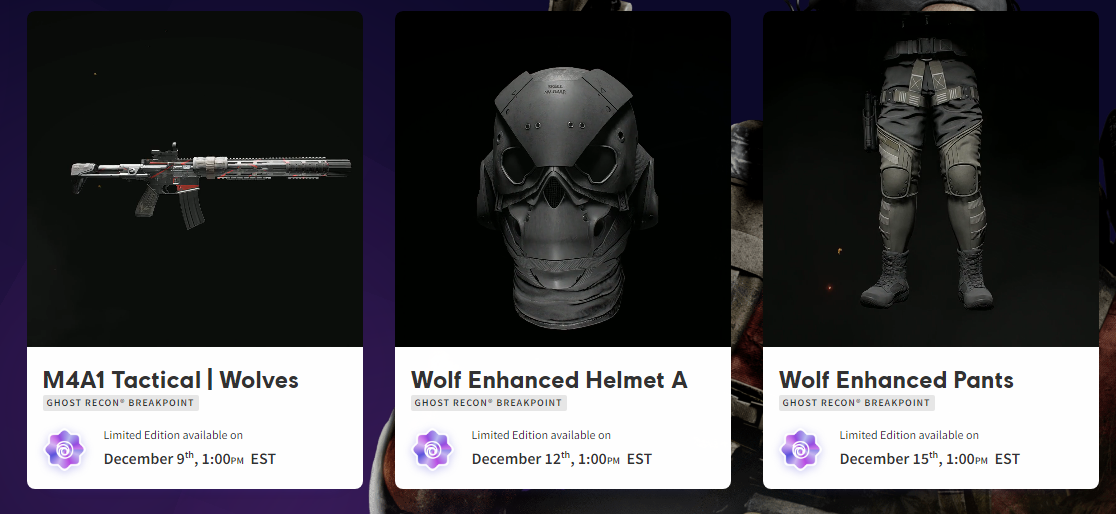
The first three "editions" of Quartz NFTs will be available at specific times later this month.
Enlarge / The first three “editions” of Quartz NFTs will be available at specific times later this month.

So in practice, your “Wolf Enhanced Helmet A” will look and function a lot like mine. But if you look closely, you’ll see a different number etched into the virtual forehead of that helmet. And if you dig into the NFT’s metadata, you’ll be able to see who used to own that particular copy of the helmet.

Ubisoft seems to foresee a chase-the-collectible metagame forming around these minor differences. “Owning a Digit will make you an actual part of its history,” the company says in its FAQ. Elsewhere, Ubisoft encourages players to “be the first owner of a particular Digit or chase the one of your favorite streamer.”

OK, sure. Maybe some people will get really excited about “owning” the only digital pair of Wolf Enhanced Pants numbered “69420” and once owned by Ninja. We can’t say that we’re excited about it, but there may be some market for such a thing.

But marketing rare or unique in-game items—and letting players resell them—isn’t a new thing. Ubisoft doesn’t need NFTs or “the blockchain” to enable this kind of artificially scarce digital collectible; a basic centrally controlled database could do the same thing much more simply.

Anyone who has sold a special-edition ship in Eve Online‘s strictly regulated economy knows how this can work. The same goes for anyone who bought and sold Artifact cards on the Steam marketplace or those who remember the ill-fated Diablo III real-money auction house.

All these examples and more predated the widespread adoption of NFTs and didn’t need the technology for any of the features Ubisoft is touting here.

https://arstechnica.com/?p=1818712



Razer’s RGB smartphone cooler attaches to iPhones with MagSafe

Razer Phone Cooler Chroma.
Enlarge / Razer Phone Cooler Chroma.

PC gamers know about heat. When you’re in the middle of an intense in-game battle, the last thing you want is for your computer to start acting up because your CPU or GPU got too hot. That’s why gamers and other extreme users rely on products like CPU coolers and liquid cooling systems. You probably haven’t been as concerned about your smartphone’s thermals while playing Candy Crush on your iPhone. Nevertheless, Razer released a new product, the Phone Cooler Chroma, on Tuesday to ensure your smartphone doesn’t overheat the next time you use it for gaming.

Of course, mobile gaming has grown beyond the likes of Candy Crush and Angry Birds. Razer (and some other vendors) have been trying to make mobile gaming a serious thing for a while. The company’s efforts are mostly focused on controllers, like the Razer Kishi, that attach to your smartphone. There’s also Razer’s finger sleeve for mobile gaming.

The Phone Cooler Chroma released Tuesday has a different purpose. Compatible with both iPhone and Android phones (it supports “most smartphones,” Razer’s product page claims), the product is meant to help keep your phone cool while it’s pushing those frames.

Interestingly, the fan takes advantage of Apple’s MagSafe, allowing you to attach the cooler magnetically. That’s convenient, but it also means the cooler won’t sit directly above the phone’s SoC.

If you don’t have a MagSafe-compatible phone, you can opt for the version with a universal clamp.

Clamp option.
Enlarge / Clamp option.

We don’t know how adjustable the cooler is, but Razer says it works with phones that are 2.64-3.46 inches (67-88 mm) wide.

Staying cool?

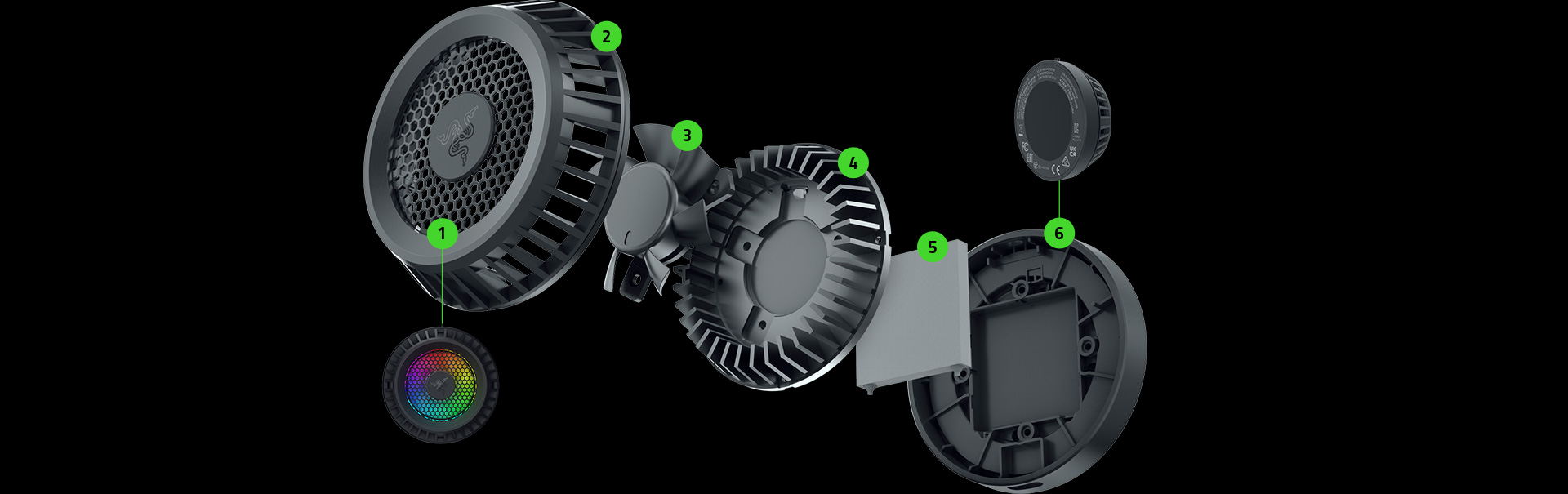
1. RGB, 2. cover, 3. fan, 4. heatsink, 5. Peltier cooling tile, 6. cooling plate.
Enlarge / 1. RGB, 2. cover, 3. fan, 4. heatsink, 5. Peltier cooling tile, 6. cooling plate.

A cooling plate sits on the back cover and is topped by an electronic tile that uses Peltier cooling, also known as thermoelectric cooling, to transfer heat. The next layer is a heatsink under a seven-bladed fan spinning at up to 6,400 revolutions per minute, adjustable via Bluetooth. Razer says the cooler can stay at 30 dB.

On top of the fan lies a cover with air vents, and—of course—RGB lighting. Does the lighting help your phone stay cool? Absolutely not. But it almost wouldn’t be a Razer product without it. The gaming brand even put RGB on its N95 mask, so Chroma lighting here is no surprise.

RGB feels like a Razer requirement.
Enlarge / RGB feels like a Razer requirement.

There are 12 RGB LEDs in the cover, and each can be set to its own color and effect.

You’ll need a USB-C cable to power the Phone Cooler Chroma. The cooler comes with a 4.9-foot (1.5 m) USB-C to USB-C cable, but this seems like it could be burdensome when gaming on the go, as a mobile gamer is inclined to do.

Power over USB-C required.
Enlarge / Power over USB-C required.

Razer didn’t make any claims about how much cooler the product will keep your phone’s components. Unlike a CPU cooler, this cooler doesn’t come into direct contact with the processor, and it doesn’t have any exhaust vents to work with as some laptop fan coolers do. So the heat transfer from the actual SoC may be limited. Hardcore mobile gamers can find out for themselves for $60.

Ars Technica may earn compensation for sales from links on this post through affiliate programs.

https://arstechnica.com/?p=1818769


Neo discovers he still knows kung fu in latest Matrix Resurrections trailer

[embedded content]
Official trailer #2 for The Matrix Resurrections.

Not even a full week has gone by since we got an exciting new trailer for The Matrix Resurrections, but with the film’s premiere just two weeks away, Warner Bros. is clearly intent on amping up the excitement. The company released another trailer on Monday, and while new footage is in short supply, everything we’ve seen thus far is finally put into useful context.

The first trailer was released in September and was set to Jefferson Airplane’s “White Rabbit” to drive home the red pill/blue pill theme. We saw Neo in therapy with a smarmy psychiatrist played by Neil Patrick Harris, and it soon became clear that we were in a brave new Matrix-constructed world. People take two blue pills daily, and everyone is glued to their iPhones and tablets—whatever it takes to keep the masses sedated.

Last week’s trailer was aptly titled “Déjà Vu” since it riffed on that key moment from the first Matrix film when Neo saw the same black cat walk past a doorway in the Lafayette Hotel. We learned that the entire preceding “reality”—i.e., the events of the original trilogy—had been changed, but not many other details were revealed.

Thomas Anderson/Neo (Keanu Reeves) must try to remember a past reality.
Enlarge / Thomas Anderson/Neo (Keanu Reeves) must try to remember a past reality.
YouTube/Warner Bros

After months of sly hints, we now have a full official premise:

In The Matrix Resurrections, return to a world of two realities: one, everyday life; the other, what lies behind it. To find out if his reality is a physical or mental construct, to truly know himself, Mr. Anderson will have to choose to follow the white rabbit once more. And if Thomas… Neo… has learned anything, it’s that choice, while an illusion, is still the only way out of—or into—the Matrix. Of course, Neo already knows what he has to do. But what he doesn’t yet know is the Matrix is stronger, more secure and more dangerous than ever before. Déjà vu.

[Keanu] Reeves reprises the dual roles of Thomas Anderson/Neo, the man once saved from the Matrix to become the savior of humankind, who will once again have to choose which path to follow. [Carrie-Anne] Moss portrays the iconic warrior Trinity… or is she Tiffany, a suburban wife and mother of three with a penchant for superpowered motorcycles?

Morpheus is played by Yahya Abdul-Mateen II, while Jessica Henwick plays the hacker Bugs, aka the White Rabbit, who has long idolized the legend of Neo and is on a mission to find him again. Jonathan Groff plays Thomas Anderson’s business partner, described as “a slick, confident corporate type with insouciant charm, a disarming smile, and an eye on the bottom line—everything Mr. Anderson is not.”

Carrie-Anne Moss returns as Trinity—or is she a suburban housewife named Tiffany?
Enlarge / Carrie-Anne Moss returns as Trinity—or is she a suburban housewife named Tiffany?
YouTube/Warner Bros

Lambert Wilson returns as The Merovingian, a rogue Matrix program with his own agenda; Daniel Bernhardt will reprise his role as Agent Johnson; and Jada Pinkett Smith is returning as Niobe. Priyanka Chopra Jonas plays “a young woman with a wisdom that belies her years and an ability to see the truth, no matter how murky the waters.” The cast also includes Toby Onwumere, Max Riemelt, Eréndira Ibarra, Andrew Caldwell, Brian J. Smith, Ellen Hollman, and Christina Ricci.

“We can’t see it, but we’re all trapped inside these strange, repeating loops,” we hear in a voiceover as the new trailer opens. Thomas and “Tiffany” (aka Trinity) have a brief moment of recognition in a coffee shop, and we get several quick scenes from the original film interspersed with new takes on those same scenes—e.g., Hugo Weaving’s original Agent Smith‘s “billions of people just living out their lives” line is echoed by Groff’s character. Soon, Thomas finds himself in the familiar (to us) virtual white space in complete silence. He gingerly touches the back of his head to check for cables and says, “I remember this.”

"This is the moment for you to show us what is real."
Enlarge / “This is the moment for you to show us what is real.”
YouTube/Warner Bros

We see Morpheus showing Thomas images from the reality he’d forgotten on a big screen in a darkened room. “They taught you good,” he says. “Made you believe their world was all you deserved. But some part of you knew that was a lie. Some part of you remembered what was real.” Another war is brewing between humans and the Matrix, but there might be a few surprises in store. “It’s so déjà vu, and yet it’s obviously all wrong,” Bugs says. “Maybe this isn’t the story we think it is.”

Also, it seems that Trinity is in trouble. Morpheus tells Thomas that if he wants to see her again, he needs to “fight for her.” And fight he does. Everyone fights. A lot. And it all looks awesome. But there are hints that Trinity’s fate might already be sealed. “I saw this in a dream,” she tells Neo as they stand on that familiar rooftop from another reality. “My dream ended here.” We can’t wait to see how that dream plays out for real.

The Matrix Resurrections hits theaters on December 22, 2021. As always, we strongly recommend only going to see films in theaters if you have been fully vaccinated and wear a mask for the duration of the screening.

Listing image by YouTube/Warner Bros.

https://arstechnica.com/?p=1818330


Raven Software developers walk off the job to protest QA layoffs

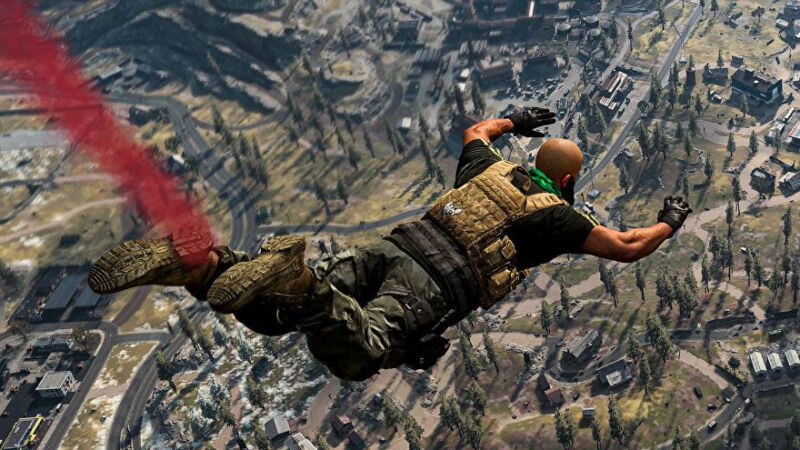
Screenshot from a video game shows a paratrooper after jumping from an aircraft.
Enlarge / Taking the leap.

A group of developers at Call of Duty: Warzone developer Raven Software are walking off the job to protest what they see as unfair treatment of members of the quality assurance team who were let go unceremoniously late last week. In a public statement, the group of contractors and full-time employees says it will be “walking out with a singular demand: Every member of the QA team, including those terminated on Friday, must be offered full time positions.”

Wisconsin-based Raven, which has been a subsidiary of Activision for decades, laid off 12 contractors representing nearly 30 percent of the QA team on Friday, according to the statement. Further Raven QA contractors will be notified this week about whether they are being promoted to full-time positions or being laid off, according to a Washington Post report. The walkout is reportedly effective today, and those taking part vow to stay off the job until their colleagues’ positions are restored.

“These individuals were let go in ‘good standing,’ meaning they had not underperformed or committed any fireable offense,” the group’s statement notes. “These personnel cuts come after five weeks of overtime, and before an anticipated end of year crunch.”

In response to the walkout, an Activision Blizzard spokesperson told Polygon that “Activision Publishing is growing its overall investment in its development and operations resources. We are converting approximately 500 temporary workers to full-time employees in the coming months. Unfortunately, as part of this change, we also have notified 20 temporary workers across studios that their contracts would not be extended.”

“We support [the Raven employees’] right to express their opinions and concerns in a safe and respectful manner, without fear of retaliation,” Activision Blizzard added in a statement to The Washington Post.

The Better ABK Workers Alliance—which has organized two previous temporary walkouts in protest of widespread harassment allegations across Activision Blizzard—today congratulated the company for promoting all temporary employees at fellow Call of Duty developer Treyarch to full-time positions.

“However, in light of recent events, there is no excuse for the company to lay off 30% of Raven’s QA department while simultaneously making all Treyarch [temporary employees] full-time employees,” the group continued in a follow-up tweet. “The termination of high-performing testers, while workload and profits are soaring, is an unacceptable action by the company and contradicts Raven’s goal of being an exemplary workplace in our industry.”

A common problem, an uncommon solution?

Many in the game industry are accustomed to the cycle of contract hiring and subsequent layoffs that surround a major game’s release. In one high-profile example, Activision Blizzard laid off nearly 800 employees in early 2019, shortly after announcing record earnings the year before. Similar examples are not hard to find across the industry.

The game industry’s constant cycle of layoffs and studio closures—and the turmoil that causes for developers who pinball from position to position—is at the center of Jason Schreier’s book Press Reset, which was released earlier this year. Some developers have started publicly agitating for union protections to help ameliorate these issues, though there’s been little to show so far in terms of fully unionized studios.

“The vast majority of game workers are in the industry because it’s our dream job, and working on games is our passion,” Game Workers Unite co-founder and Campaign to Organize Digital Employees lead organizer Emma Kinema told Ars Technica last year. “Unfortunately, that passion can open us up to exploitation by our bosses, because we are simply grateful or content to have the job we have.”

“Outsourcing firms, temporary employment schemes, and low-wage positions of all sorts [are] as essential to the industry as the more publicly visible developers at name-recognition studios,” Kinema continued. “The industry is not a single monolith, and we need to care about and organize all workers throughout the industry.”

https://arstechnica.com/?p=1818336


Review: Halo Infinite’s campaign finishes the fight—but arrives in tatters

<img src="https://rassegna.lbit-solution.it/wp-content/uploads/2021/12/review-halo-infinites-campaign-finishes-the-fight-but-arrives-in-tatters.png" alt="Chief and "The Weapon" bond through adversity in Halo Infinite—and not just in the game’s plot or firefights.”>
Enlarge / Chief and “The Weapon” bond through adversity in Halo Infinite—and not just in the game’s plot or firefights.
Xbox Game Studios / 343 Industries


Halo Infinite is the best campaign-driven entry since 343 Industries took over the series in 2011. It is also the messiest Halo game yet.

To be clear, I enjoyed my time with Halo Infinite‘s campaign. That’s primarily because the game sees 343 finally nail its own Halo “voice,” one whose mechanics, gunplay, and physics feel more rooted in the series’ past than ever before. Meanwhile, 343 uses clever ideas to modernize and go beyond the foundation established by Bungie. And the game delivers story, dialogue, and sci-fi stakes where they count.

But there’s no way to review this title without complaining about the game’s launch state. Halo Infinite may reach new series heights, but its ambition tests the limits of the duct tape keeping the game together.

Before we begin, three housekeeping notes

First, this is a campaign-exclusive review. Xbox Game Studios has wisely split Halo Infinite into two discrete parts, and the online versus-multiplayer suite has been live as a free-to-play game since November 20. It’s quite fun, and I’ll have more to say about it in the near future. For this article’s purposes, “Infinite” refers to the campaign launching on Steam, Windows 10, and Xbox consoles on Wednesday, December 8, not the versus modes.

Second, Ars Technica takes spoilers seriously, so I will avoid talking about significant plot points. I arguably spoil a few things about the game’s progression to make critical points, though. If that’s an issue for you, now’s a good time to stop reading, or you can simply skip to the verdict at the very end of the story.

And third, Infinite is currently missing a massive feature: there’s no co-op mode yet. 343 Industries opted to sacrifice the series’ expected co-op functionality in order to meet a December 2021 launch deadline. Get the single-player done now; add co-op later. (Current estimate: May 2022.)

Demerit for not being cooperative

<a href="https://cdn.arstechnica.net/wp-content/uploads/2021/12/12-2-2021_1-14-32_AM-2cvtd2uh.png" class="enlarge" data-height="2160" data-width="3840" alt="Master Chief gets an AI companion throughout the Infinite campaign, but that’s not the same as "co-op."”><img alt="Master Chief gets an AI companion throughout the Infinite campaign, but that’s not the same as "co-op."” src=”https://rassegna.lbit-solution.it/wp-content/uploads/2021/12/review-halo-infinites-campaign-finishes-the-fight-but-arrives-in-tatters-1.png” width=”980″ height=”551″>
Enlarge / Master Chief gets an AI companion throughout the Infinite campaign, but that’s not the same as “co-op.”

Having played the Infinite campaign to completion, I understand how this situation could have come to be. Progression and quest chains are now blended into an open-world structure, which means the game doesn’t work like the menu-driven Halo games of old. I wonder if co-op will work as a drop-in, drop-out kind of game, with only the “primary” player advancing in terms of unlockables and progress. (I’ll get to that later.)

Was nixing co-op the right call? Financially, for Microsoft, maybe. On a gameplay level, I couldn’t stop thinking about co-op while playing Infinite alone. The game’s best missions and combat include more reasons to invite squadmates and issue battlefield commands than any Halo game in the past, and 343 acknowledges this by giving you AI squadmates as an unlockable perk through the campaign.

If the absence of co-op is a dealbreaker for you—a likelihood reinforced by the past seven campaigns shipping with the feature—you should wait. Don’t install the campaign. Even if you hate online shooters, I suggest grabbing the free-to-play versus-multiplayer suite, teaming up with friends, and playing together in Infinite‘s handy “versus bots” lobbies. You’ll get all the game’s new weapons and abilities, plus some very solid AI bots to square off against. The mode will tide you over much better than making someone watch you play the campaign by yourself.

“We’ll build a ring-shaped superweapon again!”

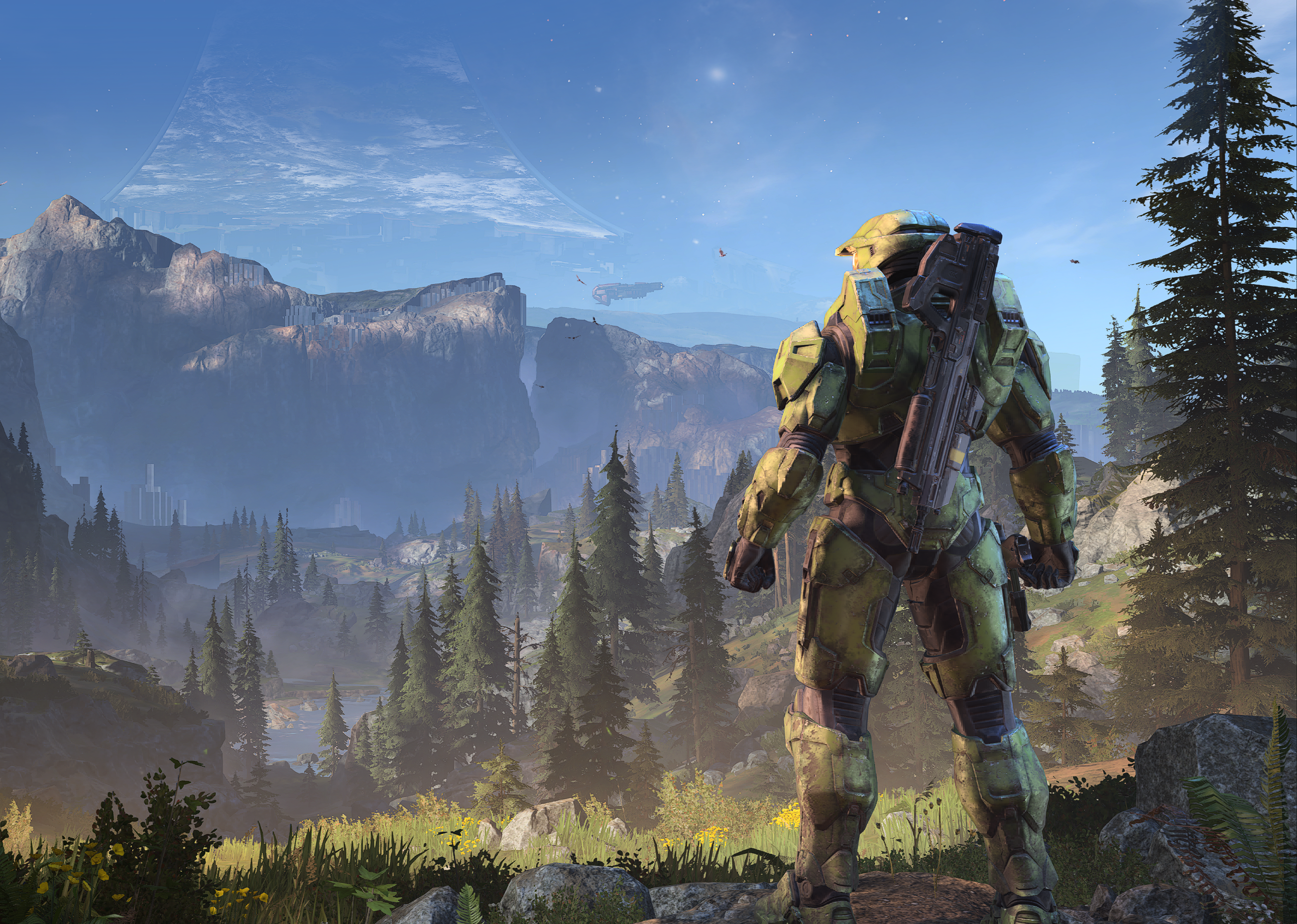
Master Chief looks upon Zeta Halo. This in-game shot is angled to make the location look as scenic and pretty as possible. It gets worse from here.
Enlarge / Master Chief looks upon Zeta Halo. This in-game shot is angled to make the location look as scenic and pretty as possible. It gets worse from here.
Xbox Game Studios / 343 Industries

With that out of the way, I’ll start with the good news.

Do you want a return to the series’ meaty sci-fi plot stakes, bolstered by trippy scenes and solid acting? Do you want a massive landscape over which you can drive a rumbly, tumbly four-wheeler through an encampment of foes? After that, do you want to nimbly grapple-hook your way into a massive battle that rekindles your love for Halo? You’ll find that stuff here.

Infinite follows the series’ core tenets of providing excellent first-person gunplay, third-person driving, and a slew of familiar military and alien weapons. Unlike in 2015’s Halo 5, we’re back to controlling the character Master Chief the entire time, and he finds himself landing on an unfamiliar, supersized ring planet called Zeta Halo. It has been blasted and partially destroyed, and some very bad monsters have designs on putting it back together—and turning it into a human-killing superweapon.

That may sound like the Halo series is putting up its version of the Death Star—”we’ll build a ring-shaped superweapon again!”—but the game differentiates its environments and plot beats enough to make Infinite‘s familiar premise work better in practice than on paper. More on that in a bit.

https://arstechnica.com/?p=1817954


Sony drops first look teaser trailer for Spider-Man: Across the Spider-Verse (Part One)

[embedded content]
Shameik Moore and Hailee Steinfeld reprise their roles as Miles Morales and Gwen Stacy, respectively, in Spider-Man: Across the Spider-Verse (Part One), a two-part sequel to the 2018 Oscar-winning film Spider-Man: Into the Spider-Verse.

Sony Pictures unveiled a first-look teaser trailer for its upcoming animated sequel Spider-Man: Across the Spider-Verse (Part One) at the Comic-Con Experience in Brazil this weekend. Yep, it’s going to be a two-part sequel to 2018’s critically acclaimed, Oscar-winning blockbuster Spider-Man: Into the Spider-Verse.

(Some spoilers for Spider-Man: Into the Spider-Verse below.)

The 2018 film was a megahit, grossing over $375 million worldwide against a $90 million budget, and won the Oscar for Best Animated Feature—a well-deserved honor. As Ars Technica’s Sam Machkovech wrote in his review, “It’s easily the best comic-nerd film in years to warmly embrace the kinds of viewers who know their comics canon front and back, all without intimidating the inevitable kid and newbie viewers attracted to this incredibly family-friendly adventure.”

Miles Morales (Shameik Moore) finds time to daydream while he's grounded.
Enlarge / Miles Morales (Shameik Moore) finds time to daydream while he’s grounded.
YouTube/Sony Pictures

Sony began developing the sequel one month before Into the Spider-Verse was released, and soon after, producer Amy Pascal announced that the film would focus on the budding relationship between Miles and Gwen Stacy/Spider-Gwen. The film is directed by Joaquim Dos Santos, Kemp Powers, and Justin K. Thompson, all making their feature-film directorial debuts.

Writer-producers Phil Lord and Chris Miller told Entertainment Weekly on Saturday that they decided to split the sequel into two separate films after realizing they just had too much story to tell to squeeze into a single installment. (They’re working on both films simultaneously.) And as we see in this first-look trailer, each universe in the multiverse has its own distinct look, designed to suggest they were drawn by a different artist.

Gwen Stacy, aka Spider-Gwen (Hailee Steinfeld), pops in via portal.
Enlarge / Gwen Stacy, aka Spider-Gwen (Hailee Steinfeld), pops in via portal.
YouTube/Sony Pictures

Per the official premise:

Miles Morales returns for the next chapter of the Oscar®-winning Spider-Verse saga, an epic adventure that will transport Brooklyn’s full-time, friendly neighborhood Spider-Man across the Multiverse to join forces with Gwen Stacy and a new team of Spider-People to face off with a villain more powerful than anything they have ever encountered.

The teaser trailer is light on plot specifics, but has some amazing visuals. We open with Miles (Shameik Moore) chillaxing at home—actually, he’s grounded—after successfully saving the multiverse and becoming his world’s Spider-Man. Then Gwen Stacy (Hailee Steinfeld) unexpectedly opens a portal to pop by, having figured out how to communicate with Miles across dimensions at the end of the first film. I mean, she could have called first so he could clean up his room a bit. But Gwen only teases him a little when she sees Miles’ drawing of her. (“I missed you too.”)

And there's Miguel O'Hara / Spider-Man 2099 (Oscar Isaac) interrupting Miles' multiverse adventure.
Enlarge / And there’s Miguel O’Hara / Spider-Man 2099 (Oscar Isaac) interrupting Miles’ multiverse adventure.
YouTube/Sony Pictures

Miles might be grounded but Spider-Man isn’t, so it’s not long before he’s swinging through portal after portal, traveling between universes. Just as he’s getting the hang of it, the Spider-Man from 2099, Miguel O’Hara (Oscar Isaac), tumbles out of another portal. (O’Hara made a brief appearance in the end credits of the last movie, arguing with yet another Spider-Man in 1967’s New York City.) Everything flashes by, but we do catch a glimpse of Miles swinging through a place called Mumbattan in what seems to be an India-inspired universe. (Hindi and Tamil words dot the background.)

Jake Johnson will also reprise his role as Peter B. Parker from the first film. Spider-Woman, aka Jessica Drew (Issa Rae) is expected to make an appearance at some point in the two-part sequel, and Takuya Yamashiro, the “Japanese Spider-Man” from the 1978 Spider-Man series is listed among the cast for Part One. As for characters like Kimiko Glenn’s Peni Parker, Nicolas Cage’s Spider-Man Noir, or John Mulaney’s scene-stealing Spider-Ham—well, Lord and Miller would neither confirm nor deny those possible cameos. “Miles will reunite with some old friends and meet… a lot of new ones,” they told EW.

Spider-Man: Across the Spider-Verse (Part One) is currently slated for theatrical release on October 7, 2022. Part Two is scheduled to drop sometime in 2023. Also in development: a female-centric spinoff Spider-Women film spanning three generations: Gwen Stacy/Spider-Gwen, Jessica Drew/Spider-Woman, and Cindy Moon/Silk.

Listing image by YouTube/Sony Pictures

https://arstechnica.com/?p=1818142


Raised by Wolves S2 teaser reminds us why we loved the series—until the S1 finale

[embedded content]
The second season of HBO’s new original sci-fi series, Raised by Wolves is coming in February.

The first teaser for S2 of Raised by Wolves is here, and our feelings are mixed. On the one hand, once again, the visuals are amazing and we’re thrilled that the strikingly androgynous Danish actress Amanda Collin is returning to star as Mother. Her extraordinary performance anchored the first season’s narrative arc and spooky, other-worldly vibe, and that same moody, disquieting viibe is present in the teaser.  On the other hand, we were seriously disappointed in the S1 finale, which has shaken our confidence that S2 will rebound from that fiasco to become the genuinely original and visionary series it initially had promised to be.

(Major spoilers for the S1 finale below.)

The series was created by Aaron Guzikowski, with Ridley Scott serving as executive producer and directing the first two episodes. As I’ve written previously, the story involves two androids serving as Mother (Amanda Collin) and Father (Abubakar Salim) figures on a strange virgin planet, Kepler 22b (an actual observed extrasolar planet), after Earth has been destroyed by the outbreak of a religious war. They are programmed to incubate, birth, and raise human children to rebuild the population and set up an atheist civilization to keep the human race from going extinct. It’s a harsh, dangerous environment, even for androids, and only one of their original six children survived: Campion (Winta McGrath).

Then the remnants of an extreme religious sect from Earth, the Mithraic, who worship Sol, found their way to the same planet aboard a spaceship, or ark, called Heaven. The reconnaissance team tried to abduct Campion and kill Mother.

That’s when we discovered that Mother has special abilities: she’s actually a reprogrammed weaponized android called The Necromancer, who once slaughtered atheists back on Earth. Her deadly sonic screams—which can disintegrate humans in seconds—were turned on the Mithraic, and she crashed their ark onto the planet. Her new maternal instincts led her to bring the surviving Mithraic children into her fold.

That did not go over well with the few surviving Mithraic, especially Marcus (Travis Fimmel) and his partner, Sue (Niamh Algar). They were determined to rescue their (technically adopted) son Paul (Felix Jamieson) from Mother and Father, against the orders of the Mithraic leader, Ambrose (Awissi Lakou). The various conflicts inevitably escalated, and the planet itself has its own mysterious secrets and hidden dangers, with the fate of the human race ultimately lying in the balance.

Amanda Collins once again stars as Mother, an android programmed to incubate, birth, and raise human children on an alien planet.
Enlarge / Amanda Collins once again stars as Mother, an android programmed to incubate, birth, and raise human children on an alien planet.
YouTube/HBO Max

Some viewers found the pacing of Raised by Wolves S1 to be too slow, but I genuinely found it atmospheric and weird in interesting ways—until the finale. Mother became pregnant after having virtual sex with her VR creator, “downloading” the required information. Except instead of giving birth to a baby as she’d hoped, Mother literally vomited up a creepy snake with suckers that—I kid you not—can fly with no obvious means of generating lift. In my review, I called it “a jarring, over-the-top ploy that simply wasn’t sufficient payoff for the viewer, and clashed mightily with the original set-up.”

Apparently the flying alien sucker snake (FASS)—which had rapidly grown to an alarming size in the final scene— is going to be a major part of the overall narrative arc for S2. This was not welcome news, especially since the ultimate fates of Mother and Father remained ambiguous. Fortunately, this teaser confirms that the pair will be back in full force for the second season, and there’s barely a hint of the FASS to be seen, apart from a brief glimpse of a snake figure painted on a rock.

Mithraic survivor Marcus (Travis Fimmel) seems to be devolving into one of the strange creatures Mother and Father first encountered in S1.
Enlarge / Mithraic survivor Marcus (Travis Fimmel) seems to be devolving into one of the strange creatures Mother and Father first encountered in S1.
YouTube/HBO Max

It’s not clear what’s happening in terms of plot, but the teaser opens with a shot of a badly injured Mother. “Androids can change, just like human beings,” her voice tells us. Father also has survived, along with the children and Sue. Marcus appears to be devolving into the strange creatures Mother and Father first encountered on the alien planet, and he hasn’t become any less zealous and violent. He’s still got some minion survivors to boss around, and he’s still intent on “bringing purity to this planet.”

Something violent seems to be reawakening in Mother as well, although her primary purpose is still to keep her children safe and find them a new home. The teaser ends ominously. “Perhaps we are becoming too human,” Mother muses, covered in what might just be blood. Will she re-appear in her full Necromancer glory? That would be a sight to see.

The second season of Raised by Wolves will premiere on February 3, 2022, on HBO Max.

The appearance of a flying alien sucker snake ruined the S1 finale for us. Alas, it's rumored to play a major role in S2.
Enlarge / The appearance of a flying alien sucker snake ruined the S1 finale for us. Alas, it’s rumored to play a major role in S2.

Listing image by YouTube/HBO Max

https://arstechnica.com/?p=1818067


Activision Blizzard “will not be a part” of this year’s Game Awards show

A statuette from The Game Awards.
Enlarge / A statuette from The Game Awards.

Activision Blizzard will “not be part” of next week’s annual Game Awards broadcast beyond its nominations, award host and creator Geoff Keighley said in a Twitter thread Friday night.

Keighley’s post comes after a more non-committal statement on Activision’s participation published in The Washington Post Friday morning. “We want to support employees and developers” Keighley told the Post before adding “we have to think very carefully about how to proceed here.”

That statement drew widespread condemnation among industry members and watchers on social media in light of ongoing lawsuits and investigations surrounding widespread reports of employee harassment and gender inequity issues.

Activision’s Call of Duty: Warzone will still have a place in the awards, owing to its nomination for “Best Ongoing Game” and “Best Esports Game.” But more than the presentation of actual awards, The Game Awards has risen to prominence in recent years as an annual holiday-season opportunity for publishers to promote trailers and footage of new and upcoming games to an audience of millions.

Activision won’t take place in that kind of paid promotion this year, Keighley said on Twitter. “The Game Awards is a time of celebration for this industry, the biggest form of entertainment in the world,” Keighley wrote. “I also realize we have a big platform which can accelerate and inspire change. We are committed to that, but we all need to work together to build a better and a more inclusive environment so everyone feels safe to build the world’s best games. All of us are accountable to this standard.”

It’s currently unclear whether Activision’s reduced presence at the show represents a significant change from previous plans. Keighley previously told the Post that the recently delayed Diablo 4 and Overwatch 2 would not be shown at this year’s show. But the Post also characterized Keighley’s earlier position on Activision’s potential participation by saying he “supported people coming forward with their stories but also didn’t want to diminish developers’ opportunities to spotlight their games.” Keighley was not immediately available to respond to a request for comment.

Rob Kostich, the president of Activision Blizzard, serves on the Advisory Board for The Game Awards alongside many other major game publishers and executives. There’s been no public indication of any change in that relationship.

Back in 2015, amid an employment dispute between Konami and Metal Gear Solid auteur Hideo Kojima, Keighley used his Game Awards stage to publicly criticize Konami for not allowing Kojima to come to the show to accept his awards. “[Kojima] is still under an employment contract, and it’s disappointing,” Keighley said. “It’s inconceivable to me that an artist like Hideo would not be allowed to come here and celebrate with his peers, his fellow teammates, for such an incredible game as MGS V. That’s the situation we’re in.” https://arstechnica.com/?p=1818073


New Peacemaker trailer gives us a redeemable villain we might learn to like

[embedded content]
John Cena reprises his role in The Suicide Squad in new HBO Max spinoff series Peacemaker.

HBO Max has dropped the official full trailer for Peacemaker, the spinoff series based on John Cena’s murderously entertaining character from The Suicide Squad.

As we’ve reported previously, director James Gunn wrote the series last summer during the COVID-19 lockdown, just for fun, but then DC Films approached him about a possible spinoff series for one of the characters in The Suicide Squad. He picked Cena’s Peacemaker, since he felt audiences never got the chance to get to know the character in the film—where, it must be said, he does some Very Bad Things, even for a member of the Suicide Squad. Gunn wanted to make Peacemaker less irredeemable. HBO Max was sufficiently impressed with Gunn’s take that it ordered Peacemaker straight to series.

The eight-episode series is set after the events of The Suicide Squad, specifically after the post-credits scene, in which we learned that Peacemaker had survived what had appeared to be a fatal shooting. The first teaser dropped in October, showing Peacemaker (aka Christopher Smith) being recruited by Clemson Murn (Chukwudi Iwuji) for another mission in order to avoid going back to prison.

Once again, he’s basically an assassin, but at least he’s only killing bad people (maybe). He gets assistance from warden John Economos (Steve Agee) of the Belle Reve penitentiary, NSA agent and former Waller aide Emilia Harcourt (Jennifer Holland), and new team member Leota Adebayo (Danielle Brooks). The cast also includes Robert Patrick (Terminator 2) as Peacemaker’s crusty father, Auggie Smith, who thinks his son is a “nancy-boy”; Freddie Stroma as Adrian Chase (aka Vigilante), a district attorney who fights crime and has rapid-healing abilities; and Nhut Le as Judomaster.

The teaser was heavy on the cheesy, off-color bro-humor, but it showcased Cena’s gift for physical comedy, and the irreverent, over-the-top tone was note-perfect—very much in line with the character. The full trailer opens with Detective Sophie Song (Annie Chang) telling her partner about Peacemaker. “He is a trained killer,” she says, and correctly predicts there will be trouble with “that maniac.” The very next scene is Peacemaker dodging gunfire to get to Harcourt’s getaway car, along with his trusty bald eagle sidekick, Eagley. (“That thing better not crap back there.”)

There’s certainly plenty of violence and explosions—this is Peacemaker, after all—but until now, the Peacemaker we’ve seen would kill pretty much anyone for his country. And he’d still find the time to do some vain macho posturing while he was at it. But the Very Bad events of The Suicide Squad have clearly affected him. (“I’m having… feelings about things.”) Suddenly he has qualms when ordered to kill women and children. And his Daddy Issues start kicking in when he goes to visit Auggie.

Harcourt dismisses Peacemaker as a clown, but Leota thinks “there’s something about him that’s kinda sad.” Even Vigilante warns him about the dangers of too much introspection: “The mind is a den of scorpions better left running from, not toward.” Will his sudden lapse of confidence threaten a vital mission? “Right now the world needs a son of a bitch,” Murn tells him. “And you’re the only one I got.”

The first three episodes of Peacemaker premiere on HBO Max on January 17, 2022. New episodes will air weekly every Thursday after that through February 17, 2022.

Listing image by YouTube/HBO Max

https://arstechnica.com/?p=1817942


Valve shows off final packaging, carrying case for the Steam Deck


Valve’s Steam Deck hardware might have been recently delayed by a couple of months, but the portable PC gaming device is still barreling toward release. As evidence of this, Valve posted some quick pictures late Thursday evening of the final packaging that will hopefully be reaching preorder customers early next year.

Yup, it's a box all right.
Enlarge / Yup, it’s a box all right.
A multi-language lining.
Enlarge / A multi-language lining.
<a href="https://cdn.arstechnica.net/wp-content/uploads/2021/12/sd3.jpeg" class="enlarge" data-height="2000" data-width="3000" alt="Unlike recent iPhone packaging, the Steam Deck will come with a region-appropriate power supply to enable the unit’s USB-C charging.”><img alt="Unlike recent iPhone packaging, the Steam Deck will come with a region-appropriate power supply to enable the unit’s USB-C charging.” src=”https://rassegna.lbit-solution.it/wp-content/uploads/2021/12/valve-shows-off-final-packaging-carrying-case-for-the-steam-deck-2.jpg” width=”640″ height=”427″ srcset=”https://rassegna.lbit-solution.it/wp-content/uploads/2021/12/valve-shows-off-final-packaging-carrying-case-for-the-steam-deck-7.jpg 2x”>
Enlarge / Unlike recent iPhone packaging, the Steam Deck will come with a region-appropriate power supply to enable the unit’s USB-C charging.

From the outside, the shipping packaging is a standard plain brown box, but Valve joked about the usual warnings on the side, urging customers to “not use the shipping box as an umbrella, smash [it] on the ground, or use [it] as a magnet.” On the inside of the box, meanwhile, the design includes recommendations for where to play in multiple languages. Among the English suggestions: “On the toilet, on the subway, on a ferris wheel, on the moon, in a test chamber, on the couch, in a hammock, in a tent.”

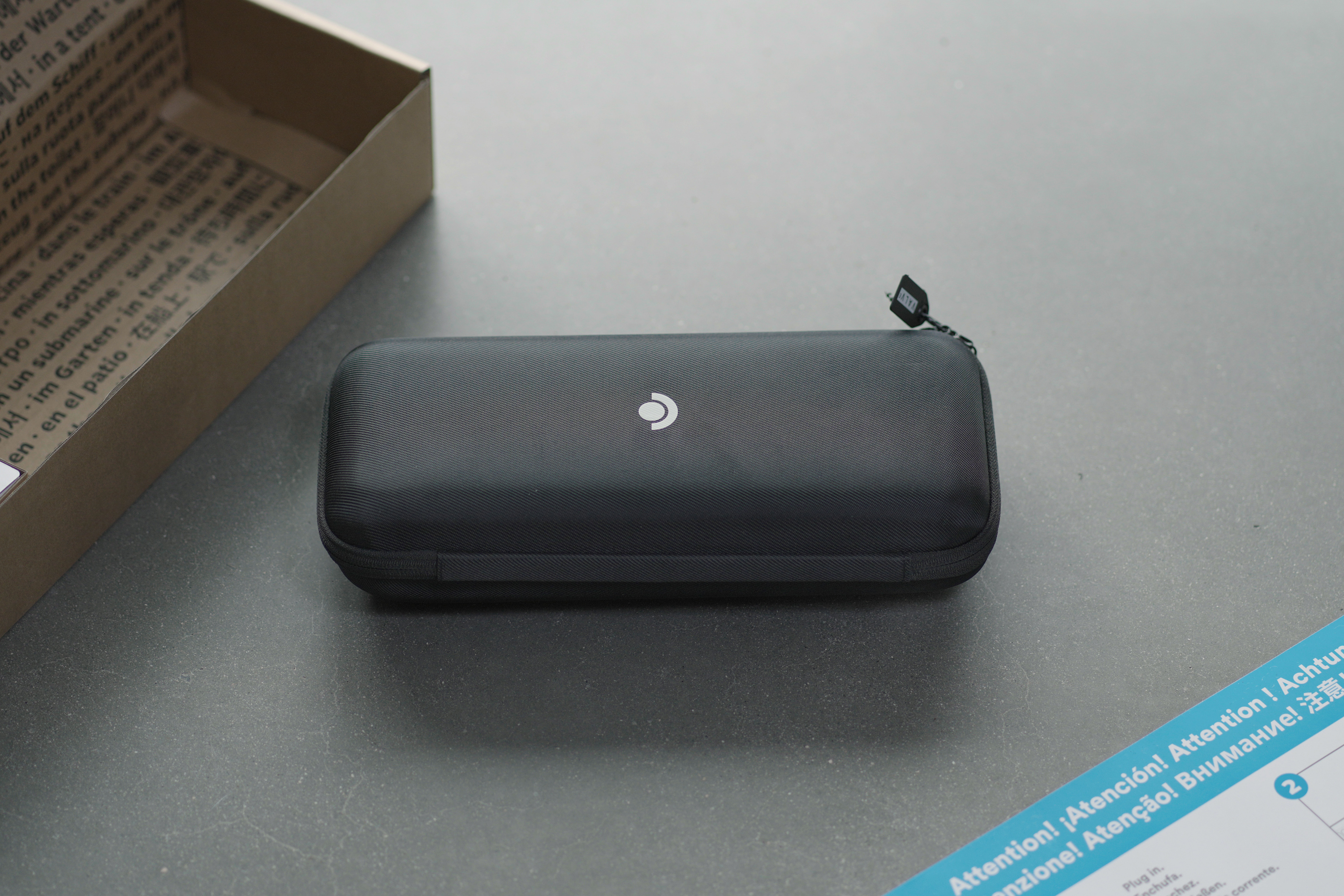
The case includes the Steam Deck's minimalist "circle and a curve" logo.
Enlarge / The case includes the Steam Deck’s minimalist “circle and a curve” logo.

Valve also provided a look at the form-fitting carrying case that will accompany the lower-end 64GB and 256GB editions of the system. The new case, which includes an understated Steam Deck logo on the front outside, differs from the Valve-logoed carrying cases the company showed when Valve started shipping dev kits in September. Those who purchase the 512GB system, meanwhile, have been promised an “exclusive carrying case,” likely this one, which has a white lining and an embedded Valve logo. The case was first shown when the Deck was announced.

The final carrying case for low-end models, containing a near-final "design validation" prototype.
Enlarge / The final carrying case for low-end models, containing a near-final “design validation” prototype.

Valve’s post also includes a quick glimpse at the final “design validation” prototype, which is being used to test the fit of the packaging. While Valve says this build includes “improvements from the EV2 [engineering verification] build” that was previously sent to developers, those improvements aren’t readily apparent from this single external photo. Valve writes that there will only be “minor changes” from this DV build to the final product.

Valve still expects to ship the Steam deck to the first of its preorder customers in February. Orders placed today are being given an expected order availability of “after Q2 2022.”

https://arstechnica.com/?p=1817914