Andrew and Lee do The Wheel of Time episode five: Funerals everywhere!

Rand and Mat finally make it to Tar Valon.
Enlarge / Rand and Mat finally make it to Tar Valon.

Andrew Cunningham and Lee Hutchinson have spent decades of their lives with Robert Jordan and Brandon Sanderson’s Wheel of Time books, and they’re bringing that knowledge to bear as they recap each episode of Amazon’s new WoT TV series. These recaps won’t cover every element of every episode, but they will contain major spoilers for the show and the book series. If you want to stay unspoiled and haven’t read the books, these recaps aren’t for you.

New episodes of The Wheel of Time will be posted to Amazon Prime subscribers every Friday.

Lee: Greetings, dear readers! Part five marks the start of the second half of our eight-episode season, and we pick up with a funeral—the aftermath of the attack that closed out episode four. White seems to be the funerary color in the world of the Wheel of Time, and the dead are shrouded in it as we close out the pre-credits scene with a cool overhead shot showing a circular arrangement of graves. Straight-down overhead views and circles are a strong recurring visual motif this season—and this isn’t the last time we’ll see a similar shot.

And after that, we get a big, month-long time skip—and then we’re off to Tar Valon!

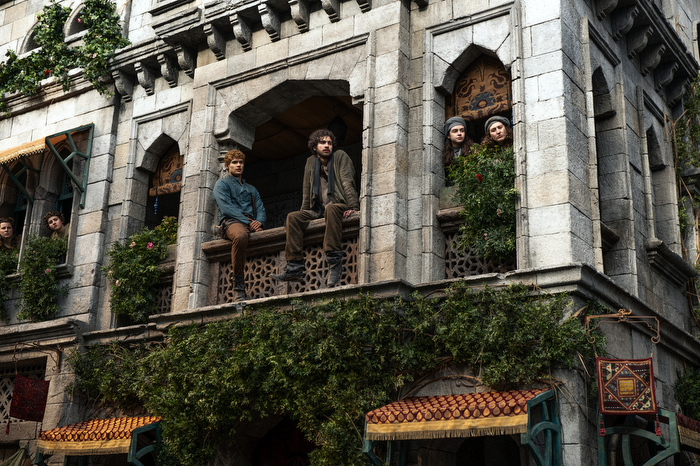
<a href="https://rassegna.lbit-solution.it/wp-content/uploads/2021/12/andrew-and-lee-do-the-wheel-of-time-episode-five-funerals-everywhere-3.jpg" class="enlarge" data-height="466" data-width="700" alt="Ahh, Minas Tirith Tar Valon!”><img alt="Ahh, Minas Tirith Tar Valon!” src=”https://rassegna.lbit-solution.it/wp-content/uploads/2021/12/andrew-and-lee-do-the-wheel-of-time-episode-five-funerals-everywhere-1.jpg” width=”640″ height=”426″ srcset=”https://rassegna.lbit-solution.it/wp-content/uploads/2021/12/andrew-and-lee-do-the-wheel-of-time-episode-five-funerals-everywhere-3.jpg 2x”>
Enlarge / Ahh, Minas Tirith Tar Valon!
Amazon Studios
Andrew: For book-readers, being in Tar Valon this early will drive home just how far off the map we now are, in terms of adapting Eye of the World. Many of our characters, particularly Rand and Mat and Egwene and Perrin, are all caught up in plots that actually aren’t too dissimilar from the book’s version of events. But we are far, far away from Caemlyn, the city that anchors these story beats in EotW, which means we’re either skipping or delaying some major character introductions, and also that inter-Aes-Sedai scheming is a bigger part of the story.
Lee: Can I do the Comic Book Guy thing and talk about Tar Valon’s appearance just a bit?

I promise not to make this kind of pooh-poohing a habit, but the show’s Tar Valon doesn’t really match my headcanon appearance. I see no flowing Ogier masonry, no fluted bridges and connecting towers. The up-close shots of the city streets with their dirty white stonework look like they were borrowed from Minas Tirith in Return of the King. And the White Tower itself is an artless stump of half-melted wax—like if you put the book’s version of the White Tower in a microwave and let it just kind of… collapse on itself. If there’s an architectural antecedent to the design we see on screen, it’d be something like Angkor Wat—except without the grace or beauty. Sorry, Amazon, but the Shining City is a swing and a miss for me.

<a href="https://rassegna.lbit-solution.it/wp-content/uploads/2021/12/andrew-and-lee-do-the-wheel-of-time-episode-five-funerals-everywhere-4.jpg" class="enlarge" data-height="466" data-width="700" alt="Poor Logain. He's maybe looking a little, how do you say, mad.”><img alt="Poor Logain. He's maybe looking a little, how do you say, mad.” src=”https://rassegna.lbit-solution.it/wp-content/uploads/2021/12/andrew-and-lee-do-the-wheel-of-time-episode-five-funerals-everywhere-2.jpg” width=”640″ height=”426″ srcset=”https://rassegna.lbit-solution.it/wp-content/uploads/2021/12/andrew-and-lee-do-the-wheel-of-time-episode-five-funerals-everywhere-4.jpg 2x”>
Enlarge / Poor Logain. He’s maybe looking a little, how do you say, mad.
Amazon Studios
Andrew: Huh, the look of Tar Valon didn’t jump out at me as wrong, though I see what you mean. It’s Minas Tirith by way of King’s Landing. It could definitely be trying harder to be its own thing. But I’ll admit that I was mostly checking to make sure they had faithfully recreated the island’s, uh, distinctive topography (we only really see the city in profile, but it seems like yes?).

We have talked a few times about the differences in how the One Power is depicted in this show, and I came away from this episode mulling something that is kind of separate from that but also kind of not? Everything we see about Warder culture on this show is modeling an emotionally open and vulnerable version of masculinity that is really sticking out to me as a reader of the books. Most (if not all) of these men spend the books talking about duty and self-sacrifice and how they’re all too DANGEROUS to have friends or lovers. No one ever takes their childhood friend by the shoulder and just asks how they’re holding up. Book-Lan gives Nynaeve the Pee-Wee Herman “I’m a loner, Dottie, a rebel” speech pretty much verbatim.

But in the show we are regularly seeing groups of men having emotionally mature conversations, and crying, and just being there for each other? We briefly noted it last week, in that moment where Rand checks in on Mat because he’s worried about him. I am sure that this is going to piss off some element of the fandom, anyone who believes this affected machismo is something to emulate and not (as the books ultimately depict it!!) a character flaw. But I’ve found it strikingly refreshing.

https://arstechnica.com/?p=1817626


Ars Technica’s ultimate board game gift guide, 2021 edition

Ars Technica’s ultimate board game gift guide, 2021 edition
Aurich Lawson | Getty Images

It’s that time of year again—time to buy more board games than you possibly have time to play.

To aid you in your quest, we’ve once again updated our massive board game buyer’s guide for the year by adding new entries (including a bunch of games from 2020 and 2021), pruning some old entries, and bringing things in line with our current thoughts. The list is divided into sections that cater to different audiences, and we think there’s something here for everyone—even those who don’t yet know they like board games.

Whether you’re looking to pick up your next cardboard obsession or need a gift idea for your weird cousin who’s always going on about “efficient resource trade routes,” you’re in the right place.

Table of Contents

Aaron Zimmerman, Nate Anderson, Keith Law, and Tom Mendelsohn contributed to this guide.

Ars Technica may earn compensation for sales from links on this post through affiliate programs.

https://arstechnica.com/?p=1817502


Survivors try to stay positive after deadly pandemic in Station Eleven trailer

[embedded content]
A limited series based on Emily St. John Mandel’s international bestseller, Station Eleven is a post-apocalyptic saga that follows survivors of a devastating flu as they attempt to rebuild and reimagine the world anew while holding on to the best of what’s been lost.

A deadly flu wipes out most of humanity and the survives try to cling to hope in the official trailer for Station Eleven, the forthcoming new series from HBO Max about the onset and aftermath of a global flu pandemic that wipes out most of humanity. The ten-episode series is based on the international bestselling novel of the same name by Emily St. John Mandel.

I won’t re-hash the novel’s entire complicated plot; you can get those details here. It concerns an outbreak of the “Georgia Flu”—a virus that is both highly contagious and deadly—that is sweeping over the world, leaving millions of corpses in its wake. Within a few weeks, the majority of humanity succumbs to the disease. The novel then jumps some 20 years after Year Zero, focusing in part on a group of actors and musicians who travel from  from town to town, staging concerts and Shakespeare’s plays. But not everyone has responded to this new reality with that kind of positive idealism. The troupe soon runs into trouble in a town controlled by a mysterious cult figure known only as The Prophet.

Himesh Patel plays Jeevan a paramedic traineee who befriends a young child actress named Kristen after most of her fellow King Lear cast members die in Year Zero. Mackenzie Davis portrays the adult Kirsten. Gael Garcia Bernal plays doomed actor Arthur Leander (star of the aforementioned production); Danielle Deadwyler plays Arthur’s first wife Miranda; Caitlin FitzGerald plays Arthur’s second wife Elizabeth; and Julian Obradors plays Tyler, Arthur’s son by Elizabeth. Daniel Zovatto is listed as playing The Prophet, which is either sleight of hand on the production’s part or a genuine departure from the novel. (The true identity of The Prophet is one of the novel’s big reveals.)

Mackenzie Davis co-stars as Kristen, a survivor who joins a traveling theater troupe post-apocalypse.
Enlarge / Mackenzie Davis co-stars as Kristen, a survivor who joins a traveling theater troupe post-apocalypse.
YouTube/HBO Max

Showrunner Patrick Somerville seems to have followed that basic outline pretty closely in his TV adaption, based on a teaser and first-look images that dropped last month. While they were intriguing, I noted that HBO greenlit the series in the Before Times (pre-pandemic), and I wondered whether the series could attract an audience fatigued and frustrated with sporadic surges of continuing COVID-19 cases around the world.

The official trailer opens right where the novel does in Year Zero: with Arthur’s fatal heart attack on stage, and Javeen’s befriending of Kristen. We see the scenes of devastation, as health care workers try to cope with all the deaths and those lucky enough to escape that fate struggle with what to do next. At leasts one character (played by David Wilmot) seems ridiculously optimistic. “We have shelter. We have food. This is the best thing that could have possibly happened,” he tells a group of his fellow survivors. (They understandably seem dubious.)

We next jump forward 20 years, as the grown Kirsten and her troupe travel the countryside trying to make sense of their new reality and maybe help a few others do the same. We see overgrown city buildings, and a brief glimpse of an array of now-defunct technology, courtesy of one man”s Museum of Civilization. And there are dire warnings to “beware the Prophet,” as well as “the children who follow him.” The trailer strike some of the same hopeful notes as Mandel’s novel, and the series could be very good. Here’s hoping pandemic fatigue doesn’t deprive it of its audience.

Station Eleven debuts on HBO Max on December 16, 2021.

Spot the now-defunct technology from the Before Times.
Enlarge / Spot the now-defunct technology from the Before Times.
YouTube/HBO Max

https://arstechnica.com/?p=1817786


Quake 1 gets its first major co-op content update in 25 years


Months after the FPS classic Quake got a major 25th anniversary re-release, its modern handlers have returned with an update that exceeds all expectations. Thursday’s new 770MB patch on all platforms (Xbox, PlayStation, Switch, PC) adds an entirely new co-op combat mode, and it officially opens the game’s mod floodgates for players outside the PC ecosystem.

The uncreatively named “Horde” mode works much like a mode of the same name in Gears of War. Instead of progressing through a level from start to finish, players are expected to hunker down inside a somewhat circular arena and then contend with hundreds of enemies spawning from all sides. Kill a full “wave” of foes, and your team will get a moment to breathe, replenish health and ammo (or argue over who gets to use it), and do it all over again.

For the sake of Quake‘s first-ever official co-op mode (beyond the campaign, which always supported co-op as an option), Bethesda support studio MachineGames has whipped up four brand-new battling arenas, which are pictured above. Each includes at least one “silver key” door, which is full of more powerful weapons and is gated until players earn a key by defeating a tougher “boss wave” of foes. Get through nine enemy waves, and your team gets a “gold key.” You can either exit the level at that point or stay and keep fighting increasingly tough foes until your team dies. (If you’re hunting for in-game achievements or trophies, Bethesda hasn’t updated Quake with any new ones for Horde, if that changes whether your team uses the gold key or not.)

The results aren’t as complex as newer stabs at the Horde concept, and MachineGames didn’t add complicated systems like the ability to build turrets, barriers, or other implements of survival. But as an excuse to distill the OG Quake experience and fast forward you and some friends into high-speed combat, it works fantastically—and it’s hard to knock as a freebie.

<a href="https://cdn.arstechnica.net/wp-content/uploads/2021/12/Quake-4.png" class="enlarge" data-height="2160" data-width="3840" alt="The 2012 Quake mod "Honey" starts innocently enough. Descend into this abandoned village’s underbelly to find its secrets.”><img alt="The 2012 Quake mod "Honey" starts innocently enough. Descend into this abandoned village’s underbelly to find its secrets.” src=”https://rassegna.lbit-solution.it/wp-content/uploads/2021/12/quake-1-gets-its-first-major-co-op-content-update-in-25-years.png” width=”980″ height=”551″>
Enlarge / The 2012 Quake mod “Honey” starts innocently enough. Descend into this abandoned village’s underbelly to find its secrets.

The other major addition in this week’s patch is the first full-blown “add-on” built into the Quake menu system. Bethesda teased this feature at launch with “Quake 64,” which tweaked the maps, changed the game’s music, and added an N64-like blur filter to better resemble the original game’s N64 port. This week’s addition is much more full-fledged: it’s the beloved 2012 Quake mod “Honey,” made by a modder who was eventually hired by MachineGames. As part of this week’s release, Bethesda also released an interview with said modder, Christian “czg” Grawert, who confirms that the studio has hosted weekly Quake 1 modding challenges among its devs—and that these eventually led to the contents of the new level pack included in the Quake 1 re-release in August.

Honey became Quaddicted’s highest-rated mod over the years for good reason, and it’s a good kickoff to Quake‘s new “add-on” menu. id Software and Bethesda have already been filling Doom 1 and Doom 2 re-releases with a variety of community-made mods, all free as part of both games, with a somewhat regular cadence of free updates there. Based on how Quake‘s menu structure resembles that of Doom and Doom 2, we believe the same will come to Quake—and are stoked to see quality map packs breaking out of the PC ecosystem on consoles like PlayStation, Switch, and Xbox.

Ars Technica may earn compensation for sales from links on this post through affiliate programs.

Listing image by Bethesda / id Software

https://arstechnica.com/?p=1817582


Archaeologists find partially mutilated Vesuvius victim at new Herculaneum dig

The partially mutilated remains of a Vesuvius victim, found at the site of what would have been the beach of Herculaneum.
Enlarge / The partially mutilated remains of a Vesuvius victim, found at the site of what would have been the beach of Herculaneum.
Domenico Camardo/Herculaneum Project

Archaeologists have announced the “sensational” discovery of the partially mutilated skeletal remains of a middle-aged man who perished on the beach at Herculaneum during the eruption of Mount Vesuvius in 79 CE. It’s the first excavation of the site in nearly three decades, and Herculaneum Archaeological Park director Francesco Sirano expects to find even more victims’ remains as the excavations continue.

Eagle-eyed excavators spotted a couple of leg bones sticking out of the edge of an escarpment; a prior excavation had chopped the skeleton off at the feet. Experts estimate that the man was between 40 and 45 years old. The remains were found lying with the head pointing back in the direction of the sea and surrounded by carbonized wood, including a roof beam that could have crushed the man’s skull. The victim’s bones were a reddish color, which Sirano identified as stains left by the man’s blood.

“We can learn many things from his bones: his exact age, what jobs he may have done, whether he had any illnesses,” Domenico Camardo told reporters. Camardo is chief archaeologist of the Herculaneum Conservation Project.

There’s a long and occasionally contentious history among archaeologists who study the remains of the Vesuvius victims. As we’ve reported previously, the eruption released thermal energy roughly equivalent to 100,000 times the atomic bombs dropped on Hiroshima and Nagasaki at the end of World War II, spewing molten rock, pumice, and hot ash over Pompeii and the nearby city of Herculaneum in particular. Pliny the Younger wrote of “broad sheets of flame” and a rain of ash in a letter to the historian Tacitus (the letter is the sole surviving eyewitness account of the disaster).

While it took three days to destroy Pompeii, Herculaneum was destroyed in roughly two hours, according to Miami University archaeologist and historian Steven Tuck. Excavations in the 1980s and 1990s unearthed the well-preserved skeletons of more than 300 victims piled up in boat sheds, seeking shelter from the volcano’s wrath. Archaeologists made fiberglass casts of each set of remains where it was found.

Others gathered on the beach to wait for help. Most never made it off. Unless people managed to jump onto a ship in the harbor in the first 10 minutes, they would have succumbed to the pyroclastic flows (fast-moving hot ash, lava fragments, and gases) that swept through and obliterated the town. If the ash didn’t get them, the tsunami that developed in the wake of the eruption, and the accompanying earthquake (and aftershocks), would have done so.

Their last moments would have been horrendous. “It was one o’clock at night, when the pyroclastic surge produced by the volcano reached the town for the first time,” Sirano told Italian news agency ANSA. “A white-hot cloud that raced towards the sea at a speed of 100 kilometers per hour, which was so dense that it had no oxygen in it. In the space of a few minutes, [the inferno] engulfed and swallowed up the upper part of the town, uprooting the roofs and mowing down men and animals with a heat such as to make their bodies evaporate.”

The archaeological ruins of Herculaneum.
Enlarge / The archaeological ruins of Herculaneum.
Pier Paulo Patrone

It’s well-known that the vast majority of the victims died of asphyxiation, choking to death on the thick clouds of noxious gas and ash. But a 2001 study in Nature estimated a temperature of 300° Celsius (572° Fahrenheit) for the pyroclastic surge that destroyed Pompeii, sufficient to kill inhabitants in fractions of a second. Back in 2018, we reported on the conclusion of University of Naples archaeologist Pierpaolo Petrone (one of the co-authors of the 2001 Nature paper) that inhabitants of Herculaneum may have suffered a similar fate. The heat was so extreme in some places that it vaporized body fluids and exploded the skulls of several inhabitants unable to flee in time.

Last year, Petrone determined that the heat also fused brain tissue into glass in one victim, according to a short paper he published in The New England Journal of Medicine. Not everyone agreed with Petrone et al.’s conclusions. Tim Thompson, a forensic anthropologist at Teesside University in the UK, told bioarchaeologist Kristina Killgrove at the time that he doesn’t find the vaporization theory plausible, preferring his own alternate theory that the victims at Herculaneum may have been essentially “baked” by lower-intensity heat.

Undaunted, Petrone published another paper in October 2020 reporting the discovery of preserved human neurons in the victim with the “glassified” brain. Thompson told Ars at the time that he found the paper interesting, although he criticized the authors for not including their raw data—just a list of the proteins and related gene expressions. Granted, brains don’t typically survive for long after death; brain tissue is typically the earliest thing to decompose in most contexts. But it is not unprecedented, and Herculaneum was not a typical decompositional context. Per Petrone, the unique vitrification process that occurred at Herculaneum apparently “froze” this particular victim’s neuronal structures, preserving them intact.

https://arstechnica.com/?p=1817432


Activision Blizzard faces new pressure from group of state treasurers

Activision's publishing HQ in Santa Monica, California.
Enlarge / Activision’s publishing HQ in Santa Monica, California.


The continuing lawsuits and investigations surrounding widespread reports of employee harassment and gender inequity issues at Activision Blizzard have now attracted the attention of six state treasurers who are seeking substantial changes at the company.

Axios reports on a letter sent last month by the state treasurers of California, Massachusetts, Illinois, Oregon, Delaware, and Nevada to Activision Blizzard, asking to meet with the company’s board of directors regarding their “response to the challenges and investment risk exposures that face Activision.” The group also writes that it is considering a “call to vote against the re-election of incumbent directors,” echoing similar calls from activist investors in recent weeks.

“We think there needs to be sweeping changes made in the company,” Illinois State Treasurer Michael Frerichs told Axios. “We’re concerned that the current CEO and board directors don’t have the skill set nor the conviction to institute these sweeping changes needed to transform their culture, to restore trust with employees and shareholders and their partners.”

Illinois is among the states that invests in Activision through its employee pension fund and other public investments, which makes the company’s sinking stock price of direct concern for the state government. As of this writing, Activision’s stock is down almost 40 percent from six months ago and nearly 35 percent for the 2021 calendar year so far.

In September, Activision Blizzard reached a proposed settlement in a federal discrimination lawsuit for $18 million, a small fraction of its annual revenue. Frerichs told Axios he sees that settlement “as a penalty, as perhaps an admission of wrongs in the past,” but also as far from sufficient.

“We’re long-term investors, and we want to see those risks that caused that penalty addressed so they don’t happen again,” he said. “You can point to ‘Hey, we paid the victims, we’re making them whole.’ But if you’re continuing a culture that creates new victims in the future, you are creating more risk for your company.”

The newly reported pressure from state treasurers comes as Jessica Gonzalez, a major employee organizer at Activision Blizzard, announced her departure from the company. Gonzalez was instrumental in helping organize the A Better ABK Workers Alliance and in putting together multiple employee walkouts to protest management’s handling of the allegations.

“To [CEO Bobby Kotick]: Your inaction and refusal to take accountability is driving out great talent, and the products will suffer until you are removed from your position as CEO,” Gonzalez wrote in a public departure message. “This may seem harsh, but you had years to fix the culture, and look at where the company currently stands.”

https://arstechnica.com/?p=1817477


Twitch’s “ban evasion” flag is a bigger anti-hate tactic than you might think

Twitch logo.

Twitch, the livestreaming service that largely caters to gamers, has exploded in popularity since being acquired by Amazon in 2014—but toxicity on the platform has also increased. This week, Twitch took an important step toward getting a handle on its applause-like “chat” feature, and it goes beyond the usual dictionary-based approach of flagging inappropriate or abusive language.

The Tuesday rollout of a new “ban evasion” flag came with a surprising amount of fanfare, and it puts Twitch in a position to do what many other platforms won’t. The company is not only paying attention to “sockpuppet” account generation; it is pledging to squash it.

Spinning up attacks

Pretty much any modern online platform faces the same issue: Users can join, view, and comment on content with little more than an email address. If you want to say nasty things about Ars Technica across the Internet, for example, you could make a ton of new accounts on various sites in a matter of minutes. Your veritable anti-Ars mini-mob requires little more than a series of free email addresses. Should a service require some form of two-factor authentication, you could simply attach spare physical devices or spin up additional phone numbers.

In less hypothetical terms, Twitch creators have dealt with this “hate mob” problem for some time now, with the issue peaking in intensity after Twitch added an “LGBTQIA+” category. Abusive users charged up hyperfocused lasers of hateful speech, usually directed at smaller creators who could be discovered in Twitch’s category directory. As I explained in September:

While Twitch includes built-in tools to block or flag messages that trigger a dictionary full of vulgar and hateful terms, many of the biggest hate-mob perpetrators have turned to their own dictionary-combing tools.

These tools allow perpetrators to evade basic moderation tools because they construct words using non-Latin characters—and can generate thousands of facsimiles of notorious slurs by mixing and matching characters, thus looking close enough to the original word. Their power for hate and bigotry explodes thanks to context that turns arguably innocent words into targeted insults, depending on the marginalized group they’re aimed at.

Battling these attacks on a dictionary-scanning level isn’t so cut and dried, however. As any social media user will tell you, context matters—especially as language evolves and as harassers and abusers co-opt seemingly innocent phrases to target and malign marginalized communities.

Server-side suspicions

Twitch’s “ban evasion” flag takes a different approach. It uses Twitch’s server-side information about account generation to determine whether a newly generated account appears to have come from someone who broke the site’s terms of service and then created another account. If the account is flagged, the user in question won’t notice anything different, but streamers and their moderators will see that user’s messages land in a special “ban evasion” moderation silo. This practice is generally known as “shadowbanning” since messages appear to work just fine for the banned person, but nobody else in the chat feed sees them.

Twitch's ban-evasion-flag system at work in an illustration provided by Twitch.
Enlarge / Twitch’s ban-evasion-flag system at work in an illustration provided by Twitch.

If the account was moderated in error or the streamer doesn’t see any issue with the flagged user’s messages, the flagged user can be unbanned and brought back into public chat. Otherwise, the channel can either kick/ban the flagged user or leave the account shadowbanned. (Twitch also offers a milder version of this flag that leaves the user’s chatting abilities untouched but gives moderators a heads-up that an account seems suspicious.)

The move appears to split the difference between immediately shutting down suspicious accounts and letting them roam free and unchecked across Twitch’s hills and valleys. And it follows a new optional toggle, which launched in late September, for individual channels. Hosts can choose to restrict chat features to users who have verified their phone number and/or been live on Twitch for a certain amount of time.

Twitch is essentially admitting to something that “engagement”-obsessed social media sites are loath to confront: Fake accounts exist and they can poison whatever platforms they’re created on. This idea tends to run counter to the metrics that site operators love to show off when seeking advertising partners; social media sites would rather not add asterisks to any counts of “monthly active users” when determining advertising rates.

https://arstechnica.com/?p=1817281


Report reveals which sealed NES games are the rarest of the rare

A golden, 8-bit Zelda cartridge sits atop a mess of gold coins.
Enlarge / Some copies of The Legend of Zelda might be worth less if they were made of real gold…


This summer, when a copy of Super Mario 64 sold for over $1.5 million, no one could say for sure just how rare it was to find a copy in such pristine, unopened condition. That’s because Wata Games—the company that’s come to dominate the market for professional grading of video game rarities—wasn’t releasing the population reports that would detail the quantity and quality of all the games that had come across its desk.

Now, Wata is beginning to open up a little bit, releasing its first partial population report for NES games and announcing plans to publish more robust data covering more consoles in the near future. The numbers in that first report show just how rare it is for Nintendo boxes to still exist in sealed, unopened condition decades later, and the report gives the public and collectors an idea which NES games are likely to be the most valuable to the right collector.

The time is now

So-called population reports—in which a collectible grading service shares the distribution of quality grades for every piece it has ever seen—have long been common in high-end collectible markets like sports cards and coins. But back in July, Wata’s then-CEO (and current vice president of new ventures for new parent company Collector’s Universe) Ryan Sabga told Ars he was hesitant to release such a report for video games.

At the time, Sabga said the small, self-selected universe of games submitted for Wata grading could provide a skewed and unreliable picture of the full market to collectors. A video game population report “would show some potentially misleading information; it would show rare games as common and common games as rare,” he said. “Eventually, things would settle out, but the reality is that it would cause undue turmoil in the marketplace in the short term.”

That was then, this is now. Wata’s first partial population report of NES games breaks down information on over 7,000 shrink-wrapped boxes by Wata’s 10-point quality-grading scale (as well as a portion of its opened “complete in box” and loose NES cartridge grades). Wata also announced plans to issue wider population reports for other consoles “in the first few months of 2022.” Those expanded reports promise to include more detailed information on quality spreads for shrink-wrap seals, more separation of rare variants that are sometimes sought after by collectors, and “live” data that “will update automatically based on graded submissions.”

Sabga told Ars in a recent interview that Wata is comfortable releasing the NES population report now because “the numbers are just enough that, while I think there is a definite selection bias, it is just enough that it can give customers, consumers, and collectors an idea of what’s out there. Collectors were starting to get to a point where they didn’t know exactly where to go with their collecting without a little bit of help from a population report, even a limited population report as this.”

Looking back, Sabga said, “One of my concerns was I was afraid it was going to wreak havoc in the marketplace. The reality is I’m not the guardian of the hobby, I’m not the guardian of the marketplace by any stretch of the imagination. But… I always feel like there’s some level of responsibility.”

https://arstechnica.com/?p=1817332


New trailer for The Matrix Resurrections is heavy on the déjà vu

[embedded content]
Keanu Reeves and Carrie-Anne Moss reprise their respective starring roles as Neo and Trinity in The Matrix Resurrections.

We’re just a few weeks away from the release of The Matrix Resurrections, and Warner Bros. is whetting our appetites with a shiny new trailer.

As we’ve reported previously, series writers/directors Lilly and Lana Wachowski didn’t originally intend to make another Matrix film after Revolutions, but rumors about a possible fourth film have been swirling since 2012. Lilly Wachowski went so far as to call the prospect “a particularly repelling idea in these times” in a 2015 interview—a sharp critique of Hollywood’s preference for sequels, reboots, and adaptations.

Nonetheless, Warner Bros. officially announced the fourth film in August 2019. Lana Wachowski signed on to direct and co-write the film with novelist David Mitchell (Cloud Atlas) and Aleksandar Hemon (Sense8). Lilly Wachowski gave the project her blessing but declined to be involved, partly because she was busy with Showtime’s Work in Progress.

That darn déjà vu cat.
Enlarge / That darn déjà vu cat.
YouTube/Warner Bros

Keanu Reeves and Carrie-Anne Moss will return to their roles as Neo and Trinity, respectively. Three actors will be reprising their roles in Reloaded and Revolutions: Jada Pinkett Smith as Niobe, captain of the Logos; Lambert Wilson as The Merovingian, a rogue Matrix program with his own agenda; and Daniel Bernhardt as Agent Johnson. We’re also getting a host of new cast members: Yahya Abdul-Mateen II (currently lighting up the box office in Candyman), Neil Patrick Harris, Jessica Henwick, Jonathan Groff, Toby Onwumere, Max Riemelt, Eréndira Ibarra, Priyanka Chopra, Andrew Caldwell, Brian J. Smith, Ellen Hollman, and Christina Ricci.

The first trailer was released in September and was set to Jefferson Airplane’s “White Rabbit” to really drive home the red pill/blue pill theme. We saw Neo in therapy with a smarmy psychiatrist played by Neil Patrick Harris, and it soon became clear that we were in a brave new Matrix-constructed world. People take two blue pills daily, and everyone is glued to their iPhones and tablets—whatever it takes to keep the masses sedated, one assumes. When Neo runs into Trinity, the two feel a vague sense of recognition.

Trinity has melting Matrix face.
Enlarge / Trinity has melting Matrix face.
YouTube/Warner Bros

Of course, Neo once again finds a “white rabbit” to follow, and a new version of Morpheus (Abdul-Mateen II) offers Neo that all-important red pill. There were agents, explosions, gravity-defying fight scenes, and a scene showing Neo stopping a hail of bullets, with one final shot of Jonathan Groff welcoming us “back to the Matrix.” It was perfection.

This new trailer is aptly titled “Déjà Vu” since it riffs on that key moment from the first Matrix film where Neo saw the same black cat walk past a doorway in the Lafayette Hotel. “A déjà vu is usually a glitch in the Matrix,” Trinity told him. “It happens when they change something.” In that case, the code around them was being rewritten as the Agents closed in. In this case, it seems that the entire preceding “reality” has been changed, but the trailer doesn’t spill many details beyond that.

Assailants with glowing green eyes are creepy.
Enlarge / Assailants with glowing green eyes are creepy.
YouTube/Warner Bros

We get haunting strains of “White Rabbit,” harkening back to the first trailer, and Trinity’s line is repeated several times as images from the original trilogy and the new film flash by in parallel—including that déjà vu cat—with blue and red hues washing over them to represent the changes coming. I am especially intrigued by a visually arresting shot of Trinity’s face melting into code and Neo facing off against a band of assailants with glowing green eyes.

“Why use old code to make something new?” we hear Neo say. “Maybe this isn’t the story you think it is,” a mechanized voice replies. We’ll find out just what kind of story this is in a few weeks.

The Matrix Resurrections hits theaters on December 22, 2021. As always, we strongly recommend only going to see films in theaters if you have been fully vaccinated and wear a mask for the duration of the screening.

Listing image by Warner Bros.

https://arstechnica.com/?p=1817224


Bus Simulator 21: We should really pay bus drivers more

<img src="https://rassegna.lbit-solution.it/wp-content/uploads/2021/12/bus-simulator-21-we-should-really-pay-bus-drivers-more.jpg" alt="This is Chinatown in Angel Shores, a substitute for the Bay Area in Bus Simulator 21.”>
Enlarge / This is Chinatown in Angel Shores, a substitute for the Bay Area in Bus Simulator 21.

Have you ever had a game you really wanted to love, but it just didn’t work out? For me, Bus Simulator 21 is that game. News of its impending release caught my eye in late summer, and I knew I had to try it. Almost all of my gaming these days involves a handful of racing sims, but the idea of a lower-stress driving experience seemed like an attractive distraction from the world outside.

At this point, any actual bus drivers reading this will be shaking their heads. Because as I have come to learn, driving a bus is pretty stressful.

The conceit of Bus Simulator 21 is extremely straightforward: you manage a transportation company and drive buses across a number of different environments. There are fictional open-world environments—one in the US and one in Europe—and real buses, including double-deckers and even fully electric ones.

To begin with, you design your character—the creator includes the pandemic-aware option to give your avatar a face mask—and test drive a couple of buses at the dealership. You can wander around the environment, including checking out the interiors of the buses, then take control of a bus by approaching the driver’s seat. After choosing your bus, it’s time to drive the first route.

Tank top, hat, face mask: let's do this, 2021.
Enlarge / Tank top, hat, face mask: let’s do this, 2021.

Since this is a game, you have missions—spend time driving at night or create a new route, for instance—and as you complete them, you unlock new buses and new parts of the environments.

Almost immediately, it became clear that my fantasy of having a relaxing time cruising through the city was just that—a fantasy. Because cruising implies leisure, and driving a bus is not a leisure activity—it’s a job with requirements that must be met.

For instance, you have to obey all the traffic laws. This is not Grand Theft Auto, and running over a pedestrian is frowned upon. It might even discourage them from riding your bus. That means you need to signal when you’re turning.

You are also expected to stop relatively precisely at each stop. The bus should be facing the right direction. It really should not be parked half on the curb.

On the plus side, I did remember to wake a sleeping passenger...
Enlarge / On the plus side, I did remember to wake a sleeping passenger…

Then it’s time to lower the bus, open the door, and do the ticketing. I enjoy the ticketing process—about two-thirds of your passengers have passes and just smile or walk past you. But others will ask for tickets in various combinations, and you get to make change. The ticket machine makes a satisfying noise as you dispense each coin.

But you can’t take your time, because a bus route is nothing without a timetable. And timetables only allow for so much dawdling… or someone’s inability to remember how to put the bus back into gear. At this point, it’s helpful to not get flustered and to remember that, yes, you still have to signal when pulling out.

There’s also the fact that driver engagement is not really a priority in bus development. I remember, a long time ago, reading that Lotus Engineering had done some consultancy for a coach manufacturer and that the result was a bus chassis that handled like a big, slow Lotus Esprit. But the crowded streets of Angel Shores never seemed like the place to test if my Mercedes-Benz Citaro had some of the same magic.

In fact, all my bus driving has been with a controller. Wheel support is pretty good on the PC but not so great on consoles, and I haven’t been able to get my Thrustmaster T-GT to work with the game when played on the PS4. Sadly, that dealt a pretty big blow to my immersion in the game.

I wish I had it in me to stick with this game long enough to unlock this double-decker. But I don't.
Enlarge / I wish I had it in me to stick with this game long enough to unlock this double-decker. But I don’t.

Consequently, time spent in Bus Simulator 21 often felt like hard work. My gaming time is so limited these days that I’d rather not spend it doing more chores, so I haven’t put in enough time to unlock an electric bus. The game never felt like something more rewarding than working for a bus company without getting paid.

I don’t necessarily mean this as a knock on Bus Simulator 21. It’s not called Relaxing Bus Cruiser 21, after all—that was just my projection.

Verdict: The game promised to faithfully simulate the “exciting daily life of a bus driver,” and I think it delivers. Just make sure that’s actually what you want—bus drivers are paid for their time.

Available at: Steam | Humble | PlayStation Store | Xbox

Ars Technica may earn compensation for sales from links on this post through affiliate programs.

https://arstechnica.com/?p=1817204