Review: Reimagined Cowboy Bebop largely preserves beloved elements of original
John Cho is perfection as bounty hunter Spike Spiegel.
Mustafa Shakir shines as Jet Black, captain of the Bebop.
Daniella Pineda matches the boys shot for shot as Faye Valentine.
A pair of Welsh corgis named Charlie and Harry play the smart, winsome Ein.
Alex Hassell glowers with style as Spike’s nemesis, Vicious.
There’s always a femme fatale. Here, it’s Julia (Elena Satine), now married to Vicious.
It’s a daunting task to create a live action series out of one of the most trailblazing, influential anime series of the last 25 years. That would be Cowboy Bebop, a stylish, genre-busting neo-noir space Western that earned universal acclaim when it debuted in 1998. Count yours truly among its many admirers. So I had some reservations about Netflix’s decision to adapt the original into a live-action streaming series—why mess with perfection?
Diehard purists likely won’t be happy; the new series is a different beast. But I found that Netflix’s Cowboy Bebop mostly struck a balance between preserving the most beloved elements of the anime and remixing them in fresh, intriguing ways for a new dramatic format. Is it flawless? Hardly. But it’s still pretty darn entertaining.
(Spoilers for the 1998 anime series below. Some spoilers for the live-action series, but no major reveals—except for one smallish one at the very end. We’ll give you a heads-up when we get there.)
Set in 2071, the original anime series is about a group of bounty hunters on a spaceship called the Bebop. Earth has become largely uninhabitable, and people have colonized the various rocky planets and moons of our Solar System. The Inter Solar System Police (ISSP) rely on contracts with bounty hunters, called “cowboys,” to keep criminal activity in check, although the powerful Red Dragon Syndicate nonetheless manages to thrive.
The main character is Spike Spiegel, a bounty hunter born on Mars with a history of violent gang activity and a penchant for fisticuffs, not to mention a tragic romance in his past. His BFF and business partner is Jet Black, captain of the Bebop and a former police officer with a cybernetic arm. Their crew expands over the course of the series. Faye Valentine is a con artist and fellow bounty hunter who spent over 50 years in suspended animation after a space shuttle accident and hence suffers from amnesia. Ein is an adorable, genetically engineered Welsh corgi. And Edward Wong Hau Pepelu Tivruski IV, aka Radical Ed, is an eccentric and energetic teenaged girl skilled at computer hacking, who provides much of the show’s comic relief.
Enlarge/ Tamara Tunie plays Ana, the proprietor of an underground jazz club on Mars, who knows Spike from his Syndicate days.
In addition to their weekly adventures, each member of the Bebop‘s crew had broader character arcs, exploring their respective backstories—particularly Spike’s. Spike had repeated tense encounters with archnemesis Vicious, an ambitious member of the Syndicate. Vicious and Spike used to be blood brothers until Spike had an affair with Vicious’ girlfriend, Julia. The two had planned to run away together, but nobody leaves the Syndicate alive. Julia had to go into hiding, and Spike faked his own death and eventually joined Jet Black on board the Bebop. A final showdown between Spike and Vicious made up the series’ tragic climax. Director Shinichirō Watanabe didn’t blink on that score; the show ran for a single glorious season and helped redefine what people thought anime could be in the process.
Cowboy Bebop drew critical acclaim and became a cult hit thanks in part to its striking visual style and its strong thematic elements—and, of course, its incredible, eclectic soundtrack, courtesy of Yoko Kanno (whose mannerisms inspired the character of Ed). The term “masterpiece” doesn’t get thrown around that often with regard to anime, but in the case of Cowboy Bebop, the moniker is deserved. I rewatched the entire series recently, since I hadn’t seen it for years, and it’s as fresh and enjoyable as it was the first time around.
That was the level of adulation facing showrunner André Nemec and his team when they took on the challenge of creating a live-action adaptation. (Nemec previously worked as a writer and producer on Alias, as well as the 2014 Teenage Mutant Ninja Turtles movie.)
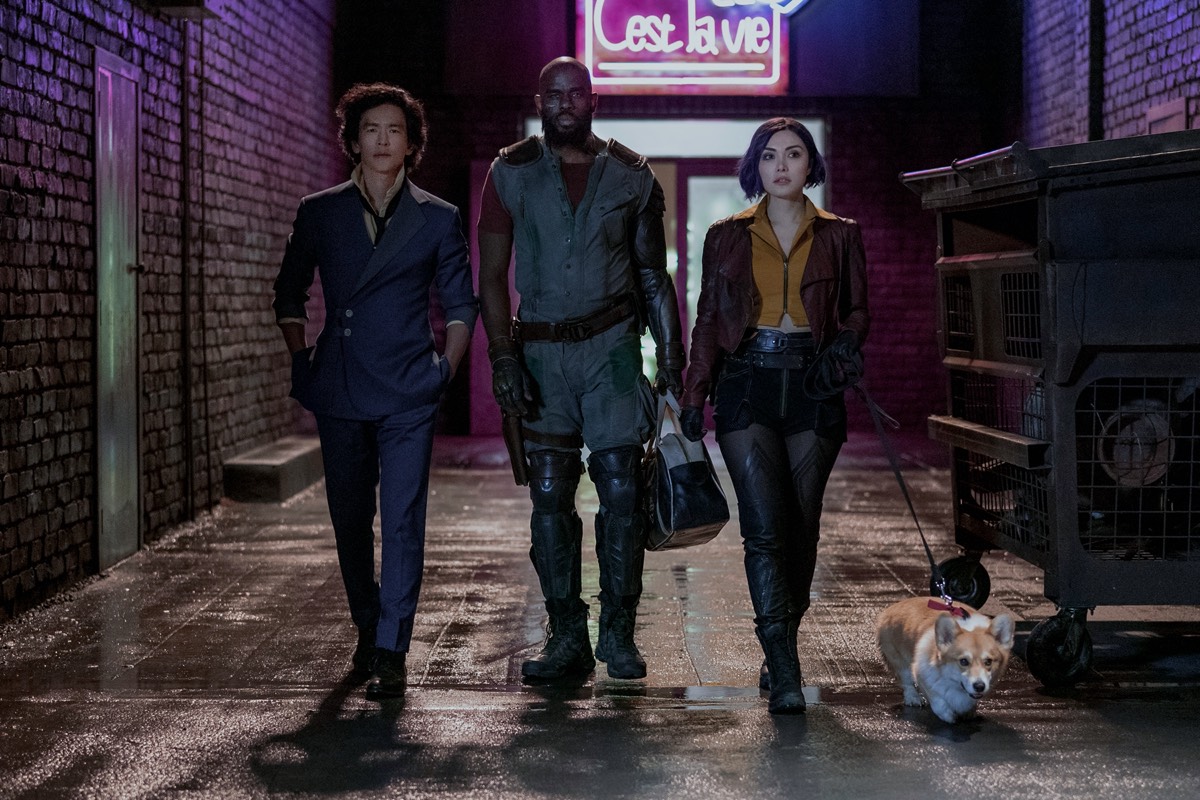
Enlarge/ Spike, Jet, Faye, and Ein take a stroll. Notably absent this season: Edward.
“I knew we were treading on hallowed ground,” he told the Los Angeles Times, realizing he and his writers needed to approach the task with equal parts reverence and a willingness to depart from canon and reinvent when necessary. Two decades have passed, after all, and a streaming series is a very different medium than the original half-hour format. Their mantra: “It’s Cowboy Bebop, let’s not f— this up.” It helped that Watanabe consulted for the new show, with Kanno returning to compose the soundtrack for the series.
The live-action series opens with an action-packed set piece, in which Spike and Jet try to foil a heist at a space casino—with disastrous results. Strapped for cash, they next track down a bounty named Asimov Solensan (Jan Uddin) and his wife, Katarina (Lydia Peckham). The couple has stolen a batch of a sensory-enhancement drug called Red-Eye from the Syndicate and are trying to sell it in New Tijuana. This is straight from the anime’s pilot episode, with just a few tweaks here and there—namely, the presence of Faye as a rival bounty hunter hired by Katarina’s wealthy father to retrieve her.
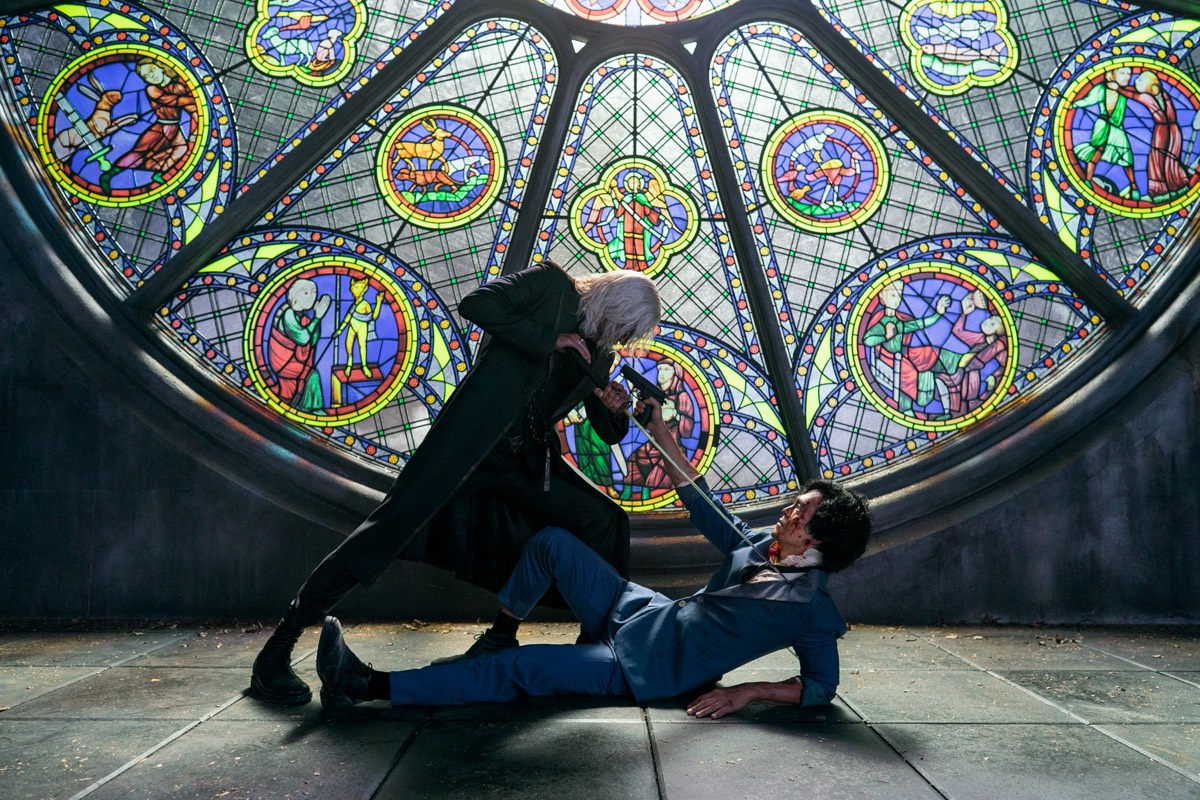
Enlarge/ Vicious and Spike work out their differences.
Ecofascist terrorist Maria Murdock (Adrienne Barbeau, Carnivale), another favorite from the anime, shows up in a later episode—except the gas she releases turns people into trees rather than monkeys. Also getting screen time are the face-shifting thief Abdul Hakim (Cali Nelle), who originally steals Ein before the corgi ends up joining the crew of the Bebop; the madman Pierrot Le Fou (Josh Randall, Ed, Scrubs); and the infamous “Teddy Bomber” (voiced by Rodney Cook). And Punch and Judy (Ira Munn and Lucy Currey, respectively) ham it up as co-hosts of the fictional show Big Shot, which tracks bounties and those who hunt them. It’s kind of a public service.
Nemec and co. successfully established the Chandler-esque neo-noir tone, Kanno’s new score is sheer delight, and the casting is perfection. John Cho (Star Trek, Sleepy Hollow) brings a weary, jaded nihilism to Spike, with just enough of the naive, hopeless romantic intact to keep him likably vulnerable. Alex Hassell (Suburbicon) plays a suitably edgy and violent Vicious; Daniella Pineda (Jurassic World: Fallen Kingdom) plays a feisty Faye Valentine; and Mustafa Shakir (Luke Cage) brings out Jet Black’s basic decency and strong moral code, not just his exterior toughness.
https://arstechnica.com/?p=1814568
Star Trek: Discovery is tearing the streaming world apart
<img src="https://rassegna.lbit-solution.it/wp-content/uploads/2021/11/star-trek-discovery-is-tearing-the-streaming-world-apart.jpg" alt="Pictured: Oyin Oladejo as Lt. Joann Owosekun, Sonequa Martin Green as Burnham, and Emily Coutts as Lt. Keyla Detmer of the Paramount+ original series Star Trek: Discovery.”>
Enlarge/ Pictured: Oyin Oladejo as Lt. Joann Owosekun, Sonequa Martin Green as Burnham, and Emily Coutts as Lt. Keyla Detmer of the Paramount+ original series Star Trek: Discovery.
Michael Gibson | ViacomCBS
Dan Leckie has been a Star Trek fan since he pressed play on a VHS tape of the original TV show during Christmas of 1991. Leckie, from Aberdeen, Scotland, was instantly hooked on the sci-fi series and its subsequent iterations and regularly attends conventions to meet up with fellow fans. But on November 16 he noticed something weird: Netflix had stopped promoting the first three seasons of Star Trek: Discovery—and previews of season four, due to launch on November 18, had also vanished.
What Leckie had spotted would soon become a point of outrage for Star Trek fans the world over: Netflix had lost the rights to the fourth season of Discovery outside of the US, and the previous seasons, too. They would now appear on Paramount+, the streaming service formerly known as CBS All Access and owned by ViacomCBS—but not until 2022, and even then, not everywhere. (In the US, Star Trek: Discovery has always streamed exclusively on Paramount+/CBS All Access.) And Star Trek is just the beginning. What’s bad news for Discovery fans now is yet another glimpse of the increasingly muddled future of streaming.
Up until relatively recently, most intellectual property (IP) owners sold rights for TV and movies through paid TV, physical home video, and cinema. The concept of online streaming was seen as a non-priority. Then everything changed—and quickly. As Netflix’s popularity soared, Disney grabbed back the streaming rights to its vast catalog and launched Disney+ in November 2019, raking in 118 million subscribers to date. Others are following quickly—from Discovery+ to HBO Max and Britbox. And as streaming services scramble to produce more original content, anyone wanting to sit down and watch their favorite TV shows is left with a headache. Rather than subscribing to a single streaming service, with each passing year people are being asked to fork out more and more to access rival platforms.
“A lot of fans, in the UK and around the world, are outraged that they’ll have to pay for yet another subscription service to enable them to see Discovery, and eventually the rest of the Star Trek TV series,” says Leckie. Glenn van t’Hof, a Dutch Star Trek fan, is more blunt. “What a dick move to announce this two days before the supposed European release date,” he says. “This is no service to the fans.” Leckie believes the move—which prevents people outside the United States and Canada from seeing season four of Discovery until 2022—will drive many toward pirated versions of the show. The rights deal with Netflix for Star Trek covered 190 countries and territories—but Paramount+ will only be available in 45 countries by the end of 2022. “That leaves three-quarters of their market unable to watch without piracy,” says Leckie.
Analysts are also skeptical about the benefits to Star Trek fans from the shift to Paramount+. Andrew A. Rosen, a former Viacom digital media executive and founder of Parqor, a streaming service analyst firm, believes it’s highly unlikely Paramount+ can replicate the economics, scale, or sophistication of Netflix’s marketing model around major franchises such as Star Trek. Neither ViacomCBS nor Netflix responded to requests for comment.
The bet Paramount and ViacomCBS are making is that fans of Star Trek love the brand enough to follow it to whichever streaming service ends up offering it—rather than whichever is the most convenient for them. That isn’t beyond the realm of possibility: The average American household accesses eight streaming and video-on-demand services in a given week, according to data gathered by technology research company Omdia—though that includes free catch-up services and websites like YouTube. In the UK, the average is nearer six to seven, and in mainland Europe, five to six. “For the audience there’s no difference,” says Tony Gunnarsson, principal analyst of TV, video, and advertising at Omdia. “They dip in and out of everything that’s available.” But as major media companies like ViacomCBS, which are racing to catch up to Netflix, attempt to claim space in the streaming industry, it’s only going to get messier for consumers. Omdia research indicates there are 292 video streaming services available in the United States, and 182 in the United Kingdom.
https://arstechnica.com/?p=1814473
Review: Ghostbusters: Afterlife sinks under treacly, over-the-top fan service
Enlarge/ They ain’t afraid of no ghosts. A new generation goes a-busting.
Sony Pictures
The original Ghostbusters is one of my all-time favorite movies. Ghostbusters II? Not so much. But I enjoyed the 2016 all-female film (especially the extended cut, which let the cast cut loose a bit more), and I am not one of those overly nostalgic sorts who fetishize the films of my youth. So I was truly rooting for Ghostbusters: Afterlife. The trailers were promising, the casting was spot-on, and I loved the kid-centric premise of a new generation picking up the ghostbusting mantle of Bill Murray and the original gang.
There’s much to like about this sequel from Jason Reitman (son of Ivan Reitman, who directed the first two films): great performances, nimble direction, and some humorous callbacks to the original beloved film. Unfortunately, all of that sinks under the weight of a clunky script and a tired, predictable plot that takes the fan service to downright treacly levels.
(Major spoilers below the gallery. We’ll give you a heads-up when we get there.)
The official synopsis is short and sweet: “A single mother and her two children move to Summerville, Oklahoma, after inheriting property from a previously unknown relative. They discover their family’s legacy to the original Ghostbusters, who have become something of a myth, as many have long since forgotten the events of the ‘Manhattan Crossrip of 1984′”—i.e., the events of the original film.
Carrie Coon (The Leftovers) plays mom Callie, who has some serious abandonment issues where her dad, Egon Spengler, is concerned. Mckenna Grace (The Haunting of Hill House) plays her science-loving daughter Phoebe, who struggles to make friends or even tell a decent joke. Finn Wolfhard (Stranger Things) plays Callie’s mechanically inclined son, Trevor. Paul Rudd (Ant-Man) plays summer school teacher (and mom’s love interest) Gary Grooberson, a seismologist and a science nerd who is also a big, goofy Ghostbusters fanboy.
The main cast also includes Logan Kim as Podcast, who befriends the socially awkward Phoebe and actually appreciates her odd jokes. Celeste O’Connor plays Lucky, a pretty local teen who catches Trevor’s eye. And of course, we get cameos from members of the original cast: Bill Murray (as Peter Venkman), Sigourney Weaver (as Dana Barrett in a mid-credits scene), Dan Aykroyd (as Ray Stantz), Ernie Hudson (as Winston Zeddemore), and Annie Potts (as Janine Melnitz). Harold Ramis, who played Egon Spengler, died in 2014 but briefly appears in archival clips and a bit of CGI magic.
The first act drags in places as we see the Spengler clan struggle to acclimate to their new home. But once Phoebe and Trevor discover the Ectomobile, a ghost trap, a PKE meter, and their grandfather’s laboratory, the stage is set for some entertaining ghostly encounters. These include welcome cameos by some of the classic ghosts, most notably the decaying cabbie and the little green monster, Slimer—in this case, reimagined as a ghost from the same specter class that Reitman has dubbed “Muncher.” The appearance of a bunch of mischievous Stay-Puft mini-marshmallow men wreaking havoc as Gary shopping in the local Walmart is a particular highlight.
(Major spoilers beyond this point. Stop reading now if you haven’t seen the film.)
Ghostbusters: Afterlife moves the setting from New York City to Summerville, Oklahoma.
Callie (Carrie Coon) is relocating with her two kids after inheriting her father’s old mansion.
YouTube/Sony Pictures
Daughter Phoebe (Mckenna Grace) is a shy, awkward, science-loving nerd.
YouTube/Sony Pictures
Son Trevor (Finn Wolfhard) has a knack for fixing mechanical things… like old station wagons.
YouTube/Sony Pictures
Now that’s a welcome sight.
YouTube/Sony Pictures
Celeste O’Connor plays Trevor’s new pal, Lucky.
YouTube/Sony Pictures
A blast from the past.
YouTube/Sony Pictures
Annie Potts reprises her role as Janine Melnitz.
YouTube/Sony Pictures
Science teacher Gary Grooberson (Paul Rudd) shows Podcast (Logan Kim) and Phoebe a relevant old YouTube video.
YouTube/Sony Pictures
The world has forgotten the Ghostbusters, but the Internet is forever.
YouTube/Sony Pictures
Trouble is brewing.
YouTube/Sony Pictures
That looks like some serious paranormal activity.
YouTube/Sony Pictures
Mini Stay-Puft marshmallow men provide some comic relief.
YouTube/Sony Pictures
Rudd gives us his best flabbergasted face.
YouTube/Sony Pictures
The ghosts are back in town.
YouTube/Sony Pictures
A terrifying specter.
YouTube/Sony Pictures
A new generation of Ghostbusters pursues its quarry.
YouTube/Sony Pictures
Is that our old friend, Slimer? Nope, it’s Muncher, but he’s the same class of specter.
But then it all goes horribly wrong. The opening sequence seemed to hint at a new menace threatening humanity. So imagine my disappointment to discover that rather than facing something new, the Spengler kids are battling none other than Gozer the Gozerian, who is trying to make a comeback after being soundly defeated by the original Ghostbusters. It turns out that Ivo Shandor (J.K. Simmons), who designed Dana Barrett’s haunted Manhattan high-rise, also built a temple for Gozer’s resurrection at the bottom of his Summerville mine. Egon had been trying to set a trap and lost his life in that failed attempt.
Even that might have worked if there had been some genuinely innovative twists. Alas, everything plays out in almost exactly the same way. Gary ends up being possessed by Vinz Clortho, aka the Keymaster, while mom Callie ends up channeling Zuul the Gatekeeper, followed by the inevitable coitus. This sets the stage for the re-emergence of Gozer (Olivia Wilde) and her lightning fingers. The kids must figure out how to send the ancient Sumerian god back to whatever hell dimension she came from—with a little last-minute help from the original gang, including a ghostly apparition of Egon Spengler.
Reitman has said his film is ultimately about family, and I think he sincerely wanted to make an entertaining, moving tribute to his father’s original comic masterpiece, particularly given the loss of Harold Ramis. (This film is dedicated to Ramis.) At times, he succeeds. Those scenes where Phoebe figures out that the ghost of her grandfather is trying to communicate with her, particularly where he guides her in repairing an old proton pack, are poignantly satisfying.
However, the same sequence proves much less effective later in the film, when her mother, Callie, makes a similar connection and belatedly realizes how much her father really loved her. And when Egon’s ghost joins his former comrades in the final showdown, the film sinks completely into cheap mawkish sentiment, rather than genuine emotion. There should have been wild cheers in the theater when Murray & Company appeared; instead, the moment landed with a thud. Ultimately, while it has some entertaining moments, Ghostbusters: Afterlife is the palest echo of its brilliant predecessor.
Ghostbusters: Afterlife is currently playing in theaters. We strongly recommend only going to see movies in theaters if you are fully vaccinated and wear a mask throughout the screening.
[embedded content]
Passing the Proton Pack from one generation to the next: Meet the filmmakers behind Ghostbusters: Afterlife.
https://arstechnica.com/?p=1813894
Rockstar admits GTA remasters “did not… meet our own standards of quality”
Today, though, the developer admitted in a blog post that “the updated versions of these classic games did not launch in a state that meets our own standards of quality, or the standards our fans have come to expect.”
Rockstar now promises that “a new Title Update is on the way… that will address a number of issues,” so we can only hope that helps solve some of these problems. In the meantime, Rockstar is backtracking on the controversial decision to delist the original versions of the GTA Trilogy games from digital download services ahead of the remaster’s release. The developer now says it “understand[s] that some of you would still like to have the previous classic versions available for purchase” and will thus bring them back to the Rockstar store “shortly” as a bundle. Those classic versions will also be made available as a free download to anyone who purchases the Remastered version by June 30, 2022.
https://arstechnica.com/?p=1814488
Andrew and Lee dissect The Wheel of Time’s television premiere
Enlarge/ Our lead characters, from L-R: Nynaeve, Mat, Lan, Moiraine, Egwene, Perrin, and Rand.
Amazon Studios
Andrew Cunningham and Lee Hutchinson have spent decades of their lives with Robert Jordan and Brandon Sanderson’s Wheel of Time books, and they’re bringing that knowledge to bear as they recap each episode of Amazon’s new WoT TV series. These recaps won’t cover every element of every episode, but they will contain major spoilers for the show and the book series. If you want to stay unspoiled and haven’t read the books, these recaps aren’t for you.
New episodes of The Wheel of Time will be posted to Amazon Prime subscribers every Friday.
Andrew: I thought it would be best to start this first one off by establishing our Book Reading Cred.
A friend gifted me a paperback copy of The Eye of the World in what must have been mid-2003, which I have pinpointed so precisely because I know that Crossroads of Twilight had come out but that it hadn’t yet come out in paperback. So I burned through them all once or twice in high school, and then re-read the whole series again sometime in the mid-Sanderson era, and then did my last full-series re-read in 2019 after I talked about EotW on my book podcast.
Lee: Way back in 1997, when dinosaurs roamed the earth, a coworker at the friendly neighborhood Babbage’s suggested I try this fantasy series she’d been hooked on called “The Wheel of Time.” She loaned me her copy of Eye of the World, and then yeah, same thing—it was like falling into a mad vortex of dizzying addiction. The latest book at the time was the just-released Crown of Swords, book seven, and I blazed through the series in just a few months. There have been several re-reads since then, every time a new book landed (even the mess that was Crossroads of Twilight), but at this point it’s been probably a couple of years since I picked one up. However, I’ve got my wife to fill in the gaps for me—I infected her with WoT as I was infected, as is tradition, and she is if anything even more excited about the show than I am.
Andrew: My wife, sadly, had too many antibodies to catch Wheel of Time fever. Maybe from reading so much Tolkien? And like, I get it. It can be a hard series to sell to a skeptic. The conversation always goes something like “well, it’s fourteen gigantic books, and the first one especially is mostly a Lord of the Rings pastiche, and it spends a lot of time in this “men be like this/women be like this” space that hasn’t aged especially well…”
Lee: Half-hating the characters in WoT is a huge core part of the fandom! Maybe we can get her into it after the show!
<a href="https://cdn.arstechnica.net/wp-content/uploads/2021/11/wot-emonds-field.jpg" class="enlarge" data-height="1199" data-width="1920" alt="The world of Wheel of Time is lovingly (and expensively) recreated. “><img alt="The world of Wheel of Time is lovingly (and expensively) recreated. ” src=”https://rassegna.lbit-solution.it/wp-content/uploads/2021/11/andrew-and-lee-dissect-the-wheel-of-times-television-premiere-1.jpg” width=”980″ height=”612″>
Enlarge/ The world of Wheel of Time is lovingly (and expensively) recreated.
Amazon Studios
Andrew: I mean, I saw A Knight’s Tale in her “watch it again” Netflix queue, so I know she’s watched sillier stuff.
All of that being said! When these books are good they are still really engaging. Song of Ice and Fire/Game of Thrones comparisons are going to be inevitable throughout this project, so I will just break that seal now—those books and that series sort of revel in their blood-soaked nihilism, but Robert Jordan and Brandon Sanderson loved all their characters and very, very rarely deployed “surprise major character death” or “gratuitous sexual assault” as a driver of narrative.
Lee: That’s a good way to put it. I’ve always thought of WoT vs. GoT as kind of like a Star Trek vs. Star Wars pairing—WoT is the Excelsior, all smug and superior and ready to smack you with that transwarp drive. GoT is the Millennium Falcon—dirty, loud, with some swearing, but it’s got it where it counts. Where WoT is all graceful lines, flowing slow-motion dresses, stark and shining Whitecloaks, and a camera that can never hold still, GoT is dirt, mud, filth, and then you sh— yourself when you die. (Aes Sedai, on the other hand, clearly do not poop at all.) The differences aren’t just thematic, though there’s lots of that—the two shows visually are very, very different experiences.
Andrew: OK, let’s jump into these first three episodes, which all, collectively, have kind of a “sweaty TV pilot” feel to me. There’s a lot to say about what they are and are not doing well individually, but as a group they are all doing a ton of heavy lifting—they have to establish a whole bunch of pro- and antagonists and start building their personalities and story arcs. They visit a few locations and talk about a bunch more of them. We either meet or hear about, by my count, three completely distinct subcultures (the Whitecloaks, the Tinkers, and the Aiel). It’s all a bit dizzying, and some of the introductions work better than others.
Enlarge/ Abdul Salis’ turn as the slimy Whitecloak Questioner Eamon Valda is a highlight of the early episodes.
Amazon Studios
Lee: It’s a hard ask for a TV writer to get us into this story—you don’t have the luxury a book author has where you can just go ahead and take a thousand pages to do whatever. And Eye of the World is one of the biggest meals to get through in the whole saga. Folks who are coming into this show expecting to see their favorite scenes echoed back at them onscreen are going to have to realign their expectations, because as you say, we’ve got so much we have to get into. What we see of the Whitecloaks is excellent, and Eamon Valda (Abdul Salis) is gratifyingly unctuous. We speed through the Tinker encounter without the aid of a major supporting character—I suppose we’ll get to that in detail, but something to be aware of is that a lot of swizzling has been done to shape the narrative for TV. If you’re still angry that Tom Bombadil didn’t show up on screen to sing you songs or that you never got to see the Scouring of the Shire, you might take issue with WoT’s streamlining for TV.
(Speaking of characters whose names sound like “Tom,” Thom Merrilin has an absolutely electrifying introduction—though, sadly, the character lacks giant, white twirly mustaches. We’ll probably have more to say about Thom in a future piece.)
You’re an excellent book reviewer—folks, check out Andrew’s podcast!—and I’d love to hear your take. What is the right way for a monstrous book-to-TV adaptation to slim down? How do you balance the need to tell that story with the need to be a coherent, functional, standalone adaptation?
Andrew: Seconded on the Whitecloak introduction. It would be very, very easy to make them dour and joyless pricks, since as a group they are typically the most interested in imposing their rigid idea of what “goodness” is onto characters who we already know to be fundamentally “good.” Making the most prominent Whitecloak—and our introduction to the organization writ large—a slimy, horny sadist who murders Aes Sedai with a smile is one of the strongest moments we get here.
And that’s sort of what you need to do, right? TV shows especially rely on this kind of shorthand, the ability to tell us what we need to know about a person or a group of people with a combination of visual cues and one or two characters. Obviously, some of a book’s depth and complexity can be introduced later, once audiences have gotten a bit more comfortable. But in the early going in a show like this it’s all about combining performances and visuals to create memorable first impressions. The Whitecloak sequences are great at this. The scenes where Moiraine or Lan stand and monologue at the rest of the characters for multiple minutes, less so.
Enlarge/ Lan (Daniel Henney) and Moiraine (Rosamund Pike) don’t exactly match the characters’ descriptions in the books, but the performances are spot-on.
Amazon Studios
Lee: Moiraine is kind of the primary driver of plot for this batch of episodes, too, and Rosamund Pike has to carry a lot on her blue-draped shoulders. She gets to kick off the story—without any Age of Legends prologue to speak of—and she sets the world’s stage for us. I swear I don’t want to make this an extended book-versus-movie thing, but it is worth commenting that even in the first few minutes, the show updates the books’ canon a bit—in the world of the Wheel of Time, souls are reborn again and again after they die, spun out by the Wheel in new bodies. And in the show, a man can be reborn as a woman, or a woman as a man—something that was not in the books (Aran’gar and Osan’gar notwithstanding—though folks who have never read the books don’t need to worry about the reference).
Moiraine is hunting, as we’re told, for the Dragon Reborn—the reincarnation of the man who, thousands of years ago, “broke the world” and ushered in an age of chaos and darkness. Though the first Dragon was a man, the current Dragon Reborn could be anyone of a certain age. There are long-term plot implications here, and a bunch of the first season is concerned with leading the audience on about precisely who this Dragon is. All Moiraine knows is that it’s almost certainly one of our five main characters—the rougue-ish Mat, red-haired Rand, brooding Perrin, pensive Egwene, or Nynaeve, the village Wisdom (think half doctor, half person who punches you in the face for disturbing the peace).
Andrew: If there’s one “well actually” moment I will entertain as a book reader, it’s the revelation that Egwene or Nynaeve could be the Dragon Reborn. On the one hand, I really appreciate a lot of what the show is doing to add nuance to the books’ dated and rigid gender roles. Two Rivers women in the books are intelligent and resilient, but they’re also a bunch of arm-crossing, braid-tugging, foot-tapping scolds. Two Rivers women in the show, from the glimpse we see, maintain that same sense of community but also get to drink and party and have sex. Rand and Egwene are doing sex to each other. And explicitly putting Egwene and Nynaeve on even narrative footing with Rand, Mat, and Perrin serves to emphasize how central they will be to the rest of the story moving forward.
On the other hand, the split between the male and female halves of the One Power is foundational to pretty much everything in the entire series (gender is strictly binary in Randland, though the show seems open to experimenting with this, and I hope that it does). The Dragon Reborn is in danger, and Moiraine needs to find him, specifically because he is a man who will channel the corrupted male half of the One Power, dooming him to eventual madness. The last time the Dragon Reborn went mad, he snapped the world in half like a fresh Oreo. Even among people who believe he will save the world, there’s a belief that he must be tightly controlled. This is, again, pretty foundational stuff. And I’m still not sure how the decision to mess with that is going to play out long-term.
Enlarge/ Nynaeve al’Meara (Zoë Robins) is a character the show gets a handle on pretty quickly.
Amazon Studios
Lee: I agree—and there are some things in later episodes that really make me wonder how the One Power works in this adaptation. Though, if we’re calling out changes, the one that stuck out to me was the fact that instead of making all three of The Boys (Mat, Perrin, and Rand) inept with The Ladies, Perrin (Marcus Rutherford) starts out married! He’s got a wife! And she’s not a wasting wallflower or nagging angry person—she’s an all-business blacksmith lady, who seems like she knows how to work the forge even better than Perrin does.
Andrew: A wife whom the show tragically almost instantaneously murders so that Perrin can suffer from a Deep and Abiding Sadness. It’s one of the show’s cheapest shots, and it was my least favorite thing in all three of these episodes by kind of a lot!
Discussing this without trying to race through it to look at the narrative consequences is difficult—almost as difficult as adapting this series in the first place. And without spoiling things for non-book readers, Perrin’s choice about whether to “take up the axe” or “take up the hammer” makes up the majority of his character arc, and this is a difficult thing to see the consequences of. At first, I thought I was going to hate it—but the more I think about it, the more interesting it becomes. It’s fascinating to see these characters I’ve lived with in my head for 20+ years suddenly doing something new. I think I like it.
Enlarge/ Rand, Perrin, and Mat (Josha Stradowski, Marcus Rutherford, and Barney Harris) enjoying a rare moment of peace.
Amazon Studios
Andrew: That feeling of, “Ooh, I am excited to see how they change this!” is the healthiest attitude for a book reader to have going in, I think. The first season of Game of Thrones was a very straightforward, true-to-the-book adaptation of A Game of Thrones. The sheer length of WoT and how the scope and focus of the books change as they move forward meant that was always going to be a lot harder to do for Eye of the World. Honestly, for me, the fact that this show is happening at all is so wildly improbable that I am planning to just enjoy the ride. But that’s a kind of trust that the creative teams behind these adaptations can easily lose, as David Benioff and D.B. Weiss did by the time Game of Thrones had slogged through to its last seasons.
Zooming in a bit: what characters are working for you in these first three episodes? Who seems to have a handle on the character and who doesn’t? I have thoughts, but I want to hear yours first.
Lee: Let me start real quick with our Main Five—Rand, Mat, Perrin, Nynaeve, and Egwene. They’re all perfectly adequate, though Nynaeve (Zoë Robins) and Mat (Barney Harris) are probably given the most to do. Everyone except Rand (Josha Stradowski) has some nice character-building moments (though, I expect the community to be divided as hell by Perrin’s wife, and seeing Mat’s cheerful horse-trading dad turned into an alcoholic domestic abuser stings a bit). The “which one is the Dragon!?” misdirection is strong—so strong that a major interaction between Rand and his father Tam is cut entirely out of the first episode. (I’m sure the whole “you’re not really my son” bit will show up later, but its absence is jarring.)
Andrew: There are definitely crumbs here vis-a-vis Rand’s origins (“no one has red hair in the Two Rivers” is expressed at least once that I saw), but, yeah, one benefit of not being in Rand’s head for 95 percent of the story is that he can blend in with the rest of them a little more.
Lee: On the Aes Sedai side, the ones we meet in the first few episodes are excellent—Moiraine is Moiraine, and I’d have to dig to find a real complaint about the way the character is portrayed. (The only critical thing I can think of is that Pike is maybe a little tall for the role, and that’s minor criticism indeed.) Lan (Daniel Henney) doesn’t really match my mental picture of “Brooding Conan-looking Man Mountain,” but he’s got a nimbleness and a careful, deliberate grace that I’m really enjoying. And he’s definitely got a face of planes and angles.
How about you?
Andrew: Yeah, he did not match up with Lan physically in my head, but the distance he maintains from all the non-Moiraine characters and the way he and Pike interact sold me on the performance. I think another early standout is Nynaeve, whose arc is tweaked for the show (she’s carried off by and escapes from Trollocs during the initial attack on Emond’s Field and catches up with the rest of the party from there, rather than following of her own volition), but in ways that are consistent with her character in the books. She’s a bit older and more capable than the other Two Rivers-ians (??), she’s driven by anger but also by her compassion. She’s doing a good job.
Lee: She is definitely less of a sullen rage-filled harridan in the show—I don’t think she’s thumped anyone with a stick even once. So far.
Andrew: There’s time!
The characters who have changed more are the ones who struggle more. Madeleine Madden, who plays Egwene, isn’t doing anything wrong, but she hasn’t left much of an impression yet. And Harris is just coming across as flat and unlikable as Mat. Some of that might be the show’s fault! Because, as you mentioned, show-Mat is substantially more unsavory and less Han Solo-ian than book-Mat. But I do wonder if the onscreen struggles contributed at all to his recasting for season two.
Enlarge/ Mat and Padan Fain (Johann Myers), who appears in the first episode but hasn’t (yet) reappeared.
Amazon Studios
Lee: Yeah—too early to tell, but that would definitely follow from what we’ve seen so far. There’s certainly lots for him to do, since we get to Shadar Logoth relatively quickly, and it’s the second big setpiece after Emond’s Field, and from the dagger springs a big chunk of Mat’s character arc for the first few books.
Andrew: To my memory we don’t actually get a PoV chapter from Mat until book three, so it’s also possible that if you were just reading EotW to research the role, there would not be a whole lot to go on there.
https://arstechnica.com/?p=1814073
Halo Infinite preview: The more things change…
A map to make a Far Cry fan proud.
Need a vehicle? This station’s got you covered.
Upgrade ahoy!
The Halo series has seen plenty of changes over the years, but the core gameplay loop of the single-player campaigns has remained largely the same. You march (or drive or fly) through corridors, chambers, and open-air compounds, gunning down waves of bad guys to get to the next goal and the next cutscene. Then you go somewhere else and march from point A to point B again, maybe with a few small detours for hidden secrets along the way.
Halo Infinite starts out the same way, with two broad tutorial missions set in broken, collapsing space stations that good ol’ Master Chief does his best to help break, at points. After that quick introduction, though, you take an elevator up to the lush outdoor environments of Zeta Halo, where you’re greeted with a much more open-ended gameplay experience than you might expect from the franchise.
I’ve only just scratched the surface of that open-world design while playing with a limited preview build of the game this week, ahead of its launch December 8. Thus far, though, the more things change, the more they stay the same. Halo Infinite is still very much a Halo game, even if the path you take from point A to point B winds a little more than usual.
Open the gates
Looking strictly at the map screen, it would be easy to confuse Halo Infinite with Assassin’s Creed or other open-world Ubisoft games. Like those games, Infinite operates on a kind of hub-and-spoke design, where you “activate” a central tower (in this case, a Forward Operating Base) to reveal and unlock more missions and information about its immediate surroundings. These Forward Operating Bases also serve as fast-travel hubs (avoiding a lot of tedious backtracking) and a central place to access unlocked weapons or vehicles at will. That last bit is especially nice once you unlock your favorite weapon and can start any future encounter with a fully loaded version in hand.
Those instant-access items are gated behind “Valor,” a points system that rewards you for completing random tasks throughout the open-world map. These can be as simple as blowing up an unguarded communications tower sitting alongside a path or as complicated as invading a heavily guarded outpost, raising and destroying its lowered power cells and sabotaging two vehicle destruction bays as you fight off waves of reinforcements. You can also earn Valor by answering distress calls from your fellow UNSC soldiers, who’ll helpfully join you as temporary AI companions after their rescue.
Yes, all of these missions essentially boil down to minor variations on “run in and shoot everything that moves.” And a few feel like compartmentalized versions of the “get from point A to point B” corridors you’re used to. Still, it’s nice just having the ability to pick and choose those missions on your own schedule. Or perhaps you’ll simply wander the spaces between missions and stumble on a random band of banished soldiers, finding a rare weapon variation for your trouble. The new structure helps you feel more in control of the pacing and flow than ever before, rather than on a simple conveyor belt of destruction.
But this isn’t like Breath of the Wild, where you can literally run to the final boss right from the start if you’re bold and foolhardy enough. Major missions and sections of the map will still be gated off behind key story moments and boss fights that feature alongside newly unlocked equipment. Those bosses provide an interesting change of pace, too, featuring visible health bars, strong shields, and aggressive attack patterns. Learning those patterns, and how to use the environment and your equipment to avoid them, could take a few attempts even for seasoned Halo players used to blasting through enemy hordes mainly via muscle memory.
More grappleshot, please
Speaking of equipment, the other major change apparent early in Halo Infinite is the grappleshot. With a tap of the right bumper you send out a grappling hook that can drag you to higher ledges or simply zip you to a point on the ground farther along your path (quick tip: give a jump at the end of this pull to extend your temporary speed boost). The added mobility enabled by this one change is so satisfying that you may start to wonder how you did without it in other Halo games.
After a bit of practice, the grappleshot becomes like a superpower in firefights, letting you quickly dodge to cover or flank behind enemies to expose their weak sides. The real fun, though, comes when you grapple directly onto an enemy, pulling yourself toward them and unleashing a hefty melee attack when you arrive. After an upgrade (enabled by one of the not-very-hidden Spartan Cores that dot the mission areas), the grappleshot can temporarily stun enemies as you zip toward them, transforming it into a useful secondary weapon in its own right.
[embedded content]
In the preview build I was also able to try out a Threat Sensor, another new piece of equipment that puts a temporary, easy-to-spot red outline around enemies within a certain radius, even when they duck behind walls or other cover. That provides some marginal use in basic fights with grunts, but the game practically forces you to use it to reveal the many enemies that can disappear seemingly at will. In these cases, it was more than a little annoying needing to use multiple presses on the d-pad to switch between the Threat Sensor and Grappleshot to maximize the use of both in a heavy firefight.
While I did see the same basic enemy types over and over again in my few hours with the preview (this is a Halo game after all), I was encouraged by how the game was already mixing in stronger and more aggressive enemies with the basic grunts, even early on. Those enemies also react pretty authentically to you based on your aggressiveness and their relative power level; strong ones will charge or launch salvos from behind cover, where weak ones will run hilariously in a blind panic as you get close.
Those kinds of touches are what make Halo Infinite feel instantly familiar, even with the trappings of its new design. The jumping is still as endearingly floaty as ever. Butting an enemy in the face with a melee attack feels as wonderfully crunchy as it always has. The weapon selection (and the need to switch weapons frequently as ammo runs out) won’t be a surprise if you’ve played previous Halo titles.
Despite the new design touches, Halo Infinite is already proving to be a nice, well-paced update that doesn’t throw out the series’ most beloved bits.
https://arstechnica.com/?p=1814287
EA and FIFA’s 30-year videogame union at risk in battle over name
<img src="https://rassegna.lbit-solution.it/wp-content/uploads/2021/11/ea-and-fifas-30-year-videogame-union-at-risk-in-battle-over-name.jpg" alt="Zlatan Ibrahimovic of AC Milan reacts in front of an EA Sports FIFA 21 video game billboard advertising during the Series A football match between AC Milan and Torino FC in 2021. “>
Enlarge/ Zlatan Ibrahimovic of AC Milan reacts in front of an EA Sports FIFA 21 video game billboard advertising during the Series A football match between AC Milan and Torino FC in 2021.
Nicolò Campo | LightRocket | Getty Images
For millions of football fans, “FIFA” refers not to the sport’s international governing body, but to their favorite video game.
The connection was formed 30 years ago, when California-based Electronic Arts licensed the name of Zurich-headquartered FIFA. The game is now played by 100 million people worldwide, has become a multibillion-dollar business, and is a cultural phenomenon.
Despite the long and profitable association, the two sides are in a bitter dispute over the value of the FIFA name. “We are not certain that we will move forward with FIFA as a naming rights partner,” David Jackson, a senior executive who runs EA’s football brand, told the Financial Times.
Jackson said “the name FIFA lives in the minds of many young players around the world,” but that it had “lots and lots of players… we don’t see a reason why that would change in the future.”
In preparation, the company has trademarked the name “EA Sports F.C.” across Europe and plans to make a final decision on what to call its football franchise by the end of the year.
The battle highlights growing tension as some within the sport seek a greater share from the game’s enormous success.
Mino Raiola, the super-agent who represents footballers including Zlatan Ibrahimovic and Paul Pogba, has said hundreds of players want to sue EA over the use of their identities within FIFA. In recent years, Juventus has pulled out of the game, alongside other Italian clubs such as Roma and Lazio. EA said it had contractual rights to include the likeness of all players currently in its game.
Enlarge/ Romelu Lukaku of FC Internazionale clashes with Zlatan Ibrahimovic of AC Milan during the Coppa Italia match between FC Internazionale and AC Milan at Stadio Giuseppe Meazza on January 26, 2021, in Milan, Italy.
Marco Luzzani | Getty
Gareth Sutcliffe, from media analyst company Enders Analysis, said “the economics of the game are fantastic.” But he added there were only so many battles that EA could pick with football bodies.
“You don’t want to be in a position where all of a sudden you’re beginning to unpick [naming] arrangements,” he said.
Console owners pay up to $70 to buy each new iteration of FIFA released every year, though there are also free-to-play mobile versions. At the end of September, it had 36 million unique “entitlements,” meaning people who have signed into FIFA 21, the version of the game released in October last year. This compares with 35.3 million at the end of September for FIFA 20.
EA said 27 percent of FIFA 21 players have made “in-game” purchases, such as through “Ultimate Team,” where gamers spend money to improve their squads to compete against others online. Analysts suggest Ultimate Team is worth about $1.5 billion a year for EA.
FIFA has tried to leverage this to demand a significant increase from the roughly $150 million it receives from EA each year, according to people familiar with the negotiations, after the video game company’s 10-year contract to use the name expires at the end of the men’s World Cup in Qatar in 2022.
https://arstechnica.com/?p=1814301
Why modern consoles can’t just “run any… older executable” [Updated]
Aurich Lawson | Getty Images
Historically, when major game companies have talked about emulation, they’ve pigeonholed the technology primarily as a way for players to steal their IP through piracy. Now, though, Xbox chief Phil Spencer is urging the industry to embrace legal emulation as a way to preserve the legacy and wider availability of older games.
“My hope (and I think I have to present it that way as of now) is as an industry we’d work on legal emulation that allowed modern hardware to run any (within reason) older executable allowing someone to play any game,” Spencer told Axios in a recent interview. “I think in the end, if we said, ‘Hey, anybody should be able to buy any game, or own any game and continue to play,’ that seems like a great North Star for us as an industry.”
That’s an admirable goal and an important statement of intent from a major console executive going forward. But in the real world, legal emulation of older games runs into some practical licensing problems that make it hard to achieve Spencer’s “run any… older executable” ideal.
The state of legal emulation
Despite the implication of Spencer’s statement, Sony and Nintendo haven’t exactly ignored official legal emulation options on their hardware. Nintendo was using emulators to recreate classic games even before the creation of the Wii Virtual Console, which took the concept of legal emulation mainstream in 2006. And Sony has made use of emulators in everything from HD remasters to PS1 downloads on the PSP to its PlayStation Classic hardware (which licensed the work of the open source emulator community).
Enlarge/ Only a small subset of N64 games is available on the Switch through an online subscription.
That’s a different tack from Microsoft, which uses an emulation layer to allow many older Xbox and Xbox 360 discs to work on newer hardware. Microsoft even sells digital copies of some decades-old games individually and/or makes them available through its Game Pass subscription, including some with enhancements like HDR and frame-rate boosts on Xbox One and Series S/X hardware.
Licensing and legal constraints
Spencer’s statement encouraging “legal emulation” options comes during the same week that Microsoft announced that 70 additional original Xbox and Xbox 360 games are now playable on later Xbox hardware. But alongside that announcement, Microsoft also said that “we have reached the limit of our ability to bring new games to the catalog from the past due to licensing, legal and technical constraints [emphasis added].”
That means Xbox users will only officially be able to play just over 600 of the more than 2,000 Xbox 360 games on current hardware and just 63 of the nearly 1,000 original Xbox games. While those proportions include some of the best-selling and best-remembered games on those classic consoles, the list still pales in comparison to the wide range of playable games compatible with unofficial emulators.
That’s because the limiting factor isn’t technology, in most cases, but rights issues. “Some of the challenges are technical, but more often than not it comes down to licensing,” Xbox Director of Program Management Jason Ronald told Inverse last year regarding why more old Xbox games aren’t compatible with new Xbox hardware. “In some cases, the developer or publisher doesn’t exist anymore. Even tracking down who we need approvals from can be very, very difficult.”
Enlarge/ Modern Xbox hardware can play a lot of legacy Xbox titles but not all of them…
Why does Microsoft need individual licenses to emulate games for consoles it created in the first place? The answer seemingly has to do with the way the original licenses were written.
“Generally speaking when you have a development or publishing contract, it’s going to say what publishing rights you are licensing out/in,” Michigan attorney and Virtual Legality host Richard Hoeg told Ars. Those contracts usually explicitly state which specific platforms the game can be published on, meaning “running on ‘virtual 360’ software on an Xbox One, for instance, isn’t necessarily going to be permitted,” Hoeg said.
For any game with such a contract, Microsoft would have to negotiate a fresh license from the publisher to emulate it on a new platform. This is also why Nintendo couldn’t just cite its original publishing contracts to throw every NES game onto the Wii Virtual Console, for instance; subsequent platforms weren’t covered in the original deal. Even disc-based Xbox 360 games would need a new license to cover the new emulated versions running on the Xbox One (which involve downloading a new version of the game in an emulation wrapper).
And as Ronald mentioned above, finding the right companies to negotiate that new license with isn’t always easy, especially if licensed music or middleware come into play. “Say [a video] decoder was baked into the OS rather than the game itself,” attorney and Law of the Game blogger Mark Methenitis told Ars. “Depending on the original license, they may need to re-license it for the emulator, and if they could no longer do that, then it might mean they can’t emulate the games that used [the decoder]. They simply would not work.”
https://arstechnica.com/?p=1814080
A physicist studied Ben Franklin’s clever tricks to foil currency counterfeiters
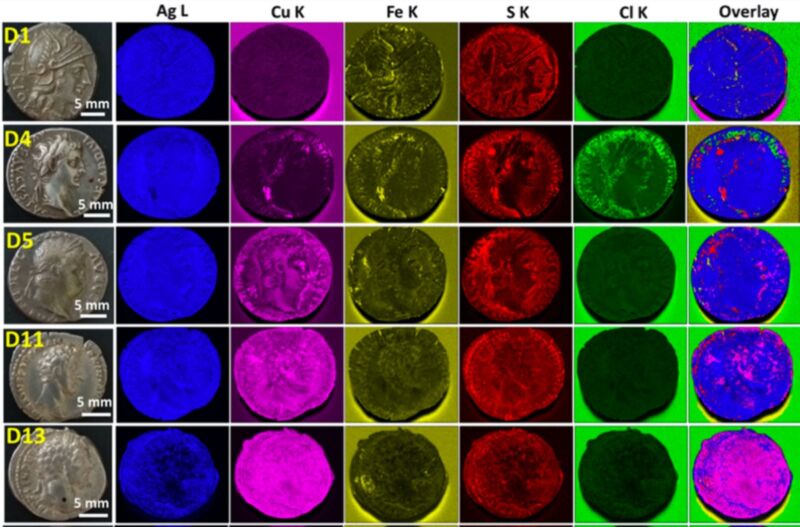
Enlarge/ Nuclear physicists used micro-XRF scanning to produce elemental maps for Roman denarii coins and their color overlays.
K.V. Manukyan et al., 2019
Most people associate nuclear physics with the atomic bomb or nuclear power plants, and those associations are often negative. Michael Wiescher, a nuclear physicist at the University of Notre Dame, wants to change that perception by applying his expertise—and some of his sophisticated imaging hardware—to research that bridges science, history, and culture. His work in this area has included collaborations to analyze a rare medieval manuscript and unearth currency fraud and forgery throughout history, most notably in ancient Rome and Colonial America. He recently described those efforts at a virtual meeting of the American Physical Society’s Division of Nuclear Physics.
Much of this work was conducted in conjunction with undergraduate students in physics, chemistry, art restoration, history, and anthropology as part of a course Wiescher teaches at Notre Dame on physics-based methods and techniques in art and archaeology. In the process, students can get certified as operators of a broad range of advanced physics-based instruments and techniques. These include Raman spectrometers, transmission electron microscopes (TEM), a 3MV tandem accelerator, handheld X-ray fluorescence (XRF) scanners, micro-XRF scanners, and X-ray diffractometers, among others.
Enlarge/ XRF elemental distribution in macro- (A), millimeter- (B) and micrometer- (C) scale mappings of leaves of a 15th-century Breton illuminated manuscript.
K.V. Manukyan et al., 2016
One of Wiescher’s projects was a 2016 analysis of a rare 15th-century illuminated Breton manuscript. Wiescher and his collaborators combined micro-XRF elemental mapping with Raman spectroscopy to gain deeper insight into how the manuscript’s illustrations were prepared and the particular pigments that were used. The first technique reveals the elements present as well as individual pigment particles and how they are distributed across regions of interest. The latter is ideal for analyzing select areas to reveal the molecular compositions of the pigments. Based on their findings, Wiescher and his co-authors concluded that the Breton manuscript was likely the work of a single artisan or perhaps a small number of artisans working from a single palette.
Wiescher turned his attention to Roman denarii in 2019. The Roman silver denarius was the backbone currency of the Roman Empire between 200 BCE and 300 CE, according to Wiescher. During Nero’s reign, the coins were required to be 92.5 percent silver, in order to protect the currency against inflation and devaluation. Despite the emperor’s reputation for tyranny and debauchery, “Nero was a one of the most fiscally responsible of his progenitors and successors, sticking to the laws in the way of having the coins minted,” said Wiescher.
But the analysis of coins from 250 BCE to 350 BCE showed declining percentages of silver. According to Wiescher, the Roman mints gradually debased the denarius, deliberately, to increase their profits and make it easier to finance ongoing wars in the empire. The mints relied on certain metallurgical techniques to hide the lower percentages of silver to keep inflation at bay. By 295 CE, the silver content was just about 5 percent.
Enlarge/ Photos of Roman coins from the republican to the imperial periods characterized. D – Denarii, A – Antoninianus. Dates are approximate.
K.V. Manukyan et al., 2019
Wiescher and his students combined XRF scaling with PIXE mapping of the coins to test the currency’s quality and learn more about the production techniques. They also used electron spectroscopy to measure the silver content of each coin and how the impurities were distributed. Their analysis revealed that most of the coins are composed of silver and copper and that sulfur and iron impurities led to corrosion in some of them.
Merchants would typically test any coins proffered as payment by biting on them, since they should be able taste the silver. This would reveal any attempt to cut corners. “So the Romans invented a number of interesting technologies in metallurgy to hide [that debasement],” said Wiescher. For instance, throwing a mixed silver/copper coin into liquid mercury will cause the silver to dissolve and flow around the coin. “Then you remove the coin from the mercury bath and heat it up to drive the mercury out,” said Wiescher. This gives you a silver coin with a copper core, capable of passing the bite test.
The same trick of replacing some of the silver in coins with copper showed up again thousands of years later in Spain’s Latin American colonies. Wiescher analyzed 91 silver rials dated between the 16th and 18th centuries, from Mexico and Potosi, Bolivia. Between 1645-1648, the silver content dropped from 92.5 percent sterling to just 70-80 percent; the rest was a copper admixture. When this was discovered in the 17th century, the silver market in Spain crashed and the coins were devalued, with devastating effects on the colonial Spanish economy, per Wiescher.
Some of that silver from Spain and Mexico eventually made its way to the early American colonies. The colonies initially adopted the bartering system of the Native Americans, trading furs and strings of decorative shells known as wampum, as well as crops and imported manufactured items like nails. But the Boston Mint used Spanish silver between 1653 and 1686 for minting coins, once again adding a little copper or iron to increase their profits.
Enlarge/ A 20-shilling bill, date August 10, 1739, printed by Benjamin Franklin.
Michael Wiescher
The first paper money appeared in 1690, when the Massachusetts Bay Colony printed paper currency to pay soldiers to fight campaigns against the French in Canada. The other colonies soon followed suit, although there was no uniform system of value for any of the currency. To combat the inevitable counterfeiters, government printers sometimes made indentations in the cut of the bill, which would be matched to government records to redeem the bills for coins. But this method wasn’t ideal, since paper currency was prone to damage.
In light of that early history, it’s appropriate that Benjamin Franklin is featured on the US 50-cent piece and 100-dollar bill, given his efforts to promote printed currency and combat forgeries in Colonial America. By the time he was 23, Franklin was a successful newspaper editor and printer in Philadelphia, publishing The Pennsylvania Gazette and eventually becoming rich as the pseudonymous author of Poor Richard’s Almanack. He was a strong advocate of paper currency from the start.
https://arstechnica.com/?p=1804790
Visitors from other universes converge in new trailer for Spider-Man: No Way Home
[embedded content]
Spider-Man: No Way Home hits theaters on December 17, 2021.
Sony Pictures teased a new trailer for Spider-Man: No Way Home yesterday, then dropped said trailer this evening at a global fan event in Los Angeles, featuring a surprise appearance by star Tom Holland. In the trailer, a magic spell gone wrong unleashes a multiverse of villainy on Peter Parker’s world. But fans hoping for confirmation of rumored cameos from Spider-Man actors of the past were once again disappointed.
(Spoilers for 2019’s Spider-Man: Far From Home below.)
In 2019’s Spider-Man: Far From Home, Peter Parker (Holland) was grieving the loss of his mentor, Tony Stark (Robert Downey Jr.), who perished in the final battle against Thanos in Avengers: Endgame. What better than a summer field trip to Europe to help him process his grief? Then Nick Fury (Samuel L. Jackson) showed up and enlisted Spider-Man’s help in battling a series of Elementals. Peter thought he’d found a new mentor in Quentin Beck, aka Mysterio (Jake Gyllenhaal). But Beck had his own agenda and betrayed Peter. The two battled it out, and Beck was killed. But he got his revenge by sending doctored footage of the climactic battle to Jonah Jameson at The Daily Bugle. Not only did Mysterio’s footage frame Spider-Man for his death, but it also revealed Peter’s secret identity as Spider-Man to the world.
<a href="https://rassegna.lbit-solution.it/wp-content/uploads/2021/11/visitors-from-other-universes-converge-in-new-trailer-for-spider-man-no-way-home-2.jpg" class="enlarge" data-height="772" data-width="1200" alt="Looks like Sandman from 2007's Spider-Man 3 will make an appearance.”><img alt="Looks like Sandman from 2007's Spider-Man 3 will make an appearance.” src=”https://rassegna.lbit-solution.it/wp-content/uploads/2021/11/visitors-from-other-universes-converge-in-new-trailer-for-spider-man-no-way-home.jpg” width=”640″ height=”412″ srcset=”https://rassegna.lbit-solution.it/wp-content/uploads/2021/11/visitors-from-other-universes-converge-in-new-trailer-for-spider-man-no-way-home-2.jpg 2x”>
Enlarge/ Looks like Sandman from 2007’s Spider-Man 3 will make an appearance.
YouTube/Sony Pictures
Spider-Man: No Way Home picks up in the aftermath of that devastating reveal. A teaser trailer leaked in August, prompting Sony to release it officially the next day. We saw a frustrated Peter seek out Doctor Strange (Benedict Cumberbatch) for help, asking if there was any way to restore his secret identity. Our old friend Wong (Benedict Wong) warned Strange not to cast the spell that could grant Peter’s request. But since when has Strange ever listened to Wong? Naturally, the spell goes haywire, causing other dimensions to crash into their reality.
We got hints that Electro (Jamie Foxx), from 2014’s The Amazing Spider-Man 2, will make an appearance, as well as Willem Dafoe’s Green Goblin from 2002’s Spider-Man and Alfred Molina’s Otto Octavius, aka Doctor Octopus (affectionately known as Doc Ock). But there was no sign of either Tobey Maguire or Andrew Garfield, both past incarnations of the web-slinging superhero.
And we don’t get to see them in the new footage, either, although we do get a better look at the aforementioned villains from other universes, along with the Lizard (Rhys Ifans) from 2012’s The Amazing Spider-Man and Sandman (Thomas Haden Church) from 2007’s Spider-Man 3 (granular media for the win). This new trailer opens with Peter Parker confessing to MJ (Zendaya) that, ever since he was bitten by that radioactive spider, he’s only felt normal for exactly one week—the week after she found out he was Spider-Man. But we don’t waste much time dwelling on his private angst, since Doctor Strange shows up with some bad news about the repercussions of their botched spell. “We started getting some visitors from every universe,” he says.
Enlarge/ “Wait, no, seriously, what’s your actual name?”
YouTube/Sony Pictures
Doc Ock gets the majority of screen time here, quickly realizing that this Peter Parker isn’t the same one from his universe. And the name Dr. Otto Octavius doesn’t have quite the chilling effect he expected on Peter, MJ, and Ned (Jacob Batalon), who can’t help giggling when they hear it. (“Wait, no, seriously, what’s your actual name?”) Kids today have no respect. Their mission this time around is to send the intruders back to their own worlds, or as Strange puts it, “Scooby-Doo this crap!”
Of course, technically Peter is fighting ghosts, since all those villains died fighting Spider-Man. And Peter seems to be having trouble with that harsh reality. “You’re struggling to have everything you want while the world tries to make you choose,” we hear the Green Goblin say. And Peter does seem to realize that not only is the present mess his fault (his and Strange’s), he probably can’t save everyone. But can he save MJ as she falls from a staggering height? Or are we going to get a Gwen Stacy-style tragedy?
Spider-Man: No Way Home hits theaters on December 17, 2021. We strongly recommend only going to movies in theaters if you’ve been fully vaccinated and wear a mask throughout the screening.