Nintendo throws rare bone to modern EU gamers via N64 60 Hz toggle
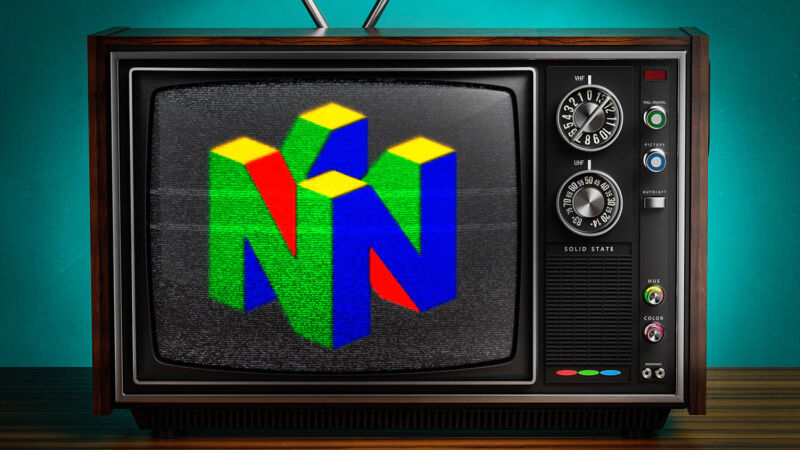
We're well past the days of CRT TVs by default, and Nintendo Europe's latest welcome update acknowledges this.
Enlarge / We’re well past the days of CRT TVs by default, and Nintendo Europe’s latest welcome update acknowledges this.
Aurich Lawson | Getty Images

On Monday, Nintendo of Europe announced a very region-specific—and era-specific—tweak for its upcoming collection of N64 games on the Switch: an option to swap between the PAL and NTSC video standards. While the announcement may sound ho-hum to outsiders, anyone in Europe with a vested interest in classic gaming will appreciate what the toggle affords.

The issue boils down to differences between NTSC and PAL, the leading video broadcast standards on CRT TVs during Nintendo’s ’80s and ’90s heyday. North American and Japanese TV sets were configured for NTSC, which has a refresh rate standard of 60 Hz, while the PAL sets that dominated Europe had a slightly higher pixel resolution and a lower refresh rate standard of 50 Hz.

If you merely watch TV series or films on both NTSC and PAL sets, the difference is noticeable yet mild. But for much of the ’80s and ’90s, many video games, especially the ones made by the largely Japanese console industry, suffered in PAL because they were coded specifically for NTSC standards. In order to port the games to PAL, developers generally didn’t go back and reconfigure all of the timings, especially in the case of early 3D games. Instead, internal clock speeds were often slowed down to 83.3 percent to match European TV refresh rates. This meant both slower gameplay than what was originally coded and slower playback of music and sound effects. (These games also often shipped with NTSC’s pixel maximums in mind, so they were squished to fit on PAL displays.)

Mario aus papier gemacht

[embedded content]
Nintendo Direct, September 2021, European edition. The timestamp for information on 50 Hz N64 games is 21:16.

Sure enough, last month’s announcement of N64 games on Nintendo Switch Online put fear into European classic-gamer hearts. That region’s reveal video included slightly slower timings of classic N64 games compared to videos posted by Nintendo of America and Nintendo of Japan, since they were emulating the original European retail releases. At the time, Nintendo of Europe did not immediately reply to social media questions about whether European Switch owners would get an option for 60 Hz N64 gameplay—especially in an LCD TV era, where such CRT-related restrictions no longer technically apply to most EU and UK TV owners.

Monday’s announcement confirms that European players will get a 60 Hz option by default for every N64 game in the Nintendo Switch Online “Expansion Pack” collection, along with a toggle to access a game’s original 50 Hz version if it launched with multi-language support. Reading between the lines, we believe this means that if a European N64 game only had English language support, its Switch Online version will be the North American NTSC ROM.

On a more global scale, however, we’re still waiting to see exactly how authentic Switch’s N64 emulation will be, especially on original hardware that rarely nailed its frame rate targets. Will we get a faithful reproduction of ’90s frame rate chugs, or will Nintendo’s newest emulator smooth out those processing bumps? Last month’s video reveals didn’t necessarily clarify the situation. Previous N64 Virtual Console releases on Wii U included noticeable processing improvements, though that emulator was also cursed with infamously dark color reproduction.

Enterprising ROM collectors have found simple ways to modify European releases of NES, Super NES, and Mega Drive games in order to convert their refresh rates from PAL to NTSC, but the same cannot be said for games on popular 3D consoles like the N64, PlayStation, and Saturn. So the fact that Nintendo won’t apply a special 60 Hz patch to, say, the German-language version of Paper Mario checks out.

Speaking of PlayStation, the 2018 PlayStation Classic miniature console shipped in all regions with a curious PAL issue, in that nine of its included games were sourced from their European CDs, not their North American ones. This was arguably done to increase built-in language support and make the device easier to ship in more Western regions, but it also left affected fans with the dubious option of jailbreaking their PS Classic consoles and upload NTSC ROMs to the hardware instead.

The Switch Online Expansion Pack still does not have a release date or price (beyond carrying a confirmed additional fee on top of the existing $20/year Switch Online price), and Nintendo of Europe now describes its launch as coming in “late October.” Additionally, Nintendo has yet to show us its N64 controller, which will launch for $50 at some point. We’ve seen the front, but what about the back? Will it come with the three-pronged controller’s original expansion slot? Perhaps a built-in “Rumble Pak“? We’re still waiting to see.

https://arstechnica.com/?p=1803032


Adventures of a Mathematician brings an unsung scientist back into the light

Still from Adventures of a Mathematician
Enlarge / Philippe Tlokinski stars as Stanislaw Ulam in the new film Adventures of a Mathematician.
Samuel Goldwyn Films

On November 1, 1952, the US detonated the first thermonuclear weapon, dubbed “Ivy Mike,” off the Enewetak Atoll in what is now the Marshall Islands. Most of us consider the late physicist Edward Teller to be the “father of the hydrogen bomb”—and Teller did indeed champion the notion of a fusion-based “super bomb.” But hardly anyone outside of physics has heard of Stanislaw Ulam, the Polish mathematician and physicist who helped realize Teller’s objective, although the extent of their respective contributions to the breakthrough Teller-Ulam design remains both highly classified and controversial.

Ulam is also the mastermind behind what is known as the Monte Carlo method of computation, and along with his Hungarian-born colleague John von Neumann, he was a pioneer of early computing technology. He proposed a novel nuclear pulse propulsion method for starships that led to the formation of Project Orion in 1958, with the goal of achieving interplanetary travel. And he was a formidable poker player, as many of his Los Alamos colleagues learned to their detriment.

The life of this extraordinary yet largely unsung scientist is the focus of Adventures of a Mathematician, a new film from German director Thor Klein. Klein’s thoughtful, haunting film is less a straightforward biopic and more an elegant impromptu composed out of key events in Ulam’s life, set against the backdrop of World War II and its immediate aftermath.

(Some spoilers for the film below.)

Ulam's best friend, John von Neumann (Fabian Kociecki) convinces him to accept an unusual offer.
Enlarge / Ulam’s best friend, John von Neumann (Fabian Kociecki) convinces him to accept an unusual offer.
YouTube/Samuel Goldwyn Films

What was it about Ulam that made him so special in the eyes of his colleagues? “The key is having the right idea at the right time,” George Dyson, a science historian who consulted on the film, told Ars. “Ulam is one of the lead characters in three of my books. He keeps appearing because he did so many different things. A lot of ideas that we credit to other people came from their bouncing them off of Ulam.” Apart from his research in pure mathematics and logic, Ulam is known for a handful of particularly influential ideas.

First and foremost is the Teller-Ulam design for thermonuclear weapons. It was Enrico Fermi who first mentioned to Edward Teller in the fall of 1941 the possibility of using the energy from a fission device to begin a fusion reaction. Even after the Trinity Test and bombings of Hiroshima and Nagasaki in 1945, Teller was convinced there would be a need for a nuclear “super bomb.” When the Soviet Union detonated its first atomic bomb in August 1949—an implosion design similar to the Fat Man bomb detonated over Nagasaki, courtesy of information provided by Soviet spy Klaus Fuchs—President Harry S. Truman greenlit a US program to develop a hydrogen bomb.

The sticking point for the hydrogen bomb was how to ignite the fusion material, which required tremendous temperatures and pressures. The original idea was to use a fission “trigger,” but the heat from that explosion alone turned out to be insufficient. Ulam and Teller’s ingenious 1951 solution is now called “staged implosion,” and it’s believed to be the basis for most thermonuclear weapons today.

A confrontation with Edward Teller (Joel Basman) over technical issues with the planned hydrogen "super" bomb.
Enlarge / A confrontation with Edward Teller (Joel Basman) over technical issues with the planned hydrogen “super” bomb.
YouTube/Samuel Goldwyn Films

While Teller later denied Ulam’s contribution, other physicists, like nuclear weapons designer Ted Taylor, contend that Ulam deserves credit for ideas about compression and basic staging of the weapon, while Teller realized that radiation—rather than hydrodynamic pressure—was the key to ignition. (Since many of the relevant files remain classified, the controversy is unlikely to be resolved any time soon.)

Ulam got the idea for his MonteCarlo method while recuperating from surgery. This was when scientists were developing ENIAC, the first programmable, electronic general-purpose digital computer. Ulam had been playing a lot of solitaire during his recovery, trying to estimate the odds of, say, a successful Canfield solitaire game using abstract combinatorial calculations. He came up with a more practical method, laying out the game a hundred times, for example, and then observing and counting the number of successful plays. Ulam quickly recognized that a computer like ENIAC would make such methods feasible. When he mentioned it to von Neumann, they began planning actual calculations, and the Monte Carlo method was born.

Dyson also credits Ulam with having the vision to foresee the digital universe. “Ulam had this very clear picture that once you had enough computers, you would effectively have a two-dimensional universe,” said Dyson. “Ulam had the insight that you could look at this in a biological way. These arrays of cells could become ‘Turing complete’ and become their own universal machines. So you could have free-floating computers in this digital space, which at the time seemed like an insanely crazy idea. It took many years for that to even become science fiction. That’s the digital universe we live in now, what we call the cloud.”

Much of this is touched upon, albeit briefly, in Adventures of a Mathematician. Director Klein has had a lifelong love of mathematics, ever since he read a book called Who Got Einstein’s Office (by Edward Regis), telling the story of the Institute for Advanced Study in Princeton, New Jersey. Ulam and John von Neumann both figured prominently. “They were throwing parties and driving fast cars, in Johnny’s case,” Klein told Ars. “They were so different from the math teachers I had in school.”

Ulam was a gifted poker player.
Enlarge / Ulam was a gifted poker player.
YouTube/Samuel Goldwyn Films

Initially, Klein dreamed of becoming a mathematician himself, but he eventually realized math wasn’t his strength. “I had a great literature teacher who made me aware that I was probably more interested in these people and their ideas than doing the actual math,” he said. “And I realized when I got older that the parties and fast cars were on the surface. Underneath it was deep tragedy, because they lost their families and just had each other to rely on.”

Klein encountered Ulam’s memoir, Adventures of a Mathematician, while still in film school and decided to base his film on that. Of course, the story about the Manhattan Project and the birth of the atomic age has been told and retold many times on-screen in many different ways. But Ulam was a relatively minor character at Los Alamos. True, his insights proved crucial, particularly for the later hydrogen bomb, but he is not one of the famous names associated with the project in popular culture, like Robert Oppenheimer and Teller.

“Stan was on the periphery of the place,” said Klein. “[Ulam’s story] opened up visually an interesting way to portray this, to show a different layer [to the story].” The fact that so many of the Los Alamos scientists were European immigrants who had fled the Nazi occupations of their home countries also appealed to Klein.

https://arstechnica.com/?p=1799843


Captain Michael Burnham and crew face a dire threat in ST: Discovery S4 trailer

We didn’t get a new trailer for the fourth season of Star Trek: Discovery during the Star Trek Day festivities last month, although we did get a premiere date: November 18, 2021. But we didn’t have that long to wait. The much-anticipated new trailer debuted during Discovery’s New York Comic Con 2021 panel, which included cast members Sonequa Martin-Green, Anthony Rapp, Mary Wiseman, Wilson Cruz, David Ajala, and Blu del Barrio, as well as showrunner and executive producer Michelle Paradise

(Spoilers for prior seasons below.)

As I’ve written previously, in S3, Michael Burnham (Martin-Green), Discovery, and her crew arrived in the future and found that Control’s plan had been thwarted: life still exists. But the galaxy was very different thanks to something called The Burn, a catastrophic event that caused all the dilithium in the Milky Way to explode and destroy much of Starfleet in the process. In the aftermath, with no warp drive possible, all the planets had become disconnected and were no longer governed by the Federation. Michael did, however, manage to locate one sole Federation liaison on a remote space station with the help of a new ally, Book (David Ajala).

The Discovery crew reunited with what was left of Starfleet, figured out what caused The Burn, and managed to defeat a rival syndicate known as the Emerald Chain. In the S3 season finale, planets were beginning to rejoin the Federation, and Discovery set out to bring dilithium from the nebula to planets that had been cut off by the Burn, presumably bringing the warp drive back and enabling travel between distant worlds once again. Burnham finally became captain of Discovery after Saru opted to return to his home planet of Kaminar for a spell. And we bid a sorrowful farewell to Philippa Georgiou (Michelle Yeoh); a spinoff series is rumored to be in the works.

According to the official synopsis, in S4, “Captain Burnham and the crew of the USS Discovery face a threat unlike any they’ve ever encountered. With Federation and non-Federation worlds alike feeling the impact, they must confront the unknown, and work together to ensure a hopeful future for all.” Much of the main cast is also returning for S4: Doug Jones as Saru, Rapp as Stamets, Wiseman as Tilly, Emily Coutts as Keyla Detmer, and Cruz as Dr. Culber. S3 additions Book (Ajala), Adira (del Barrio), Gray (Ian Alexander), and Starfleet Commander-in-Chief Vance (Oded Fehr) will also be returning.

The first trailer dropped in April, and made mention of a “gravitational anomaly” five light years in diameter moving through the galaxy—clearly the formable threat hinted at in the synopsis. Highlights included spiffy new Starfleet uniforms), as well as glimpses of Vulcans and Book’s cat, Grudge.

This new trailer focuses even more on the threat of that mysterious anomaly—”a threat like none our galaxy has ever faced before,” per Michael. It’s serious enough to warrant a gathering of Federation (and presumably non-Federation) leaders to strategize about how to combine efforts to meet the threat head-on, given that billions of lives are at risk. On a more personal level, Michael is struggling to balance her new leadership role with her penchant for taking risks and bending Starfleet rules. “Your acts of bravery are huge swings of the pendulum,” she is told. “But there is a very fine line between a pendulum and a wrecking ball.”

But that’s precisely the combination of qualities that could make Michael a truly great captain, assuming she and her crew survive their jump into the anomaly itself.  “Once we enter the anomaly we are going where no one has gone before,” Michael says from her captain’s chair.  What could be more true to the spirit of Star Trek than that?

Star Trek: Discovery S4 will premiere on November 18, 2021, on Paramount+.

[embedded content]
Official trailer for Star Trek: Discovery S4.

Listing image by YouTube/Paramount+

https://arstechnica.com/?p=1802647


How to transfer save data from one Nintendo Switch to another

Side-by-side comparison for two handheld video gaming devices.
Enlarge / The new OLED Switch above its predecessor.
Sam Machkovech


Your Nintendo Switch is loaded up with precious game save data, not to mention your prized screenshots and gripping gameplay recordings. You don’t need to upgrade to the new Switch OLED, but if you are—or you just need to swap from one console to another—you’ll need to transfer all of this data over. There are a couple of ways to do it.

Transferring save game data and your screengrabs involve different processes, and for the latter, you’ll need a separate MicroSD card. Things are also very different (in a good way) if you pay for Nintendo Switch Online. Here, we break down all the details so you can follow the process that best applies to you. Here’s how to transfer your Switch data.

How to transfer save data and user profiles

Your most precious data—all the save data and progress you’ve made in your games—is tied to the user profile you created when you first set up your Switch. It’s the profile you pick each time you start a game, with a name and an avatar. All of that associated data is stored on your Switch and needs to be copied over to your new console.

There are two ways to do this, and one of them costs money. If you subscribe to Nintendo Switch Online, then this process is (much) easier.

Method 1: If you have Nintendo Switch Online

Eric Ravenscraft

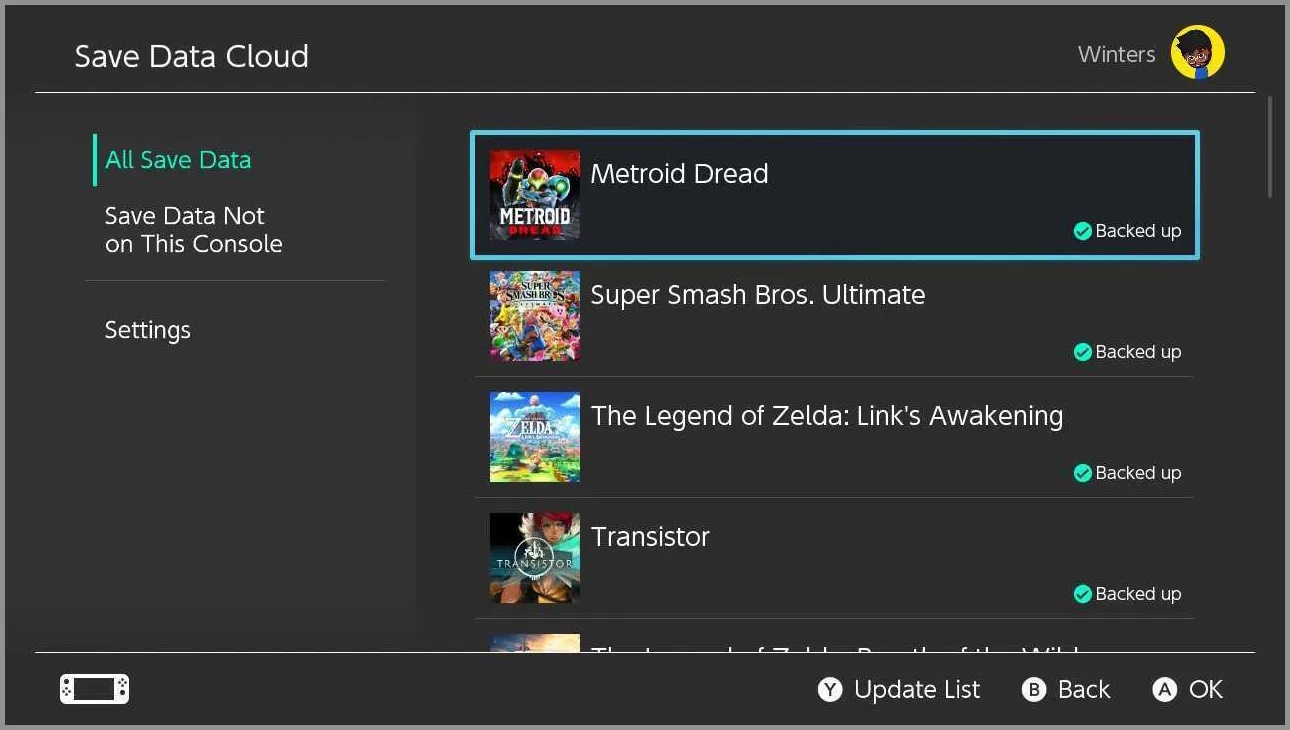
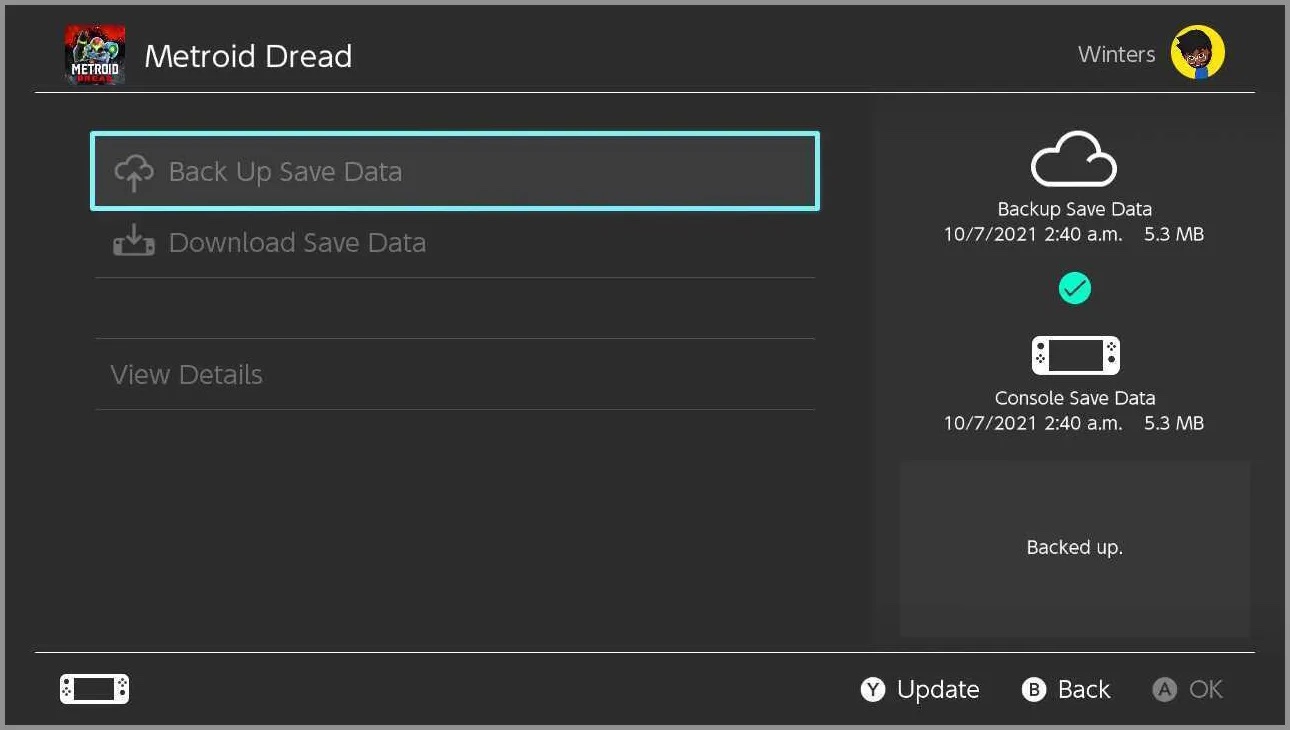
When you first sign up for Nintendo Switch Online, your games will automatically be set to back up data to the cloud. However, you can individually control which games get backed up, and you can manually back up data by heading to Settings > Data Management > Save Data Cloud.

On your new Switch, log in to your Nintendo account. You can either do this during the normal setup process when you first get your Switch or by selecting an existing profile from the home page and selecting “Link Nintendo Account.” When you do, you’ll be able to manually download save data for each game by heading to the aforementioned settings page. To redownload your games, head to the Nintendo eShop, tap on your profile picture on the top right, and go to Redownload.

You can keep playing games on both Switches if you plan to keep both. Just make sure you toggle on Automatic Save-Data Download in Settings > Data Management > Save Data Cloud > Settings. This makes sure that the save file is always updated to the newest data no matter which Switch is being used, meaning you can pick up where you left off on any of your consoles.

If another person in the household wants to play a game you own on the older console, the Switch will need to be connected to the same Wi-Fi network, and you’ll need to deregister it as the primary console after you transfer, which we get to further below.

It’s worth noting that Animal Crossing: New Horizons has a special process for transferring your island from one Switch to a new system. You can read the instructions here. Also, developers can choose to disable syncing cloud game saves, so some games like Splatoon 2 and Pokémon Sword and Shield won’t transfer over. If that happens, you can transfer them manually with the steps below.

Method 2: If you don’t have Nintendo Switch Online

Eric Ravenscraft

If you don’t have a Nintendo Switch Online and don’t want to get it, you can still transfer data over, but it’s a little more annoying. You’ll need both Switch devices handy, as well as an Internet connection and a Nintendo account. Make sure the profile you want to transfer is signed into your Nintendo account on the Switch you’re transferring data from.

Important note: Don’t sign in to your Nintendo account on the console you want to transfer data to. If you link your Nintendo account to a profile on the new Switch, this process won’t be able to merge them, so wait until you’re instructed to sign in.

Once everything is ready, you can follow these steps on both the source Switch you’re transferring data from, and on the target Switch you’re transferring data to:

  1. Go to System Settings from the home screen.
  2. Select Users from the left-hand menu.
  3. Select Transfer Your User and Save Data.
  4. Click Next.

At this point, the process for each console will diverge. On the old Switch, choose Source console, and click Continue. On the new Switch, choose Target console. You’ll then be able to sign into the Nintendo account that’s associated with the profile you want to transfer.

https://arstechnica.com/?p=1802517


Millionaire Twitch streamers react to their leaked earnings

According to the leaked data, 81 streamers have earned over $1 million each through Twitch since late 2019.
Enlarge / According to the leaked data, 81 streamers have earned over $1 million each through Twitch since late 2019.
Getty Images


Usually on Twitch, the rallying cry “Let’s get top five, baby!” refers to a video game leaderboard. Now, in the wake of a cataclysmic data breach, the gaming world is focused on a new leaderboard: one that ranks streamers according to how much money they make from Twitch.

A circus of controversy washed over the Internet Wednesday after an anonymous 4chan user leaked 125 GB of data from the streaming platform, which included payout information for over 10,000 Twitch streamers. Twitch confirmed the breach later that day, saying that a server configuration change had allowed a “malicious third party” to access the data. The revenue data, which spanned subscriptions, donations, and ads from August 2019 to October 2021, immediately went viral on 4chan, Twitter, Reddit, and other social media. (Several streamers have stated that the information is mostly accurate, although the Twitch payments do not represent their only income source.) And while streamers are understandably concerned about potential privacy risks associated with the data breach, many have also been meme-ing on the money and, as always, making money on the memes.

“NUMBA 6 BEGS FOR PRIMES,” top streamer Ludwig Ahgren titled his livestream Wednesday, referring to Twitch’s Prime subscriptions. Twenty-four thousand viewers tuned in. Scrolling through a website that organized the payout information into a leaderboard, Ahgren typed in various streamers’ usernames to find what they made. (The website has since been taken down.) At one point, Ahgren called another streamer, Matthew “Mizkif” Rinaudo, to continue the gossip fest. “Number six!” Rinaudo yelled in a greeting to Ahgren. “You have to scroll to see my number. That’s embarrassing.”

“I’d never want to hide how much I make, so I’m down to make a meme out of it,” Ahgren tells WIRED. “I’ve had a meme for a while: bigger number, better person. That’s kind of how it feels when you’re a content creator, directly correlating your value as a human to how big you are, how much money you make.” (Ludwig confirmed that he did earn about $3.3 million through Twitch subscriptions, Twitch Bits, and ads from late 2019 to October 2021.)

All day Wednesday, streamers and their fans referred to their favorite gaming celebrities by their numbers on the now-defunct Twitch earnings leaderboard. On popular Twitch gossip subreddit r/LivestreamFail, posts piled up with titles like “#6 talks to #23,” “#137’s worst nightmare” or even “#6, #188, #264, #280, #269, #343, #414, #550, #1049 and #1905 team up to beat up #28.”

Part of the impetus to meme came simply from streamers’ gargantuan payouts. According to the leaked data, the top 81 streamers each earned over $1 million through Twitch since late 2019. The top five earned more than $5 million each. While the financial information was explosive, it’s not news that some streamers rake in millions. In fact, savvy viewers might be able to approximately calculate some streamers’ revenue information on their own, no leak required. Most subscriptions for streamers with Partner status cost $5, and Twitch takes 50 percent of those earnings. So if a Partnered streamer has 50 subscribers paying $5 a month, that streamer will earn $125 a month from subscriptions. On top of that, streamers earn money from Bit donations (Twitch takes 30 percent) and partner program ads (which Twitch takes 20 to 30 percent), according to Alex Curry, a gaming influencer marketing strategist at Upfluence.

“This leak highlights how lucrative streaming can be, and we are only speaking of direct incomes from Twitch itself (subs plus ads plus bits),” says Curry. That’s not a whole picture of streamers’ earnings, though. “To those figures, you can add brand collaborations, sponsorship, merchandising, and donations. So the top-streamer salary reality is significantly higher than this.” The actual mystery, at least to the public, is how much money streamers make from those private deals. And those numbers—which weren’t included in the hacker’s data dump—can be huge. Wednesday, in a spreadsheet, Ahgren shared that from late 2019 to October 2021, he made $3 million, 44 percent of his income, from sponsors.

https://arstechnica.com/?p=1802529


Baking Impossible: The great nerdish bake-off for the engineering set

Structural integrity, physics, and load-bearing properties—how often do you see reality TV series that reward contestants’ careful engineering efforts? And how often do you see those creations subsequently picked apart with a fork and tasted by judges?

I’m not exactly sure how Netflix’s algorithms, the ones that pore over millions of hours of viewers’ watching habits and guess what we’ll love next, settled on the idea of combining Top Chef and Mythbusters. But as I settle into the oncoming gloom of fall and look for series to watch with non-nerds in my life, I’m convinced that new series Baking Impossible is a good idea.

Having now watched a few episodes, I can safely recommend this as one of the better nerd-fluent reality series out there—even if it’s occasionally too cheesy for its own good.

“Screwdrivers and spatulas down”

In this eight-episode series, Netflix dumps contestants into a massive lab decked out with everything a hobbyist or a baker could want. On one side, the lab is covered in laser cutters, 3D printers, and jigsaws. Oversized ovens, industrial-grade mixers, and a massive pantry fill out the other side. Each competing team has one established baker and one award-winning engineer, and every episode asks the teams to design and produce some sort of elaborate object that does three things: tastes good, looks good, and fulfills a defined function.

As an example, the series’ first episode revolves around each team building a working sailboat out of food. It must be almost entirely edible, with the exception of whatever remote-control function operates its steering, and it must traverse a 20-foot pool of water with only a gust of wind as propulsion. (Merely floating won’t do the trick; each boat needs legitimate sails to both catch a gust of wind and then subsequently go down as a tasty amuse-bouche.)

On a sheer reality TV level, Baking Impossible passes the crucial “no fast-forward needed” test. Most network reality series pad their runtimes with invented drama or overlong personal-backstory segments, arguably to fill out an exact episode length for the sake of mid-episode commercial breaks. Thanks to this series’ emphasis on the creation and crafting process, and its ability to alternate between two types of crafting (functionality and flavor), each episode is generally deft about making us wonder, “Are they really going to pull off this edible such-and-such?”

Quick personal stories pop up between the teams’ drafting and blocking-out phases, and they’re tidy, entertaining punctuation marks, as opposed to shrug-worthy attempts to invent drama. The results are more American than British, so if you’re looking for the softest, fluffiest reality TV, Baking Impossible might not be your bag—especially in the rare cases when a baker and an engineer disagree on a project’s execution. But as a whole, it’s certainly less catty and aggressive than your average Bravo reality series.

Some robots cannot drive over roads covered in marshmallows

The show is at its best when we see each team of randomly assigned contestants interact. More often than not, teammates value each other’s expertise, and Netflix’s editing stresses each project’s ideation, execution, and rapid-fire revision process. The scope of these projects is massive, since teams get eight-hour time limits to complete each episode’s challenge, yet both the big picture and the nitty-gritty details get coverage. Then we’re off—usually with neat camera cuts from one team to the next—as each decides which food items make the most sense for the project.

Every contestant’s creation, from the most impressive to the most humdrum, finally takes its time on the catwalk, whether as a technical demonstration or a camera lingering on the “centerpiece” dessert within each edible creation. On a personal level, cooking and baking reality series drive me nuts when I’m looking at food I cannot eat, and thus, I appreciate Baking Impossible‘s gimmick of thoroughly demonstrated gadgets. That gives me more to, ahem, bite into—especially when the series dedicates an entire episode to satisfying, food-filled Rube Goldberg devices.

But this is also an unprecedented series concept, and it needed a little more engineering of its own before moving into production. The biggest issue is that a majority of the competitors fail each episode’s testing demands, in spite of the elaborate robo/snack hybrids they build. The prowess is clearly there, with the baking side consisting largely of bakery owners and the engineering side made up of decades-long toy manufacturers (and even an engineer from NASA’s Artemis project). But the demands placed upon them are perhaps too steep.

The worst challenge sees every team having to build a mobile robot that can drive across an obstacle course. But the teams only get a vague warning about how demanding this course will be. They don’t really know what to spend their limited time and driving energy on, and that episode’s vehicles mostly prove too unwieldy to complete the track. Only two out of eight robots could finish the course.

The series’ judges and ever-present host are all a little too eager to nudge non-scientific viewers with groan-worthy puns and middle-school explanations of physics. And they overuse of the awkward phrase “bake-ineers”—which sounds less like the series’ concept and more like the cookie-making staff at Epcot Center.

None of that is enough to turn me off from casual viewing of the series, and the hosts are shameless about this all being tongue-in-cheek. But engineering-minded viewers should expect to cringe at least once per episode.

Verdict: A perfectly fine snack

[embedded content]
Baking Impossible season one trailer

I’ve watched a lot of bad reality TV, and I am not sure I’ve ever been more pleasantly surprised by a new series—I had heard nothing about this one in advance. Still, I don’t want to overhype the series, especially due to its first-season hiccups.

But if you already have access to a paid Netflix subscription (one way or another), I see zero reason not to put this series’ first episode on in the background to see if it charms you too.

The first six episodes of Baking Impossible‘s first season are currently live on Netflix. Its final two episodes go live on Wednesday, October 13.

Listing image by Netflix

https://arstechnica.com/?p=1802482


Review: No Time to Die finds 007’s heart in Daniel Craig’s final outing

Everyone has their favorite incarnation of James Bond, Ian Fleming’s iconic British spy with an eye for the ladies, fast cars, cool gadgets, and a martini that’s shaken, not stirred. Sean Connery, George Lazenby, Roger Moore, Timothy Dalton, and Pierce Brosnan have all brought their own distinctive style to 007, with varying results. But Daniel Craig has been my #1 Bond since 2006’s Casino Royale, aka one of the best Bond films yet made. So I was delighted to find that Craig’s 007 is getting the action-packed, emotionally powerful sendoff he deserves with No Time to Die. The film brings the character arc that began with Casino Royale to a satisfying and fitting conclusion.

(Spoilers for prior films in the Craig/Bond series; only minor spoilers for No Time to Die.)

It’s worth taking a moment to revisit why Casino Royale worked so well as a fresh take on a well-worn franchise. It brought 007 firmly into the 21st century while still remaining true to the character. Even Craig’s physical appearance was markedly different from the tall, dark, and handsome incarnations that came before. This Bond was more of a rugged street tough who’s learned to adopt the trappings of refinement. The cinematography, production design, and even the music reinforced that portrayal.

Essentially, Casino Royale is an origin story, as Bond takes on his first mission after earning his 00 status. The franchise has always trafficked in exciting car chases and spectacularly elaborate action sequences, but director Martin Campbell opened his film with a novel, parkour-influenced scene where Bond must chase down a suspect on foot through an active construction zone. Sure, that four-way final hand in the high-stakes poker game against Le Chiffre (Mads Mikkelsen) was ridiculously implausible, but this is a James Bond movie, where the improbable happens all the time.

Above all else, Casino Royale was a tragic love story, as our stoically cold-hearted, womanizing spy met and fell for a woman who showed herself to be very much his equal: Her Majesty’s Treasury agent Vesper Lynd (played to perfection by Eva Green). Vesper’s eventual betrayal and death was the catalyst that transformed this fledgling Bond into the cynical, hard-edged 007 we know and love. That loss also drives the action of the four subsequent Craig films: Quantum of Solace (2008), Skyfall (2012), Spectre (2015), and now No Time to Die.

No Time to Die builds on the events of Spectre, which sees Bond being suspended from MI6 after carrying out an unauthorized mission to stop a terrorist bombing in Mexico City—based on a posthumous message from Judi Dench’s late, lamented M. The new M (Ralph Fiennes) finds his agency in competition with a rival, privately backed intelligence service led by C (Andrew Scott).

Things get complicated, as they always do, leading to a showdown between Bond and archvillain Ernst Stavro Blofeld (Christoph Waltz), a criminal mastermind who heads the titular SPECTRE. (Ian Fleming’s original character inspired Dr. Evil and his cat, Mr. Bigglesworth, in the Austin Powers film series.)

Blofeld is behind an attempt to infiltrate a planned global intelligence surveillance system so that SPECTRE can access information about any investigations into its criminal activities. The film ends with Blofeld captured and Bond driving off into the sunset with his romantic interest, psychiatrist Madeleine Swann (Lea Seydoux). She is the daughter of Mr. White (Jesper Christensen), first introduced in Casino Royale as the liaison for the criminal origination that featured prominently in Quantum of Solace.

Directed by Cary Joji Fukunaga, No Time to Die takes place about five years after Blofield’s capture and imprisonment. Per the official premise:

Bond has left active service and is enjoying a tranquil life in Jamaica. His peace is short-lived when his old friend Felix Leiter from the CIA turns up asking for help. The mission to rescue a kidnapped scientist turns out to be far more treacherous than expected, leading Bond onto the trail of a mysterious villain armed with dangerous new technology.

The film opens with a flashback to Madeleine’s past, when a masked intruder seeking revenge for Mr. White’s massacre of his family murders her alcoholic mother but spares Madeleine’s life. Cut to Madera, where Bond and Madeleine have come to put their pasts behind them. This involves Bond visiting Vesper’s tomb, but the symbolic moment is rudely interrupted by SPECTRE assassins. Believing Madeleine betrayed him (technically, she is a “daughter of SPECTRE”), Bond leaves her. Five years have passed by the time Leiter (Jeffrey Wright) turns up.

The mission this time is to track down a kidnapped MI6 scientist, Valdo Obruchev (David Dencik), who has developed a nasty nanobot bioweapon coded to a specific person’s DNA. The nanobots can infect anyone with a single touch, but they are fatal only to the intended target(s). MI6 is also keen to retrieve Obruchev, and Bond’s MI6 counterpart is Nomi (Lashana Lynch), who inherited the 007 number after Bond retired. Awkward! The stakes become even higher when the agents learn that the bioweapon has fallen into the hands of new archvillain Lyutsifer Safin (Rami Malek). 

No Time to Die has all the classic tropes we’ve come to expect from a globe-trotting Bond film, with plenty of excitement and spectacle, as well as touches of humor (and oh, those cars). Fukunaga knows his way around an action sequence, and it shows.

True, there’s nothing quite as fresh and exciting as that parkour chase scene, and I would have loved to see more of CIA agent Paloma (Ana de Armas of Knives Out fame), who assists Bond when he infiltrates a SPECTRE gathering in Cuba. She proves herself more than combat-ready—and then we just jump to the next exotic locale, never to see Paloma again. And frankly, Safin doesn’t make for a particularly interesting villain, even though Fukunaga intended him to be Bond’s most dangerous, intelligent, and worthy adversary yet.

But that’s not what this film is ultimately about. It’s not trying to one-up all the previous Bond films in terms of villainy, gadgetry, action sequences, romantic conquests, and so forth. Thematically, it’s essentially an exploration of past trauma, damaged relationships, and family, wrapped in spy thriller trappings. That’s refreshing new territory for a James Bond film, and Fukunaga takes the time to let the story breathe between action sequences in order to fully explore those themes (hence the film’s 2:43 run time). Craig’s swan song as Bond turns out to be the most personal and intimate look at 007 we’ve seen since, well, Casino Royale. The bar has been set very high for his successor.

No Time to Die is currently playing in theaters. We strongly recommend only attending movies in theaters if you have been fully vaccinated and wear a mask for the duration of the film.

[embedded content]
Meet Bond’s new allies in No Time to Die: Agents Nomi (Lashana Lynch) and Paloma (Ana de Armas).

Listing image by United Artists/MGM

https://arstechnica.com/?p=1802053


You have 72 hours to buy the original, moddable GTA III trilogy on PC

You have 72 hours to buy the original, moddable GTA III trilogy on PC

After months of rumors that Rockstar was cooking up revamped versions of the original Grand Theft Auto 3 trilogy for modern hardware, the publisher confirmed Friday its plans to do just that—and if you’re interested in playing your own custom-tailored version of these classics on PC by installing mods, you have three days to buy the collection on Steam.

As has become standard practice for many publishers when updating older games for newer platforms, Rockstar is removing all previous versions and bundles of Grand Theft Auto 3, Vice City, and San Andreas from every console and PC storefront effective “the week of October 11, 2021,” the publisher said on its support page. While each entry received Windows ports in the early 2000s, PC players are currently limited to buying the games via Rockstar’s game launcher or through Steam, and only the latter platform supports mods.

Modded no more

Steam is also noticeably absent from the new trilogy’s list of confirmed platforms, which include the PlayStation 4 and 5, Xbox platforms, Nintendo Switch, and PC via Rockstar’s game launcher, with iOS and Android ports coming next year. As of press time, all three games and the Grand Theft Auto: The Trilogy bundle are still available on Steam. Current owners will also be able to download and access the games on their purchased platforms after they’ve been delisted, Rockstar confirmed.

Though getting modernized versions of the GTA 3 trilogy sounds like great news for anyone who wants to revisit the games with a contemporary lick of paint, there are number of mods for the current PC versions that do a pretty good job of “remastering” these PS2-era titles to make them more playable by today’s standards.

Aside from the expected HD textures, widescreen support, and UI overhauls, there are even more extravagant mods to add (unnecessarily) realistic effects like dynamic weather and ray traced reflections and shadows, all of which really stand out against the low-poly vehicle and character models. While the number of available mods for these retro entries are certainly lacking compared to Grand Theft Auto V’s, there are still enough around to make a noticeable difference.

For now, Rockstar has not revealed many details of the awkwardly named Grand Theft Auto: The Trilogy – The Definitive Edition, including whether fans should expect extremely souped-up ports built on the bones of the GTA 3 engine or, maybe more likely, actual ground-up remakes that recreate the experiences. (There’s also no word yet on whether any of the many songs removed from San Andreas’ licensed soundtrack over the years may be restored in its redux.)

Either way, the publisher says that the games will have “across-the-board upgrades including graphical improvements and modern gameplay enhancements for all three titles, while still maintaining the classic look and feel of the originals.” This statement appears to track with a rumor that surfaced in August, when sources claimed to Kotaku that new versions of the trilogy were being developed using Unreal Engine with a “mix of new and old graphics.” The same month, Rockstar’s parent company Take-Two Interactive shut down several GTA V mods that used the new game’s engine to recreate older games like Vice City.

Rockstar hasn’t announced a release date for the trilogy, but it did note that it was removing the older games from storefronts “to prepare for launch.” But hey, if you miss out on picking up the trilogy on Steam this weekend, at least Grand Mafia Crime – Auto Theft will still be up for grabs on PC. It even works on the Hololens.

https://arstechnica.com/?p=1802507


Far Cry 6 review: A familiar return to open-world stupidity

Less than five minutes into Far Cry 6, I was iffy about it.

The game opens with dictatorial President Antón Castillo delivering a televised address to Yara, a faux-Cuban paradise saddled with a history of political upheaval. Castillo has reinstated a citizen draft for the ongoing cultivation of Viviro, a homegrown wonder drug that cures cancer. Made by fertilizing Yara’s tobacco crops with a chemical gas, this magic medicine is the key, the president declares, to lifting his broken-down island into the upper echelons of the world economic stage.

But this is Far Cry, well-known for its love of open-world war games, destabilized nation-states, and crackpot despots. And Castillo, played with gusto by Giancarlo Esposito (Breaking Bad), is certainly a tyrant. The truth we’re shown during his address—of citizens being shipped off to the fields as forced slave labor or gunned down for resisting—is a non-revelation given the series’ touchstones.

It’s when the president’s forces then march into Yara’s capital of Esperanza and begin indiscriminately slaughtering everyone on the “draft” list that I first raised an eyebrow. Though this series has made its cartoonishly warped sociopaths the stars of their respective games for some time, the game-y nonsense of making your fascist regime an inhuman death squad before it’s had time to carry out the vile plan your antagonist just finished explaining is beyond ridiculous. It also feels like peak Far Cry—and maybe says a lot about where these games are today.

Two sides of the same coin

You can’t say Far Cry isn’t aware of its own ridiculousness; starting with 2012’s Far Cry 3, the order of the day has been breezy, stupid, free-form fun. The franchise has incentivized running riot through typically exoticized locales by enticing you with truckloads of guns and gimmicky death toys to inflict maximum mayhem. That is, if you’re not already distracted by setting things on fire; hunting wildlife (or otherwise unleashing it on hapless goons); capturing occupied strongholds and points of interest; tearing around air, sea, and sky in all kinds of vehicles with and without mounted weaponry; or engaging in any of the other myriad activities that have become staples of the series.

And so it goes with Far Cry 6. You play as Yaran ex-soldier Dani Rojas, who has just escaped Castillo’s draft in Esperanza and has become a member of Libertad, a revolutionary group with plans to overthrow Castillo’s rule and free Yara. To do that, the band of guerrilla fighters needs the support of a number of allies spread across the western, central, and eastern parts of the massive country.

In practice, earning their pledges boils down to familiar territory for longtime players. You’re given the option to take on bigger, set piece-type missions at your leisure or just screw around with side distractions like pursuing a homing-beacon pelican across the sky to hidden caches of “treasure” (loot and gear) and chasing a geriatric guerrilla through a carnival of explosive traps to deliver a love letter.

To its credit, developer Ubisoft has gradually made each passing entry in this series increasingly frictionless. Getting around and terrorizing Castillo’s troops in whatever ways you feel like is straightforward from the get-go—even momentum-destroying enemy checkpoints, a sticking point to greater or lesser degrees in earlier entries—don’t pose much of an impediment this time around.

Early on, I was easily able to gain access to an enemy base with some parked tanks and only a handful of guards on duty. A few messy machete stealth kills later, I stole a tank and wreaked explosive havoc for almost an hour, turning hostile jeeps into hunks of twisted metal, sending soldiers ragdolling comically, and otherwise bulldozing through everything destructible that got in my way.

I have to admit, there’s some brainless fun to be had here.

https://arstechnica.com/?p=1802221


Resident Evil reboot trailer looks like a welcome return to gaming roots

When the first Resident Evil game debuted in 1998, it was an immediate commercial and critical success, spawning several sequel games, comics, novels, and a very lucrative film franchise directed by Paul W.S. Anderson and starring Milla Jovovich. But those films were only loosely based on the games, keeping a few primary characters and the basic concept, but little else. Sony Pictures just dropped the official trailer for its upcoming reboot, Resident Evil: Welcome to Raccoon City, and it looks like it will hew much more closely to the source material than its big-screen predecessors.

(Some spoilers for the first two games in the franchise below, but no major reveals.)

The sixth and final film in the Anderson series was released fairly recently, in 2016. But the franchise made a ton of money, so naturally a complete reboot was in the works by early 2017, with Johannes Roberts (47 Meters Down) at the helm.

Although he was a fan of the preceding franchise, Roberts told IGN earlier this year that he wanted to bring a very different tone to his film. He wanted to stay closer to the Resident Evil and Resident Evil 2 games—even employing the same fixed angles of Spencer Mansion in the first game. “What I loved about the games was that they were just scary, and that’s a lot of what I wanted, that atmosphere. It’s raining constantly, it’s dark, it’s scary, Raccoon City is a rotten character,” he said. “I wanted to… mix it with the fun side, especially with the narrative style of the first game.”

The first Resident Evil game is set in July 1998, as the the fictional Midwestern town of Raccoon City is reeling from a series of brutal murders. The STARS team sends in a Beta unit but soon loses contact with them, then sends its Alpha team to investigate. Attacked by zombie dogs, they take refuge in the abandoned Spencer Mansion—except it’s not really abandoned. All manner of zombies and mutant monsters—the result of bizarre experiments conducted by the Umbrella Corporation using a biological agent called the T-Virus—roam the mansion and its environs.

Players can choose to play STARS agents Chris Redfield or Jill Valentine, and they must find documents containing helpful clues and solve various puzzles to figure out what happened. And of course, there is much fighting against the monsters, including a giant humanoid supersoldier dubbed the Tyrant.

Resident Evil 2 takes place in September 1998, two months after the events of its predecessor. Here, the main characters are Claire Redfield (Chris’ sister) and rookie Police Officer Leon S. Kennedy, who must get out of the city, which has been overrun with zombies. They must battle the Tyrant, who is hunting for yet another mutating biological agent called the G-Virus. (Will these mad scientists at Umbrella Corporation ever learn?) They must also race to create a vaccine for the G-Virus, which can stop the process of mutation in the human body.

Do you remember the 30th night of September?

The trailer for Resident Evil: Welcome to Raccoon City opens with the welcome sign for Raccoon City and the date: September 30, 1998. That places us squarely in the timeframe of Resident Evil 2. True to his word, Roberts seems to have brought not just the look and feel of the game to his film but also most of the characters and several plot points. The cast includes Claire and Chris Redfield (Kaya Scodelario and Robbie Amell, respectively), Jill Valentine (Hannah John-Kamen), and Leon Kennedy (Avan Jogia), who team up to find out the truth about the Umbrella Corporation and Spencer Mansion—and of course, fight off the mutant monsters and hopefully save the world.

William Birkin (Neal McDonough), the mad scientist who conducts the disastrous experiments for the Umbrella Corporation, will clearly play a significant role (as he does in Resident Evil 2). Donal Logue plays corrupt Raccoon City Police Chief Brian Irons, Lily Guy plays the mysterious spy Ada Wong, Tom Hopper and Chad Rook play STARS team members Albert Wesker and Richard Aiken, and Marina Mazepa plays Lisa Trevor, the unfortunate subject of one of Birkin’s twisted experiments. And of course, we get all the zombies, savage mutant dogs, and badly deformed monsters any fan of the original games could hope for.

Resident Evil: Welcome to Raccoon City opens exclusively in theaters on November 24, 2021. We strongly recommend only viewing movies in theaters if you have been fully vaccinated and wear a mask for the duration of the screening.

Listing image by Sony Pictures

https://arstechnica.com/?p=1802183