Hands-on with Back 4 Blood’s retail version: Our three-hour stream is now on VOD

2021 is apparently the year of Left 4 Dead spiritual successors, with two co-op shooters catching our attention thanks to their ties to that original Valve series: this week’s Back 4 Blood and this fall’s Anacrusis.

Back 4 Blood, developed by Turtle Rock Studios, is first out of the gate, with its zombie co-op action now officially live for people who shell out a whopping $99.99 for the game’s “ultimate” edition on Xbox consoles and PC. The more patient among you can wait until October 12, when the standard game not only goes live but becomes a part of paid Xbox Game Pass subscriptions.

If you need something to tide you over while waiting to get your band of zombie-slaying friends back together, fear not: we have our early copies of the game, and we’re eager to see exactly how it looks as a full retail product. The game can no longer hide behind the safe haze of a “beta test,” and we’ll see how game balance, technical performance, an unlockable card system, and any microtransactions play out in the real world.

It’s in the cards

Starting at 3 pm ET today, we’ll have the Ars Technica Twitch feed live and embedded at the bottom of this post. At that time, you can either watch the gameplay from this site or click through to participate in the feed’s live chat while I make my way through random matchmaking of the game’s zombie-filled campaign levels.

For a recap of what to expect, refer to my last hands-on impressions from the beta earlier this year:

Many of B4B‘s concepts are lifted shamelessly from L4D (if the naming convention with a number “4” didn’t clue you in). To wit: Each of the game’s “campaign” zones is broken up into smaller levels, and your squad gets an opportunity to rest, heal, and stock up on supplies at a “safe zone” between each level. Use guns, melee weapons, and explosive implements to tear through zombies, and juggle health items and tools to get your team from one safe zone to the next.

The biggest differentiator from L4D‘s classic formula is a series of gameplay-modifying card decks. From what I can tell, Turtle Rock Studios has implemented something that should work without demanding players spend a single additional penny on top of the retail price.

You’ll start the game with a solid inventory of cards, along with an invitation to build 15-card decks. Whenever you dive into either PvE (co-op with friends against computer-controlled zombies) or PvP (a four-on-four versus mode), your first step is to pick one of your custom decks. At the beginning of each campaign phase, some of your cards will be randomly dealt, and you pick one or two of them to augment your battling from there on out.

My session will last roughly three hours, and the gameplay should include enough card unlocking and combat differentiation to give you a good sense of what B4B looks and feels like as a live product. We’ll upload and embed a VOD version for those who miss the stream. (Additionally, we’ll be back later this year with a peek at the aforementioned co-op shooter Anacrusis whenever its “when it’s done” release date comes.)

Update: Stream complete! Twitch broke the presentation up into two separate VODs, which are embedded below in order. If you skip directly to the second video, you can fast forward through it to see a taste of some content that hadn’t yet been revealed during the game’s beta tests.

[embedded content]
Part one: Ars Technica plays Back 4 Blood on its release date of October 7, 2021. Also, some brief chat about Nintendo Switch OLED.
[embedded content]
Part two: Ars Technica beats the first Act of Back 4 Blood on its release date of October 7, 2021.

Listing image by Turtle Rock / WB Games

https://arstechnica.com/?p=1802034


The Locke kids are not alright in official trailer for Locke and Key S2

It has been a long, pandemic-induced wait, but the official trailer for the second season of Locke and Key is finally here. This is Netflix’s adaptation of the award-winning comic book series written by Joe Hill and illustrated by Gabe Rodriguez. In our 2020 year-end TV roundup, I wrote that the series successfully brought “the fabled Key House and the darkly fantastical world of the comics to vivid life.” I’ve been eager for more of the story—and we’ll be getting a lot more, since the series has already been renewed for a third season.

(Spoilers for the first season below.)

Following the brutal murder of their father, Rendell (Bill Heck, The Alienist), the surviving members of the Locke family—mom Nina (Darby Stanchfield, Scandal) and three children, Tyler (Connor Jessup, Falling Skies), Kinsey (Emilia Jones, Doctor Who), and Bode (Jackson Robert Scott, IT and IT Chapter Two)—arrive at Keyhouse, Rendell’s Massachusetts ancestral home. Shortly after arrival, Bode, the youngest sibling, finds a magical key, and then another, and another, each with its own special power. The keys whisper to those who are sensitive to them—and of course, Bode, Tyler, and Kinsey can hear them.

The Anywhere Key, for instance, means the bearer can turn any door into a portal to any place he or she can visualize, while the Matchstick Key—exclusive to the Netflix series—creates fire (and self-immolation if one is foolish enough to insert it into one’s own body). The Ghost Key lets the holder’s soul leave the body, while the Head Key inserts into the back of someone’s head to reveal their thoughts and memories. But those keys also make the siblings the target of a mysterious being who goes by the name of Dodge (Laysla De Oliveira) and wants to possess all the keys—especially one known as the Omega Key, which opens a mysterious Black Door hidden deep in a nearby cave.

Over the course of the first season, we learned why Rendell Locke moved far away from his ancestral home: a high school tragedy that killed two of his friends. Let’s just say it wasn’t an “accidental drowning” that killed them but Dodge’s possession of Rendell’s best friend Lucas (Felix Mallard). Rendell and his surviving friends eventually imprisoned Dodge in the Well House—until Ellie (Sherri Saum), in a weak moment, tried to bring Lucas (her first love) back with the Echo Key and brought back Dodge instead.

Still, Rendell’s kids proved to be a formidable match against Dodge’s many machinations. And they thought they had successfully tossed Dodge back into the void behind the Black Door and locked it behind them. But above all else, Dodge is a trickster. The kids used the Identity Key to make Ellie look like Dodge. So it’s poor Ellie who finds herself trapped in the void, while Dodge has taken on the identity of high school nerd Gabe (Griffin Gluck), Scot’s (Petrice Jones) rival for Kinsey’s affections. (And can I just say—really, Kinsey? You’d trade Scot for Gabe?)

The 10 episodes of the first season covered most of the main narrative arc in the comics but left out quite a bit of the background lore. There is still so much of the world’s rich history and mythology to explore—where the keys came from, who made them, and who (or what) Dodge really is, for instance. Hill and Rodriguez are currently working on a new six-book series, World War Key, as well as a compendium of short stories set in the past—plus a planned Locke and Key/Sandman crossover comic centered on the Hell Key (the bearer is automatically the Lord of Hell).

So how much fodder will this new material provide for the second and third seasons of Locke and Key? The official premise is pretty vague: “With danger lurking closer than they know, Tyler, Kinsey, and Bode unlock more family secrets as they dig deeper into the power and mystery of the keys.” But showrunner Meredith Averill told io9 last year that season 2 will incorporate some of the historical lore surrounding Key House and the forging of the magical keys, and it will explore what happens to the magic as the latest crop of Locke children approach adulthood. “What does it mean as they get closer to being 18 years old—the age when you age out of magic?” she said.

The trailer opens with Nina back in Alcoholics Anonymous after her sobriety lapsed during the traumatic events of last season. She’s struggling with “things that make no sense to me”—i.e., all of season 1’s supernatural happenings, which adults tend to forget pretty quickly. Nina apparently has some lingering fragments of memories, or at least a strong foreboding that perhaps the kids are not alright.

That foreboding is spot on. “Just because we figured out a few of the keys, we think we know everything,” Bode tells his siblings. Tyler assures him that at least they know that Dodge is gone—except Dodge is now Gabe, who is growing closer to Kinsey. “This world has so much potential to be reborn,” we hear Dodge/Gabe say. “To be ruled. It’s time to finish what I started.”

Their ploy appears to involve convincing Kinsey to help them forge a new magical key. Apparently, it’s the maker who decides if a key brings about “the greatest good or the greatest evil.” Three guesses as to which one Dodge/Gabe will choose. And we’ll definitely be getting some of the background lore, thanks to a glimpse of a figure in Revolutionary War captain’s regalia—most likely a newly announced character named Frederick Gideon (Kevin Durand), whom Deadline Hollywood describes as “a dangerous adversary for the Locke family.”

The second season of Locke and Key releases on Netflix on October 22, 2021.

[embedded content]
Official trailer for Locke and Key season 2, coming to Netflix on October 22, 2021.

https://arstechnica.com/?p=1801801


Jabra owner goes after gaming with SteelSeries acquisition

SteelSeries arctis prime on headset stand near monitor
Enlarge / SteelSeries’ Arctis headsets are well-known among gamers.

Gaming peripherals-maker SteelSeries is being purchased by GN, the owner of audio equipment company Jabra. The deal announced Wednesday gives GN access to SteelSeries’ headsets, keyboards, mice, and other peripherals for PC and console gaming, as well as its sub-brands, like Nahimic.

Denmark-based GN is buying SteelSeries from Axcel, a Nordic private equity firm, in a deal that reportedly amounts to 8 billion DKK (about $1.2 billion).

Founded in 2001 in Denmark, SteelSeries has made a name for itself with a large selection of advanced peripherals targeting console and PC gamers. As an audio company, GN is undoubtedly interested in SteelSeries’ Arctis headset lineup, which comprises a wide range of prices and form factors and has become a go-to brand among gamers. SteelSeries also has a reputation with other types of peripherals, including its Apex Pro mechanical keyboard (you’ll regularly see gamers sharing social media posts of the keyboard as they peel the sticker off its unique OLED screen).

SteelSeries' OLED-clad Apex Pro gaming keyboard.
Enlarge / SteelSeries’ OLED-clad Apex Pro gaming keyboard.

Calling SteelSeries a “new growth engine,” GN was wooed by SteelSeries’ “growth profile and margin structure,” according to the announcement. GN is seeking to cash in on demand for gaming hardware you can control with software and expects the gaming gear market to “continue to grow in the mid-term at around 7–8 percent per year.” Further, GN believes SteelSeries will show “strong growth in revenue and EBITA” this year.

Both companies promised that SteelSeries will continue to have its own brand and identity. SteelSeries CEO Ehtisham Rabbani said in a statement that the brand will continue to focus on eSports and gaming with new hardware and software. The exec also said the brand will “be run by the same leadership team and organization that’s driving it now.” The acquisition affects 350 SteelSeries employees, including 80 software engineers, GN pointed out in its announcement.

GN’s current roster includes Jabra, known for high-end headsets and earbuds; ReSound, a hearing aid brand; and wireless headset-maker BlueParrot. The company has 6,500 employees.

“We have for some time searched for the right way for GN to enter the very interesting gaming market, being keenly interested in the ‘high-end’ segment,” René Svendsen-Tune, CEO of GN Audio, said in a statement.

With GN’s audio roots, it’s unclear if SteelSeries will have a heightened focus on headsets post acquisition, but it’s hard to imagine the brand’s investments in areas like mice, keyboards, and controllers suddenly going away. The purchase will also net GN Nahimic, a company that focuses on PC gaming audio software, and KontrolFreek, which sells console controller accessories.

The SteelSeries acquisition is expected to close “by the beginning of 2022” but is subject to regulatory approvals.

https://arstechnica.com/?p=1801977


Among the Stars chronicles daring space mission to repair physics experiment

[embedded content]
Experience the mission to repair the Advanced Mass Spectrometer (AMS) aboard the International Space Station in Among the Stars, an original documentary series now streaming on Disney+.

It’s problematic enough when something goes wrong with a complicated, $2 billion physics experiment on Earth. Those challenges are considerably greater when said physics experiment is on the International Space Station, orbiting 250 miles above the surface of the Earth. Thanks to the efforts of the intrepid ISS crew, who conducted a series of spacewalks to make repairs, a damaged particle detector has a new lease on life.

Among the Stars, a new six-part documentary series on Disney+, chronicles the challenges the crew faced on that mission over the course of two years. The series also chronicles the final spaceflight of veteran NASA astronaut Chris Cassidy, which occurred right as the COVID-19 pandemic put the world in lockdown. “I joke that, three years ago, I knew I was going into quarantine in March 2020, according to plan,” Cassidy told Ars. “I just didn’t know that the whole world would join me there.”

As we’ve previously reported, the Alpha Magnetic Spectrometer (AMS) is a particle detector that launched to the International Space Station in 2011 on the penultimate flight of the space shuttle. The machine has steadily been collecting data during the last six years as it looks at a variety of particles from many sources, among them dark matter collisions.

Invented by Nobel laureate (and AMS principal investigator) Samuel C.C. Ting, the AMS consists of layers of smaller detectors and is designed to measure the energy and trajectory of cosmic ray particles, including high-energy photons, electrons, and positrons (electrons’ antimatter partners). The instrument also contains a bank of high-grade magnets that steer the path of electrically charged particles and help to separate the contributions from different particle types. The detectors allow researchers to distinguish between positrons and protons (which have equal positive charge but different mass), electrons (which are negatively charged), and other particles.

In 2014, the AMS team announced the results of its first 18 months of data collection. They turned out to be frustratingly ambiguous. As Matthew Francis wrote for Ars at the time, “While AMS-02 found an excess of a certain type of particle expected from some models of dark matter annihilation, this excess didn’t bear the hallmarks predicted for a dark matter signature. So something interesting is going on in the AMS-02 data, but the chances of dark matter being the cause seem a bit low.” Still, physicists were hopeful that additional data collected at even higher energies might yield more conclusive results.

But then the experiment hit a potential snag. In 2017, scientists monitoring the $2 billion AMS instrument noticed an increase in the “degradation” of several of the pumps that operate the thermal cooling system on its silicon tracker. Three of the four pumps had essentially failed. Only one is required, but the cooling system had lost all of its redundancy. Eventually, the fourth pump showed signs of failing, too.

Nobel laureate Samuel Ting is the physicist behind the Alpha Magnetic Spectrometer (AMS) experiment on-board the International Space Station.
Enlarge / Nobel laureate Samuel Ting is the physicist behind the Alpha Magnetic Spectrometer (AMS) experiment on-board the International Space Station.
YouTube/Disney+

So physicists associated with the experiment began working with a team at NASA to devise a long-range strategy that would extend the life of the AMS. They knew that the installation of a new set of pumps would require fairly intensive work, including the removal of insulation. All of that called for multiple spacewalks. ESA astronaut Luca Parmitano and NASA astronaut Andrew Morgan were the designated spacewalkers for the mission, with assistance from NASA astronauts Christina Koch and Jessica Meir, who were in charge of operating the robotic arm from inside the ISS.

Although he was on Earth, filmmaker Ben Turner was on hand to capture it all on camera for posterity, including video diaries and livestream footage. The executive producer and director of Among the Stars admits to a lifelong obsession with space flight, and among the highlights of his filmmaking career was shooting a music video for One Direction at NASA. The experience whetted his appetite for more. “As a documentary filmmaker, I have the ability to get into cool places and tell the story of cool people and try to see the world through their eyes,” he said. “It long was my ambition to do that with NASA.”

He got his chance when one of his company’s partners, James Corden (aka the voice of Peter Rabbit), happened to be chatting with Peter Rabbit director Will Gluck on set. Gluck mentioned he had met Cassidy. Knowing Turner was a big space fan, Corden put Gluck in touch with Turner for an introduction to the astronaut. Cassidy was soon involved in the project.

https://arstechnica.com/?p=1800732


Twitch source code, creator earnings exposed in 125GB leak

Twitch source code, creator earnings exposed in 125GB leak
Aurich Lawson / Getty Images

Live video broadcasting service Twitch has been hit by a massive hack that exposed 125GB of the company’s data. In a 4chan thread posted (and removed) Wednesday, an anonymous user posted a torrent file of the data dump. The dump contains the company’s source code and details of money earned by Twitch creators.

Twitch admits to breach but is unsure of the “extent”

In a 4chan post seen by Ars today, an anonymous user claimed to leak 125GB of data lifted from 6,000 internal Twitch Git repositories. The forum poster mocked Amazon’s acquisition of Twitch, writing, “Jeff Bezos paid $970 million for this, we’re giving it away FOR FREE.”

A 4chan user posted a torrent of a 125GB data dump.
Enlarge / A 4chan user posted a torrent of a 125GB data dump.

The hacker wrote that the purpose of the leak was to cause disruption and promote competition among video streaming platforms. The hacker further said that Twitch’s “community is a disgusting, toxic cesspool.”

Twitch has admitted to the breach but has not responded to Ars’ questions. It appears that even Twitch isn’t aware of the full extent of the breach, as the company is still working out the details:

Earnings of top Twitch creators revealed

The same thread on 4chan also claimed to expose “creator payout reports from 2019 until now. Find out how much your favorite streamer is really making!”

Notably, the 125GB archive is titled “Part One,” alluding to the possibility of future leaks.

A small subset of data seen by Ars shows the earnings of the top 10,000 Twitch users next to their usernames. An updated list was posted by game creator Sinoc, and a Twitter user who analyzed the dump posted a detailed breakdown of the payouts:

An anonymous Twitch source confirmed to Video Games Chronicle that the leaked data, including Twitch’s source code, is legitimate. According to the company source, the data was obtained as recently as Monday.

The 4chan poster claims the leaked data dump contains:

  • The entirety of twitch.tv’s source code, with commit history from the beginning
  • Creator payout reports starting from 2019
  • Mobile, desktop, and video game console Twitch clients
  • Proprietary SDKs and internal AWS services used by Twitch
  • Data from “every other property that Twitch owns,” including IGDB and CurseForge
  • Information about an unreleased Steam competitor (“Vapor”) from Amazon Game Studios
  • Twitch’s internal “red teaming” tools used by SOC (security) teams

The dump also reportedly contains Unity source code for a game called “Vapeworld.”

Portions of the leaked archive are vast and contain large ZIPs, and it may be days before the complete extent of the breach is understood:

Twitch data dump "Part one" contents.
Enlarge / Twitch data dump “Part one” contents.

Some Twitter users also claimed to see encrypted passwords present in the dump and are urging Twitch users to enable two-factor authentication and change passwords as a safeguard.

The hack puts more bad news on Twitch’s plate and follows a recent and long-awaited public response to hate raid issues. During such raids, vulgar and hateful speech is dumped into the site’s prominent chat feeds by users and bots.

Interestingly, NBC’s tech investigations reporter Olivia Solon says that all of Amazon’s warehouse systems were hit by a network disruption last night, although the company won’t confirm if this event was connected to the Twitch hack.

According to Solon:

Amazon warehouse workers across the US were unable to work for at least two hours last night because their internal software crashed and none of their scanners would work.

All Amazon will say is that it was a “network disruption that was quickly resolved.”

Amazon’s 2014 acquisition of Twitch maintained that the entity would operate “independently” from Amazon. As such, whether Twitch runs its own server stack or uses Amazon’s rack space isn’t clear.

https://arstechnica.com/?p=1801622


On the eve of No Time to Die, a look at Bond cars past and present

The sports car is as intrinsic to 007’s character as a vodka martini or that license to kill. At the start, long before James Bond went from page to screen, he drove a Blower Bentley, the equivalent in 1953 of tooling about today in a Toyota GT-One. The move to motion pictures meant driving something a bit more current than a 1931 Le Mans racer, and over the course of 25 films there’s been plenty of four-wheel action. But one car stands out above all the others—the Aston Martin DB5.

We first saw the ionic coupé in 1964’s Goldfinger, where it almost stole the show with its battering ram, ejector seat, smoke screen, and the rest of the gadgets that introduced the world to the Bond car. It has appeared in eight films in total. After Goldfinger it returned in Thunderball, then sat out the Lazenby and Moore years before returning in GoldenEye and then Tomorrow Never Dies, despite a marketing deal that meant Q had to issue the secret agent BMWs instead.

Casino Royale offered a new origin story for the DB5, with Bond winning the car in a game of poker. However, when it shows up again in Skyfall six years later, the steering wheel has switched sides, and Q Branch has had some fun with it. When last we saw 007 in Spectre he was driving away in BMT 216A, and we’ve known since the first trailer for No Time to Die that the DB5—and its headlamp miniguns—plays an important role in No Time to Die.

The DB5s you’ll see on-screen are real Aston Martins, too. Not the $3.5 million continuation cars that Aston Martin is making, though, although no doubt that project did prove useful. Instead, they’re the result of a six-month engineering project between Aston Martin’s Q Advanced Operations division (yes, really) and the filmmakers. The eight stunt cars—six stunt cars and two pod cars that can be controlled from their roofs—use original DB5 glass and brightwork but a carbon-fiber body that’s a laser-scanned replica of EON Production’s DB5.

“It’s a nine-part clamshell that all clips in and goes together,” stunt coordinator Neil Layton told me. “Within an hour you can be down to the spaceframe chassis.” The chassis necessarily matches the original DB5 in dimensions, and the straight-six engine—donated from an E46 BMW M3—sends its power to rear wheels that are as small and skinny as they were in 1964. By all accounts the stunt cars are a hoot to drive, something Layton confirmed.

Bond has driven Aston Martins other than the DB5 down the years, and some of those cars, and plenty more besides, are on display at the Petersen Museum in Los Angeles. There’s the bespoke DB10, a concept car designed just for Bond to drive in Spectre, and the DBS that 007 spectacularly barrel-rolls in Casino Royale. My personal favorite is probably the V8 Vantage from The Living Daylights, even if the car at the Petersen breaks the illusion with its empty interior and rocket launcher HUD printed onto the windshield.

If any other Bond car can rival the DB5’s star power, it has to be the white Lotus Esprit from The Spy Who Loved Me. Elon Musk would probably agree—in 2013 he bought one of the cars seen on-screen and underwater for $866,000. Another one of that film’s Esprits is on display at the museum, but the Bond in Motion exhibit is not all sports cars.

Bond’s BMWs are on display, too, although my memory tells me that the only one that really did anything of note on-screen was the 7 Series in Tomorrow Never Dies that could be driven by remote control from what passed as a smartphone in 1997. There’s (part of) a Citroen 2CV that took part in a possibly too-zany chase in For Your Eyes Only, and a Q Branch-modified Tuk Tuk that did a wheelie in Octopussy.

There’s some American metal as well. In 1974, an AMC Hornet performed a corkscrew jump in The Man with the Golden Gun, a stunt that was the first to undergo extensive computer simulation before being attempted for real. Such attention to detail would have been nice on the set of Diamonds Are Forever a few years earlier. In that film, Bond tips his Ford Mustang onto its right wheels to escape down a narrow alley and emerges still on two wheels, but this time the left ones.

Listing image by Ted7/The Petersen Museum

https://arstechnica.com/?p=1801118


Nintendo wraps Smash Bros. roster with Kingdom Hearts’ Sora

Nintendo revealed on Tuesday that Kingdom Hearts‘ Sora will be the final addition to Super Smash Bros. Ultimate’s substantial roster of fighters—and the fan-favorite Square Enix-Disney action RPG series will be coming to the Switch via cloud gaming.

Announced in a final showcase hosted by director Masahiro Sakurai, Ultimate‘s Challenger Pack 11 DLC will feature Kingdom Hearts‘ hero, the twelfth new DLC fighter since Super Mario’s Piranha Plant was added in January 2019. Sora employs his elemental magic attacks and his signature weapon, the Keyblade. The update will be available for download later this month.

Disney world(s)

If you’re unfamiliar with Kingdom Hearts, picture a Ready Player One-style crossover between Final Fantasy and Disney characters—who come from their own individual “worlds” themed around their respective movies or cartoons, like Toy Story, Nightmare Before Christmas, and Pirates of the Caribbean—which Sora and his friends visit. (2002’s original Kingdom Hearts launched a year before the company then known as Squaresoft merged with Enix, so the latter’s Dragon Quest series has never been added to the universe.)

In a nice nod for fans, Sora’s alternate costumes are all based on his various outfits from across a number of Kingdom Hearts games, including one from the Steamboat Willie world in 2006’s Kingdom Hearts II, inspired by Disney’s 1928 short where Mickey Mouse made his debut. Nine music tracks and a new themed stage from the series will also be added as part of the Challenger Pack’s DLC.

During the stream, Sakurai said adding Sora to Ultimate‘s fighter lineup is the result of a collaboration going back all the way to the release of Super Smash Bros. for the 3DS and Wii U in 2014. At the time, Nintendo ran a poll asking fans which characters they would most like to see added to the game, and Sora was the most requested character. Sakurai said he discussed the poll’s results with former Nintendo head Satoru Iwata, who died in 2015—the ever-considerate Iwata appeared to ask the director not to reveal the other top characters to avoid putting any company in an awkward position with fans.

“While this ballot was happening, we spoke with Mr. Iwata, who was still with us then, and we decided not to reveal the results,” Sakurai said. “For fighters at the top of the list, we thought that some people might demand them from the respective companies. We believed that this would cause some inconvenience to many parties. We’re sorry that we could not reveal the results.”

Sakurai also announced that the Kingdom Hearts series is coming to Switch via cloud gaming, allowing players to experience Kingdom Hearts HD 1.5 + 2.5 ReMIX, Kingdom Hearts HD 2.8 Final Chapter Prologue, and Kingdom Hearts 3, joining the platform’s only previous series entry, 2020’s rhythm game Kingdom Hearts: Melody of Memory. Aside from the mainline trilogy entries, these releases also include spinoffs and supplemental material, though newcomers should be aware that the series’ plot lines get as convoluted as their collection titles suggest. No launch dates were announced.

Three final Mii Fighter costumes will be available the same day as the Challenger Pack, including Doom‘s Doom Slayer and Splatoon‘s Octoling and Judd the cat, which will cost $0.75 each. Rounding out the stream, Sakurai announced that Final Fantasy VII‘s Sephiroth, Tekken‘s Kazuya, Pyra and Mythra from Xenoblade Chronicles 2, and Minecraft‘s Steve and Alex are all receiving Amiibo, presumably sometime in 2022.

Sora will be available on October 18 for owners of Ultimate‘s $30 Fighter Pass Vol. 2 or as a separate download for $5.99.

https://arstechnica.com/?p=1801153


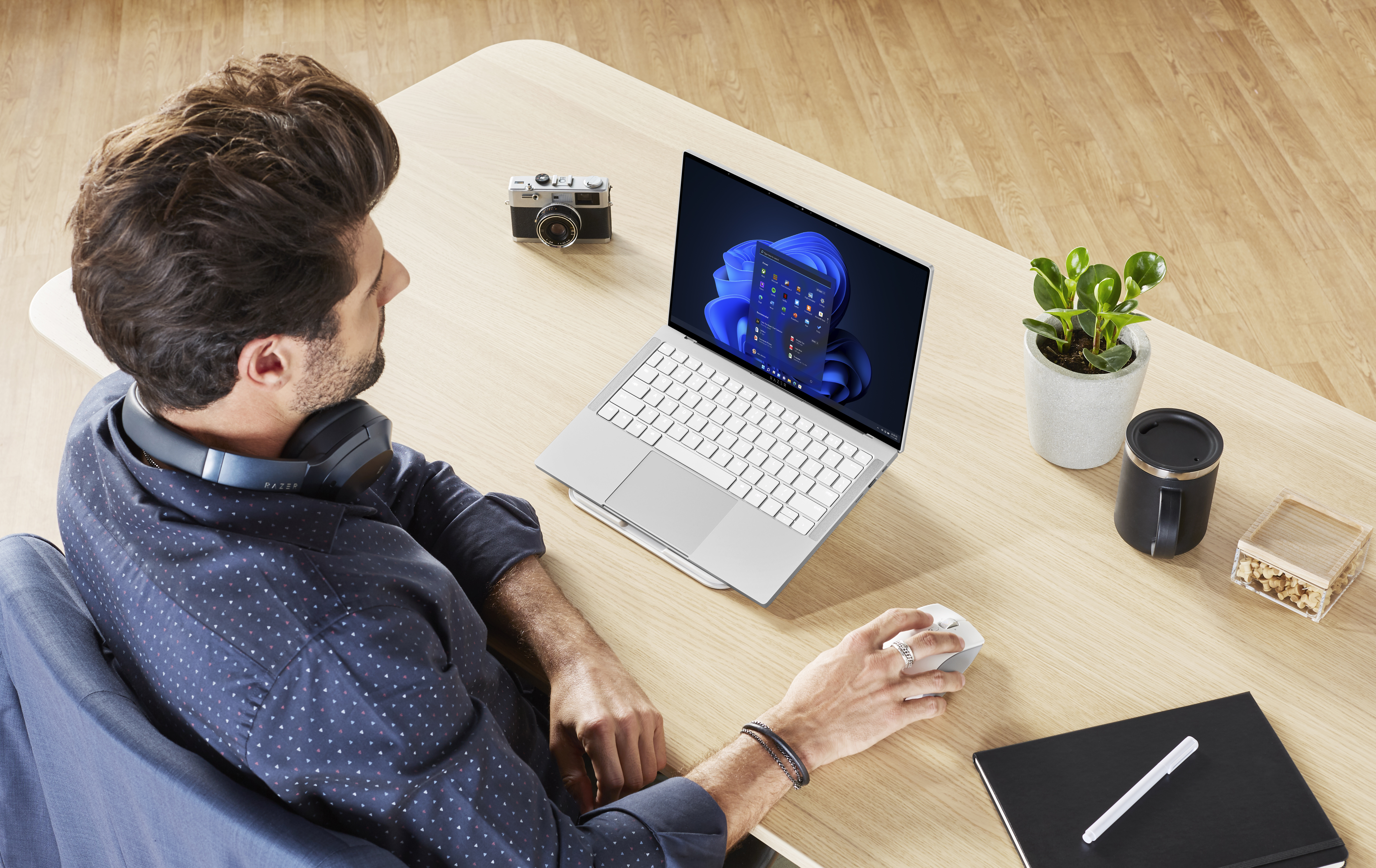
Razer delivers new ultraportable and gaming PC options for Windows 11

Razer Book.
Enlarge / Razer Book.

Windows 11 arrived yesterday, giving PC-makers everywhere an excuse to refresh their lineups. Razer announced new SKUs for its ultraportable Razer Book laptop and Razer Blade 15 Advanced gaming laptop today, and both are preloaded with Microsoft’s latest operating system. Of course, the new PCs also come with some fresh specs to consider.

New Razer Book

Razer's peripherals are also said to be Windows 11-ready.
Enlarge / Razer’s peripherals are also said to be Windows 11-ready.

Razer’s roots are in PC gaming, but the Razer Book is the three-headed snake’s attempt at a more mainstream, portable PC. The clamshell’s silver aluminum unibody chassis starts at just 2.9 pounds and 0.6 inches of thickness, making it competitive with ultraportables like Dell’s XPS 13.

Today’s announcement lowers the Razer Book’s starting price to $1,000. That gets you a quad-core i5-1135G7 CPU, 8GB of RAM, 256GB of SSD storage, and a 1920×1200 resolution screen with a 60 Hz refresh rate. Razer also announced more powerful versions with a quad-core i7-1165G7, 16GB of RAM, 512GB for $1,500 or 1TB of storage, and a 3840×2100 screen for $1,800.

New Razer Blade 15 Advanced Model

1440p at 240 Hz now available.
Enlarge / 1440p at 240 Hz now available.

Packed with an RTX 30-series mobile graphics card, the Blade 15 Advanced Model is obviously the gaming machine of the two, but compared to the majority of gaming laptops, its design is pretty trim and subdued. The laptop weighs just 4.4 pounds and is 0.67-inches thick.

There were already many configuration options available for this notebook, but the two that Razer added today use an octa-core i7-11800H. The cheaper one, which sells for $2,700, has an RTX 3070 GPU, 16GB of RAM, a 1TB SSD, and a speedy 240 Hz screen with a 2560×1440 resolution. The Advanced Model goes for $3,100 and has twice the RAM and a more powerful RTX 3080 GPU.

Windows 11 support confirmed

Razer noted today that owners of older Razer laptops will be able to upgrade to Windows 11 “soon,” and relevant Razer drivers will integrate automatically. You can find Razer’s full list of supported PCs here.

Razer also said that its software (like Synapse) and peripherals are all “fully compatible with Windows 11.”

Listing image by Razer

https://arstechnica.com/?p=1801193


Ex-Sony exec opens up about efforts to bring PlayStation hits to PC

Ex-Sony exec opens up about efforts to bring PlayStation hits to PC

Sony has a long history of keeping its first-party games behind the walled garden of console exclusivity.

So the company’s choice to bring its PS4 hit Horizon Zero Dawn to PC in August 2020 felt like a precedent-changing move away from that barrier to entry. It represented a seismic shift for a publisher protective of its wide array of console exclusives.

But as former CEO of Sony Interactive Entertainment Shawn Layden tells it, adopting a more open strategy for porting first-party titles to PC was actually an easy decision.

Speaking on the latest episode of the What’s Up PlayStation podcast, Layden—who left Sony in October 2019—said he had been one of a number of people who were considering adopting a PC initiative in the time shortly before his retirement. Following Horizon‘s launch in 2020, Days Gone hit the platform earlier this year. Meanwhile, Sony followed an Uncharted 4 leak in May with an announcement at its September PS5 showcase that next year’s Uncharted Legacy of Thieves Collection will hit PC shortly after its console launch. (Death Stranding was also ported over in July 2020, with 505 Games on publishing duties.)

Branching out

Layden’s plans came down to one question: how could Sony attract new customers who weren’t already console-owning fans? PC owners offered an easy pool of new players to attract.

Layden said:

The strategy as we were developing it when I was there was that we need to go out to where these new customers are, where these new fans could be. We need to go to where they are… Because they’ve decided not to come to my house, so I’ve got to go their house now. And what’s the best way to go to their house? Why not take one of our top-selling games?

The gap between Horizon‘s launch on PS4 in February 2017 and a release on PC was a key part of the idea, he said. “It’s already been out there for 18 months or 24 months, there’s no real retail activity against that title,” he said, referring to his thinking in late 2019.

Layden doesn’t believe Sony will ever commit to simultaneous console and PC releases for its first-party games, either. So far, that holds to Sony’s outward strategy. In a June interview on the Playstation Blog, current SIE President Hermen Hulst said, in the wake of Horizon‘s success, the company was still “planning” on how to approach the platform moving forward. Sony’s own consoles, he added, would continue to be the presumably only way to play new PlayStation Studios exclusive “at launch.”

Holding to Layden’s ideas, Hulst pointed out that Days Gone launched on PC roughly two years after its PS4 release.

“We do value PC gamers, and we’ll continue to look at the right times to launch each game,” he said.

What comes next?

Sony has also seemed to commit to the idea of bringing more of its first-party roster over with its recent acquisition of Nixxes, a studio that specializes in PC port for developers like Eidos-Montréal and Crystal Dynamics. So far, though, Sony hasn’t announced what Nixxes may be working on. (The Legacy of Thieves Collection port is being handled by former Sony exec Adam Boyes’ studio Iron Galaxy.) Sony ramping up serious consideration of PC isn’t even the craziest thing it has done recently, either, after PlayStation exclusive MLB The Show 21 landed on Xbox platforms in April.

Where does this leave Sony’s PC plans looking into the next calendar year? Judging by its last tentpole PS4 exclusives, a safe bet is that something from its 2020 catalog will be in the cards. Our money is on Ghost of Tsushima, which has been a major success in its original 2020 incarnation. Sony could maintain some exclusive draw for Ghosts if it chooses to keep the PS4 and PS5’s recent director’s cut content locked to those versions, as appears will remain the case with PS5’s Death Stranding Director’s Cut. Given the relative popularity of Sony’s franchises across the board, though, it’s really anyone’s guess which one might get picked next.

There is, however, no reason not to keep up the strategy, Layden said. Some PC players who decide to check out Horizon or Days Gone will even pick up a PS5 after doing so, he explained.

“They might not have otherwise,” he said. “There’s no losing in this transaction. It’s allowing people have a glimpse inside the PlayStation world.”

https://arstechnica.com/?p=1800685


Epic Games Store gets achievements next week—so what’s still missing?

<img src="https://rassegna.lbit-solution.it/wp-content/uploads/2021/10/epic-games-store-gets-achievements-next-week-so-whats-still-missing.jpg" alt="How long until EGS's new experience point system unlocks outfits and dances in Fortnite?”>
Enlarge / How long until EGS’s new experience point system unlocks outfits and dances in Fortnite?
Aurich Lawson

Nearly three years after its debut on Windows PCs, the Epic Games Store (EGS) will soon finally support a feature that has become common on other gaming platforms: achievements.

As announced on Monday, the system will go live “next week”; it revolves around a mix of “trophies” and “experience points,” thus resembling both the Xbox and PlayStation families’ takes on the concept. Fulfill an objective while playing a game and a pop-up box will announce whatever you completed, along with both a trophy and a number of experience points. Every EGS achievement list will add up to 1,000 experience points, with smaller achievements (45 points or less) being labeled “bronze” and higher point counts described as “silver,” “gold,” and “platinum.”

Epic hasn’t said how these points will impact the service. “Keep your eyes out for more updates you’ve been waiting for as we drop new social features and player rewards later this year,” the announcement reads. Does this mean achievement points might work as currency in some fashion, akin to Ubisoft Connect? Epic isn’t saying.

Achievements will not be mandated for either existing or upcoming EGS games, though if they’re included, Epic has a list of rules for participating developers. However many achievements a game gets, they must add up to 1,000 points—not more, not less—and once a slew of achievements goes live, it cannot be altered. In an email to Ars Technica, an Epic representative confirmed that the store will support adding more achievements to both DLC packages and “live service” dumps of free content, though how exactly that will work has not yet been announced.

The rollout had technically begun earlier this year as a confusing beta feature known as “developer achievements.” In a rare few games currently on EGS, these achievements appear in a pop-up box whenever players fulfill certain objectives, only to vanish into the ether shortly afterward—they’re nowhere to be found on players’ profiles. Next week’s update includes verbose achievement menus, visible either in the EGS client’s “library” or “store” tabs, and developers can elect to modify those existing developer achievements to work with the new system or ignore the public-facing update altogether.

Not holding our breath on “user reviews”

Monday’s announcement also teased at least one major update for the EGS client that had been shown off as far back as July: customizable profiles. An Epic representative tells Ars that this feature will not be live in next week’s update, despite the announcement page including a visual hint of how it will look, complete with achievement progress and customizable profile icons.

The EGS roadmap is a stark reminder of how far behind Epic’s PC storefront is on a features basis compared to its competition. So far, the roadmap lists quite a few highly requested features, including:

  • Buying games for other people, then sending them as digital “gifts”
  • A “shopping cart” that lets buyers pay for multiple games in a single transaction
  • A download interface that includes manual controls for prioritizing particular software
  • User reviews
  • Native support for more worldwide currencies and payment methods

The last two items on that list were bumped as far back as 2019 into EGS’s nebulous “future development” tier, which shows how low a priority those two are for Epic on the development front.

Since EGS’s rollout in late 2018—complete with an aggressive pricing structure for all devs and additional licensing-based incentives for devs who favor Unreal Engine—Valve’s popular storefront, Steam, has fought back with features of its own, as opposed to dropping its default 30 percent cut of digital game sales. (To be fair, public-facing data suggests that Steam doesn’t quite take that full percentage.) Arguably the biggest addition has been Steam Play Together, which can turn most “couch co-op” games into an online lobby with a single click.

EGS has yet to move forward with storefront options that exceed what Steam offers, with its roadmap mimicking what players had already gotten used to from other storefronts, including cloud save support and functional offline modes.

https://arstechnica.com/?p=1800528