N64 on Switch: Reading the tea-leaves on future game prospects

Get N(S) or get out.
Enlarge / Get N(S) or get out.
Nintendo / Sam Machkovech

On Thursday, the latest Nintendo Direct presentation confirmed something most Nintendo fans had either suspected, hoped for, or predicted (based on a recent FCC “controller” tip): the N64 is finally back. Instead of a miniaturized N64, however, the company’s first dedicated 3D-rendering console is returning as part of a software suite on Nintendo Switch.

And in classic Nintendo fashion, Thursday’s announcement only told some of the story.

So far, we know that the initial selection of the Nintendo Switch Online “Expansion Pack” will include nine N64 games, ranging from classics like Super Mario 64 and Mario Kart 64 to niche surprises like Winback: Covert Operations. These games will require an additional fee over NSO’s standard $20/year rate, though Nintendo has not yet announced a price for this tier. The company also did confirm plans to roll out seven more N64 games at some point, particularly Rare’s Banjo-Kazooie, which hasn’t been seen on a Nintendo console since Microsoft bought the developer in 2002.

What we don’t know—and what I’d like to estimate, ahead of the N64 tier’s October rollout—is how many, or how often, new N64 games might be added to the NSO service in the months ahead, and which third-party hits may join its current roster of first-party titles. Without further word from the big N itself, we can look to the company’s track record thus far.

Crunching the numbers

Delving into Nintendo’s track record of current NSO games for NES and SNES, along with N64-specific offerings from Wii and Wii U’s Virtual Console stores, yields some interesting results. To date, NSO’s standard service tier gives Switch owners access to 58 NES and 49 SNES titles, dating from 2018 and 2019, respectively. (Note: these numbers don’t include the “SP” versions of certain games Nintendo has periodically added. These are special “cheat code” editions of titles like Zelda or Metroid that start players out with all gear unlocked, max rupees, and other perks.)

Nintendo opened fairly strong with its NES support on NSO in September 2018, dropping 31 games over NSO’s first six months. From there, each 4-6 month calendar window dwindles.

  • Feb-July 2019: 15 additional NES games
  • Aug-Dec 2019: 4
  • Feb-July 2020: 4
  • Sept 2020-July 2021: 4

Out of the 673 games released during the NES’s lifespan in North America, this puts the total available via NSO at 8.6 percent.

A year after NSO’s NES launch, Nintendo added Super Nintendo games without raising the service’s costs. The company launched its SNES support with 20 games in September 2019. Its update cadence from there is more irregular than with NES, but overall the numbers are still relatively low.

  • Sept 2019-Feb 2020: 6 additional SNES games
  • May-Sept 2020: 9
  • Dec 2020-May 2021: 11
  • July 2021: 3

All told, that puts the number of SNES games on NSO at roughly seven percent of the console’s 717 North American titles released.

What about Virtual Console?

As for Nintendo’s record of N64 releases on the Wii U and Wii’s defunct Virtual Console storefronts, the numbers are paltry: just 21 games were made available for each. Of these, the lineup is almost exactly the same, mostly pulling from Nintendo’s first-party catalog of hits like Super Mario 64, Ocarina of Time, Majora’s Mask, Mario Kart 64, Kirby 64, Star Fox 64, and other expected classics.

The lower number of N64 retail releases in North America altogether—only 296 games—may be partially to blame for the lower number here. That still only puts Nintendo’s VC offerings at seven percent of the complete lineup stateside, lower than either the NES and SNES choices Switch owners can currently access through NSO.

Judging from Nintendo’s already confirmed titles, there’s not much commitment (yet) to offering much more for N64 than they have in the past, at least not publicly. Out of the 16 North American titles announced at yesterday’s stream, only three haven’t seen a digital, post-N64 release in the U.S.: Dr. Mario 64, Winback, and Banjo-Kazooie. The latter is undoubtedly the biggest surprise with the most significant implications, given Microsoft’s ownership of Rare. That means MS owns any of Rare’s N64 games that didn’t feature licensed characters like Donkey Kong or Mickey Mouse, which is why many of Rare’s N64 games appeared on Microsoft’s 2017 anthology Rare Replay.

If Nintendo plans to release a similar number of N64 games for the service over the next 2-3 years, Switch owners could be looking at getting a new bump of 4-6 new additions every 5-6 months. On the other hand, should Nintendo decide to dig deeper into console’s back catalog, there’s no way of knowing what it might be. With a general shrinking pattern for game drops across NES, SNES, and N64, however, it’s a bit less likely the company intends to pull out many of N64’s deeper cuts.

Third-party support

This brings us to third parties. Unlike NES and SNES, classic games from third-parties on N64 are decidedly fewer. With Banjo-Kazooie coming back to a Nintendo console, NSO could eventually see other Rare entries added from Xbox’s Rare Replay collection, with Jet Force Gemini, Blast Corps, Banjo-Tooie and potentially even the original, uncensored version of Conker’s Bad Fur Day (over the tweaked-and-bleeped Conker: Live and Reloaded for the original Xbox) all seemingly potential candidates. And if the stars align, maybe we’ll see the return of a certain FPS starring a secret agent.

The list of NSO’s third-party studios on NES and SNES also points to some historical patterns—namely the inclusion of Japanese developers with powerhouse reputations in the 8- and 16-bit eras. Konami, Capcom, Koei Tecmo, Natsume, and Arc System Works pop up a lot trawling through NSO’s NES and SNES libraries (with a few others which no longer exist or have been absorbed into parent entities), though pulling out more than a few known-quantity N64 entries isn’t as straightforward.

But as you may recall, Nintendo’s ironclad support from Japanese studios dwindled in the face of fierce PlayStation competition, which leaves fewer candidates to pick from across the board. Winback‘s inclusion, while welcome, comes from Koei Tecmo, so it doesn’t add a new third-party to Nintendo’s list of NSO partners. Potential Konami titles might include Castlevania: Legacy of Darkness (probably the more likely choice over its very different vanilla version Castlevania 64), or if someone wanted to get really wacky, the Goemon games or a year-specific sports title like International Track and Field 2000. Capcom only released three games for the console: ports of PS1’s Mega Man Legends and Resident Evil 2, as well as Magical Tetris Challenge (which starred Disney cartoon characters, so that’s a long shot). Natsume only released one N64 game, Harvest Moon 64.

None of this speaks to how Nintendo may handle future launches for the Japanese side of NSO, by the way. If we’re lucky, we could see untranslated N64 weirdness arrive in that region’s NSO package—and get those games as region-free downloads, in the same way that Western players can access Famicom and Super Famicom libraries on Switch via some Nintendo eShop trickery. Soon after NSO’s N64 service launches, its Japanese equivalent will get two Japan-only games in the Custom Robo series, which will provide a good test case for possible region-free fun from the 64-bit generation.

Ultimately, with fewer N64 games to choose from across all regions, especially compared to PS1’s explosion during the same era, our expectations are generally slim. And Nintendo’s unwillingness to launch certain N64 exclusives on older Virtual Console platforms, including Pilotwings 64 and Mischief Makers, doesn’t instill confidence that they’ve gone to greater license-agreement lengths this time around—especially since they’re not getting packaged in an attractive, miniaturized set-top box. It’s probably best to prepare for a distinct lack of boat-rocking here beyond what’s been made available on Virtual Console and the total number of games, first-party or otherwise, that the company might consider worthy enough to re-release.

At least Nintendo’s on the right track with that authentic controller—and we’ll be back to report on that controller’s build quality, and how well it works with the upcoming NSO pack of N64 games, in a future follow-up.

https://arstechnica.com/?p=1798338


Review: More remix than adaptation, Foundation is top-notch storytelling

Isaac Asimov’s hugely influential Foundation series of science fiction novels is notoriously difficult to adapt to the screen. The author himself admitted that he wrote strictly for the printed page, and he always refused invitations to adapt his work for film or TV. But Asimov was more than happy to let others adapt his work to a new medium, and he was wise enough to expect that there would—and should—be significant departures from the print version.

That’s just what showrunner David S. Goyer (Dark Knight trilogy, Da Vinci’s Demons) has done with Foundation, Apple TV+’s visually stunning, eminently bingeable new series. Goyer describes it as more of a remix than a direct adaptation, and to my taste, it is a smashing success in storytelling. This series respects Asimov’s sweeping visionary ideas without lapsing into slavish reverence and over-pontification. That said, how much you like Goyer’s vision might depend on how much of a stickler you are about remaining faithful to the source material.

(Some spoilers below, but no major reveals.)

The fundamental narrative arc of the series remains intact. It’s a story that takes place across multiple planets over 1,000 years, with a huge cast of characters. Mathematician Hari Seldon (Jared Harris, Chernobyl, Carnival Row) has developed a controversial theory of “psychohistory” that essentially applies math to sociology to make predictions about the future of the Galactic Empire, which rules every living person in the Milky Way. Seldon’s calculations predict the fall of the empire, ushering in a Dark Ages that will last 30,000 years, after which a second empire will emerge.

The collapse of the empire is inevitable, but Seldon has a plan to reduce the Dark Ages to a mere 1,000 years through the establishment of a Foundation to preserve all human knowledge so that civilization need not rebuild itself entirely from scratch. He is aided by his adoptive son and right-hand man, Raych Foss (Alfred Enoch, who played Dean Thomas in the Harry Potter franchise) and his new protege, Gaal Dornick (Lou Llobell, Voyagers), a math prodigy who travels to the capital to work with Seldon.

Seldon’s predictions make him a dangerous traitor in the eyes of the empire’s rulers. As he himself notes, those in power fear and despise change, and yet change is constant—and inevitable. Instead of executing him and creating a martyr, the rulers exile Seldon to the remote planet of Terminus at the edge of the galaxy, along with the members of the new Foundation, where they begin compiling the Encyclopedia Galactica.

Eventually, there is a threat from a neighboring outer planet, ultimately resolved by the warden of Terminus, Salvor Hardin (Leah Harvey, Fighting with my Family). And the Foundation members learn that Seldon’s plan was far more ambitious and complex than they realized. He told them just enough to set events in motion, since the tenets of psychohistory include an uncertainty principle of sociology, whereby if the collective population learns too much about its predicted fateful actions, those actions will soon become unpredictable. The clash between Seldon and the empire has often been described as a thousand-year game of chess, but there’s an element of rolling the dice and trusting in probabilities for the long game as well.

Perhaps the biggest change from the books is the replacement of the Empire’s ruling committee with a trio of clones called the Cleons. Brother Day (Lee Pace, Halt and Catch Fire, Pushing Daisies) is the primary ruler, with Brother Dusk (Terrance Mann, Sense8) serving in an advisory/legacy role. Meanwhile, Brother Dawn (played as a child by Cooper Carter and as a teenager by Cassian Bilton) is being groomed to take over as the new Brother Day. This gives more of a human face to the rulers, with complex emotions and interpersonal relationships, and all the actors are perfectly cast. I personally would watch Lee Pace read the phone book, and he has much meatier fare to work with here. Technically, they are all perfect incarnations of the same man, at different ages, and this is both the source of their strength as a team and of their conflicts. (Dusk has gained valuable wisdom, if the younger, strong-willed Day could bring himself to listen.)

We knew from the trailers that Salvor Hardin, warden of Terminus, had been gender-swapped, but the character has also been completely reimagined. The Salvor of the books is a shrewd politician (the latest in a long line) who deftly navigates a fraught political environment as the Foundation plants roots on Terminus. In the series, Salvor is a young woman who is still figuring out who she is and what role she’s meant to play in Seldon’s great plan. She shares many of the same traits as Book Salvor, but they are not yet fully developed. She also has a love interest in intergalactic space junker Hugo Krast (Daniel MacPherson, A Wrinkle in Time), and a secret connection in the grand scheme of things that we shall refrain from revealing here.

Asimov’s original trilogy was (to my college self) an enjoyably brisk read, even if the prose got a bit dry and cerebral at times. Goyer has preserved that same tight pacing in the TV series, deftly weaving in character backstories to flesh them out, setting up relationships and the inevitable conflicts between those characters, and inventing some pretty big dramatic moments out of whole cloth to keep the story humming along and viewers hooked. The story jumps between settings and time periods quite a lot, but the writers have done an excellent job sign-posting those jumps, especially in the earlier episodes, to ensure viewers are sufficiently oriented to follow along. (No need for elaborate timeline charts here, as with The Witcher and Dark, although that may change with subsequent seasons.)

The actors all deliver strong, powerful performances from the aforementioned leads on down, and the cinematography and costume and production design are exceptional. Apple TV+ is deeply invested in this series, and it shows. If I had one tiny quibble, it would be that Goyer had so much ground to cover to set up this first season that the big ideas sometimes feel more ornamental than central. I’d love to see the ensuing seasons (assuming they transpire) take a few more breaths here and there to bring those elements front and center more often. I’m confident this writing team could do so without bogging down everything else that works so well.

In short, this is a terrific first ten episodes—Goyer envisions some 80 episodes, should Apple TV+ give him the chance—with no maddening cliffhanger. The finale resolves several plot lines and sets up a few others, leaving viewers both satisfied and eager for more. I think Asimov himself would be pleased with Foundation, particularly since his daughter Robyn is an executive producer on the series and signed off on Goyer’s vision.

The first two episodes of Foundation are now available for streaming on Apple TV+. New episodes will drop every Friday until the S1 finale on November 19, 2021.

Listing image by YouTube/Apple TV+

https://arstechnica.com/?p=1797337


Death Stranding Director’s Cut review: More fun, just as divisive

Death Stranding‘s release in 2019 was probably the most anticipated game of Hideo Kojima’s career.

The Metal Gear director had arguably become the premiere auteur in video games. He had a reputation for convention-bucking design, meta-humor, and unapologetic cinematic influences. But this project was the first child of his acrimonious divorce with Konami, and no one had a clue what he might do next.

Death Stranding was appropriately weird, whatever it was. The first teaser had crab exoskeletons on a lifeless beach, tar handprints imprinted in sand, a naked, weeping Norman Reedus (The Walking Dead) tethered to a tiny, distressed baby, beached whales, and dead fish. All with zero indication of what the game actually was.

The teaser encapsulated Kojima’s entire body of work: take it or leave it. As Senior Gaming Editor Kyle Orland noted in our original review on PS4, Death Stranding is Hideo Kojima unleashed. So what could possibly be left for a Death Stranding Director’s Cut? It turns out, quite a lot—just maybe not by that name.

Death Stranding Director’s Cut [PS5]

(Ars Technica may earn compensation for sales from links on this post through affiliate programs.)

A Hideo Kojima game, still

Yes, Death Stranding has finally hit PS5, and it’s as uncompromising now as it was two years ago—even if it doesn’t much resemble a director’s cut in the typical film sense. Unlike Ghost of Tsushima Director’s Cut (Sony’s other recent PS5 re-release buoyed by extended content), Death Stranding‘s doesn’t have a full-blown expansion bolted on to its older foundations to help flesh out its story.

Kojima doesn’t agree with its naming convention, either, which won’t faze anyone who follows his daily film, book, and music recommendations on social media. In a recent tweet, he offered a more fitting name for this release (“Director’s Plus”), confirming that there wasn’t a collection of cutting-room-floor scenes inserted back into the original’s ambitious, unwieldy script.

If you skipped Death Stranding when it was on PS4 or PC, Director’s Cut is the one to play. It offers fresh goodies for players to mess around with and a couple of fun, if bite-sized, new mission areas which blatantly call back to Metal Gear, among other things. As a bells-and-whistles port, Director’s Cut does a good job of expanding on its delivery-man-in-the-post-apocalypse-simulator premise, bolstered by the exclusive DLC of its release and tweaked further to take full advantage of the PS5’s suite of exclusive features.

These extras don’t necessarily push things far outside the grueling moment-to-moment revolutions of the game’s underlying systems—and in some instances, they even intensify the game. But what stands out more to me than the advertised toys is how KojiPro has gone back and seemingly re-finessed what was previously there, going so far as to smooth out some of the prickly rough edges that divided players on release. Though subtle, these revisions offer the best argument for playing (or replaying) this version. That said, I’ve loved Kojima’s work since 1998, so if you weren’t already on board for Death Stranding‘s wild ride, my digging into what’s new here may not change your mind.

For everyone else, you’ll find plenty of Kojima goodness. Director’s Cut leans into Metal Gear‘s inclination to turn on a dime from theatrical gravitas to left-field absurdity, something that was curbed a bit in the original Death Stranding. Now you’re free to run for your life past umbilical-corded monsters to building ramps for daredevil jumping over chasms, or you can use a cargo catapult as a remote-controlled mortar to bombard terrorists in POV with a load of parcels—y’know, normal stuff for any software carrying the “A Hideo Kojima Game” label.

There’s more here for diligent players, too. You can uncover additional equipment types designed for more efficient hauls across Death Stranding‘s desolate landscape, a genuinely unexpected shift that goes a long way toward making Director’s Cut as inviting for newcomers as it ever will be. There are also actual changes to the game world itself, though you’d likely never notice them without comparing this version with the PS4’s. Regardless of whatever you choose to do, though, you’re playing in Kojima’s sandbox. Hope you like his pitch.

Reconnecting the world?

If you’ve never touched Death Stranding, it’s a good example of what happens with a celebrity creative calls up all his buddies to make something crazy. Joining Reedus, several of its characters are played by actors or directors Kojima deeply admires, including Mads Mikkelsen (Hannibal, Casino Royale), Lea Seydoux (Blue is the Warmest Color, Spectre), Guillermo Del Toro (Pan’s Labyrinth, The Shape of Water), and Nicolas Winding Refn (Drive, Only God Forgives), and the Bionic Woman herself, Lindsay Wagner, though she was mostly let off the hook for voice work alongside Del Toro and Refn. A number of other friends appear as survivors in the world: Jordan Vogt-Roberts (Kong: Skull Island), Geoff Keighley, Junji Ito, Famitsu Weekly editor Hirokazu Hamamura, Remedy head and Max Payne face model Sam Lake—the list goes on.

Its plot sounds equally insane. After a future America is devastated by a mysterious cataclysm, invisible ghosts from a post-limbo otherworld permeate the land of the living. These ghosts (BTs, an abbreviation for “Beached Things”) cause “voidouts” (massive explosions that annihilate entire cities) when they come into contact with a human. Meanwhile, any corpse will transform into a BT itself if not incinerated. Following the disaster, the country is in shambles, and survivors from sea to shining sea to permanently hunker down in underground shelters. They want to avoid BTs and the storms of instant-aging “timefall” the monsters bring in their wake.

Sam Porter Bridges (Reedus), a porter from the organization Bridges (one of Kojima’s tamer name choices) is different. He can come back from the dead, for one. He also has an affliction that allows him to sense nearby BTs, and he is partnered with the baby from the game’s first teaser, BB, who lives in a pod on Sam’s chest and operates as a living spectral radar to make BTs visible. With these gifts, Sam is tasked by Bridges with the unenviable job of saving what’s left of America and reintegrating the now-disparate “strands” of society through an interconnected successor to the internet.

As such, you deliver cargo to people in need on a coast-to-coast journey while also bringing more nodes into the so-called Chiral Network. In a clever touch, outposts throughout the country indirectly connect you with other players on their own expeditions, allowing anyone “in-network” to share items, traversal equipment, vehicles, and (if they feel like lending a hand) lost deliveries, transported asynchronously in from others’ games.

https://arstechnica.com/?p=1797675


Apple turns post-lawsuit tables on Epic, will block Fortnite on iOS

Extreme close-up photograph of a hand holding a smartphone.
Enlarge / A Fortnite loading screen displayed on an iPhone in 2018, when Apple and Epic weren’t at each other’s legal throats.

Weeks after Epic’s apparent “win” against Apple in the Epic Games v. Apple case, Apple issued a letter denying Epic’s request to have its developer license agreement reinstated until all legal options are exhausted. This effectively bans Fortnite and any other software from the game maker from returning to Apple’s App Store for years.

Epic was handed an initial victory when the US District Court for Northern California issued an injunction on September 10 ordering Apple to open up in-game payment options for all developers. At the time, the injunction was something of a moral victory for Epic—allowing the developer to keep its in-game payment systems in its free-to-play Fortnite intact while avoiding paying Apple a 30 percent fee that had previously covered all in-app transactions.

But now Epic has faced a significant reversal of fortune.

In a letter sent on September 21 to Epic’s legal counsel, Apple’s lawyers said the company refused to reinstate Epic’s account until the courts issue a final, non-appealable verdict. Epic CEO Tim Sweeney revealed Apple’s decision in series of tweets posted on September 22. Sweeney claims the appeals process for the case could take as long as five years.

Apple’s revocation of Epic’s developer license—required to develop and distribute games to the App Store—was “valid, lawful, and enforceable,” Judge Yvonne Gonzalez Rogers said in her ruling. This leaves the decision whether to allow Epic back into the App Store up to Apple.

Apple’s legal team also cited Epic’s alleged “duplicitous” conduct. Apple is referring to the move that sparked the case—Epic adding code into iOS’s version of Fortnite that enable users to buy items directly from the company.

The letter pointed to a tweet Sweeney had posted earlier this month. In the tweet, Sweeney said he “wouldn’t trade an alternative payment system away to get Fortnite back on iOS.” Sweeney said his words were taken out of context.

Sweeney tweeted an email he wrote to Apple’s legal counsel on September 16, stating that, while Epic was appealing the court’s decision, the developer had paid Apple the court-ordered $6 million in damages required by the September 10 ruling. He said that his company had disabled the server-side software required for in-game payments for players who still had Fortnite installed on their iOS devices. He also alleged that Apple lied about its intentions to work with Epic to bring the developer back to the App Store.

“Apple lied,” Sweeney said. “Apple spent a year telling the world, the court, and the press they’d ‘welcome Epic’s return to the App Store if they agree to play by the same rules as everyone else.’ Epic agreed, and now Apple has reneged in another abuse of its monopoly power over a billion users.”

While the September 10 ruling went in Apple’s favor, the company was not granted everything it sought in its legal defense. Judge Gonzalez Rogers gave Apple a victory in ruling it had not violated antitrust law, though the company lost the ability to prevent developers from including and advertising their own in-game app purchase payment systems. That ruling could lead to greater repercussions for Apple from other game makers or subscription service providers in the future.

https://arstechnica.com/?p=1797887


Nintendo Direct highlights: N64 Online in October, Super Mario 2022 film cast

Nintendo’s “winter 2021” direct-video presentation exploded on Thursday with reveals of serious fan service coming to not only Switch consoles but also movie theaters by the end of next year.

The event’s biggest pop-culture announcement was the upcoming Super Mario CGI animation movie, now confirmed to launch in the United States on December 21, 2022. This film, helmed by CG animation house Illumination (Despicable Me), still doesn’t have a title or any preview footage. But it does have an English-language cast:

  • Chris Pratt (Guardians of the Galaxy) as Mario
  • Anna Taylor-Joy (The Queen’s Gambit) as Peach
  • Charlie Day (It’s Always Sunny in Philadelphia) as Luigi
  • Jack Black (Jumanji) as Bowser
  • Keegan-Michael Key (Key and Peele) as Toad
  • Kevin-Michael Richardson (Teen Titans) as Kamek
  • Fred Armisen (SNL) as Cranky Kong
  • Sebastian Maniscalco (The Irishman) as Foreman Spike (from the Wrecking Crew series)

None of Nintendo’s other YouTube channels, particularly the Japanese feed, confirmed any voice cast members for the film’s likely additional languages. Nintendo did confirm that Charles Martinet (who has voiced Super Mario in games since 1996) will participate in the film, though in exactly what capacity remains to be seen (er, heard). My money’s on Waluigi.

In more directly game-related fan service, Nintendo finally confirmed plans to bring N64 games to Nintendo Switch Online’s classic console lineup. This will require paying an additional charge on top of NSO’s $20/year subscription fee, though Nintendo was not ready to announce the exact price during the Thursday event. Whatever that cost is, it will include nine N64 games at launch and 14 games from the Sega Genesis. Check the first two images in the above gallery for those lists, along with a peek at Nintendo of Japan’s nearly identical selection of N64 and Genesis games coming to its version of the service. (If existing NSO subscribers don’t pay the extra fee, they can continue accessing the service’s libraries of NES and SNES games.)

In fantastic news, any of the games in the collection with four-player modes, particularly Mario Kart 64 and Star Fox 64, will support four-player online connectivity. NSO has previously maxed out with two-player online modes, and we’re already curious how the service will scale with two more connected players in each session’s mix. Should you wish to play the N64 collection more authentically, paying NSO subscribers will soon be able to buy a Switch-compatible N64 gamepad for $50. Nintendo has not yet confirmed exactly when and how that controller will go on sale. Three-button Genesis controllers for Switch will also go on sale soon, at the same price.

Nintendo took the additional step of confirming six N64 games that will roll out after the service’s October launch, though their release dates aren’t yet confirmed:

  • Zelda: Majora’s Mask
  • F-Zero X
  • Mario Golf
  • Pokemon Snap
  • Kirby 64
  • Banjo-Kazooie

The last one, we should note, is wholly owned by Microsoft, thanks to its acquisition of game studio Rare during the GameCube era. Hence, that business agreement might be a hint of a certain fraught Nintendo-Microsoft license kerfuffle to come to NSO’s N64 slate. Though I’m not Golden… er, I mean, holdin’ my breath.

Sequels and surprises

Most of the event’s other highlights involved either previously announced sequels or brand-new entries in beloved IPs.

After getting a bare-minimum teaser reveal in 2017, the flashy, stylized brawler sequel Bayonetta 3 finally emerged looking like a video game. This sequel, helmed once again by Platinum Games, appears to continue the series’ streak of flashy, over-the-top third-person combat, with a mix of up-close melee and long-distance guns. The biggest apparent series addition in this week’s trailer comes in the form of wacky supersized monster combat, which sees the game’s titular hero transform into a massive, city-stomping beast who fights other classically designed kaiju. For a series like Bayonetta, that ramping-up of intensity seems appropriate.

After leaks that were courtesy of a slip-up at Nintendo of Japan’s website earlier on Thursday, Kirby and the Forgotten Land got a proper reveal. The Forgotten World is the pink, puffy mascot’s first-ever open-world, fully 3D adventure game. The reveal trailer mostly involves the simple running, jumping, platform-hopping, and enemy-absorbing mechanics seen in prior 2D (and 2.5D) Kirby games, only this time with a few clever 3D twists. One boss battle looked quite epic in comparison to older Kirby games, while one of Kirby’s inhaled abilities turned him into a destructive, Katamari-like ball that grabbed anything in his rolling wake. The game is slated to launch on Nintendo Switch in spring 2022.

Arguably, the biggest showcase surprise was Square Enix’s Actraiser: Renaissance. The game immediately went on sale on Switch’s eShop after its out-of-nowhere announcement. The 1991 Super Nintendo classic—which combined 2D platforming action with sim management of a magical village—has received a complete visual makeover and some additional, brand-new challenge modes. Players also get an option to pick from either the game’s original music as rendered on SNES consoles or newly remastered tunes.

The showcase began with a brief tease of Monster Hunter Rise‘s first paid DLC expansion pack, dubbed Sunbreak. Sunbreak is slated to launch in “Summer 2022.” The showcase included a lengthy reveal of next year’s Splatoon 3, which mostly involves special abilities being added to the game’s standard 4-on-4 versus modes. And it asked viewers to tune in to upcoming Nintendo video events dedicated to Super Smash Bros. Ultimate (October 5) and Animal Crossing (November) to learn more about each of those games’ next major downloadable updates. Oh, and Square Enix revealed a new kart-racing series dubbed Chocobo GP that incorporates Final Fantasy characters. It feels like a kart-racing clone that should’ve come out in the late ’90s. Better late than never.

For more on those announcements, we’ve embedded the original presentation below. Or head to Nintendo of Japan’s YouTube channel to see region-specific announcements from its version of the event, particularly about the upcoming, Japan-only launch of the RPG Shin Megami Tensei V.

[embedded content]
Nintendo Direct, September 2021.

Listing image by Nintendo

https://arstechnica.com/?p=1797938


PS5 storage analysis concludes: Spend less, get the same gaming performance

Extreme close-up photograph of fingers holding computer component labeled PS5 compatible.

After nearly a year of questions and confusion, PlayStation 5 owners can finally add to the console’s very high-end storage via Sony’s latest firmware update—which is leading to many tests in the wild over the past week. Arguably the biggest test yet has resulting in some potentially great news: you don’t need to overspend on compatible SSDs as many had previously feared.

We’ve pointed to Digital Foundry’s coverage of PS5 storage and performance in the past, and founder Richard Leadbetter returned to the topic on Tuesday to confirm that any compatible PS5 drive will deliver apparently identical performance when running native titles for the console (and backwards compatible ones, too).

In order to upgrade the PS5’s storage capacity, the minimum requirements for a compatible drive are that it must be NVME M.2 format and PCIe 4.0 speed rated, as well as meeting certain dimensional and technical requirements to slot into the console’s storage expansion bay. Beyond those requirements, compatible SSDs have a significant range of storage amounts (as low as 256GB) and speed ratings (in terms of both sequential and random read/write operations, which can significantly impact general-purpose performance on an average computer).

A much cheaper solution?

Though Sony recommends any PS5 compatible SSD have a sequential read speed of at least 5,500MB/s, Digital Foundry has discovered that the lowest-spec drive currently available—the 3,200 MB/s, 250GB Western Digital SN 750 SE—performed just as well in a series of in-game loading and performance tests as either the console’s internal drive or Western Digital’s beefier 7,000MB/s, 1TB model SN 850. With the 250GB SN 750 SE’s current price going for about $55, the price difference over the $200 SN 850 is a big leap.

To put the PS5’s memory through its paces, Leadbetter primarily used Ratchet and Clank: Rift Apart as a benchmark. The game is considered the most memory-heavy on PS5, with instant loads of entirely new worlds, a current-gen perk that benefits from higher-speed storage. Surprisingly, he found that in-game performance effects on frame rate during its most taxing scenes was indistinguishable between the underpowered SN 750 SE, Sony’s internal drive, and the SN 850—with a variance of “literally single-frame” between each drive’s performance. In other words, the most underpowered SSD didn’t result in any additional frame-rate hitches in gameplay.

Loading times: Practically identical

The SN 750 SE performed almost as well in load-time tests in Rift Apart. Cold launching the game from the PS5’s dashboard, the cheaper SSD had a difference in start-to-main-menu loading of between two to three seconds, with the PS5’s internal drive loading at seven seconds, the SN 850 coming in at just over eight seconds, and the SN 750 taking almost 10 seconds.

Digital Foundry also conducted multiple direct comparisons of loading differences jumping between a number of save files. It found that, for in-game loading, no drive had more than a split-second difference, with each drive taking roughly 1.5 to two seconds to load each save state. Additional loading tests with Ghost of Tsushima Director’s Cut yielded similar results.

Tests copying PS5 games from the console’s internal drive were dismal—the apparent drawback of using a cheaper model SSD. Here, the SN 850 far outclassed the SN 750 SE. The 60GB Ghost of Tsushima copied to the higher-end drive in only 49 seconds compared to seven minutes using the SN 750 SE, while Marvel’s Avengers, a 96GB install, transferred over in 1 minute 17 seconds using the SN 850 versus 3 minutes 26 seconds with the underpowered drive. (Also worth noting: the $55 250GB SN 750 SE doesn’t include a heatsink, meaning you have to install one yourself.)

Moving PS4 and PS5 games back to the PS5’s internal drive was also much slower, with the backwards-compatible Cyberpunk 2077 on PS4 and PS5’s Avengers taking around seven minutes to transfer back. Leadbetter chalked that up to what appeared to be an unknown bottleneck somewhere behind the scenes.

The history of using PC-compatible hardware for storage dates back to 2004, when the Nintendo DS launched with storage compatibility for standard SD cards. Sony’s record of adding upgradable storage solutions to its consoles dates back to the PS3, which was compatible with standard platter-based and solid state drives. In 2017, the company added external storage options of up to 8TB via USB to the PS4, eliminating the need to open up the console to install a larger-capacity internal drive.

Microsoft has also made drive performance a priority this generation with the Xbox Series X’s so-called velocity architecture, which the company pledged would make “100 GB of game assets to be instantly accessible to the developer” through the console’s m.2 PCIe 4.0 SSD, as well as reducing input lag. For now, Xbox owners looking for a cheaper solution over Seagate’s expensive proprietary memory card—currently only available in a $220, 1TB size—are stuck attempting this hack.

Note: Ars Technica may earn compensation for sales from links on this post through affiliate programs.

https://arstechnica.com/?p=1797124


Restored Vermeer painting finally reveals hidden Cupid in background

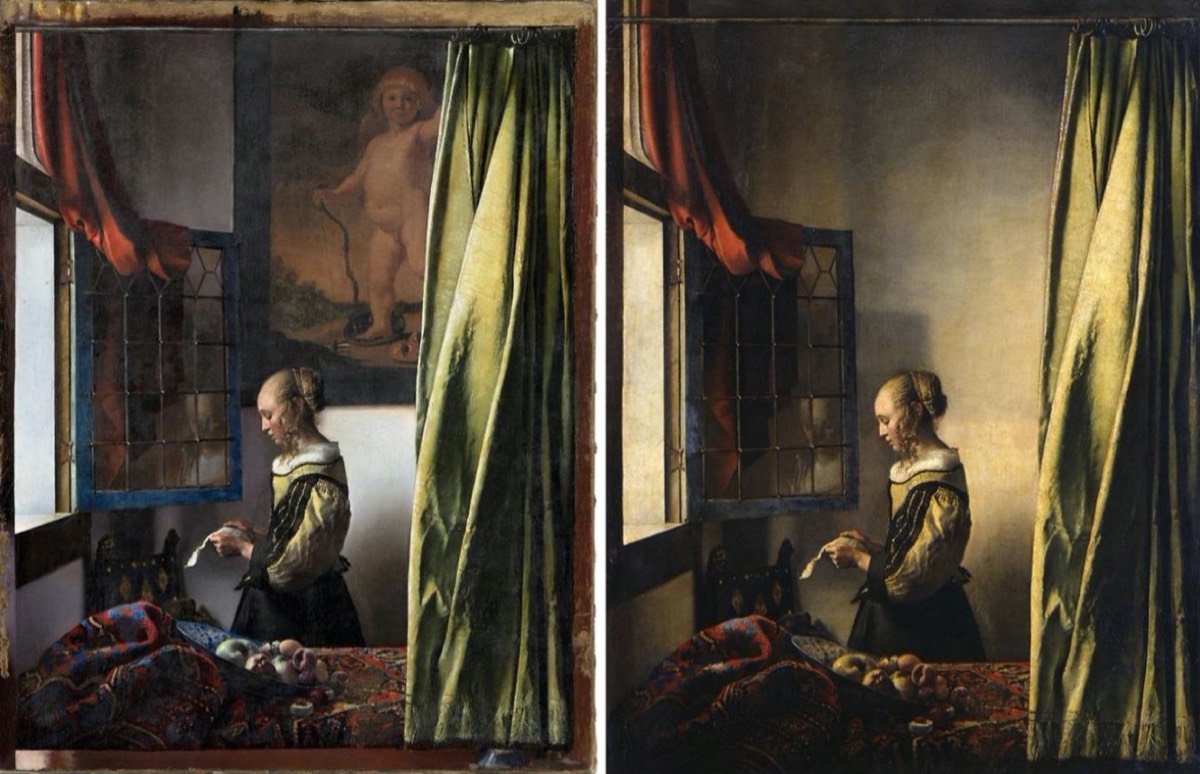
Side-by-side comparison of painting before and after restoration.
Enlarge / A new restoration of Johannes Vermeer’s Girl Reading a Letter at an Open Window has revealed a Cupid in the background. The restored painting will be the centerpiece of a new exhibition at the Gemäldegalerie Alte Meister in Dresden, Germany, from September 10, 2021, through January 2, 2022.

Since 1979, art historians have known that Johannes Vermeer’s Girl Reading a Letter at an Open Window (circa 1657-1659) featured an overpainted figure of a Cupid in the background. Most assumed Vermeer himself had painted over the figure. Now, thanks to a major restoration by the Staatliche Kunstsammlungen Dresden in Germany, the overpainting has a been removed to reveal the Cupid. That process also revealed that someone else painted over the Cupid in the 18th century, after the artist’s death, causing a rethinking of how the painting should be interpreted. The fully restored canvas is now on view to the public for the first time at the Gemäldegalerie Alte Meister, one of many galleries that form the Staatliche Kunstsammlungen Dresden.

The use of various X-ray imaging techniques—especially synchrotron radiation—has become a powerful tool for the nondestructive analysis of great works of art. For instance, European scientists in 2008 used synchrotron radiation to reconstruct the hidden portrait of a peasant woman painted by Vincent van Gogh. The artist (known for reusing his canvases) had painted over it when he created 1887’s Patch of Grass. The synchrotron radiation excites the atoms on the canvas, which then emit X-rays of their own that can be picked up by a fluorescence detector. Each element in the painting has its own X-ray signature, so scientists can identify the distribution of each in the many layers of paint.

In 2019, we reported on the work of a team of Dutch and French scientists who used high-energy X-rays to unlock Rembrandt’s secret recipe for his famous impasto technique, believed to be lost to history. And in 2020, an international team of scientists used synchrotron radiation to determine the cause of alarming signs of degradation to Edvard Munch’s famous painting The Scream. The team’s analysis revealed that the damage is not the result of exposure to light, but humidity—specifically, from the breath of museum visitors, perhaps as they lean in to take a closer look at the master’s brushstrokes.

Once mistakenly attributed to Rembrandt, Vermeer’s Girl Reading a Letter at an Open Window is one of the earliest-known examples of the Dutch master’s use of pointillé, a technique similar to embossing or engraving that involves punching dots. It was popular in the 15th century for decorating armor and firearms and was used on handmade book bindings in the 17th century. Vermeer’s version incorporated tiny white globules of paint to capture effects of the light. It’s sometimes cited as evidence that Vermeer used optical aids, most likely a camera obscura or a double-concave lens, although this remains a controversial hypothesis.

Paint samples were analyzed in the 1960s, revealing nothing unusual about the artist’s choice of materials. He used pigments common to the Baroque era, including blue azurite, lead-tin yellow, vermillion, madder lake, and lead white. The painting was first subjected to X-ray analysis in 1979, revealing the Cupid lurking under the overpainting and making this another example of Vermeer’s “painting within a painting” canvases. Scientists subjected Girl Reading a Letter to infrared reflectography in 2009, and in preparation for this latest restoration, the painting was examined via macro X-ray fluorescent scanning—to map the distribution of elements—and stereomicroscopy as well.

Conservationist Christoph Scholzel initially removed multiple layers of varnish, first applied in the 19th century and renewed repeatedly, which had gradually turned yellowish brown with age. That’s when he noticed the paints used in the central background where the Cupid was hidden had different solubility properties than those used elsewhere. Subsequent analysis showed that there were old layers of a binding agent, as well as a layer of dirt, between the paints in that area and the paints used by the Dutch master. This implies that several decades must have elapsed between Vermeer completing Girl Reading a Letter and the overpainting of the Cupid. The latter could not have been done by Vermeer.

Based on that finding, the decision was made to remove the overpainting to restore Girl Reading a Letter as Vermeer had intended. For this, Scholzel used a fine scalpel, monitoring the process under a microscope in order to retain what is likely the last original varnish layer applied by the artist himself. Here’s what the painting’s once-blank background now depicts, per Hyperallergic:

The blond-haired god of love and desire holds a bow in his right hand and gazes out at the viewer from the picture on the wall, enclosed by a thick black frame. On the floor behind him are two masks, possible symbols of deception; Cupid tramples over one of them with his right foot in an allegory of faithfulness and true love. Vermeer’s famous ethereal light streams through the open window, lending the scene a transcendent, spiritual glow.

“It is in Girl Reading a Letter that Vermeer discovers his own, distinct style. It marks the beginning of a series of paintings in which individuals, generally women, pause during an activity to find a moment of calm, and to reflect,” said museum director Stephan Koja. “Restoring the Cupid in the background shows us the master from Delft’s true intention. Beyond the superficial romantic context, it makes a fundamental statement on the nature of true love. Until now, we could only see this as a fragment. Now we know what a key role it plays in his oeuvre.”

From a technical standpoint, “The changed appearance of the Girl Reading a Letter at an Open Window, including the overpainting removed at the borders of the canvas, gives us an opportunity to reconsider the painting’s composition and how it works visually,” said Uta Neidhardt, the museum’s head conservator and exhibition curator. “The borders appear curiously unfinished—perhaps Vermeer covered it with an actual wooden frame, which is why he left them in such an ‘open’ condition. If we assume that he had planned to use such a construction, we immediately recall the experimental works by church interior painters from Delft, with their trompe-l’oeil curtains, or Pieter de Hooch’s intricate interiors.

https://arstechnica.com/?p=1791079


Review: Kena: Bridge of Spirits is this year’s best Zelda 35th-anniversary gift

What would a legitimate “dark” Legend of Zelda game look like? I don’t mean a game made by another studio that copies Zelda concepts while adding violence, cursing, or gothic architecture—we’ve seen plenty of those. I’m more curious how Nintendo itself might craft a 3D, “E-10” rated adventure—full of magical melee combat, puzzles, charm, and meticulous art direction—that somehow takes the series into a more sinister direction.

My praise for this week’s Kena: Bridge of Souls, the first-ever game from Ember Lab, is that it is as close to that pitch as I’ve seen since the Zelda series revolutionized the 3D adventure genre. This new, 15-hour series premiere is exhilarating, accessible, cute, gorgeous, ominous, and above all, touching.

K:BoS doesn’t necessarily exceed what we got from Nintendo’s 2017 classic Breath of the Wild, and its occasional slip-ups and issues are firm reminders that its creators are a bit green. But there’s something special here, in a debut game that most studios would kill to launch as their third or fourth game.

Gather ’round for a jubjub?

Kena: Bridge of Spirits [PS4, PS5, PC]

(Ars Technica may earn compensation for sales from links on this post through affiliate programs.)

Ember Lab’s debut game embraces the core of what makes Zelda games special, yet it finds unique magic by reimagining Nintendo’s tunic-clad hero as a supercharged, teenaged grim reaper. The Zelda-adjacent elements shouldn’t come as a surprise: the studio tested Nintendo’s command of IP law with a 2016 CG animation video that loudly features characters from Zelda: Majora’s Mask . Unsurprisingly, K:BoS looks quite similar to that video.

When the game first emerged during a PlayStation 5 reveal event last year, Ember Lab’s origins as a CGI animation house and its prior homage to a single Nintendo series set of as many alarm bells as you can imagine. I view gorgeously rendered game trailers with suspicion—a pretty game is not the same as a good one. And I’ve seen plenty of Zelda clones. But a hands-on K:BoS preview earlier this summer boosted my hopes, while the final product has done even more.

At K:BoS‘s outset, the titular Kena emerges from a cave to discover a mostly deserted village. Poisonous vines cover an otherwise empty town square, and desolate forests, mountains, and rivers stretch across the horizon in every direction. The exceptions are two children and a small, ink-black creature who follows you around. (The children—who are twins—call this Ewok-like blob a “Rot,” and they make clear that you’ll find more Rot if you pick through the game’s outskirts and corners.)

Rot will also warp ahead in order to pose adorably on the edges of a given trail.

The twins are named Beni and Saiya, and they want you to help them find their older brother. They magically vanish as they run away from you, only to reappear for a chat on the other side of a forest passage. This lines up with a few other magical things about Kena, including her glowing blue staff that can summon a magical shield and make various totems in and around the village light up a matching shade of blue. And when Kena notices any small, purple-glowing objects in the world, she can smack her staff onto the ground to uncover more Rot.

Kena soon learns she can use these Rot to deal with various problems in this grim village. For example, you may be approached by monsters, which usually consist of carved wood and gathered grass and mud that have been molded into bipedal, humanoid beasts. While engaging in combat, tap the appropriate button to make your Rot supercharge a slam of your staff, harvest a nearby healing berry for immediate consumption, or do other useful moves. (More on combat in a bit.)

Outside of battles, the Rot can gather, lift, and drop heavy objects a la Nintendo’s Pikmin. They can also temporarily combine into a powerful snake that slithers and slams into certain poisonous brambles, thus clearing your path. And sometimes, they walk or crawl up to items of interest in your general vicinity in order to get your attention. Rot will also warp ahead to pose adorably on the edges of a given trail, because, hey, why not.

Picking and choosing its storytelling battles

The twins’ request comes as a response to Kena’s mission: scaling the village’s ominous mountain and freeing the trapped spirit at the top. But Kena comes to learn that what befell this village was more than the work of a single dark entity. Helping the twins is a smaller, more manageable goal on the way to uncovering a larger tragedy from the past. This is why K:BoS makes me think of a “dark Zelda.”

<a href="https://cdn.arstechnica.net/wp-content/uploads/2021/09/Screenshot-8821.png" class="enlarge" data-height="1440" data-width="2560" alt="I want to keep this review spoiler-free, so I'm not including screenshots from K:BoS‘s compelling cinema scenes. But this picture should give you a sense of their general tone. “><img alt="I want to keep this review spoiler-free, so I'm not including screenshots from K:BoS‘s compelling cinema scenes. But this picture should give you a sense of their general tone. ” src=”https://rassegna.lbit-solution.it/wp-content/uploads/2021/09/review-kena-bridge-of-spirits-is-this-years-best-zelda-35th-anniversary-gift.png” width=”980″ height=”551″>
Enlarge / I want to keep this review spoiler-free, so I’m not including screenshots from K:BoS‘s compelling cinema scenes. But this picture should give you a sense of their general tone.

I was consistently impressed by Ember Lab’s mastery of visual storytelling. Visual and nonverbal cues fill out the village as you explore everything from its forest glens to its seaside docks to its abandoned factory. The game’s “wide linear” approach does well to choreograph players’ transitions from one location to the next, but it still leaves you free to hunt for shiny collectibles. And you occasionally find clues tucked in hidden corners. But K:BoS doesn’t hide journal entries or other dumps of text. Stories sometimes emerge because Kena has broken down a wall of poisonous rot, thus exposing what the village looks like in the light of day. Or a ghost-filled illusion may appear after completing a puzzle to show what life used to look like in this place.

Full-blown cinematic scenes serve as guideposts between these exploratory moments, and goodness: if you’re looking for a happy-go-lucky adventure with zero serious feelings, go elsewhere. K:BoS benefits from having only a few big scenes, and even though its dialogue is serviceable at best, it still exceeds your average anime. The game really shines when it connects the dots between your adventure and the way the world was before you go here. You’re not just exploring a village—you’re exploring the lengths that its previous inhabitants went to in the name of love and hope.

Without spoiling the dots that K:BoS connects, I will say, with a tear in my eye, that I haven’t been this touched by a video game in some time. Hats off to Ember Lab for understanding how to join storytelling with interactivity in meaningful ways that don’t require tabbing out to a text-filled submenu.

https://arstechnica.com/?p=1796788


Sony’s new PS5 firmware can make your games slightly faster

Sony’s new PS5 firmware can make your games slightly faster
Aurich Lawson | Sony

Sony’s latest PS5 system firmware update makes some games run slightly faster, at least under certain scenarios. In a new Digital Foundry video, it was discovered that a performance bump—which affects both the console’s 1000 series launch model and recently released 1100 series model revision—appears to make certain games run up to three percentage points faster.

Digital Foundry founder Richard Leadbetter compared performance tests in Control Ultimate Edition and Devil May Cry 5 Special Edition using previously released PS5 firmware as a benchmark against the now-current September system software update. The video’s accompanying frame-graph footage showed DMC5SE cut scenes and Control‘s photo mode (which unlocks the game’s frame rate, capped at 30 fps during gameplay) running at a fluctuating 1-2 frames per second higher on the PS5 using the newer firmware.

During his tests, Leadbetter said each game was running 1-3 percent faster with a 1 percent margin of error. He added that ray tracing and unlocked frame rates seemed to be a “common component” in their occurrence. Digital Foundry did not mention any other games that have unlocked frame rates below 60 fps, since the powerful PS5 console doesn’t have many of those. This leaves to interpretation exactly how much power this firmware update is possibly opening up to PS5 games across the board.

Though faster performance for games may seem unusual for a hardware-side system update, the case of Sony’s new firmware is only the latest example. Microsoft initially launched the original Xbox One in 2013 with 10 percent of the device’s overall GPU processing time reserved for “system processing,” which earmarked space for mandatory Kinect integration as well as the hardware’s jump-between-apps feature, Snap mode.

Representatives for Sony did not immediately respond to questions about the PS5’s latest firmware update and its impact on game performance.

https://arstechnica.com/?p=1796836


SEC probing Activision Blizzard in wake of harassment, discrimination lawsuits

Photoshopped image from a video game shows a person in an Activision Blizzsard hoodie confronted barrels filled, presumably, with gasoline.

In video game parlance, longtime gaming publisher Activision Blizzard has jumped to “extreme” difficulty as of late, thanks to a wave of highly publicized lawsuits. On Monday, the company behind World of Warcraft, Diablo, and Call of Duty faced arguably its biggest test yet, this time from the federal government.

The Securities and Exchange Commission is investigating Activision Blizzard over how the video game publisher dealt with allegations of sexual misconduct and workplace discrimination—and whether related information was properly disclosed to shareholders by executives.

The federal regulator has subpoenaed the company as well several senior executives, including CEO Bobby Kotick, according to The Wall Street Journal. It has also requested a variety of documents, including Kotick’s communications with other executives regarding the matter, minutes from board meetings held since 2019, the personnel files of six former employees, and separation agreements written this year. Former employees also reportedly have been subpoenaed.

Activision confirmed the SEC investigation in a statement to the WSJ, saying that the company is cooperating with the agency.

Earlier this year, Activision Blizzard was accused of fostering a “frat boy” culture in a lawsuit brought against it by the California Department of Fair Employment and Housing. In the filing, the agency claims that the Santa Monica-headquartered company paid women less, gave them fewer opportunities for advancement, and created a “breeding ground for harassment and discrimination against women.”

“Blatant sexual harassment”

Sexual harassment was allegedly rampant. “High-ranking executives and creators engaged in blatant sexual harassment without repercussions.” In one terrible incident, a female employee committed suicide while on a work trip with a male supervisor, who allegedly harassed her during the trip.

The lawsuit also claims that former Senior Creative Director Alex Afrasiabi “was permitted to engage in blatant sexual harassment,” including openly hitting on female employees, trying to kiss them, telling them he wanted to marry them, and more. Other male employees and supervisors had to physically pull him off his female colleagues, the lawsuit says. Afrasiabi’s behavior was tolerated with “little to no repercussions.” Among Afrasiabi’s supervisors was Blizzard President J. Allen Brack, who the lawsuit says received reports from employees about the alleged behavior but only gave the creative director a “slap on the wrist.”

Afrasiabi was fired from the company in early 2020 for “misconduct in his treatment of other employees,” Activision Blizzard confirmed, and Brack left the company last month. In August, Activision also confirmed the departure of other employees, including Luis Barriga (former director of Diablo IV), Jesse McCree (a former Diablo IV designer), and Jonathan LeCraft (former World of Warcraft designer) without specifying why they left. McCree and LeCraft were seen in photos published by Kotaku that tied them to an alcohol-fueled BlizzCon 2013 after-party in what some staffers called the “Cosby Suite.”

Under pressure

Brack’s resignation came on the heels of a shareholder lawsuit that said the company “artificially inflated” the value of the stock and made “false and misleading statements” by withholding details on harassment, discrimination, and misconduct. Activision Blizzard’s SEC filings, the shareholder lawsuit says, included boilerplate language about business risks posed by lawsuits against the company. That language, the shareholder lawsuit alleges, obscured the “numerous complaints about unlawful harassment, discrimination, and retaliation [that] were made to human resources (“HR”) personnel and executives which went unaddressed.”

Indeed, Activision Blizzard’s stock price dropped more than 6 percent on July 27, the day after the California lawsuit was made public, and has slid further since.

The company’s initial response to the California lawsuit drew harsh criticism from employees, who circulated a petition calling for the company to acknowledge the “seriousness of the allegations.” “To claim this is a ‘truly meritless and irresponsible lawsuit,’ while seeing so many current and former employees speak out about their own experiences regarding harassment and abuse, is simply unacceptable,” it said. Later that week, employees organized a walkout to “end mandatory arbitration clauses” that “protect abusers and limit the ability of victims to seek restitution” as well as new hiring and compensation practices.

The SEC investigation comes as Activision Blizzard is planning to release Diablo II: Resurrected on September 23.

https://arstechnica.com/?p=1796859