Finch trailer is carefully tailored to push all the right warm, fuzzy buttons
A catastrophic solar “event” has wiped out most of humanity.
YouTube/Apple TV+
Finch (Tom Hanks) is a robotics engineer who has been living underground for a decade with his trusty doggo, Goodyear.
YouTube/Apple TV+
Even after an apocalypse, diner manners still matter: no paws on the table.
YouTube/Apple TV+
Finch builds a robot sidekick named Jake.
YouTube/Apple TV+
Finch is delighted with his creation.
YouTube/Apple TV+
Goodyear has seen the Terminator films and is more skeptical.
YouTube/Apple TV+
The trio embarks on a road trip to the mountains.
The battered RV must protect them from some seriously harsh conditions along the way.
YouTube/Apple TV+
Finch takes the wheel.
YouTube/Apple TV+
Jake the robot gets a driving lesson.
YouTube/Apple TV+
A possible message from other survivors?
YouTube/Apple TV+
Jake just might prove valuable in a crisis.
YouTube/Apple TV+
Bonus glamour shot of adorable doggo.
YouTube/Apple TV+
Apple TV+ has dropped the official trailer for Finch, its forthcoming sci-fi film starring Tom Hanks as a robotics engineer who survives an apocalyptic solar flare, then goes on a trek to mountain safety with his trusty dog and robot sidekick. That is so Tom Hanks, amirite? Yes, this is a real movie, not a gag. Based on the trailer—carefully tailored to push all the requisite emotional buttons—the film looks like a strange mix of Cast Away, WALL-E, and Chappie. In the right hands, that unlikely mix just might work.
The title was BIOS when the film was originally announced in 2017. The global pandemic put the planned 2020 theatrical release on hold indefinitely, and Universal Pictures eventually sold the rights to Apple TV, which changed the title to Finch. There are reasons to be cautiously optimistic. The film is directed by Miguel Sapochnik, the mastermind behind several big, battle-centric episodes of Game of Thrones, including “Hardhome,” “The Battle of the Bastards,” “The Long Night,” and the hugely controversial (because of a favorite character’s heel turn) “The Bells.” The spec script by Craig Luck and Ivor Powell made 2017’s “Black List” of favorite unproduced screenplays. And you’ve got the world’s most likable everyman (Hanks) in the lead role.
Per the official synopsis:
Tom Hanks stars as Finch, a robotics engineer and one of the few survivors of a cataclysmic solar event that has left the world a wasteland. But Finch, who has been living in an underground bunker for a decade, has built a world of his own that he shares with his dog, Goodyear. He creates a robot, played by Caleb Landry Jones, to watch over Goodyear when he no longer can. As the trio embarks on a perilous journey into a desolate American West, Finch strives to show his creation, who names himself Jeff, the joy and wonder of what it means to be alive. Their road trip is paved with both challenges and humor, as it’s as difficult for Finch to goad Jeff and Goodyear to get along as it is for him to manage the dangers of the new world.
We hear Finch in a voiceover ruminating on just how quickly the world turned into an inhospitable hellscape: “Goodbye crops and food, goodbye everything.” We see him retreat to his underground bunker and befriend Goodyear, who is clearly a Very Good Boi (and a much livelier companion than Wilson the volleyball in Cast Away). Finch is delighted when he succeeds in building a robot that clearly states its mission: “Robot must protect dog.” But when an approaching storm threatens to wipe out their enclave, the trio embarks on the aforementioned road trip, hoping to reach the mountains, where apparently they will be safe—or as safe as one can be under the circumstances. Count on at least a couple of gut-wrenching moments to play on our heart-strings before it’s over. The trailer also hints at other human survivors, possibly hostile, “hiding in the shadows.” [Updated]
Finch debuts November 5, 2021, on Apple TV+.
[embedded content]
Official trailer for Apple TV+’s Finch.
Listing image by Apple TV+
https://arstechnica.com/?p=1796691
Valve moves Dota 2 International to Romania, adds mask-and-vax rules
Valve announced this week that its prestigious Dota 2 tournament The International will require all attendees to be fully masked and vaccinated for entry.
As noted on the Dota 2 site, anyone attending the October competition at the National Arena in Bucharest, Romania, must be at least 10 days out from their final vaccination, and attendees will need to present proof of inoculation (which must be in either English or Romanian) along with a photo ID to gain access to the event grounds and tournament arena. All attendees must also wear a mask and proof-of-vaccination wristband along with their registration badges. Additional safety protocols will be put into place throughout the tournament.
Now in its tenth year, The International gathers together the best Dota 2 teams from around the globe to compete for a multi-million dollar prize pool. But over the past year, Valve has not had an easy time with COVID-related restrictions for its annual tournament. The company’s initial plans to hold The International 10 in Stockholm were scrapped earlier this summer after the Swedish Sports Federation decided not to include esports in its officially recognized body—a move that meant anyone traveling for the tournament would be denied an entry visa.
Valve’s subsequent requests for the Swedish government to intervene were denied, with the company announcing the move to Romania in July. (2020’s tournament, which was also planned to be held in Stockholm, was indefinitely delayed in April 2020 over safety concerns amidst the global pandemic.)
The move to make The International a fully-vaccinated, fully-masked tournament is just the latest in a growing trend of gaming events tightening up COVID restrictions. For instance, this summer’s PAX West in Seattle required attendees to present either proof-of-vaccination or a negative PCR test for entry, as well as wearing a vaccination-proof wristband along with their registration badges.
The International 10’s group stage, which doesn’t appear to be open to the public, will be held October 7-10, while the main stage tournament event (the only stage Valve is selling tickets for) will be split between two midweeks running from October 12-15. The finals are scheduled to be held on October 16 and 17. Tickets for the main stage will go on sale September 22, and those are sold in three separate two-day bundles.
https://arstechnica.com/?p=1796333
RIP Sir Clive Sinclair, creator of UK’s famed ZX Spectrum gaming computer
Enlarge/ Sir Clive Sinclair holding the world’s smallest television screen when it was created by Sinclair Radionics in 1977.
Getty Images
Sir Clive Sinclair, the namesake of a British electronics manufacturer who helped pioneer Europe’s microcomputing boom, is dead at the age of 81.
His company, Sinclair Radionics, is arguably best known around the world for 1982’s ZX Spectrum, an early example of a computer capable of multi-color, real-time graphics. The device dominated the UK and other European territories in the early 1980s. This computer was a major processing step up from black-and-white Sinclair computers like ZX80 and ZX81, and it debuted in a configuration priced as low as £125. American readers probably best know this platform thanks to popular and ambitious ZX Spectrum games from the little developer Ultimate: Play The Game. That company eventually rebranded itself as Rareware and turned into a ’90s powerhouse on Nintendo consoles.
Yet before his name became interminably linked to gaming history, Sinclair’s rise to running his own electronics manufacturing company largely resembles the stories of American electronics pioneers who began as garage hobbyists. A BBC documentary, Clive Sinclair: The Pace Setters, chronicles the inventor’s rise, which began with him selling one-at-a-time radio kits via mail order in the 1960s.
As the documentary is region-locked, many readers will have to settle on this BBC text version of its highlights, which follows Sinclair’s rise as a maker of British pocket calculators and portable TVs before redirecting his efforts to personal computers. During this time, an effort to get the British government to back Sinclair as a formally supported PC maker, especially as the government began bullishly promoting computer access in homes and schools, fell apart. Instead, rival computer manufacturer Curry became a “BBC Micro” partner. Sinclair and Spectrum fired back with the better power-per-pound option of the ZX Spectrum, which went on to sell over 5 million units. Sadly, the rest of his career didn’t reach the same heights, and it was largely marked by botched efforts to launch electric modes of transport, including the famous failure that was the pod-like C5 “car.”
For a charming Clive-on-Clive conversation, check out this 1990 interview with longtime British TV host Clive Anderson (Whose Line Is It Anyway?), complete with the two men looking at and talking about various Spectrum inventions over the years—including, incredibly, Sinclair’s failed C5.
[embedded content]
Sir Clive Sinclair talks about his product history in 1990.
https://arstechnica.com/?p=1796244
Study confirms superior sound of a Stradivari is due to the varnish
Enlarge/ A 1729 Stradivari known as the “Solomon, Ex-Lambert” on display at Christie’s in New York in March 2007.
Along with Andrea Amati and Andrea Guarneri, Antonio Stradivari dominated the so-called Golden Age of Violins (roughly 1660 to 1750), and the instruments they crafted remain the gold standard today in terms of acoustic quality. World-renowned cellist Yo-Yo Ma has long favored a Stradivarius instrument, as does violinist Joshua Bell. But scientists have been arguing for years about precisely why these instruments have such superior sound. A recent paper published in the journal Angewandte Chemie confirms a theory dating back to 2006: the secret lies in the chemicals used to soak the wood, most notably borax, zinc, copper, alum, and lime water.
I’ve written extensively about this topic in the past. The (perceived) unique sound can’t just be due to the instrument’s geometry, although Stradivari’s geometrical approach did give us the violin’s signature shape. One hypothesis is that Stradivari may have used Alpine spruce that grew during a period of uncommonly cold weather, which caused the annual growth rings to be closer together, making the wood abnormally dense. Another prevailing theory has to do with the varnish: namely, that Stradivari used an ingenious cocktail of honey, egg whites, and gum arabic from sub-Saharan trees—or perhaps salts or other chemicals.
Then again, the difference may be all in our heads. A player’s instrument preference is highly subjective, and there’s some evidence of so-called “psychoacoustics” at play: that is, we’ve become so awed by the name Stradivarius that it influences how we evaluate or respond to the sound of one of Stradivari’s instruments.
In fact, a 2012 double-blind study of 21 experienced violinists found that most of the subjects preferred playing the newer instruments; the Stradivarius ranked last in their preferences. Most of them couldn’t tell the difference between the old and new instruments, with no significant correlation between an instrument’s age and its monetary value. “Rather than searching for the ‘secret’ of Stradivari, future research might best be focused on how violinists evaluate instruments, on which specific playing qualities are most important to them, and on how these qualities relate to measurable attributes of the instruments, whether old or new,” the authors concluded.
The varnish theory dates back to 2006, when Joseph Nagyvary, a professor emeritus of biochemistry at Texas A&M University, made headlines with a paper in Nature claiming that it was the chemicals used to treat the wood—not necessarily the wood itself—that was responsible for the unique sound of a Stradivarius violin. Specifically, it was salts of copper, iron, and chromium, all of which are excellent wood preservers but may also have altered the instruments’ acoustical properties. He based his findings on studies using infrared and nuclear magnetic resonance spectroscopy to study the chemical properties of the backboards of several violins (the backboard is the instrument’s largest resonant component).
Enlarge/ Close-up of the sculpture of Antonio Stradivari (1644–1737) in Corso Garibaldi, Cremona, Italy.
Elena Piccini/Fototeca Gilardi/Getty Images
In 2007, physicist George Bissinger of East Carolina University used a 3D scanning laser to produce detailed and quantitative measurements of the acoustic properties of several Strad violins—essentially mapping out how they vibrate to produce those heavenly tones. Bissinger hung each of the five violins by elastic bands, then struck the wood of the top plate with a little hammer while recording and measuring the vibrational modes with the scanner.
He specifically wanted to measure the in-plane and out-plane motion: the in-plane motion is the source of much of the sound energy, and this converts into out-plane motion, which produces the rich tonal sounds we associate with fine violins. In addition, he hired a world-class violinist to play each of the violins used in the study for an hour to get the feel of the instruments and then offer subjective ratings for each one. The musician’s subjective analysis was then compared to the objective acoustical data. The resulting measurements were sufficiently detailed to reconstruct the stiffness properties of the wood used to make the Strads, according to Bissinger.
CT scans
In 2008, Berend Stoel from the Leiden University Medical Center in the Netherlands collaborated with a luthier named Terry Borman to take CT scans of several Strads, along with several modern instruments for comparison. The aim was to study the density of the woods used, since differentials in wood density impact vibrational efficiency and thereby the production of sound. Stoel had developed a computer program that noninvasively calculated lung densities in people suffering from emphysema, and he adapted it to study wood densities from CT scans.
There wasn’t much significant difference between the average wood density of the classical and modern violins used in the study. But the density differences between wood grains of early and late-growth wood was significantly smaller in the classical Cremonese violins compared with modern violins. “Our results clearly document basic material property differences between the woods used by the classical Cremonese and contemporary makers,” the authors concluded.
More evidence in favor of Team Varnish came from a 2016 study by researchers at the Swiss Federal Laboratories for Materials Science and Technology (EMPA). They studied how a varnish’s chemical composition, thickness, and degree of penetration into the wood affected the acoustics of the instrument.
They used samples of Norway spruce tone wood cut from the same tree and coated the samples with different kinds of varnish: two of their own making, and two used by German master violin makers. Then they conducted vibration tests of the samples over time, using x-ray tomography to measure the effects.
The researchers found that all the varnishes increased the wood’s dampening ability—that is, how well it absorbs and stops vibrations. That extra damping, compared to unvarnished wood, leads to a warmer, mellower, and aesthetically pleasing sound. The varnishes favored by German luthiers performed slightly better in that regard, and also made for better sound radiation (louder tones).
A 2017 study by Taiwanese researchers compared the maple used by Stradivarius with modern, high-quality maple wood. Their analysis showed evidence of chemical treatments in the form of aluminum, calcium, and copper, among other elements. And thanks to the decomposition over time of a wood component called hemicellulose, the Stradivari and Guarneri instruments used in the study had 25 percent less water than modern instruments. “This is fundamentally important because the less moisture, the more brilliant the sound,” Nagyvary told The New York Times.
Enlarge/ Violinist Adrian Pintea plays a 1729 Stradivari known as the “Solomon, Ex-Lambert” in 2007 at Christie’s in New York.
Don Emmert/AFP/Getty Images
This latest study analyzes trace chemicals preserved in the maple wood used to make the soundboards of Stradivari and Guarneri instruments. The research involved a rare collection of Cremonese wood samples of spruce and maple used by Stradivari, Guarneri, and Amati, and the results were then compared to modern spruce and maple tonewoods, as well as woods from antique Chinese zithers and less exceptional old European violins.
They found traces of borax and several metal sulfates in the wood samples dating between 1600 to 1750. As David Bressan explained over at Forbes:
Borax, also known as sodium-borate, occurs naturally in evaporite deposits produced by the repeated evaporation of seasonal lakes. Borax is still used today in various household laundry and cleaning products, and in the past was used also as an insecticide and fungicide, killing pests. Copper and zinc sulfates, often associated with copper ore, likely served the same purpose. Alum, an evaporite mineral containing sulfur, aluminum, potassium and sodium, was added to the mix to form a weak acidic environment in the wood, preventing mold growth. Halite, common table salt, was added as moisture control, keeping the wood too dry for microbes and fungi, and at the same time preventing the deformation of the instrument caused by humidity fluctuations.
This is welcome news to Nagyvary, who co-authored this latest paper. “This new study reveals that Stradivari and Guarneri had their own individual proprietary method of wood processing, to which they could have attributed a considerable significance,” he told Texas A&M Today. “They could have come to realize that the special salts they used for impregnation of the wood also imparted to it some beneficial mechanical strength and acoustical advantages. These methods were kept secret. There were no patents in those times. How the wood was manipulated with chemicals was impossible to guess by the visual inspection of the finished product.”
Nagyvary still thinks more research is needed to shed further light on the connection between the chemicals used to treat the wood and the sound quality of the finished instruments. “First, one needs several dozens of samples from not only Stradivari and Guarneri, but also from other makers of the Golden Period (1660-1750) of Cremona, Italy,” he said. “There will have to be better cooperation between the master restorers of antique musical instruments, the best makers of our time, and the scientists who are performing the experiments often pro bono in their free time.”
Nintendo’s “thing after the Switch”: How an overheard convo sent me reeling
Enlarge/ Today’s very brief hint of the gaming future comes wrapped in a Nintendo bow.
Aurich Lawson
SEATTLE—It’s not every day I hear about unannounced Nintendo products over guac.
Thanks to a chance encounter last month, I’ve been sitting on one of the weirder scoops in my 25-year writing career—one that will simultaneously set many gamer tongues wagging and bore other gamers to death. It’s about Nintendo, and I should start by making abundantly clear that I didn’t get the information double-checked or verified by anyone who has particular access or insight into the gaming company’s plans (neither did I ask my uncle who—promise, swear—works as Mario’s personal driver).
But I have been turning over this minuscule scrap of information in my mind ever since. What I heard is both simultaneously a resounding “duh” for a company like Nintendo and yet also possibly illuminating about the industry giant’s near-future plans. So I invite you to sit with me, grab a chip, and pick at this bowl of game-industry-news guacamole.
Ars Technica is always listening
On an overcast August afternoon, I put on a mask, hop on my bike, and pedal to a cozy restaurant that’s a decent haul from my Seattle apartment. I’m meeting a longtime colleague to talk shop—something I haven’t done in a long time but am finally comfortable doing—and we want an option with a patio. I don’t overthink my choice.
While waiting for my colleague to arrive, I order some chips and grab my smartphone. I’m idly doomscrolling when the party three tables over catches my attention. I hear the word “Nintendo,” and my ears perk up. Decades of nerd-dom mean that I always want to hear public chatter about video games. (Or, you know, awkwardly walk up to a stranger and offer unwanted “well, actually”s about the Mother/Earthbound series of JRPGs.)
The words are fuzzy, other than clarifying that one of the speakers “works” at Nintendo. But one declaration can be heard across the patio: “I’m working on the thing after the Switch.” Then a pause. “If I tell you more than that, I would have to kill you.” A laugh. I brace myself by clenching my phone. My eyes dart about in search of a hidden-camera prank-show crew.
This is followed by fuzzier words—something about working in “Microsoft’s backyard” (likely meaning Redmond in Washington state, where Nintendo of America is headquartered). Another mumbler starts talking about their life, not Nintendo. They go quiet when the check shows up and the credit card comes out, and a heartbeat later, they’ve slipped away from the patio, no further secrets revealed.
An unsurprising surprise
My eyes are glued to my smartphone so as not to look directly into the sun of this incredible moment for me, a full-time critic and reporter on the games industry—and also to type every word I heard before I possibly black out and lose the thread. Minutes later, my colleague shows up, and I give him the kind of look that suggests Bill Murray just sat next to me, bought me a shot of tequila, and whispered into my ear, “No one will ever believe you” before vanishing into a cloud of smoke.
“You are not going to believe what I just heard,” I tell Ars Technica contributing reporter Steve Haske, and I describe the white-hot moment I had just undergone. Haske nods and waits for me to offer a further bombshell. I admit I don’t necessarily have one, then ask if he’ll help me turn the aluminum wrap on my burrito into a tin-foil hat. He obliges, and we begin hashing out my weird moment. First up: we nearly met elsewhere for coffee instead of here for lunch. (Though in Seattle, who’s to say how relevant the location was? Maybe we missed our shot at hearing a wild, local Apple or Facebook rumor over cappuccinos, instead.)
It seemed legit, we each say. I would be impressed if someone went to the trouble of tailing and trolling me for the sole purpose of dropping fake Nintendo news into my bowl of guacamole. But the overheard conversation also sounded like exactly how two friends would catch up, if one works for the gaming sphere and one doesn’t. “Switch.” “Microsoft’s backyard.” They were picking and choosing recognizable terms instead of immediately explaining revolutionary tech concepts or exact release dates of niche sequels. (So, no, this chance encounter didn’t lead to revelations about the return of a dormant Nintendo series like F-Zero.)
The revelation also seemed a bit pedestrian. Nintendo’s going to make more gaming hardware? Big whoop, Poindexter. You don’t have to look far in any of Nintendo of Japan’s financial disclosures to see reminders that the company is constantly developing new ideas in the realms of both hardware and software. Some gaming analysts and execs have suggested that concepts like cloud gaming will eventually render standalone game consoles obsolete. But we’re not there yet, and Switch sales are still too hot for Nintendo to stop making new consoles altogether. So, sure. Another Nintendo console. That checks. https://arstechnica.com/?p=1795870
Battlefield 2042 joins recent game-delay frenzy, moves to November
Battlefield 2042 has been delayed from its initial October 22 release date, though it will still launch this year, EA announced today. The multiplayer-only shooter will now hit stores on November 19, the publisher said in a statement.
Citing the complications of developing games in a work-from-home environment during a global pandemic—by now a familiar challenge for the countless game makers that have had to delay other high-profile 2021 games—DICE assured fans that the team is working on finishing touches rather than dealing with any kind of development trouble. The developer also reiterated that there would be updates later this month regarding 2042‘s open beta. In other words, this is pandemic business as usual.
After Battlefield 2042‘s reveal during EA’s June E3 news blitz, the publisher announced that the game will feature three modes, none of which are battle royale-related. “All-Out Warfare,” the traditional BF deathmatch mode, is finally upgrading to 128 players on current-gen consoles and PC. “Battlefield Portal” is a mashup game that lets players customize matches with elements of Battlefield 1942, Battlefield: Bad Company 2, and Battlefield 3 inside 2042 maps. “Hazard Zone” is an alleged squad-based mode that EA has thus far been mum on. Today’s announcement didn’t specify whether all three modes would launch with the game.
As far as the seemingly endless train of 2021 delays is concerned, DICE’s isn’t as bad as it could be. Earlier this week, Techland confirmed its long-in-production Dying Light 2 is being pushed back to February 2, while Ubisoft announced this week that its guitar-instruction game Rocksmith+ is shifting to 2022. Sony also recently announced that Horizon Forbidden West will move to February 28 from its original “late 2021” launch.
https://arstechnica.com/?p=1795959
Lost Judgment impressions: 15 wild hours in Yokohama
Lost Judgment‘s action detective, Takayuki Yagami.
You’ll be seeing this stance a lot.
Another day on the job…
…Collecting photo evidence of a shady customer.
Could be the Yagami Detective Agency’s motto.
Yagami’s special EX moves are pretty brutal.
More evidence collecting.
Yagami’s inner monologue offers clues.
At a glance, Lost Judgment may seem intimidating to anyone who hasn’t graduated from Sega’s school of hard Yakuza knocks. To start, it’s a spinoff of Ryu Ga Gotoku Studio’s long-running crime series, which is saddled with a truckload of backstory. On top of that, it’s a direct follow-up to 2019’s Judgment, the first game from that spinoff. Finally, the overwhelming, unadulterated immersion into modern Japan that Yakuza games are known for doesn’t really feel like anything else in video games.
With these eccentricities in mind, anyone not already intimately familiar with the broader Yakuza universe may feel too lost to know where to begin here, if they want to bother trying at all. Yet after spending roughly 15 hours over the past week playing through the first four chapters of this game, I can say Lost Judgment is absolutely worth your time, with a barrier to entry much lower than you’d expect. Stacked up against any recent high-production action games, it’s unlike anything else you’ll play this year.
A radical shift?
Following in the footsteps of every Yakuza that has come before it, Lost Judgment can’t be pigeonholed into one genre easily. Is it a bareknuckle 3D brawler? An action RPG exploding with side quests? An open-world playground of ridiculous mini-game distractions? An immersive “virtual Japan” simulator? A gripping, complex underworld melodrama worthy of prestige cable? The answer to all of these is unapologetically yes, yes, and yes.
The resulting cocktail plays like a successor to 1999’s classic Dreamcast martial arts adventure, Shenmue, shaken up with Judgment’s mix of unique ingredients. But rather than dousing players in the blood oaths and inter-family political coups of Yakuza proper, Lost Judgment picks up in a mostly self-contained story where its predecessor left off. The game trades long-held gangsterisms for a detective’s mindset. And as much as I love the originals, that’s a very engrossing twist on their formula.
Oh, and did I mention there’s a shiba that helps you solve crimes? Because there’s a shiba that helps you solve crimes.
Dark days in Yokohama
This game opens on a brutal scene seemingly unrelated to protagonist Takayuki Yagami, a lawyer-turned-private investigator in Tokyo. A pair of firefighters are responding to red smoke billowing from the windows of a derelict warehouse in Isezaki Ijincho, a waterfront neighborhood in Yokohama. Inside, a series of lit emergency flares have been carefully laid out on the building’s floor, forming an arrow that points to a filthy tarp thrown over something large.
Clearly nothing good can come of this, and sure enough, nothing does. When the responders remove the covering, they’re greeted with the horrific sight of a maggot-ridden, decaying corpse of a man tied to a chair, choked in a black swarm of flies. End scene.
A second major event central to the game’s mystery is equally troubling. Early on, an active-duty police officer, Akihiro Ehara, is arrested for groping a woman on a train bound for Shinjuku. Caught by a crowd on the station platform, he makes a scene while resisting capture, and given his occupation, the scandal makes national news. But something unexpected happens when Ehara appears in court for his sentencing.
A guilty verdict reached, the disgraced cop uses the opportunity to reveal information about the Yokohama corpse, giving details not even the police have uncovered. Further complicating matters, Ehara is being defended by two of Yagami’s former colleagues from his old law office, though neither can explain his motive or sudden enigmatic change. From here, Yagami is brought to Yokohama, where he’s dragged into an increasingly intricate web of intrigue I won’t spoil. Let’s just say, players will end up in some pretty unorthodox situations even for a detective story. I will also say that you should be prepared to settle in here, because there is a lot of dialogue. This game takes its script very seriously, and RGG Studio’s writing fires on all cylinders.
Yokohama is gorgeously rendered in Ryu Ga Gotoku Studio’s Dragon Engine.
Yagami has a full platter of parkour skills to get into places he shouldn’t be.
You can act casual if a suspect notices you tailing them.
Investigation mode.
Stealth mode, complete with sneaking stance.
Guards will always fall for the old coin-toss trick.
Yagami’s partner, the color ex-yakuza Masaharu Kaito.
Kamurocho, Yakuza‘s take on Shinjuku’s infamous red light district.
It wouldn’t be a Yakuza game without silly, Sega-licensed distractions.
You’ll often need to gather information from witnesses.
Just an ordinary detective… with a skateboard
Though Japan’s courts and judicial system are thematic narrative pillars, Lost Judgment’s interactive bread and butter is in old-fashioned gumshoeing. On the morning the corpse is found, the impossibly fashionable Yagami is in Tokyo doing just that, tracking a person of interest for a client in the Kamurocho district. This criminal hotbed (a stand-in for Shinjuku’s actual red light district, Kabukicho) is well-trodden ground for Yakuza, having appeared in most entries including Judgment. Here, the city eases you into basic sleuthing.
In the ensuing half-hour distillation (the last time you’ll be in Kamurocho for quite a while), you get a nice encapsulation of most of the detective hallmarks from the previous game, and then some. As Yagami shadows his subject, you move through elementary concepts like tailing suspects, combing designated areas for clues, running down perps in high-speed, on-foot chases, and capturing photo evidence in a comically Pokemon Snap-esque mini-game complete with requisite framing-and-extra-criteria “score” boosts. (Later you’re able to don disguises as well, but don’t expect anything like Hitman, where you can just wander around dressed like a chicken.)
A few new, if simple, systems are added into the mix, too. Should Yagami need to find a way into off-limits buildings, he can now use his parkour skills to clamber up pipes, run across walls, or vault over gaps in exploration sections. Trespassing in hostile territory similarly instigates a stealth mode, with the crouching, coin-throwing detective adding the tiniest touch of Metal Gear Solid’s evasive action to what would start and end in Yakuza with a throwdown.
Though the thrust of these investigative “puzzle” segments is hardly the brainy stuff of, say, Phoenix Wright or the Professor Layton series, that’s not the point. RGG Studio has done an absolutely bang-up job of taking pains to always break up the tenor of Lost Judgment’s moment-to-moment flow, which can jump from conversationally questioning witnesses to beating the tar out of a room of delinquent punks at the drop of a hat. The game often does just that when you’re not left to your own devices touring Ijincho on a skateboard.
(And, yes, you read that correctly. Yagami is a skateboarding detective. Could he be any cooler?)
https://arstechnica.com/?p=1795692
Storage galore: New PS5 update finally lets users add more space for games
Enlarge/ A major new update to the PS5 firmware lets players upgrade the console’s internal storage via an M.2 SSD.
Players will be able to add specific M.2 SSDs to the PS5 with a new system update rolling out tomorrow, two months after a beta that featured the option was made available to users who signed up.
As detailed in a post on the PlayStation Blog, the update gives users the option to increase the PS5’s overall storage capacity by installing a PCIe 4.0 M.2 SSD (ranging from 250GB to 4TB) that fits certain technical and dimensional requirements. Once the M.2 drive is installed, the new storage space can be used to copy, download, update, and play PS4 and PS5 games as well as media applications. The result will essentially add a second, fully functional internal drive to the console.
This is a big step up over the “cold-storage” solution that was added to the system in April, which allowed last-gen games to run straight from a standard platter-based external hard drive or SSD via USB—and notably kept players from doing the same for PS5 games. As a result, the feature did little more than let players free up space for PS5 games by storing PS4 games on an external drive… or just letting PS5 downloads collect dust in storage, which Sony said still allowed for faster transfers back to internal storage than redownloading from scratch. For PS5 players, this did little to alleviate problems with the console’s internal 667GB of available space.
Some assembly required
As a public release of the beta version of the update that was offered starting in July, the specifications for usable M.2 SSDs appear to be unchanged. Single and double-sided M.2 devices can be used, and Sony recommends a minimum sequential read speed of at least 5,500MB/s. Compatible devices also require a heat-dissipation component with a cooling structure.
In physical terms, to fit into the PS5’s SSD slot, a drive’s width can’t exceed 25 mm (which includes space for a heatsink). Meanwhile, length can run from 30-110 mm depending on the model. Users have the option to use either a drive with a heatsink built in or install their own, though Sony specifies the PS5’s housing only allows for a total depth of both SSD and heat dissipation of up to 11.25 mm. Though the company doesn’t currently have a list of specific recommended compatible M.2 models, it states the “majority” of M key numbers 2230, 2242, 2260, 2280, and 22110 will fit into PS5’s storage expansion bay.
A couple of standard disclaimers apply, just like during the beta. Players running games from an SSD may not have an identical experience as they would playing from the PS5’s standard internal storage, regardless of a device’s sequential read speed. Sony also doesn’t guarantee that every M.2 SSD with these specifications will work. It’s probably best to stick to well-known names like Seagate and WD Black, which both offer built-in, low-profile models in a range of storage capacities. (Samsung is also a reliable choice, though it should be noted that, as of this writing, the manufacturer doesn’t offer any compatible devices with built-in heatsinks.)
Compared to Xbox Series S and X, which require a 1TB-only $220 proprietary memory card (unless you want to try this hack), the cheaper, wider selection of SSDs PS5 that work with this update is a sizable improvement. Fans of storage-gluttonous games like Call of Duty Black Ops: Cold War, which can take up more than 200GB on a full install, should find it a welcome change.
Alongside with SSD expansion options, the new update also includes 3D audio capabilities for built-in TV speakers and new features across the PS5’s dashboard and UX, among other additions.
https://arstechnica.com/?p=1795141
It’s all in the ink: Vinland Map is definitely a fake, new analysis finds
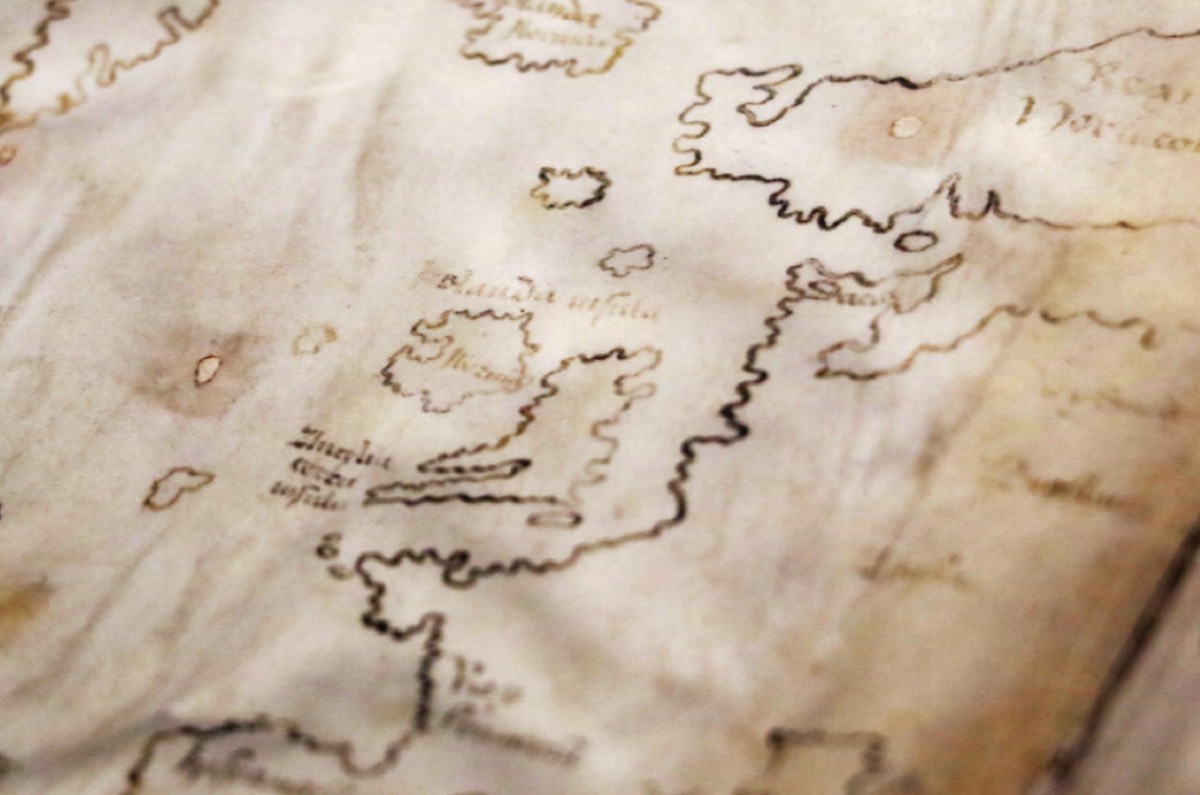
Enlarge/ The Vinland Map purports to be a 15th-century map with a pre-Columbian depiction of the North American Coast. A new analysis has confirmed that the map is, in fact, a modern-day forgery.
Scholars have questioned the authenticity of a purported 15th-century map housed in Yale University’s Beinecke Rare Book & Manuscript Library since it was first unveiled to the public in 1965. About the size of a placemat, the Vinland Map is an intriguing document because, in addition to Africa, Asia, and Europe, the map depicts a section of the North American coastline identified as “Vinlandia Insula” just southwest of Greenland. This suggested that Norsemen may have been the first Europeans to discover the Americas, well before the first voyage of Christopher Columbus. But evidence that the map is a hoax has been steadily accumulating, particularly over the last few years. And the latest scientific analysis has definitively put an end to the controversy once and for all: the inks used to draw the map are of modern origin.
“The Vinland Map is a fake,” said Raymond Clemens, curator of early books and manuscripts at the Beinecke. “There is no reasonable doubt here. This new analysis should put the matter to rest.”
The map first came to light in 1957, when a London book dealer named Irving Davis initially offered the Vinland Map—then bound together with a medieval text, Hystoria Tartarorum—to the British Museum, acting on behalf of another European dealer named Enzo Ferrajoli de Ry. (It was later discovered that Ferrajoli had been convicted of possessing stolen manuscripts in the 1950s.) But the museum’s Keeper of Manuscripts thought the handwriting style showed elements that weren’t common until the 19th century and passed on the offer, suspecting a forgery.
An American dealer, Laurence C. Witten III, ended up purchasing the volume for $3,500 and offered to sell it in turn to Yale (his alma mater) for $300,000. The price was a bit steep for the university, but another alumnus agreed to purchase the map and donate it to Yale, provided its authenticity was confirmed.
Wormholes
The map’s existence was kept secret for several years as a handful of scholars examined the artifact in detail, all while writing a book about their findings. There was good reason to be suspicious: while both the map and the Hystoria were dotted with wormholes, those wormholes didn’t line up with each other. And Witten was reluctant to reveal the map’s provenance, possibly because of tax concerns.
But the following year, Davis sold Yale another medieval tome, the Speculum Historiale, which also had wormholes—and those wormholes did line up with the Vinland Map. Clearly, all three books had been bound together into a single volume at some point. Since both the Hystoria and Speculum were genuine, it seemed more likely that the Vinland Map was genuine as well. Further encouragement came with the discovery of a Norse archaeological site in 1960 at L’Anse aux Meadows on the northern tip of the island of Newfoundland—the only confirmed Norse settlement in or near North America outside of Greenland.
Enlarge/ An inscription on the back of the map (top) was overwritten in an apparent attempt to deceive. The bottom image shows the presence of titanium in the ink, which strongly suggests a modern origin.
Yale publicly announced its acquisition of the Vinland Map just before Columbus Day in 1965. Experts questioned its authenticity almost immediately and even held a conference at the Smithsonian Institution the following year. Among other criticisms, no scientists had been allowed to examine the map since 1957. Radiocarbon dating done in 1995 found that the parchment, at least, was genuine and likely originated between 1423 and 1445. But in addition to the handwriting concerns, the British Museum’s experts had noted peculiarities about the inks used to create the Vinland Map. The experts found no trace of the iron-gall ink used in the two books with which it had been bound, and they couldn’t identify the recipes.
That was a task for science, and science obliged in 1972. That’s when forensic specialist Walter McCrone conducted a number of chemical analyses on the inks. He found that the map’s yellowish lines—beneath nearly vanished black lines—contained titanium dioxide (anatase) in a form that wasn’t manufactured until the 1920s. Only trace amounts of iron were in the ink. The titanium finding was called into question in the early 1980s, when scientists at the University of California, Davis studied the map with Particle-Induced X-ray Emission (PIXE) and found only trace amounts—the first time the PIXE technique had been used for ink analysis. However, subsequent PIXE data gleaned over the ensuing decades cumulatively demonstrated that the discrepancy was due to errors in the UC-Davis team’s work.
Yale declined to weigh in on the controversy while all the various examinations were being done, although Yale historian Paul Freedman said during a 2011 lecture that he thought the Vinland Map “was unfortunately a fake.” By 2018, Richard Hark, a conservation scientist at Yale, had conducted a new global chemical analyses and also found anatase, concluding the ink was modern. At this point, it seemed fairly certain that the document was a fake.
More X-rays
This latest chemical analyses by Yale is notable because they are the first complete examination of the entire document’s composition of elements, using tools and techniques not available previously. Yale University conservators Marie-France Lemay and Paula Zyats worked with scientists in Yale’s Institute for the Preservation of Cultural Heritage on the various experiments. They subjected the ink to X-ray fluorescence spectroscopy to identify how various elements were distributed throughout the map. That gave the team a “big picture” data set, rather than focusing on individual points.
Enlarge/ Macro X-ray fluorescence spectroscopy (XRF) revealed the presence of titanium throughout the map’s lines and text.
The conservators found no sign of iron, sulfur, or copper, which would be typical of a medieval iron-gall ink. As for the Vinland Insula portion of the map, there were high levels of titanium and small amounts of barium, consistent with commercially manufactured white pigments in the 1920s. For comparison, the team also analyzed the inks used in 50 15th-century medieval manuscripts in the Beinecke’s collection, all containing significantly lower amounts of titanium than the inks used to draw the map, as well as much higher levels of iron. A follow-up analysis using field emission scanning electron microscopy (FE-SEM) ruled out the possibility that the anatase could be naturally occurring.
So the Vinland Map is most definitely a modern forgery—and probably a deliberate one. According to Hark, an inscription on the back of the map appears to have been a bookbinder’s note on how to put together the original Speculum manuscript. But it was written over with modern ink. “The altered inscription certainly seems like an attempt to make people believe the map was created at the same time as the Speculum Historiale,” said Clemens. “It’s powerful evidence that this is a forgery, not an innocent creation by a third party that was co-opted by someone else, although it doesn’t tell us who perpetrated the deception.”
The team also examined the Speculum and Hystoria medieval texts. Radiocarbon dating showed those texts dated back to between 1400 and 1460, in keeping with the parchment used to create the Vinland Map. So the forger seems to have used empty pages from a genuine 15th-century manuscript to create the map. One leaf of the Speculum had the watermark of a paper mill in Basel, Switzerland, and the texts of both the Speculum and Hystoria look like the handwriting of the same scribe. Apparently, the two volumes were often bound together, per Zyats, as evidenced by the recent discovery of a 14th-century copy of the Speculum with a copy of the Hystoria bound in its final volume.
Clemens expressed relief that the question of authenticity (or lack thereof) of the Vinland Map has finally been settled. “Objects like the Vinland Map soak up a lot of intellectual air space,” he said. “We don’t want this to continue to be a controversy. There are so many fun and fascinating things that we ought to be examining that can actually tell us something about exploration and travel in the medieval world.”
https://arstechnica.com/?p=1793985
LittleBigTrouble: Sony kills multiple games’ online service without notice
Enlarge/ Almost every LittleBigPlanet release just lost its online hub.
After a year marked by targeted hacks and unexplained downtime, the online service for four of Sony’s LittleBigPlanet games—and arguably the heart of their “play.create.share” mantra—is no more. Announced in a tweet on its official Twitter account, online services across LittleBigPlanet Vita and the LittleBigPlanet trilogy for PS3 have been discontinued with no prior warning, citing issues of continued safety for its online fanbase.
For the uninitiated, the original 2008 LittleBigPlanet introduced a massively online concept of level creation and sharing. Series creators Media Molecule included incredibly robust creation tools that let fans transform the side-scrolling game into any number of incredible concepts, and that foundation grew as the series expanded from the PS3 generation to Vita and PS4.
But challenges to that creation toolbox started to spring up in November 2020 when several fans posted on Twitter that LBP.me—the series’ social site that lets players browse or queue up every available user-made level across almost every release—stopped working. Meanwhile, social features in the game’s older entries began experiencing related issues.
LittleBigTrouble
The next year was tough on the LBP community. In March, Sony pulled the original game’s servers—which worked with LBP2 and 3 so users could still play levels made for the original game while simultaneously leaving all three games open to online attacks—offline for “technical issues.” Many members of the community believe it was the result of one angry fan’s repeated DDOS attacks, though to date no individual or group has taken credit for any such incident.
Since then, both the PS3 entries and LittleBigPlanet Vita have been repeatedly attacked, leading to multiple shutdowns that have rendered online services inaccessible through the majority of the year. Today’s statement is the first update from the LittleBigPlanet team on the situation since May.
<a href="https://cdn.arstechnica.net/wp-content/uploads/2021/09/E_K5YbMXIAkuRGr-1.jpg" class="enlarge" data-height="773" data-width="1360" alt="The official statement from the LittleBigPlanet Twitter account regarding the shutdown of its legacy platform servers.”><img alt="The official statement from the LittleBigPlanet Twitter account regarding the shutdown of its legacy platform servers.” src=”https://rassegna.lbit-solution.it/wp-content/uploads/2021/09/littlebigtrouble-sony-kills-multiple-games-online-service-without-notice-1.jpg” width=”640″ height=”364″ srcset=”https://rassegna.lbit-solution.it/wp-content/uploads/2021/09/littlebigtrouble-sony-kills-multiple-games-online-service-without-notice-2.jpg 2x”>
Enlarge/ The official statement from the LittleBigPlanet Twitter account regarding the shutdown of its legacy platform servers.
A lack of transparency
Following the digital paper trail of what’s happened to which LittleBigPlanet and when is a mess. When LBP.me went down in November, the LBP social account tweeted that there were no plans to shut down the games’ servers and that the site was simply offline for maintenance. (Concerned fans would later suspect the site was actually being targeted by the same hacker who instigated the DDOS attack in March, but no one has come forward to claim responsibility for this, either.)
Neither Sony nor the series’ current developer, Sumo Digital, have been very open about what has been happening behind the scenes. LBP‘s Twitter echoed Sony’s statement after the March attack, explaining the team was investigating some technical issues. It issued a follow-up in April, saying security updates had been the cause of recent erratic online availability.
A third tweet on May 21 confirmed the team was aware the LBP servers were once again experiencing problems. A day later, the account announced that the servers would be temporarily taken offline. Around the same time, users on Reddit and Twitter posted screenshots of hacked in-game social pages that included transphobic messages.
“Due to the severity of the recent attacks we have no other option than to temporarily disable the game servers. We do not take these attacks lightly especially when they target our loyal community members,” the statement read. All tweets the series’ social account related to ongoing hacks have since been deleted without further comment until today’s news.
It’s currently unknown whether this DDOS barrage is the work of one person as some community members allege or if multiple parties are behind it. No one has explained either if these attacks were exclusively targeting the original LittleBigPlanet versus LBP2 and 3 or when the Vita game’s servers were first bombarded.
Equally shrouded in mystery is whether the decision to shut down LBP‘s legacy servers came from Sony or Sumo Digital, which most recently developed the cross-gen PS5 LBP spinoff Sackboy: A Big Adventure. IGN even tried looking into the circumstances behind the hacks with its own investigation dating back to April.
As it stands, the campaigns for each of the game’s PS3 and Vita entries can still be played offline, but any access to any social features or the game’s store is now cut off. LBP Twitter has confirmed that the cross-gen LittleBigPlanet 3‘s servers are back online for PS4 players after a new patch, though many members of the community have complained the PS4 netcode for the 2014 release—Sumo’s first after taking over the series from Media Molecule—ruins many of the user-made levels from the older games.
Sony has faced other problems this year dealing with online services on its older platforms. In April, the company halted plans it had announced to sunset access to the PlayStation Network storefronts on Vita and PS3 alongside the PSP store. Sony Interactive Entertainment head Jim Ryan even came out and said, “It’s clear that we made the wrong decision here.”