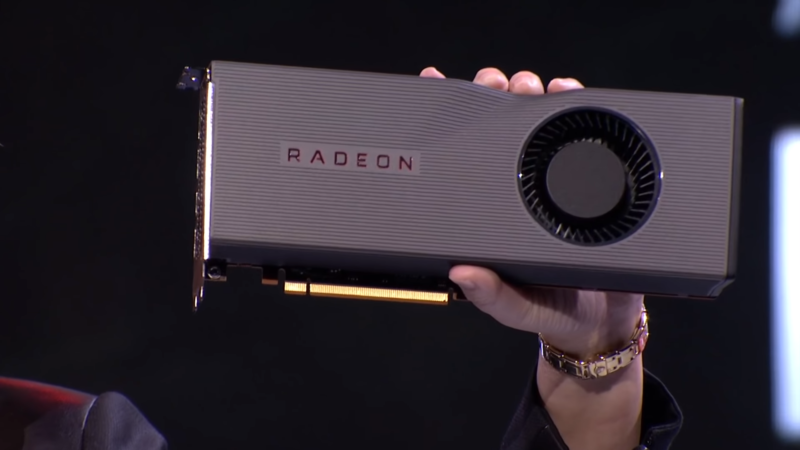
GPU driver releases normally aren’t very newsworthy; they usually fix bugs, boost performance in some games, and add support for new GPUs. But owners of last-generation AMD Radeon RX 5000-series graphics cards should take note of today’s Adrenalin 21.9.1 release. This update adds support for AMD’s “Smart Access Memory” (SAM) feature for older GPUs. AMD says the feature can improve game performance by up to 15 percent in some games.
SAM support was previously restricted to the Radeon RX 6800 series (and Nvidia’s GeForce RTX 3000 series, which support a mostly identical feature that Nvidia calls Resizable BAR). In addition to the right GPU and the right drivers, you’ll also need to be running a supported processor on a supported chipset: either a 10th- or 11th-generation Intel Core CPU in a 400- or 500-series motherboard or a Ryzen 3000 or 5000-series CPU in a 400- or 500-series motherboard.
Whether you’re talking about SAM or Resizable BAR, the different names all refer to the same PCI Express functionality. Normally, your computer’s processor can only directly access 256MB of your GPU’s video memory at a time, and the memory requires larger assets to be broken up into smaller chunks for transfer. Resizable BAR removes that limit and noticeably improves performance in some games. A TechSpot test of 36 games using an RX 6800 GPU and Ryzen 5950X processor observed an improvement of up to 20 percent depending on the game and the settings. For most games, though, performance improved by a much smaller amount or didn’t improve at all. A few games even showed performance decreases with SAM enabled, though never by enough to make any games unplayable.
Even with the new drivers and supported hardware, users of existing PCs will need to jump through a few hoops to ensure they’re taking advantage of Smart Access Memory. Start by installing your motherboard’s latest BIOS update (motherboard makers started adding support for Resizable BAR and SAM in late 2020 and early 2021). Then enter your BIOS settings and enable the feature; depending on your motherboard, it might be called “Resizable BAR” or “Smart Access Memory.” Or your motherboard manufacturer might call it something weird and GPU-agnostic like ASRock’s “Clever Access Memory.” You may also need to enable a separate but related feature called “Above 4G Decoding.”
AMD says that the Adrenalin 21.9.1 driver release is also its first to officially support Windows 11 and that it adds support for auto-overclocking Ryzen 5000-series CPUs when they’re paired with an RX 6000-series GPU. Overclocking Ryzen processors within Windows normally requires the separate “Ryzen Master” utility, which supports a wider range of processors and doesn’t care what GPU you’re using.
https://arstechnica.com/?p=1794214
Jeremy Renner passes down his bow in fun, holiday-themed trailer for Hawkeye
Jeremy Renner reprises his role as Clint Barton in Hawkeye.
YouTube/Marvel Studios
A nice family dinner in New York City.
YouTube/Marvel Studios
Oh, look, a Broadway show about Captain America.
YouTube/Marvel Studios
Would totally watch this Hamilton-inspired musical.
YouTube/Marvel Studios
A sighting of Lucky the Pizza Dog (played by a golden retriever named Jake). Lucky is in the holiday spirit.
YouTube/Marvel Studios
Some disturbing breaking news.
YouTube/Marvel Studios
Flashback to Clint’s days as Ronin in Endgame.
YouTube/Marvel Studios
Kate Bishop (Hailee Steinfeld) is a skilled archer who aims to take up Hawkeye’s mantle.
YouTube/Marvel Studios
“Some people have actually called me the world’s greatest archer.”
YouTube/Marvel Studios
Kate’s arrow hits its mark.
YouTube/Marvel Studios
Hail the conquering hero?
YouTube/Marvel Studios
Vera Farmiga as Kate’s mother, Eleanor.
YouTube/Marvel Studios
We get the briefest glimpse of what appears to be Alaqua Cox as Maya Lopez/Echo, who will have her own spinoff series.
YouTube/Marvel Studios
Clint confronts some bad guys from his past.
YouTube/Marvel Studios
Clint is looking a bit like James Bond.
YouTube/Marvel Studios
Two Haweyes are better than one.
YouTube/Marvel Studios
I’ll admit that I wasn’t exactly excited about Marvel’s upcoming Hawkeye spinoff series on Disney+. It seemed like an odd choice, given the character’s relatively minor role in the various Avengers films. But the studio released the official trailer this morning, and I might just change my mind. Hawkeye looks like a fun, comedy-action holiday romp and will debut on the streaming platform just in time for the Thanksgiving/Christmas season.
Per the official premise:
Former Avenger Clint Barton has a seemingly simple mission: get back to his family for Christmas. Possible? Maybe with the help of Kate Bishop, a 22-year-old archer with dreams of becoming a super hero. The two are forced to work together when a presence from Barton’s past threatens to derail far more than the festive spirit.
Obviously, Jeremy Renner is back as Clint Barton/Hawkeye, as are the actors who played his three children, Cooper (Ben Sakamoto), Lila (Ava Russo), and Nathaniel (Cade Woodward). And thanks to that Black Widow end-credits scene where Yelena (Florence Pugh) meets Valentina (Julia Louis-Dreyfus) at Natasha’s grave, we know that she’s been manipulated into blaming Clint for her foster sister’s death and may well be seeking revenge. Pugh’s inclusion in the cast list pretty much confirms that.
As for new faces, Hailee Steinfeld (who earned an Oscar nomination for 2010’s True Grit at the tender age of 13) plays Kate. It’s possible that she’s being groomed to become the new Hawkeye in the MCU’s Phase Four, although that hasn’t been officially confirmed. She voiced Gwen Stacey in 2018’s animated Spider-Man: Into the Spiderverse and certainly makes a strong showing here.
Vera Farmiga plays Kate’s mother, Eleanor Bishop, and Alaqua Cox plays Maya Lopez/Echo, a deaf woman of Native American descent who is able to perfectly copy the movements of other people. (Cox herself is deaf, and there’s already a spinoff series in development featuring Maya/Echo.) The cast also includes Bryan d’Arcy James; Tony Dalton as Barton’s early mentor, Jack Duquesne; Zahn McClarnon as Maya’s father, William Lopez; and Fra Fee as Kazi.
The trailer opens with the Barton family reuniting in a Chinese restaurant in New York City for Christmas. Clint is trying to make up for lost time by spending more time with his kids. We get some nice holiday scenes, including an amusing glimpse of a Hamilton-inspired Broadway musical, Rogers!, celebrating Captain America and the Avengers.
Of course, the peace is interrupted by news reports of a masked vigilante, possible the same bad guy who terrorized “the underworld” a few years back. And Hawkeye flashes back to that scene in Endgame where we see him dressed as Ronin. “The past has caught up with me,” he tells his daughter, while assuring her there’s nothing to worry about (yeah, right). And then he packs the kids off in a limo and promises he’ll still be home for Christmas.
The new incarnation of Ronin is, of course, Kate Bishop, who goes all fan girl the first time she and Clint meet while foiling some criminal activity: “You’re Hawkeye!” And naturally, trouble ensues—because Clint made quite a few enemies during his own vigilante stint, and it seems they are back and out for blood. Fortunately, Clint and Kate make an excellent team. The car chase where Clint dissuades Kate from using a couple of arrows that he deems too “dangerous” is a highlight. Kate then makes a bulls-eye shot that explodes the Trust-a-Bro moving van that has been in pursuit. “Your arrow’s more dangerous than that one?” There’s no sign of Yelena, but we’re confident she’ll show up eventually.
Hawkeye premieres on November 24, 2021, on Disney Plus.
[embedded content]
Official trailer for Hawkeye.
Listing image by YouTube/Marvel Studios
https://arstechnica.com/?p=1794019
Twitch sues users over alleged “hate raids” against streamers
MikkelWilliam | Getty Images
Since early August, Twitch has been wrestling with an epidemic of harassment, known as “hate raids,” against marginalized streamers. These attacks spam streamers’ chats with hateful and bigoted language, amplified dozens of times a minute by bots. On Thursday, after a month trying and failing to combat the tactic, Twitch resorted to the legal system, suing two alleged hate raiders [PDF] for “targeting black and LGBTQIA+ streamers with racist, homophobic, sexist and other harassing content” in violation of its terms of service.
“We hope this Complaint will shed light on the identity of the individuals behind these attacks and the tools that they exploit, dissuade them from taking similar behaviors to other services, and help put an end to these vile attacks against members of our community,” a Twitch spokesperson said in a comment to WIRED.
Harassment based on gender, race, and sexuality is not new to the 10-year-old game-streaming platform; however, over the last month, targeted hate raids have escalated. Marginalized streamers receive derogatory messages—sometimes hundreds at a time—like “This channel now belongs to the KKK.” To raise awareness of the hate raids and pressure Twitch to act, thousands of streamers have banded together under hashtags like #TwitchDoBetter and #ADayOffTwitch, a one-day boycott of the service.
Twitch has instituted several changes aimed at mitigating hate raids. The company says it has banned thousands of accounts over the last month, created new chat filters, and has been building “channel-level ban evasion detection.” But stomping out botters is a bit like playing whack-a-mole; the perpetrators continue to make new accounts while obscuring their online identities to avoid accountability. “The malicious actors involved have been highly motivated in breaking our Terms of Service, creating new waves of fake bot accounts designed to harass Creators even as we continually update our sitewide protections against their rapidly evolving behaviors,” a Twitch spokesperson said in a comment to WIRED.
Thursday’s lawsuit, which was filed in the US District Court for the Northern District of California, targets two users, identified only as “Cruzzcontrol” and “CreatineOverdose,” whom Twitch believes are based, respectively, in the Netherlands and Vienna, Austria. Twitch, in the suit, says it initially took “swift action” by suspending and then permanently banning their accounts. However, it reads, “They evaded Twitch’s bans by creating new, alternate Twitch accounts, and continually altering their self-described ‘hate raid code’ to avoid detection and suspension by Twitch.” The complaint alleges that Cruzzcontrol and CreatineOverdose still operate multiple accounts on Twitch under aliases, as well as thousands of bot accounts, to conduct hate raids, and that both users claim, in the lawsuit’s words, that they can “generate thousands of bots in minutes for this purpose.” Twitch alleges that Cruzzcontrol is responsible for about 3,000 bots associated with these recent hate raids.
On August 15, the suit alleges, CreatineOverdose demonstrated how their bot software “could be used to spam Twitch channels with racial slurs, graphic descriptions of violence against minorities, and claims that the hate raiders are the ‘K K K.’” The suit also alleges that the defendants may be part of a “hate raiding community,” which coordinates attacks over Discord and Steam.
Twitch has gotten into legal fisticuffs with bot-makers in the past. In 2016, the company sued several bot-makers who artificially inflated viewer and follower numbers—what Twitch’s senior vice president for marketing, Matthew DiPietro, at the time called “a persistent frustration.” A California judge ruled in Twitch’s favor, ordering the bot-makers to pay the company $1.3 million for breach of contract, unfair competition, violation of the Anti-Cybersquatting Consumer Protection Act, and trademark infringement. Thursday’s suit can potentially help uncover the identities of the anonymous hate raiders so they can face legal consequences, too.
“I feel hopeful,” says Raven, a streamer who goes by RekItRaven on Twitch. Raven has been outspoken about the hate raids they continue to suffer through and helped coordinate both the #TwitchDoBetter and #ADayOffTwitch movements. “The people who are behind this need to be held accountable for their actions. They’ve terrorized hundreds if not thousands of people. If this were to happen in a physical location we’d expect the same. It shouldn’t be any different online.”
Welcome to Ars Cardboard, our weekend look at tabletop games! Check out our complete board gaming coverage at cardboard.arstechnica.com.
Aliens: Another Glorious Day in the Corps is a peculiar release. Aliens, James Cameron’s follow-up to the sci-fi classic Alien is frankly one of the best action films ever made, so the excitement around this new cardboard adaptation is not surprising. The problem? We’ve seen it all before.
Aliens first received a tabletop implementation with a strong 1989 design published by Leading Edge. The spirit of the film was further embodied in Games Workshop’s classic Space Hulk, a game that was Aliens in all but name. Space Hulk influenced hundreds of tabletop dungeon crawlers since, each paying homage to their predecessors and re-wrapping that core tense experience with minute deviations.
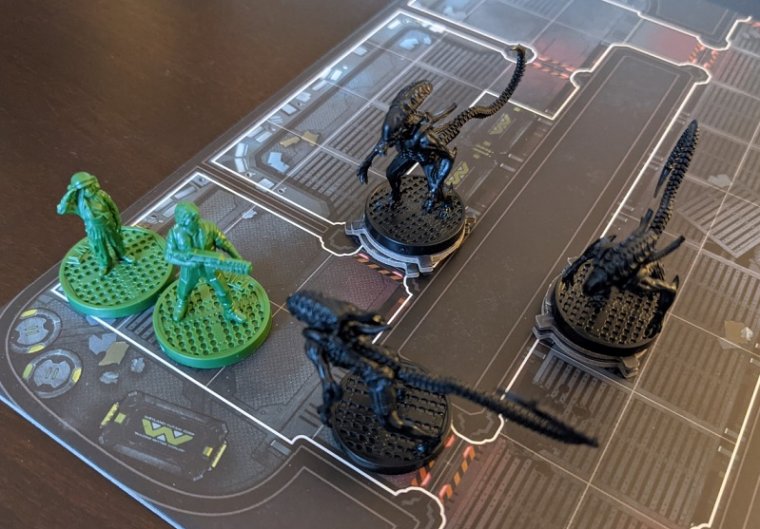
So Aliens: Another Glorious Day in the Corps is already facing a challenge: how to be something new? Designer Andrew Haught realized that hurdle and introduced a seemingly unique central mechanism called the “endurance deck.” Everything else in this game is secondary. The plastic miniatures depicting Hicks, Ripley, and a score of aliens are all background. The fog of war blips, clearly influenced by Space Hulk, are just another tool. The lovingly crafted graphic design that covers every square inch of this game is simply veneer.
But the endurance deck is the game’s lifeblood. Players control multiple marines, spending cards to fire their weapons and initiate special abilities. Even new equipment enters play through the deck. Occasionally, players trigger a negative event from this deck as well, adding to the sense of danger lurking around every corner.
In some ways, this system is sleek and clever. It condenses multiple ideas—equipment, events, and abilities—into a single mechanism, which saves table space and lowers the rules overhead.
Of even more significance is the thematic accomplishment. You exhaust cards from the endurance deck to pay for actions, sometimes removing them permanently from play. The number of cards waning over time represents your group’s decreasing morale and resources. The deck provides an overt sense of dread that escalates across the arc of play. It will often mimic the board state, supporting the tension as xenomorphs crawl out of the ductwork and surround your squad.
As you engage with the game, the endurance system instills a real sense of dread and atmosphere. Thematic mechanisms add meaning and subtlety to the experience, leading to a sense of satisfaction. The game even feels novel at times.
A major supporting peripheral is the “aim dial.” This round cardboard tracker ticks down when you fire a weapon, representing your dwindling resolve as you quickly fire off additional shots. It fully resets each round, but you have to weigh whether it’s worth the further actions, as it leaves your character less capable of defensive fire during the alien activation. It’s part of a structure that, over time, makes the game increasingly tense—even desperate. In terms of capturing the content of the film, it’s a wonderful idea.
But that’s looking at it from one perspective.
A mission map.
Marines in battle.
Player boards.
Vasquez holding the doorway.
Putting the minis together is not simple!
Another view is that the endurance system is overwrought. For Vasquez to fire her M65 Smart Gun, you have to remove three cards to pay the cost, then turn the aim dial to lower your aim stat, and finally roll a 10-sided die to check if your shot hits. Then you have the option to fire again, burning another card to repeat the process. You may need to interrupt your turn to reshuffle and reset the deck. Imagine doing this for multiple marines every single round.
Except some of these marines won’t fire their shotgun or pulse rifle. Instead, they will take a rest action, passing cards from the “exhaust pile” back into the bottom of the endurance deck and preserving your troop’s unit integrity. This will often be a stronger option than attacking, forcing you to balance action and inaction.
Thus, the game is almost entirely about manipulating the deck. This idea doesn’t feel tied into the more thematic elements of play, and it disengages you from the experience. Worse, it exposes a fundamental misunderstanding of what the game should be about.
A much stronger implementation would have seen the deck replenish as a reward for taking down large numbers of aliens. Drop more than one with automatic fire? Return a card from the exhaust pile. That would have actually tied the incentive system more strongly to the source material and embraced the enticing aspects of the film while still maintaining the thematic touchstones of the downward arc.
There’s simply no shaking the clunkiness here. It appears to be an iteration of the exhaustion system in the Kickstarter darling The 7th Continent, but a good iteration should streamline and enhance, neither of which happens here. That previous design had you expend cards to pay for actions and resulted in a fail state after you eventually reshuffled and worked your way through the deck a second time. It was clear and concise, as you only had to contend with a single draw and discard pile.
Another Glorious Day in the Corps uses a draw deck, an exhaust pile, and an out-of-game discard pile. These different sets can interact in various ways, and cards can reference different costs. You also have to insert a reshuffle tile at the bottom of the draw deck to properly manage endurance restoration.
After the exciting first impression of the art and miniatures wears off, the cumbersome realities of this mechanism take over. It can feel like you’re fighting a faceless enemy, battling for directorial control of the script as opposed to actually blasting xenomorphs in the face.
There are many other elements to this game. The miniatures are attractive, although they require painful assembly. The approach of using larger cardboard tiles instead of smaller modular rooms is commendable, as it decreases setup time substantially. The campaign system is entertaining and much stronger than the one-off “Bug Hunt” scenarios. The linked-scenario narrative parallels the film, and losing characters is permanent. Of special interest is the chance for soldiers to be captured and the option to embark on a side mission to rescue them from their new cocooned existence.
Some of this stuff is interesting; other parts are unfortunately less so. But the very essence of this game, and what separates it from its peers, is that endurance deck. As a consequence, the design struggles to make a case for itself. Its core mechanism was better accomplished in The 7th Continent. Its encapsulation of Aliens‘ claustrophobia was more strongly executed in 1989 with Space Hulk. Even its arc of play featuring decaying protagonist capabilities was more effective in the underrated Claustrophobia. This simply is not the novel accomplishment that we saw in other recent games like Nemesis.
What may salvage this game is the fact that there are surprisingly few options for fully cooperative games of this type. Most dungeon crawlers require a player to control the antagonists, a role which many dislike. Here, you and a group of friends can confront a terrifying foe side by side.
This is also the only current tabletop miniatures design to feature the Aliens intellectual property. There’s lots of fan service, and the script repeatedly features staples such as “game over, man!” and “they mostly come at night…mostly.”
That may be enough for some, even if the rest of the design is derivative.
https://arstechnica.com/?p=1793765
Star Trek Day celebrates 55 years with Picard, Prodigy trailers, and more
[embedded content]
Paramount+ celebrated 55 years of Trek on Star Trek Day 2021, a live-streamed event held at the Skirball Cultural Center in Los Angeles, California, on September 8, 2021.
It’s been 55 years since the television debut of Star Trek: The Original Series (TOS), and the franchise continues to expand its reach in film and television, bringing delight to new generations of fans. Paramount+ marked the occasion with Star Trek Day 2021, a live-streamed event staged (and taped for posterity) at the Skirball Cultural Center in Los Angeles.
Co-hosted by Wil Wheaton (aka Wesley Crusher on Star Trek: The Next Generation) and actress Mica Burton (daughter of LeVar Burton), the event featured a live orchestra and back-to-back panels with cast members and creatives from the new generation of Star Trek TV shows: Star Trek: Discovery, Star Trek: Picard, Star Trek: Strange New Worlds, and Star Trek Prodigy. These events were interspersed with “legacy moments” featuring such iconic past cast members as George Takei (Hikaru Sulu, TOS), Cirroc Lofton (Jake Sisco, Star Trek: Deep Space Nine), Anthony Montgomery (Ensign Travis Mayweather, Star Trek: Enterprise), and Garrett Wang (Ensign Harry Kim, Star Trek: Voyager).
The event also marked the launch of a month-long “Boldly Go” campaign in honor of Star Trek creator Gene Roddenberry. Fans worldwide are invited to submit photos and videos about their hopes for the next 100 years. The Roddenberry Foundation will work with its campaign partners to combine the submissions into a piece of artwork that will eventually be auctioned off, with the proceeds going to support various nonprofits. The artwork will also be etched onto a network of satellites slated to be launched in 2022—”a first-of-its-kind space-based art installation.”
<a href="https://rassegna.lbit-solution.it/wp-content/uploads/2021/09/star-trek-day-celebrates-55-years-with-picard-prodigy-trailers-and-more-1.jpg" class="enlarge" data-height="798" data-width="1200" alt="The intrepid crew of Star Trek: The Original Series, which debuted in September 1966 and launched a media empire. “><img alt="The intrepid crew of Star Trek: The Original Series, which debuted in September 1966 and launched a media empire. ” src=”https://rassegna.lbit-solution.it/wp-content/uploads/2021/09/star-trek-day-celebrates-55-years-with-picard-prodigy-trailers-and-more.jpg” width=”640″ height=”426″ srcset=”https://rassegna.lbit-solution.it/wp-content/uploads/2021/09/star-trek-day-celebrates-55-years-with-picard-prodigy-trailers-and-more-1.jpg 2x”>
Enlarge/ The intrepid crew of Star Trek: The Original Series, which debuted in September 1966 and launched a media empire.
The campaign is about inspiring hope and creating an opportunity for people to participate in building a better future. We want to acknowledge and in a way thank the fans for their role in keeping Star Trek and my dad’s legacy relevant. And we want to remind ourselves that we can make a difference, that together we can ensure that the values that fuel Star Trek—diversity, inclusion, and progress—are worthy and achievable. My dad would have loved the idea of combining philanthropy and fan participation into real-world impact.
And of course, the panels provided the perfect opportunity to debut lots of teasers, trailers, and other newsy nuggets for the growing Star Trek streaming television franchises.
[embedded content]
Trailer for the second season of Picard, slated to release next February on Paramount+.
Official trailer for Star Trek:Picard S2
The second season of Picard won’t be released on Paramount+ until next February, but a tantalizing teaser dropped in June, giving us our first look at the return of fan-favorite Q (John de Lancie), an extradimensional being with power over time, space, the laws of physics, and reality itself.
We saw Picard (Sir Patrick Stewart) returning to his family vineyard, calling for Laris (Orla Brady), who strangely wasn’t there. Then Q enters, commenting that Picard looks “a bit older than imagined” (as does Q himself). The teaser was brief, but it was clear that Q had done something to the timeline. We got glimpses of all the changes that have come as a result. We saw Elnor and Raffi fleeing for their lives, Soji dressed all in white and looking very VIP, Rios in a snazzy new Federation uniform with new insignia, and Agnes Jurati in civilian garb. Most shocking of all: Seven of Nine wakes up in an unfamiliar apartment to find her Borg implant is gone.
This new trailer fleshes out those initial brief glimpses to give us a better sense of what’s going on. Q’s time-tampering mischief has created an alternate reality where Earth in the 24th century is essentially a totalitarian state. Picard and the crew of La Sirena go back in time to the 21st century to set things right again. Yep, that’s the Borg Queen (Annie Wersching) making an ominous appearance. We can also expect a bit of humor to lighten up the drama and high cosmic stakes—check out Seven of Nine (Jeri Ryan) driving a stolen police car as if she were recreating the famous French Connection car chase scene. It feels a bit like a cross between Star Trek: The Voyage Home and Back to the Future II.
The second season of Picard is slated to debut on Paramount+ in February 2022. Stewart announced during his panel appearance that the show has already been renewed for a third season.
[embedded content]
Official trailer for Star Trek: Prodigy.
Star Trek: Prodigy trailer
We’re big fans of the animated series Star Trek: Lower Decks (it was one of our favorite TV shows of 2020), so we were intrigued by the first teaser for another new animated series, Star Trek: Prodigy, which debuted during the Star Trek Universe panel at Comic-Con@Home 2021 in July. Prodigy will be a very different beast from Lower Decks, as it is aimed at a younger audience. It’s set in 2383 and takes place after the events of Star Trek: Voyager.
The show is different from Lower Decks in both tone and visual style, as the first teaser showed. Specifically, the animation will be computer-generated and feature a more cinematic style. Producer Alex Kurtzman likened the look to Netflix’s Emmy-nominated animated sci-fi anthology series Love, Death and Robots, as well as Ninjago and Trollhunters, the latter two both written by Prodigy creators Kevin and Dan Hageman. (Rod Roddenberry is also a member of the writing team.)
The plot involves a “motley crew of young aliens in the Delta Quadrant” who stumble upon the USS Protostar, an abandoned Starfleet ship, and decide it’s the perfect vessel to get them to the Alpha Quadrant. Kate Mulgrew will return to voice Captain Kathryn Janeway—or rather, she will appear as the ship’s Emergency Training Hologram, who must teach the crew how to navigate the ship through the vastness of space. From the start, Kurtzman vowed to only bring back “legacy characters” for very specific reasons; apparently, Mulgrew’s Janeway met his criteria. So did Billy Campbell, who will be reprising his role as rogue freighter captain Thadium Okona from Star Trek: The Next Generation.
Rounding out the cast are Brett Gray as Dal, described as a “teen maverick with a lot of hope”; Angus Imrie as Zero, a non-corporeal, energy-based lifeform called a Medusan; Ella Purnell as Gwyn, a Vaunt N’Akat who grew up on a mining planet; Jason Mantzoukas as Jankom Pog, a Tellarite who likes to play devil’s advocate; Rylee Alazraqui as Rok-Tahk, an animal-loving eight-year-old; Dee Bradley Baker as an indestructible blob named Murf who enjoys chomping on ship parts; John Noble as Gwyn’s tyrannical father, the Diviner; and Jimmi Simpson as Drednok, a robotic enforcer who works for the Diviner.
The first season of Star Trek: Prodigy premieres on October 28, 2021, on Paramount+, and once all ten episodes have aired, they will then air on Nickelodeon. A second season was produced simultaneously with season 1 and is expected to debut after all ten S1 episodes have aired on Nickelodeon.
[embedded content]
Midseason trailer for Star Trek: Lower Decks.
Star Trek: Lower Decks mid-season trailer
Speaking of Lower Decks, we also got a mid-season trailer for that show’s second season. Ars Senior Technology Reporter Andrew Cunningham reviewed the first half of S2 last month, saying that the series “is still giving me pretty much exactly what I want from Star Trek: episodic fun where the very fabric of the world/the Federation/the universe/reality as we know it is almost never in mortal peril.” He added, “Lower Decks never asks me to feel feelings I don’t feel about one-note, tropey characters I just met, and it’s refreshingly light on mysterious people with troubled pasts and unknown allegiances.”
Yep, that about sums up what we love best about the series. And it looks like we’ll be getting more of the same in the second half of the season, including the appearance of a Borg cube, complete with a Borg uttering the famous line “You will be assimilated.” The second season of Star Trek: Lower Decks is currently airing on Paramount+.
[embedded content]
Meet the cast of Star Trek: Strange New Worlds.
Star Trek: Strange New Worlds teaser
One of the highlights of Star Trek: Discovery‘s second season was the appearance of classic TOS characters Captain Christopher Pike (Anson Mount), Number One (Rebecca Romijn), and Spock (Ethan Peck). The actors will reprise their roles in the new spinoff series Star Trek: Strange New Worlds, created by Kurtzman, Akiva Goldsman, and Jenny Lumet. It’s a prequel to TOS, as Pike and his crew navigate the USS Enterprise through the galaxy, exploring new worlds along the way.
While we didn’t get an official teaser during Star Trek Day, the above video introduces all the main cast members. In addition to Mount, Romijn, and Peck, Babs Olusanmokun plays Dr. M’Beng; Christina Chong plays La’An Noonien-Singh; Celia Rose Gooding fills Nichelle Nichol’s shoes as Cadet Nyota Uhura; Jess Bush plays Nurse Christine Chapel; Melissa Navai plays Lieutenant Erica Ortegas; and Bruce Orak plays an Aenar named Hemmer.
Star Trek: Strange New Worlds debuts on Paramount+ in 2022.
As for Discovery, we didn’t get any new teasers for the upcoming fourth season—apart from a brief clip introduced by a virtual Sonequa Martin-Green—but we did get a premiere date announcement: November 18, 2021. In the S3 season finale, planets were beginning to rejoin the Federation, and Discovery set out to bring dilithium from the nebula to planets that have been cut off by the Burn, presumably bringing the warp drive back and enabling travel between distant worlds once again.
What can we expect from S4? Per the (deliberately vague) description, the season “finds Captain Burnham and the crew of the USS Discovery facing a threat unlike any they’ve ever encountered. With Federation and non-Federation worlds alike feeling the impact, they must confront the unknown and work together to ensure a hopeful future for all.”
A family affair
Star Trek has always had one of the most passionate and loyal science fiction fandoms, and it offers fans a large global community with which to share their love (and the occasional grievance) and nerd-gas over tiny details. What’s less talked about is the tight-knit community that has grown up around the cast members of the various films and TV series over the decades. That sense of community was readily apparent during the red carpet appearances before the official event, which featured writers and cast members of TOS, The Next Generation, Voyager, Deep Space Nine, Enterprise, Picard, Discovery, Lower Decks, Strange New Worlds, and Prodigy all laughing and mingling like they were at one big multi-generational class reunion.
Wheaton posed with his former TV mom Gates McFadden (Beverly Crusher on TNG) and greeted LeVar Burton (TNG‘s Geordi La Forge) with a warm bear hug. Discovery‘s Wilson Cruz (aka Dr. Hugh Culber) graciously shepherded his slightly nervous young co-stars Blu del Barrio (Adira) and Ian Alexander (Gray) through their first red carpet experience, occasionally reminding the assembled media of their preferred “they/them” pronouns. And when Prodigy‘s Hageman brothers posed with cast members Baker and Gray, they were greeted by Enterprise‘s Anthony Montgomery with a warm, enthusiastic “welcome to the family!”
May there be many more new family members to come.
Rod Roddenberry, son of Star Trek creator Gene Roddenberry.
Jennifer Ouellette
George Takei (TOS) was all smiles.
Jennifer Ouellette
Wil Wheaton and Gates McFadden, aka TNG‘s Wesley and Beverly Crusher.
Jennifer Ouellette
McFadden, LeVar Burton (TNG), and co-host Mica Burton.
Jennifer Ouellette
It’s Jonathan del Arco, aka Hugh (TNG, Picard).
Jennifer Ouellette
Chase Masterson played Leeta on Deep Space Nine.
Jennifer Ouellette
Jeri Ryan, aka Seven of Nine (Voyager, Picard).
Jennifer Ouellette
Tim Russ, aka Lieutenant Commander Tuvok on Voyager.
Jennifer Ouellette
Jolene Blalock, aka T’Pol (Enterprise).
Kevin Winter/Getty Images
Garrett Wang, aka Harry Kim (Voyager).
Jennifer Ouellette
Anthony Montgomery (Enterprise) yukking it up with Burton.
Jennifer Ouellette
Wilson Cruz flanked by Discovery cast mates Blu del Barrio (left) and Ian Alexander (right).
Jennifer Ouellette
Mary Chieffo (L’Rell, Discovery) wins the red carpet with those fabulous platform shoes.
Jennifer Ouellette
Isa Briones, aka Soji on Picard.
Jennifer Ouellette
Annie Wersching plays the Borg queen on the upcoming second season of Picard
Jennifer Ouellette
Akiva Goldsman, executive producer and co-showrunner for Picard and Strange New Worlds.
Jennifer Ouellette
Anson Mount stars as Captain Christopher Pike in the forthcoming Strange New World.
Jennifer Ouellette
Ethan Peck plays Spock in Discovery S2 and Strange New Worlds.
Jennifer Ouellette
Rebecca Romijn (Discovery, Strange New Worlds) with Jerry O’Connell (Lower Decks).
Jennifer Ouellette
Mike McMahan, creator and showrunner for Lower Decks.
Jennifer Ouellette
Noell Wells voices Ensign Tendi on Lower Decks.
Jennifer Ouellette
Fred Tatasciore voices Lieutenant Shaxs on Lower Decks.
Kevin Winter/Getty Images
Eugene Cordero voices Ensign Sam Rutherford on Lower Decks.
Jennifer Ouellette
New kids on the block (L-R): Star Trek: Prodigy‘s Keven Hageman, Dee Bradley Baker, Dan Hageman, Brett Gray, and Ben Hibon.
Jennifer Ouellette
Listing image by Paramount+
https://arstechnica.com/?p=1793340
Your standard SSD might work as an Xbox storage expansion
Aurich Lawson | Microsoft
Xbox Series X or S owners in need of more storage space for current-gen software may be in luck if they have a spare SSD, according to one modder’s experiences.
Writing in a step-by-step post on the Chinese video-sharing site Bilibili, a user has discovered that it’s potentially possible to use any high-speed SSD in the Xbox Series X and S by using an adapter to convert the drive’s storage interface—instead of mandating that users who want to expand installable space for newer “Velocity Architecture” games purchase proprietary Series X/S memory cards. (Past-gen software on Series X/S can be installed to older, slower storage options connected via USB ports.)
The modder learned via a teardown video that the Xbox Series S uses two PCIe 4.0 ports to house its NVMe SSD and external expansion, and, crucially, that the console’s external expansion card uses the CFExpress protocol, which also uses an NVMe interface. (Asian video-sharing sites like Bilibili generally work like YouTube, except users can often post blog-style entries as well as videos, hence the tutorial.)
A really easy workaround… if it works
As far as theoretical mods go, this one is pretty straightforward because of how Xbox hardware works. Since the console’s expansion card—Seagate’s expensive, proprietary add-on designated as the sole operable external storage solution for the latest Xbox platforms—uses a separate storage interface, the modder extrapolated that any standard compatible PCIe 4.0 SSD could be converted into a CFExpress one, thereby fooling the Xbox hardware into thinking it was running the Seagate card.
Armed with this knowledge, the modder used a PCIe-4.0-to-CFExpress adapter to plug a cheaper, standard CH SN530 m.2 2230 SSD (the same internal storage used in the Series X and S) into the expansion slot on a Series S, with the hardware sticking out like a dongle-y DIY memory card—no need for any messy disassembly. The hunch paid off, as the Xbox recognized the SSD as a “storage expansion card,” adding more than 800GB.
A couple of caveats to this tale: First, the modder emphasized that the workaround was only tested with the CH SN530 m.2 2230 SSD used as internal storage in the new Xboxes. Second, the modder wrote that another modder had tried the trick using a CFexpress Type B PCIe 3.0 card used for cameras, and it was not recognized as compatible. If this method to bypass the Seagate card proves viable with other SSDs, it appears that PCIe 4.0 is a requirement.
Microsoft could push out a firmware update to plug the hole, rendering this supposed hack null. Sony has taken a similar tack over the years to shut down the Vita modding community’s efforts to crack open that hardware.
On Sony’s end, PlayStation 5’s storage compatibility options are already available to firmware beta users and are expected to open up soon, allowing players to use their own PCIe 4.0 m.2 rated drives.
https://arstechnica.com/?p=1793731
Further testing shows new PS5’s smaller, lighter heatsink keeps console cooler
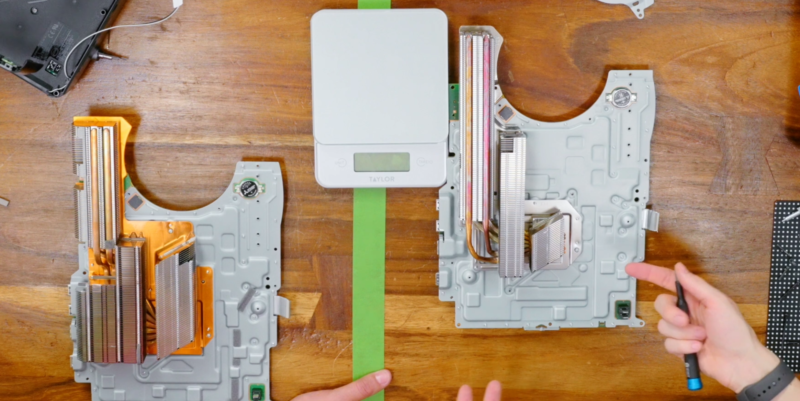
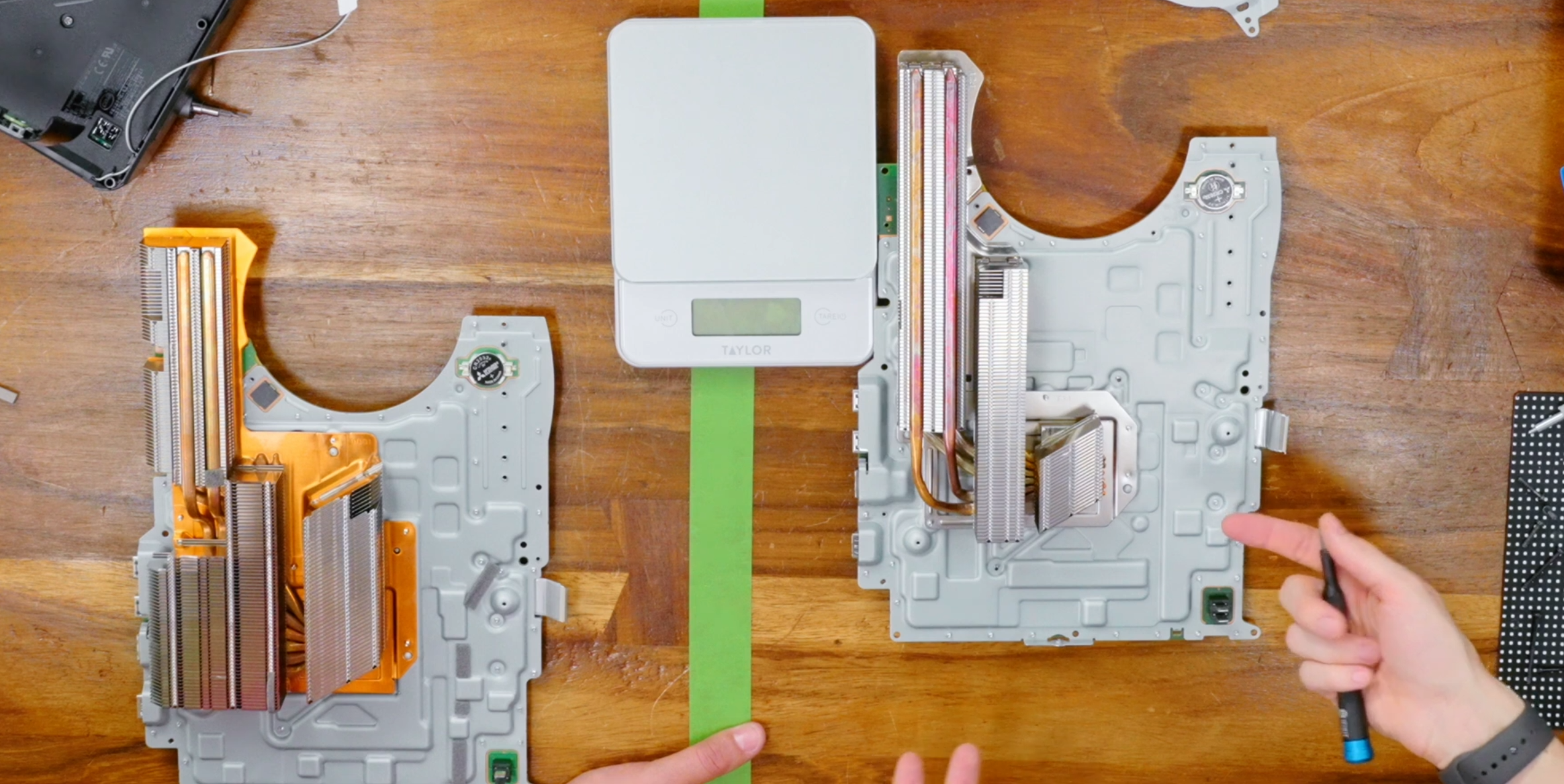
Enlarge/ Old PS5 heatsink on the left, new “11-series” PS5 heatsink on the right.
Last month, Sony began shipping a lightly revised version of its PlayStation 5 console with a smaller, lighter heatsink and a handful of other tweaks. An earlier teardown and analysis of the revised PS5 made headlines because it suggested that the new PS5 ran warmer than the old one, based on the temperature of the air being exhausted from the console. This does make some intuitive sense if you assume that a smaller heatsink will automatically be worse at dissipating heat. But more detailed and precise testing from the YouTubers at Hardware Busters International backs up our skepticism of that claim, showing that the PS5’s exhaust air is warmer because the new cooling system is doing a better job of removing heat from the console, as cooling systems are meant to do.
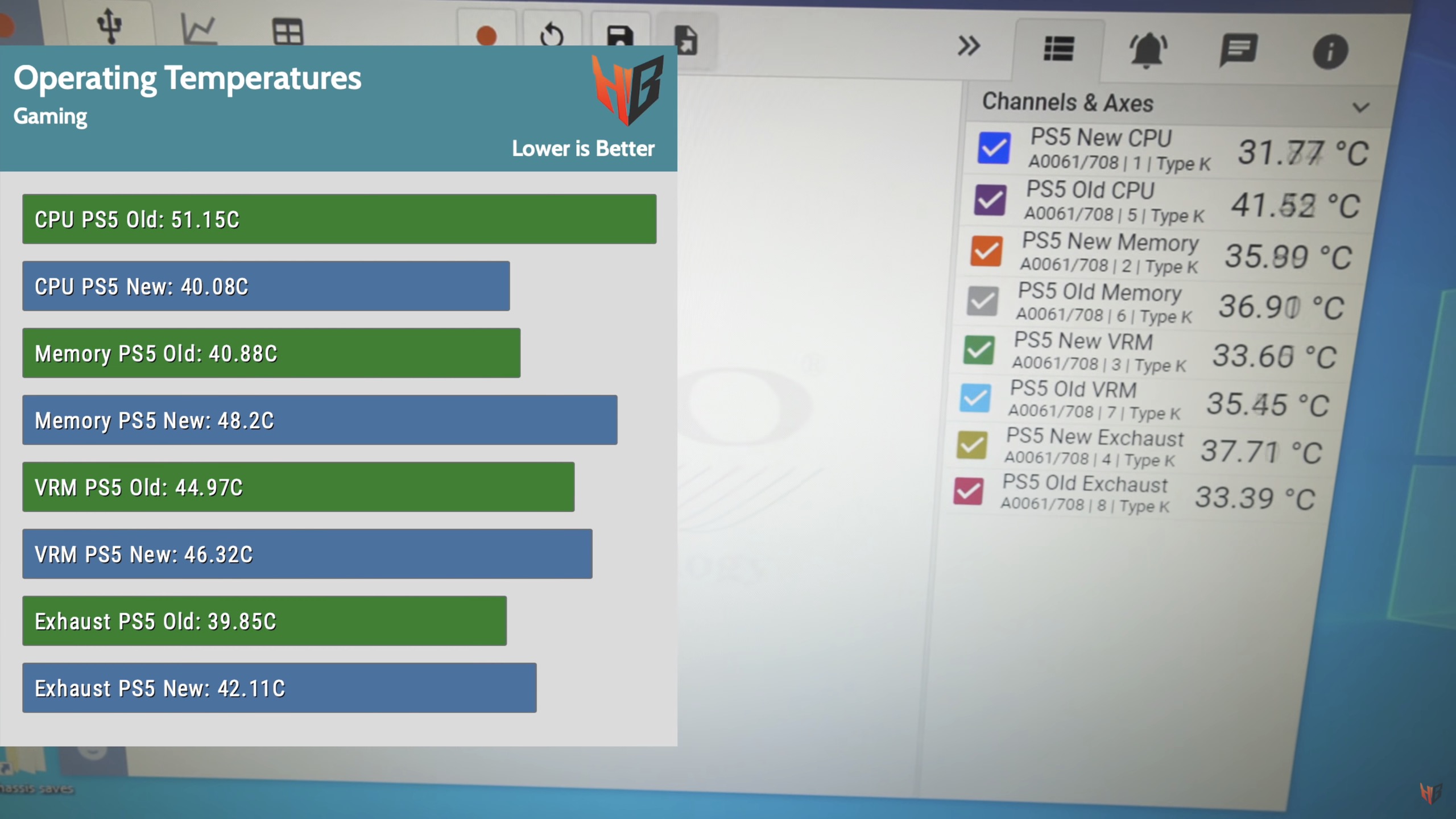
The Hardware Busters testing measured the temperature of the APU, memory, voltage regulator modules (VRMs), and exhaust air while Devil May Cry 5 was running on both PS5 models. The exhaust air is indeed a few degrees warmer in the new PS5 than the old one, but on average, the new PS5’s APU ran about 11°C cooler, dropping from about 51°C to 40°C.
The memory and VRM temperatures in the new PS5 rise a bit—the memory temperature goes up by around 7°C and the VRM temperature goes up by around 1.3°C—but neither increase should have a huge impact on the console’s reliability or longevity. The much larger drop in APU temperature is worth the tradeoff.
Comparing the CPU, RAM, VRM, and exhaust temperatures of the original PS5 and the revised model with the smaller heatsink.
These results only compare a single old PS5 to a single new PS5, and the numbers might look different with a larger sample size. But they should at least convince you that the newer, lighter PS5’s smaller heatsink is not automatically going to result in a hotter, louder, more failure-prone console. The new PS5’s model number is CFI-1102A, while the original’s is CFI-1000—look for these numbers if you want to make sure to get the new revision.
The Hardware Busters team identified a few other minor differences in the system board with the new revision but found that almost everything important to keeping the console cool—the number and type of fans, the fan speed, and the noise level—are either identical or nearly identical. The new PS5 was about one decibel louder, and its power consumption under most circumstances was a couple of watts higher, but this kind of minor variance between consoles is normal and not necessarily related to the heatsink or other internal changes.
https://arstechnica.com/?p=1793565
Gran Turismo 7, Spider-Man 2, KOTOR remake lead PlayStation 5 showcase
“Will one of you finally give me what I desire?”
“Yes… we will.”
Spider-Man 2‘s fast-paced action was too blurry to generally capture for this gallery, but it included quite a few team-up attacks, suggesting co-op. We love the idea of double the Spidey.
A long-rumored remake, now confirmed.
A familiar voice: “Peace is a lie. That is what the Sith believe.”
Prerendered CGI of a guy who doesn’t realize what a dumb fight he just picked.
You can probably guess what comes next from these grizzled hands.
No release date yet set, but Insomniac is working on the new Wolverine game.
Sony broke a months-long game of silence today with a wide-ranging PS5 showcase, announcing two new Marvel games from Insomniac, a remake of Star Wars: Knights of the Old Republic, and a March release date for Gran Turismo 7, among other news. This is the first significant update from the publisher since it opted to skip multiple major industry events throughout 2021. The industry behemoth is now offering first glimpses of several games in production from PlayStation Studios and third-party developers.
Leading the charge was news that a remake of BioWare’s classic 2003 RPG Knights of the Old Republic—which many players consider the best Star Wars game ever made—is in development as a PS5 and PC exclusive, at least at launch. Though only the briefest clip of what looked like a Sith knight was shown, we already know this is a joint project between Lucasfilm, Sony, and Aspyr Media, a studio known for porting classic Star Wars games to modern hardware. Without a release date yet, we wonder whether BioWare’s Old Republic MMO will still be in operation by the time this remake launches.
PlayStation Studios galore
Sony also had some first-party news to share with actual PS5-only releases. Insomniac is expanding its vision of the Marvelverse in Marvel’s Spider-Man 2, due out 2023, and, unexpectedly, a new game starring Wolverine.
Spider-Man 2‘s in-game trailer had Peter Parker and Miles Morales teaming up or possibly fighting (or both) opposite fan-favorite Venom. The game is being led by creative director Bryan Intihar and director Ryan Smith from the staff of Marvel’s Spider-Man.
Marvel’s Wolverine is still early enough in production to skip showing gameplay. Instead, we only got a CG tease of the mutant unleashing his adamantium claws in a rundown bar. No release date here, but the creative team behind Spider-Man: Miles Morales aims to bring the same faithful-to-the-spirit-of-the-comics touch to this one.
As a welcome change given the franchise’s usual “it’ll be done when it’s done” approach, Gran Turismo 7 announced a March 4 launch on PS4 and PS5. The news was accompanied by an operatic montage trailer that was as polished as you’d expect from Kazunori Yamauchi’s detail-precise team at Polyphony Digital, highlighting the game’s arcade circuits, a complicated-looking photo mode, a livery editor, reams and reams of meteorological data used to create photo-real weather and lighting, and, finally, the return of campaign mode. Though a new numbered GT is always something to look forward to, bringing back a real campaign is a huge victory for fans after its absence in Gran Turismo Sport.
No release date, but plenty of apparent in-game footage.
Atreus is seen here riding a ghost beast of some sort, attacking monsters on Kratos’ behalf.
Melee combat? In a God of War sequel? Who would’ve thunk?
Here, gator, gator, gator.
Canoodlin’ in a canoe.
Kratos, looking over his soon-to-be-bloody domain in God of War: Ragnarok.
Ride a sled! Heck yes.
Kratos and Atreus happen upon a god with lightning-infused abilities and a big hammer. Hmm. I dunno, I could use another hint.
“Wait, does he still call you ‘boy’? Because you’ve gotten pretty big, kid.”
Kratos applies a freezing effect to this axe before tossing it in a bloody rage.
New, shiny Gran Turismo logo.
We finally have a Gran Turismo 7 release date (and, yes, it’s coming to both PS4 and PS5).
The GT7 included a mix of pre-rendered and in-game footage. This caption indicates the screen appears to be based entirely on real-time gameplay.
The GT7 included a mix of pre-rendered and in-game footage. This caption indicates the screen appears to be based entirely on real-time gameplay.
The GT7 included a mix of pre-rendered and in-game footage. This caption indicates the screen appears to be based entirely on real-time gameplay.
Among the GT7 trailer’s flurry of menu hints: the usual series main menu, now modeled after a lovely seaside town.
A variety of weather patterns stretch over the same car, each with its own handsome reflections.
A variety of weather patterns stretch over the same car, each with their own handsome reflections.
A variety of weather patterns stretch over the same car, each with their own handsome reflections.
Among the GT7 trailer’s flurry of menu hints: a car upgrade interface.
Among the GT7 trailer’s flurry of menu hints: a shopping interface.
Can we add a custom soundtrack when riding this? If so, “Big Pimpin,” please?
Is this handsome, reflection-filled shot taken from actual GT7 gameplay, or from a pre-rendered cinematic? That still isn’t clear.
That’s gonna look sick in HDR.
Winter comes to Midgard, with gameplay
After only a logo announcement last year, Santa Monica Studio gave a first look at God of War: Ragnarok, picking up with Kratos and Atreus some years after the events of the 2018 reboot. Despite being cross-gen, the game’s visuals looked stunning on PS5—Kratos using both his ax and Blades of Chaos against a number of mythological monsters. But more than combat was highlighted—there was also a lot of dialogue between the Spartan, his son, and other hardy-looking characters who served to show off the game’s very high-poly models. No release date for this one, either.
However, one big question still remains for Ragnarok and GT7 after today’s splashy event: how will these two tentpoles scale down their visual splendor to PS4 and PS4 Pro consoles? Unsurprisingly, no clarification was given.
Sony’s other top-shelf studio, Naughty Dog, made a quick appearance, though not related to any unannounced projects. Instead, the studio announced Uncharted 4 and Lost Legacy are coming to the PC—and PS5—for the first time. Bundled together as the Uncharted: Legacy of Thieves Collection, the studio appears to be handling the PS5 remaster itself. Meanwhile, the PC release is being developed by former Sony VP Adam Boyes’ studio, Iron Galaxy. The collection will be out in early 2022, with the PC launch coming slightly after PS5’s.
The sleeper hit of the September 2021 PlayStation Showcase: Forspoken.
This game’s new hero has a lot of varied magical powers in her bracelets.
It’s blurry, but you can probably make out that sick-looking dragon in Forspoken.
Forspoken‘s first reveal of a mysterious baddie.
Ghostwire: Tokyo looks to have plenty of magic battles against Yokai, Japanese spirits.
Ghostwire seems to heavily feature the Tokyo neighborhood of Shibuya.
This Yokai is inspired by Kuchisake-onna, the “slit-mouthed woman,” a malevolent spirit who often covers her face and wields a sharp object.
Tango Gameworks’ track record of really cool art direction continues.
Tchia is inspired by the New Catalonia indigenous culture.
A lot of Zelda influence here.
Radiohead’s interactive “exhibition” (whatever that means), Kid A Mnesia.
In November, Radiohead and Epic Games will release an interactive walk through various 3D worlds inspired by the albums Kid A and Amnesiac.
Radiohead is partnering with Epic to make…whatever this is.
And some third-party originals
And if you’re the kind of Sony fan who gets exhausted by sequels, this presentation had a few gems for you, as well. Particular standouts: Tchia, a cute-looking cross-gen indie that resembles Zelda with animal-shapeshifting powers that are based on the indigenous culture of New Catalonia; a closer look at Tango Gameworks’ bizarre, aesthetically compelling Yokai-combat first-person, uh, magicker Ghostwire: Tokyo; and, coming completely out of left field, Kid A Mnesia, a Radiohead interactive “exhibition” (whatever that means) in development with Epic.
Finally, Forspoken, a sweeping third-person adventure previously teased by Square Enix, got a long-awaited gameplay reveal that makes it look less Final Fantasy-derivative and more like a charismatic, magic-pumped breath of fresh gaming air. It’s co-written by games industry legend Amy Hennig, which Ars generally considers a good sign—and it gives her an opportunity for redemption after her fallout with EA and Star Wars.
Sex can relieve nasal congestion, and other work honored by 2021 Ig Nobels
[embedded content]
Watch the 2021 Ig Nobel Prizes virtual ceremony, honoring “achievements that first make people laugh, and then make them think.”
Scientists are nothing if not endlessly curious, and sometimes that trait can lead them into unusual research directions. Maybe they find themselves exploring whether sex could be a natural alternative to nasal sprays for relieving nasal congestion, or maybe they’ll end up taking the vitals of a rhinoceros while the animal is sedated and suspended from its feet for helicopter transport. Perhaps they might find surprising insights into how cats communicate or into the bacteriomes of discarded wads of chewing gum from different parts of the world. These and other unusual research topics were honored tonight in a virtual ceremony to announce the 2021 recipients of the annual Ig Nobel Prizes. You can watch the livestream of the awards ceremony above.
Established in 1991, the Ig Nobels are a good-natured parody of the Nobel Prizes that honors “achievements that first make people laugh, and then make them think.” The unapologetically campy award ceremony usually features miniature operas, scientific demos, and the 24/7 lectures whereby experts must explain their work twice: once in 24 seconds, and the second in just seven words. Acceptance speeches are limited to 60 seconds. And as the motto implies, the research being honored might seem ridiculous at first glance, but that doesn’t mean it is devoid of scientific merit.
Viewers can tune in for the usual 24/7 lectures, as well as the premiere of a miniopera, A Bridge Between People, in which children try to mediate between argumentative adults by building actual tiny suspension bridges between them—in keeping with the evening’s theme of engineering. Traditionally, the winners also give public talks in Boston the day after the awards ceremony, although the pandemic put a kibosh on that for the second year in a row. Instead, the winners’ talks will once again be given as webcasts a few weeks from now.
Here are the winners of the 2021 Ig Nobel Prizes.
Enlarge/ Akira Horiuchi (center) won the 2018 Ig Nobel Medical Education Prize for his do-it-yourself colonoscopy tube.
Natsuko Fukue/AFP/Getty Images
Biology Prize
Citation: Susanne Schötz, “for analyzing variations in purring, chirping, chattering, trilling, tweedling, murmuring, meowing, moaning, squeaking, hissing, yowling, howling, growling, and other modes of cat–human communication.”
Schötz, a researcher at Lund University in Sweden, was struck by a talk several years ago comparing the purring of a big cheetah with a domestic cat, which found that both animals purred at around 30 Hertz, despite the significant difference in size. Intrigued, she went home and recorded the purrs of her own cat Vincent as well as those of three young kitty siblings from the same litter—Donna, Rocky, and Turbo—who found their way into her care. Thus began a yearslong project to better comprehend the different vocalizations of domestic cats, spawning five separate papers (in 2011, 2012, 2013, 2014, and a review paper in 2016). Donna, Rocky, and Turbo were the subjects in all of the studies.
Cats purr for many different reasons: when they are angry, stressed, in pain, and yes, when they are contented and happy. But the phenomenon has not been well-studied, particularly when it comes to acoustic analysis. They also chirp, chatter, trill, moan, yowl, meow, growl, and hiss, among other common vocalizations. Schötz has found that a combined murmur and meow is the most common kitty utterance, while watching birds through a window will elicit chatters, chirps, tweets, and tweedles (prolonged chirps or tweets). Meows for food will have a rising contour to the pitch, while meows associated with a trip to the vet have falling pitch contours.
Based on all that previous work, Schötz and her collaborators received a grant to study “Melody in Human-Cat Communication,” playfully dubbed “Meowsic.” The ultimate goal is to collect even more data in support of their key hypotheses: that cats “semi-consciously” alter intonation, intensity, length, and quality of their vocalizations to fit different contexts; that most cats share similar types of this so-called “prosodic variation”; and that these variations can be correctly interpreted by experienced human listeners. Most cat owners would probably agree.
Ecology Prize
Citation: Leila Satari, Alba Guillén, Àngela Vidal-Verdú, and Manuel Porcar, “for using genetic analysis to identify the different species of bacteria that reside in wads of discarded chewing gum stuck on pavements in various countries.”
People have been chewing some form of gum for millennia, from wood tar during the Mesolithic and Neolithic eras, all the way up to the many varieties of commercial chewing gum sold around the world today. Once the gum has released all its flavor, people have a bad habit of depositing the spent wad on public surfaces, especially walls and pavements—or priceless works of art. Sometimes it even becomes a tourist attraction, like Seattle’s notorious “gum wall” located in an alley behind Pike Place Market. (The wall was steam cleaned to remove 20 years of accumulated gum in 2015.)
But discarded chewing gum also offers potential positive benefits. In addition to DNA, used gum can contain oral bacteria as well as certain opportunistic pathogens like Streptococcus spp and Corynebacterium spp. Leila Satari and her co-authors at the University of Valencia in Spain set out to characterize the bacteriome of discarded chewing gum from five different countries—including the streets around their Valencia laboratory—and monitor how it changed over time. Their experiments also involved chewing 13 gum samples (Orbit and Trident brands) and placing the wads in outdoor pavement for up to 12 weeks, monitoring how the bacterial content changed.
Enlarge/ Seattle’s famous “gum wall”—located in an alley behind Pike Place Market—accumulated 20 years’ worth of used gum before it was finally steam cleaned in 2015.
George Rose/Getty Images
Satari et al. found a moderate degree of diversity in terms of the bacterial populations in the chewing gum samples. They also found that, over the course of a few weeks, the kinds of microbes typically found in recently chewed gum (the oral microbiome) gave way to microbes typically found in the surrounding environment. “Taken together, our results suggest that bacteria can play a role in the natural biodegradation of the chewing gum and may also be a source of strains with other biodegradable properties,” the authors concluded in their paper. And while there are concerns about wasted chewing gum carrying pathogenic microorganisms, the relative longevity of the oral bacteria could prove useful in the legal and forensic arenas, akin to DNA analysis.
https://arstechnica.com/?p=1792344
VR review: Space Pirate Trainer’s new “Arena” is massive, must-play (if you can)
I-Illusions
If you already thought the average VR use case was too inconvenient, you are absolutely not the target market for Space Pirate Arena. Later today, this brand-new mode lands as a free update to the five-year-old VR hit Space Pirate Trainer (whose new name, Space Pirate Trainer DX, still only costs $15 and is a fine VR-action option even for the smallest, weakest VR rigs).
Like other popular VR games, Space Pirate Arena requires strapping into a face-covering headset, which is inconvenient enough. In good news, this game’s wholly free new mode doesn’t require any cables, PCs, or external sensors, owing to its exclusivity to the self-contained Oculus Quest platform. You are, in some ways, quite liberated as this brand of space pirate.
But Arena‘s playable convenience ends there, as the mode pushes Quest and Quest 2 headsets to their room-sensing limit: an exact 10 m x 10 m square (32.8 ft x 32.8 ft) in your VR lasering room of choice, not a centimeter (inch) less. This is because Space Pirate Arena is a fully blown laser tag facsimile, meant to resemble the real-life zap-a-rama that you might associate with ’80s and ’90s malls.
Ambitious, inconvenient, and unwieldy—even compared to other VR games? This, I had to dive into. My review of this unique mode, as a result, does account for Arena‘s coolest and trippiest aspects as it covers this release’s faults and annoyances. Plus, I encountered some outright Facebook-related rage that got in the way of my tests (and might do the same to yours).
Arguably cheaper than the plastic-gun option
As I previously wrote, Arena‘s sales pitch is as follows: would you like to play two-player laser tag in the year 2021? If so, you could buy a pair of plastic laser tag guns and sensors, and you could build a single, elaborate room, full of hallways, windows, and duck-and-cover debris—which means you’d need the materials, the time, and a space where you’re allowed to temporarily erect such physical wizardry. (This list, obviously, doesn’t account for optional niceties like a black light, proper ’80s-mall carpeting, or a sick stereo system pumping out some fusion of disco, techno, and pop-punk.)
Orrrrrr you could buy two Quest virtual reality headsets, two copies of the game Space Pirate Trainer DX, and have two players strap into them in the same oversized room. (You’ll also need Wi-Fi, which I’ll get to.) That’s a base price of $630 before tax, and the cost might tick up a bit higher if you get a Quest with a higher memory capacity or comfort-aiding upgrades like a face liner or a head strap. Still, that buy-in also nets you all the general use cases of VR, and you’ll arguably get more general use out of a VR headset than a real-world laser tag rig.
I make that comparison specifically because I could imagine 12-year-old me drawing up the above as a spreadsheet, presenting it to my parents, and hosting a brief seminar on why I believed this was the best birthday gift of all time, so would you pleeeeease give it to me.
Fit to be square (eventually)
This gallery is made up of captures from Space Pirate Trainer DX‘s new “Arena” mode. As such, they’re shaped similarly to lenses in a VR headset. Here’s the beginning of a fight and a peek at your foe on the battleground’s opposite side.
Some serious Quake 1 vibes in this arena.
Shields as an option.
I bet these explode.
A VR-perspective peek on menus.
Where are you?
Danger incoming.
An animated GIF of how one of the outdoor battling arenas looks.
Animated GIF of single-player action inside Arena’s maps.
Animated GIF of single-player action inside Arena’s maps.
For adult Sam, however, trouble began when I started looking for appropriate playspaces. My first thought was to hit up a parking garage near my Seattle apartment. It’s not massive, but it was big enough to suit previous out-of-my-house tests of “untethered” VR systems. Unfortunately, this parking garage offers a large rectangle, not Space Pirate Arena‘s specific demand—an exact square, 100 meters squared.
This is thanks to a specific limitation of the Oculus Quest platform. After strapping into a Quest headset in a new real-world space, the system turns on its outward facing cameras, then asks users to point at the nearby floor and paint a “guardian” boundary. Tell your VR system where the floor ends and nearby walls begin so it can appropriately frame the virtual nonsense to come. This works quite well in average indoor environs, but it hits a harsh tracking limit once you’re in a big-enough room. You can’t paint a guardian space larger than a 10 m x 10 m square, and its line becomes straight and right-angled at any edges.
Additionally, both models of Oculus Quest struggle to track your exact presence in an open field without static visual indicators on a ceiling. It’ll work in a pinch, but you generally want to be indoors with these sets to guarantee stable VR tracking.
Hence, I went looking for an ideal space to even boot into Space Pirate Arena, since its loading screen responds with a no-no-no wag of the finger if you haven’t confirmed a maximum-size tracking square within a Quest’s system settings. I finally found such a space at last weekend’s PAX West 2021: the expo’s media team graciously offered an “interview” room where no interviews were happening. (As I reported, it was a weird PAX.)
Finally, I’m playing the game—and having a blast
Top-down views of some of Space Pirate Arena‘s bespoke levels. This is Scrapyard.
Another Scrapyard angle.
This is Transit.
This is the Lab, the science-y battleground.
Another angle of the Lab.
This battleground has the uninspiring name of Outdoor.
Another Outdoor angle.
Once I had that all set up, I booted Space Pirate Arena by myself, knowing I could at least battle built-in AI “droid” opponents. Arena‘s pre-battle lobby shows various options on a floating virtual screen on one edge of the room. Shoot at it with the virtual gun in your hand to pick from the game’s pre-built levels, check your friends list, pick some options, and then… wait, how does it start? I kept shooting at the virtual screen in hopes I’d find a “start” button of some sort.
Eventually, I realized I needed to walk to one of the four “teleporters” inside this mode’s pre-battle void, which is essential for Arena‘s real-world conceit. You and a second player need to start each match standing on opposite ends of the tracked playspace. Until the game knows you’re not standing directly next to an opponent in the real world, it won’t take you to a far more elaborate virtual world. The same applies when playing in single-player mode, which makes for a slightly annoying hoop to jump through. Either way, you must track a wide-open room to boot the mode at all. You should be able to walk to a little starting teleporter.
Do all of this, and the game will black out and load one of its battlegrounds. Each of the five pre-built worlds on offer is designed to fit perfectly in a 10 m x 10 m square, and each is designed for optimal high-speed performance on weak Quest hardware. Do not expect eye-popping graphics. Some spaces are surrounded by walls, while others look out to wide-open skies and ho-hum details in the distance. The textures and geometry are utilitarian, not gorgeous, even though developer I-Illusions has made an effort to spruce up each scene with unique differentiating architectural details and varied aesthetics.
Once you’re in, there are no joysticks to speak of. Everything you do in Arena revolves around physical motion. Walk, sneak, crawl, and hide using your arms and legs. Aim a one-handed pistol with one hand (which you can define in the game’s menus). The other hand holds a decently sized shield, and this is activated with a button-press. The shield also has a charge meter, so if you hold the shield up for too long, or it absorbs too many attacks, it goes away temporarily.
The first thing worth noting is that every Arena sightline is cluttered and limited by a healthy variety of walls, windows, hallways, and chest-high clutter. Start shooting your gun in one of these rooms, and you’ll quickly realize that the VR experience feels nothing like standing in a wide-open room and shooting directly at a foe who stands eight meters away. Aim and shoot at a virtual wall, and your laser will stop upon impact. Hold down your gun’s trigger to “charge,” on the other hand, and that can shoot a bouncing laser, which will reflect off roughly 2-3 surfaces—possibly around a corner, which is tactically useful. Yet, that comes at the cost of making a humming noise that your opponent will not only hear but be able to triangulate, using Quest’s built-in 3D positional audio.