Bethesda’s Starfield pushed back to Sept. 6 launch date
[embedded content]
Bethesda’s highly anticipated space exploration game Starfield is now due to release on September 6, the publisher announced in a new trailer video Wednesday morning.
The new launch date announcement trailer intercuts shots of space stations and massive castle-like spires on barren planets. An unseen narrator talks of “another one of those big anomalies” and encourages the player to “uncover the source of it all.”
It all ends with some extremely 2001: A Space Odyssey-style shots of an astronaut floating amid a set of giant, spinning circular rings in the vast expanse of space. More details will be revealed in a “Starfield Direct” video presentation on June 11, Bethesda says.
“We know you’ve waited a long time to play something new from us,” Starfield director Todd Howard says in the announcement video. “Believe it or not, we’re kind of the same. We miss it.”
Howard goes on to promise a game that will have “many of the hallmarks that you’d expect from us, but it’s also a very unique experience… We have poured ourselves into this game, and even I’m surprised how much we can pour. It is large.”
Starfield will be among the first Microsoft-published games to be offered for a $70 MSRP, a price Microsoft says “reflects the content, scale, and technical complexity of these titles.” The game will also be available to Xbox Game Pass subscribers on launch day.
Enlarge/ “Maybe you’ll… uncover the source of it all.”
Starfield‘s release will now come months after Redfall, Bethesda’s long-in-development supernatural shooter that has also faced delays. That title is now set for a May 2 release on Xbox and PC after a previous target of “summer 2022.”
Listing image by Bethesda
https://arstechnica.com/?p=1922545
Adorable Playdate handheld gets new free games alongside $20 price increase
Enlarge/ Is the Playdate the most adorable portable console out there? You gotta believe!
Sam Machkovech
Last April, we enthused that the tiny, yellow Playdate portable game console “earns its $179 price tag” with a unique design and a lineup of free, inventive crank-powered games. Unfortunately, those interested in joining the ranks of 25,000 current Playdate owners will soon have to shell out $20 more to get their hands on this adorable handheld.
The increase to a $199 price is coming “because our factory recently gave us the inevitable news that in 2023, the price of building a single Playdate is going up,” Panic (Untitled Goose Game) CEO Cabel Sasser said in a Playdate update stream Tuesday. “Our margins are already surprisingly slim, so although we’ve absorbed a lot of weird price increases on this weird journey, this is the one we couldn’t avoid, and we’re truly sorry.”
For those who want to avoid the roughly 11 percent price hike, Panic is giving interested customers until April 7 to purchase a Playdate at the current $179 price. Customers still waiting on their preorders (which should all be fulfilled in “early 2023,” Panic now says) will not have to pay the higher price.
Alongside the price increase, Panic announced some important new features and content for the 11-month-old Playdate today. The latest downloadable system update adds Playdate’s first onboard “Catalog” system. There, users can purchase and download games directly to the Playdate hardware, rather than sideloading games downloaded from itch.io or other web-based sources (sideloading will still work, of course).
The 15 curated titles in the first Catalog update include two that are available absolutely free: Reel Steal, a heist game based around a crank-controlled fishing pole; and Recommendation Dog, about a canine temp worker helping to fulfill the city’s needs. Those titles serve “as a little thank you bonus for every Playdate owner,” Panic says, and come on top of the still-available Season One collection of 24 free games, delivered two per week to every new Playdate owner. Other Catalog titles are currently available for $1 to $15 and require a credit card to be added to the Playdate account via the web.
Elsewhere in today’s update, Panic also promised that the Stereo Dock first announced nine months ago is still in the works, with beta hardware recently arriving in the Panic offices.
Despite the price increase, it’s nice to see a small company like Panic continuing to put time and effort into a decidedly niche console like the Playdate. Here’s hoping the on-hardware Catalog opens the novel little device up to an explosion of new software just as the App Store did for the iPhone all those years ago.
https://arstechnica.com/?p=1922369
Scientists have found Lake Huron wreck of 19th century ship that sank in 1894
[embedded content]
Ironton, a late 19th century shipwreck, has been located in NOAA’s Thunder Bay National Marine Sanctuary.
In 1894, a schooner barge called Ironton collided with a Great Lakes freighter called Ohio in Lake Huron’s infamous “Shipwreck Alley.” Ohio‘s wreck was found in 2017 by an expedition organized by the National Oceanic and Atmospheric Administration’s (NOAA) Thunder Bay National Marine Sanctuary. Now the same team has announced its discovery of the wreck of the 191-foot Ironton nearly 130 years after its sinking, so well-preserved in the frigid waters of the Great Lakes that its three masts are still standing, and its rigging is still attached. Its discovery could help resolve unanswered questions about the ship’s final hours.
Schooner barges like Ironton were part of a fleet that helped transport wheat, coal, corn, lumber, and iron ore across the Great Lakes region, towed by steamers. At 12:30 am on September 26, 1984, Ironton and another schooner, Moonlight, were being towed unladen across Lake Huron by the steamer Charles J. Kershaw when the steamer’s engine failed. The weather was rough, and strong winds pushed the two schooners perilously close to the disabled steamer. Fearing a collision, Moonlight‘s crew cut Ironton‘s tow line, setting Ironton adrift.
Captain Peter Girard and his crew tried to regain control of the ship, but the wind blew them onto a head-on collision course with the Ohio, which was carrying 1,000 tons of grain. According to the account of surviving crew member William Wooley, it was too dark to spot the Ohio until it was too late, and Ironton struck the steamer with its starboard bow, tearing a 12-foot wide hole in Ohio‘s hull.
<a href="https://rassegna.lbit-solution.it/wp-content/uploads/2023/03/scientists-have-found-lake-huron-wreck-of-19th-century-ship-that-sank-in-1894-1.jpg" class="enlarge" data-height="776" data-width="1200" alt="Multibeam sonar image of the schooner-barge Ironton as it sits on the lake floor today. “><img alt="Multibeam sonar image of the schooner-barge Ironton as it sits on the lake floor today. ” src=”https://rassegna.lbit-solution.it/wp-content/uploads/2023/03/scientists-have-found-lake-huron-wreck-of-19th-century-ship-that-sank-in-1894.jpg” width=”640″ height=”414″ srcset=”https://rassegna.lbit-solution.it/wp-content/uploads/2023/03/scientists-have-found-lake-huron-wreck-of-19th-century-ship-that-sank-in-1894-1.jpg 2x”>
Enlarge/ Multibeam sonar image of the schooner-barge Ironton as it sits on the lake floor today.
Ocean Exploration Trust/NOAA
Ohio sank quickly but its 16-member crew escaped in lifeboats and were rescued by nearby ships. Ironton‘s crew was less fortunate. The barge had drifted too far away, out of view from the rescue vessels. The crew boarded a lifeboat as the schooner sank but nobody remembered to untie the line securing the lifeboat, so everyone was pulled down with the ship. The one other survivor, William Parry, managed to make his way to the surface and grab onto a sailor’s bag. He noticed Wooley nearby, clinging to a box, and swam over. Eventually, they were rescued by a passing steamer, but Girard and the four other crewmates perished.
In 2017, Thunder Bay National Marine Sanctuary researchers teamed up with NOAA’s Office of Ocean Exploration and Research to search for the 100 or so lost shipwrecks they believed had sunk somewhere within the sanctuary. They used unmanned aircraft systems and autonomous underwater vehicles to take sonar scans, among other tools. That’s how they found the wreck of the Ohio, along with the Choctaw, a 267-foot steel semi-whaleback steamer that collided with the freighter Wahcondah in dense fog and sank on July 12, 1915. Almost all of the rigging and deck hardware on both ships remained intact.
Ironton rests hundreds of feet below the surface with its three masts standing and rigging attached to the spars, and is magnificently preserved by the cold freshwater of Lake Huron. An anchor rests still attached on the bow of the sunken schooner barge.
NOAA/ Undersea Vehicles Program UNCW
The wooden bowsprit of Ironton reaches into the clear blue water of Lake Huron.
NOAA/Undersea Vehicles Program at University of North Carolina Wilmington
A lifeboat rests at Ironton‘s stern.
NOAA/Undersea Vehicles Program at University of North Carolina Wilmington
Once the Ohio had been found, the team conducted further research into the weather and wind conditions on the fateful night of the double sinking to narrow down the search area for Ironton. They partnered with famed explorer Robert Ballard and the Ocean Exploration Trust to map that area in 2019. (Ballard famously discovered the wreck of the Titanic, as well as the wrecks of the battleship Bismarck and the USS Yorktown aircraft carrier, among other finds.) Finally, in the final days of the expedition, they captured a sonar image from the lakebed clearly showing a shipwreck.
There wasn’t enough detail in that sonar image to definitively identify the wreck as Ironton, so the team decided to capture video of the wreck with a remotely operated vehicle (ROV). That footage confirmed that they had found the Ironton. The site will be marked with a deep-water mooring buoy so divers can safely visit the wreck.
“The discovery illustrates how we can use the past to create a better future,” said Jeff Gray, Thunder Bay National Marine Sanctuary superintendent. “Using this cutting-edge technology, we have not only located a pristine shipwreck lost for over a century, we are also learning more about one of our nation’s most important natural resources—the Great Lakes. We will continue to map Thunder Bay National Marine Sanctuary, and this research will ultimately lead to even more discoveries about the Great Lakes and the unique collection of shipwrecks that rest on the lakebed.”
Listing image by NOAA/ Undersea Vehicles Program UNCW
https://arstechnica.com/?p=1921935
HBO’s The Last of Us episode 8 ruins one of the game’s best villains
New episodes of The Last of Us are premiering on HBO every Sunday night, and Ars’ Kyle Orland (who’s played the games) and Andrew Cunningham (who hasn’t) will be talking about them here every Monday morning. While these recaps don’t delve into every single plot point of the episode, there are obviously heavy spoilers contained within, so go watch the episode first if you want to go in fresh.
Kyle: Up until now, for the most part, I think the Last of Us TV show has done a good job fleshing out the game’s story without really ruining the key moments. That didn’t really happen with this episode.
In the games, we get a quick cut from the events of episode 6 to Ellie hunting wild game in the snow. As we take direct control of Ellie for the first time, we don’t even know if the unseen Joel is alive or dead.
We also don’t know anything about the mild-mannered stranger named David that Ellie stumbles upon while hunting. He even seems like a plausible Joel replacement at points during the early, amenable parts of their in-game team-up.
Seeing everything from Ellie’s perspective really heightens the tension and mystery of David’s whole arc, and I feel like the show kind of ruined that pacing here.
Andrew: Even with no knowledge of how this plays out in the game, I agree that this episode felt super rushed and uneven in a way that makes me more frustrated about last week’s flashback episode. Not that last week’s episode was bad at all! But this arc clearly wanted another episode to breathe, like the Kansas City arc got. Instead we have to cram all this stuff into a single hour.
David suffers the most. It’s like the show needed to stuff him full of red flags to make sure that viewers really didn’t like him or feel bad for him, but it also makes him into a cartoon character in a show where most of the antagonists have already been a little flat.
Enlarge/ We are in need of a more interesting characterization…
Kyle: The whole preacher subplot is completely new to the show, as far as I can tell, as is David’s baffling vision of a violent teenager as a partner in leading the flock. I can see why they wanted to give his turn to cannibalism some grounding, but yeah, it’s another situation where the red flags are a little too overt.
Andrew: Yeah, in a TV show, there are some places where I am more willing and able to suspend disbelief—like when Joel goes from laid-out-on-his-back-delirious-with-infection to full-on Rambo-killing-spree in the space of 45 minutes. A more realistic recovery would take a long time to show and to watch! Bo-ring!
But I did not believe for even one fraction of one second that Ellie was in any danger of joining up with this creepy fundamentalist/mushroom cultist/child-hitter/cannibal guy, and it makes it weirder that the last sequence between them is framed as this big emotional showdown.
And also… this community had a lot of other people in it? Where did they go? A more organic and satisfying version might have had David’s own community seeing what a creep he is and turning on him, rather than a big dramatic one-on-one confrontation between David and Ellie in the world’s most flammable restaurant. It doesn’t sound like that’s how it goes in the games, but it also sounds like the character is just handled fundamentally differently.
Kyle: Not getting any resolution to what happens to this community of people that have now had their cult leader violently killed does seem like a pretty big dangling plot thread.
Here’s my main question for someone going in fresh: Did you ever feel like David was potentially just a nice guy and someone that Ellie could justifiably trust and/or let down her guard in front of? I feel like the game went to great pains to push the player in that direction for a while before the heel turn, and it just didn’t work for me here. Then again, I knew some of David’s dark secrets from the get-go…
Andrew: I don’t think the audience is meant to believe that David could be a good guy at any point. The scene where you meet him is too full of meaningful looks and ominous pauses, and obvious fear on the part of the other people in the community.
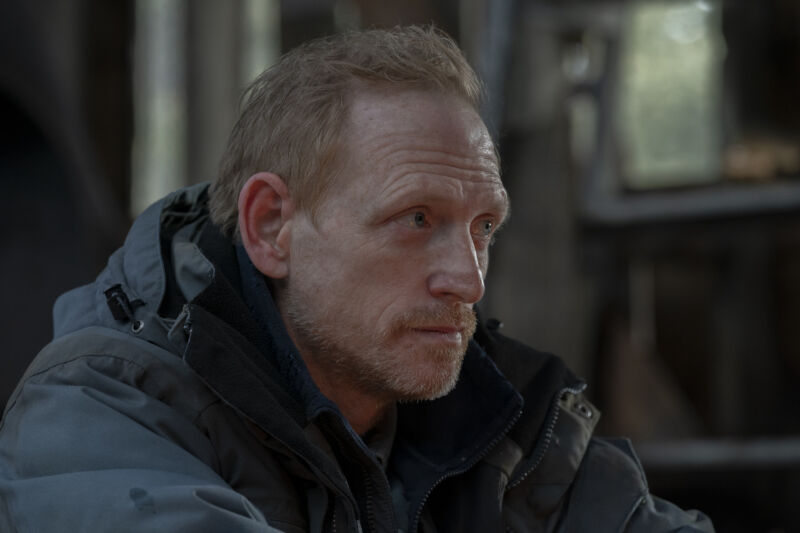
The first scene where David and Ellie meet, on the other hand—I could see it! David (played by Scott Shepherd, a fairly prolific character actor who has one of those “what have I seen him in?” faces) has a certain reassuring avuncular charisma to him. Unfortunately, we’ve already seen too many Bad Guy markers from him, even before you find out that he’s been reading To Serve Man.
Kyle: Where this episode does follow the games pretty closely is in leaning more toward the “torture porn” side of the equation than any part of the story so far. Not that there hasn’t been plenty of violence previously, but seeing Joel torture and kill two prisoners without any remorse and Ellie’s own almost-chopping-and-revenge really takes it to a new level. It also makes you look at both characters in a disturbing new light, I think.
Andrew: Joel is clearly being driven both by his dawning acceptance of Ellie-as-daughter figure (his “baby girl” when they finally meet back up is extremely loaded) and his established trust-no-one views of life post-apocalypse. But that doesn’t make it any less uncomfortable to watch. This is a dated reference, but I was reminded of Kiefer Sutherland’s Jack Bauer, from the War On Terror-era show 24. Sure, he tortures people, and sure, he seems just a hair too enthusiastic about it, but he gets results!!
And you’re right that Ellie’s butchering of David at the end of the episode goes on just a bit too long for comfort. I’m just not sure what to make of it. Surely Ellie has been traumatized as much as she could possibly need to be for story purposes. It’s not as though David was close enough to her to really betray her. Between the two of them, Joel and Ellie do enough violence this episode to sour their tearful reunion a bit. Which is not really where I wanted to be heading into the season finale of a show I have otherwise mostly liked.
Kyle: There’s definitely a certain “War on Terror” mindset that creeps into the narrative from decades past, for sure.
Andrew: That was where society ended, something the show occasionally references but doesn’t pick at too much. We’ve had one 9/11 reference and one Pearl Jam album with a lot of anti-Bush stuff on it, so presumably the US had invaded Iraq six months before society fell apart.
Kyle: Now I’m wondering if Osama bin Laden’s cave hideout was relatively safe from the Infected. Depends how much cordyceps-infused flour they imported, I guess?
Andrew: It does kind of make me want to see more about how the world outside the US is handling the apocalypse. Maybe we would have, back in the old days of 22-episode seasons.
Kyle: Which gets into what I think has become a pretty big pacing problem with the show. In the games, new characters would pop in and stick around for a while, and you never knew precisely when they would pop out again (usually with a violent death). Here, the structure means the pattern of “here’s a new character, they will be dead by the end of this episode (or maybe the next one)” has become way too obvious…
All that death has been building toward the big finale, though. Without getting too spoilery, I wonder if you even remember what Joel and Ellie are trekking for/toward at this point, and if you have any big predictions for the final episode?
Andrew: They still have to get her magic blood out to some Firefly-affiliated scientists! The only thing I’m confident enough to assert is that they’re finally going to get where they’re going, and the scientists are going to end up being weirdo creeps who aren’t totally on the level.
I would love to be pleasantly surprised! Maybe the show has settled into this predictable rhythm to make it especially mind-blowing next week when all the scientists end up being super chill and professional.
Kyle: Not to set your expectations too high, but the conclusion of The Last of Us Part One is what raises it to the level of “All Time Great” game for me, so I’m looking forward to seeing this team of actors and producers tackle it.
Andrew: It’s too late, you’ve set my expectations too high! If I don’t like the finale, it’ll be all your fault.
https://arstechnica.com/?p=1921436
How The Last of Us re-created a 2003 arcade with the help of true enthusiasts
<img src="https://rassegna.lbit-solution.it/wp-content/uploads/2023/03/how-the-last-of-us-re-created-a-2003-arcade-with-the-help-of-true-enthusiasts.jpg" alt="It took a lot of work for Ellie and Riley to play Mortal Kombat II in The Last of Us—and somehow just as much work, if not more, to be able to film it.”>
Enlarge/ It took a lot of work for Ellie and Riley to play Mortal Kombat II in The Last of Us—and somehow just as much work, if not more, to be able to film it.
The Last of Us‘ HBO series went to great lengths to re-create a 2003 mall arcade for a recent episode. Two of the arcade enthusiasts hired on for that scene have detailed the triumphs and technical limitations they encountered, at length, in an arcade history forum thread.
In the HBO adaptation of The Last of Us, a cordyceps outbreak overtakes the world in 2003, leaving things much as they were in the 2023 world through which Joel and Ellie struggle. In episode 7, a flashback shows Ellie and a friend powering up and exploring an early-aughts mall, complete with a beautifully neon-lit arcade, left just as it was during the first George W. Bush administration.
[embedded content]
The arcade scene in episode 7 of The Last of Us.
Production designer John Paino told Variety that “Raja’s Arcade” took its name and frontal appearance from the game’s Left Behind DLC, but otherwise the production team built it from scratch. All the games had to actually work because creators Craig Mazin and Neil Druckmann demanded it, according to Paino. But the original games would have had cathode-ray tube (CRT) screens, which—as anybody using a camera back then would remember—can be difficult to capture. “We rebuilt them on LED screens,” Paino told Variety.
That’s only partly true, and definitely not the whole story. Over at the forums on Museum of the Game (aka the International Arcade Museum, aka Killer List of Videogames, aka KLOV), active members noticed. More than one member reports selling some of their classic games to The Last ofUs for these arcade scenes. Two more worked as consultants on the scene.
“They bought 3 games from me and all 3 had beautiful working tubes. I hope they didn’t trash them…,” member shortcircuit wrote. They were, however, “extra stock,” and “not needed,” they later wrote.
Forum members JoshODBrown (Josh Brown) and ChanceKJ (Chance Johnson), who together make up The Canadian Arcade, consulted with HBO on the episode. Throughout an extensive thread, the duo unpacks a lot of the tricks, workarounds, and concessions necessary for the scene.
Enlarge/ Inside this cabinet is a Sony OLED panel, flipped and treated to resemble CRT output.
The Mortal Kombat II gameplay footage in the episode is their own, captured on a 46-inch OLED panel they rotated 90 degrees and then treated with scanlines, curvature, and rounded corners to look more like a real CRT. They set up a remote interface that would trigger each of their gameplay clips whenever the actors dropped a quarter into the machine, so the show could capture the actors reacting to the clips in real time.
“On the day we filmed it I’m actually lying on my stomach behind the ticket counter a few feet away with a 50 foot HDMI cable connecting the OLED to a MacBook Air running VLC playing those clips in real time as the girls interact with the game,” wrote Johnson in a later message.
“While we got Mortal Kombat to MOSTLY look like a CRT on camera, it was an expensive process (time and money) and we did do it for a few other games in the arcade, but time was not on our side to make it happen for every game,” Brown wrote. Some games had their monitors blanked, so as to not flicker on camera. Some games legitimately glitched or stopped working during the shoot, recreating something likely to happen in an arcade that had sat dormant for 20 years.
https://arstechnica.com/?p=1921605
Scientists have mapped a secret hidden corridor in Great Pyramid of Giza
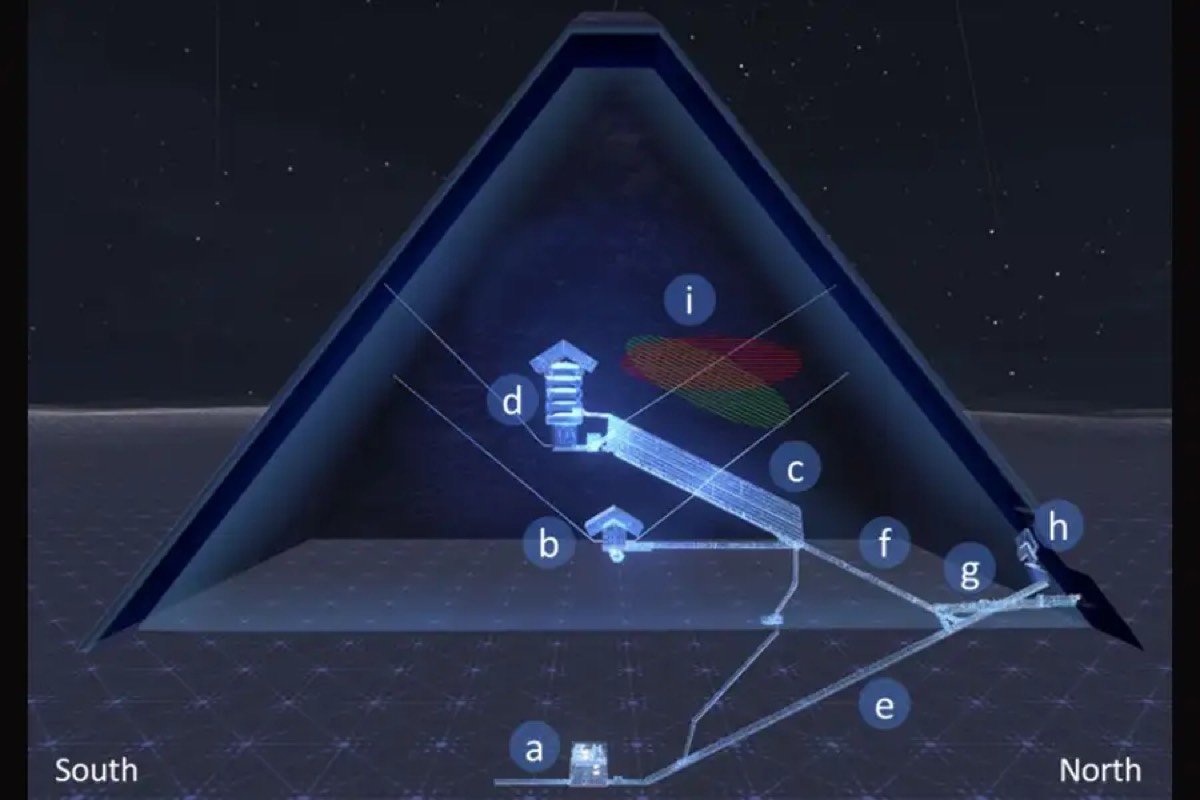
Enlarge/ Map of the known corridors and rooms inside the Great Pyramid of Giza. Evidence of a secret corridor was detected in 2016 behind the famed chevron blocks on the north face (h). Another mysterious large void (i) was discovered in 2017—a possible hidden chamber.
Procureur et al., 2023
In 2016, scientists using muon imaging picked up signals indicating a hidden corridor behind the famous chevron blocks on the north face of the Great Pyramid of Giza in Egypt. The following year, the same team detected a mysterious void in another area of the pyramid, believing it could be a hidden chamber. Two independent teams of researchers, using two different muon imaging methods, have now successfully mapped out the corridor for the first time, according to a new paper published in the journal Nature Communications. Zahi Hawass, Egypt’s former antiquities minister, called it “the most important discovery of the 21st century.”
As we’ve reported previously, there is a long history of using muons to image archaeological structures, a process made easier because cosmic rays provide a steady supply of these particles. An engineer named E.P. George used them to make measurements of an Australian tunnel in the 1950s. But Nobel-prize-winning physicist Luis Alvarez really put muon imaging on the map when he teamed up with Egyptian archaeologists to use the technique to search for hidden chambers in the Pyramid of Khafre at Giza. Although it worked in principle, they didn’t find any hidden chambers.
There are many variations of muon imaging, but they all typically involve gas-filled chambers. As muons zip through the gas, they collide with the gas particles and emit a telltale flash of light, which is recorded by the detector so scientists can calculate the particle’s energy and trajectory. It’s similar to X-ray imaging or ground-penetrating radar, except with naturally occurring high-energy muons rather than X-rays or radio waves. That higher energy makes it possible to image thick, dense substances like the stones used to build pyramids. The denser the imaged object, the more muons are blocked, casting a telltale shadow. Hidden chambers in a pyramid would show up in the final image because they blocked fewer particles.
Muons are being used to hunt for illegally transported nuclear materials at border crossings and to monitor active volcanoes in hopes of detecting when they might erupt. In 2008, scientists at the University of Texas, Austin, tried to follow in Alvarez’s footsteps, repurposing old muon detectors to search for possible hidden Mayan ruins in Belize. And physicists at Los Alamos National Laboratory have been developing portable versions of muon imaging systems to unlock the construction secrets of the soaring dome (Il Duomo) atop the Cathedral of St. Mary of the Flower in Florence, Italy, designed by Filippo Brunelleschi in the early 15th century. The dome has been plagued by cracks for centuries, and muon imaging could help preservationists figure out how to fix it.
As Annalee Newitz wrote for Ars in 2017, the Pharaoh Khufu (2509-2483 BCE) ordered the Great Pyramid to be built at Giza roughly 4,500 years ago. The structure remained sealed until 820 CE, when the Caliph al-Ma’mun broke open one of its walls and discovered three chambers inside, arranged vertically: the King’s Chamber, the Queen’s Chamber, and an abandoned subterranean chamber, connected by the “Grand Gallery,” a large corridor. There is also a descending corridor, an ascending corridor, and a passage dug in the Middle Ages that now serves as a tourist’s entrance.
https://arstechnica.com/?p=1921289
Medieval manuscripts may have described “new” whale feeding trick centuries ago
Enlarge/ A digital reconstruction of a humpback whale engaged in trap feeding.
John McCarthy, Flinders University
About 10 years ago, marine biologists witnessed two different species of whales in different geographic locations engaged in a novel feeding strategy. The whales would position themselves at the water’s surface and stay motionless with their mouths wide open. Fish would swim into their mouths, and the whales would snap their jaws and swallow. It’s been dubbed trap feeding, or tread-water feeding. A clip of whales engaged in trap feeding even went viral on Instagram in 2021.
Yet this feeding strategy might not be as recent as scientists initially thought. Researchers at Flinders University in Australia have found striking descriptions of what sounds a lot like trap feeding in Old Norse descriptions of the behavior of a sea creature called the hafgufa, according to a new paper published in the journal Marine Mammal Science. That creature, in turn, can be traced back to medieval bestiaries and a type of whale called aspidochelone, first mentioned in a 2nd century CE Alexandrian manuscript called the Physiologus.
“It’s exciting because the question of how long whales have used this technique is key to understanding a range of behavioral and even evolutionary questions,” said co-author Erin Sebo, a medievalist at Flinders University. “Marine biologists had assumed there was no way of recovering this data but, using medieval manuscripts, we’ve been able to answer some of their questions.”
Whales deploy a variety of feeding strategies. For instance, lunge feeding involves charging at schools of fish with the mouth open, while whales engaged in bubble-net feeding create a round curtain of bubbles to concentrate fish before charging into the center to feed. Scientists first observed lobtail feeding in the 1980s, novel behavior that seems to have been driven by a sharp decline in herring populations because of overfishing. The behavior is culturally transmitted between associated groups of whales.
Enlarge/ Diagram of humpback whales engaged in trap feeding; with a jaw either flush with the waterline, or raised to a similar height to the rostrum.
John McCarthy, Flinders University
Trap feeding was first recorded in 2011 in a group of humpback whales feeding on herring off Vancouver Island. The discovery was published in 2018 after a separate 2017 paper reporting similar feeding behavior among Bryde’s whales feasting on anchovies in the Gulf of Thailand. Similarly to the emergence of lobtail feeding, some researchers surmised that the behavior developed in response to increased pollution, “dead zones,” algal blooms, and similar environmental challenges, which had driven the whales’ prey closer to the water’s surface. Others thought it might simply be a particularly energy-efficient means of feeding when the fish population is less densely clustered.
Co-author John McCarthy, a maritime archaeologist at Flinders University, thought the recent trap-feeding behavior was strikingly similar to Norse descriptions of the hafgufa, most notably in a 13th century text called King’s Mirror (Konungs skuggsjá). It’s described as a sea creature of great size with an unusual feeding method:
[W]hen it goes to feed, it gives a great belch out of its throat, along with which comes a great deal of food. All sorts of nearby fish gather, both small and large, seeking there to acquire food and good sustenance. But the big fish keeps its mouth open for a time, no more or less wide than a large sound or fjord, and unknowing and unheeding, the fish rush in in their numbers. And when its belly and mouth are full, [the hafgufa] closes its mouth, thus catching and hiding inside it all the prey that had come seeking food.
That is a remarkable accurate description of trap feeding, and the key details are also found in earlier medieval bestiaries and the aforementioned Physiologus: a creature holding its jaws open, emitting a smell or scent that attracts small fish to jump in its mouth, with the creature snapping its jaws shut and swallowing when enough fish have amassed in the trap. “The tradition remained remarkably coherent and consistent over 1,500 years, with minimal embellishment or reinterpretation,” the authors wrote. Further, the creatures in those earlier source texts are identified as whales, not mythical sea monsters. Many of those texts also have illustrations showing sea creatures consuming fish in a manner reminiscent of trap feeding.
https://arstechnica.com/?p=1920523
Beyond Good & Evil 2 studio rocked by reported gov’t labor investigation
<img src="https://rassegna.lbit-solution.it/wp-content/uploads/2023/03/beyond-good-evil-2-studio-rocked-by-reported-govt-labor-investigation.jpg" alt="The team that brought you this Beyond Good & Evil 2 concept art is not doing well, according to a new report.”>
Enlarge/ The team that brought you this Beyond Good & Evil 2 concept art is not doing well, according to a new report.
If you’ve been waiting patiently for Beyond Good & Evil 2 since its first announcement back in 2008, we have some bad news about the studio responsible for the long-delayed project’s development. Kotaku now reports that Ubisoft Montpellier has lost its managing director amid a local government investigation into labor policies that have left “an unprecedented number of developers experiencing burnout and going on sick leave.”
Ubisoft Montpellier, which also developed the first Beyond Good & Evil two decades ago, is being looked at by its local branch of the Inspection du Travail, according to “three sources familiar with the development,” cited by Kotaku. In December, that office reportedly started looking into reports that dozens of developers had taken extended leave over stress or sickness over the last year. Employees have been interviewed regarding their health and well-being by a third party, according to the report.
“The health and wellness of our teams is an ongoing priority,” an Ubisoft spokesperson told Kotaku. “Given the length of the development cycle with Beyond Good & Evil 2, the Montpellier development team is undergoing well-being assessments through a third-party for preventative measures and to evaluate where additional support may be needed.”
News of the investigation comes as staff were informed last week of the departure of managing director Guillaume Carmona, who came to Montpellier from Ubisoft’s Paris offices in 2019. A number of development leads on the project have reportedly left or been shuffled around as well.
In the years since those trailers, Beyond Good and Evil creator and director Michel Ancel left Ubisoft amid reports of an investigation into his “toxic leadership” at the company. And while Ancel denies his departure was linked to that scandal, the move left the project without what was likely its greatest champion inside the company.
Study: Bronze Age remains in Israel show signs of trepanation
Enlarge/ Two Bronze Age skeletons (brothers) were found at Tel Megiddo in Israel. One showed evidence of trepanation.
Just a couple of weeks ago, we reported that scientists had analyzed the skull of a medieval woman who once lived in central Italy and found evidence that she experienced at least two brain surgeries consistent with the practice of trepanation. Now a recent paper published last week in the journal PLoS ONE has reported evidence of trepanation in the remains of a man buried between 1550 and 1450 BCE at the Tel Megiddo archaeological site in Israel.
Cranial trepanation—the drilling of a hole in the head—is perhaps the oldest known example of skull surgery and one that is still practiced today, albeit rarely. It typically involves drilling or scraping a hole into the skull to expose the dura mater, the outermost of three layers of connective tissue, called meninges, that surround and protect the brain and spinal cord. Accidentally piercing that layer could result in infection or damage to the underlying blood vessels. The practice dates back 7,000 to 10,000 years, as evidenced by cave paintings and human remains. During the Middle Ages, trepanation was performed to treat such ailments as seizures and skull fractures.
In the case of the medieval woman’s skull, an oval area in the center of the cross-shaped defect was evidence of a well-healed trepanation procedure. Metal surgical tools were probably used to make a cross-shaped incision to the top of a head, scraping away the scalp from the bone—a trepanation method that is historically well-documented—which could also explain the signs of inflammation and/or infection. The second surgery likely occurred shortly before the woman’s death. It’s one of the few archaeological pieces of evidence of trepanation being performed on early medieval women yet found, although why the woman in question was subjected to such a risky invasive surgical procedure remains speculative.
This latest report of trepanation concerns one of two brothers (based on DNA testing of the remains) buried together at Tel Megiddo, which is located in the Jezreel Valley. The settlement once controlled part of a major land route connecting Egypt with Syria, Mesopotamia, and Anatolia called the Via Maris, making Tel Megiddo a prosperous urban center during the Middle and Late Bronze Ages. The remains of the two brothers were found in a tomb near the city’s Bronze Age palace, along with many fine wares, suggesting that the site was part of the palace complex, perhaps a residence for high-ranking officials.
Enlarge/ A-B: Magnified edges of the trepanation. C: All four edges of the trepanation. D: Reconstructed location of trepanation on head.
One skeleton was largely intact (Individual 1), while the other’s (Individual 2) bones were disarticulated and partially covered by goat or antelope remains. The authors believe that Individual 2 was buried between one and three years before his brother in a different location, then exhumed and reburied along with his brother in a new pit—hence the disarticulation.
Most notably, Individual 1 had a small hole—about 32×31 mm at its widest point, formed by a series of intersecting notches—in his skull’s frontal bone where a piece of the skull had been removed. The authors report that the instrument used probably had to have a sharp beveled edge, given the clean margins. They also noted smaller scratches “consistent with the opening of the scalp, a necessary step prior to bone excision.” There was no sign of the bone healing, suggesting that the brother died either during or within a week after the trepanation.
Archaeologists also recovered two excised pieces of cranial bone with cuts on at least two sides, indicative that the procedure was performed piecemeal. Per the authors, all the evidence is consistent with a process known as angular-notched trepanation, in which a flap of skin is removed, followed by making one or two initial grooves, stopping before piercing the soft tissues underneath (the dura mater). Once all the grooved pieces had been cut, the practitioner would then remove them all at once. The authors suggest these pieces may have been placed back in the hole after the procedure to encourage healing. But lacking “proper hygienic storage conditions,” fatal complications likely ensued.
Enlarge/ Excised cranial pieces. Trepanation with refit excised cranial piece (left). Both extant pieces found during analysis (right).
The authors offered speculative thoughts on why a trepanation might have been performed. The bones of both brothers showed evidence of developmental anomalies that were more severe in Individual 1, who had a fourth molar and two frontal bones that had not fully fused (metopic suture). Both are consistent with a rare skeletal disease called Cleidocranial dysplasia. (Actor Gaten Matarazzo, who plays Dustin on Stranger Things, has this condition.)
There were also indications of extensive lesions on the bones of both brothers, signs of a likely chronic debilitating disease. Leprosy is one possible candidate since it is known to spread throughout family units, and males between 10 and 19 years of age are most susceptible. However, “It is notoriously difficult to identify leprosy in archaeological, fragmented skeletal remains,” the authors wrote; hence, “we cannot identify a single underlying illness without further biomolecular testing.”
The authors also surmise the brothers were high-ranking and wealthy since they had survived so long with such a condition and had been buried with so many fine things near the palace. Also, an intervention like trepanation would have been quite rare and reserved for those with access to highly trained medical practitioners. Per the authors, only four other cases of this type of angular notched trepanation have been found in the region, and none showed any signs of post-operative healing, indicating those individuals also died shortly after the procedure.
These scientists lugged logs on their heads to resolve Chaco Canyon mystery
Enlarge/ Rodger Kram, left, and James Wilson carry a log with tumplines with the Boulder Foothills in the background.
Patrick Campbell/CU Boulder
The so-called “great houses” of Chaco Canyon in New Mexico may have taken decades or longer to construct. Most large complexes had four or five stories and averaged over 200 rooms, with the largest boasting as many as 700 rooms. The complexes also featured large circular ceremonial areas called kivas. To construct these great houses, archaeologists have estimated that the Chacoans would have needed wood from some 200,000 trees, and those 16-foot-long wooden beams must have been transported from mountain ranges as far as 70 miles (110 km) away.
Many scientists have hypothesized about how the Chacoans might have accomplished this feat. The latest theory is that the Chacoans may have used simple devices called tumplines, still favored by sherpas in Nepal, according to a new paper published in the Journal of Archaeological Science: Reports. To test that hypothesis, co-authors Rodger Kram and James Wilson spent the summer of 2020 training until they could haul a heavy log some 15 miles using tumplines. “Some people baked sourdough bread during COVID,” said Kram, an emeritus professor of integrative physiology at the University of Colorado at Boulder. “Instead, we carried sand and heavy logs around using our heads.”
There are no preserved timber scrape marks near the site, and the people of Chaco Canyon didn’t have draft animals or even wheels, according to Kram and his co-authors. So the logs must have been carried by people, most likely along the wide roadways that linked this world. A 1925 publication featured a photograph depicting eight young men from Zuni Pueblo carrying a log: four on each side holding thin cross-poles at hip height, with the log laid on top. That photograph influenced many of the proposed mechanisms for transporting the logs. However, Kram et al. pointed out that there’s no clear evidence that the residents of Zuni Pueblo share cultural connections with the people who once inhabited Chaco Canyon. “We feel that it is dubious to infer Chaco era timber transportation methods from a staged 20th century image,” they wrote.
Others have suggested that the timbers were rolled rather than carried to construction sites, perhaps bundled within smaller wood pieces for protection or carried on the shoulders. And the published oral traditions and ethnography of the Pueblo and Dineo peoples descended from the Chachoans don’t shed much light on the issue, either. There is one account of the timbers for Pueblo Bonita being hauled on little wagons made of a small tree, with a cross-section at either end serving as a rudimentary wheel. But that account is inconsistent with the known sourcing of the timbers—the Chuska, Zuni, San Mateo, La Plata, ad Sa Juan Mountains—and there is also no archaeological evidence for the existence of such carts, according to the authors.
Enlarge/ The ruins of Chetro Ketl in Chaco Canyon, featuring the complex’s great kiva.
Pubic domain
Kram developed his own theory about how the Chacoans managed the feat, starting with his realization a few years ago that the assumptions since 1980 about the mass of a typical roof beam (viga) used in one of the great houses was likely too high: 275 kilograms, a bit more than 600 pounds. “I cut a 1-foot-long section of pine and weighed it on my bathroom scale,” said Kram. “I multiplied by 16 feet and realized, ‘That can’t add up to 275 kilograms.’”
He and Wilson, who was then an undergraduate in biochemistry at the University of Colorado, Boulder, read up on the properties of dried wood and published their conclusions last year. They estimated that a 16-foot-long pine log weighed closer to 85 kilograms, or just over 185 pounds. That changed the calculation significantly when determining how many people would have been needed to carry the timbers 60-70 miles. And they decided to test whether the journey was possible themselves.