Myst remake impressions: Handsome island touch-ups, launch-week woes

Welcome back, yet again, to Myst Island.
Enlarge / Welcome back, yet again, to Myst Island.
Cyan Worlds, Inc.

This week, eight months after a touched-up version of 1993’s Myst landed exclusively on the Oculus Quest VR system, the same remake has been further touched up and made available on more devices—including non-VR options. This remade version of the puzzle classic, simply titled Myst, is included on Xbox Game Pass on both consoles and PC, and that subscription option may be easier for some longtime fans to swallow than another $30 retail purchase (on Xbox, Steam, or GOG).

This release goes beyond the touch-ups found in 2014’s realMyst Masterpiece Edition, but it’s equal parts refined and iffy. Cyan has so far been proactive on its Steam forums, suggesting that fans should expect fixes and responses to some of this release’s first-week woes in short order. In the meantime, certain returns to Myst Island are already easy to recommend. Others merit a wait-and-see approach.

Changes mild and major since realMyst

On the most basic level imaginable, this week’s Myst is the same as the CD-ROM Myst you know and (possibly) love. Should you have the original game’s puzzles and steps memorized, load the game in its default state, and you can either unravel every puzzle and story as you remember it or skip the hunt for clues and instantly expose every age attached to Myst Island.

But this journey isn’t identical to the original. For one, players can no longer expect the original game’s Hypercard-based point-and-click system. This is now a real-time, first-person game, modeled after the controls you’d find in a shooter on PC or consoles. There’s no menu toggle to revert to the original game’s slideshow style—nor the realMyst 2000 edition’s “node-by-node” smooth walks between the original game’s frozen moments. I’m honestly peeved that the latter has been removed for non-VR players. I always appreciated that option to split the difference between the old and the new.

A few of the game’s switches and machines have been touched up to account for either VR compatibility or the shift to modern controls, too. Instead of clicking in the center of a painting to activate a door, for example, you now have to aim at a mechanical switch next to the painting. Once touched, the mechanical switch animates with a chunky sound effect. In general, I prefer the new touch-ups, in part because I imagined an entirely unfamiliar player trying Myst for the first time and having more obvious, mechanical items to click and manipulate. Mercifully, players won’t have to rewind their brain to the unfamiliar universe of mid-’90s CD-ROMs, but the heart of each puzzle remains intact.

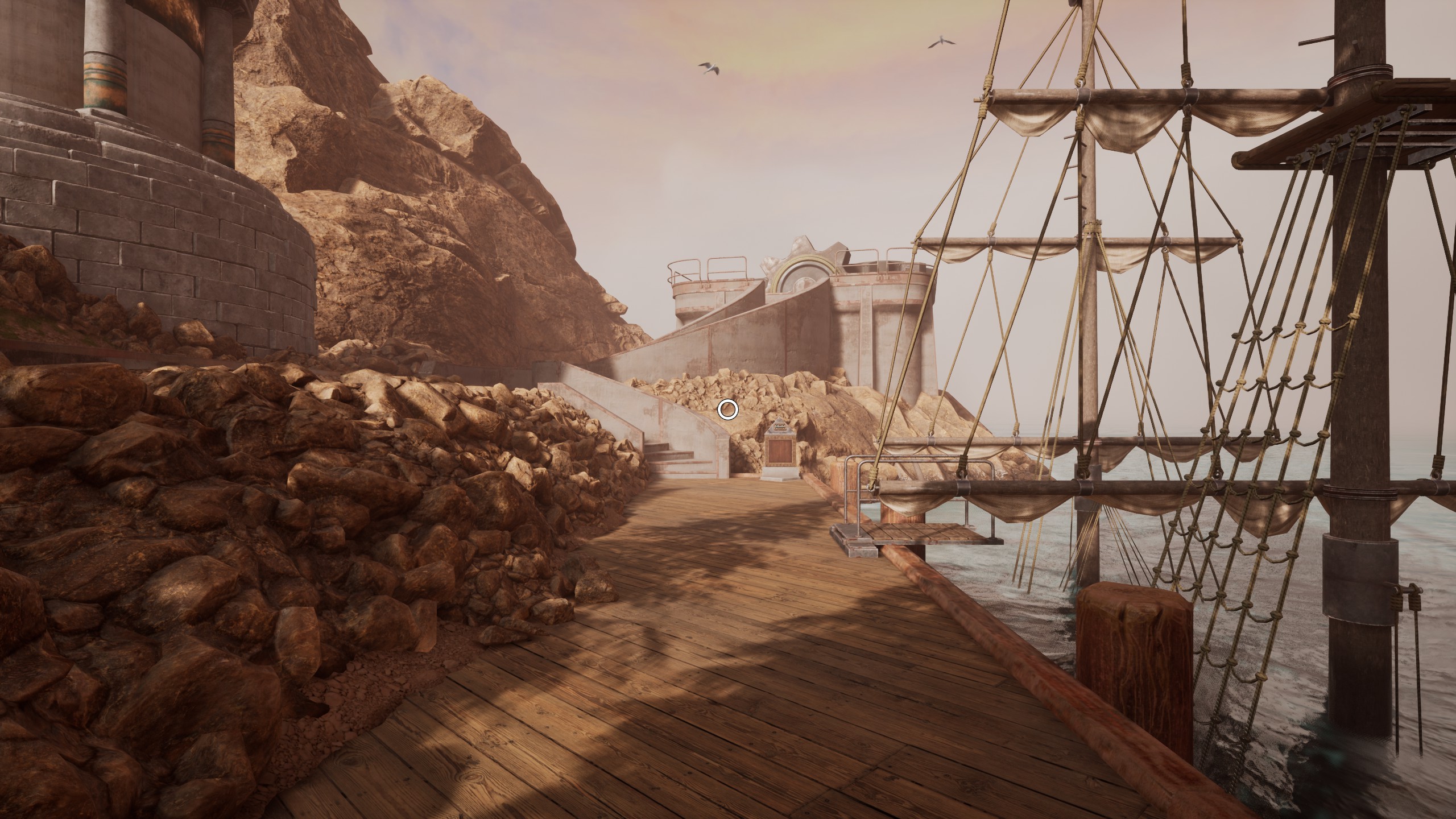
Meanwhile, the game’s original geometry has been overhauled—now for the third time, after two versions of realMyst and this time inside Unreal Engine 4. For the most part, the results are quite handsome, whether thanks to more bespoke foliage and trees, improved texture quality and object variety, or (most impressively) more realistic and grounded lighting that emulates material-based bounces, even without ray tracing enabled. When reviewing each version of the game side-by-side, you can see Cyan applying a different philosophy to how its dated 1994 CGI should be brought forward into a new computing generation. The results show the team’s willingness to reimagine various architectural touches or natural rock, forest, and water formations.

The crucial stuff looks identical or mighty familiar compared to the original game, and major island and underground arrangements are nearly identical in terms of physical walking distance. Plus, quite honestly, neither version of realMyst holds up particularly well in 2021, especially in terms of 3D translations of natural world elements. If you’re asking me to pick a favorite version of Myst, the grainy original is still my favorite, but I’d probably rather play this year’s model.

Solid defaults on both PC and console

Should you have an Xbox console (as low as the base Xbox One or as new as Xbox Series X) and Game Pass, I’d argue that’s the best way to dive back into the game in 2D, at least if you’re already paying for Game Pass. Performance and image quality are quite sharp on Series X/S, with most of the game’s PC effects toggles enabled and a frame rate that seems to stick to 60 fps. Both Xbox One versions drop to 30 fps, lower resolutions, and reduced graphics sliders. In particular, you’ll see less grass and foliage on a base Xbox One, with the results looking more like the wimpy Oculus Quest version. (The console version is currently Xbox exclusive. Sorry, PlayStation and Switch fans.)

On a features basis, at least in terms of flat-screen gaming, you’re getting practically the exact same experience. So if you can save $30 via Game Pass, you should do that.

Beyond the visuals, there’s the question of whether this is a better gaming option for anyone new to the meandering, puzzle-solving island pastiche. I’d say the answer is ultimately yes, whether because Myst‘s genre-defining foundation deserves to be so carefully preserved, or because a good gaming completionist should play CD-ROM fare meant for larger attention spans. You can’t get far in Myst without reading its texts, taking notes, and becoming absorbed in its plot, and that runs counter to the colder likes of The Talos Principle and The Witness. Sit with your kids and this version of Myst, and whatever purchase price is attached might soon melt away as you peel its mysteries away together.

Meanwhile, PC players can expect the usual slate of visual toggles, which Cyan thankfully exposes to players for easy tweaking. Since this is the original Myst we’re talking about—not updated with giant, walking robots or high-speed action sequences—you can arguably get away with an emphasis on visuals over high frame rates on older PCs. Should you want to peel back some frames, this version of Myst includes two upscaling options: Nvidia’s DLSS, which is exclusive to its RTX graphics cards, and AMD’s FSR, which works on a larger variety of both AMD and Nvidia GPUs.

I’ve tested both DLSS and FSR in games that support both, and my general conclusion has been a vote in favor of DLSS, which is admittedly an apples-versus-oranges showdown. DLSS can tap into dedicated GPU cores to do its work, while FSR can’t say the same, so it errs on the side of minimally invasive visual trickery. FSR is at its best when you’re fine running a lower base resolution anyway, but only DLSS really smartly builds a new pixel model on top of a lower base resolution. The same bears out in Myst 2021. It’s very tricky to prove this out in single screenshots, as some of each tech’s trickery is better represented with moving images, but you can see Nvidia ultimately win in comparisons, albeit in barely noticeable ways, in the above screenshot comparison gallery.

https://arstechnica.com/?p=1790309


Samurai-themed sci-fi flick It’s A Summer Film! expertly slices expectations

[embedded content]
The trailer for It’s a Summer Film!

When’s the last time you had pure fun at the movies? For a lot of us, it has probably been at least 1.5 years, given the whole global health pandemic that has been shutting down theaters and prompting distributors to withhold the types of movies that may deliver such joy (please, hold on Bond, please). Throughout 2020 and early 2021, the state of the industry sort of meant only extremes were released—prestige dramas vying for hardware and big budget blockbusters that cost so much they must push ASAP for ticket sales or a big streaming deal. Stumbling upon the unfettered pleasure of, say, something like Palm Springs became a rarity.

But if you can find It’s a Summer Film!—a genre mashup from Japan that’s centered on some samurai-obsessed high school girls—prepare for 90+ minutes of nonstop grinning. This film recently screened as part of Fantasia Fest, perhaps the world’s finest genre film event. It’s a festival that routinely features the type of work that catches viewers off guard but ends up landing among the year’s best (see The Columnist, from 2020). Within another unusual film year in progress, It’s a Summer Film! has already comfortably secured that very fate. In fact, it might be one of the most feel-good films we’ve come across in the last five years (up there with Bill & Ted 3, Coco, a documentary about Highlights for Children, and a high school zombie Christmas musical).

Filmed on (maybe) iPhone

<a href="https://cdn.arstechnica.net/wp-content/uploads/2021/08/Screen-Shot-2021-08-26-at-7.35.26-AM.png" class="enlarge" data-height="1356" data-width="958" alt="The poster for It’s a Summer Film! (is that 8.6 a Pitchfork score? I think my colleagues over there would agree this is the cinematic equivalent of Best New Music).”><img alt="The poster for It’s a Summer Film! (is that 8.6 a Pitchfork score? I think my colleagues over there would agree this is the cinematic equivalent of Best New Music).” src=”https://rassegna.lbit-solution.it/wp-content/uploads/2021/08/samurai-themed-sci-fi-flick-its-a-summer-film-expertly-slices-expectations.png” width=”300″ height=”425″ srcset=”https://rassegna.lbit-solution.it/wp-content/uploads/2021/08/samurai-themed-sci-fi-flick-its-a-summer-film-expertly-slices-expectations-1.png 2x”>
Enlarge / The poster for It’s a Summer Film! (is that 8.6 a Pitchfork score? I think my colleagues over there would agree this is the cinematic equivalent of Best New Music).
Fantasia Fest

Barefoot loves movies—so much so that she’ll stick it out with film club even when popular girl Karin’s derivative rom-com wins the group vote to become this year’s project. But if things were up to Barefoot, she’d be producing her own script, a passionately penned ode to classic samurai films called Samurai Spring. That’s the stuff that gets her out of bed in the morning, and it’s what she watches constantly outside of school with her pals Kickstand (an Astronomy Club-loving gearhead) and Blue Hawaii (a secret rom-com admirer with excellent Kendo skills). Barefoot casually references Zatōichi or Gate of Hell the way others her age might talk about Taylor Swift or BTS; she swears her grandmother claimed Ichikawa Raizō as a friend.

Kickstand and Blue Hawaii know this, which is why they can’t let poor Barefoot sit idle through 50 takes of “I can’t hear you / I love you!!!” They hatch a plan to stage a pirate production, scraping together Samurai Spring using some of their school’s other misfits as cast and crew (the kid who looks like he’s 30 would make a great villain; the punk guy who keeps modding his bike could probably handle lighting!). Kickstand can man the smartphone camera, Blue Hawaii can choreograph the fight scenes, and Barefoot will handle the script and direction. The goal? Usurp Karin’s shlock (“A film should be able to say I love you without words, say it too many times and it becomes avante-garde,” says Barefoot) by swapping out her film for a surprise screening of their own at the big year-end club festival.

There’s merely one tiny problem: Samurai Spring needs the right lead, someone who can be vulnerable and strong (and “also hot,” as Barefoot’s pals remind her). Luckily, Barefoot and Kickstand have noticed a newer guy at school named Rintaro, who’s pretty to the point even Barefoot can’t deny it. It takes some over-the-top effort to convince him, but the young now-actor reluctantly agrees to be the clay for Barefoot’s exquisite samurai vision. It’s just… something is a little weird with that one. He’s never heard of Netflix? Never eaten a marshmallow before, either?

More films need samurai overtones

I was enamored by It’s a Summer Film! almost immediately. Writer/director Sôshi Masumoto has taken the genres or societal subcultures he’s (presumably) in love with and crafted a debut film that affectionately combines them in clever ways. This is an ode to film nerdery, to teen movies, to rom-coms, to AV clubs, to a very excellent subgenre of sci-fi I am laboring not to spoil. The script is great, filled with enough breadcrumbs so that each second and third act development lands as a surprise but not an outright shock. Masumoto’s writing is perhaps a real-life analogue to the blood, sweat, and tears Barefoot puts into Samurai Spring within the film. (He’s just the latest filmmaker who started out making music videos and commercials only to nail his first full-length opportunity; see also Andrew Patterson with The Vast of Night and Aneesh Chaganty with Searching.)

If “ode to genre” sends chills down your “Uh oh, I’ve seen Ready Player One” spine, though, fear not. It’s a Summer Film! has real characters and an engaging story on top of all the references to Shintaro Katsu. The friendship between Barefoot, Kickstand, and Blue Hawaii will bring to mind other great female friendship adventures, like Booksmart or Whip It! They accept each other for who they are, even if they recognize each other’s shortcomings or pain points and sometimes have to act in conflict. Barefoot herself (played by Marika Itô) may initially strike you as annoyingly counterculture by choice, but she (and Itô’s performance) reveals herself to be incredibly genuine. This is a young woman increasingly becoming comfortable in her skin. Barefoot discusses themes and motifs of her beloved samurai stories with a depth that demonstrates this isn’t someone trying on a Nine Inch Nails shirt for style points (and those insights help viewers who are less familiar with that canon appreciate the ways It’s a Summer Film! echoes it by the end).

There are a number of sequences that I’ll be describing for weeks on end to anyone willing to listen. The (inevitable) final samurai fight happens in such an organic yet fitting way for these school cinema-heads. The glib glimpses of Karin’s extremely teen-written rom-com stay consistently funny. And I remain a sucker for pop culture centered on AV Club kids working their way through the hiccups, which Barefoot and co. encounter plenty of. (Her turn as a Fincher-like director in particular is delightful.)

Almost immediately after finishing It’s a Summer Film!, it became so easy to imagine some deep-pocketed US producer catching wind of this, purchasing adaptation rights, and doing a new English-language version. Closing my eyes, I saw Emma Stone circa Easy A in the lead role, and maybe the central films would be flipped to “sci-fi” instead of “samurai.” That’s basically what happened to The Guilty (coming to Netflix this fall with Jake Gyllenhaal!), so no problem. But this original film is so endearing and fun as is, I hope instead it lands on a streaming service with a massive subscriber base before 2022. In the meantime, can someone get this movie programmed as part of an Alamo Drafthouse theme month or something? Where are you, Neon and A24?

It’s a Summer Film! recently screened as part of the 2021 hybrid edition of the great genre event, Fantasia Fest. The film is in theaters in Japan but continues to play the festival circuit elsewhere, including the 2021 JAPAN CUTS event where it’s available VOD until September 2. The most up-to-date availability can likely be found on the film’s official website (note it’s in Japanese without a language option, but you can always try Google Translate).

Listing image by Fantasia Fest

https://arstechnica.com/?p=1789926


Overwatch’s cowboy will be renamed over namesake’s ties to Activision lawsuit

Video game image of a grizzled Old West gunfighter.
Enlarge / The cowboy formerly known as McCree is currently the “Man with No Name.”

Overwatch’s cowboy is getting a new name.

This is Blizzard’s latest attempt to salvage its image. The studio is dealing with a lawsuit filed by the state of California in July over employee claims of sexual discrimination and harassment, and its recent public defense was ill-received. The cowboy’s namesake was Diablo 4‘s former lead designer Jesse McCree, who was fired after images showed him inside “the Cosby suite,” where female employees reported they were harassed. The announcement comes a day after the Golden State accused the company in an amended complaint of shredding HR documents.

The cowboy McCree is a gun-for-hire loner in Overwatch lore. In-game, one interaction jokingly casts doubt about McCree’s first name being Joel, but it was officially Jesse.

Blizzard's statement in full.
Enlarge / Blizzard’s statement in full.

The change is not insignificant, causing a delay to new story content previously scheduled for September. In its statement, Blizzard set a vague date of later this year for that expansion. In the interim, Overwatch players will receive a new FFA map next month instead. Furthermore, no characters will take the name of employees going forward. Blizzard’s Twitter post reads, “… we’re building a fictional universe that is unmistakably different from the real world” and is “an ongoing commitment to honest reflection.”

There’s no word on potential new names for McCree, but Blizzard’s post says it will keep the community updated as these changes are put in place.

https://arstechnica.com/?p=1790106


As it turns out, “Netflix Gaming” isn’t a streaming service [Updated]

One month after its vague announcement of a new gaming-centric strategy, Netflix has explained how it will “publish” video games in the foreseeable future: as downloadable smartphone apps, available exclusively for paying video-streaming subscribers.

The news coincides with the company’s public launch of Netflix Gaming on Thursday as part of the service’s smartphone app… but only in Poland—and only on Android. The company’s American Twitter translated Thursday’s Polish announcement, which explains how the service works. It also announced the two games launching as part of the service today: Stranger Things 3, a 16-bit beat-‘em-up that was previously available as a standalone Google Play purchase (and is still live on PC and consoles); and Stranger Things: 1984, a rebranding of a 2017 smartphone-exclusive game that revolve around slow, puzzle-solving movement through pixelated TV-series environments. (Both games, coincidentally, were made by the same indie game studio, BonusXP, which is based in Texas, not Poland.)

To access this content, you’ll need to log in to Netflix’s Android app while using a Polish IP address, then open the region’s new “N Gaming” row of icons (pictured below). From there, pick either of those games, and the app will direct you to their Google Play download listings. Once downloaded, the apps in question will request your Netflix credentials before loading, and they will not work without an active Netflix membership.

No ads, no MTX—but also no iOS?

[Update: Since this article’s publication, Netflix has clarified that the process for accessing games on Android devices is more streamlined than previously announced. We have yet to personally test putting Netflix credentials into games attached to its app, but this falls in line with standard credential checks across the Android and iOS marketplaces, which means it should translate neatly enough if it ever finds its way to Apple smartphones and tablets.]

The good news about this access method is that Netflix can promise two key things within its controlled game umbrella: no in-game purchases (aka microtransactions, or MTX) and no advertisements. If a game is “N Gaming” branded, it’s in the clear on those fronts.

(If you’re wondering, Poland has recently become a more popular test region for game and app launches, with Sony’s PlayStation Plus Video Pass remaining a Poland-only promotion for the time being.)

Thursday’s Netflix Gaming launch clarifies that, for now, Netflix does not have designs on becoming “the Netflix of video games,” at least in terms of mimicking its popular video-streaming app to deliver video games. If you want cloud-streamed games, served in all-you-can-eat fashion for a flat subscription fee, Xbox Game Streaming and Amazon Luna remain your best options, so long as you live in a compatible region.

The move seems less interested in the delivery method and more in pumping out easily accessible games that lean on Netflix’s massive library of licenses. Considering how huge the smartphone-gaming market is and how much room there is for a recognizable service that promises ad-free, MTX-free fun with familiar characters and series, it’s arguably a better business call than competing directly with Nintendo, Sony, or Microsoft.

Could Netflix have other platforms or delivery methods in its sights? It’s unclear. Today’s announcement reminds users that the company is “explor[ing] what gaming looks like on Netflix,” a statement that gives the company the legal wiggle room to say that it might one day announce a backpack-mounted VR-chess version of The Queen’s Gambit or a real-life escape room experience modeled after any of its docuseries about serial killers.

But Netflix’s choice to announce one specific game-production path today, without hinting at popular options like PCs, consoles, or cloud-streaming platforms, is quite telling. What’s more, it aligns with Netflix’s notable hire of Mike Verdu as the company’s gaming team’s head; his modern track record has mostly revolved around mobile fare on behalf of EA and Zynga.

This article has been updated to correct an error about the origins of the video game Stranger Things: 1984.

Listing image by Netflix

https://arstechnica.com/?p=1790000


Need to get root on a Windows box? Plug in a Razer gaming mouse

Need to get root on a Windows box? Plug in a Razer gaming mouse

This weekend, security researcher jonhat disclosed a long-standing security bug in the Synapse software associated with Razer gaming mice. During software installation, the wizard produces a clickable link to the location where the software will be installed. Clicking that link opens a File Explorer window to the proposed location—but that File Explorer spawns with SYSTEM process ID, not with the user’s.

Have mouse, will root

By itself, this vulnerability in Razer Synapse sounds like a minor issue—after all, in order to launch a software installer with SYSTEM privileges, a user would normally need to have Administrator privileges themselves. Unfortunately, Synapse is a part of the Windows Catalog—which means that an unprivileged user can just plug in a Razer mouse, and Windows Update will cheerfully download and run the exploitable installer automatically.

Jonhat isn’t the only—or even the first—researcher to discover and publicly disclose this bug. Lee Christensen publicly disclosed the same bug in July, and according to security researcher _MG_, who demonstrated it using an OMG cable to mimic the PCI Device ID of a Razer mouse and exploit the same vulnerability, researchers have been reporting it fruitlessly for more than a year.

Vulnerability fixes coming soon to a Windows Catalog near you

Happily, Razer seems to have finally gotten the memo—jonhat reported that the company reached out to him shortly after his August 21 public disclosure to assure him that its security team is “working on a fix ASAP,” and the company even offered him a bounty despite the public disclosure.

Once Razer itself has patched the vulnerability, the next step will be pushing it to Microsoft for inclusion in Windows Catalog—where it will need to replace the current and vulnerable Razer HIDClass driver that Windows Update automatically downloads and runs whenever a Razer mouse is plugged into the system. (The vulnerable version in the Windows Catalog as of publishing time is 6.2.9200.16495, dated January 2017.)

https://arstechnica.com/?p=1789961


Graphene veils may hold the secret to conserving priceless works of art

<img src="https://rassegna.lbit-solution.it/wp-content/uploads/2021/08/graphene-veils-may-hold-the-secret-to-conserving-priceless-works-of-art.jpg" alt="Detail from Matina Stavropoulou's original painting, Triton and Nereid, one of several used for a series of experiments with graphene veils.”>
Enlarge / Detail from Matina Stavropoulou’s original painting, Triton and Nereid, one of several used for a series of experiments with graphene veils.
Matina Stavropoulou

Graphene is the thinnest material yet known, composed of a single layer of carbon atoms arranged in a hexagonal lattice. That structure gives it many unusual properties that hold great promise for real-world applications: batteries, super capacitors, antennas, water filters, transistors, solar cells, and touchscreens, just to name a few. And now this wonder material might just provide a solution to the fading of colors of many artistic masterpieces, according to a recent paper published in Nature Nanotechnology.

“All art establishments are concerned with the discoloration of paintings upon exhibition and storage, since harmful factors such as sunlight, moisture, and certain volatile organic compounds (VOCs) accelerate the degradation,” said co-author Costas Galiotis, a chemical engineer at the University of Patras in Greece. “There are many references to well-known endangered artworks, such as [Vincent] Van Gogh’s The Bedroom and Sunflowers, or [Edvard] Munch’s The Scream.”

A variety of culprits are behind the degradation of fine art. For instance, several of Georgia O’Keeffe’s oil paintings housed in the Georgia O’Keeffe Museum in Santa Fe, New Mexico, have developed tiny pin-sized blisters, almost like acne, for decades. Conservators have found similar deterioration in oil-based masterpieces across all time periods, including works by Rembrandt. As we’ve previously reported, conservationists and scholars initially assumed they were grains of sand trapped in the paint. But then the protrusions grew, spread, and started flaking off.

Chemists concluded that the blisters are actually metal carboxylate soaps, the result of a chemical reaction between metal ions in the lead and zinc pigments and fatty acids in the binding medium used in the paint. The soaps start to clump together to form the blisters and migrate through the paint film. Some 70 percent of all oil paintings have deterioration associated with metal carboxylate soaps to varying degrees.

In the case of Van Gogh’s Sunflower series, which has been fading over the last century due to constant exposure to light, the culprit seems to be the lead chromate dyes favored by the artist. A 2011 study found that chromium in the chrome yellow Van Gogh favored reacted strongly with other compounds like barium and sulfur when exposed to sunlight. A 2016 study pointed the finger at the sulfates, which absorb in the UV spectrum, leading to degradation.

Last March, scientists took swabs from Renaissance and Renaissance-style pieces and confirmed the presence of so-called “oxidase positive” microbes on painted wood and canvas surfaces. These microbes munch on the compounds found in paint, glue, and cellulose, which are found in paper, canvas, and wood). This in turn produces water or hydrogen peroxide as byproducts. Those byproducts are likely to influence the presence of mold and the overall rate of deterioration of the artworks.

Even contemporary art materials are prone to irreversible color changes from exposure to light and oxidizing agents, among other hazards. There has been recent work on the use of nanomaterials for conservation of artworks. Graphene has a number of properties that make it attractive for art-conservation purposes, according to Galiotis. The one-atom-thick material is transparent, adheres easily to various substrates, and serves as an excellent barrier against oxygen, gases (corrosive or otherwise), and moisture. It’s also hydrophobic and is an excellent absorber of UV light.

“It seemed to us the perfect solution to protect colors from photodegradation,” Galiotis told Ars. “The innovation of our approach is based on the fact that graphene adheres to any clean surfaces, but it can easily be removed, in contrast to current commercial polymeric coatings. Thus, it exhibits a competitive advantage over other protective materials and substances for the protection of artworks from color fading.”

Galiotis and his colleagues developed a roll-to-roll method for transferring a thin layer of graphene to a work of art. This means there is no need for solvents or other chemicals, which can damage the art. First, they synthesized a graphene monolayer veil on copper foil via chemical vapor deposition, then cleaned it with nitrogen gas to remove any dust, dirt, or water molecules. Then they attached the graphene to one side of a commercial polyester/silicon adhesive membrane with a roll-to-roll machine.

But how could they get hold of original paintings to test the safety and effectiveness of their method, given the fact that the work would be destroyed in the process? According to Galiotis, the team had an extensive network of painters in Greece and Europe, but most were reluctant to have their paintings destroyed. Enter Matina Stavropoulou, an artist who became sufficiently fascinated by the group’s technique to donate three of her more recent paintings for the experiments, all created using Indian inks on glossy paper placed over a canvas support. “We are very grateful to her for this,” said Galiotis.

Suffering for art

Stavropoulou’s Resistance and Triton and Nereid, each measuring 20×20 cm2, were used for the characterization and aging experiments. Half of the artwork was protected using the team’s roll-to-roll method to apply a graphene veil. Both paintings were then artificially aged in an in-house chamber, with one portion of the artwork covered as a reference sample. Resistance was exposed to three neon lamps for 16 weeks, while Triton and Nereid was exposed to panel of seven white lights for 1,050 hours. The graphene layers in both cases showed no signs of cracks or wrinkles after the aging process.

The third painting, Biplane, Handley Page H.P. 42, was used to assess how safely and easily the graphene layers could be removed form the painting’s surface. The team applied the graphene layer as usual and then used a soft rubber eraser to remove it. The researchers used paper mockups made of cardboard, with pink drawing ink on one side, to test the entire process. The samples were coated with a graphene layer and artificially aged under white light for 70 hours before the graphene was removed with a soft rubber eraser.

This is a promising proof of principle in the effectiveness of graphene veils for protecting art from exposure to harmful agents, particularly those created on glossy paper, cardboard, and canvas. However, the authors caution that their method may not be suitable for artworks with extremely rough surfaces or embossed patterns. For those situations, the authors developed a method for the deposition of graphene on museum framing glass for added protection.

DOI: Nature Nanotechnology, 2021. 10.1038/s41565-021-00934-z  (About DOIs).

https://arstechnica.com/?p=1789025


Documentary about Amiga classic Lemmings due for game’s 30th anniversary

[embedded content]

The Amiga classic Lemmings turns 30 this year. To celebrate, current license holder Exient (who acquired the property from Sony) is producing a documentary titled Lemmings 30th: Can You Dig It?, which follows the series from its European PC origins to its current mobile iterations.

Even though it has been ported to a seemingly infinite number of consoles in the US, Lemmings is deeply British. It’s a game about guiding blue-robed, green-haired critters to an exit before they accidentally kill themselves along the way.

The game’s dry humor and puzzle design eschewed the typical ’90s American-style action/arcade platforming for something less reflex-intensive, helping Lemmings become a hometown favorite. “If you visit Dundee, where Lemmings was originally created for the Amiga by DMA Design, there’s even a park with three little monuments to the Lemmings characters,” Exient Creative Marketing Manager Jamie Wotton told Ars. “Quite clearly—and hopefully the documentary will show this—the franchise has a special place in British culture.”

Lemmings’ gimmick is based on an untruth; the real-life creatures do not regularly engage in mass suicide. That idea goes back a long way but was popularized by an infamous Disney documentary, 1958’s White Wilderness, in which a narrator says that lemmings often fling themselves off cliffs during migration. In truth, the film’s producers allegedly pushed lemmings off a cliff into water to capture footage for the segment, and the images weren’t of the Arctic Ocean as stated (the video showed a river in Calgary).

When asked about those shaky origins, Wotton said, “There’s certainly plenty of discussion over the origins of the game concept in the documentary, including how the gameplay influenced other titles of its time and since, including the likes of Populous. And it’s been fascinating to hear about the origins and legacy from so many different points of view. Perhaps Disney’s legacy on lemming behavior was a little wide of the mark though.”

Lemmings 30th: Can You Dig It? is set for an online release in late 2021 and is directed by Richard Wilcox from the team at That Video Company. Interviewees will include the original developers, industry veterans like Peter Molyneux, journalists, and fans.

Listing image by Exient

https://arstechnica.com/?p=1789718


Horizon Forbidden West delayed, leaves Sony with fall 2021 first-party gap

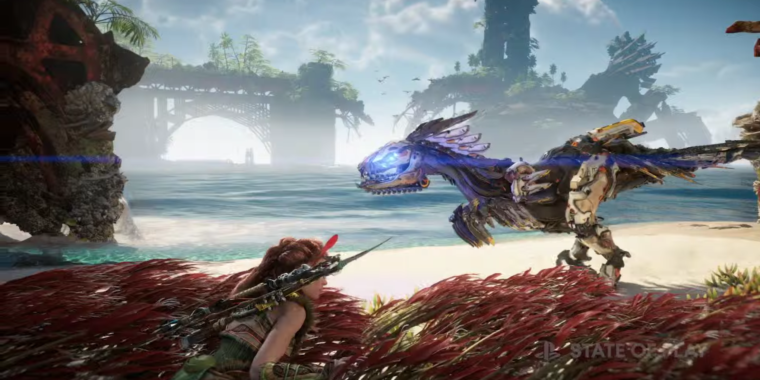
After receiving a lengthy gameplay reveal in May of this year, the upcoming PlayStation-exclusive sequel Horizon Forbidden West went into hiding. Today, the game’s developers at Guerrilla confirmed a major reason for that silence: The game isn’t actually ready for its teased “2021” release window.

The news of the game’s delay—and a (possible) release date of February 18, 2022—came from its director, Mathijs de Jonge, as part of Wednesday’s Gamescom 2021 Opening Night presentation. While de Jonge claimed that the sequel had reached a “major milestone” shortly after its May gameplay reveal, he then offered familiar-sounding caveats about the challenges of video game development during a pandemic—and didn’t clarify whether the upcoming game was yet feature-complete.

The Wednesday news came without new gameplay footage or any clarification of how Horizon Forbidden West, launching on both the PlayStation 4 and PlayStation 5 next year, will scale between two generations of consoles. Instead, de Jonge took the opportunity to announce that a patch is now live on the PS5 to bring the franchise’s first PS4 game, Horizon Zero Dawn, up to a 60 fps refresh rate.

Pain-station?

This development leaves Sony in the peculiar position of having zero major first-party games scheduled for launch by year’s end for either of its consoles. Previously announced sequels like God of War: Ragnarok and Gran Turismo 7 have yet to receive firm release dates outside of a “2022” window, all while transforming into “cross-gen” games after their initial announcements. And Sony’s current 2021 console exclusives are made by other studios and largely land in the indie domain—without any Sony-developed indies to fill in the gap, let alone any classic Sony games getting remasters to ease the pain.

The biggest exception, ironically enough, comes from Deathloop, a Groundhog Day-like time-loop shooter developed by the Microsoft-owned Arkane Studios and launching on PlayStation consoles on September 14. That deal was inked before Microsoft acquired parent publisher ZeniMax and its many subsidiaries.

Listing image by Sony Interactive Entertainment / Guerrilla Games

https://arstechnica.com/?p=1789789


Halo Infinite will launch on Wednesday, December 8—in incomplete fashion [Updated]

It’s official: Halo Infinite will launch on Xbox One, Xbox Series X/S, and Windows 10 PCs on Wednesday, December 8.

Up until today, the long-awaited game’s release had been pegged to a vague “Holiday 2021” window, but the firm release date slipped out via a Microsoft Store update. The timing was supposed to be confirmed as part of Gamescom’s Opening Night 2021 video presentation, which will begin airing shortly after this article goes live. Soon after the store listing slip-up, The Verge cited “a source familiar with Microsoft’s plans” to confirm that the date was accurate.

[Update, 2:35 pm ET: Halo Infinite team lead Joseph Staten confirmed the release date as part of the video presentation. The presentation also included a peek at a new Xbox Elite Series 2 gamepad and a new Xbox Series X console design, both modeled after Halo and Master Chief iconography.]

On that date, the game will arrive as a split package. One half is a standard retail-priced “campaign” for the first-person series, in which Master Chief teams up with a hapless outer-space survivor and a memory-wiped version of the popular AI character Cortana to land on a wide-open planet and contend with the series’ first “open-world” arrangement of levels. The other half is an entirely free-to-play versus-multiplayer suite of modes that will be supported by a paid “battle pass” system that developer 343 Industries has described as being made up entirely of cosmetic add-ons, with all modes and levels being free for all players. It’s currently unclear whether the paid retail version of the campaign will include any bonuses, cosmetic or otherwise, for use in the free-to-play multiplayer suite.

What’s far clearer, unfortunately, is that both packages will launch in incomplete fashion in December. As we learned late last week, the campaign will not include any cooperative options at launch; instead, the option to play the campaign with friends has been delayed until the game’s “second season” of content, which 343 Industries estimates will arrive “about three months” after the game’s launch. And the multiplayer suite’s “Forge” mode, meant to allow players to create their own levels and modes, has been delayed until the game’s third season of content, which has been estimated to arrive roughly six months after the game’s launch. At this time, neither of those delay estimates is firm.

The game was originally slated for a holiday 2020 release—to align with the launch of the Xbox Series X/S—but it was abruptly delayed in August 2020. 343 Industries insisted as recently as last week that the game is coming out by the end of 2021, hell or high Warthog.

We’re tuning in to today’s Gamescom presentation and will return with any Halo-specific updates upon its completion.

Listing image by Xbox Game Studios

https://arstechnica.com/?p=1789729


30 years later, the baby on Nirvana’s Nevermind cover is suing for damages

<img src="https://rassegna.lbit-solution.it/wp-content/uploads/2021/08/30-years-later-the-baby-on-nirvanas-nevermind-cover-is-suing-for-damages.jpg" alt="Nirvana's Nevermind album cover.”>
Enlarge / Nirvana’s Nevermind album cover.
DGC Records

Nirvana’s 1991 album Nevermind is widely credited with bringing alternative and grunge rock into the mainstream, but now it’s in the news for another reason. Spencer Elden, the adult who was the baby depicted swimming naked on the album’s cover, has filed a lawsuit on the grounds that the photo violated various federal child pornography laws.

The suit, posted here in its entirety, names (among others) DGC Records and its parent companies; Courtney Love and the estate of Nirvana frontman Kurt Cobain; then-band members Krist Novoselic and Dave Grohl; and Chad Channing, a drummer who had left Nirvana the year before Nevermind was released but whose work on the album has been credited in later reissues. The suit is seeking “the actual damages [Spencer] has [sustained], or liquidated damages in the amount of $150,000, and the cost of the action.”

According to Spencer’s father, Rick Elden, the family was paid $200 to throw 4-month-old Spencer into a pool for “half a second” so he could be shot by photographer Kirk Weddle (also named in the suit). The dollar bill on the fish-hook was added after the fact; the suit claims that the baby is grabbing for the dollar bill “like a sex worker,” which together with the exposed penis forms the basis of the suit’s claim that the image is “sexually explicit.”

As an adult, Spencer Elden has been more than willing to give interviews and recreate the album cover. He was paid $1,000 to recreate the photo as a 17-year-old in 2008, and he earned another $200 from the New York Post to recreate the cover for the album’s 25th anniversary (complete with a “Nevermind” tattoo across his chest).

“Stuff happens like random cool situations where I get paid $500 just to go hang out,” Elden said in 2008. He also mentioned getting an internship with artist Shepard Fairey as a result of a radio interview he gave about the album.

But Elden’s relationship with the photo and the album’s success is complicated. As far back as 2008, he told MTV News that “it’s kind of creepy [to think] that that many people have seen me naked. I feel like I’m the world’s biggest porn star.” And in an interview with Time for the album’s 25th anniversary, he said, “[When] I go to a baseball game and think about it: ‘Man, everybody at this baseball game has probably seen my little baby penis,’ I feel like I got part of my human rights revoked.”

Perhaps more relevant for this lawsuit, Elden has also expressed a longstanding frustration with being excluded from the album’s success. The Time interview mentions that he had pursued but didn’t follow through with earlier legal action against Geffen Records, saying that “it’s hard not to get upset when you hear how much money was involved.”

https://arstechnica.com/?p=1789596