Back 4 Blood beta impressions: A template for potential co-op greatness

As the new video game Left 4… ahem, Back 4 Blood shambles its way toward launch later this year, this zombie co-op shooter has entered a state that formally counts as a “beta.” I’ve determined this after about six hours playing the game’s latest test version, now live for its preorder customers (or anyone who has scored early codes). This version will open up to the public on Thursday, August 12. The PvE and PvP modes I’ve tested feel solid and stable, at least on PC, and they make it easier to determine exactly what Back 4 Blood will feel like as a retail game starting October 12.

In short, Back 4 Blood already feels like the Left 4 Dead series learned how to count to three. You don’t have to squint to see the places where the game lacks some Valve-like magic, but it’s not enough to drag down the bloody good times. Back 4 Blood feels like something approaching a worthy sequel, thanks to a ramping up of engine tech, a clever and fair “card deck” system, and surprisingly entertaining tweaks to humans-versus-zombie PvP combat.

Build many decks, kill many zeds

For a primer, rewind to my December 2020 look at the game’s less-polished alpha version, which sets the stage as follows:

Many of B4B‘s concepts are lifted shamelessly from L4D (if the naming convention with a number “4” didn’t clue you in). To wit: each of the game’s “campaign” zones is broken up into smaller levels, and your squad gets an opportunity to rest, heal, and stock up on supplies at a “safe zone” between each level. Use guns, melee weapons, and explosive implements to tear through zombies, and juggle health items and tools to get your team from one safe zone to the next.

That core conceit is still here, while this week’s testing version adds more near-final polish to the experience. The biggest differentiator is a better look at its series of gameplay-modifying card decks, and from what I can tell, Turtle Rock Studios has implemented something that should work without demanding players spend a single additional penny on top of the retail price.

You’ll start the game with a solid inventory of cards, along with an invitation to build 15-card decks. Whenever you dive into either PvE (co-op with friends against computer-controlled zombies) or PvP (a four-on-four versus mode), your first step is to pick one of your custom decks. At the beginning of each campaign phase, some of your cards will be randomly dealt, and you pick one or two of them to augment your battling from there on out.

Most directly benefit your character, with a smaller number of cards giving all teammates some sort of boost. Often, these are simple numerical boosts, ranging from additional health or ammo to special perks that turn on when your character is low on health. Others give your character entirely new attacks or abilities, like a “charged” melee attack that lets you hold the melee button down longer to barrel into zombies.

Each player will choose roughly six cards per session (always in a “deal five, pick one” capacity). This means proper deck-building lets players dial-in various gameplay philosophies—without necessarily guaranteeing their dream cards get dealt every time. The earliest deck options in the beta strongly emphasize melee, especially when they stack a health bonus for every zombie killed with a melee weapon. Later card unlocks make it easier to kill from afar, heal and revive allies, or stack up your endurance meter (which runs down when you run or use melee attacks).

As I spent more time playing the beta, I felt genuine excitement in earning the points needed to unlock more deck options. I didn’t want to be a sniper at first, thanks to how much fun I had battling with shotguns and axes, but I grew to long for a deck that would emphasize distance attacks while hand-to-hand duties went to my squadmates. I imagine the beta will expose various math-related tweaks needed for some of the cards, but make no mistake: already, this system adds welcome spice to the dated Left 4 Dead co-op formula. And if publisher WB Games doesn’t screw it up by adding microtransactions to these cards, then we’re in for a good deck-building time.

A surprising zombie-versus success

B4B‘s four-on-four versus mode will look familiar to L4D fans, as it, too, pits teams of “cleaner” humans against teams of super zombies. But where the L4D version could feel overlong and unwieldy, Turtle Rock’s new spin prioritizes quicker, more dynamic combat that’s better built to stave off rage-quitters.

[embedded content]
B4B versus mode trailer.

In L4D‘s versus modes, teams of zombies invaded normal campaign maps to interrupt, annoy, and (hopefully) kill the human teams. B4B‘s twist revolves around smaller, versus-specific slices of the campaign’s maps, along with a battle royale-like “safe zone” that moves every 60 seconds. Each team takes turns as the zombies and the humans, one shot at each side per round, and the object is for each team to last longer as humans in a given round.

From what I’ve seen, teams in human mode can last as long as four minutes or as little as 45 seconds per round. Lasting longer as a human team, or ruining the humans’ day as zombies, requires both sides to make wise decisions about map control. In particular, humans can’t rely on hiding in a “safe” corner of a map, as the moving safe zone will usually lead to a poison cloud filling up a formerly useful building or cave. Humans would be wise to maximize any seemingly safe region’s extra ammo, gadgets, and health pickups before they’re covered in poison gas.

Zombies, meanwhile, are seriously overpowered in terms of seeing humans’ outlines on the map at all times. This is arguably a compensation for how slow most super zombies are compared to humans. Thus, a good zombie round will hinge on effective communication and triangulation—as the super zombies do best when they separate human teammates, then take one or two of them down. (Meanwhile, humans, stick together, for god’s sake!)

As a best-of-three mode, B4B‘s versus combat is always in equal reach for both teams until the moment it’s not, as opposed to dragging out obvious team imbalances. Unfortunately, I’m not charmed by the versus mode map design I’ve seen thus far: it’s mostly made up of remixed houses and terrain from the campaign—often with too many easy corner hiding spots for humans to settle into. More verticality and forced movement could go a long way to add legs to this mode, especially since human players can’t expect to use weapon families like sniper rifles in the levels I’ve thus far seen.

https://arstechnica.com/?p=1785379


Y: The Last Man TV series gets premiere trailer ahead of Sept. 13 Hulu launch

A TV series based on Y: The Last Man, the award-winning Vertigo comic series about a sex-specific apocalypse, has always seemed inevitable, but ever since the comic series wrapped in 2008, plans for a live-action adaptation have lingered in apparent development hell. That all changes next month, when a TV series finally launches on Hulu. The news came in the form of a trailer that shows off the series’ stars while explaining its peculiar twist on a society-crushing disease.

The original comics, written by former Lost writer/producer Brian K. Vaughan (also involved with beloved comic series like Saga and Paper Girls), revolved around the simultaneous death of everything on Earth with a Y chromosome, humans and animals alike. Thursday’s new trailer recaps the same premise by focusing on the president of the United States succumbing to a bloody collapse, followed by apparently every other man on the planet… save one.

That man, Yorick Brown (played by Ben Schnetzer), begins making his way across a decimated United States, and this TV version matches the comics by including his pet monkey named Ampersand (who also has a Y chromosome). Meanwhile, his mother, Senator Jennifer Brown (played by Diane Lane), apparently assumes control as president of the United States. That’s a twist on the original comics, which had Yorick’s mother in Congress but not necessarily promoted to the top of the pecking order.

The rest of the premiere trailer requires reading between the lines based on what we know of the original comics. The easiest connection to draw comes from the character of Agent 355 (played by Ashley Romans), a member of a clandestine American military group assigned to protect Yorick, and we see 355 kick butt and activate explosives on Yorick’s behalf. We also see a hint of rival factions among the surviving women, though the trailer doesn’t clarify whether they’re a one-for-one match for the apocalyptic Daughters of the Amazon. There are also brief flashes of original series characters like Dr. Allison Mann (played by Diana Bang) and Yorick’s sister Hero Brown (played by Olivia Thirlby).

A possible live-action take of Y: The Last Man has bounced around for over a decade; developments included a feature-length movie that never moved into production, a 2018 TV pilot that was scrapped, a change of showrunners, and a recasting of the lead role of Yorick. It’s unclear whether its exclusive home on Hulu will be a boon for the series, though we’re hopeful that the plot’s emphasis on a predominately female cast (and FX’s insistence that the whole first season is directed by women) will offer a breath of fresh air on TV screens starting September 13.

[embedded content]
Y: The Last Man premiere trailer.

Listing image by FX

https://arstechnica.com/?p=1785300


Netflix is still trying to find its female John Wick with trailer for Kate

A ruthless criminal operative is poisoned and has less than 24 hours to exact revenge on her killers in Kate, a new action thriller from Netflix starring Mary Elizabeth Winstead, who played Huntress in Birds of Prey.

The streaming service seems to be casting about for a female version of the hugely successful John Wick franchise, but it’s harder to pull off than it looks. First, there was 2020’s The Old Guard, in which Charlize Theron leads an immortal group of mercenaries on a mission of revenge. Theron was terrific, but the film itself was uneven. Just last month, Netflix served up the disappointing Gunpowder Milkshake, which had a stellar all-star cast and all the right elements, including some impressive fight choreography. But as with The Old Guard, nothing really gelled, and as much as I love Karen Gillan, she seemed ill-suited to the role. Gunpowder Milkshake ended up feeling flat, predictable, and like an exercise in style over substance.

The basic premise of Kate is a familiar one; it’s essentially a twist on the classic 1950 film noir D.O.A., in which a man—a seemingly ordinary accountant and notary public—walks into a police station and says he has been poisoned, with only a few days left to live and discover who murdered him. (Due to someone not renewing the copyright on time, the film is in the public domain.) It has inspired three direct remakes: 1969’s Color Me Dead, 1988’s D.O.A. (starring Dennis Quaid), and the 2017 film Dead on Arrival. And the film has influenced countless more, such as the 2006 film Crank, in which Jason Statham plays a British hitman who has to keep his adrenaline levels spiking to counteract being given a deadly poison.

Kate seems like a combination of D.O.A., Crank, and Gunpowder Milkshake. Per the official premise:

Meticulous and preternaturally skilled, Kate is the perfect specimen of a finely tuned assassin at the height of her game. But when she uncharacteristically blows an assignment targeting a member of the yakuza in Tokyo, she quickly discovers she’s been poisoned, a brutally slow execution that gives her less than 24 hours to exact revenge on her killers. As her body swiftly deteriorates, Kate forms an unlikely bond with the teenage daughter of one of her past victims.

I don’t know why filmmakers seem to think female assassins have to bond with young girls to show their softer emotional side, but so be it. Director Cedric Nicolas-Troyan received an Oscar nomination for his visual effects for 2012’s Snow White and the Huntsman and made his directorial debut in 2016 with The Huntsman: Winter’s War. Based on this trailer, he has put that background to excellent use in Kate. We’ll have to see if Nicolas-Troyan can take this well-worn formula and make it his own, despite a frankly boring title.

The Huntress was my favorite character in Birds of Prey, largely due to Winstead’s deadpan delivery, which draws out both the character’s single-minded resolve and her extreme social awkwardness. Case in point: after taking out several bad guys with her trademark efficiency and athleticism, she turns around to see her compatriots staring at her in awe. “What?” she says, completely unaware of what a badass she is. If Winstead gets the chance to showcase that mix of skills again in Kate, she could easily establish her place alongside Charlize Theron as a credible action star.

The Kate trailer opens with Kate on a job that goes horribly wrong when she misses the kill shot. By the time Kate checks in with a doctor, she only has 14 or 15 hours to exact revenge. She tells her handler, Varrick (Woody Harrelson), that she was poisoned and asks who the target was for this job. It’s none other than “the grand honcho of the Yakuza,” who lives in the shadows and “never surfaces… ever,” Varrick tells her. “Somebody knows,” Kate replies, and she sets her sights on young Ani (Miku Patricia Martineau) for information.

Ani does seem to know who’s behind the poisoning and offers to help. Frankly, Ani is more than a little taken with her new ally. “You’re like that person in a nightmare,” she enthuses. “Take no shit from no dudes. You’re scary. Just a total killer babe.” We get plenty of footage of Kate in action to demonstrate that Ani’s assessment is largely correct. Even when the odds are 20 to 1, a confident Ani assures the villains that they are outnumbered and are all going to die. Kate will probably take her revenge, which should teach the mysterious mastermind a lesson about giving a highly trained assassin a slow-acting deadly poison, thereby ensuring said assassin has plenty of time to retaliate.

Kate debuts on Netflix on September 10, 2021.

[embedded content]
Trailer for Netflix action thriller Kate, debuting September 10, 2021.

Listing image by YouTube/Netflix

https://arstechnica.com/?p=1785095


Low semiconductor supplies may not be the main reason for PS5 shortages

Snapping off the outer white panel on the PS5.

In an earnings call last night, Sony CFO Hiroki Totoki said that despite worldwide semiconductor shortages, the company has “secured a number of chips that’s necessary to achieve” the company’s current production target of at least 14.8 million PlayStation 5 consoles in the current fiscal year (which ends in March 2022). “Regarding the supply of the semiconductors, we’re not concerned,” he said during a Q&A portion of the event.
That statement implies that Sony plans to make and ship at least 12.5 million PS5 units on top of the 10.1 million it shipped through the end of June (10 million of which had sold through to consumers by July 18). That production rate would only be about 4 percent faster than the roughly 44,000 units per day Sony shipped on average in the system’s first 7.5 months on the market. That’s despite a February statement from Sony Interactive Entertainment President Jim Ryan suggesting that supply chain improvements would mean “by the time we get to the second half of [2021], you’re going to be seeing really decent [PS5 production] numbers indeed.”

Are shortages here to stay?

The modest increase in PS5 production in the coming months likely won’t be enough to put a dent in widespread PS5 shortages, which are causing units of the system to sell out almost immediately when they hit retail shelves. But Totoki’s new statement suggests those shortages are driven more by intense demand than by Sony’s inability to secure the chips it feels it needs in the near term (and while scalpers certainly aren’t helping that situation, healthy demand from consumers seems to be driving the market in total).

Sony’s planned PS5 production numbers through the end of the console’s first full fiscal year are broadly in line with the company’s production of the PS4 in the same period following its late 2013 launch. Initial shortages of the PS4 had given way to easy retail availability by the summer of 2014, though, another point suggesting that demand for the PS5 is simply much higher than that of its predecessor.

Sony could theoretically respond to this stronger-than-expected demand by cranking PS5 production well above the 14.8 million consoles it had originally planned to make this fiscal year. But that kind of ramp-up doesn’t seem likely in the short term, either because of chip supply issues or the logistical difficulty of quickly changing long-planned production schedules.

In April, Totoki warned that he felt it was “not likely” that Sony could “drastically increase the supply” of PS5 units before the end of the fiscal year. In May, he followed that statement up by telling investors, “I don’t think demand is calming down this year, and even if we secure a lot more devices and produce many more units of the PlayStation 5 next year, our supply wouldn’t be able to catch up with demand.”

Despite the shortages, the success of the PS5 is driving record revenues for the company’s Game & Network Services division, which brought in $5.6 billion in the quarter ending in June. Sony said PlayStation software sales were up 38 percent over the same quarter in pre-pandemic 2019, leading Totoki to say, “We believe that the game market has expanded significantly over the last 2 years.” Time spent playing PlayStation titles was similarly up 18 percent from two years ago, though it was down from the pandemic-lockdown-induced highs of 2020.

Only a bit more than 16 percent of PlayStation software sales came from Sony’s first-party exclusives in the quarter, in contrast to the vast majority of software sales on the Nintendo Switch that come from Nintendo’s own titles. A full 71 percent of Sony’s full-game sales came as digital downloads, though, reflecting long-standing sales trends away from physical discs on consoles.

Overall, Sony’s quarterly operating profit was up 26 percent year-over-year to a record $2.57 billion.

https://arstechnica.com/?p=1785085


Shareholders sue Activision Blizzard for withholding harassment info

Photoshopped image from a video game shows a person in an Activision Blizzsard hoodie confronted barrels filled, presumably, with gasoline.


In a proposed class-action lawsuit, Activision Blizzard shareholders argue that they were “economically damaged” by company executives withholding information and allegations that have recently come to light through a California Department of Fair Employment and Housing (DFEH) discrimination and harassment lawsuit against the company.

The class-action complaint, filed in a California Federal Court by the Rosen law firm, specifically names Activision Blizzard CEO Bobby Kotick, current CFO Dennis Durkin, and former CFO Spencer Neumann. Those executives and others were “aware of or recklessly disregarded the fact that the false and misleading statements were being issued concerning the Company,” according to the complaint.

To support that claim, the lawsuit cites multiple SEC filings Activision Blizzard made from mid-2016 onward. Those filings included boilerplate language regarding the risks to the business imposed by various legal matters. Activision Blizzard said that “such routine claims and lawsuits are not significant and we do not expect them to have a material adverse effect on our business, financial condition, results of operations, or liquidity,” the suit says.

That line and similar ones in the filings hide the fact that Activision Blizzard had fielded “numerous complaints about unlawful harassment, discrimination, and retaliation [that] were made to human resources (“HR”) personnel and executives which went unaddressed,” according to the complaint. The complaint goes on to suggest that “the pervasive culture of harassment, discrimination, and retaliation [at the company] would result in serious impairments to Activision Blizzard’s operations.”

The proposed suit says the company failed to tell shareholders that it was under investigation by the California DFEH or that it was “at greater risk of regulatory and legal scrutiny and enforcement” based on these undisclosed facts.

This all led to an Activision Blizzard share price that was “artificially inflated,” according to the complaint, resulting in shareholders overpaying based on faulty information. The shareholders are entitled to monetary damages based on that overpayment, the suit says. Activision Blizzard stock fell over 6 percent on July 27, the day after the lawsuit’s existence was publicly revealed. Since then, the stock has fallen an additional 5 percent, based on Tuesday’s closing price of $79.83.

This morning, Activision Blizzard announced that Blizzard President J. Allen Brack is stepping down after nearly 16 years with the company. That move comes after thousands of Activision Blizzard employees signed a petition decrying the company’s initial response to the California lawsuit and hundreds took part in a one-day “Walkout for Equality” last week while demanding action on numerous fronts. https://arstechnica.com/?p=1784897


The Lord of the Rings TV series has finished filming, and it has a release date

<img src="https://rassegna.lbit-solution.it/wp-content/uploads/2021/08/the-lord-of-the-rings-tv-series-has-finished-filming-and-it-has-a-release-date.png" alt="The first live action promotional image for Amazon's new The Lord of the Rings-related series.”>
Enlarge / The first live action promotional image for Amazon’s new The Lord of the Rings-related series.

Today, Amazon Studios announced that its new TV series based on J.R.R. Tolkien’s The Lord of the Rings has finished filming its first season. The season is expected to premiere on September 2, 2022, “with new episodes available weekly,” Amazon says.

Additionally, Amazon tweeted out one of the first visuals from the series, seen above. It depicts a person standing in a field looking out at a spectacular fantasy landscape.

Thirteen months might seem like a long gap between the conclusion of filming and the airing of the series, but a series like this is likely to have many visual effects that could contribute to a prolonged post-production period.

The season has been in production since early 2020, but the COVID-19 pandemic caused delays. When it does debut, the series will air exclusively on Amazon’s Prime Video streaming service. It has already been renewed for a second season.

The new series (which does not have a name) takes place in the Second Age, a time period that is alluded to frequently in The Lord of the Rings but that has not been depicted onscreen apart from a few flashbacks. Those flashbacks notably included the opening battle scene of Peter Jackson’s The Fellowship of the Ring adaptation. That sequence caps the centuries-long Second Age and marks the beginning of the Third Age, which is when The Hobbit and The Lord of the Rings books and movies take place.

The series has a large cast, most of whom are relative unknowns compared to stars fans know from the movies, like Elijah Wood or Sean Bean. (Though it’s worth noting that the movies also had several relative unknowns who went on to fame after they debuted, like Viggo Mortensen and Orlando Bloom.) The series’ showrunners are J.D. Payne and Patrick McKay, who are also likely to be unknown to audiences.

https://arstechnica.com/?p=1784532


Post Mortem is the Norwegian vampire procedural dramedy we need right now

Scandinavian crime dramas have become so prevalent—thanks in part to Netflix including so much foreign content on their platform—that they’ve inspired the occasional sketch comedy parody. And now we’re getting Norway’s take on the supernatural police procedural, with vampires: Post Mortem: No One Dies in Skarnes. Netflix just released some first-look images on the heels of dropping the official trailer last week, and Post Mortem looks like the darker cousin of iZombie and The Santa Clarita Diet with a dash of Six Feet Under.

Directed by Harald Zwart (The Mortal Instruments: City of Bones, The Karate Kid) with Petter Holmsen (who also serves as head writer), the six-episode series is “an intriguing mix of thriller, drama, and supernatural elements,” according to Tesha Crawford, director of Nordic original series at Netflix. Per the official premise:

Live Hallangen is declared dead. Hours later she suddenly wakes up on the forensic table. A dark, insatiable hunger has awoken in her. Meanwhile, her brother Odd tries to keep the family driven funeral home afloat, but the stagnant death rate in the small Norwegian town of Skarnes makes it impossible. Live has to learn to control her new dangerous nature and decide if she is willing to sacrifice people’s lives for her own survival, which ironically goes hand in hand with the survival of the family business.

Kathrine Thorborg Johansen stars as Live, Elias Holmsen Sorensen plays Odd, Kim Fairchild plays Judith, Andre Sorum is Reinert, Sarah Khorami is Rose, and Terje Stromdahl is Arvid. In a statement, Zwart praised his cast members, saying that they all “embody the blend of Scandinavian mystique and dark humor.”

The trailer opens with Live waking up in a hospital. Odd tells her that everyone thought she was dead after her body was found in a field. The responding officers processed the scene and transported her body to the morgue—at which point she woke up on the autopsy table. Officers Judith and Reinert are beside themselves about the mix-up, although Judith adds, “In our defense, you seemed really dead.”

Live soon realizes she isn’t quite herself. There’s the sudden onset of insomnia, and her senses are strangely heightened—so much so that she can hear a person’s pulse. Also, her eyes have changed color to a rich emerald, and she finds that she is significantly stronger. Then there’s her growing thirst for blood, culminating in a shot of Live waking up with her mouth covered in it—hopefully from the local blood bank, but Officer Judith has her suspicions that something stranger is going on. Odd, for his part, is happy to admit that he wishes there were a serial killer on the loose, as at least that would drum up some much-needed business for his funeral home.

A dive into the family archives reveals that Live’s mother may have suffered from a similar malady, shrieking about just needing “a little blood” on the preserved tapes. There’s a strange naked figure with a yellow bag over its head, a shot of Live being chloroformed, and an outbreak of fire—one of the things that definitely kills a vampire. All in all, Post Mortem looks like an entertaining series. Coming on the heels of the Netflix horror thriller Blood Red Sky (essentially “Vampires on a Plane”), bloodsuckers seem to be pushing back against the pop-culture dominance of zombies over the last decade.

Post Mortem: No One Dies in Skarnes drops on Netflix on August 25, 2021.

[embedded content]
Trailer for Post Mortem: No One Dies in Skarnes, coming to Netflix on August 25, 2021.

Listing image by YouTube/Netflix

https://arstechnica.com/?p=1784530


Review: The Green Knight weaves a compelling coming-of-age fantasy quest

<img src="https://rassegna.lbit-solution.it/wp-content/uploads/2021/08/review-the-green-knight-weaves-a-compelling-coming-of-age-fantasy-quest.jpg" alt="Dev Patel stars as Gawain—nephew to King Arthur and an aspiring knight—in The Green Knight, filmmaker David Lowery’s mesmerizing adaptation of the 14th-century anonymous poem, Sir Gawain and the Green Knight.”>
Enlarge / Dev Patel stars as Gawain—nephew to King Arthur and an aspiring knight—in The Green Knight, filmmaker David Lowery’s mesmerizing adaptation of the 14th-century anonymous poem, Sir Gawain and the Green Knight.

The tale of Sir Gawain and the Green Knight, immortalized in a 14th-century anonymous poem, is among the most popular of the Arthurian legends, second only to the quest for the Holy Grail. Yet I would argue that it has never been successfully adapted to film—until now. Director David Lowery’s new film, The Green Knight, takes some necessary liberties with the source material. But he also artfully weaves in elements and symbols from that source material to create a darkly brooding fantasy quest that is just as richly textured and layered as the medieval poem on which it is based.

(Major spoilers for the 14th-century medieval poem below; some additional spoilers for the film are below the gallery.)

Let’s lay out the basics of the original poem before discussing the clever ways in which Lowery (A Ghost Story, Pete’s Dragon) has reimagined it. As I’ve written previously, Sir Gawain and the Green Knight falls into the chivalric romance genre, relating a well-known story from Arthurian legend in distinctively alliterative verse. (Alliteration was all the rage at the time. I highly recommend J.R.R. Tolkien’s translation from 1925 or Simon Armitage’s 2008 translation, recently revised.) 

On New Year’s Day, King Arthur and the knights of the Round Table gather at Camelot to feast and exchange gifts. A mysterious Green Knight disrupts the festivities and proposes a different kind of exchange: any one of the knights may strike him with one blow with his axe; in return, the Green Knight will come back in a year to return the blow. Sir Gawain, the youngest of the knights and nephew to Arthur, accepts the challenge and beheads the Green Knight. Everyone is shocked when the Green Knight picks up his severed head. He says Gawain must meet him at the Green Chapel one year hence to receive a similar blow, per their bargain.

[embedded content]
Legends never die: an oral history of The Green Knight, narrated by Ralph Ineson.

As the deadline approaches, Gawain embarks on a quest to find the Green Chapel, having plenty of adventures and battles along the way. Finally, he arrives at a castle, and the lord and lady invite him to stay as their guest. The lord, Bertilak de Hautdesert, proposes another bargain: he will go out hunting every day and give Gawain whatever he catches, provided Gawain gives the lord anything he gains during the same day. And every day, the lady of the castle attempts to seduce the young knight while her husband is away. Gawain is caught between two competing codes: the code of chivalry demands that he not betray his host’s trust by sleeping with his wife, but the code of courtly love demands that he do whatever a damsel requests.

He manages to courteously fend off the lady’s advances for two days, granting her only one and two kisses, respectively, which Gawain then passes on to the lord when he brings back a deer and a boar. On the third day, when Gawain once again spurns her advances, the lady tries to give him a gold ring. He declines the gift. But when she next offers him a green and gold silk sash that she swears will protect him from physical harm, Gawain—knowing his rendezvous with the Green Knight approaches—accepts in a moment of weakness. Then they exchange three kisses. He passes the three kisses on to the host when the lord returns with a fox, but Gawain doesn’t tell his host about the lady’s sash.

The next day, Gawain rides off to meet the Green Knight, who delivers the return blow. Gawain, who is wearing the sash, only suffers a minor nick on the neck. Technically, he “wins” their game, but the Green Knight reveals himself to be none other than Lord de Hautdesert—transformed by the magic of Morgan Le Fay—and says that the entire yearlong scheme was meant to be a test of the Arthurian knights. Had Gawain told the lord about the sash, he would not have even suffered a slight wound on his neck. So Gawain’s “victory” is also a source of personal shame.

A knight comes of age

Lowery’s challenge was to remain true to the original text’s major themes and rich symbolism, while making the character of Gawain and the story of his quest more relatable and resonant for modern audiences. Most notably, Lowery opted to make Gawain a callow young man who aspires to earn the right to join the Knights of the Round Table by proving his honor and bravery—confronting some hard truths about himself along his journey. (In the poem, Gawain is already a distinguished knight.)

When we first meet young Gawain (Dev Patel, Slumdog Millionaire), he is waking up in a brothel on Christmas Day, where he has spent the night carousing with his lover, Essel (Alicia Vikander, Ex Machina, Man from U.N.C.L.E.). He returns home to his disapproving mother (Sarita Choudhury, Lady in the Water)—yep, he still lives with his mom—before heading off to King Arthur’s court for the holiday festivities.

(WARNING: Some spoilers for the film, below.)

Invited to sit beside Arthur (Sean Harris, Prometheus, Mission: Impossible – Fallout) and Queen Guinevere (Katie Dickie, Game of Thrones, Prometheus), Gawain is asked to regale the group with a tale of his heroic adventures—and realizes he has no such stories to tell. Meanwhile, his mother is seen casting a mysterious spell, which might be related to the sudden appearance of the Green Knight (Ralph Ineson, Game of Thrones, Absentia, The VVitch) at court.

The beheading game plays out pretty much like it does in the poem, and a year later, Gawain embarks on his journey to the Green Chapel to keep his end of the bargain—and most likely lose his head. His mother gives him a green and gold belt (girdle) that she swears will keep him safe from harm. The film also hews reasonably close to the original tale when Gawain takes refuge in the castle of a Lord (Joel Edgerton, Midnight Special, Star Wars Episodes II and III) and Lady (also played by Vikander). Lowery has added a mysterious, blindfolded old dowager who lurks in the background as the two play their own little game of gift exchange and seduction with Gawain.

The middle act is when The Green Knight really diverges from the source material. Gawain’s harrowing journey to find the Green Chapel and fulfill his promise is referenced only in vague terms in the poem: there is a passing mention of skirmishes and giants, and the harsh weather he endures, for instance. Lowery has fleshed out this part of Gawain’s story to create a more traditional three-act structure of the protagonist’s journey.

First, Gawain is waylaid by a forest scavenger (Barry Keoghan, Dunkirk) who robs him, binds him, and leaves him for dead. After freeing himself, Gawain befriends a little fox and asks a tribe of giants to point him north. Later, he meets a ghostly woman identified onscreen as Saint Winifred (Erin Kellyman, Falcon and the Winter Soldier). She entreats him to retrieve her severed head from a lake and, in exchange, tells him the Green Knight is someone he knows. This is not in the original poem at all—although there is passing mention of St. Winifred’s Well—but thematically, it’s a fitting addition, since the legend of Saint Winifred holds that she was beheaded by a suitor for refusing his advances and a spring formed where her head fell. (She came back to life when her head was rejoined with her body.)

A rich tapestry

Patel is an inspired choice to play Gawain. He has the charisma to make a flawed, spoiled young man likable enough that we empathize with his struggles and humiliations. That’s a crucial factor in how Gawain’s final encounter with the Green Knight in the chapel plays out—another example of how Lowery’s thoughtful embellishments on the poem both underscore and enhance its themes and emotional power. In this case, we keenly feel Gawain’s sense of crushing shame over failing to live up to the impossible ideals of the Arthurian codes as he struggles to overcome his fear of death. It’s an open question how everything he has experienced will influence the kind of man he chooses to become.

The character of the Green Knight has been interpreted by some scholars as representing the Green Man from pagan folklore, and that’s how the character is depicted in Lowery’s film: a greenish face with the texture of wood, peering out through thick foliage. The Green Chapel is a ruin overgrown with vines, moss, and other plants—the wild chaos of nature encroaching on the crumbling remnants of civilization’s attempts to tame it. And there are strong hints that Gawain’s mother is Morgan Le Fay, whose magic may have set the film’s events in motion—although Lowery is wise enough to leave her true identity ambiguous. (She is not Gawain’s mother in the poem; that would be Arthur’s other half-sister, Morgause).

Lowery has cited multiple films that influenced him over the years as he worked to bring The Green Knight to life onscreen: Willow, Bram Stoker’s Dracula, The Dark Crystal, Marie Antoinette, and The Passion of Joan of Arc, a 1928 French silent film by Carl Dreyer. (See the embedded video at the end of this review for Lowery’s take on each of them.) Excalibur is another obvious influence, particularly since Lowery shot his film in many of the same locations in Ireland.

One can definitely see elements from all those sources in The Green Knight, but the tapestry Lowery has woven out of so many disparate threads is every inch an original vision. There are no quick cuts or frenetic action sequences. Lowery takes the time to let the story unfold at a leisurely pace, drawing the viewer into the Arthurian world he has created, as seen through the eyes of young Gawain. At times, the film takes on a hallucinatory quality. Just as the 14th-century poem continues to fascinate us some 700 years later, this strange, powerfully evocative film will have you mulling over everything you’ve just seen, pondering various interpretations, long after you’ve left the theater.

The Green Knight is now playing in theaters. We strongly recommend only watching movies in theaters if you have been fully vaccinated.

[embedded content]
Filmmaker David Lowery on the “shared DNA” between The Green Knight, Willow, The Dark Crystal, Marie Antoinette, The Passion of Joan of Arc, and Bram Stoker’s Dracula.

https://arstechnica.com/?p=1783822


Valve issues scathing reply over the facts behind a Steam antitrust case

Valve issues scathing reply over the facts behind a Steam antitrust case
Getty / Aurich Lawson

Valve has issued a scathing response to Wolfire’s April lawsuit alleging anticompetitive monopoly practices on the Steam storefront. In that response, Valve argues that the suit should be dismissed because it “fails to allege the most basic elements of an antitrust case.”

There’s no right to free Steam keys

Wolfire’s case centers in part on the fact that Valve requires free Steam Keys generated by developers using Valve’s platform to be sold on other platforms at prices no lower than those offered on Steam. But Valve argues multiple times in its filing that it has “no obligation to distribute Steam Keys, let alone to allow developers to use Steam Keys to undercut their Steam prices in other stores.”

The free key system, Valve says, is intended as a way to “[give] developers a free way to sell (or give away) a reasonable number of copies of their Steam-enabled games.” With that in mind, restrictions on off-Steam pricing for those keys “prevents developers from free-riding on Valve’s investment in Steam.” The pricing and quantity guidelines “prevent developers from eroding large quantities of sales on Steam, which Valve bears 100% of the expense of creating and maintaining, yet provides to users for free.”

Valve goes on to say that the antitrust laws impose “no obligation on Valve to facilitate competition with itself” and points to supporting case-law to that effect. “Nor does Valve have a duty to continue offering [free keys], to grant them in unlimited numbers, or allow developers to use them to sell Steam-enabled games in other stores cheaper than on Steam,” Valve argues.

Wolfire’s lawsuit also alleges that Valve tries to enforce pricing parity not just for generated Steam keys but for non-Steam versions sold on other platforms. Valve, in its response, is not impressed with the factual basis for this allegation, which it says is tied to “a single anecdote of Valve allegedly telling one unnamed developer it shouldn’t give a non-Steam-enabled game free on Discord’s competing platform if it charges Steam users $5 for the Steam-enabled version of that game on Steam.” That narrow anecdote, Valve argues, “fails to allege market-wide enforcement or plausibly lead to any effect on competition.”

Wolfire’s suit does present evidence that many games are priced at the same level on Steam and other storefronts that charge lower fees. But Valve argues that this kind of pricing parity across storefronts is commonplace. Even if it wasn’t, Valve says, the lawsuit is missing “any factual allegation that Valve… did anything at all to affect, let alone coerce, the developers to sell at the same prices in two stores.”

Competitive rates

Valve also takes Wolfire to task for not presenting any facts to back up its assertion that Steam’s 30 percent base cut for game sales is higher than what would be available in a more “competitive” market. Instead, Valve says, “Plaintiffs can muster only a generalization that economics predicts Valve’s 30 percent commission should have decreased over time.”

Valve points out that it hasn’t increased its base fee since “Steam’s beginning when it had zero market share, and hence no power to charge anything but a competitive price.” On the contrary, in 2018, Steam reduced its fees for high-earning games, a move the company suggests “lay[s] out the opposite of a supracompetitive commission.”

Here, Valve points to a 2008 antitrust case against Apple and its iPod/iTunes markets for music. In that case, Apple successfully pointed out that it had maintained the same 99 cent cost per song “both before and after it obtained a monopoly—and never changed that price, even after a large seller (Amazon) entered the market.”

The fact that Steam’s 30 percent fee is higher than that of competitors like the Epic Games Store is a reflection that “the market allegedly regards Steam as superior… which is consistent with Valve’s ability to fairly command higher prices,” Valve says. In support of this, Valve cites lines from Wolfire’s own suit describing consumer backlash when Borderlands 3 was not available on Steam.

“The Steam platform is far more than a middleman but offers real value to gamers and developers,” Valve writes. “Indeed, gamers allegedly prize Steam so much that Epic’s offering popular games exclusively on its Epic Games Store platform ‘caused backlash’ and ‘calls for boycotts’ from gamers forced to ‘wait for a Steam-enabled release or use a PC Desktop Gaming Platform they do not prefer.'”

https://arstechnica.com/?p=1784203


This 3D-printed soft robotic hand beat the first level of Super Mario Bros.

[embedded content]
A team led by University of Maryland mechanical engineering Professor Ryan Sochol has created a soft robotic hand agile enough to manipulate a game controller.

A team of engineers at the University of Maryland has built a three-fingered soft robotic hand that is sufficiently agile to be able to manipulate the buttons and directional pad on a Nintendo controller—even managing to beat the first level of Super Mario Bros. as proof of concept, according to a recent paper published in the journal Science Advances. The same team also built two soft robotic turtles (the terrapin turtle is UMD’s official mascot) using the same multimaterial 3D-printing process that produced the robotic hand.

We traditionally think of robots as being manufactured out of hard, rigid materials, but the subfield of soft robotics takes a different approach. It seeks to build robotic devices out of more flexible materials that mimic the properties of those found in living animals. There are huge advantages to be gained by making the entire body of a robot out of soft materials, such as being flexible enough to squeeze through tight spaces to hunt for survivors after a disaster. Soft robots also hold strong potential as prosthetics or biomedical devices. Even rigid robots rely on some soft components, such as foot pads that serve as shock absorbers or flexible springs to store and release energy.

Harvard researchers built an octopus-inspired soft robot in 2016 that was constructed entirely out of flexible materials. But soft robots are more difficult to control precisely because they are so flexible. In the case of the “octobot,” the researchers replaced the rigid electronic circuits with microfluidic circuits. Such circuits involve regulating the flow of water (hydraulics) or air (pneumatics), rather than electricity, through the circuit’s microchannels, enabling the robot to bend and move.

Although this solution is ingenious, it brings its own set of challenges. These include the high cost (clean room facilities are required) and time necessary to fabricate those microfluidic systems and then integrate them with the system as a whole. “Recently, several groups have tried to harness fluidic circuits to enhance the autonomy of soft robots,” said co-author Ruben Acevedo. “But the methods for building and integrating those fluidic circuits with the robots can take days to weeks, with a high degree of manual labor and technical skill.”

As an undergraduate, Acevedo worked in the lab of University of Maryland mechanical engineer Ryan D. Sochol, who was interested in moving beyond having to manually connect fluidic circuitry components to soft robots in favor of embedding these functions directly in the soft robotic systems. His team found the answer in PolyJet 3D printing, in which several different layers of materials are stacked on top of each other. The printer sets down one liquid layer, lets it solidify, then sets down the next layer, and so on.

University of Maryland mechanical engineer Ryan D. Sochol shows off his team's soft robotic hand.
Enlarge / University of Maryland mechanical engineer Ryan D. Sochol shows off his team’s soft robotic hand.
YouTube/UMD A. James Clark School of Engineering

“The incorporation of materials that differ in rigidity serves to enhance performance by allowing the material properties of specific features to be tailored to complement desired functionalities,” Sochol et al. wrote in their paper. Components like diaphragms and O-rings must be able to deform during operation, so a soft rubber-like material was used to make them, while a more rigid, plastic-like material was chosen to make components that need to be stable (fluidic channels, access ports, and structural casings, for instance). Finally, the team used a water-soluble material to serve as scaffolding during the printing process, which was then removed from both the exterior and internal voids and channels—first by dissolving the stuff with water, then manually removing whatever scaffolding material remained.

Microfluidically controlled soft robots typically require distinct control inputs for every independently operated soft actuator. By integrating the fluidic circuit, the UMD team could operate the hand by varying the pressure strength between low, medium, and high. In other words, a single source of fluid could send different signals just by changing the pressure, so that each finger could move independently. Even better, the one-step 3D-printing process for the hand and the two turtle-bots—encompassing soft actuators (moving parts), the fluidic circuits, and robot body—took a matter of hours, not days or weeks.

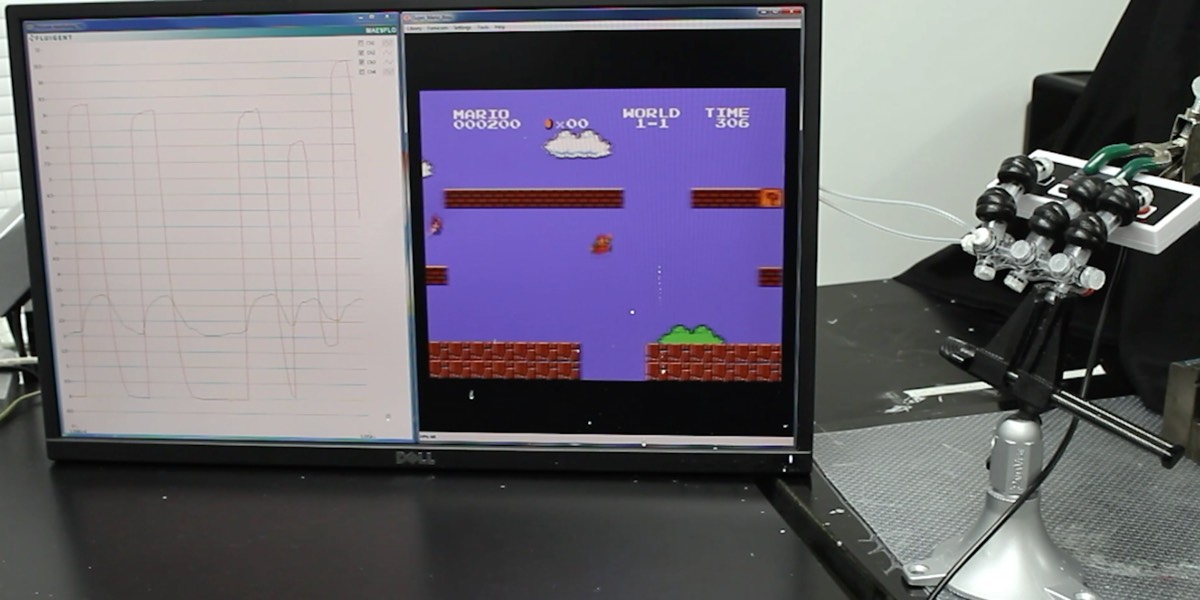
The team tested the performance of the robotic hand by having it play Super Mario Bros. To make Mario walk, the team used a low pressure, so only the first finger pressed the controller. The researchers used a medium pressure to make Mario run and a high pressure to make the hand press the correct button on the controller to get Mario to jump.

<a href="https://rassegna.lbit-solution.it/wp-content/uploads/2021/07/this-3d-printed-soft-robotic-hand-beat-the-first-level-of-super-mario-bros-3.jpg" class="enlarge" data-height="600" data-width="1200" alt="The soft robotic hand plays a round of Super Mario Bros.“><img alt="The soft robotic hand plays a round of Super Mario Bros.” src=”https://rassegna.lbit-solution.it/wp-content/uploads/2021/07/this-3d-printed-soft-robotic-hand-beat-the-first-level-of-super-mario-bros-1.jpg” width=”640″ height=”320″ srcset=”https://rassegna.lbit-solution.it/wp-content/uploads/2021/07/this-3d-printed-soft-robotic-hand-beat-the-first-level-of-super-mario-bros-3.jpg 2x”>
Enlarge / The soft robotic hand plays a round of Super Mario Bros.
YouTube/UMD A. James Clark School of Engineering

As for why they chose Super Mario Bros., Sochol told Scientific American that it was the very first Nintendo game he had played as a child. But the choice wasn’t just a matter of nostalgia. The timing and specifics of the game are well-established; the robot hand simply needed to time its responses in accordance with the preprogrammed moves. And there are actual consequences for failure: a single mistake will cost Mario a life. The hand performed so well, it was able to successfully beat the first level of the game in less than 90 seconds.

“We are freely sharing all of our design files so that anyone can readily download, modify on demand, and 3D print—whether with their own printer or through a printing service like us— all of the soft robots and fluidic circuit elements from our work,” said Sochol, who estimates that printing one’s own soft robots would cost about $100 using the team’s software on GitHub. “It is our hope that this open-source 3D printing strategy will broaden accessibility, dissemination, reproducibility, and adoption of soft robots with integrated fluidic circuits and, in turn, accelerate advancement in the field.”

DOI: Science Advances, 2021. 10.1126/sciadv.abe5257  (About DOIs).

Listing image by University of Maryland

https://arstechnica.com/?p=1782874