Dread Pirate Roberts escaped development hell: Making Silk Road work as a film
[embedded content]
Trailer for Silk Road.

In the last decade or so of Ars, two pre-COVID news stories stand out to me as the “biggest”—the kind of stuff that captivates a general audience in the moment and will attract the eyes of Hollywood eventually. The first one happened back in 2013, when former NSA contractor Edward Snowden leaked classified documents that showed the US had a secret surveillance program up and running that even monitored US citizens. To make the saga even juicier, Snowden ultimately had to flee the country for fear of legal retribution.

The second story largely unfolded in that same year. A young libertarian named Ross Ulbricht pondered why in the United States you couldn’t purchase drugs freely and openly on the Internet through some kind of one-stop repository like Amazon. Eventually, his Silk Road website sprang up and captivated the world… until federal authorities finally closed in on Ulbricht in a San Francisco library in October 2013. The arrest led to an eye-opening trial and a life sentence for the pseudonymous Dread Pirate Roberts.

Snowden’s story ultimately got the Hollywood treatment, via the Oscar-winning documentary Citizenfour in 2014 and a fictionalized account starring Joseph Gordon-Levitt two years later. And though it took a bit longer (unless we’re counting a made-for-TV documentary), the Silk Road odyssey has finally made its feature film debut, too.

After years of rumors and vetted projects, Silk Road had a February VOD run and arrived on Hulu this month. Previous attempts to get a film in the can included industry royalty as big as the Coen brothers (that one would have been based on coverage by our Condé brethren Wired). But time and again, these initiatives sputtered out during some stage of “development hell”—scripts that weren’t quite right, issues with casting and budget, etc. What actually got the job done was paring down rather than expanding the scope of this complex crypto crime thriller.

“There’s a long history of attempts to get this movie made—there were many competing projects at one time, I think there were four or five,” says Duncan Montgomery of High Frequency Entertainment, the production company that helped get Silk Road (based on this Rolling Stone piece) done. “[When we were finally brought on], we started giving our opinion directly to everyone: it needs to be a smaller film.

“[Screenwriter/director] Tiller Russell had interesting elements—the cat-and-mouse detective stuff that gets out of the box and has some entertaining aspects. But this was never going to be a $30 to $40 million-budget film,” he told Ars this spring. “So when Imagine Entertainment‘s deal with the other producer expired, we stepped in and got the rights. And I think Imagine was OK with that, because by then they understood it wasn’t going to be a fit for the kind and size of films they like to make.”

How to make a Silk Road film, step one: Narrow it

Anyone who followed even a tiny amount of the Silk Road news coverage can probably close their eyes and imagine how a studio might see this as a globetrotting blockbuster. It’s the Stefon of source material: the Silk Road had everything. Worldwide reach with major happenings in San Francisco, Austin, and DC. Bleeding-edge technology leveraged for lucrative crime. Drugs galore. An alleged murder-for-hire scheme. Dirty cops capable of major schemes and good cops capable of intricate investigation. And at the center of it all stood a stubbornly ideological kingpin who ultimately turned out to be more bluster and brains than brawn.

All that drama happens long before you even get to the tense arrest attempts and courtroom fireworks. But taking this huge story and translating it into a film that could be successful at the (before times) box office while keeping a normal runtime isn’t simple. Montgomery says the team started by identifying and then tackling two core challenges: the scope and the screens.

“To this day, there’s so much we had to leave out. Really, what this needs is a six-hour limited series,” he tells Ars. “So that was really hard, and it had to find a balance. Do we just tell Ross’ story? Do we even have enough time? Then we ultimately had a DEA agent who’s really an amalgamation of real people. We didn’t feel comfortable from a legal standpoint telling Carl Force’s story or using another guy, so we made a combination of several.”

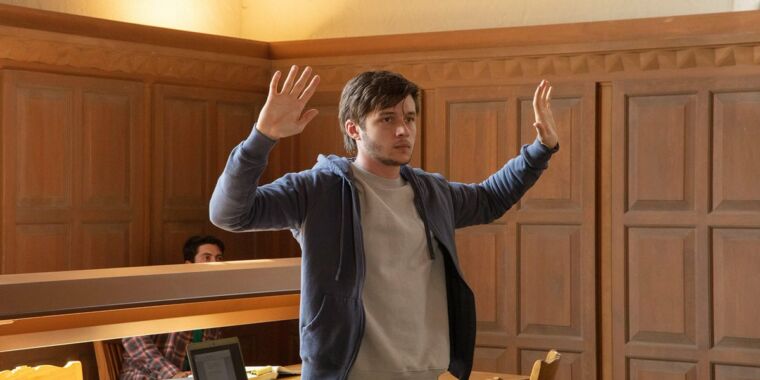
To maintain this narrow focus, Silk Road unfolds in parallel storylines. On one side, the film follows Ulbricht, played by Nick Robinson (Jurassic World). Montgomery has lived in Austin, Texas, since the ’90s, and he remembers having friends that put him a degree of separation away from a young Ulbricht. But despite how captivating the team found Ulbricht’s backstory while working through the research, the film ultimately skips the Silk Road founder’s upbringing and college years, and it halts before the courtroom drama.

What’s covered, however, is extremely loyal to reality. Silk Road had Ulbricht’s former girlfriend Julia Vie as a consultant who also optioned her story rights. The film shows Ulbricht problem-solving early marketing and technical hiccups until he increasingly loses his grip on reality. He goes from philosophically driven entrepreneur with a life to a man whose site is his sole focus. And as nefarious as some of his choices and motivations ultimately become, Silk Road does sympathize with this character—a stubborn but personable young adult driven to a dangerous obsession that wipes out his humanity.

“On Ross’ side, that portion of the story is very, very accurate,” Montgomery says. “[Vie] lived with him during that time, so she more than anyone else—even more than his family, his friends—knew. We don’t always tell our parents everything. But it’s much harder to hide it from her, so he was very open with her story… The FBI had interviewed Vie and decided she was not a suspect, so she felt very free to talk with us. They had a relationship we could explore, and we could share their intimacy.”

https://arstechnica.com/?p=1769648


Review: Old is a mostly solid film undermined by jarring twist ending

[embedded content]
A family on a tropical holiday discovers that the secluded beach where they are relaxing for a few hours is somehow causing them to age rapidly in Old, a new thriller from M. Night Shyamalan.

Director M. Night Shyamalan has a well-known fondness for his signature surprise twist endings. When those twists work organically, we get classics like The Sixth Sense and Unbreakable. When they don’t—well, if you’re lucky, you get something like his new film, Old, in which everything that comes before is sufficiently compelling that you can almost shake off a jarring final twist that feels so forced, it’s almost like it belongs in an entirely different movie.

(This being an M. Night Shyamalan film where surprise twists are tantamount, I have taken great pains to avoid spoilers. There is nothing discussed in the review below that has not already been revealed in the film’s trailers.)

Old is based on a French graphic novel called Sandcastle, written by Pierre Oscar Levy (also a documentary filmmaker) and illustrated by Frederik Peeters. It’s about a group of 13 people who find themselves trapped on a mysterious, secluded beach where time moves much more quickly—so quickly that young children reach puberty in a matter of hours, and everyone will reach old age and die within 24 hours. Shyamalan received a copy of the book as a Father’s Day gift and was immediately touched by how it humanely grappled with the all-too-human fear of aging and the relentless passage of time.

Shyamalan’s film is not a direct adaptation of the graphic novel, although it keeps the same central premise and several key scenes. It’s more of a re-imagining, with the director fleshing out the narrative and amping up the tension to create an existential thriller that feels more like a “two-hour Twilight Zone episode,” per Shyamalan. Married couple Guy (Gael Garcia Bernal, Mozart in the Jungle) and Prisca (Vicky Krieps, The Phantom Thread) Cappa decide to take a family vacation at a luxurious tropical resort with their two children: daughter Maddox (Alexa Swinton), age 11, and son Trent (Nolan River), age six.

The resort manager (Gustaf Hammarsten) arranges a special excursion for the family: a day at a secret, secluded beach. They are not the only chosen ones. There is also a hip-hop artist named Mid-Sized Sedan (Aaron Pierre, Krypton); another married couple, nurse Jarin (Ken Leung, Star Wars: The Force Awakens) and psychologist Patricia (Nikki Amuka-Bird, Jupiter Ascending); and a cardiothoracic surgeon, Charles (Rufus Sewell, Man in the High Castle), his trophy wife Chrystal (Abbey Lee, Lovecraft Country), his mother Agnes (Kathleen Chalfant, The Affair), and their six-year-old daughter, Kara (Kylie Begley).

Nothing seems amiss at first, despite the lack of cell phone service, although the children do discover a stash of other people’s personal belongings half-buried under the sand. Then the corpse of a young woman washes up on the beach, and things take a turn for the creepy. Anyone who tries to leave the beach inevitably blacks out. The corpse decomposes in record time, and the children age several years over the course of a few hours. The beach essentially reduces 50 years of life into a single day, making their collective escape a matter of survival.

This is a fantastic concept, and one can see why it appealed to Shyamalan, who uses the premise to explore how the very different personalities trapped on the beach respond to their predicament. Visually, Old is a gorgeous film, almost entirely shot at Playa El Valle in the Dominican Republic. Shyamalan said his angular cinematographic approach was inspired by Akira Kurosawa’s Ran and Rashomon, in order to create an increasingly claustrophobic feel to what starts out as an idyllic beach setting. Composer Trevor Gureckis’ score reinforces the sense of foreboding, with strings playing detuned harmonies, and tribal bass drums evoking the relentless forward march of time.

There are some truly lovely moments in Old, especially with the Cappa family. Guy and Prisca must confront the issues in their marriage and struggle with watching their kids grow up way too fast—something Shyamalan, father to now-grown daughters, understands very well. Both Bernal and Krieps give exquisitely subtle performances, while Thomasina McKenzie (JoJo Rabbit) and Alex Wolff (Hereditary) are equally effective as the teenaged Maddox and Trent, respectively.

Unfortunately, the other characters aren’t nearly as fully developed, although the talented cast does its best to bring depth to underwritten roles that amount to little more than stereotypes. This is especially disappointing in the case of Chrystal, the trophy wife, whose entire sense of self-worth rests on her youth and physical beauty. Ours is a culture that treats aging women particularly harshly, and there could have been a fascinating character arc for Chrystal where she genuinely grappled with what sudden, rapid aging means for her sense of self. Instead, she becomes increasingly monstrous, which is far less interesting.

The biggest issue with the film is that Shyamalan just can’t resist trying to be clever, thereby undermining in the last 10-15 minutes the reflective, almost elegiac notes he achieves in the preceding scenes. All I will say about that twist ending is that it feels tacked on as an afterthought and is utterly inconsistent in tone with everything that comes before. Some things are best left unexplained. (The graphic novel that inspired Shyamalan, for instance, never explains the strange aging anomaly on the beach and ends with a cryptic scene of a young child building a new sandcastle all alone.)

I came out of the screening with mixed feelings, convinced that Old would prove to be divisive with both critics and audiences, and thus far that seems to be the case. (It’s even languishing a bit at the box office, although that’s probably as much due to spiking COVID cases dissuading folks from going to theaters as anything else.) Shyamalan has made several films hammered by critics at the time of their release, which were later re-assessed more favorably (see The Village). Perhaps Old will also be favorably re-assessed a few years down the road, despite its flaws, since it really does successfully evoke both an existential sense of dread and an ultimate acceptance of human mortality.

Old is now playing in theaters. We strongly recommend only watching movies in theaters if you have been fully vaccinated.

Listing image by Universal Pictures

https://arstechnica.com/?p=1782046


Star Trek: Lower Decks S2 trailer promises more scrappy underdog adventures

[embedded content]
Our favorite ensigns are back with more wacky hijinks in the second season of Star Trek: Lower Decks.

The animated series Star Trek: Lower Decks was one of our favorite TV shows of 2020, so we’ve been looking forward to its second season. We won’t have long to wait. S2 drops next month on Paramount+, and the studio debuted its first trailer during the Star Trek Universe panel at Comic-Con@Home 2021. That same panel also gave us our first teaser for another new animated series, Star Trek: Prodigy.

(Spoilers for S1 of Star Trek: Lower Decks below.)

As we’ve reported previously, this is the first animated Star Trek series since the Emmy-award-winning Star Trek: The Animated Series (TAS), which ran from 1973 to 1974. Lower Decks is part of a five-year overall deal that Star Trek: Discovery co-creator and showrunner Alex Kurtzman signed with CBS to expand the franchise. Kurtzman tapped Rick and Morty head writer Mike McMahan to spearhead the project. Chronologically, the show takes place after the events of the 2002 film Star Trek: Nemesis; the name is an homage to an episode of Star Trek: The Next Generation (TNG). 

The first season, which premiered last August, introduced us to the support crew serving on one of Starfleet’s least important ships, the USS Cerritos, in 2380: Ensigns Beckett Mariner (Tawny Newsome), Brad Boimler (Jack Quaid), Sam Rutherford (Eugene Cordero), and D’Vana Tendi (Noël Wells). Mariner adopts a lax approach to following the rules, which contrasts sharply with the attitude of Boimler, who is a stickler for the rules and dreams of being captain of his own starship one day. Rutherford sports a cyborg implant and bears some resemblance to Geordi La Forge from TNG, while Tendi is an eager-to-please new addition to the medical bay. As Mariner says, “We’re not really elite. We’re more the cool, scrappy underdogs.”

Their madcap S1 adventures included the crew dealing with an alien viral outbreak that turns crew members into raging zombies; Boimler getting slimed by an alien farm animal; Tendi creating a pet dog despite her limited knowledge of canine anatomy; and Mariner getting drunk with a Klingon general who proceeds to steal the shuttlecraft.

Who could forget Boimler’s briefly homicidal holographic assistant Badgey? And we could all benefit from “The Boimler effect,” a mandate that encourages scheduling in “buffer time” so crew members can complete tasks at their own leisurely pace. We also got guest appearances by Riker (Jonathan Frakes), Deanna Troi (Marina Sirtis), and everyone’s favorite extra-dimensional being, Q (John de Lancie).

In her review for Ars Technica, Kate Cox described the series as “comfort food with a comic twist.” It included sufficient winks and nods for hardcore Trekkies without veering too far into over-indulgence. “In a universe of lofty goals and monologued moral exhortations, Lower Decks primarily begs us to check ourselves before (and after) we wreck ourselves and to take the opportunities to screw around, have fun, and enjoy the absurdities of space when they are presented,” she concluded.

So what can we expect from S2’s ten episodes? McMahon has said the season will combine standalone episodes with season-long character arcs, including one involving Mariner and Tendi. The season will not undo any of the events of S1, which saw the demise of security chief Lieutenant Shaxs (Fred Tatasciore), who sacrificed himself to save Rutherford. Rutherford will be struggling with some lingering memory issues as a result of those events, and Boimler will now be working on the USS Titan. Meanwhile, Mariner and Captain Carol Freeman (Dawnn Lewis)—revealed to be her mother last season—will be learning how to work together. We’ll also be seeing more of Riker as captain of the Titan, plus some additional cameos by other characters from past Star Trek series.

[embedded content]
Teaser for new animated series Star Trek: Prodigy.

Star Trek: Prodigy will be a very different beast, aimed at a younger audience than the usual Star Trek fare. It’s set in 2383 and takes place after the events of Star Trek: Voyager. In fact, Kate Mulgrew will return to voice Captain Kathryn Janeway—or rather, her appearance as the ship’s Emergency Training Hologram. The show is expected to be different from Lower Decks in both tone and visual style, and this first teaser is certainly in keeping with that idea. Per the official premise:

Star Trek: Prodigy is the first Star Trek series aimed at younger audiences and will follow a motley crew of young aliens who must figure out how to work together while navigating a greater galaxy, in search for a better future. These six young outcasts know nothing about the ship they have commandeered—a first in the history of the Star Trek Franchise—but over the course of their adventures together, they will each be introduced to Starfleet and the ideals it represents.

The main cast features Brett Gray as Dal, a 17-year-old “maverick”; Rylee Alazraqui as Rok-Tahk, an eight-year-old Brikar who loves animals; Angus Imrie as Zero, a non corporeal energy-based Medusan; Jason Mantzoukas as Jankom Pong, a Tellarite who enjoys playing devil’s advocate; Ella Purnell as Gwyn, a Vau N’Akat who grew up on a mining planet; and Dee Bradley Baker as Murf, an “indestructible blob” who likes to chow down on ship parts. In addition, guest star Billy Campbell will be back as rogue freighter captain Thaius Okona from TNG.

Star Trek: Lower Decks S2 will debut on Paramount+ on August 12, 2021, and the show has already been renewed for a third season. Star Trek: Prodigy is expected to land later this year with ten episodes on Paramount+. After that, it will air on Nickelodeon.

Listing image by YouTube/Paramount+

https://arstechnica.com/?p=1782594


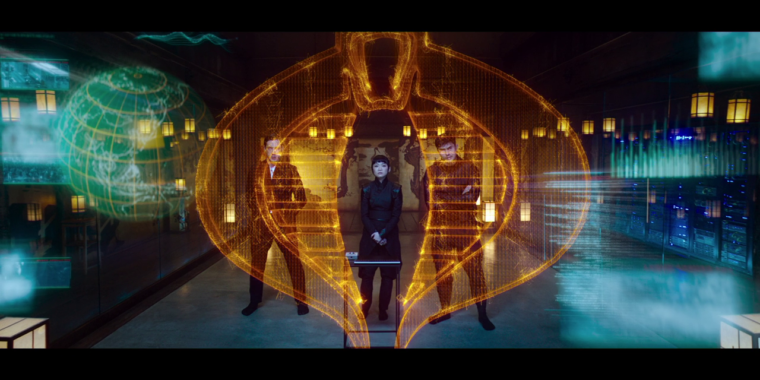
Snake Eyes film review: More like “G.I. No”

Earlier this year, I gave a tepid recommendation to Mortal Kombat‘s latest theatrical reboot. What I didn’t know at the time was how quickly I’d feel nostalgic for its quality and pacing.

That’s how I felt after Snake Eyes: G.I. Joe Origins, which I went into with next to zero expectations. The trailers looked fun! Charm volcano Henry Golding (Crazy Rich Asians) as an action star sounded intriguing! And it couldn’t be worse than the previous G.I. Joe movie, right? Right?

Sadly, Snake Eyes takes the uneven formula, momentum, writing, and acting of Mortal Kombat 2021 and turns down the expectations dial in every way imaginable. By the end, Snake Eyes dampens its own so-bad-it’s-good potential, in case you hoped to at least laugh and cheer while watching your favorite childhood action figures.

“I looked into your eyes, and I saw honor”

To its credit, Snake Eyes‘ opening 30 minutes are so dizzyingly bad that the filmmakers appear to be in on the joke. My favorite examples include:

  • Every fight has no less than 10 henchmen screaming in unison while swarming our hero (serious “YARRRGH!!” territory with eyes directed at the camera)—then they circle him, attack one at a time, and get their asses handed to them
  • The initial exposition whips by so quickly and nonsensically that I thought I was watching a gamer lay on the A button to skip past the plot of a video game
  • Every argument in the brooding brother-and-sister conflict includes million-dollar glares and bombastic declarations about trust and loyalty—usually repeated a few times in case we don’t catch the foreshadowing that someone is, like, totally about to be betrayed
  • And the British-born Golding pops in and out of his native accent roughly once every four minutes, despite playing a native-born American.

Snake Eyes opens with something resembling a backstory for Snake Eyes, a man who never knew his given name, and it’s a sharp pivot from whatever you remember from the G.I. Joe comics or cartoons. This time, Snake watches his father get murdered by a mysterious assassin, which we see play out in dark, serious staging. This sends the adult version of Snake on a path to… wander from town to town in search of fight clubs, where he beats the crap out of strangers, collects a paycheck, and hits the road. (Also, his nickname is “Snake Eyes” because the man who killed his dad rolled some dice before doing so. When the dice landed on a pair of ones, that was apparently reason enough to kill said dad.)

How did Snake get from preteen trauma to a Tyler Durden lifestyle? What happened to his original origin story about traumatically losing his voice? And wasn’t Storm Shadow the one with the “hunt for a family member’s killer” plot in the first place? Whoa, watch it, bub: questions like those will get you beat up in logic-free zones like Snake Eyes: G.I. Joe Origins.

“Your fishboy life in LA is over”

Snake’s eventual collision with all things G.I. Joe-related—complete with a showdown between a willing Joe coalition and a shadow organization smothered in Cobra logos—is similarly slapdash.

I think I have this right: Snake gets a tip about his father’s killer, which leads him to working on a dock and packing illegal guns into fish carcasses so the carcasses can be shipped around the world on the Yakuza’s behalf. (This dock, by the way, has a gaggle of giggling teens who routinely hang out in a nearby alley and play pick-up soccer, seemingly so that Snake can show his lighter side for roughly 10 seconds. There has to be a better place to practice soccer, kids. Snake’s character development isn’t worth it.)

Within weeks of getting this job, Snake is asked to murder the dock’s lead contraband manager, Tommy Arashikage, over a business disagreement. Why is Snake suddenly given such a macabre responsibility when he’s clearly the dock’s nice-guy youth-group leader? We never find out, because Snake immediately spares Tommy’s life instead of following orders. Instead, he starts beating the crap out of every thug in eyeshot. (Cue the “dozens of men screaming and running to form a circle” motif.) After watching the big boss get away, then running away from what’s clearly an entrenched Yakuza stronghold, Tommy somehow safely whisks Snake away on a private jet to Tokyo… where we learn Tommy is actually the heir to a honor-bound family dynasty (which, I’ll add, doesn’t know about his fish-stuffed-with-guns enterprise).

… and this trip is what the bad guys wanted all along! From there, Snake Eyes transforms into a sluggish montage of Snake ninja-training under Tommy’s care to become a true member of his family (no, not that family, Vin Diesel). Deep into this montage, mysterious fireball conjuring enters the chat. And that is followed by two female, Uzi-toting assassins flatly reading index cards ordained by Hasbro brass to explain that this “train in philosophical, noncombat philosophies” sequence somehow connects to G.I. Joe and Cobra Command.

“I’m pretty good at finding people. Especially people who kill other people.”

Character motivations remain muddy even as they trickle into the film’s stream of consciousness. We catch glimmers of likability in Golding and his friend-then-foe-then-friend-again co-star Haruka Abe (Late Shift), but no one gets any sensible motivation. Snake repeatedly goes to great lengths to stop a bitter double-cross plot only to have a trinket dangled in front of his face, which is when he makes a Goofy-like “gawrsh” noise and becomes shady again.

I could tolerate all that if the warped plot wasn’t scotch-taped together by stiff acting and stilted dialogue or if the action sequences between each overlong-yet-unsatisfying exposition dump approached anything that could be called “unique,” “exciting,” or “stomach-safe.”

If you’ve ever thought that the multiplex’s glut of comic- and toy-licensed action films needed more motion blur and erratic camera cuts, Snake Eyes has your back (but not your barf bag; you’ll need to bring your own). Hand-to-hand combat is generally impossible to track amidst all the grunts, even though the heavies are almost all dispatched one at a time. Car and gun combat scenes play out in kill-by-numbers fashion. An eventual mysterious foe commands walls of flame, which emerge from the ground like gas fireplaces at a pub’s outdoor seating area. Honestly, I loved the cheap trashiness of that effect, but Snake Eyes is more about bare-minimum effects and choreography than it is about hilarious cheese.

Having laughed through some of Snake Eyes, I hope fans eventually put together a 60- or even 80-minute edit once the movie is on Blu-ray. This week’s version suffers the most when its “cinematic universe” aspirations get in the way of what’s really going on: a child grabbed various action figures and slammed them together while shouting nonsense, and a group of excited adults scribbled down his every exclamation of “Yo Joe!” to commit it to this script.

But this G.I. Joe film has no idea what that branding arrangement should mean, and it never commits either to its Crouching Tiger, Hidden Dragon inspirations, its meaningless character alliances, or its “guns and cars go boom” bravado.

Listing image by Paramount

https://arstechnica.com/?p=1782476


Latest Dune trailer gives us our best look yet at Denis Villeneuve’s epic film

It seems like we’ve been waiting forever for the much-anticipated release of filmmaker Denis Villeneuve’s adaptation of Frank Herbert’s epic science fiction novel Dune. The movie was originally slated for a November 2020 release before moving to December, but the winter surge of COVID-19 ultimately crushed those hopes. It was rescheduled to October 1, 2021, then bumped yet again to October 22. That date still holds (fingers crossed!), and Warner Bros. just released a new three-minute trailer showcasing tons of new footage from the film.

As we’ve reported previously (here and here), Herbert’s Dune is set in the distant future and follows the fortunes of various noble houses in what amounts to a feudal interstellar society. Much of the action takes place on the planet Arrakis, where the economy is driven largely by a rare, life-extending drug called melange (“the spice”). Melange also conveys a kind of prescience and makes faster-than-light travel practical. There’s betrayal, a prophecy concerning a messianic figure, giant sandworms, and battle upon battle, as protagonist Paul Atreides (a duke’s son) contends with rival House Harkonnen and strives to defeat the forces of Shaddam IV, Emperor of the Known Universe.

When Dune was first published, The Chicago Tribune called it “one of the monuments of modern science fiction.” Astronomers have used the names of fictional planets in Dune to identify various topographical features on Saturn’s moon Titan. Herbert wrote five sequels, and the franchise also includes board games, computer games, and numerous prequels and sequels written by his son Brian Herbert with the help of Kevin J. Anderson.

Dune is notoriously difficult to adapt—as David Lynch discovered when he directed his critically panned 1984 film adaptation—but Villeneuve found the trick was to split the novel in half. This first film will cover events in the first half of the novel, and a second installment will cover events in the second half. However, Villeneuve wrote an op-ed for Variety last December, sharply criticizing the studio’s decision to release Dune simultaneously in theaters and on HBO Max (for a 31-day period) because of the ongoing global pandemic. He predicted this could result in the film underperforming at the box office (“piracy will ultimately triumph”), leading to a cancellation of the planned sequel.

Per the official premise:

A mythic and emotionally charged hero’s journey, Dune tells the story of Paul Atreides, a brilliant and gifted young man born into a great destiny beyond his understanding, who must travel to the most dangerous planet in the universe to ensure the future of his family and his people. As malevolent forces explode into conflict over the planet’s exclusive supply of the most precious resource in existence—a commodity capable of unlocking humanity’s greatest potential—only those who can conquer their fear will survive.

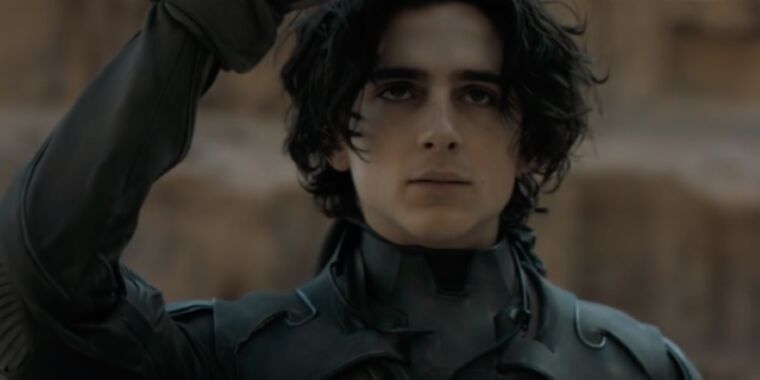
Timothée Chalamet plays the scion of House Atreides, Oscar Isaac plays Duke Leto Atreides, Rebecca Ferguson plays Lady Jessica, Jason Momoa plays Duncan Idaho, and Zendaya plays the mysterious Chani. Josh Brolin plays Paul’s other mentor, troubadour/warrior Gurney Halleck, while Javier Bardem plays Stilgar, the leader (naib) of the Fremen tribe—the original inhabitants of Arrakis who naturally view House Atreides as invaders.

Villeneuve tapped Stellan Skarsgård (in full-body prosthetics) to play Baron Vladimir, head of House Harkonnen, and Dave Bautista plays Glossu Rabban, the baron’s brutish nephew. In a departure from the book, the character of Liet Kynes, an Imperial planetologist on Arrakis, has been gender-swapped to be a Black woman, played by Sharon Duncan-Brewster.

Warner Bros. debuted the first trailer last September. The reactions of Ars staffers were decidedly mixed, bordering on “meh”—mine being the exception. As I wrote at that time:

I found the 1984 Lynch film almost comically unwatchable (see Sting’s space Speedo), so Villeneuve’s take looks appealing to me. And I’m generally pretty tolerant of creative adaptations and thus not as heavily invested in how much the new film adheres to the details in Herbert’s novels. I think it was wise of Villeneuve to split the film into two parts; in fact, a big-budget prestige TV series might be even better, given the span and complexity of the source material.

This latest trailer opens with Paul’s recurring visions of a mysterious woman (Zendaya’s Chani). “My planet Arrakis is so beautiful when the Sun is low,” she tells him in a voiceover. “Rolling over the sands you can see spice in the air. The outsiders ravage our lands in front of our eyes. Their cruelty to my people is all I’ve known. What’s to become of our world… Paul?”

Paul tells Duncan Idaho about his dreams, but his friend is dismissive. “Dreams make good stories,” Duncan assures him, “but everything important happens when we’re awake.”

When Duke Leto accepts stewardship of Arrakis at the emperor’s request (despite suspecting that it’s a trap set by his political enemies), he takes Paul and Lady Jessica to the planet. But the Duke is betrayed, leading Paul and Lady Jessica to natives of Arrakis called the Fremen—and Paul recognizes Chani as the woman from his dreams. It’s not long before an all-out war breaks out on Arrakis, as House Harkonnen undertakes what Paul realizes is an extermination: “They’re picking my family off one by one.” Fortunately, he has Duncan Idaho urging him and the Fremen to “fight like demons”—with some great footage of Duncan doing just that.

I’m still not entirely sold on casting Chalamet in the lead role, but visually, Villeneuve’s film looks stunning—and there are small touches of humor sprinkled throughout that give me hope that Dune will be a serious adaptation that knows when not to take itself too seriously.

Dune premieres in theaters and on HBO Max on October 22, 2021, following the film’s world premiere at the 2021 Venice International Film Festival this September. Here’s hoping Villeneuve’s pessimistic forecast doesn’t prevail and the film does well enough so that we get to see his two-part vision realized in full. There’s also a prequel TV series in development, Dune: The Sisterhood, which will focus on the Bene Gesserit.

[embedded content]
Official trailer for Dune.

Listing image by YouTube/Warner Bros.

https://arstechnica.com/?p=1782258


Activision Blizzard sued by state agency over alleged widespread discrimination

Sign on facade of Activision's Los Angeles offices.
Enlarge / Sign on facade of Activision’s Los Angeles offices.
Getty Images

On Wednesday, a California State agency filed a lawsuit against the game publisher Activision Blizzard over allegations of rampant sexual discrimination and sexual harassment. The nature of this harassment is so widespread, the lawsuit says, that women who have worked for the game maker “almost universally confirmed that working for Defendants was akin to working in a frat house”—which, according to this lawsuit, means a workplace full of inebriated men who sexually harassed their female colleagues without being punished for it.

The 29-page lawsuit claims that across the entire corporation, pay disparity led to women receiving “less total compensation than their male counterparts while performing substantially similar work.” It includes multiple alleged examples of Activision Blizzard slowing promotions for women in favor of male counterparts, even when those women had longer tenures and a superior review record at the company, and added that women of color were “particularly targets of Defendants’ discriminatory practices.”

A direct report to Blizzard’s president

The full lawsuit includes a lengthy list of violations of both sexual discrimination and sexual harassment statutes, including many that single out unnamed Activision Blizzard staffers, and they range from explicit to repugnant. The lawsuit describes one particularly extreme example of alleged harassment—and says the sufferer eventually took her own life.

Multiple company executives are mentioned by name in the filing. Blizzard Entertainment President J. Allen Brack allegedly received a direct report from an employee in “early 2019” that staffers were quitting the company over “sexual harassment and sexism.” The report pointed directly to the company’s battle.net online service team, where “women who were not ‘huge gamers’ or ‘core gamers’ and not into the party scene were excluded and treated like outsiders.”

A former senior creative director at the company’s World of Warcraft division allegedly had a reputation at Blizzard’s annual BlizzCon event for hitting on female colleagues; he was so aggressive that “supervisors had to intervene and pull him off female employees.” Brack is named in these allegations for giving the director nothing more than a “slap on the wrist” after each incident.

And one Activision CTO, not identified by name, was allegedly seen “groping inebriated female employees at company events” and allegedly hired women based on their looks.

The lawsuit alleges a long and detailed history of Activision Blizzard not responding to official complaints filed by affected staffers. Those complaints were allegedly not kept confidential, and the lawsuit claims those complainants were subject to subsequent retaliation, which came in the form of layoffs, unwanted department transfers, and denied career advancements.

Company response: “Unaccountable State bureaucrats”

Activision Blizzard issued a statement following the lawsuit, going so far as to accuse California State’s Department of Fair Employment and Housing of “distorted, and in many cases false, descriptions of Blizzard’s past.” After claiming that the DFEH didn’t engage in “good faith discussions” prior to filing its suit, it then called the suit “irresponsible behavior from unaccountable State bureaucrats that [is] driving many of the State’s best businesses out of California.”

The damages sought by the DFEH include those based on women’s pay disparity, and while Activision Blizzard’s statement includes claims that it “strive[s] to pay all employees fairly for equal or substantially similar work,” it doesn’t acknowledge any possible issue of pay disparity in the company’s past, nor how the company might have rectified prior violations of California state law.

Activision Blizzard is far from alone in terms of sexual harassment allegations in the video games industry—as seen in recent examples at Ubisoft, EA, and Riot Games.

https://arstechnica.com/?p=1782211


Netflix bleeds subscribers in US and Canada, with no sign of recovery

Netflix bleeds subscribers in US and Canada, with no sign of recovery
LPETTET | Getty Images

Netflix lost 430,000 subscribers in the US and Canada in the second quarter and issued weaker than expected forecasts for later in the year, rekindling investor doubts over how the streaming group will fare after the economic reopening.

The California-based company predicted it would add 3.5 million subscribers in the third quarter, disappointing investors who were looking for a stronger rebound in the second half of the year. Analysts had forecast that Netflix would add 5.9 million subscribers during the third quarter.

In the past year and a half, Disney, Apple, WarnerMedia, Comcast and others have launched streaming platforms, and there are more than 100 streaming services for consumers to choose from, according to data company Ampere.

Yet on a call for investors, executives dismissed the idea that competition was behind the weaker figures.

“Does HBO or Disney… have a differential impact compared to the past? We’re not seeing that in the [data] we have,” said Reed Hastings, Netflix co-chief executive. “That gives us comfort.”

Traditional media companies have spent the past few years consolidating in order to compete with Netflix. Most recently, Discovery agreed to merge with WarnerMedia to form a mega-streaming service.

Referencing the industry consolidation, Ted Sarandos, co-chief executive, told investors: “Let’s see if one plus one equals three… versus the typical one plus one equals two.”

Intrigue over Netflix’s plans to delve into video games helped offset the weakness in its core business, lifting the shares 0.8 percent in after-hours trading.

Netflix last week revealed the hiring of Mike Verdu, a 30-year veteran of the gaming industry. The company on Tuesday said it would initially focus on games for mobile phones and offer games at no extra cost to paying subscribers of the streaming group.

Hastings framed video games as a complement to Netflix’s existing business rather than a large new profit driver. “We’re a one-product company with a bunch of supporting elements.”

In total, Netflix added 1.5 million subscribers in the second quarter, just above Wall Street forecasts of 1.1 million.

After adding a record number of customers last year, subscriber growth has slowed sharply as competitors entered the market and people emerged from coronavirus pandemic lockdowns.

Sign-ups have ground to a halt in the US, Netflix’s largest market, where the majority of COVID restrictions have been rolled back.

“The pandemic has created unusual choppiness in our growth,” the company’s management told shareholders.

Netflix executives have blamed the subscriber number weakness on a lighter offering of shows and movies and promised that growth would pick up in the second half of 2021 with the return of titles such as The Witcher and Sex Education.

“COVID and its variants make predicting the future hard, but with productions largely running smoothly so far, we’re optimistic in our ability to deliver a strong second half [shows],” the company said.

Netflix remains by far the largest paid video streaming service, with 209 million subscribers, compared with 104 million for Disney Plus, its closest competitor.

Revenues in the second quarter rose 19 percent from the same period last year to $7.3 billion, meeting analysts’ forecasts. Net income increased to $1.4 billion, up from $720 million a year ago.

© 2021 The Financial Times Ltd. All rights reserved Not to be redistributed, copied, or modified in any way.

https://arstechnica.com/?p=1781890


The surprising connection between a mockingbird’s song and Kendrick Lamar

[embedded content]
New study explores how the mockingbird structures its song, using techniques of timbre change, pitch change, stretch, and squeeze. These are similar strategies used in Tuvan throat singing, Beethoven, Broadway musicals, and hip hop.

What do the remarkably complex songs of the mockingbird have in common with Tuvan throat singing, Beethoven’s “Fifth Symphony,” the song “Show Yourself” from Frozen 2, and Kendrick Lamar‘s “Duckworth”? According to a recent paper published in the journal Frontiers in Psychology, the mockingbird follows similar musical rules when composing its songs to those used in human music.

“When you listen for a while to a mockingbird, you can hear that the bird isn’t just randomly stringing together the melodies it imitates,” said co-author Tina Roeske, a neuroscientist at the Max Planck Institute for Empirical Aesthetics. “Rather, it seems to sequence similar snippets of melody according to consistent rules. In order to examine this hunch scientifically, however, we had to use quantitative analyses to test whether the data actually supported our hypotheses.”

Mockingbirds are known for their ability to mimic other birds and certain sounds from their surrounding environment, provided those sounds fall into the mockingbird’s acoustic range. For example, the birds can mimic blue jays but not ravens, tree frogs but not bullfrogs. Over half of the mockingbird’s songs are mimicry, and the species boasts an impressive repertoire composed of hundreds of types of phrases.

There have been numerous studies of mockingbird songs over the decades, which is how scientists know that mockingbirds typically repeat each syllable three to five times, separated by tiny breaths, before switching to something new. (A “syllable” can be a single note or a cluster of notes.) One 1987 study classified thousands of song phrases from just four birds, concluding that while there are hundreds of syllable types, most aren’t produced frequently; 25 percent appeared just once in the sample data.

What’s less understood is how mockingbirds choose which syllables to sing—that is, how they go about composing their complex songs. It’s not a random sampling. This new study is the first attempt to qualify or quantify the specific compositional strategies the mockingbird uses when putting together its musical stylings: so-called “morphing modes,” akin to variations on a theme. To do so, the team examined the songs of five different mockingbirds: three were recorded in the field in mid-spring, and two others came from a publicly available birdsong database (xeno-canto).

The mockingbird employs musical techniques similar to those of humans.
Enlarge / The mockingbird employs musical techniques similar to those of humans.
MPI for Empirical Aesthetics

All three authors brought a unique perspective to the study. Roeske’s specialty is the statistical analysis of animal signals. David Rothenberg is a music philosopher at the New Jersey Institute of Technology who studies the connections between music and nature. And Dave Gammon is a field biologist at Elon University in North Carolina, who has studied the songs of mockingbirds (and one bird in particular) for many years.

“When confronted with a complex mockingbird song, a musician will hear one thing, an ornithologist another, and a signal analyst something else,” the authors wrote of the reasoning behind this inter-disciplinary approach. “The most complete human knowledge of any natural phenomenon comes from combining distinct human forms of knowing—no one perspective negates the others. They are strongest when applied together.”

The team created spectrograms of the mockingbirds’ songs to help visualize the component syllables. They listened to the recordings and made their own qualitative assessments of the birds’ “morphing modes” (the transitions between phrases). In the end, they boiled everything down to four basic compositional strategies employed by mockingbirds as they transition from one sound to the next: timbre change, pitch change, stretching the transition, and squeezing the transition. They quantified the frequency of the four modes based on sample songs from three of the five birds used in the study and found that roughly half of all the morphing was based on timbre.

Granted, this is a simplification, and “almost every transition involves a mixture of more than one of these modes,” the authors acknowledged. The four modes are not a strict system of classification but more of a heuristic tool. “We use this as the basis from which testable hypotheses can be derived,” they wrote, likening the four modes to the minimal pairs commonly used in phonology (e.g., “house/mouse”, “pull/pool”, and other word pairs that differ by a single phoneme).

Timbre describes the color or tonal quality of a musical note or phrasing. It’s why a human voice, a trombone, an oboe, or a flute, for instance, can hit the same note and yet all sound distinctly different. With the timbre morphing mode of mockingbirds, everything about the syllable stays the same, except for the timbre. This typically happens when the mockingbird shifts from mimicking the call of one bird species to another with a markedly different tonal quality, without changing the basic rhythm. In one case, the mockingbird began with a non-mimetic phrase that was similar to the “pump handle” call of the blue jay, then gradually morphed into imitating the blue jay.

The authors point to Tuvan throat singing (specifically, a song by the group Huun-Huur-Tu) as an example of human music that clearly shows the same timbre morphing mode. “A single human voice changes the quality of the upper overtone partials so it sounds like more than one person is singing,” they wrote.

The pitch morphing mode is when just the pitch or frequency of the syllable changes. For instance, a mockingbird may begin by mimicking the call of a Northern flicker or a Carolina wren, and then take it up a few notes for a non-mimetic version of that call. Anyone who’s heard the opening notes of Beethoven’s “Symphony No. 5” will recognize the strategy, in which the first “duh-duh-duh-DUH” is followed by the same phrasing at a lower pitch. (Legend has it that when asked about the opening, Beethoven replied, “That is the sound of fate knocking at the door.”)

The stretch (or half-time) morphing mode occurs when the mockingbird slows down or stretches the syllable of choice, like mimicking a summer tanager’s call and stretching it out until it morphs into a fragment of a call from a northern cardinal. According to Roeske et al., Idina Menzel employs a similar strategy toward the end of Show Yourself.

“Lamar uses a whole series of compositional strategies that have worked wonders for mockingbirds for millions of years.”

The squeeze morphing mode is the opposite of the stretch mode, wherein one phrase is followed by a similar phrase that is performed much faster, while maintaining the same timbre and pitch. Kendrick Lamar uses a similar approach in “Duckworth” from the 2017 album Damn, combining squeezing with pitch morphing. “This did not win the Pulitzer Prize in music composition for nothing,” the authors wrote. “Lamar uses a whole series of compositional strategies that have worked wonders for mockingbirds for millions of years.”

From this, Roeske et al. conclude that mockingbirds compose their songs much like human composers do, drawing phrases from other birds’ melodies that follow these four basic morphing modes, or compositional “rules”—just like humans follow the “rules of harmonic motion.”

There is some risk of anthropomorphism at play here: we have an all-too-human bias toward seeing similarities between ourselves and other species. That’s why the authors took pains to control for such a bias with additional analysis, finding that mockingbirds generally pick adjacent phrases with similar acoustic properties more often than would be expected by chance. So this qualitative perception that they are morphing between phrases is not just due to human bias. That said, they can’t quite rule out the possibility that these morphing modes are a mere byproduct of how song phrases are stored in the brain.

Roeske et al. practically bend over backwards in their paper to emphasize this point again and again, lest they be accused by colleagues of “over-stepping the bounds of science by hearing music in the mere functional sounds of a bird.” That said, they insist, “It would be naive… for scientists or musicologists to assume that mockingbirds do not have an aesthetic sense until the relevant studies have been performed,” particularly since there is considerable evidence of birdsong aesthetics in other species, such as black-capped chickadees (pitch morphing), field sparrows (squeezing), or canyon wrens (stretching).

DOI: Frontiers in Psychology, 2021. 10.3389/fpsyg.2021.630115  (About DOIs).

[embedded content]
Ten minutes of a mockingbird song, recorded by biologist Dave Gammon at Elon University, visualized with Amadeus Pro software, scrolling so you can see the specific complexity of the way the bird moves from one sound to the next.

Listing image by MPI for Empirical Aesthetics

https://arstechnica.com/?p=1781239


The massive Museum of Pinball is closing its doors for good

In 2015, we took you on a photo tour of the Museum of Pinball, home to one of the world’s largest collections of pinball and arcade games under one roof. Since then, the number of games grew by hundreds; the last official count was “over 1,100.”

Sadly, the museum is closing for good (and being replaced by a cannabis-growing operation). An attempt to relocate the museum to Palm Springs, California, failed, and the entire collection of games will be going up for auction soon.

Lead tech for the museum Chuck Casey posted this update:

All deadlines have passed to relocate, obtain a sponsorship, sell to one collector, etc.
Therefore, all the games will be auctioned in the upcoming months.
The official announcement will be forthcoming.
You can bid online and/or in person.
The primary auction will take place in Banning at the Museum of Pinball.
Pins and vids are being sold via auction only. The collection is “locked” for the auction.

We’ll miss the museum and the amazing array of games. The auction will be one to watch.

Our original post about the museum’s opening event follows:

BANNING, Calif.—The weekend of January 16, 2015, was host to the inaugural Southern California Arcade Expo. Featuring over 750 pinball and arcade games, the show was the largest in Southern California’s history. Unlike most arcade shows, where the games are brought by volunteers and enthusiasts to share with the general public, the collection is primarily owned by one man, John Weeks, who has spent the last 40 years amassing his horde of games. Weeks also owns the 40,000-square-foot facility where the games are permanently housed and is hoping to make events there happen at least twice a year. The second one is currently scheduled for some time in October.

Despite some minor issues typical of a first-time show, it went off spectacularly, with 3,300 people all enjoying the vast collection of games. There was live music, various styles of tournament play, several seminars, and an attempt to break the Guinness World Record for “most games of pinball being played simultaneously.” But most people just came for the games, and we’ve attempted to document them for you above.

Special thanks to the members of Pinside who donated their photos to help make this gallery possible.

Listing image by Steve Tsubota

https://arstechnica.com/?p=1781377


Collectors are as confused as you are about that $1.56M Super Mario 64 sale

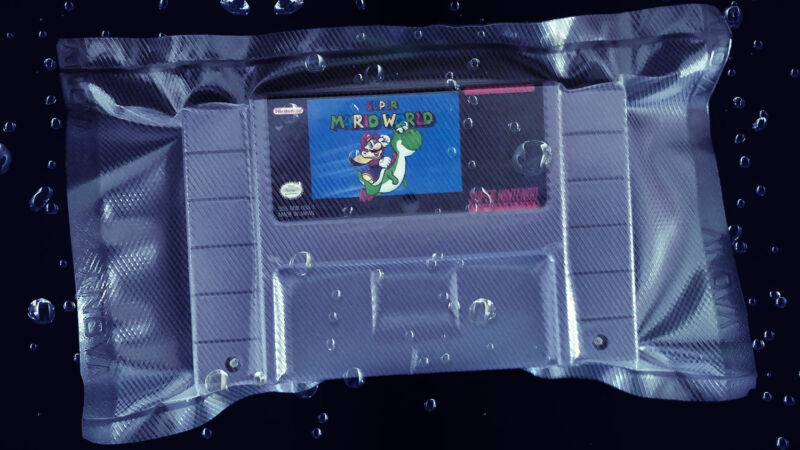
Collectors say bare cartridges in "sous vide" condition can command a premium at auction.
Enlarge / Collectors say bare cartridges in “sous vide” condition can command a premium at auction.
Aurich Lawson

If you aren’t immersed in the world of high-end video game collecting, it’s probably hard to understand why someone paid in excess of $1.5 million for a single, shrinkwrap-sealed boxed copy of Super Mario 64 last Sunday. But if you talk to people who have been collecting games and following this insular world for decades, you’ll find… well, they also think it’s hard to understand.

The confusing part isn’t even the sheer amount of money being spent on a video game box that no one will ever open, much less play. Ever since an early sealed printing of Super Mario Bros. sold for over $100,000 in 2019, the general consensus in the world of high-end game collecting was that an eventual seven-figure game sale was inevitable. But even after a $660,000 Super Mario Bros. sale two months ago, many didn’t think the flashy million-dollar barrier would be broken so quickly. “I honestly thought that this was a milestone that we wouldn’t pass until years from now,” Heritage Auctions Video Game Consignment Director Valarie McLeckie told Ars.

More than the timing, though, game collectors that spoke to Ars expressed near-universal shock that this was the first game to command such a high price. In the past, the small handful of games that have sold for $100,000 or more have all been extremely rare and notable in some way. The Legend of Zelda that temporarily set an $870,000 sales record earlier in Heritage’s recent weekend auction, for instance, was described in the listing as “the only copy from one of the earliest production runs that we’ve ever had the opportunity to offer” for an iconic game.

“I could understand the logic behind a lot of the expensive ones. This felt like the first one that I didn’t understand the ‘Why?’”
Kelsey Lewin

Sure, Super Mario 64 is an important game in a franchise with a huge number of fans. But it’s not the first home video game appearance of Mario—early printings of Super Mario Bros. are more analogous to Superman’s first appearance in Action Comics #1, the holy grail of comic collecting.

And yes, it’s hard to find a copy of the N64 best-seller that wasn’t torn open and played immediately by some kid the second they got it in the late ’90s. But it’s not impossible. Over the last two years, clearinghouse PriceCharting.com lists 30 public sales of “graded” sealed copies of Super Mario 64 (i.e., those which have been evaluated and put in a protective slab by a rating agency). Dozens of additional sealed copies have been sold “raw” and ungraded in that time.

None of those sealed Super Mario 64 boxes sold for more than $38,400 before this $1.56 million sale.

[embedded content]

“I thought that a lot of [these high-end sealed-game sales] made sense up until this last weekend,” said Kelsey Lewin, co-director of the Video Game History Foundation and co-owner of retro game store Pink Gorilla. “I could understand the logic behind a lot of the expensive ones. This felt like the first one that I didn’t understand the ‘Why?'”

Long-time sealed-game collector Bronty, who sold that $100,000 Super Mario Bros. two years ago, put a finer point on it. “A $400K result I might have understood. $1.5 million? What the fuck?”

Twilight of the completionists

“What’s basically happening is that people are getting in with a lot more money in their pockets than has been going around in game collecting so far,” says former Wired gaming editor and current Digital Eclipse Editorial Director Chris Kohler. “And they’re saying, ‘You guys are doing it wrong.'”

Kohler has been collecting video games since he was a teenager in the ’90s, or about as long as video game collecting has existed as a hobby. For most of that time, he says, the vast majority of game collectors weren’t all that animated by the idea of today’s hot mint-condition, shrinkwrap-sealed specimens. Instead, the biggest collectors generally wanted to own a complete, playable set of all the titles on their favorite platforms, either as loose cartridges or unsealed but “complete in box” copies.

Antonio Monteiro's world-record 20,139 game collection exemplifies the "old school" completionist mentality.
Antonio Monteiro’s world-record 20,139 game collection exemplifies the “old school” completionist mentality.

Eventually, as these completionist collectors got near the end of their checklists, they all ended up competing for the same rare titles. Thus, obscure games like Stadium Events or Chase the Chuck Wagon would sell for hundreds or thousands of dollars to collectors who needed one of the handful of extant copies in order to finish their collections. For these completionists, the fact that these titles had little-to-no intrinsic value in terms of nostalgia, gameplay, or historical significance was beside the point.

“What’s basically happening is that people are getting in with a lot more money in their pockets than has been going around in game collecting so far… and they’re saying, ‘You guys are doing it wrong.’”
Chris Kohler

Collectors who focused on sealed video games existed in the long ago days of 2018 and prior, but they were a small niche. “None of us were collecting sealed games before this,” Lewin said. “Sealed games of course went for more money than not-sealed games, but it was such a small amount of traditional retro game collectors that were buying the sealed games that I personally hadn’t felt like it was affecting my ability [to collect].”

https://arstechnica.com/?p=1780880