Base44’s Super Bowl Debut Is As Simple As Its App Building Platform


Base44 has only been around for a year, and it’s already airing a Super Bowl commercial.

The AI-powered app building platform is part of a new crop of “vibe coding” platforms that enable non-technical users to build applications from text prompts, no coding required.

Founded by Israeli developer Maor Shlomo, Base44 grew rapidly in early 2025 and in June was acquired by website builder Wix for $80 million, as part of its mission to expand its AI-driven app development capabilities.

To make a big splash about its AI investments, Wix has bought a double-feature at the Super Bowl. In addition to Base44’s Super Bowl ad, the company is also airing a national ad in Super Bowl 60 that will center around Wix’s prompt-based AI website building tool, Wix Harmony. It follows a seven-year hiatus from the game.

Base44’s campaign, “It’s App to You,” is a simple demonstration of the company’s core offering, where anyone can create an app and get it live in minutes.

The company released a teaser on Thursday (Jan. 29) showing an office worker putting a budgeting app live, triggering a domino effect among her coworkers who all scramble to build apps for their professional and personal interests. 

The teaser was followed by the full 30-second spot, released Tuesday (Feb. 3), in which the woman’s coworkers all go off and build their various apps, from an app to manage office snack inventory to an office dating app…for dogs.

Shay Korin, vice president of marketing of Base44, said in a statement that the campaign “was inspired by what we saw firsthand, as Base44 spread organically across teams and workplaces.” 

“We’re shining a light on that first moment of realization: this is my idea, and it’s live. Once you experience that, you naturally want to share it. And every time someone shares what they built, it creates the next builder and pushes what’s possible even further,” Korin said.

The spot was created by Base44’s in-house creative and directed by Tal Rosenthal and Noam Sharon.
In a digital extension of its Super Bowl broadcast, Base44 is launching a nationwide contest with a $50,000 total prize pool that will offer rewards to “useful” or “ridiculous” apps built around the game.

https://www.adweek.com/creativity/base44s-super-bowl-debut-is-as-simple-as-its-app-building-platform/


Starbucks’ Super Bowl Pregame Ad is an Olympic and Italian-Inspired Love Letter to the Coffee Run


Starbucks is skipping an in-game Super Bowl spot again this year. However, as it did in 2025, the coffee giant will make its presence felt pre- and post-match with a beautiful film that’s equal parts Italian cinema and Olympic spectacle.

Highlighting its role as the official coffee of Team U.S.A., “The Coffee Run” from creative agency Anomaly LA, will debut during the opening ceremony of the Milano Cortina Winter Olympic and Paralympic Games on February 6 on NBC.

A 60-second version of the spot will also feature before and after the Seahawks-Patriots showdown on Super Bowl Sunday.

“Our vision is to be visible, relevant, and loved everywhere,” Starbucks chief brand officer (CBO) Tressie Lieberman told ADWEEK. “And I think that the greatest stage is the Super Bowl. So coming back is just a natural way to continue the narrative around our coffee, craft, and connection. And we’re breaking through with something that feels fresh.”

Filmed on location at a real Starbucks in the Austrian town of Hall in Tirol, an hour outside of Italy, the ad follows a day in the life of a delivery driver making repeated coffee runs to the peak of a ski slope.

Along the way, he furnishes Team U.S.A Olympic and Paralympic athletes, including Amber Glenn, Elana Meyers Taylor, Oksana Masters, and Aaron Pike, with much-needed hot beverages. The commercial also stars a real Starbucks barista, who greets the driver with a smile each time he comes in from the cold.

The art direction by duo Julian & Quentin was inspired by Italian cinema of the 1960s and ’70s. The pair put the footage through a “film-out process,” transferring it to physical film and back to introduce texture, grain, and imperfection to the scenes that can’t be replicated digitally.

Despite the vintage Italian feel, the ad nods to the U.S. brand’s roots, choosing “South American Getaway” from American composer Burt Bacharach as its soundtrack.

Back to Starbucks

Lieberman said “The Coffee Run” will be supported by a social media push, partnerships with Olympians, and via the Starbucks app, which now counts over 35 million members globally.

Starbucks’ Big Game-adjacent marketing blitz follows its 2025 “Hello Again,” ad, a campaign which aired around the broadcast to reintroduce the business as a “third space” where people can connect and gather.

That formed part of the brand’s ongoing “Back to Starbucks” turnaround strategy, led by CEO Brian Niccols, designed to “enhance the in-store experience.” This included the return of the condiment bar, baristas writing on cups, and a revised code of conduct.

Recent campaigns have included “Together at Starbucks” from Anomaly, and a sell-out holiday merch run that included a viral limited-edition teddy bear tumbler which people camped outside stores for.

Despite employee strikes and consumer boycotts, the turnaround plan is starting to pay off for Starbucks, which returned to U.S. same-store sales growth in the latest quarter after two years of declines. In Q1, $7.3 billion of its net revenues came from North America, up 3% year-on-year.

Lieberman said one in three customers said Starbucks was their first choice on their list of coffee shops to visit, “the highest it’s been in five years.”

“We’ve grown our traffic for both rewards and non-rewards members for the first time in nearly four years,” she added. “We’re getting back to brand love and getting that flywheel moving.”

A Super Bowl-Olympics Crossover

Starbucks isn’t the only brand investing in an Olympics-Super Bowl crossover campaign.

AB InBev’s Michelob Ultra is touting its Milano Cortina sponsorship during the event with an ad fronted by Hollywood icon Kurt Russell.

“We know there’s going to be so much pre-game coverage talking about the Olympics,” said Lieberman. “So it felt like we could create one big moment with two big stages coming together. It’s been a part of our planning process since we signed our partnership with the Olympic team.

The company is set to go big on the ground with a roastery in Millan serving coffee to athletes and spectators, as well as Olympic merchandise.

Last year, the Monday after the Super Bowl, Starbucks inserted itself into fans’ post-game ritual by offering members a free hot drink; it has not yet confirmed whether it will do the same in 2026.

https://www.adweek.com/brand-marketing/starbucks-super-bowl-pregame-ad-is-an-olympic-and-italian-inspired-love-letter-to-the-coffee-run/


FanDuel Gives Football a ‘Last Call’ Ahead of the Super Bowl

As the NFL season reaches its final whistle, FanDuel is using the Super Bowl not just as an advertising moment, but as the emotional endpoint of a months-long ritual.

The sportsbook is rolling out a three-spot campaign, “Last Call for Football,” that unfolds across the final week of the season and culminates with a premium Super Bowl placement just before kickoff. 

Created in partnership with the agency Arts & Letters, the work leans into a simple but often overlooked truth: for fans, the Super Bowl isn’t just the biggest game of the year—it’s also the last.

“When we started thinking about the Super Bowl, we came back to a simple but powerful fan truth: It’s the biggest moment on the sports calendar, but it’s also the moment when the season ends,” said Mike Raffensperger, president of sports at FanDuel. “‘Last Call for Football’ sits right at the center of that insight—celebrating the season that was, while savoring the final night we all get to enjoy the NFL together.”

Rather than competing with the game itself, FanDuel’s campaign is designed to frame the week leading up to it as a collective moment of reflection and anticipation. 

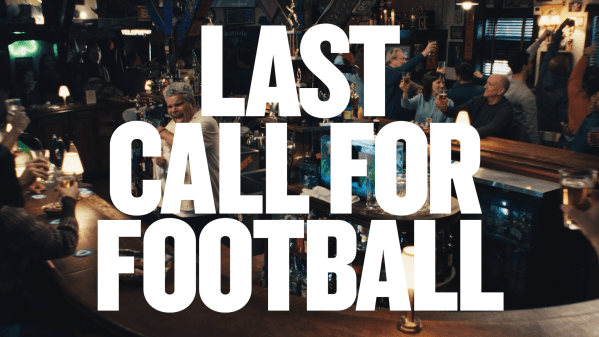
The creative centers on a fictional bar where fans and football legends gather to toast the season that was and brace for its end. NFL icons Joe Montana, Rob Gronkowski, and Adam Vinatieri appear alongside FanDuel’s season-long brand host Luis Guzmán.

The campaign launches Feb. 2 with “Toast,” a 30-second spot that sets the tone for the week.

In the ad, Guzmán announces a “last call for football,” prompting fans in the bar to raise their glasses to the moments, rituals and emotions that carried them through the season. 

The second spot, “Fever Dream,” debuts Feb. 7 and shifts the tone as kickoff nears. Starring Gronkowski, the ad plays with the mounting pressure of the moment.

When Guzmán asks if anyone wants to give a pregame speech, Gronk freezes and spirals into an internal monologue that captures the nervous energy many fans feel heading into Super Bowl Sunday. Joe Montana appears at the end of the spot, setting up the campaign’s finale.

That finale arrives just before kickoff with “Speech,” another 30-second spot airing immediately ahead of the game.

In it, Montana delivers a unifying address not to a team, but to fans, framing the Super Bowl as the emotional payoff of an entire season rather than a single night.

The work is supported by high-impact social and digital placements and a significant out-of-home push, including a takeover of Penn Station in New York, which is designed to make the “last call” message unavoidable as fans head into Super Bowl weekend.

Together, the three spots mark the latest chapter in FanDuel’s ongoing “Play Your Game” brand platform, positioning the company less as a loud in-game presence and more as a narrator of the fan experience.

https://www.adweek.com/brand-marketing/fanduel-super-bowl-ad-last-call-football/


How NBCU Scored the First $10 Million Super Bowl Ads


NBCUniversal’s Super Bowl 60 winning streak continues.

After mentioning it on a Puck podcast earlier this month, Mark Marshall, chairman, global advertising and partnerships, NBCUniversal, confirmed to ADWEEK that his team has sold a “handful” of 30-second Super Bowl units for $10 million or more. This marks the first time broadcasters have hit that number in the Big Game.

“While I would love to say it’s brilliant strategy and execution, part of it is just the marketplace demand,” Marshall told ADWEEK. “We did start earlier this year than in years past. There was so much interest in the Super Bowl and the Olympics, so we went to the marketplace earlier with packages that would include both of them.”

Marshall said NBCU was talking with marketers as early as fall 2024 about Super Bowl LX, which airs Feb. 8, and he noted that the inventory became “tighter and tighter” throughout the summer, with increased demand in certain categories such as tech and CPG.

Despite the demand, the NBCU ads president said the company didn’t add additional inventory, keeping the typical number of ad slots, which totals more than 80.

“There just was so much demand against it, and there were just not enough spots for everyone who wanted to be in,” Marshall said. “So the marketplace just drove the pricing up to $10 million-plus over the course of the summer and into the fall.”

Putting additional pressure on the market, more brands were requesting multiple ad units, or 60-second ads, than ever before, with Novartis, Rocket, and OpenAI being just a few of the examples in this year’s Big Game.

“Taking up those two blocks all of a sudden was stressing the capacity that we had pretty early in the system,” Marshall added.

Marshall also cited the company’s multi-sport offerings as a key to success, noting that in 2022, the last time NBCU had the Super Bowl and the Olympics, advertisers who chose a single sport missed reaching millions of viewers.

“If an advertiser only ran in the Olympics and did not run in the Super Bowl, they missed 30 million people. If a Super Bowl advertiser just ran in the Super Bowl and did not run in the Olympics, they lost 42 million people,” Marshall said.

During February, NBCU has the Super Bowl, the Winter Olympics, and the NBA All-Star Game, all of which have sold out ad inventory, according to the company. Following that, NBCU is continuing its sports-heavy calendar with the Spanish-language broadcast of the World Cup on Telemundo in June.

“People were starting to look at, ‘If I’m in the World Cup, if I’m in the Olympics, or I’m in the Super Bowl, how do I start to string these together?’ We started working with marketers on how to build plans, not just strict units,” Marshall said. “So when you look at it, about 70-75% of the Super Bowl advertisers will also be in the Olympics.”

Accelerating the Super Bowl playbook

NBCU showed signs of Super Bowl success early.

Last year, after initially asking for around $7 million for a 30-second spot in Super Bowl 60, NBCU’s price tag jumped to $8 million and an $8 million match across its other sports properties as early as July, ADWEEK previously reported. The company then announced a Super Bowl sellout in September, a month earlier than Fox’s announcement for Super Bowl 59.

And the success extends beyond in-game units.

Last year, pre-game ad units for Fox’s Super Bowl 59 broadcast fetched as much as $4.5 million, and post-game units reached around $4 million. One media buyer recently told ADWEEK that this year’s ads exceeded those prices, though Marshall was coy about revealing final numbers.

“Everything’s a little pricier than it was,” Marshall said.

Overtime is also already planned. In previous years, broadcasters have held live auctions for fourth-quarter overtime ad units. However, Marshall said NBCU wasn’t leaving things to chance.

“We already have conversations with advertisers, so if it happens, we actually have the game plan lined up already,” Marshall said. “I’m too nervous to sit there and not have a game plan in case overtime happens. And there have been so many events, so many close games in these playoffs, that I don’t think overtime is out of the question for this one.”

Following our interview with Marshall, a media-buying source told ADWEEK that prices were coming in at $4 million per overtime ad unit; however, NBCU couldn’t be reached for comment on the figure.

Regardless, all the pre-planning makes sense, as Marshall’s schedule for the week doesn’t have much flexibility.

With the game taking place at Levi’s Stadium in Santa Clara, Calif., Marshall will be on the West Coast on Monday for media day, with interviews and meetings scheduled throughout the week, including a stop at ADWEEK House on Feb. 6. On Saturday, Marshall has a screening of all the ads in a row, and Sunday is for scenario planning, ensuring everything is running smoothly, and spending time with clients.

Then, immediately following the game, Marshall is being whisked off to Milan for the Winter Olympics, just in time to arrive and talk about Super Bowl ratings the next morning. There isn’t much breathing room, but that’s not bothering NBCU’s ads chief, who noted he was most proud of the team for bringing together the whole NBCU ecosystem for the sports push.

“We want all of our couple hundred advertisers that will run across that day all to be happy with the experience, and hopefully they all sell a lot of product as a result of their investment in that day across Olympics, as well as the Super Bowl,” Marshall said.

https://www.adweek.com/convergent-tv/nbcuniversal-first-10-million-super-bowl-ads/


‘Will Shat’ Stars in Raisin Bran’s Pro-Poo Super Bowl Ad

In Raisin Bran’s Super Bowl 60 ad, Will Shat happens.

More specifically, the cereal brand, which revealed its Big Game ad today, confirmed that William Shatner’s recent paparazzi sightings were not a coincidence, but in fact the opening act of a carefully staged Big Game rollout.

In the spot, the 94-year-old actor stars in a role he was born to play: Will Shat, a Star Trek knockoff with a penchant for the scatological, whose shortened surname is an unsubtle reference to the effects of fiber.

Lest the connection go unnoticed, Raisin Bran peppers the spot with digestive double entendres, including the prominent placement of a shih tzu and a tailgate scene that prompts an onlooker to remark, “Will Shat on a car!”

The character, who begins the spot seated in the command deck of a spaceship, mirrors another William Shatner role, that of Star Trek’s Captain Kirk. Similar to Kirk, Will Shat teleports to help those in need, but this time around, the danger threatening civilians is a lack of dietary fiber.

The commercial will air just ahead of halftime across streaming platforms, with additional regional placements during the broadcast.

Developed in partnership with VaynerMedia, the creative reframes gut health less as a lecture and more as a cultural wink, one that began not on television but in staged paparazzi photos circulated by outlets including TMZ and MailOnline.

Those faux-candid images, which showed Shatner eating cereal in his car and later stepping out with a box of Raisin Bran under his arm, were designed to seed curiosity ahead of the reveal, a VaynerMedia spokesperson previously confirmed to ADWEEK. The approach borrows from a new Super Bowl playbook in which brands treat the game as a multi-week narrative rather than a single 30-second moment.

For WK Kellogg Co, the campaign marks its first Super Bowl appearance in roughly 15 years and reflects a broader push to reposition cereal within a health-conscious food conversation. Raisin Bran, in particular, is being framed as an easy on-ramp to fiber at a time when the nutrient is gaining renewed cultural relevance.

The full-ad release also places Raisin Bran on trend for the so-called Wellness Bowl, as health-forward brands look to stand out amid the Super Bowl’s traditional indulgence.

In this case, the punchline was the point, and the reveal was always part of the plan.

https://www.adweek.com/brand-marketing/will-shat-raisin-bran-super-bowl-ad/


Oikos’ Streaming-Only Super Bowl 60 Ad Stars Derrick Henry and Kathryn Hahn

After teasing its seventh Super Bowl appearance earlier this month, Oikos released the full version of its 2026 Big Game spot today, giving viewers a complete look at the streaming-only ad that will run on Peacock during Super Bowl 60.

The ad, titled “The Big Hill,” stars NFL running back Derrick Henry and actor-comedian Kathryn Hahn navigating San Francisco’s steep streets as a visual metaphor for strength. The full cut expands on the teaser’s core idea, leaning into both physical exertion and comedic relief as Hahn and Henry confront increasingly absurd uphill challenges.

The spot reinforces Oikos’ long-running brand platform, “Stronger Makes Everything Better,” while spotlighting two parts of its portfolio: the brand’s core high-protein yogurt cups and its newer ready-to-drink protein shakes, which launched last year. The shakes contain 30 grams of protein per bottle and represent a growing priority for Oikos as it looks to capture consumers seeking functional nutrition beyond traditional dairy formats.

The full ad was developed in partnership with BBDO, continuing a relationship that dates back to Oikos’ “Hold My Oikos” campaign, while Danone’s in-house team handled elements of the surrounding teaser and social content, according to Victoria Badiola, senior vice president of Oikos Danone U.S.

Oikos’ decision to run the spot exclusively on Peacock reflects its broader shift toward streaming-first Super Bowl buys, a strategy it says better aligns with how younger audiences are watching the game.

The brand has also built a larger ecosystem around the ad, including creator partnerships and second-screen activations designed to extend the moment beyond the 30-second commercial.

Oikos declined to share which quarter the ad will air or additional details about its creator lineup, but said the full release marks the start of a broader push that will build through game day—positioning the brand squarely within what marketers have dubbed the “Wellness Bowl” era of Super Bowl advertising.

https://www.adweek.com/brand-marketing/oikos-super-bowl-ad-derrick-henry-kathryn-hahn/


Pepsi Zero Sugar’s Super Bowl Ad Gives Coke’s Polar Bear the Pepsi Challenge


When a Coke mascot chooses Pepsi, it’s almost un-bearable.

Today, Pepsi Zero Sugar unveiled its Super Bowl 60 commercial, “The Choice,” a 30-second ad airing in the second quarter in which a certain cola-loving bear takes the Pepsi Challenge and ultimately chooses a Pepsi product over Coke Zero Sugar.

The revelation triggers an existential crisis for the polar bear and sends it on a journey of self-discovery, ultimately ending in a callback to a meme-able kiss cam moment during a Coldplay concert last year.

Academy Award-winning filmmaker Taika Waititi directs the ad—which is set to Queen’s “I Want to Break Free”—and also makes a cameo as the polar bear’s therapist. PepsiCo previously worked with the director on its Lay’s Super Bowl 59 campaign.

PepsiCo Content Studio and BBDO led the creative.

Pepsi marketing vp Gustavo Reyna noted that the ad showcases Pepsi’s “challenger DNA” as the company takes on Coca-Cola, which leads in market share. However, the marketer also pointed out that the creative was data-driven.

According to Pepsi, the idea for the bear’s taste test came from real data from its 2025 Pepsi Challenge. Last year, the company conducted Pepsi Challenges across 34 markets, with 66% of participants preferring Pepsi Zero Sugar to Coke Zero Sugar in taste tests. Showcasing the brand’s success, Reyna noted that Pepsi Zero Sugar had 30.8% growth in the Zero Sugar Cola category in 2025.

The marketing exec explained that the polar bear in the ad is “just another cola lover that represents the vast majority of Americans.”

And in the face of Coca-Cola turning to AI for its ads, Reyna noted that, though there is a CGI bear, it was important to have a human touch in the ad, led by Waititi’s direction.

“If there’s something we care about and we believe in, it’s in the craft and the creativity of our people, our talent, and our partners,” Reyna said. “This time around, we’re honing in on those talents and on the craft, and we’re bringing the bear to life.”

Beyond the ad, Pepsi’s bear will have a presence on the ground in San Francisco, and the company will conduct more Pepsi Challenges for fans to participate in. Meanwhile, the company plans a podcast blitz following the game as part of a campaign focused on “edu-tainment,” i.e., entertaining while getting its message across.

“We’re very excited about it because, when you unpack all of this, you get to the bottom of the issue, and you get people to rethink, reappraise the brand and to rethink their choice of cola,” Reyna said.

https://www.adweek.com/convergent-tv/pepsi-zero-sugar-super-bowl-ad-coke-polar-bear/


Novartis Gets Cheeky With Super Bowl Ad About Men’s ‘Tight Ends’


In 2025, Novartis created a stir during Super Bowl 59 by using Hailee Steinfeld and the female anatomy to draw attention to breast cancer. This year, the brand is back in the Big Game, and it’s getting cheeky in a new way.

For its second year in the Super Bowl, Novartis, a global innovative medicines company and the official pharmaceutical partner of the NFL, is showcasing NFL tight ends and their … you know … “tight ends” in the name of prostate cancer.

The campaign, “Relax, It’s a Blood Test,” features several NFL tight ends, including George Kittle (San Francisco 49ers), Colby Parkinson (Los Angeles Rams), and Rob Gronkowski (Tampa Bay Buccaneers), along with Super Bowl-winning coach (and prostate cancer survivor) Bruce Arians, joining to raise awareness for testing, noting that the initial screenings can be done with a blood test.

The 60-second ad, which airs after halftime, showcases the tight ends relaxing and urges men to stop clenching their bottoms at the thought of testing, especially since one in eight men will be diagnosed with prostate cancer in their lifetimes.

“The phrase ‘clenching your tight end’ came up in some of the research, and it just naturally led to the execution,” Gail Horwood, chief marketing and customer experience officer, Novartis U.S., told ADWEEK. “We wanted to do it with humor and really get the message across simply.”

The agencies involved in the campaign include Fallon (creative), Publicis N2 (media), Bespoke Sports & Entertainment (activation), and Digitas Health, as well as support from a collection of Publicis Groupe talent and resources. Horwood noted that Novartis also worked with the NFL, which helped secure players in their official jerseys, a move the league had to approve.

“The NFL has been an amazing partner, because they believe and share the same values and the message that we’re trying to get people to be more proactive about their health,” Horwood said, adding, “It is unusual, to be honest, you’ll see a lot of fake uniforms and nondescript uniforms [in ads].”

Novartis is also looking to support the campaign well beyond the Big Game, creating an online educational hub for men at RelaxItsABloodTest.com, risk assessment tools, screening events with its partner NFL teams, and an on-site activation at the Super Bowl.

Last year, the Novartis ad featuring Steinfeld drove millions of people to the company’s breast cancer awareness site, according to Horwood. However, the exec noted Year Two could be a bigger challenge, with men largely avoiding prostate cancer testing.

Still, with the help of the message and the players’ tight ends, Horwood noted that the company has an ad that can break through.

“You’ve got families, friends, half the country watching the Super Bowl at once,” Horwood said. “You really need to be you need to get their attention, and we think this was a really nice way to do that with this message.”

Correction: Omnicon was not involved in the campaign, as stated in a previous version.

https://www.adweek.com/convergent-tv/novartis-super-bowl-ad-tight-ends/


Hims & Hers Returns to the Super Bowl With a Stark Message: ‘Rich People Live Longer’


Hims & Hers is returning to the Super Bowl this year with what it describes as a “hard-hitting and unconventional” message, airing another 60-second spot in the fourth quarter. This time, the telehealth company’s Super Bowl spot is arguing that America’s widening wealth gap has quietly become a health gap.

“Rich people live longer,” the ad’s voiceover, delivered by Grammy and Academy Award-winning artist Common, states bluntly in its opening moments. Visually, the spot leans into surrealism to make its point: In one scene, surgeons pull back the skin on a seemingly affluent older person’s face, as if tightening it. In another, a person pedals a stationary bike while wearing an oxygen mask. Elsewhere, a wealthy-looking figure blasts off into space — a not-so-subtle nod to the extreme lengths the ultra-rich go to in pursuit of longevity.

According to Dan Kenger, Hims & Hers’ chief design officer, that opening shot — and everything surrounding it —was “deliberately done.”

Over the scenes, the voiceover ticks through offerings that feel clinical: “custom-formulated peptides,” “preventive care,” and “a specialist on call.” The ad also highlights Hims & Hers’ push into diagnostic testing, positioning lab work and blood testing as a way to give patients what the company calls a “complete snapshot” of their health.

“The sad truth is,” Kenger said, “rich people live longer than poor people.” Much of that, he added, can be attributed to wealthier Americans’ access to medications and treatments and ability to be proactive in pursuing measures to extend their life.

That framing marks an evolution from Hims & Her’s last year’s Super Bowl appearance, which centered heavily on the brand providing access to compounded GLP-1 weight-loss drugs. The ad triggered criticism from lawmakers and health advocacy groups over whether it sufficiently disclosed risks or the FDA approval of the medications being promoted. The backlash thrust Hims & Hers into a broader debate about telehealth marketing, compounded drugs, and the boundaries of pharmaceutical advertising.

This year’s creative avoids spotlighting a single product, and instead zooms out to critique the broader health system — though the company is still clearly betting on provocation. The ad was developed entirely in-house. Tools including Google’s Gemini, OpenAI’s Sora and NanoBanana were used during the creative exploration phase, though not in the final spot itself, Kenger said.

The timing, Kenger added, is deliberate. One year into a new presidential administration, he said the cultural conversation around food, health, and personal responsibility has shifted. Kenger pointed to what he described as a renewed “war on sugar” and changes to federal dietary guidance. Though, of course, the Super Bowl remains dominated by ads for soda, snacks and celebrity excess.

“The Super Bowl is Doritos and Pepsi and sugar, sugar, sugar — celebrity, celebrity, celebrity,” he said. “People don’t want to put this shit in their body anymore. They want to take control.”

https://www.adweek.com/brand-marketing/hims-hers-super-bowl-ad-2/


U.K. Regulators Just Handed Publishers a Win Against Google’s AI Overview


The U.K.’s top anticompetition regulator, the Competition and Markets Authority (CMA), issued a critical ruling against Google on Wednesday, calling for the search giant to provide content creators with more agency over how their content is used by the company’s AI tools.

The proposal deals with a concern that arose when Google first introduced its AI Overviews, which use content pulled from publisher websites to answer user queries on the search page, reducing users’ need to visit the websites themselves. 

The new ruling calls for Google to allow publishers to opt-out of AI Overview feature without harming their visibility on search.

This dynamic, colloquially known as Google Zero, has become an existential issue for publishers, which rely on search traffic to generate advertising revenue. The same issue holds with Gemini, which also ingests publishers’ data to answer user queries without sending those users to the original sources of that information. According to data from Chartbeat, search traffic to publishers declined globally by a third in 2025.

In response to the issue, publishers have sought to block the Google crawlers that pull information from their sites and feed it to Gemini and AI Overviews. But Google uses the same indexing system for Gemini and AI Overviews as it does for its search engine, meaning if publishers blocked the crawler, they would also risk losing search visibility.

Publisher advocates and critics of the set-up have called on Google to split its lone crawler into two, allowing publishers to block scraping for Gemini and AIOs while still allowing the company to crawl and index sites for search. 

Google has resisted those efforts, but the CMA finding may now force its hand.

Two key caveats

While the proposal is a welcome ruling for publishers, it is hardly a windfall.

.newsletter-subscription-form-wrapper p:empty{ display: none !important } .newsletter-subscription-form-wrapper button br{ display: none !important }

First, the CMA does not explicitly require Google to split its crawler into two; instead, it simply calls on the search giant to create a system that provides publishers with more choice, transparency, and attribution. This could lead to a decoupling of the crawler functions, but it does not mandate it.

Second, the CMA governs how Google must behave in the U.K., but those regulations do not necessarily apply in other jurisdictions, like the U.S. or European Union. 

Historically, Google has often abided by the standards set by U.K. regulators; it pledged to do so with the Privacy Sandbox developments, as well as with cookie depreciation findings. But it is not legally required to do so, meaning a CMA ruling does not necessarily compel Google to change its behavior in the U.S.

Still, the proposals are significant. Whatever system Google adopts will have a wide-ranging impact, affecting every website on the internet. It also marks a defining symbolic turn, as it marks the first regulatory ruling to affect Google’s AI business.

https://www.adweek.com/media/uk-regulator-google-publishers-ai-control/