EXCLUSIVE: Symmetri Raises $6 Million to Help Brands Compete in the ‘AI Agent Economy’


As more people turn to AI tools like ChatGPT and Gemini to gather information or glean product recommendations, Symmetri wants to help brands control how they appear. The 9-month-old startup has raised $6 million in seed funding to help brands deploy a panoply of AI agents. These agents carry out tasks like gathering brand data, improving discovery on AI interfaces, identifying potential customers, and managing loyalty programs

The seed round was led by startup stuido Super{set}. 

Symmetri’s goal is a future where AI agents—software that performs tasks on behalf of humans—touch every part of the digital economy, including commerce, finance, legal, and marketing. “Today, you already see brands struggling because traffic is not coming from Google searches anymore, and the consumer experience has been already radically transformed where it starts with an LLM,” said Steven Wolfe Pereira, the company’s chief growth officer. “How do brands prepare for this agentic world? That’s where we come in with this view of data first to really power what we really believe is a learning system.”

AI agents are already reshaping how people find information and make purchases. Companies like OpenAI, Google, and Microsoft have rolled out agents that can answer questions, compare products, or even handle transactions. As consumers increasingly bypass traditional search engines, marketers are looking for ways to ensure their brands remain visible and relevant in this new “agent economy.”

Symmetri’s cofounders include enterprise software veterans Pereira (former CMO of Datalogix, acquired by Oracle), Tom Chavez (former CEO of Habu, acquired by LiveRamp), Vivek Vaidya (former CTO of Rapt, acquired by Microsoft, and later CTO of Habu), Jeremy Micley, and Jed Putterman.

The startup has 15 employees and plans to use most of the seed funding on engineering and technology as it scales.

Making brands readable for AI

Symmetri’s technology builds specialized agents to help brands navigate AI search and the new customer journey.

For example, brands using Symmetri can interact with what the company calls an “answer engine” agent. The agent simulates the questions a consumer might ask ChatGPT or Perplexity and compiles those responses to show how the brand performs compared with competitors. 

“Those agents are going off, pulling all of those LLMs, posing those questions, compiling the results, making sense of them, cutting them into analytic results now that are bubbled up into a dashboard,” said Tom Chavez, Symmetri’s CEO. 

Using those insights, brands can craft hidden content formatted in Markdown, a text format that AI agents can read easily. “Machines don’t want to see all the pretty pictures and all the little marketing flourishes, right? They want raw data,” Chavez added. 

Symmetri also helps brands deliver more relevant loyalty offers. Using customer activity and payment data, Symmetri’s platform identifies which promotions or rewards are most likely to engage individual customers, enabling marketers to tailor loyalty programs.

The company charges a monthly enterprise fee, with additional pricing tiers based on usage. Symmetri declined to name its customers, but said clients span consumer products, retail, media, financial services, and technology. The company said its platform integrates with enterprise tools like Adobe, Amazon, Google, Microsoft, Salesforce, and Snowflake.

Symmetri is also building a tool to help publishers control what content they share with AI systems. Instead of blocking the AI bot entirely, publishers can cherry-pick which content is visible to LLMs. “If you’re blocking Perplexity or OpenAI—those are thermonuclear weapons, and the blast radius is huge,” Chavez said. “Publishers understand the planet has tilted, and they now need precise, targeted control over their content.”

https://www.adweek.com/media/symmetri-seed-funding-superset-6-million-ai-agent-economy/


Semafor Takes Aim at Davos as Events Surpass Half Its Revenue

The news publisher Semafor is doubling down on live journalism, unveiling four senior hires on Wednesday as part of a broader bid to build out its events business, expand globally, and challenge the primacy of the World Economic Forum in Davos, Switzerland.

Since its launch two years ago, the startup newsroom has incorporated events prominently into its commercial and editorial strategy, with cofounder and chief executive Justin Smith calling events its “core” business. Semafor now brings in more than 50% of its revenue from the division, according to Smith.

The publisher has similarly focused on offering its audiences a global perspective, with notable coverage of dynamic regions including the Persian Gulf.

https://www.adweek.com/media/semafor-events-davos-world-economy-summit/


WCPO in Cincinnati Hires Lauren Minor as Weekend Morning Anchor

Lauren Minor is joining Cincinnati ABC affiliate WCPO as a weekend morning anchor.

She started her career in 2013 as an assignment editor and production assistant at WKRC in Cincinnati before joining WTWO in Terre Haute, Indiana as a multimedia journalist.

She’s also worked as an anchor and reporter at WKYT in Lexington, WXIX in Cincinnati and, most recently, WLEX in Lexington.

https://www.adweek.com/tvspy/wcpo-in-cincinnati-hires-lauren-minor-as-weekend-morning-anchor/


The SSP in the Shadows

The world of online ad buying can be pretty opaque. For many advertisers, the path an ad impression takes is murky—standard reports often don’t reveal which, or how many, exchanges and supply-side platforms (SSPs) handled the inventory along the way.

An ADWEEK investigation found that media buyers at WPP, IPG, Dentsu, Havas, several independents, and one Fortune 500 brand unknowingly bought ads through Publicis Groupe’s Epsilon SSP via reseller supply paths. So while they thought they were buying through a given SSP, like Magnite or PubMatic, the purchased inventory had passed through Epsilon SSP. This means that dollars and data were in some cases sent to Publicis, a direct competitor. 

Each resold impression not only adds fees but also exposes bidstream data to the SSP, revealing who the advertiser is, how much they’re bidding, what audiences they’re targeting, and more. Programmatic experts explained that such data could give Publicis valuable intel to win new business. Publicis denies using this data to gain a competitive advantage. 

In this episode of Adspeak, ADWEEK staffers are joined by Arielle Garcia, chief operating officer of adtech watchdog Check My Ads, and an anonymous media buyer. Together, they unpack how reselling works in the programmatic ecosystem, the story of how some advertisers learned they’d unknowingly bought ad space via Publicis’ Epsilon SSP, and why some are concerned that Publicis’ role in the industry constitutes a conflict of interest. 

Tune in now.

https://www.adweek.com/programmatic/the-ssp-in-the-shadows/


Steve Hayden, Co-Creator of Apple’s ‘1984’ Ad, Passes at 78

Steve Hayden, the visionary advertising executive behind some of the most influential campaigns of the modern era, died on Aug. 27 at the age of 78.

Hayden began his career as a copywriter at General Motors in Detroit. His career took off at Chiat/Day in the 1980s, where he partnered with Lee Clow and Brent Thomas to create Apple’s now-iconic “1984” Super Bowl ad. The cinematic spot, which launched the Macintosh computer, redefined how advertising and technology could tap into culture.

He later served as chairman and CEO of BBDO West, where he brought over and helped retain the Apple account for more than a decade, further solidifying his reputation as a creative force who could marry brand storytelling with business impact.

In 1994, Hayden became vice chairman and chief creative officer at Ogilvy, where he oversaw the consolidation of IBM’s global business, which at the time was the largest account shift in advertising history. Under his leadership, the agency launched IBM’s “e-business” campaign, a defining effort that helped reshape the brand and the category. He also guided award-winning work for American Express, Kodak, Motorola, and Dove, including the ongoing “Real Beauty” campaign.

At Ogilvy, Hayden is remembered not only as a strategist and creative visionary, but also as a mentor and collaborator. “Steve Hayden was my partner,” said Shelly Lazarus, chairman emeritus of Ogilvy. “Without him I would never have been able to do what I was able to do. Without him, Ogilvy would never have had the success that it had over so many years. Steve made it look easy. But there was brilliance behind every seemingly simple idea. And how much fun we all had together. I can’t quite believe that he’s gone. The world is a less good place. My gratitude for all that I got to share with Steve Hayden is endless. My love for him is forever.”

Colleagues across the industry echoed that sentiment. “The people that I look up to all looked up to Steve. That’s how big he was,” said Chris Beresford-Hill, global chief creative officer of BBDO. “The entire BBDO community sends condolences and love to his family.”

Bill Davaris, now co-CEO of MALKA, told ADWEEK that he spent 18 years at Ogilvy as an executive creative director under Hayden.

“Yesterday, we lost an industry giant, our dearest mentor, our biggest role model, the funniest boss, and the kindest leader,” he shared on LinkedIn. “Steve Hayden was a true legend in our work lives—someone who always made time to inspire, advocate and motivate. His contributions to the advertising world are immeasurable, some may say never repeatable. But what we’ll remember most is his generosity. May his memory be eternal—the gentle genius whose greatest love was to make us all better!”

Hayden’s influence stretched across generations of creatives. Beyond the campaigns that defined his career, his legacy endures in the people he mentored and inspired.

Born Stephen Edward Hayden on May 21, 1947, in St. Louis, Missouri, he was the son of an internist and an opera singer. He is survived by his longtime partner Kristy Allen, his family, and loved ones.

https://www.adweek.com/agencies/steve-hayden-co-creator-of-apples-1984-ad-passes-at-78/


EXCLUSIVE: Perplexity Ad Chief Taz Patel Departs


Taz Patel, head of advertising and shopping at the AI search startup Perplexity, has left the company after nine months, the startup confirmed to ADWEEK.

Patel joined Perplexity in December 2024, and was tasked with building out the 3-year-old startup’s fledgling ads business. He was previously chief revenue officer and co-founder of the influencer-marketing firm Captiv8, which was acquired by Publicis Groupe in May of this year.

Perplexity declined to comment on who, if anyone, would replace Patel. Patel did not respond to requests for comment.

“It’s been great to have Taz on our team, and we wish him all the best in his future endeavors,” Ryan Foutty, Perplexity’s vp of business told ADWEEK in a statement. “Perplexity is driven by velocity and curiosity, so our work continues unchanged and we still partner with the world’s best marketers and merchants who want to experiment and develop the best consumer experiences for the AI age.”

ADWEEK first reported on Perplexity’s advertising ambitions in April last year. Since then, the company has brought on a handful of brands and agencies—including TurboTax, Indeed, Whole Foods, Universal McCann and PMG—to test sponsored ads on its U.S. platform.

Perplexity, which raised $100 million in July, is valued at about $18 billion. The company’s ad business reportedly generated only about $20,000 in Q4 last year, though it has also expanded into online shopping, allowing users to buy products surfaced in search through PayPal and Venmo.

CEO Aravind Srinivas said in March that Perplexity had surpassed $100 million in annualized revenue, up 25% from January. To reach new users, the company spent nearly $10 million last year—about half its payroll expenses—on sales and marketing, including its first national TV campaign during ABC’s broadcast of the 2024 NBA Finals, according to The Information. Perplexity also spent almost $5 million on legal fees.

Perplexity has also experimented with unconventional ways to reach new users, including partnering with video podcasts and streaming shows from Theo Von and Ben Shapiro to answer real-time questions.

The New York Times has warned Perplexity to stop using its content, and earlier this month Japanese publishers Nikkei and Asahi Shimbun filed a joint lawsuit making similar claims of copyright infringement. 

Perplexity this week announced plans to share 80% of revenue from Comet Plus, its browser-based subscription product, with publishers—part of its effort to secure licensing deals amid these mounting legal challenges.

Correction, August 29 at 12:25 p.m. ET: An earlier version of this article incorrectly said that The New York Times had sued Perplexity. It had warned the company of legal action in a cease-and-desist letter.

https://www.adweek.com/media/perplexity-advertising-chief-taz-patel-departs/


The Trade Desk Shareholders Will Vote Whether CEO Jeff Green Should Keep Supervoting Shares


The Trade Desk shareholders will vote whether to change the voting structure of the company, potentially imperiling CEO Jeff Green’s control, according to an SEC filing.

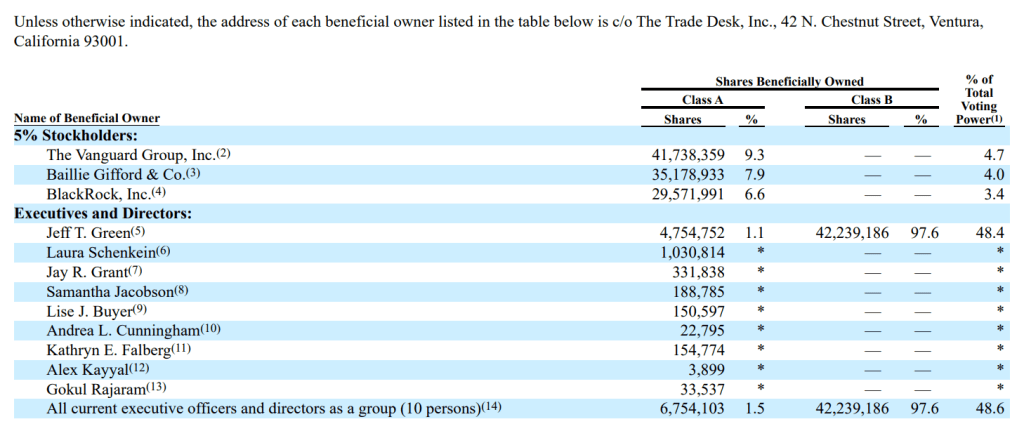
The Trade Desk is holding a special stockholder vote on September 16 on whether to amend the date in which Green’s super-voting shares expire, or maintain the company’s current dual-class structure. Under that structure, the company offers two kinds of stock: Class A stock, which carries one vote per share; and Class B stock, which comes with super-voting rights that equate to 10 votes per share. 

Green, who controls more than 42 million shares of Class B stock and nearly 5 million shares of Class A stock in The Trade Desk, maintains 48.4% of total voting power in the company, according to the filing.

While not required, it’s general practice for companies with dual-class stock structures to have triggers for when those super-voting shares expire, or automatically become Class A voting shares. Those triggers include when Green’s term as chairman and CEO ends, if more than two-thirds of shareholders vote to end it, or at a pre-determined sunset trigger, which is currently set for December 22, 2025. In the filing, The Trade Desk’s board has proposed extending that sunset trigger by 10 years, to December 22, 2035.

In a proxy statement, the company urged shareholders to vote to approve the proposal, citing Green’s tenure as chief executive and The Trade Desk’s high valuation as confidence in extending the sunset trigger. Should shareholders reject it, which analysts say is unlikely in part also because of the dual-class share structure, Green’s position as top decision-maker at the company could be up in the air. 

“We have outperformed other ad-tech enterprises during our tenure with a unique approach and dedication to our customers,” the committee wrote, crediting Green’s “foresight, vision and grit.”

The committee praised Green for steering the company through a stock dip in early 2025 and accelerating its rebound, inking new partnerships, and debuting “a flurry of AI-powered innovations.” As such, the group said, “we concluded that it is in the best interest of all of our stockholders to stay the course that has served us so well to date by again asking to keep the Class A and B structure in place.”

The Trade Desk declined to provide further comment.

“My opinion is they’re going to extend it. [Jeff is] not going to give up his super vote,” said Jason S. Helfstein, managing director, head of internet research at Oppenheimer & Co. “While the stock is down from a valuation standpoint, at this point there are plenty of adtech companies that trade at much lower multiples than The Trade Desk does. It’s a very high probability that the board extends super voting shares.”

Dual-class structures have become increasingly common among U.S. tech companies since the early 2000s, spiking in the mid-2010s with major IPOs including Facebook in 2012, Square in 2015, Pinterest in 2019, and Coinbase in 2021, according to data compiled by Jay R. Ritter, a finance professor at the University of Florida.

While the structure can empower visionary leaders, it also limits checks on power. Without such a structure, Green would be forced to bend to the will of outside shareholders on any number of matters. 

“If this vote goes against Jeff, he would lose control of the company. He wouldn’t be able to appoint his own board members, and he would essentially have to report to a functioning board of directors of the company,” said a former Trade Desk employee who still has some equity in the company, speaking on condition of anonymity. 

The company held a similar vote in 2020 and was set to vote on the dual-class structure every five years thereafter. In that initial vote, the board of directors and investors chose to extend the dual-class arrangement. 

In essence, the request asks stockholders to trust Green’s instincts over their own voting power. Whether investors will agree with this recommendation is yet to be seen.

The Trade Desk’s market value soared as high as $69 billion in December of 2024, nearly 70 times its 2016 IPO valuation, before sliding to around $25 billion today. Despite its largely positive revenue, earnings, and margins trendlines, the stock—and Green himself—have attracted recent scrutiny.

Wall Street reacted harshly to Green’s commentary on an August 7 earnings call on which he brushed aside concerns about intensifying competition from Amazon. “I think Amazon is more of a potential partner, honestly, than it is a long-term competitor,” he said. Millions of dollars in marketing spend had funneled out of The Trade Desk and to Amazon’s DSP this year, as ADWEEK previously reported. The company’s shares crashed nearly 40% in the days after the earnings call.

Correction, Aug 29 at 9:45 a.m. ET: This story has been corrected to clarify the details of the proxy vote.

https://www.adweek.com/programmatic/the-trade-desk-shareholders-will-vote-whether-ceo-jeff-green-should-keep-supervoting-shares/


Scope3 Names Tim Collier Chief Commercial Officer as It Pushes Into ‘Agentic Advertising’


Scope3 has promoted Tim Collier to chief commercial officer, effective immediately, as the sustainability-focused adtech firm doubles down on what it calls “agentic advertising.”  

Collier, who has led Scope3’s U.K. and Northern Europe business for the past year, succeeds Brenda Tuohig, who will remain as an advisor. He will report to CEO Brian O’Kelley.

Before joining Scope3, Collier spent more than a decade at Google, most recently as head of technology and data partnerships for the U.K.

In his new role, Collier will oversee all of Scope3’s commercial operations, but will focus on building out the company’s agentic advertising strategy—an emerging category that uses AI agents to reshape how brands, agencies, and media companies buy media.

“This is the first time this category has been built,” he told ADWEEK, adding that the challenge lies in designing a commercial structure that supports early adopters—brands, agencies, and media companies—that want to experiment with new approaches that involve AI agents.  

“As we think about building and owning the agentic advertising category, it requires us to totally rethink how we set up the commercial structure of the business,” he said. “This isn’t about taking a ton of programmatic players and putting an AI on top of it. That doesn’t work.”

Scope3 already counts Omnicom, Butler/Till, Draft Digital and platforms including Meta and Amazon among its partners, and is eyeing for more deals. Collier wouldn’t share specifics. 

“This isn’t about going in and taking a ton of programmatic players and put an AI on top of it. That doesn’t work.”

Collier’s promotion comes at the heels of Scope3’s announcement earlier this year, introducing Brand Standards, an AI-powered brand safety and suitability tool that lets marketers build custom agents based on company values, business goals and audience demographics to assess placements at the content level.

In one example, agency Draft Digital used Scope3’s tool on Meta for a lottery client. The agent flagged that part of the advertiser’s spend was running alongside gambling content—something prohibited under lottery guidelines. By blocking that 25% of misplaced spend and redirecting it into approved inventory, the brand reinvested in media that was both compliant and more effective, according to Collier. 

“25% is really material in terms of the difference agentic solutions can make,” he added. 

https://www.adweek.com/media/scope3-names-tim-collier-chief-commercial-officer-as-it-pushes-into-agentic-advertising/


Denver Station Airing Series on Importance of a Free Press

KUSA in Denver, Colorado is airing a campaign showing the importance of a fair and free press.

Free Press, Free Country includes a broadcast documentary, short video segments, and a social media campaign.

On Thursday, a 90-second video called A Matter of Fact aired during the Denver NBC affiliate’s nightly newscast Next with Kyle Clark.

The video outlines the importance of the First Amendment. KUSA has a web page showing all the topics. Click here to view.

“As Americans, we all have a right to a free and open press, to ask questions and openly criticize those in power, and hold them accountable,” said on-air host Jessica Duran. “It’s why the press is often called the Fourth Estate.”

The series includes videos about press freedom, algorithm bias, the importance of issuing corrections, open-records laws, identifying the difference between news and opinion and sponsored content.

“The intent is civic education on its very basic level,” Brian Malone of Malone Media Group and Fast Forward Films told Corey Hutchins on his substack “This is to remind all of us of the core values of the First Amendment and the importance of journalism in our free and open society.”

Malone said he hopes other news outlets will pick up the series and share it with viewers and readers.

“If you’re a paper in Yuma, if you’re a paper in Burlington, if you’re a radio station in Ignacio, this material will be available for you to share — and you’re encouraged to share it,” Malone said. “This is civic education that benefits all of us in the journalism industry.”

https://www.adweek.com/tvspy/denver-station-airing-series-on-importance-of-a-free-press/


Blue Apron Pioneered Meal-Kit Subscriptions. Here’s Why It’s Scrapping Them


Earlier this year, The Hollywood Reporter asked Charlie Brooker, creator of Netflix’s anthology series Black Mirror, how he can take almost any topic to a dark and dystopian place. Brooker admitted to having “a lot of neuroses and worrying about horrible but logical consequences. I can’t look at anything without thinking, ‘How could that hurt me?’” he said.

Thus far, the long-running series hasn’t taken on the topic of home meal kits—but maybe it should. Next week, Blue Apron will begin airing three spots that head of marketing Raina Enand is first to say are distinctively Black Mirror-like.

“Hopefully when you watch it,” she said, “it should look like something that you would not expect from Blue Apron.”

And you probably wouldn’t. That’s because the characters in these spots are trapped in a nightmare realm controlled by nefarious subscription plans—which have been Blue Apron’s revenue model since its 2012 founding.

But now that model is gone, replaced by à la carte ordering.

The three ads—the final piece of a comprehensive brand overhaul—follow a similar story line. They open with people trapped in a gray, Orwellian world where it’s impossible to do anything from unfasten a seatbelt to get a beverage from a vending machine without committing to prepayment.

“We turned subscription fatigue into a dystopian fever dream,” said Angela Campos, creative and commercial director of Quirk, the agency behind the work. “Trust me, it’s a lot more fun to watch than to live through.”

These slate gray visions give way to a happier, freer world where purchase flexibility and consumer autonomy have returned. “Somewhere along the way, you had to subscribe to everything—even dinner,” intones a narrator in one spot. “With the new Blue Apron, you don’t.”

The video segments alone are an ambitious effort: three 30-second ads with six 15-second cuts; a 15-second homepage app video; a 16-minute video; 10 videos for social media; and seven audio versions.

But one question looms behind all of it: why is Blue Apron scuttling its revenue model in the first place?

From meal kits to á la carte

Because times change. England said that the fast-paced life that made meal subscriptions look like a good solution a decade ago has now grown so hectic that subscriptions feel confining and out of date. 

“Life is really different now,” she said. “Busy families need more control and flexibility.” Committing to a weekly meal plan, she added, is “just not how people eat food.”

To increase flexibility, Blue Apron has doubled its menu offerings to 100 and added two new kinds of kits. Assemble & Bake is aimed at families and can be prepared in 10 minutes, while Dish is a single-serve meal that comes ready to put into the oven. Those who still prefer the subscription option will enjoy rewards such as Blue Apron+, which offers perks like free delivery and Auto Ship and Save, which lets customers dial their delivery frequency anywhere from weekly to just one week a month.

The other reason Blue Apron is changing its business model is more systemic: the company has needed a major overhaul for years.

Wonder Group bought Blue Apron in 2023 for $103 million, a shadow of the $1.9 billion valuation Wall Street gave it after its 2017 IPO. But operational complexities, high marketing costs, and increased competition caused the brand to slip from those heights almost immediately. By the end of 2017, Blue Apron’s net losses tallied to $210 million, while its customer count shrank by 15%.

In fact, high customer attrition rates assail the whole meal-kit industry, a love-’em-and-leave-’em world in which customers pivot among introductory offers instead of staying loyal to one service. Research conducted by the Wall Street Journal in 2023 showed that a staggering 90% of customers for the five leading meal-kit brands abandoned their memberships within a year of signing up.

A hill to climb

As part of the brand relaunch, Blue Apron has also reworked its website, toning down the blues in favor of ochre and flax “to make the food the star of the show,” Enand said. Food photography has also changed to “look like a plate on a countertop in your home—it should feel identifiable with your life.”

Yet even if all the new tweaks resonate with customers, category leader Hello Fresh still commands some 75% of the market—leaving open the question of whether these efforts, calculated as they are, will deliver the needed results.

Digital transformation authority Craig Miller, author of Bricks and Clicks: How We Drove Sonic into the Digital Age, believes the revenue model shift will help Blue Apron reclaim some market share, “but would most likely be a short-term win and difficult to sustain.”

“The tradeoffs and drawbacks for a no-commitment model may more than offset the benefits,” Miller continued. “An increase in operational complexity in their supply chain will continue to put a strain on their customer service levels and overall profitability.”

But Enand remains confident that the hard work will pay off. 

“We’ve been working on this for the past year, listening to customer feedback on what the market is moving towards, and we really thought about this as all encompassing from every aspect of the business,” she said. “Calling it a rebrand is actually doing it a disservice. It’s really a relaunch of the company.”

https://www.adweek.com/brand-marketing/blue-apron-pioneered-meal-kit-subscriptions-heres-why-its-scrapping-them/