SuperBloom House Broadens Its Creative Roster With Non-Advertising Talent


As the skill set of advertising creatives broadens, independent agency SuperBloom House is tapping into creative minds from outside the industry.

The New York- and Los Angeles-based agency has launched “House Players,” a roster of 35 non-industry creatives who will work on brand and entertainment projects with the agency that involve profit-sharing and early creative input.

The House Players include choreographers, reality TV producers, documentarians, AI artists, chefs, and other creatives from outside advertising. Each will take on two to three major projects per year and may share in profits or retain ownership of original work developed through the program. That often looks like continuing to monetize the intellectual property outside the original campaign—through licensing, adaptations, or extensions.

The 35 House Players come from SuperBloom House’s 300-member Creative Collective, a global network of filmmakers, musicians, chefs, choreographers, and other cultural makers. Notable House Players include Brazilian choreographer Sérgio Reis, known for his work with Troye Sivan and brands like Gap and Charlotte Tilbury and director and cinematographer Alice Gu, whose documentary The Donut King won critical acclaim.

“We wanted to focus our energy on the people we could give extra attention to—the ones approaching things in a completely different way,” Mitch Eisner, head of the Creative Collective, told ADWEEK. “It’s not just about the work we hire them for. We’re building a community and creating collaborations that might not even involve SuperBloom.”

House Players are embedded in projects from the earliest stages—sometimes before a brief is finalized—and paid for ideas as well as production. Rates vary depending on the scope, but members can earn for participating in pitches, licensing existing intellectual property, and delivering finished creative.

So far, House Player and reality TV executive Cooper Green worked with SuperBloom House to create Mystery Voyage, a murder-mystery competition series for Virgin Voyages. The roster has also contributed to Tyson Foods’ “Always Been Tyson” campaign, Tripadvisor’s “We’ve Been There” global brand film, and Topo Chico’s portrait series of Los Angeles artists.

SuperBloom promotes Collective members’ work through a quarterly print and digital zine and a bi-monthly newsletter. Each zine issue centers on a theme, with past editions featuring essays, photography, and art from Collective members. The current edition, which examines what’s real and what’s not in the age of AI, is distributed directly to brands and creative leaders and will also spotlight House Players’ work.

The House Players roster will remain around its current size with members rotating in and out to keep the mix fresh. “Every person in the program is someone we know personally and can give consistent opportunities to,” said chief creative officer Heather Pieske.

Founded in 2020 and backed by Mother Ventures, SuperBloom House was spun out of creative agency Mother. Its model pairs ad-world expertise with cultural talent from other fields to produce branded content. In the past year, the agency has worked with clients including Sonic Drive-In, Tyson Foods, Virgin Voyages, Sundance, Simon Malls, and Deel.

At a time when AI is reshaping creative production, Pieske said the House Players program underscores the agency’s commitment to human creativity. “The second you lose the warmth of a human touch, you’re going in a weird direction,” she said.

https://www.adweek.com/agencies/superbloom-house-broadens-its-creative-roster-with-non-advertising-talent/



Disney Reorgs Marketing Leadership Ahead of Disney+ and Hulu Merge


Following news that Disney is fully integrating Hulu into Disney+, the company is now streamlining its streaming marketing.

Today, in a memo to staff, Alan Bergman and Dana Walden, Disney Entertainment co-chairmen, announced several executive changes, with both Asad Ayaz, Disney’s chief brand officer, and Shannon Ryan, president of marketing for Disney Entertainment Television, taking on new responsibilities.

According to the memo, Ayaz, a 20-year Disney veteran and part of ADWEEK’s 2025 Marketing Vanguard, has been named president, Disney Entertainment Marketing, with oversight of marketing teams across Disney Entertainment. His duties will include overseeing marketing for studios, television, and streaming while continuing oversight of brand strategy globally under CEO Bob Iger, including leading the company’s in-house creative agencies across Disney Experiences and Disney Entertainment.

Ayaz’s full title will be chief brand officer, The Walt Disney Company, and president, Disney Entertainment Marketing. The exec will report to Bergman and Walden, who noted in the memo that Ayaz’s dual role will “further connect all the company’s consumer touchpoints” and align its marketing approach.

In addition, Ryan, a recent ADWEEK 50 recipient, will add direct-to-consumer to her remit, overseeing the integrated teams across Disney+ and Hulu while also leading TV marketing. Ryan’s new title is president, DTC and Disney Entertainment Television Marketing. The executive will report to Ayaz and remain on Walden’s leadership team.

Samantha Rosenberg, who has been leading Disney+ marketing, and Barrie Gruner, who has been leading Hulu marketing, will both report to Ryan.

“Operating as one cohesive DTC marketing team will enable us to speak to consumers with greater efficiency and impact, and this new structure will also create a deeper connection and collaboration across all of our marketing efforts,” Bergman and Walden said in the memo.

The company didn’t share any news of potential layoffs as a result of the restructuring. Disney recently had hundreds of layoffs across Disney Entertainment in June, which Deadline said included marketing for both film and television.

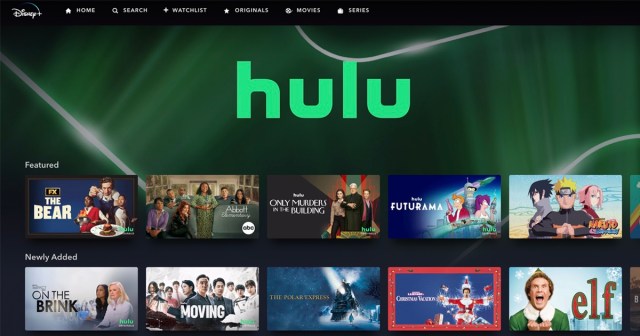
The restructuring comes following Iger’s announcement at a recent earnings call that Hulu will be folding into Disney+ to create a single streaming experience in 2026. Disney first started integrating Hulu content into Disney+ in 2023, with a more robust version debuting in 2024.

Iger noted the single app would also provide more advertiser opportunities, as the organization has the “chance to package” its properties “far more effectively.”

In addition to the Hulu news, Disney is in the process of debuting its new ESPN streaming service later this month, which will also be available in a bundle with Fox’s upcoming Fox One streamer.

See the full memo from Alan Bergman and Dana Walden below:

Team,

Disney Entertainment is home to an iconic and acclaimed collection of storytelling brands, and our marketing teams play a vital role in bringing the magic of Disney storytelling to audiences around the world. As we continue to scale our business globally, we’d like to share an update about the future of our marketing structure, particularly focused on supporting the full integration of Hulu into Disney+ that Bob announced during earnings last week.

To create a more unified strategy across streaming, film, and television, we’re realigning our marketing organization to create one best-in-class Disney Entertainment Marketing team under the leadership of Asad Ayaz, who will now report to the both of us. Asad is a strategic leader with sharp creative instincts who has been instrumental in driving high-impact campaigns at both the company and the Studio. As Chief Brand Officer, TWDC, and President, Disney Entertainment Marketing, he will now oversee marketing for our studios, television, and streaming, while continuing to drive brand strategy for the company under Bob Iger, including leading our in-house creative agencies for Disney Experiences and Disney Entertainment. This dual role will further connect all the company’s consumer touchpoints and align our marketing approach.

Shannon Ryan will add DTC to her portfolio and oversee a newly integrated team across Disney+ and Hulu, while continuing to lead marketing for television content. Shannon is a dynamic marketing leader with a proven track record of crafting innovative campaigns that resonate with audiences and create breakout hits. As President, DTC and Disney Entertainment Television Marketing, she will now report to Asad, while remaining on Dana’s leadership team. Barrie Gruner and Samantha Rosenberg will both report to Shannon moving forward.

Operating as one cohesive DTC marketing team will enable us to speak to consumers with greater efficiency and impact, and this new structure will also create a deeper connection and collaboration across all of our marketing efforts. These changes reflect our confidence in the exceptional talent across our marketing organization, and we’re excited for what’s ahead. We are grateful for your continued creativity, passion, and partnership as we shape the future of Disney Entertainment together.

Alan & Dana

https://www.adweek.com/convergent-tv/disney-reorgs-marketing-disney-and-hulu-merge/


McCann Taps Brendan Gaul to Lead Long-Form Entertainment Push


TRAVERSE32, the long-form entertainment production studio part of IPG Mediabrands, will move under creative network McCann. As part of the transition, TRAVERSE32 global president Brendan Gaul will join McCann as its first global chief entertainment officer.

In the new role, Gaul will continue to run TRAVERSE32 while leading entertainment property development at McCann. The move aims to make it easy for McCann’s clients to extend their brand platforms into long-form, Hollywood-style storytelling, while keeping brand-owned IP closer to creative teams with the infrastructure to package, distribute, and protect it.

“The role is to take the work that is being developed by our creative teams within McCann and say, ‘is there also an entertainment idea there?’” Gaul said.

TRAVERSE32’s team of six will join McCann as a dedicated, on-demand resource for its global creative teams looking to extend client work into entertainment.

“Sometimes there’s a brief that comes in and the client says, ‘I want to make a film.’ Now we have the right expertise within McCann to help tackle that challenge together,” Gaul said.

Gaul added that McCann “has a long history of creating things in culture that transcend advertising,” from A Charlie Brown Christmas for Coca-Cola to the agency’s appearance in the final episode of Mad Men. TRAVERSE32’s work includes Dear Santa, a documentary and series for the U.S. Postal Service; 5B, a documentary about an AIDS ward for Johnson & Johnson; and The Final Copy of Ilon Specht for L’Oréal Paris, about the copywriter who coined the brand’s famous “Because I’m Worth It” tagline, which won the 2025 Cannes Lions Grand Prix for Film.

Brands, Meet Hollywood

Gaul said long-form entertainment can “move some of the hardest to move metrics” for brands. He pointed to Dear Santa for the USPS, which was tested in multiple formats—a trailer, a 30-minute TV episode, and a 90-minute film—and consistently showed that “the longer the audience stays with the work, the more the metrics move in favor of the brand.”

Such projects not only engage audiences in a new way, but also “build a different kind of partnership with the most senior of brand clients,” Gaul said.

For Gaul, the new role marks a return to McCann, where he began his career 22 years ago as an art director. He has since built his career on creating Hollywood-style entertainment for major brands like L’Oréal, Johnson & Johnson, and the USPS.

“Now there’s almost a calling from the most senior brand marketers that are really looking for that kind of work,” he said.

Gaul’s new role comes after McCann Worldgroup restructured in May under global CEO Daryl Lee to serve a rise in project work and reduce silos across its network.

The reshuffling of TRAVERSE32 under McCann also comes as IPG prepares to be acquired by Omnicom; the deal is expected to clear remaining regulatory hurdles this fall.

https://www.adweek.com/agencies/mccann-taps-brendan-gaul-to-lead-long-form-entertainment-push/


Cheil Unites North America Agencies to Target Mid-Market Gap


Cheil North America is bringing five of its agencies—McKinney, Barbarian, Iris, Attention Arc, and CYLNDR Studios—together under a new umbrella called the Cheil Agency Network (CAN).

The move, shared exclusively with ADWEEK, more closely aligns the shops, which previously operated separately under Cheil Worldwide, in a bid to offer mid-market brands an alternative to both large holding companies and small independents.

Joe Maglio, who will continue as CEO of McKinney and Barbarian, now also leads CAN, which has a dedicated leadership team and provides finance, HR, operations, and growth support to its agencies. The team includes Tim Jones as chief financial officer, Sue Roche as chief people officer, Bill Mattis as managing director and head of network growth, and Lisa Hughes as head of network operations.

All agency leaders now report directly to Maglio, including Gretchen Walsh, president at McKinney; Jill Smith, CEO of Iris Americas; Jeff Blackman and Gourang Mehta, managing directors at Barbarian; Swapnil Patel and Asieya Pine, co-presidents at Attention Arc; and Sylvain Tron, managing director at CYLNDR Studios.

Maglio said more closely aligning these agencies was “about the opportunity in front of us” to target mid-market brands with a full suite of solutions across creative, media, digital transformation, tech, and production.

“We have scale if we pull all the agencies together,” he said. “But we also have nimbleness, because each of the agencies in their own right is a mid-sized agency that can move pretty quickly.”

CAN agencies will pitch together, share resources, and jointly invest in areas like AI development, integrated creative and media solutions, and brand research. Maglio said the network will now be able to create “custom, bespoke” teams to solve specific client problems.

The launch of CAN follows Cheil’s July debut of Attention Arc, a media agency formed by merging McKinney Media with Lockard & Wechsler Direct. Attention Arc will handle all media buying across CAN.

CAN has offices in Atlanta, Boston, Dallas, Durham, N.C., Irvington, N.Y., Los Angeles, New York City, Phoenix/Scottsdale and Toronto. In New York, all five agencies share a floor at Penn One, with similar office consolidations underway in Toronto and planned in other markets.

Working out of the same office “just makes for more efficient collaboration,” Maglio said. “People get to know each other better.”

Not Your Typical Hold Co

Maglio said CAN is built to operate differently than traditional holding companies. He described it as an “operating company” that serves to facilitate collaboration on behalf of clients.

“We’re not going to create this massive body that then has to be funded by each of the agencies,” he said. “We’re going to keep it as lean as possible.”

Though CAN is targeting the underserved mid-market, the network also believes it can address gaps on both ends of the client spectrum. For large clients looking for an alternative to the big networks, “you’re going to get a network of agencies that can move a lot faster, with far less bureaucracy, and you have access to all the senior executives,” Maglio said.

As for those working with smaller independents: “They just don’t have the diversity of talent or access to certain tools and capabilities that we have,” he added.

The launch of CAN comes as the traditional holding companies undergo consolidation, notably as Omnicom prepares to swallow IPG. “The scale of that is crazy,” Maglio said of the deal, adding it will leave “a lot of great talent out there that midsized networks” can hire.

Maglio said CAN will consider adding more agencies and capabilities to its network, as well as expanding geographically, based on client demand.

“At the end of the day, none of this matters if it’s not better for the clients,” Maglio said.

https://www.adweek.com/agencies/cheil-unites-north-america-agencies-to-target-mid-market-gap/


Sydney Sweeney Redefines Brand DNA

It’s perhaps the sharpest of marketing’s double-edged swords: brands quest endlessly for attention, but aren’t always happy with the sort of attention they get.

The last two weeks have served up a textbook example of this paradox—actress Sydney Sweeney’s coquettish series of ads for American Eagle Outfitters, which turned a lot of heads and also curled a lot of lips. 

It was one specific ad that did it. In a stylistic invocation of Brooke Shields’ famous 1980 ads for Calvin Klein jeans, Sweeney slipped into her denims while talking to the camera about the importance of having good jeans. 

Or was it genes? Actually, it was both. And the brand’s willingness to slip suggestively between those two homophones prompted some to charge it with espousing debunked theories around racial superiority and waxing nostalgic for eugenics.

Hindsight is a blessing in cases like this, of course, and you don’t need a lot of it. American Eagle launched the ad, pulled the ad, then issued a statement explaining the ad—all within a nine-day period.

In this episode of Adspeak, Adweek editor-in-chief Ryan Joe and senior editor Robert Klara discuss the Sweeney conflagration with the benefit of the embers having been (mostly) extinguished. It’s an opportunity to ask some questions that felt too big for the heat of the moment. Among them:  Why were so many people so upset, anyway? Was the Sweeney campaign a victim of public anger, or was it courting it? And what does the campaign tell us about the historic role of controversy itself?

https://www.adweek.com/brand-marketing/sydney-sweeney-redefines-brand-dna/


American Eagle Ad Controversy Hasn’t Driven Sales, Early Data Suggests


So far, the controversy surrounding American Eagle Outfitters’ campaign starring actress Sydney Sweeney has created a lot of noise for the brand, but not much else.

Traffic to American Eagle’s U.S. website soared following the campaign’s roll out on July 23, rising more than 60% on July 28 compared to the same day last year, according to data and insights company Consumer Edge.

Despite the hubbub around the campaign—both positive and negative—the brand’s market share has remained relatively flat.

Figures from Consumer Edge, which collects anonymous debit and credit card transactions from millions of U.S. consumers, indicate that a sales bump has not yet accompanied the heated online debate.

Case in point: American Eagle’s control of the denim market has hovered between 17.5% and 19% since the controversy began.

Additional data from Consumer Edge reveals that any partisan gap in purchase behavior between Democrats and Republicans has yet to emerge.

“The American Eagle/Sydney Sweeney story is a useful reminder that viral moments don’t necessarily translate into immediate consumer behavior change,” Michael Gunther, head of insights at Consumer Edge, wrote in a blog post. “Interest may spike, but unless that attention converts into spending, the business impact remains limited.”

Not everything, however, has been static for American Eagle since the campaign launched. One metric that remains up is the company’s share price, which has climbed around 15% since the Sweeney ad debuted in late July, thanks in part to an assist from President Donald Trump.

The Campaign That Cried Eugenics

For those who haven’t been on their phones for the last three weeks, a quick recap: American Eagle’s campaign, starring 27-year-old actress Sweeney, sparked intense debate for its wordplay with the homophones “jeans” and “genes.” One ad showed a supine Sweeney pulling on her terrific America Eagle jeans while talking about her terrific…genes.

“Genes are passed down from parents to offspring, often determining traits like hair color, personality, and even eye color,” Sweeney purrs, while a male narrator closes the spot with the slogan “Sydney Sweeney has great jeans.”

Some viewers took the message as a joke, but others saw it as a coded reference to the social desirability of being blond-haired, blue-eyed, and white—like Sweeney—and even as support for eugenics.

American Eagle let the fires burn for a few days before issuing a clarifying statement on August 1. But while AE pulled the one provocative ad, it left the campaign and slogan in place—for better or worse.

Genetic wordplay aside, as any first-year business major knows, sexual suggestiveness is part of the marketer’s toolbox—especially in fashion advertising. As history has shown, it can benefit a brand handsomely.

For example, starting in 2007, Nascar driver Danica Patrick appeared in 22 spots for GoDaddy, usually wearing a too-small tank top that struggled to contain her. In a 2009 Super Bowl spot, she took a shower while three frat boys controlled her movements via their computer. Tacky as these ads were, they helped make GoDaddy a household name. When the brand went public in 2015, Patrick was on hand to do pushups on the floor of the New York Stock Exchange.

But promoting perfect bodies and conventional beauty standards has also backfired. Abercrombie & Fitch turned into a money-printing machine when it began promoting itself with shirtless beefcake boys. But when CEO Mike Jeffries explained the marketing strategy to a reporter—admitting that the brand was “exclusionary” and that appealing to “old” and “fat” people would make A&F “totally vanilla”—millennial shoppers turned on the brand as a symbol of exclusion and discrimination. (A&F has since regained some status among millennials for introducing inclusive sizing and modern, business-friendly attire for young professional women.)

Odds are that American Eagle won’t suffer that sort of fate, but the Sweeney spots are a reminder that sex doesn’t always sell.

https://www.adweek.com/commerce/american-eagle-ad-controversy-hasnt-driven-sales-early-data-suggests/


Josh Allen Is Snickers’ Latest Quarterback for Long-Running “You’re Not You…” Play

It’s not uncommon for a brand to hang onto the same slogan for years, or even decades. Nike has used “Just Do It” since 1988, for example. McDonald’s has embraced “I’m Lovin’ It” since 2003. And, for its part, Snickers has been telling Americans that they’re just not themselves when they’re hungry for the last 15 years. 

Today, Mars’ candy-bar colossus will remind them yet again with a pair of spots starring Buffalo Bills quarterback Josh Allen.

Of course, the tricky part about sticking with a longtime slogan is finding fresh interpretations of it, and that’s especially true in Snickers’ case. “You’re Not You When You’re Hungry” came storming out of the gate at the 2010 Super Bowl with a 30-second spot from BBDO featuring the incomparable Betty White playing football in the mud with a bunch of bros straight out of central casting. After White gets sacked and decides to take a time out with a Snickers bar, she metamorphoses into a strapping young jock.

Those final few seconds created not just the a-ha moment, but a template that’s served the snack brand for a generation.

Following the White spot (still considered among the best Super Bowl ads of all time) was no mean feat. But Snickers managed it by adapting its transmogrification formula to an all-star cast that over the years has included Robin Williams becoming a football coach, Joe Pesci transforming into a frat boy, and Danny Trejo turning into… Marsha Brady.

The latest ads (still from BBDO), hold fast to that formula. The twist this time is that Allen transforms into… himself. 

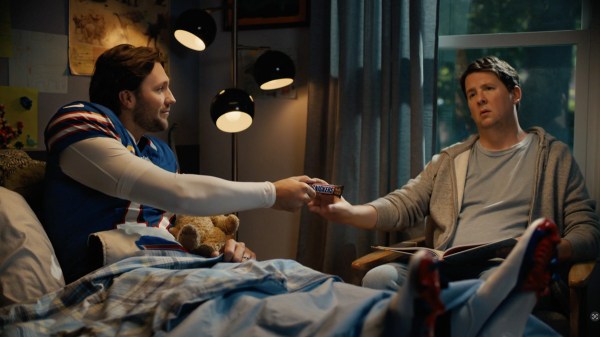
The cornerstone spot shows us Allen’s father dozing off while reading his adult son—in bed, wearing his Bills uniform—a bedtime story. With a bite of a Snickers bar, delirious dad blinks and he’s again reading to Allen as a boy.

The second features Allen rescuing a heat-exhausted construction worker by snatching a Snickers bar from an ice chest he has handy. There’s no sugar-fueled metamorphosis in this one, but Allen’s delivery of a self-referential punchline (“Still stressed about the Bills game next week, huh?”) furnishes the requisite denouement.

BBDO also shot quick-cut verticals for social channels, featuring Allen blowing his lines and holding the candy bar the wrong way—until, of course, a restorative nibble on a Snickers returns order to the universe.

“Even Josh Allen isn’t immune, fumbling lines and forgetting sponsors until he gets his Snickers fix,” helpfully chirped a company statement.

That these crisply-produced snippets feel like outtakes and bloopers spotlights Allen as one of those rare pro athletes who’s actually a natural on camera. Who knows? If Allen doesn’t get his Super Bowl ring before retirement time, there’s always marketing as a second career.

https://www.adweek.com/creativity/josh-allen-is-snickers-latest-quarterback-for-long-running-youre-not-you-play/


IPG Partners With AI Startup to Simulate Audience Reactions for Brand Campaigns


Interpublic Group is betting on a one-year-old AI startup to speed up marketing’s slowest step—understanding audience response. The advertising and marketing agency is partnering with Aaru to embed its real-time human behavior simulation tech directly into IPG’s end-to-end marketing platform Interact.  

Financial details of the partnership were not disclosed. 

Aaru’s technology can simulate how a brand’s target audiences will react to a campaign, product innovation, or media plans within hours, said Jayna Kothary, IPG’s chief solutions officer,

“We do not have the luxury anymore of long-term surveys and waiting for six months. We need to be able to real-time inform our campaign design, our workflows, and our customer strategies,” she said.

Kothary, who sits on Aaru’s board of directors, said IPG is co-developing technology with Aaru that would enable brands to build AI versions of their target audiences, test the efficacy of campaigns before launch, and then fine-tune them based on feedback. The new product would use Aaru’s AI tools alongside commerce data from IPG’s Interact platform, Kothary said.

For IPG, success will be reflected in whether the new AI tools will help brands drive growth.

“Startups and the innovators in this space are where we’re going to be able to bring differentiation, speed and distinction to our clients,” Kothary said.

AI saves survey fatigue 

Brands and their agencies are increasingly using AI-generated audiences to simulate conversations with potential customers. 

Aaru CEO Cameron Fink said the startup uses 20,000 agents, digital profiles packed with hundreds of demographic and psychographic data points, to replicate audiences. It’s become harder to learn directly from audiences, Fink said, as they’ve become less likely to respond to surveys.

“If you phone [a person] and you say ‘Hey, how do you feel about this brand?’ they’re going to assume it’s a scam call and put the phone down,” Fink said, adding that the technology to run these simulations at scale matured in the last six months. 

The partnership comes on the heels of IPG’s latest earnings, which saw a 3.5% year-over-year decline in revenue. The marketing giant emphasized its AI initiatives and said it planned to embed AI across its workflows as it nears a planned merger with Omnicom Group. 

“If we close this deal with Omnicom in Q4, we will have Omni and Interact as a very strong platform, taking Aaru to more clients at more scale,” Kothary said.

https://www.adweek.com/agencies/ipg-partners-with-ai-startup-aaru-simulate-audiences-marketing-campaigns/


Sally-Ann Dale, Droga5 Founding Partner and Pioneering Production Leader, Dies

Sally-Ann Dale, a founding leader of Droga5 and one of advertising’s most influential production executives, died unexpectedly on August 3. She was 55 years old.

Born in the U.K., Dale began her advertising career at just 15 years old and quickly rose through the ranks at Saatchi & Saatchi London, becoming head of TV at 18. It was there that she first worked with David Droga, forging a creative partnership that would span decades.

In 2003, Dale relocated to New York to lead production at Publicis, where Droga was worldwide chief creative officer. Three years later, she became the third employee at Droga5, playing an instrumental role in the agency’s rise to prominence.

As chief creation officer and partner, Dale helped forge a new model for modern production leadership while overseeing work for clients including Meta, Hennessy, The New York Times, Chase, and Amazon. She built a 180-person production and studio defined by creativity, excellence, and care.

Neil Heymann, global CCO at Accenture Song, remembered Dale as “a giant.”

“She led with heart, and her quiet fearlessness is woven through the entire Droga5 portfolio,” he said. “Sally’s portfolio speaks for itself: world-class work, crafted beautifully in every form. But what we’ll remember most is her love for her collaborators and co-conspirators… She was a servant leader—always making sure her team was supported, empowered, and seen.”

Outside of shaping some of the most acclaimed creative in modern advertising, Dale’s influence extended far beyond work. Her proudest role was as a mother to her children: 19-year-old Matilda and 17-year-old Saul.

“We lose a leader, a mother, a force that’s fed so many,” wrote Justin Durazzo, immersive design director at Accenture Song. “Sally-Ann set new bars. As human, colleague, mentor.”

Marianne Stefanowicz, chief community and communications officer at Mother, described Dale as “a lovely human,” adding, “she will be missed by many as her impact will continue to be felt throughout the industry, and beyond.”

Calleen Colburn, executive producer at Arts & Letters Creative Co., shared a more personal memory on LinkedIn: “I loved my time with her and looked forward to our weekly catch ups. She’d take notes and we’d bond over our love for pens and notebooks. She was the real deal—no BS and was authentic in her pursuit and approach to craft but what I enjoyed most was the sparkle in her eyes and how much she cared.”

In 2024, Dale stepped away from Droga5 to launch a consultancy exploring new forms of immersive storytelling. She also dedicated her time and skills to the nonprofit Saving Mothers, which works to prevent deaths during pregnancy and childbirth—a cause close to her heart.

In lieu of flowers, the family encourages donations to Saving Mothers. A memorial site where friends and colleagues can share memories is available here.

https://www.adweek.com/agencies/sally-ann-dale-droga5-founding-partner-and-pioneering-production-leader-dies/


How ESPN and NFL Deal Could Redefine Sports Streaming, According to Experts


ESPN and the NFL are teaming up, and it’s changing the sports media game.

This week, Disney and the NFL announced that ESPN will acquire the NFL Network and other NFL media assets, including the NFL’s linear RedZone channel and NFL Fantasy, in exchange for a 10% equity stake in the network—a stake which could be worth $2 billion or more. In addition, the NFL will license certain NFL content and other intellectual property to ESPN, and Disney CEO Bob Iger noted on a recent earnings call that the network will have 28 NFL games annually.

The deal comes ahead of ESPN’s direct-to-consumer streamer launch later this month, and according to Paul Verna, vp of content, eMarketer, “It’s a win-win for Disney and the NFL.”

Verna noted that the NFL can utilize Disney to boost visibility and distribution for its NFL Network assets. Meanwhile, the Mouse House can benefit from the added draw of the NFL for its new streamer.

The partnership “cements ESPN’s alliance with the NFL,” Verna added.

“When you look at how Disney’s direct competitors are managing this whole transition from linear to digital, I think Disney is doing a much more effective job of it,” Verna said. “Warner Bros. Discovery, Paramount, NBCUniversal, they’re all having more growing pains, more issues getting from that point of traditional TV to the streaming economy.”

With the move, Disney may be setting itself up for the next evolution of the streaming landscape.

The drive for advertising

“The next battle in the streaming war is the battle for sports rights, and that’s all because sports engenders captive audiences that are advertiser-friendly, so all of this comes down to jockeying for ad revenue at the end of the day,” said Mike Proulx, vp, research director, Forrester.

And when it comes to ad revenue, it doesn’t get bigger than the NFL.

“NFL is the top of the pyramid of value in TV advertising, period, bar none, not even close,” Kevin Krim, president and CEO of measurement and analytics company EDO, said.

According to Krim, other marquee properties, including the NBA Playoffs, college football playoffs, or even the Oscars, all pale in comparison when it comes to attracting huge audiences and delivering engagement in ad breaks.

However, Krim noted that ESPN will “have to innovate” when it comes to ad options, especially with assets like RedZone not being endemic to ads, with the program known for constant action and showing every score.

When looking at format options, things like co-branded ticker ads, which Disney is already bringing to its Disney+ news programming, could be a possibility. In addition, Krim points to NASCAR as an example of programming that successfully deploys squeezeback ads, which temporarily minimize the main video content to make space for other elements, including video or display ads and text.

“NASCAR on Fox and on Amazon has been over 20% more effective at driving engagement with the ads than the average broadcast and cable daytime ads,” Krim said, adding, “Those kinds of ad innovations are effective at getting people to engage with the advertising while not missing any of the action.”

But to engage with the advertising, viewers also have to know how to find it.

The big question: Where’s my content?

Despite Disney’s CEO saying on an earnings call that the company will give fans more games to watch than ever, Proulx said the deal adds further complexity to the TV landscape. After all, NFL games and content are now spread across various streaming services, including ESPN’s streamer, Amazon Prime, Peacock, Paramount+, Netflix, Fox One, and more.

However, that confusion may not last forever.

Iger said in the earnings call that Disney is talking about potential bundles with other sports streamers. And according to Proulx, the industry is still at the beginning of streaming market consolidation, with Disney’s news that it’s folding its Hulu app into Disney+ being a recent example.

“This is a signal that consolidation is starting to happen, and I think we’re going to start to see it happen with sports and distribution rights as well,” Proulx said.

Moving forward, Proulx’s biggest question is about how the deal affects consumer behavior, and when things will settle down to make it easier for fans to find the programming they want to watch.

“It is hard for the sports fan to be able to figure out where to watch their favorite leagues,” Proulx said. “Streaming has yet to solve for that problem.”

A more complicated media playbook

Additionally, a sweet deal for Disney and the NFL also comes with complications for everyone else. With the NFL having a monetary stake in ESPN, the deal raises questions of partner favoritism or coverage bias.

“We’re in a very dynamic, fragmented, and rapidly evolving world here. The kinds of alliances that in the past would have raised a lot of red flags, now, it almost seems like it’s the Wild West,” Verna said.

However, the analyst noted that the NFL’s 10% stake—though it may “rub some people the wrong way”—is still relatively low, and there is plenty of NFL to go around: “If this had been the NFL taking a 30% or 40% stake in ESPN, the conversation might be different,” Verna said.

But could the deal affect how other leagues approach streamers like Peacock or Netflix? Or would Warner Bros. Discovery, which recently lost its NBA rights, want to team up with a league to help bolster viewership?

“I don’t know that it would make sense for the NBA or MLB to go all in with any broadcaster or digital streaming company, but it’s possible that they may carve out deals for small equity shares, the way NFL and ESPN have done,” Verna said. “Again, I think all options would be on the table.”

https://www.adweek.com/convergent-tv/how-espn-nfl-deal-redefine-sports-streaming/