Join iconic brands and world-class marketing leaders at Brandweek to unlock powerful insights and impact-driven strategies. Attend in Miami or virtually, Sept. 11–14. Save 50% with early-bird passes.
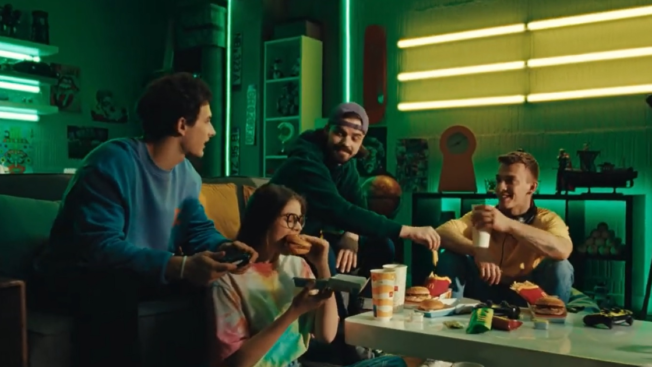
Created by DDB Romania, the latest campaign aims to launch its new value platform and communicate its items as good value for money. To do this, it has released a 90-second film titled Home Menu Mix that introduces the hyper-rational hero, Maria—a very focused young lady who is also a Chess champion and looks for logic in every decision.
The audience sees Maria’s prowess for winning as moves, numbers and deductions appear before her eyes as she makes decisions.
We also meet the members of her family unit, whom she has a point of view on and fails to understand. But when her mother brings home a McDonald’s meal for dinner one night, her deductions around the value and reasons for that choice make her smile as they all eat together.
The Netflix series Wednesday, which focuses on the daughter from The Addams Family, premiered in November, producing 341.23 million viewing hours in its first week of release.
Explaining the creative idea to Adweek, Roxana Nita, executive creative director for DDB Romania, said: “We wanted to be able to build relatable characters that people will come to recognize and expect in future campaigns.”
The film will initially run in Romania until the end of March.
CREDITS:
DDB Romania:
Senior copywriter: Alexandru Iliescu Executive creative director: Roxana Nita Strategy director: Ioana Dobrinescu Account director: Georgiana Rotaru Account manager: Dana Popescu Senior art director: Ana Ramona Tanasa
McDonald’s Romania:
Marketing manager: Lucia Rudaci Digital marketing manager: Cosmina Tapliuc Marketing director: Irina Angelescu Production agency: Multi Media Est Director: Anton Groves Marketing manager: Alexandra Todirica
Join iconic brands and world-class marketing leaders at Brandweek to unlock powerful insights and impact-driven strategies. Attend in Miami or virtually, Sept. 11–14. Save 50% with early-bird passes.
SharkNinja is awarding its media business to Carat U.S., following a competitive review that the brand led itself.
The review was an “expeditious process,” said Michael Law, Carat’s North America CEO, estimating just six weeks passed from when Carat received the brief to when it learned of the decision. “In the world of pitches, this one moved quite quickly. I think the client had a very clear point of view on what they were looking to do,” he said.
The media agency will manage all media planning and buying for the brand in North America. The business leaves IPG Mediabrands agency UM, which won the account in 2018. At that time, the business was worth an estimated $59 million.
“We’re honored to have had the opportunity to support SharkNinja, and we’re proud of the growth, results and award-winning work we’ve created together. We wish them the very best in this next chapter,” a UM spokesperson said in a statement shared with Adweek.
SharkNinja declined to name the other agencies it invited to the pitch, but did confirm it evaluated both holding companies and independent agencies. It was looking for a single media agency partner, instead of the group-level solutions that are increasingly more common, according to Ashley Eckerlin, svp of commercial strategy, planning and analytics at SharkNinja.
Deviating from a 20,000-foot strategy
SharkNinja wants to deviate from marketing at a 20,000 foot level, Eckerlin told Adweek. So, Carat’s data-first strategy was attractive. The agency’s Merkury audience segmentation tool could help Eckerlin and her team reach consumers on a 1-1 level.
“It’s not just, ‘We have this tool and we can reach these audiences on a one-to-one basis,’ but, ‘Oh, by the way, we have a really strong strategy principle that allows us to bring that to the next level,” she told Adweek.
Dentsu Media’s focus on attention metrics also made a difference during the pitch.
“The one area that I’m most excited about in terms of Carat’s offering is the attention economy,” Eckerlin said.
The leader and her team hadn’t considered planning around attention, primarily because they didn’t have access to research that supported it. She wondered if there were new platforms SharkNinja could potentially build into its plan based on how its consumers interacted with them.
The Carat team provided data that supported SharkNinja upping its investments in under-utilized channels like Twitch.
“The key insight of the kind of tactical work and immediate plans, to me was the work around attention,” Law told Adweek.
‘An immediate culture connection’
The Carat team already managed the SharkNinja business in Germany, which gave the U.S. Dentsu Media agency some advanced knowledge of the brand’s strategies and goals.
During the pitch, Carat focused on its data capabilities and showing the client how data can inform media channel strategy and uncover new information about target audiences.
A data-centric approach made sense for the brand, according to Law, since SharkNinja’s aims to grow and convert new consumers. The brief was specific, and asked agencies to craft a media strategy that would support an upcoming product launch that Law declined to elaborate on.
SharkNinja also requested Carat validate the audience segments it had already identified, to ensure the brand was on the right track.
“There was an immediate culture connection, which made the meeting feel more like work sessions, versus that we were we were pitching,” said Law. “The teams clicked very quickly,” he added.
Finding the most engaged people
The business transition is currently underway, and the agency will formally begin work this April.
“We move very fast as an organization, and Carat does as well. We are quickly approaching that scale up,” Eckerlin said.
The Carat team is collaborating with its international counterpart to build global connectivity and learn from the SharkNinja Germany team’s strategy.
The Carat U.S. team is also tapping its most engaged employees to work on the account. During the pitch, it had more than half the team fully identified and ready to work on the business, Law told Adweek.
“One interesting thing that we’ve really focused on is having people that are more dedicated to single pieces of business, versus working in a portfolio approach,” he said.
Social Media Week returns May 16–18. Join as leading brands and agencies share strategies for marketing within the creator economy. Register now to get an early bird discount.
Stars of the original “Get Crackin’” campaign for Wonderful Pistachios ran the gamut from D-listers like Snooki and the Winklevoss twins to early internet sensation Keyboard Cat, tragicomic character Mr. Bill and cannapreneur Snoop Dogg, all showing off the personality-defining ways they enjoyed their salty tree nuts.
The catchy tagline appeared in two Super Bowls—via Stephen Colbert and an all-American bald eagle, and Korean pop singer Psy who, of course, did it “Gangnam style.”
And then “Get Crackin’” faded away, much like some of the snide jokes that were timely in the Obama era but would need to be Googled now.
But the campaign has sprung back to life, with The Wonderful Company’s in-house creatives hatching a 2.0 version that sneak peeked last summer with diminutive fan favorite Groot from Marvel Studios’ Guardians of the Galaxy.
For its winter 2023 rollout, the ad lineup consists of Humpty Dumpty, the universe and competitive eater Joey Chestnut, with Pac-Man and Boston Dynamics’ robo-dog named Spot still to come.
Replaying the hits
In digging into its own archives, Wonderful Pistachios is the latest brand to dust off and refresh a previous hit: Apple relaunched its iconic iPod “Silhouettes” ads to hype its wireless AirPods in 2021, later adding Harry Styles for global appeal, while MilkPEP memorably brought back “Got Milk?” in 2020 with Olympic swimmer Katie Ledecky. ESPN’s legendary “This is SportsCenter” has a new incarnation, as razor-sharp as ever.
Industry vets cite the advantages of revisiting a campaign from yesteryear—built-in awareness—as well as its challenges—retaining its core while rejiggering it enough that it speaks to the consumer of today.
“Who doesn’t love a good comeback?” Josh Paialii, group creative director at The Many, told Adweek. “Especially in Adland, a well-timed, expertly crafted campaign reprise has a way of taking a brand’s IP and making it feel timeless.”
A once-popular campaign from the vault, with its positive associations, translates to “a massive amount of equity,” David Littlejohn, founder and chief creative director at Humanaut, told Adweek. The key is to make it feel fresh and inspired, while “the danger is that an older campaign could feel worn out and make the brand look un-innovative, like they are out of new ideas.”
Long-dormant creative has been a springboard for successful new work, according to Mona Hasan, creative director at Fortnight Collective, who noted the M&Ms spokescandies were first introduced in the 1950s and reawakened in the ’90s, and the ’70s Burger King jingle “Have it your way” returned in the 2000s.
“While the time gap for ‘Get Crackin’ is hardly as big, you could look at the success of those brands as powerful evidence that reviving older campaign equities can be genius if done at the right moment in time in the right way,” Hasan told Adweek.
Speed of culture
The Wonderful Agency’s chief creative officer Margaret Keene, who was at TBWA\Chiat\Day when “Get Crackin’” initially dropped in 2009, said she thought the work was “brilliant” back in the day.
“It was a killer campaign—it was moving at the speed of culture before that was even a thing,” Keene told Adweek. “If you mentioned it, everybody in the industry and outside of it would nod. They all knew it.”
And while resurrecting the platform could prove tricky, Keene shared with Adweek a handful of reasons that Wonderful is redeploying the well-known call to action.
It moved the needle: In the first few months after the “Get Crackin’”debut, the company saw a whopping 233% boost in sales, with Wonderful Pistachios becoming the fifth fastest growing brand in grocery channels, per IRI. The nuts, which previously weren’t at the top of consumers’ shopping lists, started outselling peanuts by almost two-to-one, according to IRI. It was the first-ever industry campaign for the nutrient-rich nut, helping to make the brand “a household name,” Keene said.
It was far-reaching and open-ended: Though there was a start and stop to the original work—which had about 100 iterations through 2016—a revitalized “Get Crackin’” could go on indefinitely, Keene said. And its marketing and media tentacles can spread out over TV, social, digital, experiential, out of home and partnerships.
Previous collaborations linked the pistachios to the blockbuster Angry Birds game, a Muppets movie, Tim Burton’s Frankenweenie and the Disney+ short-form series I Am Groot. Tie-ins will continue to be important to the 2.0 version, with marketers considering a range of opportunities.
It’s ripe for influencers and spectacle: For a distinctly modern and egalitarian edge, the brand is showcasing young talent such as TikTok’s axe-thrower Thoren Bradley, dancer Alex Wong, Olympic gymnast Shawn Johnson and trick shot experts Daniel and David Hulett, as well as a #GetCrackin hashtag challenge. Fans have responded quickly, logging nearly 50 million cumulative views for the Huletts, Bradley and skater Elladj Baldé videos.
“Get Crackin’” plans to lean into the product’s interactive qualities, hosting more events like a recent professional eating contest in Santa Monica, Calif., featuring Chestnut and other top-ranked competitors.
It bolstered the in-house agency model: Being able to turn ideas around in short order, making decisions with an internal team rather than dealing with an outside agency, can be vital to a culture-based campaign. Keene saw that nimbleness as one of the strongest assets for the original “Get Crackin’” and she’s eager to prove the concept again in 2023 and beyond.
It was cheeky, nostalgic and often controversial: The purposely unsubtle weed references in Snoop Dogg’s playful 2012 ad, in which he ate pistachios “habitually,” got it banned from network TV. It also stoked more interest and conversation.
Blending familiar and quirky, the brand also recruited Dennis Rodman, The Village People, Kermit the Frog, Charlie Brown, Crystal the Hangover 2 monkey and Brobee from the trippy kids’ show Yo Gabba Gabba! The mix of stars will continue to be eclectic, Keene said, taking in an even broader range of potential spokespeople and content creators and not shying away from potential hot-button issues.
That “Get Crackin’” has a history of “taking massive swings at culture” is a plus, according to Pailii, though it’s risky to follow in those footsteps. “That is a pretty high bar and benchmark to follow up with the current campaign,” he said.
Drawing from the past has its place, Keene said, but “Get Crackin’” will evolve its humor to fit the current times and provide some light-hearted post-pandemic inspiration for consumers to seize the day.
“There’s a double entendre to ‘Get Crackin’ that says we’ve been through a lot in the past few years,” Keene said. “Now, let’s go do all the things we want to do. That’s the larger brand halo.”
Social Media Week returns May 16–18. Join as leading brands and agencies share strategies for marketing within the creator economy. Register now to get an early bird discount.
LeBron James fans will know that, off the court, the basketball icon is an avid gamer. King James regularly interacts with his 52.8 million Twitter followers about his passion for gaming. And his fandom for Sony’s PlayStation console is legendary, as evidenced by an earnest image circling online from 2003 that shows him (on the precipice of an NBA draft) carrying around a clunky PS2 along with some tangled DualShock controllers, all to get his PlayStation fix.
Now, Sony has tapped him to join the gaming brand’s new creator initiative called “Playmakers,” making James a core part of its engagement strategy. PlayStation has also teamed with James to design and promote a limited-edition range of accessories for the PS5.
“We’ve got this really unique set of products that he [James] helped design,” Eric Lempel, senior vp and head of worldwide marketing and consumer experience at PlayStation, told Adweek. “It’s something we really haven’t done before, and it’s going to vary by Playmaker.”
James worked with the brand last year on its “All Parents Can Relate” campaign alongside John Travolta and Ben Stiller in a 3-minute spot to promote God of War Ragnarök.
James’ involvement with God of War’s campaign led Lempel and his team to broaden its work with James on Playmakers.
The Playmakers are a group of passionate gaming fans, creators, across, artists and entertainers who have partnered with PlayStation to share previews and behind-the-scenes access and unique experiences with their own fan base.
“There’ll be a lot of different executions, but it’s all about giving the Playmaker closer access to PlayStation and then finding ways for them to creatively show their passion for the category and for PlayStation while giving back to our fans in a meaningful way,” Lempel said.
Other names involved include country music star Jimmie Allen, actor and comedian King Bach, professional BMX athlete Nigel Sylvester, WNBA All-Rookie NaLyssa Smith, NFL stars Ja’Marr Chase and CeeDee Lamb, French football freestyler Lisa Zimouche, Belgian football star Romelu Lukaku and Brazilian content creator Julio Cocielo.
The Playmakers’ roles will form part of the brand’s aim to “inspire gaming fans” around the power of play and to share their passion for gaming around the world.
“We’re just so fortunate to have this beloved brand that people get excited about and having these people be some of the most creative and talented people in the world and want to work with PlayStation and do something interesting, beyond making a game, because the majority of them don’t have that skill,” Lempel told Adweek.
The company’s first global effort at engaging its fan base through creators follows some activity on the local level as PS broadened community-building efforts. Now that the program has begun, the main aim will be to build excitement for forthcoming experiences and products, including the release of games such as the remake of The Last of Us, Destiny 2: Lightfall and MLB The Show 23, due later this year.
A dedicated international PlayStation team will run the program, working closely with the Playmakers and monitoring their direct feedback along with the community’s. Metrics will include video views and social sentiment.
Lempel promised the company would not enforce a lot of “handholding” and allow the Playmakers to “do their thing.”
He continued: “They’re identified because they’re good at what they do, and they’re legitimate fans, in many cases, talking about PlayStation a lot without us talking to them at all. So, we’re kind of OK to let them go.”
Lempel also said that his own direct involvement would be based on an individual initiative basis. For example, he has been heavily involved in the work with James by reviewing the product, as well as overseeing the PlayStation design team’s finished concept for the accessories range. But in some cases, he won’t learn of the activation until it’s live.
“At the core of what we do is creativity and embracing creators,” Lempel said. “This is a way to get out there and talk to people who are creators and influencers in other categories but make it about PlayStation.”
Cookie-Alternative Fledge Testing Grows, But Not Among SSPs
Fledge, part of Google’s Privacy Sandbox suite of solutions intended to replace third-party cookies, is moving from a theoretical ad-tech framework to reality, according to new findings from demand-side platform RTB House.
But encouraging all members of the media supply chain to test, especially in tough economic conditions, is limiting its adoption.
Fledge, or first locally executed decision over groups experiment, aims to deliver privacy-compliant, targeted ads via on-device auctions and is predicated on buyers, sellers and vendors adding users to interest groups based on browsing activity or behavior.
RTB House displayed nearly 120 million impressions via Fledge auctions in January 2023, an 18-fold increase from the 6.5 million served in August 2022 (though still a tiny fraction of RTB House’s monthly average of 30 billion impressions). RTB House can use Fledge to serve more users with ads in part because Google is expanding its testing population on Chrome.
Industry consensus is growing around Fledge being a viable, privacy-safe alternative to transacting digital advertising via third-party cookies. Fledge live testing has more than tripled since October, according to a Google spokesperson, and 46% of RTB House’s performance advertisers are bidding on Fledge auctions. But the tough economic climate hampers experimental testing and any desire to spend on tech integrations.
Fledge is especially lacking in support from supply-side platforms, which let publishers sell their inventory programmatically, and are especially challenged. While several SSPs are testing Fledge internally, RTB House has found no bid requests coming from SSPs, with the exception of Google’s SSP, Google Ad Manager.
“I hope that other SSPs will do something about this,” said Lukasz Wlodarczyk, vp of programmatic ecosystem growth & innovation at RTB House. “[Otherwise], publisher interest will not be represented.”
In cases when RTB House wants to test Fledge auctions with other SSPs, the company has developed a workaround: When an advertiser wins the auction via RTB House, the DSP runs a second auction via Fledge if the user it’s bidding on is part of the Fledge testing population. RTB House declined to share performance data for Fledge auctions, partly because the firm is not yet able to compare Fledge apples-to-apples to cookies given the lack of available data.
The state of the economy deprioritizes any effort to test at scale because every dollar counts.
Anonymous SSP exec
Otherwise, Poland-based RTB House is also testing by directly integrating with publishers, including European titles such as Ringier Axel Springer, Wirtualna Polska and Ströer Media. U.S.-based ad network CafeMedia, which had already been testing Fledge internally, plans to go live with the protocol in the bidstream in the coming weeks, said its chief strategy officer Paul Bannister.
Two SSP sources told Adweek that while they see the value of testing Fledge, it is not an immediate priority given Google’s changing deadline.
“It’s been difficult to justify investing a bunch of engineering dollars in a moving target,” said Garrett McGrath, SVP of product management at SSP Magnite.
More technically laborious than other alt IDs
With Fledge, buyers don’t bid on individual users but via an interest group where users are members. When a user visits a site, all the buyers who own interest groups that contain that user are invited to bid, and the whole auction takes place in a browser, not an ad server.
Fledge constitutes a totally new system for auctions, and setting it up is more technically laborious than swapping out the cookie for another identifier, said McGrath.
“I wouldn’t conflate fledge with cookie alternatives,” McGrath said. “UID2 or any number of cookie alternatives are not programmatic transaction alternatives. Fledge fundamentally rewires the transaction.”
Sources said that the technical lift was not necessarily greater for SSPs than DSPs, and the fact that more DSPs, like RTB House and Criteo, have tested Fledge is mostly circumstantial.
Missing the boat
But when ad-tech firms are laying off employees and SSPs are closing, some companies may decide not to waste impressions on techniques that are still experimental, said an SSP source who didn’t have the authorization to talk to the press.
“The state of the economy deprioritizes any effort to test at scale because every dollar counts,” the source said.
Others on the sell side are more eager to test. Some SSPs and publisher entities are in the process of setting up Fledge integrations, said Bannister, calling the current moment “the end of the beginning.”
“We’re at the point where this is getting serious, and if you don’t get moving now, you could miss the boat,” Bannister said.
A Google spokesperson said DSPs are ramping up Fledge testing while SSP interest in testing is growing.
Still, many practitioners don’t see the value of testing any one solution, perhaps choosing one alternative at random but without much urgency, the SSP source said.
“It’s been really hard to understand why certain companies value certain opportunities more than others,” the SSP source said, referring to different cookie alternatives. “There’s upside for both the buy and the sell side if Fledge can be figured out. In the interim, it’s a little bit like herding cats.”
The use of food delivery services has skyrocketed—and restaurants should take advantage. Join this Adweek webinar to learn how to create a seamless customer experience and deliver ROI. Register
MikMak is going global.
The U.S.-based ecommerce platform, which revolutionized retail and recently secured a patented technology enabling the use of multi-retail selection and checkout within online video marketing campaigns, announced the acquisition of Swaven, a Paris-based ecommerce enablement and analytics software company that operates across EMEA, APAC and LATAM.
“I think this acquisition for MikMak is very telling of the industry and where the industry is headed,” said Rachel Tipograph, MikMak’s founder and co-host of the Brave Commerce podcast. Tipograph said the deal will expand MikMak’s reach to include more than 3,000 retailers across 20 industries and 80 countries.
Tipograph began building MikMak eight years ago. And while heavily focused on North America, the platform works with global, blue-chip brands providing ecommerce analytics software across major media channels, from Meta and TikTok to programmatic and CTV. “We work with over 600 brands. And these are behemoth brands like P&G, Unilever, Hershey, Kraft, Anheuser-Busch, etc. In the U.S., we’ve had over 1,500 retailers in the ecosystem,” Tipograph told Adweek.
Tipograph said the Swaven acquisition will accelerate the company’s capabilities globally.
“If you look at Amazon, [they have an] extremely global footprint. Sephora is aggressively making moves into India. Then you have Alibaba—these players are becoming more global, and these big brands really want to be able to understand this customer and this channel and to have real-time learning,” she said.
Bringing transparency to retail media
Tipograph also sees an opportunity to correct what she identifies as a problem for advertisers; a lack of transparency in retail media due to a highly fragmented environment in which media channels and retailers have been “grading their own homework.” She notes the new iteration will provide brands with an omnichannel view of their consumers.
“We will be able to provide analytics across every major media channel,” she said, adding it’s a “huge win for the ecosystem to have third parties—whether its MikMak or someone else—that verifies the measurement of what’s happening.”
Swaven’s co-founder and CEO, Laurent Quatrefages, echoed Tipograph’s sentiment and sees the union as a perfect fit.
“MikMak is the ideal partner to take our advanced technology platform to the next level,” said Quatrefages in a company statement. “Our combined expertise and innovative solutions make us the most agile global player in our industry. We can, in a single platform, address the challenges brands face in operating and adjusting their digital and retail mix.”
“Our customers are already benefiting from the combination of our companies with a ready-to-use platform,” added Sébastien Thiberge, Swaven’s co-founder and COO. “We are honored to have a partner who shares our ambitions to accelerate growth and revolutionize the industry with disruptive digital technologies.”
According to the statement, the combined entity will now service a Gross Merchandise Value (GMV) of $2.4 trillion with an increased foothold in the EMEA, APAC and LATAM markets, and “solidifies the company’s place in the Commerce-Marketing industry with a Total Addressable Market (TAM) valued at $120 billion.”
MikMak 3.0
When Tipograph—a GAP veteran—founded MikMak eight years ago, the use of video content by brands and retailers was an untapped opportunity. Today, brands like Kraft have now adopted the platform’s tech to create an in-house operation churning out content and learnings in real time, resulting in exponential growth for the global brand.
“The DNA has been deeply rooted in social and video,” said Tipograph. MikMak has a patent on the technology in the U.S. that allows for the ability to instantiate ‘at-Cart’ sessions in video. “And what this is [going to] accelerate us to do is not only live across every single media channel and brand website but also bring our technology to the media impression level. We’re picking up on inventory in real-time.”
In addition to inventory data and other key reporting, brands will also be able to use the enhanced tech to forecast revenue and streamline onboarding to optimize self-serve capabilities, which Tipograph believes will be game-changing for small brands with lower head counts.
“The smaller brands … they really can’t play in retail media right now. Retail media is designed for the big brands. And there’s very few self-serve capabilities outside of Amazon. So, this is [going to] open up the aperture for them in a big way.”
Learn how the creator economy is transforming the marketing landscape, and how to cultivate partnerships to grow engaged communities at Social Media Week: The Creatorverse, May 16–18 in NY. Register now to secure your early bird pass.
The adoption around the use of the description “rock star” in the business world has gone too far, according to enterprise software company Workday’s Super Bowl spot, which features actual rock stars to make its point.
The 60-second ad from Ogilvy, which will run nationally during the third quarter of the game Feb. 12, features Ozzy Osbourne, Paul Stanley, Gary Clark Jr., Joan Jett and Billy Idol as they each showcase what it takes to be a true rockstar.
Workday claims to serve 60 million workers within its customer community, serving more than 1,450 organizations.
The theme is narrated by Kiss co-founder Paul Stanley who is on stage in front of a baying crowd. He turns to the audience, saying, “Hey, corporate types. Will you stop calling each other rock stars?” before two men in suits sitting in their office compliment each other with the term. This includes Idol boasting that he has trashed hotel rooms in 43 countries … while standing in another completely trashed hotel room.
Joan Jett then asks, “Do you know what it takes to be a rock star?” before the rest of the spot showcases the necessary behavior to qualify. It also sees Osbourne dressed in a plain suit (but retaining the eyeliner and painted fingernails) working in an office, where he introduces himself as Oswald.
The theme follows from an Instagram post from the company last month prior to the release of the Big Game teaser spot, which invited its followers to “tag a #rockstar who inspires you” in the comments. The post also described the company’s rock stars as “The changemakers. The data-drivers. The future-proofers. Those who are tackling challenges head-on and leading the way to greatness.”
For the latest Super Bowl 57 advertising news—who’s in, who’s out, teasers, full ads and more—check out Adweek’s Super Bowl 2023 Ad Tracker and the rest of our stories here. And join us on the evening of Feb. 12 for the best in-game coverage of the commercials.
Join TV, media, marketing and tech leaders for Adweek Convergent TV, Mar. 21–22. Virtual and in-person passes available. 50% off through Feb. 6.
Sports fans’ favorite campaign is back with a new ad—this time starring Olympic gold medalist Sydney McLaughlin and SportsCenter anchor Hannah Storm.
The latest spot in ESPN’s iconic “This Is SportsCenter” campaign, titled “Seconds,” will make its linear debut on Saturday on ESPN during the Duke and UNC men’s basketball game, tipping off at 6:30 p.m.
A 15-second ad created with agency Arts & Letters, the new spot was filmed inside the ESPN headquarters in Bristol, Conn., and features the track and field star working in the ESPN office while Storm comes over to see if she has time to catch up.
“I’ve got 51.46 seconds right after lunch, or I’ve got 51.41 seconds later this afternoon. Or wait, I have 50.86 seconds right now,” McLaughlin responds.
The declining numbers aren’t random—51.46 was when she broke her own 400m hurdles world record for Olympic gold in Tokyo. The 51.41 number was her 400m hurdles time at the 2022 USA Outdoor Track and Field Championships (then a world record), and 50.68 was her 2022 World Athletics Championships time, again shattering her world record mark a month later.
“This Is SportsCenter has featured the greatest athletes of the past three decades. Sydney is the latest superstar athlete to come to our campus in Bristol, Conn. She is the the very best at her craft,” Laura Gentile, evp of commercial marketing, networks and ESPN, told Adweek.
The spot featuring McLaughlin and Storm is the fourth ad since ESPN revived the “This Is SportsCenter” campaign in late 2022. Two of the ads, “Orange Slices” and “Stoppage Time,” feature U.S. Women’s National Team stars Megan Rapinoe, Becky Sauerbrunn and Sophia Smith. A third spot, “Performance Evaluation,” stars the beloved Delta State University’s Fighting Okra mascot.
The SportsCenter campaign began airing in the mid-1990s, mostly produced by agency Wieden+Kennedy. ESPN brought the campaign in-house in 2017, and it was discontinued shortly after. Now, it has new life with Richmond, Va.-based Arts & Letters.
“It’s really exciting that part of our brand personality is alive and well. It’s always been the fun side of sports,” Gentile said.
ESPN shot all four spots in Bristol in a single day. “Orange Slices” was not initially a planned campaign and instead ended up being a “bonus” ad—and the one that led off the return of “This Is SportsCenter.”
And expect more spots to roll out throughout 2023, starting during the NFL Pro Bowl. “Wet Willy,” featuring Peyton and Eli Manning and first created in 2017, aired Thursday night during the NFL Pro Bowl on ESPN and ESPN+, and all of the new creative will air during the Pro Bowl on Sunday.
Convergent TV Summit returns March 21-22. Hear timely insights from TV industry experts virtually or in person in NYC. Register now to secure your early bird pass.
Welcome to Marketing Morsels, Adweek’s weekly sampling of the most delectable brand stunts and campaigns we saw this week (but weren’t able to cover elsewhere). This week, discover offerings from M&M’s, Coca-Cola, Twix and more. Enjoy the assortment!
Morsel #1: Are Ma&Ya’s a Super Bowl stunt?
Most of the internet will have heard or seen by now that M&M’s has decided to pause with its spokescandies in favor of turning to comedian Maya Rudolph—but it also claims to have rebranded to become Ma&Ya’s and placed her face on an M&M as well. The brand released this video showing her announcing the supposed name change. Smart money is on this being a Super Bowl stunt, but still no official word yet.
Morsel #2: Coca-Cola’s family of rabbits celebrate Chinese New Year
With the passing of Chinese New Year, we have entered the Year of the Rabbit, which Coca-Cola jumped on to celebrate in a new animated campaign featuring a family of furry critters as they reunite for dinner.
The rabbit is seen to be the luckiest of the 12 animals represented by Chinese zodiac signs, and Coca-Cola hopes to have struck luck with this one-minute animated film. It focuses on the grandparents of a family of rabbits as they come together to celebrate the holiday, with them all enjoying their meal together over a can or bottle of the brand.
Morsel #3: Twix takes its new cookie dough snowboarding for the X Games
Timed to the X Games in Aspen, Colo., Twix has teamed up with snowboarder and Olympian Maddie Mastro to create a splitboard—a snowboard that can come apart to make two skis—inspired by its new Twix Cookie Dough. Mastro will design one half, while fans can enter designs to be featured on the other half, with 100 of the winning design available in a giveaway come spring.
Morsel #4: Maybelline and Winnie Harlow touch the sky
Maybelline New York is taking the name of its Sky High Mascara literally in a campaign starring model and activist Winnie Harlow, who went skydiving over NYC with the makeup in hand. The campaign emphasizes the product’s high impact and the fearlessness of its audience.
Morsel #5: Would you drink this Hormel Chili Cheese-inspired beer?
Hormel Chili and Modist Brewing Co. teamed up to create a beer brewed with chili cheese-inspired spices that aims to pair with the brand’s gameday snack staple. The limited-edition beer, which launches on Jan. 24 in time for the Super Bowl, is being sold for $24 via a dedicated website.
Morsel #6: Puppies grow in pumpkins in Nutro’s adorable new campaign
Pet food brand Nutro has launched its first campaign in three years with BBDO. The campaign, called “Let’s Grow Healthy Pets,” sets up pet health food as a heart-meltingly adorable metaphor of picking furry friends from patches of veggies and fruit, hatching puppies from eggs and more.
Morsel #7: Barilla’s Valentine’s Day pasta comes with a full-blown romantic getaway
Barilla Love is a limited-edition, heart-shaped pasta cut, that will bring loved ones closer together in the kitchen.
Ahead of Valentine’s Day, Barilla is feeling the love with heart-shaped pasta as part of its Barilla Love Pasta Kit—as well as offering customers a shot at taking their loved one on a romantic vacation to Italy. Fans who visit BarillaLove.com can enter to win airfare, hotel, tours, experiences and more in Parma and Florence.
Morsel #8: This matcha brand cha chas into Web3 with Hang
Matcha brand Cha Cha Matcha has launched a first-of-its-kind Web3-powered loyalty program through Hang, a membership platform that enables brands to generate points and rewards for in-store and online purchases. The platform doesn’t require cryptocurrencies to sign up, but instead uses email and credit card registration with rewards including event tickets, merch, product drops and sweepstakes for vacations.
Morsel #9: Gatorade’s Fast Twitch energizes brands to run through the Super Bowl stadium tunnel
To accompany the launch of its first-ever energy drink, Fast Twitch, the brand will select fans who make the best videos of themselves running and send them to Super Bowl 57, where the winners will be able to run through the stadium tunnel that NFL players usually use to take the field.
For the first time this year, the organizers are requesting information on the carbon footprint and sustainability impact of each creative submission.
A new set of questions on the form includes to what extent diversity, equity and inclusion was considered in the conceptualization, production and impact of the work, and the business growth that resulted from it. While the moves have been praised, many note that global standards of measurement are necessary before these components are made mandatory.
“Cannes Lions has always been an agent of change within the industry,” Anna Lungley, chief sustainability officer at Dentsu, told Adweek. “If they’re setting down judging criteria related to DEI and carbon, then that’s really, really important.”
Laying the groundwork
For this first year, reporting around sustainability, DEI and growth information isn’t mandatory.
“Because it’s the first year, we didn’t want to spring it on people. So we thought it would be unfair to make it compulsory,” said CEO of Cannes Lions Simon Cook. “The whole point is that we’re trying to get a base. Because at the moment, we just don’t have any visibility.”
Cook wouldn’t share whether this reporting would be mandatory in the future, or whether the Lions would deny application fees for submissions in the future that didn’t include sufficient detail regarding carbon emissions measurement, or certain sustainability, DEI or growth standards.
Standard measurement
The current sustainability submission questions ask whether the carbon emissions of a piece of work were measured, with a link to Cannes Lions’ partner Ad Net Zero’s five-step action plan for reducing the advertising industry’s climate impact. A second question asks, “What consideration was given to the sustainable development, production and running of the work?”
Still, for these questions to be taken into serious consideration during judging, there will have to be a clearly defined standard. Right now, it’s unclear what that would be. While Ad Net Zero offers a starting point, it doesn’t have a clear benchmark of success—arguably, no one does.
Gemma Redgrave, global marketing director for AKQA, handles all the agency’s award submissions. The WPP-owned shop has about a $250,000 annual budget for all awards—and Cannes is only one of many. The fees for each Lion range from around $680 to $2,800, depending on the timing and the award.
As agencies plan how to spend their award budgets each year, reporting requirements and certifications tend to layer on top of the baseline submission price. While AKQA supports adding information related to sustainability and DEI, Redgrave said that a clear focus on measurable progress would help agencies justify the additional costs.
“There’s more clarity that is needed,” Redgrave said. “How that information is collected, stored, and then used—in terms of allocating awards—remains to be seen. Anything that drives positive change, we should absolutely be doing it. If it’s lip service, why are we doing it?”
Still, the burden of those extra costs falls disproportionately on smaller agencies and those without the backing of a major holding company.
Kelly Taylor, new business and marketing director at London-based agency Creature, said her agency had to forgo one award entry last year that required a costly sustainability membership platform—one that would’ve been redundant given Creature’s other certifications and memberships. While the agency was aligned with the values of the award requirements, it just wasn’t in the budget for a small, 50-person shop.
Cannes can do better
The most important question that the new sustainability-related submission requirements raise for Jake Dubbins, managing director of agency Media Bounty and co-chair of the Conscious Advertising Network, is how far along the Ad Net Zero action plan it’ll go.
While the first four actions focus on the climate impact of agency operations, ad productions, media planning and events, the fifth action gets to the heart of the industry. It aims to “harness advertising’s power to support consumer behavior change,” i.e., to change the metric by which advertising is measured.
The risk, Dubbins said, is that “the sustainability part becomes literally a tick box exercise in epic greenwashing.” If the broader cultural impact of advertising isn’t taken into account, the current standards would allow major polluters to win awards simply because they used agencies who cleaned up their own operations and production.
Still, Lungley believes juries may be where Cannes Lions shapes the awards more clearly than within the stated policy requirements.
“You see these beautiful campaigns that have an actually driven social or environmental impact, and you see them coming from organizations who are actually behaving in a way that has a negative impact on society or the environment,” She noted. At that point, it’s up to the jury. “Whether or not the criteria is mandatory, you’ll see juries taking that responsibility very seriously.”