Google: Don’t make “bite-sized” content for LLMs if you care about search rank

Signal in the noise

Google only provides general SEO recommendations, leaving the Internet’s SEO experts to cast bones and read tea leaves to gauge how the search algorithm works. This approach has borne fruit in the past, but not every SEO suggestion is a hit.

The tumultuous current state of the Internet, defined by inconsistent traffic and rapidly expanding use of AI, may entice struggling publishers to try more SEO snake oil like content chunking. When traffic is scarce, people will watch for any uptick and attribute that to the changes they have made. When the opposite happens, well, it’s just a bad day.

The new content superstition may appear to work at first, but at best, that’s an artifact of Google’s current quirks—the company isn’t building LLMs to like split-up content. Sullivan admits there may be “edge cases” where content chunking appears to work.

“Great. That’s what’s happening now, but tomorrow the systems may change,” he said. “You’ve made all these things that you did specifically for a ranking system, not for a human being because you were trying to be more successful in the ranking system, not staying focused on the human being. And then the systems improve, probably the way the systems always try to improve, to reward content written for humans. All that stuff that you did to please this LLM system that may or may not have worked, may not carry through for the long term.”

We probably won’t see chunking go away as long as publishers can point to a positive effect. However, Google seems to feel that chopping up content for LLMs is not a viable future for SEO.

https://arstechnica.com/google/2026/01/google-dont-make-bite-sized-content-for-llms-if-you-care-about-search-rank/


Google announces AI Overviews in Gmail search, experimental AI-organized inbox

Gmail made us all rethink how email could work when it debuted more than 20 years ago. Google thinks we’re in the process of another email transformation courtesy of AI. The company has unveiled a new round of AI features that will make Gemini an even more integral part of Gmail. The new Gemini experiences are coming to paying subscribers starting today, and a collection of previously premium-only AI features are rolling out widely.

AI Overviews first appeared in Gmail last year to summarize email chains, and now it’s expanding to Gmail search. This is closer to the AI Overview experience to which you are accustomed in Google’s web search. You can enter a natural language search, and the robot churns through your messages to generate a response.

Gmail AI Overview

In the example above, the user looks up a past plumbing quote. Traditionally, Gmail would show emails that are likely matches for your search. With AI Overview, you instead get a nicely formatted AI answer that includes all the relevant information and cites the email. That sounds all well and good, assuming it works. AI Overviews in search is notoriously inaccurate when summarizing search results, but grounding it in your email could make it less likely to screw up. Maybe.

AI Pro and Ultra subscribers will also begin seeing a new proofreading tool in Gmail. Proofreading suggestions will appear as dotted underlines in your email text, offering suggestions to streamline and clarify your writing. Google says AI Proofreading can make more nuanced changes than standard spellchecking features thanks to the company’s largest and most powerful Gemini 3 models.

Gmail AI Inbox

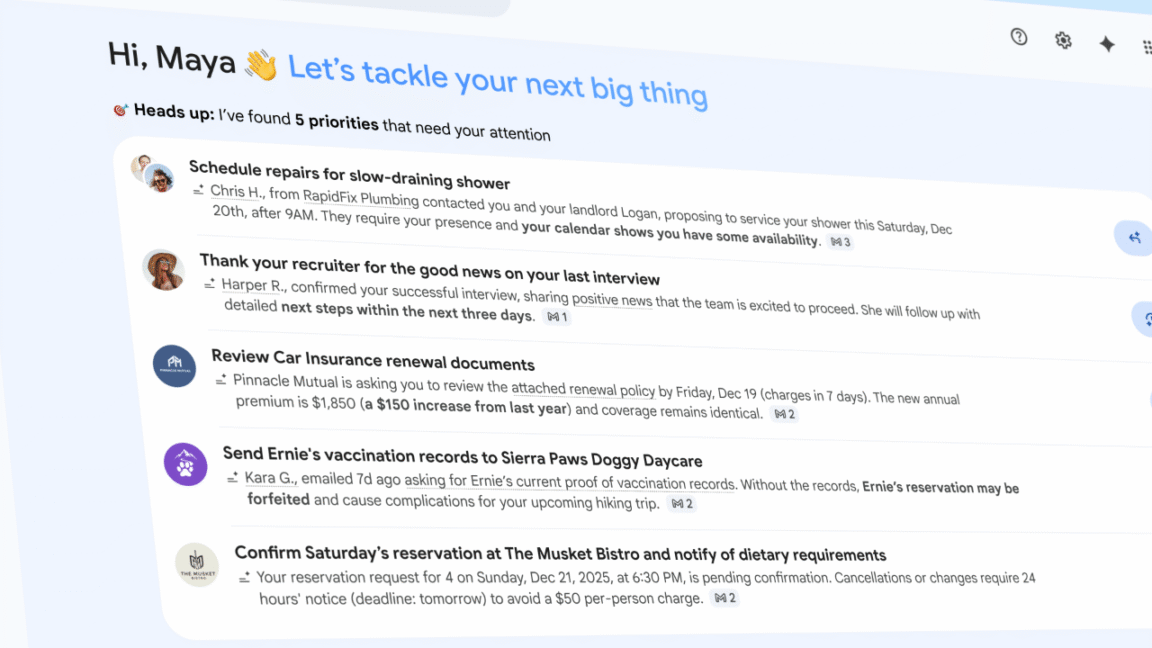
Lastly, Google is previewing a new version of its iconic inbox—no, not that Inbox. The AI Inbox will roll out to a group of “trusted testers” before making its way to more users. The AI Inbox looks at your unread mail and creates an interactive list with “Priorities” at the top. If Gemini thinks an email is important, it will become a line item in that section. Below that is “Catch me up,” which summarizes less important messages. Again, this is based on Gemini’s ability to delineate important from unimportant.

https://arstechnica.com/google/2026/01/google-announces-ai-overviews-in-gmail-search-experimental-ai-organized-inbox/


From prophet to product: How AI came back down to earth in 2025

To be sure, it’s hard to see this not ending in some market carnage. The current “winner-takes-most” mentality in the space means the bets are big and bold, but the market can’t support dozens of major independent AI labs or hundreds of application-layer startups. That’s the definition of a bubble environment, and when it pops, the only question is how bad it will be: a stern correction or a collapse.

Looking ahead

This was just a brief review of some major themes in 2025, but so much more happened. We didn’t even mention above how capable AI video synthesis models have become this year, with Google’s Veo 3 adding sound generation and Wan 2.2 through 2.5 providing open-weights AI video models that could easily be mistaken for real products of a camera.

If 2023 and 2024 were defined by AI prophecy—that is, by sweeping claims about imminent superintelligence and civilizational rupture—then 2025 was the year those claims met the stubborn realities of engineering, economics, and human behavior. The AI systems that dominated headlines this year were shown to be mere tools. Sometimes powerful, sometimes brittle, these tools were often misunderstood by the people deploying them, in part because of the prophecy surrounding them.

The collapse of the “reasoning” mystique, the legal reckoning over training data, the psychological costs of anthropomorphized chatbots, and the ballooning infrastructure demands all point to the same conclusion: The age of institutions presenting AI as an oracle is ending. What’s replacing it is messier and less romantic but far more consequential—a phase where these systems are judged by what they actually do, who they harm, who they benefit, and what they cost to maintain.

None of this means progress has stopped. AI research will continue, and future models will improve in real and meaningful ways. But improvement is no longer synonymous with transcendence. Increasingly, success looks like reliability rather than spectacle, integration rather than disruption, and accountability rather than awe. In that sense, 2025 may be remembered not as the year AI changed everything but as the year it stopped pretending it already had. The prophet has been demoted. The product remains. What comes next will depend less on miracles and more on the people who choose how, where, and whether these tools are used at all.

https://arstechnica.com/ai/2025/12/from-prophet-to-product-how-ai-came-back-down-to-earth-in-2025/


I switched to eSIM in 2025, and I am full of regret

Maybe this isn’t a good idea

Many people have had the same phone number for years—even decades at this point. These numbers aren’t just a way for people to get in touch because, stupidly, we have also settled on phone numbers as a means of authentication. Banks, messaging apps, crypto exchanges, this very website’s publishing platform, and even the carriers managing your number rely on SMS multifactor codes. And those codes aren’t even very secure.

So losing access to your phone number doesn’t just lock you out of your phone. Key parts of your digital life can also become inaccessible, and that could happen more often now due to the fungible nature of eSIMs.

Most people won’t need to move their phone number very often, but the risk that your eSIM goes up in smoke when you do is very real. Compare that to a physical SIM card, which will virtually never fail unless you damage the card. Swapping that tiny bit of plastic takes a few seconds, and it never requires you to sit on hold with your carrier’s support agents or drive to a store. In short, a physical SIM is essentially foolproof, and eSIM is not.

Obviously, the solution is not to remove multifactor authentication—your phone number is, unfortunately, too important to be unguarded. However, carriers’ use of SMS to control account access is self-defeating and virtually guarantees people are going to have bad experiences in the era of eSIM. Enshittification has truly come for SIM cards.

If this future is inevitable, there ought to be a better way to confirm account ownership when your eSIM glitches. It doesn’t matter what that is as long as SMS isn’t the default. Google actually gets this right with Fi. You can download an eSIM at any time via the Fi app, and it’s secured with the same settings as your Google account. That’s really as good as it gets for consumer security. Between Google Authenticator, passkeys, and push notifications, it’s pretty hard to get locked out of Google, even if you take advantage of advanced security features.

We gave up the headphone jack. We gave up the microSD card. Is all this worthwhile to boost battery capacity by 8 percent? That’s a tough sell.

https://arstechnica.com/gadgets/2025/12/i-switched-to-esim-in-2025-and-i-am-full-of-regret/


Google lobs lawsuit at search result scraping firm SerpApi

Google has filed a lawsuit to protect its search results, targeting a firm called SerpApi that has turned Google’s 10 blue links into a business. According to Google, SerpApi ignores established law and Google’s terms to scrape and resell its search engine results pages (SERPs). This is not the first action against SerpApi, but Google’s decision to go after a scraper could signal a new, more aggressive stance on protecting its search data.

SerpApi and similar firms do fulfill a need, but they sit in a legal gray area. Google does not provide an API for its search results, which are based on the world’s largest and most comprehensive web index. That makes Google’s SERPs especially valuable in the age of AI. A chatbot can’t summarize web links if it can’t find them, which has led companies like Perplexity to pay for SerpApi’s second-hand Google data. That prompted Reddit to file a lawsuit against SerpApi and Perplexity for grabbing its data from Google results.

Google is echoing many of the things Reddit said when it publicized its lawsuit earlier this year. The search giant claims it’s not just doing this to protect itself—it’s also about protecting the websites it indexes. In Google’s blog post on the legal action, it says SerpApi “violates the choices of websites and rightsholders about who should have access to their content.”

It’s worth noting that Google has a partnership with Reddit that pipes data directly into Gemini. As a result, you’ll often see Reddit pages cited in the chatbot’s outputs. As Google points out, it abides by “industry-standard crawling protocols” to collect the data that appears on its SERPs, but those sites didn’t agree to let SerpApi scrape their data from Google. So while you could reasonably argue that Google’s lawsuit helps protect the rights of web publishers, it also explicitly protects Google’s business interests.

https://arstechnica.com/google/2025/12/google-lobs-lawsuit-at-search-result-scraping-firm-serpapi/


Trump Media nella fusione nucleare, operazione da 6 miliardi di dollari con TAE (sostenuta da Alphabet)

Donald Trump vuole puntare sulla fusione nucleare e lancia una fusione da 6 miliardi di dollari con TAE Technologies

La fusione annunciata tra Trump Media & Technology Group e TAE Technologies è una di quelle operazioni che, a prima vista, sembrano improbabili, ma che raccontano molto bene la fase storica che sta attraversando l’industria energetica e tecnologica globale. La società che fa capo a Donald Trump, conosciuta soprattutto per il social network Truth Social, ha deciso di reinventarsi completamente entrando in uno dei settori più ambiziosi e complessi in assoluto: la fusione nucleare.

L’accordo, strutturato come una fusione interamente in azioni e valutato oltre 6 miliardi di dollari, porterebbe alla nascita di una delle prime aziende di fusione nucleare quotate in Borsa.

Per Trump Media si tratta di una trasformazione radicale, si legge in un articolo pubblicato sul New York Times. Il gruppo, che nei primi nove mesi dell’anno ha generato ricavi per appena 2,7 milioni di dollari e ha visto il proprio titolo perdere circa il 69% del valore nel 2024, passa da società media in difficoltà a veicolo industriale e finanziario per una tecnologia energetica considerata potenzialmente rivoluzionaria.
Non a caso, l’annuncio ha immediatamente spinto le azioni al rialzo (il titolo di Trump Media & Technology guadagna il 27,7%, dopo i primi minuti di scambi), segnalando che il mercato guarda alla fusione come a una scommessa sul futuro, più che come a un’estensione del modello di business originario.

L’ennesima “distrazione economico-finanziaria” che si concede il Presidente americano. Trump Organization (la multinazionale di famiglia) ha registrato utili record nel 2025: cresciuti di 17 volte nei primi sei mesi (da 51 a 864 mln di dollari), trainati da criptovalute (802 mln di dollari), licenze su profumi/orologi/resort e nuovi progetti immobiliari in Medio Oriente. Truth Social beneficia del suo ruolo istituzionale, con picchi di utenza durante annunci presidenziali, sollevando conflitti d’interesse.

TAE Technologies e il ruolo di Alphabet (Google)

TAE Technologies, dal canto suo, non è un nome improvvisato. Fondata nel 1998 con il nome di Tri Alpha Energy, è una delle realtà private più avanzate e capitalizzate nel campo della fusione. In oltre venticinque anni di attività ha raccolto più di 1,3 miliardi di dollari, costruito cinque reattori sperimentali e attratto investitori industriali e tecnologici di primo piano.

Il suo amministratore delegato, Michl Binderbauer, ha chiarito che oggi la vera sfida non è più solo scientifica, ma finanziaria: la tecnologia, secondo l’azienda, è matura al punto che il limite principale è l’accesso a capitali su larga scala. In questo senso, la quotazione indiretta tramite Trump Media rappresenta un acceleratore decisivo.

In questo scenario si inserisce anche Alphabet, la holding di Google, che gioca un ruolo chiave come investitore storico di TAE. Il contributo di Google non si è limitato al capitale: l’azienda ha collaborato con TAE applicando tecniche avanzate di machine learning per migliorare il controllo del plasma e ottimizzare il funzionamento dei reattori sperimentali.

L’energia che alimenterà un giorno l’AI

È un passaggio cruciale, perché la fusione moderna è tanto un problema di fisica quanto di calcolo: senza l’intelligenza artificiale (AI), gestire sistemi così complessi sarebbe quasi impossibile. La presenza di Alphabet rafforza quindi la credibilità tecnologica di TAE e spiega perché il progetto venga preso sul serio dagli investitori.

Il legame con l’AI è, in realtà, ancora più profondo. Da un lato, l’intelligenza artificiale è uno strumento indispensabile per rendere possibile la fusione; dall’altro, la fusione è vista come una possibile risposta alla crescente fame di energia dei data center che alimentano l’AI generativa. Le grandi aziende tecnologiche sono alla ricerca di fonti di elettricità continue, affidabili e a basse emissioni, capaci di sostenere una crescita esponenziale dei consumi.

Non è un caso che Microsoft abbia firmato accordi con altre startup della fusione, né che figure come Sam Altman siano direttamente coinvolte nel settore. In questo senso, il merger tra Trump Media e TAE colloca indirettamente Donald Trump all’interno di una delle filiere strategiche più sensibili del prossimo decennio.

Fusione nucleare, niente prima del 2031

Resta però una distanza significativa tra l’ambizione e la realtà industriale. Se i comunicati parlano di centrali “utility-scale” già nella seconda metà di questo decennio, le dichiarazioni più prudenti degli stessi manager indicano il 2031 come orizzonte per la prima produzione di energia da fusione nucleare.
È una tempistica coerente con quella di altri attori del settore, ma che conferma come la fusione resti una scommessa ad alto rischio tecnologico e finanziario.

In definitiva, questo merger non è solo una curiosità finanziaria o politica. È il segnale che la fusione nucleare sta uscendo dai laboratori per entrare nel mondo dei mercati, degli investitori e delle strategie industriali globali. Un passaggio che potrebbe aprire la strada a una nuova età dell’energia (in questo caso pulita e concettualmente infinita), ma che richiederà anni, capitali enormi e una dose significativa di pazienza. Come spesso accade in questi casi, la finanza corre veloce; la sperimentazione e la tecnologia necessaria alla realizzazione delle prime centrali, inevitabilmente, molto meno.

L’operazione assume una rilevanza particolare anche per il contesto geopolitico e industriale in cui si inserisce. La fusione nucleare è considerata da molti il “Santo Graal” dell’energia: utilizza combustibili abbondanti, non produce emissioni di carbonio, non comporta il rischio di meltdown tipico del nucleare tradizionale e non genera scorie radioattive di lungo periodo.
Tuttavia, trasformare una reazione che avviene nelle stelle in un processo industriale stabile e conveniente resta una sfida enorme. Negli ultimi anni i laboratori pubblici hanno ottenuto risultati promettenti, ma sono soprattutto le startup private a spingere ora verso la commercializzazione, in una corsa globale che vede impegnati Stati Uniti, Europa e Cina.

Leggi le altre notizie sull’home page di Key4biz

https://www.key4biz.it/trump-media-nella-fusione-nucleare-operazione-da-6-miliardi-di-dollari-con-tae-sostenuta-da-alphabet/560019/


YouTube bans two popular channels that created fake AI movie trailers

Deadline reports that the behavior of these creators ran afoul of YouTube’s spam and misleading-metadata policies. At the same time, Google loves generative AI—YouTube has added more ways for creators to use generative AI, and the company says more gen AI tools are coming in the future. It’s quite a tightrope for Google to walk.

AI movie trailers

A selection of videos from the now-defunct Screen Culture channel.

Credit: Ryan Whitwam

A selection of videos from the now-defunct Screen Culture channel. Credit: Ryan Whitwam

While passing off AI videos as authentic movie trailers is definitely spammy conduct, the recent changes to the legal landscape could be a factor, too. Disney recently entered into a partnership with OpenAI, bringing its massive library of characters to the company’s Sora AI video app. At the same time, Disney sent a cease-and-desist letter to Google demanding the removal of Disney content from Google AI. The letter specifically cited AI content on YouTube as a concern.

Both the banned trailer channels made heavy use of Disney properties, sometimes even incorporating snippets of real trailers. For example, Screen Culture created 23 AI trailers for The Fantastic Four: First Steps, some of which outranked the official trailer in searches. It’s unclear if either account used Google’s Veo models to create the trailers, but Google’s AI will recreate Disney characters without issue.

While Screen Culture and KH Studio were the largest purveyors of AI movie trailers, they are far from alone. There are others with five and six-digit subscriber counts, some of which include disclosures about fan-made content. Is that enough to save them from the ban hammer? Many YouTube viewers probably hope not.

https://arstechnica.com/google/2025/12/youtube-bans-two-popular-channels-that-created-fake-ai-movie-trailers/


OpenAI’s new ChatGPT image generator makes faking photos easy

For most of photography’s roughly 200-year history, altering a photo convincingly required either a darkroom, some Photoshop expertise, or, at minimum, a steady hand with scissors and glue. On Tuesday, OpenAI released a tool that reduces the process to typing a sentence.

It’s not the first company to do so. While OpenAI had a conversational image-editing model in the works since GPT-4o in 2024, Google beat OpenAI to market in March with a public prototype, then refined it to a popular model called Nano Banana image model (and Nano Banana Pro). The enthusiastic response to Google’s image-editing model in the AI community got OpenAI’s attention.

OpenAI’s new GPT Image 1.5 is an AI image synthesis model that reportedly generates images up to four times faster than its predecessor and costs about 20 percent less through the API. The model rolled out to all ChatGPT users on Tuesday and represents another step toward making photorealistic image manipulation a casual process that requires no particular visual skills.

The "Galactic Queen of the Universe" added to a photo of a room with a sofa using GPT Image 1.5 in ChatGPT.

The “Galactic Queen of the Universe” added to a photo of a room with a sofa using GPT Image 1.5 in ChatGPT.

GPT Image 1.5 is notable because it’s a “native multimodal” image model, meaning image generation happens inside the same neural network that processes language prompts. (In contrast, DALL-E 3, an earlier OpenAI image generator previously built into ChatGPT, used a different technique called diffusion to generate images.)

This newer type of model, which we covered in more detail in March, treats images and text as the same kind of thing: chunks of data called “tokens” to be predicted, patterns to be completed. If you upload a photo of your dad and type “put him in a tuxedo at a wedding,” the model processes your words and the image pixels in a unified space, then outputs new pixels the same way it would output the next word in a sentence.

Using this technique, GPT Image 1.5 can more easily alter visual reality than earlier AI image models, changing someone’s pose or position, or rendering a scene from a slightly different angle, with varying degrees of success. It can also remove objects, change visual styles, adjust clothing, and refine specific areas while preserving facial likeness across successive edits. You can converse with the AI model about a photograph, refining and revising, the same way you might workshop a draft of an email in ChatGPT.

https://arstechnica.com/ai/2025/12/openais-new-chatgpt-image-generator-makes-faking-photos-easy/


Google releases Gemini 3 Flash, promising improved intelligence and efficiency

Google began its transition to Gemini 3 a few weeks ago with the launch of the Pro model, and the arrival of Gemini 3 Flash kicks it into high gear. The new, faster Gemini 3 model is coming to the Gemini app and search, and developers will be able to access it immediately via the Gemini API, Vertex AI, AI Studio, and Antigravity. Google’s bigger gen AI model is also picking up steam, with both Gemini 3 Pro and its image component (Nano Banana Pro) expanding in search.

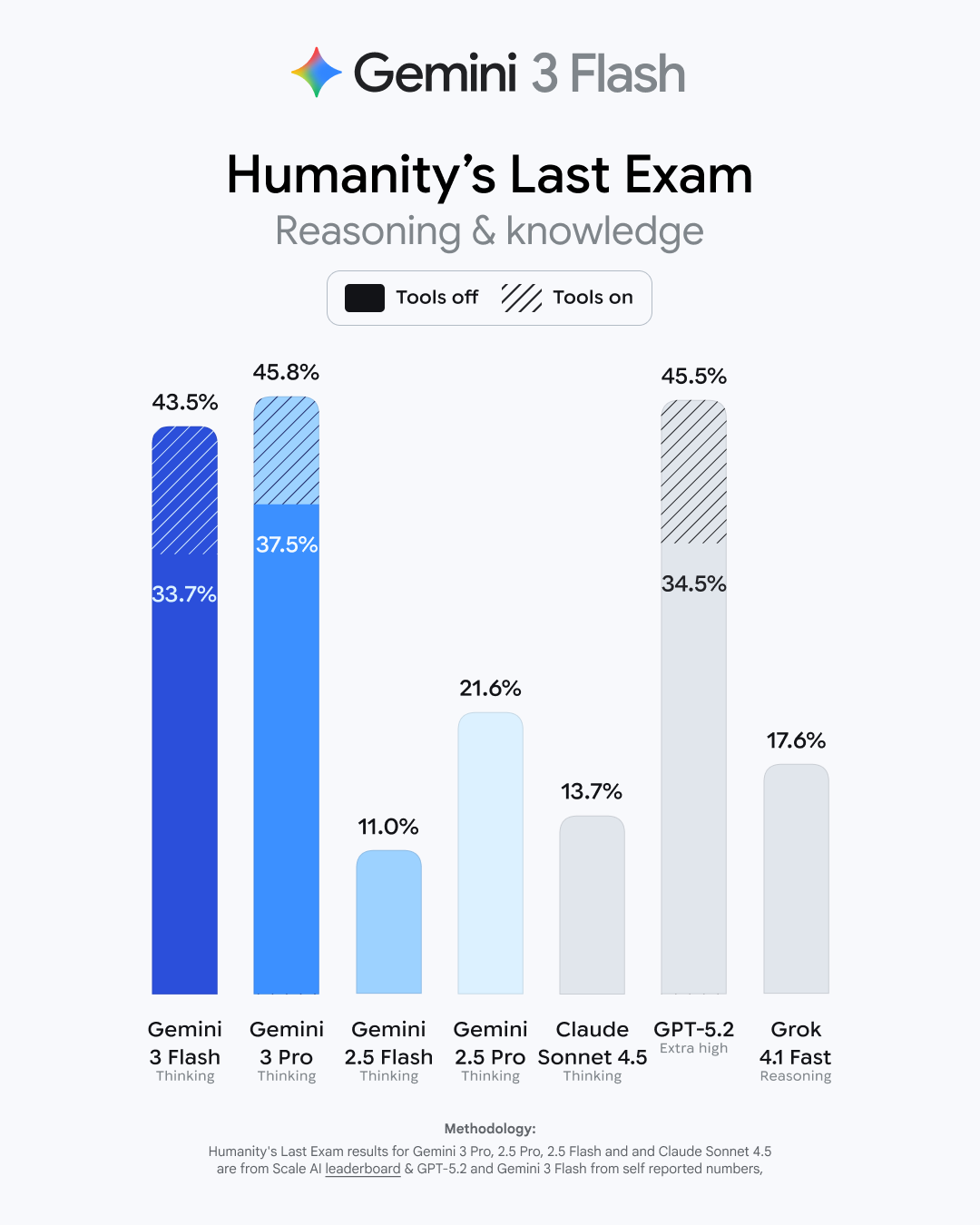
This may come as a shock, but Google says Gemini 3 Flash is faster and more capable than its previous base model. As usual, Google has a raft of benchmark numbers that show modest improvements for the new model. It bests the old 2.5 Flash in basic academic and reasoning tests like GPQA Diamond and MMMU Pro (where it even beats 3 Pro). It gets a larger boost in Humanity’s Last Exam (HLE), which tests advanced domain-specific knowledge. Gemini 3 Flash has tripled the old models’ score in HLE, landing at 33.7 percent without tool use. That’s just a few points behind the Gemini 3 Pro model.

Gemini HLE test

Credit: Google

Google is talking up Gemini 3 Flash’s coding skills, and the provided benchmarks seem to back that talk up. Over the past year, Google has mostly pushed its Pro models as the best for generating code, but 3 Flash has done a lot of catching up. In the popular SWE-Bench Verified test, Gemini 3 Flash has gained almost 20 points on the 2.5 branch.

The new model is also a lot less likely to get general-knowledge questions wrong. In the Simple QA Verified test, Gemini 3 Flash scored 68.7 percent, which is only a little below Gemini 3 Pro. The last Flash model scored just 28.1 percent on that test. At least as far as the evaluation scores go, Gemini 3 Flash performs much closer to Google’s Pro model versus the older 2.5 family. At the same time, it’s considerably more efficient, according to Google.

One of Gemini 3 Pro’s defining advances was its ability to generate interactive simulations and multimodal content. Gemini 3 Flash reportedly retains that underlying capability. Gemini 3 Flash offers better performance than Gemini 2.5 Pro did, but it runs workloads three times faster. It’s also a lot cheaper than the Pro models if you’re paying per token. One million input tokens for 3 Flash will run devs $0.50, and a million output tokens will cost $3. However, that’s an increase compared to Gemini 2.5 Flash input and output at $0.30 and $2.50, respectively. The Pro model’s tokens are $2 (1M input) and $12 (1M output).

https://arstechnica.com/google/2025/12/google-releases-gemini-3-flash-promising-improved-intelligence-and-efficiency/


Senators count the shady ways data centers pass energy costs on to Americans

“If data centers end up providing less business to the utility companies than anticipated, consumers could be left with massive electricity bills as utility companies recoup billions in new infrastructure costs, with nothing to show for it,” senators wrote.

Already, Utah, Oregon, and Ohio have passed laws “creating a separate class of utility customer for data centers which includes basic financial safeguards such as upfront payments and longer contract length,” senators noted, and Virginia is notably weighing a similar law.

At least one study, The New York Times noted, suggested that data centers may have recently helped reduce electricity costs by spreading the costs of upgrades over more customers, but those outcomes varied by state and could not account for future AI demand.

“It remains unclear whether broader, sustained load growth will increase long-run average costs and prices,” Lawrence Berkeley National Laboratory researchers concluded. “In some cases, spikes in load growth can result in significant, near-term retail price increase.”

Until companies prove they’re paying their fair share, senators expect electricity bills to keep climbing, particularly in vulnerable areas. That will likely only increase pressure for regulators to intervene, the director of the Electricity Law Initiative at the Harvard Law School Environmental and Energy Law Program, Ari Peskoe, suggested in September.

“The utility business model is all about spreading costs of system expansion to everyone, because we all benefit from a reliable, robust electricity system,” Peskoe said. “But when it’s a single consumer that is using so much energy—basically that of an entire city—and when that new city happens to be owned by the wealthiest corporations in the world, I think it’s time to look at the fundamental assumptions of utility regulation and make sure that these facilities are really paying for all of the infrastructure costs to connect them to the system and to power them.”

https://arstechnica.com/tech-policy/2025/12/shady-data-center-deals-doom-americans-to-higher-energy-bills-senators-say/