UK to “encourage” Apple and Google to put nudity-blocking systems on phones

The push for device-level blocking comes after the UK implemented the Online Safety Act, a law requiring porn platforms and social media firms to verify users’ ages before letting them view adult content. The law can’t fully prevent minors from viewing porn, as many people use VPN services to get around the UK age checks. Government officials may view device-level detection of nudity as a solution to that problem, but such systems would raise concerns about user rights and the accuracy of the nudity detection.

Age-verification battles in multiple countries

Apple and Google both provide optional tools that let parents control what content their children can access. The companies could object to mandates on privacy grounds, as they have in other venues.

When Texas enacted an age-verification law for app stores, Apple and Google said they would comply but warned of risks to user privacy. A lobby group that represents Apple, Google, and other tech firms then sued Texas in an attempt to prevent the law from taking effect, saying it “imposes a broad censorship regime on the entire universe of mobile apps.”

There’s another age-verification battle in Australia, where the government decided to ban social media for users under 16. Companies said they would comply, although Reddit sued Australia on Friday in a bid to overturn the law.

Apple this year also fought a UK demand that it create a backdoor for government security officials to access encrypted data. The Trump administration claimed it convinced the UK to drop its demand, but the UK is reportedly still seeking an Apple backdoor.

In another case, the image-sharing website Imgur blocked access for UK users starting in September while facing an investigation over its age-verification practices.

Apple faced a backlash in 2021 over potential privacy violations when it announced a plan to have iPhones scan photos for child sexual abuse material (CSAM). Apple ultimately dropped the plan.

https://arstechnica.com/tech-policy/2025/12/uk-to-encourage-apple-and-google-to-put-nudity-blocking-systems-on-phones/

Google will end dark web reports that alerted users to leaked data

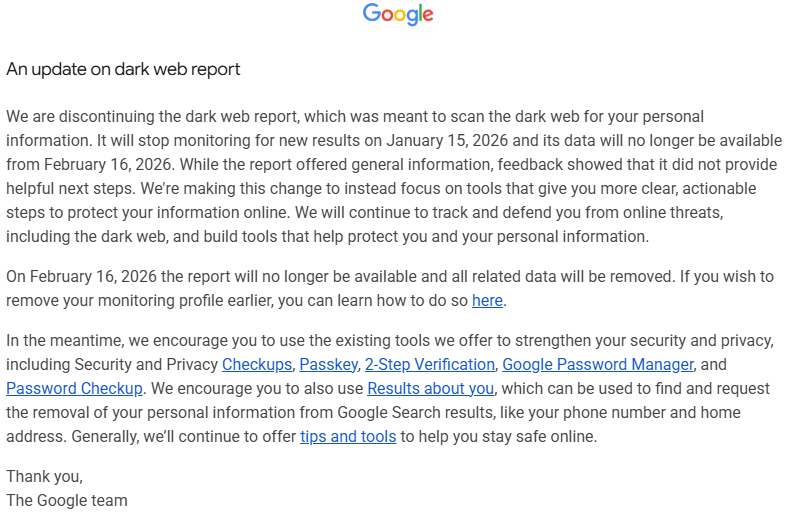
As Google admits in the email alert, its dark web scans didn’t offer much help. “Feedback showed that it did not provide helpful next steps,” Google said of the service. Here’s the full text of the email.

Google dark web email

Credit: Google

With other types of personal data alerts provided by the company, it has the power to do something. For example, you can have Google remove pages from search that list your personal data. Google doesn’t run anything on the dark web, though, so all it can do is remind you that your data is being passed around in one of the shadier corners of the Internet.

The shutdown begins on January 15, when Google will stop conducting new scans for user data on the dark web. Past data will no longer be available as of February 16, 2026. Google says it will delete all past reports at that time. However, users can remove their monitoring profile earlier in the account settings. This change does not impact any of Google’s other privacy reports.

The good news is that the best ways to protect your personal data from being shuffled around the dark web are the same ones that keep you safe on the open web. Google suggests always using two-step verification, and tools like Passkeys and Google’s password checkup can ensure you don’t accidentally reuse a compromised password. Stay safe out there.

https://arstechnica.com/gadgets/2025/12/google-is-shutting-down-dark-web-reports-in-january-because-they-werent-helpful/


OpenAI built an AI coding agent and uses it to improve the agent itself

Ed Bayes, a designer on the Codex team, described how the tool has changed his own workflow. Bayes said Codex now integrates with project management tools like Linear and communication platforms like Slack, allowing team members to assign coding tasks directly to the AI agent. “You can add Codex, and you can basically assign issues to Codex now,” Bayes told Ars. “Codex is literally a teammate in your workspace.”

This integration means that when someone posts feedback in a Slack channel, they can tag Codex and ask it to fix the issue. The agent will create a pull request, and team members can review and iterate on the changes through the same thread. “It’s basically approximating this kind of coworker and showing up wherever you work,” Bayes said.

For Bayes, who works on the visual design and interaction patterns for Codex’s interfaces, the tool has enabled him to contribute code directly rather than handing off specifications to engineers. “It kind of gives you more leverage. It enables you to work across the stack and basically be able to do more things,” he said. He noted that designers at OpenAI now prototype features by building them directly, using Codex to handle the implementation details.

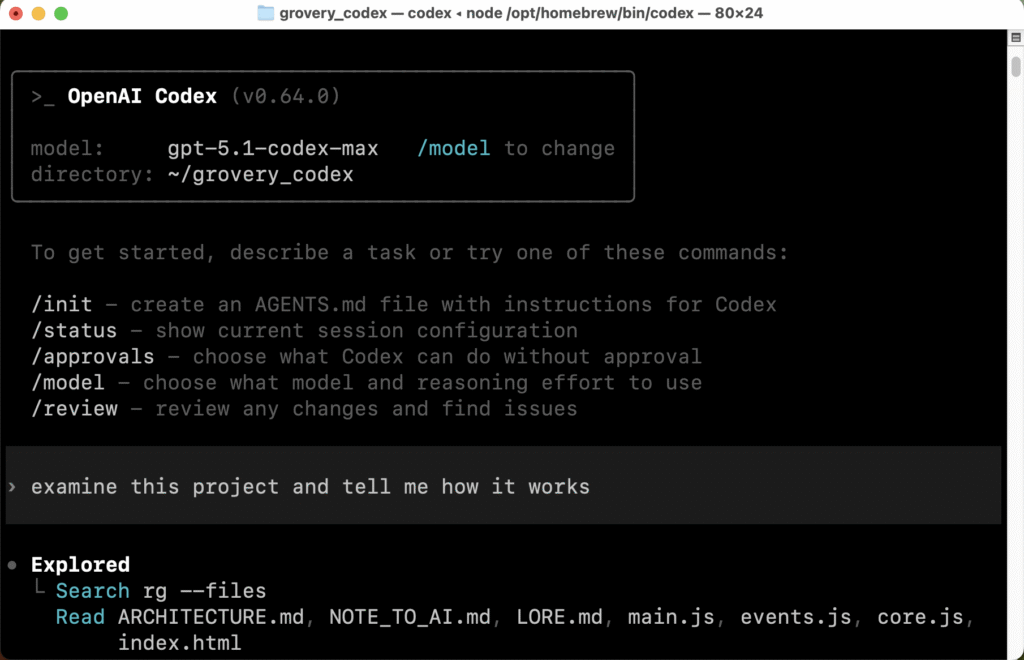
The command line version of OpenAI codex running in a macOS terminal window.

The command line version of OpenAI codex running in a macOS terminal window. Credit: Benj Edwards

OpenAI’s approach treats Codex as what Bayes called “a junior developer” that the company hopes will graduate into a senior developer over time. “If you were onboarding a junior developer, how would you onboard them? You give them a Slack account, you give them a Linear account,” Bayes said. “It’s not just this tool that you go to in the terminal, but it’s something that comes to you as well and sits within your team.”

Given this teammate approach, will there be anything left for humans to do? When asked, Embiricos drew a distinction between “vibe coding,” where developers accept AI-generated code without close review, and what AI researcher Simon Willison calls “vibe engineering,” where humans stay in the loop. “We see a lot more vibe engineering in our code base,” he said. “You ask Codex to work on that, maybe you even ask for a plan first. Go back and forth, iterate on the plan, and then you’re in the loop with the model and carefully reviewing its code.”

https://arstechnica.com/ai/2025/12/how-openai-is-using-gpt-5-codex-to-improve-the-ai-tool-itself/


Google Translate expands live translation to all earbuds on Android

Gemini text translation

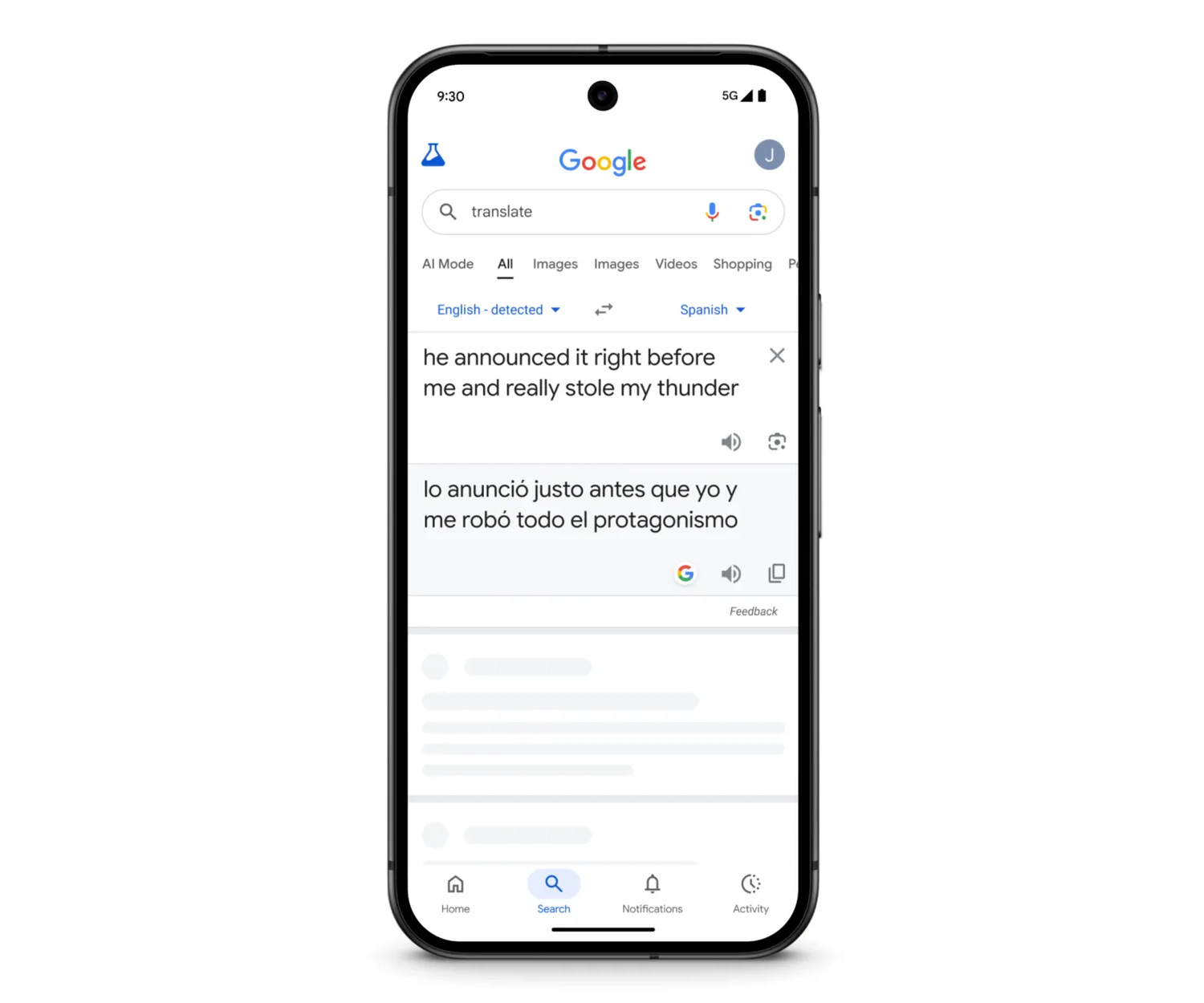
Translate can now use Gemini to interpret the meaning of a phrase rather than simply translating each word.

Credit: Google

Translate can now use Gemini to interpret the meaning of a phrase rather than simply translating each word. Credit: Google

Regardless of whether you’re using live translate or just checking a single phrase, Google claims the Gemini-powered upgrade will serve you well. Google Translate is now apparently better at understanding the nuance of languages, with an awareness of idioms and local slang. Google uses the example of “stealing my thunder,” which wouldn’t make a lick of sense when translated literally into other languages. The new translation model, which is also available in the search-based translation interface, supports over 70 languages.

Google also debuted language-learning features earlier this year, borrowing a page from educational apps like Duolingo. You can tell the app your skill level with a language, as well as whether you need help with travel-oriented conversations or more everyday interactions. The app uses this to create tailored listening and speaking exercises.

AI Translate learning

The Translate app’s learning tools are getting better.

Credit: Google

The Translate app’s learning tools are getting better. Credit: Google

With this big update, Translate will be more of a stickler about your pronunciation. Google promises more feedback and tips based on your spoken replies in the learning modules. The app will also now keep track of how often you complete language practice, showing your daily streak in the app.

If “number go up” will help you learn more, then this update is for you. Practice mode is also launching in almost 20 new countries, including Germany, India, Sweden, and Taiwan.

https://arstechnica.com/google/2025/12/google-translate-learns-slang-and-idioms-expands-live-translation-beyond-pixel-buds/


Google is reviving wearable gesture controls, but only for the Pixel Watch 4

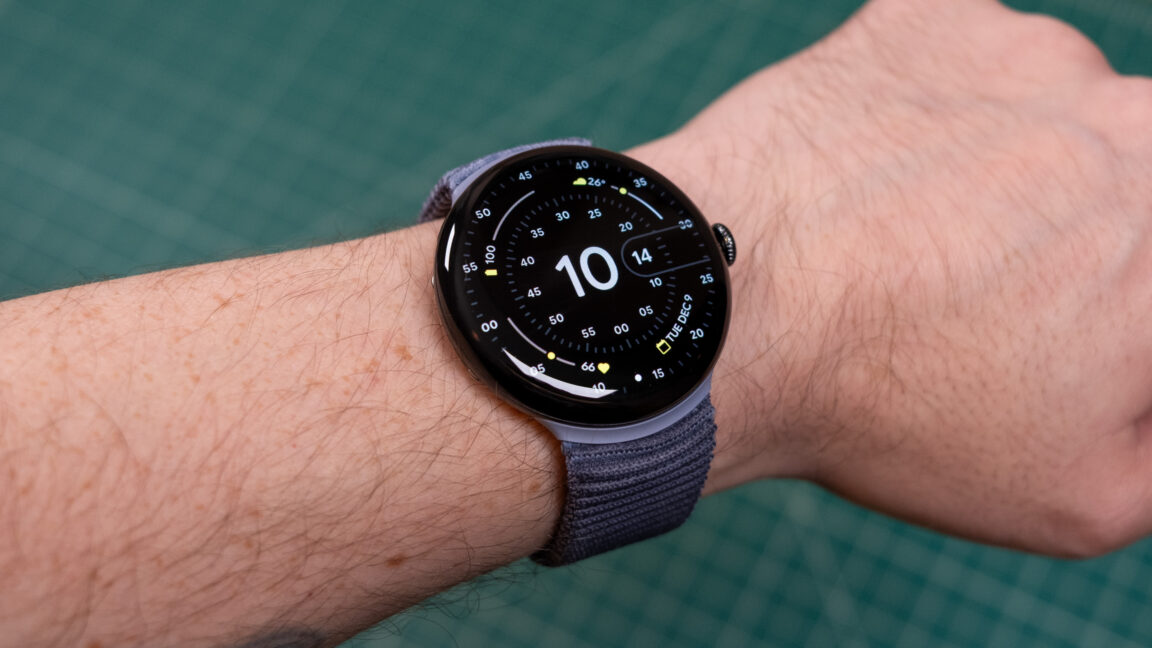
Long ago, Google’s Android-powered wearables had hands-free navigation gestures. Those fell by the wayside as Google shredded its wearable strategy over and over, but gestures are back, baby. The Pixel Watch 4 is getting an update that adds several gestures, one of which is straight out of the Apple playbook.

When the update hits devices, the Pixel Watch 4 will gain a double pinch gesture like the Apple Watch has. By tapping your thumb and forefinger together, you can answer or end calls, pause timers, and more. The watch will also prompt you at times when you can use the tap gesture to control things.

In previous incarnations of Google-powered watches, a quick wrist turn gesture would scroll through lists. In the new gesture system, that motion dismisses what’s on the screen. For example, you can clear a notification from the screen or dismiss an incoming call. Pixel Watch 4 owners will also enjoy this one when the update arrives.

And what about the Pixel Watch 3? That device won’t get gesture support at this time. There’s no reason it shouldn’t get the same features as the latest wearable, though. The Pixel Watch 3 has a very similar Arm chip, and it has the same orientation sensors as the new watch. The Pixel Watch 4’s main innovation is a revamped case design that allows for repairability, which was not supported on the Pixel Watch 3 and earlier.

https://arstechnica.com/gadgets/2025/12/google-is-reviving-wearable-gesture-controls-but-only-for-the-pixel-watch-4/


Google tells employees it must double capacity every 6 months to meet AI demand

While AI bubble talk fills the air these days, with fears of overinvestment that could pop at any time, something of a contradiction is brewing on the ground: Companies like Google and OpenAI can barely build infrastructure fast enough to fill their AI needs.

During an all-hands meeting earlier this month, Google’s AI infrastructure head Amin Vahdat told employees that the company must double its serving capacity every six months to meet demand for artificial intelligence services, reports CNBC. Vahdat, a vice president at Google Cloud, presented slides showing the company needs to scale “the next 1000x in 4-5 years.”

While a thousandfold increase in compute capacity sounds ambitious by itself, Vahdat noted some key constraints: Google needs to be able to deliver this increase in capability, compute, and storage networking “for essentially the same cost and increasingly, the same power, the same energy level,” he told employees during the meeting. “It won’t be easy but through collaboration and co-design, we’re going to get there.”

It’s unclear how much of this “demand” Google mentioned represents organic user interest in AI capabilities versus the company integrating AI features into existing services like Search, Gmail, and Workspace. But whether users are using the features voluntarily or not, Google isn’t the only tech company struggling to keep up with a growing user base of customers using AI services.

Major tech companies are in a race to build out data centers. Google competitor OpenAI is planning to build six massive data centers across the US through its Stargate partnership project with SoftBank and Oracle, committing over $400 billion in the next three years to reach nearly 7 gigawatts of capacity. The company faces similar constraints serving its 800 million weekly ChatGPT users, with even paid subscribers regularly hitting usage limits for features like video synthesis and simulated reasoning models.

“The competition in AI infrastructure is the most critical and also the most expensive part of the AI race,” Vahdat said at the meeting, according to CNBC’s viewing of the presentation. The infrastructure executive explained that Google’s challenge goes beyond simply outspending competitors. “We’re going to spend a lot,” he said, but noted the real objective is building infrastructure that is “more reliable, more performant and more scalable than what’s available anywhere else.”

https://arstechnica.com/ai/2025/11/google-tells-employees-it-must-double-capacity-every-6-months-to-meet-ai-demand/


Google’s latest swing at Chromebook gaming is a free year of GeForce Now

Earlier this year, Google announced the end of its efforts to get Steam running on Chromebooks, but it’s not done trying to make these low-power laptops into gaming machines. Google has teamed up with Nvidia to offer a version of GeForce Now cloud streaming that is perplexingly limited in some ways and generous in others. Starting today, anyone who buys a Chromebook will get a free year of a new service called GeForce Now Fast Pass. There are no ads and less waiting for server slots, but you don’t get to play very long.

Back before Google killed its Stadia game streaming service, it would often throw in a few months of the Pro subscription with Chromebook purchases. In the absence of its own gaming platform, Google has turned to Nvidia to level up Chromebook gaming. GeForce Now (GFN), which has been around in one form or another for more than a decade, allows you to render games on a remote server and stream the video output to the device of your choice. It works on computers, phones, TVs, and yes, Chromebooks.

The new Chromebook feature is not the same GeForce Now subscription you can get from Nvidia. Fast Pass, which is exclusive to Chromebooks, includes a mishmash of limits and bonuses that make it a pretty strange offering. Fast Pass is based on the free tier of GeForce Now, but users will get priority access to server slots. So no queuing for five or 10 minutes to start playing. It also lacks the ads that Nvidia’s standard free tier includes. Fast Pass also uses the more powerful RTX servers, which are otherwise limited to the $10-per-month ($100 yearly) Performance tier.

https://arstechnica.com/gaming/2025/11/googles-latest-swing-at-chromebook-gaming-is-a-free-year-of-geforce-now/


“Hey Google, did you upgrade your AI in my Android Auto?”

Now it’s “Hey Google” not “OK Google” to trigger the assistant, which had started feeling a little left behind in terms of natural language processing and conversational AI to other OEM systems—sometimes even AAOS-based ones—that used solutions like those from Cerence running on their own private clouds.

Gemini

Going forward, “Hey Google” will fire up Gemini, as long as it’s running on the Android device being cast to the car’s infotainment system. In fact, we learned of its impending, unspecified arrival a couple of weeks ago, but today is the day, according to Google.

Now, instead of needing to know precise trigger phrases to get Google Assistant to do what you’d like it to do, Gemini should be able to answer the kinds of normal speech questions that so often frustrate me when I try them with Siri or most built-in in-car AI helpers.

For example, you could ask if there are any well-rated restaurants along a particular route, with the ability to have Gemini drill down into search results like menu options. (Whether these are as trustworthy as the AI suggestions that confront us when we use Google as a search engine will need to be determined.) Sending messages should supposedly be easier, with translation into 40 different languages should the need arise, and it sounds like making playlists and even finding info on one’s destination have both become more powerful.

There’s even the dreaded intrusion of productivity, as Gemini can access your Gmail, calendars, tasks, and so on.

A polestar interior

Google Gemini is coming to all Polestar models. Credit: Polestar

Gemini is also making its way into built-in Google automotive environments. Just yesterday, Polestar announced that Gemini will replace Google Assistant in all its models, from the entry-level Polestar 2 through to soon-to-arrive machines like the Polestar 5 four-door grand tourer.

“Our collaboration with Google is a great example of how we continue to evolve the digital experience in our cars. Gemini brings the next generation of AI voice interaction into the car, and we’re excited to give a first look at how it will enhance the driving experience,” said Polestar’s head of UI/UX, Sid Odedra.

https://arstechnica.com/cars/2025/11/hey-google-did-you-upgrade-your-ai-in-my-android-auto/


AI, Pichai (CEO Google): “Se la bolla scoppia nessuno immune”. E intanto da SoftBank a Peter Thiel tutti vendono azioni Nvidia

“Se la bolla dell’IA dovesse scoppiare, nessuna azienda sarebbe immune, Google compresa”.

Queste parole sono state dette non da uno qualunque ma dal CEO di Alphabet e Google, Sundar Pichai, in un’intervista esclusiva alla BBC nella sede di Mountain View. Per il capo di Big G. “l’ondata di investimenti nell’intelligenza artificiale è straordinaria, ma è anche segnata da “elementi di irrazionalità”.

Il vero problema che fa paura a tutti? Quello energetico

Pichai sottolinea come l’attuale ciclo di investimenti abbia raggiunto dimensioni senza precedenti. Google, per esempio, è passata da meno di 30 miliardi di dollari di spesa annua a oltre 90 miliardi, mentre l’intero settore ha superato la soglia del trilione di dollari destinati a infrastrutture e sviluppo.

Una corsa alimentata dalla crescente domanda di strumenti come Gemini, dai nuovi superchip proprietari e dalla competizione sempre più serrata con OpenAI e gli altri protagonisti globali.

Il manager mette però in guardia anche sull’enorme fabbisogno energetico dell’AI: secondo l’Agenzia Internazionale dell’Energia, i data center rappresentavano già l’1,5% dei consumi globali nel 2023. Una sfida che, secondo Pichai, richiede infrastrutture e fonti rinnovabili più ambiziose per non frenare l’innovazione e la crescita.

Clem Delangue, cofondatore e CEO di Hugging Face: “La bolla? Non è dell’AI, ma degli LLM”

Clem Delangue, cofondatore e CEO di Hugging Face, sostiene che l’attuale euforia nel settore tecnologico non sia una bolla generalizzata sull’AI, bensì una specifica ‘bolla degli LLM’ (large language models).

Durante un evento organizzato da Axios, Delangue ha spiegato che l’interesse eccessivo per modelli linguistici generali, come quelli che alimentano ChatGPT o Gemini, potrebbe ridimensionarsi nel breve termine, mentre l’AI, nella sua interezza, è ancora in una fase iniziale di espansione.

Secondo Delangue, la convinzione che un singolo modello possa risolvere ogni problema è illusoria. A suo avviso, il futuro sarà dominato da una pluralità di modelli più piccoli, specifici e personalizzabili, adatti a contesti aziendali e infrastrutture locali.

Tutti vendono azioni Nvidia: da Softbank a Peter Thiel

Thiel Macro, l’hedge fund di Peter Thiel, ha chiuso venduto completamente la sue azioni in Nvidia nel terzo trimestre del 2025. L’operazione ha riguardato 537.742 azioni, per un controvalore di circa 100 milioni di dollari calcolato sui prezzi di chiusura del 30 settembre. La mossa conferma come alcuni grandi investitori stiano scegliendo di ridurre l’esposizione sui titoli più surriscaldati del settore AI.

La decisione di Thiel Macro arriva a distanza di pochi giorni da un’altra uscita di peso: SoftBank ha infatti liquidato l’intera partecipazione in Nvidia per 5,8 miliardi di dollari. Il gruppo giapponese ha spiegato che le risorse saranno reindirizzate verso nuovi investimenti nell’intelligenza artificiale, confermando una strategia rivolta a rafforzare ulteriormente la sua presenza nei modelli e nelle tecnologie di nuova generazione.

Nonostante l’uscita da Nvidia, il fondo rimane investito in Apple, Microsoft e, in misura più contenuta, in Tesla. Peter Thiel resta una figura centrale nell’ecosistema tech americano: cofondatore di PayPal insieme a Elon Musk, primo grande finanziatore esterno di Facebook, presidente di Palantir Technologies e voce influente nel panorama politico statunitense, dove mantiene rapporti stretti con il presidente Donald Trump.

Leggi le altre notizie sull’home page di Key4biz

https://www.key4biz.it/ai-pichai-ceo-google-se-la-bolla-scoppia-nessuno-immune-e-intanto-da-softbank-a-peter-thiel-tutti-vendono-azioni-nvidia/556054/


Google CEO: If an AI bubble pops, no one is getting out clean

Market concerns and Google’s position

Alphabet’s recent market performance has been driven by investor confidence in the company’s ability to compete with OpenAI’s ChatGPT, as well as its development of specialized chips for AI that can compete with Nvidia’s. Nvidia recently reached a world-first $5 trillion valuation due to making GPUs that can accelerate the matrix math at the heart of AI computations.

Despite acknowledging that no company would be immune to a potential AI bubble burst, Pichai argued that Google’s unique position gives it an advantage. He told the BBC that the company owns what he called a “full stack” of technologies, from chips to YouTube data to models and frontier science research. This integrated approach, he suggested, would help the company weather any market turbulence better than competitors.

Pichai also told the BBC that people should not “blindly trust” everything AI tools output. The company currently faces repeated accuracy concerns about some of its AI models. Pichai said that while AI tools are helpful “if you want to creatively write something,” people “have to learn to use these tools for what they’re good at and not blindly trust everything they say.”

In the BBC interview, the Google boss also addressed the “immense” energy needs of AI, acknowledging that the intensive energy requirements of expanding AI ventures have caused slippage on Alphabet’s climate targets. However, Pichai insisted that the company still wants to achieve net zero by 2030 through investments in new energy technologies. “The rate at which we were hoping to make progress will be impacted,” Pichai said, warning that constraining an economy based on energy “will have consequences.”

Even with the warnings about a potential AI bubble, Pichai did not miss his chance to promote the technology, albeit with a hint of danger regarding its widespread impact. Pichai described AI as “the most profound technology” humankind has worked on.

“We will have to work through societal disruptions,” he said, adding that the technology would “create new opportunities” and “evolve and transition certain jobs.” He said people who adapt to AI tools “will do better” in their professions, whatever field they work in.

https://arstechnica.com/ai/2025/11/googles-sundar-pichai-warns-of-irrationality-in-trillion-dollar-ai-investment-boom/