Microsoft’s new AI agent can control software and robots

On Wednesday, Microsoft Research introduced Magma, an integrated AI foundation model that combines visual and language processing to control software interfaces and robotic systems. If the results hold up outside of Microsoft’s internal testing, it could mark a meaningful step forward for an all-purpose multimodal AI that can operate interactively in both real and digital spaces.

Microsoft claims that Magma is the first AI model that not only processes multimodal data (like text, images, and video) but can also natively act upon it—whether that’s navigating a user interface or manipulating physical objects. The project is a collaboration between researchers at Microsoft, KAIST, the University of Maryland, the University of Wisconsin-Madison, and the University of Washington.

We’ve seen other large language model-based robotics projects like Google’s PALM-E and RT-2 or Microsoft’s ChatGPT for Robotics that utilize LLMs for an interface. However, unlike many prior multimodal AI systems that require separate models for perception and control, Magma integrates these abilities into a single foundation model.

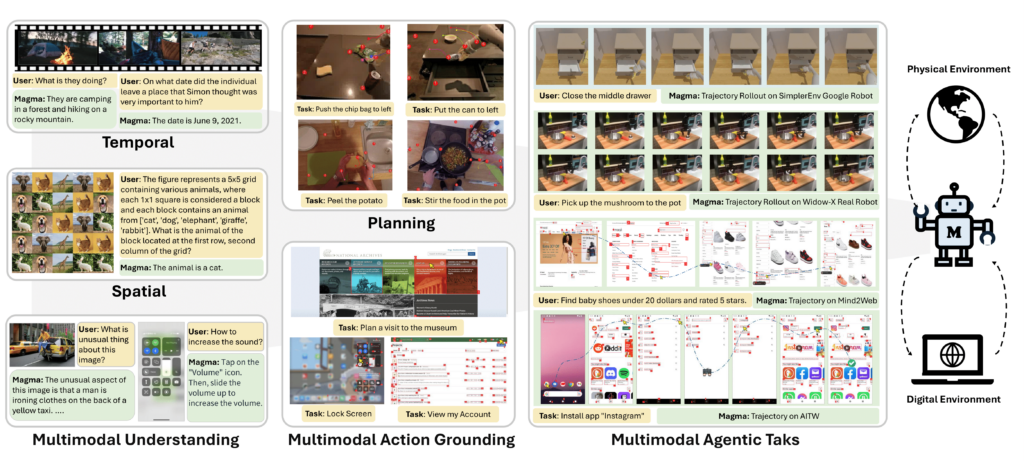
A combined graphic that shows off various capabilities of the Magma model.
A combined graphic that shows off various capabilities of the Magma model. Credit: Microsoft Research

Microsoft is positioning Magma as a step toward agentic AI, meaning a system that can autonomously craft plans and perform multistep tasks on a human’s behalf rather than just answering questions about what it sees.

“Given a described goal,” Microsoft writes in its research paper. “Magma is able to formulate plans and execute actions to achieve it. By effectively transferring knowledge from freely available visual and language data, Magma bridges verbal, spatial, and temporal intelligence to navigate complex tasks and settings.”

Microsoft is not alone in its pursuit of agentic AI. OpenAI has been experimenting with AI agents through projects like Operator that can perform UI tasks in a web browser, and Google has explored multiple agentic projects with Gemini 2.0.

Spatial intelligence

While Magma builds off of Transformer-based LLM technology that feeds training tokens into a neural network, it’s different from traditional vision-language models (like GPT-4V, for example) by going beyond what they call “verbal intelligence” to also include “spatial intelligence” (planning and action execution). By training on a mix of images, videos, robotics data, and UI interactions, Microsoft claims that Magma is a true multimodal agent rather than just a perceptual model.

https://arstechnica.com/ai/2025/02/microsofts-new-ai-agent-can-control-software-and-robots/


Waterworth, il cavo sottomarino lungo 50 mila km. Meta si arrotola sul mondo

Waterworth, il cavo dei record

Meta ha annunciato Project Waterworth, un’iniziativa unica nella storia delle telecomunicazioni globali. Una volta completato, si avrà un cavo sottomarino che si estenderà per oltre 50.000 km, superando la circonferenza terrestre e diventando il più lungo mai realizzato. Con una copertura che raggiungerà Stati Uniti, India, Brasile, Sudafrica e altre regioni chiave, Waterworth promette di ridefinire la connettività globale.

I cavi sottomarini sono il pilastro dell’infrastruttura digitale planetaria, trasportando oltre il 95% del traffico intercontinentale. Waterworth rappresenta un investimento plurimiliardario che si svilupperà in più anni, aprendo tre nuovi corridoi oceanici e garantendo una connettività ultra-veloce, indispensabile per l’innovazione nell’intelligenza artificiale (AI) e le tecnologie emergenti.

L’impatto globale del progetto Meta

L’iniziativa non si limita a migliorare la velocità e l’affidabilità della rete globale, ma ha anche implicazioni economiche e sociali significative. In paesi come l’India, dove il settore digitale sta conoscendo un’espansione esponenziale, contribuirà ad accelerare la trasformazione digitale, sostenendo le ambizioni nazionali per un’economia digitale avanzata.

Analogamente, leggendo il comunicato aziendale. il progetto rafforzerà le infrastrutture di connettività in regioni emergenti come il Sud America e l’Africa, creando nuove opportunità di sviluppo economico e facilitando l’inclusione digitale di milioni di persone.

Un nuovo tipo di cavo sottomarino: 24 coppie di fibre ottiche

Meta ha una lunga esperienza nello sviluppo di cavi sottomarini innovativi, avendo già partecipato alla realizzazione di oltre 20 progetti negli ultimi dieci anni. Waterworth porterà ulteriormente avanti questa evoluzione, con 24 coppie di fibre ottiche, rispetto alle 8-16 dei sistemi tradizionali.

Stando alle informazioni diramante dall’azienda di San Francisco, parliamo di un livello di connettività potenzialmente senza pari, finalizzato a soddisfare la crescente domanda globale di dati.

Il cavo sarà posizionato principalmente in acque profonde fino a 7.000 metri, riducendo il rischio di danni accidentali. Inoltre, nelle zone costiere ad alto rischio, verranno impiegate tecniche di seppellimento avanzate per proteggere il cavo da pericoli come ancore di navi e movimenti sismici.

L’espansione della connettività non riguarda solo l’internet tradizionale, ma rappresenta una componente critica per il futuro dell’AI e di altre tecnologie avanzate. Con la crescente dipendenza da infrastrutture ad alta velocità e bassa latenza, il progetto di Meta fungerà da spina dorsale per l’elaborazione e il trasferimento dei dati su scala globale.

Meta si arrotola sul mondo: i cavi e il controllo sui dati

Meta sta inoltre realizzando altre infrastrutture sottomarine, altrettanto imponenti e finalizzate al controllo del flusso globale di dati. Con investimenti miliardari, partecipa infatti a progetti come 2Africa (il più grande cavo sottomarino mai realizzato, lungo 45.000 km), o Echo e Bifrost, che collegano USA e Asia.

Questo sforzo della società americana mira a raggiungere diversi obiettivi che vanno valutati attentamente:

  1. Centralizzazione del traffico internet – Se Meta controlla le rotte digitali, può influenzare direttamente la velocità, il costo e l’accesso ai dati. Questo crea una dipendenza tecnologica critica.
  2. Monopolio sull’infrastruttura – Il dominio delle Big Tech (Google, Meta, Amazon, Microsoft) sta riducendo il ruolo di governi e operatori tradizionali come Orange, Vodafone e Telefonica, con impatti sulla regolamentazione e la concorrenza.
  3. Privacy e sorveglianza – Più Meta controlla l’infrastruttura, più aumenta il rischio che possa gestire, analizzare o persino sfruttare i dati trasmessi, soprattutto in Paesi con regolamentazioni deboli sulla protezione delle informazioni.
  4. Geopolitica digitale – Il predominio di aziende statunitensi sulle reti globali potrebbe escludere altre nazioni o limitarne l’accesso a internet indipendente, mentre Cina e Russia stanno costruendo reti alternative per ridurre la dipendenza dalle Big Tech occidentali.

L’aumento di capacità da parte di Meta di realizzare cavi sottomarini solleva necessariamente degli interrogativi sulla neutralità della rete, la sicurezza dei dati e la sovranità digitale dei Paesi, consolidando sempre più potere nelle mani di una sola azienda (ma la stessa cosa vale per le altre Big Tech).

Il mondo nascosto dei cavi sottomarini

I cavi sottomarini sono fondamentali per la connettività globale, con oltre 485 cavi che coprono 900.000 miglia negli oceani. Le Big Tech dominano sempre più il settore: Google è il maggiore investitore privato, con oltre 20 cavi, mentre Meta, Amazon e Microsoft hanno investito miliardi in progetti come Echo e Bifrost.

Il controllo di queste infrastrutture ha implicazioni strategiche sotto diversi punti di vista: sovranità digitale (dipendenza da aziende straniere aumenta i rischi per sicurezza e dati), competitività tecnologica (chi gestisce i cavi regola costi e velocità delle telecomunicazioni), geopolitica (gli USA bloccano tecnologie cinesi nei cavi, mentre la Cina sviluppa rotte indipendenti), sviluppo economico (Paesi senza investimenti in cavi rischiano marginalizzazione nell’economia digitale).

Caso emblematico è la “guerra dei cavi” USA-Cina: Washington ha bloccato il Pacific Light Cable Network, spingendo Pechino a investire nel Peace Cable tra Asia, Africa ed Europa. Il dominio su queste reti è definitivamente cruciale per sicurezza, economia e indipendenza digitale di ogni Paese.

Leggi le altre notizie sull’home page di Key4biz

https://www.key4biz.it/waterworth-il-cavo-sottomarino-lungo-50-mila-km-meta-si-arrotola-sul-mondo/521675/


New hack uses prompt injection to corrupt Gemini’s long-term memory

[embedded content]

Google Gemini: Hacking Memories with Prompt Injection and Delayed Tool Invocation.

Based on lessons learned previously, developers had already trained Gemini to resist indirect prompts instructing it to make changes to an account’s long-term memories without explicit directions from the user. By introducing a condition to the instruction that it be performed only after the user says or does some variable X, which they were likely to take anyway, Rehberger easily cleared that safety barrier.

“When the user later says X, Gemini, believing it’s following the user’s direct instruction, executes the tool,” Rehberger explained. “Gemini, basically, incorrectly ‘thinks’ the user explicitly wants to invoke the tool! It’s a bit of a social engineering/phishing attack but nevertheless shows that an attacker can trick Gemini to store fake information into a user’s long-term memories simply by having them interact with a malicious document.”

Cause once again goes unaddressed

Google responded to the finding with the assessment that the overall threat is low risk and low impact. In an emailed statement, Google explained its reasoning as:

In this instance, the probability was low because it relied on phishing or otherwise tricking the user into summarizing a malicious document and then invoking the material injected by the attacker. The impact was low because the Gemini memory functionality has limited impact on a user session. As this was not a scalable, specific vector of abuse, we ended up at Low/Low. As always, we appreciate the researcher reaching out to us and reporting this issue.

Rehberger noted that Gemini informs users after storing a new long-term memory. That means vigilant users can tell when there are unauthorized additions to this cache and can then remove them. In an interview with Ars, though, the researcher still questioned Google’s assessment.

“Memory corruption in computers is pretty bad, and I think the same applies here to LLMs apps,” he wrote. “Like the AI might not show a user certain info or not talk about certain things or feed the user misinformation, etc. The good thing is that the memory updates don’t happen entirely silently—the user at least sees a message about it (although many might ignore).”

https://arstechnica.com/security/2025/02/new-hack-uses-prompt-injection-to-corrupt-geminis-long-term-memory/


Google Chrome may soon use “AI” to replace compromised passwords

Google’s Chrome browser might soon get a useful security upgrade: detecting passwords used in data breaches and then generating and storing a better replacement. Google’s preliminary copy suggests it’s an “AI innovation,” though exactly how is unclear.

Noted software digger Leopeva64 on X found a new offering in the AI settings of a very early build of Chrome. The option, “Automated password Change” (so, early stages—as to not yet get a copyedit), is described as, “When Chrome finds one of your passwords in a data breach, it can offer to change your password for you when you sign in.”

Chrome already has a feature that warns users if the passwords they enter have been identified in a breach and will prompt them to change it. As noted by Windows Report, the change is that now Google will offer to change it for you on the spot rather than simply prompting you to handle that elsewhere. The password is automatically saved in Google’s Password Manager and “is encrypted and never seen by anyone,” the settings page claims.

If you want to see how this works, you need to download a Canary version of Chrome. In the flags settings (navigate to “chrome://flags” in the address bar), you’ll need to enable two features: “Improved password change service” and “Mark all credential as leaked,” the latter to force the change notification because, presumably, it’s not hooked up to actual leaked password databases yet. Go to almost any non-Google site, enter in any user/password combination to try to log in, and after it fails or you navigate elsewhere, a prompt will ask you to consider changing your password.

https://arstechnica.com/gadgets/2025/02/google-chrome-may-soon-use-ai-to-detect-leaked-passwords-and-replace-them/


Ad Buyers Blast Google, Amazon, and Others After Ads Appear on Site Hosting Child Abuse Content


.article-native-ad { border-bottom: 1px solid #ddd; margin: 0 45px; padding-bottom: 20px; margin-bottom: 20px; } .article-native-ad svg { color: #ddd; font-size: 34px; margin-top: 10px; } .article-native-ad p { line-height:1.5; padding:0!important; padding-left: 10px!important; } .article-native-ad strong { font-weight:500; color:rgb(46,179,178); }

Social media is evolving. Are you adapting? Connect with a community of brand pros and content creators at Social Media Week, May 12–14 in NYC, to learn how to keep pace with new trends and technology. Register now to save 20% on your pass.

Ad buyers are pointing the finger at Google, Amazon, and brand safety firms like Integral Ad Science and DoubleVerify after a report from research firm Adalytics claimed that ads for top brands like Sony, Pepsi, and the NFL appeared on ibb.co or imgbb.com—sites that have been flagged by the National Center for Missing & Exploited Children for hosting child sexual abuse material (CSAM).

Google and Amazon don’t provide enough data

On Friday, Senators Marsha Blackburn (R-TN) and Richard Blumenthal (D-CT) criticized Google and Amazon for obscuring ad placement data, preventing advertisers from seeing the exact URLs where their ads appeared on imgbb.com.

Neither company typically provides full URL-level reporting to advertisers, multiple sources told ADWEEK. 

Instead, most ad buyers receive domain-level reports, which reveal the broader website but not the specific webpage—preventing them from knowing, for example, whether their ads appeared next to a reputable article or on a subpage with objectionable content. 

Without access to exact URLs, senators said, advertisers can’t ensure their messages aren’t appearing next to illegal or policy-violating content.

Media executives at two different consumer brands whose ads appeared on ibb.co via Amazon’s demand-side-platform each confirmed to ADWEEK that Amazon provided them only with domain-level data about ad buys—and that multiple requests for URL-level data were not fulfilled. 

ADWEEK reviewed a recent email sent to one exec in which an Amazon representative said that the company cannot provide full URL-level reporting.

A spokesperson for Amazon did not respond to a question from ADWEEK about whether URL-level data is available to advertisers.

A Google spokesperson, however, said: “Advertisers can access campaign reporting in the Google Ads UI about where their ads run. This may include site and URL-level reporting depending on the ad inventory and campaign type.”

Both Amazon and Google told ADWEEK that they’ve blocked the site in question.

Two ad buyers at agencies and two at brands said they paid vendors including IAS and DoubleVerify for brand safety technology, and those vendors marked impressions on ibb.co or imgbb.com as entirely brand-safe. 

IAS and DoubleVerify are under fire

IAS and DoubleVerify are the biggest firms that sell brand safety tech, with market caps of $1.73 billion and $3.67 billion respectively.

“Their tech quite simply does not do what they say it does,” said one of the buyers who spoke to ADWEEK on the condition of anonymity.

“The blame lies … with any verification company that even pretends to offer brand safety products that could [allow ads to] appear on something so horrific,” said Jay Friedman, CEO of independent media agency Goodway Group, who reviewed an advance copy of Adalytics’ report. 

The industry bodies that certify vendors’ ad verification and safety practices are also being blamed. Both DoubleVerify and IAS have the TAG Brand Safety Certified Seal, signaling compliance with brand safety standards in digital advertising, as well as MRC certifications for meeting specific brand safety and suitability criteria. 

Letters published Friday by Senators Blackburn and Blumenthal, written in response to Adalytics’ report, called out the certification organizations’ failures to protect advertisers’ interests and uphold their own standards: “TAG has failed to enforce its standards and investigate non-compliance, resulting in the continued funding of CSAM and other criminal activity for years.”

“A lot of the blame here is on MRC and TAG, who are certifying these vendors,” said Arielle Garcia, chief operating officer of adtech watchdog Check My Ads, who advised the lawmakers. “I cannot fathom that any advertiser would expect a certified vendor to allow their ads to serve on a site that hosted CSAM, and not at least notify them of the risk.” 

Garcia believes TAG and MRC are complicit in the monetization of CSAM on imgbb.com and ibb.co.

TAG CEO Mike Zaneis said in a statement: “We have not been allowed to review this report, so we cannot comment on the accuracy of any claims made in it.”

MRC declined to comment on the record, but confirmed that IAS and DoubleVerify are only accredited for ad verification based on text and keywords, but not based on whether ads appear next to appropriate content.

Easy steps could prevent bad placements

Brand safety firms missed some obvious red flags that could have prevented ad buying on imgbb.com and ibb.co. For instance, the imgbb.com domain had been flagged by NCMEC.

“Brokers and ad network operators who onboard websites wanting to monetize web traffic can engage in much more robust KYC [Know Your Customer] practices when onboarding a website or platform,” said Jacques Marcoux, the director of research and analytics at the Canadian Centre for Child Protection. 

While the opacity of the adtech ecosystem makes it difficult to see the full scope of CSAM monetization, Garcia said “it’s fairly simple” to gauge the extent to which NCMEC-flagged websites are hosting advertising. 

She hopes that might serve as a starting point for future research and help the ad industry work toward resolving the inadvertent funding of CSAM on the internet.

Update Feb. 7, 4:25pm ET: DoubleVerify has issued a statement in response to the Adalytics report.
.font-primary { } .font-secondary { } #meter-count { position: fixed; z-index: 9999999; bottom: 0; width:96%; margin: 2%; -webkit-border-radius: 4px; -moz-border-radius: 4px; border-radius: 4px; -webkit-box-shadow: 0 0px 15px 4px rgba(0,0,0,.2); box-shadow:0 0px 15px 4px rgba(0,0,0,.2); padding: 15px 0; color:#fff; background-color:#343a40; } #meter-count .icon { width: auto; opacity:.8; } #meter-count .icon svg { height: 36px; width: auto; } #meter-count .btn-subscribe { font-size:14px; font-weight:bold; padding:7px 18px; color: #fff; background-color: #2eb3b2; border:none; text-transform: capitalize; margin-right:10px; } #meter-count .btn-subscribe:hover { color: #fff; opacity:.8; } #meter-count .btn-signin { font-size:14px; font-weight:bold; padding:7px 14px; color: #fff; background-color: #121212; border:none; text-transform: capitalize; } #meter-count .btn-signin:hover { color: #fff; opacity:.8; } #meter-count h3 { color:#fff!important; letter-spacing:0px!important; margin:0; padding:0; font-size:16px; line-height:1.5; font-weight:700; margin: 0!important; padding: 0!important; } #meter-count h3 span { color:#E50000!important; font-weight:900; } #meter-count p { font-size:14px; font-weight:500; line-height:1.4; color:#eee!important; margin: 0!important; padding: 0!important; } #meter-count .close { color:#fff; display:block; position:absolute; top: 4px; right:4px; z-index: 999999; } #meter-count .close svg { display:block; color:#fff; height:16px; width:auto; cursor:pointer; } #meter-count .close:hover svg { color:#E50000; } #meter-count .fw-600 { font-weight:600; } @media (max-width: 1079px) { #meter-count .icon { margin:0; padding:0; display:none; } } @media (max-width: 768px) { #meter-count { margin: 0; -webkit-border-radius: 0px; -moz-border-radius: 0px; border-radius: 0px; width:100%; -webkit-box-shadow: 0 -8px 10px -4px rgba(0,0,0,0.3); box-shadow: 0 -8px 10px -4px rgba(0,0,0,0.3); } #meter-count .icon { margin:0; padding:0; display:none; } #meter-count h3 { color:#fff!important; font-size:14px; } #meter-count p { color:#fff!important; font-size: 12px; font-weight: 500; } #meter-count .btn-subscribe, #meter-count .btn-signin { font-size:12px; padding:7px 12px; } #meter-count .btn-signin { display:none; } #meter-count .close svg { height:14px; } }

Enjoying Adweek’s Content? Register for More Access!

https://www.adweek.com/media/ad-buyers-blast-google-amazon-and-others-after-ads-appear-on-site-hosting-child-abuse-content/


Hugging Face clones OpenAI’s Deep Research in 24 hours

On Tuesday, Hugging Face researchers released an open source AI research agent called “Open Deep Research,” created by an in-house team as a challenge 24 hours after the launch of OpenAI’s Deep Research feature, which can autonomously browse the web and create research reports. The project seeks to match Deep Research’s performance while making the technology freely available to developers.

“While powerful LLMs are now freely available in open-source, OpenAI didn’t disclose much about the agentic framework underlying Deep Research,” writes Hugging Face on its announcement page. “So we decided to embark on a 24-hour mission to reproduce their results and open-source the needed framework along the way!”

Similar to both OpenAI’s Deep Research and Google’s implementation of its own “Deep Research” using Gemini (first introduced in December—before OpenAI), Hugging Face’s solution adds an “agent” framework to an existing AI model to allow it to perform multi-step tasks, such as collecting information and building the report as it goes along that it presents to the user at the end.

The open source clone is already racking up comparable benchmark results. After only a day’s work, Hugging Face’s Open Deep Research has reached 55.15 percent accuracy on the General AI Assistants (GAIA) benchmark, which tests an AI model’s ability to gather and synthesize information from multiple sources. OpenAI’s Deep Research scored 67.36 percent accuracy on the same benchmark.

As Hugging Face points out in its post, GAIA includes complex multi-step questions such as this one:

Which of the fruits shown in the 2008 painting “Embroidery from Uzbekistan” were served as part of the October 1949 breakfast menu for the ocean liner that was later used as a floating prop for the film “The Last Voyage”? Give the items as a comma-separated list, ordering them in clockwise order based on their arrangement in the painting starting from the 12 o’clock position. Use the plural form of each fruit.

To correctly answer that type of question, the AI agent must seek out multiple disparate sources and assemble them into a coherent answer. Many of the questions in GAIA represent no easy task, even for a human, so they test agentic AI’s mettle quite well.

https://arstechnica.com/ai/2025/02/after-24-hour-hackathon-hugging-faces-ai-research-agent-nearly-matches-openais-solution/


Google Pixel 4a’s ruinous “Battery Performance” update is a bewildering mess

Choosing the $100 Google Store credit might seem the better option, but there is a caveat there, too. The discount applies only to Pixel phones and only to devices that are not otherwise on sale.

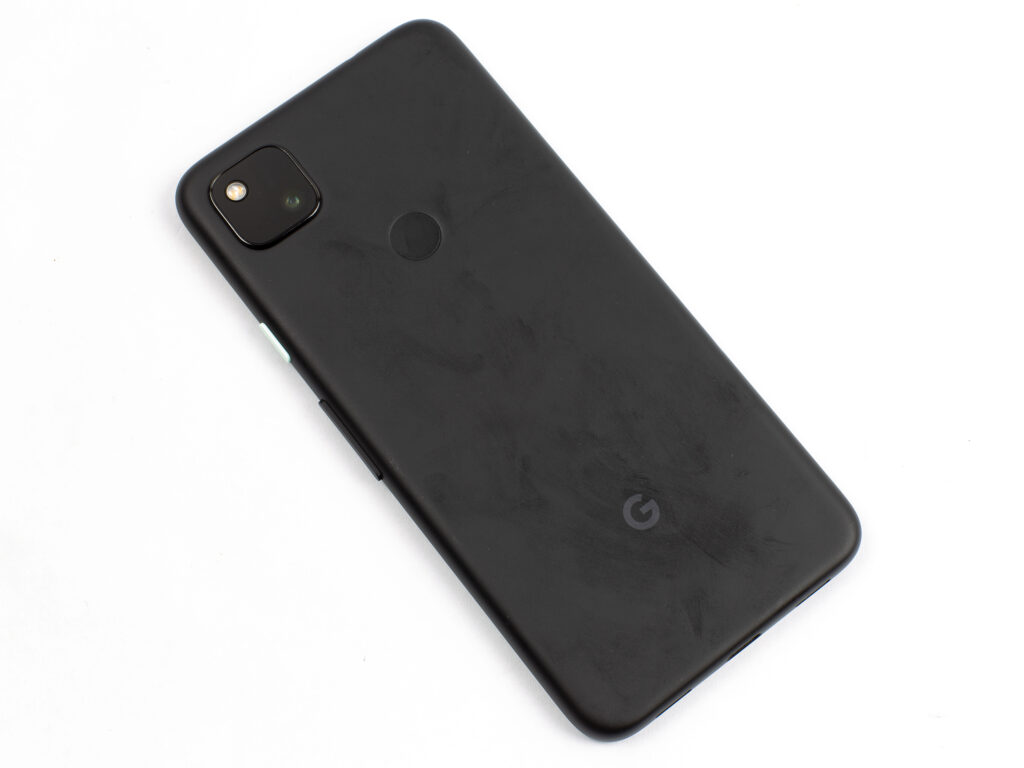
Pixel 4a, tilted, face down, with fingerprints across its back cover.

Credit: Ron Amadeo

The big question: Why?

As we noted when Google first announced the update, a lot of Pixel 4a batteries are now four to five years old. Some have been kept as secondary (or “junk drawer”) phones, and many are already at diminished capacity, especially when at low charge levels and in cold conditions. If every Pixel phone this old received a battery-minded final update, intended to prevent sudden shutdowns (akin to Apple’s originally unannounced iPhone slow-down fixes), there wouldn’t be quite the amount of outcry and confusion there is now.

But Google has not said why certain Pixel 4a phones are “Impacted Devices” and others are not. It has not clarified what issue is so notable or severe as to push an automatic update to a phone from 2020, such that its battery life is all but decimated. No news or community reports have surfaced yet of Pixel 4a devices causing fires, or even simply failing to function, after four years. It’s an automatic update with a strong fix, but for what?

Google’s support page only states that the update will “improve the stability of their battery’s performance.” This is true in the sense that, if you stop using a severely capped Pixel 4a entirely, its battery can provide a stable amount of output (none) into the future.

Google support staff have suggested to more than one 4a owner that yet another future update could force a factory reset and automatic update. That hasn’t come to pass, at least in the timelines suggested by support staff. But all of this raises the question as to how this confusing process is better than a traditional recall, if there really is some kind of danger, to device or human, with a certain set of batteries.

https://arstechnica.com/gadgets/2025/01/google-pixel-4as-ruinous-battery-performance-update-is-a-bewildering-mess/


“Just give me the f***ing links!”—Cursing disables Google’s AI overviews

If you search Google for a way to turn off the company’s AI-powered search results, you may well get an AI Overview telling you that AI Overviews can’t be directly disabled in Google Search. But if you instead ask Google how to turn off “fucking Google AI results,” you’ll get a standard set of useful web suggestions without any AI Overview at the top.

The existence of this “curse to disable Google AI” trick has been making the rounds on social media in recent days, and it holds up in Ars’ own testing. For instance, when searching for “how do you turn off [adjective] Google AI results,” a variety of curse word adjectives reliably disabled the AI Overviews, while adjectives like “dumb” or “lousy” did not. Inserting curse words randomly at any point in the search query seems to have a similar effect.

A nice, polite query that results in a nice, polite “you can’t” from AI Overviews.

Google / Ars Technica

A cathartic curse eliminates the AI Overview in the results.

Google / Ars Technica

There’s long been evidence that Google’s Gemini AI system tries to avoid swearing if at all possible, which might help explain why AI Overviews balk at queries that contain curses. Users should also keep in mind, though, that the actual web link results to a query can change significantly when curse words are inserted, especially if SafeSearch is turned off.

https://arstechnica.com/google/2025/01/just-give-me-the-fing-links-cursing-disables-googles-ai-overviews/


AI haters build tarpits to trap and trick AI scrapers that ignore robots.txt

Currently, Aaron predicts that Nepenthes might be most attractive to rights holders who want AI companies to pay to scrape their data. And many people seem enthusiastic about using it to reinforce robots.txt. But “some of the most exciting people are in the ‘let it burn’ category,” Aaron said. These people are drawn to tools like Nepenthes as an act of rebellion against AI making the Internet less useful and enjoyable for users.

Geuter told Ars that he considers Nepenthes “more of a sociopolitical statement than really a technological solution (because the problem it’s trying to address isn’t purely technical, it’s social, political, legal, and needs way bigger levers).”

To Geuter, a computer scientist who has been writing about the social, political, and structural impact of tech for two decades, AI is the “most aggressive” example of “technologies that are not done ‘for us’ but ‘to us.'”

“It feels a bit like the social contract that society and the tech sector/engineering have had (you build useful things, and we’re OK with you being well-off) has been canceled from one side,” Geuter said. “And that side now wants to have its toy eat the world. People feel threatened and want the threats to stop.”

As AI evolves, so do attacks, with one 2021 study showing that increasingly stronger data poisoning attacks, for example, were able to break data sanitization defenses. Whether these attacks can ever do meaningful destruction or not, Geuter sees tarpits as a “powerful symbol” of the resistance that Aaron and Nagy readily joined.

“It’s a great sign to see that people are challenging the notion that we all have to do AI now,” Geuter said. “Because we don’t. It’s a choice. A choice that mostly benefits monopolists.”

Tarpit creators like Nagy will likely be watching to see if poisoning attacks continue growing in sophistication. On the Iocaine site—which, yes, is protected from scraping by Iocaine—he posted this call to action: “Let’s make AI poisoning the norm. If we all do it, they won’t have anything to crawl.”

https://arstechnica.com/tech-policy/2025/01/ai-haters-build-tarpits-to-trap-and-trick-ai-scrapers-that-ignore-robots-txt/


Anthropic chief says AI could surpass “almost all humans at almost everything” shortly after 2027

He then shared his concerns about how human-level AI models and robotics that are capable of replacing all human labor may require a complete re-think of how humans value both labor and themselves.

“We’ve recognized that we’ve reached the point as a technological civilization where the idea, there’s huge abundance and huge economic value, but the idea that the way to distribute that value is for humans to produce economic labor, and this is where they feel their sense of self worth,” he added. “Once that idea gets invalidated, we’re all going to have to sit down and figure it out.”

The eye-catching comments, similar to comments about AGI made recently by OpenAI CEO Sam Altman, come as Anthropic negotiates a $2 billion funding round that would value the company at $60 billion. Amodei disclosed that Anthropic’s revenue multiplied tenfold in 2024.

Amodei distances himself from “AGI” term

Even with his dramatic predictions, Amodei distanced himself from a term for this advanced labor-replacing AI favored by Altman, “artificial general intelligence” (AGI), calling it in a separate CNBC interview from the same event in Switzerland a marketing term.

Instead, he prefers to describe future AI systems as a “country of geniuses in a data center,” he told CNBC. Amodei wrote in an October 2024 essay that such systems would need to be “smarter than a Nobel Prize winner across most relevant fields.”

On Monday, Google announced an additional $1 billion investment in Anthropic, bringing its total commitment to $3 billion. This follows Amazon’s $8 billion investment over the past 18 months. Amazon plans to integrate Claude models into future versions of its Alexa speaker.

https://arstechnica.com/ai/2025/01/anthropic-chief-says-ai-could-surpass-almost-all-humans-at-almost-everything-shortly-after-2027/