Google experiments with locking YouTube Music lyrics behind paywall

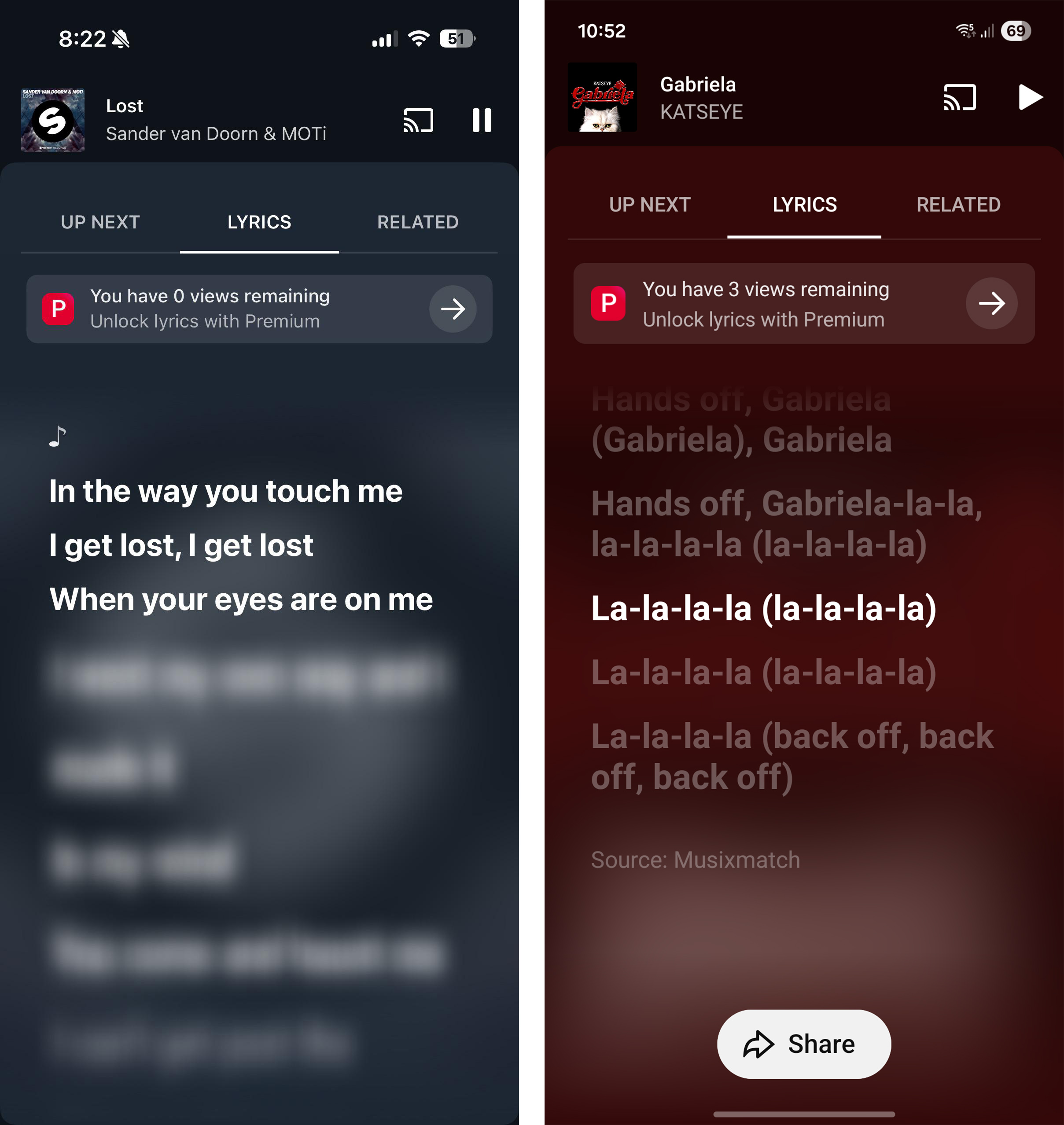
The app’s lyrics feature allows listeners to follow along as the song plays. However, only the first few lines are visible once free users in the test hit the lyric cut-off. After that, the lyrics are blurred. Users who want to keep seeing lyrics are advised to upgrade to a premium account, which costs $14 for both YouTube video and music or $11 for music only. The subscription also removes ads and adds features like downloads and higher-quality video streams.

Lyrics paywall in YT music

The new paywall in YouTube Music.

Credit: /u/MrYeet22836 and /u/Vegetable_Common188

The new paywall in YouTube Music. Credit: /u/MrYeet22836 and /u/Vegetable_Common188

This change is not without precedent. Spotify began restricting access to lyrics for free users in 2024. However, the response was so ferociously negative that the company backtracked and restored lyric access to those on ad-supported accounts. YouTube Music doesn’t have the same reach as Spotify, which may help soften the social media shame. Many subscribers are also getting the premium service just because they’re paying for ad-free YouTube and may never know there’s been a change to lyric availability.

As Google has ratcheted up restrictions on free YouTube accounts, the service has only made more money. In Google’s most recent earnings report, it reported $60 billion in YouTube revenue across both ads and subscriptions (both YouTube Premium and YouTube TV). That’s almost $10 billion more than last year.

Lyrics in YouTube Music are provided by third parties that Google has to pay, so it’s not surprising that Google is looking for ways to cover the cost. It is, however, a little surprising that the company hasn’t just used AI to generate lyrics for free. Google has recently tested the patience of YouTube users with a spate of AI features, like unannounced AI upscaling, fake DJs, and comment summaries.

This story was updated with Google’s response. 

https://arstechnica.com/google/2026/02/google-locks-youtube-music-lyrics-behind-paywall/


Waymo leverages Genie 3 to create a world model for self-driving cars

On the road with AI

The Waymo World Model is not just a straight port of Genie 3 with dashcam videos stuffed inside. Waymo and DeepMind used a specialized post-training process to make the new model generate both 2D video and 3D lidar outputs of the same scene. While cameras are great for visualizing fine details, Waymo says lidar is necessary to add critical depth information to what a self-driving car “sees” on the road—maybe someone should tell Tesla about that.

Using a world model allows Waymo to take video from its vehicles and use prompts to change the route the vehicle takes, which it calls driving action control. These simulations, which come with lidar maps, reportedly offer greater realism and consistency than older reconstructive simulation methods.

With the world model, Waymo can see what would happen if the car took a different turn.

This model can also help improve the self-driving AI even without adding or removing everything. There are plenty of dashcam videos available for training self-driving vehicles, but they lack the multimodal sensor data of Waymo’s vehicles. Dropping such a video into the Waymo World Model generates matching sensor data, showing how the driving AI would have seen that situation.

While the Waymo World Model can create entirely synthetic scenes, the company seems mostly interested in “mutating” the conditions in real videos. The blog post contains examples of changing the time of day or weather, adding new signage, or placing vehicles in unusual places. Or, hey, why not an elephant in the road?

Waymo is ready in case an elephant shows up.

Waymo’s early test cities were consistently sunny (like Phoenix) with little inclement weather. These kinds of simulations could help the cars adapt to the more varied conditions. The new markets include places with more difficult conditions, including Boston and Washington, D.C.

Of course, the benefit of the new AI model will depend on how accurately Genie 3 can simulate the real world. The test videos we’ve seen of Genie 3 run the gamut from pretty believable to uncanny valley territory, but Waymo believes the technology has improved to the point that it can teach self-driving cars a thing or two.

https://arstechnica.com/google/2026/02/waymo-leverages-genie-3-to-create-a-world-model-for-self-driving-cars/


Neocities founder stuck in chatbot hell after Bing blocked 1.5 million sites

As Neocities grew, Drake told Ars that much of his focus has been on improving content moderation. He works closely with a full-time dedicated content moderation staffer to quickly take down any problematic sites within 24 hours, he said. That effort includes reviewing reports and proactively screening new sites, with Drake noting that “our name domain provider requires us to take them down within 48 hours.”

Microsoft prohibits things like scraping content that could be considered copyright infringement or automatically generating content using “garbage text” to game the rankings. It also monitors for malicious behavior like phishing, as well as for prompt injection attacks on Bing’s large language model.

It’s unclear what kind of violations Microsoft found ahead of instituting the complete block; however, Drake told Ars that he has yet to identify any content that may have triggered it. He said he would promptly remove any websites flagged by Microsoft, if he could only talk to someone who could share that information.

“Naturally, we still don’t catch 100 percent of the sites with proactive moderation, and occasionally some problematic sites do get missed,” Drake said.

Although Drake is curious to learn more about what triggered the blocks, he told Ars that it’s clear that non-violative sites are still invisible on Bing.

One of the longest-running and most popular Neocities sites, Wired Sound for Wired People, is a perfect example. The bizarre, somewhat creepy anime fanpage is “very popular” and “has a lot of links to it all over the web,” Drake said. Yet if you search for its subdomain, “fauux,” the site no longer appears in Bing search results, as of this writing, while Google reliably spits it out as the top result.

Drake said that he still believes that Bing is blocking content by mistake, but Bing’s automated support tools aren’t making it easy to defend creators who are randomly blocked by one of the world’s biggest search engines.

“We have one of the lowest ratios of crap to legitimate content, human-made content, on the Internet,” Drake said. “And it’s really frustrating to see that all these human beings making really cool sites that people want to go to are just not available on the default Windows search engine.”

https://arstechnica.com/tech-policy/2026/02/neocities-founder-stuck-in-chatbot-hell-after-bing-blocked-1-5m-sites/


Google hints at big AirDrop expansion for Android “very soon”

Android has its own AirDrop-like feature called Quick Share (formerly Google Nearby Share), but until recently, it couldn’t communicate with Apple’s AirDrop. As we reported in November, the European Union required Apple to implement the Wi-Fi Aware standard in AirDrop, which enabled Google to add support for the Pixel 10 lineup. Google confirmed it didn’t need to work with Apple at all to make that happen.

As part of the Quick Share updates, Google has added an extension to the Play Store that allows Quick Share to operate as a full, updatable APK rather than an element of Play Services. That should make it easier to roll out new features to the entire Android ecosystem. Currently, the extension only supports a smattering of Android phones, but we can expect that list to expand as AirDrop comes to more devices this year.

With AirDrop support, Android devices can send files to iOS and macOS devices without downloading third-party apps. However, the functionality requires Apple users to enable the “Everyone for 10 minutes” connectivity option. While Google can shoehorn Android into the Wi-Fi Aware system, it cannot use Apple’s contact-based sharing options. That probably won’t change with the pending update.

Of course, “very soon” in Google-speak can mean many things. The company does like to pair Android ecosystem updates with Pixel Drops, and the next one of those is expected in March, with changes to location privacy, At a Glance, and more.

https://arstechnica.com/gadgets/2026/02/google-hints-at-big-airdrop-expansion-for-android-very-soon/


Google court filings suggest ChromeOS has an expiration date

The documents suggest that Google will wash its hands of ChromeOS once the current support window closes. Google promises 10 years of Chromebook support, but that’s not counted from the date of purchase—Chromebooks are based on a handful of hardware platforms dictated by Google, with the most recent launching in 2023. That means Google has to support the newest devices through 2033. The “timeline to phase out ChromeOS is 2034,” says the filing.

Android goes big

From the start, the ChromeOS experience was focused on the web. Google initially didn’t even support running local apps, but little by little, its aspirations grew. Over the years, it has added Linux apps and Android apps. And it even tried to get Steam games running on Chromebooks—it gave up on that last one just recently. It also tried to shoehorn AI features into ChromeOS with the Chromebook Plus platform, to little effect.

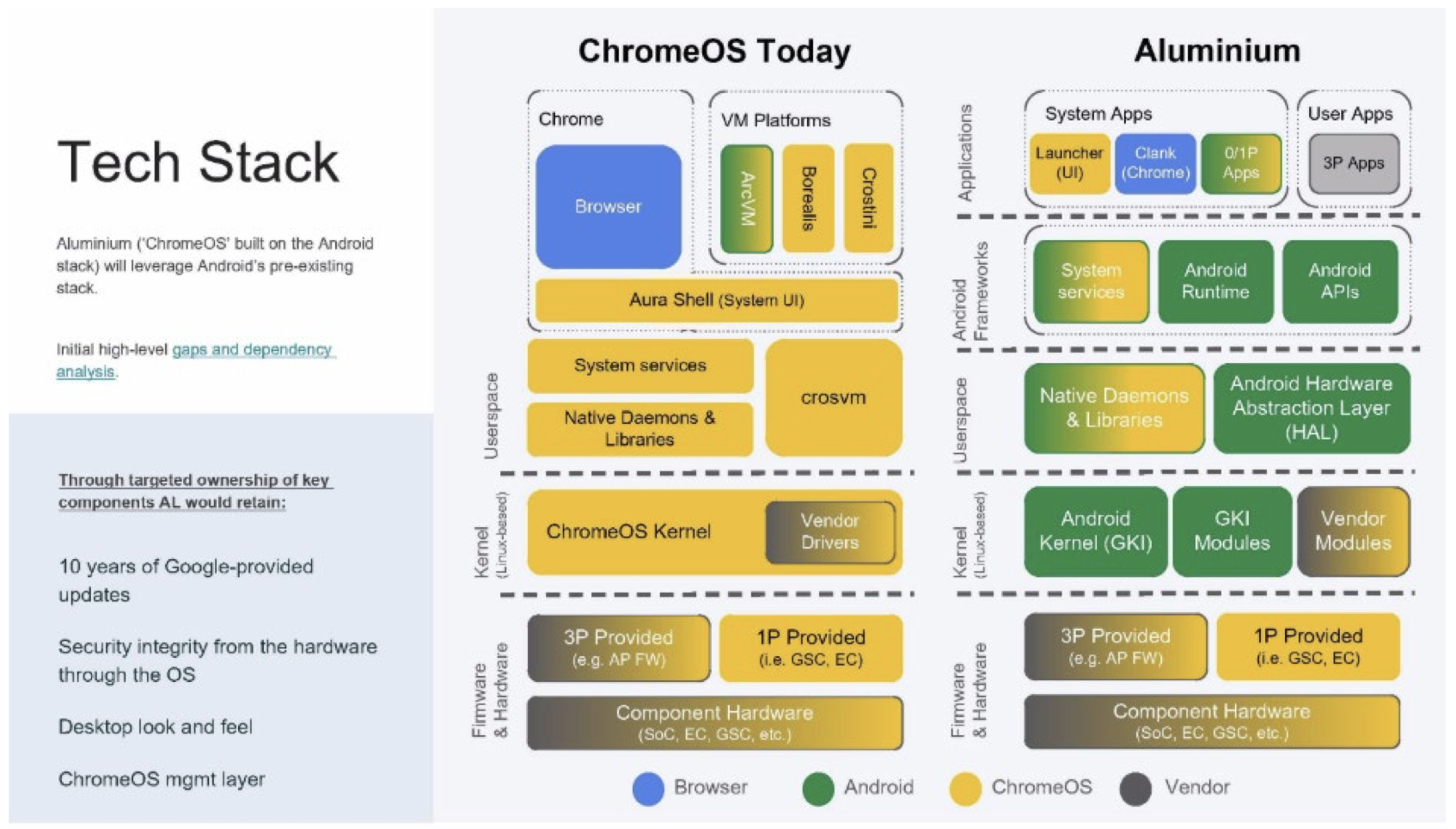
Android was barely getting off the ground when ChromeOS began its journey, but as we approach the 2030s, Google clearly wants a more powerful desktop platform. Android has struggled on larger screens, but Aluminium is a long-running project to fix that. Whatever we see in 2028 may not even look like the Android we know from phones. It will have many of the same components under the hood, though.

Aluminum vs ChromeOS

Aluminium will have Google apps at the core.

Credit: US v. Google

Aluminium will have Google apps at the core. Credit: US v. Google

Google could get everything it wants with the upcoming Aluminium release. When running on powerful laptop hardware, Android’s performance and capabilities should far outstrip ChromeOS. Aluminium is also expected to run Google apps like Chrome and the Play Store with special system privileges, leaving third-party apps with fewer features. That gives Google more latitude in how it manages the platform and retains users, all without running afoul of recent antitrust rulings.

https://arstechnica.com/google/2026/02/google-court-filings-suggest-googles-chromeos-has-an-expiration-date/


Google Project Genie lets you create interactive worlds from a photo or prompt

If that 60-second jaunt into the AI world isn’t enough, you can just run the prompt again. Because this is generative AI, the results will be a little different each time. Google also lets you “remix” its pre-built worlds with new characters and visual styles. The video generated of your exploration is available for download as well.

Still an experiment

Google stresses that Project Genie is still just a research prototype, and there are, therefore, some notable limitations. As anyone who has used Google Veo or OpenAI Sora to create AI videos will know, it takes a few seconds to create even a short clip. So, it’s impressive that Genie can make it feel interactive at all. However, there will be some input lag, and you can only explore each world for 60 seconds. In addition, the promotable events feature previously demoed for Genie 3, which allows inserting new elements into a running simulation, is not available yet.

While Google has talked up Genie’s ability to accurately model physics, the company notes that testers will probably see examples of worlds that don’t look or behave quite right. Testers may also see changing restrictions on content. The Verge was able to test Project Genie, and initially, it was happy to generate knockoffs of Nintendo games like Super Mario and The Legend of Zelda. By the end of the test, The Verge reports that some of those prompts were being blocked due to “interests of third-party content providers.”

Project Genie is only accessible from a dedicated web app—it won’t be plugged into the Gemini app or website. You can only access this tool for the time being with an AI Ultra subscription, which runs $250 per month. Generating all this AI video is expensive, so it makes sense to start with the higher tier. Google says its goal is to open up access to Project Genie over time.

https://arstechnica.com/google/2026/01/google-project-genie-lets-you-create-interactive-worlds-from-a-photo-or-prompt/


OpenAI, pronti 60 miliardi di dollari da Nvidia, Amazon e Microsoft

OpenAI pronto a ricevere ingenti finanziamenti da Nvidia, Microsoft e Amazon come nuovo investitore

Nvidia, Amazon e Microsoft sono in trattative per investire complessivamente fino a 60 miliardi di dollari in OpenAI. Secondo quanto riportato da The Information, il gigante tecnologico guidato da Jensen Huang, già azionista e fornitore chiave dei chip che alimentano i modelli di intelligenza artificiale di OpenAI, starebbe valutando un investimento fino a 30 miliardi di dollari.

Microsoft, che è partner storico e principale sostenitore industriale della società guidata da Sam Altman, sarebbe pronta a mettere sul tavolo meno di 10 miliardi, mentre Amazon, potenziale nuovo investitore, starebbe discutendo un impegno ben più consistente, superiore ai 10 miliardi e forse vicino ai 20 miliardi.

Segnale che le negoziazioni stanno entrando in una fase avanzata è che OpenAI sarebbe vicina a ricevere le prime term sheet, diciamo le lettere di intenti, quindi documenti preliminari non vincolanti usati nelle negoziazioni di investimento.

La notizia arriva in un momento cruciale per il settore tecnologico e, più in generale, per il ricco e rapidissimo comparto dell’intelligenza artificiale (AI). I costi per addestrare e far funzionare modelli sempre più potenti continuano a crescere rapidamente, mentre la competizione si intensifica, con Google, Anthropic e altri attori che stanno riducendo il divario rispetto al vantaggio iniziale di OpenAI.

In questo contesto, l’ingresso o il rafforzamento di grandi investitori industriali non è solo una questione finanziaria, ma anche strategica: cloud, chip e canali di distribuzione diventano leve decisive quanto gli algoritmi.

Big Tech: investitori pronti a sostenere livelli stellari di spesa in AI, solo se si traducono in crescita solida dei ricavi

Sul fronte dei mercati, la settimana degli utili delle Big Tech ha mandato un messaggio chiaro e, per certi versi, severo. Gli investitori sono disposti a tollerare e premiare livelli record di spesa in intelligenza artificiale solo se questi si traducono in una crescita solida e visibile dei ricavi.
In caso contrario, è spiegato sulla Reuters, la reazione è immediata e punitiva.
È un cambio di paradigma evidente rispetto agli anni precedenti e riflette quanto le aspettative si siano alzate dal lancio di ChatGPT, più di tre anni fa.

Meta è l’esempio più lampante di come, almeno per ora, il mercato stia premiando chi riesce a dimostrare un ritorno tangibile dagli investimenti in AI. I ricavi del gruppo sono cresciuti del 24% nell’ultimo trimestre, grazie anche a un miglioramento dell’efficacia della pubblicità basata sull’intelligenza artificiale, e le previsioni per il trimestre in corso hanno superato le attese. Questo ha dato credibilità a un piano di spesa molto aggressivo sui data center, nonostante l’impennata dei costi.

Diversa, e più delicata, la posizione di Microsoft. Pur restando uno dei leader indiscussi nell’AI per il mondo enterprise, grazie alla profonda integrazione di OpenAI nei suoi prodotti, il rallentamento relativo della crescita di Azure e l’enorme impegno in capitale stanno alimentando dubbi tra gli investitori.
Il fatto che OpenAI rappresenti una quota rilevante del backlog evidenzia il potenziale, ma anche il rischio di concentrazione, in un momento in cui la concorrenza tecnologica si fa più serrata.

AI, la promessa di una crescita futura non basta più a Wall Street

Il quadro che emerge è quello di un settore in piena corsa, ma sotto esame costante. L’intelligenza artificiale è ormai considerata una tecnologia abilitante per il futuro dell’economia digitale e le Big Tech stanno scommettendo cifre senza precedenti per non restare indietro.

Wall Street, però, chiede prove concrete: la promessa di una crescita futura non basta più. L’eventuale maxi-investimento in OpenAI da parte di Nvidia, Amazon e Microsoft si inserisce proprio in questa dinamica, come una scommessa ad altissimo valore strategico, ma anche come un banco di prova per dimostrare che l’era dell’AI può e deve generare non solo innovazione, ma anche ritorni economici sostenibili.

Leggi le altre notizie sull’home page di Key4biz

https://www.key4biz.it/openai-pronti-60-miliardi-di-dollari-da-nvidia-amazon-e-microsoft/563566/


Google begins rolling out Chrome’s “Auto Browse” AI agent today

Google began stuffing Gemini into its dominant Chrome browser several months ago, and today the AI is expanding its capabilities considerably. Google says the chatbot will be easier to access and connect to more Google services, but the biggest change is the addition of Google’s autonomous browsing agent, which it has dubbed Auto Browse. Similar to tools like OpenAI Atlas, Auto Browse can handle tedious tasks in Chrome so you don’t have to.

The newly unveiled Gemini features in Chrome are accessible from the omnipresent AI button that has been lurking at the top of the window for the last few months. Initially, that button only opened Gemini in a pop-up window, but Google now says it will default to a split-screen or “Sidepanel” view. Google confirmed the update began rolling out over the past week, so you may already have it.

You can still pop Gemini out into a floating window, but the split-view gives Gemini more room to breathe while manipulating a page with AI. This is also helpful when calling other apps in the Chrome implementation of Gemini. The chatbot can now access Gmail, Calendar, YouTube, Maps, Google Shopping, and Google Flights right from the Chrome window. Google technically added this feature around the middle of January, but it’s only talking about it now.

Sidepanel with Gmail integration

Gemini in Chrome can now also access and edit images with Nano Banana, so you don’t have to download and re-upload them to Gemini in another location. Just open the image from the web and type in the Sidepanel with a description of the edits you want. Like in the Gemini app, you can choose between the slower but higher-quality Pro model and the faster standard one.

https://arstechnica.com/google/2026/01/google-begins-rolling-out-chromes-auto-browse-ai-agent-today/


AI Overviews gets upgraded to Gemini 3 with a dash of AI Mode

It can be hard sometimes to keep up with the deluge of generative AI in Google products. Even if you try to avoid it all, there are some features that still manage to get in your face. Case in point: AI Overviews. This AI-powered search experience has a reputation for getting things wrong, but you may notice some improvements soon. Google says AI Overviews is being upgraded to the latest Gemini 3 models with a more conversational bent.

In just the last year, Google has radically expanded the number of searches on which you get an AI Overview at the top. Today, the chatbot will almost always have an answer for your query, which has relied mostly on models in Google’s Gemini 2.5 family. There was nothing wrong with Gemini 2.5 as generative AI models go, but Gemini 3 is a little better by every metric.

There are, of course, multiple versions of Gemini 3, and Google doesn’t like to be specific about which ones appear in your searches. What Google does say is that AI Overviews chooses the right model for the job. So if you’re searching for something simple for which there are a lot of valid sources, AI Overviews may manifest something like Gemini 3 Flash without running through a ton of reasoning tokens. For a complex “long tail” query, it could step up the thinking or move to Gemini 3 Pro (for paying subscribers).

https://arstechnica.com/google/2026/01/ai-overviews-gets-upgraded-to-gemini-3-with-a-dash-of-ai-mode/


“Wildly irresponsible”: DOT’s use of AI to draft safety rules sparks concerns

At DOT, Trump likely hopes to see many rules quickly updated to modernize airways and roadways. In a report highlighting the Office of Science and Technology Policy’s biggest “wins” in 2025, the White House credited DOT with “replacing decades-old rules with flexible, innovation-friendly frameworks,” including fast-tracking rules to allow for more automated vehicles on the roads.

Right now, DOT expects that Gemini can be relied on to “handle 80 to 90 percent of the work of writing regulations,” ProPublica reported. Eventually all federal workers who rely on AI tools like Gemini to draft rules “would fall back into merely an oversight role, monitoring ‘AI-to-AI interactions,’” ProPublica reported.

Google silent on AI drafting safety rules

Google did not respond to Ars’ request to comment on this use case for Gemini, which could spread across government under Trump’s direction.

Instead, the tech giant posted a blog on Monday, pitching Gemini for government more broadly, promising federal workers that AI would help with “creative problem-solving to the most critical aspects of their work.”

Google has been competing with AI rivals for government contracts, undercutting OpenAI and Anthropic’s $1 deals by offering a year of access to Gemini for $0.47.

The DOT contract seems important to Google. In a December blog, the company celebrated that DOT was “the first cabinet-level agency to fully transition its workforce away from legacy providers to Google Workspace with Gemini.”

At that time, Google suggested this move would help DOT “ensure the United States has the safest, most efficient, and modern transportation system in the world.”

Immediately, Google encouraged other federal leaders to launch their own efforts using Gemini.

“We are committed to supporting the DOT’s digital transformation and stand ready to help other federal leaders across the government adopt this blueprint for their own mission successes,” Google’s blog said.

DOT did not immediately respond to Ars’ request for comment.

https://arstechnica.com/tech-policy/2026/01/wildly-irresponsible-dots-use-of-ai-to-draft-safety-rules-sparks-concerns/